Bass Kevin Langan brings 40 years of Sarastro to Central City

Sometimes his career “just happened,” but he’s been lucky

By Peter Alexander July 24 at 4:05 p.m.

Bass Kevin Langan, Sarastro in this summer’s remarkable production of Mozart’s Magic Flute at Central City Opera, brings a little bit of experience to the role.
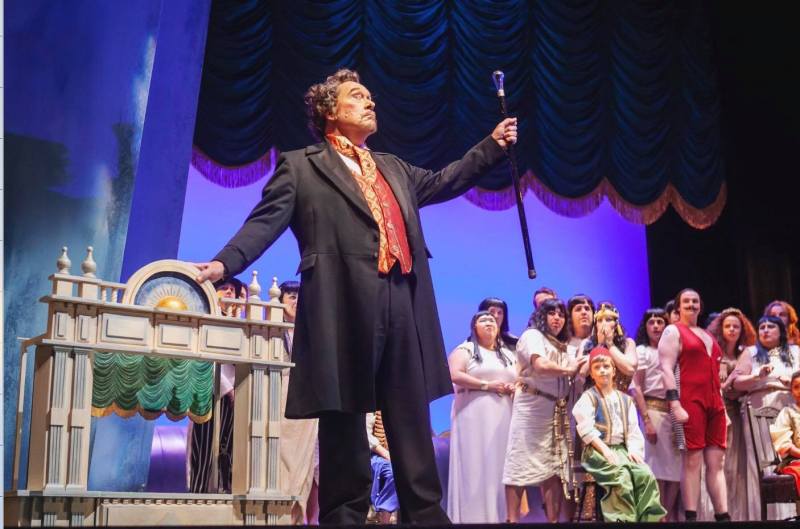
36912496_10214780108129643_3747920090352320512_o

Kevin Langan is performing in his 20th production as Sarastro, at Central City Opera

It is his 20th Sarastro over a 40-year career, starting with a performance at the Indiana University Opera Theater when he was a student.

That was a particularly remarkable production, since among the cast were singers who went on to performances at the Metropolitan Opera, the Glyndebourne Festival, the Chicago Lyric Opera, the Santa Fe Opera, the Houston Grand Opera, La Scala, the Salzburg Festival, the Bavarian State Opera, and other major opera houses. Many are conservatory or university faculty today. (I resist the temptation to name some for fear I will forget others, and they all have had serious careers.)
36739880_10216356441801210_3937471299365896192_n

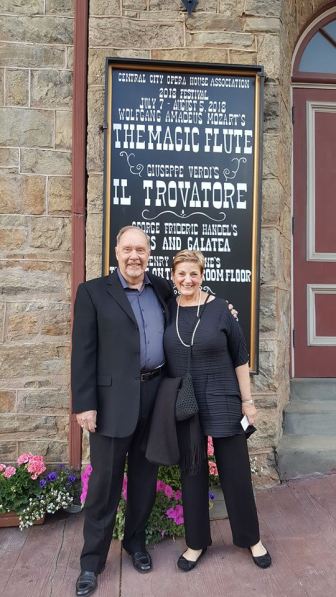
Kevin Langan and Sally Wolf earlier this summer in Central City (photo courtesy of Kevin Langan)

One I can name: soprano Sally Wolf, who sang the Queen of the Night in 1977 and married Langan a few years later. Both Langan and Wolf have performed at CCO over the years, although only Langan is cast this summer. They just celebrated their 35th wedding anniversary while in Central City.

I knew Langan and Wolf when we were all graduate students at Indiana U., and I attended that performance in 1977. I don’t remember it in detail, having heard many Flutes since then, but Langan does. After hearing the performance in Central City last week, I sat down with Langan and asked him to reflect back on his 40 years of singing Sarastro, and talk about his interpretation of the role. Interestingly, he says it has not changed much since 1977.

“When I first saw Magic Flute (it was) at the Metropolitan Opera around 1977, right before we did it at IU, because I wanted to get an idea of what it was like,” he says. “The German basses who used to do it at the Met were usually big voices that sang loud, and I thought that’s the way you’re supposed to do Sarastro. Over the years as I did it and worked on it, I decided no, Sarastro should be sung like an (art song) singer would sing it, like you were going to sing Schubert or Schumann.”

Langan names one singer as a model for his approach. “I never saw him live, but I liked the way he sounded on records, and that’s Ludwig Weber,” he said. Weber was an Austrian bass who sang leading roles in Europe from the 1930s, including roles at the Royal Opera Covent Garden during the Second World War and the Vienna State Opera in the 1950s. (You can hear Weber here.)

“The music is not bombastic. That’s the way Mozart wrote it. I don’t think he writes fortissimo once for Sarastro, barely even forte. The more times I did it, I would go to conductors and say ’I don’t want to just go up there and hammer it out, I want to do it like a song.’ And the conductor this time around [André de Ridder] said, ‘Perfect. That’s exactly how I want to do it.’”

Like the Queen of the Night, Sarastro’s part consists largely of two major arias: O Isis und Osiris, sung to the priests of his temple, and In diesen heil’gen Hallen, sung to Pamina. “They’re lessons,” Langan explains. “The first one is a lesson about the gods, and In diesen heil’gen Hallen is a lesson to Pamina, who’s been just devastated by her mother (who asked her to kill Sarastro and rejected her when she refused). It shouldn’t be (sung) out to the audience, it should be to her, and the audience is privy to these two people talking.

“That’s my approach to the role, no matter what production values you give it. I don’t want to make him a blowhard—I want him to be friendly. And that’s the way I sang it at Indiana.”
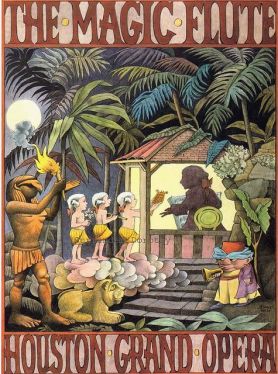
c6f748c7c1c8e368f090d858141317f9

Poster for the Houston Grand Opera production designed by Maurice Sendak

Langan has been thinking back about his career, partly for a potential memoir of his years in opera. He has sung with many of the greats of the operatic stage over the years, including Leontyne Price, Luciano Pavarotti, Joan Sutherland and Cesare Siepi, to name a few, so he has a lot of memories to draw upon. And of all the Magic Flutes he has sung, two stand out. Interestingly, he remembers them more for their production designs than their musical interpretations.

One was designed by children’s author Maurice Sendak, created originally for the Houston Grand Opera and later performed by other companies around the country, including Opera Colorado in 1999. That one was like performing inside a story book, Langan said.

He and Wolf both performed in a production designed by the English painter David Hockney. Originally created for the Glyndebourne Festival Opera in 1978, that one also toured around the country. Langan and Wolf sang in the Hockney production in San Francisco in 1991, and a DVD of the production from the Metropolitan Opera was released in 2000.
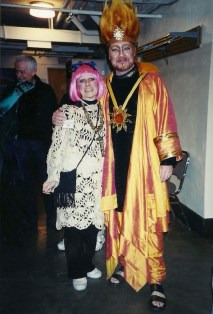
Zandra Rhodes FLUTE San Diego 2001

Langan backstage with designer Zandra Rhodes (photo courtesy of Kevin Langan)

Those are not the only productions he remembers, though. Another favorite was a production designed by Zandra Rhodes, a clothing designer from the “Swinging ‘60s” in London. “I looked like Don King with orange hair,” Langan recalls. “I had a bright orange outfit, and she herself always had purple hair. We had a lot of fun with that show, but it was more about the visuals.
Calgary FLUTE 1997

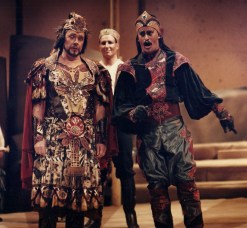
Langan in costume as Sarastro at Calgary Opera (photo courtesy of Kevin Langan)

“I played Sarastro as an Indian chief in Calgary. We were all a tribe of Indians and I was their chief. That was fun. And there was Zack Brown’s production that we did in Washington, where I was in a white gown, bald, very elegant. That was cool—I almost look like I’m out of Star Wars!”

Looking back, Langan feels lucky, because he was never asked to do Sarastro in a production that was too crazy. “I don’t think I ever did one that was really ridiculous. I’ve done some pretty whacked-out shows, but not Flute. I was pretty lucky.”
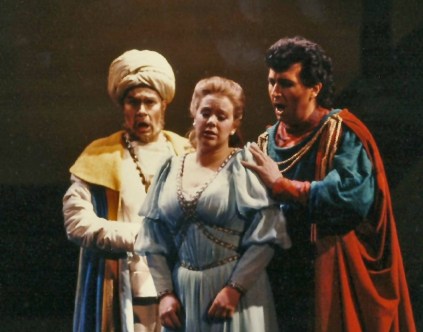
Magic Flute, SFO, Summer, 1991 (Ruth Ann Swenson & Jerry Hadley)

Langan (left) as Sarastro at the San Francisco Opera in 1991, with Ruth Ann Swenson (Pamina) and Jerry Hadley (Tamino) (photo courtesy of Kevin Langan)

And that’s the last point that Langan wants to make, especially for young singers: His career may look like it was all well planned, going from one Sarastro to another, singing other great bass roles including Osmin in Abduction from the Seraglio, Timur in Turandot, King of Egypt in Aida and The Grand Inquisitor in Don Carlos. You might think that’s just the way he planned it, but that’s not really the case. Some of it was luck.

“I had a lot of things happen to me that were unusual for a young singer,” he says. “Going to San Francisco so young, and working with all these great singers. (But) I had no idea what was going to happen next. It was an odyssey. Things just happened. And that’s one thing about a career, you have no control over it. It takes you on a trip.”

As a lifelong fan of the Beatles, whom he credits for his first interest in singing, Langan can’t resist one more comment. “I say John Lennon’s line, ‘Life is what happens to you while you’re busy making other plans.’ That is so true.”

Langan will continure in the role of Sarastro at Central City Opera through Aug. 5. Tickets are available here.
36285470_10216733559152131_359432563028131840_n

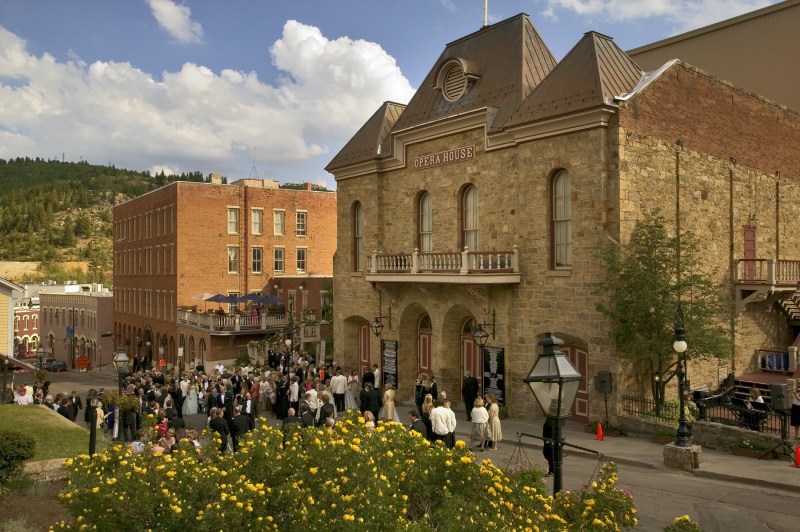
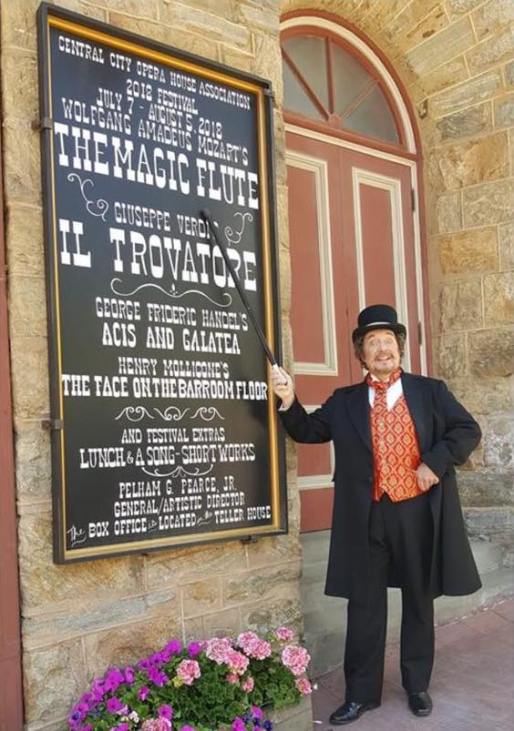
Kevin Langan outside the Central City Opera House (photo courtesy of Kevin Langan)

Dramatic Trovatore, strikingly original Magic Flute in Central City

Both operas run in repertory to the first week of August

By Peter Alexander July 17 at 4:05 p.m.

Central City Opera opened a powerful, dramatic production of Verdi’s Il Trovatore Saturday (July 14) in their intimate and historic opera house.

Trovatore 080

Il Trovatore: Ashraf Sewailam (Ferrando), Lindsay Ammann (Azucena) and ensemble. Photo by Amanda Tipton.

Intimate is not just a descriptor; it is a significant reason for the production’s impact. With it’s rousing choruses, virtuoso arias, violent passions and gruesome deaths, Il Trovatore meets all the expectations of grand opera, fit for the grandest houses. And yet Central City proved that thoughtfully presented, it can thrive and land a powerful punch in a smaller house. In this space, the music is loud; occasionally I thought it could have been scaled back, but grand opera is meant to overwhelm the emotions. This is a Trovatore to remember.

Trovatore 035

Il Trovatore: Jonathan Burton (Manico) and Lindsay Ammann (Azucena). Photo by Amanda Tipton.

Director Joachim Schamberger’s creative production design uses projections—he is also a video designer—to visually expand the limited space of the Central City stage, making a unit set serve effectively as gypsy camp, a palace garden, a gloomy dungeon. Scenes mimed on a bridge above the back of the stage helped fill out the action, much of which is described after the fact. These scenes were effective supplements to the narrations of past events, but at other times distractions from the singers on the main stage below.

Schamberger’s direction served the drama well. The convoluted story of switched babies, misfired revenge and long-nurtured hatreds can be confusing, but the direction, including some well calculated pieces of stage business, the mimed scenes, the acting of the cast, and texts that were projected between scenes all served to clarify the story.

The cast featured top-rank singer-actors. In the title role, tenor Jonathan Burton had a powerful Italianate sound, ideal for the role. From his plaintive offstage serenades to his violent fight scenes with his rival DiLuna, to his climactic cabaletta near the end he handled the vocal demands handily. He carried the lyrical lines effectively, and sang the climatic high notes with a strong, ringing sound. There is no genuine love duet in the opera, but his tenderness in the quieter moments with Leonora was expressive.

Trovatore 077

Il Trovatore: Michael Mayes (DiLuna), Jonathan Burton (Manico), Alexandra Loutsion (Leonora) Photo by Amanda Tipton.

As Leonora, Alexandra Loutsion has the power from top to bottom to handle one of the most difficult soprano roles in the repertoire. Her sound was most beautiful in softer passages, but when pushed in volume or intensity she developed a wobbly vibrato that slightly muddied some lines. The fearsome coloratura was dispatched with surety and aplomb.

Baritone Michael Mayes warmed into the role of DiLuna vocally, but was dramatically a force of nature throughout. His characterization, both physically and vocally, conveyed DiLuna’s mad obsession with Leonora compellingly. His brooding anger gave depth to his character and to the drama. At times, the intensity of his passion was vocally over the top, and I thought the music would have been better served by a more modulated, lyrical handling of some phrases.

The character whose obsession drives the drama is the gypsy Azucena. In this searing role, mezzo-soprano Lindsay Amman rose to the big moments in her part, but was fitfully effective elsewhere. Her voice has the dark, smoky quality for the part, but transitions to the lowest notes were not always graceful. Azucena is, frankly, a monstrous character—she throws her own baby in the fire and raises the brother of the man she despises largely to seek revenge by seeing either of them kill the other—and a daunting challenge to any singer. Amman was carefully directed, and often conveyed Azucena’s fury, but at other times was not crazed enough next to the violent passions of the other characters.

Ashraf Sewailam, a CU graduate and well known to Boulder audiences, was a commanding Fernando, as he should be. From his sudden appearance at the very beginning, where he has one of the best scenes ever written for a secondary character, his deep bass sounded strongly. His well dramatized interactions with DiLuna strengthened both characters.

I should spare a word for the chorus, which was superb. As well as an opera for big voices, this is a choral opera, with the Anvil Chorus and the Soldiers’ Chorus of Act III only the two best known moments of many. I loved seeing the gypsy women pounding the anvils in the second act. I’m not sure that fits the medieval setting of the opera, but it was a great moment, and seemed to be relished by the actors.

Dana Tzvetkova’s neo-medieval costumes matched the production well, delineating the characters without any fussy affectations. John Baril led an effective performance, supporting the singers and keeping the performance moving at full tilt. Apprentice artists Michelle Siemens, Zachary Johnson and Fidel Angel Romero, and studio artist Griffen Hogan Tracy were all pleasing in their smaller roles.

# # # # #

The summer’s other major production in the Central City Opera House is a radical and fascinating re-imagination of Mozart’s Magic Flute. This strikingly original interpretation deserves a careful response.

Magic Flute.047

Magic Flute: Katherine Manley (left, Pamina) and Joseph Dennis (right in tan suit, Tamino), with Kevin Langan (center, Sarastro) and ensemble. Photo by Amanda Tipton.

Director Alessandro Talevi conceives of the opera’s fairy-tale plot as seen through the eyes of children, specifically the three boys who serve as the opera’s spirit guides. In a pantomime during the overture, the three boys are shown in a Victorian-era bedroom dominated by a grim portrait of the boys’ mother—the Queen of the Night.

Magic Flute.091

Magic Flute: Two boys from the Colorado Children’s Chorale and the dollhouse theater. Photo by Amanda Tipton.

Downstage right, and onstage throughout the opera, is a dollhouse theater with cutout characters the boys are playing with. Sent to bed by three stern servants—who become the three ladies who serve the Queen of the Night—they sneak back to the theater for after-hours play. Everything that happens from that point until just before the end comes from their imaginations, as symbolized by characters coming in and out through the bedroom fireplace.

This conception accomplishes several things. For one, it makes the magical aspects of the story seem natural as the product of boys’ imaginations. This solves, for example, the problem of how to portray the later trials by fire and water. Usually rather lame—sweet music played by the flute while two singers walk in front of colored projections—this is here shown as the boys playing in their theater. For modern viewers, this scene makes more sense as a child’s game than as reality.

Magic Flute.011

Magic Flute: Will Liverman (Papageno) with Tascha Koontz, Kira Dills-DeSurra and Melanie Ashkar (three ladies). Photo by Amanda Tipton.

Talevi’s interpretation also makes more palatable the misogynistic aspects of the text. Pre-adolescent boys would naturally expect a hero to have women fawning over him and a chosen mate who needed his guidance. In other boyish innovations, Tamino’s sidekick Papageno rides an ostrich and Sarastro, the philosopher king of Mozart’s and librettist Emanuel Schickaneder’s Masonic-inspired plot, becomes the father the boys wish they had—the ringmaster of a wondrous carnival.

Talevi also aims to explain the supposed confusion in the original story, that the Queen of the Night starts as a good character and Sarastro evil; then they switch places, with the Queen becoming evil and Sarastro good. This reversal has never bothered me, since the libretto makes it clear that part of Tamino’s quest is learning to see the truth about both characters.

For Talevi, the subject of The Magic Flute is growing up. Tamino symbolically, and the boys more literally, reject their punishing mother and grow into adults over the course of the opera. This change is made manifest in the production, and Talevi’s sense of theater makes it especially touching at the end

As written, there is a great deal of silliness in The Magic Flute. This production adds silliness on top of silliness, which may not be to everyone’s taste, but which the Central City audience clearly relished Sunday afternoon (July 15). The silliness does have one drawback: it detracts from the moments that Mozart and Shickaneder took more seriously. Particularly discomfiting were the two arias sung by Sarastro; the texts are those of a philosopher, not a ringmaster.

Obscured in the reinvention is the fact that The Magic Flute was part of a long Viennese operatic tradition of questing heroes and comic sidekicks. Mozart and Schickaneder simply superimposed Masonic ideals on that template. They were both Masons, as were many of Vienna’s leading citizens, and there is every reason to believe that their audiences took the opera more seriously in 1791 than we are likely to in 2018. Sarastro’s texts were not bland bromides at a time when the Enlightenment ideals underlying our Declaration of Independence were still fresh.

Magic Flute.067

Jeni Houser (Queen of the Night) and Katherine Manley (Pamina) Photo by Amanda Tipton.

But whatever the strengths and weaknesses of the production, Talevi is to be applauded for taking a fresh look at the opera and pursing his conception to its logical conclusion. Ultimately, he has taken the opera’s message seriously, and given us a serious new way of looking at it. If you go, don’t be afraid to think!

The cast is generally strong. As Tamino, Joseph Dennis has a pleasant voice that was sometimes pinched in the upper register, particularly earlier in the evening. Pamina was portrayed by Katherine Manley, who expressed her character’s fluctuating emotions—melancholy, love at first sight, joy, despair—very effectively.

Magic Flute.066

Fidel Angel Romero (Monastotos) and Katherine Manley (Pamina) Photo by Amanda Tipton.

Jeni Houser’s Queen of the Night commanded all the heights and leaps of her notorious part. Will Liverman was especially outstanding as Papageno, vocally solid and funny. Ashraf Sewailam was an imposing Speaker of the Temple, full voiced and effective. Apprentice artist Fidel Angel Romero provided all the villainy required for the role of Monastatos.

Disclosure: When Kevin Langan sang his very first Sarastro 40 years ago, I was in the audience and reviewed his performance. I am certainly not objective, but I enjoyed his continuing command of the role and his adaptation, after so many years, to the unfamiliar notion of Sarastro-as-ringmaster. For the record, this is his 20th  production as Sarastro.

Apprentice artists Tasha Koontz, Kira Dills-DeSurra and Melanie Ashkar were pleasing in every way as the Three Ladies. Studio artist Véronique Filloux was cheerful and bright-voiced in the tiny role of Papagena.

Magic Flute.036

Joseph Dennis (Tamino) with three boys from the Colorado Children’s Chorale. Photo by Amanda Tipton.

The boys from the Colorado Children’s Chorale were onstage more than any other singers, and they carried off their parts with enthusiasm and energy. One of my favorite moments is when they appear alongside Tamino, costumed as a Victorian explorer, in the uniforms of Boy Guides, map in hand, but they were delightfully in tune with both music and concept throughout. Conductor André de Ridder lead the very solid orchestra with finesse and style.

Both Il Trovatore and The Magic Flute continue in repertory in the Central City Opera House  through Aug. 3 and Aug. 5 respectively. Tickets may be purchased through the CCO Website.

CCO.Interior.3x4-large

Central City Opera House interior

A mix of operas large and small drives the season at Central City Opera

The method in artistic director Pelham Pearce’s madness

By Peter Alexander July 5 at 10:50 a.m.

Pelham Pearce, general/artistic director of Central City Opera (CCO), insists, “there is method to my madness!”

Central City Opera Opening Night 2006- Page 2 of Book

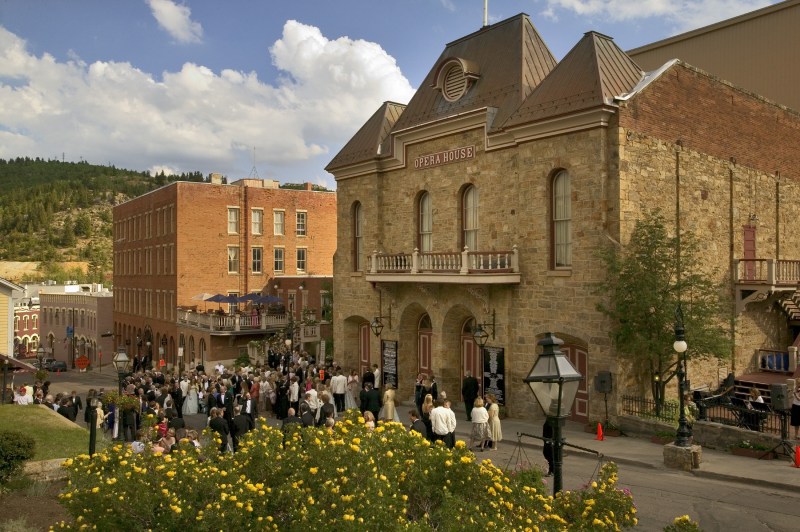
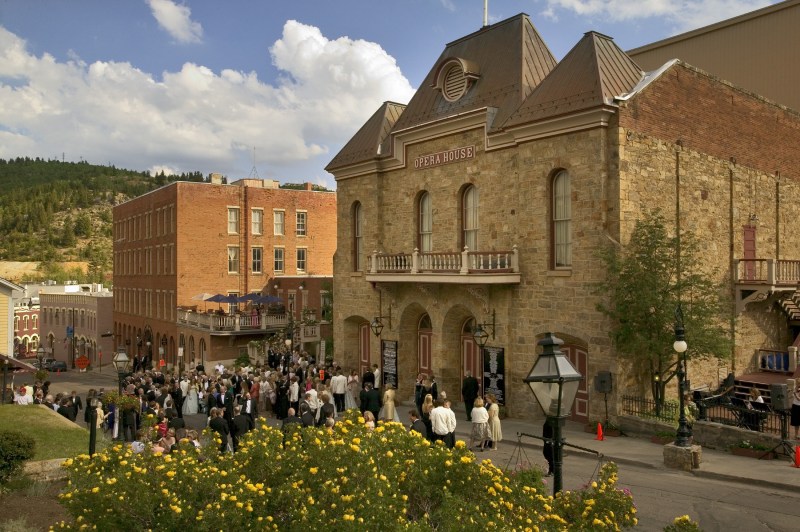
Central City Opera House (photo courtesy of Central City Opera)

The madness is expecting audiences to attend opera high in the Colorado mountains. And the method involves a mix of big pieces and small pieces, famed operas and unknown operas, with first-rate casts and imaginative productions. For the 2018 season, Pearce says, “you’ve got Handel, Mozart, Verdi and Mollicone. It represents a broad swath of styles.”

The formula devised through trial and error is to present two major productions in the historic Central City Opera House — this year, Mozart’s Magic Flute and Verdi’s Il Trovatore — and two shorter works in smaller venues — this year, Handel’s Acis and Galatea and The Face on the Barroom Floor by Henry Mollicone, a work that was written for CCO 40 years ago.

The season opens Saturday (July 7) with the Magic Flute; Il Trovatore opens a week later (July 14). These productions run in repertory until Aug. 5, with the shorter works being presented over a span of 10 days, July 25–Aug. 3.

Read more in Boulder Weekly.

# # # # #

Central City Opera Summer 2018

The Magic Flute by Mozart/Emanuel Schikaneder
André de Ridder, conductor; Alessandro Talevi, stage director

2:30 p.m. July 11, 13, 15, 17, 21, 25, 29; Aug. 2, 5
8 p.m. July 7, 19, 27, 31
Central City Opera House
Performed in German with English supertitles.

Il trovatore by Verdi/Salvadore Cammarano
John Baril, conductor; Joachim Schamberger, stage director

2:30 p.m. July 18, 22, 24, 28; Aug. 1, 3
8:00 p.m. July 14, 20, 26
Central City Opera House
Performed in Italian with English supertitles.

Acis and Galatea by Handel/John Gay, Alexander Pope, John Hughes
Christopher Zemliauskas, conductor; Ken Cazan, stage director

8 p.m. July 25, 28; Aug. 1
5 p.m. July 26
Martin Foundry, Central City
Performed in English

The Face on the Barroom Floor by Henry Mollicone/John S. Bowman
40thanniversary production
Michael Ehrman, director

1:15 p.m. July 25, 28, Aug. 1, 2 3
Williams Stables Theater, Central City
Performed in English

Tickets for all productions


Boulder Phil sells out West Side Story 10 days in advance

Orchestra ends 60th-anniversary season on a high April 28

By Peter Alexander April 18 at 10:40 a.m.

The Boulder Philharmonic has announced that their concert performance of Leonard Bernstein’s West Side Story on Saturday, April 28, has sold out 10 days in advance.

westsidestoryThe orchestra’s 60th-anniversary season has already been a success at the box office, leading to a modest expansion of next year’s season. When announcing the 2018–19 season April 6, Katherine Lehman, the Boulder Phil’s executive director, observed that “We have been extremely successful with ticket sales, and we’re ending the year particularly well this year.”
The sellout of West Side Story adds success to success. “This is thrilling news for us,” Lehman says today. “We can’t imagine a better way to bring our 60th-anniversary season to a close than to share West Side Story with a sell-out crowd!”

MB-jiah 1

Michael Butterman will conduct the sold-out West Side Story in Concert with the Boulder Phil

Boulder Phil has sold out a few performance in Macky Auditorium in recent years. Besides the Sunday Nutcracker performances with Boulder Ballet, these include several performances with Cirque de la Symphonie. Another sellout was the Boulder performance of the “Nature and Music” concert in March, 2017, that was subsequently performed in the Kennedy Center in Washington, D.C.

Performances by the orchestra with ukulele virtuoso Jake Shimabukaro in 2017 and violinist Sarah Chang in 2013 both sold out the day of the performance. The current production of West Side Story marks the first time in recent years that Boulder Phil has sold out a concert 10 days in advance.

The performance, in celebration of the 100th anniversary of Bernstein’s birth, is a presentation of the Boulder Phil in collaboration with Central City Opera. Boulder Phil music director Michael Butterman is conducting, with stage direction by Robert Neu, and a cast selected in audition by Butterman, Neu, and Central City Opera artistic director Pelham Pearce. The orchestra will be seated onstage, with action occurring on the front apron of the stage, and on a platform erected behind one side of the orchestra.

1-westsidestory003.StefanCohen

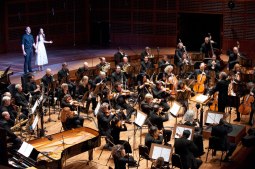
San Francisco Symphony: West Side Story in Concert (photo by Stefan Cohen)

A few years ago, this performance would not have been possible. It has been popular for many years for orchestras to perform live with a screening of the film, but rights were not given for concert performances until 2014, when the San Francisco Symphony gave the first live in concert performances. Their performance was subsequently released on CD.

There have a been a few other orchestras who have performed West Side Story in concert, but the Boulder Phil is one of the first, if not the first, regional orchestra to do so.

2017: The Year in Classical Music

Some outstanding concerts, and some changes of leadership in Boulder

By Peter Alexander

With the year drawing to a close, it is time to look back at 2017. It has been a tumultuous year in many realms, including some aspects of Classical music. But before that, it is good to remember the outstanding musical experiences of 2017 here in the Boulder area.

Pro Musica

The year began on an expressive high point when Pro Musical Colorado Chamber Orchestra, conductor Cynthia Katsarelis and soloists Jennifer Bird-Arvidsson, soprano, and Ashraf Sewailam, bass, presented Shostakovich’s rarely-heard Symphony No. 14.

I wrote at the time: “This somewhat gloomy meditation on death is not often given live, partly because of the difficult assignments facing the soprano and bass soloists, but mostly because of the difficult subject matter. But it is a major statement from a great composer—what Katsarelis calls ‘a piece that needs to be heard’—and so the rare performances are to be treasured.”

The February visit of Deborah (Call Me Debbie) Voigt to Macky Auditorium will be a cherished memory for fans of the classical voice. Voigt Lessons, the superstar soprano’s candid retelling of her struggles with relationships, substances, and weight that clouded her career not only showed some realities of life at the top of the opera world, it also revealed the very human person beneath the superstar image. For both reasons, this was a meaningful event.

Takasce SQ

Takacs Quartet

The Takacs Quartet always provides some of the year’s best performances. It’s hard to chose just one, but for 2017 I would single out their February concert including Beethoven’s Quartet in G major, op. 18 no. 2—performed while the Takacs was in the midst of a full Beethoven cycle at several venues—and CU music faculty Daniel Silver, clarinet, playing the Brahms Quintet in B minor, op. 115. An especially beautiful rendering of this beautiful work had at least one audience member in tears by the end.

March saw the arrival of another superstar in Boulder when Sir James Galway played at Macky Auditorium, and the departure of an important member of Boulder’s classical music community when Evanne Browne gave her farewell concert with Seicento Baroque Ensemble, the organization she founded in 2011.

BPhil.onstage

Boulder Phil at Kennedy Center

One of the biggest events of the year for Boulder performing arts was the visit in March of the Boulder Philharmonic Orchestra, conductor Michael Butterman and Frequent Flyers Aerial Dance Company to the Kennedy Center in Washington, D.C., for the first annual Shift Festival of American Orchestras. The Phil repeated a concert they had given in Boulder a few days earlier, including the world premiere of All the Songs that Nature Sings by Stephen Lias and Copland’s Appalachian Spring, performed with Frequent Flyers.

An audience favorite of the festival, the Boulder Phil played to a sold out house. Butterman wrote the next day, “It was a peak experience for me, and, I think, for all of us at the Phil. . . . To be there with our orchestra, with that crowd and with that repertoire—it was something I shall never forget. We had a great sense of pride in representing our hometown.”

Several important changes of personnel were announced for Boulder classical scene in the spring. In April, Jean-Marie Zeitouni announced that he was stepping down as music director of the Colorado Music Festival. He will remain with CMF as principal guest conductor, and conductor/violinist Peter Oundjian will serve as artistic advisor for the 2018 season. Later the same month, James Bailey left his position as music curator of the Dairy Arts Center, to be replaced by Sharon Park.

Elliot Moore at Lake McIntosh - credit - Photography Maestro (1)

Elliott Moore

In May, Seicento Baroque Ensemble announced the appointment of Kevin T. Padworksi as artistic director, succeeding Browne, and the Longmont Symphony announced the appointment of Elliot Moore to succeed long-time music director Robert Olson.

The same month, the Boulder Chamber Orchestra wrapped up its 2016–17 season with its largest performance to date, Beethoven’s Ninth Symphony presented in Macky Auditorium. The performance under conductor Bahman Saless was unfortunately the occasion of a protest by the anti-fracking group East Boulder County United. Seven members of EBCU blew whistles, shouted slogans and left flyers before the concert to voice their opposition to the orchestra having accepted a contribution from Extraction Oil & Gas.

Olga Kern

Olga Kern, photographed by Chris Lee at Steinway Hall.

Zeitouni proved to be anything but a lame duck conductor at the Colorado Music Festival. The 2017 season started at the end of June with an all-Russian program featuring exciting performances of Shostakovich’s Festive Overture and Rachmaninoff’s Second Symphony. On the same concert, one of Boulder’s favorite guest artists, pianist Olga Kern, gave scintillating performances of Prokofiev’s First Piano Concerto and Rachmaninoff’s Rhapsody on a Theme of Paganini.

Other high points over the summer included the return of CMF’s founding director Giora Bernstein to lead a concert of Mozart, Zeitouni conducting Beethoven’s Ninth as the CMF centerpiece, and the visit of violinist Gil Shaham at the end of the summer season. Up in the mountains, Central City Opera’s Downton-Abbey-inspired Victorian-era production of Mozart’s Così fan tutte was one of the year’s highlights for opera lovers.

Another delight for the opera crowd came in the fall, with the CU Eklund Opera Program’s serio-comic production of Lehar’s Merry Widow. In November, Saless and the Boulder Chamber Orchestra returned to its core repertoire with a lively concert featuring two youthful works for smaller ensemble: the Concerto for piano, violin and strings by the 14-year-old Mendelssohn, with violinist Zachary Carrettin and pianist Mina Gajić, and Janáček’s Idyll for Strings.

Zachary & Mina

Carrettin and Gajic

Carrettin and Gajić were featured performers in December when the Boulder Bach Festival gave one of its most intriguing and adventurous concerts in its increasingly adventurous schedule. With guest artist Richie Hawley, the program offered insight into the instruments and performance practices of the early 20th century, performed on Hawley’s 1919 Buffet clarinet, Gajić’s 1895 Érard piano, and Carrettin’s violin set up with strings typical of the period.


# # # # #

For the classical music world outside of Boulder, the biggest news was certainly the intrusion of a long-overdue reckoning for sexual misconduct that is going on in our society generally. The first bombshell, not unexpected by people in the business but a bombshell nonetheless, landed Dec. 3 with the suspension of conductor James Levine from the Metropolitan Opera and other organizations, including the Boston Symphony and the Ravinia Festival. Accusations against Charles Dutoit, artistic director and principal conductor of the Royal Philharmonic Orchestra in London, surfaced later in the month.

levine

James Levine

Both conductors are in the twilight of long careers. Rumors about Levine have been widely known in the classical music world; indeed I first heard them in the 1980s. Every music journalist I know has heard the same stories, but so far as I am aware, no one who experienced Levine’s assaults was previously willing to speak publicly. In the case of Dutoit, I had not heard the rumors, but I do know one of the women who spoke publicly about what happened to her, and I believe her unquestioningly.

As the controversy has swirled about the subject of sexual abuse, harassment and assault in classical music, several critics have written powerfully about the subject: Anne Midgette of the Washington Post, Jennifer Johnson of the Guardian, Andrew Riddles of Classical Ottawa to name three. Singer Susanne Mentzer has written about her personal experiences in the opera world for the Huffington Post, as has Dan Kempson for Medium.

There are certain to be more revelations. One major journalist has more first-hand information, with names including some of the of the most famous classical artists, and is preparing an article. I have no doubt that several men are nervously awaiting that story, or some other revelation that reveals past misdeeds.

Will this tidal wave reach Boulder?

It’s hard to say with certainty. I have spoken with many on the classical scene here, and the only rumor I have heard, from several sources, has been of inappropriate comments and behavior by one person, none of which reached the level of abuse or assault. “He might not have been hired today,” one person speculated, but as so often happens, the people who heard the comments preferred not to make an issue of it.

Another person told me he had never heard any rumor from the College of Music, so Boulder may escape the worst of this necessary but unhappy process. In the meantime, it is my wish for 2018 that society in general and the music world specifically create a safe environment, where powerful men do not feel free to behave like adolescent boys.

___________

Edited for clarity 12.31.17

Central City Opera announces Magic Flute and Il trovatore for 2018

The Face on the Barroom Floor returns for 40th anniversary production

By Peter Alexander

Mozart’s Magic Flute and Verdi’s Il trovatore, two staples of the operatic repertoire, will be the mainstage productions for Central City Opera’s 2018 summer season.

Central City Opera Opening Night 2006- Page 2 of Book

The Historic Central City Opera House

Magic Flute and Il trovatore will be performed in repertory in Central City’s historic 550-seat opera house. Filling out the season are two smaller productions, to be presented in more intimate venues in Central City during the summer: the 40th-anniversary production of The Face on the Ballroom Floor by Henry Mollicone, which was commissioned by CCO; and Handel’s Acis and Galatea, in its Central City debut production.

Face on floor

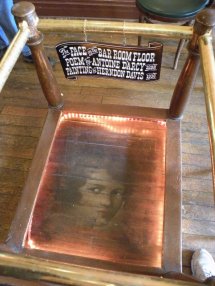
The Face on the Barroom Floor in the Teller House bar

Mollicone’s Face on the Ballroom Floor was premiered in 1978 in the Teller House Bar in Central City, where the painting that inspired the opera still draws tourists. The painting was made in 1936 under disputed circumstances and was inspired by a poem by Hugh Antoine d’Arcy that was published in 1887—and which was itself derived from an even earlier poem by John Henry Titus.

The one-act opera features two love triangles separated by a century, both revolving around the mysterious face on the barroom floor.

Classical Singer LanganThe season will see the return of number of singers in the two mainstage productions. Bass Kevin Langan, last seen in 2013 as Dr. Gibbs in Our Town, returns in his signature role of Sarastro in The Magic Flute. Langan was recently featured on the cover of Classical Singer magazine in recognition of his longevity over 38 years in opera. Katherine Manley returns as Pamina, and Alessandro Talevi returns to Central City as stage director.
Il trovatore will be practically a reunions party for the 2016 production of Tosca, including Jonathan Burton as Manrico, Alexandra Loutsion as Leonora and Michael Mayes as Count di Luna. John Baril, Central City Opera Music Director, will conduct, and Joachim Schamberger will be stage director.

PatPearce-215x300

Pelham (Pat) Pearce

The pattern of presenting two major works in the Opera House and two smaller productions in other venues in Central City is one the CCO has adopted in the past few years. At one time, the shorter works were taken to other cities and towns in Colorado, but Pelham (Pat) Pearce, CCO’s general/artistic director, says “We decided that part of our identity is the actual experience of being (in Central City).”

According to Pearce, keeping the performances in Central City has not affected the company’s success. “The popularity of these one-acts continues to grow,” he says. “They draw opera goers who are looking for something different as well as those who are new to the art form and curious about experiencing something that’s shorter, less expensive, and feels more accessible.”

In addition to the four staged productions, the CCO summer season includes recitals, opera scenes, pre-performance lectures and post-performance opportunities to meet the artists.

# # # # #

CCOperaLogoPreferred

Central City Opera 2018 Season

Mozart: The Magic Flute
André de Ridder, conductor
Alessandro Talevi, stage director

Cast includes Kevin Langan as Sarastro, Katherine Manley as Pamina. Debuting with Central City Opera: Joseph Dennis as Tamino, Will Liverman as Papageno, Jeni Houser as The Queen of the Night and Ashraf Sewailam as The Speaker.

Matinees at 2:30 p.m.: July 11, 13, 15, 17, 21, 25, 29; Aug. 2, 5
Evenings at 8 p.m.: July 7, 19, 27, 31
Central City Opera House

Performed in German with English supertitles.

Verdi: Il trovatore
John Baril, conductor
Joachim Schamberger, stage director

Cast includes Jonathan Burton as Manrico, Alexandra Loutsion as Leonora, Michael Mayes as Count di Luna and Maria Zifchak as Azucena.

Matinees at 2:30 p.m.: July 18, 22, 24, 28; Aug. 1, 3
Evenings at 8 p.m.: July 14, 20, 26
Central City Opera House

Performed in Italian with English supertitles.

Handel: Acis and Galatea
Christopher Zemliauskas, conductor
Ken Cazan, director

Cast includes artists of the Bonfils-Stanton Foundation Artists Training Program

July 25, 28 and Aug. 1 at 8 p.m.
July 26 at 5 p.m.
Venue in Central City TBA

Performed in English.

Henry Mollicone: The Face on the Barroom Floor, 40th-Anniversary Production
Michael Ehrman, head of the Bonfils-Stanton Foundation Artists Training Program, director

Cast includes artists of the Bonfils-Stanton Foundation Artists Training Program

July 25, 28 and Aug. 1, 2, 3 at 1:15 p.m.
Venue in Central City TBA

Performed in English.

For tickets and more information about the 2018 summer season, visit the Central City Opera Web page, or call (303) 292-6700.

Central City offers splendid mainstage productions of ‘Così fan tutte’ and ‘Carmen’

By Peter Alexander

The 2017 season of the Central City Opera (CCO) is well launched, with two splendid productions in the main theater: a musically solid and entertaining production of Bizet’s Carmen and a revelatory production of Mozart’s Così fan tutte.

Carmen opened the season July 8 and continues through Aug. 6. Using sets stored since CCO’s 2011 season, it had an all-new cast and director. Carmen is a tricky show to pull off on Central City’s small stage. The act set in Lillas Pastia’s tavern works well, but the other three force compromises that are not always effective, including an awkward ballet in place of the bullfighters’ parade in the final act.

AC-1_Amanda-Tipton-640x426

Matthew Plenk (Ferrando), Hailey Clark (Fiordiligi) and David Adam Moore (Guglielmo). Photo by Amanda Tipton, courtesy of Central City Opera.

Opening last Saturday, July 15, and continuing through Aug. 4, the production of Così fan tutte takes its cue from the opera’s subtitle: the school for lovers. By placing it in a Victorian-era boarding school, the production appropriately brings out the youth and inexperience of the lovers; it creates wonderful opportunities for humor, and it appeals to the Victorian vogue stoked by Downton Abbey.

In this context, Don Alfonso is a fusty professor teaching a needful lesson. Despina is a “house-mistress” whose cynicism comes from years of exasperation with the follies of adolescents. And the four lovers, described in the program as “students” who are “dating,” are clearly in the throes of self-dramatizing first love.

This setting fits Così perfectly. The Central City cast conveyed this interpretation wonderfully.

Read more in Boulder Weekly.


‘Carmen’ and ‘Così’ highlight Central City Opera’s summer season

For 2017, all performances will be in Central City

By Peter Alexander

Central City Opera Opening Night 2006- Page 2 of Book

Opening Night at Central City Opera. Photo courtesy of Central City Opera.

Central City Opera (CCO) is offering two operatic mainstays in their historic 1878 opera house this summer, Bizet’s Carmen (July 8–Aug. 6) and Mozart’s Così fan tutte (July 15–Aug. 4).

Carmen and Così are joined on the Central City season by limited performances of three short operas presented in smaller venues in Central City (July 26–Aug. 4): The Burning Fiery Furnace by Benjamin Britten, The Cabildo by Amy Beach, and Gallantry by Douglas Moore. Though little known, these works are an important part of CCO’s long-term goal.

“We’re doing this to build new audiences,” Pat Pearce, CCO’s artistic director, says. “Come up and see one of these one-acts! You’re out in an hour, and it’s in English.”

The two mainstage productions appear to be worlds apart. Carmen is a gritty story about a decent man destroyed by his fatal passion for an untamed Gypsy, Così fan tutte an artificial semi-comedy about two pairs of lovers. But beneath the surface, both works explore the same emotions: love, jealousy, anger.

Read more in Boulder Weekly

# # # # #

CCOperaLogoPreferredCentral City Opera
Summer 2017

Georges Bizet: Carmen
Central City Opera House
Matinees at 2:30 p.m.: July 12, 14, 16, 18, 22, 26, 30, Aug 3, 6
Evenings at 8 p.m.: July 8, 20, 28; Aug. 1

Mozart: Così fan tutte
Central City Opera House
Matinees at 2:30 p.m.: July 19, 23, 25, 19, Aug. 2, 4
Evenings at 8 p.m.: July 15, 21, 27

Benjamin Britten: The Burning Fiery Furnace
The Martin Foundry, Central City
12 noon July 26 and Aug. 2
5 p.m. July 27

Amy Beach: The Cabildo
Williams Stables, Central City
8 p.m. July 26, 29, Aug. 2 (Double feature with Gallantry)

Douglas Moore: Gallantry
Williams Stable
8 p.m. July 26, 29, Aug. 2 (Double feature with The Cabildo)
12 noon Aug. 3 and 4

Tickets


Central City Opera reaches out for new audiences

A conversation with general director Pat Pearce

By Peter Alexander

Central City Opera Opening Night 2006- Page 2 of Book

Opening Night at Central City Opera. Featured in Central City Opera’s 75th anniversary book, “Theatre of Dreams, The Glorious Central City Opera- Celebrating 75 Years.”

Central City Opera opens its 2016 Summer Season tonight (July 9) with their 60th anniversary production of Douglas Moore’s Ballad of Baby Doe, which premiered at the Central City Opera House July 7, 1956. (A review will appear in Boulder Weekly July 14).

Other works on the summer season will be Puccini’s Tosca and two shorter works—The Impresario by Mozart and Later the Same Evening by John Musto—which will be performed both in Central City and on the road in Boulder and Colorado Springs, respectively. Those shorter works take the place in the company’s schedule of a third production in Central City, and they represent an effort to reach out and build new audiences for opera.

I recently had the opportunity to speak with Pelham (Pat) Pearce, general/artistic director of Central City Opera, about the motivations for taking those shorter works on the road, and on the condition of opera in American today. Here is part of that conversation, lightly edited for clarity:

Alexander: Over the past few seasons, you have been looking for the right menu for Central City Opera—is that fair to say?

PatPearce-215x300

Pelham “Pat” Pearce

Pearce: I think so. These days, everybody is having to adjust and in many cases, shift and change for the environment we’re living in. But ultimately everything we’ve done over these past oh-so-many-years has been about finding and developing new audiences for this art form. That’s really what it’s been about.

Some of it involved taking a show that we were doing up here (in Central City) down to Denver. Other things involved us actually creating down in Denver in the music theater vein. And what we’ve done in the last year, and what we’re doing this is year, is taking one of our slots and devoting it to an effort to find and drive new audiences for this art form.

We’ve come up with a list of things that we felt were barriers for people, and we think we’re right about this. One of them is price, and opera tickets everywhere can run to be fairly expensive, mostly because it’s the most expensive art form in the world—and even with those expensive tickets that’s still only a small percentage of what it actually costs to do it. But for something that you either don’t know or don’t think you’re going to like in the first place, you’re hesitant to spend a lot of money to try something out. So price was a deal.

Length was a deal—perceptions about how long opera is, how long the sit is, so we created things that were around an hour in length.

The fact that it’s in a foreign language is another perception, and so we tried to basically focus on things that were written in English. This year we have one piece, the Mozart Impresario, that we will be doing in translation, from its original German to English.

CCO.Interior.3x4-large

Historic Central City Opera House, interior

And the other thing is making people come to you. Doing opera in spaces that were created for doing that is the easiest way to do it. We have everything we need—dressing rooms, lighting, pit—all of those things we need to produce the art form. But we find that crossing that threshold is problematic for some people. So, we have said that we will do these pieces in non-traditional places, so that any pre-conception about what you have to be, who you have to be, what you have dress like—all of those things are shifted to the side and we’ll do these pieces in nontraditional places.

So those four things are sort of the drivers for us, in addressing how we take this third of our offerings in the summer and translate it into something we think will address all of those barriers. So this year that happens to be Mozart’s Impresario and John Musto’s Later the Same Evening. That was a long answer to your question, but I think that’s absolutely the correct answer in the end.

This fascinates me, because there are areas of opera that are thriving right now. For example, I’ve been to some very successful premieres in the past year: Manchurian Candidate by Kevin Puts at the Minnesota opera; Cold Mountain by Jennifer Higdon at Santa Fe; and The Shining by Paul Moravec, again at the Minnesota Opera. And we had Scarlet Letter by Lori Laitman at Opera Colorado this spring.

 People do seem to respond to new work, at least the first time. There’s always a cachet with a world premiere, especially these days. It becomes an event, a “thing” that everybody feels like they need to be there, which is great, especially for the original commissioner and presenter. The subsequent productions of it, in other places, (are another matter).

In the 1980s and ‘90s Opera America and the National Endowment for the Arts gave out money for people to commission new work. And what they found was that people were willing to commission new work, but the work was not really going anywhere because there weren’t subsequent productions. It didn’t have the opportunity to grow and to evolve, and for more people to see it. And so in the next couple of decades they gave money to encourage people to take the risk of that second production of the work.

In many cases these days, people have co-commissioned new works and they’ve set up, like they did with Moby Dick (by Jake Heggie), and like they did with Cold Mountain, multiple presenters. That cuts down on the risk and the cost of the original commission. As part of doing that, they have first dibs (on subsequent productions in other places). And so Cold Mountain went from Santa Fe last summer to Philadelphia over the course of this past season. The largest one in recent memory was Moby Dick, which started off in Dallas and it took it almost two and a half years to get through all of the co-commissioners.

DeadManWalkingExecution4

Dead Man Walking execution scene. Photo by Mark Kiryluk. Central City Opera, 2014.

Today, some pieces do go on to have real success around the country. Jake Heggie’s Dead Man Walking, which you produced in 2014, is a good example.

 Dead Man Walking is a really wonderful piece. It works, and nine times out of ten, new work is not going to work. I mean, that’s the reason most people don’t present new productions of works after the premiere—because having everything come together and have a piece actually work is hard, and it’s rare. Even back in the heyday of opera, there were lots of operas written, but the ones that we still see today are the ones that rose to the top.

There are many operas we’ve never heard of, for good reason.

 There are a lot of different ways to develop a new audience. And in addition to people that are commissioning these new works, in big houses, and doing them in their home theaters, there are also a plethora of new, very small opera companies that are popping up in larger cities, usually, that do work in non-traditional places—in warehouses, that sort of thing. Nobody gets paid much and they don’t charge much for the tickets, but people show up to see it. And so far they’ve managed to do it.

So everybody’s trying a lot of different things, and we’re all trying to learn as quickly as we can, from other people’s risk-taking, about what seems to work, and we try to adapt our offerings to that. Or at least a portion of our offering, so that at the same time we’re producing standard repertoire and interesting repertoire for our current audiences, we’re also working to develop new audiences. We set out a goal last year of having at least 50% of the people that bought tickets to the shows be new audience. We actually did 55%, so we did really well with that last year.

My concern was that our current audiences would want to see everything that we were doing, and would fill up all of the seats—which is a wonderful thing, but ultimately wasn’t the reason specifically we were doing it. Which is why we’ve taken at least a few of these performances off the hill, away from here. Last year we went up to Ft. Collins and down to Colorado Springs. This year, we’re going to go down to Colorado Springs and to Denver with Later the Same Evening, and to Boulder with two performances of The Impresario. So we’re taking it off the hill on purpose, and that’s often where we get the new audience.

# # # # #

Central City Opera
2016 Summer Season

CCOperaLogoPreferredThe Ballad of Baby Doe by Douglas Moore
2:30 p.m. July 13, 15, 17, 19, 21, 23, 27, 31; Aug. 2, 4
8 p.m. July 9, 29; Aug. 2, 6
Central City Opera House

Tosca by Giacomo Puccini
2:30 p.m. July 20, 24, 26, 30; August 3, 5, 7
8 p.m. July 16, 22
Central City Opera House

The Impresario by W.A. Mozart
12 noon July 27 and Aug. 3, William’s Stables Theater, Central City (sold out)
6 and 8 p.m. Thursday, July 28, Nomad Playhouse, 1410 Quince Ave., Boulder

Later the Same Evening by John Musto
7 p.m. Thursday, July 28, Pikes Peak Center Studio Bee, 190 S. Cascade Ave., Colorado Springs
8 p.m. Saturday, July 30, Denver Art Museum, Denver
7 p.m. Friday, Aug. 5, Gilman Studio, Lanny and Sharon Martin Foundry Rehearsal Center, Eureka St., Central City

Tickets

Edited 7/10/16 to correct typos


Boulder Phil will present three works in one

Performances of Bach’s St. Matthew Passion will be a collaboration with several organizations

By Peter Alexander

J.S. Bach’s St. Matthew Passion is at least three different works.

Michael Butterman conducts the Boulder Phil - Glenn Ross Photo.jpg

Michael Butterman and the Boulder Philharmonic. Photo by Glenn Ross.

It is a sacred work, written and performed in Bach’s lifetime as part of Good Friday services at the Thomaskirche in Leipzig. It is a concert work that has been performed apart from religious services for most of the 266 years since Bach’s death. And it is a dramatic work, the closest Bach came to writing an opera.

This weekend’s performances by the Boulder Philharmonic, a semi-staged production presented in conjunction with the Boulder Bach Festival, Central City Opera, the CU College of Music and the Boulder Children’s Chorale, will definitely tilt toward the third option. (Performances will be at 7 p.m. Saturday in Macky Auditorium, with supertitles projected over the stage; and at 2 p.m. Sunday in Denver’s Central Presbyterian Church.)

Bach’s score unfolds on different levels: There is a tenor singing the Biblical narration, a baritone singing the words of Jesus, and individuals from the chorus who sing the words of other characters named by St. Matthew; there is a double chorus, which sings large choral movements that introduce and close the work, the words of the crowd, and Lutheran chorales that symbolically represent the reaction of the congregation; and there are aria soloists who sing non-Biblical poetic texts that reflect upon the story.

To these musical events, this performance will add an onstage dramatization, but not in a literal way. “There’s very little that’s literal action,” stage director Robert Neu says. “What we’re trying to do is take it a little bit out of the realm of a traditional concert performance. The piece is very operatic in the way it’s shaped, it’s very dramatic, but given the nature of the piece, you can’t be overly literal about it.”

Read more in Boulder Weekly.

# # # # #

Bach’s St. Matthew Passion
Boulder Philharmonic, Michael Butterman, music director
A semi-stage production with
Central City Opera, Robert Neu, stage director
Boulder Bach Festival chorus, Zachary Carrettin, artistic director
The University of Colorado, Boulder, University Singers and University Choir, Gregory Gentry, chorus master
Boulder Children’s Chorale, Kate Klotz, artistic director
Vocal soloists

7 p.m. Saturday, April 23 [Note early starting time]
Macky Auditorium, Boulder
Preceded by pre-performance discussion, 6 p.m.

2 p.m. Sunday, April 24
Central Presbyterian Church, Denver

Tickets