Colorado Music Festival faces another transition

Executive director Andrew Bradford resigns after 18 months on the job

By Peter Alexander

The Colorado Music Festival (CMF), which underwent a full change of leadership and administration 18 months ago, faces another transition.
Bardford

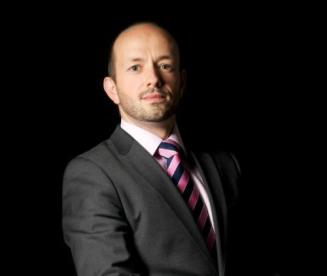
Andrew Bradford

Andrew Bradford, the executive director who was hired in the summer of 2014 and started work Aug. 11 of that year, announced last Thursday (Feb. 11) that he had resigned, effective Friday, March 25, 2016. Bradford is leaving to take another position, which will be announced soon.

When Bradford was hired, the position had been open for a full year, during which time there had been one failed search for executive director (ED), and the position of musical director (MD) was also open.

The larger organization that Bradford heads includes the CMF, headquartered at Chautauqua in Boulder, and its affiliated educational arm, the Center for Musical Arts (CMA), located in Louisville.

Bradford and others say his departure will not affect the upcoming 2016 summer season. Bradford has worked with Zeitouni and the CMF staff to plan the 2016 festival, and will be in place through the public announcement of the season on March 2.

“I’m staying through the end of March, and I’ll be working full steam ahead 100% until my very last day,” he says. “We’re going to all work together to make sure that the transition is as seamless and as smooth as possible.”

Lupberger.2

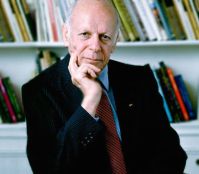
Edward Lupberger

The CMF/CMA Board of Directors will oversee the transition to the next ED. Edward (Ted) Lupberger, who became the board president last month, says the directors will appoint an interim director, probably from inside the organization, and then begin a search for a permanent director.

“Right now we’re addressing what’s the best mode for moving forward,” he says. “We’re definitely starting a search, but we’re also going to the people that did the search (before). Some of the people at that time were close candidates, so we’ll start pursuing those as an option, but also in the short term before that, what we’re doing is going to the staff.

“We have a really strong staff that know how to produce a festival, they know the CMA, they know the donors and what we need to be planning for. We probably will give an interim title to someone (from the staff), because it seems that’s the prudent thing to do, and it conveys to the community that we have a person in that leadership role.”

Because he is new to the president’s job, Lupberger said he would continue to work with a team that forms “kind of an executive committee” within the board. That group, comprising Lupberger with board secretary Jane Houssiere, treasurer Dave Brunel, and director Caryl F. Kassoy, worked to facilitate Lupberger taking on the role of board president, and they will continue to work together during the search.

At this time, Lupberger says, there is not yet a specific timeline for the search and hiring process. “I’d rather take more time and get the right person than go quick and get the wrong person,” he says.

# # # # #

Over the past year, the CMF/CMA has been developing a strategic plan for the organization’s future, guided by a consultant who specializes in the arts and non-profit sectors. According to Lupberger, the consultant’s recommendations, which have only recently been given to the board, include directions on how to be ready for administrative changes. “It just happened sooner than we expected,” he says.

“There’s directives for the board in what we should be doing to better support the organization, there’s directives for staff on how to do operations and what things we need to be focusing on.”

While the 100-page consultant’s report has not been made public, Lupberger does not plan on keeping the board’s plans secret. “We are working on more of an executive summary, and then I think we all want to get the world to know what we’re planning,” he says. “It’s not going to be shocking.”

Both Lupberger and music director Jean-Marie Zeitouni praised the condition of the organization after Bradford’s 18 months in charge. “We’re a very healthy, strong organization,” Lupberger says.

Zeitouni_2

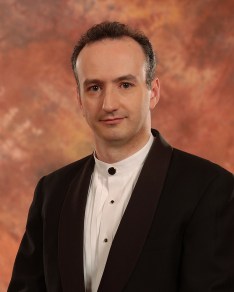
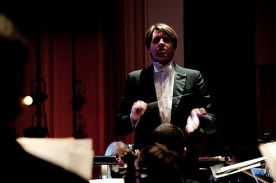
CMF music director Jean-Marie Zeitouni

Bradford “was a very strong asset (to CMF),” Zeitouni wrote in an email from Montreal, Canada, where he lives during most of the year. “To his credit, we are in a really good place right now: The staff is strong and enthusiastic, the board is really committed and involved, our budget is approved, the festival season is all planned and we are moving along nicely towards long-term artistic planning.”

Bradford and others have mentioned an 18% increase in ticket sales in 2015 from the previous year’s summer festival as a basis for the CMF’s current strength. While that is an important figure, the full context shows that it is a one-year increase from the 2014 season, which was the year of the music director search. Without a highly popular music director on the scene, with no central theme to the summer, and several different conductors coming in and out of Chautauqua, audiences were visibly smaller in 2014 than in the previous two or three years. Consequently, it is difficult to put the 2015 increase into the long-term context of ticket sales and revenues for the festival without consulting detailed financial records over the past five to ten years.

# # # # #

The recent history of the CMF/CMA administration provides insight into the issues faced by the board. In 2013 the organization lost both its executive director, Catherine Underhill, and the popular musical director of the summer festival, Michael Christie, in a single year. A search was undertaken immediately for a new ED to be in place before the summer of 2014, when finalists for the MD position would each lead the orchestra in a pair of concerts.

The board of CMF/CMA announced in Dec. 2013 that David Pratt of the Savannah (Georgia) Philharmonic had been selected as ED and would be in place early in 2014. Instead, he backed out in January 2014, and the board had to begin another search. Bradford was announced as the new ED in June, nearly a year after the position was first vacated, and he was present for the audition concerts by the three official MD candidates.

He and the board chose Jean-Marie Zeitouni as the new music director, announcing the appointment Sept. 8, 2014. Zeitouni conducted his first festival season last summer, July–August 2015. In the meantime, many of the top administrative positions at the CMF/CMA turned over in the first months of Bradford’s tenure, including one person who was hired early in the fall of 2014 and then left May 1, 2015. That position was covered by other staff members during the 2015 summer festival.

While no specific reasons have been given for most of the departures, Bradford is unstinting in his praise of the current staff. “I am absolutely delighted with the folks that I’ve hired,” he says. “These are fantastic, really capable people.”

Through all of this change, Lupberger believes that the CMF and CMA have remained strong. “At the end of the day, the board and the two organizations that make up the one, the Center for Musical Arts and the Colorado Music Festival, have maintained their identities—what they are, who they are—through this whole period. We have a strong orchestra, and we have a strong faculty at the Center (for Musical Arts), and that’s remained true through this whole process.”

For that reason, Lupberger remains upbeat about the future of the CMF/CMA organization. “At the end of the day, we’re talking about an organization that produces amazing music in the summer, and then educates others throughout the year,” he says.

“The core of what we do is what we should be excited about. The rest of it is less important, because what we do is a great thing and we should be proud of it and focus on that and move forward.”

_________________
Edited for clarity 2/16

CU’s Takács Quartet and Edward Dusinberre in the news

The Economist praises Dusinberre’s “fascinating book”

By Peter Alexander

Takacs.Dusinberre.CUphoto-X2

Edward Dusinberre

The Economist, the weekly newsmagazine published in London, has published an article—it is more a description of the book and its subject than a review—about Takács Quartet first violinist Edward Dusinberre’s new book on the Beethoven string quartets.

The Tákacs is the quartet-in-residence at the University of Colorado, Boulder College of Music; Dusinberre and the other members are Ralph E. and Barbara L. Christoffersen Faculty Fellows.

Beethoven for a Later Age: The Journey of a String Quartet was published in England by Faber & Faber and will be published in the U.S. by the University of Chicago Press in May. “Mr Dusinberre is the lead violinist of the Takács Quartet, one of the world’s most highly regarded string ensembles, and he has written a fascinating book about the musical life of this group of players,” the publication states in the unsigned article.

“Interwoven with that is the story of Beethoven’s 16 string quartets, works of extraordinary power written over a quarter-century that moved the genre on from the earlier masters and are now regarded as the apogee of the chamber-music repertoire.” (Read the full article in The Economist.)

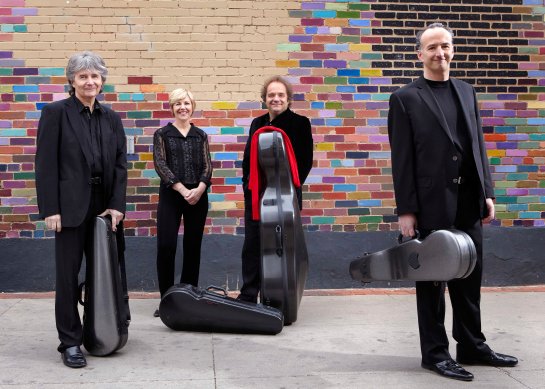
Takasce SQ

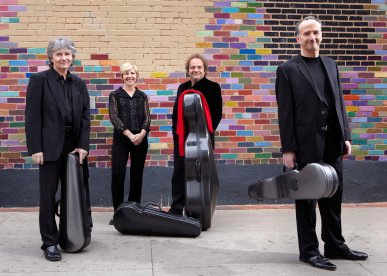
Tákacs Quartet. Photo by Keith Saunders.

Like most books today, Beethoven for a Later Age has already attracted a number of celebrity blurbs and reviews. For example, pianist Garrick Ohlsson comments, “Dusinberre brilliantly spans Beethoven’s life, works, and the real issues of music making for his contemporaries into our time—via the working process of a great modern quartet living with Beethoven’s creations in the twenty-first century.”

Writing in the The Telegraph, Rupert Christiansen points out that Dusinberre intends to do more than elucidate the music. “Dusinberre’s second, and perhaps more daring, aim is to reveal something of the personal dynamics of the Takács Quartet itself, generally ranked as one of the two or three finest quartets active in the world today,” he writes.

“The glimpse Dusinberre gives us of their working is fascinating, but the alchemy that makes the Takács perform as sublimely as it does remains a mystery.”

# # # # #

25329.books.origjpgBeethoven for a Later Age: The Journey of a String Quartet. By Edward Dusinberre. 232 pages, 14 line drawings. Faber & Faber; £18.99. To be published in America by University of Chicago Press in May; $30. ISBN: 9780226374369; an e-book edition will also be published.


Dairy Center asks “Who is Missy Mazzoli?”

Wednesday’s Soundscape concert poses questions and offers answers

By Peter Alexander

Missy Mazzoli

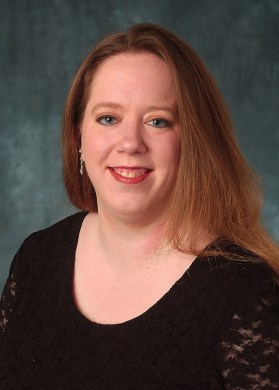
Missy Mazzoli

“Who is Missy Mazzoli?”

That’s the question being asked—and at least partly answered—by the Dairy Center for the Arts and music curator James Bailey on their Soundscape program at 2 p.m. Wednesday (Feb. 10).

The short answer is that Mazzoli is an adventurous composer from New York who writes in diverse genres, from opera to chamber music. She is in Boulder for a week for a Music Alive Composer Residency with the Boulder Philharmonic. The premiere of a new orchestral version of her Sinfonia (for Orbiting Spheres) by the orchestra and conductor Michael Butterman Friday evening (7:30 p.m. Feb. 12, Macky Auditorium) is only one part of her week-long residency. (More information in Boulder Weekly; tickets for the Boulder Phil concert here.)

Missy.skyline

Mazzoli with New York skyline

But it’s a deeper answer that Bailey is after—one that showcases many facets of a complex and label-defying artist. To give that fuller picture, Mazzoli and Bailey have put together a program that seems to live up to the New York Times’s description of her as “among the more consistently inventive and surprising composers now working in New York.” There will be pieces for solo violin, for viola with electronics, for string quartet, and two pieces for piano and electronics performed by Mazzoli herself. (Click here for tickets.)

weatherbee

Charles Wetherbee

It is the pieces themselves that justify the adjective “inventive.” What is most surprising, however, is the fact that Mazzoli’s works will be presented in alternation with—of all things—the movements of Bach’s monumental Partita in D minor for solo violin, performed by Boulder Phil concertmaster and CU faculty member Charles Wetherbee.

“The motivation to include the Bach was because I have a solo violin piece called ‘Dissolve, O My Heart,’” Mazzoli explains. “It was a commission from the violinist Jennifer Koh, who did a project called ‘Bach and Beyond.’ She commissioned pieces based on existing works by Bach, and my piece (is based on) the famous solo violin Chaconne from the D-minor Partita.

“When (the Dairy Center) came to me for a program, I said why don’t we play the whole Partita and we could intersperse (my pieces). My other music doesn’t come directly out of that, but it has inspiration from Baroque material and ornamentation. There’s a lot of string pieces on this program, a string quartet, solo viola piece, electronic solo violin piece, and I’m also playing two piano pieces some with electronics.”

Altius_2.jpg

Altius String Quartet

The complete list of Mazzoli’s pieces on the program will be: Tooth and Nail for viola and electronics, performed by Wetherbee; Orizzonte for piano and electronics, performed by Mazzoli; A Thousand Tongues for piano and electronics, performed by Mazzoli; Dissolve, O My Heart for solo violin—the piece based on the Bach Chaconne—performed by Wetherbee; and Quartet for Queen Mab performed by the Altius String Quartet, the award-winning Fellowship String Quartet in Residence at CU, Boulder.

Reading about Mazzoli, one quickly becomes aware of how eclectic her work is. She has had commissions from individual artists, including Koh; from orchestras around the country; from the Kronos Quartet; and from the Grammy-nominated adventurous vocal ensemble Roomful of Teeth. Her works sometimes include electronics, sometime not, and she also performs with Victoire, an all-female band described by critic Alan Kozinn as “an art-rock band, a live electronic music group, or both.”

Glenn+and+Mizz

Mazzoli and Kotche. Photo by Michael Woody.

She and Victoire collaborated with Wilco percussionist Glenn Kotche and experimental keyboardist Lorna Dune for her recently recorded Vespers for a New Dark Age. National Public Radio’s “First Listen” asked, “Is Victoire’s music post-rock, post-minimalist or pseudo-post-pre-modernist indie-chamber-electronica? It doesn’t particularly matter. It’s just good music.”

Clearly, Mazzoli is an enthusiastic participant in many of the musical trends of our times. Writing in the Los Angeles Times, Mark Swed said that her “musical influences are John Adams, the Minimalists and the moody vocal sonorities of early sacred music, with a hint of rock.”

Victoire1-1024x1024.jpg

Victoire. Photo by Stephen Taylor.

Mazzoli does not deny these varied sources. “Studying classical music you would be surrounded by all of that, so yeah, I claim all of them proudly,” she says. “It’s become kind of a cliché to say, oh I have so many diverse interests, I’m interested in pop music as well as classical music, but I think it’s kind of a natural state growing up in the ‘80s.

“I wouldn’t even call it a trend. It’s as if the whole palette of sound is available for composers now from throughout history. It’s not as much a self-conscious choice as just sort of pulling from everything you’ve encountered in your life.”

But Mazzoli doesn’t want listeners to get hung up on labels or influences. “I want people to just hear music for what it is,” she says, “and to maybe be intrigued by one of those phrases, because it can sound like any one of those things.

“There’s bits and pieces of all of that in there.”

# # # # #

The Feb. 10 Soundscape concert is only one of many events exploring the world of contemporary musical performance to be presented by the Dairy Center this spring. The full schedule is listed below; visit the Dairy Center Webpage for updates.

 SOUNDSCAPE MATINEE SERIES

2 p.m. Wednesday, March 9: The Austin Piazzolla Quintet and the Boulder Chamber Chorale
After a sold out concert last season, the tango band from Texas returns to perform with the Boulder Chorale Chamber Singers.

Thow Down:Shot Up

CU’s Throw Down or Shut Up

2 p.m. Wednesday, April 13: Classical Music Unbuttoned
One of Boulder’s most innovative groups, Throw Down or Shut Up is a faculty quartet from the University of Colorado, Boulder. They will share the concert with Trio Cordillera another CU faculty trio, performing Argentine and Spanish music.

2 p.m. Wednesday, May 25: The Altius Quartet:  The Passion of the String Quartet
Winners of the silver medal at the 2014 Bischoff Chamber Music Competition, the Altius Quartet was selected to perform at the Melbourne International Chamber Music Competition. At the Dairy they will perform selected movements from quartets by Beethoven, Mendelssohn, Stravinsky, Bolcom—and Led Zepplin!

2 p.m. Wednesday, June 8: Youth be Served
A concert of music featuring some of Colorado’s most talented high school performers and ensembles.

ONE NIGHT ONLY SERIES

 7:30 p.m. Monday, February 22: Voxare Meets the Man with the Movie Camera
The Voxare String Quartet from New York City the soundtrack to Russian filmmaker Dziga Vertov’s remarkable 1929 silent masterpiece The Man with the Movie Camera.

Wendy_Woo

Wendy Woo

7:30 p.m. Friday, March 4: Wendy Woo—A 25 Year Retrospective
An evening with the guitarist and singer/songwriter Wendy Woo, together with musical artists from her 25 years on the Colorado music scene. The concert will be preceded by a First Friday reception in the new Dairy lobby.

7:30 p.m. Wednesday, March 30: Conversations
For Boulder Arts Week, the Dairy will present an evening of duets, including Irish, Indian and Turkish duos. Two performances will also feature Boulder’s Frequent Flyers aerial ballet group.

4 p.m. Sunday, June 26th: The Miami String Quartet
The internationally renowned string quartet returns to the Dairy with a new program.

JAZZ AT THE DAIRY SERIES

 7:30 p.m. Saturday, February 27: Jazz and Vonnegut

brad goode

Brad Goode


A concert with the David Fulker Quartet and jazz singer Robert Johnson in a program of jazz standards thematically wrapped around an unusual short story by Kurt Vonnegut.

7:30 p.m. Wednesday, May 4: The Brad Goode Quartet with Sheila Jordan
Brad Goode, Boulder’s jazz trumpet virtuoso, will appear with his traveling quartet and jazz vocalist Sheila Jordan.

SPECIAL PERFORMANCE

 4 p.m. Sunday, April 17: Never to Be Forgotten
This Dairy collaboration with the Boulder Jewish Community Center and the University of Colorado School of Religious Studies will focus on chamber music by composers who were lost in the Holocaust.

(Edited to correct typos 2/8/16)


Busy, busy, busy: Many events for Boulder Phil, composer, violinist

Friday concert culminates residency week for composer Missy Mazzoli

By Peter Alexander

Missy.skyline

Missy Mazzoli

The Boulder Philharmonic and composer Missy Mazzoli will have a busy week Feb. 6–12.

Mazzoli, who visits Boulder courtesy of a Music Alive Composer Residency, will participate in a workshop with CU composition students, a Café Phil open rehearsal, a “Meet the Artists” luncheon and a musical stargazing hike (see the list of public events, below).

That’s in addition to the concerts: “Who is Missy Mazzoli” at 2 p.m. Wednesday, Feb. 10, on the Dairy Center Soundscape series; and “Spheres of Influence,” a concert by the Boulder Phil and music director Michael Butterman at 7:30 p.m. Friday, Feb. 12, featuring the premiere of the orchestral version of Mazzoli’s Sinfonia (for Orbiting Spheres).

A.A.Meyers1

Anne Akikoi Meyers

Mazzoli isn’t the only one who will be busy. Anne Akiko Meyers—who as soloist for the Mendelssohn Violin Concerto will share the Friday concert—is teaching a public masterclass at the CU on Thursday, Feb. 11, and attending the “Meet the Artists” lunch.

The full program of the Boulder Phil concert Friday will be Mazzoli’s Sinfonia, the Symphony No. 9 of Shostakovich, Tchaikovsky’s Mozartiana and the Mendelssohn Concerto. The Tuesday afternoon Soundscape concert will feature several of Mazzoli’s pieces, performed by Mazzoli, the Altius String Quartet and other local musicians, interspersed with movements of the Bach Partita in D minor for solo violin, performed by Boulder Phil concertmaster and CU music professor Charles Wetherbee.

Read more at Boulder Weekly.

# # # # #

Spheres of Influence

Boulder Philharmonic Orchestra
Michael Butterman, music director, with Anne Akiko Meyers, violin

Missy Mazzoli: Sinfonia (for Orbiting Spheres) World premiere of the orchestral version
Shostakovich: Symphony No. 9
Tchaikovsky: Mozartiana
Mendelssohn: Violin Concerto

7:30 p.m. Friday, Feb. 12 (note the day)
Macky Auditorium
Tickets

Other public events

6:30 p.m. Saturday, Feb. 6, Monday, Feb. 8, and Wednesday, Feb. 10, at the Boulder Valley Ranch Trailhead (Free; dates dependent on weather)
“Stars, Spirals and Orbiting Spheres” musical hike

Tuesday, Feb. 9 at the Dairy Center: Café Phil (Free)
7:10 p.m. Composer Chat in the lobby
7:30 p.m. Open Rehearsal

2 p.m. Wednesday, Feb. 10 at the Dairy Arts Center
Soundscape Concert: “Who is Missy Mazzoli?”
Tickets

9:30 a.m. Thursday, Feb. 11, Grusin Music Hall (Free)
Masterclass with Anne Akiko Meyers

1 p.m. Thursday, Feb. 11, Chautauqua Dining Hall
Meet the Artists, Progressive Luncheon with Anne Akiko Meyers, Missy Mazzoli and Michael Butterman
Tickets

Pro Musica Colorado delivers a performance to be remembered

Shostakovich’s personal expression of suffering anchors a fascinating program

By Peter Alexander

Pro Musica Colorado Chamber Orchestra and conductor Cynthia Katsarelis presented a concert last night in Boulder (Jan. 23) that deserved a far larger audience than it drew.

OLYMPUS DIGITAL CAMERA

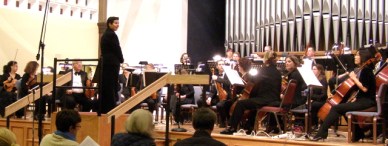
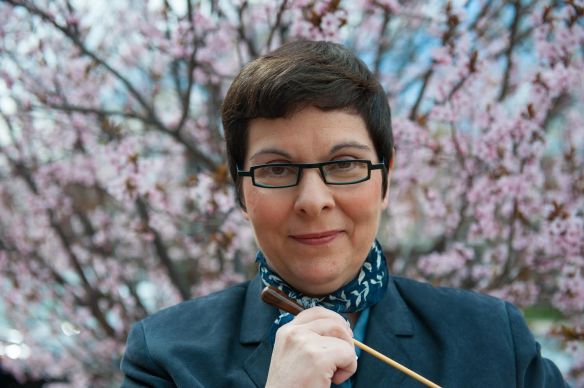
Cynthia Katsarellis and the Pro Music Colorado Chamber Orchestra

Perhaps it was the gloomy-sounding topic—music for and by victims of World War II—but the sanctuary of the First United Methodist Church was not quite half filled. Anyone who stayed away missed an extraordinary program and one exceptional performance.

The centerpiece and foundation of the program—and final work of the evening—was Shostakovich’s Chamber Symphony, op. 110, a string orchestra setting of the composer’s String Quartet No. 8. Dedicated to “the victims of fascism and war,” the Quartet is more than that; it is a personal expression of deep suffering, possibly a self-eulogy from a composer who was contemplating suicide.

silver Gelatin Print

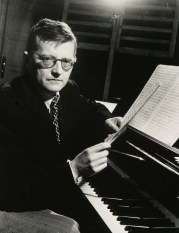
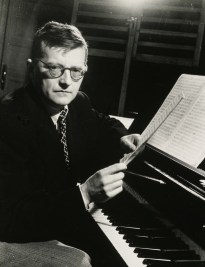
Dmitri Shostakovich

The evidence of the composer’s real intent lies in the quotations from his own works scattered through the score—particularly works written under the oppressive yoke of Stalinism. The quartet’s most prominent theme, D-E-flat-C-B, is an anagram of his own name in German musical notation: DSCH.

As gloomy as that may sound, the Quartet No. 8 is one of Shostakovich’s greatest works, and one of the great string quartets of the 20th century. Last night’s performance was evocative, powerful and beautifully crafted. The unity of performance within the individual sections—corresponding to the four parts of the quartet—was remarkable, in pitch, in rhythm, in phrasing. Katsarelis led the performance with commitment and careful control of the quartet’s emotional flow.

The translation to a string orchestra changes the score in some ways. In the quartet version, the single instruments seem to represent individual voices crying out, a poignant reminder of both Shostakovich’s plight and the individual lives lost in the war. On the other hand, the added force of the orchestra version effectively conveys the weight of oppression. This is most notable with the fierce, pounding three-note motive representing the KGB and their feared late-night knock at the door. That motive, and the anguished passages that follow, were the most powerful moments of the concert.

While I am inclined to prefer the original version, because of its intimacy and because it was the composer’s first intention, last night’s performance made a strong case for the Chamber Symphony version as well. It was a performance to be remembered.

The rest of the program was creatively put together, with three pieces that complimented one another nicely: Bach’s Brandenburg Concerto No. 3; the world premiere of Life Between Lives by D.J. Sparr, loosely derived from the Bach; and the Study for String Orchestra by Pavel Haas, a genuine victim of the Second World War. Unfortunately, none of these works quite reached the heights of the Shostakovich.

The concert opened with the Bach Brandenburg. A delightful score, it was given a sprightly performance, but the church’s acoustics—about which I have complained before—made Bach’s sparkling counterpoint sound tubby and turgid. The closely spaced parts, especially in the lower register, just cannot be heard clearly in that space.

The use of the slow movement from Bach’s G-major Sonata for violin and harpsichord to fill out the Brandenburg’s enigmatic two-chord slow movement was an interesting choice, and one that worked well as it moved nicely into the key-defining chords.

DJ Sparr

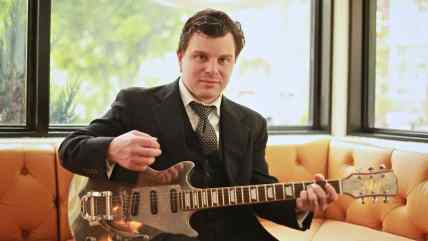
Composer/guitarist D.J. Sparr

Sparr’s Life Between Lives was composed for the Colorado Pro Musica and plays with the same instruments and textures as the Bach. It opens with mysterious chords, representing “Moment before Breath” (as the movement is titled), just before the beginning of life. This movement seems to recall Sparr’s performing career as an electric guitarist, with sounds resembling electric guitar effects transferred to strings.

Slow moving lines hovering within and above the often dissonant chords gradually accumulate, creating a dramatic sense of breath withheld. That texture soon becomes animated by pizzicato rhythms beneath the surface texture. This is the second movement, “Moment Before Thought,” but other than the pizzicato stirrings, the sound is very much like the first movement.

A sudden acceleration signals the last movement, “Life Between Lives,” where the increasing speed is created by a pulsing repetition of notes and chords, still within the same sound palette. The repetitive rhythms provide the only sense of direction, while the lack of contrast casts a pall of timbral monotony over the texture. There is an increase in intensity with an ascending line in the violins; and then the piece stops with, to my ear, no sense of arrival.

PavelHaas

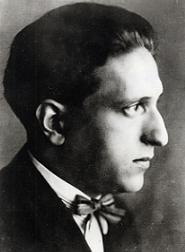
Pavel Haas

Ending the concert’s fist half was Haas’s Study for String Orchestra. A victim of the Nazis who was interned in the Terezín concentration camp and later killed at Auschwitz, Haas is known as part of the missing generation of German and Austrian Jewish musicians who perished in the Holocaust. The Study is a pleasant, entertaining work written under the most difficult of circumstances—in the camp, where it was premiered in 1943.

This is a work that, as Katsarelis has said, “speaks marvelously to the human spirit—and to the power of music.” The performance was on a very high level, especially the fugue that drives the piece to its end. That said, in spite of the work’s history, it is neither as profound nor as moving as the Shostakovich that ended the concert.

In the end, then, Katsarelis and the orchestra gave us a fascinating combination of composers and works, much to think about, some wonderful playing, and one great performance to be remembered.

Eulogy of Self

Pro Musica Colorado plays music for and by victims of World War II

By Peter Alexander

Photography by Glenn Ross. http://on.fb.me/16KNsgK

Cynthia Katsarelis. Photo by Glenn Ross.

Composers who write their own musical eulogies do not usually create jolly pieces.

silver Gelatin Print

Dmitri Shostakovich

Dmitri Shostakovich, who suffered various forms of personal and artistic oppression throughout his career, was certainly no exception. When he wrote his Eighth String Quartet in 1960 he was contemplating suicide—which his friends prevented, fortunately. The work he wrote, dedicated to “the victims of fascism and war” but also reflecting his own suffering under the Soviet regime, remains a powerful testament to a low point in his life.

“This is really dark” says Cynthia Katsarelis, who will conduct the string orchestra version of the quartet, the Chamber Symphony for String Orchestra, with the Colorado Pro Musica Chamber Orchestra Friday in Denver and Saturday in Boulder. “He thought it was his own eulogy.”

The concerts are part of a two-year celebration of Shostakovich chamber music organized by the Colorado Chamber Players. Other works on the program will be the world premiere of Life Between Lives by American guitarist/composer D.J. Sparr, J.S. Bach’s Third Brandenburg Concerto, and the Study for Strings by Pavel Haas.

For more, see Boulder Weekly.

# # # # #

pmc-logo

Shostakovich: Dedication
Pro Musica Colorado Chamber Orchestra, Cynthia Katsarelis, conductor

J.S. Bach: Brandenburg Concerto No. 3
D.J. Sparr: Life Between Lives (world premiere)
Pavel Haas: Study for Strings
Dmitri Shostakovich: Chamber Symphony for String Orchestra

7:30 p.m. Friday, Jan. 22, First Baptist Church, Denver
7:30 p.m. Saturday, Jan. 23, First United Methodist, Boulder

Tickets


Takacs Quartet’s Dusinberre on music and health

An article in The Guardian explores a most unusual topic: Life insurance for string quartet players

By Peter Alexander

Takacs.Dusinberre.CUphoto-X2

Edward Dusinberre

Edward Dusinberre, the first violinist of the Takacs Quartet, CU artist-in-residence and Ralph E. and Barbara L. Christoffersen Faculty Fellow at the CU College of Music, writes in The Guardian:

The foundation of a string quartet is formed over a long period of time from the musical and personal bonds that evolve between four individuals. Nonetheless, the decision we took several years ago to purchase life insurance polices for each other felt awkward. Until we became accustomed to our peculiar status as each other’s beneficiaries, minor illnesses were observed with wry attentiveness.

The article gives a peek into the inner workings of one of the world’s most celebrated string quartets, and also serves as teaser for Dusinberre’s book, Beethoven for a Later Age: The Journey of a String Quartet published in England by Faber and Faber and coming later this spring from Chicago University Press in the United States.

Read the entire article in The Guardian.

Boulder Phil offers Americana, east and west

“Dance, American Style” features collaboration with Boulder Ballet

By Peter Alexander

They will be dancing in the aisles, and on the stage of Macky Auditorium when the Boulder Philharmonic presents its first concert of 2016.

Rodeo

Photo by Keith Bobo

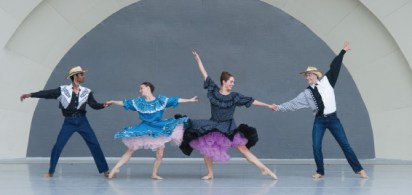
The program, titled “Dance, American Style,” will be presented at 7:30 p.m. Saturday (Jan. 16; tickets). Boulder Ballet will perform the complete ballet Rodeo by Aaron Copland, with choreography by artistic director Ana Claire.

Music director Michael Butterman will conduct the performance, which will also feature concert performances of music from Copland’s Billy the Kid ballet, the Symphonic Dances from West Side Story by Leonard Bernstein, and the New England Triptych of American composer William Schuman.

aa_bernstein_copland

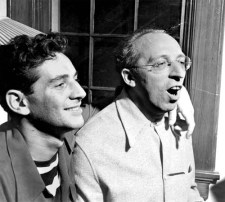
Bernstein and Copland, 1945

The program is an attractive anthology of American music from the mid-20th century. Copland was one of the most prominent composers of that era, with his folkish American style represented by both Billy the Kid and Rodeo, two staples of the orchestral repertoire to this day. Leonard Bernstein was both a champion of Copland’s music and a composer of protean abilities who made a mark on Broadway—the ultimate American musical genre of the 20th century—and in the concert hall. And William Schuman was the composer of acclaimed, accessible concert works, winner of the Pulitzer Prize in music, and a leader of American music for many years as president of first the Juilliard School and later Lincoln Center.

But as the title suggests, the program can also be seen as a tribute to the personalities and companies who established an American world of dance. In fact, it touches many of the legendary dance figures of the mid-20th century.

Billy the Kid was commissioned from Copland by dance impresario Lincoln Kirstein and premiered in 1938 by Kirstein’s Ballet Caravan. That company preceded the New York City Ballet, co-founded by Kirstein and Georges Balanchine. Billy was choreographed by Eugene Loring, who also danced in the premiere and later joined American Ballet Theater.

rodeoslides10p1

De Mille’s Rodeo; photo by Peter Shields

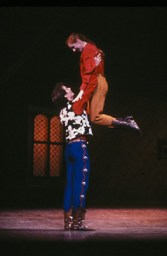
Rodeo was commissioned for the Ballet Russes de Monte Carlo. The choreographer was Agnes de Mille, who also danced the lead role at the 1942 premiere at the Metropolitan Opera House. In the audience that night were Richard Rogers and Oscar Hammerstein, who in turn invited de Mille to choreograph the dance sequences for their upcoming show, Oklahoma, thereby transforming the Broadway musical.

 Symphonic Dances from West Side Story is a suite for symphony orchestra taken from the score for Bernstein’s 1957 Broadway hit. It was compiled in 1961 by Bernstein in collaboration with his colleagues Sid Ramin and Irwin Kostal, who had just finished producing the orchestral score for the film version of the show, employing a much larger orchestra than the original Broadway pit band.

Robbins_rehearsal61

Robbins rehearsing West Side Story

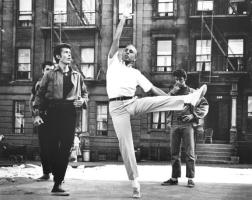
The score incorporates West Side Story’s top hits, “Somewhere” and “Maria,” alongside the many dance sequences from the show. Director and choreographer of the original Broadway production was Jerome Robbins, whose innovative dances for the rival street gangs won the 1957 Tony Award for best choreography. Robbins was for many years one of the most influential American directors, choreographers and producers of ballet, Broadway, film and television.

For the Jan. 16 concert, Rodeo will be the only dance that is brought onto the stage. The performance will conclude with Boulder Ballet performing the full ballet—slightly longer than the familiar orchestral suite—on the front of the stage and in the aisles. Even though the full orchestra will be onstage with the dancers, “we’re going to give them as much room as we can,” Butterman says.

In any case, he adds, “It’s an uncommon chance to experience great concert music and see a short ballet on the same night!”

Butterman (old)

Michael Butterman

The rest of the program, Americana of several types—the “great concert music”—all seems to fit together in a very coherent way. But in fact, Butterman says, “this concert came together in kind of a bizarre way,” with each of the other pieces having been originally planned for another concert. “But I do think the program itself works rather nicely,” he adds.

The least familiar work will be Schuman’s New England Triptych, a work that is deeply rooted in America’s early history. It is based on the work of William Billings, a colonial-era song- and hymn-writer. Three of his songs—“Be glad then America,” “When Jesus Wept” and “Chester”—are the sources of the three movements.

“This is music that a lot of wind players encounter through the wind ensemble literature,” Butterman says. “It’s really attractive, it’s splashy when it needs to be, and yet that middle movement is beautifully introspective. The outer movements are very difficult—quick and very demanding.”

schum2

William Schuman

In fact, he says, the whole concert will be difficult playing. “As I was studying this program over the past few days, I began almost kicking myself,” he says. “What was I thinking? In spite of the fact that the music is pretty familiar, it’s all difficult!”

That would be most obviously true of the Symphonic Dances from West Side Story, which was clearly designed as a jazzy virtuoso showpiece for the musicians of the New York Philharmonic. “A member of a prominent orchestra (told me) a few years ago he thought this was one of the hardest pieces in the standard repertoire,” Butterman says.

“You have to get the swinging right, you have a real sort of screaming trumpet, and you’ve got lots of percussion. It’s really hard stuff to get together. It will be a challenge—it’s a challenge for any orchestra. It just takes some work.”

Fortunately, he adds, the orchestra will have four rehearsals in Macky Auditorium before the concert, instead of having part of their rehearsal week in the Dairy Center or some other location with different acoustics. “We’ll be able to hear it the same way four times in a row,” he says. “That will help a lot, I think.”

Once all the pieces are put in place, Butterman has no doubts that the audience will love the program. It fits Boulder Phil’s winning formula: some familiar pieces, even some pop and jazz-inflected music from Broadway, and a chance for people to discover something new in the New England Triptych.

“It’s all high energy and colorful, fun Americana,” he says, “with the added appeal of seeing the Copland brought to life in the way it was originally conceived—as dance music.”

# # # # #

Dance, American Style
Boulder Philharmonic Orchestra, Michael Butterman, music director
With the Boulder Ballet, Ana Claire, artistic director

7:30 p.m. Saturday, Jan. 16, 2016
Macky Auditorium

William Schuman: New England Triptych
Leonard Bernstein: Symphonic Dances from West Side Story
Aaron Copland: “Prairie Night, “ “Waltz” and “Celebration Dance” from Billy the Kid
Aaron Copland: Rodeo (complete ballet)
Boulder Ballet performing choreography by Ana Claire, artistic director

Tickets

Takacs Quartet and McDonald shine in 2016 opener

Engrossing performances of Beethoven, Janáček and Elgar

By Peter Alexander

Yesterday afternoon (Jan. 10) the Takacs Quartet and pianist Margaret McDonald gave an engrossing performance of an unusual and fascinating program.

Takasce SQ

Tákacs Quartet. Photo by Keith Saunders.

For their first concert of 2016, the Takacs presented three works: Beethoven’s genial first string quartet, the Quartet in D major, op. 18 no. 3; Leoš Janáček’s spiky Sonata for violin and piano, played by first violinist Edward Dusinberre with McDonald; and everyone together for Edward Elgar’s brooding, late-Romantic Piano Quintet in A minor.

The program will be repeated tonight at 7:30 p.m. in Grusin Music Hall of the Imig Music Building. Call 303-492-8008 for ticket availability.

I found this a particularly engaging concert in part because of it’s remarkable and wide-ranging variety. Think about it: every piece had a different combination of players; every piece represented a starkly different style (in spite of the fact that the Janáček and Elgar pieces were written within four years of one another); and every piece was played with the full interpretive commitment and musical integrity of a world-class chamber ensemble.

The Beethoven quartet, which opened the program, was an opportunity for the Takacs to show why they are considered one of the world’s leading quartets. They play with great precision and near-perfect intonation, but many quartets do that. But listen to the balance of the chords that close the exposition of the first movement, where you hear the entire chord, not a punctuating “thump.” Listen to the clarity of the interchange among the parts in the development section, where you can hear cleanly through the texture, with no important part covered. It is as if the music were produced by a single artistic mind, a feat not easily accomplished.

The third movement, with its unexpected transitions and slightly off-balance feel, never went awry, and the virtuosic finale rushed along with great exhilaration right to the surprising and humorous ending—Beethoven was a student of Haydn!—without ever feeling strained. It’s a genial and charming piece, with just a bit of Beethoven’s rough-hewn character, and the performance was utterly convincing in every detail.

Janáček’s Sonata for violin and piano of 1914 was written in the middle of Eastern Europe in the tense months before the outbreak of the First World War. The music seems to reflect the tension of the times, but Janáček’s highly individual music is written in such fragmentary bursts of feeling and mood that it often sounds as though some dangerous drama is about to unfold.

McDonald-X2

Pianist Margaret McDonald. Photo by Casey A. Cass/University of Colorado

The Sonata is so infrequently a part of concert programs—I don’t think I’ve heard it live before—that it was a delight to hear. The performance by Dusinberre and McDonald was highly accomplished, although it struck me as slightly restrained. Particularly in the last movement, where the violin keeps interrupting the lyricism of the piano with menacing outbursts, I could imagine a more ferocious, more intense interpretation.

If the Janáček sits poised at the outbreak of World War I, the Elgar Quintet sits poised at war’s end, a melancholy Victorian ornament in a world that has been shattered. The first movement seems uneasy from the very first halting notes, a mood that is occasionally interrupted by swellings of nervous lyricism. The second movement is one of melancholy comfort, a sort of musical brown study, yearning for the Victorian confidence that was swept away by the war. And the finale tries to add a note of bravado to the mood, without quite being convincing.

This remarkable piece, one of Elgar’s last, was the triumph of the concert. String quartets are notorious for being closed musical families, but McDonald seemed completely integrated into the group. She and the quartet players matched styles and achieved a balance that was admirable, especially for such a long and emotionally complex work. Everyone was fully committed to the surging emotions of Elgar’s score.

I don’t often get to hear Takacs Quartet concerts, but this is one I am delighted not to have missed. If you can beg, borrow or steal a ticket for tonight’s performance, go. It is a program and a musical experience unlikely to be duplicated.

Grammy-nominated Takacs Quartet explores new repertoire

Pianist Margaret McDonald collaborates in performances of Janáček and Elgar

By Peter Alexander

Takasce SQ

Tákacs Quartet. Photo by Keith Saunders.

The Takacs Quartet has such a long and distinguished history, has performed and recorded so much music, that it is surprising to learn that there is major repertoire that has not appeared on their programs.

In fact, their list of unplayed works will shrink by two at their performances Sunday and Monday (4 p.m. Jan. 10 and 7:30 p.m. Jan. 11) in Grusin Music Hall. And unsurprisingly, neither is for string quartet alone: The Takacs and pianist Margaret McDonald will perform Edward Elgar’s Quintet for piano and string quartet; and McDonald and first violinist Edward Dusinberre will present Leoš Janáček’s Sonata for violin and piano.

Completing the program will be Beethoven’s String Quartet in D major, op. 18 no. 3.

This will be the first concert by the Takacs following the announcement in December that their album with pianist Marc-Andre Hamelin of Shostakovich’s Piano Quintet and String Quartet No. 2 has been nominated for a Grammy Award. It is their fifth nomination and will be their second award if they win. The Grammy Awards will be presented Feb. 15.

“We’re always trying to combine music that’s very much our standard repertoire with newer things,” Dusinberre says. “It’s fun with (Elgar and Janáček), since they’re written at a similar time around the First World War, and the musical language couldn’t be more different.”

Read more in Boulder Weekly.