120-year-old debutante makes a strong impression with Boulder Chamber Orchestra

Saless’ BCO and Mina Gajić’s 1895 piano give promise for the future

By Peter Alexander

Last night (Oct. 30) the Boulder Chamber Orchestra (BCO) and conductor Bahman Saless presented what may the most important debut of the musical season in Boulder. At 120, the debutante sounded wonderful.

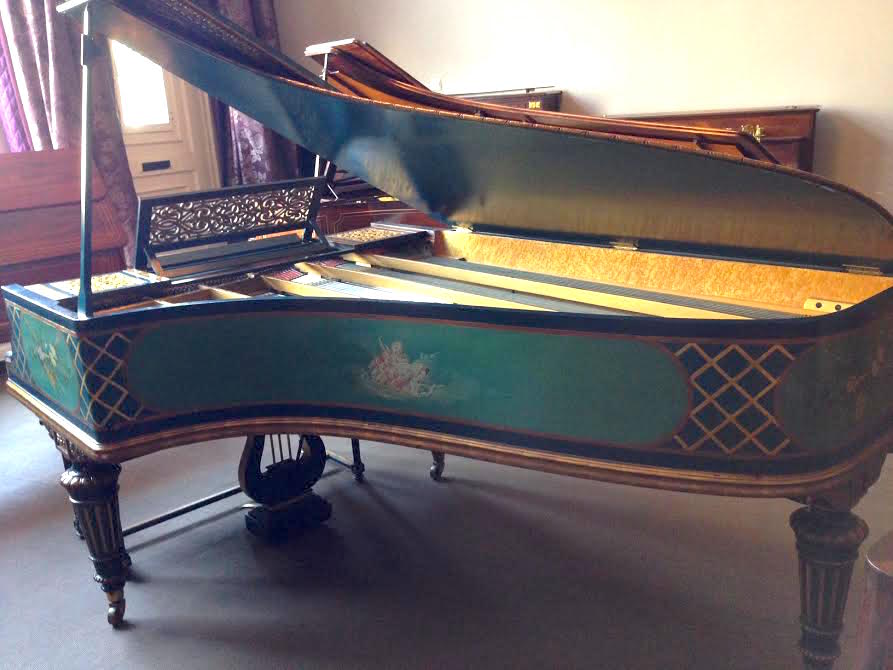
BCO's debutante: an 1895 piano by Érard.

BCO’s debutante: an 1895 piano by Érard.

In case you didn’t know, the “debutante” was a piano, made in Paris in 1895 by the firm of Sébastien Érard. It was played by the evening’s soloist, pianist Mina Gajić, who purchased the piano in Amsterdam in 2014 and brought it to Boulder. The concert was the first ever performance on the instrument in the U.S.

A superb pianist, Gajić gave memorable performances of two works—one written before the piano was built, and one after. The earlier work was the Malédiction (Curse) for piano and strings of Franz Liszt; the later was Young Apollo for piano, string quartet and string orchestra by Benjamin Britten.

“We thought it would be an interesting juxtaposition to have a piano that fits right in the middle of these pieces—Liszt in 1833, Britten in 1939, and the piano from 1895,” Gajić said.

Erard piano.4The straight-strung Érard piano, with strings that run parallel in all registers, has a marvelously clear and transparent sound. (For more details of the piano’s construction, read my earlier post previewing the concert.) The sound is particularly striking in the highest register: bright, pure and clean, without ever sounding pingy or losing a delicious piano sound. The middle register sounds more like a modern piano, but one that is remarkably present.

My only reservation might be the bass, which is powerful and hard-edged, and when heard alone almost metallic in its timbre. Nonetheless, the bass supports and blends with chords in all registers, adding weight to the sound without turning it thick or murky.

But what is most striking is the clarity and penetration of the sound in all registers. The sound was never swallowed up by the full string orchestra, in even the loudest passages. Every chord throughout the range was clear, always audible, always transparent. Even though the instrument is seven feet—in contrast to today’s Steinway D and Kawai EX at nine feet, or the Bösendorfer 290 Imperial at nine feet six inches—the Érard can be plenty loud, without any distortion or loss of sound quality.

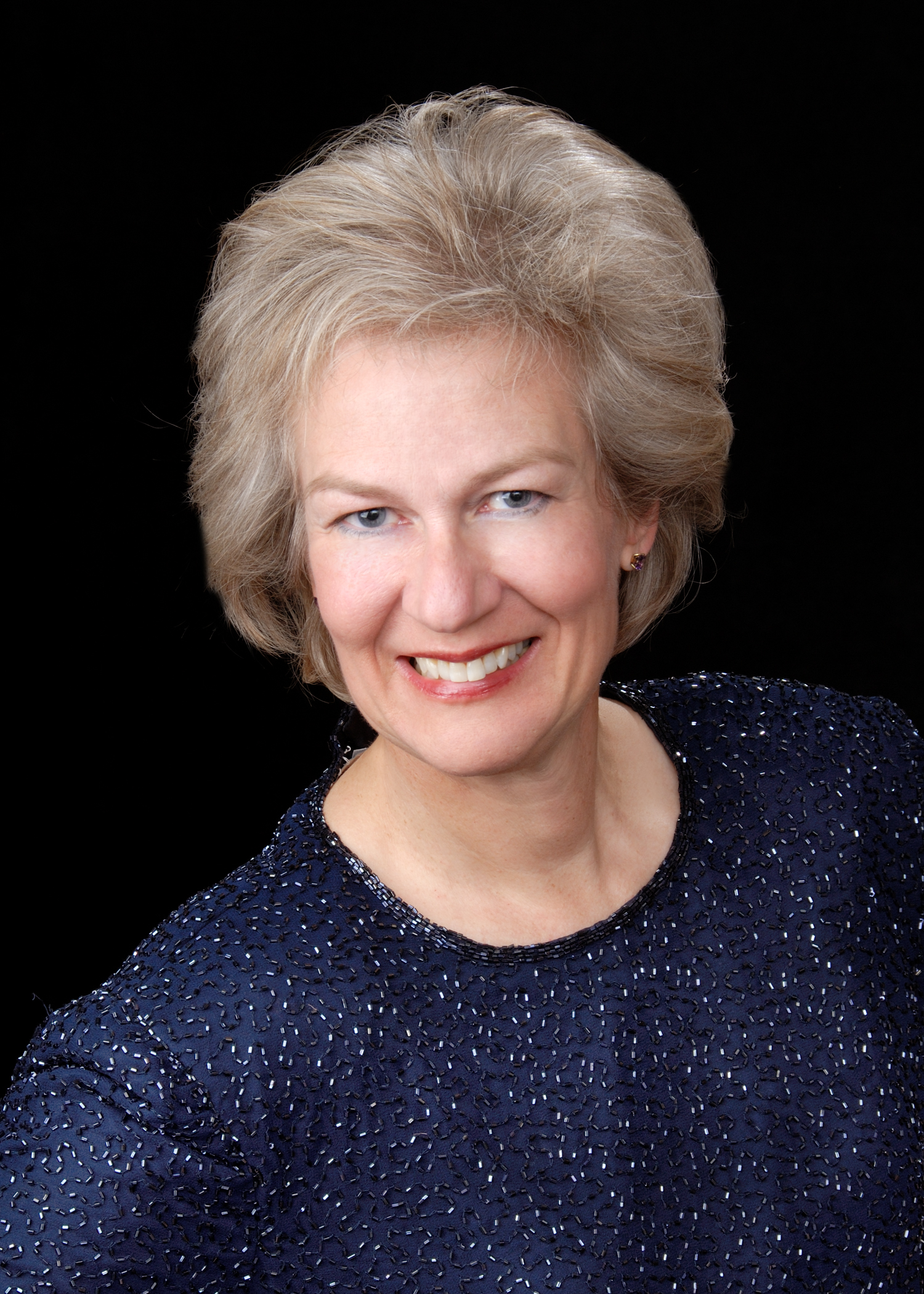
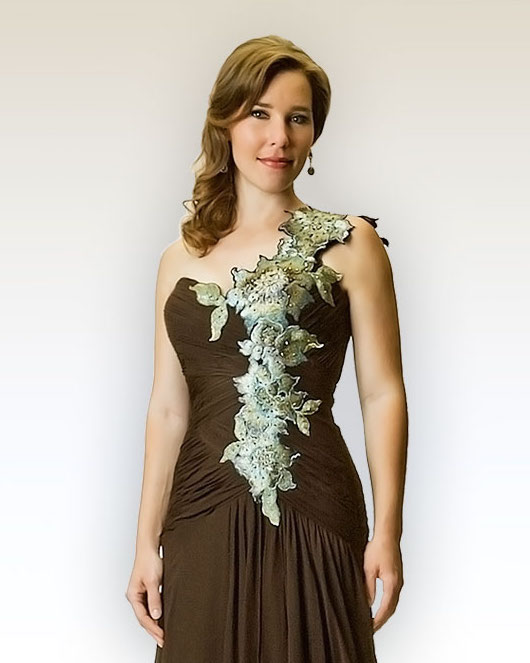
Pianist Mina Gajić

Pianist Mina Gajić

But the piano, however marvelous, doesn’t play itself. Gajić had the apparently effortless control of the music that characterizes every true virtuoso, in both the Liszt and the Britten.

Young Apollo is an odd piece, one that was written very early in the composer’s career and then withdrawn after its first performance. It was never heard again until after Britten’s death in 1976. It is hard to find in the score signs of the Britten one recognizes from his later and well known operas. It is full of bustle and fanfare, with declamatory string chords juxtaposed with surging scales running the full length of the piano.

Gajić and the BCO gave a robust performance. If the piece was not quite as nutty as Saless suggested in his remarks, it was pleasingly off-center, and played with conviction. One might consider the piano a little antiquated for a 1939 piece, but it was more than up to Britten’s quirky demands. The opening scales were the perfect introduction to the piano, allowing one to hear the sound from the bottom to the clear, bell tones that capped each run.

The title of Liszt’s Malédiction originally referred to only the first section of the piece, which contains a great deal of contrast along with its pianistic fireworks. It is likely that the pianos of 1833 couldn’t quite provide what Liszt wanted in this score, but by 1895 Érard pianos were up to the task.

Once again, Gajić and the orchestra gave a very convincing interpretation of a piece that is not heard often. Gajić tossed off all of Liszt’s virtuoso passages—written, after all, for his own showy concerts—with confidence. The piano was never covered or dominated by the orchestra in this well balanced performance.

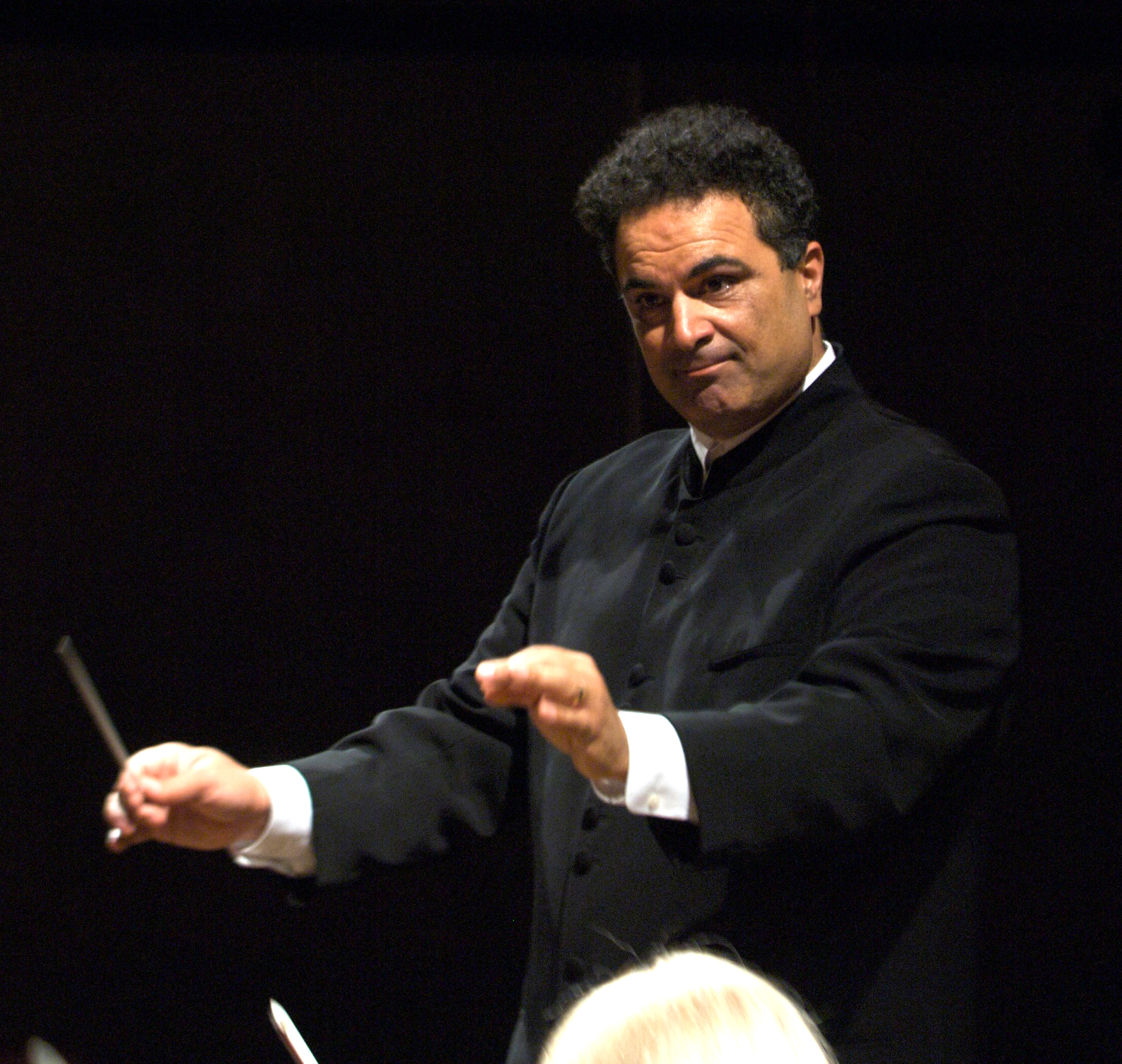
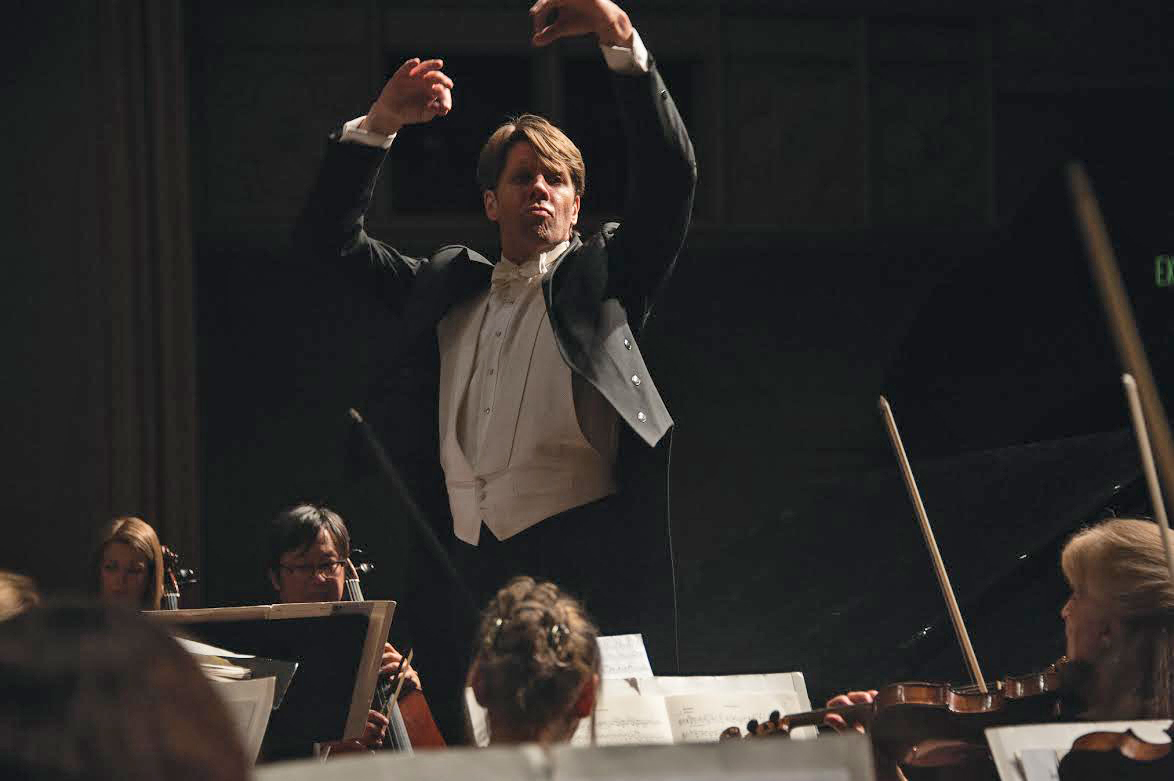
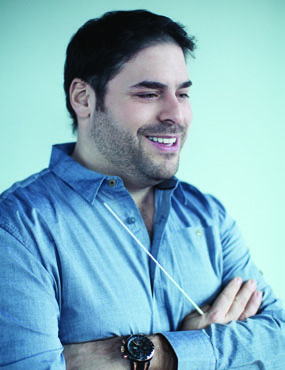
Bahman Saless. Photo by Keith Bob.

Bahman Saless. Photo by Keith Bob.

Intermission saw audience members surrounding and photographing the piano, which obviously stirred great interest. It is unfortunate if the rest of the concert was slightly overshadowed by the instrument, because Saless led incisive, controlled performances throughout. The program, titled “Spook Symphony,” included several pieces selected for Halloween.

The concert opened with Mozart’s Adagio and Fugue in C minor, K546, which begins with an ominous C minor that suggests threat and fear. The piece was written for string quartet, but the full sound of the BCO string section multiplied the sense of menace in the Adagio. On the other side of the same coin, the fugue occasionally suffered from the lower parts not being as nimble and precise in section as they could be with the single players of a quartet.

After intermission, Saless and the BCO presented the one definitively spooky piece of the “Spook Symphony,” Bernard Herrmann’s score to Alfred Hitchcock’s horror classic Psycho. Under Saless, the performance achieved all the menace and tension that Herrmann was aiming for. The parts were carefully balanced, with interior lines and a repeated three-note motive carefully brought out from the texture.

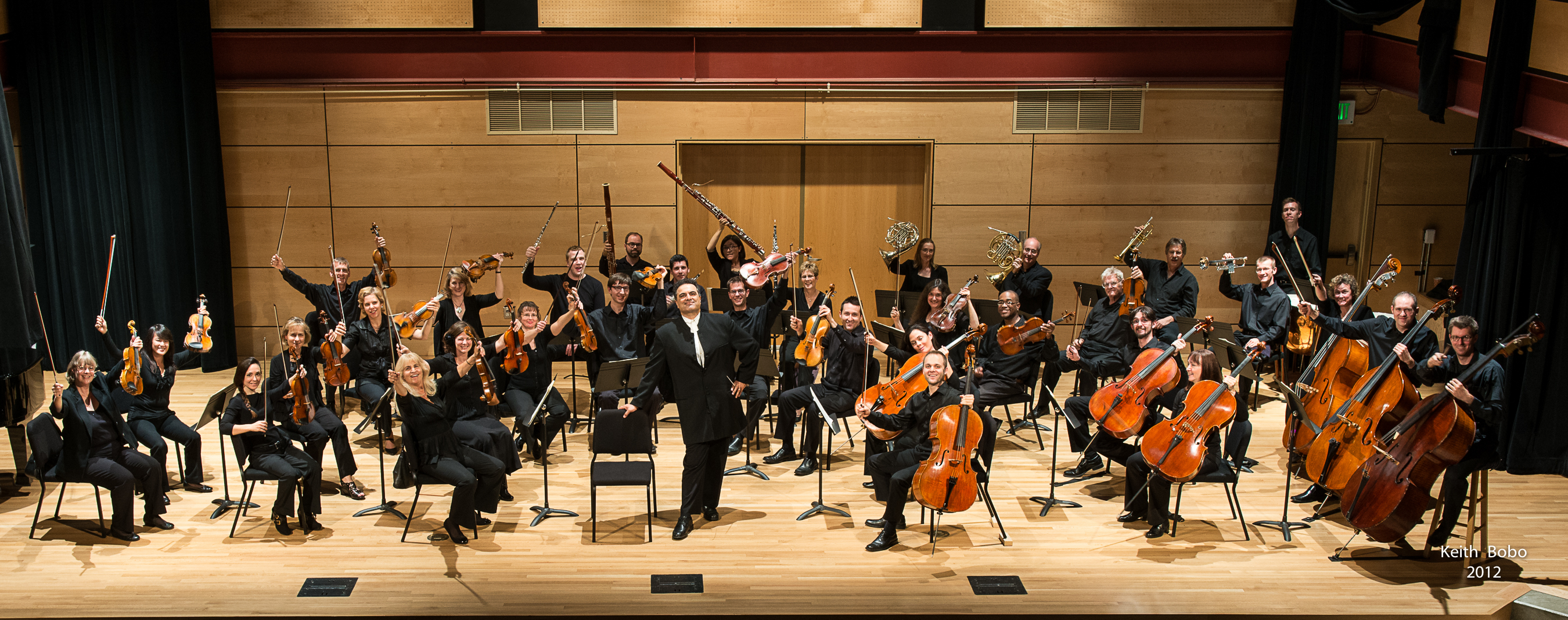
Bahman Saless with the Boulder Chamber Orchestra. Photo by Keith Bobo.

Bahman Saless with the Boulder Chamber Orchestra. Photo by Keith Bobo.

This was clearly an audience favorite. I saw knowing, if slightly guarded, smiles and heard a slight nervous chuckle when the slashing chords of the famous shower scene were played.

Happily, the concert ended with a piece that did not leave audience members afraid to venture out into the dark. Danish composer Carl Nielsen’s early Little Suite for Strings—as Op. 1 it was his first published work—opens with a slightly sinister Prelude, but proceeds with movements that are much more cheerful. The Intermezzo practically danced along, and the Finale ended comfortably. Saless elicited very good string playing and a true ensemble performance from the section.

In all, this was a memorable concert that promises well for the BCO’s season, and for all future appearances of Gajić and her historic piano.

Seicento and guest artists give a splendid realization of a musical monument

Monteverdi’s 1610 Vespers needs to be seen as well as heard

By Peter Alexander

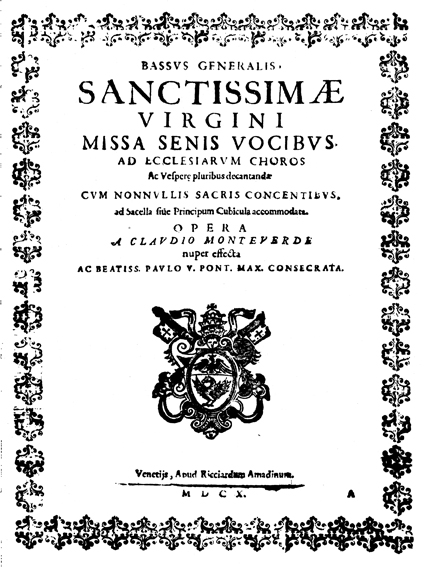
Title page of Monteverdi's 1610 Vespers

Title page of Monteverdi’s 1610 Vespers

Let’s start here: Monteverdi’s 1610 Vespers is one of the greatest, and least known, monuments of European music.

That being the case, we should be especially grateful that conductor Evanne Browne, the Seicento Baroque Ensemble, and artists gathered from the world of historical performance gave us a splendid realization of Monteverdi’s masterpiece, Saturday night in Boulder and Sunday afternoon in Denver (Oct. 24–25).

Printed in Venice in 1610, the Vespers burst upon the musical world at a critical moment in history. The style that had dominated written European music for generations, based in the chant and the modes of sacred music, was giving away to a dramatic style that opened deep levels of personal expression and musical relationships based on major and minor keys. This style led to the creation of opera as we know it, the concerto, the symphony, and ultimately most of the music we hear today.

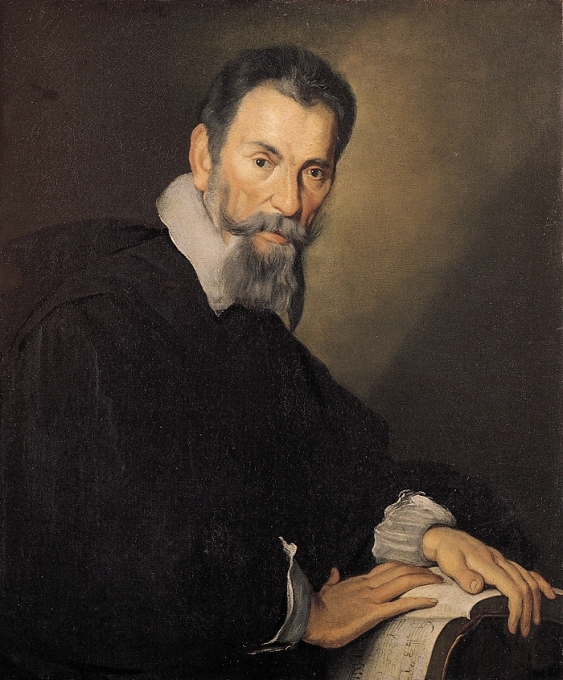
Claudio Monteverdi. Portrait by Bernardo Strozzi.

Claudio Monteverdi. Portrait by Bernardo Strozzi.

More than just a single work, the Vespers comprise an anthology of the musical styles of the early 17th century. Their 90 minutes of music include deeply expressive songs and brilliant instrumental flourishes out of early opera; stunning virtuoso vocal ensembles from late Renaissance courtly madrigals; and powerful choral passages that anticipate Bach in brilliance and contrapuntal complexity. A composer of great genius, Monteverdi here created a work of overwhelming impact.

Or as a scholar of my acquaintance remarked, with only slight hyperbole, “It’s a piece of music that we as a species do not deserve.”

In spite of such veneration from performers and scholars, the Vespers remain little known to the general musical public, because performances are relatively rare. To present them in their entirety requires both technical skill and expertise in the performance styles of the early Baroque. Happily, Seicento’s presentation was on a very high level in both respects. Browne’s apparent ease in managing such a large undertaking and leading a taut, well-paced performance are a testament to her skill as a conductor of Baroque music.

cornettos

cornettos

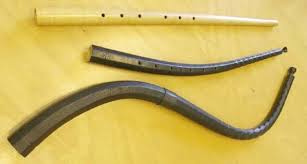
It is a sign of the depth of the resources available today in the recreation of historical musical styles that a splendid ensemble of specialist players and soloists can be assembled from around the world for performances in Colorado. In addition to singers skilled in the Baroque style, Browne brought together specialized instruments including cornettos (an early wind instrument that has a mouthpiece like the trumpet and fingerholes like the recorder, made of wood and covered in leather), sackbuts (a precursor of the modern trombone) and theorbo (a large lute).

Evanne Browne, artistic director of Seicento

Evanne Browne, artistic director of Seicento

And music lovers in Boulder and Denver can take great pride that a superb conductor, chorus and local soloists formed the foundation of these performances.

In the Sunday performance that I heard Seicento showed great skill with the Baroque style, handling the intricacies of Monteverdi’s vocal parts and filling St. Paul Lutheran and Roman Catholic Church in Denver with a splendid sound. My only reservation was that the size of the group—approximately 40 singers—and the resonance of the space conspired to obscure some details, including parts of the text and some instrumental flourishes. For example, the opening movement, Deus in adjutorium, incorporates the fanfares that also open Monteverdi’s opera Orfeo, but played by Baroque cornettos they could not cut through the choral sound.

On the other side of the same coin, when needed the chorus could create a glorious climax. Their entrance in Audi Coelum, following a series of delicate echo passages, made a powerful impact.

The soloists assembled for this performance were quite impressive. I don’t want to risk slighting anyone by singling out any one for praise, but I have to mention the solo aria-like Nigra sum, the virtuoso ensembles Laetatus sum and Duo Seraphim (the latter more than a duo, and performed without conductor in the manner of a madrigal), and the male quintet of Et misericordia as especially memorable.

Anyone who remembers the bad old days when historic instruments were played inexpertly and out of tune if at all will have been delighted with the quality of playing and accuracy of intonation. With players from the east coast and Europe, Browne assembled an ensemble equal to many specialized groups today. Indeed, some of the players have performed the Vespers dozens if not hundreds of times, and it was a great pleasure to hear a historical performance of such quality.

Seicento Baroque Ensemble

Seicento Baroque Ensemble

There were many high points in the performance, of which I will mention only a few. The convergence on a unison for the “Amen” of Laudate pueri was a moment of arresting beauty. To the vocal ensembles previously listed, I should add Pulchra es, another unconducted piece of chamber music. The brilliant Sonata sopra Santa Maria ora pro nobis—itself a miniature masterpiece of early Baroque style—elicited equally brilliant playing from the instrumentalists. And the combination of florid instrumental parts with the serene choral sound in Deposuit potentes was breathtaking.

Finally, the Vespers need be seen as well as heard. There are several wonderful recordings, but none can replace the experience of hearing the Vespers in space, seeing the placement of singers and players, observing as well as hearing the ever-changing combinations of voices and instruments, and hearing the echo effects within the airy space of a church.

And so again: deep gratitude to Browne, to Seicento, and to all the soloists and guest artists for bringing us a performance to be remembered.

Boulder Phil opens season with fairy tales and virtuosity

Two contrasting concertos contribute to a well balanced program

By Peter Alexander

Boulder Phil Music Director Michael Butterman

Boulder Phil Music Director Michael Butterman

The Boulder Philharmonic opened its 2015–16 season last night (Sept. 13) in Macky Auditorium with an intriguing mix of ingredients that added up to a well balanced—and well received—program.

Music Director Michael Butterman, returning for his tenth season with the orchestra, opened the program with Ravel’s Mother Goose Suite. The unusual addition of two soloists filled out the program, with the orchestra’s concertmaster, Charles Wetherbee, performing The Storyteller by Korine Fujiwara, a concerto for violin and strings that was written for him; and Venezuelan pianist Gabriela Montero playing Rachmaninoff’s massive Second Piano Concerto.

The two concertos provided a nice contrast. Fujiwara’s Storyteller is a lovely, cheerful piece very much in the playful spirit of the Japanese fairy tales they portray, while Rachmaninoff’s Second Concerto is one of the great virtuoso challenges of the pianist’s repertoire. The two pieces balanced one another nicely, and the Ravel added an opening touch of color that was very engaging.

Butterman and the orchestra presented Ravel’s original suite of five movements—“The Pavane of Sleeping Beauty,” “Tom Thumb,” “Empress of the Pagodas,” “Beauty and the Beast” and “The Fairy Garden”—and not the seven-movement ballet suite that the program listed. The performance was marked by delicate playing from the winds and a sense of magic that is largely created by Ravel’s brilliant sense of orchestral color.

Charles Wetherbee

Charles Wetherbee

After fulfilling his concertmaster duties for the Ravel, Wetherbee left the stage and returned in a dark red jacket that somehow evoked the storyteller of the concerto’s title. The piece opens with a long, genial violin solo, as if Wetherbee were saying “Come, gather around, and I will tell you stories of magic and wonder.”

After this inviting opening, played warmly by Wetherbee, the concerto goes into a largely episodic series of scenes that sound descriptive—of what being largely left to the imagination of the audience, even though Fujiwara had mentioned earlier that there were slamming doors, cicadas and battle scenes within the score. The various moods and characters are colorfully evoked by the string orchestra.

A string player who knows well how to write for the violin, Fujiwara fills the solo part with graceful lines and ornamented passages that always seem purposeful. There is no great momentum developed; it is more as if there is some mysterious purpose unfolding, but one that lacks deep threat or tumult.

A special word should be said for the slow movement, where Fujiwara honors the many maltreated women of folk legends with music of gentle, compassionate beauty. Wetherbee played with great sweetness of sound and sure technique. Though lacking bravura display, The Storyteller is an accessible and charming concerto that would create a welcome moment of comfort next to more dramatic fare.

Pianist Gabriela Montero. Photo by Shelley Mosman

Pianist Gabriela Montero. Photo by Shelley Mosman

Montero gave a steely, powerful performance of Rachmaninoff’s concerto. Although I found her sound hard-edged in the louder passages, her dynamic control was impressive, ranging from thundering octaves to delicate, whispering filigree. She showed great technical control of Rachmaninoff’s most fearsome passages and created an exciting sense of momentum for the climaxes.

The orchestra under Butterman played with a fullness of sound, but without the plush cushion of strings that best suits Rachmaninoff’s Romantic score. In the loudest passages the brass dominated the sound, and elsewhere the string section is not quite large enough to pull off the rich sonic embrace that larger orchestras can create. There were a few moments of push and pull between pianist and orchestra, perhaps the result of short rehearsal times. Mostly it was not obvious, except when Montero ended the first movement just ahead of the orchestra.

All shortcomings aside, the performance built to a splendid finish, and Boulder’s delighted audience answered with loud cheers and a standing ovation. After several bows, Montero came on stage with a microphone and said that she would like to improvise her encore. She explained that she has improvised since childhood, telling stories in music, and that it seemed to happen without her knowing how. “I am very much a witness,” she said, “as are you.”

She asked for a tune from the audience, and one person offered “Row, Row, Row your Boat”—actually a brilliant suggestion, since the simplest melodies provide the greatest scope for creative variation. After playing the tune alone three times while possibly working out an idea or two in her mind—unconsciously?—Montero launched into a remarkable seven or eight minute expansion of the well known tune, filled with surprising key changes, unexpected textures, sudden appearances of the unadorned tune, and a dazzling variety of sounds. A sudden turn to a lilting, swingy style drew chuckles form the audience before she ended with a final brash flourish.

This was as stunning a display of improvisational brilliance as I have ever heard from a classical pianist—and then some. The encore alone was well worthy of the standing ovation; I would happily have stayed for many more.

Final weekend at CMF includes the sweet and the sour

Composer Hannah Lash is 2016 “Click” Commission winner

By Peter Alexander

The 2015 Colorado Music Festival (CMF) came to a solemn conclusion last night (Aug. 9) with music from Handel’s Ode for St. Cecila’s Day, part of a final weekend that had its ups and downs.

Or as CMF board co-president Jane Hossière said before the final concert, it was a “sweet and sour” occasion.

Composer Hannah Lash

Composer Hannah Lash

Hossière also announced that Hannah Lash, a young composer on the faculty of Yale University, has been selected by the CMF audiences as the winner of the 2016 “Click Commission.” She will receive the commission for a new work to be premiered during the 2016 festival, other works by her will be performed during the summer, and she will be in residence during the festival.

The final Festival Orchestra concert had already been presented Thursday and Friday (Aug. 6 and 7). Music director Jean-Marie Zeitouni conducted a potpourri of pieces representing the close relationship between America and France. His fellow French-Canadian, pianist Marc-André Hamelin, was the soloist. The program included the very familiar—Gershwin’s American in Paris and the Overture to Bernstein’s Candide; one genuine masterpiece—Ravel’s Concerto for the Left Hand; and the very unfamiliar—George Antheil’s Jazz Symphony and Darius Milhaud’s A Frenchman in New York.

The concert opened with a highly charged, very fast reading of the Candide Overture. It is certainly a tribute to the players that Zeitouni’s tempos were no obstacle to a clean, precise and exhilarating performance. Zeitouni seems to love the low brass, but here I thought a little less tuba would have made a better performance.

Marc-André Hamelin. Photo by Fran Kaufman.

Marc-André Hamelin. Photo by Fran Kaufman.

The real high points of the concert were the performances with Hamelin, particularly the Ravel Concerto. Hamelin is a muscular pianist who can stand up to the full CMF orchestra—with one hand tied behind his back, as it were. The sheer sound he got from the piano was impressive, if a little thick in the lower register. His commitment to the piece and technical command made this a performance to be treasured.

Hamelin and Zeitouni returned to the stage for a programmed “encore,” Antheil’s Jazz Symphony which, in its 1955 version, is small-scale piano showpiece. Antheil described himself as “the bad boy of music,” and based on the Jazz Symphony, he may have misbehaved because of ADHD. He apparently couldn’t keep his mind on any one thought, as the piece jumps from jazzy idea to jazzy idea. All are catchy and fun, though, and the whole ensemble—Zeitouni, Hamelin and the orchestra—negotiated Antheil’s many tempo and mood changes effectively.

Reversing the printed order, Zeitouni started the second half of the concert with Milhaud’s Frenchman in New York, a piece I am sure few in the audience had ever heard. Milhaud has written some jaunty, rhythmically catchy pieces—if you don’t believe me, see Le Bœuf sur le toit—but this is not one of them.

The whole piece is dominated by thick, massed chords that represent the imposing buildings of Manhattan. That may well be what most impressed Milhaud in New York, but it did not lead to great music. I heard none of the bustle and energy and none of the jazz of New York. There is a reason it is so rarely played.

The final work on the program was Gershwin’s American in Paris. The audience loved it—it’s a familiar piece, and it was performed with great energy. The exploitation of the orchestra’s full dynamic range created dramatic contrasts. But on the whole, I found the performance a mixed bag.

Going full out in tempo and giving the brass free reign leads to some exciting moments, but also to occasional passages that are out of balance, or not quite together. So while the excitement was there, the whole was not quite at the level of Zeitouni’s best performances this summer.

# # # # #

The “sweet and sour” were of course the mixed feelings one has when a happy time comes to an end. With Sunday’s choral-chamber orchestra concert, the CMF said farewell to what has been a fascinating, and largely impressive, first year with a new music director. Zeitouni put a personal stamp on every concert, and achieved some very fine results.

The program, titled “A Royal Finish!”, had vocal, choral and orchestral music by Mozart and Handel. The soloist was soprano Mary Wilson, a last-minute substitute. She performed ably in pieces by both composers, some of which may not be part of her ready repertoire.

It seemed an odd choice to start with Mozart’s tender, late work for chorus, strings and organ, the Ave verum corpus. One of the gentlest and most lovely pieces ever written, it was a very soft start to the proceedings. Here it was little more than a beautiful sigh, so well controlled that it failed to rise even to a modest peak.

Soprano Mary Wilson

Soprano Mary Wilson

Wilson arrived onstage for Mozart’s virtuosic solo cantata for soprano and orchestra, Exsultate, jubilate. Here and in the following Regina Coeli for soprano with chorus and orchestra, Wilson sang with a bright, unforced sound and sparkling technique in the fioratura passages. She sang with great attention to the text and phrasing, but it was all so pretty that it ran the danger of becoming music-box Mozart. I believe there is more drama in Mozart’s music than we heard in these performances, delightful though they were.

As someone who believes that Handel, outside of the unavoidable Messiah and one or two ubiquitous instrumental pieces, is under-performed and under-appreciated, I was delighted to have the splendid coronation anthem Zadok the Priest and portions or the Ode for St. Cecilia’s Day on the program. The chorus, so restrained in Mozart’s Ave verum corpus, rang out impressively in Zadok. Their entrance will wake up sleepy listeners as surely as the chords in Haydn’s famous symphony.

This was followed by a fast and noisy performance of Music for the Royal Fireworks—and that is not a criticism. Taking full advantage of an orchestra of modern instruments, Zeitouni led a performance that achieved a greater dynamic range, and a faster tempo, than would be practical on Baroque instruments. This is not particularly “historical,” but it makes a splashy effect, which is what Handel was after in the first place.

CMF music director Jean-Marie Zeitouni

CMF music director Jean-Marie Zeitouni

Especially memorable were the rattling drum rolls and the brilliant work of the CMF trumpets. Not as noticeable but equally effective were the horns and woodwinds, adding their weight to music that was, after all, written to be played outdoors.

The concert and season ended with four of the 12 movements (why not more?) of Handel’s Ode for St. Cecilia’s Day. An homage to music, of which St. Cecilia is the patron saint, this was specially chosen by Zeitouni to end the festival. Here all the performers came together: the chorus, impressive in their dynamic control; Wilson, impressive with her brilliant technique; and the orchestra, impressive with their clean sound and sparkling flourishes.

The final movement, “As from the power of sacred lays,” is chorus with soprano celebrating the power of music until “the trumpet shall be heard on high, the dead shall live, the living die, and music shall untune the sky.” It is not a rousing finish, but a more solemn one that offers the audience more a sense of appreciation than excitement as they leave the theater: yet another way that Zeitouni put his own stamp on the festival.

Edited for clarity on Aug. 10, 2015.

Santa Fe audience cheers Higdon’s ‘Cold Mountain’; additional performance added

Rigoletto and Salome are also part of 2015 summer season

By Peter Alexander
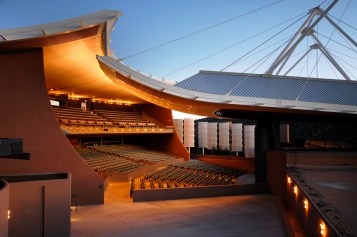
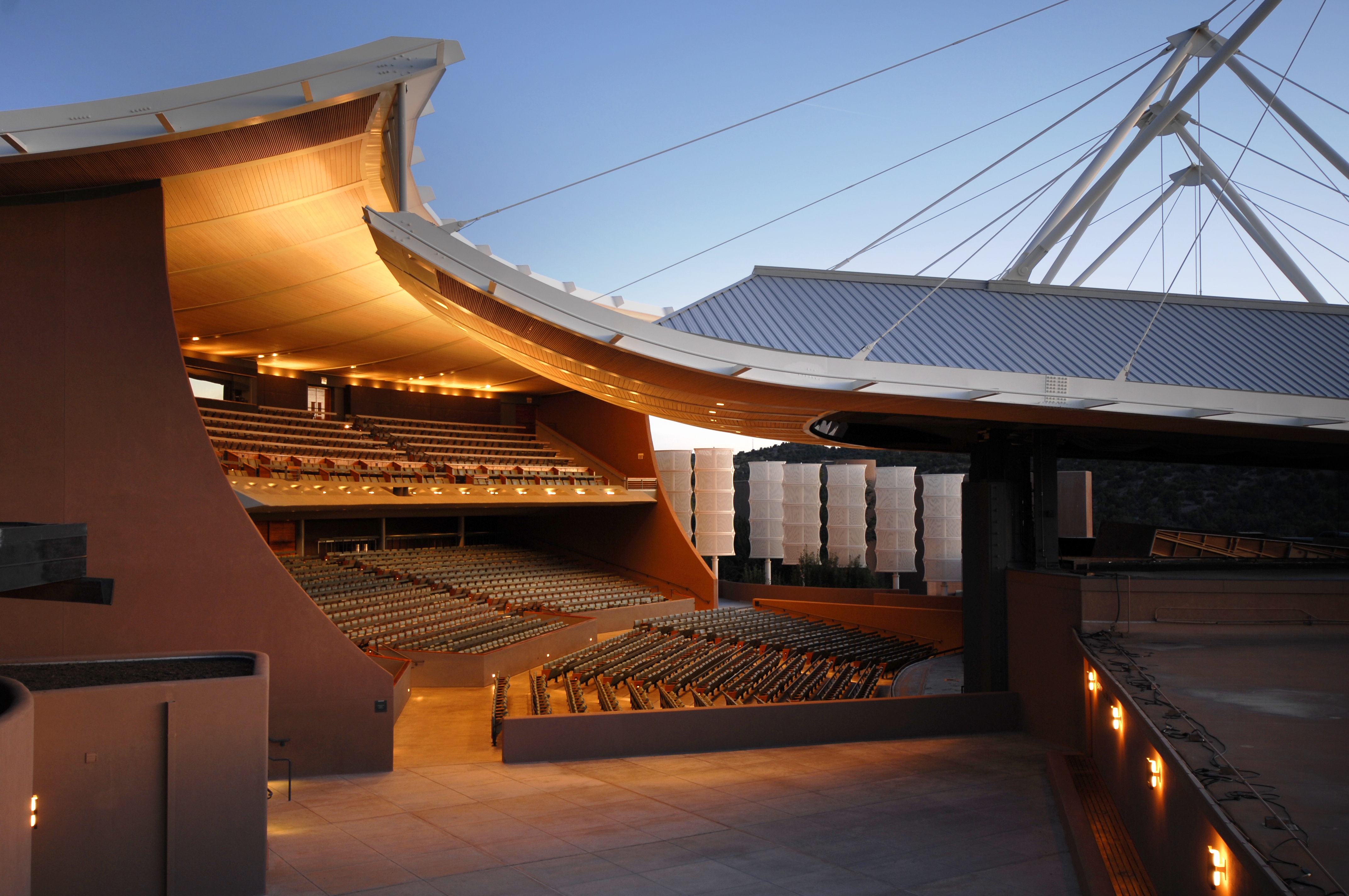
Santa Fe Opera House (c) 2010 Robert Godwin for The Santa Fe Opera

Santa Fe Opera House (c) 2010 Robert Godwin for The Santa Fe Opera

The audience stood and cheered when composer Jennifer Higdon came onstage at the Santa Fe Opera (SFO) Wednesday night (Aug. 5).

The occasion was the second performance of her new opera Cold Mountain, based on the Charles Frazier novel, which had its premiere at the SFO last Saturday (Aug. 1). The opera is playing to sold-out houses, and has in fact been so successful and generated so much demand that the SFO has added a sixth performance Aug. 24 to the original five planned dates. As of this writing, tickets are still available for that performance.

Higdon’s first opera, Cold Mountain is a powerful and assured effort from a very skilled composer. Future performances are planned by the Santa Fe Opera’s co-commissioners Opera Philadelphia and the Minnesota Opera, in collaboration with North Carolina Opera. Based on the reception by the Santa Fe audience, we can expect Cold Mountain to enter the ranks of the most successful American operas.

One of Higdon’s strengths has been the ability to build powerful momentum from rhythmically charged modules and the piling up of brass chords. That skill was particularly evident in the many scenes of threat and violence within the disturbing story of a wounded Confederate deserter’s flight. For the opera, she added to that a remarkable ability to conjure scenes of quiet, comfort and even humor, and to provide gentle, colorful support for the voice in lyrical moments.

The use of orchestral sound, ever varied, to set the mood for the contrasting scenes of the opera is one of the impressive strengths of the score. Treating the instruments as individual voices, Higdon finds a kaleidoscope of different chamber-like combinations to accompany the singers. This points in turn to another virtue: the orchestra almost never overwhelms the voices, and only where the buildup of momentum justifies it. Almost all the vocal solos and small ensembles are accompanied with extreme restraint, making them easily audible and understandable.

Higdon is especially effective in handling the transitions from scene to scene and from one mood to another. Sometimes subtly overlapping the sounds, and even the characters, and sometimes sliding seamlessly into a new musical environment, she keeps the music moving without obvious breaks or pauses.
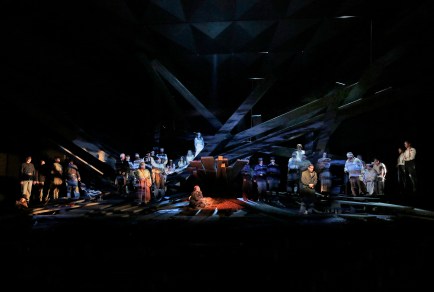
Ensemble cast in ‘Cold Mountain.’ Photo © Ken Howard for Santa Fe Opera

Ensemble cast in ‘Cold Mountain.’ Photo © Ken Howard for Santa Fe Opera

The same is true when she introduces the individual “numbers”—arias, duets, and larger ensembles—that simply emerge without any obvious signal. Each number follows its own arc, then merges back into the musical flow. Among moments I found particularly moving are Ruby’s aria telling of her childhood; several duets between the leading characters, Inman and Ada, particularly “Four Novembers come and gone” in the second act; and above all Ada’s “I feel sorry for you,” sung to Ruby’s father, which conjures in a single aria the cumulative meaning of much of the book.

Equally memorable is the use of the chorus throughout, and especially the beautiful, consoling chorus “Buried and forgotten,” recalling the numberless dead of the Civil War.

For all the breadth of Higdon’s expressive palette, one thing is missing: melodies that bloom in the voice and linger in the memory. Soaring song is the reason for opera, after all, and without it the music sometimes does not rise to the lyrical level of the text, and does not reach a convincing emotional climax near the end when Ada and Inman are finally together. The music at this point is not ineffective, but it does not transcend what has gone before, as we feel it should.

Those who know the book will notice several changes, including the omission of several of the book’s many scenes and the creation of composite characters. Opera being an art form of its own, this is unavoidable, but two changes should be noted.
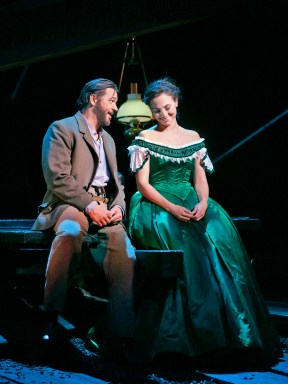
Nathan Gunn (Inman) and Isabel Leonard (Ada) in ‘Cold Mountain.’ Photo © Ken Howard for Santa Fe Opera

Nathan Gunn (Inman) and Isabel Leonard (Ada) in ‘Cold Mountain.’ Photo © Ken Howard for Santa Fe Opera

Teague is introduced from the very beginning, changing him from an unseen threat for much of the story into a familiar menace—none the less evil but more human than in the novel. And Inman and Ada’s connection is strengthened. In the novel, Inman embarks on his odyssey not knowing if Ada will even want him when he returns, whereas in the opera they are both longing to reunite throughout. Doubtless this makes for more lyrical moments and better opera.

On the other hand, fans of the book will happily recognize several lines of dialog that survive directly into the libretto, including Ada saying to Ruby of Inman, “I know I don’t need him. But I think I want him,” and Ruby’s laconic reply, “Well, that’s a whole different thing.”

Robert Brill’s set of slanted and moveable planks may unhappily remind some operagoers of the recent awkward Metropolitan Opera Ring cycle, including the use of projections over the entire stage and even outside onto the proscenium. In this case, however, the set was used effectively to represent the many different locales of the story. Dark areas of the set helped create the mood of menace that dominates the story, with danger often emerging from the shadows, while lighting was used well to direct attention to individual characters. Projections were used with restraint but impressively.

Leonard Foglia’s direction was efficient and clear. In an opera of many scene changes, from place to place and backwards and forwards in time, it is an accomplishment that only once or twice was I briefly wondering where we were.

Ada is the beating heart of the story, and soprano Isabel Leonard was a graceful, poised presence throughout. Her transformation from a sheltered city girl to a competent farm dweller was conveyed by costume and movement, and she sang with conviction and beauty of sound. Her moving performance of “I feel sorry for you” was a highlight.
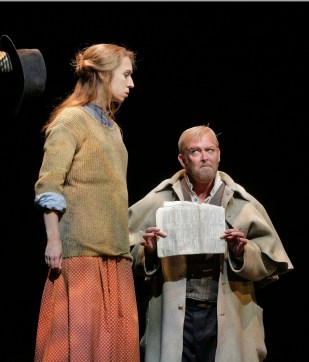
Emily Fons (Ruby Thewes) and Jay Hunter Morris (Teague) in ‘Cold Mountain.’ Photo © Ken Howard for Santa Fe Oper

Emily Fons (Ruby Thewes) and Jay Hunter Morris (Teague) in ‘Cold Mountain.’ Photo © Ken Howard for Santa Fe Opera

Her foil, Ruby, was brought to life by the excellent Emily Fons. At first, I thought the character verged on stereotype—clumping around the stage, drawing out her vowels like a country bumpkin—but as the Ada-Ruby relationship developed I liked her performance more and more.

As Inman, the man who abhors violence but finds himself good at it, Nathan Gunn gave a solid performance. He sang expressively and blended well in his duets with Ada, and his characterization was effective. Jay Hunter Morris was a strong-voiced and thoroughly despicable Teague who relished the melodramatic boos at his curtain call.

The remainder of the large cast ranged from very good to superb. I particularly enjoyed Kevin Burdette as Ruby’s father Stobrod, Robert Pomakov as the doomed Owens, and Deborah Nansteel as Lucinda. Each embodied a strongly etched personality that left a mark on the story.

I have mixed feelings about the use of an accent—those drawling vowels and dropped Gs runnin’ though the text. On one hand, it comes perilously close to southern redneck parody; on the other, it helps place the opera in a world apart. To the credit of the cast, they used it pretty consistently and made it work.

The SFO orchestra handled Higdon’s musical demands ably. The chamber-like combinations were beautifully played and well balanced, and the climaxes were powerful. The composer has complimented the players for handling her constant changes—including those made after the first performance, making the performance I saw another premiere of sorts. Conductor Miguel Harth-Bedoya kept it all moving marvelously well and provided support for the singers.

# # # # #

The night before Cold Mountain I saw Santa Fe’s serviceable and moving, if flawed, Rigoletto.

Georgia Jarman (Gilda) in 'Rigoletto.' Photo (c) Ken Howard for The Santa Fe Opera

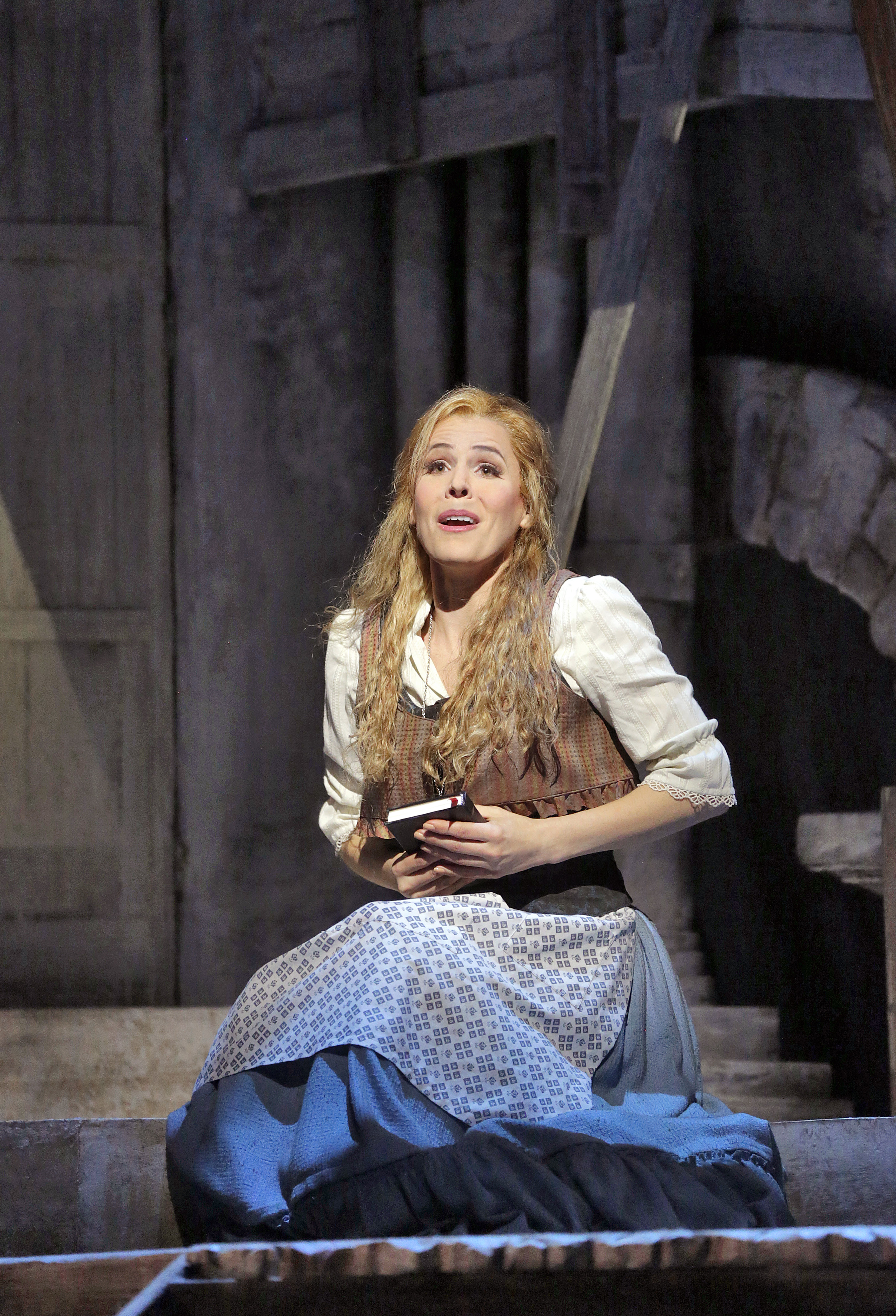
Georgia Jarman (Gilda) in ‘Rigoletto.’ Photo (c) Ken Howard for The Santa Fe Opera

The star of the evening was Georgia Jarman’s Gilda. She sang with a radiant voice, and placed an expressive weight behind the notes that made her the emotional center of the opera. Her exquisite performance of “Caro nome,” Gilda’s signature aria, earned a well deserved and prolonged ovation (in spite of having to compete with an unfortunately noisy stage turntable).

Beyond her vocal strengths, Jarman personified Rigoletto’s young and innocent daughter as well as anyone I have seen. Her physical movement onstage and her interactions with other singers contributed strongly to her portrayal of a delicate girl who finds the strength to die for love.

In the title role Quinn Kelsey sang with great power throughout. At his best, as in the second act, he became a deeply moving figure, portraying Rigoletto’s bitter torment. I thought he was less effective in other scenes, such as his duet with Gilda in the first act, when his performance seemed slack and unmotivated.

Kelsey is a large man, and he was not helped by the costuming, which made him more of a hulking figure onstage than a downtrodden and powerless jester trapped in a dissolute court. His hatred of the Duke was apparent as the opera moved toward its tragic conclusion, but the power differential between them was not always easy to see.
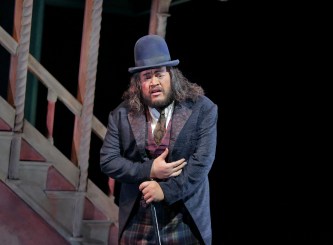
Quinn Kelsey (Rigoletto) in 'Rigoletto.' Photo (c) Ken Howard for The Santa Fe Opera

Quinn Kelsey (Rigoletto) in ‘Rigoletto.’ Photo (c) Ken Howard for The Santa Fe Opera

The Duke of Mantua is not a role with a wide emotional range. Almost the only thing he sings about is love—by which he means lust—that he is “a slave to love,” and famously, the inconstant character of women. As the Duke, Bruce Sledge sang ardently of love, with ringing tones and a pleasing tenor voice.

Others in the cast were all effective. Anne Marie Stanly raised Giovanna, Gilda’s nurse, from an easily overlooked background figure to an angry woman whose betrayal of Rigoletto was based in overt contempt. Singing another doomed man, Robert Pomakov put great weight into Monterone’s curse. Peixin Chen as Sparafucile and Nicole Piccolomini as his sister Maddalena filled their roles admirably.

The production seemed unsure of itself. At first, I thought it was set in Verdi’s time, effectively the late nineteenth century. Many of the characters had a Dickensian look. But others could be mistaken for wearing modern clothes—at the end, the Duke appeared to be wearing Dockers and a burgundy work shirt—as if they came dressed for rehearsal.

The direction and costuming made the depravity of the Duke’s court more than clear. The mannered writhings and groping in the first scene were almost comical, and the harlots in hot pants looked out of place, whatever the time period of the opera, except as reminders that the court was a really bad place.

The unit set, mounted on that noisy turntable, was mostly effective, with doorways and stairs and lairs that served all the needs to the plot. On the other hand, I was never clear why Rigoletto sometimes carried a crutch that looked like a borrowed prop from Dickens’s Christmas Carol, and sometimes managed without it.

But all reservations aside, the Santa Fe night worked its magic. Where better to watch the final scenes of Rigoletto than under the stars, with a breeze blowing though the theater?

# # # # #

I also saw the SFO production of Richard Strauss’ Salome, an opera that has now been done 11 times as part of the company’s advocacy of the composer’s works. Filled with symbolism and saturated with depravity, Salome is an opera that directors cannot resist interpreting for us—and that includes the current stage director Daniel Slater and designer Leslie Travers.

The production begins with an effective coup de theater as a stone wall across the back of the stage opens to reveal a banquet table, as well as the real-life sunset beyond the stage. The audience spontaneously applauded the lovely scene, but things soon began to get murky.
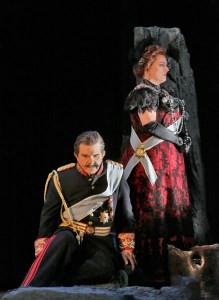
Sal.24 Robert Brubaker (Herod) and Michaela Martens (Herodias) in ‘Salome.’ Photo © Ken Howard for Santa Fe Opera

Robert Brubaker (Herod) and Michaela Martens (Herodias) in ‘Salome.’ Photo © Ken Howard for Santa Fe Opera

The costuming placed the story in Belle Époque France, a believable time for depravity among the powerful. But placed in that period much of the story fails to make sense: the Biblical prophecies; Herod’s fear of the denunciations intoned by Jochanaan (John the Baptist); and claims that the Messiah has appeared. None of this fits late 19th-century France.

But the producers have a specific aim in mind: instead of letting the story stand for itself as Oscar Wilde and Strauss wrote it, they want to show us what it is really “about.” And so Salome is presented as a Freudian family drama played out among Herod, his wife and former sister-in-law Herodias, and his stepdaughter Salome.

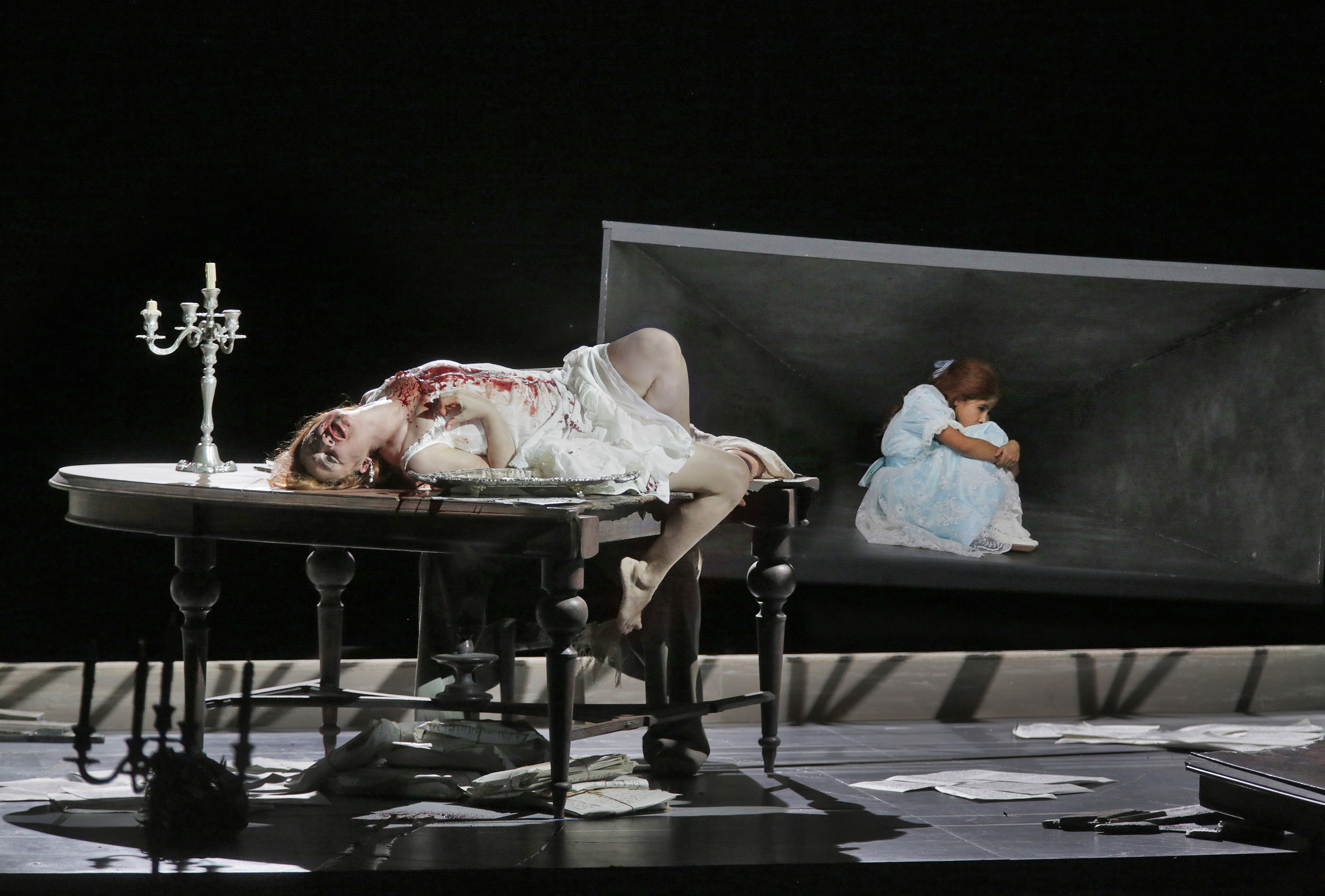
This is most obvious in Salome’s dance, which was presented not as a dance but an exploration of the deepest levels of Salome’s psyche. After a few desultory dance steps, she stepped to the side while a series of pictures opened behind her. She was shown as a child, with (apparently) her real father strangled before her by Narraboth, who later (but earlier in the opera) kills himself over his infatuation with the now teenaged princess. After seeing her father killed, the child Salome retreated into a cramped space in the back wall.
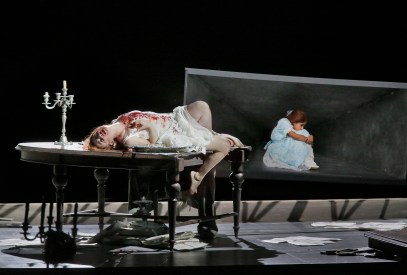
Alex Penda (Salome) in ‘Salome.’ Photo © Ken Howard for Santa Fe Opera

Alex Penda (Salome) in ‘Salome,’ with child Salome behind. Photo © Ken Howard for Santa Fe Opera

Obviously this shows how Salome is trapped by the damage she endured as a child, which is supposed to explain her hatred for her stepfather and her depraved infatuation with Jochanaan. And sure enough, after her bloody orgy with the severed head, instead of being killed—as Herod commands—she goes back to the cringing child and frees her. In other words, John the Baptist’s death serves to rescue Salome from her past.

The point is not that this interpretation is wrong; the point is that the opera contains more than that. There is the religious theme, which, apart from the text, largely disappears in this interpretation, and there is a great deal of action portrayed in the music that does not occur on stage. Strauss did not portray psychoanalysis, he portrayed a dance; he did not portray Salome freed from her demons, he portrayed her death. Substituting psychological explanation for the action of the drama not only discounts the audience’s ability to interpret the drama on its own, it also drains the music of much of its impact.

The musical performance was another matter, and was generally on a high level. The role of Salome is one of the most difficult in the repertoire: she must appear to be a petulant adolescent while singing music worthy of Isolde. Given that difficulty, Alex Penda was generally effective. She played the bored teenager very well, even though her voice was not always strong enough to carry over Strauss’ orchestra.

Nevertheless, Penda carried off the musical climaxes and reached the high notes well. And it should be noted that she was not helped by the direction, which left her far upstage in an enclosed space—Jochanaan’s cell—or singing toward the wings for several of her critical scenes.
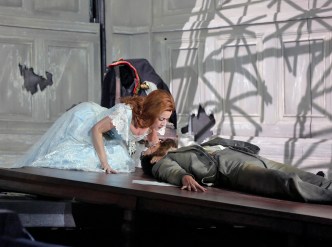
Alex Penda (Salome) and Ryan McKinny (Jochanaan) in ‘Salome.’ Photo © Ken Howard for Santa Fe Opera

Alex Penda (Salome) and Ryan McKinny (Jochanaan) in ‘Salome.’ Photo © Ken Howard for Santa Fe Opera

Her scene with Ryan McKinny as Jochanaan, when he keeps rejecting her demented advances, was played with great intensity by both singers. This is the crux of the whole opera: nothing that comes later will work if this is not brought off. In spite of the jarring anachronisms of the production, this was one of the best parts of the performance.

The production turned Jochanaan into what looked like a 19th-century radical, writing revolutionary manifestos in his crumbling study. It’s hard to see how that fits with the text and music that Strauss gave Jochanaan, but that said McKinny sang with the kind of booming certainty the role requires, and was vocally impressive.

Robert Brubaker’s Herod and Michaela Martens’ Herodias were accurately sung, but only intermittently as expressive as the roles require—which I attribute to the fact that in this production they were not acting much of what they were singing. As Narraboth Brian Jagde was memorable, displaying his fatal obsession with Salome with musical and physical intensity.

The most satisfying aspect of the production was the SFO orchestra, which under conductor David Robertson gave a powerful performance of Strauss’ virtuoso score. The full sound was resonant, and all the solos were immaculate. Slater had the demanding score under control from the beginning.

# # # # #

For tickets and information on the remaining performances in the Santa Fe Opera’s 2015 season, click here.

Edited for clarity and to correct a minor typo Aug. 8, 2015.

Name of the conductor of Salome was corrected Aug. 10, 2015. David Robertson is the conductor; Daniel Slater is the stage director.

CMF “Cellobration” winds up with the classics, plus a surprise encore

Colorado’s Julie Albers caps the weeklong mini-festival with Haydn concerto

By Peter Alexander

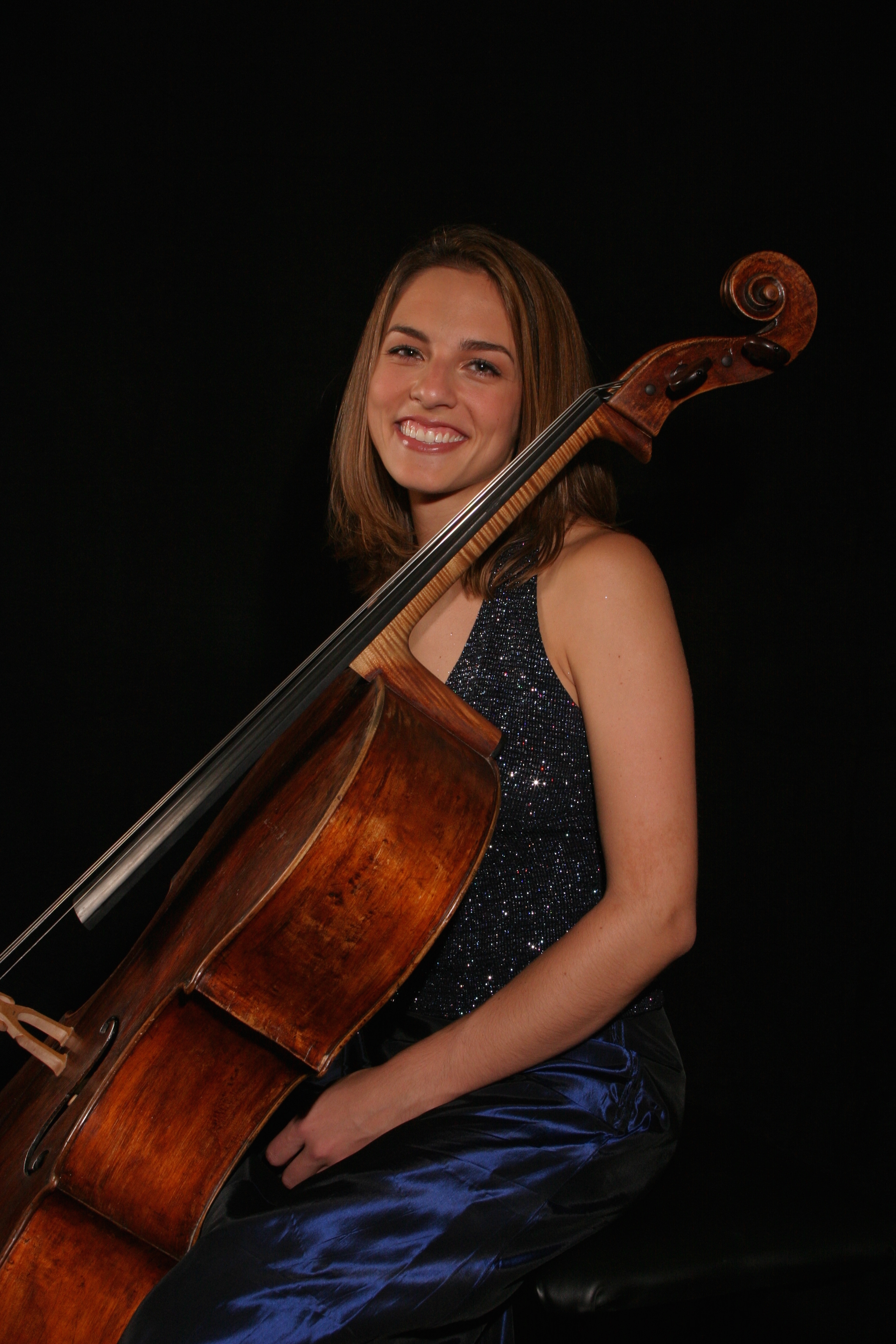
Julie Albers. Photo by Chester Higgins, Jr.

Julie Albers. Photo by Chester Higgins, Jr.

The Colorado Music Festival spent the last week celebrating the cello, wrapping up its “Cellobration” last night (July 19) with a concert titled “Classically Cello.”

The printed program for that concert featured Colorado cellist Julie Albers as soloist in Haydn’s Cello Concerto in D major, plus Mozart’s Overture to The Marriage of Figaro, Bach’s Brandenburg Concerto No. 3 in G major, and Mozart’s “Paris” Symphony. All were conducted by CMF music director Jean-Marie Zeitouni, except for the Bach, which was performed without conductor, as a piece of chamber music.

As for what was not on the program: more about that later.

The day previous (Saturday, July 18), the “Cellobration” had presented all five of Beethoven’s sonatas for cello and piano, played by three members of the Festival Orchestra cello section—Aaron Merritt, Morgen Johnson and Gregory Sauer—with the festival’s principal keyboardist, Vivienne Spy. The performances were spread across two concerts, at 4 and 8 p.m. in the CMF’s summer chamber music venue, Boulder’s First Congregational Church.

First it should be said that Spy was a full partner in these performances, playing all five sonatas with great sensitivity and ideal support for her partners. The consistency of her playing and the quality of the CMF players brought the entire Beethoven experience to a high very level.

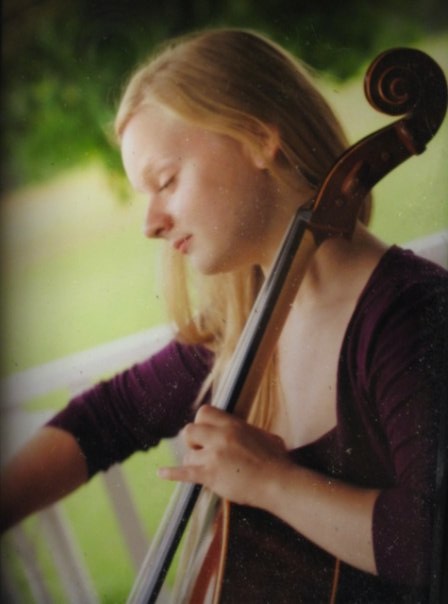
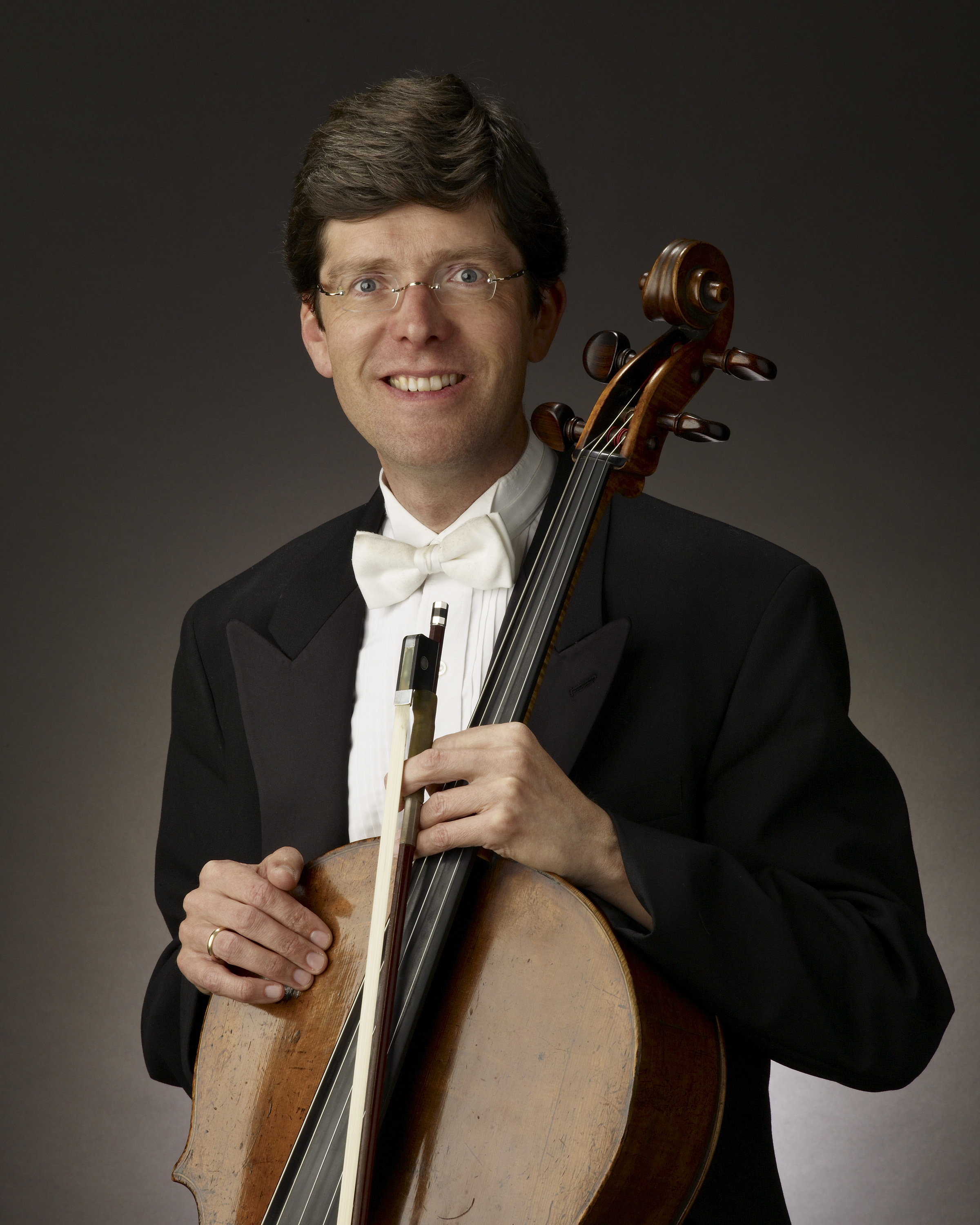
Morgen Johnson

Morgen Johnson

That said, for me two of the performances stood above the others: Johnson playing the early Sonata No. 2 in G minor, op. 5 no. 2; and Sauer playing the middle-period Sonata No. 3 in A major, op. 69. Both cellists commanded attention from the very first notes. Johnson was helped by the fact that she was playing one of the stormier sonatas, giving lots of scope for expressive display, but her commitment to the piece and the clarity of her sound were equally impressive.

Sauer played with was an even larger, richer sound and a willingness to convey all the moods of Beethoven’s outgoing sonata—one of his more “public” works, is the way Sauer described it.

Sunday evening’s chamber orchestra concert opened with the Overture to The Marriage of Figaro. This is one of the most familiar concert openers, and under Zeitouni’s direction it did not disappoint for brilliance and verve. In fact, Zeitouni took a very fast tempo, from the very first almost inaudible rush of notes in the strings, to the furious woodwind scales at the end.

Jean-Marie Zeitouni

Jean-Marie Zeitouni

Very soft beginnings seem to be a Zeitouni specialty. Here it served the purpose of pulling the audience into the gentler sound world of the 18th century, as opposed to that of the full orchestra playing Romantic showpieces, such as those we have heard this summer by Respighi and Richard Strauss. With the CMF orchestra, Zeitouni has the string players to pull off the extra-pianissimo, but it is always a trade-off. Played so soft, and so fast, the very opening was a miracle of bustling motion; but against other instruments, and later in louder passages, the details became difficult to discern.

The barn-like Chautauqua Auditorium is a great venue for those Romantic showpieces, but a challenging space for much 18th-century music—such as the Haydn Cello Concerto that was written to be played for a few dozen people in a room of the palace of Haydn’s patron, Prince Esterhazy. Julie Albers gave a polished performance of this familiar piece. Her playing was well tailored to the music, from the opening announcements of the main themes to the rollicking finale.

After the concerto, Albers returned to the stage with all of the chamber orchestra cellists for a “surprise” encore—the piece that was not in the program. Cellists love to get together and play in choirs of all cellos, so it was appropriate to end the “Cellobration” with one of the most loved pieces for multiple cellos, the Bachianas Brasileiras No. 5 for soprano and eight cellos by Heitor Villa-Lobos.

Christie Conover

Christie Conover

Christie Conover, a young soprano from Colorado who is starting to land some plumb operatic roles with the Minnesota Opera and the Komische Oper in Berlin took the soaring soprano part, and was a delight to hear. Albers played the lead cello part, but all the cellists on stage doubtless know and have played the piece. They were clearly as pleased to perform it as the audience was to hear this surprise encore.

After intermission, a collection of string players plus keyboardist Spy—now playing harpsichord—came on to present Bach’s Brandenburg Concerto No. 3 in G major for three violins, three violas, three cellos and continuo. A conductor was not needed: the players, who again doubtless all know the piece quite well, followed concertmaster Calin Lupanu in a sprightly performance of a piece that is as much fun to play as to hear. With so many players spread across the stage in a single line, there were some minor issues of ensemble precision, but nothing serious enough to spoil the fun.

The concert concluded with Zeitouni introducing, then conducting, Mozart’s Symphony No. 31 in D major, known as the “Paris” Symphony. Written during Mozart’s disastrous visit to Paris in 1778, when he failed to land a job, earned very little money, and witnessed his mother’s death, this is nonetheless one of Mozart’s most delightful and popular orchestral works.

Zeitouni began the symphony with phrasing and dynamics that I can only describe as eccentric—but it cannot be said that he lacks ideas. Except for that unusual choice, the symphony was played with delicacy and style. Zeitouni chose what is believed to be Mozart’s original slow movement, not one that was supposed to be simpler that was substituted in some later Parisian performances. The movement was played exquisitely, again taking advantage of the string section’s ability to play together very softly.

After this moment of 18th-century elegance, the finale was a bracing and light-hearted salute to the tastes of the Parisian audiences. It is brilliant, calls for the most delicate work from the strings, and rushes to a happy conclusion. Under Zeitouni’s careful control, all the pieces fell enjoyably into place.

At CMF, Don Quixote conquers more than windmills

Cellist Desmond Hoebig and conductor Jean-Marie Zeitouni give committed performance of Strauss’ tone poem

By Peter Alexander

Cellist Desmond Hoebig

Cellist Desmond Hoebig

The Colorado Music Festival Orchestra, conductor Jean-Marie Zeitouni and cellist Desmond Hoebig gave a fully committed and convincing performance of Richard Strauss’ daunting tone poem Don Quixote last night (July 16).

The program, which also includes the Prelude to Tristan und Isolde by Richard Wagner and the Suite No. 2 from Romeo and Juliet by Sergei Prokofiev, will be repeated at 7:30 p.m. tonight (July 17) in the Chautauqua Auditorium (tickets available here).

At 45 minutes, the Strauss filled the second half of the concert. The program opened with the Prelude to Tristan und Isolde, in a performance of strengths and weaknesses. Zeitouni began the prelude from the closest thing to silence, which gives scope for a wide crescendo, all the way to the Prelude’s defining climactic moment.
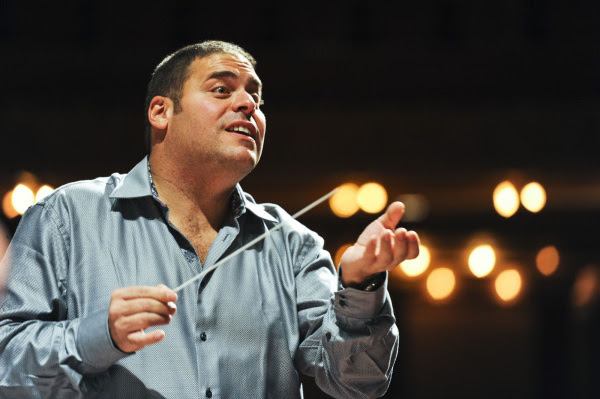
Such a beginning is captivating, but such soft levels make it difficult for the players to sustain and control the phrases, which led to some initial uncertainty and unevenness in the winds. At the opposite extreme, there were moments at the highest volume which the sound became slightly rough and not quite balanced among the sections.

Between these levels—which means most of the Prelude—the orchestral sound was warm and well controlled, including some exquisite string section playing, carefully controlled by the conductor. A lovely ending gave the performance the sense of a journey traversed.

Jean-Marie Zeitouni

Jean-Marie Zeitouni

The Second Suite from Prokofiev’s Romeo and Juliet contains some of the most familiar music from the ballet (“The Montagues and the Capulets,” “Friar Laurence”) as well as some movements that are less familiar but a welcome addition to the program (“Dance of the Girls with Lilies”). Zeitouni led a performance in which the character of each section was strongly delineated, creating meaningful contrasts from one to the next. The orchestra meticulously followed the conductor’s expressive use of rubato, adding an emotional depth to music.

The performance was at its best in the more chamber-like passages, when individual players exchanged melodies and played off each other’s phrases. Likewise, the portions played by the strings alone were again beautifully rendered. From where I sat, however, the brass occasionally overpowered the rest of the orchestra. The tuba played beautifully, but the flute and clarinet could not stand up to his volume. Likewise, the brass section playing as a whole had a magnificent sound, but it was magnificent at the cost of balance with other sections.

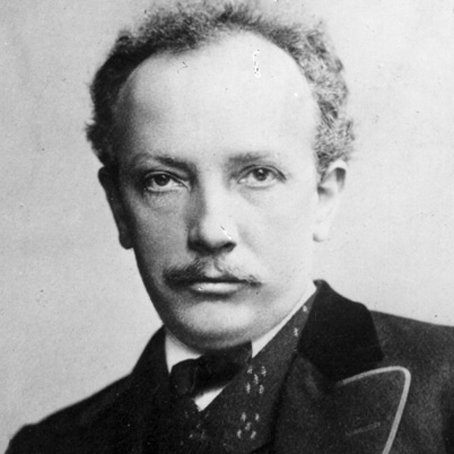
Richard Strauss

Richard Strauss

For Don Quixote, Zeitouni and the orchestra came entirely into their own. This is a piece that defines the concept of the “virtuoso orchestra,” and it requires a correspondingly virtuoso conductor. Happily, CMF has both. The Festival Orchestra boasts section players of the highest caliber, and Zeitouni clearly has an affinity for Strauss. He and the orchestra both proved that last year when his audition concert for the position of music director included powerful performances of Don Juan and Ein Heldenleben.

As part of the “Cellobration”—CMF’s week-long mini-festival celebrating the cello as a solo instrument, in chamber music and as an orchestral soloist—Don Quixote was chosen for this program because the cello is used to portray Cervantes’s literary protagonist. The score features a series of “fantastic variations” (as Strauss wrote) representing several of the Don’s fantastic adventures. Hoebig, the able soloist for CMF’s performances, is a cellist of wide experience who teaches at the Shepherd School of Music at Rice University.

Hoebig conquered all the technical demands of Strauss’ score, even fingering along with the section cellos when his solo part was silent. His intense performance was at its best in the extended solo passages, where he could not be challenged by the volume of Strauss’ massive orchestra. The lyrical sections of “Don Quixote’s Vigil” and the Finale, when the Don regains his senses and approaches his poignant end, were especially memorable. Also notable was Hoebig’s attentiveness to the lovely playing of the orchestra’s concertmaster, Calin Lupanu, in their shared passages.
The Festival Orchestra’s principal violist, Shannon Farrell Williams, is practically a second soloist portraying the Don’s sidekick Sancho Panza (together with bass clarinet and tenor tuba). Williams played with assurance and a dark, solid tone that captured Panza’s grounding in the real world throughout the Don’s chivalric fantasies. She dispatched her part on the same virtuoso level as every other member of the orchestra, from the principal wind players to the percussionist on the highly visible but (alas) barely audible wind machine.

Don Quixote is not played as often as some of Strauss’ better known tone poems—Don Juan, Till Eulenspiegel, or even Ein Heldenleben. For that reason, its programming at CMF as part of the “Cellobration” is all the more welcome—especially when it is performed with such élan and technical skill as was the case last night.

# # # # #

For those who love the cello—as who doesn’t?—the remaining events of the mini-festival will be at 4 and 8 p.m. Saturday, July 18, when members of the Festival Orchestra cello section will play all five of Beethoven’s Cello sonatas at Boulder’s First Congregational Church; and at 7:30 p.m. Sunday, July 19, when the CMF Chamber Orchestra will perform “Classically Cello,” a concert that features Julie Albers, a cellist from Longmont, Colo., performing Haydn’s Cello Concerto No. 2 in D major in the Chautauqua Auditorium. (More information and tickets to these performance available here).

I should point out that the title of the current Festival Orchestra Concert—the one with Don Quixote—is “Impossible Dreams.” This of course refers to the song “To Dream the Impossible Dream” from the popular Broadway musical Man of La Mancha—which serves as a reminder that you can see the musical this month at the Central City Opera, opening at 8 p.m. Saturday, July 18, in the Central City Opera House and continuing through Aug. 9 (details and tickets here).

And finally, to offset the melancholy side of the Don Quixote story, Central City is also offering a one-act Baroque opera on a lighter episode from Cervantes’ novel, Don Quixote and the Duchess by Joseph Bodin de Boismortier. This comic opera will be performed in Central City at 12:30 p.m. July 18 and Aug. 1, and at noon Aug. 6 at the First United Methodist Church in Ft. Collins (details and tickets here).

Pianist Terrence Wilson and CMF Orchestra dazzle in Daugherty’s Deus ex Machina

Guest conductor David Danzmayr leads the Festival Orchestra in a satisfying program

By Peter Alexander

Composer Michael Daugherty

Composer Michael Daugherty

Composer Michael Daugherty says that he has to have an idea about each piece before he can start writing. The question is, does the audience need to know that idea, or can they appreciate his compositions as “just music?”

In the case of his Grammy-Award winning piano concerto, Deus ex Machina, dazzlingly performed last night (July 9) by pianist Terrence Wilson and the Colorado Music Festival Orchestra under guest conductor David Danzmayr, the answer is that it definitely helps to know what Daugherty was thinking. So it was good that the composer spoke before the performance. Audience members would have been well advised to read the program notes as well, since they gave even more insight into the ideas behind the music.

Conductor David Danzmayr

Conductor David Danzmayr

As Daugherty explained, Deus ex Machina—translated “God from the machine”—is about one of the most powerful machines of our landscape, the train. The connection between the mechanics of a locomotive and the mechanics of a piano is even more clear when you know that Daugherty grew up with a player piano in his home, which gives a musical meaning to the notion of God from a machine.

(To be historically accurate, it should be pointed out that the phrase Deus ex machina originally referred to a classical god who resolved the tangled plots of Baroque operas and theater pieces by descending from the clouds—in other words, from a theatrical machine. But Daugherty did not have this theatrical reference in mind.)

Each movement has its own specific train reference: the first movement, “Fast Forward,” is about the Italian futurists’ early-20th-century conception of the train as an engine of progress, represented in abstract or cubist forms. This is the most obviously trainlike movement, and it indeed rushes forward with furious, abstract energy.

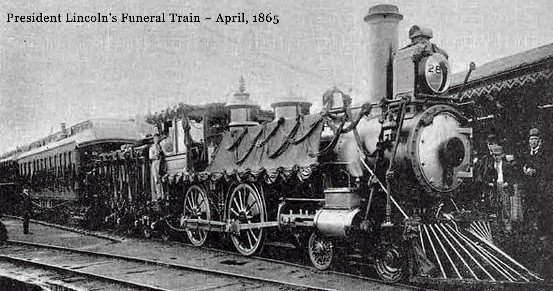
linfuneral_train_t580The second movement, “Train of Tears,” is a haunting evocation of the train that slowly carried the body of Abraham Lincoln from Washington to the slain president’s funeral in Springfield, Ill. Here the strains of taps overlay the steady movement of the piano and orchestra, expressing the slow progress of the train, or the slow spread of grief across the continent, or both.

The finale, “Night Steam,” refers to gorgeous nighttime photos of steam locomotives taken by O. Winston Link in the 1950s, but it only makes musical sense when Daugherty explains that he grew up playing jazz and boogie-woogie piano and hearing the late-night calls of the locomotives that passed through his home town of Cedar Rapids, Iowa.

“That movement’s me,” Daugherty said about “Night Steam” yesterday before the performance. And once you make the connection between the disappearing steam locomotives and the long gone style of boogie-woogie piano from Daugherty’s youth, the music takes on an elevated meaning that is otherwise unavailable to the listener.

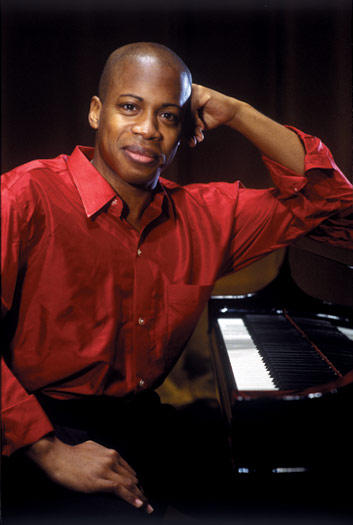
Pianist Terrence Wilson

Pianist Terrence Wilson

Only with at least this overview of the piece can one grasp the accomplishment of Wilson, for whom the concerto was written, as well as Danzmayr and the Festival Orchestra. They provided a thoroughly invigorating performance, one that captured the essence of each movement in turn while overcoming the concerto’s considerable difficulties. For Wilson, the challenge is not so much expressive as it is technical, since much of the emotional depth comes from the orchestra—especially in the dirge-like slow movement.

What Wilson provided was the energy, the technical polish, and just the sheer sound from the piano that it takes to conjure Daugherty’s trains. In each movement he was exceptional, providing the bravura, mechanistic drive of the first movement, the mourning chords of the second, and the frenetic boogie-woogie of the finale. This is a concerto that you definitely want to see as well as hear: Wilson’s sheer output of energy is visible at the keyboard, even when you don’t know just how many notes he is actually playing.

The Colorado premiere of Deus ex Machina was the major event of the first half of the program. The concert opened with another Colorado premiere, Lee Actor’s Opening Remarks. This is a brisk, bracing curtain-raiser that has more than a little bit of Shostakovich in its palette of sounds. Danzmayr and the players of the Festival Orchestra were more than equal to the challenge of Actor’s light, enjoyable score.

Conductor David Danzmayr

Conductor David Danzmayr

For the second half of the program, Danzmayr was not afraid to embrace the Romantic nature of Tchaikovsky’s Fifth Symphony, with its shifting tempos and surging climaxes. It was of course beautifully played by the Festival Orchestra, but at times the emphasis on local effect and the building of one high point after another led to raw, somewhat unbalanced climaxes. Tchaikovsky encourages this with his piling up of double, triple and even quadruple forte markings (not to mention the multiple-piano soft passages), but sometimes his music would benefit from a more restrained hand.

The overall sound was definitely that of a polished American orchestra: accurate in pitch and ensemble, with a bright forward tone that contrasts with the darker, heavier and intrinsically mournful sound of Russian orchestras. Be that as it may, the precision of the scurrying strings, the accuracy of the woodwind playing, the bright fullness of the brass sound are bracing, and they provide a satisfying, if not entirely Russian, interpretation of the symphony.

It is risky to single out individual orchestra players on such a program, since it would be difficult not to leave out some truly fine performances, so I will only say that the solos I heard—orchestra members know who they are!—were all played with great beauty of tone and technical finesse. This was a performance that deserved a larger audience, but at least no one disturbed the music with a cell phone this week.

# # # # #

If you missed the chance to purchase the Grammy-winning recording of Deus ex Machina performed by Terrence Wilson and the Nashville Symphony, Giancarlo Guerrero, conductor, at the concert, you can purchase it and other recordings of Daugherty’s music here or here.

NOTE: The time period of Link’s photos was added and the article was revised for grammar and typos on July 10.

Colorado Music Festival opens Zeitouni era with controlled, beautiful performance

Alto Lemieux provides vocal fireworks—even before the Fourth of July!

By Peter Alexander

CMF Music Director Jean-Marie Zeitouni (Photo by Tessa Berg)

CMF Music Director Jean-Marie Zeitouni (Photo by Tessa Berg)

The Colorado Music Festival (CMF) opened last night (July 1) with some splash and dash, some exoticism, some vocal fireworks, and a loud, brassy finish. With such ingredients, the audience went away happy.

Conductor Jean-Marie Zeitouni chose to begin his very first Festival Orchestra concert as music director—he appeared last year as one of several guest conductors vying for the post he now holds—with a work that ties into his own French-Canadian heritage, Debussy’s La Mer. But as Zeitouni said last week, there is another reason to program La Mer: “because it’s a virtuoso orchestral piece, and it’s my way of showcasing this wonderful orchestra.”

His performance did indeed showcase the players. This was not a lush, Romantic performance of La Mer such as you may have heard before. Zeitouni was more spare in his approach, creating a chamber-music-like sound that revealed every voice in the orchestra. One could hear every individual line, every player in the ensemble, and the players responded with some beautiful playing. This was a transparent ocean, every wave audible—or visible in the listener’s mind.

The performance was also remarkably flexible, with delineating changes of tempo and volume carefully managed. The finale in particular was immaculately controlled and detailed. Zeitouni did not take the easy way of going for big effects; the result was something more subtle, a performance that elicits admiration if not unrestrained exuberance.

Ravel’s Shéhérazade was probably the least familiar work on the program. The score is a set of three imaginative poems based on the Arabian Nights by the composer’s contemporary Tristan Klingsor, performed with colorful orchestral accompaniment. With lines like “I would like to see fine turbans of silk” and “I’d like to see cruel assassins,” the text is a classic expression of Orientalism, the dreamy distortion of Arab and Asian peoples who could not speak for themselves during the age of European colonization.

These Orientalist clichés of the text were in full view, since Timothy Orr of the Colorado Shakespeare Festival was on hand to read the poems before each song. But whether one approves of the texts or no, his dramatic readings greatly enhanced the audience experience.

Alto Marie-Nicole Lemieux

Alto Marie-Nicole Lemieux

Ravel’s music beautifully evokes in sound the images of the text. And when one hears it as well performed as it was by Zeitouni, the Festival Orchestra, and the remarkable alto Marie-Nicole Lemieux, one easily forgets that the text was tainted by the Eurocentrism of the 19th- and 20th-century colonial powers. I particularly enjoyed the playing of principal flutist Viviana Cumplido Wilson in the second song, La flûte enchantée (The enchanted flute).

After intermission, Lemieux came into her own with arias from Rossini operas. She showed why she is known and admired in Europe for her fiery performances in dramatic operatic roles. The first two arias she sang, those listed in the program, were taken from two of Rossini’s serious operas, Tancredi and Semiramide. It was good to hear these arias: they are great music taken from serious operas that are not often taken seriously today, and therefore are seldom heard by most audiences.

My only reservation was that these very dramatic pieces, in which Lemieux was clearly seeing the scene before her eyes as she performed, were largely opaque to most listeners, because the program notes opted for an irrelevant paragraph about the composer and his popularity in Beethoven’s and Schubert’s Vienna, rather than including the texts, or even descriptions of the emotions being portrayed by the singer.

Best of all was the final aria, an encore from Rossini’s L’Italiana in Algeri (The Italian girl in Algiers), which Lemieux introduced with great verve and humor. She had the audience in her hands—and that was before she began to sing! I suspect that for Colorado audiences, she will be one of the great discoveries of the summer at CMF. Her performances were vocally brilliant, dramatically engaging, and filled with personality.

It was an interesting choice to have Orr return to the stage and set the scene for each of the four scenes of Respighi’s tone poem The Pines of Rome, which closed the program. I enjoyed his introductions, but thought: why was he not employed for the Rossini arias?

Respighi’s brilliant music did exactly what it was written to do: bring the audience to their feet. But that is not to say that their enthusiasm was misplaced. Here Romanticism was in full flower, but with no loss of orchestral clarity.

As in past years, CMF has a Festival Orchestra of remarkable quality, and the musicians played with a fullness of sound and balance that made The Pines of Rome everything it is meant to be. Of the many wind solos, one must single out the work of the principal clarinet, Louis DeMartino, who played his long solo in the third section, “The Pines of the Janiculum,” with remarkable beauty, delicacy and control.

The final “Pines of the Appian Way” emerged from near silence, leading to a long and controlled crescendo that never got out of hand but reached Respighi’s great climax near the ideal moment. When the last powerful brass chord died away, the audience jumped to their feet and cheered—more spontaneously than in many of Boulder’s more dutiful standing ovations—and then left happy.

# # # # #

One parting sour note to the audience: after they were asked to turn all devices off, it was only 5 seconds into the concert that someone’s cell phone jingled in one of the quietest passages of Debussy’s score. I hope the CPR engineers can edit that out of the broadcast—but who in 2015 still doesn’t know to turn their phone OFF, when they have just been reminded?

NOTE: edited for clarity 2 July 2015

Puts’s Manchurian Candidate wins the audience on opening night

Michael Christie leads taut premiere

750x400_04Manchurian_2

By Peter Alexander

The Minnesota Opera rocked the Ordway last night (March 7) with the world premiere of Kevin Puts’s new opera, The Manchurian Candidate.

The performance was conducted by Michael Christie, former music director of the Colorado Music Festival who is now music director of the Minnesota Opera. A strong cast and first-rate orchestra gave a taut, polished performance that swept the audience up in its brisk, powerful motion, from the brittle, menacing opening sounds in the orchestra to the final, brutal punctuation mark.

Composer Kevin Puts

Composer Kevin Puts

Puts’s only previous opera, the Pulitzer Prize-winning Silent Night, had its premiere by the Minnesota Opera in 2011. For Manchurian Candidate he set a very effective libretto by Mark Campbell, based on Richard Condon’s 1950s novel of the same title. A gripping if improbable tale of cold-war brainwashing set against the McCarthy-era red scares, the novel was twice made into a film—first in 1962 starring Frank Sinatra, Laurence Harvey and Angela Lansbury; and again in 2004 with Denzel Washington, Meryl Streep and Liev Schreiber.

Campbell, who also wrote the libretto for Silent Night, here created a very efficient text from Condon’s clunky potboiler. What he could not do is give depth to characters who are often little more than plot devices: Raymond Shaw, the tainted “war hero” who is a pawn of the communists; his war buddy Ben Marco, whose role it is to unlock Shaw’s corrupted mind; Jocie Jordan, who exists only to be Shaw’s love interest and to die tragically near the end; her father, Thomas Jordan, the “good” senator of liberal beliefs; Eleanor Iselin, Shaw’s predatory mother; and her husband, Johnny Iselin, the stand-in for Sen. Joe McCarthy.

That said, the opera runs lucidly through the various complexities of the original story, dispensing with events and characters not essential to the unwinding of the plot’s mainspring. It is this focus on the central story, and Puts’ compelling music, that give the opera both clarity and momentum. And at just over 2 hours including intermission, Manchurian Candidate never drags.

0356-750x400

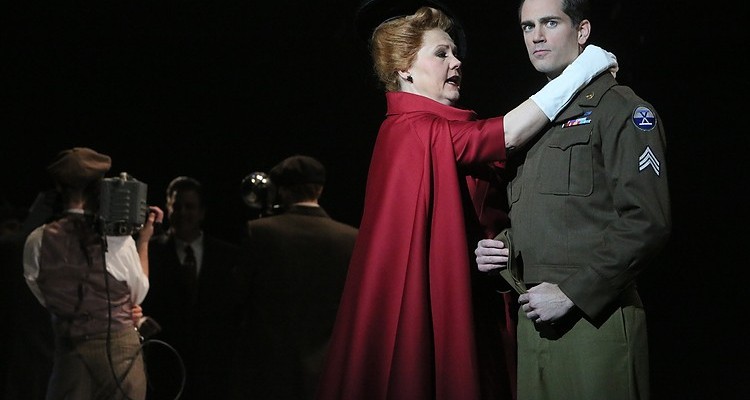
Brenda Harris as Eleanor Iselin and Mathew Worth as Sgt. Raymond Shaw. Minnesota Opera production of “The Manchurian Candidate” by Kevin Puts. Photo by Michal Daniel.

Puts has written a score of power and complexity. As scene moves rapidly to scene, he is extremely effective in changing moods and providing what contours he can to the relatively flat characters. The aura of menace around Shaw’s mother is creepily apparent, and one cannot miss the bluster and pomposity of her dim-witted husband. Similarly, the horror of Shaw’s brainwashing, the shallowness of the political hangers-on, and the languid warmth of Shaw’s “summer by the lake” are all well conveyed through the music.

Puts has mastered a range of styles, from the military band music that greets Raymond Shaw’s arrival as a Medal of Honor winner, to the delightful train music of one lighter scene, to a patriotic hymn, to the manic music of a political convention. The text is set clearly and is almost always intelligible, with the vocal parts embedded in atmospheric orchestral sounds that illuminate the meaning of the text.

The text only lost intelligibility when two different scenes were unfolding at once. Then one was grateful to have supertitles; otherwise, the audience would have no way of knowing what occurred in a some critical moments in the opera. In a theater without titles, this could be a serious shortcoming.

Matthew Worth as Sergeant Raymond Shaw in the Minnesota Opera production of The Manchurian Candidate. Photo by Michal Daniel.

Matthew Worth as Sergeant Raymond Shaw. Photo by Michal Daniel.

In his setting of English, Puts appears to have learned from the operas of Benjamin Britten—nowhere more so that in Raymond Shaw’s “mad scene,” in which the mixed fragments of previously-heard texts recall Britten’s mad scene for Peter Grimes. If not original, it is effective and was powerfully sung by baritone Matthew Worth.

Leonardo Capalbo as Captain Ben Marco in the Minnesota Opera production of The Manchurian Candidate. Popto by Michal Daniel

Leonardo Capalbo as Captain Ben Marco. Photo by Michal Daniel.

While it is not possible to cover everyone in the large cast, mention should be made of Leonardo Capalbo as Ben Marco. His scene recalling his nightmares, “Night After Night,” was one of the most effective set pieces in the opera.

Brenda Harris as Eleanor Iselin and Daniel Sumegi as Senator Johnny Iselin in the Minnesota Opera production of The Manchurian Candidate. Photo by Michal Daniel.

Brenda Harris as Eleanor Iselin and Daniel Sumegi as Senator Johnny Iselin. Photo by Michal Daniel.

Soprano Brenda Harris has the opera’s most virtuosic music, particularly in her scene at the end of Act I, calling on “My darling little boy” and foretelling that “Terrible, terrible things will happen in this country.” This moment of almost Queen-of-the-Night threat and fireworks is a great dramatic stroke, set in the middle of a party scene that can only be described as satirical, and it was spectacularly dispatched by Harris.

Daniel Sumegi’s rough-hewn voice was appropriate for Johnny Iselin’s bluster, if not particularly beautiful. Angela Mortellaro was a lovely, winsome Jocie Jordan. Other roles, from the Chinese and Russians who brainwashed Shaw to the partygoers at the Iselins’, all filled their roles ably.

The production made good use of designer Robert Brill’s unit set. Kevin Newbury’s direction was uncomplicated and natural. There were a number of effective touches, including the menacing men in suits who moved furniture and seemed to be looming behind the scenes at critical moments, and the lighting effects that seemed to put Shaw in the shadow of prison bars when others were in open light.

Michael Christie

Michael Christie

But above all one must credit conductor Michael Christie and the musicians of the Minnesota Opera orchestra. Playing in an exposed pit, they only once covered the singers. Christie maintained the flow of the opera ably. Although it is hard to judge a new work, every tempo felt right, the transitions happened smoothly and there were no audible stumbles in the complex score. I particularly appreciated that Christie did not make an entrance into the pit to elicit applause, but just started both halves with no warning.

The Manchurian Candidate is an important new opera, and it was given a worthy premiere performance at the Ordway Music Theater last night. The audience responded warmly at the end, and recognized Harris in particular as a favorite with shouts and a standing ovation.

One must congratulate the Minnesota Opera for their ongoing commissioning and support of new opera. They far surpass some much larger companies in that regard. Indeed, the recent history of the Minnesota Opera in general, and the success of The Manchurian Candidate in particular, shows that new operas can provide compelling music drama and find an important place in a successful company.

Additional performances of Manchurian Candidate will be March 8, 12, 14 and 15. Visit the Minnesota Opera Web page for details and tickets.

# # #

The same weekend as the premiere of Manchurian Candidate, the St. Paul Chamber Orchestra opened a beautiful new concert hall in the Ordway complex, with concerts Thursday and Friday evening (March 5 and 6).

This is the first time in its 30-plus-year history that the SPCO has had a home that was designed for a chamber orchestra. Previously they played many concerts in the Ordway Music Theater, whose proscenium stage, members of the orchestra say, muddied and muffled the sound that reached the audience.

To judge by the performance I heard (Friday evening, March 6), the new hall is a spectacular success. It is a beautiful space, with gentle curves, warm wood and sound-reflective gypsum blocks dominating the visual aspect. No one is more than 90 feet from the stage. The sound is very present all the way to the top of the second tier—where I was sitting. Even the softest pizzicatos carried well and the texture was consistently clean and transparent. I didn’t know if the audience’s standing ovation at the end of the concert was for the performance, or for the hall.

The first half of the program was well chosen to show the orchestra and the hall to good advantage. Playing without a conductor but following concertmaster Steve Copes’s cues, the orchestra gave a brilliant account of Prokofiev’s “Classical” Symphony. Every note of the sparkling string parts came through, and the winds were bright and clear throughout.

After Prokofiev, the SPCO gave an unlisted performance of Charles Ives’s Unanswered Question, apparently decided on at the last minute. With string playing at a barely-audible whisper and the trumpet sounding beautifully from the balcony, this was an extreme test of both orchestra and hall, and both passed, again brilliantly.

The piece commissioned for the occasion, Coraggio for string orchestra (from String Quartet No. 3) by George Tsontakis, is a pleasant, unchallenging score that passed muster as an occasional piece. If it did not test the orchestra as much as Prokofiev and Ives, it served its festive purpose well.

The second half of the concert, again without conductor, was Beethoven’s “Eroica” Symphony. It was good to hear it played by an orchestra of the size Beethoven would have known, especially of the quality of the SPCO. The dynamic range was impressive, and the momentum at the end brought the audience to their feet. But on the whole I found it less satisfying than the earlier pieces: the balance was less sure, some individual lines were too prominent, and the overall contour of the piece less controlled than might be the case with a conductor.

Still, it was a wonderful concert, and it gives hope to all fans of the SPCO. They now have a home worthy of the orchestra’s quality.

# # #

NOTE: Updated March 8 to include the running time of the performance and future performance dates  of Manchurian Candidate.