The Boulder Bach Festival presents a journey of exploration in Longmont

By Peter Alexander

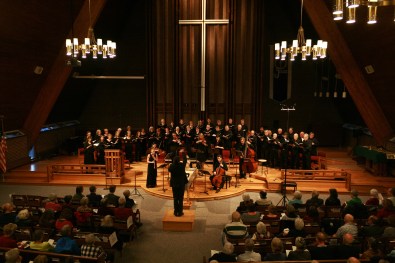
Last night’s concert presented by the Boulder Bach Festival at Longmont’s Stewart Auditorium (Dec. 10, “Journey to Vienna with Mario Aschauer and Friends”) represented an ideal combination of repertoire, instruments and performance space.

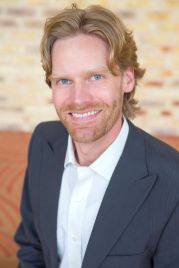
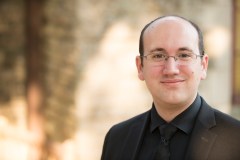
mario-aschauer

Mario Aschauer

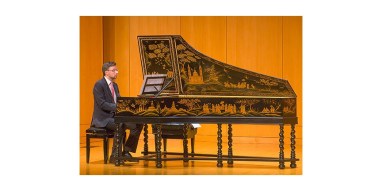
The concert featured Aschauer, a musicologist and performer on the faculty of Sam Houston State University in Texas, on harpsichord; Zachary Carrettin, the artistic director of the Boulder Bach Festival, playing Baroque violin and the cello da spalla (“shoulder cello,” a small cello played on the shoulder, like a cross between violin and guitar); and the bright, clear voice of soprano Jennifer Bird-Arvidsson. The program comprised music from the late 17th and early 18th Imperial Court in Vienna, including pieces for harpsichord alone, a sonata for violin and harpsichord, and arias from operas written for court occasions,

Most of the music was discovered by Aschauer in Viennese archives. It had been performed at the court and then set aside, making last night’s concert the modern and U.S. premieres of several pieces. The composers included the Hapsburg Emperor Leopold I as well as court composers George Muffat and his son Gottlieb, Attilio Ariosti, Antonio Caldara and Johann Joseph Fux.

The light and transparent sounds of the harpsichord and Baroque strings fit the repertoire perfectly, as did the lively, intimate space of Stewart Auditorium. Textures were clear and the audience was close enough to hear nuances that easily could be lost in larger halls. The program was presented with passion and an almost sensuous care for the sound. In short: this was as good an argument as you will hear for historical performance practice as a gateway to the sound world of the past.

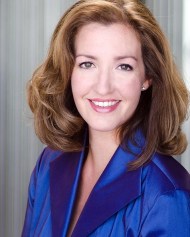
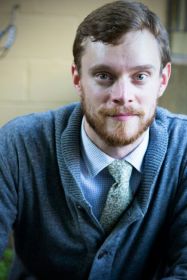
jennifer-bird-arvidsson

Jennifer Bird-Arvidsson

The entire program was both unfamiliar and fascinating. The arias were sung by Bird-Arvidsson with a seamless flow and elegant phrasing that was nicely matched by Aschauer and Carrettin in their obbligato accompaniments. Their committed advocacy for the music suggests that this unknown vocal repertoire is worthy of further exploration.

Of the instrumental works, Georg Muffat’s Sonata for Violin was strikingly strange, with passages of more or less normal Baroque phrases interrupted by sudden and unexpected  harmonic deviations. With the weirdness clearly brought out by the scoring, one wonders: was Muffat showing off for his imperial employer? It is certainly a piece that keeps both performers and listeners engaged.

Aschauer played a Plainte by Gottlieb Muffat in memory of the scholar Allison Dunlop, who tragically died just after completing a groundbreaking study of the composer. He performed this strange little lament with great feeling.

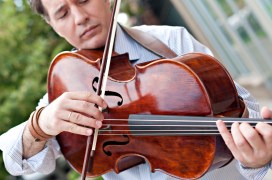
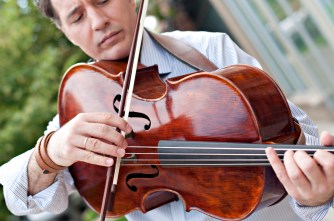
dsc-close-action-spalla-1

Zachary Carrettin with his cello da spalla

Carrettin introduced his cello da spalla to the audience, explaining how it might have been used in Baroque times, and why the instrument disappeared in the later 18th century. Built to order and based on historical models, his is a one-of-a-kind instrument that Carrettin admitted he is still learning. When played with vigor, it produces a gruff, dark sound, but Carrettin showed that it is also capable of more lyrical expression.

With this program, the Boulder Bach Festival has continued its theme using Bach “as a compass,” as Carrettin says, while exploring the musical past with fresh eyes and ears. Aschauer, Carrettin and Bird-Arvidsson made the “Journey to Vienna” one to be relished.

With BCO, comfortably familiar Americana takes many forms

By Peter Alexander

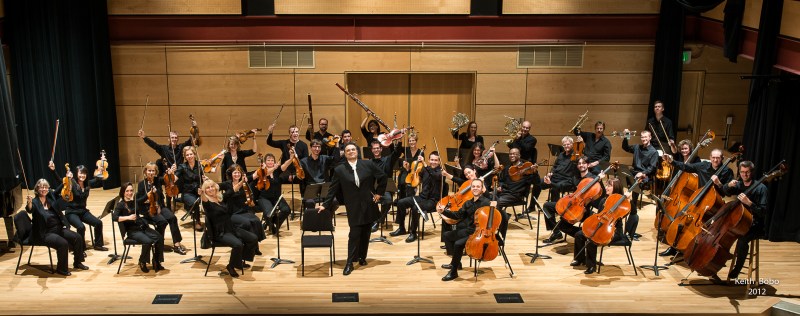
bconew_1

Bahman Saless and the Boulder Chamber Orchestra

“The Americans,” the current program of the Boulder Chamber Orchestra (BCO), offers comfortably familiar Americana in several different guises.

The program, led by conductor Bahman Saless and featuring violinist Karen Bentley Pollick, was performed last night (Nov. 11) in the Broomfield Auditorium. It will be repeated at 7:30 p.m. tonight in the Boulder Adventist Church, 345 Mapleton Ave. (tickets).

The program opens with genteel music from America’s “Gilded Age” of the late 19th century, the Air and Gavotte from Bostonian Arthur Foote’s Serenade for Strings. Here, the American-ness resides mostly in Foote’s careful homage to the music of Europe and avoidance of anything overtly American—characteristic of American high culture at the time, especially in New England.

Tenderly played by the BCO, the Air made a gentle start to the program. The following Gavotte is a Romanticized, drawing-room version of the Baroque dance, but none the less pleasant for that. Both were played with care.

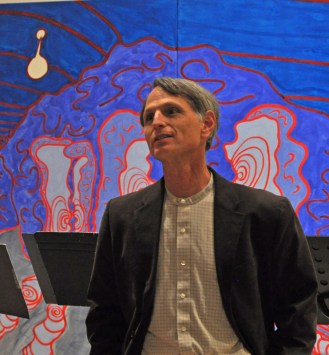
jaffe-003

Composer David Jaffe

Leaping more than 120 years, the BCO followed with the American premiere of David Jaffe’s Violin Concerto, How Did it Get so Late so Soon? This highly personal but unmistakably American work received a vigorous performance from the orchestra and Pollick, for whom the concerto was written, and by whom it was premiered in Lithuania Aug. 27.

A former bluegrass musician, Jaffe has filled the score with quotes and references to American music from the blues to the protest music of the 1930s. You may not hear the Woody Guthrie song he quotes, but the overall tone will be familiar to American audiences. The blues inflections, the outbreaks of Appalachian fiddling, the folk-tune-like melodies all come from a world we recognize.

There are portions of the concerto that sound as American as anything by Copland. But these ideas are always refracted thought a Charles Ives-ian sensibility, so that the music never settles into an extensive folkish groove. To my ears, that makes it all the more interesting: you never know what will happen next, but it all hangs together in a fascinating mélange. Bravo to Saless and the BCO for programming a work that deserves to be heard widely.

k-bentley-large

Violinist Karen Bentley Pollick

The orchestra played with a natural and relaxed understanding of Jaffe’s style. The small string section was always solid, and the second movement in particular featured some outstanding wind playing.

An enthusiastic advocate of the music she performs, Pollick played with great energy and conviction. Disclosure: I have known her since we were both music students in the 1980s, but to my entirely non-objective ear, she handled the concerto with virtuosic ease.

The rest of the program is too familiar to require extensive comment. In these fractious times, the Barber Adagio for Strings could be heard as an expression of sorrow for our broken country, and Copland’s Appalachian Spring as the hope that if we follow our hearts, things can be mended. But I doubt that anyone really wants to hear music as political metaphor.

The Barber was played with warmth and careful dynamic control. When played by a chamber orchestra, Appalachian Spring becomes less rugged, more delicate. There were a few bobbles, but Copland’s tender lyricism and robust energy were well conveyed. When everyone was having as much fun as Saless broadcast from the podium, further criticism seems irrelevant.

Boulder Phil in fine form for Mozart, Beethoven and Adés

Dusinberre and Walther delightful in Mozart Sinfonia Concertante

By Peter Alexander

The Boulder Philharmonic was in fine form last night (Nov. 6), as they presented two exquisite soloists as part of a season of duo-solo performances.

ed-geri_ellenappel_04-01

Edward Dusinberre and Geraldine Walther

Violinist Edward Dusinberre and violist Geraldine Walther, members of the Takacs Quartet, played Mozart’s Sinfonia Concertante for violin and viola with the orchestra. Conductor Michael Butterman also led the Phil in a fascinating work by British composer Thomas Adés and a bracing performance of Beethoven’s Eighth Symphony.

But first things first: Mozart. The interplay of the two soloists is central to the Sinfonia Concertante, and it is here that Dusinberre and Walther elevated their performance to the highest level. They are of course great individual players, but as members of a world-class string quartet, chamber music partners who play together professionally virtually every day, they have honed the ability to respond to one another in tone, mood, phrasing and pitch—all the myriad details that make a great performance.

Of all the delights they offered, I will single out one: There is a joint cadenza in the first movement, with the parts written out for the players. Walther and Dusinberre were so perfectly aligned in pitch and rhythm and the freedom of their phrasing that it sounded like one person on two instruments. I have never heard that passage better.

Their experienced partnership made the performance a pleasure to watch as well as hear. You could see the communication between them, as they shared their enjoyment of Mozart’s playful interchanges between soloists in the outer movements, and the beautiful sharing of extended melodies of the slow movement. And through their interactions, they shared that enjoyment with the audience.

It has to be said that Macky is not a great venue for this work There is a reason that Butterman has programmed more Romantic works than Mozart, in order to achieve what he calls “a sonic size appropriate for Macky Auditorium.” At times the Mozart sounded distant—and if it sounds that way from Row M, what must it sound like from the back or the mezzanine?

The concert began with Adés’s Three Studies from Couperin, orchestrations of harpsichord works by the French Baroque composer François Couperin. Himself a keyboard player, Adés has said that the best day he could imagine would be playing Couperin all day. I expect few in the audience have that degree of enthusiasm for the composer, but last night’s performance may well have boosted the appreciation for his strongly characterized and characteristic works.

Like the originals, Adés’s orchestrations are highly individual, offering a wondrous mix of colors. These are watercolors to the bright paintings of some orchestra arrangements—subtle and subdued hues that were given a well blended and warm interpretation by Butterman and the orchestra.

Buttermn.new

Michael Butterman. Photo by Glenn Ross

Beethoven’s Eighth Symphony was the first orchestral score I ever owned, so the rare performances are always both musical and nostalgic treasures for me. I admit I am prejudiced in favor of anyone who programs the Eighth, but I was definitely not disappointed by last night’s performance. Even though the Eighth is scored for a smaller classical orchestra, without trombones or doubled winds, the Phil’s sound was full enough to create a real presence in the hall.

Butterman’s interpretation was highly energetic, a bit on the muscular side, but none the less enjoyable for that. He found a good balance between Beethovenian outbursts, aided and abetted by a vigorous timpanist, and the more lyrical and light-hearted moments of the symphony. The second movement, marked Allegretto scherzando, was very brisk, more scherzando than allegretto. A slightly slower pace would allow the listener to enjoy Beethoven’s good cheer a bit more in this cheeky, clucking stand-in for a slow movement.

The finale was, as it should be, even faster, but here the tempo worked entirely to Beethoven’s advantage. The Boulder Philharmonic stayed right with Butterman’s galloping pace right to the end. Beethoven’s Eighth is perhaps too light hearted to elicit cheers, but the performance was more than worthy of a hearty “Bravo!”

Pro Musica and Masterworks Chorus deliver a joyful “Creation”

By Peter Alexander

Conductor Cynthia Katsarelis and her musical colleagues—the Pro Musica Colorado Chamber Orchestra, the Colorado Masterworks Chorus and three outstanding soloists—presented a joyful and enjoyable performance of The Creation by Joseph Haydn last night (Oct. 29).

amanda-balastrieri-2

Amanda Balestrieri

This was the first performance of the 2016–­17 season for Pro Musica, and the only the second outing for the Masterworks Chorus, a new entry into Boulder’s crowded classical music scene. The well matched soloists appearing with them were soprano Amanda Balestrieri, tenor Steven Soph and bass-baritone Jeffrey Seppala. Following a performance Friday in Denver, last night’s performance was in Boulder’s First United Methodist Church.

With the chorus on the broad but shallow sanctuary “stage,” the orchestra had to adopt an unusual seating arrangement, with woodwinds behind the strings on one side, brass behind the strings on the other. In a more complex work with tricky coordination among the winds this might have been a problem, but in this case it seemed to work quite well. The woodwinds in particular sounded bright and clear. In the church’s shoebox space the brass had to be restrained to avoid thickening the texture, but for the most part they succeeded.

seppala

Jeffrey Seppala

The long, deep space of the church favors the lower frequencies. The timpani, for example, had to be discreet to avoid muddying the sound, and usually succeeded. Katsarelis visually restrained the players throughout, generally keeping the orchestra and singers well balanced and the texture transparent.

The choral sound was solid and clear, even with all forces combined, as in the final fugue to the words “The Lord is great, his praise shall last for aye.” While the words from the chorus were not always understandable, the audience had the full text and the lights were, appropriately, left on.

This also benefitted the soloists, who were not always understandable, either. This is not entirely the singers fault, however: it is hard to be clearly understood when singing lines like “Softly purling glides on thro’ silent vales the limpid brook,” or “Most beautiful appear, with verdure young adorn’d, the gently sloping hills.” For this you can blame the Austrian Imperial Court Librarian, Baron Gottfried van Swieten, who wrote Haydn’s English text. Alas, his command of the language was not as fine as he thought.

Soph.jpg

Steven Soph

All three soloists should be commended for their performances. They have fine oratorio voices and sang their solo recitatives and arias with careful attention to expression. One of the highlights was surely the duet between Adam and Eve—Balestrieri and Seppala—with chorus, “By thee with bliss.” Likewise, their lengthy closing duet “Graceful consort!” drew a spontaneous “Bravo!” from the audience. And I could not suppress a chuckle at Seppala’s solemn delivery of the text “In long dimension creeps with sinuous trace the worm,” one of many delightful moments of text painting in Haydn’s score.

joseph_haydn

Joseph Haydn

One of the hallmarks of Katsarelis’s performances with the Pro Musica has been her careful control of dynamics. From the pianissimo whispers in the “Representation of chaos” and the fourth-day sunrise, to the full climaxes, the large-dimension contours were highly effective, with something held in reserve for the major climaxes. This was particularly evident at the end of the oratorio’s Part I, the much-sung chorus “The heavens are telling,” and the final “Amen.”

Finally, I have to return to Haydn, the genial genius whose lifelong humility and ability to learn paved the way for this great work. Inspired by the London Handel Festival performances of the 1790s, he wrote in his 60s a work unlike anything he had done before—to our eternal benefit. To quote the oratorio’s final chorus, “Let his name resound on high!”

Boulder Bach Festival goes exploring in an intriguing concert

Unfamiliar works and an unfamiliar instrument are unexpected treasures

By Peter Alexander

compass-logo-plusThere is a reason that the Boulder Bach Festival (BBF) uses a compass in its logo.

As demonstrated in their 2016–­17 season-opening concert yesterday (Oct. 15), the BBF under music director Zachary Carrettin goes sailing out into Bach’s musical world, looking for new discoveries for players and audiences alike. And usually, like yesterday’s concert, they bring back unexpected treasures.

The performance, given in Boulder’s Adventist Church, was a repetition of a program given Friday evening in St. John’s Episcopal Cathedral in Denver. Titled “Concertos and Chorales Contextualized,” the program explored the many different ways Lutheran chorale tunes were arranged and used as the basis of larger works in the Baroque period (late 1500s to roughly 1750), and also how Bach’s concertos reflected compositional techniques that had been refined through settings of chorale tunes.

Photography by Glenn Ross. http://on.fb.me/16KNsgK

Boulder Bach Festival Chorus and players. Photography by Glenn Ross.

There was music on the program from the early Baroque, starting with a work by the truly obscure Bartholomeus Gesius (1562–1613), through the slightly better known Michael Praetorius (1571–1621), Johann Hermann Schein (1586–1630), and Samuel Scheidt (1587–1654), and culminating with J.S. Bach (1685–1750). (See my preview of the concert here.)

Unfortunately, the space at the Boulder Adventist Church does not lend itself to clarity of the complex counterpoint you find in much Baroque music. This was evident with both the small orchestra assembled for two of J.S. Bach’s concertos, and the Boulder Bach Festival Chorus, which sang several works on the program.

The fault is not with the performers, who sang and played confidently. Carrettin led the program decisively, with a fine sense of style. Nevertheless, works performed from the front of the church were not always as clean as one would wish. Mid- to low-range sounds tended to get murky, and the bass lines were not always clear.

holman-headshot

Organist Christopher Holman

The sound is better when the music originates from the choir loft, at the back of the sanctuary. The choir sounded cleaner and clearer from the loft, and the organ, played splendidly by Christopher Holman, was transparent and at times sparkling.

In spite of any acoustic limitations, it was a thoroughly worthwhile and intriguing program, and may well have been more fully satisfying in the Denver venue.

Before the second half of the concert, Carrettin gave a brief talk on how the word Ach (the German equivalent of “Ahh!”) in Bach’s motet Jesu Meine Freude corresponds to similar exhalations in other cultures and spiritual traditions around the world. This both served to make the music, firmly grounded in north German Lutheran religious practice, more universal, and personified the festival’s motto “Across Time, Across Cultures”—the spirit that underlies the adventurous direction of today’s Boulder Bach Festival.

Three parts of the program were particularly pleasing. The anonymous setting of Ach Gott, vom Himmel sieh darein (Oh God, look down from heaven) for organ was a delightful discovery, with rippling runs and a growing sense of pace. As throughout the concert, Holman’s playing brought the music energetically to life.

Of the two concertos, Bach’s Brandenburg Concerto No. 6 was the best instrumental selection on the concert. A string ensemble with violas at the top of the texture runs the risk of being murky throughout, but the smaller ensemble and careful work by the players mostly overcame the danger. The texture was generally transparent.

The playing by viola soloists Aniel Cabán and Tal McGee was particularly lovely in the slow movement, and the finale romped along with great energy.

dsc-close-action-spalla-1

BBF artistic director Zachary Carrettin with his cello de spalla

A word about the cello da spalla (shoulder cello) that Carrettin introduced in this work. He and Renee Hemsing Patten played two interior parts (originally written for viola de gamba) on this unusual and somewhat awkward looking instrument. When heard individually, they projected a solid, clean string tone, and they obviously filled their parts well. To really judge the instruments, it would be necessary to hear one in a solo role—which Carrettin has planned for the BBF concert Dec. 8 in Boulder and Dec. 9 in Longmont.

The final set of the concert comprised three works for the Christmas season, by Michael Praetorius, J.S. Bach, and Gesius. Each work was pleasing, starting with music sung by a chamber choir, and ending with the Gesius sung in surround sound with a rank of singers in each aisle. This was good program planning: ending with the fullest and clearest choral sound of the concert, and yet another fine discovery brought back from the larger musical world.

Opening Night: Bracing, energetic, rough

Boulder Philharmonic begins conductor Michael Butterman’s 10th-anniversary season

By Peter Alexander

bpo-macky-3

Conductor Michael Butterman began his 10th anniversary season with the Boulder Philharmonic

The Boulder Philharmonic gave a mixed performance last night, playing an intriguing program to launch its 2016–17 season.

The selections ranged from the familiar—Rachmaninoff’s Rhapsody on a Theme by Paganini—to the not quite familiar—Tchaikovsky’s tuneful Symphony No. 2—to the almost exotic—Francis Poulenc’s Concerto for Two Pianos. The dynamic young piano duo of Greg Anderson and Elizabeth Joy Roe were soloists.

The performance had plenty of energy and many lovely moments, but it also suffered from being the orchestra’s first outing of the season. At times the sound was a little rough, the players not quite together, but in the end the high energy of the performance won out.

Boulder Phil principal cellist Charles Lee introduced the proceedings with announcements of his (20th) and Butterman’s (10th) anniversary seasons with the orchestra. Next, board vice-president Rudy Perez acquitted himself admirably, leading the orchestra in the Star Spangled Banner—not the easiest piece for a non-professional conductor—and then happily turned the musicians over to Butterman.

03andersonroebylisa-mariemazzucco

Duo pianists Anderson and Roe

To open the actual program, Anderson and Roe gave a bracing performance of Poulenc’s Concerto. Unfamiliar enough that Butterman gave a spoken introduction, with a recording of a Balinese gamelan to illustrate one of Poulenc’s inspirations, the concerto won the audience’s favor and a hearty ovation.

For their part, Anderson and Roe gave a scintillating performance. This is piece that it pays to hear live: the give and take between the players can be seen and enjoyed, but not necessarily heard on a recording. With their exuberant performing style, Anderson and Roe provided a visual element that only enhanced these musical exchanges and the sudden shifts in mood.

The Mozartian slow movement, played with great tenderness and pleasure by the soloists, was a delight to hear, and the spice and energy of the finale were contagious. From beginning to end, the concerto was thoroughly satisfying.

Roe returned alone as soloist for Rachmaninoff’s much loved Rhapsody. She played with great aplomb, from the strongest chords to the most delicate moments. The expressiveness of her playing and the intensity of her commitment to the music were deeply moving.

There was some lovely playing from individual musicians, moments of real beauty, but on the whole the orchestra was not at its best here. The piano forced the players farther back than usual, and the winds, sounding from the deep confines of the narrow Macky stage, were not always clear or well balanced.

Before intermission, Anderson and Roe appeared together again for two encores, giving them the opportunity to show why they are known as such charismatic players. In arrangements of Astor Piazzolla’s “Libertango” and Bernstein’s “Mambo” from West Side Story, they gave teasing, saucy performances that delighted the audience. It was sheer entertainment that did not sacrifice one iota of musicality.

After intermission, Tchaikovsky’s Second Symphony started with a dramatic chord and impressive horn solo. A faster tempo was momentarily ragged, but as the performance picked up energy from movement to movement, it became more compelling. The finale, a perfect example of Tchaikovsky’s ability to build momentum and excitement, became a showcase for the brass and timpani. Butterman’s careful dynamic control gave great impact to the ending.

# # # # #

This is an important season for the Boulder Philharmonic, and not just because of Butterman’s anniversary. In March the orchestra has been invited to the Kennedy Center in Washington, D.C., one of four orchestras nationwide to be selected for the inaugural SHIFT Festival of American Orchestras. By then, the orchestra will have had plenty of time to coalesce and work out the little kinks from last night’s performance.

waltherdusinberre

Geraldine Walther and Edward Dusinberre

In the meantime, the remainder of the season here in Boulder is based on an intriguing notion: collaboration between musical pairs. Anderson and Roe were the first examples of that theme. Later concerts will feature Mozart’s Sinfonia Concertante for violin and viola, played by Edward Dusinberre and Geraldine Walther of the Takacs Quartet (Nov. 6); Ethel Smyth’s Concerto for violin and horn, played by guests Jennifer Frautschi and Eric Ruske (Jan. 14); and the world premier of Stephen Goss’s Double Concerto for violin, guitar, strings and percussion, played by CU faculty Charles Wetherbee, who is also the Phil’s concertmaster, and Nicoló Spera (April 22).

Like last night’s concert, the programs for these and other concerts on the season range from the familiar to the exotic. You can see the full season listing on the Boulder Phil Web page. There is much to look forward to.

Boulder Chamber Orchestra opens 13th season, titled “Jinx”

Highly polished violin soloist and rocky Brahms First fill the program

By Peter Alexander

Last night Bahman Saless and the Boulder Chamber Orchestra opened “Jinx,” their 13th season, with a program that challenged the orchestra and the soloist, violinist Yabing Tan.

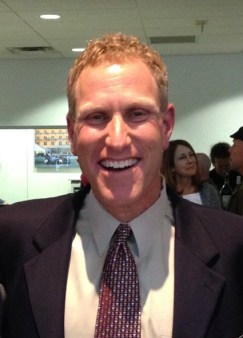
john-tayer

John Tayer in his natural environment as CEO of the Boulder Chamber of Commerce

The concert in the Boulder Adventist Church on Mapleton opened with an appearance by Boulder Chamber of Commerce CEO John Tayer as guest conductor. The orchestra played Johan Strauss, Jr.’s spirited Tritsch Tratsch Polka with appropriate vigor, while Tayer provided choreography on the podium—posing on one foot, making pantomime gestures and leading the audience in clapping. There was no sign of a jinx in this cheerful start to the season.

The rest of the concert’s first half was given over to Tan’s performance of two staples of the violin repertoire, Introduction and Rondo Capriccioso by Saint-Saëns and Henryk Wieniawski’s Second Concerto. The order—Strauss, Saint-Saëns, Wieniawski—was like going from desert to main course, but all the dishes were well prepared.

Tan earned her appearance with the BCO as winner of the Classic Alive Artist Competition. She has a silky sound that was well displayed throughout. She has said of the Saint-Saëns “if you practice for years and hours, then it’s not so hard.” Clearly she has put in the practice, because the music was completely under control. If anything, it seemed too easy, so comfortable that the music’s innate drama was understated.

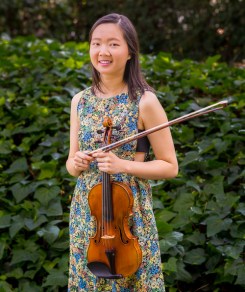
yabing-tan

Yabing Tan

The same was true to some extent of her polished performance of the Wieniawski Concerto. She flashed through all the technical passages easily, while floating beautifully through the lyrical passages. The only thing missing was a fiery spark of excitement.

The Romance emerged as a lovely interlude between the outer movements, as Tan carried Wieniawski’s lyrical lines with great tenderness. She was aided by outstanding playing from the solo clarinet. The performance caught fire in the à la Zingara (gypsy style) finale, providing a bit of flash and dash for the ending. Saless and the BCO provided sympathetic support throughout.

Brahms’s First Symphony is a serious and complex work, Brahms’s studied answer to expectations that he would follow Beethoven as the great German symphonist. This large-scale symphony was a severe test for the small forces of the BCO, pushing them to and sometimes beyond their limit. All the notes were in place, the dynamic contours generally clear, but Brahms needs more than that.

saless-dsc09399

BCO conductor Bahman Saless

To begin with, the orchestra failed to retune before beginning the symphony. The pitch never really settled comfortably until the players finally tuned again before the last movement. The lack of precise pitch agreement created a muddied and raw sound, especially when the full ensemble was playing. This compounded the natural problems that result when a small orchestra undertakes a piece that requires weight and strength.

Problems were evident in the very first notes of the introduction, when the timpani, positioned in a corner of the resonant church sanctuary, overwhelmed the rest of the orchestra. In the rest of the introduction one heard mostly a wall of wind sound, with moving lines within the small-ish string section rendered almost inaudible.

Once the Allegro portion of the movement got underway, the more lightly scored passages were much more satisfactory. Tutti climaxes, however, always tended to sound heavy and unclear. Full chords from the winds and rhythmic impulses from the brass often covered the strings. Since the strings carry much of the musical argument, a lot of what was happening in the score was not available to the listeners.

Another problem, at least in the space of the Adventist Church, is that the limited range of dynamics and weight available to a smaller orchestra did not allow for powerful contours over longer stretches of music. In other words, local contours were well shaped, but across longer spans everything fell within the same range. Extremes were lost, at both the delicate and weighty ends of the spectrum.

With intonation improved, the beginning of the finale was the best part of the symphony. The buildup to the big theme, which Saless had pointed out before the performance, was effective, and the ending achieved a satisfying level of excitement and impact.

There were outstanding performances by the individual players in the orchestra—the principal clarinet, flute and oboe were notable. Concertmaster Annamaria Karacson’s solos were beautifully played. The horn had some lovely moments, although always at the risk of overwhelming the string sound.

In short, the individual players fully met the challenges of Brahms’s First. Alas, the BCO collectively did not. The strengths and weaknesses of the performance should stand as a cautionary note for chamber orchestras venturing into large-orchestra territory.

No premieres, but enticing productions at Santa Fe Opera

“Thoroughly enjoyable” Don Giovanni and “rare, noteworthy” Vanessa among the pleasures

By Peter Alexander

It’s an unusual year at the Santa Fe Opera.
IMG_0501

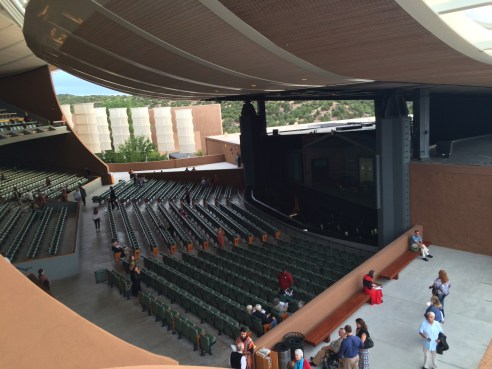
Crosby Theatre, Santa Fe Opera. Photo by Peter Alexander

The company, known for producing premieres, has no new works this year, nothing from the current century, nothing from the past 50 years. The most recent work on the 2016 season is Samuel Barber’s Vanessa, a conservative piece of neo-Romantic melodrama even when it was written in 1958. (Santa Fe is producing the now standard 1964 revision.)

This is not to imply that the current season at Santa Fe fails to live up to the company’s enviable standards. Even without new works, there is much to enjoy, appreciate and admire at the Santa Fe Opera. Of the five-opera season, I saw three: Mozart’s Don Giovanni, Puccini’s La Fanciulla del West (Girl of the Golden West) and Vanessa. Other productions were Richard Strauss’s Capriccio and Gounod’s Roméo et Juliette.

Don Giovanni receives a thoroughly enjoyable performance, in many ways one of the best I have seen. The cast is very strong, the production is interesting and successful, and except for the problematic second act where Mozart had to provide showpiece arias for each lead singer in turn, the pacing is brisk.
2 Ensemble Cast in 'Don Giovanni' (c) Ken Howard for Santa Fe Opera.SMALL

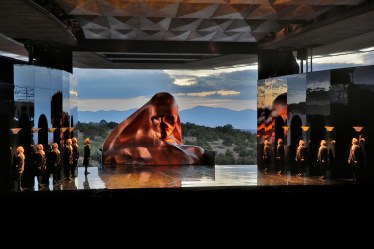
Ensemble Cast in ‘Don Giovanni’ (c) Ken Howard for Santa Fe Opera

There is nothing particularly original or striking in the concept and characterization, which largely represent a natural and direct interpretation of the libretto and score. With a largely bare stage, the production focuses on the relationships among the characters.

Riccardo Hernandez’s set is dominated by a large semi-abstract head that recalls the sculptural style of Henry Moore and other mid-20th-century artists. A dark gray when it first rises impressively from behind the stage (left open to the New Mexico hills), the head reflects many different colors and patterns during the show, from silver and blue to gold to fiery red, paralleling the passions and actions of the characters.
22 Soloman Howard (The Commendatore) and Daniel Okulitch (Don Giovanni) in 'Don Giovanni' (c) Ken Howard for Santa Fe Opera.SMALL

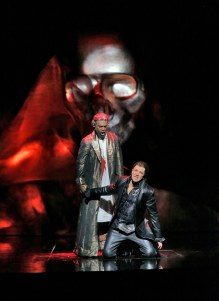
The Commendatore (Soloman Howard) drags Don Giovanni (Daniel Okulitch) to his infernal reward. (c) Ken Howard, Santa Fe Opera

The floor and side panels are a shiny, reflective black. Other than some suggestive scenes on the panels when the opera moves to Don Giovanni’s castle, the only other scenic elements are a few pieces of furniture when needed, and large statuary for the cemetery. With Peter Negrini’s intriguing projections on the sculptural head, this is enough to suggest the locations and simple enough to keep the action moving without time-consuming scene changes. The night I was in attendance, the flames projected on the set and the steam bursting from the stage floor as Don Giovanni is pulled into the underworld drew grasps and cheers from the audience.

Emily Rebholz’s attractive costumes suggest Mozart’s times without falling back on actual 18th-century styles, with their silk stockings and powdered periwigs that look silly today. Ron Daniel provides clean and effective stage direction with no tendentious psychological reinterpretation or the kind of slapstick and stylized gesturing that mar some Mozart productions.

Conductor John Nelson led a stylish interpretation, with the orchestra always well in balance with the singers. The overture had great energy but was slightly ragged until the players settled into the fast tempo that Nelson selected.
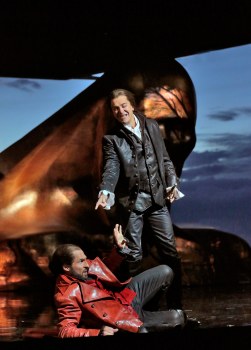
8 Kyle Ketelsen (Leporello) and Daniel Okulitch (Don Giovanni) in 'DOn Giovanni' (c) Ken Howard for Santa Fe Opera.SMALL

Leporello (Kyle Ketelsen) and Don Giovanni (Daniel Okulitch) (c) Ken Howard, Santa Fe Opera

The key pairing of Don Giovanni and Leporello is outstanding. Daniel Okulitch cuts the very figure of the wily seducer. If slightly laconic at times, he always moves on stage with the ease of the nobleman who expects obedience from the world about him. He is vocally solid, and sparkles appropriately in the famous “Champagne Aria.”

His partner, Kyle Ketelsen as Leporello, is one of the stars of the show. He sings with great energy and expression, creating a very sympathetic Leporello without descending to mugging or overacting to make a comic point. (Disclosure: I knew Ketelsen as a graduate student singer many years ago at the University of Iowa.)

Leah Crocetto’s bright, clear soprano is ideal for Donna Anna, and she handles all the brilliant figuration of her opera seria part with aplomb. As her opposite figure, Keri Alkema is a steely-voiced Donna Elvira when intent on revenge against the Don, but capable of melting into warm, creamy tones under his seductive powers. In the ungrateful role of Don Ottavio, who has little more to do than sing his undying devotion over and over again, Edgaras Montvidas is ardent, although his voice sometimes slips into an edgy, pushed sound.
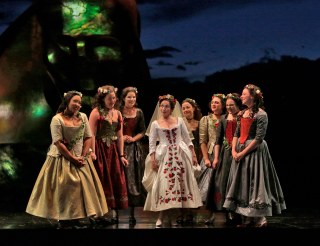
10 Rhian Lois (Zerlina) and Ensemble Cast in 'Don Giovanni' (c) Ken Howard for Santa Fe Opera.SMALL

Rhian Lois (Zerlina) and ensemble (c) Ken Howard, Santa Fe Opera

Rhian Lois was lovable and flirty as Zerlina, as she should be, singing with a bright and perky manner that was never less than delightful. If occasionally under-animated, Jarrett Ott was fine as the jealous and hot-tempered Masetto. Soloman Howard’s booming voice lent weight to the Commendatore, who, unusually, enters the final scene in person instead of as a statue.

Some Santa Fe magic: nature, always an element in the beautiful open-air Crosby Theatre, made its own contribution to the production. On Monday night (Aug. 1), distant lightning, seen from the very beginning of the overture, approached the theater as Don Giovanni approached his reckoning. The final scene had some accompanying loud thunderclaps as the Commendatore entered the stage.

# # # # #

La Fanciulla del West has always struck me as an uncomfortable hybrid, with its Italian passion applied over the Wild West setting with a very broad knife. The sourdoughs heartily calling out “Hello! Hello!” at every opportunity, the cringeworthy Native characters Wowkle and Billy, rich Puccinian climaxes applied to such lines as “I want my plow again and my mother,” the childlike miners who pivot so easily from a raging lynch mob to a happy congregation under the influence of Minnie’s sentimentality—it’s all a hard to sell to Americans. Not surprisingly, the night I attended (Aug. 2) the audience chuckled more than once in moments that should be serious.
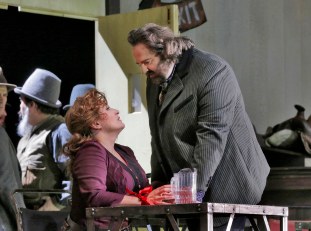
13 Patricia Racette (Minnie) and Gwyn Hughes Jones (Dick Johnson) in 'The Girl of the GOlden West' (c) Ken Howard for Santa Fe Opera.SMALL

Patricia Racette (Minnie) and Gwynn Hughes Jones (Dick Johnson) in ‘La Fanciulla del West’ (c) Ken Howard, Santa Fe Opera

This production is a bit of a mixed bag. The cast, led by the estimable veteran Patricia Racette as Minnie, gives a taut performance in the opera’s most dramatic moments, particularly the crucial turning points in the second act. It is a pleasure to hear some less familiar Puccini performed with commitment.

However, the problematic set—designed by Miriam Buether in a co-production with the English National opera—is another matter. It represents a sort of dollhouse style, with tidy buildings from somewhere far removed from a California mining camp. The second act turns Minnie’s cabin into a 1950s Adirondack weekend getaway, with a circular window and chic little lighting fixtures, while the first-act bar comes complete with neon lighting.
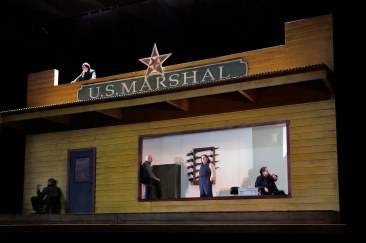
18 Raymond Aceto (Ashby).SMALL

Miriam Buether’s Hopper-esque U.S.Marshall’s Office, Act III of ‘La Fanciulla del West’ (c) Ken Howard, Santa Fe Opera

The first and third act sets leave director Richard Jones with some very stiff challenges for moving his cast and chorus. In the first act, the chorus keeps running in and out, en masse, often with no apparent motivation, largely because the set doesn’t leave room for them to do much more. The last act, with its broad front suggesting a marshal’s office as painted by Edward Hopper, forces the chorus to line up in two ranks, face the audience and sing. The only action possible in this constricted space is provided by posse members who keep dashing across the stage, seriously upstaging one of Jack Rance’s big moments.

Dramatically, it is hard to take this seriously, but Puccini is really about the music. Conductor Emmanuel Villaume leads an impassioned interpretation without sacrificing delicacy and control. He is unafraid to turn loose the orchestra at the climaxes, but otherwise remains supportive of the singers.
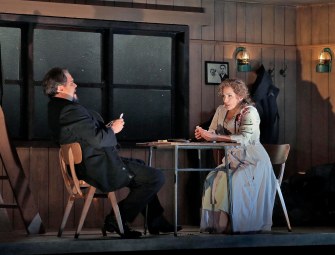
14 Mark Delavan (Jack Rance) and Patricia Racette (Minnie) in 'The Girl of the Golden West' (c) Ken Howard for Santa Fe Opera.SMALL

Jack Rance (Mark Delavan) and Minnie (Racette) play cards for Dick Johnson (c) Ken Howard, Santa Fe Opera

The only major female character in an opera of men, Minnie is the heart of the story. Racette has Puccini in her veins, and at her best delivers a Minnie of great impact. Her evocation of Minnie’s anguish, and all the emotional swerves of the second act are superb. Elsewhere, I found her less effective, with a vibrato that gets away from her when pushed for volume or range.

Gwynn Hughes Jones has an appealing tenor voice that fits Dick Johnson well. He was deeply affecting in his lyrical moments, but also in the great emotional moments of the second act. Mark Delavan is a rough hewn, threatening Rance, stressing more the jealous, angry lover than the rock-steady sheriff. With Racette and Jones, he helps bring the second act to a boil.

The other roles are well handled. Craig Verm as the sympathetic Sonora is a standout, Allan Glassman a solid Nick. As Ashby, Raymond Aceto uses his sonorous, covered voice to create a blustery, officious Wells Fargo agent.

# # # # #

For fans of Barber’s music (me included), any production of Vanessa is a rare pleasure, and this one was particularly noteworthy. The musical elements—the singing from a strong cast, the musical leadership from conductor Leonard Slatkin, the playing from the virtuoso orchestra—were all exceptional. The production struck a serious note, and while not everyone will like the approach, which chooses psychological symbolism over grandeur, it was consistent and meaningful.
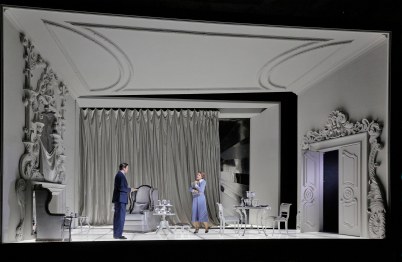
5. Zach Borichevsky (Anatol) and Virginie Verrez (c) Ken Howard for Santa Fe Opera.SMALL

Allen Moyer’s monochrome set for ‘Vanessa’ (Zach Borichevsky as Anatol and Virginie Verrez as Erika) (c) Ken Howard, Santa Fe Opera

Allen Moyer’s set portrays a grand house, set somewhere in the remote north, but Moyer eschews the lavish Masterpiece Theater Victorian-period style that often characterize the opera. Instead, his set is rendered entirely in shades of gray. That setting, and the largely monochrome costumes of James Schuette, clearly symbolize the monotony of the shuttered and emotionally choked life that Vanessa has chosen.

The back of the stage is covered by a large curtain, pulled back to reveal a shattered mirror as Vanessa begins to return to life with the arrival of the false Anatol. Representing Vanessa’s efforts to deny the aging process, when opened it stands for the shattered person that Vanessa has become. At the end, when the young Erika takes on Vanessa’s retreat from life, the curtain is pulled back over the mirror.

This approach allows for some stunning moments of theater—the eye is captured by any use of color in a costume, the pure white Erika and others wear in the second act, the view of the snowy woods through the great window—and the return to all gray at the end makes Erika’s coming fate visible. If a little oppressive for the viewer, it is handled with subtlety and consistency. The symbolism never becomes didactic or preachy, and never overtakes or contradicts the music or plot.
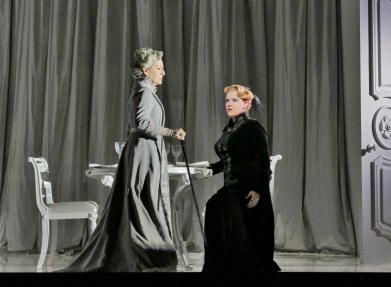
6. Helene Schneiderman (Old Baroness) and Erin Wall (Vanessa) in 'Vanessa' (c) Ken Howard for Santa Fe Opera.SMALL

Helene Schneiderman (Old Baroness) and Erin Wall (Vanessa) in ‘Vanessa’ (c) Ken Howard, Santa Fe Opera

The opera is carried well by the two female principals, Virginie Verrez as Erika and Erin Wall as Vanessa. The two singers establish their contrasting characters at the outset, with beautiful renditions first of Erika’s calm, longing aria “Must the Winter Come so Soon,” followed by Vanessa’s fiery, overwrought showpiece, “Do not utter a word, Anatol.” Wall in particular handles the extreme demands of her aria spectacularly well, from the most brilliant outbursts to the final, filmy fading of the last note.

These two singers set a very high standard, and maintain it throughout. As the baroness, who makes her greatest emotional impact by not singing, Helene Schneiderman sings expressively but is a little light of voice for such a fierce, commanding figure: only a gutsy and powerful voice will be missed when withheld.

The third side of the triangle, Anatol, is ably carried by Zach Borichevsky. His is a less interesting character than the women—the point of his role is that he is empty at the core, proposing offhandedly to Erika, then not seeming to care if she accepts. Erika is right to doubt his love, or any other deep feeling for that matter. Borichevsky illuminates Antol’s feckless character and negotiates the part’s high range nimbly, but his bright, brittle tenor sometimes sounds pinched.
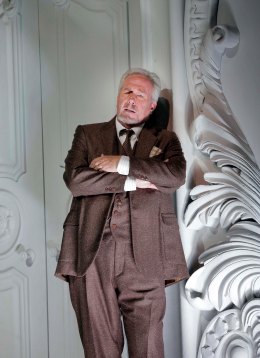
19. James Morris ( The Doctor) in 'Vanessa' (c) Ken Howard for Santa Fe Opera.SMALL

James Morris (The Doctor) in ‘Vanessa’ (c) Ken Howard, Santa Fe Opera

A great pleasure of the performance is seeing veteran baritone James Morris as the doctor. His rich sound and precise expression made the comic scene at the beginning of Act II one of the opera’s high points, confirming Morris’s stature as one of our great actor-singers.

Santa Fe’s orchestra proved more than capable of handling Barber’s virtuoso demands. I am tempted to add, “especially the woodwinds,” whose fleeting scurries and twittering commentary are brilliantly played, but in fact the brass have equal, if different demands. Special kudos go to the horns. The highly experienced Slatkin keeps the pacing and emotional temperature firmly under control, mapping out a performance that finds its most powerful moments at just the right time.

There is still time to hear all three, and the other operas on the summer’s bill. The Santa Fe season runs through Aug. 27, with all five works in rotation. Check the SFO’s Web page for ticket availability.

# # # # #

In the summer of 2017 the Santa Fe Opera will be back to their premiering ways. Sure to attract international attention, The (Re)volution of Steve Jobs will premiere July 22 with music by Mason Bates and a libretto by Mark Campbell. Michael Christie, conductor laureate of the Colorado Music Festival, will conduct. If you are interested, you should watch for the beginning of online ticket sales in the fall since this is likely to be one of opera’s hot tickets next year.

Other works on the 2017 program will include two rarities, Nicolai Rimsky-Korsakov’s Golden Cockerel and George Frideric Handel’s Alcina, along with two works more standard in the world’s opera houses, Gaetano Donizetti’s Lucia di Lammermoor and Johann Strauss Jr.’s Fledermaus. More information is available on the Santa Fe Opera Website.

Nine intriguing premieres in Fairbanks

Stephen Lias’s Composing in the Wilderness Workshop at the Fairbanks Summer Arts Festival

By Peter Alexander

The Fairbanks (Alaska) Summer Arts Festival presented an intriguing concert of nine new works by nine composers last Tuesday (July 26) in Davis Concert Hall on the University of Alaska campus.

IMG_0484

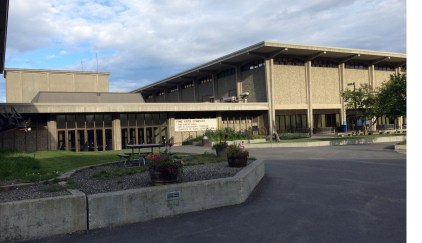
Davis Concert Hall at the University of Alaska, Fairbanks, site of the Composing in the Wilderness concert at the Fairbanks Summer Arts Festival. Photo by Peter Alexander.

The concert was the culmination of Composing in the Wilderness, a workshop led with great success by composer Stephen Lias. Lias is known to Boulder audiences: The Boulder Philharmonic opened their 2014–15 season with the world premiere of his Gates of the Arctic, inspired by the National Park in northern Alaska, and Lias has been commissioned to write a new work for the orchestra to play next year at the Kennedy Center in Washington. That work, All the Songs that Nature Sings, will be premiered by conductor Michael Butterman and the Boulder Phil March 25 and then performed at the Shift Festival in Washington March 28.

IMG_0458

Composer Stephen Lias. Photo by Peter Alexander

The nine works on the July 26 program were all written under the same conditions: after spending several days getting oriented to Alaska and the wilderness at Denali National Park and Preserve, the composers travel to a remote area in the Yukon Charley Rivers National Preserve, where they have four days to write a new work inspired by their experiences in Alaska.

The works were written for and premiered by members of Corvus, ensemble in residence at the Fairbanks Summer Arts Festival. The limited instrumentation of Corvus—Katie Cox, flute; Andie Springer, violin; Kate Sheeran, horn; and Owen Weaver, percussion—and the short working time imposed both a disciplined economy and a certain similarity of sound to all nine pieces. Nevertheless, the composers all found a way to express their own musical personalities in their necessarily short works, as well as the individual sources of inspiration they found in the wilderness settings.

Little Cosmos for flute, horn and percussion by Cassie To was the composer’s response to what she called “the amazing world of lichens” that she had discovered during the workshop. Opening with noble tones from the horn and pointillistic comments from the flute, the score features wide-ranging themes that effectively evoke both the openness of large spaces and the delicacy of tiny plants. This is a well crafted, carefully shaped piece of music.

Teklanika Twilight by David John Lang calls for the same ensemble. The composer acknowledged two sources of inspiration: the “constant sound track” provided by the Teklanika River, and the perpetual twilight of the midsummer Arctic. Steady rhythms in the melodic instruments suggested the steady flow of the river, while the percussionist added sleigh bells and other subtle sounds for the tinkling of the water over rocks. It all led to a delightful ending.

Out There for violin, flute and percussion by Dylan Labrande was inspired by the mysteries of the world “out there,” beyond the window in the composer’s cabin at Yukon Charley Rivers. The music left it to the listeners to decide what was “out there.” Was there a hint of threat in the building percussion sounds, some danger behind the implacable beauty of the scene? Whatever you hear, the score clearly implies a depth beyond what you can sense on the surface.

Over the High One for violin, flute and percussion by Alondra Vega-Zaldivar describes the rising of the sun over the highest mountain in North America. “I came to Alaska and I found magic,” the composer said in her introduction. For Vega, Denali is a pretty jazzy mountain. Her score puts the percussionist through his paces, occasionally overwhelming the comparatively softer melody instruments.

IMG_2143

Composers in the 2016 Composing in the Wilderness workshop: Shelley Washington and Cassie To (seated); Elizabeth Start, Paul Safar, Sam Young, Alondra Vega-Zaldivar, Dylan Librande, David John Lang and Gemma Peacocke (standing, l-r). Photo by Peter Alexander.

. . And Water Connects . . . for violin, horn and percussion by Elizabeth Start begins haltingly, as if musical phrases are trying to come together, with a melody first emerging from the horn. Perhaps these are trickling streams that eventually build into a flood as the piece reaches its strong conclusion. Most unfortunately, the intended recordings of water sounds failed to play, leaving an incomplete impression of the composer’s intention. After the performance Start gamely observed that the score was intended to be effective with or without the electronics, but her piece still awaits its full premiere.

Refugium for flute, violin and percussion by Paul Safar is a playful piece that combines music with a text spoken by the players that was written by the composer. The phrase “step by step” becomes a repeated rhythm that invites in the percussion, then the flute, and last of all the violin. The score captures the idea of a journey, or stroll with different views and incidents—the mountains, a stream, flowers, a scampering ground squirrel—that form a pleasurable mosaic of at least the sunnier side of the Alaskan wilderness.

Polychrome for the full quartet of flute, horn, violin and percussion by Gemma Peacocke was inspired by a specific viewpoint within the Denali National Park, overlooking a scene of disparate colors spread across the valley and mountains. Lacking overt melody, the music moves slowly through a spectrum of instrumental sounds, like slowly shifting light across the broad Polychrome vista. This was one of the most original and engaging pieces on the program, inviting the listener to hear beyond the surface colors.

Thorofare Ridge for violin, flute and horn by Sam Young reflects the composer’s observation that during the brief but intense Arctic summer, “all living things go into overdrive.” This is a thoroughly engaging piece, with melodic bits that capture the ear supported by quirky rhythms and accompanying elements. The music has a definite outdoorsy feel that suggests not only a pleasant day in the mountains, climbing Denali National Park’s alpine Thorofare Ridge, but also the sourdough history of Alaska.

IMG_0481

The Great Hall, University of Alaska, Fairbanks. Photo by Peter Alexander

Their Name is Yours for the full quartet by Shelley Washington made a strong conclusion for the program. Washington combined her experiences in Alaska with the idea of personal stories that form us all. “Tell us a story,” the players sing, sometimes singly and sometimes as a quartet, adding an additional musical challenge to the score. It is a very lively piece, with fiddling that suggests what kind of story this might be. At points there are slightly wild, slightly mysterious qualities to the composer’s story, suggesting something fundamental, something rooted in American soil.

Two further things need to be added to this report. One can assume that the composers did not bring their own individual cheering sections with them to Alaska, so the hoops and cheers after each piece indicate the kind of support that the Summer Arts Festival, and these new pieces created in Alaska receive in Fairbanks.

And one can not say enough about the players of Corvus. With even less time than the composers had to write them, they had to master nine completely new pieces for their premieres. They played—and sang—exceptionally through the program. How fortunate the composers, and Stephen Lias’s ongoing workshop program, are to have such support in their performers. Bravo to all!

__________

NOTE: A longer report on the Composing in the Wilderness workshop, with interviews with the participants, will appear later this month in Boulder Weekly.

Former CMF music director Christie returns to a warm welcome

‘Up to his old tricks again,’ including a dramatic entrance from the audience

By Peter Alexander

Michael Christie.03

Michael Christie. Photo by Steve J. Sherman

Michael Christie, for 13 years music director of the Colorado Music Festival and now conductor laureate, returned to lead the Festival Orchestra last night (July 14) in a program of music by Leonard Bernstein, Charles Ives and Johannes Brahms. Appearing with him was pianist Orion Weiss, a frequent partner with Christie during his years at CMF.

In planning the program, Christie said he wanted “to come back with a presentation style that everybody would say, ‘I remember that guy! He’s up his old tricks again.’”

New tricks or old, there is no doubt that the dramatic opening of the concert caught the audience’s attention.

The program started with concert sponsor Paul Repetto introducing Christie with great warmth but more or less in absentia, since the conductor was not on the stage. But as soon as Repetto finished his remarks Christie, standing out among the audience, gave the downbeat for brass and percussion on the sides of the hall to begin Bernstein’s noisy, boisterous Shivaree, a brief, exciting program opener.

As the last note of the Bernstein faded away, the strings sitting onstage had already began Ives’s mystical Unanswered Question. The strings, playing barely audible, slow-moving chords, were led by their section leaders while a solo trumpet, posing the titular question, sounded from backstage. The woodwinds, with Christie leading them now from the side of the house, offered energetic but inconclusive non-answers that seem to not resolve anything.

At the end the trumpet is heard one last time, over slowly dying string chords, still asking, asking, asking.

This is great musical drama. I have never heard the Ives more effectively introduced: the sudden hushed chord after the last loud flourish of the Bernstein was breathtaking. May I recommend this pairing to other conductors out there?

After such a theatrical beginning, Christie needed a powerful piece to round out the first half, and he found it in the suite from Bernstein’s music for the film On the Waterfront. A gritty, jazzy precursor to the music for West Side Story, On the Waterfront is vintage Bernstein, pure big-city Americana from the 1950s.

Christie and the Festival Orchestra gave a performance bursting with the raw energy of the streets and docks of Hoboken, but also imbued with tenderness and the aching regrets of the “contender” who never was. There was one shaky moment at the beginning, and the bluesy touches seemed a little on the careful side, but otherwise the performance was exceptional.

IMG_4013BCjpg

Michael Christie and Orion Weiss. Photo by Tom Steenland.

Weiss joined Christie and the orchestra for the second half of the program, playing Brahms’s muscular Piano Concerto No. 1 in D minor. Very few pieces open more stormily than this concerto, and from the opening timpani thunderclaps, the Festival Orchestra gave a vigorous performance. Mention should be made of the principal horn, who effectively negotiated exposed solos in both the Bernstein and the Brahms.

The powerful moments of the concerto’s first movement are so memorable that it is easy to forget that there are many passages of great delicacy. It is one of the delights of the Chautauqua Auditorium that music played softly has great presence throughout the hall. These portions of the concerto were especially effective; Weiss’s clean sound and control made every ripple, every filigreed decoration deliciously clear. He had an attentive partner in Christie, who allowed the soloist to shine through.

In contrast, some of the heavier passages lost transparency, as the piano was swallowed in a reverberant wash of sound. This is where recordings have spoiled our ears: it is too easy for the engineer to boost the piano, so that the soloist can dominate in even the strongest orchestral passages. In the real world, that is more difficult.

The practiced, responsive interplay between Christie and Weiss was one of the pleasures of the performance. I thought the final rondo was particularly enjoyable, as each episode had its own character, helped along by sparkling winds. The final measures built to a rousing end. The full house, happy to see two old friends back for a visit, responded with enthusiastic ovations.

________________

NOTE: For anyone who wants to hear more of his work, Christie will be conducting at the Breckenridge Music Festival Aug. 5 and 6.