Boulder Phil extends Butterman’s contract

Five years added to music director’s contract with the orchestra

By Peter Alexander

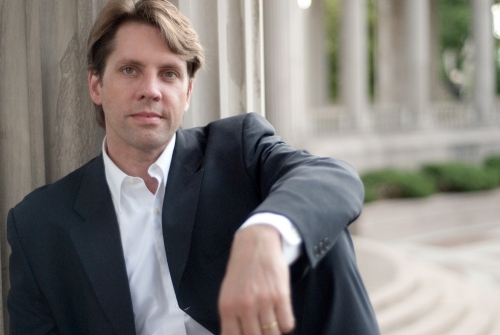
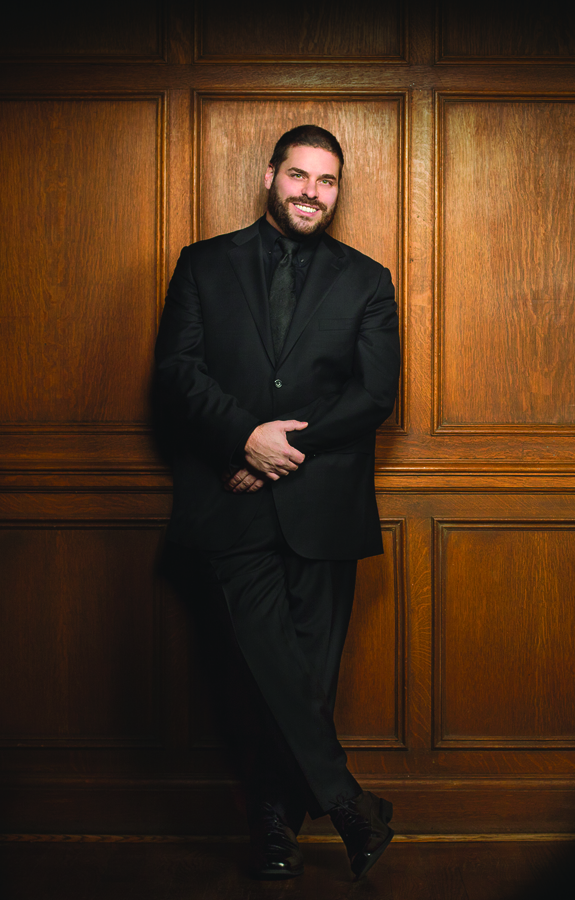
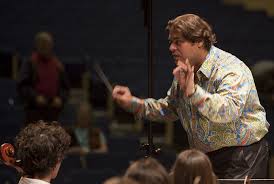
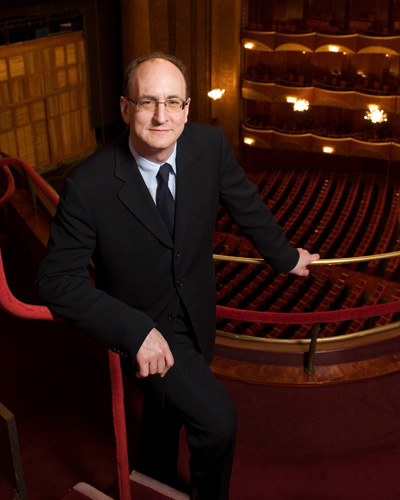
Michael Butterman. Photo by Glenn Ross.

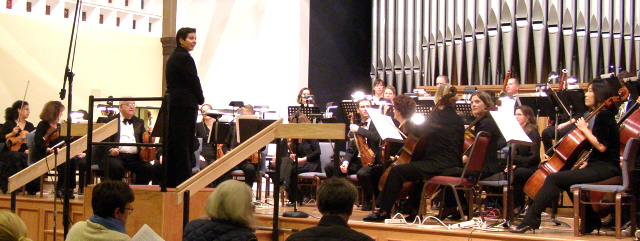
Michael Butterman. Photo by Glenn Ross.

The Boulder Philharmonic Board of Directors has announced that Michael Butterman, who began his tenure as music director with the orchestra in the 2006-07 season, has agreed to extend his contract for another five years, taking him through the 2018-19 season.

This is good news for Boulder music audiences, in part because stability is a good for an orchestra, and maestro tenure is a sure sign of stability within the organization. It is also good because Butterman has been a solid leader of the Philharmonic. Attendance has risen steadily during his tenure with the orchestra, making it one of Boulder’s most successful musical organizations. His programming has been adventurous, with intriguing new works offered every year, and the combination of new and old has been an ideal fit for Boulder’s eclectic audiences.

“I’ve so enjoyed getting to know the wonderful people in the Boulder community and working with the many talented musicians, artists and composers who make Boulder their home,” Butterman said. “Thanks to the community’s support and engagement, our programming reflects Boulder’s creative and entrepreneurial spirit. I look forward to the future, as the Phil builds on this foundation and continues to embrace the ‘spirit of Boulder.'”

Kyle Heckman, chair of the Boulder Phil Board of Directors, said “We are thrilled that (Butterman) has extended his contract with us. He has done an amazing job in raising the bar for musical excellence, and he has engaged in our community, while also developing a terrific educational program with the Boulder Valley School District.”

You may read the Boulder Philharmonic’s full news release announcing the contract extension here.

News on the boil in the World of Classical Music

Controversy and a milestone at the MET; Trouble in Atlanta

By Peter Alexander

It’s the unwatched pot that boils, and if you haven’t been watching, there’s been lots of boiling going on in the classical music world this fall.

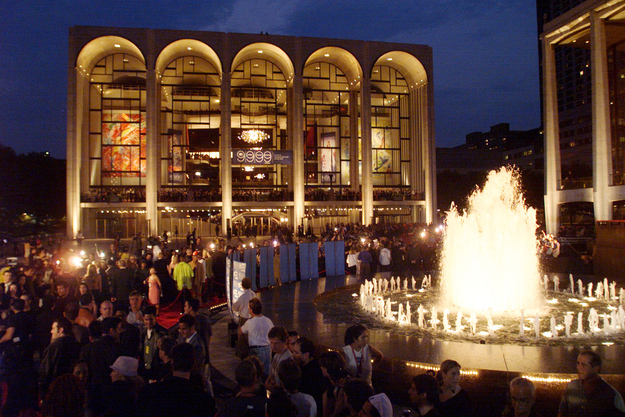
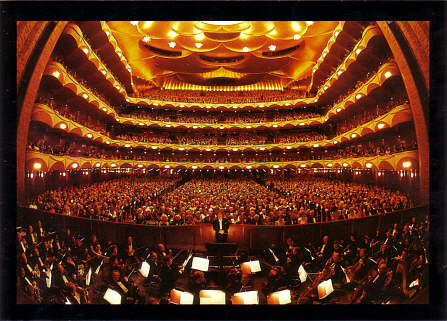
Lincoln Center Plaza and the Metropolitan Opera House

Lincoln Center Plaza and the Metropolitan Opera House

This summer I reported several times on the labor dispute that threatened to cause a lockout and the cancellation of the season for the Metropolitan Opera. Happily, the lockout was averted, but that has not kept the Met from being a center of controversy.

As part of their season, the Met had announced performances of The Death of Klinghoffer by John Adams. This opera was composed in 1991 on the subject of the 1985 hijacking of the cruise ship the Achille Lauro by members of the Palestinian Liberation Front and the subsequent murder of Leon Klinghoffer, a wheelchair-bound 69-year old Jewish American tourist whose body was dumped into the Mediterranean.

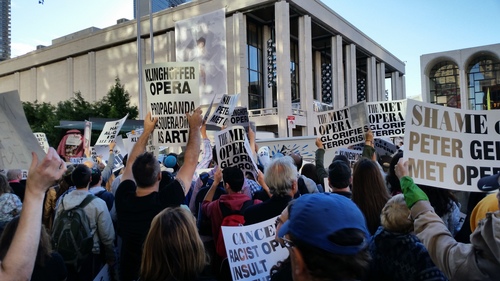
Klinghoffer protesters

Protesters outside the Metropolitan Opera House in Lincoln Center

The opera was originally created with the cooperation of Klinghoffer’s family, who later objected that it glorified the hijackers. Nevertheless, the opera has been performed uneventfully in several locations—but the Metropolitan is not just any opera company, and New York is always in the spotlight. And it is an especially important location for American Jews. So when Met General Manager Peter Gelb announced that The Death of Klinghoffer would be featured on the Met’s Live in HD series broadcast live to movie theaters around the world, there were protests and loud criticism of the Met. The claim was repeatedly made that the opera, by humanizing, or glorifying (depending on your point of view) the killers, was anti-semitic.

Scene from 'The Death of Klinghoffer.' Photo by Ken Howard/Metropolitan Opera

Scene from ‘The Death of Klinghoffer.’ Photo by Ken Howard/Metropolitan Opera

Eventually, The Death of Klinghoffer was dropped from the Live in HD broadcast series, but it remained on the Met season. It opened last Monday (Oct. 20), with a phalanx of protesters filling the Lincoln Center plaza, some minor disturbances inside the house, and generally glowing reviews for the work and the performance.

For anyone who cares about opera, or gives much thought to contemporary art forms, The Death of Klinghoffer has been a remarkable case study. Regardless of your personal opinion, the decision to write an opera on such a volatile contemporary subject, and the decision to produce it at the Met, are worthy of serious consideration and discussion. Rather than reconstruct what people who have seen the production have said, here are links to more about this remarkable opera and production.

Just about the best review and report of opening night was that written by Alex Ross for The New Yorker.  Anthony Tommasini wrote an even longer report in the New York Times.  And David Patrick Stearns had a slightly different take on the events for the Philadelphia Inquirer.

There are many more reviews. The Chicago Tribune complied a handy list of reviews and articles. Almost all are worth reading.

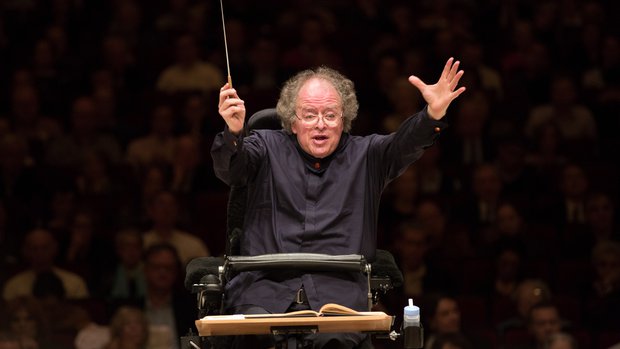
James Levine leading the Met Orchestra in 2013. (AP Photo/Metropolitan Opera, Marty Sohl)

James Levine leading the Met Orchestra in 2013. (AP Photo/Metropolitan Opera, Marty Sohl)

But not all the news from the Metropolitan Opera has been disturbing, or even controversial. This past weekend, James Levine conducted his 2,500th performance at the Met—a staggering number that is just about beyond comprehension. It is more than twice as many as the next most prolific conductor in the Met’s history, the long-forgotten Arthur Bodanzky. The milestone performance was Mozart’s Nozze di Figaro (Marriage of Figaro) Saturday night—only the 77th time he has conducted that particular work. (Those and other numbers from Levin’s remarkable Met career were reported by the New York Times.)

This would be a remarkable milestone for any conductor, but in Levine’s case, it is especially noteworthy since it was only two years ago that it appeared his conducting career might be over. But he has come back from serious injuries, and is back at work in the opera house—to the relief of his fans and fans of the Met who have a hard time imagining how anyone can follow him and maintain the reputation Levine has created for the Met and its orchestra.

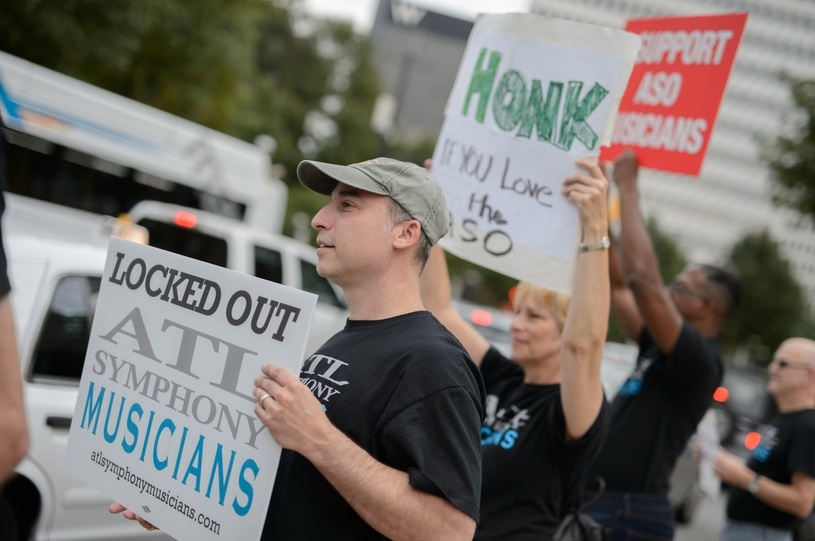
Daniel Laufer was among the supporters of the Atlanta Symphony Orchestra musicians who was picketing outside the Woodruff Arts Center in Atlanta. (Michael A. Schwarz/For the Washington Post)

Daniel Laufer was among the supporters of the Atlanta Symphony Orchestra musicians who was picketing outside the Woodruff Arts Center in Atlanta. (Michael A. Schwarz/For the Washington Post)

While the Met was resolving a labor dispute and averting a lockout this summer, the Atlanta Symphony has been dealing with a lockout and at least a partial cancellation of their season.

The sticking point in Atlanta is the proposal by management to further cut the size of the orchestra, which had previously been reduced to 88 musicians from an original compliment of 95 players. As a means of fighting deficits, the management wanted full control of the orchestra’s size and proposed cutting the orchestra—largely by leaving positions unfilled—to 76 players. Both the players and the orchestra’s conductors said that the Atlanta Symphony, an honored ensemble that has counted Robert Shaw and Yoel Levi among its music directors, could not maintain it’s standing with only 76 players.

After a bitter battle that eventually led to mediation, this one issue seems to have brought all negotiations to a halt. After the 15-month lockout nearly closed the Minnesota Orchestra permanently, this is very disheartening news. The most recent news about the ASO comes from the Atlanta Arts and Culture Blog, here and here. Earlier articles from NPR and the Washington Post provide more of the background.

A second major orchestra lockout in only a few years is bad news for America’s musicians, and those who support them and their work. The only silver lining from here is that we are not facing a similar crisis in Boulder, and we still have great riches of orchestral music to chose from. But it is interesting background for the still unfolding issue in Denver, concerning the Colorado Symphony’s future in Boettcher Concert Hall—where the pot, watched or not, boils on.

Grant Awarded to Boulder Philharmonic, and other news of interest in Boulder

Both Boulder Phil and conductor Michael Butterman are making news

By Peter Alexander

It’s kind of like a dating site, but with much better music.

Missy Mazzoli. Photo by Stephen S. Taylor

Missy Mazzoli. Photo by Stephen S. Taylor

The Boulder Philharmonic announced this week that they have been paired with composer Missy Mazzoli for a “Music Alive: New Partnerships” grant from the League of American Orchestras and New Music USA.

In a news release dated Oct. 22, the orchestra explained that the grant of $7,500 is for a one-week residency sometime during 2014 to 2016. The Boulder Philharmonic was one of 12 organizations in their category—orchestras with operating budgets of $7 million or less—to receive a grant and be paired with a composer through this program.

“Music Alive: New Partnerships” matches composers and orchestras who have not previously worked together. Each residency will take place some time during 2014 to 2016, and will culminate in the performance of an orchestral work from the composer’s catalog.

“We are thrilled to be able to welcome a composer of Missy’s caliber and creativity for a residency in our city,” Kevin Shuck, executive director of the Boulder Philharmonic, said.

Mazzoli commented, “I am so thrilled to be working with the Boulder Phil. There are so many possibilities and I have already enjoyed our conversations and sharing of ideas.  This will be my first time in Colorado and I’m very happy that it’s under these circumstances.”

You may read the entire news release here.

# # #

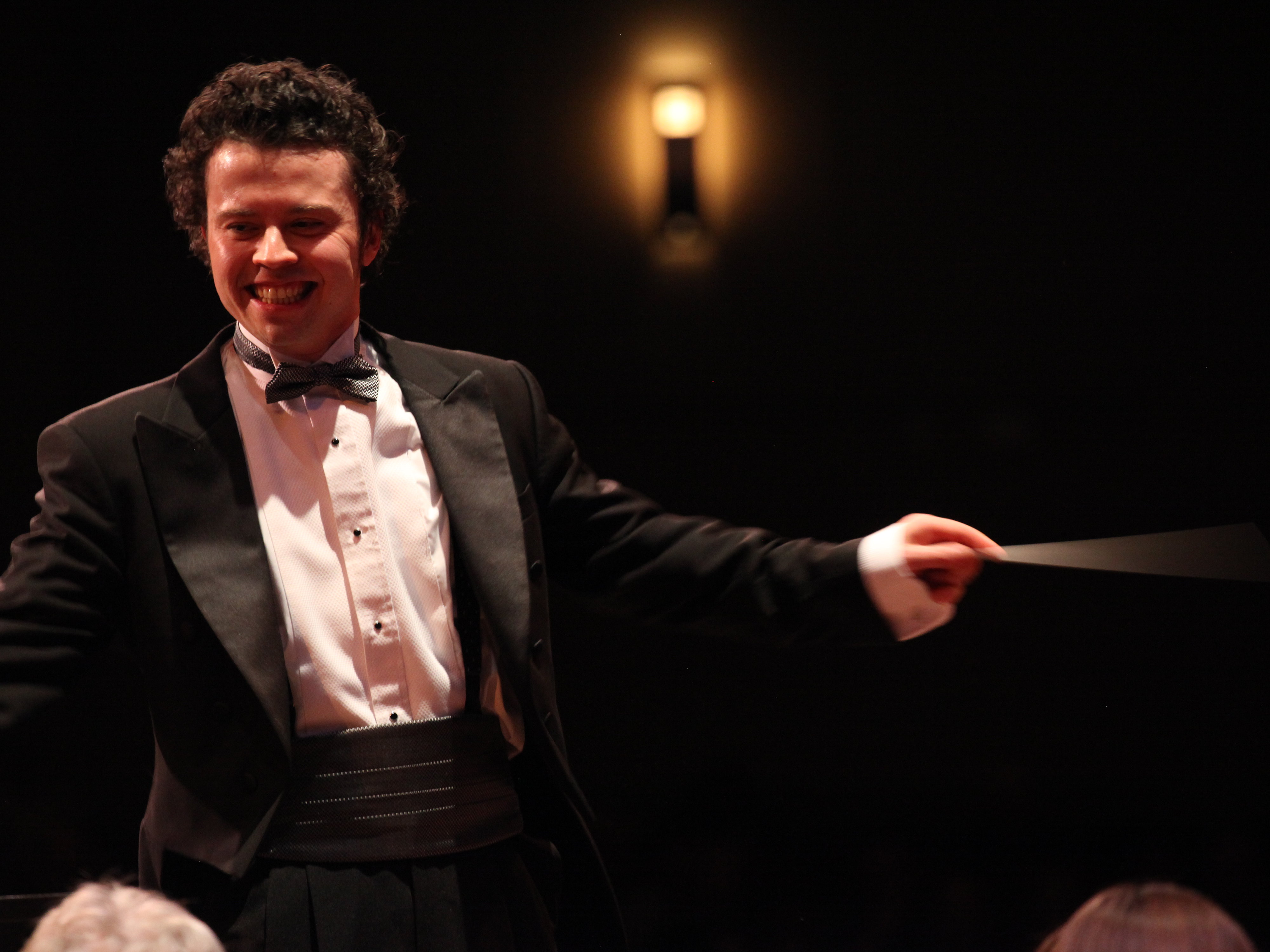
Michael Butterman

Michael Butterman

In the meantime, Boulder Phil Music Director Michael Butterman has gotten attention in Pennsylvania for his role in getting the newly founded Pennsylvania Philharmonic off the ground.

Operating with an educational mandate, the new orchestra will perform in schools and communities that can‘t support their own professional orchestra. Hired as the music director, Butterman noted how quickly the orchestra got from the planning stage, about 10 months ago, to its first performance, which is taking place Saturday (Oct. 25) in Pottstown, Penn.

In an article by Philadelphia Inquirer classical music critic David Patrick Stearns, Butterman was further quoted as saying “Building an orchestra from the ground up with community engagement being the driving force . . . is very appealing, but also a bit of a blank slate. We have to experiment and try things out.”

Simone DInnerstein. Photo by Lisa_Marie Mazzucco.

Simone Dinnerstein. Photo by Lisa-Marie Mazzucco.

Pianist Simone Dinnerstein, who has appeared with Butterman and the Boulder Phil, will be the soloist for the first concert, playing Gershwin’s Rhapsody in Blue. “I have such admiration for someone with the chutzpah to start an orchestra,” she said.

The rest of the program will include Dinnerstein playing Ravel’s Concerto in G, the Four Dances from Rodeo by Aaron Copland and the Fanfare Ritmico by Jennifer Higdon. That program, titled “Fascinatin’ Rhythms,” will be performed a total of four times over the next two weeks.

You may read Stearns’ article here.

Jean-Marie Zeituoni reflects on his new role as Music Director

The newly appointed Music Director of the Colorado Music Festival endorses the role of new music, chamber music, and festival themes.

By Peter Alexander

Jean-Marie Zeitouni

Jean-Marie Zeitouni

The following Q&A interview with Jean-Marie Zeitouni covers some of the issues facing the new music director of Boulder’s beloved Colorado Music Festival. The questions were presented to Zeitouni by email, giving him the opportunity to write careful and thorough answers to each question. This also allows him to introduce himself and his thoughts about the festival directly to our readers. The 12 questions I asked were intended to cover many of the most historically prominent aspects of the festival, including mini-festivals, commissions of new works, chamber music events, and guest soloists, and to give opportunity for comments on their future importance to the festival.

His answers are presented unedited, except for minor corrections to capitalization and punctuation. Additions for clarity are placed in brackets. Otherwise, the words are exactly as Zeitouni wrote them.

QUESTION: I assume it is too early to talk about specific programming for the 2015 festival, but I wonder if you have any thoughts about the general nature of programming for an intensive, six-week summer festival as opposed to a nine-month-long subscription season.

JEAN-MARIE ZEITOUNI: The keyword here is “intensity,” to which I would add creativity, originality and some balance. Some audience members are also yearlong classical concertgoers and are not always interested in listening to the same things they hear all year long; others however will get their first concert music experiences in the summer at a festival. It’s important to keep them also in mind as we elaborate programs. I’ve been involved with numerous festivals over the past 15 years (notably the Festival International de Lanaudière, where I’ve been conducting the festival orchestra for the past nine years, and with the Festival International du Domaine Forget, for the past 15 first with Violons du Roy and now with I Musici de Montréal, but also at Grant Park, Banff, Mostly Mozart, Parry Sound, and the Opera Festivals of Glimmerglass, St. Louis, Cincinnati, etc.), and what always strikes me is that they each have a distinct personality and audience that is reflected in their choices of programs, guest artists and explorations.

I’m looking forward to bringing along my experiences and ideas to Boulder, but I’m also allowing myself a bit of time to digest and understand what CMF is all about, from its roots to its fruits.

There is also the wonderful CMF orchestra. We need to develop our way of making music together, and some of next summer will be about that.

Chautauqua Auditorium, home to the CMF Festival Orchestra

Chautauqua Auditorium, home to the CMF Festival Orchestra

Q: How do you feel about “themes” for a festival—musical topics such a Russian music or great violin concertos—to be explored during all or part of a festival?

JMZ: I like themes and thematics in general, especially for concert programs. I think that coherent and original pairings can help us enjoy more and differently some pieces we don’t know, and even some others we think we know so well. “Mini-festivals” are also interesting if the circumstances are right. The nature of a festival allows us to explore a subject more deeply in an intensive period of time and is a good setting for organizing parallel activities (film, seminars, lectures, etc.) for audiences looking for a more complete immersion.

Q: How do you feel about programming that crosses genres and styles, such as the “mashup” programs blending pop and classical styles we have had at CMF the past two years, or the “World Music” series of earlier festivals that blended classical with music of other cultures (Klezmer, Asian styles, jazz, etc.)?

JMZ: My personal taste is very eclectic. I like great music whether it’s Western classical or Eastern or Afro-Cuban or old or modern, etc. . . . (the list goes on and on). I think it’s very natural to blend and cross styles and genres as long as we are presenting good music and at a high level of performance.

The other major factor is having the sensational Festival Orchestra, which is an invaluable asset. We want to program music that will display this ensemble’s colors and possibilities.

CMR Festival Orchestra onstage in Chautauqua Auditorium

CMF Festival Orchestra onstage in Chautauqua Auditorium

Q: What do you see as the role for new music in the festival?

JMZ: The festival has a long history of playing new music and even commissioning works. I think every arts organization should be involved in both the performance and creation of art. As for programming, it’s like creating a menu at a great restaurant—accords and contrasts, themes and threads, originality and references. Balancing the flavors.

Q: Would you like to continue the CMF’s history of commissioning new works?

JMZ: Yes, no doubt.

eTown Hall, home of CMF's chamber music concerts

eTown Hall, home of CMF’s chamber music concerts

Q: What do you think should be the role of chamber music performances in the festival?

JMZ: I don’t know where to start. . . . There are so many positive aspects of having the chamber music series in the festival. First, of course, there is the vast repertoire that is complementary to what we do with the orchestra, with so many masterpieces available for the audience to discover. Second, the intimacy and proximity between the artists and the audience that is incomparable. It’s also a great way to showcase some of the musicians of the CMF orchestra (and guest artists) and introduce them to the community in a more personal way.

Q: In picking soloists for the festival, how do feel about inviting well known artists as opposed to younger artists who may not be as well known? Do you think there is a role for each within the festival?

JMZ: There is definitely a role for both in the festival. We have the responsibility to both get the best artists possible on our stage and to be scouting for the best new talents to introduce them to the audience.

Jean-Marie Zeitouni

Jean-Marie Zeitouni

Q: How do you expect to be involved in the educational aspects of the organization? 

JMZ: Much yet has to be defined. We are looking at creating more activities for the younger ones, and I have some ideas to share with the team. There is of course the very popular young people concerts, and I hope in the future, finding the right channels to involve the kids who attend CMA in original projects.

Q: Do you anticipate any issues in maintaining balance between the two arms of the organization—the school and the festival?

JMZ: No. In fact, it is important to me that we not only strive to take both the Festival and Center to new heights, but that we also look for ways to create greater synergies between the two.

Q: Do you have specific plans for attracting new audiences to the festival?

JMZ: Although [Executive Director] Andrew [Bradford] and I are both still fairly new to the organization, we have already spent a lot of time talking about this subject. We are both committed to collaborating with some of the many arts organizations in Boulder, which we hope will lead to, among other things, new audiences attending our concerts. Also, Andrew is carefully examining how we have approached marketing and public outreach in the past, and is looking for new, more creative ways to increase awareness of the organization.

The Dining Hall, on the beautiful CMF Chautauqua campus

The Dining Hall, on the spectacular CMF Chautauqua campus

Q: What is your initial impression of Boulder?

JMZ: What is there not to love? My first impression was as positive as could be! I got to know many people and found them all to be extremely friendly. I also managed to make time to try many of Boulder’s best restaurants. The location is fantastic and the landscape is literally breathtaking. It’s a place I’m looking very forward to spending my summers in with my daughter, Gabrielle, who will turn two in a couple of months.

Q: What would be your message for Boulder audiences, and the supporters and fans of the Colorado Music Festival?

JMZ: I want them to know that I feel blessed to have been given the opportunity to serve as Music Director of this wonderful organization, and that I take this responsibility with great respect and care. I think I am coming to understand the great love and passion so many people in this community have for CMF and CMA, and I intend not only to create new, exciting programs for their enjoyment but also to be a steward of the organization.

Edited 10/7 to put back one word that dropped out in transmission.

Zeitouni chosen as music director of Colorado Music Festival

French-Canadian maestro was “consensus choice” of the search committee

By Peter Alexander

Jean-Marie Zeitouni

Jean-Marie Zeitouni

The board of the Colorado Music Festival and Center for Musical Arts has announced the selection of Jean-Marie Zeitouni as music director for the festival, succeeding Michael Christie. He is the third music director in the festival’s history.

During an initial three-year term, Zeitouni will oversee all artistic planning for the festival, lead five weeks of Festival Orchestra concerts each summer, and be involved in the center’s music education program.

The board’s announcement states that Zeitouni emerged as a consensus choice of the search committee. He was one of three official finalists for the position, along with William Boughton and Carlos Miguel Prieto. Each of the three conducted two programs during the 2014 festival—one with chamber orchestra and one with the full symphony orchestra. These three finalists were selected from a roster of dozens of conductors who were interested in the position.

The decision comes just weeks after the CMF’s new executive director, Andrew Bradford, officially began work. The festival had been without a permanent appointee for either position since August 2013.

zeitouni.3“It is a real honor to join CMF and CMA as music director,” ZeitouniZeitouni said. “In both programs I conducted, the orchestra played sensationally and was a true pleasure to work with. It was the kind of collaboration that every conductor dreams of. With an orchestra of this caliber, an important music school in the center, and a delightful community like Boulder, I could not be more excited for the opportunity to lead this marvelous organization into the future.”

Ted Lupberger, search committee co-chair and a CMA and CMA board member said, “From the very first time the search committee spoke with Jean-Marie during the early stages of the search process, we were thoroughly impressed with his dynamic personality, his understanding of the many roles of the 21st-century music director, his passion for music and music education, and his excitement about the Boulder community.”

Jeffrey Work, CMF principal trumpet who was involved in the search process, added, “With the appointment of Maestro Jean-Marie Zeitouni, the CMF & CMA gains not only a leader of high artistic ideals, but one with a vision for the future of this treasured institution.”

# # # # #

hsJean-MarieZeitouniOf the three candidates, Zeitouni probably has the lowest profile. Outside of his two concerts at Chautauqua this summer, he remains largely an unknown quantity in Boulder. That is not necessarily a bad thing—Michael Christie was largely unknown when he took the helm at CMF, too. But we have very little to go by in judging Zeitouni’s likely qualities as a festival director.

The two concerts he led this summer offered very solid performances of demanding orchestral works, and he certainly gets high marks for those. I was not entirely convinced by the nuances of the two great Strauss tone poems that he led, Don Juan and Ein Heldenleben (A hero’s life), but two concerts are hardly enough to have an idea of his vision as the director of a major festival. Programming for all conductors this summer was circumscribed by the situation and the requests of the CMF.

Zeitouni’s conversations with the CMF board and search committee may have been extensive and revealing, and we may hope that the board learned about his long-term vision and leadership skills. But those conversations were of course confidential.

Nor does he have a past professional record that reveals much. He was conductor of the Columbus (Ohio) Symphony, a position he relinquished as of Aug. 14 of this year. It is not clear why he left Columbus, except that it was, Zeitouni said, an “amicable” parting. He remains artistic director of I Musici de Montréal and maintains an active schedule as a guest conductor, but these are not professional activities that have yet built a record of achievement.

Still, there should be no doubt about his musical qualifications. In addition to the two first-rate concerts here, Zeitouni has gotten high praise from musicians and critics alike. When he moved to Columbus, he had several strong endorsements.

Laurent Patenaude was head of artistic administration for Les Violons du Roy, a chamber orchestra in Quebec that Zeitouni has conducted. Patenaude was quoted in the Columbus Dispatch saying that Zeitouni “has a real clear idea of the sound he wants, and he’s able to create it. . . . Because he’s such a great leader and listener, he can build something with what he has in front of him and at the same time bring the musicians someplace else.”

In 2012, the Boston Globe critic wrote of Zeitouni’s performance with the Handel & Haydn Society that the conductor’s “punk-tinged ‘Eroica’ was . . . the best live performance of this symphony I’ve heard.” And in 2011 the Seattle Times praised “one of the most memorable ‘Messiahs’ this city has seen.”

So we can be comfortable with his musical skills. But the music director has to do far more than conduct the orchestra. He has to maintain relations with the executive director, the board, major contributors, and other cultural leaders in the community, and of course he has to help raise funds. He has to bring in the audience on the strength of his perceived personality.

Zeitouni.2Zeitouni has a reputation—what maestro doesn’t?—for being prickly, which might not play well in Boulder. When I interviewed him, I did not sense the same level of eagerness to engage Boulder on its own terms that I have found in the other candidates and in musicians who have been successful here. But now that he has been here and met the board, he may well have a better understanding of the town and the audience. He appears to have the kind of quick intelligence that would be up to the task.

Another critical part of the music director’s job is programming for the festival. If the programs do not consistently capture the audience’s interest, the festival cannot remain viable. And here we have very little idea what Zeitouni might bring to the task. He has no record with an event comparable to the CMF.

Concentrated in a short period of time, festivals have different programming needs than an orchestra season that is spread over eight or nine months, so Zeitouni’s tenure with the Columbus symphony is not pertinent. Nor does his record as a guest, conducting individual concerts around the world, tell us what we would like to know: what can we expect from a Zeitouni-led festival?

We will know far more when we see the program for 2015. If Zeitouni and Bradford share a common vision for the festival and work harmoniously to achieve that vision, there is reason to be hopeful. But until they get to work, we will all have to reserve judgment.

The next chapter starts now.

# # # # #

My previous interview with Jean-Marie Zeitouni can be found here. A further interview will follow when Maestro Zeitouni returns from traveling in France.

Boulder’s rich abundance of orchestra concerts

No fewer than five resident orchestras offer seasons for 2014–15  

By Peter Alexander

Of this you can be certain: there is no shortage of orchestra concerts in Boulder.

With the end of the summer and the departure of the area’s best orchestra—that of the Colorado Music Festival—now’s a good time to look at Boulder’s resident orchestras that perform during the main season, between September and May. In fact, there are no fewer than five of them. This means there is a remarkable richness of orchestra concerts for a city the size of Boulder. It is one of the true blessings of living here, and with so many different orchestras and conductors contributing to the mix, it also creates a diversity of programming that would be the envy of many larger cities.

The Boulder orchestras vary widely in professionalism and experience, but each offers it own rewards. So before the season gets under way with the opening concert of the Boulder Philharmonic in Macky Auditorium on Sept. 14, here is a quick survey of area orchestras and their pending seasons. (More information on individual concerts will appear here throughout the year.)
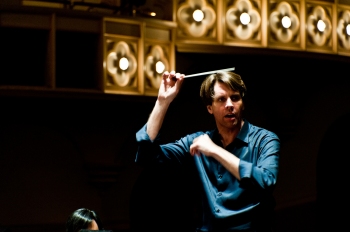
Butterman.1

Michael Butterman

The Boulder Philharmonic (BPO) is Boulder’s fully-professional orchestra. Considered a regional symphony, the Boulder Phil has an annual budget just over $1 million. The orchestra has a negotiated contract with its players, who are paid union scale. In these respects, the BPO leads the orchestra pack in Boulder.

The conductor is Michael Butterman, who also conducts the Shreveport (La.) Symphony, and is now the inaugural music director of the Pennsylvania Philharmonic, leading its very first season in 2014-15. It should be noted that regional orchestras are not full-time and do not pay anyone from the director on down through the sections a full-time wage.

For example, BPO has six concerts on its 2014–15 season, plus performances of The Nutcracker with Boulder Ballet. This is not full-time work, and members of the orchestra generally have other income, either from teaching, from other orchestras, or from free-lance work—or a combination of all three.

The same is true of the music director: In addition to the three orchestras listed above, Butterman is resident conductor of the Jacksonville (Fl.) Symphony and principal conductor for education and community engagement for the Rochester (N.Y.) Philharmonic. This summer, he was guest conductor for the opening concert of the Colorado Music Festival.

Butterman is a skilled and thoughtful conductor. Under his direction, the Phil presents worthy, professional-quality performances of programs tailored to the Boulder audience. Often that means a careful combination of challenging new works and familiar favorites. Past explorations have included concerts accompanied by aerial artists, music by the original mother of invention Frank Zappa, and the premiere of CU faculty member Jeffrey Nytch’s First Symphony, inspired by Colorado’s geological formations.

Conforming to the pattern, the opening concert of the ‘14–15 season features the world premiere of Gates of the Arctic by Stephen Lias and the perennially popular Scheherazade by Rimsky-Korsakov. Other highlights of the season will include works inspired by birds; a pops concert featuring music by piano men Billy Joel and Elton John; concertos for timpani, violin and piano; and ending with Bartók’s virtuoso showpiece Concerto for Orchestra. (Season information and tickets available here.)
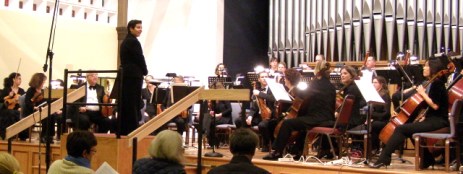
Cynthia Katsarellis and the Pro Music Colorado Chamber Orchestra

Cynthia Katsarelis and the Pro Music Colorado Chamber Orchestra

The Pro Musica Chamber Orchestra is fully professional orchestra, although operating at a more modest scale than the BPO. With only three concerts in a season and a much smaller number of musicians, their budget for the coming year is $63,000.

Still, the orchestra, under the direction of Cynthia Katsarelis, presents some terrific performances and offers intriguing repertoire for smaller orchestra. For example, one of last year’s program paired Vivaldi’s much loved Seasons with the fascinating, tango-inflected Four Seasons of Buenos Aires by Astor Piazzolla.

Players in the Pro Musica come from the CU faculty and professional orchestras on the front range. Katsarelis is a first-rate conductor who probably does not get enough recognition locally. She has conducted at the Colorado Music Festival, Rocky Ridge Music Festival and Loveland Opera Theatre. Every year since 2004 she has traveled to Haiti to conduct the Orchestre Philharmonique Sainte Trinité and to teach at the Holy Trinity School of Music in Port-au-Prince.

Katsarellis likes to explore themes in her concerts; building on the success of last year’s “Seasons,” the coming year will include a performance of Philip Glass’ Violin Concerto No. 2, “American Seasons.” There will also be a concert titled “American Voice” featuring Samuel Barber’s idyllic Knoxville: Summer of 1915 and a special performance with the silent film The Passion of Joan of Arc. (Season opens Oct. 17; information and tickets available here.)
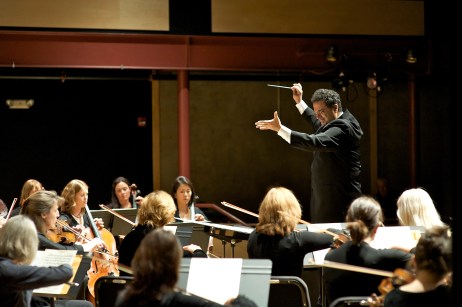
Bahman Saless with the Boulder Chamber Orcehstra. Photo by Keith Bobo.

Bahman Saless with the Boulder Chamber Orcehstra. Photo by Keith Bobo.

There is another mostly professional chamber orchestra here, the Boulder Chamber Orchestra (BCO).

This group was established in 2004 by music director Bahman Saless when friends suggested he start an amateur orchestra. Since then, the orchestra has become almost entirely paid (except for a few members who decline payment), and operates a season of seven concerts, a New Year’s Eve performance, and a couple of “MiniChamber” concerts on a budget of about $147,000.

A physicist-turned-conductor with a Ph.D. from CU and experience working for NASA and Jet Propulsion Laboratories, Saless is a genial presence at the BCO’s performances. He often speaks to the audience and has built a devoted following in the community. He loves to find key words—often enigmatic—to describe the orchestra’s season and concerts. For example, 2014–15, the BCO’s 11th season, is titled “Mystique” and the opening concert, Sept. 19, featuring Michael Haydn’s Requiem in C minor performed with St. Martin’s Chamber Choir, is titled “Charisma.”

Saless often invites compelling but little known soloists to join the orchestra. The coming year will feature performances by Spanish pianist Victoria Aja playing De Falla’s Nights in the Gardens of Spain and presenting a solo “Night of Spanish Piano Masterpieces,” Israeli-American cellist Inbal Segev and American violinist Andrew Sords, among others. (Season information and tickets available here.)
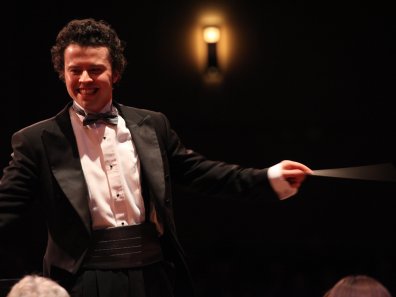
Devin Patrick Hughes

Devin Patrick Hughes

A community orchestra that has mostly remained so is the Boulder Symphony, formerly known as the Timberline Symphony.With an annual budget of $100,000, the orchestra has some paid members, including the string section principals, among volunteer musicians. They present six orchestra programs during the year, also offer four open rehearsals of pending concerts, and participate in educational activities.

Conductor of the Boulder Symphony is Devin Patrick Hughes, a young and dynamic personality who also leads the Arapahoe Philharmonic. He has also recently held conducting positions as Music Director of the Santa Fe Youth Symphony Association, Denver Contemporary Chamber Players, Resident Conductor of the Denver Philharmonic Orchestra, and Assistant Conductor for the Denver Young Artists Orchestra.

Hughes likes to collaborate with other local groups, such as Denver’s contemporary music Playground Ensemble, and has presented several world premieres—an unusual style of programming for a community orchestra. He has invited a number of young artists to appear as soloist with the orchestra. For example, the current season includes appearances by violinist Phoenix Avalon, a 13-year-old prodigy who has played with the Boulder Symphony in past seasons, and pianist Toku Kawata, a graduate student at CU. (Season opens Sept. 20; information and tickets available here.)
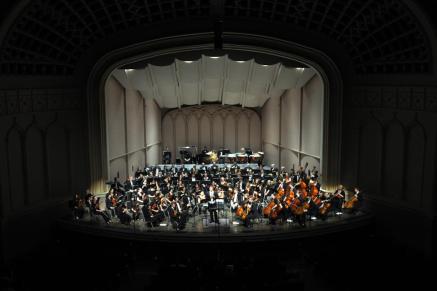
University Symphony

University Symphony in Macky Auditorium

The list of Boulder orchestras is rounded out by the CU University Symphony Orchestra, led by Prof. Gary Lewis, who is also director of Orchestral Studies in the College of Music as well as music director of the Midland-Odessa (Texas) Symphony.

Concerts by the University Symphony are held in Macky Auditorium on the CU campus and are free. Obviously a non-professional, student ensemble, the University Symphony—the top orchestral ensemble in the College of Music—presents fully satisfying performances of major orchestral repertoire.

Their first concert of the 2014–15 season, at 7:30 p.m. Thursday, Sept. 18, will feature Beethoven’s Seventh Symphony, and subsequent concerts this year will include Robert Schumann’s Symphony No. 3 (“Rhenish”), Rimsky-Korsakov’s Scheherazade and Respighi’s Pines of Rome.

If you look beyond the Boulder city limits, there are still more orchestras in the county. Particularly noteworthy is the Longmont Symphony Orchestra, a semi-professional orchestra with paid principal players throughout the orchestra and volunteer musicians selected by audition filling out the sections. The annual budget for six subscription concerts, two Nutcracker performances, a holiday concert and a community concert on the 4th of July is $240,000. Conductor of the Longmont Symphony is Robert Olson, known to Boulder audiences as the founding director of Boulder’s MahlerFest. Highlights of the coming season will include yet another performance of Scheherazade, a youth concert featuring music about spies led by Colorado Public Radio’s David Rutherford, an all-Sibelius evening and an all-American concert with Leonard Bernstein’s seldom heard “Jeremiah” Symphony. (Season begins Oct. 4; information and tickets available here.)

There is another community orchestra in the county, the Flatirons Community Orchestra in northeast Boulder County, and youth orchestras in Boulder and Longmont. All of these groups deserve support. I doubt that anyone will get to all of the concerts presented by these orchestras, but if you don’t find an orchestral program that appeals to you, you’re not looking. With so much to choose from, there’s a limit to what anyone can do, but I will try to preview all the major orchestras of Boulder throughout the year, either here or in the pages of Boulder Weekly.

In the meantime, let the music begin! I’ll see you in the audience.

Winners and Losers

One last assessment of the Metropolitan Opera’s labor agreements

By Peter Alexander

Who won and who lost at the Met? It depends.

THe Metropolitan Opera House (interior)

The Metropolitan Opera House (interior)

On Wednesday (Aug. 20), the New York Times reported on the agreement that was reached with the third of the Metropolitan Opera’s three major unions, Local 1 of the International Alliance of Theatrical Stage Employees, representing stagehands, carpenters and electricians.

The other two major unions, representing the orchestra and the chorus members, had reached agreement with the Met early on Monday. (See my post on that agreement here.) And an agreement with the remaining unions at the Met was reached on Thursday night, as reported again by the New York Times. These include unions representing scenic artists and designers, the costume department, and others.

These agreements end the conflict between management that has raged for several months and resulted in Peter Gelb, the Met’s general manager, withdrawing the threat of a lockout. He has confirmed that the Met will open its fall season as scheduled on Sept. 22, with a performance of The Marriage of Figaro conducted by James Levine.

Lincoln Center Plaza and the Metropolitan Opera House

Lincoln Center Plaza and the Metropolitan Opera House

The deal with the musicians’ unions called for an immediate 3.5 percent pay cut, followed by another 3.5 percent six months later, and no raise until the fourth year of the contract. The agreement with the stagehands has been reported to provide comparable cuts in labor costs, although the deal had to be written differently because of the different work rules and benefits packages in the contract with that union’s workers, and because their agreement is for six years instead of four.

But if it sounds like the concessions from the unions—the first pay cut accepted by the Met’s union workers in many years—represent a win by the management, that would be a hasty conclusion, for three reasons. In the first place, Peter Gelb had demanded a 17 percent pay cut from labor, and said that the Metropolitan would have to close otherwise. So the much smaller size of the pay cut than what Gelb was demanding makes his “win” look much less significant.

In the second place, the unions won some battles as well, in that the settlement calls for management to make its own, comparable cuts in the budget. The unions had argued that extravagant production expenses were part of the problem, and while there simply were not enough savings to be made in production costs to solve the Met’s budget woes, the fact that the final agreement took the form it did implies that the federal mediator for the negotiations with the musicians found merit in the union’s complaints. (The stagehands had separate negotiations that did not involve a mediator.)

Finally—and this speaks directly to the union’s complaints about Gelb’s leadership—the deal calls for an independent

Peter Gelb, general manager of the Met

Peter Gelb, general manager of the Met

monitor to keep an eye on the Met’s budget and expenses. This must be a particularly galling concession for Gelb, whose rather freewheeling, pop culture approach to opera was supposed to bring in larger, younger audiences and save the Met.

Apparently he has not accomplished either of those goals.

The question remains what effect this will have on regional opera throughout the country and here in Colorado. Will this settlement make it possible for other companies to ask for pay cuts from their employees, and to reign in costs in other ways? Will it put pressure on other companies to trim their production costs, or to make their finances more transparent, as the Met was forced to do in the course of negotiations?

For now, leaders of opera companies in this area have declined to comment on the Met’s settlement, although they do say they are keeping an eye on the situation.

 # # # # # 

For other perspectives of the Metropolitan Opera and it’s labor settlement, read these articles:

Jennifer Maloney’s highly complementary evaluation of Peter Gelb’s leadership of the Met can be read here.

Her previous, more balanced, assessment of the deal is here.

Blogger Greg Sandow’s more critical take on Gelb can be found in three installments linked from here.

The cheeky opera-fanatic blog “Parterre Box” has posted a copy of the agreement between the Met and the American Guild of Musical Artists, representing the Met Chorus, here.

The gossipy blogger Norman Lebrecht’s take on the settlement, which he sees as a “surrender” and a “humiliation for Peter Gelb,” can be found here

It’s a Deal at the Metropolitan Opera

Tentative agreement with two unions forestalls lockout at the Met

By Peter Alexander

Metropolitan Opera House, Lincoln Center, New York

Metropolitan Opera House, Lincoln Center, New York

The New York Times reports this morning, Monday, Aug. 18, that “the Metropolitan opera reached tentative agreements with the unions representing its orchestra and chorus.”

This agreement, which was announced about 6:15 a.m. today, forestalls the possibility of a lockout and means that the Met could still open on its scheduled date of Sept. 22. Opening night is to be a new production of Mozart’s Marriage of Figaro and a Met debut by the young American soprano Amanda Majeski, who is cast in the major role of the Countess.

Negotiations went all night Sunday night and extended several hours past the previously announced deadline of midnight. The deal was announced by Allison Beck, a federal mediator who was brought in just before the previous deadline for an agreement.

The agreement does not include the stagehands’ union, which is the third major union at the Met, nor any of the smaller unions that have contracts due for negotiation this year. However, the agreement with unions representing the orchestra and chorus likely paves the way for the other unions to reach an agreement.

Because details of the agreement have not yet been released, it is impossible to declare “winners” or “losers,” or to know how much each side gave in order to save the season. The one thing that is certain, though, is that not only opera lovers, but the American arts world wins from the resolution of a long and bitter battle between unions and Peter Gelb, the general manager of the Met.

Prince Igor poppies

The famous poppies in Price Igor. © Jonathan Tichler/Metropolitan Opera

In the runup to negotiations, Gelb, who was asking for 17-percent pay cuts from workers at the Met, traded accusations with the unions. Attention was placed on the highly expensive and critically unsuccessful productions Gelb has mounted since becoming general manager in 2006. But as extravagant as some productions have been—a $169,000 poppy field in Prince Igor has become particularly notorious—independent analyses of the Met’s budget suggested that production cuts alone could not solve the Met’s financial problems, and that the unions would have to give some ground as well.

While the Metropolitan Opera seems like it is a long way from Colorado, this resolution is important here and around the country. For one thing, the Met “Live in HD” broadcasts to movie theaters are popular all across the country. So there is a local audience for the Met in Boulder, Denver, and anywhere else movie theaters carry the broadcasts. It has been reported that the theaters were very reluctant to lose the income they receive from the broadcasts.

Beyond that, the Met is the most prominent advocate for opera in the country, and the loss of such a high-profile company, performing on the highest artistic level, would be a blow to the art form, to singers and opera lovers and musicians everywhere. The successes and failures of the Met influence the success and failure of opera companies everywhere, including Central City and Opera Colorado.

Until details are released and all the unions reach agreements with management we cannot consider the labor disputes totally resolved. But today there is room to breathe and reason for hope.

 # # # # # 

Update: 2:40 p.m. 18 Aug. This story from the Wall St. Journal adds some details about the agreement. If these are accurate, they certainly sound reasonable, with cuts in both salaries and production costs. Not all the details are yet clear on how the cuts are to be accomplished, but presumably that will be worked out in the coming weeks.

One thing to keep in mind is that one reason labor costs that have been so high has to do with rules about overtime pay. Because the Met has mounted so many large productions of operas that are long, or have complex scenery changes, or both, it is difficult to separate production costs and labor costs. In other words, an overly complex production will cost a lot to mount, and part of that cost comes from extended hours from the stagehands and other production staff.

 # # # # # 

Tuesday, 19 August: Today’s story from the New York Times adds more details. You should read the whole article, but here are the most critical parts:

The workers agreed to a 3.5 percent cut in wages upon ratification, and another 3.5 percent reduction six months later — either in the form of another wage cut or, if they agree in further negotiations, as a change in benefits. Part of those cuts would be restored with a 3 percent raise in the second half of the fourth year.

. . .

[T]he Met’s management agreed not only to match the value of the labor cuts on the administrative side, but also to cut $11.25 million worth of other expenses — which may include cutting costs, scheduling more carefully, or reducing rehearsals — in each of the four years of the contract. And in an unusual provision eagerly sought by the unions, the Met’s management agreed to have an independent analyst monitor its finances.

It appears everyone realized that a prolonged lockout or work stoppage would be disastrous for the Met, for opera in general, and also for them individually. Happily for everyone, rehearsals for the coming season can now continue uninterrupted.

Four or more for Music Director

By Peter Alexander

Rumors have been swirling around Chautauqua all summer.

When the Colorado Music Festival announced its summer season, it was stated that three of the guest conductors were candidates to replace Michael Christie as music director of the festival. Those three were William Boughton, Carlos Miguel Prieto and Jean-Marie Zeitouni. Of the three, Boughton and Prieto have already appeared at the festival, and Zeitouni will conduct in the festival’s final week, Aug. 3 and 7-8.

But other conductors were well liked by the orchestra and had expressed an interest in the job. Were they candidates or not?

That depended on who you talked to. Members of the orchestra said they were. Or some of them were. But officially, they weren’t. Or probably weren’t.

Officially there were three candidates, and the CMF Board and search committee admitted they had no contingency plan if none of the three worked out or accepted the position. That seemed a perilous situation, considering the festival’s past record of hiring an executive director, when it took a year and one failed hire to get Andrew Bradford into the job. But that was the official position.

Until now.


Andrés Cárdenes, another potential candidate for music director of the CMF

Andrés Cárdenes, another potential candidate for music director of the CMF

Today the search committee issued a statement acknowledging that more than just the three official candidates were finalists for the job. Andrés Cárdenes, who taught violin for two years in CU Boulder and is co-director of Strings Music Festival in Steamboat Springs, is also a candidate, even though he was not able to conduct this summer. And apparently the committee is open to other possibilities as well.

Here is the statement from the search committee:

 “We have three candidates for the music director position, and these are Maestros Boughton, Prieto, and Zeitouni. A fourth finalist, Andrés Cárdenes, was unable to conduct in Boulder this summer, but members of our team observed him in Steamboat and he did meet with the committee. These wonderful men emerged from a search that produced scores of applicants, and they have been thoroughly vetted and examined, and we have been fortunate to attract them this summer. They are all highly accomplished musicians who would be of interest to any great orchestra. We’ve also been fortunate in finding and engaging other guest conductors this summer, including Michael Butterman, Joshua Gersen, Andrew Grams, and Lawrence Rachleff. At the end of the summer, we will meet and discuss the matter and make an approach to the person whom we think is best suited for the job, and we will be looking at everyone we have seen.”

For anyone who has been following the festival over the summer, this is a fascinating statement. Until now, Cárdenes has not figured in the discussion of potential candidates. The rumors have all been about other guest conductors on the summer schedule, particularly Rachelff and Grams.

None of this is about qualifications, by the way. Cárdenes has extensive experience as a violinist, teacher and conductor that would make him an interesting fit for the job leading both the CMF summer festival and the Center for Musical Arts. (Disclosure: I knew him slightly when we were both graduate students at Indiana University.) And some of the guest conductors have made impressions as strong as, or stronger than, some of the official candidates—which makes the very last phrase of the statement particularly fascinating.

The committee says “we will be looking at everyone we have seen.” But they do not specify just who is included in “everyone.”

In any case, it is now official that the search committee is considering other possibilities than the three “official” candidates. And by saying so, the festival has helped settle the rumors.


Last-minute change of Soloist at CMF

Jennifer Koh will be replaced by Adele Anthony for Aug. 3 concert

Violinist Adele Anthony. Photo by Marcia Ciriello

Violinist Adele Anthony. Photo by Marcia Ciriello

By Peter Alexander

Violinist Jennifer Koh, who was scheduled to perform Leonard Bernstein’s Serenade (after Plato’s Symposium) for solo violin, strings, harp and percussion at the Colorado Music Festival on Sunday, Aug. 3, has had to cancel her appearance.

She will be replaced by Adele Anthony, a native of Tasmania who studied at the Juilliard School and won the 1996 Carl Nielsen International Violin Competition in Denmark. She has since collaborated with leading artists in concerts and festivals around the world.

Sunday’s performance with the CMF Chamber Orchestra will be led by guest conductor Jean-Marie Zeitouni, one of three official candidates for music director of the festival. In addition to Bernstein’s Serenade, the program will feature Carmen Suite by Rodion Shchedrin.

Koh has suffered a concussion in an accident that forced her to cancel her appearance in Boulder. While she is the kind of young and engaging soloist that Boulder audiences would enjoy hearing, the opportunity to hear Anthony, who has a truly outstanding pedigree in the violin world, is also something to relish.

Upon learning of the news and securing Anthony to take over as soloist, CMF released the following statement on its Web page:

Important Update: Due to health issues, Jennifer Koh has had to cancel her appearance for the August 3 concert.  We are thrilled that Adele Anthony has stepped in to replace her. Adele began playing the violin at the age of 2 1/2 in Tasmania. She studied with Beryl Kimber as an Elder Conservatorium Scholar at the University of Adelaide until 1987, and has attended the Aspen Music Festival several times as a Staling Fellow. At New York’s famed Juilliard School, Miss Anthony worked with three eminent teachers: Dorothy DeLay, Felix Galimir and Hyo Kang. She has collaborated with Gil Shaham (to whom she is married, with 3 children) in the United States and Spain in concerts and recordings marking the centenary of the death of legendary Spanish violinist and composer Pablo Sarasate. An active recording artist, Ms. Anthony’s work includes two releases with Sejong Soloists: Vivaldi: The Four Seasons (Naxos), and Sejong Plays Ewazen. 

NOTE: This post was updated 7/31/14 when it was confirmed that Koh had a concussion. Her condition is not believed to be serious.