Boulder Symphony’s family affair

Orchestra opens season with Beethoven and Dvorák

By Peter Alexander

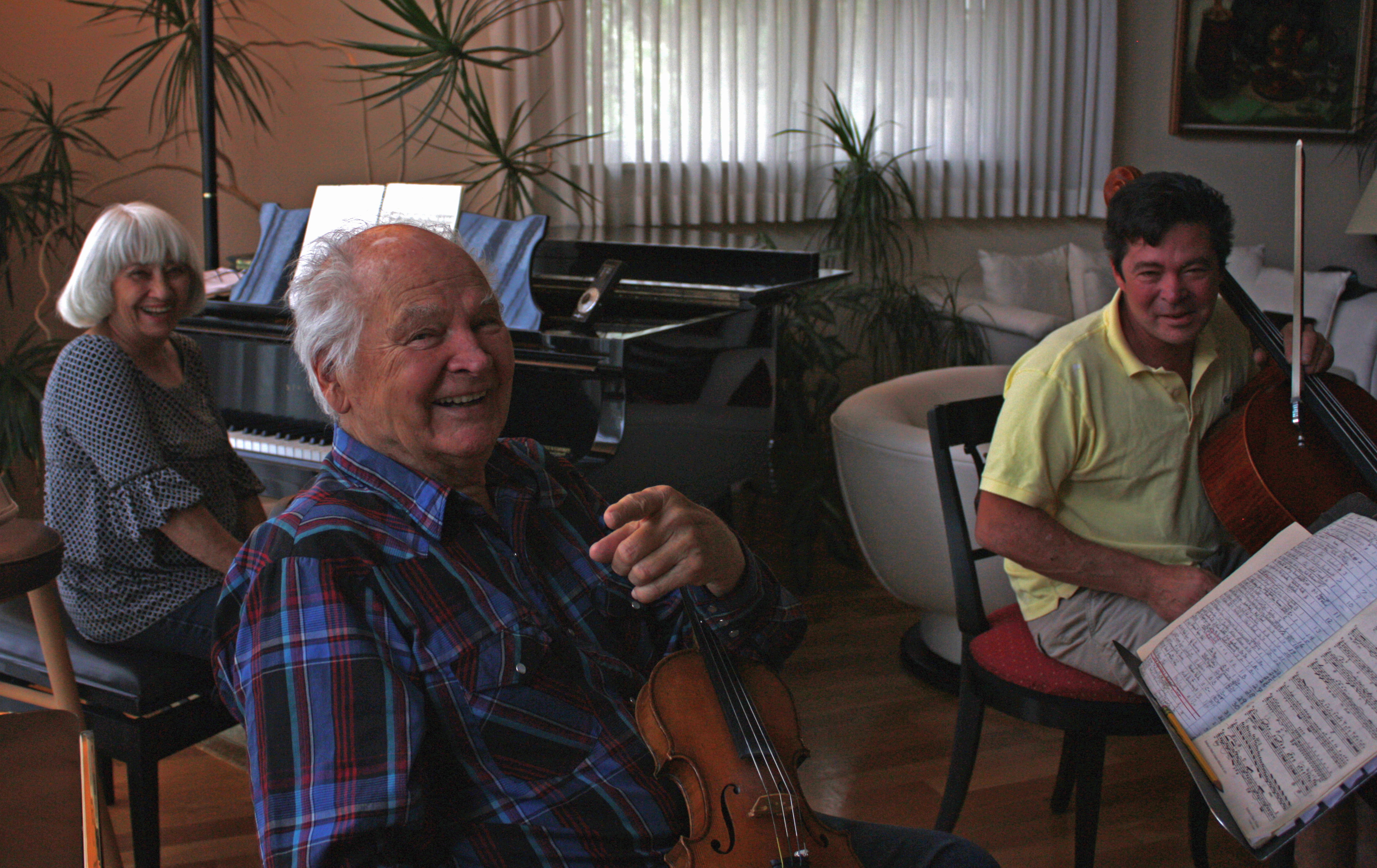
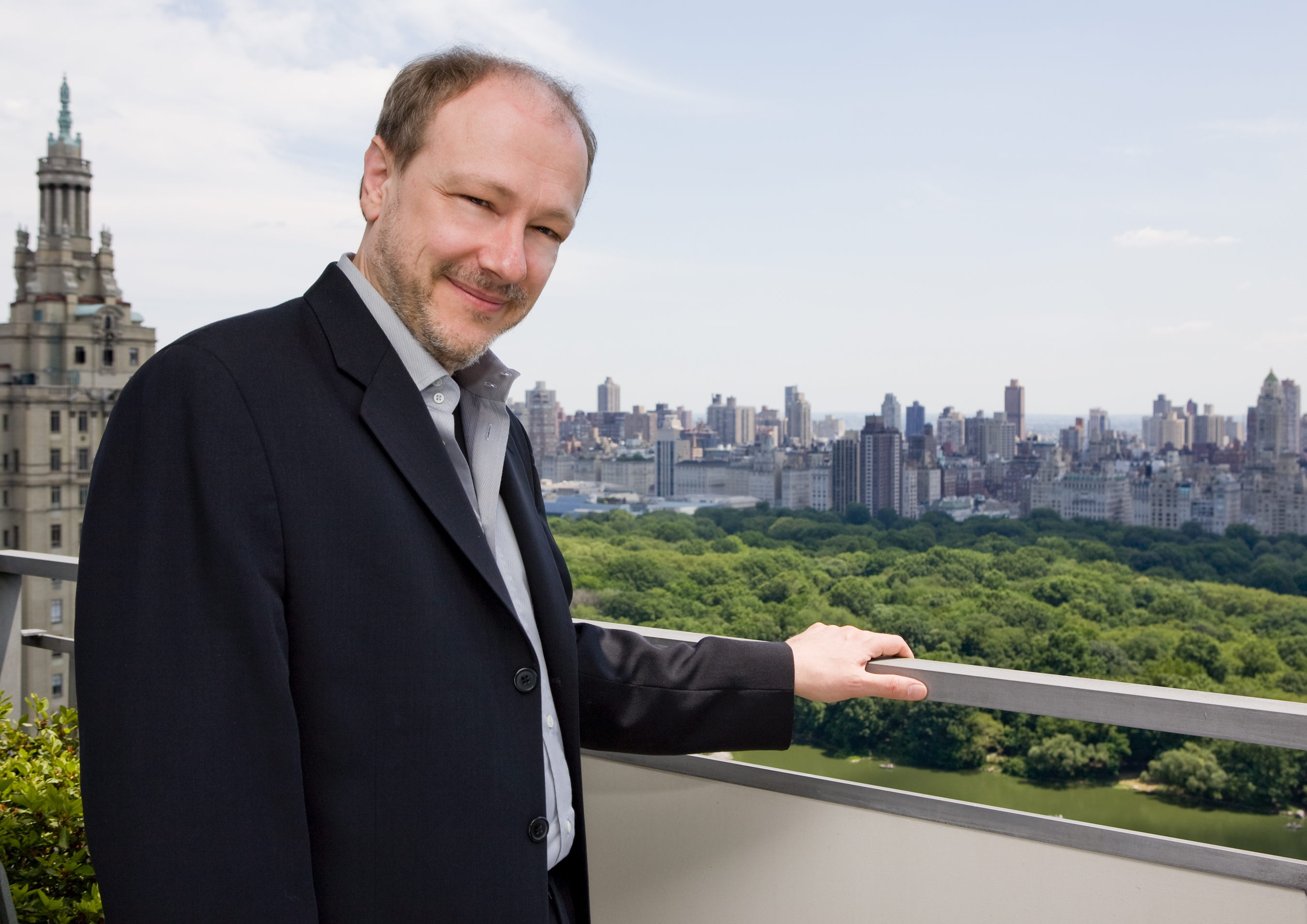
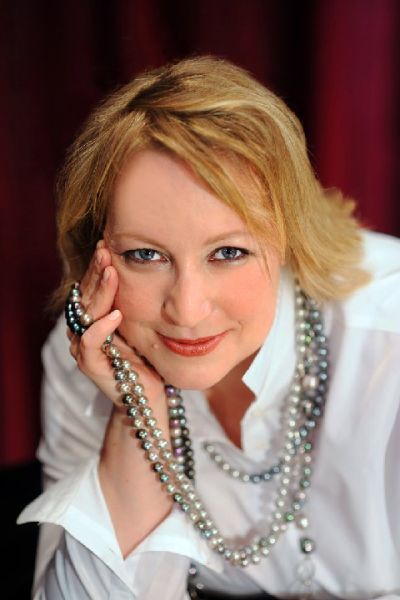
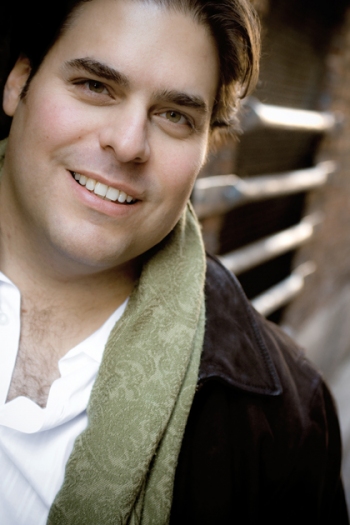
From left: Doris Pridonof Lehnert, Oswald Lehnert, Oswald Lehnert III. Photo by Peter Alexander

From left: Doris Pridonof Lehnert, Oswald Lehnert, Oswald Lehnert III. Photo by Peter Alexander

The opening concert of the Boulder Symphony’s 2015–16 season features three members of Boulder’s legendary musical family, the Lehnerts, playing Beethoven’s Triple Concerto. And it all got started at the farmers’ market.

“Nothing is more like local Boulder than that,” says the orchestra’s music director, Devin Patrick Hughes.

The concert, at 7 p.m. on Saturday, Oct. 3 in Boulder’s First Presbyterian Church, will feature Oswald Lehnert on violin, his son Oswald Lehnert III playing cello, and his wife Doris Pridonoff Lehnert as pianist in a performance of Beethoven’s Triple Concerto. Also on the program is the Symphony No. 7 in D minor by Antonín Dvorák.

“The idea of a family doing the Triple Concerto is unique,” Oswald says.

He says the concerto is rarely programmed because it’s difficult to get a trio together with an orchestra. But Doris Lehnert has no doubts that it’s a great piece.

“I love it,” she says. “I can’t imagine a much better triple concerto.”

Read more in Boulder Weekly.

# # #

“Boulder Dynasties”
Boulder Symphony, Devin Patrick Hughes conductor, with
Oswald Lehnert, violin; Oswald Lehnert III, cello; and Doris Pridonoff Lehnert, piano

Beethoven: Triple Concerto
Antonín Dvorák: Symphony No. 7 in D minor

7 p.m. Sunday, Oct. 3, First Presbyterian Church, 15th and Canyon in Boulder
Tickets

Travel Woes Update: Violinist Rachel Barton Pine stranded in Phoenix

U.S. Airways Strikes Again

By Peter Alexander

Violinist Rachel Barton Pine with her violin

Violinist Rachel Barton Pine with her violin

Violinist Rachel Barton Pine—who appeared with the Boulder Philharmonic in 2014—was stranded overnight in Phoenix when U.S. Airways declined to make room for her 1742 Guarneri del Gesú violin in the cabin of her flight.

This comes after two recent incidents reported here of string basses that were seriously damaged in transit (see below). U.S. Airways is the same airline that last year refused to take the bass of Ranaan Meyer of Time for Three as checked baggage, as is normal for traveling bassists.

Barton Pine's husband and daughter sleeping in the Phoenix Airport. Photo via Violinist.com

Barton Pine’s husband and daughter sleeping in the airport. Photo posted by Rachel Barton Pine, via Violinist.com

As reported on Laurie Niles’ blog Violinist.com, Barton Pine was traveling with her husband and four-year-old daughter, who ended up sleeping on the floor of the Phoenix Airport overnight. (Barton Pine did not try to sleep, since someone had to watch her priceless instrument overnight. She reports spending the time doing paperwork.)

Barton Pine and her family did get a flight out of Phoenix the next morning. The story at Violinist.com has full details.

Is it a hex? Another bass smashed on a flight from Atlanta

U of GA professor forced to cancel recital in Little Rock

By Peter Alexander

Now is not a good time to be flying from Atlanta with your double bass.

Milton Masciadri

Milton Masciadri

On Saturday, just days after Colorado Symphony member Karl Fenner’s bass was smashed on a flight form Atlanta to Denver, University of Georgia faculty member Milton Masciadri was scheduled to play a recital in Little Rock, Ark. But when he arrived in Little Rock from Atlanta, he discovered that he had to cancel the recital.

As first reported on the Website Slipped Disc, his bass has been smashed and the neck broken, just like Fenner’s instrument, during the flight.

Masciadri’s bass sadly is a particularly rare one, made in 1690 by a member of the Testore family of Milan, Italy—esteemed as one of the most important early builders of double basses. Their instruments are among the most sought after, and most expensive, double basses in the world.

Masciadri posted this photo of his damaged bass on Facebook

Masciadri posted this photo of his damaged bass on Facebook

In his case, the airline appears not to have been at fault. Masciadri has reported that “after I checked the instrument it went to TSA [Transportation Security Administration] for inspection but when it arrived in Arkansas they had failed to put back on the security belts that the trunk has inside. The airline had no reason to open the trunk so its obvious that TSA was the one [responsible].”

In Fenner’s case, the bassist had himself opened and re-closed the case after his instrument had been cleared by TSA. This seems a reasonable procedure, so that a valuable and delicate musical instrument can be handled safely and replaced in the case securely. It is possible that Fenner’s case fell out of a cart and was run over sometime after it was checked through by the airline.

Masciadri reported that he has contacted the TSA, and they have sent him “a long report to be filed.” He added that the airline has been assisting him, and that the instrument is insured.

The University of Georgia professor had planned to use the bass in two prominent upcoming performances: at the Ushuaia International Music Festival in Argentina, and a solo appearance with the Korean Chamber Orchestra in Carnegie Hall on Oct. 27. The Carnegie Hall concert is part of the orchestra’s 50th anniversary world tour, and also part of UNESCO’s 70th anniversary celebration.

# # # # #

Edited to add photo of Masciadri’s bass Sept. 22.

Edited for clarity Sept. 23.

Colorado Symphony bass player’s instrument smashed after successful audition

Elation and despair marked Karl Fenner’s day

By Peter Alexander

Bassist Karl Fenner and his damaged string bass

Bassist Karl Fenner and his damaged string bass at Denver International Airport

The nightmares for double bass players just got a lot worse.

There has been another incident involving a double bass and travel, but this one is more troubling than most. You may recall that about a year ago, bassist Ranaan Meyer of Time for Three had his instrument refused by U.S. Airways and had to fly another airline to get home from a performance on “Dancing with the Stars” in Los Angeles.

This time it’s much worse, and closer to home for Colorado musicians: Bassist Karl Fenner of the Colorado Symphony was returning home to Denver by Southwest Airlines from a successful audition with the Atlanta Symphony. As reported in Strad Magazine today (Sept. 17), he had checked his bass into the hold, as is required for double basses. He has a heavy-duty fiberglass case that he has used safely for 11 years of travel, but this time when he arrived, he found that the top of the case had been smashed open and the neck of the bass had been sheared off below the scroll.

Fenner posted photos of the damage on his facebook page, with the comment “Thanks Southwest Airlines and or TSA Atlanta. I’ve trusted you with my baby for 9 years and then this. The heavy duty case was heavily damaged too. Very disappointed. How?”

DB_Broken3The accident happened on Wednesday (Sept. 16). Fenner had been through three rounds of auditions in Atlanta, and was the top choice for the two open stringed bass positions with the orchestra. (Two other players will vie for the second position.) He was offered a contract on the spot, and so he left Atlanta in great spirits.

When he returned to Denver, the bass did not show up in the oversize luggage carousel. After waiting a few minutes, he walked into the airline’s baggage claim office, where he saw the case immediately.

“It was there for me, because obviously they noticed that the case itself was incredibly damaged,” he said. “My heavy-duty protective travel case was damaged, and they wanted me to open it up. When I opened it up and took [the bass] out of the case, I could feel it before I even took it out of the inner case. The neck was completely snapped in two.

“It was certainly not a good feeling. It was made slightly better by the fact they were quite helpful. They took a lot of pictures of all of the evidence themselves to put into my files.”

Kenner's smashed fiberglass travel case

Kenner’s smashed fiberglass travel case

Normally, a fiberglass travel case is almost indestructible. One possibility that the airline suggested was that the case had fallen out of a baggage cart or fork lift and had been run over.

Fenner continues to be in contact with Southwest Airlines. “I received a private message on facebook saying ‘please call me, we really want to make this right with you,’“ he says. “I talked with [an airline representative] for about 10 minutes today. We haven’t gotten very far in the process yet, but she did admit that it is obvious that it is the airline’s fault, and nobody on their end is going to dispute that.”

Fenner estimates that a good quality travel case for a double bass costs about $3,000, and the instrument, which he has had for nine years, cost more than his car. The instrument itself is insured through the Colorado Symphony. It can be repaired, to the extent that a new neck and fingerboard can be grafted onto the body. There is always a risk, though, because there is no guarantee that with such extensive repairs, the instrument will feel the same to the player.

“I know musicians who’ve had damage done to their instrument and they’ve been able to get it repaired, but it was just never the same,” Fenner says.

Repairs will probably take several months. In the meantime Fenner has the possibility of using other instruments, both in Denver and in Atlanta. He will continue to play with the Colorado Symphony during the fall, and plans to join the Atlanta Symphony after the first of the year.

Further updates to Fenner’s story will be posted here as appropriate.

# # # # #

While the damage Fenner’s instrument sustained is an exception, it is not without precedent. One bass player I spoke with reported seeing a $200,000 bass in a repair shop with damage similar to Fenner’s: “The neck had been sheered off because the case had been left hanging out of the truck and passed through a door.”

Beyond such extreme situations, bass players always face challenges when traveling with their instruments. Recent regulations mandate conditions under which airlines must take smaller instruments, including violins and violas, into the cabin. Cellists usually purchase an additional seat for their instruments to travel with them. But string basses are too large to go into the cabin and must travel in the luggage compartment. Here the regulations seem not to be applied consistently, as Meyer’s adventure last year showed.

Several bass players told me stories of frustrations and setbacks when traveling. They did not want their names used, for fear of future difficulties with airline employees, but agreed to have their stories reported.

“It’s always been dodgy traveling with a bass,” one of them said. “It seems as though it is arbitrary depending on the day and the whim of the pilot or manager behind the desk. If the player has a history of traveling with the airline already, there have never been issues, and more travel is planned, there is no excuse for inconsistently applying a policy arbitrarily.”

A professional bass teacher and soloist reported to me that he no longer takes his instrument on airplanes at all. He once went to Europe with his bass, but was not allowed to bring it back on the same airline that had taken it on the outbound flight. The gate agent suggested he call FedEx.

“When you travel with a bass, you have nothing you can do against the will of the person behind the desk,” he said. “I’ve stopped traveling with my bass internationally and always choose to drive if the distance allows domestically. I just performed a concerto with an orchestra (overseas) on a completely foreign bass. I only had two days to get used to the instrument. Is that really my preference? No. Do I have a choice? Once again, no.”

Ironically, the airline that bass players all agreed was the easiest to work with is Southwest Airlines.

Boulder Phil opens season with fairy tales and virtuosity

Two contrasting concertos contribute to a well balanced program

By Peter Alexander

Boulder Phil Music Director Michael Butterman

Boulder Phil Music Director Michael Butterman

The Boulder Philharmonic opened its 2015–16 season last night (Sept. 13) in Macky Auditorium with an intriguing mix of ingredients that added up to a well balanced—and well received—program.

Music Director Michael Butterman, returning for his tenth season with the orchestra, opened the program with Ravel’s Mother Goose Suite. The unusual addition of two soloists filled out the program, with the orchestra’s concertmaster, Charles Wetherbee, performing The Storyteller by Korine Fujiwara, a concerto for violin and strings that was written for him; and Venezuelan pianist Gabriela Montero playing Rachmaninoff’s massive Second Piano Concerto.

The two concertos provided a nice contrast. Fujiwara’s Storyteller is a lovely, cheerful piece very much in the playful spirit of the Japanese fairy tales they portray, while Rachmaninoff’s Second Concerto is one of the great virtuoso challenges of the pianist’s repertoire. The two pieces balanced one another nicely, and the Ravel added an opening touch of color that was very engaging.

Butterman and the orchestra presented Ravel’s original suite of five movements—“The Pavane of Sleeping Beauty,” “Tom Thumb,” “Empress of the Pagodas,” “Beauty and the Beast” and “The Fairy Garden”—and not the seven-movement ballet suite that the program listed. The performance was marked by delicate playing from the winds and a sense of magic that is largely created by Ravel’s brilliant sense of orchestral color.

Charles Wetherbee

Charles Wetherbee

After fulfilling his concertmaster duties for the Ravel, Wetherbee left the stage and returned in a dark red jacket that somehow evoked the storyteller of the concerto’s title. The piece opens with a long, genial violin solo, as if Wetherbee were saying “Come, gather around, and I will tell you stories of magic and wonder.”

After this inviting opening, played warmly by Wetherbee, the concerto goes into a largely episodic series of scenes that sound descriptive—of what being largely left to the imagination of the audience, even though Fujiwara had mentioned earlier that there were slamming doors, cicadas and battle scenes within the score. The various moods and characters are colorfully evoked by the string orchestra.

A string player who knows well how to write for the violin, Fujiwara fills the solo part with graceful lines and ornamented passages that always seem purposeful. There is no great momentum developed; it is more as if there is some mysterious purpose unfolding, but one that lacks deep threat or tumult.

A special word should be said for the slow movement, where Fujiwara honors the many maltreated women of folk legends with music of gentle, compassionate beauty. Wetherbee played with great sweetness of sound and sure technique. Though lacking bravura display, The Storyteller is an accessible and charming concerto that would create a welcome moment of comfort next to more dramatic fare.

Pianist Gabriela Montero. Photo by Shelley Mosman

Pianist Gabriela Montero. Photo by Shelley Mosman

Montero gave a steely, powerful performance of Rachmaninoff’s concerto. Although I found her sound hard-edged in the louder passages, her dynamic control was impressive, ranging from thundering octaves to delicate, whispering filigree. She showed great technical control of Rachmaninoff’s most fearsome passages and created an exciting sense of momentum for the climaxes.

The orchestra under Butterman played with a fullness of sound, but without the plush cushion of strings that best suits Rachmaninoff’s Romantic score. In the loudest passages the brass dominated the sound, and elsewhere the string section is not quite large enough to pull off the rich sonic embrace that larger orchestras can create. There were a few moments of push and pull between pianist and orchestra, perhaps the result of short rehearsal times. Mostly it was not obvious, except when Montero ended the first movement just ahead of the orchestra.

All shortcomings aside, the performance built to a splendid finish, and Boulder’s delighted audience answered with loud cheers and a standing ovation. After several bows, Montero came on stage with a microphone and said that she would like to improvise her encore. She explained that she has improvised since childhood, telling stories in music, and that it seemed to happen without her knowing how. “I am very much a witness,” she said, “as are you.”

She asked for a tune from the audience, and one person offered “Row, Row, Row your Boat”—actually a brilliant suggestion, since the simplest melodies provide the greatest scope for creative variation. After playing the tune alone three times while possibly working out an idea or two in her mind—unconsciously?—Montero launched into a remarkable seven or eight minute expansion of the well known tune, filled with surprising key changes, unexpected textures, sudden appearances of the unadorned tune, and a dazzling variety of sounds. A sudden turn to a lilting, swingy style drew chuckles form the audience before she ended with a final brash flourish.

This was as stunning a display of improvisational brilliance as I have ever heard from a classical pianist—and then some. The encore alone was well worthy of the standing ovation; I would happily have stayed for many more.

Telling Stories in music

Boulder Philharmonic opens 2015–16 season with two soloists

By Peter Alexander

Pianist Gabriela Montero. Photo by Shelley Mosman

Pianist Gabriela Montero. Photo by Shelley Mosman

The Boulder Philharmonic’s 2015–16 season is titled “Reflections: The Spirit of Boulder,” but the orchestra will open the season by telling stories.

The season’s opening concert under music director Michael Butterman will be at 7 p.m. Sunday, Sept. 13, in Macky Auditorium — a departure from the orchestra’s standard 7:30 p.m. Saturday concert dates.

The program will feature music that tells stories, two soloists with their own stories, and one great concerto that is a story in itself. Butterman will conduct Ravel’s Mother Goose Suite; The Storyteller for violin and orchestra, inspired by Japanese folk tales and written by Korine Fujiwara for the orchestra’s concertmaster, Charles Wetherbee; and Rachmaninoff ’s Piano Concerto No. 2, the piece that salvaged the composer’s career, performed with pianist Gabriela Montero, who has been acclaimed both as “an exciting pianist” (The New York Times) and for her “spectacular improvisation” (Cincinnati Enquirer).

That’s a lot of stories for one concert.

Read more in Boulder Weekly.

# # # # #

Concertmaster Charles Wetherbee

Concertmaster Charles Wetherbee

Boulder Philharmonic Orchestra: Opening Night
Michael Butterman, director, with
Charles Wetherbee, violin, and Gabriela Montero, piano

Ravel: Mother Goose Suite
Korine Fujiwara: The Storyteller for violin and orchestra
Rachmaninoff: Piano Concerto No. 2

7 p.m. Sunday, Sept. 13 (Note the time and day)
CU Macky Auditorium

Tickets.

logo2

Michael Christie will conduct world premiere at the Santa Fe Opera in 2017

Santa Fe’s 2016 season has also been announced

By Peter Alexander

Michael Christie conducts the Minnesota Opera

Michael Christie conducts the Minnesota Opera

Santa Fe Opera (SFO) general director Charles McKay has announced that The (R)evolution of Steve Jobs, a new opera by Mason Bates, will have its world premiere as part of the company’s 2017 season.

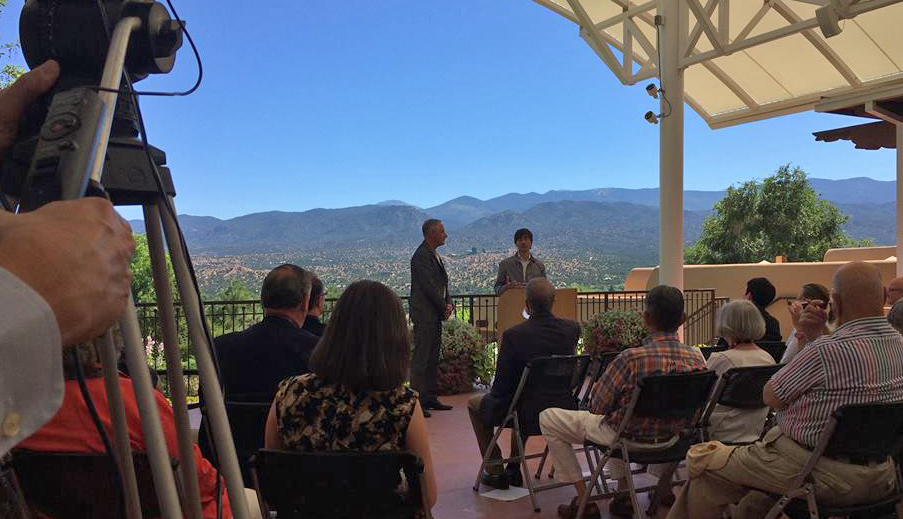
The announcement was made Aug. 5 at a press conference in Santa Fe. The opera’s libretto will be by Mark Campbell, who is well known as the librettist of the Pulitzer Prize-winning opera Silent Night. The stage director will be Kevin Newberry, and the conductor will be Michael Christie, music director of the Minnesota Opera and former music director of Boulder’s Colorado Music Festival. This will be Christie’s Santa Fe Opera debut.

The (R)evolution of Steve Jobs has been commissioned by the SFO, where it will be the company’s 15th world premiere.

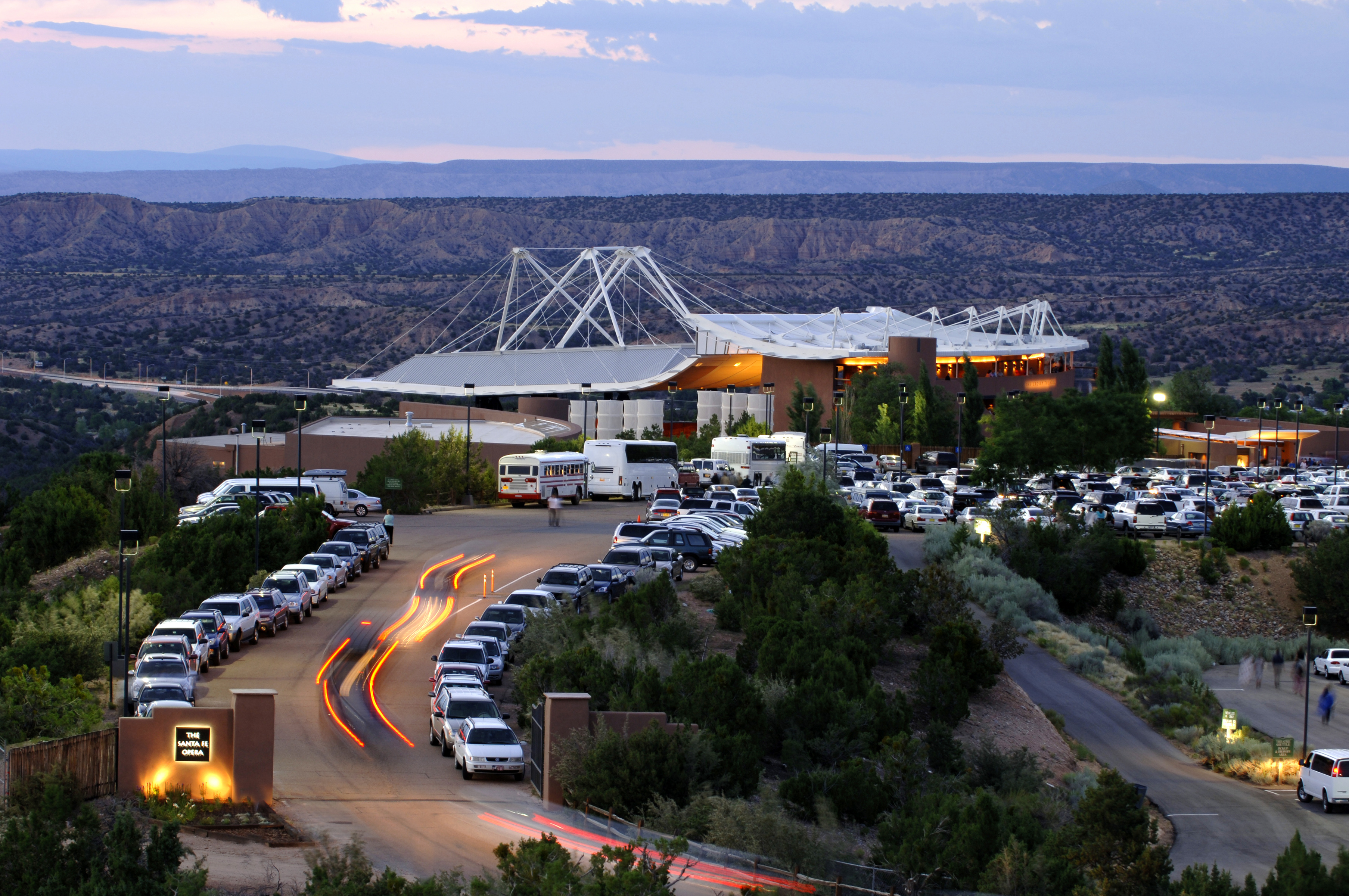
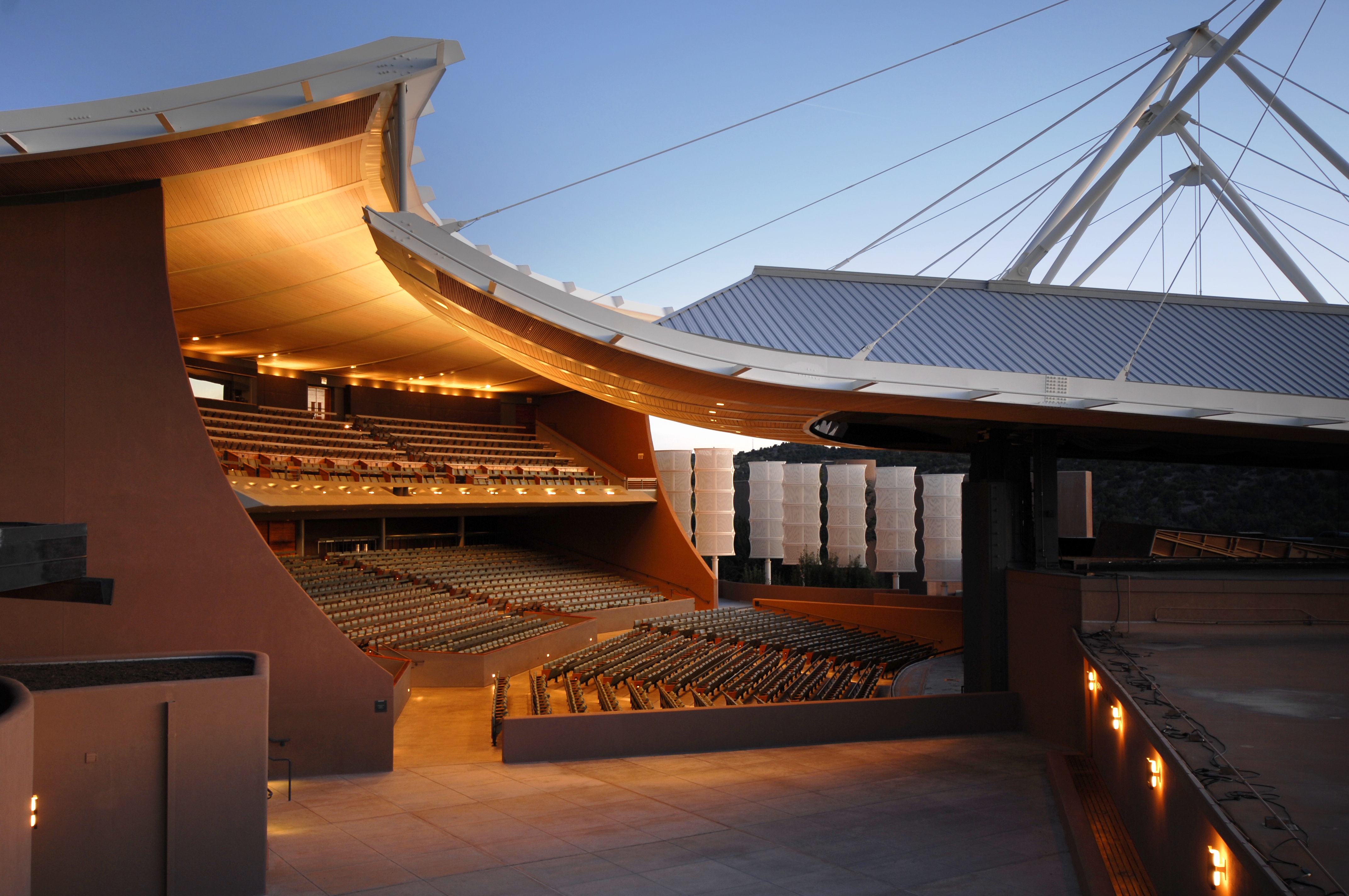
Santa Fe's unique opera house

Santa Fe’s unique opera house

Known as an adventurous company, the Santa Fe Opera has attracted both audiences and press from around the world for their world premieres, including this year’s production of Jennifer Higdon’s Cold Mountain, co-commissioned with Opera Philadelphia and the Minnesota Opera, in collaboration with North Carolina Opera. (Limited seats are still available for Cold Mountain performances Aug. 17, 22 and 14.)

The company has also recently announced their 2015–16 season, which will not include premieres, but will feature several operas that are not often heard. The operas scheduled for July and August 2016 are Romeo et Juliette by Charles Gounod; Capriccio by Richard Strauss; Vanessa by Samuel Barber; La Fanciulla del West (The girl of the golden West) by Giacomo Puccini; and Don Giovanni by Mozart. Tickets will be on sale on the SFO Web page in the fall.

# # # # #

Librettist ark Campbell (left) and composer Mason Bates (right) at the Santa Fe Opera press conference announcing the premiere of Bates's

Librettist Mark Campbell (left) and composer Mason Bates (right) at the Santa Fe Opera press conference announcing the premiere of Bates’s “(R)evolution of Steve Jobs.”

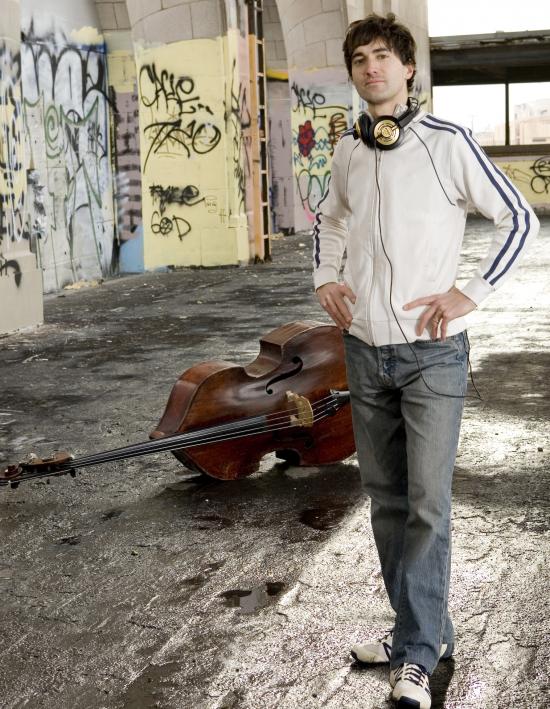
Mason Bates is known both as a composer and as a DJ in the San Francisco Bay Area. His compositions are characterized by the inclusion of electronic effects into orchestral works and other music. His “Observer in the Magellanic Cloud” for chorus with electronic sounds was performed last year by Boulder’s Ars Nova Singers and director Thomas Edward Morgan.

For The (R)evolution of Steve Jobs, Bates said that he will include electronic elements, some based on samples of early computing gear, and acoustic guitar, an instrument that Jobs especially loved. “You will not have heard these sounds before in an opera house,” he said at the press conference.

In a statement on his Web page, Bates wrote “What fascinates me about the story of Steve Jobs is that it exists at the intersection of creativity, technology, and human communication—and I think that can make for thrilling opera.

Mason Bates. Photo by Lydia Danmiller.

Mason Bates. Photo by Lydia Danmiller.

“Imagine, for example, the possibilities for bringing to life Kobun, the spiritual advisor to Steve Jobs—an important and overlooked figure who receives stunning treatment by librettist Mark Campbell. A panoply of Tibetan prayer bowls and Chinese gongs drift across the electronics, sometimes sounding purely ‘acoustic,’ sometimes imaginatively processed as if in a nirvana-esque limbo. Think of how eerily beautiful those sounds can sound when supporting the mystical textures of a low bass voice.

“In fact, Jobs’ search for inner peace is the story of the opera—which, in a sentence, is about a man who learns to be human again. The key role in this journey is his wife Laurene, who acted as the electrical ‘ground’ to the positive and negative charges of Jobs. . . .

“Because the subject is so well known, we’ve taken a poetic and non-linear approach. Anchoring this imaginative, non-chronological telling are numbers—real musical numbers—and a clear-as-crystal through-line: how can you can simplify human communication onto sleek beautiful devices, when people are so messy? We’ll travel with Jobs on his journey from hippie idealist to techno mogul and, ultimately, to a deeper understanding of true human connection.”

NOTE: Edited Aug. 16 to include that fact that The (R)evolution of Steve Jobs will be Michael Christie’s debut with the SFO.

Final weekend at CMF includes the sweet and the sour

Composer Hannah Lash is 2016 “Click” Commission winner

By Peter Alexander

The 2015 Colorado Music Festival (CMF) came to a solemn conclusion last night (Aug. 9) with music from Handel’s Ode for St. Cecila’s Day, part of a final weekend that had its ups and downs.

Or as CMF board co-president Jane Hossière said before the final concert, it was a “sweet and sour” occasion.

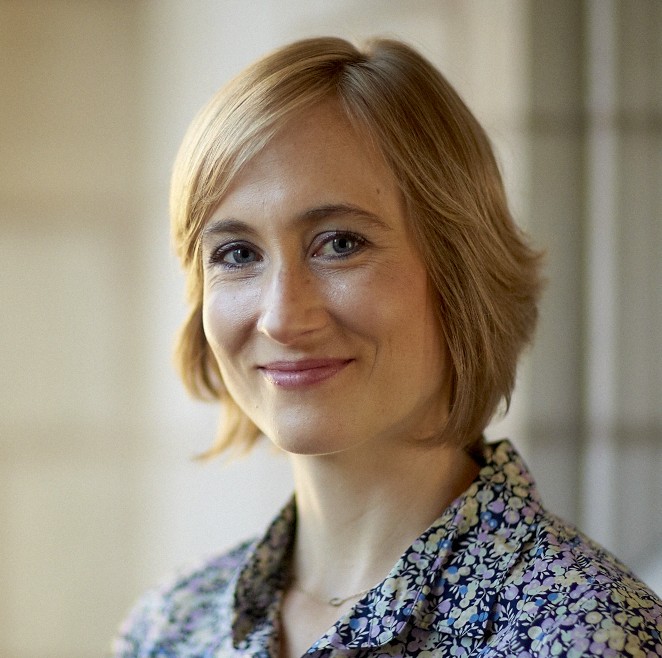
Composer Hannah Lash

Composer Hannah Lash

Hossière also announced that Hannah Lash, a young composer on the faculty of Yale University, has been selected by the CMF audiences as the winner of the 2016 “Click Commission.” She will receive the commission for a new work to be premiered during the 2016 festival, other works by her will be performed during the summer, and she will be in residence during the festival.

The final Festival Orchestra concert had already been presented Thursday and Friday (Aug. 6 and 7). Music director Jean-Marie Zeitouni conducted a potpourri of pieces representing the close relationship between America and France. His fellow French-Canadian, pianist Marc-André Hamelin, was the soloist. The program included the very familiar—Gershwin’s American in Paris and the Overture to Bernstein’s Candide; one genuine masterpiece—Ravel’s Concerto for the Left Hand; and the very unfamiliar—George Antheil’s Jazz Symphony and Darius Milhaud’s A Frenchman in New York.

The concert opened with a highly charged, very fast reading of the Candide Overture. It is certainly a tribute to the players that Zeitouni’s tempos were no obstacle to a clean, precise and exhilarating performance. Zeitouni seems to love the low brass, but here I thought a little less tuba would have made a better performance.

Marc-André Hamelin. Photo by Fran Kaufman.

Marc-André Hamelin. Photo by Fran Kaufman.

The real high points of the concert were the performances with Hamelin, particularly the Ravel Concerto. Hamelin is a muscular pianist who can stand up to the full CMF orchestra—with one hand tied behind his back, as it were. The sheer sound he got from the piano was impressive, if a little thick in the lower register. His commitment to the piece and technical command made this a performance to be treasured.

Hamelin and Zeitouni returned to the stage for a programmed “encore,” Antheil’s Jazz Symphony which, in its 1955 version, is small-scale piano showpiece. Antheil described himself as “the bad boy of music,” and based on the Jazz Symphony, he may have misbehaved because of ADHD. He apparently couldn’t keep his mind on any one thought, as the piece jumps from jazzy idea to jazzy idea. All are catchy and fun, though, and the whole ensemble—Zeitouni, Hamelin and the orchestra—negotiated Antheil’s many tempo and mood changes effectively.

Reversing the printed order, Zeitouni started the second half of the concert with Milhaud’s Frenchman in New York, a piece I am sure few in the audience had ever heard. Milhaud has written some jaunty, rhythmically catchy pieces—if you don’t believe me, see Le Bœuf sur le toit—but this is not one of them.

The whole piece is dominated by thick, massed chords that represent the imposing buildings of Manhattan. That may well be what most impressed Milhaud in New York, but it did not lead to great music. I heard none of the bustle and energy and none of the jazz of New York. There is a reason it is so rarely played.

The final work on the program was Gershwin’s American in Paris. The audience loved it—it’s a familiar piece, and it was performed with great energy. The exploitation of the orchestra’s full dynamic range created dramatic contrasts. But on the whole, I found the performance a mixed bag.

Going full out in tempo and giving the brass free reign leads to some exciting moments, but also to occasional passages that are out of balance, or not quite together. So while the excitement was there, the whole was not quite at the level of Zeitouni’s best performances this summer.

# # # # #

The “sweet and sour” were of course the mixed feelings one has when a happy time comes to an end. With Sunday’s choral-chamber orchestra concert, the CMF said farewell to what has been a fascinating, and largely impressive, first year with a new music director. Zeitouni put a personal stamp on every concert, and achieved some very fine results.

The program, titled “A Royal Finish!”, had vocal, choral and orchestral music by Mozart and Handel. The soloist was soprano Mary Wilson, a last-minute substitute. She performed ably in pieces by both composers, some of which may not be part of her ready repertoire.

It seemed an odd choice to start with Mozart’s tender, late work for chorus, strings and organ, the Ave verum corpus. One of the gentlest and most lovely pieces ever written, it was a very soft start to the proceedings. Here it was little more than a beautiful sigh, so well controlled that it failed to rise even to a modest peak.

Soprano Mary Wilson

Soprano Mary Wilson

Wilson arrived onstage for Mozart’s virtuosic solo cantata for soprano and orchestra, Exsultate, jubilate. Here and in the following Regina Coeli for soprano with chorus and orchestra, Wilson sang with a bright, unforced sound and sparkling technique in the fioratura passages. She sang with great attention to the text and phrasing, but it was all so pretty that it ran the danger of becoming music-box Mozart. I believe there is more drama in Mozart’s music than we heard in these performances, delightful though they were.

As someone who believes that Handel, outside of the unavoidable Messiah and one or two ubiquitous instrumental pieces, is under-performed and under-appreciated, I was delighted to have the splendid coronation anthem Zadok the Priest and portions or the Ode for St. Cecilia’s Day on the program. The chorus, so restrained in Mozart’s Ave verum corpus, rang out impressively in Zadok. Their entrance will wake up sleepy listeners as surely as the chords in Haydn’s famous symphony.

This was followed by a fast and noisy performance of Music for the Royal Fireworks—and that is not a criticism. Taking full advantage of an orchestra of modern instruments, Zeitouni led a performance that achieved a greater dynamic range, and a faster tempo, than would be practical on Baroque instruments. This is not particularly “historical,” but it makes a splashy effect, which is what Handel was after in the first place.

CMF music director Jean-Marie Zeitouni

CMF music director Jean-Marie Zeitouni

Especially memorable were the rattling drum rolls and the brilliant work of the CMF trumpets. Not as noticeable but equally effective were the horns and woodwinds, adding their weight to music that was, after all, written to be played outdoors.

The concert and season ended with four of the 12 movements (why not more?) of Handel’s Ode for St. Cecilia’s Day. An homage to music, of which St. Cecilia is the patron saint, this was specially chosen by Zeitouni to end the festival. Here all the performers came together: the chorus, impressive in their dynamic control; Wilson, impressive with her brilliant technique; and the orchestra, impressive with their clean sound and sparkling flourishes.

The final movement, “As from the power of sacred lays,” is chorus with soprano celebrating the power of music until “the trumpet shall be heard on high, the dead shall live, the living die, and music shall untune the sky.” It is not a rousing finish, but a more solemn one that offers the audience more a sense of appreciation than excitement as they leave the theater: yet another way that Zeitouni put his own stamp on the festival.

Edited for clarity on Aug. 10, 2015.

Santa Fe audience cheers Higdon’s ‘Cold Mountain’; additional performance added

Rigoletto and Salome are also part of 2015 summer season

By Peter Alexander
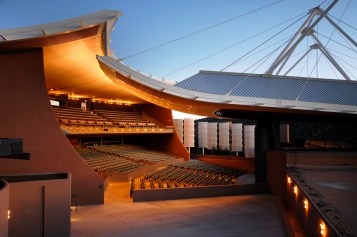
Santa Fe Opera House (c) 2010 Robert Godwin for The Santa Fe Opera

Santa Fe Opera House (c) 2010 Robert Godwin for The Santa Fe Opera

The audience stood and cheered when composer Jennifer Higdon came onstage at the Santa Fe Opera (SFO) Wednesday night (Aug. 5).

The occasion was the second performance of her new opera Cold Mountain, based on the Charles Frazier novel, which had its premiere at the SFO last Saturday (Aug. 1). The opera is playing to sold-out houses, and has in fact been so successful and generated so much demand that the SFO has added a sixth performance Aug. 24 to the original five planned dates. As of this writing, tickets are still available for that performance.

Higdon’s first opera, Cold Mountain is a powerful and assured effort from a very skilled composer. Future performances are planned by the Santa Fe Opera’s co-commissioners Opera Philadelphia and the Minnesota Opera, in collaboration with North Carolina Opera. Based on the reception by the Santa Fe audience, we can expect Cold Mountain to enter the ranks of the most successful American operas.

One of Higdon’s strengths has been the ability to build powerful momentum from rhythmically charged modules and the piling up of brass chords. That skill was particularly evident in the many scenes of threat and violence within the disturbing story of a wounded Confederate deserter’s flight. For the opera, she added to that a remarkable ability to conjure scenes of quiet, comfort and even humor, and to provide gentle, colorful support for the voice in lyrical moments.

The use of orchestral sound, ever varied, to set the mood for the contrasting scenes of the opera is one of the impressive strengths of the score. Treating the instruments as individual voices, Higdon finds a kaleidoscope of different chamber-like combinations to accompany the singers. This points in turn to another virtue: the orchestra almost never overwhelms the voices, and only where the buildup of momentum justifies it. Almost all the vocal solos and small ensembles are accompanied with extreme restraint, making them easily audible and understandable.

Higdon is especially effective in handling the transitions from scene to scene and from one mood to another. Sometimes subtly overlapping the sounds, and even the characters, and sometimes sliding seamlessly into a new musical environment, she keeps the music moving without obvious breaks or pauses.
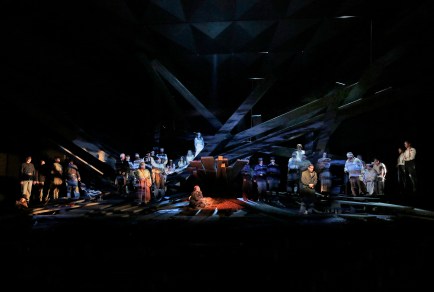
Ensemble cast in ‘Cold Mountain.’ Photo © Ken Howard for Santa Fe Opera

Ensemble cast in ‘Cold Mountain.’ Photo © Ken Howard for Santa Fe Opera

The same is true when she introduces the individual “numbers”—arias, duets, and larger ensembles—that simply emerge without any obvious signal. Each number follows its own arc, then merges back into the musical flow. Among moments I found particularly moving are Ruby’s aria telling of her childhood; several duets between the leading characters, Inman and Ada, particularly “Four Novembers come and gone” in the second act; and above all Ada’s “I feel sorry for you,” sung to Ruby’s father, which conjures in a single aria the cumulative meaning of much of the book.

Equally memorable is the use of the chorus throughout, and especially the beautiful, consoling chorus “Buried and forgotten,” recalling the numberless dead of the Civil War.

For all the breadth of Higdon’s expressive palette, one thing is missing: melodies that bloom in the voice and linger in the memory. Soaring song is the reason for opera, after all, and without it the music sometimes does not rise to the lyrical level of the text, and does not reach a convincing emotional climax near the end when Ada and Inman are finally together. The music at this point is not ineffective, but it does not transcend what has gone before, as we feel it should.

Those who know the book will notice several changes, including the omission of several of the book’s many scenes and the creation of composite characters. Opera being an art form of its own, this is unavoidable, but two changes should be noted.
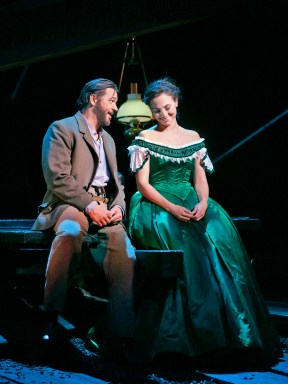
Nathan Gunn (Inman) and Isabel Leonard (Ada) in ‘Cold Mountain.’ Photo © Ken Howard for Santa Fe Opera

Nathan Gunn (Inman) and Isabel Leonard (Ada) in ‘Cold Mountain.’ Photo © Ken Howard for Santa Fe Opera

Teague is introduced from the very beginning, changing him from an unseen threat for much of the story into a familiar menace—none the less evil but more human than in the novel. And Inman and Ada’s connection is strengthened. In the novel, Inman embarks on his odyssey not knowing if Ada will even want him when he returns, whereas in the opera they are both longing to reunite throughout. Doubtless this makes for more lyrical moments and better opera.

On the other hand, fans of the book will happily recognize several lines of dialog that survive directly into the libretto, including Ada saying to Ruby of Inman, “I know I don’t need him. But I think I want him,” and Ruby’s laconic reply, “Well, that’s a whole different thing.”

Robert Brill’s set of slanted and moveable planks may unhappily remind some operagoers of the recent awkward Metropolitan Opera Ring cycle, including the use of projections over the entire stage and even outside onto the proscenium. In this case, however, the set was used effectively to represent the many different locales of the story. Dark areas of the set helped create the mood of menace that dominates the story, with danger often emerging from the shadows, while lighting was used well to direct attention to individual characters. Projections were used with restraint but impressively.

Leonard Foglia’s direction was efficient and clear. In an opera of many scene changes, from place to place and backwards and forwards in time, it is an accomplishment that only once or twice was I briefly wondering where we were.

Ada is the beating heart of the story, and soprano Isabel Leonard was a graceful, poised presence throughout. Her transformation from a sheltered city girl to a competent farm dweller was conveyed by costume and movement, and she sang with conviction and beauty of sound. Her moving performance of “I feel sorry for you” was a highlight.
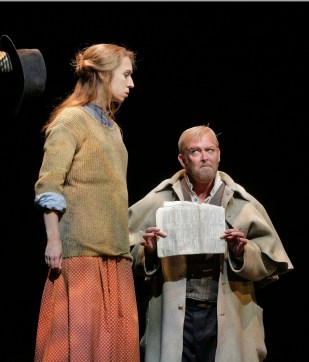
Emily Fons (Ruby Thewes) and Jay Hunter Morris (Teague) in ‘Cold Mountain.’ Photo © Ken Howard for Santa Fe Oper

Emily Fons (Ruby Thewes) and Jay Hunter Morris (Teague) in ‘Cold Mountain.’ Photo © Ken Howard for Santa Fe Opera

Her foil, Ruby, was brought to life by the excellent Emily Fons. At first, I thought the character verged on stereotype—clumping around the stage, drawing out her vowels like a country bumpkin—but as the Ada-Ruby relationship developed I liked her performance more and more.

As Inman, the man who abhors violence but finds himself good at it, Nathan Gunn gave a solid performance. He sang expressively and blended well in his duets with Ada, and his characterization was effective. Jay Hunter Morris was a strong-voiced and thoroughly despicable Teague who relished the melodramatic boos at his curtain call.

The remainder of the large cast ranged from very good to superb. I particularly enjoyed Kevin Burdette as Ruby’s father Stobrod, Robert Pomakov as the doomed Owens, and Deborah Nansteel as Lucinda. Each embodied a strongly etched personality that left a mark on the story.

I have mixed feelings about the use of an accent—those drawling vowels and dropped Gs runnin’ though the text. On one hand, it comes perilously close to southern redneck parody; on the other, it helps place the opera in a world apart. To the credit of the cast, they used it pretty consistently and made it work.

The SFO orchestra handled Higdon’s musical demands ably. The chamber-like combinations were beautifully played and well balanced, and the climaxes were powerful. The composer has complimented the players for handling her constant changes—including those made after the first performance, making the performance I saw another premiere of sorts. Conductor Miguel Harth-Bedoya kept it all moving marvelously well and provided support for the singers.

# # # # #

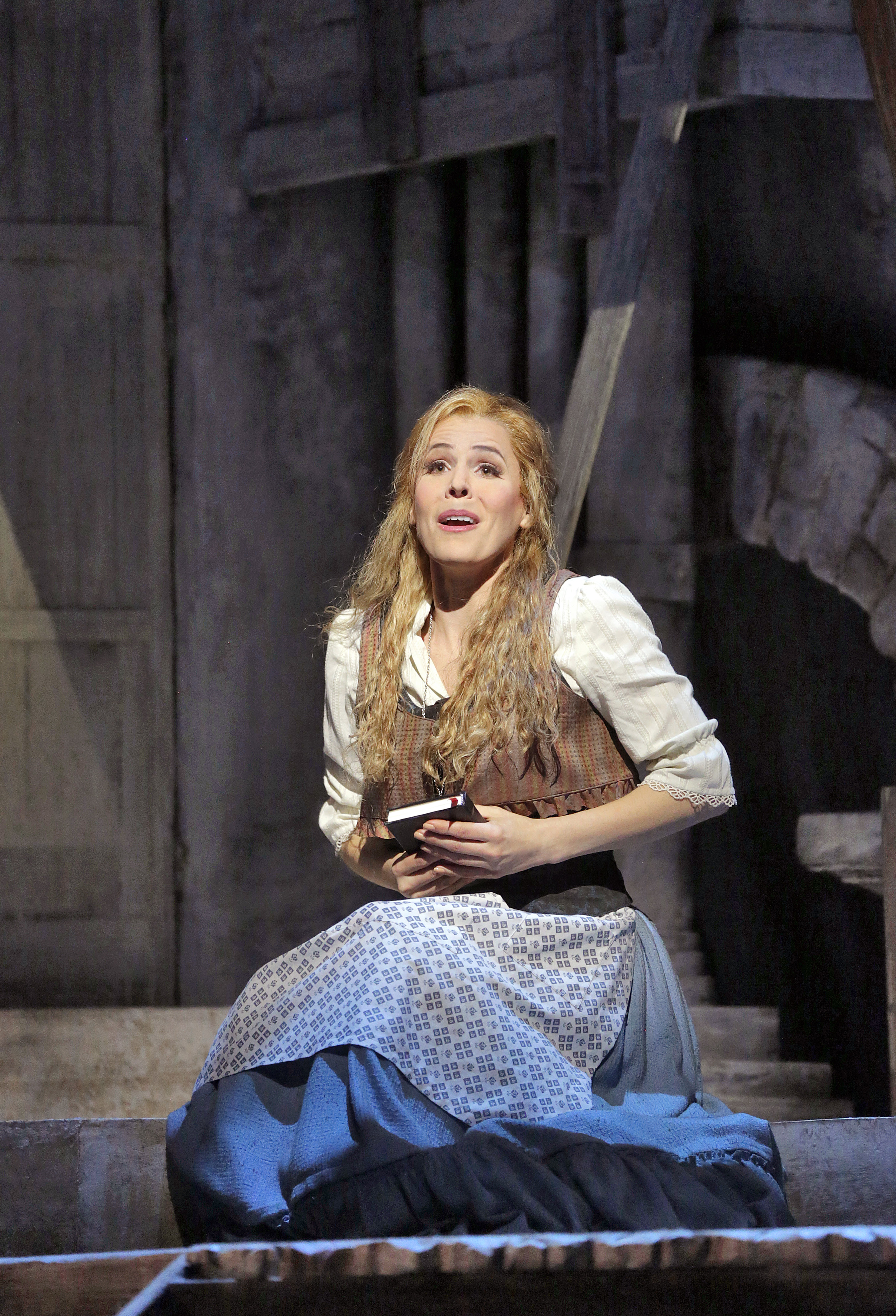
The night before Cold Mountain I saw Santa Fe’s serviceable and moving, if flawed, Rigoletto.

Georgia Jarman (Gilda) in 'Rigoletto.' Photo (c) Ken Howard for The Santa Fe Opera

Georgia Jarman (Gilda) in ‘Rigoletto.’ Photo (c) Ken Howard for The Santa Fe Opera

The star of the evening was Georgia Jarman’s Gilda. She sang with a radiant voice, and placed an expressive weight behind the notes that made her the emotional center of the opera. Her exquisite performance of “Caro nome,” Gilda’s signature aria, earned a well deserved and prolonged ovation (in spite of having to compete with an unfortunately noisy stage turntable).

Beyond her vocal strengths, Jarman personified Rigoletto’s young and innocent daughter as well as anyone I have seen. Her physical movement onstage and her interactions with other singers contributed strongly to her portrayal of a delicate girl who finds the strength to die for love.

In the title role Quinn Kelsey sang with great power throughout. At his best, as in the second act, he became a deeply moving figure, portraying Rigoletto’s bitter torment. I thought he was less effective in other scenes, such as his duet with Gilda in the first act, when his performance seemed slack and unmotivated.

Kelsey is a large man, and he was not helped by the costuming, which made him more of a hulking figure onstage than a downtrodden and powerless jester trapped in a dissolute court. His hatred of the Duke was apparent as the opera moved toward its tragic conclusion, but the power differential between them was not always easy to see.
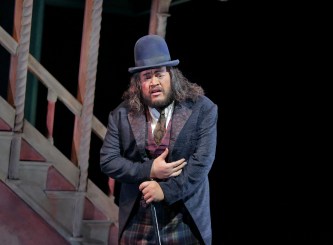
Quinn Kelsey (Rigoletto) in 'Rigoletto.' Photo (c) Ken Howard for The Santa Fe Opera

Quinn Kelsey (Rigoletto) in ‘Rigoletto.’ Photo (c) Ken Howard for The Santa Fe Opera

The Duke of Mantua is not a role with a wide emotional range. Almost the only thing he sings about is love—by which he means lust—that he is “a slave to love,” and famously, the inconstant character of women. As the Duke, Bruce Sledge sang ardently of love, with ringing tones and a pleasing tenor voice.

Others in the cast were all effective. Anne Marie Stanly raised Giovanna, Gilda’s nurse, from an easily overlooked background figure to an angry woman whose betrayal of Rigoletto was based in overt contempt. Singing another doomed man, Robert Pomakov put great weight into Monterone’s curse. Peixin Chen as Sparafucile and Nicole Piccolomini as his sister Maddalena filled their roles admirably.

The production seemed unsure of itself. At first, I thought it was set in Verdi’s time, effectively the late nineteenth century. Many of the characters had a Dickensian look. But others could be mistaken for wearing modern clothes—at the end, the Duke appeared to be wearing Dockers and a burgundy work shirt—as if they came dressed for rehearsal.

The direction and costuming made the depravity of the Duke’s court more than clear. The mannered writhings and groping in the first scene were almost comical, and the harlots in hot pants looked out of place, whatever the time period of the opera, except as reminders that the court was a really bad place.

The unit set, mounted on that noisy turntable, was mostly effective, with doorways and stairs and lairs that served all the needs to the plot. On the other hand, I was never clear why Rigoletto sometimes carried a crutch that looked like a borrowed prop from Dickens’s Christmas Carol, and sometimes managed without it.

But all reservations aside, the Santa Fe night worked its magic. Where better to watch the final scenes of Rigoletto than under the stars, with a breeze blowing though the theater?

# # # # #

I also saw the SFO production of Richard Strauss’ Salome, an opera that has now been done 11 times as part of the company’s advocacy of the composer’s works. Filled with symbolism and saturated with depravity, Salome is an opera that directors cannot resist interpreting for us—and that includes the current stage director Daniel Slater and designer Leslie Travers.

The production begins with an effective coup de theater as a stone wall across the back of the stage opens to reveal a banquet table, as well as the real-life sunset beyond the stage. The audience spontaneously applauded the lovely scene, but things soon began to get murky.
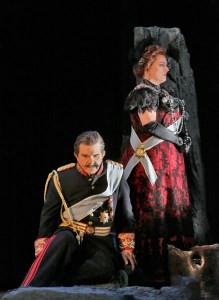
Sal.24 Robert Brubaker (Herod) and Michaela Martens (Herodias) in ‘Salome.’ Photo © Ken Howard for Santa Fe Opera

Robert Brubaker (Herod) and Michaela Martens (Herodias) in ‘Salome.’ Photo © Ken Howard for Santa Fe Opera

The costuming placed the story in Belle Époque France, a believable time for depravity among the powerful. But placed in that period much of the story fails to make sense: the Biblical prophecies; Herod’s fear of the denunciations intoned by Jochanaan (John the Baptist); and claims that the Messiah has appeared. None of this fits late 19th-century France.

But the producers have a specific aim in mind: instead of letting the story stand for itself as Oscar Wilde and Strauss wrote it, they want to show us what it is really “about.” And so Salome is presented as a Freudian family drama played out among Herod, his wife and former sister-in-law Herodias, and his stepdaughter Salome.

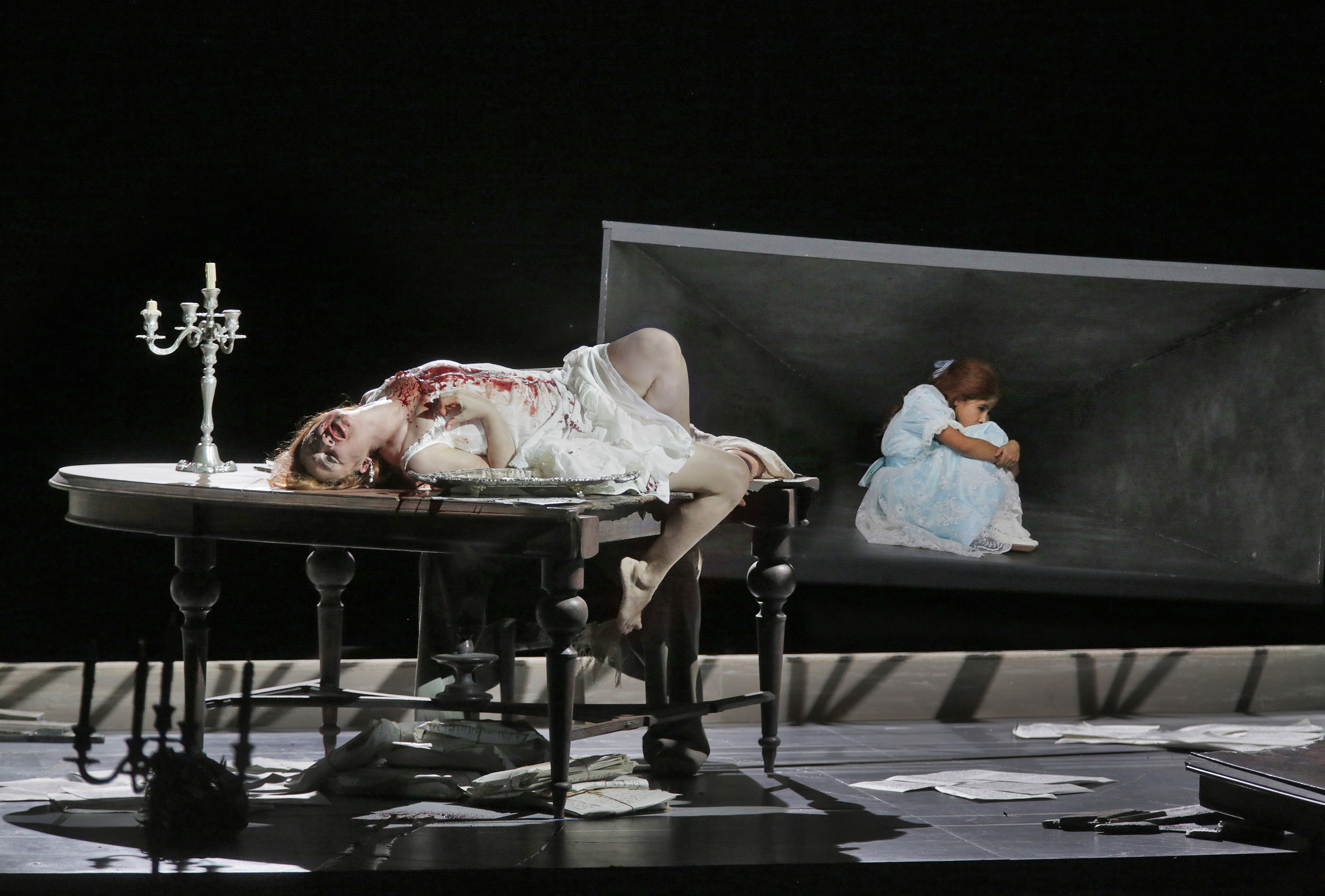
This is most obvious in Salome’s dance, which was presented not as a dance but an exploration of the deepest levels of Salome’s psyche. After a few desultory dance steps, she stepped to the side while a series of pictures opened behind her. She was shown as a child, with (apparently) her real father strangled before her by Narraboth, who later (but earlier in the opera) kills himself over his infatuation with the now teenaged princess. After seeing her father killed, the child Salome retreated into a cramped space in the back wall.
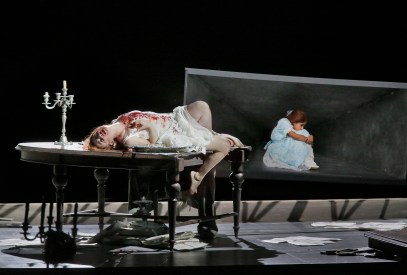
Alex Penda (Salome) in ‘Salome.’ Photo © Ken Howard for Santa Fe Opera

Alex Penda (Salome) in ‘Salome,’ with child Salome behind. Photo © Ken Howard for Santa Fe Opera

Obviously this shows how Salome is trapped by the damage she endured as a child, which is supposed to explain her hatred for her stepfather and her depraved infatuation with Jochanaan. And sure enough, after her bloody orgy with the severed head, instead of being killed—as Herod commands—she goes back to the cringing child and frees her. In other words, John the Baptist’s death serves to rescue Salome from her past.

The point is not that this interpretation is wrong; the point is that the opera contains more than that. There is the religious theme, which, apart from the text, largely disappears in this interpretation, and there is a great deal of action portrayed in the music that does not occur on stage. Strauss did not portray psychoanalysis, he portrayed a dance; he did not portray Salome freed from her demons, he portrayed her death. Substituting psychological explanation for the action of the drama not only discounts the audience’s ability to interpret the drama on its own, it also drains the music of much of its impact.

The musical performance was another matter, and was generally on a high level. The role of Salome is one of the most difficult in the repertoire: she must appear to be a petulant adolescent while singing music worthy of Isolde. Given that difficulty, Alex Penda was generally effective. She played the bored teenager very well, even though her voice was not always strong enough to carry over Strauss’ orchestra.

Nevertheless, Penda carried off the musical climaxes and reached the high notes well. And it should be noted that she was not helped by the direction, which left her far upstage in an enclosed space—Jochanaan’s cell—or singing toward the wings for several of her critical scenes.
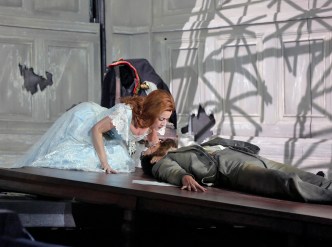
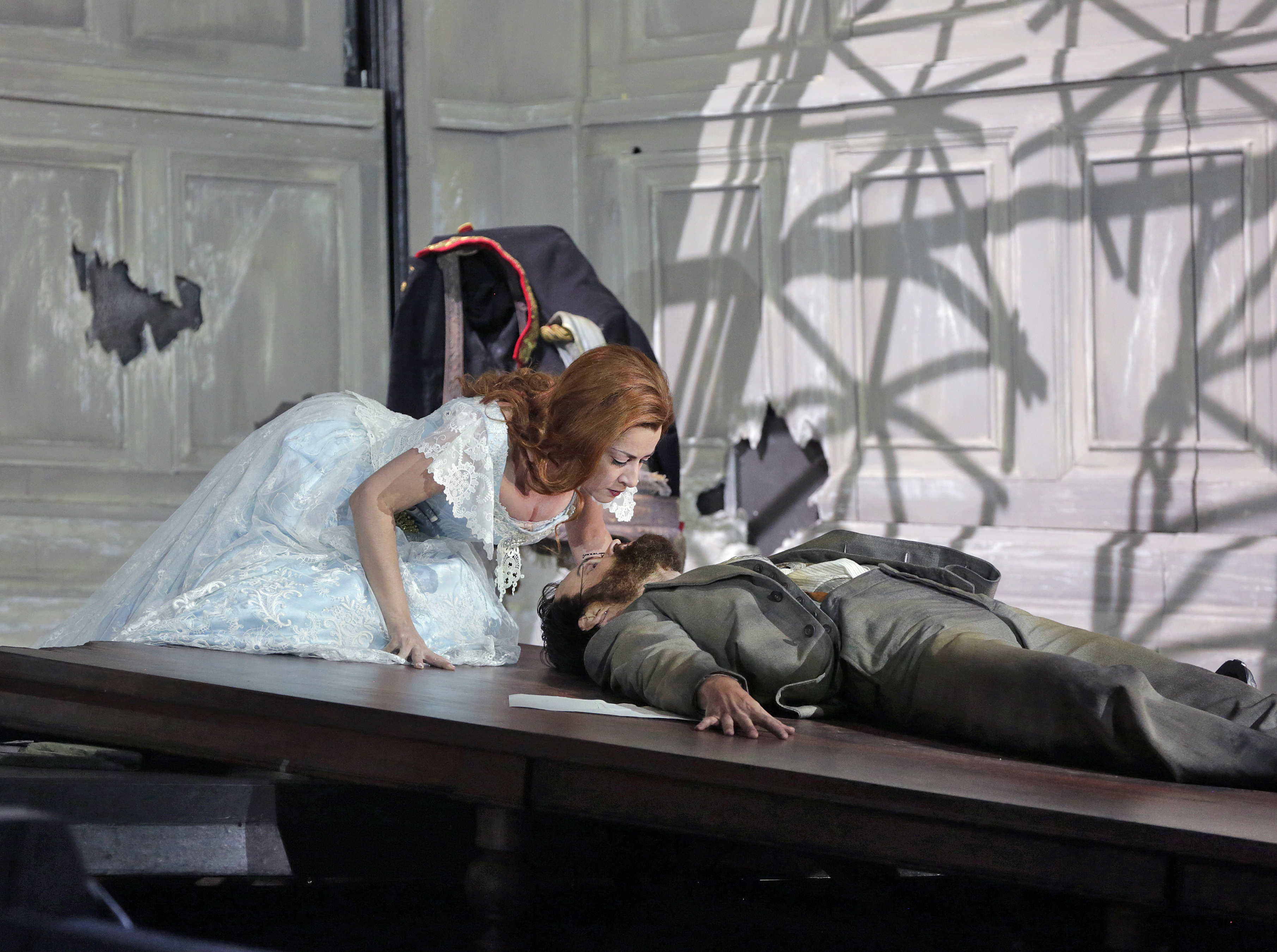
Alex Penda (Salome) and Ryan McKinny (Jochanaan) in ‘Salome.’ Photo © Ken Howard for Santa Fe Opera

Alex Penda (Salome) and Ryan McKinny (Jochanaan) in ‘Salome.’ Photo © Ken Howard for Santa Fe Opera

Her scene with Ryan McKinny as Jochanaan, when he keeps rejecting her demented advances, was played with great intensity by both singers. This is the crux of the whole opera: nothing that comes later will work if this is not brought off. In spite of the jarring anachronisms of the production, this was one of the best parts of the performance.

The production turned Jochanaan into what looked like a 19th-century radical, writing revolutionary manifestos in his crumbling study. It’s hard to see how that fits with the text and music that Strauss gave Jochanaan, but that said McKinny sang with the kind of booming certainty the role requires, and was vocally impressive.

Robert Brubaker’s Herod and Michaela Martens’ Herodias were accurately sung, but only intermittently as expressive as the roles require—which I attribute to the fact that in this production they were not acting much of what they were singing. As Narraboth Brian Jagde was memorable, displaying his fatal obsession with Salome with musical and physical intensity.

The most satisfying aspect of the production was the SFO orchestra, which under conductor David Robertson gave a powerful performance of Strauss’ virtuoso score. The full sound was resonant, and all the solos were immaculate. Slater had the demanding score under control from the beginning.

# # # # #

For tickets and information on the remaining performances in the Santa Fe Opera’s 2015 season, click here.

Edited for clarity and to correct a minor typo Aug. 8, 2015.

Name of the conductor of Salome was corrected Aug. 10, 2015. David Robertson is the conductor; Daniel Slater is the stage director.