Composer Stephen Lias reveals his plan for a new piece for Boulder Phil

Rocky Mountain N.P. provides the inspiration for All the Songs that Nature Sings

By Peter Alexander

IMG_0454

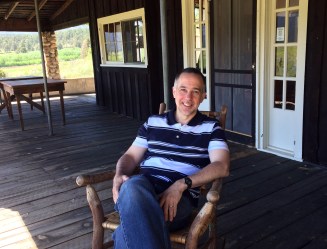
Stephen Lias on the porch of the William Allen White Cabin in Rocky Mountain National Park. Photos by Peter Alexander.

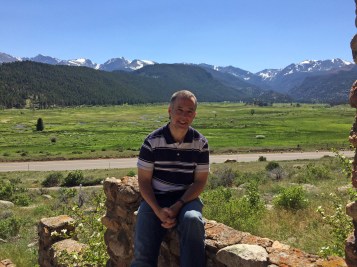
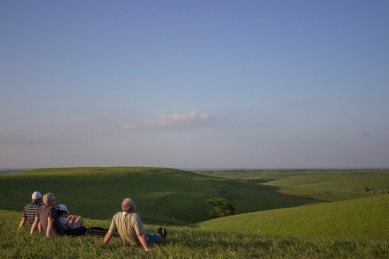
Composer Stephen Lias sits on the porch of the William Allen White Cabin in Rocky Mountain National Park and looks over the Moraine Park meadow.

“It feels right to me to have formed this plan, based on words by Enos Mills, read from a book in this cabin, looking at this scenery,” he says. “Everything about its connectedness to this place feels just right.”

The plan he is referring to is for a new piece that he has been commissioned to write for the Boulder Philharmonic. It will be premiered by the Boulder Phil and conductor Michael Butterman at their subscription concert March 25, 2017, and subsequently performed by them at the SHIFT Festival in the Kennedy Center in Washington, D.C, March 28.

IMG_0458

The view from the cabin: Lias in front of the Moraine Park meadow

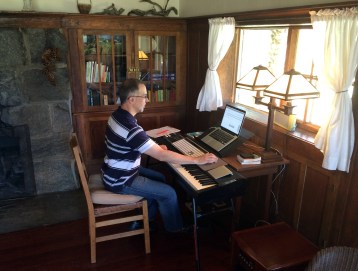
Lias has just spent nearly two weeks in the cabin, which is reserved by the park for artists in residence. Although he was not technically an artist in residence this year, as he was in 2010, the cabin was unoccupied for a few days in early June, and the park invited Lias to stay there while preparing his piece for the Boulder Philharmonic.

Known as an adventurer/composer, Lias has written a number of pieces portraying his experiences in national parks. In 2014, the Boulder Phil opened their season with his Gates of the Arctic, conceived during a National Parks Residency in Alaska’s Gates of the Arctic National Park. It was performed with synchronized images from the park, as will be the piece to be premiered in March.

The Boulder Phil won a National Endowment for the Arts grant to support their participation in the 2017 SHIFT Festival. They chose Lias for the commission because the theme of their participation in the festival is the orchestra’s ongoing celebration of music and nature.

The title of Lias’s new piece will be All the Songs that Nature Sings, which comes from a book by Enos Mills, The Rocky Mountain National Park, that Lias found on the shelves of the William Allen White Cabin. Sometimes called “The Father of Rocky Mountain National Park,” Mills was a naturalist and nature writer in the early years of the 20th century who championed the establishment of the park.

The title “is a beautiful quote in Mills’s book,” Lias says. “He’s talking about how the trails take us to all of these amazing places and scenes and wildlife and it has at its heart ‘all the songs that nature sings.’”

Lias has only written a few musical ideas at this point, but he has formed an overall design for the piece in his mind. Based on visual images taken in the park, the plan is virtually cinematic in nature. “Imagine a camera starting with something small and intimate in nature and then slowly zooming outward, bit by bit until you can see a rock, and then a bush, and then a tree, and then a river, and then a waterfall, and then a mountain, and then a range of mountains,” he explains.

“When we can see this amazing place, the range of mountains that sits here in this park, that will be the climax of the piece, and then it will start panning back in again, zooming slowly, slowly, slowly until we end the piece with another intimate shot of some very small thing. So it’s going to be a slow growth outward, and then a slow growth back inward.”

That visual plan grew out of Lias’s poring through photos of the park. “We knew from the beginning that this commission involved a composition that would have synchronized images with it,” he says.

IMG_0461

Lias working in the William Allen White Cabin in Rocky Mountain National Park

“Back in January I came up to the park and met with the staff and we talked about the imagery that might be used. The park gave me a hard drive of 700 and some images that we had culled from their archives, and so in addition to thinking about what I wanted the musical shape to be, I’ve known that there needed to be visual material.”

With the inspiration strong and the plan firmly in mind, Lias packs up his bags to get on with the rest of his summer plans—including leading a workshop on “Composing in the Wilderness” in Alaska. But none of that, he says, will get in the way of a piece firmly rooted in Rocky Mountain National Park.

“The very beginning notes of the piece have been written here in this cabin,” Lias says. “It will take me many months to complete, but it will still be deeply grounded to this place.”

# # # # #

Information and tickets for the Boulder Philharmonic’s 2016–17 season may be found here.

Renowned composer Jake Heggie is working on his newest opera in Boulder

“It’s a Wonderful Life” at the CU New Opera Workshop

By Peter Alexander

It’s a wonderful life for composer Jake Heggie right now.

IMG_3134

Left to Right: Libretist Gene Scheer; Leonard Foglia, Houston Grand Opera; composer Jake Heggie; and Bradley Moore, Houston Grand Opera. Photo by Alexandria Ortega for CU Presents.

As the composer of two highly successful operas, Dead Man Walking (2000) and Moby Dick (2010), he finds that commissions for his works keep coming.

“People keep asking me,” he says. “A commission is a huge gift.”

Now he is in Boulder to work on his latest opera, based on Frank Capra’s beloved 1946 film It’s a Wonderful Life. Joining him for work at the CU New Opera Workshop, (CU NOW) are librettist Gene Scheer and staff from the Houston Grand Opera, where the finished opera will have its premiere in December.

Under Leigh Holman, director of CU’s Eklund Opera Program, CU NOW offers composers the opportunity to workshop new operas prior to their first productions. For more than two weeks, they can try out their new works with CU student singers and other support staff, seeing what works and what doesn’t, making changes as they go.

After 18 days of intensive work, CU NOW will present performances of selected scenes from It’s a Wonderful Life at 7:30 p.m. Friday, June 17, and 2 p.m. Sunday, June 19, in the ATLAS Black Box Theater. Between those two performances, CU NOW will also present scenes by CU student composers at 7:30 p.m. Saturday (June 18) in the Imig Music Theatre. All three performances are free and open to the public.

Read more in Boulder Weekly.

# # # # #

CU New Opera Workshop (CU NOW)

IMG_0441

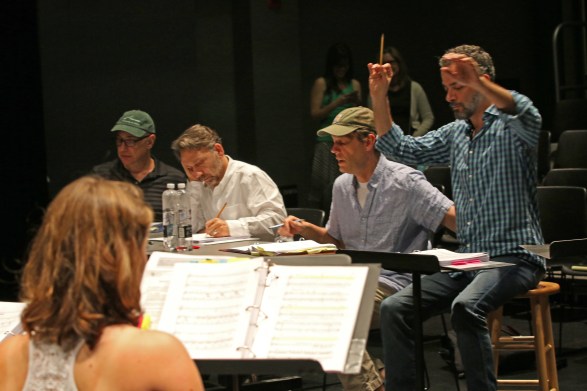
Rehearsal of “It’s a Wonderful Life” at CU NOW. Photo by Peter Alexander.

Workshop: It’s a Wonderful Life by
Jake Heggie
Libretto by Gene Scheer

7:30 p.m. Friday, June 17
2 p.m. Sunday, June 19
ATLAS Black Box Theater, CU Roser ATLAS Building

Composers Fellows’ Initiative
Performances of student opera compositions

7:30 p.m. Saturday, June 18
Music Theatre, CU Imig Music Building

Performances are free and open to the public


Kansans celebrate the environment and culture of the tallgrass prairie

‘Symphony in the Flint Hills’ is unlike any other classical music event you will find

By Peter Alexander

IMG_1501

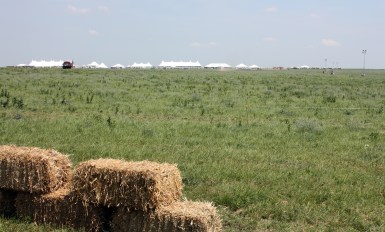
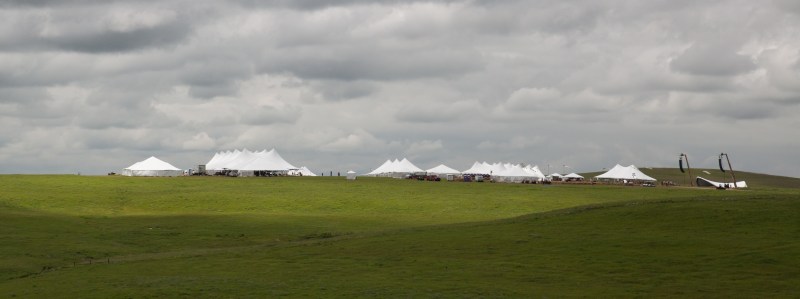
Symphony in the Flint Hills event site from the parking area (all photos by Peter Alexander)

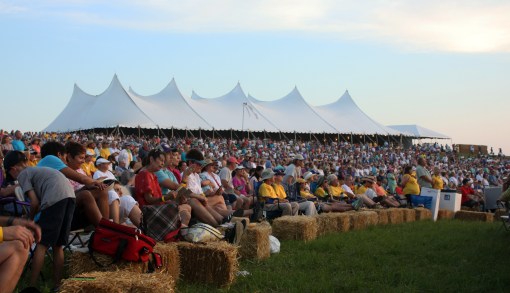
The temperature crept into the low 90s and the swelling crowd kept pouring onto a remote hilltop on the Kansas prairie. Eventually there would be about 7,000 people there, more than twice the population of the county. Tents had been set up, Bar-B-Q was served, there were lectures and prairie walks and covered-wagon rides.

Near the end of the day, cowboys drove a line of cattle across the hillside while the Kansas City Symphony broke into the theme from “The Magnificent Seven.”

It was the 11th “Symphony in the Flint Hills,” held last Saturday (June 11) in South Clements Pasture, about seven miles west of the tiny town of Bazaar, KS (pop. 81). An exuberant celebration of the tallgrass prairie, of all aspects of this unique environment, of Kansas ranching culture, of Kansas itself, the event culminated with a concert by the Kansas City Symphony.

IMG_1555

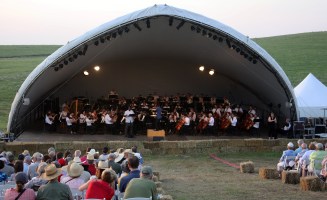
Symphony in the Flint Hills audience

If you have never attended an outdoor symphony concert on the prairie with 7,000 other people, you should put “Symphony in the Flint Hills” in next year’s calendar: June 10, 2017, at Deer Horn Ranch. (It is moved every year to give the environment time to recover.) You will never find another classical music event quite like it.

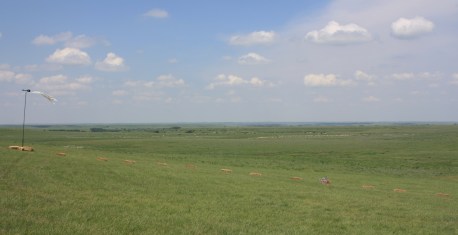
“Symphony in the Flint Hills” is first of all about the environment. The Flint Hills represent a unique ecosystem that has remained tallgrass prairie, largely as it was when the first European settlers entered Kansas. Because the rocky, flinty ground was resistant to the plow, it was never tamed by agriculture, as so much of the American prairie has been.

IMG_1509

Flint Hills vista from the concert site

Every year, there is a theme that is explored in the lectures and talks. This year’s theme was “The Future of the Flint Hills,” something worth pondering in a time of environmental challenges and global climate changes.

(The Kansas City Symphony contributed its own happy note to thoughts of the future: the orchestra has just agreed to a new four-year deal with its musicians. In contrast to some other orchestras, the KCS negotiated the new contract without drama. It took only eight meetings, with no attorneys present.)

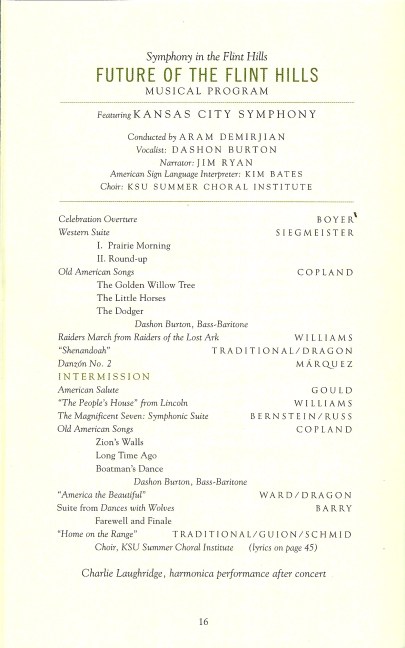
SFH programWhile celebrating the environment, the annual event has always featured a concert by the Kansas City Symphony as one of its highlights. (You may read more about the event and its history here.) The concert draws the largest portion of the audience and offers a attractive blend of light classics, familiar movie themes, and more serious works that fit the locale. As conductor Aram Demirjian put it, it’s “a really fun mix of music that you know and music that you’re going to be glad that you know once you’ve heard it.”

The details of that “fun mix” are never announced in advance, but this year it included music from the films Lincoln, Raiders of the Lost Ark, The Magnificent Seven and Dances with Wolves. (See the full program, left.) There were lush arrangements by Carmen Dragon of “Shenandoah” and “America the Beautiful.”

IMG_1552

Baas-bariton Dashon Burton and the Kansas City Symphony

Most fittingly, the orchestra played “Prairie Morning” and “Round-up” from Ellie Siegmeister’s Western Suite—an attractive and accessible work from 1945 that is doubtless one of those pieces you’d be glad you know once you’ve heard it. Bass-baritone Dashon Burton, a founding member of the adventurous vocal ensemble Roomful of Teeth, gave deeply moving and sonorous performances of six of Aaron Copland’s Old American Songs and was rewarded with cheers from the crowd.

I will not write a full review of the concert, because what I heard was not the orchestra itself, but the sound of the orchestra through the very large speakers mounted either side of the stage. The speakers are very high quality, and the sound engineering was very solid, but some details inevitably got lost. Some passages of fast repeated notes seemed slightly blurred, and in other places the wash of sound—being broadcast out to 7,000 people, after all!—covered differences of timbre among the instruments.

IMG_1560

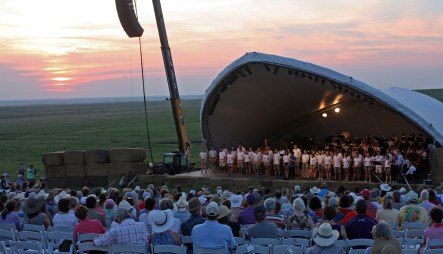
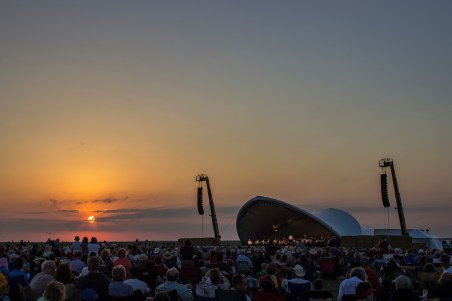
Prairie sunset, audience and symphony, ready to sing “Home on the Range”

As well as I could tell, the orchestra was very tight, the solo parts all very well played. The top trumpet soloist happily lasted the entire concert, which featured exposed high passages in nearly all the film-music selections, with no audible evidence of fatigue. Demirjian led propulsive, exciting performances.

The concert ended, as it always does, with everyone standing to sing along on the Kansas State Song, “Home on the Range.” People joined arms and swayed to the music. This was a communal event of deep significance to the audience, as 7,000 people were brought together by the music, the beautiful vistas, the words of the song. It was a lovely way to end a day on the prairie.

And the skies were not cloudy all day.

# # # # #

You may see all of my photos of the 2016 Symphony in the Flint Hills on my Flickr site.


Once a year on the prairie

Symphony in the Flint Hills joins conservation with symphonic music

Woods aims for the summit in first year as MahlerFest director

Seventh Symphony is ‘Mahler at the top of the mountain’

By Peter Alexander

Mahler, it is well known, loved to hike in the alps. So it is fitting that Kenneth Woods, the brand new artistic director of the Colorado MahlerFest, compares Mahler’s Seventh Symphony to the summit of a fourteener.

Kenneth Woods

Kenneth Woods. Photo by Benjamin Ealovega.

Woods succeeds Robert Olson, who retired last year after 28 years as founding director of the festival. The Seventh will be the major work performed at this year’s MahlerFest XXIX, with performances by Woods and the MahlerFest Orchestra at 7:30 p.m. Saturday and 3:30 p.m. Sunday in Macky Auditorium.

Also on the orchestral program will be the U.S. premiere of Nachtmusiken by Austrian composer Kurt Schwertsik, which was commissioned for a Mahler festival in Manchester, England. Other events this weekend include a symposium by leading Mahler scholars, from 9 a.m. to 3:30 p.m. Saturday in Room C199 of the CU Imig Music Building.

Read more in Boulder Weekly.

# # # # #

Colorado MahlerFest XXIX
Kenneth Woods, artistic director and conductor

Mahler: Symphony No. 7
Kurt Schwertsik: Nachtmusiken, op. 104 (U.S. premiere)
7:30 p.m. Saturday, May 21
3:30 p.m. Sunday, May 22
Macky Auditorium
(Pre-concert lecture one hour before each concert)

mahler-hiking

Mahler hiking in the Austrian alps.

Other events:

7 p.m. Thursday, May 19
Free open rehearsal, Macky Auditorium

2 p.m. Friday, May 20
Film: 7, Boedecker Theater, Dairy Arts Center

7 p.m., Friday, May 20
Free open rehearsal, Macky Auditorium

9 a.m.–3:30 p.m. Saturday, May 21
Free Symposium, Room C199, Imig Music Building

Information and tickets


Boulder Symphony Announces 2016–17 Concerts

Program is complete, even though the inspiration is interrupted

By Peter Alexander

Hughes.DP.4

Devin Patrick Hughes

“Inspiration, Interrupted,” the 2016–17 season of the Boulder Symphony, will feature two world premieres, several local artists as soloists, a competition winner, and the orchestra’s annual concert performance of a familiar opera to cap it all off. The season will presented under music director Devin Patrick Hughes,

The programming for 2016–17 represents a continuation of a pattern the Boulder Symphony has established, based on their goal of “making symphonic music more accessible and relevant to people of all ages.” Ways to achieve that goal have included featuring young soloists, presenting music by emerging young composers, and scheduling family events such the Annual Halloween Kids’ Extravaganza, scheduled for 1 p.m., Saturday, Oct. 29.

Another expression of that goal will continue, with all performances free to students from kindergarten through high school (K–12).

The season title, “Inspiration, Interrupted,” only seems to apply literally to one work on the season, Schubert’s “Unfinished” Symphony, scheduled for the Oct. 27 concert. The program is titled “Beethoven’s Shadow,” referring to the way that Beethoven’s legacy dominated the musical world for generations after his death.

But the thrust of the season is broader than just pieces that were interrupted and never finished. The orchestra’s news release states that each concert will explore “the incredible and challenging process composers encounter when creating magnificent works.”

BoulderSymphony-0671-RT

Hughes and the Boulder Symphony

Each concert has a symphony that is likely the representative of the season topic. In addition to Schubert in October, those will be Beethoven’s Fifth Symphony on the program titled “Fate Knocks, Symphony Rocks” (Sept. 17); Mozart’s “Prague” Symphony for “Prague, I Love You” (Nov. 19); Mendelssohn’s “Scottish” Symphony for “Clash of Titans” (Feb. 24, 2017); and Berlioz’s Symphonie Fantastique for “Day of Reckoning” (April 8).

The young violinist Phoenix Avalon returns for his fourth consecutive year, to play the Bach Double Violin Concerto with the Boulder Symphony’s concertmaster, Keynes Chen. Other soloists during the year will include several members of the orchestra; CU faculty member Paul Erhard, double bass; and the winner of the International Keyboard Odyssiad & Festival, to be held in Fort Collins in July.

The 2016–17 season will be the third in which the Boulder Symphony will present a concert performance of an opera. Following performances of Carmen and La Bohème in the past two years, they will present Mozart’s Marriage of Figaro May 13, 2017.

Season tickets for 2016–17 are now on sale here. The full season is listed below.

BSO.logo

Boulder Symphony
Devin Patrick Hughes, Music Director
2016–17 Season: “Inspiration, Interrupted”

“Fate Knocks, Symphony Rocks”
7 p.m. Saturday, Sept. 17
Beethoven: Symphony No. 5 in C minor
Piano Competition Winner

“Beethoven’s Shadow”
7 p.m. Saturday, Oct. 22
Schubert: Symphony No 8 in B minor (“Unfinished”)
Brahms: Double Concerto in A minor for violin and cello
Sarah Off, violin, and Matthew D’Ordine, cello

Annual Halloween Kids’ Extravaganza: “Steal This Concert”
1 p.m. Saturday, Oct. 29
Musical Borrowing and Imitation

“Prague, I Love You”
7 p.m. Saturday, Nov. 19
Mozart: Symphony No. 38 in D major, K 504 (“Prague”)
Douglas: Songs and Dances
Ingrid Anderson, oboe
J.S. Bach: Double Violin Concerto in D minor, S 1043
Phoenix Avalon and Keynes Chen, violin

“Clash of Titans”
7 p.m. Saturday, Feb . 24
Mendelssohn: Symphony No. 3 in A minor (“Scottish)
Nino Rota: Divertimento
Paul Erhard, double bass
Sebastian Laskowski: World Premiere

“Day of Reckoning”
7 p.m. Saturday, April 7
Berlioz: Symphonie Fantastique
Franz Liszt: Totentanz (Dance of death)
Cody Garrison, piano
Elizabeth Anne Comninellis: World Premiere

7 p.m. Saturday, May 13
Mozart: The Marriage of Figaro

All concerts at First Presbyterian Church, 1820 15th St., Boulder

2016–17 season tickets now available HERE.


“Stunningly brilliant” Brahms captivates Stewart Auditorium audience

Boulder Bach Festival unveils the sound of Romanticism

By Peter Alexander

Technical perfection is what musicians strive for in all those hours of practice, but never achieve. In classical music, that perfection would include uncompromised accuracy and control of pitch, and consistency of sound in all registers.

Interestingly, musical instrument makers have aimed for the same qualities, especially the consistency of sound, and they have made great progress over the past 200 years. Much has been gained in the technical capacities and consistency of sound in modern pianos, for example, as well as wind instruments. But much has been lost as well.

What has been lost was demonstrated yesterday (May 15) in a stunningly brilliant performance of the Brahms Horn Trio in E-flat major, op. 40, presented by the Boulder Bach Festival in the Stewart Auditorium in Longmont.

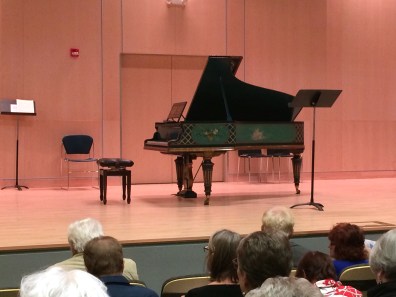
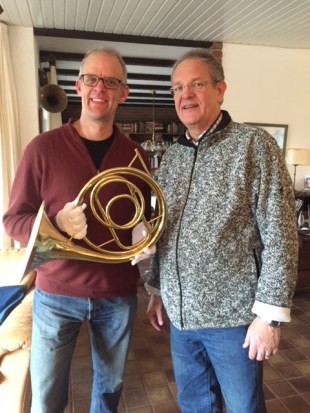
The performance brought together three players: violinist and artistic director of the Bach Festival Zachary Carrettin; pianist Mina Gajic, the festival’s director of education and outreach; and guest artist Thomas Jöstlein playing horn. More crucially, it brought together three instruments that were perfect partners: A violin strung with 19th-century style strings, including pure gut; an 1895 Érard piano; and a natural horn (without valves), made in about 1815. I have never heard a better balanced performance with such disparate instruments.

Erard@Stewart

1895 Érard piano onstage at Stewart Auditorium

The Érard, a beautiful example of the piano maker’s craft in the 19th century, was a critical ingredient. With its remarkably transparent, clear and nuanced sound, it paired with the other instrument as no modern piano could. Gajic could play with full commitment and never overwhelm the other players.

Jöstlein’s natural horn was equally critical to the success of the performance. Its smaller bore and restrained sound never overwhelmed the violin, its closest partner throughout the piece, as a modern large-bore horn, built for a big sound and the ability to cut through a modern orchestra, would do.

Both the piano and the horn brought another quality that we have lost: a sound that varies from register to register, or, in the case of the horn, from note to note. Brahms made expressive use of these differences. As Jöstlein demonstrated before the performance, the sound of the horn could be bright and clear in one phrase, muted and distant in another. And one thing you almost never hear today: the natural horn, which changes pitch by the player moving his hand inside the bell, added a snarling quality to some of the crashing chords that could be suddenly resolved into a clear and pure sound.

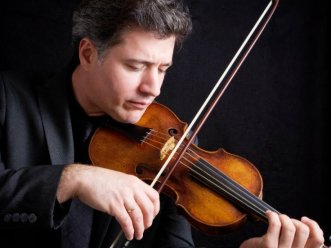
zacharycarrettin

Zachary Carrettin

The differences in sound for Carrettin’s violin were less dramatic, but his choice of natural gut for some strings, steel for the highest string, and wound gut for the lowest, gave the instrument a sound that matched the others.

A fourth partner was the space where the music was performed, the intimate Stewart Auditorium of the Longmont Museum. In an interview before the concert, Carrettin had stressed the importance of the hall: “Stewart Auditorium . . . is a 250-seat hall. It’s very much a salon setting, so we don’t have to worry about projecting to a 3,000 seat house. That has in it an authenticity in the way that we can craft the interpretation.”

Gajic

Mina Gajić

The combination of a space where everyone felt in close contact with the performers, and instruments that were perfectly matched freed the performers to play with complete commitment. No punches needed to be pulled, no climaxes pushed too hard, no passages held back in the name of balance. I have rarely heard such excitement as Gajic, Carrettin and Jöstlein generated in the last movement.

The Stewart Auditorium crowd—totally sold out with seats added onstage—gave a standing ovation that went well beyond the expected, dutiful “standing o” we get with too much regularity. They knew they had heard something special, and they reacted in a way we do not usually associate with “original instruments” or “historically accurate” performances. They had heard the door opened into an unfamiliar sound world, and they were captivated.

The short program, played without intermission, had opened with Carrettin and Gajic playing a 19th-century arrangement of Bach’s much-loved “Air on the G String.” As Carrettin explained beforehand, violinists at the time were starting to play with continuous vibrato and used far more portamento, or sliding glissandos, than we are accustomed to hearing.

The performance was fascinating, although not to the taste I developed through mid-20th-century training and listening. As the great violinist Fritz Kreisler said appreciatively of that style of playing, it gave melancholy to the music. That’s not the spirit of the original Bach, but it is the spirit of the late 19th century and Carrettin played with passion. I would not have missed the experience.

Amanda Balestrieri

Amanda Balestrieri

The remainder of the concert was filled with one Bach aria and three Brahms songs, eloquently rendered by soprano Amanda Balestrieri and Gajic (plus Carrettin on the Bach). Balestrieri’s bright, clear sound was ideal for the well controlled filigree of the Bach aria. The Brahms was sung with exemplary expression of the text, and only the slightest push to the highest notes. The lyrical songs formed a lovely companion to the more intense Horn Trio.

As this concert shows, Boulder County now has such musical riches that revelation can strike in almost any concert. This may be a golden age. If you have any interest in classical music, don’t let it pass you by.

Boulder Bach Festival will remove the veil from Romanticism

In Longmont, J.S. Bach shares the program with Brahms songs and Horn Trio

By Peter Alexander

zacharycarrettin

Zachary Carrettin

Zachary Carrettin, artistic director of the Boulder Bach Festival, has an apparently inexhaustible supply of surprises.

He and the festival have offered Bach in many different guises—on historical instruments, on traditional modern instruments with a full-sized symphony, on electronic instruments—always revealing new discoveries. And now they are heading down one of the most well traveled paths in the concert repertoire, the music of Romanticism.

You might think that era would not hold many surprises today, but the festival’s next concert—5 p.m. Sunday, May 15, in the Stewart Auditorium of the Longmont Museum (tickets)—promises to present “Romanticism Unveiled.” The program features the Horn Trio in E-flat of Johannes Brahms played on historical—that is, Romantic-era—instruments, as well as a familiar piece by Bach in a late-19th-century arrangement, and several Brahms songs.

Performers will be Carrettin, playing a modern violin but with types of strings that would have been used in Brahms’s lifetime; pianist Mina Gajic playing her straight-strung 1895 Érard piano; horn player Thomas Jöstlein playing a 19th-century natural horn; and soprano Amanda Balestrieri applying what is known of 19th-century vocal style.

The Brahms Horn Trio is a fairly well known work, but as Carrettin explains, today it is usually played on modern instruments, including a valved horn and a grand piano. “There is content in this music that is revealed when it is played on the instruments of the time,” he says. “So we are unveiling some of the colors, and some of the meaning in the music that is different when played on the original instruments.”

Carrettin admits that the modern instrument are technologically advanced, and in some ways easier to play than older versions of the same instruments. At the same time, though, the older instruments reveal aspects of the music that modern instruments may conceal—or veil from view.

“When you open the can of worms with period instruments, you have to explore different techniques, different intonation, different balance, and also (different) phrasing,” he says. “The instruments teach you how they want to be played. Certain things are possible and other things are more difficult.”

old interior

1895 Érard piano

Gajic’s Érard piano was made in Paris in 1895. It is straight strung, meaning that the strings all run parallel, which creates a different sound from the modern cross-strung grand piano. The Érard is clearer than the modern piano, and each register has its own sound. (Read my earlier description of this piano here.)

Carrettin will play his modern violin, which is essentially the same as the violins of Brahms’s era, but with strings that reflect 19th-century practice. “I’m using a combination of gut, wound gut and steel strings,” he says. “I’ll have (natural) gut wound in silver on the G, and I’m still playing with all other options. Typically for this kind of setup my two middle strings are pure gut, not wound, (with a steel E string).”

Another issue you may not have thought of is the use of a chin rest. In the Baroque and early classical era, violinists did not have chin rests, but during Brahms’s lifetime chin rests were in wide use. “One day I practice with no chin rest, which gives the violin a rounder, darker sound. The next day I practice with the chin rest which gives the violin more focus,” Carrettin says. The decision to use the chin rest will depend on how the violin sounds with the other instruments.

Jostlein

Thomas Jöstlein (l) with his 1815 natural horn and Ab Koster (r), the German horn player from whom he purchased the horn

The third member of the trio, Jöstlein, will be playing a natural horn, without valves. Even though the valved horn that we know today had been invented during Brahms’s lifetime, it was not the composer’s first choice. “He played (natural horn) as a child and always preferred it over the pistons and valves,” Carrettin says. “He wrote all four symphonies with the natural horn in mind.”

As principal horn of the St. Louis Symphony, Jöstlein has plenty of experience on the modern instruments, but he also owns and performs widely on natural horns from the 18th and 19th centuries. For “Romanticism Unveiled,” he will play a horn from about 1815 that he purchased in Europe.

Other works on the program will include a 19th-century arrangement of Bach’s “Air on the G string” for violin and piano. “We’ve talked so much in our concerts about electric violins and Baroque violins and Steinway pianos and harpsichords,” Carrettin says. “We typically have modern instruments and Baroque instruments, but this is the first time the Bach Festival has played Bach on 19th-century Romantic instruments with a style influenced by research on Romantic chamber music style.”

Amanda Balastrieri

Amanda Balestrieri

To fill out the Romantic program, Balestrieri will sing an aria from Bach’s cantata BWV 196 and three Brahms songs with piano. “Amanda is the perfect artist for this program,” Carrettin says. “She has spent her career performing with period and modern instruments and in a variety of historically informed styles.”

He is particularly pleased to be performing music from the 19th century in a smaller facility. “We’re performing in the beautiful Stewart Auditorium of the Longmont Museum,” he says. “It’s a 250-seat hall. It’s very much a salon setting, so we don’t have to worry about projecting to a 3,000 seat house. That has in it an authenticity in the way that we can craft the interpretation.”

It all adds up to an unusual opportunity for local audiences, Carrettin says. “It’s a rare thing to hear Romantic period chamber music on original instruments in this part of the country,” he says.

# # # # #

IMG_0993

Stewart Auditorium in the Longmont Museum

“Romanticism Unveiled”
Boulder Bach Festival

Zachary Carrettin, violin
Mina Gajic, piano (Érard, 1895)
Thomas Jöstlein, natural horn
Amanda Balestrieri, soprano

Program includes several short selections by J.S. Bach, Lieder by Brahms, and the Brahms Horn Trio in E-flat major, op. 40, performed on Romantic-era instruments

5 p.m. Sunday, May 15
Stewart Auditorium at the Longmont Museum, Longmont

Tickets

5/12/16 Edited for grammar

Boulder Chorale Brings Brubeck Mass to Colorado

Hope and celebration mark the end of 50th-anniversary season

By Peter Alexander

Dec-2014-BC-adults

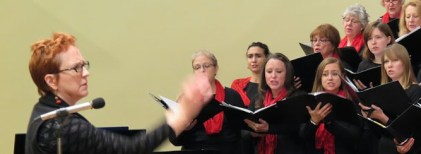
Boulder Chorale

The Boulder Chorale will close its 50th-anniversary season this weekend with hope and a celebration.

To be more precise, the Chorale and artistic director Vicki Burrichter will close the season with the first Colorado performance of “To Hope—A Celebration,” a setting of portions of the Catholic Mass by Dave Brubeck as arranged by Adam Waite. Performances will be at 7:30 p.m. Friday, May 13, and 4 p.m. Sunday, May 15, at First United Methodist Church in Boulder (tickets).

Nickydrake_jofoke_nashville10-e1454195745104

JoFoKe

Joining the chorale for the Brubeck performance will be vocalist Joslyn “JoFoKe” Ford-Keel and a jazz quintet featuring Waite on piano, bassist Ken Walker, and other local jazz musicians. The remainder of the program, forming the first half of the concert, will be music of the African Diaspora sung by the full Chorale and the 24-voice Chamber Chorale.

Saying they are performing Brubeck’s Mass is actually a tricky statement for anyone to make. Brubeck wrote the piece for orchestra and chorus, but he performed and recorded it with his own quartet performing alongside the orchestra. As Burrichter explains, “When I got the score, it did not have the jazz combo that the recording does. I said, ‘Where are the combo parts?’ and (the publisher) said, ‘Well, they’re not available.’”

dave-brubeck-08

Dave Brubeck

With or without the combo, the orchestral version posed several problems: “It’s a really odd orchestra with unusual instrumentation, and it’s difficult to find a space in Boulder where we could do that,” Burrichter says. “And I really liked the whole jazz combo feel. To me, that was the whole point of the piece.”

She found a version on YouTube with jazz quintet—piano, bass, drums, trumpet and trombone. She tracked down the arranger of that version, who was Adam Waite. She contacted him by email and he replied that he had just taken a job as director of music at Montview Presbyterian in Denver and would be moving to Colorado in two months.

adam-waite-headshot

Adam Waite

“I said ‘You’ve got to be kidding me!’” Burrichter recalls. “Talk about fate or something!

“That’s how we found it, and Adam will play and work with the band. I’m very excited because it’s the first time it’s been done in Colorado in this setting.”

Another complication in performing the piece is how much of what Brubeck wrote to perform. According to Burrichter, not all of the movements are suitable for a jazz combo arrangement. Besides, she says, “Brubeck says very clearly that he wants people to change it if it’s for a concert setting as opposed to a church setting, and he gives his thoughts on how to do that.

“We left out four or five of (Brubeck’s original) movements. How Waite described it to me is, we’re leaving out the parts that are aimed more at a church service instead of a concert setting. Because we’re not offering mass, we’re leaving out some.”

holiday-2015-photo-by-bob-evans

Burrichter with Boulder Chorale. Photo by BobEvans

As Burrichter describes the movements included on the program, “We’re doing a processional, which is a great opening. Then the cantor and choir sing ‘Lord Have Mercy’—the Kyrie (of the Catholic Mass)—then the soloist does ‘In the Desert and the Parched Land,’ which leads into ‘The Peace of Jerusalem.’ That sounds very middle eastern (with) a great drum background.”

Among the familiar movements of the mass that are omitted is the Gloria. “Instead we’re doing an Alleluia that’s in 5/4 time, so it’s wonderfully disjointed,” Burrichter says. “Then ‘Through Him, With Him,’ leading to a great Amen, the Doxology, ‘The Lamb of God’ (Agnus Dei) and then the last movement, ‘All my Hope,’ which is a gospel piece. It builds to a big climax with lots of improvisation and the choir functioning as a big band in the background. It’s a really exciting way to end it.”

Before intermission, Burrichter and the chorale will perform music from the African Diaspora in America, starting with the spirituals “My Lord, What a Mornin’” and “Elijah Rock” as arranged by Moses Hogan. A smaller group out of the full chorale, the Chamber Chorale, will perform music by Mary Lou Williams.

Mary_Lou_Williams_(Gottlieb_09231)

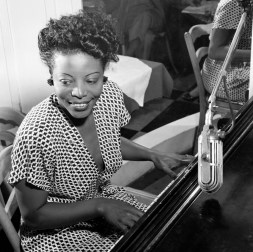
Mary Lou Williams

A prolific jazz composer and pianist who wrote for Ellington, Williams later taught some of the jazz players of the next generation, including Charlie Parker, Dizzy Gillespie and Miles Davis. The Chamber Chorale will sing two pieces from “Mary Lou’s Mass,” which in 1964 became the first jazz mass performed in the Catholic Church.

Rounding out this segment of the concert will be “Orange Colored Sky,” a jazz standard that was first popularized by Nat King Cole, and “Total Praise.” “I just wanted to touch a little bit on the African-American traditions, starting with the earliest forms,” Burrichter says.

“To me, (the music on the program) is all basically the same—it’s music of the African Diaspora. Sure, Dave Brubeck was a Caucasian guy, but he was immersed in America’s classical music, which is jazz.

“This concert is an opportunity to hear something that’s never been done here. It’s fun and moving, and it’s a great chance to have a really exciting night and hear some of the best jazz players in the state.”

# # # # #

To Hope! A Celebration—The Boulder Chorale’s Next 50 Years
Boulder Chorale, Vicki Burrichter, artistic director and conductor
With Joslyn “JoFoKe” Ford-Keel
Adam Waite, piano, and jazz quintet

7:30 p.m. Friday, May 13
4 p.m. Sunday, May 15
First United Methodist Church, 1421 Spruce St., Boulder

Tickets

Edited 5/7/16 to correct the title of “Total Praise” and clean up syntax in two quotes.

At Minnesota Opera, “The Shining” dazzles

World premiere of Paul Moravec’s opera promises future success

By Peter Alexander

The Saturday (May 7) premiere of The Shining by Paul Moravec at the Minnesota Opera was clear evidence of the vigor of contemporary opera in America.
13173843_10153765505072979_4910527002593047546_n

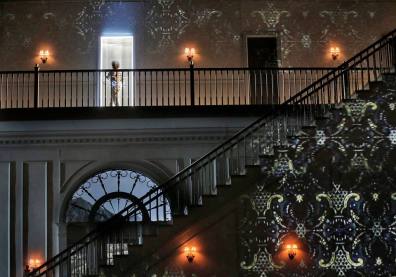
The Shining by Paul Moravec. All photos by Ken Howard for the Minnesota Opera

The opera, based on the Stephen King novel (but resolutely not on the Stanley Kubrick film), has sold out its opening run of four performances. It is a solid piece of work, dramatically effective, musically successful, and destined to be popular. And in the hands of the team from the Minnesota Opera—conductor Michael Christie, stage director Eric Simonson, scenery and properties designer Erhard Rom, the craftsmen of 59 Productions and their many colleagues—The Shining received a stunning production that realized the full potential of the score. The cast was uniformly first rate. At the end, the sold-out Ordway Music Theater audience stood and cheered.
13151477_10153761432822979_8358473026070436581_n

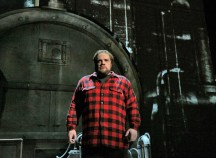
Brian Mulligan as Jack Torrance, with the massive boiler

If you don’t know the story, Jack Torrance, a writer, has taken a job as winter caretaker of the isolated Overlook Hotel (loosely inspired by Estes Park’s Stanley Hotel), a seemingly elegant relic that turns out to be haunted. Jack brings his wife, Wendy, and young son, Danny, with him. Jack and Wendy are hoping to restore their damaged marriage, but under the sway of the hotel and its ghosts, the already fragile Jack turns violent.

Librettist Mark Campbell has done an effective job of reducing King’s 400+ page novel into a two-hour opera. The essential elements of King’s tale are present: the evil spirits that control the hotel, the temperamental boiler that threatens to blow the place to bits, the smothering snow that creates a barrier from rescue, the child with second sight (or the “shining” of the work’s title), and his hair-triggered father’s troubling past. It’s a lot to get into a compact libretto, but Campbell has managed to keep the spirit of the original while necessarily cutting some elements (including several of the haunted rooms, the topiary animals standing guard and the malevolent wasps).
13179410_10153765506357979_1954666156422704678_n

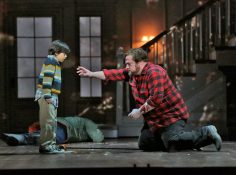
Alejandro Vega as Danny and Brian Mulligan as Jack

There is one significant change that King’s fans will notice, and it is not an improvement. At the end of the novel, Danny confronts his father fearlessly, because he knows something that Jack has forgotten: the boiler, which is close to blowing. When Danny reminds him of this, Jack rushes to the basement, leaving only enough time for the three survivors to escape. In other words, the Overlook has completely taken over Jack, who becomes a tragic figure brought down by his own weakness.
13151382_10153761433622979_8768870567870682339_n

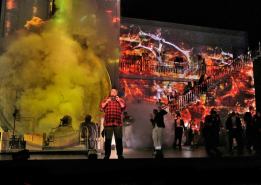
Brian Mulligan as Jack, surrounded by evil spirits just before the boiler destroys the Overlook Hotel

In the opera, Jack allows Danny to go, and when the hotel’s spirits remind him of the boiler, he defies them and decides not to relieve the built-up pressure so that his family can escape. When he chooses to die in the resultant explosion, the story becomes a more conventional one of Jack’s redemption, a point made clear in the staging. In King’s bleaker vision, there is no such redemption.

Moravec has set this tale with accessible, expressive music. The text can be clearly understood, thanks to both composer and cast, and supertitles are often not needed. There are moments of affecting lyrical beauty, particularly the moving (if predictable) final aria by Halloran, the resort’s cook and the story’s rescuer, who reassures Danny that “You’re doing fine by yourself . . . Just fine.” Other major characters—Jack, Wendy, and the spectral figure of Jack’s brutal father—all have expressive music. If the ghostly chorus of evil spirits sounds a little too real, that is a consequence of portraying incorporeal beings with corporeal actors.
13178017_10153765506462979_5945586431432079112_n

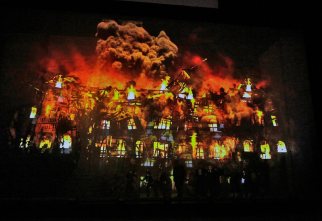
The exploding Overlook Hotel

The horror genre is of course a well worked musical field, through opera and especially film. It is probably inevitable that Moravec incorporated some familiar clichés to represent menace, the sinister noises of malevolent spirits, ghostly voices and the ratcheting up of suspense, but it is a testament to his skill as a composer that these clichés are elevated by his score.

The orchestral writing is especially outstanding. The orchestra supports but never obscures the vocal lines. Sounds from the orchestra fit the text and mood, and the final powerful cataclysm is one of the most effective moments of musical pictorialism I can recall. That orchestral explosion and the subsequent relaxation into the comfortable and comforting music of the final scene make a satisfying ending.
13124956_10153765506557979_586500643969602035_n

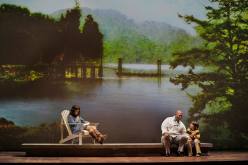
Kelly Kaduce, Arthur Woodley and Alejandro Vega in the final scene

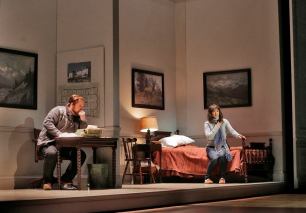
Minnesota Opera’s production is a dazzling tour de force. The beautiful projections that place the actors on a mountain road and beside a peaceful lake are impressive enough, but even more impressive are the scenes in the hotel, with a combination of atmospheric projections that heighten the mood and sliding units that shift (almost) seamlessly from room to room, with only the occasional “thump” to remind us of the stage machinery. Kudos to the designers and 59 Productions for the magic. The hulking boiler and its spectacular destruction of the hotel deserve special notice.

Of the singers, Arthur Woodley is magisterial as Halloran. The hearty cheers he received were well deserved: his robust baritone filled the hall and captured the brief scenes where he appears, at beginning and end.
13178841_10153761432417979_7664365553339574570_n

Brian Mulligan as Jack and Kelly Kaduce as Wendy

As Jack, Brian Mulligan added physical menace to a steel-cored voice. If his rapid swings early in the opera between loving family man and brutal tyrant seemed too precipitous, they were indeed frightening, as they should be. His deterioration in the second act was especially effective, as the Overlook asserts control and less and less of Jack is left. The power of the performance comes from growing intensity of his interpretation rather than any specific musical numbers along the way.

Kelly Kaduce, who sang Wendy Torrance, is deservedly a Minnesota Opera favorite. She sang with expression and beauty of sound, but her role stays long in a limited emotional range, mostly expressing fear of her husband and comfort for her son. Her aria at the beginning, “I never stopped loving you” helps suggest a warmer relationship with Jack, but in that one moment the music doesn’t quite rise to the needs of the text.

It would be remiss not to observe that the teasing and sexy moments between Jack and Wendy are well written, and that both text and actors captured well the mood of King’s novel. In the pared down, two-hour stage presentation they seem too ephemeral, as if squeezed in for relief; expansion of those moments, musically or dramatically, could restore the balance found in the novel’s more thorough back story.
13096261_10153761432437979_1411098242275429888_n

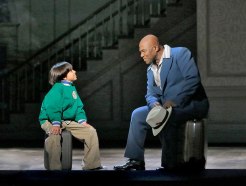
Alejandro Vega (Danny) and Arthur Woodley (Halloran)


Alejandro Vega, the 10-year-old who brings Danny movingly to life, shows great talent. His assurance and the authenticity of his emotional reactions to the story reveal a natural actor, but also one who is skillfully trained and directed in the role. He was on stage for much of the performance, and he was fully the equal of the adults with whom he shared the stage. For later productions this will be a make-or-break role. Vega definitely made it.

Minnesota Opera has put together an able ensemble cast for the other roles as well. Mark Walters as Jack’s father who reaches from beyond the grave to drive his son toward murder; David Walton as the seductive former caretaker and multi-murderer Delbert Grady; Robb Asklof as haughty hotel manager Stuart Ullman; Alex Ritchie as the hotel’s depraved founder Horace Derwent: all were scarily effective.

13124879_10153765505342979_5349882607679914159_n

Wendy, Danny and Jack surrounded by ghosts and ghouls

Christie led the Minnesota Opera’s excellent orchestra with care and sensitivity to the singers. I could not find a serious flaw in the balance, and—considering I had not heard the piece before—the pacing seemed just right. We in Boulder, and now audiences in Minnesota, know that his is an important career.

I have no doubt that The Shining will go on to other productions, especially in the United States where Stephen King’s works loom so large in the popular culture. Many more audiences will stand and cheer.

# # # # #

Minnesota Opera has become one of the most ardent and consistent supporters of new opera in the country. When you consider the record of some of the financially larger companies, their record of world premieres in four of the last five seasons (Kevin Puts, Silent Night, 2011; Douglas J. Cuomo, Doubt, 2013; Kevin Puts, Manchurian Candidate, 2015; and Paul Moravec, The Shining, 2016) puts them in a league with the adventurous Santa Fe Opera and few other professional companies.

And they have announced another premiere next season, Dinner at Eight by William Bolcom, based on the play by George S. Kaufman and Edna Ferber (March 11, 16, 18 and 19, 2017; you may see the entire, enticing season here.) I find it particularly exciting that our own American culture is being mined for operatic subjects, much as European opera has mined their shared culture for generations. This is certainly one of the reasons that contemporary opera is growing in popularity. There is more evidence than The Shining of American opera’s vigor today.