2017: The Year in Classical Music

Some outstanding concerts, and some changes of leadership in Boulder

By Peter Alexander

With the year drawing to a close, it is time to look back at 2017. It has been a tumultuous year in many realms, including some aspects of Classical music. But before that, it is good to remember the outstanding musical experiences of 2017 here in the Boulder area.

Pro Musica

The year began on an expressive high point when Pro Musical Colorado Chamber Orchestra, conductor Cynthia Katsarelis and soloists Jennifer Bird-Arvidsson, soprano, and Ashraf Sewailam, bass, presented Shostakovich’s rarely-heard Symphony No. 14.

I wrote at the time: “This somewhat gloomy meditation on death is not often given live, partly because of the difficult assignments facing the soprano and bass soloists, but mostly because of the difficult subject matter. But it is a major statement from a great composer—what Katsarelis calls ‘a piece that needs to be heard’—and so the rare performances are to be treasured.”

The February visit of Deborah (Call Me Debbie) Voigt to Macky Auditorium will be a cherished memory for fans of the classical voice. Voigt Lessons, the superstar soprano’s candid retelling of her struggles with relationships, substances, and weight that clouded her career not only showed some realities of life at the top of the opera world, it also revealed the very human person beneath the superstar image. For both reasons, this was a meaningful event.

Takasce SQ

Takacs Quartet

The Takacs Quartet always provides some of the year’s best performances. It’s hard to chose just one, but for 2017 I would single out their February concert including Beethoven’s Quartet in G major, op. 18 no. 2—performed while the Takacs was in the midst of a full Beethoven cycle at several venues—and CU music faculty Daniel Silver, clarinet, playing the Brahms Quintet in B minor, op. 115. An especially beautiful rendering of this beautiful work had at least one audience member in tears by the end.

March saw the arrival of another superstar in Boulder when Sir James Galway played at Macky Auditorium, and the departure of an important member of Boulder’s classical music community when Evanne Browne gave her farewell concert with Seicento Baroque Ensemble, the organization she founded in 2011.

BPhil.onstage

Boulder Phil at Kennedy Center

One of the biggest events of the year for Boulder performing arts was the visit in March of the Boulder Philharmonic Orchestra, conductor Michael Butterman and Frequent Flyers Aerial Dance Company to the Kennedy Center in Washington, D.C., for the first annual Shift Festival of American Orchestras. The Phil repeated a concert they had given in Boulder a few days earlier, including the world premiere of All the Songs that Nature Sings by Stephen Lias and Copland’s Appalachian Spring, performed with Frequent Flyers.

An audience favorite of the festival, the Boulder Phil played to a sold out house. Butterman wrote the next day, “It was a peak experience for me, and, I think, for all of us at the Phil. . . . To be there with our orchestra, with that crowd and with that repertoire—it was something I shall never forget. We had a great sense of pride in representing our hometown.”

Several important changes of personnel were announced for Boulder classical scene in the spring. In April, Jean-Marie Zeitouni announced that he was stepping down as music director of the Colorado Music Festival. He will remain with CMF as principal guest conductor, and conductor/violinist Peter Oundjian will serve as artistic advisor for the 2018 season. Later the same month, James Bailey left his position as music curator of the Dairy Arts Center, to be replaced by Sharon Park.

Elliot Moore at Lake McIntosh - credit - Photography Maestro (1)

Elliott Moore

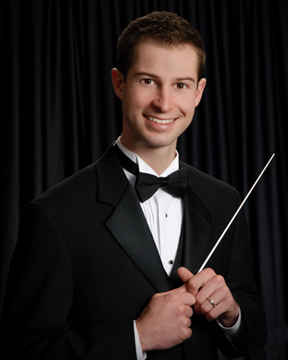
In May, Seicento Baroque Ensemble announced the appointment of Kevin T. Padworksi as artistic director, succeeding Browne, and the Longmont Symphony announced the appointment of Elliot Moore to succeed long-time music director Robert Olson.

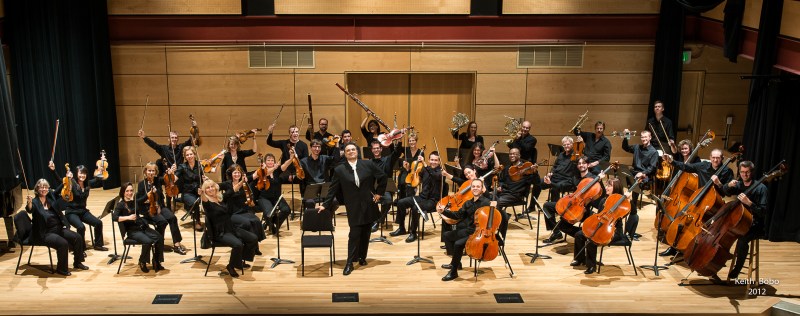
The same month, the Boulder Chamber Orchestra wrapped up its 2016–17 season with its largest performance to date, Beethoven’s Ninth Symphony presented in Macky Auditorium. The performance under conductor Bahman Saless was unfortunately the occasion of a protest by the anti-fracking group East Boulder County United. Seven members of EBCU blew whistles, shouted slogans and left flyers before the concert to voice their opposition to the orchestra having accepted a contribution from Extraction Oil & Gas.

Olga Kern

Olga Kern, photographed by Chris Lee at Steinway Hall.

Zeitouni proved to be anything but a lame duck conductor at the Colorado Music Festival. The 2017 season started at the end of June with an all-Russian program featuring exciting performances of Shostakovich’s Festive Overture and Rachmaninoff’s Second Symphony. On the same concert, one of Boulder’s favorite guest artists, pianist Olga Kern, gave scintillating performances of Prokofiev’s First Piano Concerto and Rachmaninoff’s Rhapsody on a Theme of Paganini.

Other high points over the summer included the return of CMF’s founding director Giora Bernstein to lead a concert of Mozart, Zeitouni conducting Beethoven’s Ninth as the CMF centerpiece, and the visit of violinist Gil Shaham at the end of the summer season. Up in the mountains, Central City Opera’s Downton-Abbey-inspired Victorian-era production of Mozart’s Così fan tutte was one of the year’s highlights for opera lovers.

Another delight for the opera crowd came in the fall, with the CU Eklund Opera Program’s serio-comic production of Lehar’s Merry Widow. In November, Saless and the Boulder Chamber Orchestra returned to its core repertoire with a lively concert featuring two youthful works for smaller ensemble: the Concerto for piano, violin and strings by the 14-year-old Mendelssohn, with violinist Zachary Carrettin and pianist Mina Gajić, and Janáček’s Idyll for Strings.

Zachary & Mina

Carrettin and Gajic

Carrettin and Gajić were featured performers in December when the Boulder Bach Festival gave one of its most intriguing and adventurous concerts in its increasingly adventurous schedule. With guest artist Richie Hawley, the program offered insight into the instruments and performance practices of the early 20th century, performed on Hawley’s 1919 Buffet clarinet, Gajić’s 1895 Érard piano, and Carrettin’s violin set up with strings typical of the period.


# # # # #

For the classical music world outside of Boulder, the biggest news was certainly the intrusion of a long-overdue reckoning for sexual misconduct that is going on in our society generally. The first bombshell, not unexpected by people in the business but a bombshell nonetheless, landed Dec. 3 with the suspension of conductor James Levine from the Metropolitan Opera and other organizations, including the Boston Symphony and the Ravinia Festival. Accusations against Charles Dutoit, artistic director and principal conductor of the Royal Philharmonic Orchestra in London, surfaced later in the month.

levine

James Levine

Both conductors are in the twilight of long careers. Rumors about Levine have been widely known in the classical music world; indeed I first heard them in the 1980s. Every music journalist I know has heard the same stories, but so far as I am aware, no one who experienced Levine’s assaults was previously willing to speak publicly. In the case of Dutoit, I had not heard the rumors, but I do know one of the women who spoke publicly about what happened to her, and I believe her unquestioningly.

As the controversy has swirled about the subject of sexual abuse, harassment and assault in classical music, several critics have written powerfully about the subject: Anne Midgette of the Washington Post, Jennifer Johnson of the Guardian, Andrew Riddles of Classical Ottawa to name three. Singer Susanne Mentzer has written about her personal experiences in the opera world for the Huffington Post, as has Dan Kempson for Medium.

There are certain to be more revelations. One major journalist has more first-hand information, with names including some of the of the most famous classical artists, and is preparing an article. I have no doubt that several men are nervously awaiting that story, or some other revelation that reveals past misdeeds.

Will this tidal wave reach Boulder?

It’s hard to say with certainty. I have spoken with many on the classical scene here, and the only rumor I have heard, from several sources, has been of inappropriate comments and behavior by one person, none of which reached the level of abuse or assault. “He might not have been hired today,” one person speculated, but as so often happens, the people who heard the comments preferred not to make an issue of it.

Another person told me he had never heard any rumor from the College of Music, so Boulder may escape the worst of this necessary but unhappy process. In the meantime, it is my wish for 2018 that society in general and the music world specifically create a safe environment, where powerful men do not feel free to behave like adolescent boys.

___________

Edited for clarity 12.31.17
LIVESTREAM: You can see Jake Heggie’s opera that was workshopped at CU

It’s a Wonderful Life available Friday–Saturday, Nov. 10–11, from Indiana University

By Peter Alexander

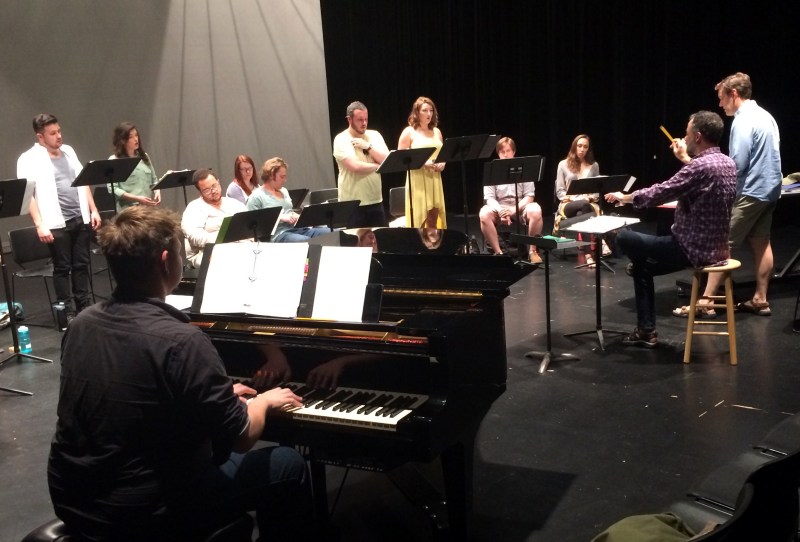
It’s a Wonderful Life, the opera by Jake Heggie and librettist Gene Scheer based on the beloved film of the same title, was workshopped in Boulder as part of the CU New Opera Workshop (CU NOW) in June, 2016. The world premiere followed at the Houston Grand Opera.

IMG_0441

CU NOW workshop of Jake Heggie’s “It’s a Wonderful Life,” June 2016. Heggie is at the far right, in blue. Photo by Peter Alexander

Now Boulder audiences will be able to see that original production, in a revised version of the score, through livestreaming from the Jacobs School of Music at Indiana University. Performances will be available live at 5:30 p.m. Mountain Time (7:30 p.m. EST), Friday and Saturday, Nov. 10 and 11. The performances will be streamed from the Musical Arts Center on the IU campus in Bloomington.

All live streams and archived performances from the Jacobs School of Music are available here.

31830526994_2139d9ce8d_z

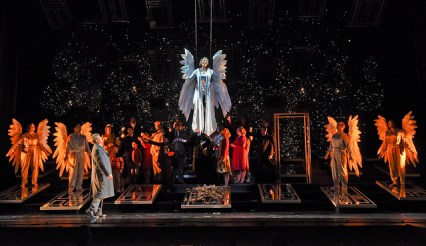
Houston Grand Opera production of “It’s a Wonderful Life.” Photo by Brian Mitchell.

It’s a Wonderful Life was commissioned by Houston Grand Opera, with the Jacobs School of Music and the San Francisco Opera, all of whom will share the original production. The world premiere was in Houston Dec. 2, 2016. Indiana performances will be Nov. 10, 11, 16 and 17, with the first two streamed live.

31830522644_92a7ae93c8_z

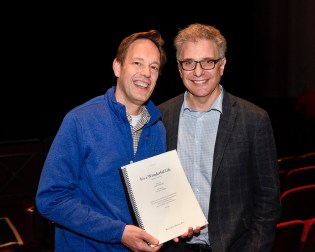
Jake Heggie (left) with librettist Gene Scheer. Photo by Brian Mitchell.

The San Francisco Opera will present It’s a Wonderful Life during the 2018–19 season. After that, the next scheduled performances, and the first new production will be presented in Boulder by the CU Eklund Opera program in 2019.

Since the Houston opening, Heggie and Scheer have made a number of revisions to the opera. Heggie is currently in Bloomington observing rehearsals, to make sure that the changes work well on stage.

“The spots where it needed revision seemed very clear to me and to Gene, once we saw the production [in Houston],” Heggie says. “We cut a lot of material but we also rewrote, and I added new material where it was needed.”

Compared to the version performed in Houston and the workshop performances in Boulder, there are some major changes. “The whole prologue is cut way down so we get right into the story,” Heggie says. “We’ve tightened things up to make sure that we’re always telling the story.”

32673289055_9f5cedec9c_z

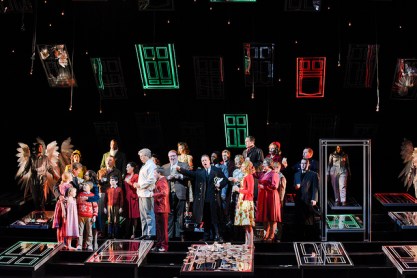
Houston Grand Opera production of “It’s a Wonderful Life.” Photo by Brian Mitchell.

Heggie has also written some new material. “I expanded two arias, one for George and one for Mary in Act I that really help them open their hearts, and then I’ve added a beautiful—I think—duet between Mary Bailey and Claire the angel in Act II,” he says.

While Heggie has made revisions in earlier operas, he says these are the most extensive changes he’s ever made. “We cut an entire character—Mr. Gower, the pharmacist,” he explains. “We realized that we actually didn’t miss anything. We got all of the information we needed elsewhere, and the thing is that in opera you’ve got to move things along so that there’s time for the music to tell the story.”

The result of all these changes is that the opera has been tightened to a total running time of less than two hours. Heggie expects that these will be the last changes he will make, meaning that the version livestreamed from Bloomington will be the same for both San Francisco and the CU production. “My hope is that we’re really set after IU, and that we don’t have to do any more tinkering or trimming,” he says.

Indiana University’s other performances online

The Jacobs School of Music livestreaming site is a broad resource for classical music audiences, and especially opera fans. The school has a long and distinguished history of high-quality opera productions and other performances, dating back more than 50 years. Past opera productions and concert performances of both classical music and jazz from the Jacobs School of Music are available on demand.

musical-arts-center

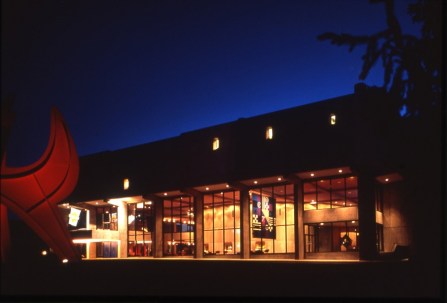
The Musical Arts Center at Indiana University, the venue for the Jacobs School of Music Opera Theater performances.

All but the very oldest of the archived opera streams include subtitles throughout. According to Philip Ponella, the Leonard Phillips and Mary Wennerstrom Director of the William and Gayle Cook Music Library at IU and director of Music Information Technology for the Jacobs School of Music, performances are generally archived if copyright restrictions allow, and left on the site for as long as practical. The project is still being developed, and policies may change.

The current site has performances archived, available on demand, from the past eight seasons. Opera performances on the site include standard repertoire, including Don Giovanni, Carmen and La Bohéme; less familiar rarities including Puccini’s La Rondine and L’Étoile by Emmanuel Chabrier; new works including The Tale of Lady Th Kính by P.Q. Phan; and several operas by Handel.

Phil.Ponella

Philip Ponella

Ponella says that it is important for the school to provide public access to their performances, and they encourage access to their streams from around the country. “First of all, many of us are concerned about the future of classical music and opera and the kind of things that we do here,” Ponella says. “One thing [Jacobs School of Music] Dean Gwyn Richards says that resonates with many of us is, how can we be more relevant to more people.

“The other part is, we like to think that this is one of the best music schools in the United States, and when you’re not located in New York or Boston or Los Angeles, sometimes that’s a hard sell. This gives us the opportunity to walk the walk, and not just say this is a really great school.”

Ponella points out that the livestreamed performances also include a pre-performance presentation given by a musicology Ph.D. student in the school, presented 30 minutes before the livestream is scheduled to start. “As Dean Richards says, whenever we can, we show that we’re not just about performance but our academics are of equal quality. And the fact that we stream at this high level of quality points to the kind of institutional resources that we’re drawing upon as well.

“We’ve got a very large pipe out to the internet that many institutions don’t have access to, and (we have a) recording arts program and audio engineers.”

Classical Music Livestreamed from Indiana, Boulder, and around the World

IU is only one source of livestreamed performances available from around the world. In addition to the performances from the Jacobs School of Music, in Boulder faculty Tuesdays and other performances from the CU College of Music are available online.

{89e5dc98-e755-b0b6-fe1e-05ed1e350ccf}

Bavarian State Opera in Munich.

Opera is available from many different sources, mostly by subscription but with occasional free performances. Livestreaming from individual companies include the Metropolitan Opera, The Vienna State Opera, and the Bavarian State Opera in Munich . There are also sites that bring operas from many different companies, such as OperaVision with productions from several European countries. A careful Google search will turn up other sites.

With so many different sources of performances that you can watch live from home, wearing your PJs and enjoying a bowl of popcorn or a glass of wine, for the classical music lover it really can be a wonderful life.

I’ll meet you at the computer!

31830518774_71bba62dc1_z

Houston Grand Opera production of “It’s a Wonderful Life.” Photo by Brian Mitchell.

From ‘Bachtoberfest’ to Carnival in Brazil, Boulder’s musicians plan celebrations

Boulder Bach Festival, Boulder Chorale announce 2017–18 seasons

By Peter Alexander

The Boulder Bach Festival and Boulder Chorale have announced their 2017–18 seasons, with globe-trotting celebrations from “Bachtoberfest” to Brazil to Venice.

imageOf the two, the Boulder Bach Festival (BBF) gets underway first with the “Bachtoberfest” at 7:30 p.m. Thursday , Oct. 12 in Boulder’s Seventh Day Adventist Church. The program will be repeated at 7:30 p.m. Saturday, Oct. 14, in Longmont’s Stewart Auditorium.

Stoppelenburg

Soprano Josefien Stoppelenburg

The concert—which actually has nothing to do with beer—will feature four guest soloists: violinist Elizabeth Blumenstock from the faculty of the Juilliard School; Guy Fishman, principal cellist of the Handel-Haydn Society of Boston; Chris Holman, historical keyboardist of the Bach Society in Houston; and Dutch soprano Josefien Stoppelenburg, who has appeared with the BBF several times in the past.

Violinist Zachary Carrettin, artistic director of the BBF will also play on the concert of 18th-century chamber music. The program includes trio sonatas and arias by Handel, Vivaldi, J.S. Bach and Telemann.

A particularly interesting item on the program that continues the BBF’s exploration of historical rarities is listed as a “Keyboard Concerto in G major” by Johann Christian Bach, arranged by Mozart. Known as “The London Bach” for having had a very successful musical career in that city, Johann Christian was the youngest of J.S. Bach’s sons. Mozart visited London while on tour with his family during the years 1763–66, when he was seven to 10 years old. He became friends with Bach, around 30 at the time.

Johann_Christian_Bach_by_Thomas_Gainsborough

Johann Christian Bach, portrait by Thomas Gainsborough

In order to learn how to write concertos, the young Mozart arranged three of Bach’s solo sonatas as concertos by adding passages for orchestra. These arrangements were originally included in Mozart’s works under the listing K107 nos. 1–3; the Concerto in G major is the second of the three. Rarely performed, because they are not strictly “by” either J.C. Bach or Mozart, they are nonetheless fascinating historical documents, revealing the young composer’s learning process.

There are two new scheduling features for BBF’s 2017–18 season: Boulder performances will all be on Thursdays, to avoid conflicts with other performing organizations; and the performances will be split between Boulder’s Seventh-Day Adventist Church and Longmont’s Stewart Auditorium. Some concerts will be presented in both venues, and others only in one or the other.

Erard@Stewart

1895 Érard piano

For example, the second event on the season, a concert titled “A World Transformed,” will only be performed at 7:30 p.m. Saturday, Dec. 9, in the Stewart Auditorium in Longmont. The performance will feature Mina Gajić performing on her 1895 Érard grand piano together with Richie Hawley performing on a 1919 Parisian clarinet and Carrettin playing a  gut-string violin. They will play music of the early 20th century by Bartók, Ives, Berg and Antheil.

Likewise, the major Bach performance of the year will only be presented once, at 7:30 p.m. Thursday, March 15, in Boulder’s Seventh Day Adventist Church. Titled “The Eternal Spirit,” the program comprises four of Bach’s great sacred cantatas. Zachary Carrettin will lead the BBF Chorus and Orchestra with vocal soloists Josefien Stoppelenburg, soprano; Abigail Nims, mezzo-soprano; Derek Chester, tenor; and Ashraf Sewailam, bass-baritone.

SONY DSC

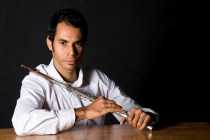
Flutist Ismael Reyes

The final concert of the season will honor the musical heritage of the Basilica of San Marco in Venice, with music by  prominent Venetian Baroque composers: Antonio Lotti, Giovanni Gabrieli, Tarquino Merulo and Antonio Vivaldi. The concert will end the season with one more piece by J.S. Bach, the Orchestral Suite in B minor with Ysmael Reyes playing the flute solos.

You can see the full Boulder Bach Festival season here.

# # # # #

Dec-2014-BC-adults

The Boulder Chorale (BC) opens its 52nd season with “Carnival Brazil,” at 2 and 7:30 p.m. Saturday, Oct. 28, in Boulder’s First United Methodist Church. Titled “All Things Bright and Beautiful,” this will be BC’s ninth season combined with the Boulder Children’s Chorale and the third with artistic director Vicki Burrichter.

Graffiti-Wall-1.2

Ginga

Carnival Brazil (Oct. 28) will see the BC sharing the stage with the Brazilian-music band Ginga and the Bateria Alegria, the percussion ensemble of the Boulder Samba School. That is only the beginning of the collaborative performances in a season that the BC is describing as “an adventurous exploration of different genres.”

The BC will be joined by JAMkeyJAM, a duo of Nepalese musicians who aim to combine ancient traditional music with contemporary sounds, March 10 and 11. The joint program, “Between Heaven and Earth,” will include a performance of Eliza’s Gilkyson’s Requiem, written in response to the 2004 Indian Ocean tsunami.

© Glenn Ross | www.glennrossphoto.com

Vicki Burrichter

Later the same month, the chorale will appear with the Boulder Chamber Orchestra for a performance of Mozart’s Requiem (March 30 in Broomfield and 31 in Boulder), and they will close out the season May 19 and 20 with Duke Ellington’s Sacred Concerts, performed with a jazz combo.


The full Boulder Chorale season, including ticket information and performances by the Boulder Children’s Chorale not mentioned in this article, can be found here.

NOTE: Typos corrected 9.8.17


CU music faculty will appear on a new concert series at the Dairy Center

“CU at the Dairy” opens Sept. 7 with “Miraculous Mozart”

By Peter Alexander

Two of Boulder’s eminent arts organizations have joined together to inaugurate a promising new collaborative music series this fall.

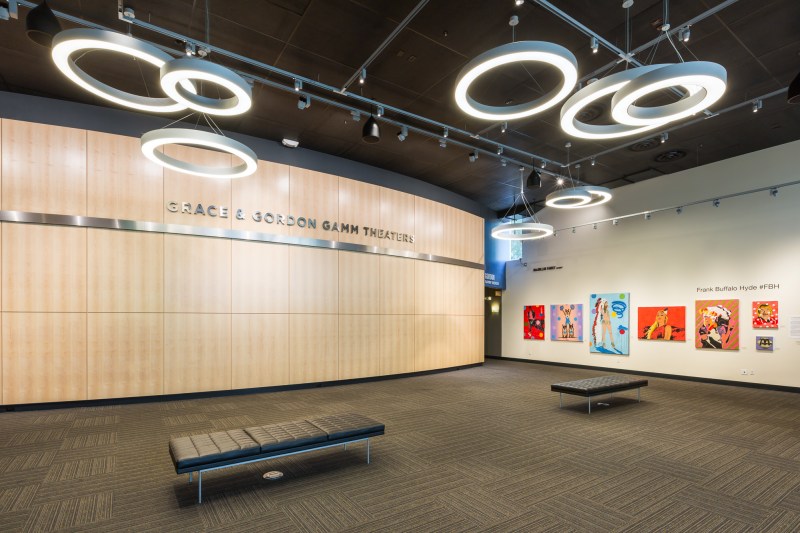
The University of Colorado College of Music and the Dairy Arts Center have announced a series of concerts jointly sponsored by both organizations, to be held during the year in the Dairy’s Grace and Gordon Gamm Theater. “CU at the Dairy,” featuring music faculty members in collaboration with one another and other local artists, will supplement the free Faculty Tuesdays series of recitals in Grusin Hall.

Gamm.Lobby.5-Dairy_Center_for_the_Arts

The lobby of the Grace and Gordon Gamm Theater at the Dairy Arts Center

Based on early listings, the Grusin Hall Faculty Tuesday events will be more traditional recitals, while the CU at the Dairy will be more exploratory, collaborative, and in some cases will be multi-media events. In a news release from Aug. 16, the Dairy’s music curator, Sharon Park, says that the CU faculty “have such great ideas and projects they want to present. The Gordon [Gamm Theater] gives them an intimate venue to pair visual art, silent film, dance or any other art form with music.”

Korevaar

David Korenaar

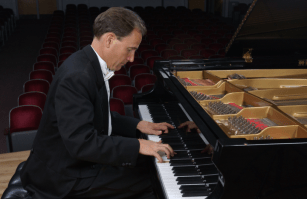
The series gets underway Sept. 7 with “Miraculous Mozart,” featuring Helen and Peter Weil Professor of Piano David Korevaar playing and conducting Mozart’s piano concertos K449 in E-flat major and K450 in B-flat major. The small orchestra for these performances will include violinist Charles Wetherbee from the music faculty along with other faculty and alumni of the College of Music.

Yellow_Ticket_in_Vancouver_2

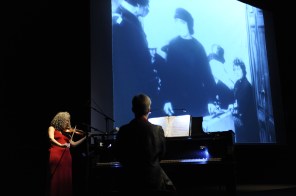
Alicia Svigals performing “The Yellow Ticket” in Vancouver

The following week a multi-media event will bring together representatives of the College of Music, CU’s Program in Jewish Studies and International Film Series. Yonatan Malin, faculty in the music theory area of the College of Music, will host the screening of “The Yellow Ticket” a silent film from 1918. The film, about a young Jewish woman studying medicine in Tsarist Russia, will be accompanied by Klezmer violinist Alicia Svigals and jazz pianist Marilyn Lerner performing Svigals’s original score live. Malin will also moderate a panel discussion with the performers and CU faculty members about film, music and cultural awareness.

“CU at the Dairy” will continue in the spring with a performance by Thompson Jazz Studies director John Gunther and friends. More details about these performances will appear on this Web page and in the pages of Boulder Weekly.

Tickets for all “CU at the Dairy” performances are available through the Dairy Center Box Office.


Elliot Moore is building bridges as director of the Longmont Symphony

First season is about connecting with local institutions—and friendship

By Peter Alexander

The Longmont Symphony Orchestra (LSO) has announced its 2017–18 season, the first under new music director Elliot Moore, and the consistent theme is building connections within the community.

Elliot Moore - credit - Photography Maestro

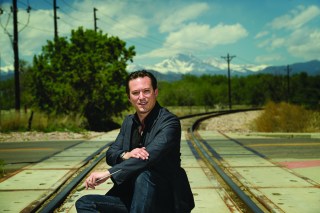
Elliot Moore. Photo by Photography Maestro

That and friendship. The first concert explicitly highlights friendships, and the entire season is filled with performances that developed out of Moore’s professional friendships.

“Building connections is something that I’m really passionate about with this orchestra and with Longmont,” Moore says. Some of the connections he has worked to establish over the coming season are with the Longmont Public Library, with local composers, with the Longmont Museum through a chamber orchestra concert in Stewart Auditorium, and with other local cultural organizations.

“These are friendships that I think are so valuable, and I’m happy that we’re highlighting that very thing on the first concert,” he says.

OLYMPUS DIGITAL CAMERA

Composer Carter Pann, one of Moore’s new friends

The season opening concert Oct. 7 features three pieces, each representing a different facet of friendship: Slalom by CU composer Carter Pann, who Moore counts as a new friend since coming to Colorado; Rachmaninoff’s Rhapsody on a Theme of Paganini with piano soloist Spencer Myer, a professional colleague and friend that Moore has worked with before; and Elgar’s Enigma Variations, in which each variation describes one of Elgar’s close friends, from his wife to his publisher.

In addition to Pann, the season includes another local composer, Michael Udow, a percussionist/composer who lives in Longmont. The LSO concert on Feb. 24 will feature the world premiere of Udow’s Mountain Myths.

Udow.Michael

Percussionist/composer Michael Udow

Udow had been on the faculty of the University of Michigan when Moore was a student. “When I was guest conducting the LSO, Michael contacted me and said, ‘Oh, by the way, I’m living in Longmont,’” Moore explains. “I got to know some of his music, and thought that he writes really beautiful stuff. I was very happy to be able to draw on that connection with a fantastic composer who literally lives right there in Longmont, and it goes along with the theme of friends.”

Several of Moore’s friends will appear as soloists. In addition to Myer on the first concert, violinist Andrew Sords will play the Barber Violin Concerto on Nov. 11, and cellist Matthew Zalkind, Moore’s fellow student at Michigan who now teaches at the Lamont School of Music at the University of Denver, will play the Saint-Saëns Cello Concerto No. 1 on Feb. 24.

prelutsky2

Popular children’s author Jack Prelutsky

Another personal acquaintance on the season is sure to attract attention. “I believe this is going to be a real feather in the cap of this orchestra and this season,” Moore says. “The main work on our family concert (Jan. 27) is Lucas Richman’s Behold the Bold Umbrellaphant. People are going to have an unbelievable experience because the music is so good!”

In collaboration with the Longmont Public Library, the LSO is bringing in to narrate Richman’s piece the well known author and former Children’s Poet Laureate Jack Prelutsky. “Prelutsky is a music lover and a great singer,” Moore explains. “It just so happens that my mom conducted a choir, which she recently stepped down from, and Jack was in her choir.”

Another program that Moore wants to point out is the concert on Nov. 11, Veterans’ Day. Titled “The American Frontier: In Honor of Our Veterans,” the all-American program includes both Aaron Copland’s World War II-era “Fanfare for the Common Man,” and Joan Tower’s 1987 response to Copland’s iconic piece, “Fanfare for the Uncommon Woman.”

Other works on the program are “Hymn to the Fallen,” taken from John Williams’ score for the World War II film Saving Private Ryan, and the Barber Violin Concerto, played by Sords. The program closes with just about the first piece to enter the standard orchestra repertoire that was written in America, Antonín Dvořák’s Symphony No. 9, “From the New World.”

Balancing the needs of the orchestra and the audience, Moore has put together a season with a mix of styles and periods, known and unknown composers. There are several pieces by living composers, but also many of the most popular classical composers are on the schedule as well: Rachmaninoff, Elgar, Mendelssohn, Dvořák, Vivaldi, Bach, Sibelius, Tchaikovsky. And the season will end with a chamber orchestra concert featuring the two most loved classical-era composers, Beethoven and Mozart.

Six‐concert subscription packages will go on sale by phone only on Thursday, July 6 (303‐772‐5796; 10 a.m.–4 p.m. Mondays, Tuesdays and Thursdays, and 9:30 a.m.–3:30 p.m. Fridays). Prices and details will be available on the LSO Web page. Single tickets go on sale on Monday, Aug. 28 by phone or online.

# # # # #

Longmont Symphony
Elliot Moore, music director
2017–18 Season

(All performances at Vance Brand Civic Auditorium except as noted)

Opening Night: On the Frontier with Old & New Friends
7:30 p.m. Saturday, Oct. 7
Elliot Moore, conductor, with Spencer Myer, piano

Carter Pann: Slalom
Rachmaninoff: Rhapsody on a Theme of Paganini
Elgar: Enigma Variations

The American Frontier: In Honor of Our Veterans
7:30 p.m. Saturday, Nov. 11
Elliot Moore, conductor, with Andrew Sords, violin

Joan Tower: Fanfare for the Uncommon Woman
John Williams: Hymn to the Fallen from Saving Private Ryan
Samuel Barber: Violin Concerto
Aaron Copland: Fanfare for the Common Man
Antonín Dvořák: Symphony No. 9, “From the New World”

HOLIDAY EVENTS

The Nutcracker Ballet with the Boulder Ballet
Elliot Moore, conductor
4 p.m. Saturday, Dec. 2.
2 p.m. Sunday, Dec. 3

Candlelight Concert with the Longmont Chorale Singers
4 p.m. Sunday, Dec. 17
Westview Presbyterian Church, Longmont
Longmont Symphony Chamber Orchestra
Elliot Moore, conductor, with the Longmont Chorale singers & soloists

Vivaldi: Gloria
J.S. Bach: Jesu, Joy of Man’s Desiring
Respighi: Adoration of the Magi
John Rutter: Candlelight Carol and Angel’s Carol
Cynthia Clawson: O Holy Night
Holiday carols & sing‐alongs

Family Matinee Concert
4 p.m. Saturday, Jan. 27, 2018
Elliot Moore, conductor, with Concerto Competition Winner (TBA)
Longmont Youth Symphony
Jack Prelutsky, narrator

Matthias Bamert: Circus Parade
Sibelius: Symphony No. 2 (Finale)
Lucas Richman: Behold the Bold Umbrellaphant

A Longmont World Premiere
7:30 p.m. Saturday, Feb. 24, 2018
Elliot Moore, conductor, with Matthew Zalkind, cello

Michael Udow: Mountain Myths (world premiere)
Saint–Saëns: Cello Concerto No. 1
Tchaikovsky: Symphony No. 4

Tales from the Sea
7:30 p.m. Saturday, April 7, 2018
Elliot Moore, conductor, with Sarah Barber, mezzo‐soprano

Mendelssohn: The Hebrides (Fingal’s Cave)
Elgar: Sea Pictures
Rimsky Korsakov: Scheherazade

Museum Concert
4 p.m. Sunday, April 15, 2018
Stewart Auditorium, Longmont Museum
Longmont Symphony Chamber Orchestra
Elliot Moore, conductor

Mozart: Symphony No. 35, “Haffner”
Beethoven: Symphony No. 1

Pops Concert: Divas through the Decades
7:30 p.m. Saturday, May 12, 2018
Elliot Moore, conductor, with vocal soloists

In celebration of Mother’s Day, the LSO will feature music by and about women across decades and genres―from opera to cabaret, jazz and pop, and from Bernstein’s West Side Story to Lady Gaga.


Bach Festival 2017–18 Season will avoid busy Fridays and Saturdays in Boulder

Long-range plan: an historical-instrument ensemble for Boulder

By Peter Alexander

newBBFLogoSquareWebsiteThe Boulder Bach Festival has announced its 2017–18 season of five concerts, three to be presented in both Boulder and Longmont.
Of the other two, one will be presented only at the festival’s Boulder home, the Seventh-Day Adventist Church, and the other in Longmont’s Stewart Auditorium. In a significant change, the concerts have been scheduled to avoid the busy weekends in Boulder.

“Boulder is saturated,” Bach Festival director Zachary Carrettin says. “We have so many wonderful music presenters and organizations for such a small community, so I’ve put us on Thursday nights in Boulder and Saturday nights in Longmont. That’s my contribution to the scheduling madness we’re experiencing in Boulder.” (See the full schedule below.)

Carrettin is confident that having performances on Thursday nights will not limit the audience as much as the scheduling conflicts might. “We have a very specific audience,” he says. “They want to hear the particular, distinct programs and artists that we offer. And I think by and large, it doesn’t matter to them which night of the week (the concerts are presented).”

zc-conducting

Zachary Carrettin

Rather than build a season around a single theme, Carrettin looks for connections across seasons, from year to year. ”Each time we finish one season, I ask, where did we start to go?” he says. “What doors did we open? What happens next?”


One example is that the festival has programmed music from Venice, one of the musical centers that influenced Bach and others of his generation. In 2016, it was a program titled “Venice on Fire,” featuring chamber music that Carrettin called “the rock ‘n’ roll of the Baroque.” And the 2017–­18 season will close with “La Venexiana,” a concert of music from Venice for orchestra, soloists and chorus (May 24 & 26, 2018).

That concert also represents the beginning of a new long-range project of the Bach Festival: the establishment of a standing Baroque orchestra. Carrettin’s goal is to establish in Boulder a center for historical instrument performance, much as exists in New York, Boston, Amsterdam, and other cities around the world.

“We are introducing concert by concert, season by season, our own in-house Baroque orchestra, on historical instruments,” he says. “Due to the generosity of some donors, we have decided to fill in some of the gaps on the front range by purchasing instruments, three instruments a year for the next three years. You’ll see more (orchestral) concerts each season, and a larger and larger Baroque orchestra.”

The Boulder Bach Festival is partnering with CU Boulder and other musical organizations for this project. “We are working with doctoral students and recent graduates of CU who want to have a world-class international experience with historical instruments here on the front range,” Carrettin explains. “We are offering them access to luminaries in the field—our guest artists—access to the instruments, access to master classes, lessons and reading sessions, so that they can explore the world of early music.”

That project reflects a major thread that connects one season of the Bach Festival with another: the exploration of the many aspects of historical performance practice. “Next year we are engaging even more in the dialog of original instruments, or historical instruments,” Carrettin says. “That dialog is one that I hope results in some unexpected delights.”

In the festival’s recent seasons, the dialog around historical instruments has expanded from Bach and the Baroque era to the late 19th century, where questions of historical performance are not as obvious, but are still significant. “We play Bach with harpsichord and with chamber organ, then why would we not pay Brahms with the straight-strung 19th-century piano?” Carrettin asks. “When the Boulder Bach festival started doing that two seasons ago, our artists were able to work with a piano that has very different properties than today’s concert grand.”

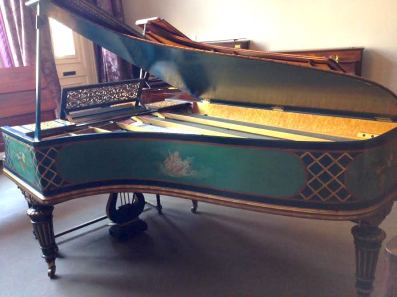
Erard piano.1

Mina Gajic’s historic 1895 Érard piano.

That piano was manufactured in Paris in 1895 by Érard and belongs to pianist Mina Gajic, the festival’s director of education and outreach. (Further information on the straight-strung Érard is here.) It was used in a concert of music by Bach and Brahms presented in 2016 that included the Brahms Horn Trio played on a 19th-century-style natural horn (without valves) and a violin with natural gut strings.

The Érard will return in the coming season for “A World Transformed,” a program the encompasses the late 19th and early 20th centuries (Dec. 9, Longmont). “We are opening a new door in the 36-year history of the Bach Festival,” Carrettin says of the program. Opening with some late Romantic music by Brahms the program will move on to works by Bartók, Ives, Enescu and Berg. Gajic and her historic Érard piano will be joined for the program by Carrettin, on violin and clarinetist Richie Hawley, playing a clarinet manufactured in 1919.

zachary+carrettin

Zachary Carrettin

“What we’re looking at is an early 20th-century clarinet, a violin set up in the manner of the time with silk and gut strings and the piano from the period as well,” Carrettin says. “We are performing (the pieces on the program) as they would have been heard at that time.”

Historical instruments will also be featured on the seasons opening concert, “BachtoberFest,” a concert of chamber music by Bach, Handel, and their contemporaries (Oct. 12 Boulder, Oct. 14 Longmont); and Baroque orchestra concert that closes the season, “La Venexiana” (May 24, 2018 in Boulder, May 26 in Longmont).

For the Bach devotees in the festival audience, the culminating concert of the year may well be on March 15, in Boulder only. Titled “Eternal Spirit,” the program features four of Bach’s best known cantatas: No. 4, Christ lag in Todesbanden; No. 50, Nun is das Heil und die Kraft; No. 61, Nun kumm, der Heiden Heiland; and No. 63, Christen, ätzet diesen Tag.

“These works are chosen because of their musical content,” Carrettin says. “The four masterworks represent different periods of Bach’s life, from 1707 to the 1720s. Liturgically they come from different parts of the church year. One special work on the program is Cantata 50, which is a single movement double chorus, based on the chorale Nun kumm, der Heiden Heiland.

 “This work has trumpets and timpani and orchestra, and where we connect season to season is that last October we did three different settings of that chorale, for organ and choir and strings. And now we bring back that chorale in a rarely performed masterwork of Bach.”


Boulder Bach Festival
Zachary Carrettin, artistic director
2017–18 Season

Bachtoberfest
7:30 p.m. Thursday, Oct. 12, Seventh Day Adventist Church, 345 Mapleton Ave., Boulder
7:30 p.m. Saturday, Oct. 14, Stewart Auditorium, Longmont Museum, Longmont
—Program of chamber music by Bach, Händel and other Baroque composers performed on historical instruments

A World Transformed
7:30 p.m. Saturday, Dec. 9, Stewart Auditorium, Longmont
—Music of the late 19th and early 20th centuries performed on historical instruments

Schwartz-Bournaki in Recital
7:30 p.m. Thursday, Feb. 8, Seventh Day Adventist Church, Boulder
7:30 p.m. Saturday, Feb. 10, Stewart Auditorium, Longmont
—A recital by the New York- based duo of Julian Schwartz, cello, and Marika Bournaki, piano, winners of the 2016 first Boulder International Chamber Music Competition.

Eternal Spirit
7:30 p.m. Thursday, March 15, Seventh Day Adventist Church, Boulder
—Four Bach cantatas performed buy the Boulder Bach Festival Chorus, orchestra and soloists.

La Venexiana
7:30 p.m. Thursday, May 24, Seventh Day Adventist Church, Boulder
7:30 p.m. Saturday, May 26, Stewart Auditorium, Longmont
—Vocal and instrumental music from Venice, including works of Giovanni Gabrieli, Monteverdi, Merulo and Vivaldi, plus the Bach Orchestral Suite in B minor.

All-access passes available at (720) 507-5052.

Elliot Moore chosen to lead the Longmont Symphony

Moore will conduct the orchestra’s annual Fourth of July concert.

By Peter Alexander

The Longmont Symphony Orchestra (LSO) announced last night at their spring pops concert that its board has signed Elliot Moore to a two-year contract as its next music director.

Elliott.Moore.2

Elliot Moore, new director of the Longmont Symphony

Moore was selected at the conclusion of a year-long search that included appearances by four candidates with the orchestra. He conducted a concert with the orchestra in November. He will succeed Robert Olson, LSO director for the past 34 years. Olson conducted last night’s concert, titled “A Few of my Favorite Things,” concluding the orchestra’s 50th anniversary season.

Moore, who currently lives in Detroit, has said that he and his wife will move to Longmont by the fall, so that they can become part of the community. For the 2017–18 season, he will conduct all rehearsals and performances. These include six subscription concerts at Longmont’s Vance Brand Auditorium, the holiday candlelight concert and two Nutcracker performances with Boulder Ballet.

Because of the planning involved, it is likely that the 2017–18 season will not be announced until August. In the meantime, Moore will make his first appearance with the orchestra in their annual Fourth of July concert in Thompson Park. In the coming year he will also lead the orchestra’s community engagement concert for St. Vrain Valley School District fifth graders, and two concerts in the Stewart Auditorium of the Longmont Museum.

In a statement released by the Longmont Symphony, board president Robert Pilkey wrote, “The entire LSO family—musicians, board members, and our many volunteers—are thrilled to have Elliot Moore as our new music director. He will play a major role in civic and social activities throughout our community, paying special attention to our youth and the expansion of our community engagement programs. We’re delighted with Elliot’s enthusiastic commitment to continue the legacy of our iconic community orchestra.”

DSC_3078-2

Elliot Moore. Courtesy of the Longmont Symphony.

As part of a wide ranging conversation, Moore talked extensively about his move to Longmont. “The plan is definitely to become part of the fabric of the Longmont community and to really invest our lives here,” he said. “By being a member of the community, I hope that people will feel free to come up to me and introduce themselves.

“I hope people will stop me when they see me in the grocery store and have a conversation about what’s going on in the town, what’s going on in the community. I hope that my being here in the community will play a role in making the symphony an even more integral part of the Longmont community.”

Moore said he is looking forward to taking a role he described as the “full-time steward” of the Longmont Symphony. “I have various ideas about how an orchestra can really impact the community, how a symphony is a symbol of the community,” he said. “How players listen and respond to one another is symbolic of what a community does.

“One thing about a vision is not coming in with a preconceived idea, but communicating to community leaders, asking them questions, asking the orchestra questions, and asking the board members questions about their vision—where they would like to see the orchestra go in the next several years. So while I do come in with various ideas, I also want to make sure that what we do is authentic for Longmont.”

Moore is especially interested in the educational activities that the LSO offers. “One of the things that I am very excited about is the 5th-grade concerts that we have in January,” he said. “I want to have a further reach into education. One of the ideas I would love to do is to teach people who don’t have much knowledge about conducting—or even about music—what a conductor actually does.”

Moore has several engagements for the coming year outside Colorado. This is normal for any conductor of a less than full-time orchestra, in order to supplement his income, but Moore made it clear that the LSO will remain his top priority. “The rehearsal schedule and the concert schedule leave room for guest conducting with other orchestras,” he observed.

Moore was born in Anchorage, Alaska, and lived briefly in Denver when he was six years old. He has also lived in Texas, Cleveland, New York and Switzerland, as well as Detroit. He studied at the University of Michigan, where he received a Doctor of Musical Arts degree. He has been conductor of the Blue Period Ensemble in New York and the Detroit Medical Orchestra. In 2015 he also became director the Michigan’s Five Lakes Silver Band.

He has led rehearsals and/or performances with Mexico’s Orquesta Filarmónica de Jalisco, Canadian Chamber Opera of New York City, Sewanee Symphony Orchestra and Canada’s National Arts Center Orchestra, as part of its Summer Music Institute Conductors Program. After completing his doctoral work at the University of Michigan, Moore was invited back to lead programs of the University Philharmonia Orchestra and the Contemporary Directions Ensemble.

Seicento Baroque Ensemble appoints new artistic director

Kevin T. Padworski will succeed founding director Evanne Browne

By Peter Alexander

Seicento Baroque Ensemble, a Boulder-based choral organization specializing in the music of the early Baroque period, has appointed composer/conductor/organist Kevin T. Padworski to succeed Evanne Browne as artistic director.

At the same time Amanda Balestrieri, a soprano who is well known for her early music performances, has been selected as assistant conductor of the group.

KEVINPadworski

Kevin T. Padworski has been appointed artistic director of Seicento

Browne founded Seicento in 2011 with the goal of “performing worthy but rarely heard music of the early Baroque musical period,” their Web page states. Under Browne’s leadership the auditioned choir has employed historically informed performance practice and period instruments in their performances.

In a statement released by Seicento, Browne praised the choice of Padworski as artistic director, saying, “Seicento is honored to have a musician of this caliber lead our group into the future.”

“Evanne clearly has kind of established a little bit of a legacy here in Colorado,” Padworski says. “I’m following an incredible woman in her field, and I’m excited to work on the repertoire. I’m excited about being able to perform Baroque repertoire up to historically informed performance practice.”

The transition has been made easier by planning that already taken place for the 2017­–18 season. Themes have been selected for two concerts during the year. “The fall theme will be ‘Luther to Bach,’ and that can mean a whole bunch of things,” Padworski says. “That’s really exciting because Luther’s influence was widespread in Europe, so that leaves a lot of composers available to explore.

“Then in the spring they had established a theme called ‘Mad Madrigals.’ It gives us a breadth of madrigal repertoire from a couple of centuries. As I look at that, my initial reaction would be to try to make that as broad as possible.

“I see it as a privilege to work with and collaborate with the people in the ensemble, and to offer music to greater Boulder.”

balestrieri

Amanda Balestrieri will be assistant conductor of Seicento

Balestrieri has been a frequent soloist with Seicento, most recently for Browne’s last performances with the group March 24–26. She worked closely with Browne and the ensemble over the past six years, and has also appeared with the Boulder Bach Festival, Pro Musica Colorado Chamber Orchestra, and other performing organizations in Colorado.

“I think it’s going to be a really good collaboration,” she says of her role working with Padworski as assistant conductor. “Kevin’s skills are huge. He’s a singer and a conductor and a keyboard player, and he has energy and wonderful musicianship. What I bring is how to technically execute some of the more difficult parts of the early music style, and a much longer experience in the early music movement.”

Padworski is a doctoral student in choral conducting at the University of Colorado, Boulder. He is artistic director of the Colorado Chorale and director of music and organist at Calvary Baptist Church in Denver. He is the composer of both choral and instrumental works, available through MusicSpoke and Santa Barbara Music Publishing.

He performs as an organist, singer, pianist and harpsichordist with an interest in early music. He has appeared professionally with the Jubilate Deo Chorale and Orchestra, Dallas Symphony, Colorado Choral Arts Society, Colorado Symphony, Colorado Symphony Chorus, Colorado Children’s Chorale, Opera Colorado and American Baptist Churches USA, among other organizations.

Padworski holds a bachelor’s degree in music education from Eastern University, a certificate in leadership from the Foundations program at Duke Divinity School, and a master’s degree in conducting from the University of Denver’s Lamont School of Music.  He has been a conducting fellow with the Sarteano Chamber Choral Workshop and with Chorus America.

Protest precedes Boulder Chamber Orchestra performance

Corporate contribution attracts activists’ attention

By Peter Alexander

They started blowing their whistles about three minutes before the concert was scheduled to begin.

Last night (May 5) was one the biggest nights in the history of the Boulder Chamber Orchestra (BCO). Just before 7:30 p.m., the players were all on the Macky Auditorium stage, along with members of the Boulder Chorale, getting ready to perform Beethoven’s monumental Ninth Symphony.

BCO November Concert 2009

Artistic director Bahman Saless and the Boulder Chamber Orchestra

It would be the climactic concert of their 13th season. The house was filling with a large audience.

Suddenly, several protesters—I saw three but it sounded like there were more—stood up and started blowing police whistles. The audience suddenly grew quiet. A woman near me stood up and started shouting, although her words were lost in the general din. Loud voices could be heard from other parts of the hall.

The woman hurried down the aisle, still blowing her whistle and talking to several audience members on the way. A man near the back was shouting, and raised a fist in protest; I saw one or two others rushing out of the auditorium. They made a quick exit from the building, leaving behind flyers headed “Community Alert.”

The protestors were from East Boulder County United (EBCU), an activist group that opposes fracking. The group’s Facebook page lists as one of its goals “to protect our community and neighbors from the dangers that oil and gas development poses to our health, the quality of our air and water, and our agricultural heritage.”

They had already stated their opposition to contributions the BCO received from Extraction Oil & Gas, which describes itself as “a domestic energy company focusing on the exploration and production of oil and gas reserves in the Rocky Mountains.” It is likely that EBCU alerted some of the media of the planned protest against Extraction, since the Boulder Daily Camera had a reporter and photographer at Macky before the performance.

As soon as the EBCU protesters had left the building, the concert continued as planned. Board chair Jessica Catlin spoke briefly from the stage, acknowledging the BCO’s supporters. Conductor Bahman Saless came onstage and talked about the program, as he often does. The performance took place without further incident.

There was no evidence that the musicians were rattled in any way. Their ardent performance received a boisterous standing ovation. With people on the main floor and in the balcony, this was likely the largest audience the BCO has played before.

After the performance, BCO board member Ari Rubin said that the board and orchestra had received no notice or threat of the protest. “It saddens me that they would choose to use this as an outlet rather than contact their elected officials,” he said.

The trouble between EBCU and the orchestra began about April 30, when the BCO posted a notice on their Facebook page that a gift from Extraction Oil & Gas would help pay the cost of free student tickets to the performance. EBCU responded with a message to supporters, asking them to “Please contact the Boulder Chamber Orchestra and call on them to end their partnership with Extraction Oil and Gas. . . . We are calling upon (the BCO) to immediately return all money you have taken from this lethal corporation and remove all promotion of them from your publications. Make music, not pollution.”

EBCU also posted protests on the BCO Facebook page. Those posts were taken down, and the BCO board issued a statement that read in part: “Organizations like ours have increasingly been forced to look towards private donations and corporations to help fund our mission to educate and expand the cultural fabric of our city. . . .Donations are necessary [for us] to survive and thrive as a nonprofit.”

The donations from Extraction was one of three gifts that provided free tickets to the performance for students from Boulder Valley School District, Jefferson County School District, and St. Vrain Valley School District. The University of Colorado, Boulder, and Excel Energy also contributed to this initiative. According to the board statement of May 2, “Students have responded eagerly to our offer, and we must honor our commitment to them.

“We understand corporate donations may present difficult and controversial issues, but we viewed the acceptance of funds as way of ensuring that some good can come from otherwise divisive issues surrounding corporate stewardship.”

Extraction Oil & Gas is one of 15 sponsors listed on the BCO Web page. Total corporate contributions, including Extraction and other local businesses, are reported as 17% of the BCO’s budget.

Regarding the larger controversy that ECBU has generated, Saless  and the BCO’s acting managing director, Nell Clothier, have declined to comment. Members of board have indicated that they prefer for the board’s written statement, posted May 2, to speak for itself.

UPDATE: According to a report published in the Boulder Daily Camera, EBCU member Kristin McLean said that there were seven activists who blew whistles in Macky Auditorium before the performance. She was also quoted saying that the group had paid $562 for their tickets to get into the auditorium.


Boulder Chamber Orchestra returns to basics for 14th season

Concertos familiar and unfamiliar will decorate the 2017–18 season

By Peter Alexander

bconew_1

Boulder Chamber Orchestra: Fourteeners all year for 2017–18

Conductor Bahman Saless is calling next year’s season of the Boulder Chamber Orchestra (BCO) “Fourteeners,” because it is their 14th season, but there are no massive summits on the horizon.

saless-dsc09407

Bahman Saless returns to basics

“If there were going to be a theme it would be going back to our basics,” he says of the season’s program. “We have kind of stretched ourselves for a year or two, to get us to some benchmarks, and now we can go back to our more intimate chamber orchestra concerts.”

The search for benchmarks has led Saless and the BCO into Romantic territory, with concertos and symphonies by Brahms, and this season’s performance of Beethoven’s Ninth Symphony (coming May 5, 6 and 7). But the 2017–18 season stays mostly in the classical period, which is the core repertoire for smaller orchestras, including two symphonies by Mozart and one each by Haydn and Schubert.

Along with chamber orchestra basics, the season will be decorated by concertos, some of them familiar and some virtually unknown. Undoubtedly the least familiar will be on the December concert, when the orchestra’s principal flutist, Cobus du Toit, will be featured in the Pastorale Suite for flute and strings by Swedish composer Gunnar de Frumerie.

It’s a piece that Saless literally found on a beach in Mexico.

cobus-du-toit-flute

Cobus du Toit: Playing music from a Mexican beach

“Cobus has been bugging me for a concerto to do with him for a while, and I love showing him off,” he says. “I was in Mexico by the beach and I heard this on my phone, and I’m like, ‘I’ve never heard this before! I’ve got to do this!’

“I really don’t know anything about the composer. The piece is unknown enough that even Cobus had to look it up!”

Another unfamiliar solo work will be the Concerto for piano, violin and strings by Mendelssohn, written when the composer was 14 years old, and unpublished in his lifetime. It will be performed in November by pianist Mina Gajic and violinist Zachary Carrettin.

Filling out the roster of little known concertos will be the Piano Concerto No. 3 in B minor by Johann Nepomuk Hummel, a contemporary of Beethoven who succeeded Haydn as Kapellmeister to the Hungarian Prince Esterhazy. Known principally as a piano virtuoso, Hummel wrote eight concertos for his own use of which, Sales says, the Third is “really hard to do.” It will be performed in February by Andrew Staupe.

Christie-Conover-cropped

Soprano Christie Conover

Beethoven will provide another rarity for the February concert, the complete incidental music for the play Egmont by Goethe. The Overture is a common concert opener, but the full incidental music, including songs that will be sung by soprano Christie Conover, is not often heard.

Well known solo works on the season schedule are Mozart’s Sinfonia Concertante for violin and viola, played by Sharon Park and Andrew Krimm; and the Concierto de Aranjuez for guitar and orchestra by Joaquín Rodrigo, performed by Chaconne Klaverenga. The season wraps up in May with a concert that will feature four members of the BCO in Haydn’s Sinfonia Concertante for oboe, bassoon, violin and cello.

Tickets for the 2017–18 season will go on sale through the BCO Web page May 5. The full season schedule and programs are listed below.

# # # # #

October 20, 21
Mozart: Sinfonia Concertante in E-flat major, K364 for violin and viola
—Sharon Park, violin, and Andrew Krimm, viola
Mozart: Symphony No 29 in A major, K201
Elgar: String Serenade

November  10, 11
Mendelssohn: Concerto for piano, violin and strings
—Mina Gajic, piano, and Zachary Carrettin, violin
Janacek: Idyll for strings

chavconne:1

Chaconne Klaverenga

December 15, 16
Rodrigo: Concierto de Aranjuez for guitar and orchestra
—Chaconne Klaverenga, guitar
Gunnar de Frumerie: Pastorale Suite For Flute and Strings, op. 13
—Cobus du Toit, flute
Schubert Symphony No. 5 in D major, D485

February 23, 24
Hummel: Piano Concerto No. 3 in B minor
—Andrew Staupe, piano
Beethoven: Overture and Incidental Music to Egmont
—Christie Conover, soprano

March 30, 31
Mozart: Requiem in D minor, K626
—Boulder Chorale
—Soloists TBD

May  11,12
Haydn: Sinfonia Concertante in B-flat major for oboe, bassoon, violin and cello
—Soloists from the orchestra
Haydn: Symphony No. 95 in C minor
Mozart: Symphony No. 36 in C major, K 425 (Linz)