Out of the Ordinary at the Ordway

St. Paul Chamber Orchestra, Minnesota Opera explore unusual repertoire

By Peter Alexander Feb. 7 at 9:35 p.m.

A weekend in St. Paul, Minn., provided the opportunity to hear some musical works that were completely new to me, and to most in the audience. On Friday (Feb. 4) the St. Paul Chamber Orchestra played music by Thomas Adès, Karl Amadeus Hartmann and some Austrian named Joseph Haydn. And Saturday (Feb. 5) Minnesota Opera presented the company premiere of The Anonymous Lover by Joseph Bologne, Chevalier de Saint-Georges.
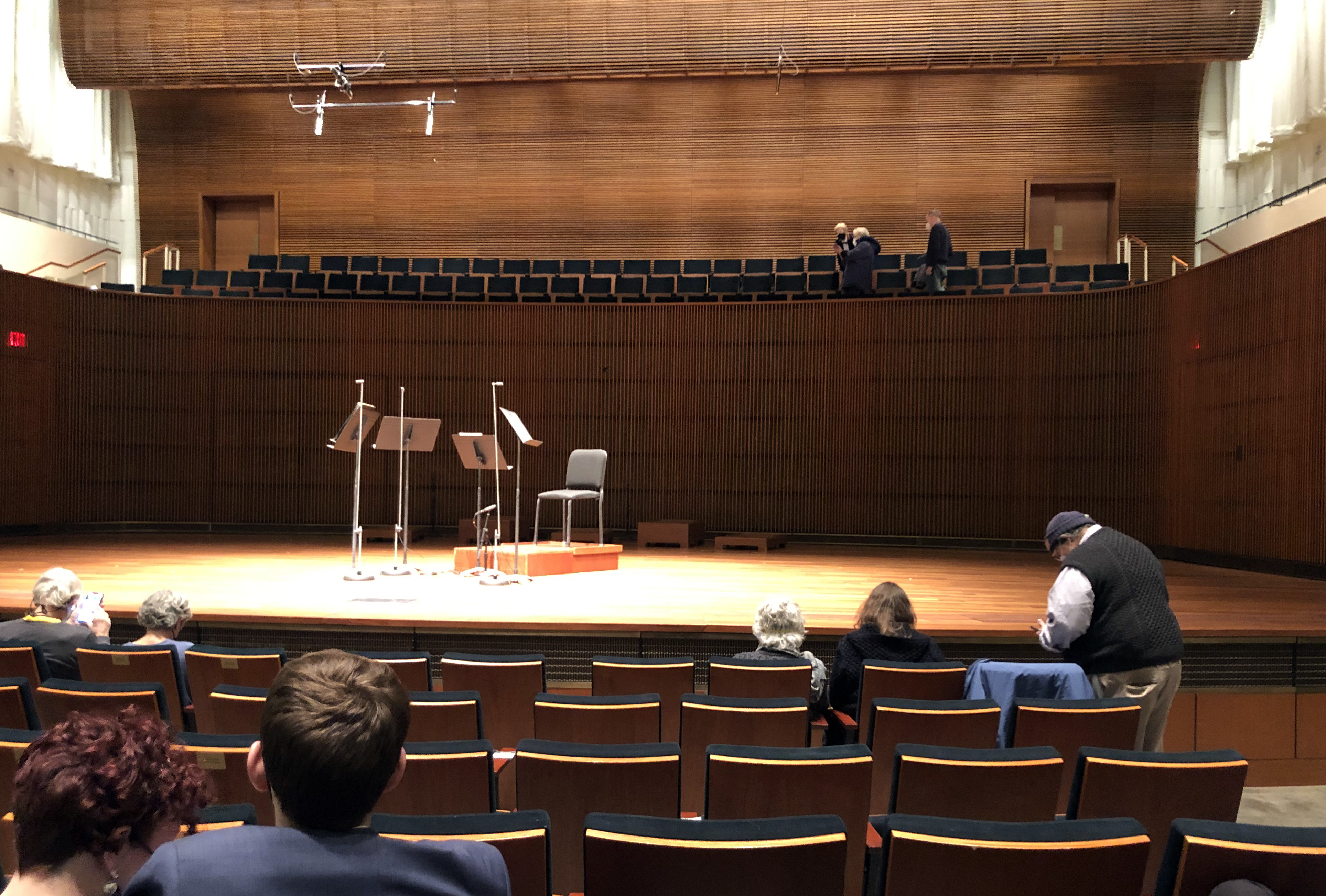
The Ordway Concert Hall before the SPCO concert. Photo by Peter Alexander.

Adès is a Grammy-winning British composer best known in this country for his operas The Tempest and The Exterminating Angel, both presented by the Metropolitan Opera (2012 and 2017, respectively). The SPCO opened their COVID-impacted, intermissionless, limited-capacity concert in the Ordway concert hall with “O Albion” from his Arcadiana for string quartet, one of his gentlest, most audience-friendly if not quite conventional movements. 
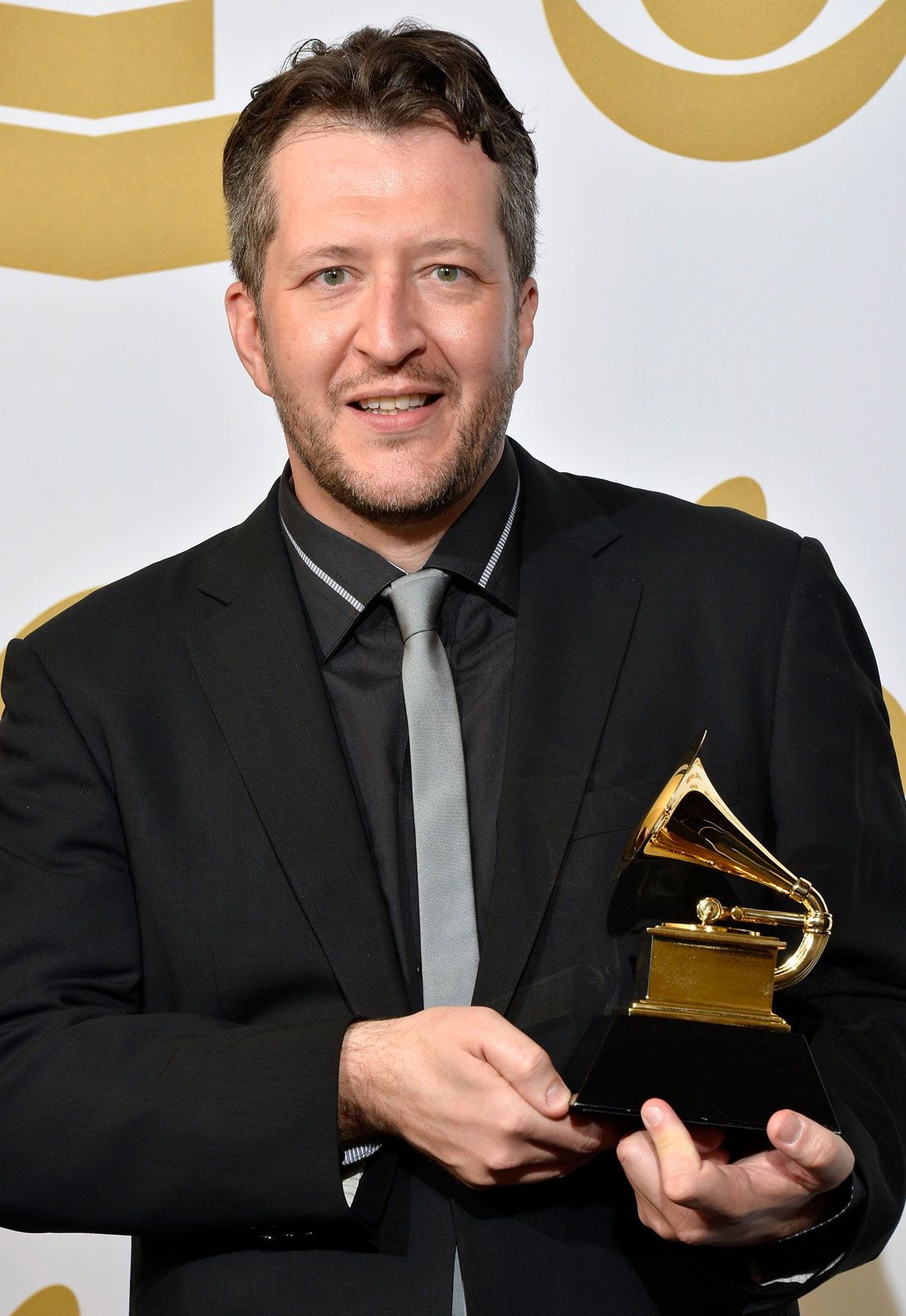
Thomas Adès

First performed at the 1994 Cambridge Elgar Festival, the brief piece recalls in mood and gesture the “Nimrod” variation from Elgar’s Enigma Variations. Played with warmth and expression by four players from the SPCO, this was a quiet and genial beginning to the program.

Hartmann deserves to be better known, for both musical and political reasons. Born in Munich, Germany, in 1905, he survived the Second World War in spite of his profound but largely silent opposition to the Nazi regime. During the war he withdrew from public life and declined to have any of his music performed as long as the Nazis remained in power, a position sometimes described as “internal emigration.”

His music mostly conforms to the modernist aesthetic of the 1930s. He is remembered chiefly as the composer of eight well structured symphonies. The work chosen by the SPCO was Hartmann’s Chamber Concerto for the unusual combination of clarinet, string quartet and string orchestra. The clarinet, here played by SPCO principal Sang Yoon Kim, is the virtuoso star of the work. 

Inspired by and written in honor of Zoltán Kodály, the Chamber Concerto is permeated by Hungarian idioms. A central set of variations is framed by melancholy, reflective movements that allowed Kim to show his dynamic control and beautiful tone in the softest passages. Following the yearning mood of the opening, the variations erupt in propulsive folk dance rhythms and a series of virtuoso variations that Kim carried off with impressive technique. The final Fantasie movement returns to the quiet character of the opening, with the clarinet and string quartet players fading in and out as their parts intertwine. At the end they all vanish in silence.

This is an attractive piece that I would love to hear again, especially performed with such commitment and polish. Anyone in Boulder willing to take up this unfamiliar gem?
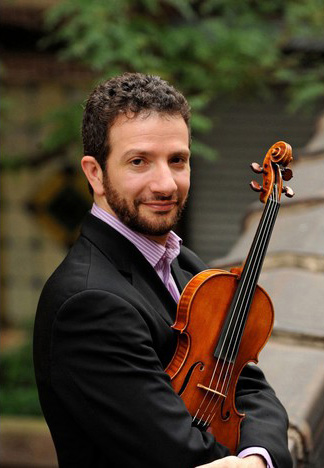
SPCO concertmaster Steven Copes

Like the rest of the concert, Haydn’s Symphony No. 43 in E-flat was ably led from the concertmaster’s chair by violinist Steven Copes. Sometimes called the “Mercury” Symphony for reasons unknown, it was written in 1771—early in the development of the symphony. It comprises four relatively short movements.

Playing on modern instruments, the SPCO gave a spirited reading of the symphony. They brought out all the drama of the first movement, with attention to the expressive potential of every motive and gesture. They made the most of the relatively routine slow movement, which is not the strongest part of the work.

The modern stringed instruments created a robust sound, especially for the repeated chords that mark the minuet. Other than slight smudges getting started, the finale was clean and precise, characterized by great energy and strong contrasts in dynamics. The winds—pairs of oboes, bassoons and horns—are limited to harmonic support in the symphony, and in that role they played with admirable restraint.

This is an ideal program: attractive newer pieces deserving of attention combined with lesser known works by familiar composers. Such a program can expand the horizons of audiences in both directions. I would love to hear more concerts built on this model, in place of the usual repetitions of well-trod repertoire with only the occasional unfamiliar piece thrown in. 

# # # # # 
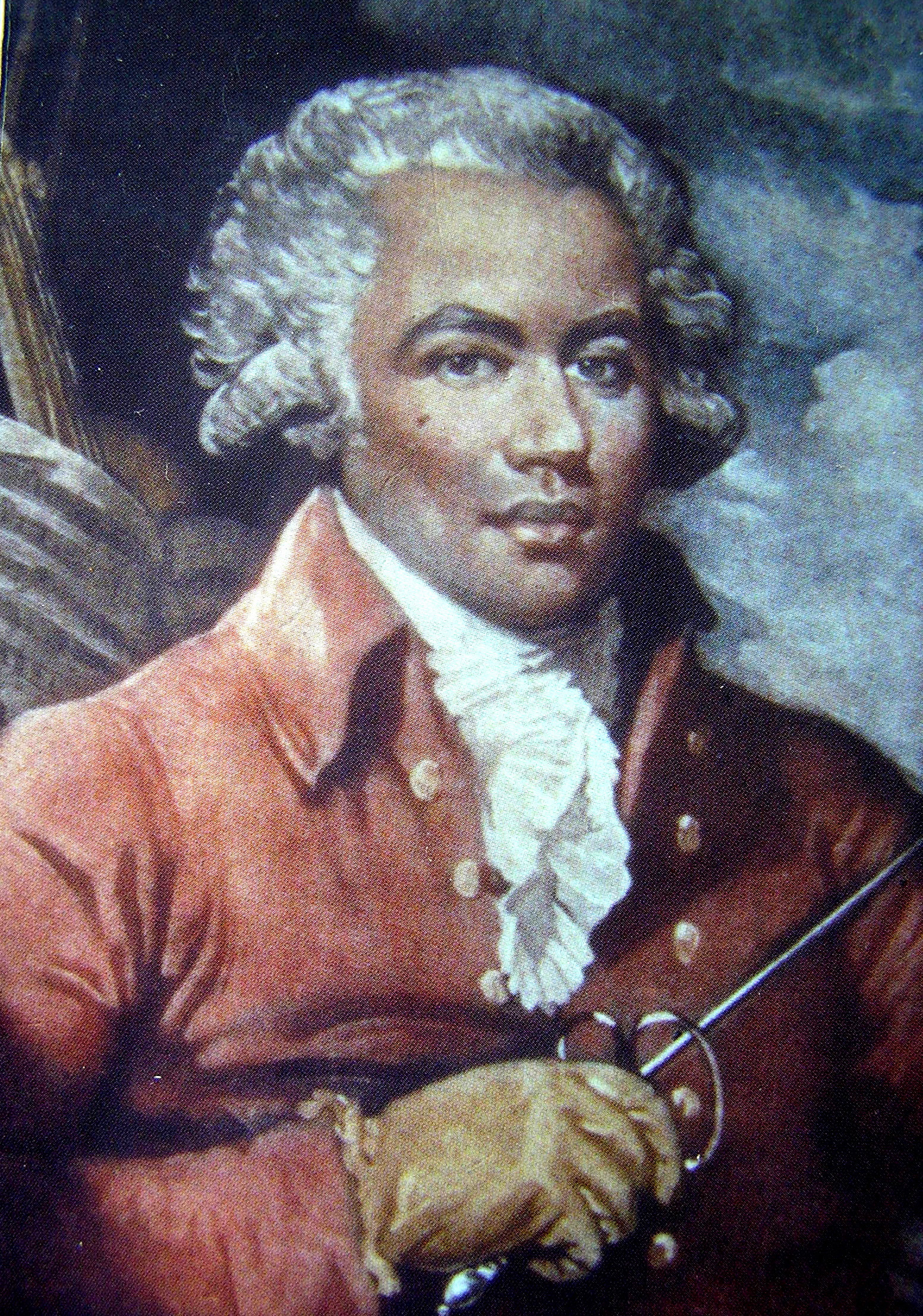
Joseph Bologne, Chevalier de Sanit-Georges

The son of a French aristocrat and a teenaged Afro-Caribbean slave, Bolonge was born  in Guadeloupe in 1745 and spent most of his life in Paris, where he was renowned as a swordsman. As a violinist he rose to the position of concertmaster and conductor of a popular concert series,  Le Concert des Amateurs, in the 1770s. He composed at least six operas, of which only The Anonymous Lover (1780) has survived complete.

Bologne has received long overdue attention over the past two years, as both the COVID hiatus in performing schedules and political events have stimulated explorations of music by composers of color. His Violin Concerto in G major was performed by Harumi Rhodes with the Colorado Pro Musica Chamber Orchestra in October, and others of his works have been presented from Bangor, Maine, to Los Angeles and overseas. The Anonymous Lover has received several productions, both staged and virtual.

The Minnesota Opera production took full advantage of Bologne’s background, placing the events in 18th-century Guadaloupe. With that Caribbean inspiration, the unit set was filled with dazzling colors and flooded with tropical sunlight for the daytime—a welcome sight in subfreezing St. Paul!—and romantic moonlight for night. The choreography and some stage direction were inspired by Latin dance, with exuberant festivity on stage sometimes covering the music. 
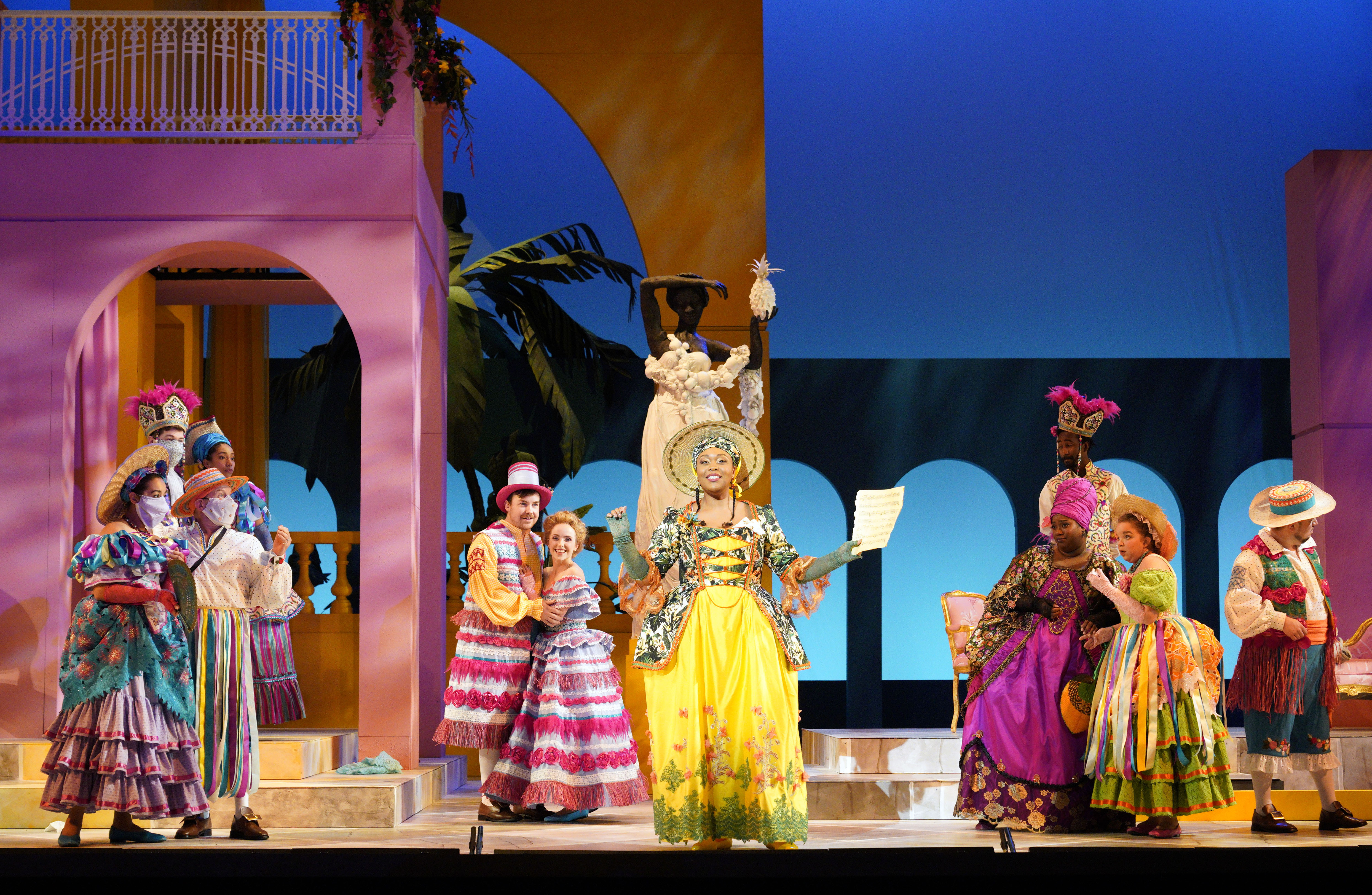
Cast and set for the Minnesota Opera production of The Anonymous Lover. Production photos by Cory Weaver.

There were several other innovations for this production. Bologne is portrayed onstage by a dancer, who overlooks the proceedings from a balcony while pretending to be an immobile piece of decoration when noticed by the operatic characters below. This just too-clever device sometimes upstaged the main action and detracted from the singing, but served to remind the audience of the composer’s position as a mixed-race man legally defined as a slave.

There were other hints of Bologne’s life as well: some adroit fencing moves in the opera’s first duet, a violin candenza inserted into the Overture. In other modifications, two songs by Bologne have been added to the score for Dorothèe, otherwise a purely spoken role.
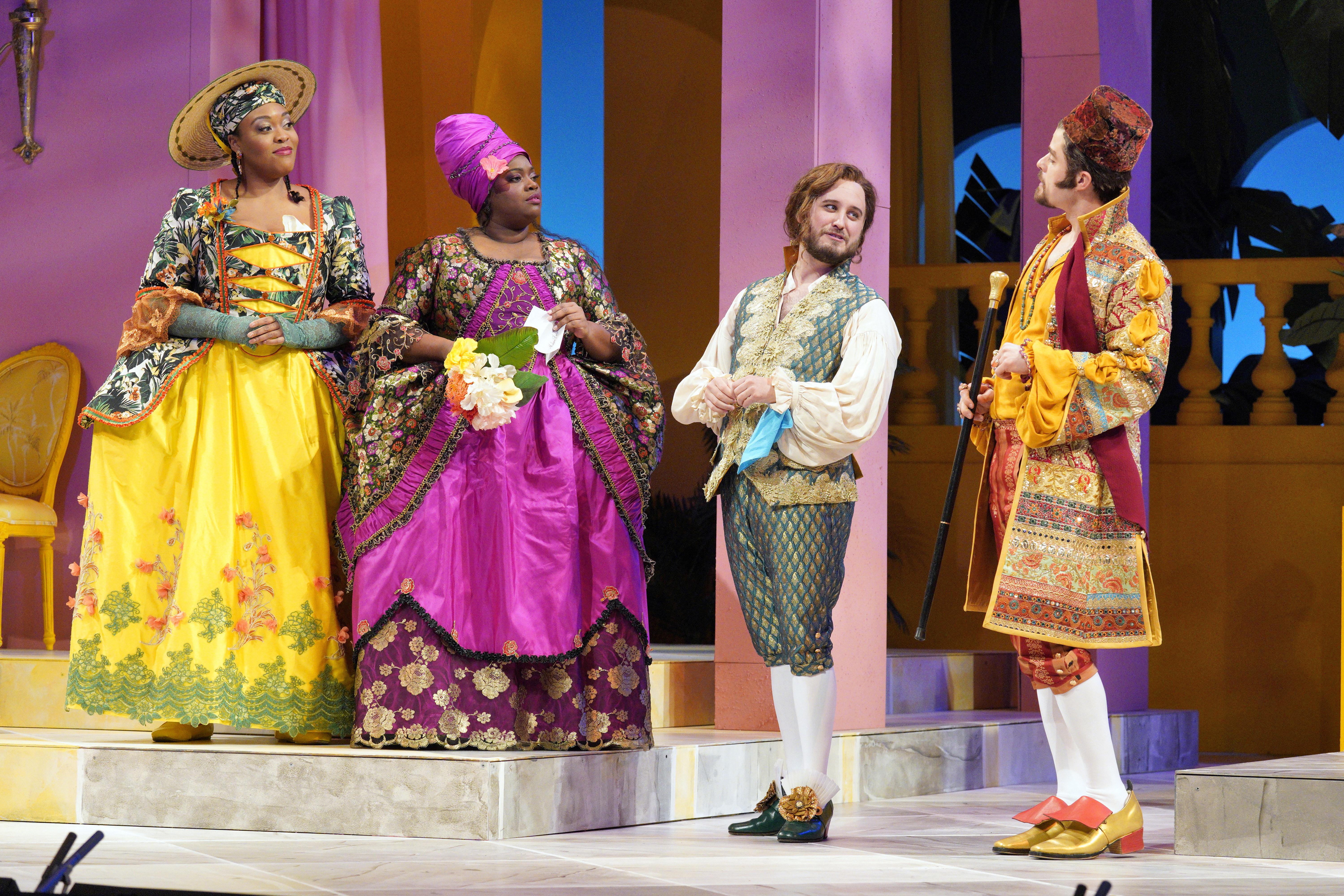
Leading cast members of The Anonymous Lover: Zoie Reams (Dorothèe), Symone Harcum (Lèontine) , Carlos Enrique Santelli (Valcour), and Aaron Kenney (Ophémon).

Any pedantic reservations aside, the production is endlessly fun, bright and gorgeous to see, and filled with action. Stage director Maria Todaro has created a highly entertaining and appealing version of an opera that is otherwise improbable in its action and often shallow in its emotions. Sometimes her endless imagination got in the way of the larger picture—as with the figure of Bologne, or the characters who kept hiding from one another, until all the ducking in and out of alcoves became tedious. Nevertheless, the opening night audience was delighted.

One innovation for which Todaro claims credit is that the leading female character Léontine overhears the supposedly anonymous lover, so that she knowns the truth throughout. A welcome interpolation in a typically male-centric operatic story, this serves to even the score: since she knows throughout who the anonymous admirer really is, she is manipulating him as much as the other way around.

The dancers Brian Bose as Bologne and his partner Jennifer Mack as Madame de Genlis were decorous and graceful. It’s not their fault they sometimes distracted from the rest of the performance. Individual musical numbers are separated by extensive passages of spoken dialog, but conductor Christopher Franklin kept the music moving at a suitably brisk pace. 
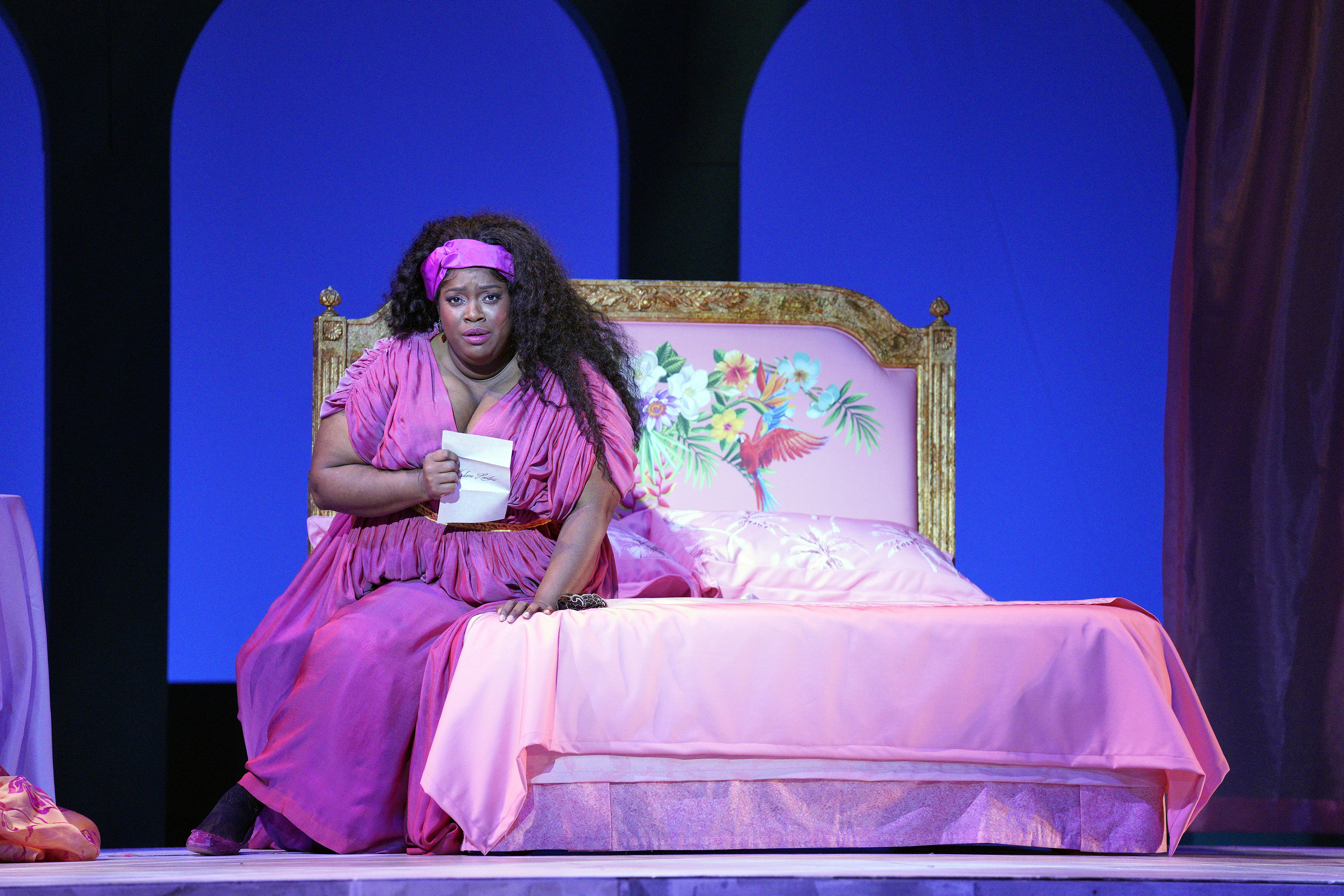
Symone Harcum (Lèontine)

A standout member of the cast was Symone Harcum as Léontine, the woman who is receiving the attention of the anonymous lover. Her strong, commanding voice rang out well in the 1900 seat Music Theater, and she found satisfying expressive content in her music. Her minor-key entrances, with suggestions of anxiety and frustration, are the strongest arias in the opera, and they were strongly presented.

As Valcour, the lover himself, Carols Enrique Santelli was challenged by the top of the range, where his bright tenor developed a hard edge, but was otherwise a sympathetic character. As his co-conspirator in anonymity, Ophémon, Aaron Keeney acted his part well and sang with confidence. Though dry in sound, his baritone blended well in the ensembles that are the largest part of his role.
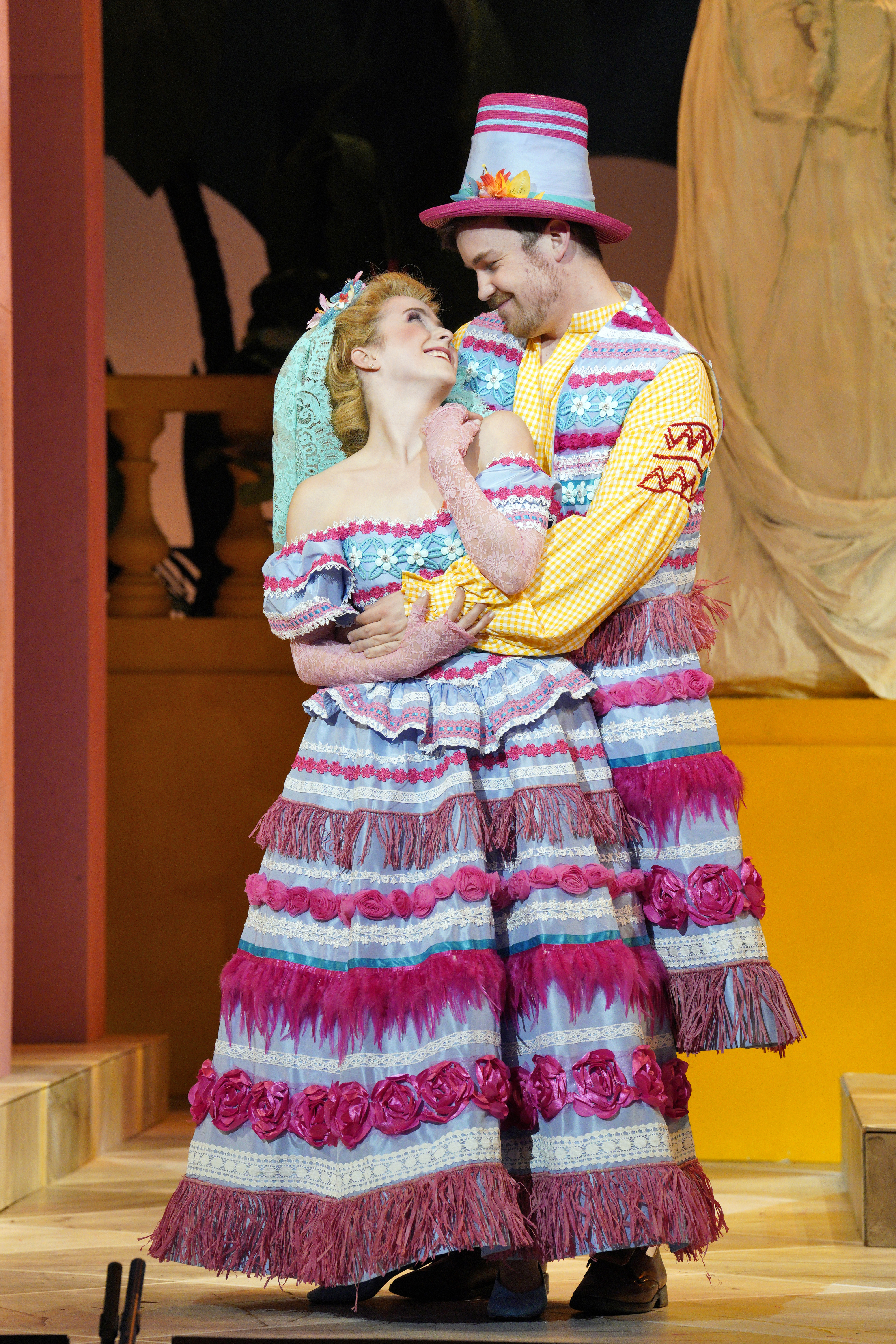
Leah Brzyski (Jeanette) and Joseph Leppek (Colin)

As Dorothèe, Zoie Reams milked her interpolated arias for all they were worth musically and dramatically. Some stagey business with a handkerchief, reprised for curtain calls, turned hers into a memorable role. As the young lovers Jeanette and Colin—a sort of Caribbean Zerlina and Masetto—Leah Brzyski and Joseph Leppek were every bit as charming as they were meant to be. With her bright soprano and gift for perkiness, Brzyski has a future in the so-called “-ina” roles, should she want them.

Todaro and Harrison David Rivers are credited with the translations of the dialog, which were as natural as one dared hope for. In fact, The Anonymous Lover is an entirely artificial 18th-century comedy. The action is implausible and superficial, but Bologne’s music is polished and never less than enjoyable, even if it does not rise to the Mozartian level of transcending its material. Minnesota Opera and their capable cast have made Bologne’s previously overlooked opera into a treat well worth a trip to St. Paul for the remaining performances next weekend (Feb. 10, 12 and 13).

At 90 minutes, The Anonymous Lover is ideal for performance during a pandemic, as it can easily be played without intermission. The not-quite sold out Ordway audience remained safely masked during the performance.

Puts’s Manchurian Candidate wins the audience on opening night

Michael Christie leads taut premiere

750x400_04Manchurian_2

By Peter Alexander

The Minnesota Opera rocked the Ordway last night (March 7) with the world premiere of Kevin Puts’s new opera, The Manchurian Candidate.

The performance was conducted by Michael Christie, former music director of the Colorado Music Festival who is now music director of the Minnesota Opera. A strong cast and first-rate orchestra gave a taut, polished performance that swept the audience up in its brisk, powerful motion, from the brittle, menacing opening sounds in the orchestra to the final, brutal punctuation mark.

Composer Kevin Puts

Composer Kevin Puts

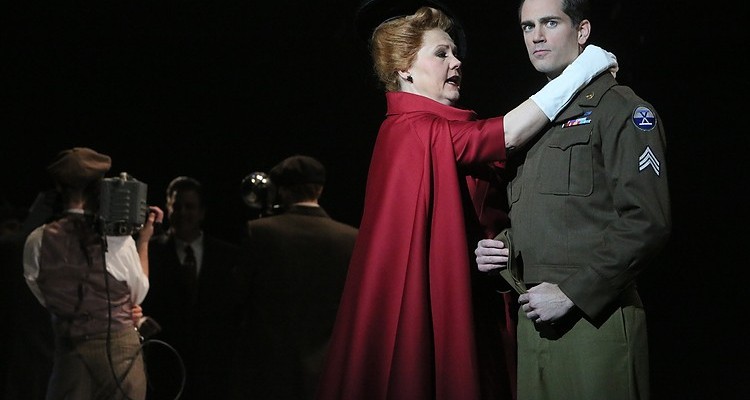
Puts’s only previous opera, the Pulitzer Prize-winning Silent Night, had its premiere by the Minnesota Opera in 2011. For Manchurian Candidate he set a very effective libretto by Mark Campbell, based on Richard Condon’s 1950s novel of the same title. A gripping if improbable tale of cold-war brainwashing set against the McCarthy-era red scares, the novel was twice made into a film—first in 1962 starring Frank Sinatra, Laurence Harvey and Angela Lansbury; and again in 2004 with Denzel Washington, Meryl Streep and Liev Schreiber.

Campbell, who also wrote the libretto for Silent Night, here created a very efficient text from Condon’s clunky potboiler. What he could not do is give depth to characters who are often little more than plot devices: Raymond Shaw, the tainted “war hero” who is a pawn of the communists; his war buddy Ben Marco, whose role it is to unlock Shaw’s corrupted mind; Jocie Jordan, who exists only to be Shaw’s love interest and to die tragically near the end; her father, Thomas Jordan, the “good” senator of liberal beliefs; Eleanor Iselin, Shaw’s predatory mother; and her husband, Johnny Iselin, the stand-in for Sen. Joe McCarthy.

That said, the opera runs lucidly through the various complexities of the original story, dispensing with events and characters not essential to the unwinding of the plot’s mainspring. It is this focus on the central story, and Puts’ compelling music, that give the opera both clarity and momentum. And at just over 2 hours including intermission, Manchurian Candidate never drags.

0356-750x400

Brenda Harris as Eleanor Iselin and Mathew Worth as Sgt. Raymond Shaw. Minnesota Opera production of “The Manchurian Candidate” by Kevin Puts. Photo by Michal Daniel.

Puts has written a score of power and complexity. As scene moves rapidly to scene, he is extremely effective in changing moods and providing what contours he can to the relatively flat characters. The aura of menace around Shaw’s mother is creepily apparent, and one cannot miss the bluster and pomposity of her dim-witted husband. Similarly, the horror of Shaw’s brainwashing, the shallowness of the political hangers-on, and the languid warmth of Shaw’s “summer by the lake” are all well conveyed through the music.

Puts has mastered a range of styles, from the military band music that greets Raymond Shaw’s arrival as a Medal of Honor winner, to the delightful train music of one lighter scene, to a patriotic hymn, to the manic music of a political convention. The text is set clearly and is almost always intelligible, with the vocal parts embedded in atmospheric orchestral sounds that illuminate the meaning of the text.

The text only lost intelligibility when two different scenes were unfolding at once. Then one was grateful to have supertitles; otherwise, the audience would have no way of knowing what occurred in a some critical moments in the opera. In a theater without titles, this could be a serious shortcoming.

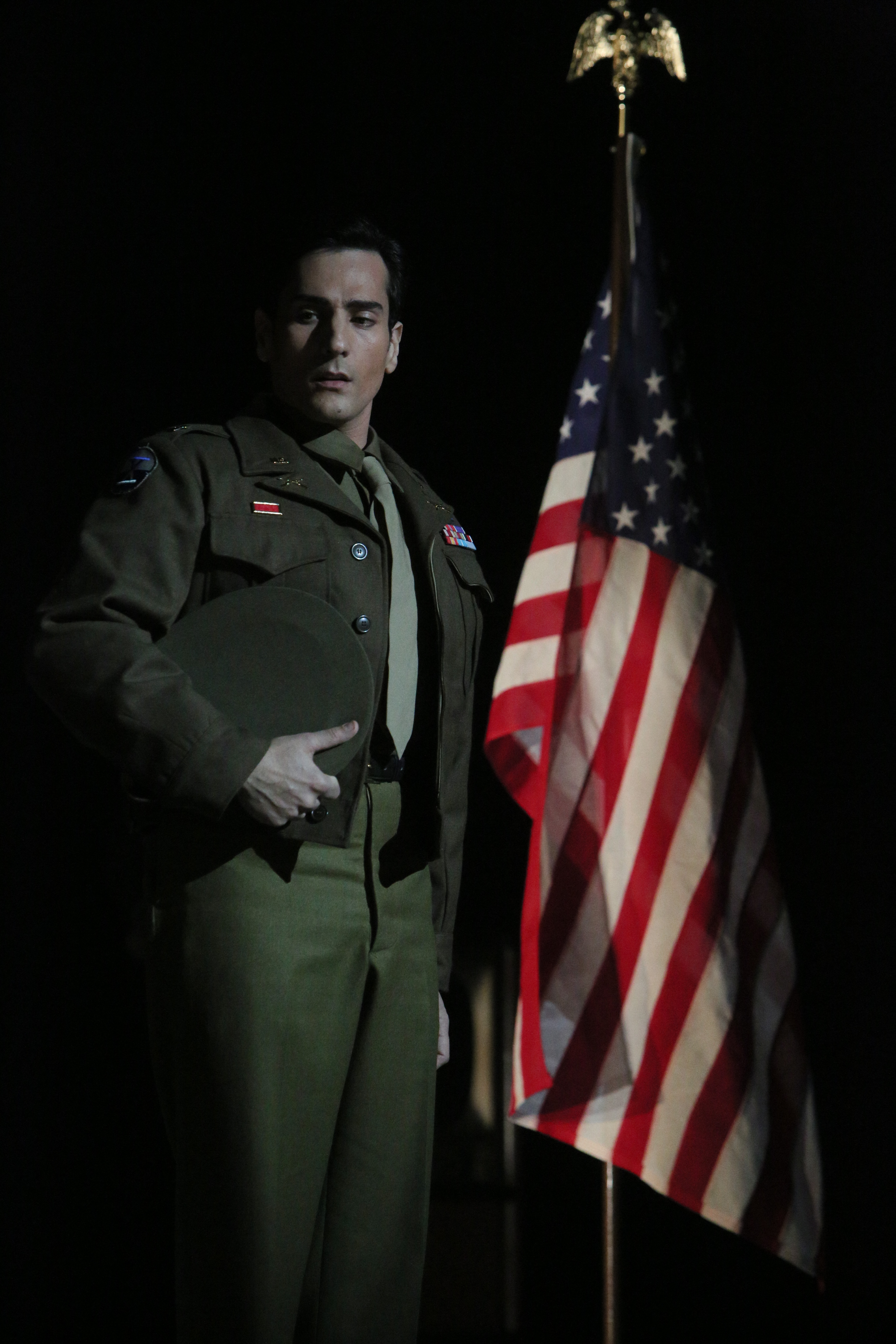
Matthew Worth as Sergeant Raymond Shaw in the Minnesota Opera production of The Manchurian Candidate. Photo by Michal Daniel.

Matthew Worth as Sergeant Raymond Shaw. Photo by Michal Daniel.

In his setting of English, Puts appears to have learned from the operas of Benjamin Britten—nowhere more so that in Raymond Shaw’s “mad scene,” in which the mixed fragments of previously-heard texts recall Britten’s mad scene for Peter Grimes. If not original, it is effective and was powerfully sung by baritone Matthew Worth.

Leonardo Capalbo as Captain Ben Marco in the Minnesota Opera production of The Manchurian Candidate. Popto by Michal Daniel

Leonardo Capalbo as Captain Ben Marco. Photo by Michal Daniel.

While it is not possible to cover everyone in the large cast, mention should be made of Leonardo Capalbo as Ben Marco. His scene recalling his nightmares, “Night After Night,” was one of the most effective set pieces in the opera.

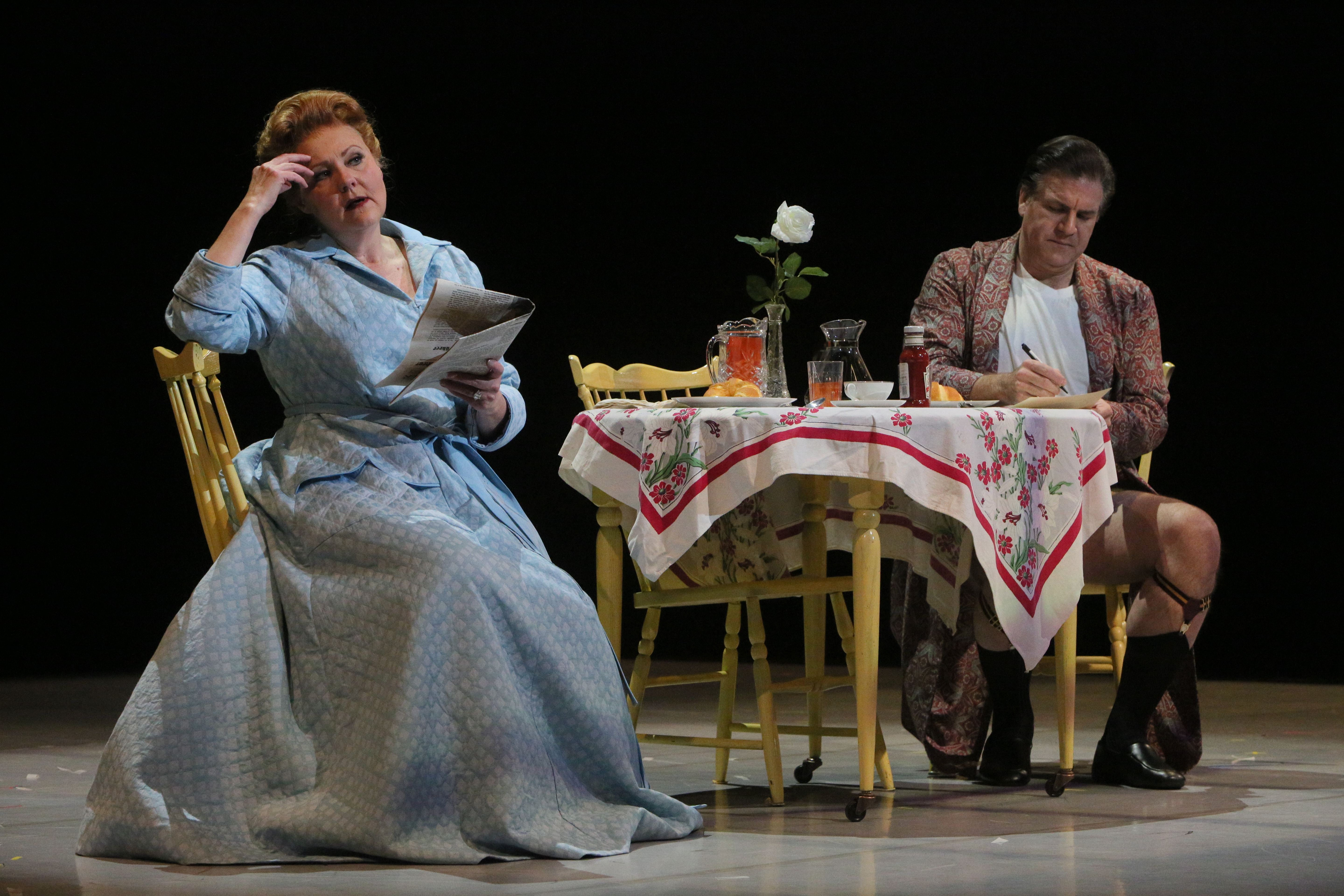
Brenda Harris as Eleanor Iselin and Daniel Sumegi as Senator Johnny Iselin in the Minnesota Opera production of The Manchurian Candidate. Photo by Michal Daniel.

Brenda Harris as Eleanor Iselin and Daniel Sumegi as Senator Johnny Iselin. Photo by Michal Daniel.

Soprano Brenda Harris has the opera’s most virtuosic music, particularly in her scene at the end of Act I, calling on “My darling little boy” and foretelling that “Terrible, terrible things will happen in this country.” This moment of almost Queen-of-the-Night threat and fireworks is a great dramatic stroke, set in the middle of a party scene that can only be described as satirical, and it was spectacularly dispatched by Harris.

Daniel Sumegi’s rough-hewn voice was appropriate for Johnny Iselin’s bluster, if not particularly beautiful. Angela Mortellaro was a lovely, winsome Jocie Jordan. Other roles, from the Chinese and Russians who brainwashed Shaw to the partygoers at the Iselins’, all filled their roles ably.

The production made good use of designer Robert Brill’s unit set. Kevin Newbury’s direction was uncomplicated and natural. There were a number of effective touches, including the menacing men in suits who moved furniture and seemed to be looming behind the scenes at critical moments, and the lighting effects that seemed to put Shaw in the shadow of prison bars when others were in open light.

Michael Christie

Michael Christie

But above all one must credit conductor Michael Christie and the musicians of the Minnesota Opera orchestra. Playing in an exposed pit, they only once covered the singers. Christie maintained the flow of the opera ably. Although it is hard to judge a new work, every tempo felt right, the transitions happened smoothly and there were no audible stumbles in the complex score. I particularly appreciated that Christie did not make an entrance into the pit to elicit applause, but just started both halves with no warning.

The Manchurian Candidate is an important new opera, and it was given a worthy premiere performance at the Ordway Music Theater last night. The audience responded warmly at the end, and recognized Harris in particular as a favorite with shouts and a standing ovation.

One must congratulate the Minnesota Opera for their ongoing commissioning and support of new opera. They far surpass some much larger companies in that regard. Indeed, the recent history of the Minnesota Opera in general, and the success of The Manchurian Candidate in particular, shows that new operas can provide compelling music drama and find an important place in a successful company.

Additional performances of Manchurian Candidate will be March 8, 12, 14 and 15. Visit the Minnesota Opera Web page for details and tickets.

# # #

The same weekend as the premiere of Manchurian Candidate, the St. Paul Chamber Orchestra opened a beautiful new concert hall in the Ordway complex, with concerts Thursday and Friday evening (March 5 and 6).

This is the first time in its 30-plus-year history that the SPCO has had a home that was designed for a chamber orchestra. Previously they played many concerts in the Ordway Music Theater, whose proscenium stage, members of the orchestra say, muddied and muffled the sound that reached the audience.

To judge by the performance I heard (Friday evening, March 6), the new hall is a spectacular success. It is a beautiful space, with gentle curves, warm wood and sound-reflective gypsum blocks dominating the visual aspect. No one is more than 90 feet from the stage. The sound is very present all the way to the top of the second tier—where I was sitting. Even the softest pizzicatos carried well and the texture was consistently clean and transparent. I didn’t know if the audience’s standing ovation at the end of the concert was for the performance, or for the hall.

The first half of the program was well chosen to show the orchestra and the hall to good advantage. Playing without a conductor but following concertmaster Steve Copes’s cues, the orchestra gave a brilliant account of Prokofiev’s “Classical” Symphony. Every note of the sparkling string parts came through, and the winds were bright and clear throughout.

After Prokofiev, the SPCO gave an unlisted performance of Charles Ives’s Unanswered Question, apparently decided on at the last minute. With string playing at a barely-audible whisper and the trumpet sounding beautifully from the balcony, this was an extreme test of both orchestra and hall, and both passed, again brilliantly.

The piece commissioned for the occasion, Coraggio for string orchestra (from String Quartet No. 3) by George Tsontakis, is a pleasant, unchallenging score that passed muster as an occasional piece. If it did not test the orchestra as much as Prokofiev and Ives, it served its festive purpose well.

The second half of the concert, again without conductor, was Beethoven’s “Eroica” Symphony. It was good to hear it played by an orchestra of the size Beethoven would have known, especially of the quality of the SPCO. The dynamic range was impressive, and the momentum at the end brought the audience to their feet. But on the whole I found it less satisfying than the earlier pieces: the balance was less sure, some individual lines were too prominent, and the overall contour of the piece less controlled than might be the case with a conductor.

Still, it was a wonderful concert, and it gives hope to all fans of the SPCO. They now have a home worthy of the orchestra’s quality.

# # #

NOTE: Updated March 8 to include the running time of the performance and future performance dates  of Manchurian Candidate.