Longmont Symphony Pops Concert features musical portraits of the West
By Peter Alexander April 29 at 5:22 p.m.
The Longmont Symphony and conductor Elliot Moore will end the 2024-25 concert season with their annual Pops Concert, Saturday at the Vance Brand Civic Auditorium (7 p.m. May 3; details below).
The program offers what the orchestra calls “an exciting trip out west”—or, since we are in Colorado, you might think of it as a musical step out the door and into the wide open spaces around us. Included are fiddle tunes, musical descriptions of the Grand Canyon and an 1878 cattle drive, and music to a cowboy ballet.
Richard Hayman, for many years chief musical arranger or the Boston Pops Orchestra, contributes Pops Hoedown. A collection of well known fiddle tunes including “The Devil’s Dream,” “Chicken Reel,” “Turkey in the Straw,” “Rakes and Mallow” and others, Pops Hoedown evokes the high spirits of a Saturday night barn dance.
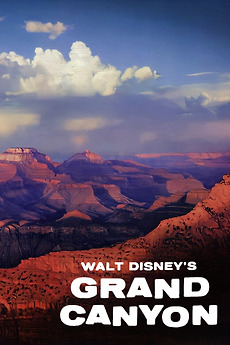
Disney’s 1958 film Grand Canyon won the Academy Award for best short film. The music written for the film by composer/arranger Ferde Grofé lived on long past the film itself in the form of the Grand Canyon Suite. Of the five movements of the full suite, the LSO will play the most familiar: “On the Trail,” describing the steady gait of donkeys into the canyon and their race back to the barn; and a movement depicting an afternoon “Cloudburst.”
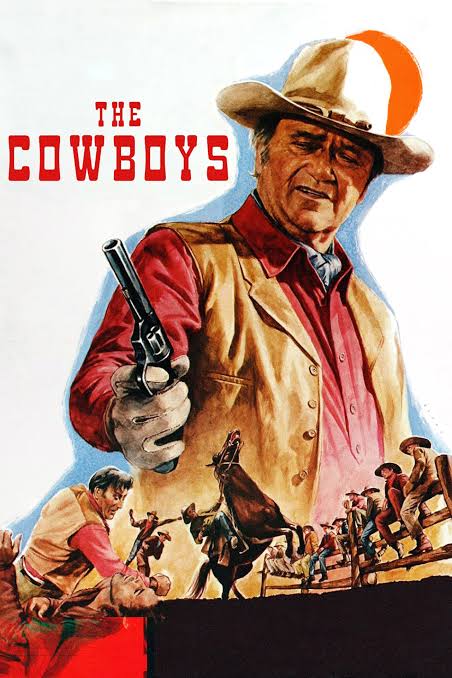
The 1972 Western film The Cowboys starred John Wayne, Bruce Dern, Colleen Dewhurst and Slim Pickens. The music for the film was one of John Williams’s earlier film scores, and the Overture Williams wrote drawn from the film creates an intense, uptempo portrayal of a cattle drive and the young cowboys who are the film’s subjects.
Agnes de Mille’s ballet Rodeo had its premiere in 1942 at the Metropolitan Opera House, receiving 22 curtain calls. The success was due not only to de Mille’s inventive choreography—which led to her selection to choreograph Rogers and Hammerstein’s Broadway hit Oklahoma—but also the music by Aaron Copland. Subtitled “The Courting at Burnt Ranch,” the ballet tells the story of the romance between the Cowgirl and the Champion Roper.
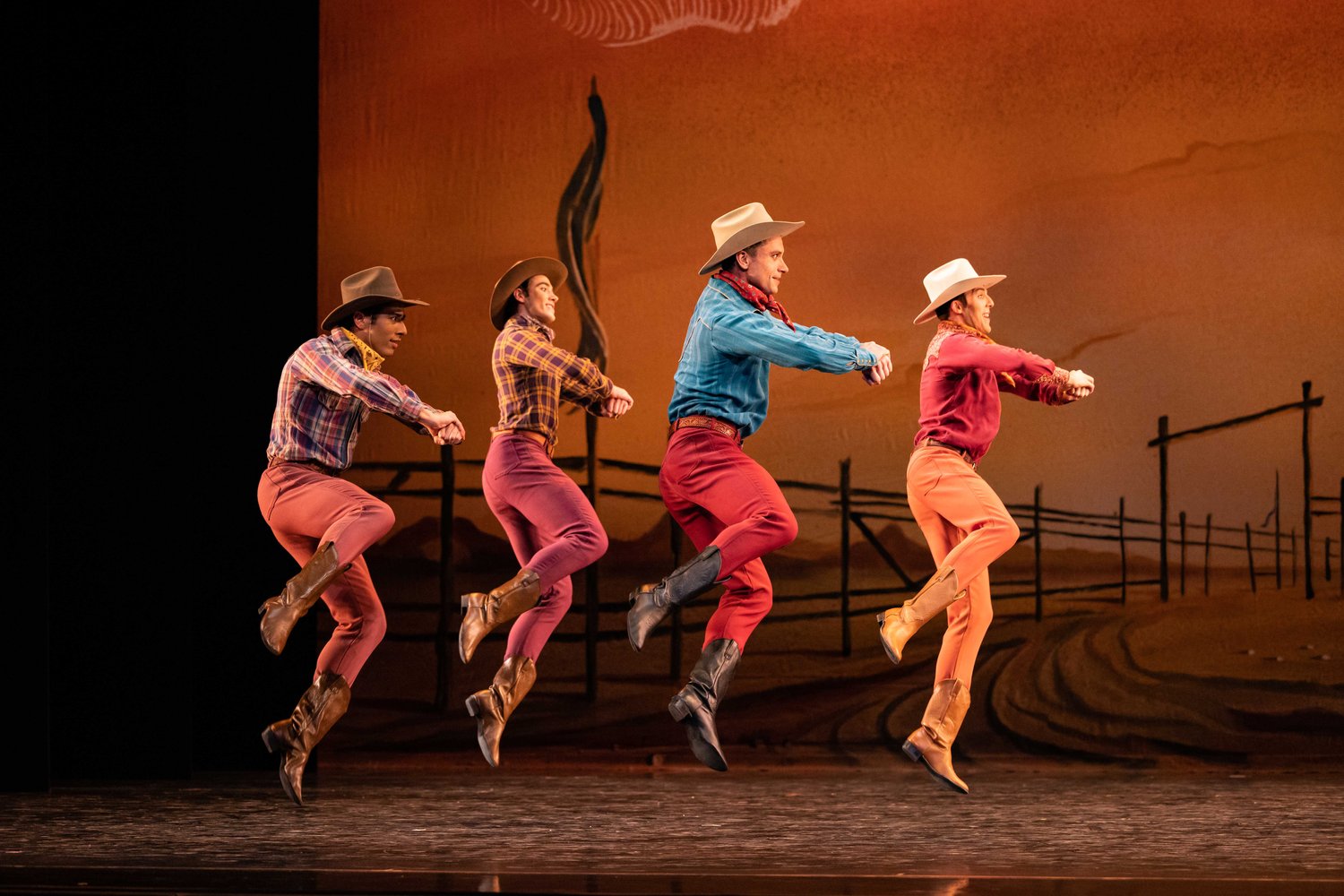
Vinicius Lima, Joseph Lynch, Brian Waldrep (“Head Wrangler”) and Tyler Gum (“Champion Roper”) in “Buckaroo Holiday” from Aaron Copland’s and Agnes de Mille’s Rodeo. Photo by Beau Pearson.
From its use in the orchestral suite and television commercials, Copland’s “Hoedown” from Rodeo has become instantly recognizable as musical Americana. Copland incorporates several fiddle tunes into the “Hoedown,” including “Bonaparte’s Retreat” and “Miss McLeod’s Reel.” The LSO will play the full ballet score, including sections titled “Buckaroo Holiday,” “Corral Nocturne,” “Ranch House Party” and “Saturday Nigh Waltz.”
In addition to these popular pieces inspired why the American West, the LSO Pops program includes Leroy Anderson’s Fiddle Faddle,The American Frontier by Calvin Custer and Cowboy Rhapsody by Morton Gould.
# # # # #
“Pops: A Western Hoedown“ Longmont Symphony Orchestra, Elliot Moore, conductor
Leroy Anderson: Fiddle Faddle
Richard Hayman: Pops Hoedown
Ferde Grofé: Grand Canyon Suite
Calvin Custer: The American Frontier
John Williams: Overture to The Cowboys
Morton Gould: Cowboy Rhapsody
Aaron Copland: Rodeo
7 p.m. Saturday, May 3, Vance Brand Civic Auditorium
Programs feature piano quartet, acrobatics and film music
By Peter Alexander May 1 at 4:38 p.m.
The Boulder Piano Quartet presents it’s final concert of the 2023-24 season Friday featuring music by Dvořák and the 19th-century French musical prodigy Mélanie Hélène Bonis Domange, known as Mel Bonis (7 p.m. May 3 at the Academy University Hill; further details below).
This will be the fourth and final performance this concert season to feature a guest violinist with the Quartet, appearing in place of their former violinist Chas Wetherbee, who died in 2023. The guest violinist for this performance will be Hilary Castle Green.
Mel Bonis
This program is the second time that the Boulder Quartet has played music by Bonis, who is virtually unknown in the United States. About a year ago in May 2023, they played her Second Piano Quartet. This year they are playing her First Quartet in B-flat major.
Born in 1858, Bonis taught herself to play piano and entered the Paris Conservatory at 16. She was in the same class with Debussy, and studied composition with Cesar Franck. At the time women were not expected to be composers, and Bonis was urged by her parents to marry an older businessman. Because he didn’t like music, she gave up composing for a number of years.
Later she met a former classmate who encouraged her and connected her with publishers, which led her to begin writing music again. She wrote the First Piano Quartet soon after, in 1901. When the composer Camille Saint-Saëns heard the Quartet, he is supposed to have said “I never thought a woman could write such music.” After her husband died in 1918, Bonis devoted herself to music.
Dvořák won the Australian State Prize for composition—in effect a grant to allow artists the time for creative work—in 1875. At 34 years of age he was still relatively unknown to the larger musical world, even though he had written four symphonies, seven string quartets, three operas, and other works. During that year he wrote a number of larger pieces, including his Symphony No. 5, his Serenade for Strings and the Piano Quartet No. 1 in D major.
The Quartet is in the standard classical chamber-music structure of three movements, arranged fast, slow, fast. Unlike other quartets of the time, the piano is not placed separate from, or against the strings, as if it were a chamber concerto. Instead the four parts are more fully integrated. Though only three movements, the Quartet is an expansive work. It was not performed for nearly five years, however, having its premiere in Prague in 1880.
# # # # #
Boulder Piano Quartet: Matthew Dane, viola, Thomas Heinrich, cello, and David Korevaar, piano, with guest violin Hilary Castle Green
Mel Bonis: Piano Quartet No. 1 in B-flat major
Dvořák: Piano Quartet No. 1 in D major, op. 23
7 p.m. Friday, May 3, Academy Chapel Hall, Academy University Hill Admission free with advance reservations
# # # # #
The Boulder Philharmonic will continue its relationship with the performing group Cirque de la Symphonie with two performances Saturday in Macky Auditorium (2 and 7:30 p.m. May 4; details below).
Classical music’s answer to Cirque du Soleil, Cirque de la Symphonie presents aerialists, jugglers, ribbon dancers, acrobats, contortionists and other acts to the accompaniment of classical music performed live on stage. Macky Auditorium will be especially rigged for the aerial acts, and the front of the stage reserved for other performers. The performance of selected short classics will be conducted by Renee Gilliland, associate director of orchestras at CU Boulder.
Renee Gilliland
This will be the fifth time that the Boulder Phil has hosted Cirque de la Symphonie at Macky. Their last previous appearance was in 2018. While limited tickets are still available for both scheduled performances Saturday, previous Cirque performances have sold out.
Gilliland earned a Doctor of Musical Arts in orchestral conducting and literature from CU Boulder, a Master of Music in viola performance with an outside area in conducting from the Indiana University Jacobs School of Music, and a Bachelor of Music in music education and certificate of violin performance from the University of Texas at Austin Butler School of Music. She was also awarded an Artist Diploma in orchestral conducting from the University of Denver where she was assistant conductor of the Lamont School of Music Symphony and Opera Theater orchestras.
She was formerly music director of the CU Anschutz Medical Orchestra and associate conductor of the Denver Philharmonic.
# # # # #
“Cirque Returns” Boulder Philharmonic Orchestra, Renee Gilliland, conductor With Cirque de la Symphonie
NOTE: Indications of which pieces are played by the orchestra alone without Cirque performance added 5/2.
# # # # #
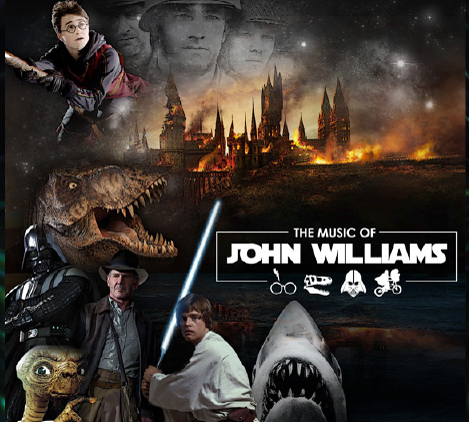
The Longmont Symphony Orchestra (LSO) concludes its 2023-24 concert season Saturday (May 4) with “A Tribute to John Williams,” featuring the music of one of Hollywood’s greatest film composers.
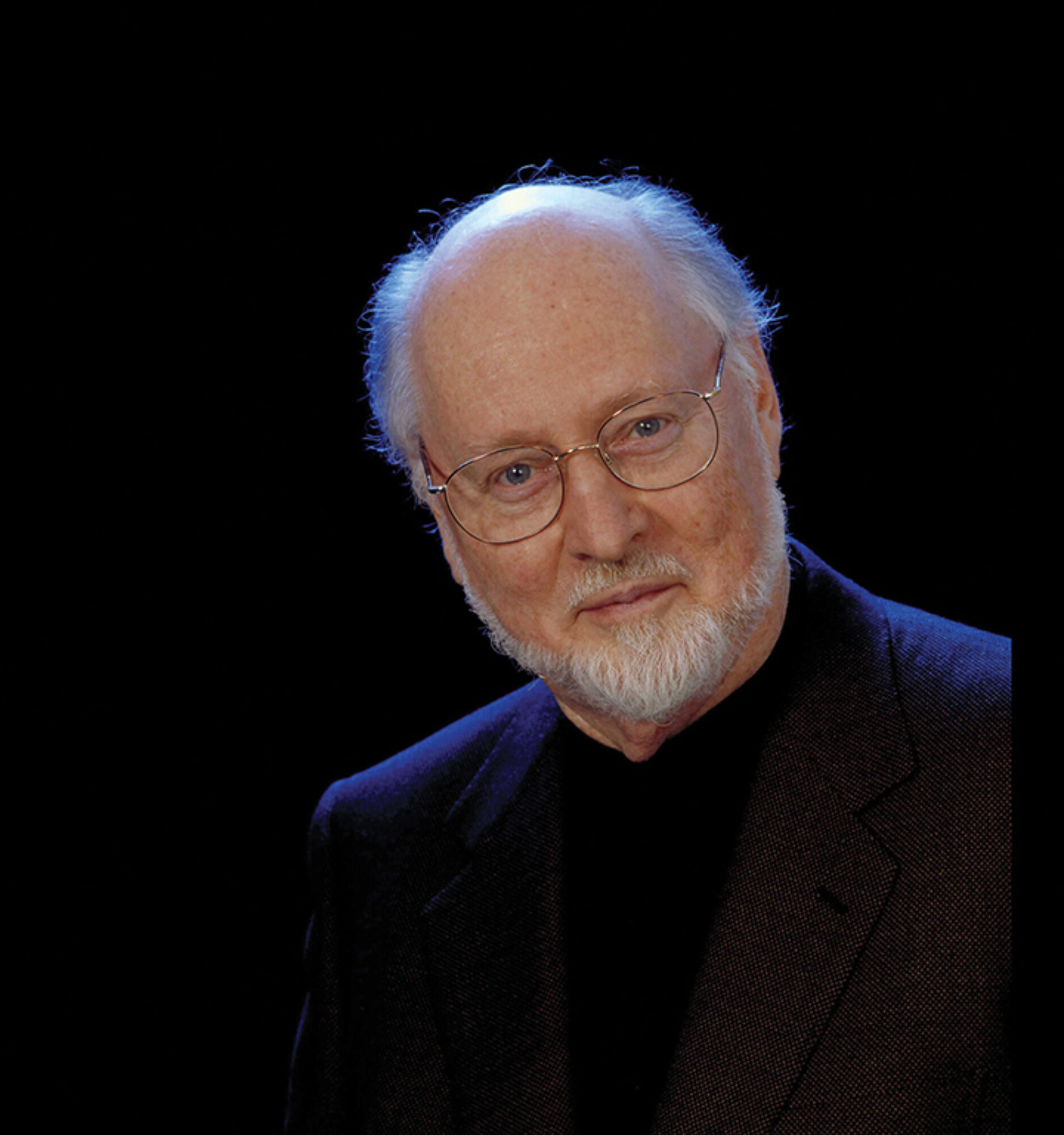
John Williams
The Pops Concert, at 7 p.m. in Longmont’s Vance Brand Civic Auditorium, will be under the direction of the LSO’s music director, Elliot Moore. The program will include music from the soundtracks for Star Wars, Jurassic Park, E.T. and Harry Potter, among other popular films.
With more than 1100 tickets already sold, there are only a few seats left at time of posting. Because of the size of crowd expected, the LSO advises attendees to arrive early. Overflow parking from the Skyline High School lot will be available at the Timberline School lot, on Mountain View Avenue.
# # # # #
Tribute to John Williams Longmont Symphony Orchestra, Elliot Moore, conductor
Music of John Williams
7 p.m. Saturday, May 4 Vance Brand Civic Auditorium, Longmont
Music from Star Wars, Jaws, Raiders of the Lost Ark, E.T., and more
By Peter Alexander Sept. 25 at 10:15 p.m.
Boulder Philharmonic Orchestra
From Jaws to Harry Potter and Star Wars, John Williams has written some of the most familiar music of the past 45 years, across generations, social classes and all varieties of musical taste.
Composer John Williams
“I dare say that Williams is a well known entity” Michael Butterman, music director of the Boulder Philharmonic, says with a smile. And so he admits that the orchestra is not breaking new ground when they perform “A Tribute to John Williams” as their opening event of the 2018–19 season, Saturday (Sept. 29) in Macky Auditorium.
“This (concert) is more in the camp of wanting to create experiences that are broadly appealing to as wide a swath of the community as possible,” Butterman says. “Williams’s music has an appeal to people who love great orchestral sonorities, as well as people who love any of the great movies that he’s scored.”
To reach that broad audience, he and the orchestra are presenting music from some of Williams’s best known films, including Jaws—his first big hit, from 1975—Star Wars (1977), Raiders of the Lost Ark (1981), E.T. (1982), Jurassic Park (1993), and Harry Potter and the Sorcerer’s Stone (2004). He also selected music from some less familiar films, including The Cowboys (1972), The Terminal (2004) and Memoirs of a Geisha (2005).
Michael Butterman
Butterman’s aim in choosing music for the concert was to showcase the wide variety of styles that Williams can adopt in his scores. “There’s really just no end to the variety that this guy is capable of,” he says. “If there is a discovery to be made here, or at least a reminder, it’s that he has an ability to write in a huge variety of styles, and do it really effectively in each one.”
If Williams is known for anything to students of film music, it’s not his originality, but his ability to assimilate many different styles, and to create a mood in just a few notes. For example, it is no secret that the “Imperial March” from Star Wars has a striking resemblance to “Mars the Bringer of War” from Holst’s Planets. Nor is it disputed that it perfectly creates the impression of grandeur and menace that the forces of The Empire require.
John Williams with one of his Oscars
That ability to capture exactly the right style to pull the movie audience into the scene is the essence of great film music. And John Williams has it to such a degree that he has been nominated for no fewer than 50 Academy Awards, and has won five of the golden statuettes.
“The music is there to nonverbally transport the listener to a time and place, and he can do that with just a few notes or a couple of chords,” Butterman says. “There are works where he channels a particular culture, like Memoirs of a Geisha where he’s writing in a style that is evocative of Asian music, or Angela’s Ashes where there’s an Irish or British Isles feel to the music, or “Viktor’s Tale”from The Terminal where he’s channeling a sort of folksy central European feel.”
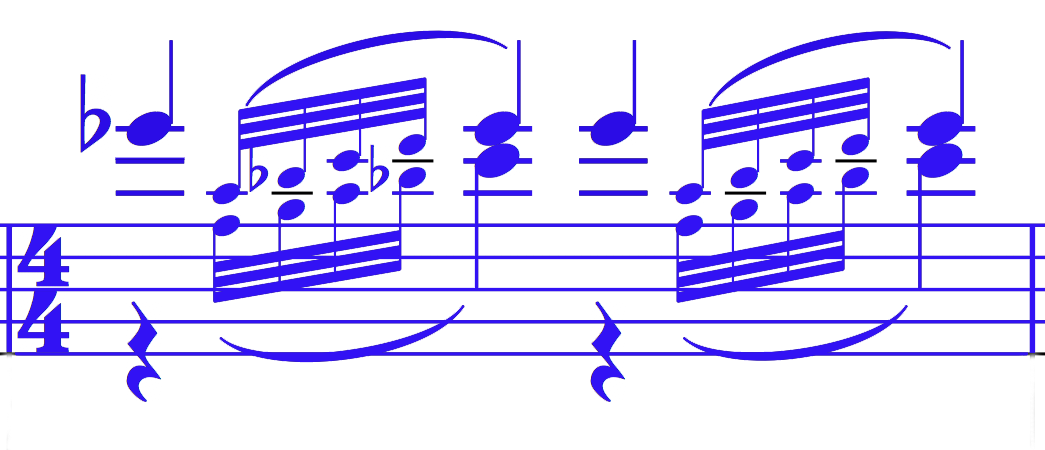
The concert will open with the “Superman March”—in case you forgot, Williams wrote music that was used in all four of the Christopher Reeves films (1978–87). Early on you will hear what is likely the most famous and terrifying two-note theme ever written, and the program ends with one of the greatest opening fanfares of any film—but I don’t have to identify those, do I?
Hint: Both scores won an Academy Award.
# # # # #
A Tribute to John Williams
Boulder Philharmonic Orchestra, Michael Butterman, conductor
7:30 pm. Saturday, Sept. 29
Macky Auditorium
Music from Star Wars, Jaws, Raiders of the Lost Ark, E.T., Jurassic Park, Harry Potter and the Sorcerer’s Stone, and other films






 Sharps & Flatirons