GRACE NOTES: Prominent violinists and a sold-out Ugly Duckling

Vadim Gluzman, Ray Chen and the Colorado Symphony in Boulder and Longmont 

By Peter Alexander March 19 at 4:06 p.m.

The Boulder Bach Festival (BBF) will present the Ukrainian-Israeli violinist Vadim Guzman in a program that spans centuries, from J.S. Bach to Arvo Pärt.

The final concert of BBF’s 2023–24 season, Gluzman’s performance occurs on Bach’s birthday, at  4 p.m. Thursday, March 21 (Dairy Arts Center; details below). He will perform with the BBF CORE (COmpass Resonance Ensemble) and be joined by BBF music director Zachary Carrettin for Bach’s Double Violin Concerto.

Known for his wide repertoire, Gluzman has premiered works by Sofia Gubaidulina, Michael Daugherty and Pēteris Vasks, among others. His recordings have won numerous awards, including Gramophone magazine’s Editor’s Choice, and Disc of the Month from The Strad, BBC Music Magazine and other publications. He is currently distinguished artist-in-residence at the Peabody Conservatory. He performs on the 1690 ‘ex-Leopold Auer’ Stradivari, on extended loan through the Stradivari Society of Chicago.

# # # # #

“Old and New Dreams”
Boulder Bach Festival CORE with Vadim Gluzman and Zachary Carretttin, violin

Program includes:

  • J.S. Bach: Violin Concerto in A minor, S1040
  • Arvo Pärt: Passacaglia
  • J.S. Bach: Concerto in D minor for two violins, S1043

4 p.m. Thursday, March 21
Gordon Gamm Theater, Dairy Arts Center

TICKETS

# # # # #

The CU Presents Artist Series will feature violinist Ray Chen, who is billed as “redefining what it means to be a classical musician in the 21st century,” together with Hispanic-American pianist Julio Elizalde in a concert program combining serious and lighter works Thursday ( 7:30 p.m. March 21 in Macky Auditorium; details below).

The major works on the program are Beethoven’s Violin Sonata No. 7 in C minor, op. 30 no. 2, and J.S. Bach’s Partita No. 3 in E major for solo violin, S1006. Filling out the program are encore material pieces, starting with Tartini’s showpiece the “Devil’s Trill” Sonata. After the two heavier works, Chen and Elizalde will wrap up the program with Antonio Bazzini’s brilliant “Dance of the Goblins,”  Fritz Kreisler’s arrangement of Dvořák’s Slavonic Dance No. 2, and their own arrangement of “Spain” by Chick Corea.

Beethoven’s Violin Sonata No. 7 is part of a set published in 1803 as “Sonatas for the pianoforte with the accompaniment of violin.” This label reflects an earlier time, when domestic music-making often featured female pianists, who were expected to have more time to practice than their male partners on violin, and who therefore could master more difficult parts. In the case of this Sonata, each movement opens with the piano and the violin part, while it is not insignificant, often follows the lead of the piano. Unusually for a piece named “sonata,” the Sonata No. 7 is in four movements, and the key of C minor marks it as an often dramatic and stormy work.

Bach’s Third Partita is a suite of dances, preceded by a Preludio. It is the last of his set of Six Sonatas and Partitas for solo violin, one of the pinnacles of the solo violin repertoire. In the bright key of E major, it is one of the most cheerful of the set. That is particularly true of the Preludio, a perpetual-motion movement that is one of Bach’s most familiar pieces. Apparently Bach was himself fond of this movement, which he re-used in a version for organ and orchestra in his Cantata No. 29.
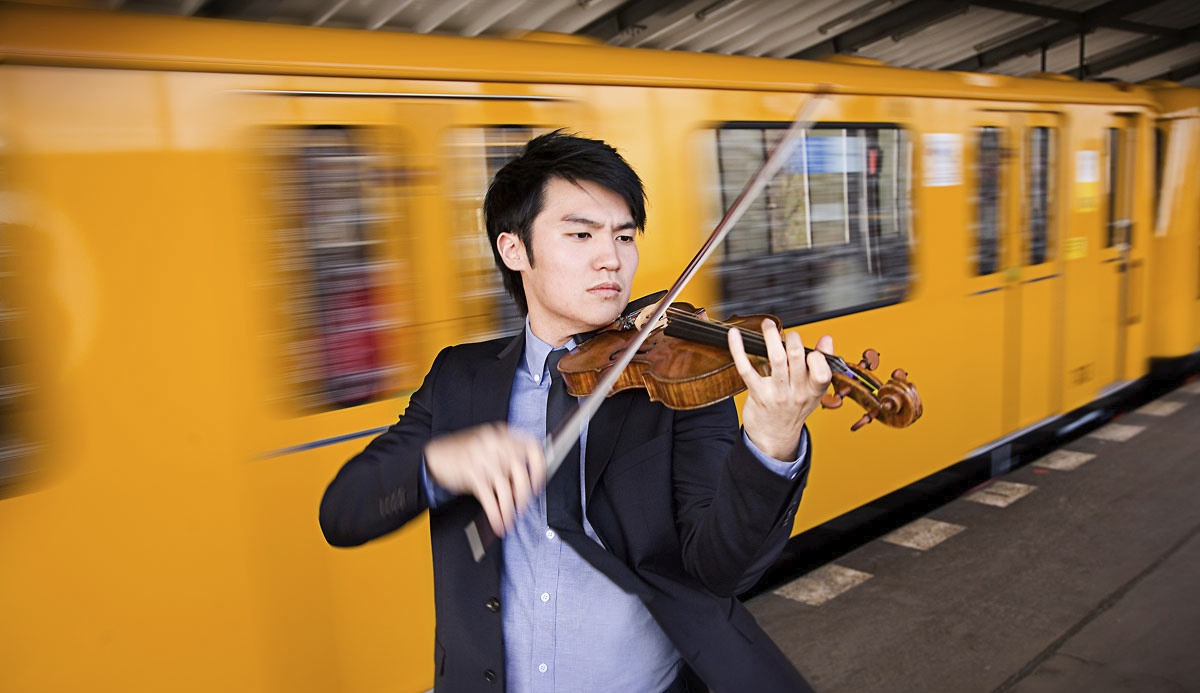
Violinist Ray Chen

Chen came to wide attention in the music world when he won first prize in both the Yehudi Menuhin and Queen Elizabeth violin competitions, in 2008 and ’09 respectively. He is known for his use of social media to reach a wider audience, including as a co-founder of the Tonic Website that allows young musicians to practice and learn together.

Born in Taiwan and raised in Australia, he was accepted at Philadelphia’s Curtis Institute at the age of 15. He plays the 1714 “Dolphin” Stradivarius violin on loan from the Nippon Music Foundation and once owned by Jascha Heifetz. 

Pianist Julio Elizalde has been performing as a recital partner with Chen and violinist Sarah Chang for nearly ten years. A native of the San Francisco Bay area, he is a graduate of the San Francisco Conservatory of Music, where he is currently on the faculty, and the Juilliard School. He has collaborated with several living composers including Osvaldo Golijov, Stephen Hough and Adolphus Hailstork.

# # # # #

Ray Chen, violin, and Julio Elizalde, piano

  • Giuseppe Tartini: Sonata in G minor (“Devil’s Trill”; arr. Fritz Kreisler)
  • Ludwig van Beethoven: Violin Sonata No. 7 in C minor, op. 30 no. 2
  • J.S. Bach: Partita No. 3 in E major for solo violin, S1006
  • Antonio Bazzini: La Ronde des Lutins (“Dance of the Goblins”), op. 25
  • Dvořák: Slavonic Dance No. 2 in E minor, op. 72 (arr. Fritz Kreisler)
  • Chick Corea: “Spain” (arr. Elizalde and Chen)

TICKETS

# # # # #

Members of the Colorado Symphony will visit the Longmont Museum’s Stewart Auditorium Saturday (March 23) of present a bilingual concert that tells the story of “The Ugly Duckling.”

The interactive performance in English and Spanish, dubbed a “Mini Música,” will incorporate storytelling, singing and dance. It will be accompanied by a 16-piece orchestra made up of members of the Colorado Symphony.

The performances at 10 and 11:30 a.m. are free, but both are already full with advance reservations.

# # # # #

“The Ugly Duckling” Mini Música
Members of the Colorado Symphony

10 and 11:30 a.m. Saturday, March 23
Stewart Auditorium, Longmont Museum

SOLD OUT

CORRECTION on March 19: the word ”Música,” which had inadvertently dropped out, was restored in the penultimate paragraph of the story about Colorado Symphony’s performance of “The Ugly Duckling.”
News on the boil in the World of Classical Music

Controversy and a milestone at the MET; Trouble in Atlanta

By Peter Alexander

It’s the unwatched pot that boils, and if you haven’t been watching, there’s been lots of boiling going on in the classical music world this fall.

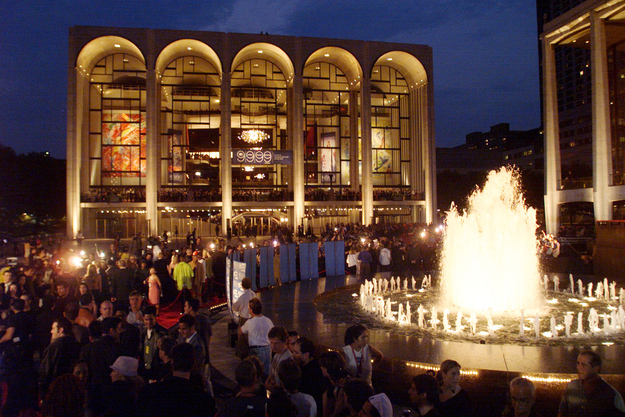
Lincoln Center Plaza and the Metropolitan Opera House

Lincoln Center Plaza and the Metropolitan Opera House

This summer I reported several times on the labor dispute that threatened to cause a lockout and the cancellation of the season for the Metropolitan Opera. Happily, the lockout was averted, but that has not kept the Met from being a center of controversy.

As part of their season, the Met had announced performances of The Death of Klinghoffer by John Adams. This opera was composed in 1991 on the subject of the 1985 hijacking of the cruise ship the Achille Lauro by members of the Palestinian Liberation Front and the subsequent murder of Leon Klinghoffer, a wheelchair-bound 69-year old Jewish American tourist whose body was dumped into the Mediterranean.

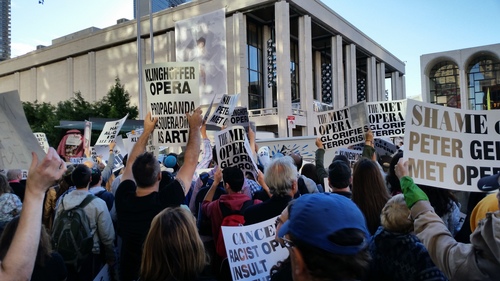
Klinghoffer protesters

Protesters outside the Metropolitan Opera House in Lincoln Center

The opera was originally created with the cooperation of Klinghoffer’s family, who later objected that it glorified the hijackers. Nevertheless, the opera has been performed uneventfully in several locations—but the Metropolitan is not just any opera company, and New York is always in the spotlight. And it is an especially important location for American Jews. So when Met General Manager Peter Gelb announced that The Death of Klinghoffer would be featured on the Met’s Live in HD series broadcast live to movie theaters around the world, there were protests and loud criticism of the Met. The claim was repeatedly made that the opera, by humanizing, or glorifying (depending on your point of view) the killers, was anti-semitic.

Scene from 'The Death of Klinghoffer.' Photo by Ken Howard/Metropolitan Opera

Scene from ‘The Death of Klinghoffer.’ Photo by Ken Howard/Metropolitan Opera

Eventually, The Death of Klinghoffer was dropped from the Live in HD broadcast series, but it remained on the Met season. It opened last Monday (Oct. 20), with a phalanx of protesters filling the Lincoln Center plaza, some minor disturbances inside the house, and generally glowing reviews for the work and the performance.

For anyone who cares about opera, or gives much thought to contemporary art forms, The Death of Klinghoffer has been a remarkable case study. Regardless of your personal opinion, the decision to write an opera on such a volatile contemporary subject, and the decision to produce it at the Met, are worthy of serious consideration and discussion. Rather than reconstruct what people who have seen the production have said, here are links to more about this remarkable opera and production.

Just about the best review and report of opening night was that written by Alex Ross for The New Yorker.  Anthony Tommasini wrote an even longer report in the New York Times.  And David Patrick Stearns had a slightly different take on the events for the Philadelphia Inquirer.

There are many more reviews. The Chicago Tribune complied a handy list of reviews and articles. Almost all are worth reading.

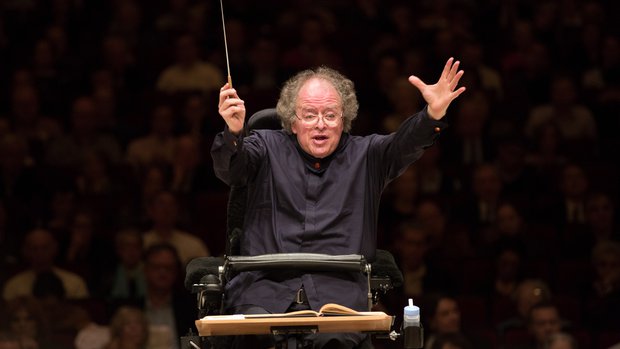
James Levine leading the Met Orchestra in 2013. (AP Photo/Metropolitan Opera, Marty Sohl)

James Levine leading the Met Orchestra in 2013. (AP Photo/Metropolitan Opera, Marty Sohl)

But not all the news from the Metropolitan Opera has been disturbing, or even controversial. This past weekend, James Levine conducted his 2,500th performance at the Met—a staggering number that is just about beyond comprehension. It is more than twice as many as the next most prolific conductor in the Met’s history, the long-forgotten Arthur Bodanzky. The milestone performance was Mozart’s Nozze di Figaro (Marriage of Figaro) Saturday night—only the 77th time he has conducted that particular work. (Those and other numbers from Levin’s remarkable Met career were reported by the New York Times.)

This would be a remarkable milestone for any conductor, but in Levine’s case, it is especially noteworthy since it was only two years ago that it appeared his conducting career might be over. But he has come back from serious injuries, and is back at work in the opera house—to the relief of his fans and fans of the Met who have a hard time imagining how anyone can follow him and maintain the reputation Levine has created for the Met and its orchestra.

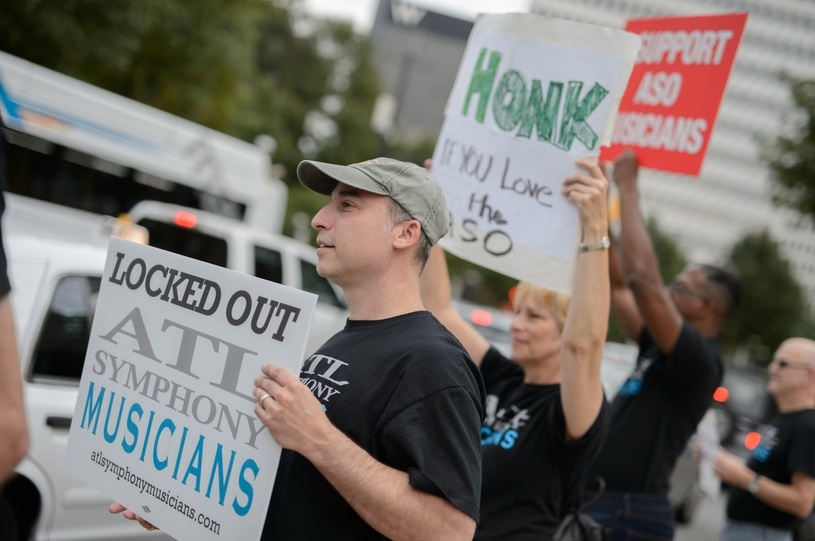
Daniel Laufer was among the supporters of the Atlanta Symphony Orchestra musicians who was picketing outside the Woodruff Arts Center in Atlanta. (Michael A. Schwarz/For the Washington Post)

Daniel Laufer was among the supporters of the Atlanta Symphony Orchestra musicians who was picketing outside the Woodruff Arts Center in Atlanta. (Michael A. Schwarz/For the Washington Post)

While the Met was resolving a labor dispute and averting a lockout this summer, the Atlanta Symphony has been dealing with a lockout and at least a partial cancellation of their season.

The sticking point in Atlanta is the proposal by management to further cut the size of the orchestra, which had previously been reduced to 88 musicians from an original compliment of 95 players. As a means of fighting deficits, the management wanted full control of the orchestra’s size and proposed cutting the orchestra—largely by leaving positions unfilled—to 76 players. Both the players and the orchestra’s conductors said that the Atlanta Symphony, an honored ensemble that has counted Robert Shaw and Yoel Levi among its music directors, could not maintain it’s standing with only 76 players.

After a bitter battle that eventually led to mediation, this one issue seems to have brought all negotiations to a halt. After the 15-month lockout nearly closed the Minnesota Orchestra permanently, this is very disheartening news. The most recent news about the ASO comes from the Atlanta Arts and Culture Blog, here and here. Earlier articles from NPR and the Washington Post provide more of the background.

A second major orchestra lockout in only a few years is bad news for America’s musicians, and those who support them and their work. The only silver lining from here is that we are not facing a similar crisis in Boulder, and we still have great riches of orchestral music to chose from. But it is interesting background for the still unfolding issue in Denver, concerning the Colorado Symphony’s future in Boettcher Concert Hall—where the pot, watched or not, boils on.