The Boulder Chamber Orchestra is first out of the gate of the city’s five orchestras that present a season every year.
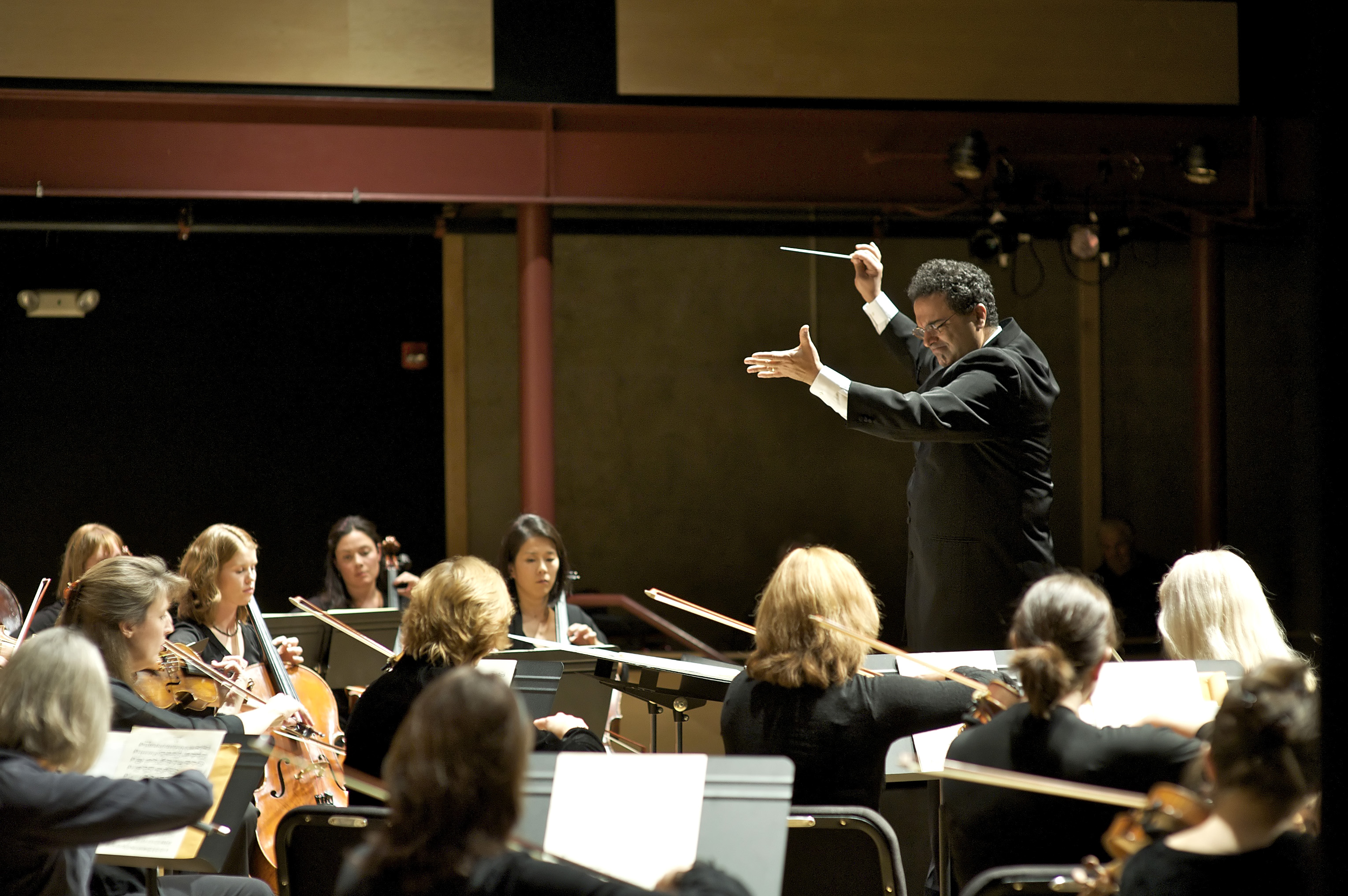
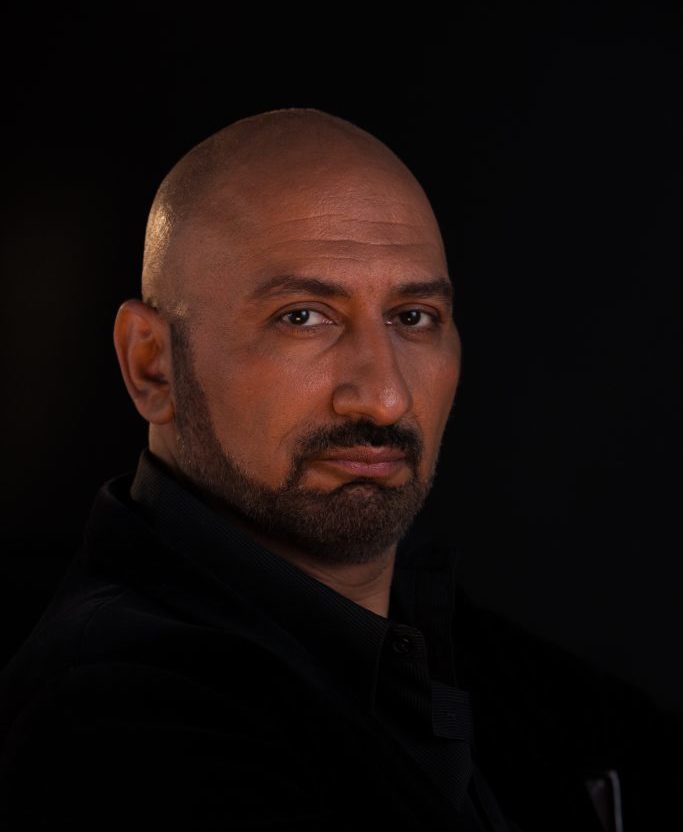
Bahman Saless with the Boulder Chamber Orchestra. Photo by Keith Bobo.
Their opening concert for the fall of 2023–24, featuring music by Mozart, Beethoven and Dvořák, will be the coming Saturday (Sept. 16 at 8 p.m. at the Boulder Adventist Church; program below) and will feature solo appearances by violinist Jubal Fulks and pianist Petar Klasan. Music director Bahman Saless will conduct.
This is ahead of all other local orchestras—the Boulder Philharmonic, the Boulder Symphony, the Pro Musica Colorado Chamber Orchestra and the University Symphony—by two weeks or more.
If there is a theme to the season, it might be the presentation of three different piano concertos by Beethoven by three different soloists: Concerto No. 3 played by Petar Klasan Sept. 16; Concerto No. 2 played by Adam Zukiewicz Oct. 21; and the “Emperor” Concerto played by Jennifer Hayghe in 2024. There is also the usual mixture of very familiar composers (Beethoven! Mozart!) with quirky, unfamiliar composers (Jim Klein and Ian Jamison! Maxim Goulet!) that reflect Saless’ eclectic tastes.
December offers the world premiere of a flute concerto written for the BCO and principal flutist Cobus DuToit by Czech composer Sylvie Bodorova. Compiled from previous works, the concerto was suggested to Saless this past summer when he met Bodorova in a conducting workshop.
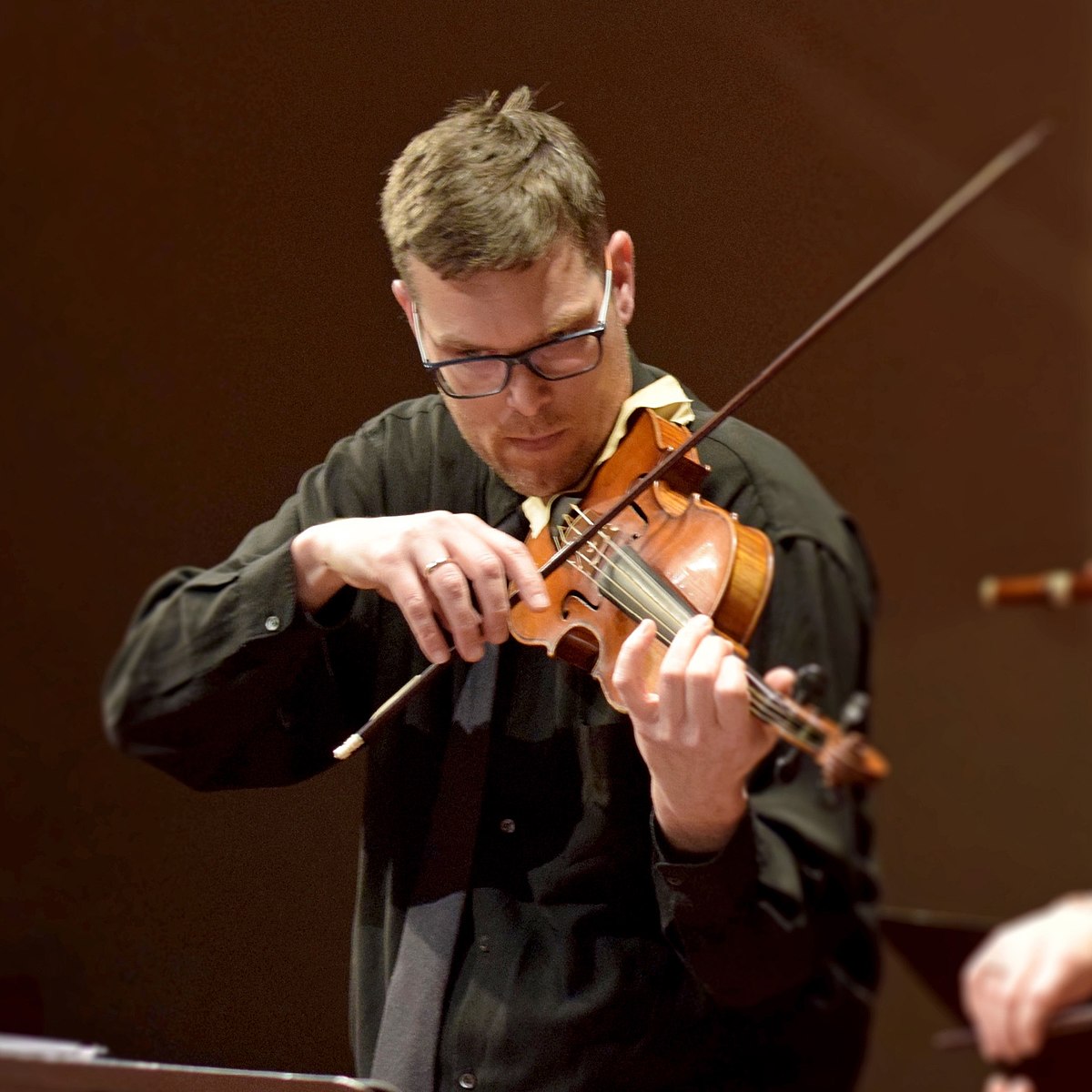
Jubal Fulks
The “Romance” in the title of Saturday’s opening concert comes from Dvořák’s Romance in F minor for violin and orchestra. A gently enchanting piece, it was derived from the slow movement of the composer’s String Quartet no. 5 in F minor. The soloist, Jubal Fulks, teachers violin and heads the string area at the University of Northern Colorado.
Mozart’s Symphony No. 35 has a somewhat complicated backstory, having been preceded by two different serenades Mozart wrote for the Haffner family of Salzburg. The first, written for a wedding in 1776, is known today as the “Haffner Serenade.” Portions of the second, commissioned for the ennoblement of Siegmund Haffner in 1782, became Symphony No. 35, first performed in Vienna in 1783.
Beethoven composed his Third Piano Concerto in or around 1800—the exact date is disputed—and gave the first performance on a concert in April 1803 on which he also presented first performances of his Symphony No. 2 in D major and his oratorio Christ on the Mount of Olives. Although the concerto was complete, at least in the composer’s head, he had not yet written it all down. Ignaz von Seyfried, a friend who turned pages at the performance, later reported that almost all the pages were blank!
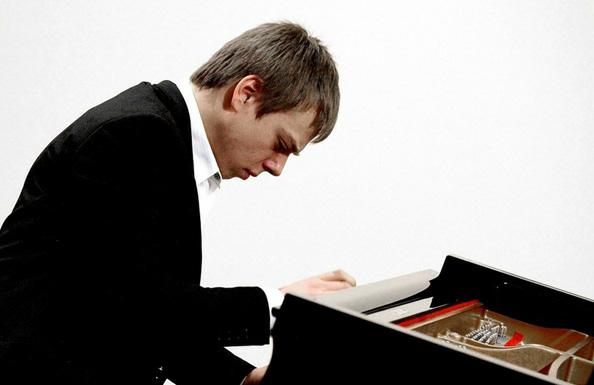
Petar Klasan
“He played nearly all the solo part from memory since, as was so often the case, he had not had time to set it all down on paper,” Seyfried wrote.
With BCO, the soloist will be Croatian pianist Petar Klasan, who fortunately has studied Beethoven’s completed score. A prize winner in several European competitions, Klasan, 21, is a fellow of the International Music Academy in the Principality of Liechtenstein. He currently lives in Vienna, where he continues his studies and performs with “Con Brio,” a concert series that he founded in 2018.
A full listing of the BCO’s 2023–24 season, and access to ticket purchases, can be found on the orchestra’s Web page.
# # # # #
Boulder Chamber Orchestra 2023 Fall Concert Schedule
“Romance and Intrigue” Boulder Chamber Orchestra, Bahman Saless, conductor With Petar Klasan, piano, and Jubal Fulks, violin
Dvořák: Romance in F minor for violin and orchestra
“Mozart Mass and More” Boulder Chamber Orchestra, Bahman Saless, conductor Boulder Chamber Chorale, Vicki Burrichter, conductor
Jim Klein and Ian Jamison: Summation for choir and orchestra
Mozart: Mass in C minor
7:30 p.m. Friday Oct. 6 First United Methodist Church, 1421 Spruce, St. Boulder
“Capturing the Folk Spirit” Mini-Chamber Concert 1 Hsing-sa Hsu, piano, with members of the orchestra
Bartók: Romanian Folk Songs for violin and piano
Dvořák: Quintet for piano and strings in A major
Brahms: Klavietstücke, op. 118 no. 3
7:30 p.m. Sunday, Oct. 21 Boulder Adventist Church
Holidays Celebration Boulder Chamber Orchestra, Bahman Saless, conductor Nadia Artman, guest conductor With Adam Zukiewicz, piano, and Cobus DuToit, flute
Mozart: Overture to Marriage of Figaro
Maxime Goulet: Chocolats Symphonique
Sylvie Bodorova: Concerto for Flute and Orchestra (2023; world premiere)
Beethoven: Piano Concerto No. 2 in B-flat, op. 19
7:30 p.m. Saturday, Dec. 16 Boulder Adventist Church
TICKETS for all concerts available at the Boulder Chamber Orchestra Web site.
NOTE: Correction of spell-corrector errors, 9/12: paragraph 2, the violin soloists name is Jubal Fulks, not Forks; paragraph 4 and penultimate paragraph, the soloists name for the Third Concerto is Petar Klasan, not Peter.
I will be taking the next 2–3 weeks off from SharpsandFlatirons. During that period I will not be writing . . . anything! Around Sept. 1 I will be back with some long-planned CD reviews and the first previews of the coming season. Until then I wish you all a very pleasant August and I look forward to being back when the Fall performance season gets under way.
Rusalka and Flying Dutchman come to life in their music
By Peter Alexander Aug. 10 at 11:15 a.m.
Dvořák’s remarkable, beautiful opera Rusalka(Aug. 4) is based on the widespread folk tale of a water spirit, or mermaid, who falls in love with a human, with tragic consequences. As a fairy tale, it is open to many imaginative treatments in performance.
Many, but not all.
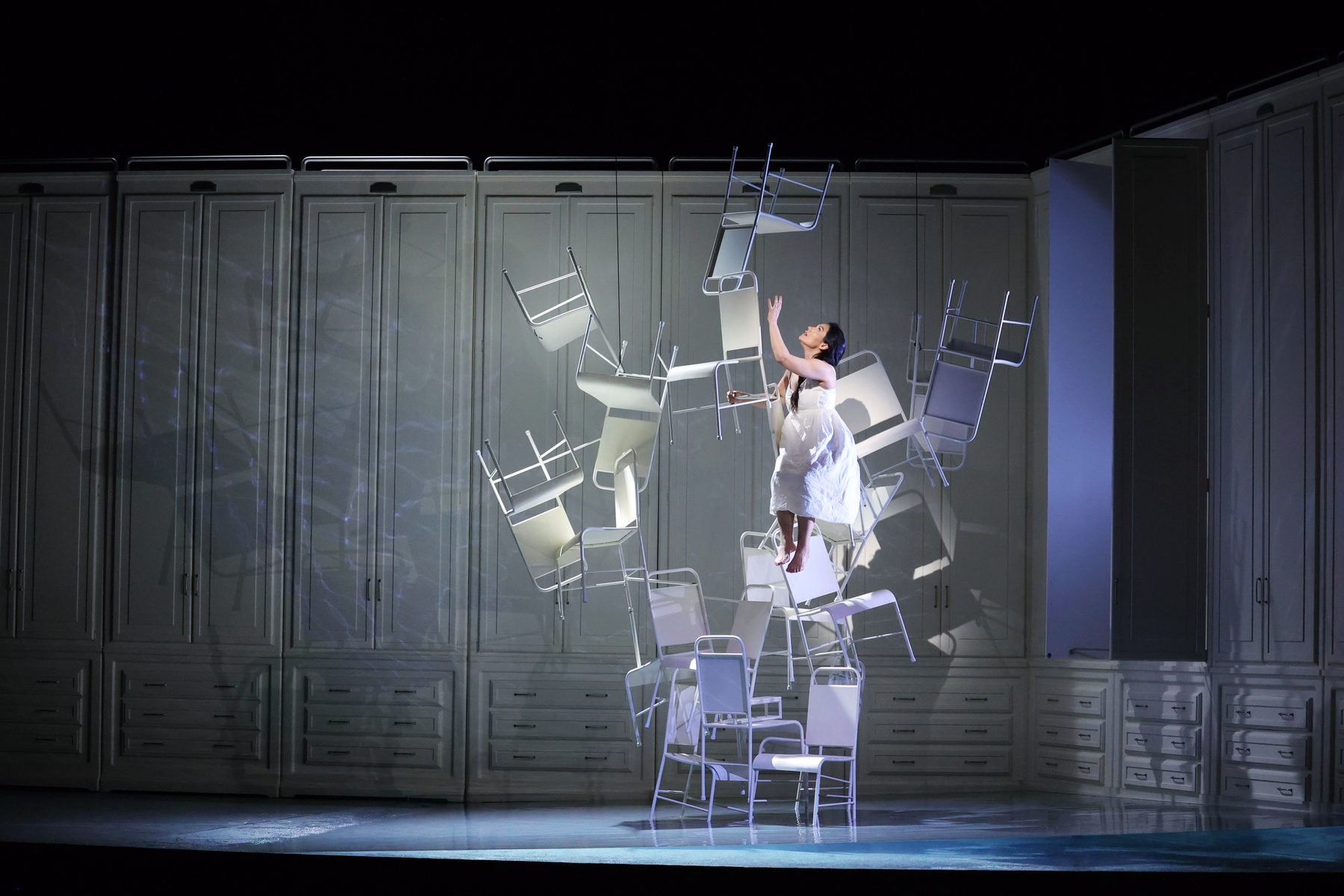
Ailyn Pérez (Rusalka). Photo by Curtis Brown for the Santa Fe Opera.
Santa Fe’s production is designed by Leslie Travers, with costumes by Marie-Jeanne Lecca, and directed by Sir David Poultney. There are significant aspects of the original tale that point to the placement of the opera in an asylum, with attendants in white looking over the characters. Rusalka, the spirit who wants to escape the watery realm in order to love a human, is clearly a dreamy misfit, rebelling against her restricted existence—the kind of free spirit who often found themselves confined in Victorian asylums, eager to escape just as Rusalka wants to escape into the human world.
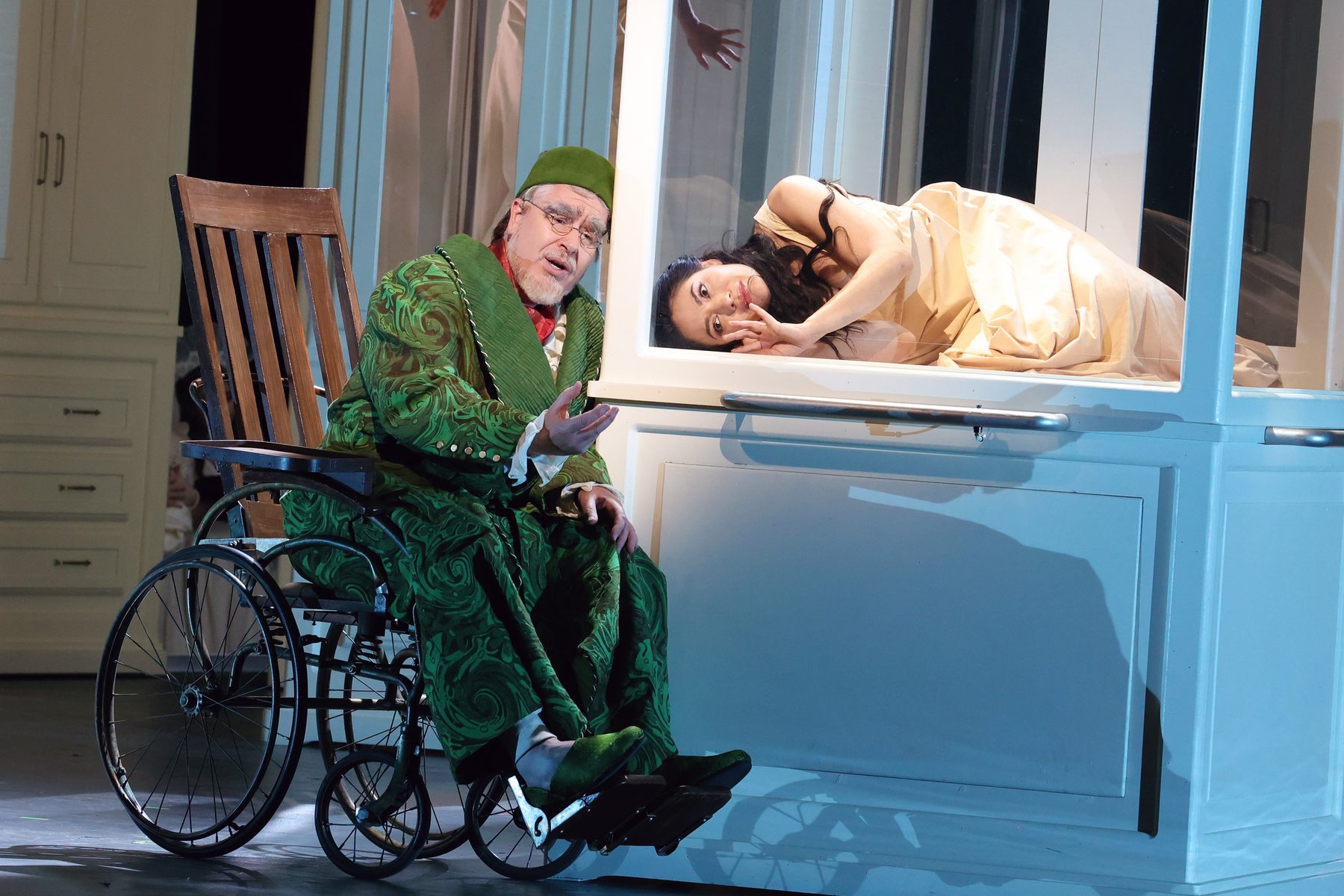
But from that essential truth, Poultney and designers take a series of wrong turns that lead into bewildering dead ends and inappropriate moments of laughter. Having Vodnik, Rualska’s father and a potent spirit of Czech legend known as the Water Goblin confined to a wheelchair, moved around by attendants and drugged by the witch Jezibaba, reduces him to an impotent bystander. This contradicts the legend and the music.
James Creswell (Vodník) confined to a wheelchair, Ailyn Pérez (Rusalka) confined in glass case. Photo by Curtis Brown.
There are no trees in the first act, since it is an asylum rather than a forest. There is a shallow puddle of water and a stack of chairs that Rusalka climbs into and out of during the scene. (The chairs are missing in the final act, which is supposed to be the same place as the first act.) The three sprites who are Rusalka’s sisters enter the scene first as hand puppets (nervous laughter), then as children (ahh!), and then as singers.
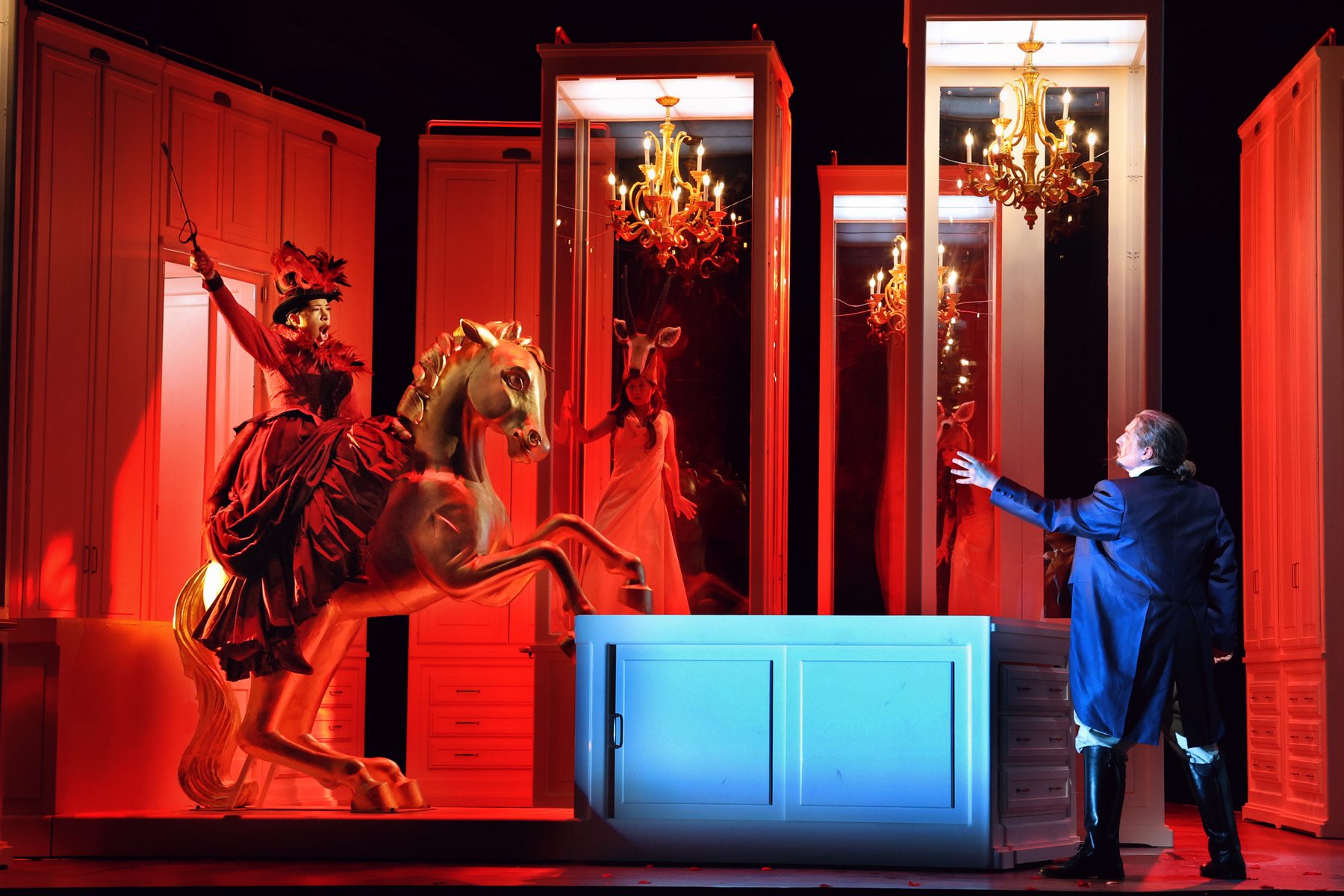
At different times characters from the spirit world appear inside glass cases, a demonstration of their imprisonment that needs no repetition. Or are they the Prince’s feminine conquests, inside trophy cases? How would you know? Either way it reflects a truth of the legend, but it is heavy handed. This is especially true in the final scene, when the stage was filled six or eight cases standing at different angles. Not only are these cases obstacles to smooth staging, they clutter the stage to make a point we already know.
Mary Elizabeth Williams (Foreign Princess), Robert Watson (The Prince). Photo by Curtis Brown.
And when the foreign princess, who will seduce and reject the Prince, enters on a golden horse and dressed in scarlet, the laughter serves neither the opera nor the singers. Her riding crop, wielded against first Rusalka and then the Prince, only adds to the hyperbole. It would be better to rely on acting to establish her brutal haughtiness.
There is more; it’s enough to say that this is a production that starts with an interesting concept and takes it so far that action contradicts music and the magic is lost.
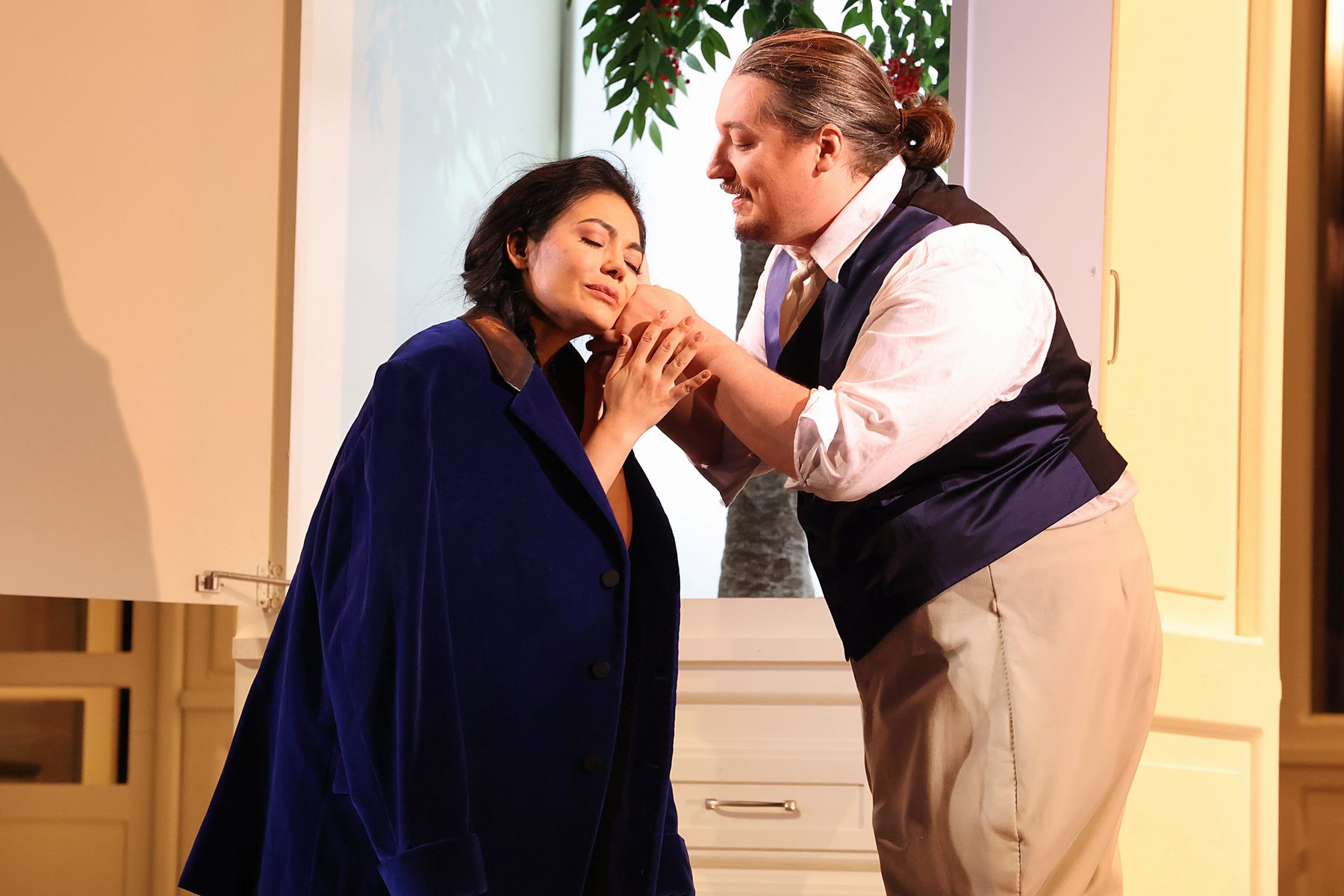
As with other operas this summer, the musical performance is first rate. In the title role Ailyn Pérez gave one of the season’s most satisfying performances. In spite of her mute moments in the second act, Rusalka is a large role, with intense, emotionally charged music in all three acts. Pérez consistently delivered her music with a focused voice and intense expression that were a pleasure to hear. The “Song to the Moon” and her anguished aria in the last act were highlights.
-Ailyn Pérez (Rusalka), Robert Watson (The Prince). Photo by Curtis Brown.
Robert Watson brought a big heldentenor voice to the Prince. In spite of his strong voice, he sounded tight and pressed on the top, where his vibrato was not always controlled. Even in his most ardent moments, he was wooden in his movements and often appeared detached. In spite of the direction that left him dramatically powerless, James Creswell sang richly and expressively as Vodnik. Freed from a wheelchair, he would have made a powerful water goblin. Mary Elizabeth Williams nailed her portrayal of the Foreign Princess. She does not need a riding crop to communicate the character; she does it well with voice and demeanor.
Raehann Bryce-Davis sang well as Jezibaba. Her brewing of the potion for Rusalka—another occasion for self-indulgent comedy, including the simulated killing of a cat—was scenically overdone but musically not quite fierce enough, but elsewhere she fulfilled the expectations for a witch of doubtful trustworthiness. The three wood sprites, Ilanah Lobel-Torres, Lydia Grindatto and Meridian Prall, made a lovely trio, singing some of the most charming music in Rusalka.
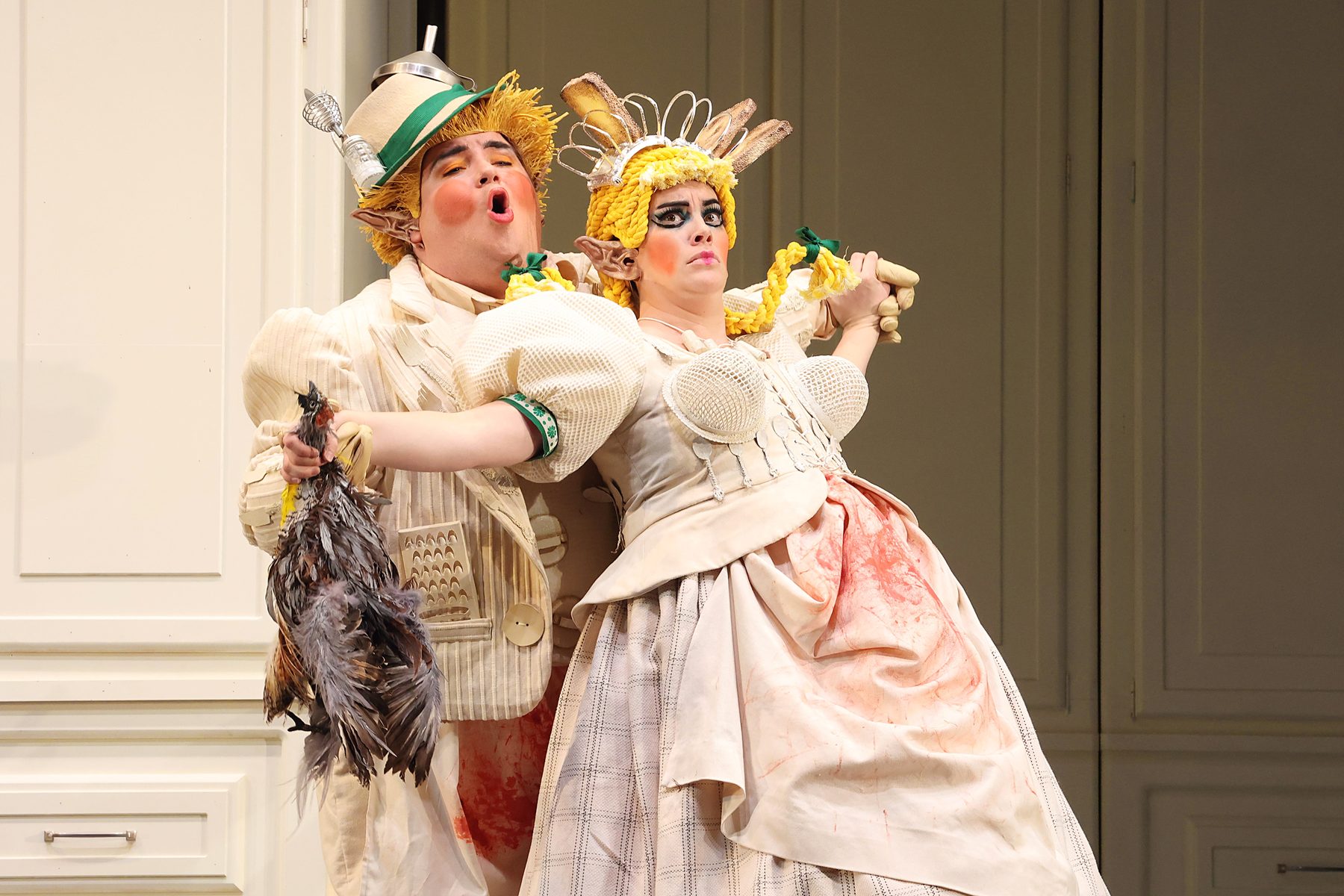
Jordan Loyd (Gamekeeper), Kaylee Nichols (Kitchen Girl). Photo by Curtis Brown.
A particular misjudgment were the characters of the Gamekeeper, sung by Jordan Lloyd, and the Kitchen Girl (usually his nephew, the kitchen boy) sung by Kaylee Nichols. As Dvořák wrote the opera, they provide lighter moments of relief from the tragic tale, especially when they wander into the forest seeking Jezibaba. But making them into splapstick characters with silly hats and marionette clumsiness, eliciting more raucous laughs, does not serve Dvořák’s music or the opera. Lloyd and Nichols sang well, but the conception remains misguided.
Russian-American conductor Lidia Yankovskaya, making her Santa Fe Opera debut, captured all the magic of Dvořák’s score. Under her baton the orchestra evoked the forest that was absent from the stage, and captured the stateliness of the Polonaise that was awkwardly choreographed around glass cases. Here is where Dvořák’s opera came to life: in the orchestra and the singers they so ably supported. For that alone the performance was well worth while.
* * * * *
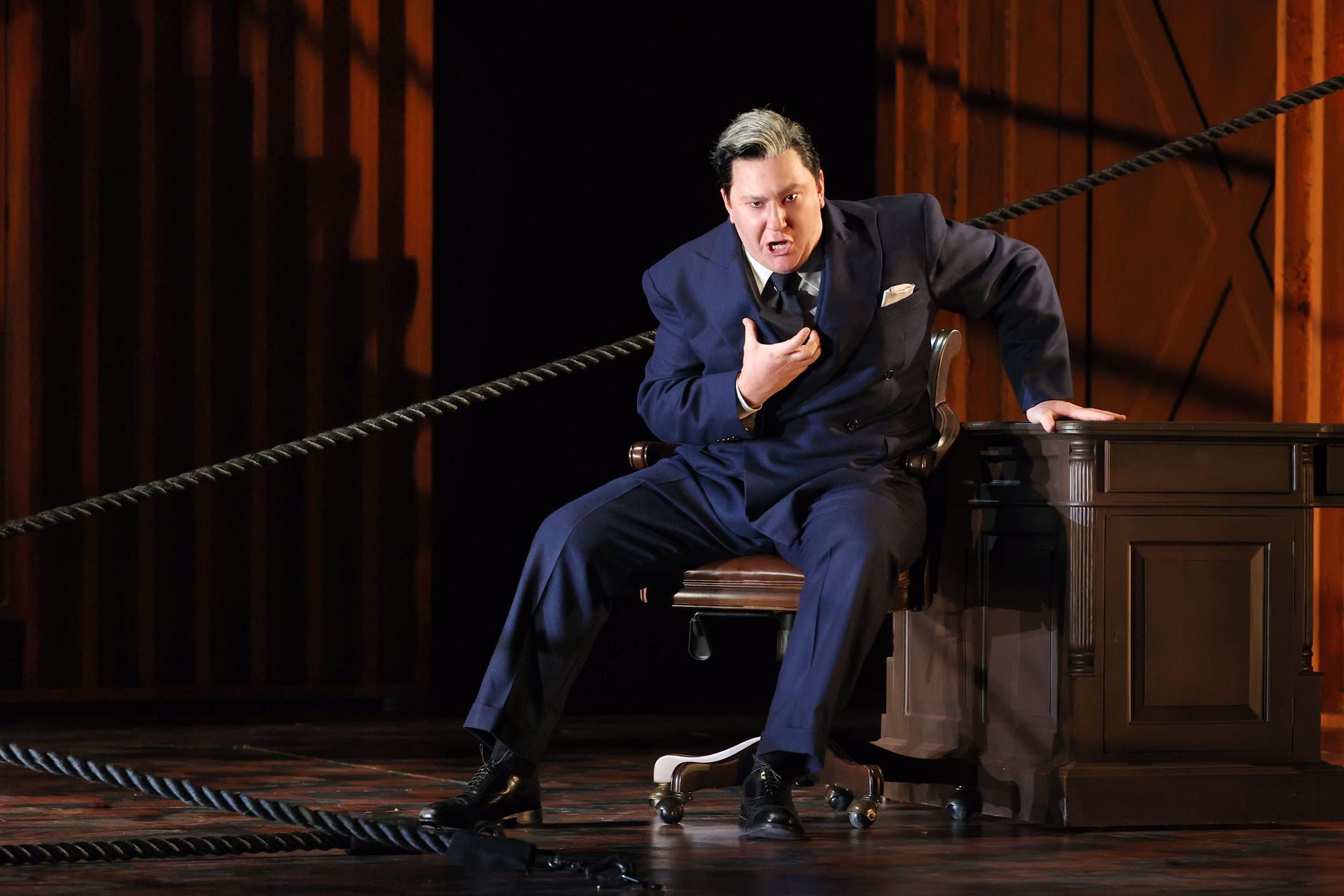
Wagner’s Flying Dutchman (Der fliegende Holländer) (Aug. 5) is, like Rusalka, based on a supernatural legend with a life-long curse at its center. In the Santa Fe Opera production directed by David Alden, however, the Dutchman is an industrial CEO, or a captain of industry rather than a ship’s captain. This suggests that the real curse is greed—one of the deadly sins and so another offense to God—from which Daland, the other major male character, also suffers.
Morris Robinson (Daland), Santa Fe Opera Chorus. Photo by Curtis Brown.
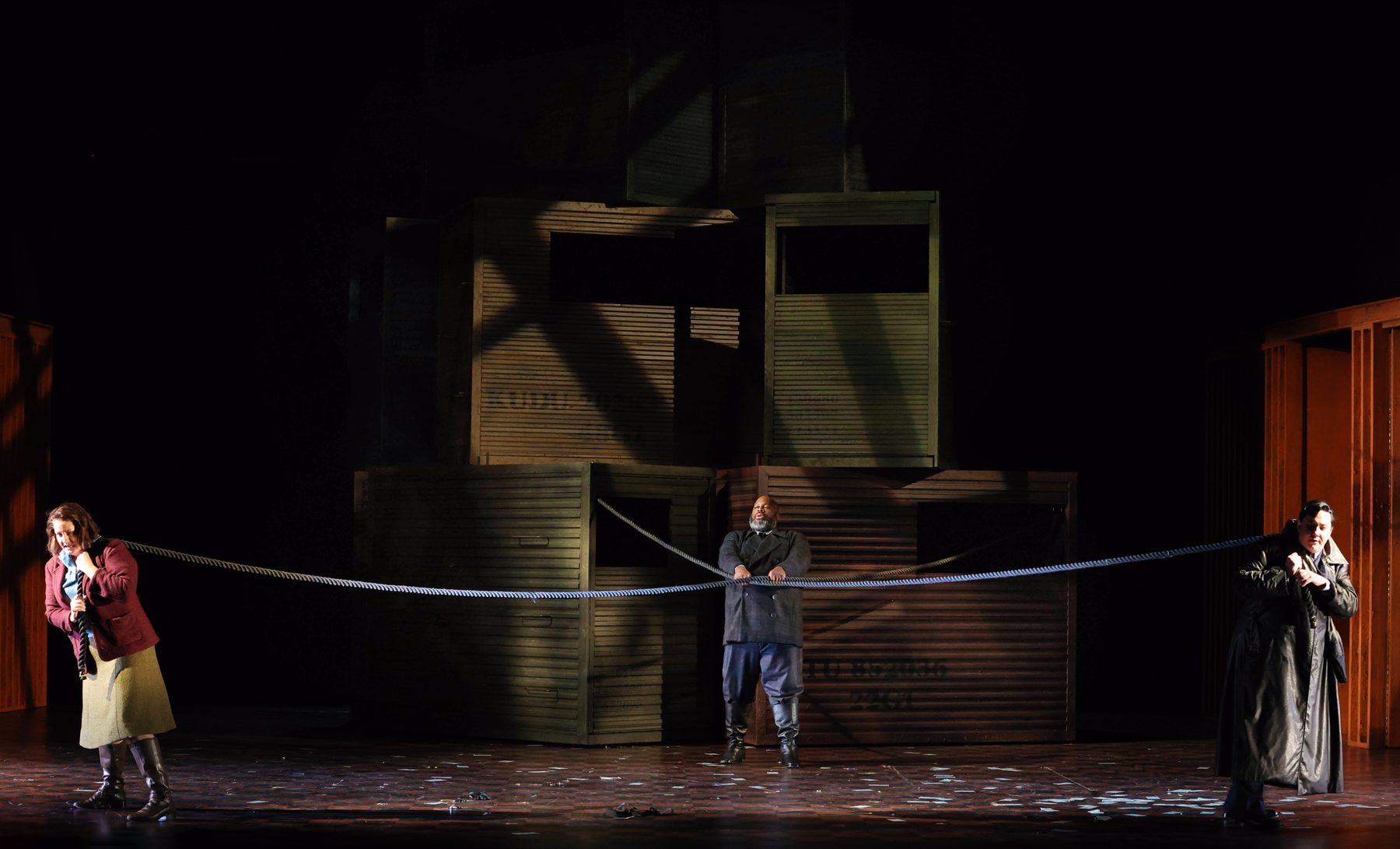
As a directorial statement, this perspective works well enough, but it contradicts many of the lines of the libretto that refer explicitly to a sea-going context—e.g., sailors are commanded to hoist sails and weigh anchors, when there is neither sail nor anchor in sight. And there is the music, which is is some of the most effective invocations of the sea ever written. The Dutchman’s ship is not so much a ship as a pile of shipping containers, symbolizing the world-wide commerce from which the anti-hero gains his riches. And when he arrives, as the containers/ship arise from behind the stage, the Dutchman’s ghostly crew bring on an executive’s desk and chair.
Nicholas Brownlee (Dutchman) as CEO entangled in ropes of greed. Photo by Curtis Brown.
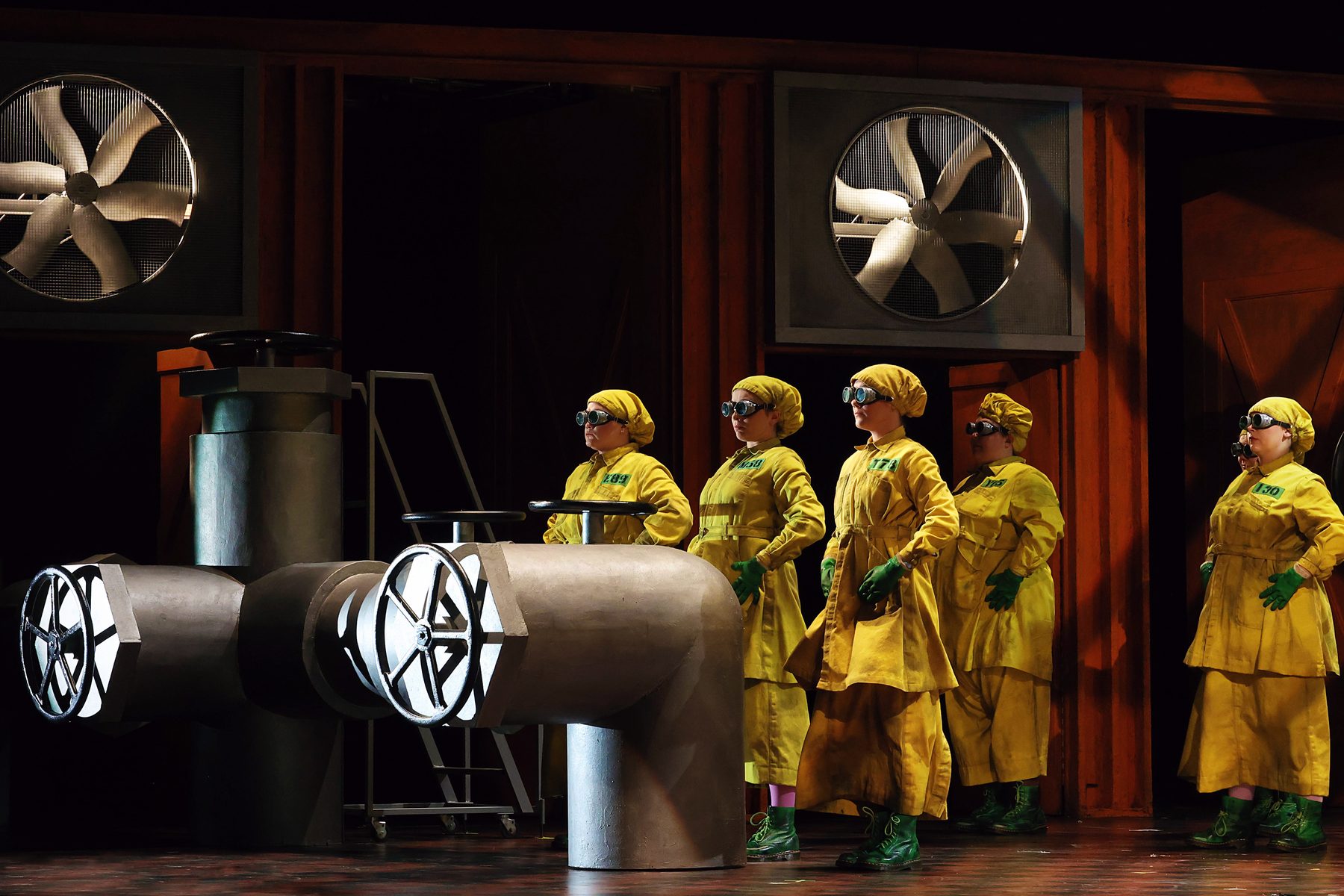
When we get to the second act, where the libretto has the sailors’ home-bound sweethearts singing at their spinning wheels, Alden’s production gives us a chemical plant, indicated by industrial pipes and control valves that are opened and closed. The maidens are clad in yellow protective gear, and Mary, often described as Senta’s nurse, is a plant foreman, watching the workers from above and dressed more like a Soviet commissar than a Norwegian matron. Senta appears to be the plant bookkeeper, seated, like the Dutchman, at the desk.
Santa Fe Opera Chorus. Photo by Curtis Brown.
As to why a captain of industry can be redeemed from his greed by a woman’s death, that is not made any more clear than what is in the libretto about the fated Dutchman. At the end, Senta does not make a fatal leap off a cliff but becomes increasingly bound by ropes that are pulled onstage at different moments by sailors, Senta, or the Dutchman. This is a feeble stage image to go with Wagner’s powerful music; whether we believe in feminine sacrifice, Wagner did and he repeatedly wrote powerful music to express that concept. Finally, the ropes: I have seen too many productions of Dutchman where ropes with no apparent purpose are tugged on to suggest a shipboard setting, once even in a Victorian parlor. It has become a cliché.
Still, if you accept the conceit, this is an enjoyable evening of opera, especially with the powerful orchestra and strong voices that Santa Fe again assembled for their production. From the opening of the overture, one of the greatest sea pictures in music, the orchestra under Thomas Guggeis conveyed Wagner’s score powerfully. I don’t usually enjoy overture pantomimes, but the vision of a young Senta reading a book, presumably the legend of the Dutchman, was appropriate.
Elza van den Heever (Senta), Morris Robinson (Daland), Nicholas Brownlee (Dutchman). The Dutchman’s “ship“ in the background.
In the title role, Nicholas Brownlee had unusually clear diction and used his booming bass expressively. He gave a great, raging performance of his critical opening scene, subsiding into a plaintive appeal for a redeeming love, tinged with anger and exhaustion. As Senta, Elsa van den Heever gave an utterly dramatic rendering of her Ballad, accurately hitting the emphatic top notes but melting into the more tender passages. Hers was a powerful and gripping performance throughout.
Morris Robinson was a commanding Daland, equally in charge of his crew in Act I and his daughter in Act II. Even though he asked her to marry the Dutchman, his stentorian voice did not leave much room for her own discretion. Bille Bruley sang the Steuerman with an edgy, penetrating tenor, and offered a slightly choppy performance of “Mit Gewitter und Sturm” that easily disintegrated into sleepiness. Richard Trey Smagur was an impassioned Erik, ardent and expressive throughout. Gretchen Krupp was an officious Mary, resolute in her refusal to sing the Dutchman’s ballad, and fierce in her displeasure when Senta launched into the troubling song.
An early work in Wagner’s career, The Flying Dutchman is more of a traditional opera than the celebrated music dramas that followed. As such, I find it one of the most easily enjoyable of Wagner’s stage works. There are many attractive set numbers—the Steersman’s song, the Dutchman’s arrival scene, the spinning chorus, Senta’s dramatic Ballad, and the large choral scene in the final act with Daland’s crew and the townspeople celebrating around a large table. That is one of the great choral scenes of the operatic repertoire, and it was performed with energy and rhythmic verve by the Santa Fe Opera chorus.
The Santa Fe Opera house and the Northern New Mexico twilight. Photo by Robert Goodwin.
Realistic, traditional productions are out. Most major opera houses today present re-interpretations of the original works, either transposed in time or symbolically represented to get at deeper truths within the artwork. At the Santa Fe Opera this summer, there were five productions, and each was presented in some kind of re-imagined setting. Every one offered some very strong musical performances, but the physical productions varied considerably.
Puccini’s Tosca (which I saw Aug.1) is the least re-interpreted of the summer’s five productions. It tells a story that is direct, brutal and melodramatic, a story of lust, piety, love, betrayal, and murder. Embedded in theatrical realism, it is not as suitable for symbolic or complex psychological representation as opera based in legend, myth, or literary symbolism. The current Santa Fe Opera production changes the time setting, but otherwise remains mostly faithful to the text.
The opera’s original setting—Rome in June 1800, during the Napoleonic Wars—is believably transferred to Fascist Rome of the 1930s, with few incongruities. That time period, shown by costumes, electric lights, an electric floor polisher and a camera, fits the main points of the story well. Scarpia is a believable representative of Mussolini’s regime. All the other characters—political prisoner, rebellious painter, operatic diva, pious sacristan and thuggish toadies—are types found in virtually any era.
However, not all updatings are equally successful. In the second act, designer Ashley Martin-Davis invented a cartoonish torture device with pulleys and levers that is more comical than frightening; Cavaradossi’s screams from an unseen room are more terrifying than watching him hoisted up and down with 1950s sci-fi electrodes attached to his head.
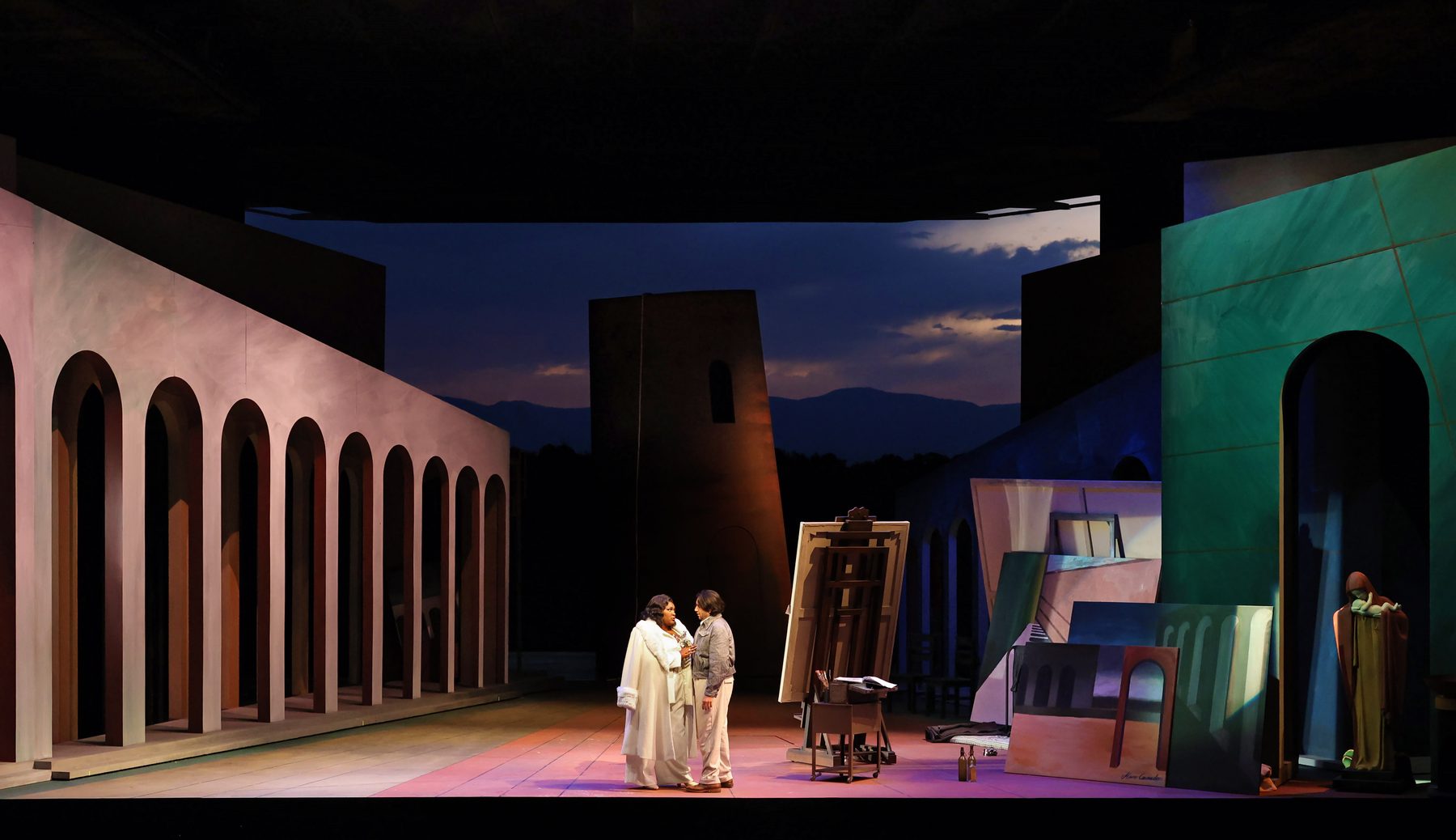
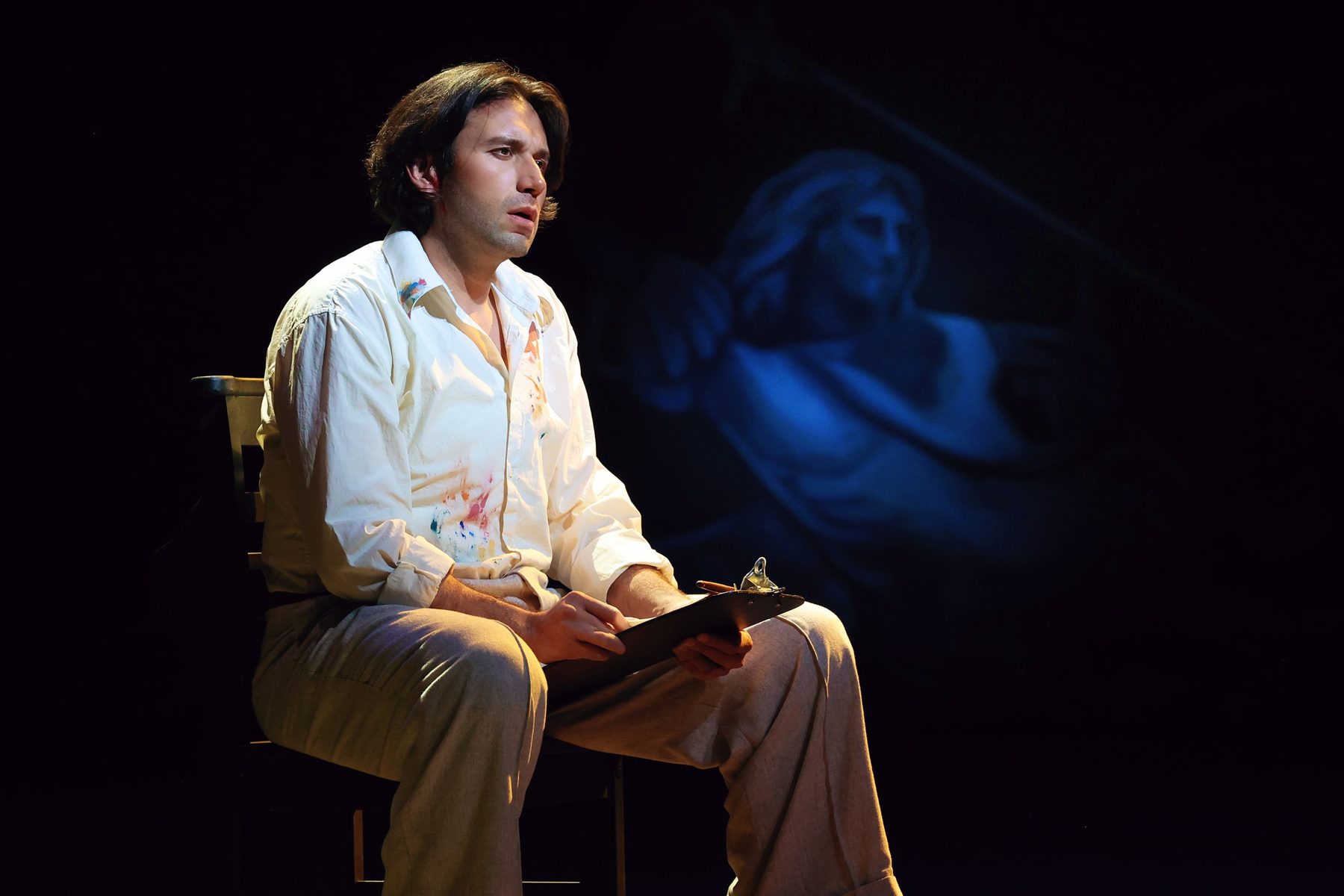
Leah Hawkins (Tosca) and Joshua Guerrero (Cavaradossi) in Ashley Martin-Davis’s set for Tosca. Photo by Curtis Brown for the Santa Fe Opera.
The substitution of electric lights for the iconic candles when Tosca stages Scarpia’s dead body was probably inevitable, but the effect is tame. I still don’t know how Tosca got blood on her hands from garotting the police chief, in place of the traditional stabbing, and Scarpia’s post-mortem convulsion was a shock without consequence.
Act III has some awkward moments. In spite of singer Joshua Guerrero’s best efforts, Cavaradossi’s collapse when shot is hampered by his being shackled to a post. The set does not allow Tosca to jump dramatically from the wall of the Castel Sant’Anglelo. Instead, she pulls out a gun she took from Scarpia and holds it to her head as she fades into darkness and another actor—a doppelgänger? A younger Tosca? A mysterious “other woman”?—rises from the floor and walks slowly into a gap at the back of the stage.
Martin-Davis’s minimal but serviceable set consists mostly of arcades of archways that can be moved around the stage during transitions, going smoothly from suggesting the church of Sant’Andrea della Valle in Act I, to Scarpia’s rooms in the Palazzo Farnese in Act II, to the Castel Sant’Angelo for the final act, with no attempt to duplicate the actual places.
Joshua Guerrero as Cavaradossi. Photo by Curtis Brown.
The opening act features a tower at the back of the stage that provides an opportunity to portray Angelotti’s escape from prison via a daring rope descent by an athletic Blake Denson. This nicely fills in the background for his breathless appearance in the church and rush to hide in the side chapel before he is seen. We already know he is an escapee.
The Santa Fe cast is filled with strong voices. Joshua Guerrero brought a vivid tenor and a strong sense of style to his portrayal of Cavaradossi. His sense of control and shaping of phrases were strengths throughout, with only a slight moment of strain marring the final act. His aria “E lucevan le stelle” was carefully controlled, from a quiet, reflective opening to a bold ending.
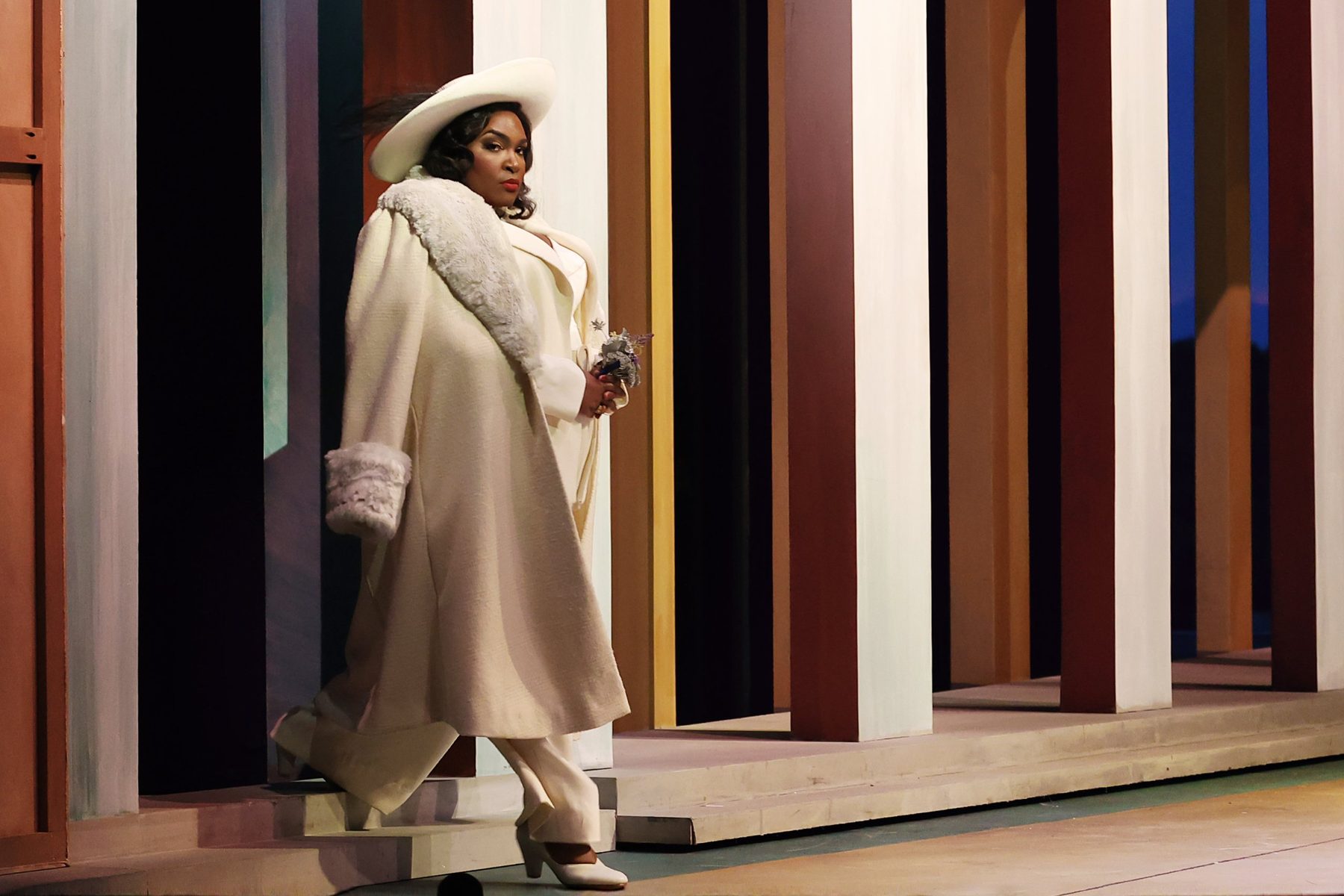
Leah Hawkins as Tosca. Photo by Curtis Brown.
Throughout he was a good partner for Leah Hawkins’ Tosca. Her soaring soprano met the part’s requirements well, with great intensity in Tosca’s fiercest moments. From her first entry in white furs that could have come directly from the glamour photos of the 1930s, she was every inch the diva, standing up to Scarpia’s threats and demands with appropriate hauteur.
As Scarpia, Reginald Smith Jr. conveyed well the brutal aspects of his character. But in spite of the gang of thugs that surround him, he is more than a back-alley bully. The aristocratic Baron Scarpia is polished as well as evil, and should display as much icy menace as overt threat. Smith sang strongly, never leaving any doubt of his power and brutality, but never quite conveyed the aloof and oily side of his character.
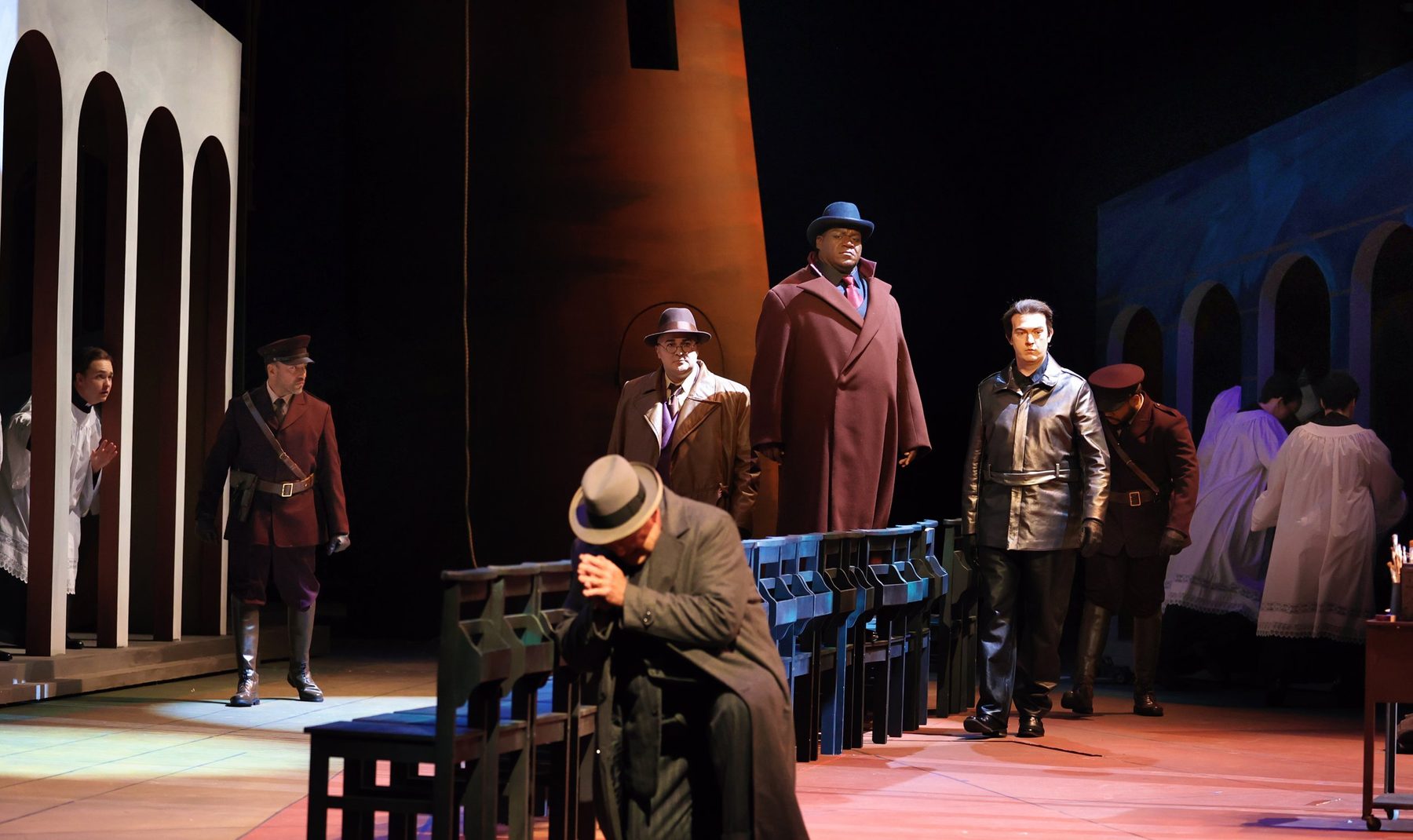
Scarpia takes over the church: Spencer Hamlin (Spoletta), Reginald Smith, Jr. (Scarpia), Ben Brady (Sciarrone). Photo by Curtis Brown.
At the end of the first act, Smith showed Scarpia’s command of the crowd and the terror he inspires, through the strength of his voice and his powerful presence on stage. But this point went over the top when he was shown being worshipped by the crowd and choristers. That sight clashes with the singing of the Te Deum in an Italian cathedral; Scarpia knows how to observe religious expectations.
Denson sang well in the relatively small part of Angelotti. Dale Travis was fine as the pious and comical Sacristan, earning the usual laughs in the usual places. Scarpia’s unprincipled henchmen Spoletta and Sciarrone were well portrayed by Spencer Hamlin and Ben Brady. Kai Edgar was a strong and clear voiced Shepherd Boy. Dressed like Cavaradossi, he was heard not outside the castle walls but onstage alongside the prisoner.
Conductor John Fiore gave an idiomatic and stylish account of Puccini’s score, with all the flexibility necessary to keep the opera on track. The orchestra followed well, providing firm and lush support for the singers. Only once during the offstage cantata did the balance go awry; otherwise it was well controlled and the singers remained clearly audible and understandable throughout.
* * * * *
At the opposite end of the dramatic spectrum, Monteverdi’s Orfeo (Aug. 2) is based on the ancient myth of Orpheus’s descent to Hades and rescue of Eurydice through song, and is therefore at its heart symbolic in meaning. Alas, Santa Fe’s disjointed production is by turns stunning, baffling, effective and frustrating. It is the kind of production we see too often, filled with ideas, many ideas, without a unifying point of view.
As performed at Santa Fe, Monterverdi’s 1607 masterpiece has been orchestrated for modern orchestra by composer Nico Mulhy. This is not the first time Santa Fe has presented updated versions of Baroque operas. In the 1970s and ‘80s they presented three different operas by Francesco Cavalli as arranged and orchestrated by Raymond Leppard. That was a time when authentic Baroque orchestras and trained Baroque singers were in short supply, and Leppard’s arrangement brought works to life that we would not otherwise hear.
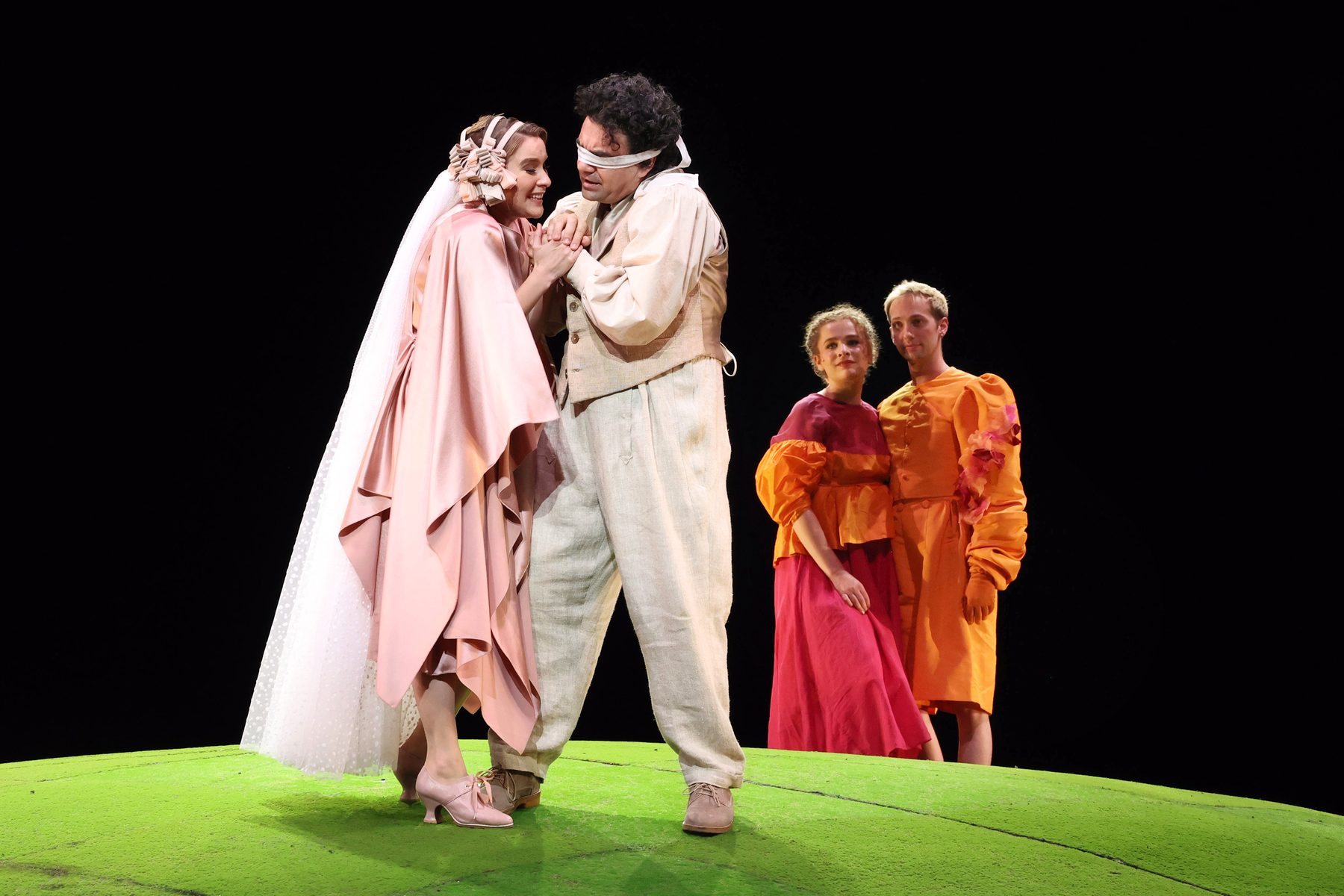
Amber Norelai (Euridice), Rolando Villazón (Orfeo), Lucy Evans (La Ninfa), Luke Elmer (3rd Pastore). Photo by Curtis Brown.
In the Santa Fe program book, Muhly justifies his arrangement using the same argument today. He writes, “The reason to orchestrate Orfeo for modern orchestra is so it can actually be done,” but that is no longer a valid position. It would certainly surprise musicians and audiences in Europe, where Baroque opera is frequently presented with original instruments and Baroque performance specialists.
Nonetheless, Monteverdi was the first great composer of operas, and Orfeo was the first opera to remain stageworthy, and any opportunity to hear this wonderful music is a cause for celebration. The cast, led by tenor Rolando Villazón in the taxing role of Orfeo, sang with conviction and commitment, if somewhat uneven application of Baroque performance style.
Villazón began his career with traditional tenor roles, including Rodolfo (La Boheme), Don Jose (Carmen) and Alfredo (La Traviata). He has more recently added Orfeo to his repertoire, with performances in Europe, and while he applies some appropriate ornaments, his overall approach is intensely expressive, with no holds barred for the top notes and the expressive highlights, of which there are many in Orfeo’s music.
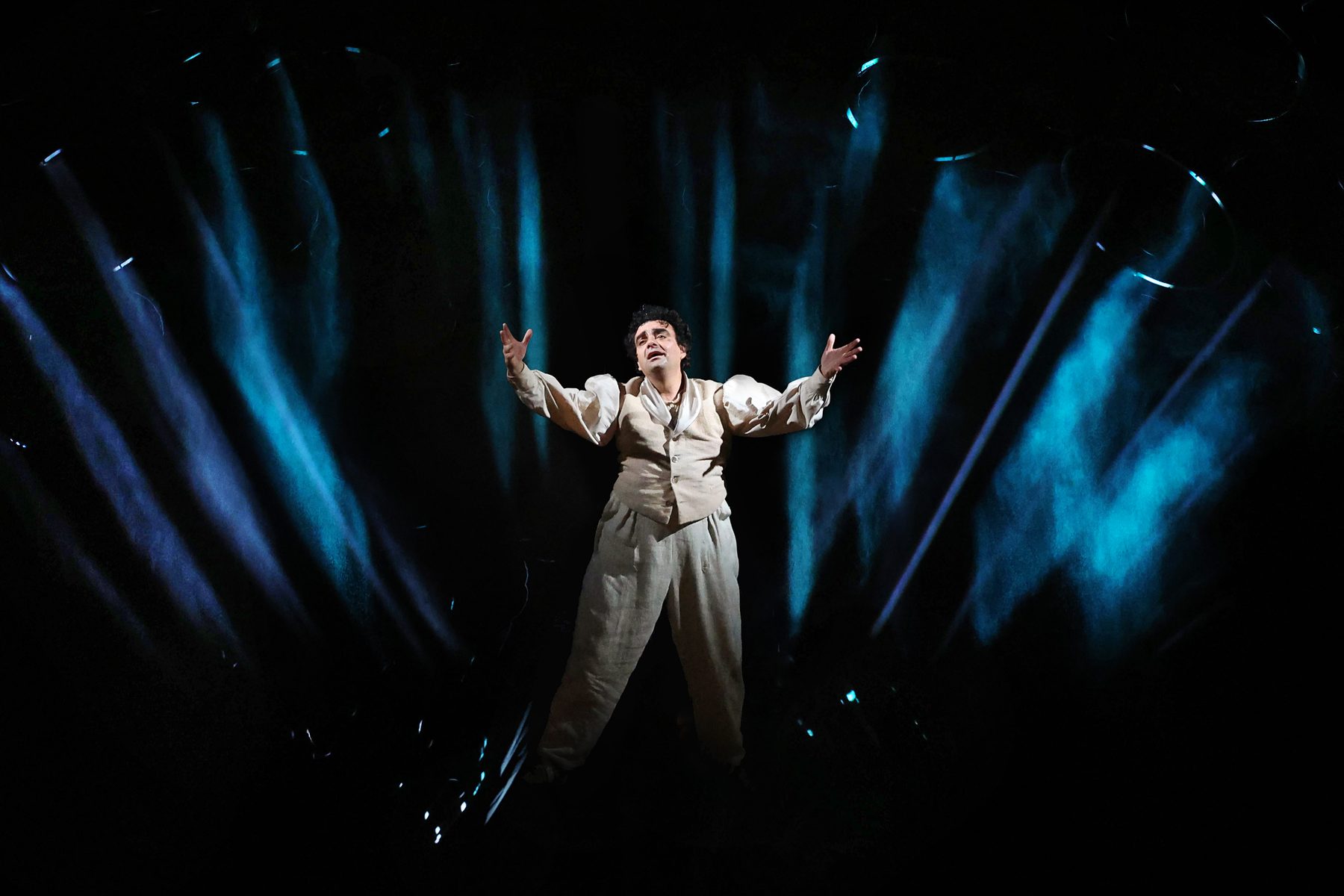
Rolando Villazón (Orfeo) suspended in the river Styx. Photo by Curtis Brown.
Villazón showed signs of stress throughout the evening. And Monteverdi’s music speaks best for itself when presented with restraint and careful application of ornamentation to provide emotional emphasis. The use of modern instruments in the pit, with their capacity for greater volume than Baroque strings, cornetti and sackbuts, no doubt encourages the greater volume and more intense projection that Villazón applied, but they do not serve Monteverdi’s music well.
One exception would be Orfeo’s great Act III aria “Possente Spirto,” directed to Charon, the gatekeeper of Hades. Considered one of the greatest musical pieces of the early Baroque, this show-stopping number was sung by Villazón while suspended above the stage, apparently swimming in the River Styx as represented by rippling projections. Perhaps it was the harness that held Villazón in the air, or the aria’s length, but he sang with more restraint here than in most of the opera, and the less passionate approach allowed the aria to build carefully to its end. This was a highlight of the performance.
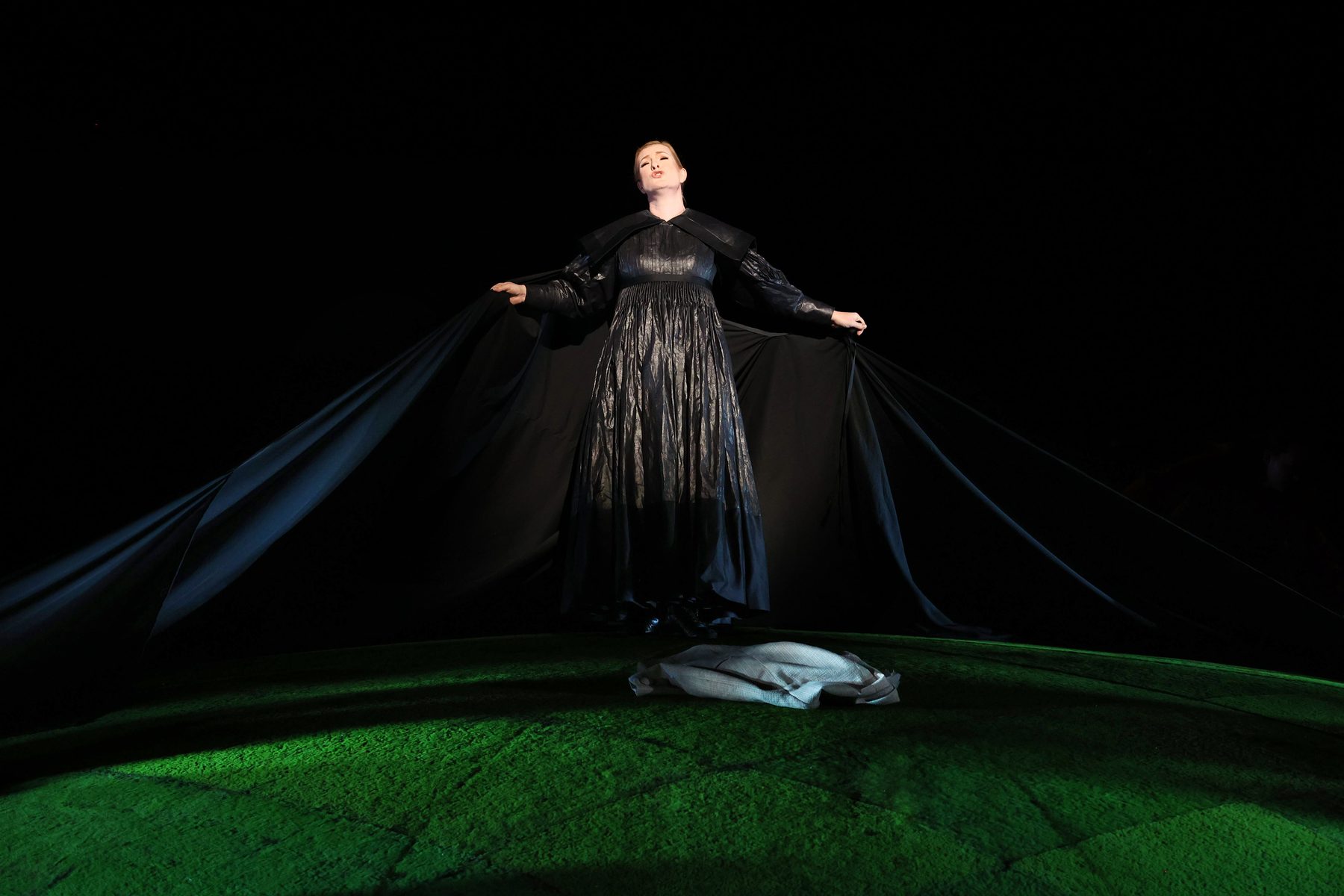
Paula Murrihy (La Messaggera). Photo by Curtis Brown.
Another highlight was provided by Paula Murrihy as La Messaggera (The Messenger), who brings the news of Eurydice’s death. Her immobile figure against the darkening New Mexico sky behind the stage was striking enough, but she also sang beautifully, with a purity of sound that allowed the carefully applied ornaments to do their work and Monteverdi’s music to convey the depth of the tragedy with no unnecessary exaggeration.
Lauren Snouffer sang effectively as both La Musica and Speranza (Music and Hope), who first introduces the story and then conveys Orfeo to the gates of Hades. Her bright voice and straight tone allowed her to apply vibrato as an ornament, as is appropriate Baroque style. Eurydice has relatively little to sing, and Amber Morelai made the most of the expressive opportunities in her third-act aria.
James Creswell as Charon and Blake Denson as Pluto were appropriately sepulchral of voice. One is at a loss to accurately distinguish among the pastores and ninfe (shepherds an nymphs) who emerge from the chorus in brief solos, but they all fulfilled their roles well. The chorus sang with the rhythmic impulse that their dance-like music requires.
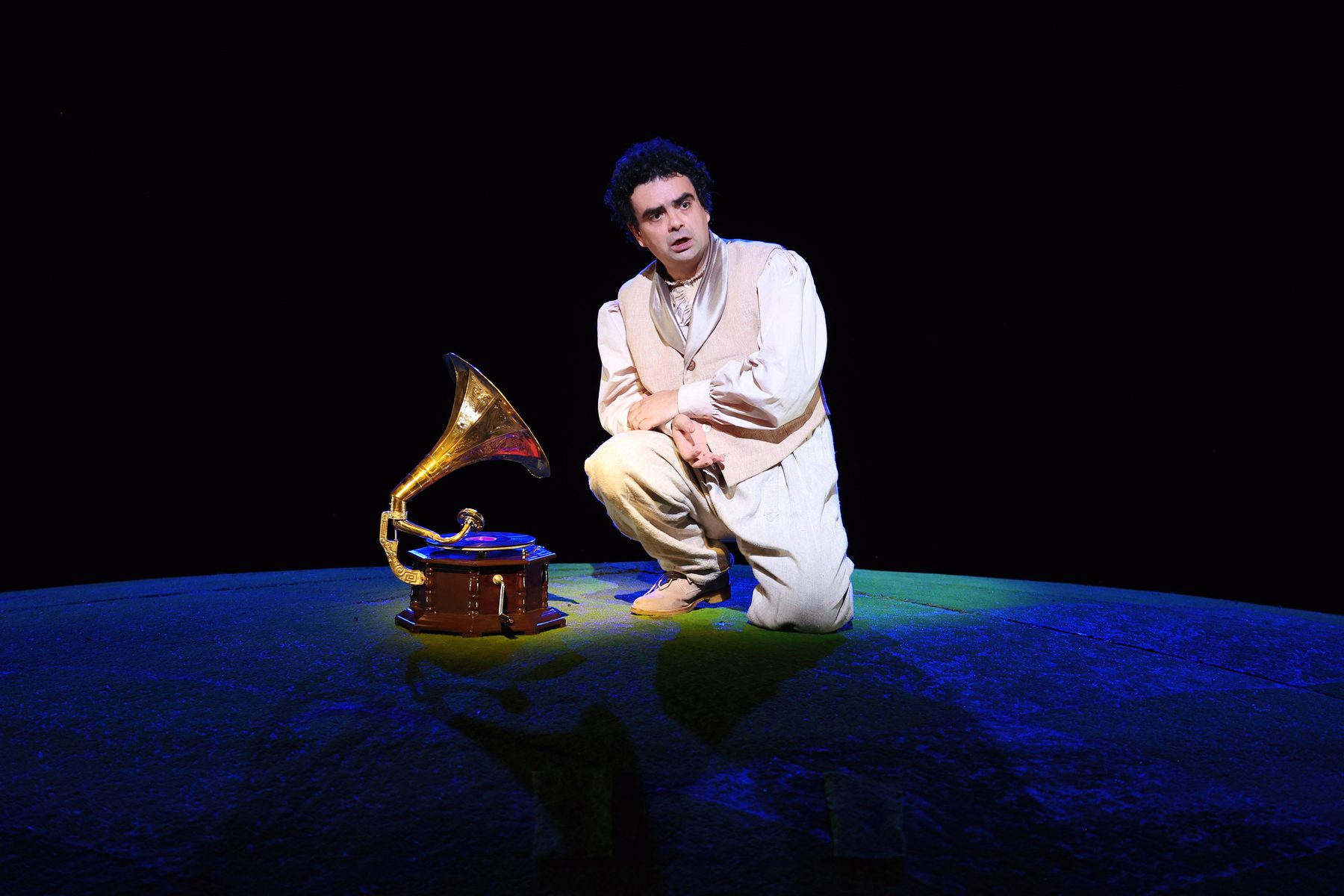
Rolando Villazón (Orfeo)with his golden gramophone. Photo by Curtis Brown.
There are many confounding aspects of the physical production. Some of the effects—the stark imagine of La Messaggera against the sunset sky, well timed for early August, Orfeo’s swimming in the projected waves of light, and Speranza’s appearance on a rising moon in the last scene—are stunning. Others, however are not effective, or seem outright humorous. For example, Pluto presenting Orfeo with a golden gramophone—as a going-away gift?—induced chuckles. I have more ideas of what that might symbolize than one opera can encompass.
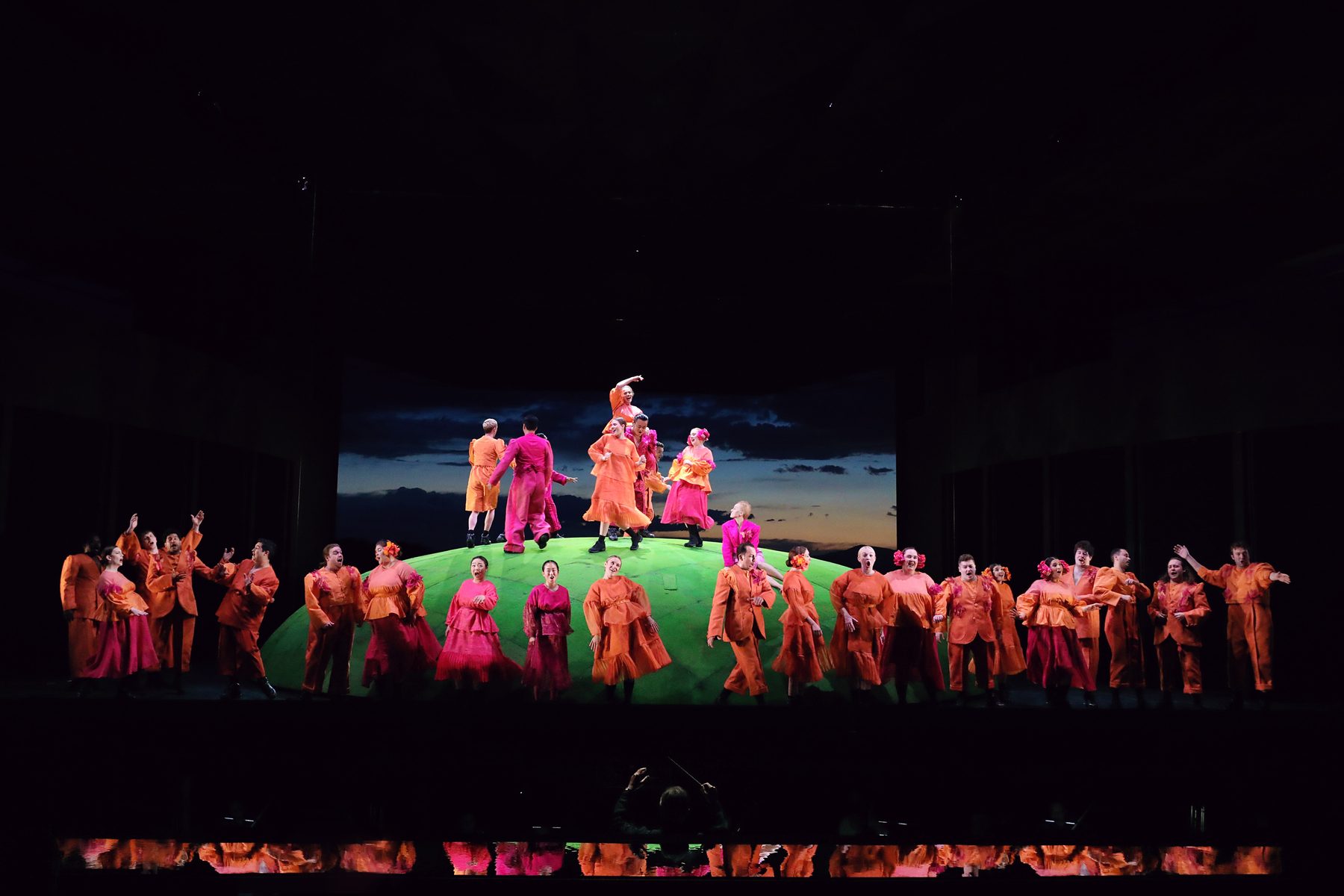
More problematic is the setting of the opening and closing scenes on earth (as opposed to Hades). The stage is filled with a large green mound that apparently stood for the idyllic fields where the shepherds and nymphs live and play, but it was awkward in the extreme. Singers had to balance carefully on its steepening slope, and slide down to stage level; it had to be clambered onto with effort; and it so filled the stage that there was no room for the chorus to dance, when their music is definitely dance music. The chorus costumes in orange and fuchsia conveyed anything but arcadian shepherds and nymphs.
Orfeo: Santa Fe Opera chorus as shepherds and nymphs. Photo by Curtis Brown.
I have other questions. Why were La Musica and later Eurydice in hospital beds? Why did the chorus dress up as birds, rabbits, and donkeys? These and other ideas show that stage director Yuval Sharon was busy thinking about all of the meanings embedded in the opera, as is his reputation, but not all the ideas contributed to the whole. Harry Bickett led the orchestra with sensitivity to the expression embedded in the Baroque style. Muhly’s orchestration reflects the original sounds as well as one could want with modern instruments.
But the question remains: is it really necessary to update Monteverdi’s operas for modern orchestra, when we now have so many accomplished orchestras and Baroque performance specialists in the world? Any re-orchestration is in effect a compromise with what Monteverdi wrote. Fifty years ago that was the only way we could hear professional-level performances of Monteverdi, Cavalli, Caccini, or in some cases even Handel. But we are past those days.
* * * * *
Debussy’s Pelléas et Mélisande (Aug. 3), based on a symbolist drama by Maurice Maertilinck, is imbued with multiple layers of meaning.
That was the intent of the composer, who said that his ideal librettist would be “one who only hints at what is to be said.” In the case of Pelléas et Mélisande, both the text and the music fulfill that ideal. Many elements of the plot hint at symbols, some clear and others not. Mélisande is found alone in the forest; Golaud exits the first scene saying “I’m lost too.”
Some symbols are clear: Mélisande’s hair that in most productions engulfs Pelléas, sheep that are lost and not heading home, the setting sun as Mélisande dies. Others seem meaningful, even when the meaning is murky: A ship sailing into a storm, Golaud taking Pelléas to smell the stench of death below the castle. Clear or not, the action conveys many meanings.
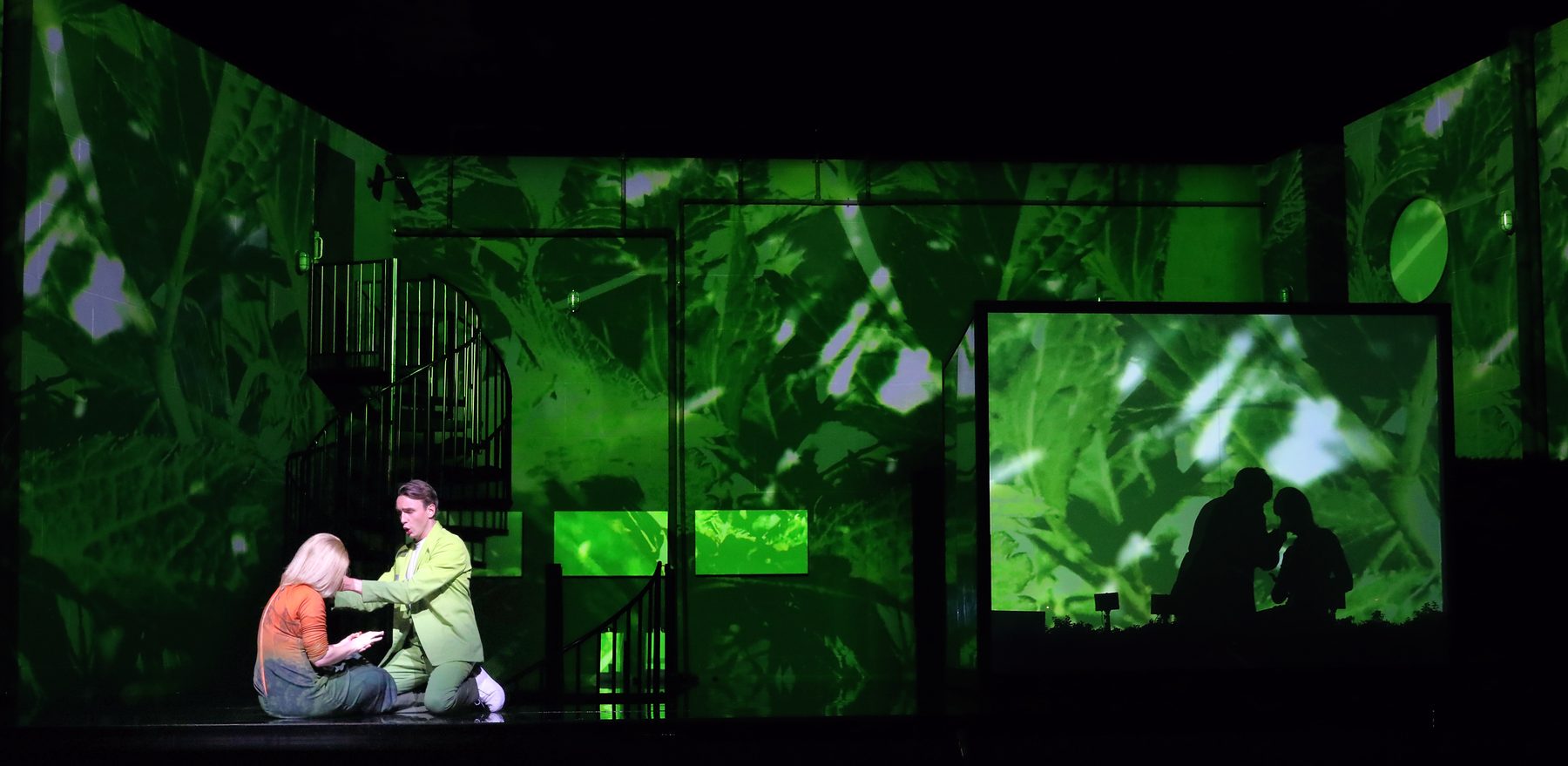
Samantha Hankey (Mélisande), Huw Montague Rendall (Pelléas) in Netia Jone’s stage set with projections and doppelgängers. Photo by Curtis Brown
The production designed and directed by Netia Jones for Santa Fe Opera makes sure that you know that. Every major character has a doppelgänger who often moves in the background, or enters on the opposite side of the stage simultaneously with the actor singing the role. The fact that you may not know which is which until the singing starts certainly reinforces the murkiness, but it doesn’t help the audience.
Samantha Hankey (Mélisande), Zachary Nelson (Golaud). Photo by Curtis Brown.
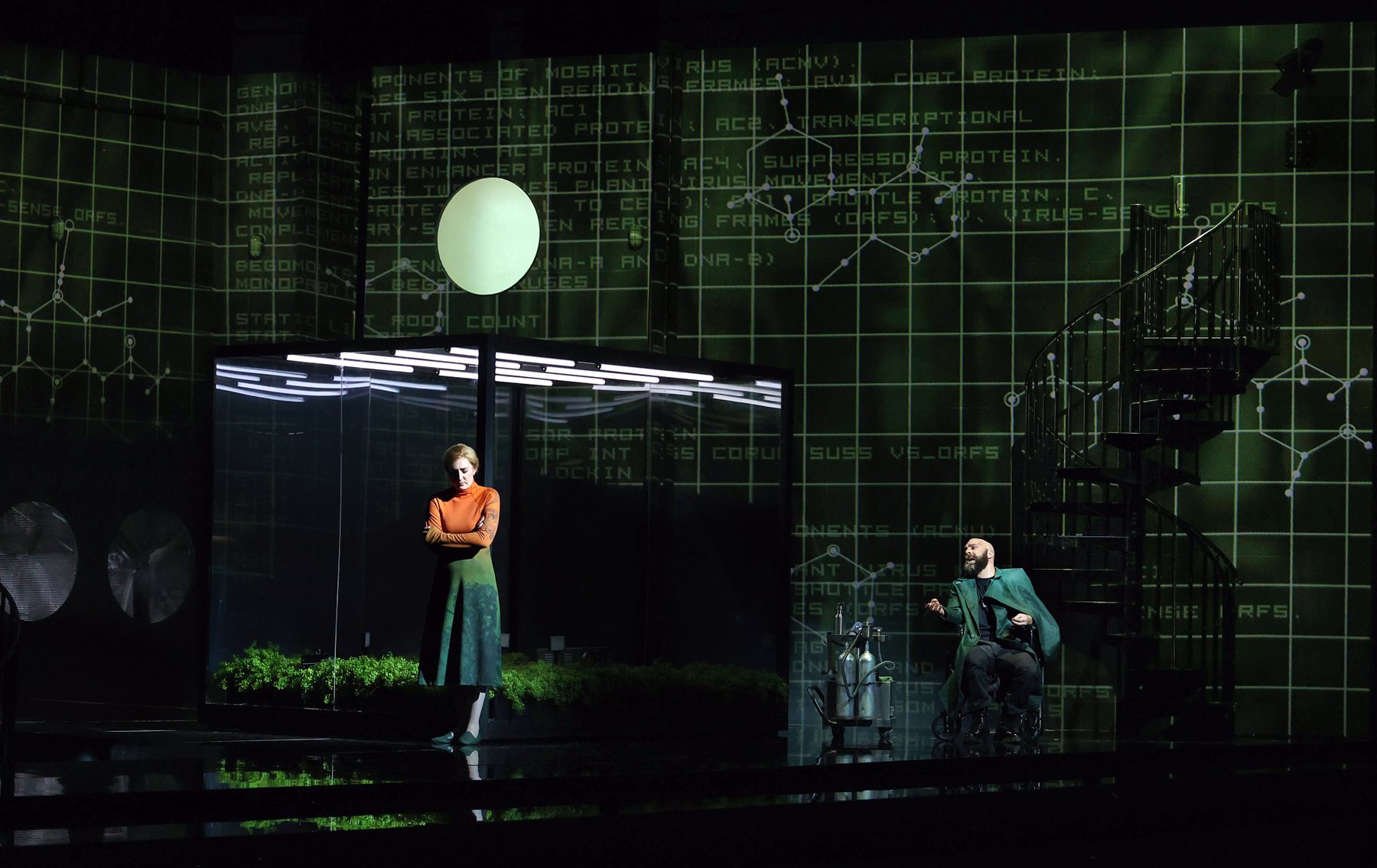
The costumes are essentially stylized modern dress—Pelléas wears white tennies and in one scene has a hoodie—but the time period is uncertain. The setting may be a post-apocalyptic time with the castle a sanctuary against the outside world that Mélisande fears. Projections suggest at different times an industrial setting, or a laboratory with chemical diagrams and texts projected on the walls. Outside scenes are suggested by projections of leaves or water.
And then there is the shadow box downstage left that rotates to offer a screen for shadows of the doppelgängers, or other projections that may or may not be the same as the walls. One open side provides a space for Goulaud’s bed after his riding accident, and Mélisande’s death bed in the final scene. Of the window she asks to be opened to the setting sun, there is no hint, which indicates that not all symbols of the original remain in Jones’s realization.
Another lost symbol in this production is Mélisande’s hair, which in the plot reaches from her tower to Pelléas below. At Santa Fe, however, her hair is not long enough to reach her waist, and when the time comes for her to let it down to Pelléas, she takes scissors and cuts off tufts that she drops.
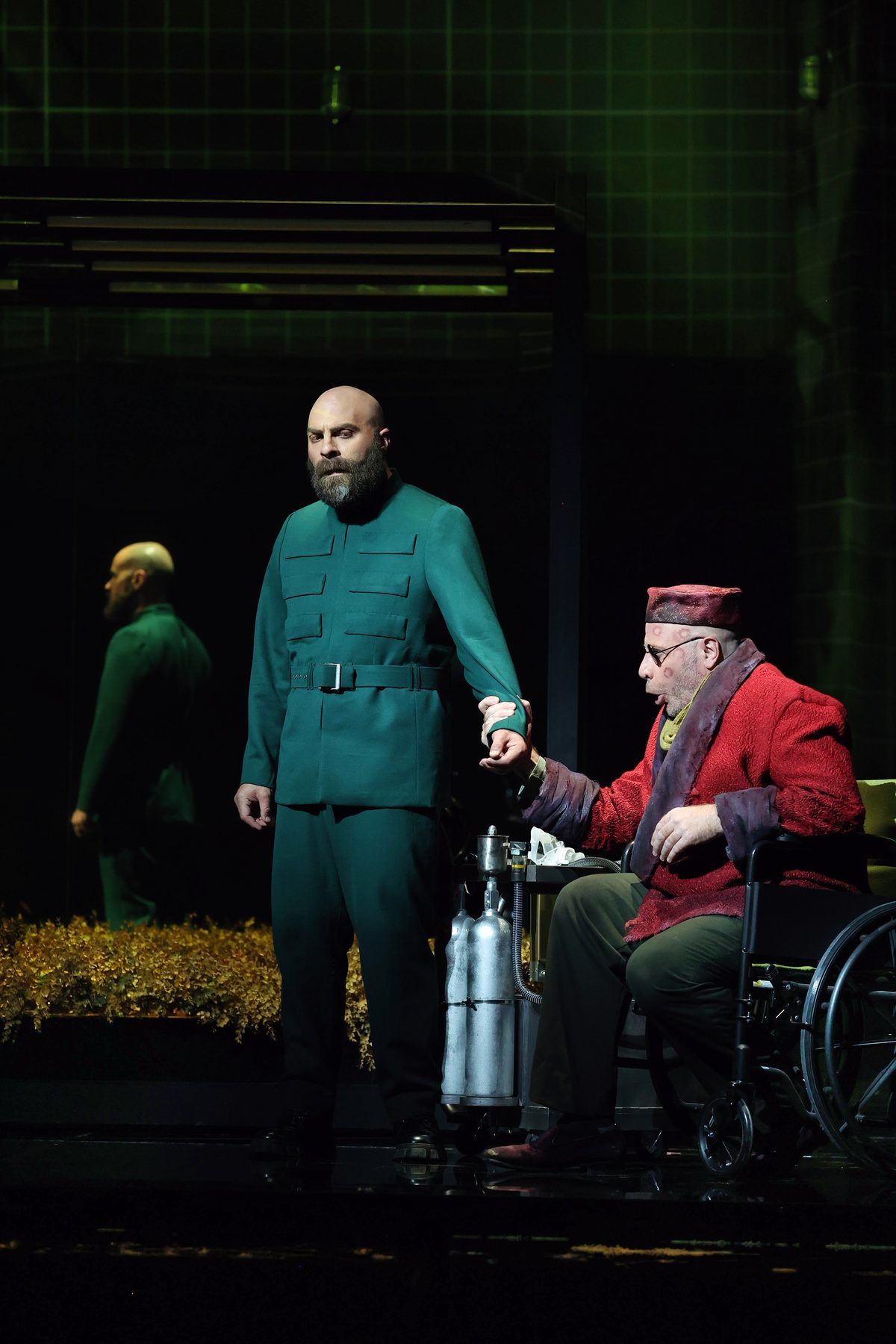
Zachary Nelson (Golaud), Raymond Aceto (Arkel). Photo by Curtis Brown.
Jones also added symbols, particularly with the character doubles. At the opening, Mélisande is sitting by a stream, with her double—drowned?—floating past, suggesting the character’s drift away from the real world. In one scene, the double of Pelléas and Mélisande moves slowly closer as the singers act out the text.
And there are curiosities in Jones’s direction. Arkel is nearly blind (shown by his darkened glasses) and only hobbles with a cane, yet he enters and exits down a steep spiral stairway before collapsing into a wheelchair. After his accident, Golaud is in bed, yet recovers fast enough to spring up to attack Mélisande. And why has Golaud’s sword become a knife—is that because of the modern setting? It is less menacing than a sword.
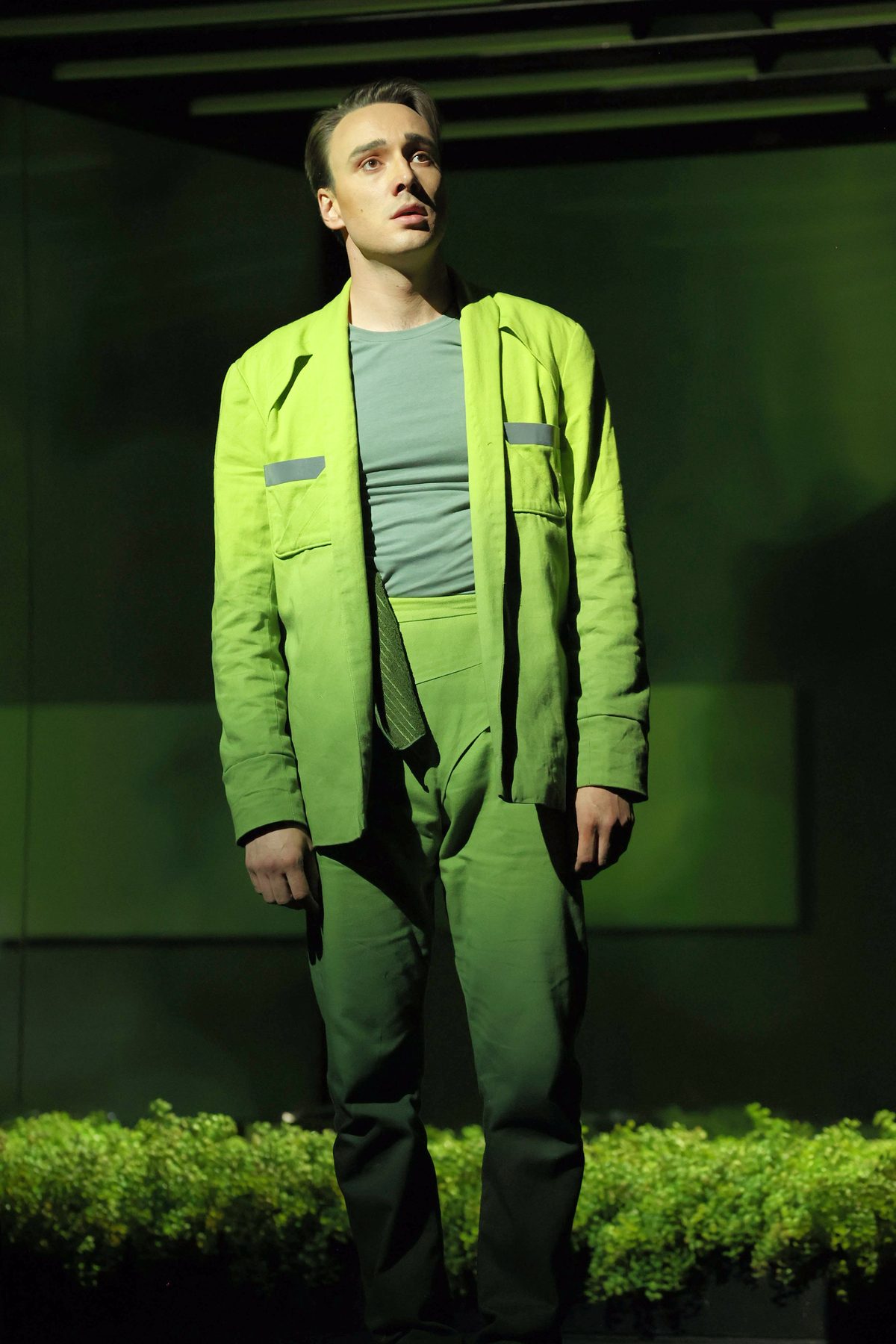
Huw Montague Rendall (Pelléas). Photo by Curtis Brown.
If piling obscurities on top of obscurities leaves the audience without a sure footing, the same cannot be said of the singers. Pelléas is as well cast as any production of this difficult work I have seen. Huw Montague Rendall’s Pelléas was clear voiced, secure into the top range, and eloquent. His voice sounded in turns clear, tentative, trembling, tender. It was a delight to hear such an expressive and well managed interpretation.
As Golaud, Gihoon Kim was solid, powerfully portraying the character’s growing menace. By the final scene Kim made his threat to the title characters palpable. Raymond Aceto was commanding as Arkel, the closest thing the opera has to a conscience. He used a rough hewn sound to convey his character’s age and infirmity, as well as an unsettled sense of moral authority.
Susan Graham (Geneviève). Photo by Curtis Brown.
Samantha Hankey sang Mélisande beautifully. Is it the director’s interpretation that she seemed more forthright and steady than the conventional, fragile Mélisande? Often immobile for long periods, she conveyed both hesitation and firmness, which added a different slant on her relationships. Susan Graham, well known and loved by Santa Fe audiences, provided just about the best French of the evening, and a memorable performance overall. She sang with the confidence of the veteran she is. As Geneviève, she commanded the stage in her short scenes.
Treble Kai Edgar made Yniold the vulnerable target of Golaud’s growing frustration. A sure-footed actor, he sang with a clear and precise sound; I only wish he had not been nearly covered by the orchestra so that his increasing fear could be heard more surely. As the physician, Ben Brady was a steady presence attending to first Arkel, then Golaud, then where he is usually seen, at Mélisande’s bedside.
Conductor Harry Bicket and the Santa Fe Opera orchestra capture the elusive quality of Debussy’s music, both the delicate sonorities and the constantly flexible rhythms. Pelléas et Mélisande is so steeped in French language and theatrical custom that it is difficult for most Americans to fully embrace. It communicates through the treatment of language more than melody. Even if one cannot grasp the subtleties, one can sense the subtle beauties even of a work that remains just beyond reach. Musically, Santa Fe provides that opportunity.
__________
NOTE: The remaining productions of the Santa Fe Opera’s 2023 season, Dvořák’s Rusalka and Wagner’s Flying Dutchman, will be reviewed in a later post.
Festival Finale concert ends with Mahler Symphony No. 1
By Peter Alexander July 26 at 11 a.m.
The 2023 Colorado Music Festival (CMF) is nearing its end up at the Chautauqua Auditorium, but one thing that remains the same all the way to the final concert is the felicitous mix of programming selected by Music Director Peter Oundjian.
CMF Music Director Peter Oundjian
Since his arrival at the festival as music advisor (2018) and then music director (2019), Oundjian has curated programs that recognize both the most interesting work being done by living composers and the greatest works from the standard repertoire, all performed by creative and adventurous musicians. That mixture continues.
The two final concerts conceived as a pair for Thursday, Aug. 3, and Sunday, Aug. 6 (7:30 p.m. and 6:30 p.m. respectively; see details below) are leading examples. Both concerts feature familiar orchestra works, plus violinist Joshua Bell, certainly one of the most distinctive and accomplished of soloists, playing a series of short pieces that were written for him by five different composers.
Or is it one piece?
Joshua Bell. Photo by Richard Ascroft
“Talk about a focused idea, I think it’s brilliant,” Oundjian says. Because the finished piece is scheduled for a series of official premieres starting in the fall, Oundjian thought Bell and the composers might like to hear their pieces in a workshop setting, where they could make adjustments.
“In one of my conversations with Josh, I said, ‘Do you want a preview series of performances where you can work the repertoire over an entire week?’ And we both felt it was really great way to introduce a new piece, for everyone including the composers, who I think are all going to be there. We’ll workshop these pieces over the week.”
That piece is The Elements: Suite for Violin and Orchestra. Bell contacted five composers that he knew—Jake Heggie, Jessie Montgomery, Edgar Meyer, Jennifer Higdon and Kevin Puts—and asked each to write a mini-concerto movement for him. To unify the piece, each movement (or are they separate pieces?) was based on an individual element: fire, ether, water, air and earth.
The three movements will be split over the final two concerts, both conducted by Oundjian and featuring Bell as soloist. The movements by Heggie, Montgomery and Meyer (“Fire,” “Ether,” “Water”) will be presented on Thursday, July 3, when they will share the program with Debussy’s La Mer—perhaps inevitable after the movement titled “Water”?
The movements by Higdon and Puts (“Air” and “Earth”) will follow on the “Festival Finale Concert” Sunday (Aug. 6). They will share the program with Mahler’s Symphony No. 1 in D major. The latter might be the least surprising feature of the final week, but one that history suggests will be embraced by the audience. “We have created a tradition of closing with a Mahler symphony, so that’s going to continue,” Oundjian says.
Eun Sun Kim. Photo by Nikolaj Lund
Before the final concerts, there are two separate orchestral programs scheduled for the coming weekend, featuring guest conductors. Korean conductor Eun Sun Kim, whose appointment as music director of the San Francisco Opera starting in 2021 made headlines throughout the musical world. She will lead the Festival Orchestra Thursday and Friday playing Brahms’ gently lyrical Symphony No. 2 in D major. Joining Kim, German-Canadian cellist Johannes Moser will play the Cello Concerto No. 1 of Shostakovich.
Opening the program will be The Rhapsody of Steve Jobs by Mason Bates. This is based on music from Bates’ opera The (R )evolution of Steve Jobs, which premiered at the Santa Fe Opera in 2017 under the baton of CMF Conductor Laureate Michael Christie. Bates wrote in his program notes that The Rhapsody of Steve Jobs “swirls together many key musical elements” of the opera, including electro-acoustic sound elements that “conjure the excitement of the early Information Age.”
Hannu Lintu. Photo by Veikko Kähkönen
Hannu Lintu, chief conductor of the Finnish Radio Symphony, happened to be on his way to California at the end of July, and as luck would have it, was able to stop off for a single concert at Chautauqua Sunday. “He is an absolutely extraordinary conductor,” Oundjian says. “He conducts major orchestras all over the world, so we’re delighted to have him!”
Like other programs at the CMF this summer, his concert will combine music from different centuries, opening with the 1972 orchestral score Cantus Arcticus by Finnish composer Einojuhani Rautavaara. Subtitled Concerto for Birds and Orchestra, the Cantus incorporates recordings of birds including the shore lark and the whooper swan, collected in northern Finland and near the Arctic Circle.
Moving back a century, Canadian pianist Tony Siqi Yun, first prize winner and gold medalist at the First China International Music Competition in 2019, will play the Schumann Piano Concerto from the mid-19th century with Lintu and the Festival Chamber Orchestra. And one more century: the program will close with Joseph Haydn’s Symphony No 96 in D major.
One of the 6 symphonies Haydn wrote for his first trip to London 1791–92, No. 96 is known as the “Miracle” Symphony. The name, however, is misapplied; it actually refers to an incident in 1795, when a chandelier fell at the premiere of Haydn’s Symphony No. 102 without harming the audience, which was crowded to the front of the hall.
No chandeliers will collapse at Chautauqua. No, the miracle of CMF is in the programming, with music from the 18th century to the 21st, familiar favorites mixed with intriguing discoveries. The festival is one of Boulder’s musical treasures, and there are only eleven more days to join the 2023 CMF audience.
# # # # #
COLORADO MUSIC FESTIVAL 2023 Summer Festival, remaining concerts All performances at Chautauqua Auditorium
7:30 p.m. Thursday, July 27, and 6:30 p.m. Friday, July 28 Festival Orchestra: Eun Sun Kim, conductor With Johannes Moser, cello
Mason Bates: The Rhapsody of Steve Jobs (2021)
Shostakovich: Cello Concerto No. 1 in E-flat Major, op. 107
Brahms: Symphony No. 2 in D Major, op. 73
6:30 p.m. Sunday, July 30 Festival Orchestra, Hannu Lintu, conductor, With Tony Siqi Yun, piano
Einojuhani Rautavaara: Cantus Arcticus (1974)
Schumann: Piano Concerto in A Minor
Haydn: Symphony No. 96 in D Major (“Miracle”)
7:30 p.m. Tuesday, Aug. 1 Robert Mann Chamber Music Series: Members of the Colorado Music Festival Orchestra
Beethoven: String Trio in C Minor, op. 9 no. 3
Debussy: Danses sacrée et profane (Sacred and profane dances)
Dvořák: Piano Quintet No. 2 in A Major, op. 81
7:30 p.m. Thursday, Aug. 3 Festival Orchestra, Peter Oundjian, conductor With Joshua Bell, violin
The Elements: Suite for Violin and Orchestra (commissioned by Joshua Bell) —“Fire” by Jake Heggie —“Ether” by Jessie Montgomery —Water” by Edgar Meyer
Debussy: La Mer
6:30 p.m. Sunday, Aug. 6: Festival Finale Concert Festival Orchestra, Peter Oundjian, conductor With Joshua Bell, violin
The Elements: Suite for Violin and Orchestra (commissioned by Joshua Bell) —“Air” by Jennifer Higdon —“Earth” by Kevin Puts
CORRECTION: The original version of this article listed the soloist in the Schumann Piano Concerto on July 30 as Lisa de la Salle. She had to cancel here appearance at CMF; the correct soloist for the Schumann Concerto is Tony Siqi Yun. I apologize for the error.
Kiss Me Kate, Roméo et Juliette, Otello comprise a Shakespearean trifecta
By Peter Alexander July 21 at 7:10 p.m.
Cole Porter’s racy Kiss Me Kateis the apotheosis of the ‘40s musical: spicy, jazzy, witty, full of spiffy dance and raucous fun.
It is also a work filled with the stereotypes of the era that in 2023 push the bounds of taste and acceptability. The current production at Central City Opera, under the direction of veteran Ken Cazan, certainly conveys the style and fun of the ‘40s musical. Whether it avoids all of the pitfalls will be a matter of taste.
Kiss Me, Kate at Central City Opera. All images by Amanda Tipton Photography
The production is flawlessly cast with Broadway-style performers. Cazan’s direction takes the show as it is and capitalizes on all its strengths. The pit orchestra, under the direction of Adam Turner, plays smoothly and with a natural sense of style. The set, by Matthew S. Crane, serves the script well, moving easily between scenes onstage and backstage.
Kiss Me, Kate at Central City Opera.
This is no mean accomplishment, as the stage at the Centra City Opera House is really small. A few well chosen items, easily moved in and out, convey the superficial glamour of the stage setting and the contrasting shabbiness of the backstage. Especially noteworthy is choreographer Daniel Pelzig’s staging of the ensemble number “Too Darn Hot” which opens the second act and manages to offer a full production number in spite of the cramped quarters for dancers.
My only real complaint is the use of amplification for the sung numbers. I assume this is done to balance the singers with the orchestra, but the transition from natural speaking voices onstage to disembodied singing voices coming from everywhere and nowhere is jarring. When they happen, naturally sung choral numbers are a relief.
The leading couple of Jonathan Hays as Fred Graham/Petruchio and Emily Brockway as Lilli Vanessi/Kate sparred delightfully. If anything, Hays, all smooth baritone and pleasant crooning, could be more obnoxious. His “Were Thine That Special Face” was a musical highlight, but there were times I wanted more disdain toward Lilli. He is supposed to be a jerk.
Emily Brockway as Lilli Vanessi/Kate and Jonathan Hays as Fred Graham/Petruchio in Kiss Me, Kate
Brockway embellished her light and lovely voice well with a snarling rage, particularly in her showstopper “I Hate Men.” The fight scene between her and Hays is a hilarious highlight, as it should be, with neither holding back. Special credit should go here to fight choreographer Matt Herndon, although I have it on good authority that the sound was deafening in the orchestra pit below the stage.
Lauren Gemelli as Lois/Bianca was just the kind of brassy dame—to adopt the sexist language of the time—that every ‘40s musical needs. Her hit number “Always True to You in my Fashion” was an ideal representation of her loose but lovable character. Jeffrey Scott Parsons was an audience favorite as Bill/Lucentio, for both his smooth tenor and his fluid dance moves, especially the tap dance at the top of Act II.
General Harrison Howell is one of the show’s most obvious stereotypes, brought up to date with a few script additions. Matthew Cossack fulfilled the stereotype of the Southern military martinet and sang his one number, “From This Moment On,” well. Likewise Adelmo Guidarelli and Isaiah Feken as the central-casting gangsters, who found individual ways to personify the dim-witted and swaggering thugs. Their in- and comically out-of-character “Brush up Your Shakespeare” was perfectly enjoyable.
On the subject of stereotypes, it is the sexist tropes that are the most troubling. The relationship between a man-hating harridan and the man who will dominate her, the kernel of so much stale humor, is unavoidable as it is built into the script. In defense of book authors Sam and Bella Spewack, and with a nod to Shakespeare, this show brings a deft touch to the old story. Cazan and Brockway did what they could to make Lilli/Kate more than a doormat, and at the end the traditional obsequious groveling submission to Fred/Petrucchio was reversed, with Fred raising her back up and kneeling at her feet.
Is that enough to redeem a fundamentally misogynist premise? I guess it depends on your own ratio of laughs to cringes. I enjoyed the show, but not without reservations.
# # # # #
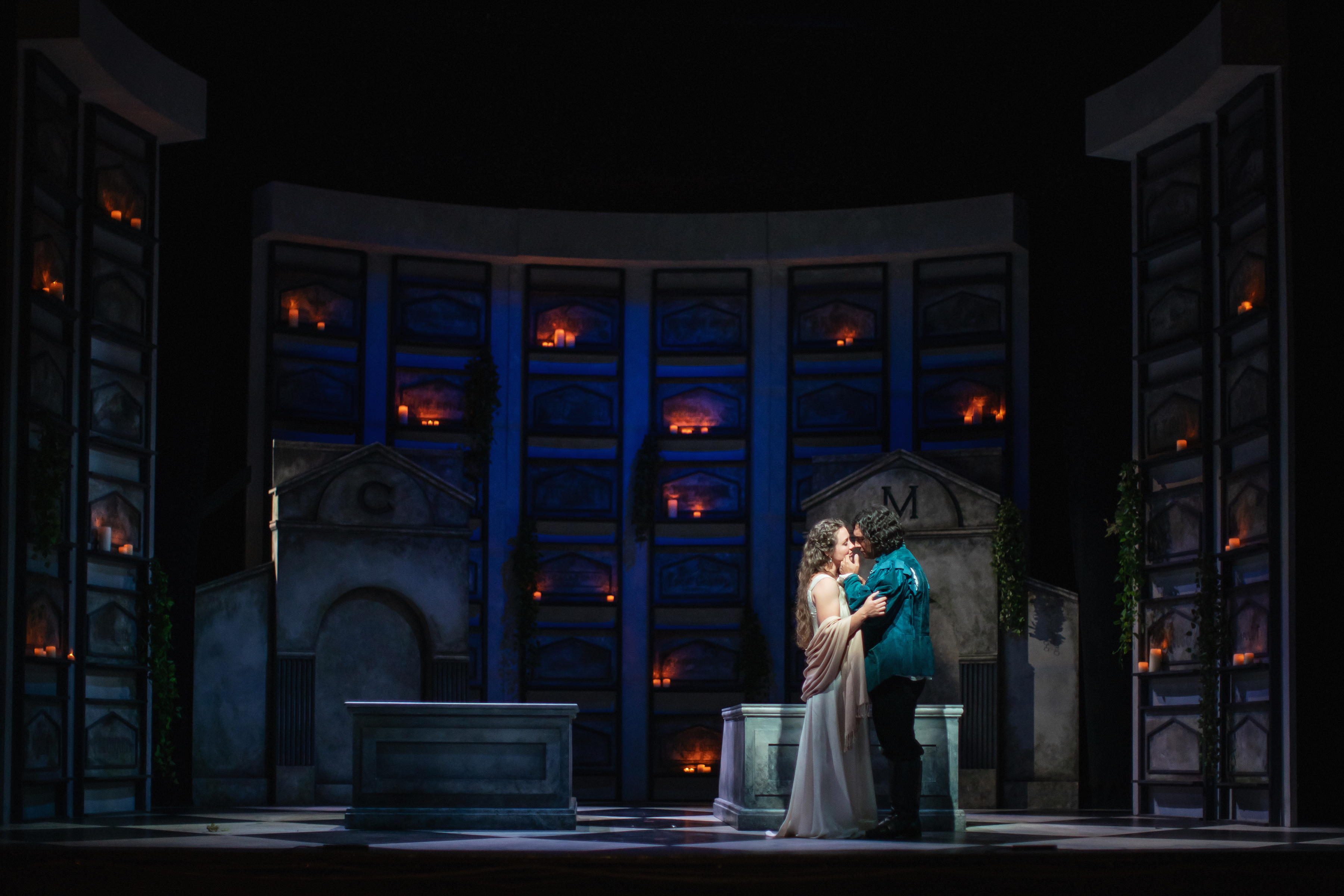
Central City’s production of Gounod’s Roméo et Julietteis set in the crypt of the Capulet family, where Juliette’s body will be placed and where she and Romeo will both die.
This unit set designed by Matthew S. Crane serves the entire opera, with two large, raised catafalques that double as serving tables and beds in other scenes. The setting serves a symbolic purpose: with its high walls on the small Central City stage, it portrays physically the claustrophobia of living in a society where hatred seals off half of your neighbors, and it represents how the hatred between Capulet and Montague has turned all of Verona into a boneyard.
Madison Leonard as Juliette and Ricardo Garcia as Roméo in Matthew S. Crane’s effectively claustrophobic set. All images by Amanda Tipton Photography
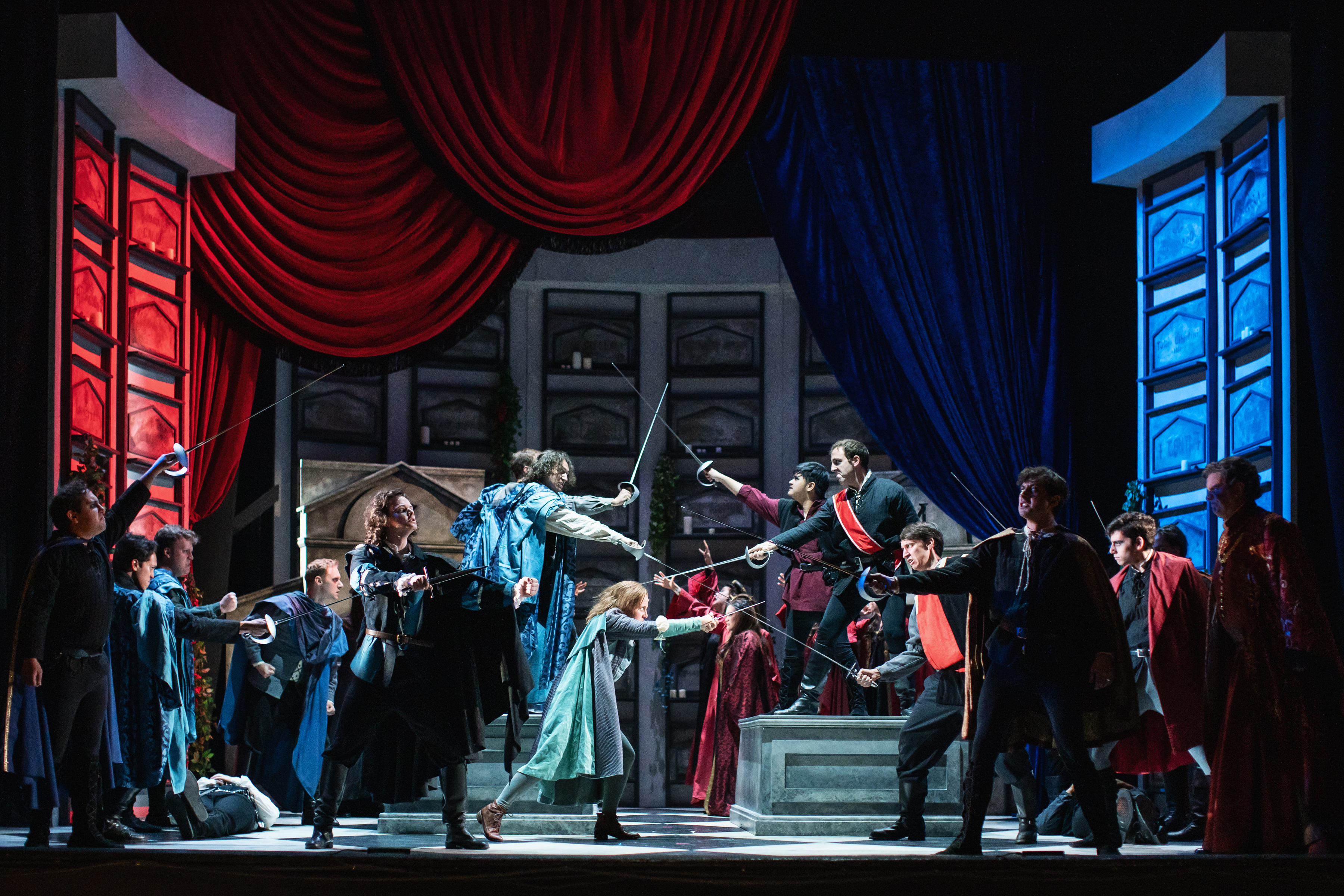
But it barely contains a French Grand opera. The intimate scenes worked best, while larger scenes became so full of singers that they were almost static. The Capulet ball in Act I and the Act III fight were especially challenging. The latter was a directorial tour de force, with the combatants swirling around the stage so fluidly one almost forgot how small the space is. Fight choreographer Matt Herndon has his hands full.
Fight scene from Act II
Director Dan Wallace Miller adheres closely to Shakespeare’s characters, notably the fact that Roméo and Juliette are young teens—she explicitly not yet 14, he probably about 17. Miller writes in his Director’s Note about the “teenagers’ hurricane of uncontrollable emotion,” which makes more sense to them than the curdled adult world of hatred and violence they see around them.
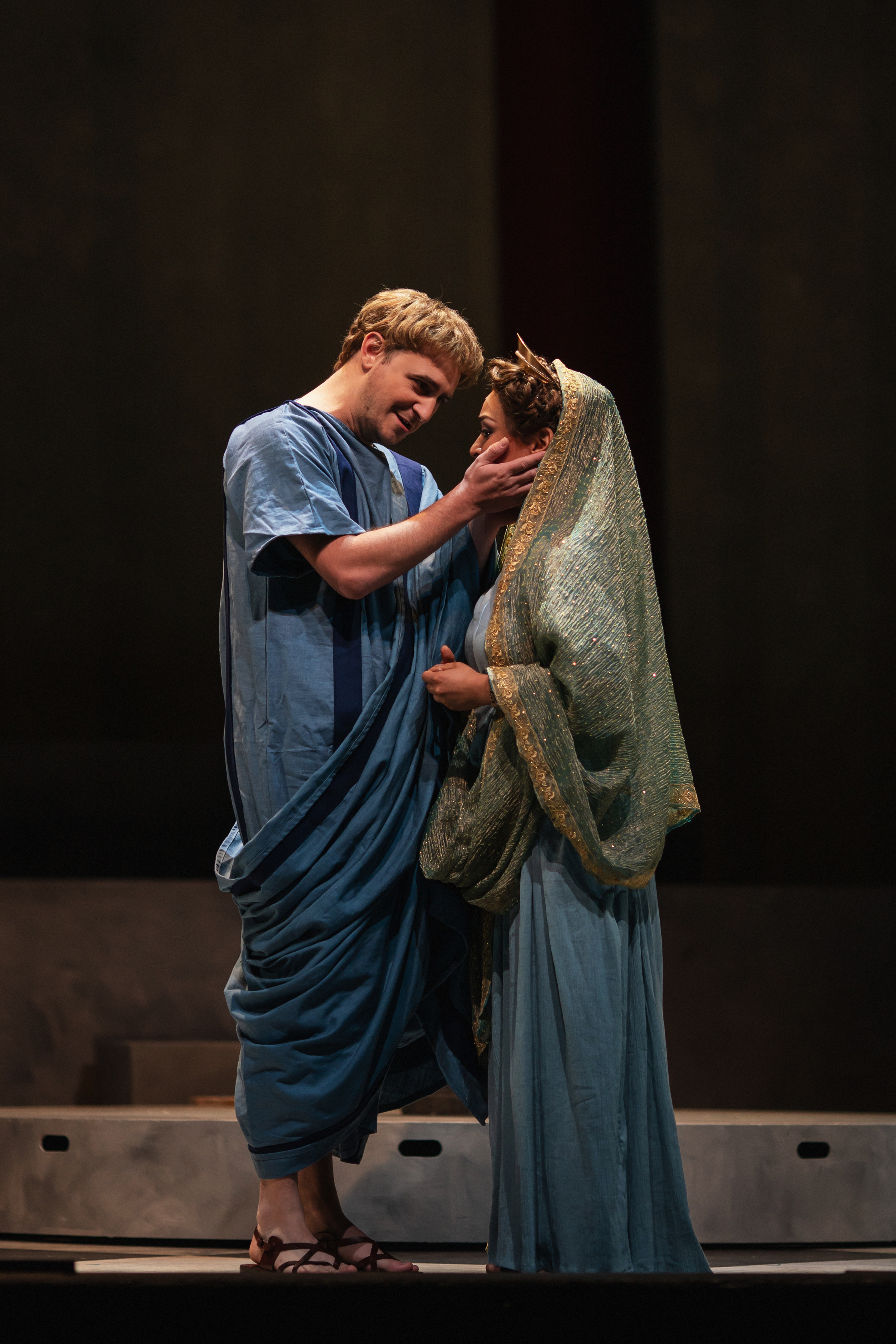
This sounds exactly right, and the singers—Madison Leonard as Juliette and Ricardo Garcia as Roméo—do a remarkable job of acting like teens. Particularly revealing were the moments right after their balcony scene when they couldn’t tear themselves apart. Likewise, the wedding scene is an appropriate mixture of joy, impatience and reverent wonder. The point was well made that they were adolescents who had known each other less than a day and were at the mercy of their abruptly aroused lust.
But the fundamental problem with the opera (and many others from the 19th century) is that the music written for young characters requires mature adult artists. No 13-year-old can sing Juliette’s music. So while the singers performed admirably as young lovers, the musical performances revealed their age and experience.
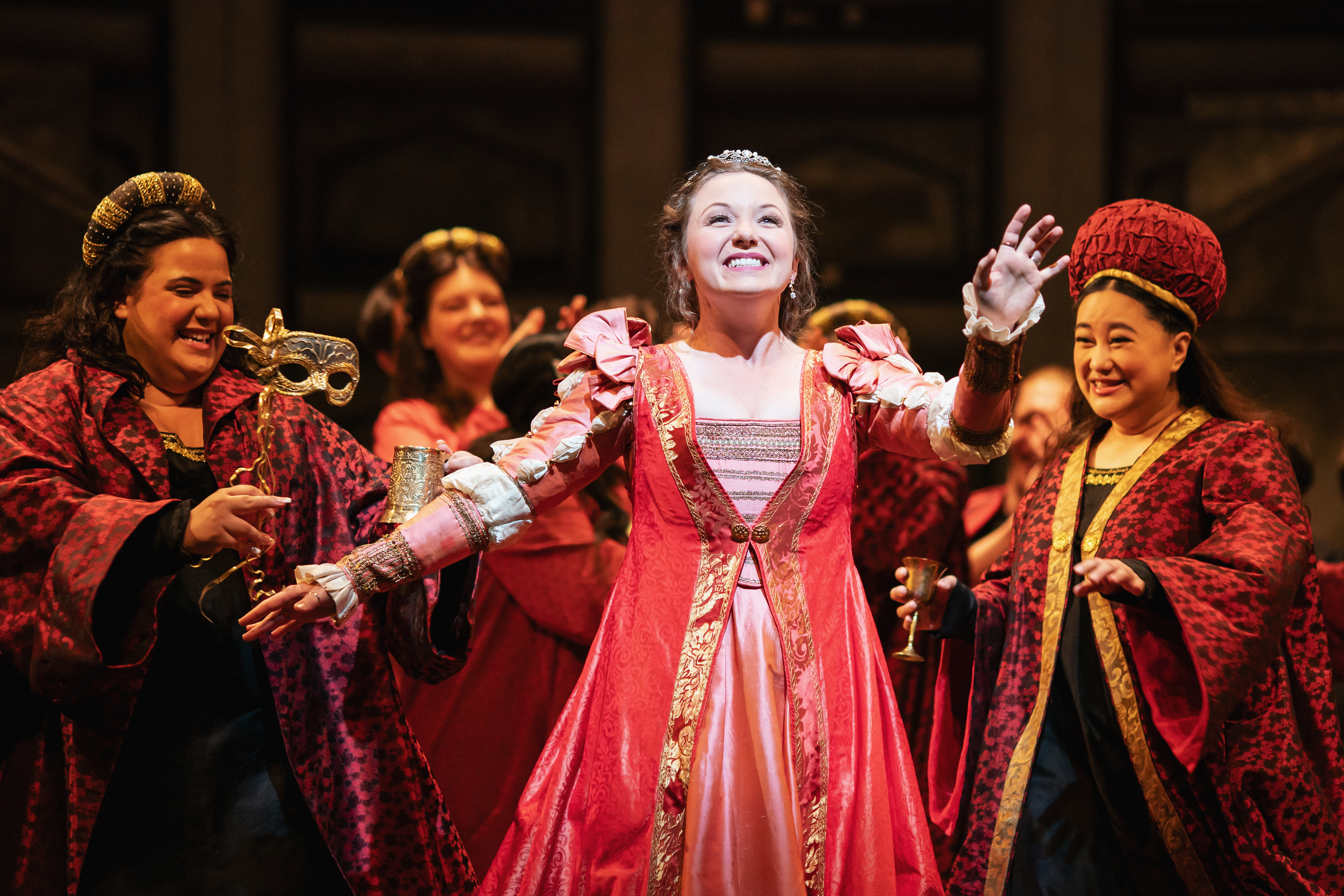
Madison Leonard as the teenaged Juliette at the Capulet’s ball
Still, the music is gorgeous. Leonard as Juliette has a full voice that commands the stage and fills the house. The first act Waltz was graceful if not quite girlish. Her singing throughout was bright and focused. Her performance of the poison scene was particularly effective, with mercurial mood changes, terror, and beautifully sung lyric outbursts.
As Roméo, Garcia has an expressive, soaring tenor that was occasionally strained on top. In an opera largely defined by its duets, he was a worthy partner for Leonard. Their duet concluding the balcony scene was especially beautiful.
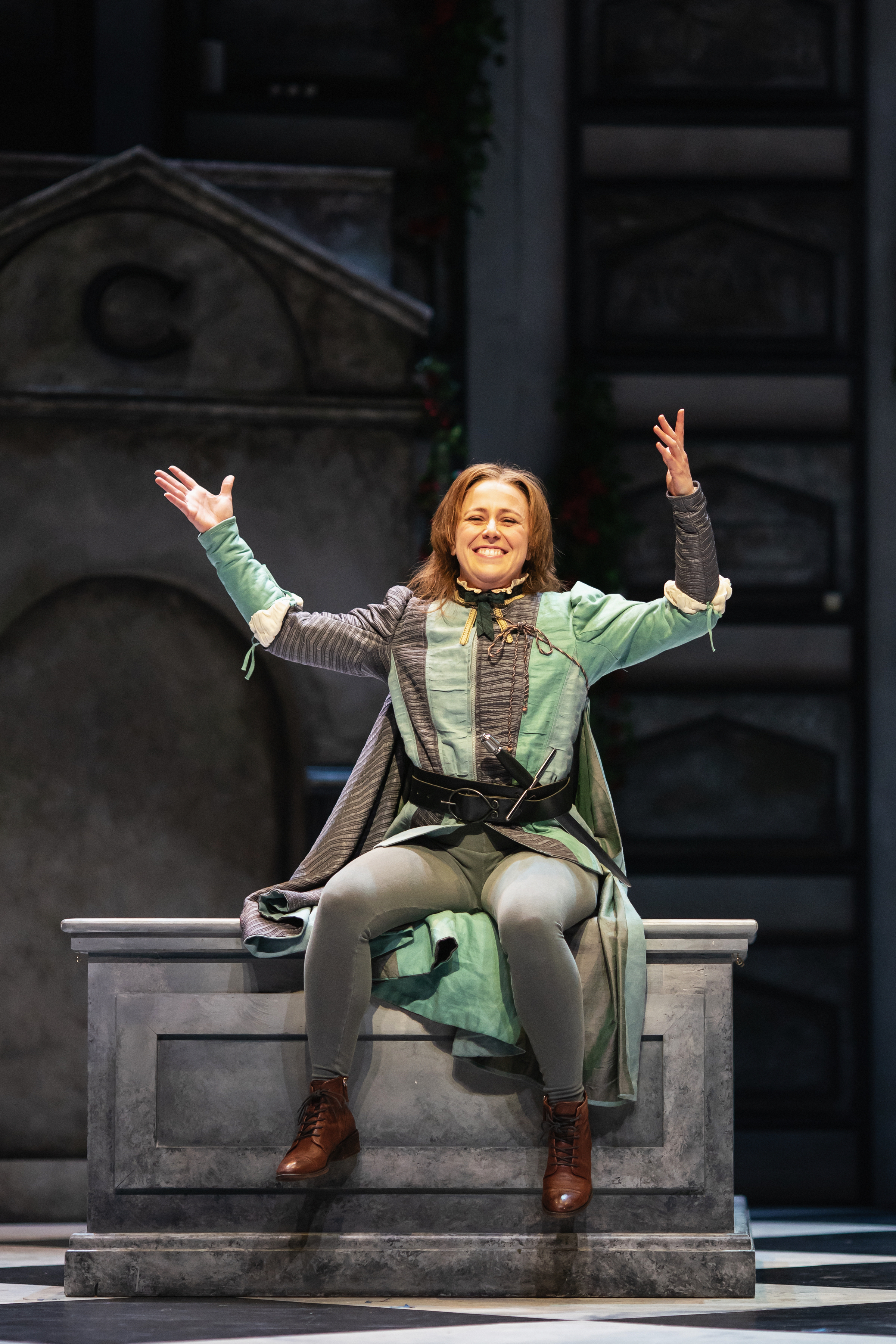
Sable Stout as Stéphano
In the smaller roles, Skyler Schlenker brought a big voice to his portrayal of Count Paris. As Tybalt, Kameron Alston sang with a penetrating, edgy tenor, while his opponent from the Montagues, Shea Owens as Roméo’s pal Mercutio, sang with power and a nice ring at the top. Boulder’s Wei Wu lent his fine, rich bass to a slightly tipsy Frère Laurent.
Soprano Sable Stout had fun in the trousers role as Roméo’s page Stéphano, in spite of a moment or two of unsettled pitch. Mezzo-soprano Sarah Neal was sympathetic as Juliette’s nurse, Gertrude. Bass Adam Cioffari made Juliette’s father, Count Capulet, a benevolent host in Act I and a vengeful head of the Capulets after Tybalt’s death.
Brandon Eldredge led the orchestra, which had been conducted by CCO Music Director John Baril in earlier performances, with sensitivity to the emotional sweep of the score. The chorus, which Eldredge prepared, was ragged in the prologue that lays out the hatred between families, but offered a rich and homogenized sound afterward.
# # # # #
Long before “The Three Tenors” became a world-wide phenomenon, there was Rossini’s Otello.
Composed in 1816, Rossini’s opera—based loosely on Shakespeare’s play as translated into French—was premiered in Naples, where the company apparently had a surplus of strong tenors. Rossini obligingly wrote highly decorated tenor parts for three of the characters: Otello, his nemesis Iago, and Rodrigo, his rival for Desdemona’s love.
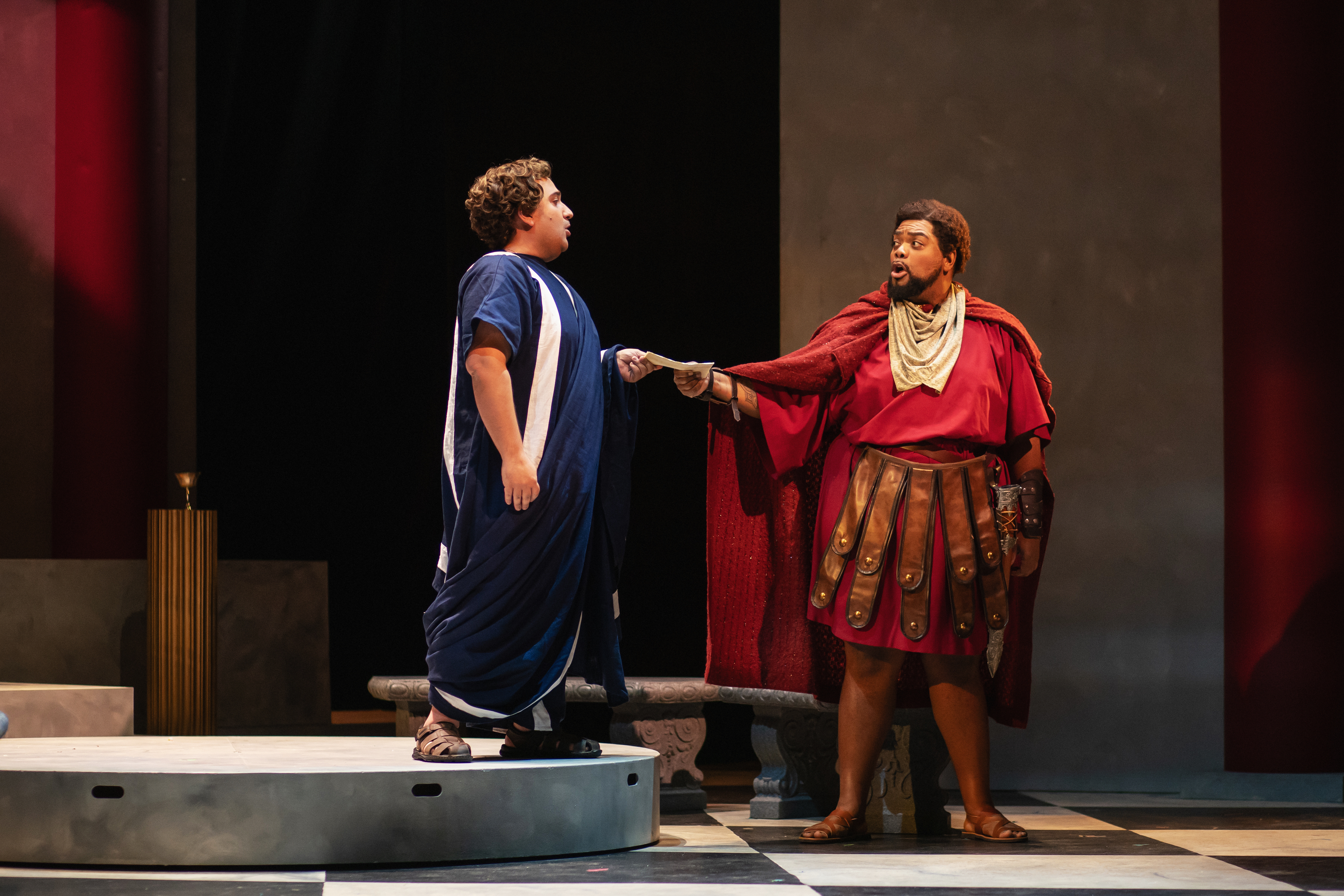
Christopher Bozeka (Rodrigo) and Bernard Holcomb (Iago) sing one of the many tenor duets in Otello. All images by Amanda Tipton Photography
This casting is both the glory and the curse of Rossini’s Otello. The score is filled with stirring arias and duets for tenors in the elaborate style Rossini’s early tenor roles, but finding three tenors up to the challenges in not easy. This is one reason that this opera is not heard often today. The other is that it was surpassed in drama, music and popularity 71 years after its premiere by Verdi’s masterpiece on the same subject.
Nonetheless, Rossini’s three-tenor Otello remains a great opera, full of musical fireworks and potent drama. On that basis, Central City’s production is a welcome opportunity to hear a genuine rarity. It does not quite tell the story that is familiar from Shakespeare’s play and Verdi’s opera. For one thing, it all takes place in Venice; for another the marriage between Otello and Desdemona is secret, opposed by her father who prefers the White Rodrigo to the Black Otello as a match. And Rodrigo is promoted to a major character, one of the three tenors.
Elmiro (Federico de Michelis)tries to persuade his daughter Desdemona (Ceciia Violetta López) to marry Rodrigo
But the biggest difference is that Otello’s downfall comes not from jealousy but racism. Both the text, where Otello is referred to repeatedly as “The African,” and the staging, where characters repeatedly wash their hands after contact with Otello, point to the pervasive racism of the world in which he lives. Stage director Ashraf Sewailam explains that Otello himself came to “believe the narrative” of his own inferiority.
An extra layer is provided by the coincidence that in CCO’s cast, Otello and Iago are performed by Black singers. Sewailam does not fail to make use of this opportunity: action during the Overture make it clear that Iago has been rejected, romantically and otherwise, because of his skin color, which fuels his hatred of Otello. At the same time, his skin color enables him to feign friendship with Otello. He also pretends to help Rodrigo, while laying a trap for Otello to believe that Desdemona has betrayed him.
In the production it is all much clearer than my synoptic outline. Sewailam does an excellent job of keeping actions and motivations clear. He also faces down the opera’s greatest difficulty—the large number of musical numbers where the actors sing but no action takes place. He finds various ways of keeping attention on the stage, some quite successful and others looking more like busywork designed to disguise the static action.
The setting is moved from Venice to Imperial Rome. Done on the basis that the Empire allowed peoples of all nations to succeed on merit, this is a distinction that makes no difference. Matthew S. Crane’s unit set is perfectly serviceable. Plot twists are carefully laid out in performance, both by Sewailam’s thoughtful direction and by the three tenors, who are all capable singing actors.
In the title role Kenneth Tarver is a figure of strength, vocally and dramatically, who is twisted into turning that strength against himself. With his lightning-fast roulades he handles Rossini’s lines comfortably. As a character, he is never less than dignified and controlled.
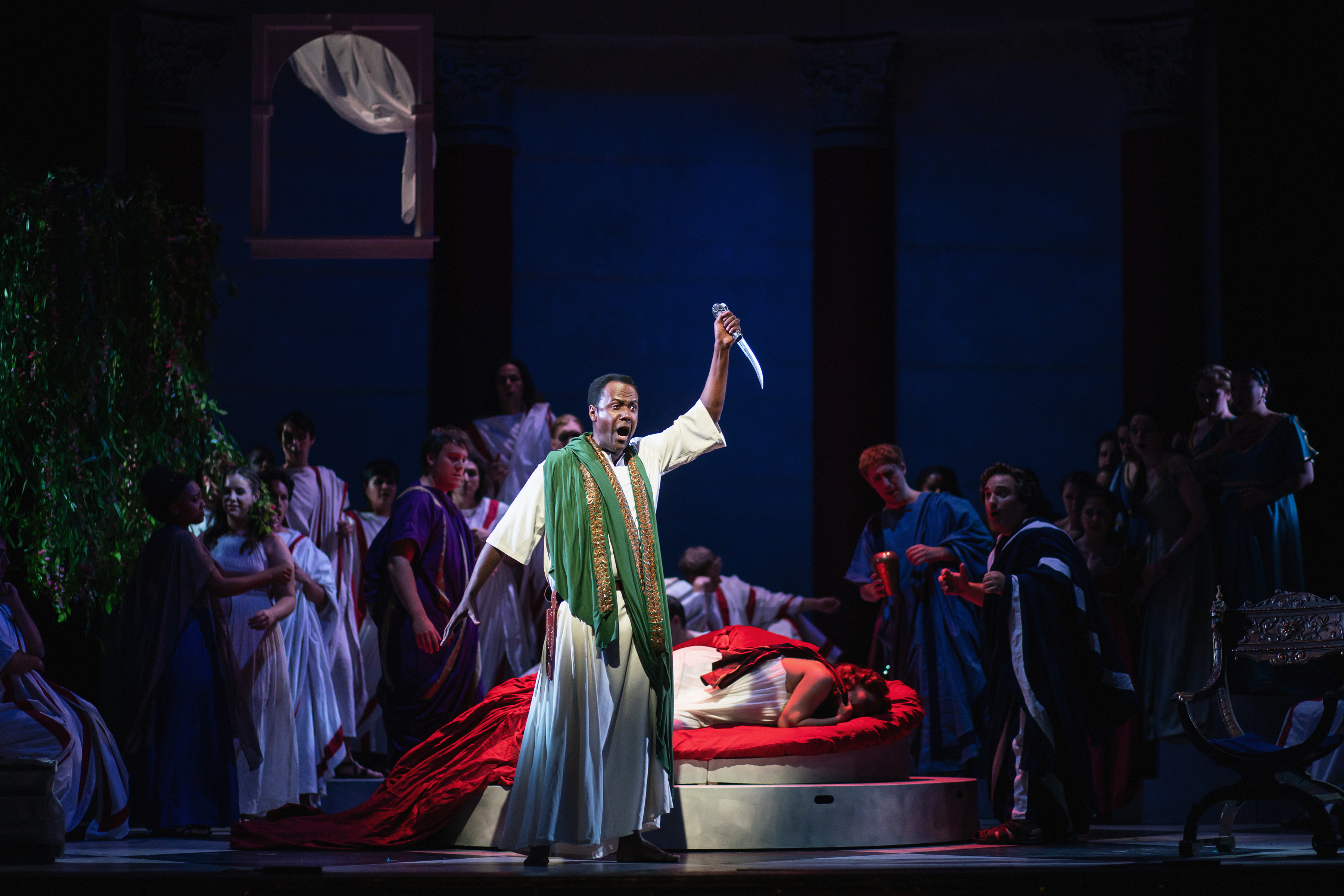
Kenneth Tarver as Otello, shortly after his murder of Desdemona (Cecilia Violetta López)
Christopher Bozeka (Rodrigo) sings with ease into his highest registers, not always cleanly but with great feeling. He effectively uses facial expressions to connect with the audience and announce his rarely failing hopes—illicitly encouraged by Iago—to turn Desdemona to his wishes. Bernard Holcomb as the treacherous Iago has at times the cleanest execution, and always projects the cunning ease of the true villain. The various duets featuring two of the tenors—a distinguishing feature of Otello—are rousing highlights.
Desdemona has her own spectacular moments that she carries off comfortably, to the top of her range. She delivers the “Willow Song,” the one aria sung outside of full performances, affectingly. Federico de Michelis’s well rounded bass lends weight to Elmiro, Desdemona’s father, making him so convincing a racist enemy of Otello that his conversion at opera’s end—part of a rapid turn of events that also unmasks Iago’s treachery—is scarcely credible. Hilary Ginther is a warm and sympathetic Emilia.
Under John Baril, the orchestra gives a sprightly and stylish performance of Rossini’s score. Special credit goes to the sparkling woodwinds and horn players for their solo turns.
# # # # #
All three productions on the summer schedule—Kiss Me Kate, Roméo et Juliette, Otello —are presented in attractive productions, their stories cleanly told and well sung. Any one of them makes for a good summer excursion to the mountains, but if you can only make one trip to Central City, see Otello. It is a true rarity that is worth hearing, and its story of the harm done by thoughtless racism still resonates. And where else outside reruns can you hear three tenors?
# # # # #
Central City Opera Remaining performances of the 2023 Season All performances in the Central City Opera House
Roméo et Juliette By Charles Gounod, Jules Barbier and Michel Carré John Baril, conductor, and Dan Wallace Miller, stage director
Performed in French with English supertitles
2 p.m. Friday July 28; Sunday, July 30; Wednesday, Aug. 2; Saturday, Aug. 5
Kiss Me, Kate By Cole Porter, Samuel and Bella Spewack Adam Turner, conductor, and Ken Cazan, stage director Performed in English with English supertitles
7 p.m. Saturday, July 29; Saturday, Aug. 5 2 p.m. Wednesday, Saturday, July 22; Wednesday, July 26
Otello By Gioachino Rossini and Francesco Berio di Salsa John Baril, conductor; Ashraf Sewailam, stage director Performed in Italian with English supertitles
7 p.m. Saturday, Friday, Aug. 4 2 p.m. Wednesday, July 23; Saturday, July 29; Sunday, Aug. 6
CORRECTION: The original version of this review inadvertently omitted the name of tenor Kameron Alston, who sang the role of Tybalt in Roméo at Juliette. I apologize for the oversight, which has been corrected as of 7.27.23.
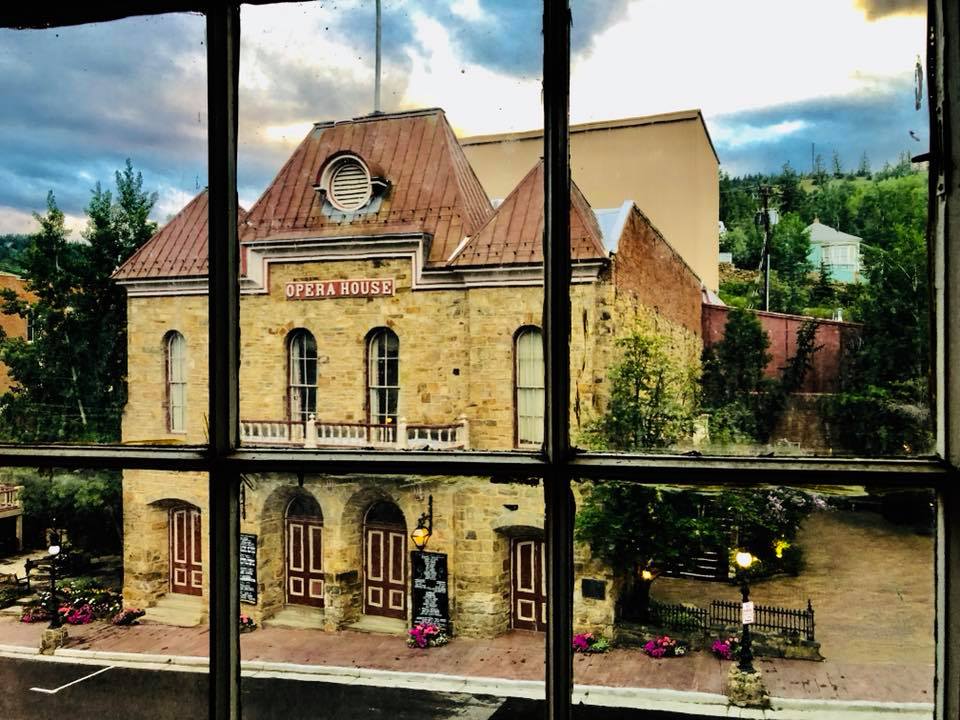
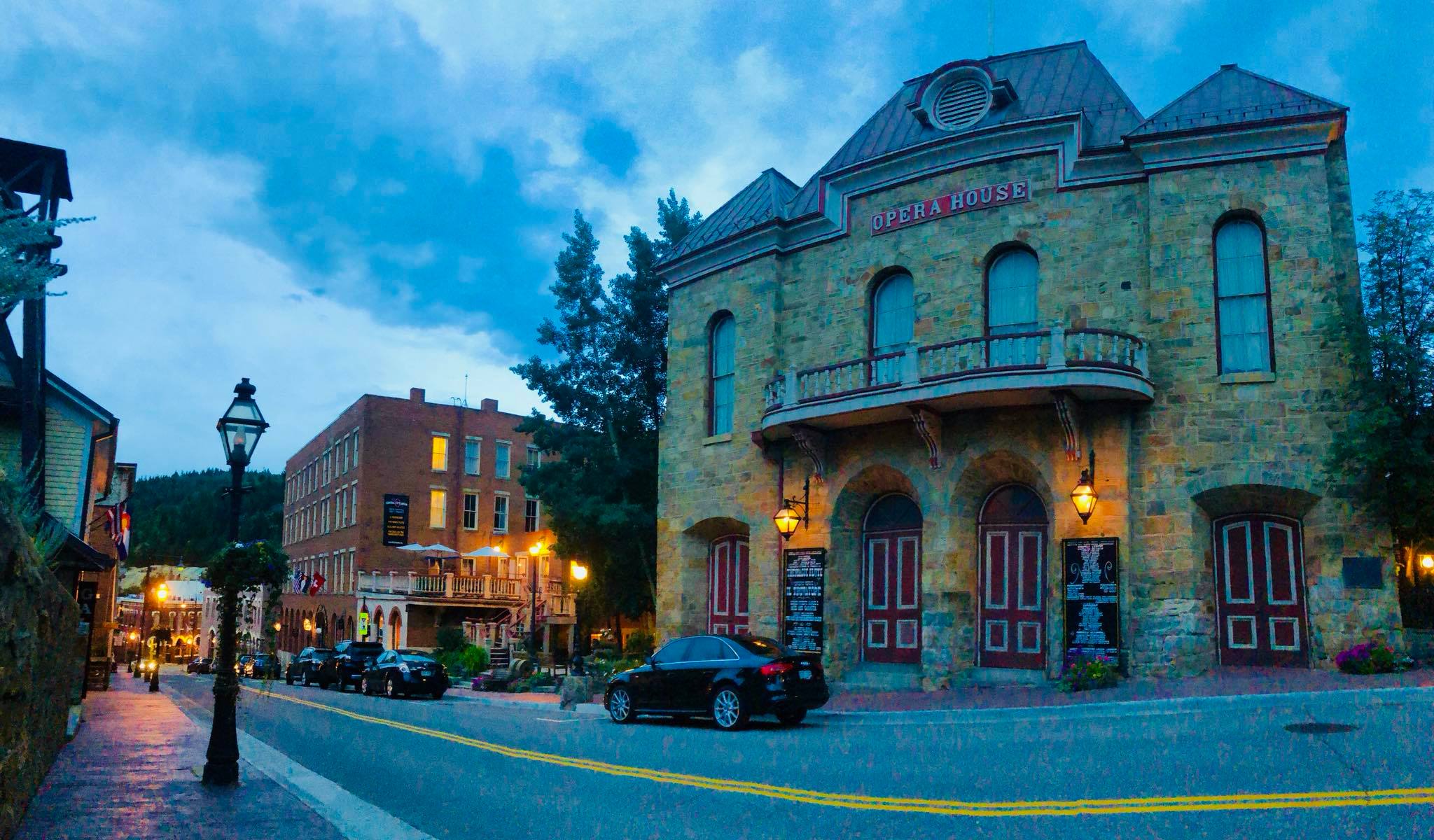
Central City Opera House. Photo by Ashraf Sewailam.
Two of the three stage directors who helped produce this summer’s performances at Central City Opera (CCO) have given comments on the recent departure of CEO Pamela Pantos and the future of Central City Opera. (See: CEO Pamela Pantos’ employment at Central City Opera has ended.)
Ken Cazan
Ken Cazan, professor of opera and resident stage director at the University of Southern California Thornton School of Music, is the senior director of the three. He has been a feature of the CCO artistic community for many years. Last December when CCO was embroiled in a contract dispute with the American Guild of Musica Artists (AGMA), he wrote a letter to Pantos stating his unwillingness to work for the company until the dispute was resolved. Subsequently the two other directors signed the letter as well. The dispute was resolved at the last minute.
For the 2023 season, Cazan directed the production of Cole Porter’s classic musical Kiss Me, Kate. After yesterday’s surprise announcement that Pantos was leaving CCO, he wrote the following: “I’m glad it’s over. Now, hopefully, the company will wipe the slate clean and start from the ground up to recreate itself.
“At the moment it is totally up to the board and I pray that they have the fortitude to look at the company and its mission through a very fresh, clear lens. It is the perfect time to reimagine who and what they are and how they fit into the Colorado, American and international arts landscapes. I have so many thoughts on the huge potential for the company to move forward and grow artistically in this moment. It just takes guts and trusting a new artistic mentality—whoever that may be.
“Let the Managing Director and the new Artistic Director (a must position and one that was sorely missed this summer) create a new world within and around CCO, one that hopefully reaches out and invites in a new, fresh audience while being grateful for the guidance and support of current and past generations.”
Ashraf Sewailam
Ashraf Seawilam was the most junior of the three stage directors. Although he has sung at Central City and around the world, the CCO production of Rossini’s Otello was his first fully professional directing job. He wrote: “To me—and many of my colleagues share this sentiment—the priority now is to concentrate on performing the rest of the festival not only successfully, but brilliantly.
“I won’t speak about the circumstances under which we put this excellent season together. The company and its great history will move on from this episode. The tremendous efforts put together by the artists, creatives, and crew in order to produce this season in spite of the ‘obstacles’ should be what’s in the limelight now, not what we left behind. In the end it’s why we’re here: The art and artists who make it happen.
“Come and see the shows! You will not be disappointed.”
Details of the remaining performances and access to ticket sales may be found here.
Meeting held Tuesday morning, June 18; name removed from Web page
By Peter Alexander July 18 at 5:55 p.m.
The Central City Opera Company (CCO) called all members of the company, administrative staff and festival personnel, to meetings held simultaneously at the Teller House in Central City and the company’s office in Wheat Ridge at 9:30 a.m. this morning (July 18).
Central City Opera House. Photo by Ashraf Sewailam
According to the internal message that was passed to Sharpsandflatirons anonymously, board co-chairs Roopesh Aggarwal and Heather Miller had the following update for all CCO personnel: “Effective immediately, Pamela Pantos’ employment with the Opera has ended and we thank her for her work. We wish her the best in her future endeavors and will begin a search immediately for a new President and CEO.“
The announcement comes in the middle of the company’s summer season of three operas in the Central City Opera House. The three productions—Cole Porter’s Kiss Me, Kate, Charles Gounod’s Roméo et Juliette and Rossini’s Otello—will continue in rotating repertory through the originally announced final date, Sunday, Aug. 6.
The board’s announcement indicates that members of the administrative staff will take on additional duties. Scott Finlay will be Chief External Affairs Officer and Margaret Williams will be Interim Operations Officer. Both will report directly to the board of directors.
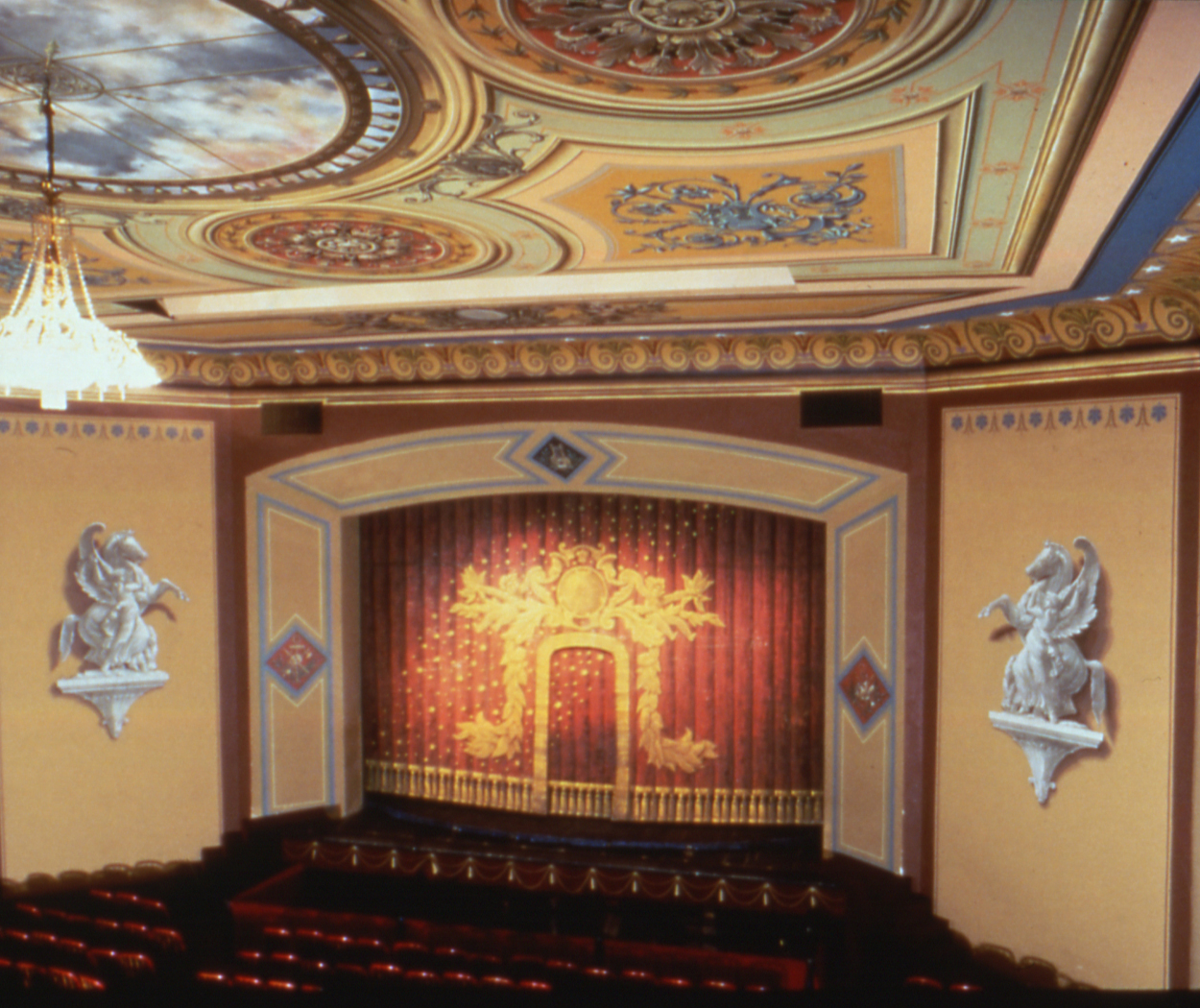
Opera House interior
Pantos’ name has been removed from the “Who Are We” listing on Central City Opera’s Web page, and the updated assignments have been posted.
Although no one said so on the record, it was widely believed that the previously reported dispute between the opera company and the American Guild of Performing Artists (AGMA) was a result of Pantos’ administrative style and reflected her wishes. Central City Opera and AGMA subsequently signed a contract that resolved the dispute.
Tickets for remaining performances this summer may be purchased here. Three productions have been announced for summer 2024—Gilbert & Sullivan’s Pirates of Penzance, Puccini’s La fanciula del West and Kurt Weill’s Street Scene. Menotti’s Amahl and the Night Visitors will be presented in Denver Dec. 23 and 24.
NOTE: The original version of this story said that upcoming seasons had not yet been announced for Central City Opera. In fact, the listing in the final paragraph above is correct.
All comments on this article must be approved before they will be posted. Personal attacks and name calling against anyone currently or formerly employed at Central City Opera will not be allowed. There are varying opinions on what has unfolded at CCO, but in this context personal attacks serve no purpose.
Michael Christie is looking forward to being back at Chautauqua this week.
Michael Christie
Christie, who was music director of the Colorado Music Festival (CMF) 2000–13, will lead the Festival Orchestra in a pair of concerts Thursday and Friday (7:30 and 6:30 p.m. respectively in the Chautauqua Auditorium; see program below). Since leaving CMF at the end of the 2013 festival, Christie spent eight years at the Minnesota Opera, conducted at the Santa Fe Opera, and is now music director of the New West Symphony in Los Angeles.
Among other world premieres, he has conducted Manchurian Candidate by Kevin Puts and Mark Campbell, and The Shining by Paul Moravec and Campbell at Minnesota Opera; The Gospel of Mary Magdalene by Mark Adamo at San Francisco Opera; and The ( R)evolution of Steve Jobs by Mason Bates and Campbell at the Santa Fe Opera.
Now designated CMF Music Director Laureate, Christie returned as guest conductor once before, in the summer of 2016. “It was really wonderful to see all those faces again and inhabit that space,” he says. The Chautauqua Auditorium “is so unique and full of so many memories and such a great place to have a musical experience.
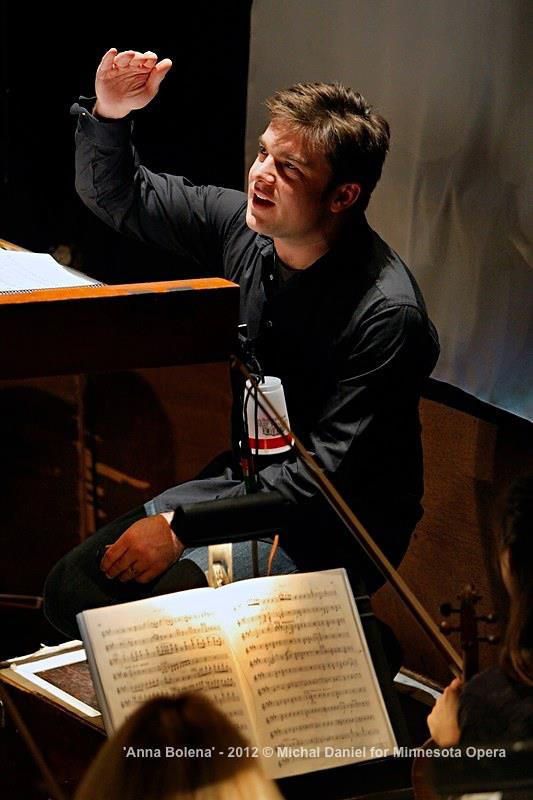
Michael Christie at the Minnesota Opera. Photo by Michael Daniel
“(The hall) is one of the truly great aspects of the CMF—the enduring part that transcends all of us, audience members or performers. There’s still that auditorium—it’s just always there.”
One of his most recent appearances around the world was as a conductor for the 2023 “Singer of the World” contest in Cardiff, Wales. A biennial contest for classical singers that was established in 1983, the Singer of the World has launched many great careers including those of Finnish soprano Karita Mattila, Welsh baritone Bryn Terfel and Russian baritone Dmitri Hvorostovsky.
You may see Christie conducting the final concert with this year’s prize winner on the OperaVision Website.
The diversity of his career post-CMF, including both opera and symphonic performances, is not an accident. “I have been working very hard to escape the pigeon holing that can happen to people,” Christie says. “I love both opera and symphonic music, and they speak to each other so clearly.
“I feel strongly that to conduct a symphonic work when a composer has also composed a lot of ballet or a lot of opera, and not to have done those pieces, you’re missing a huge part of the story. There is a different kind of emotion that composers are able to express with the voice.”
The New West Symphony is a regional orchestra, equivalent in size and scheduling to the Boulder Philharmonic. It has the advantage of drawing on the pool of freelance musicians in Los Angeles, but Christie chose that job for another reason. “I thought it would be a wise choice to have an orchestra that had a lean schedule, so that I could take the longer periods for opera,” he says. “That’s worked out quite well.”
Working over a period of years with a smaller orchestra has also been an educational experience. “With smaller orchestras, the conductor really has to be way more involved,” he says. “I have learned a huge amount.
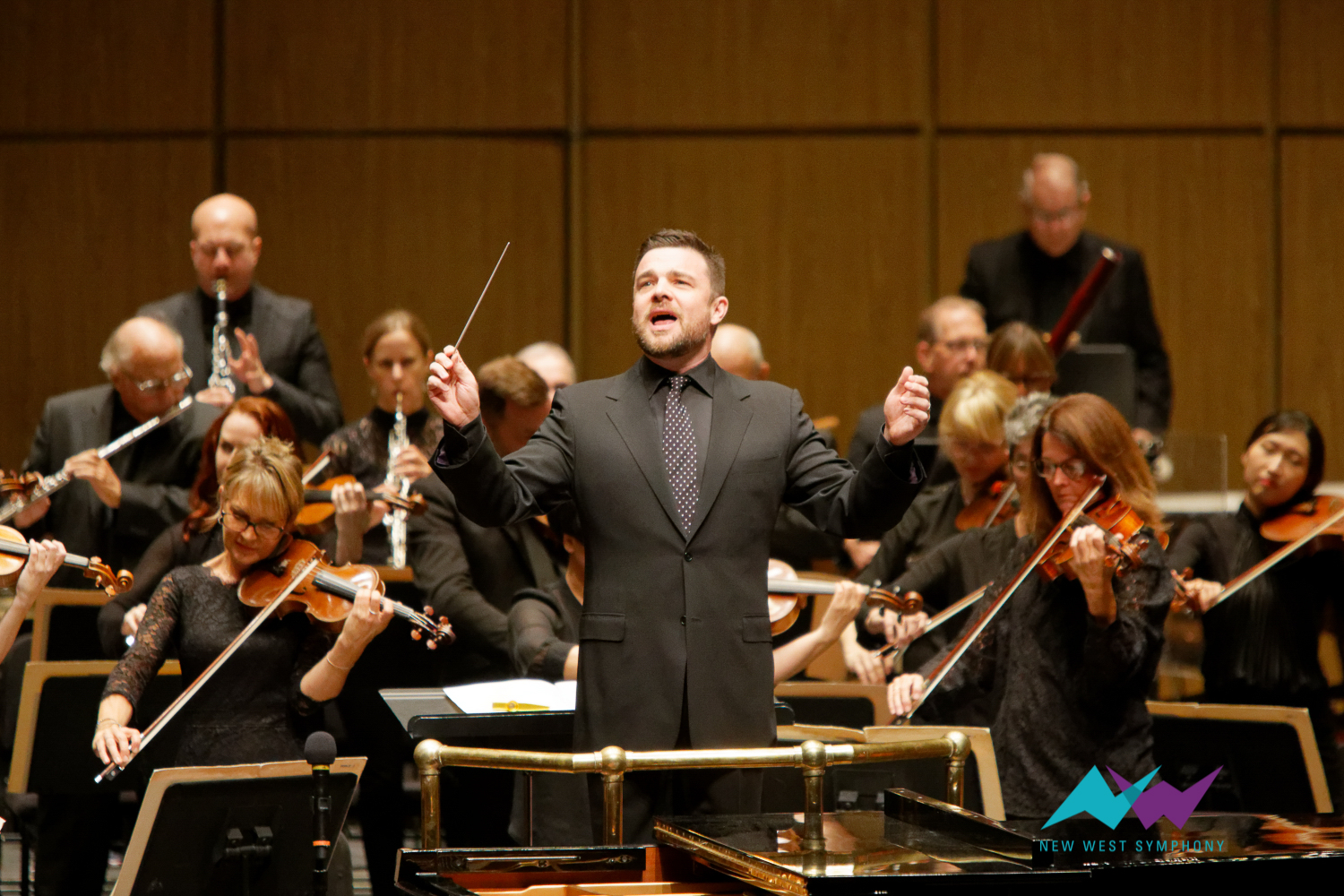
Michael Christie with the New West Symphony
“The conductor is much more hand-on about community engagement that in bigger orchestras is handled by the general manager. I found with the smaller orchestra that I’m having way more specific conversations about what (community partners’) needs are. It’s been really eye-opening and very immediately engaging every day.”
Christie has a list of favorite things about Chautauqua concerts that he’s looking forward to. “I’m looking forward to how the audience spills out of the hall afterward, and that moment where folks are sharing with each other and talking to the musicians. I’m looking forward to seeing that.
“I love the auditorium just before the concert starts. People are milling about, there’s this lovely energy that happens—a very friendly energy that happens among everybody in the hall. The musicians gathering near the green room, standing around and chatting before the concert starts—there’s always a special human easiness about things before and after those concerts.
“I always treasure those moments.”
# # # # #
COLORADO MUSIC FESTIVAL
Festival Orchestra, Music Director Emeritus Michael Christie, conductor With Michelle Cann, piano
Ravel: Piano Concerto in G Major
Florence Price: Piano Concerto in One Movement
Tchaikovsky: Symphony No. 4 in F Minor, op. 36
7:30 p.m. Thursday, July 20, and 6:30 p.m. Friday, July 21 Chautauqua Auditorium
Peter Oundjian led an all-Corigliano program by the CMF Festival Orchestra
By Peter Alexander Jan. 14 at 12:24 a.m.
There are several reasons that John Corigliano is an important composer, and many of them were on display last night (July 13) at the Colorado Music Festival.
The Festival Orchestra under music director Peter Oundjian played an all-Corigliano program—a rare honor for a living composer that Oundjian has made a feature of his annual “Music of Today” programming. The three pieces on the program spanned not only 50 years of Corigliano’s work, as Oundjian pointed out from the stage; they also displayed some of the breadth and diversity of his creativity.
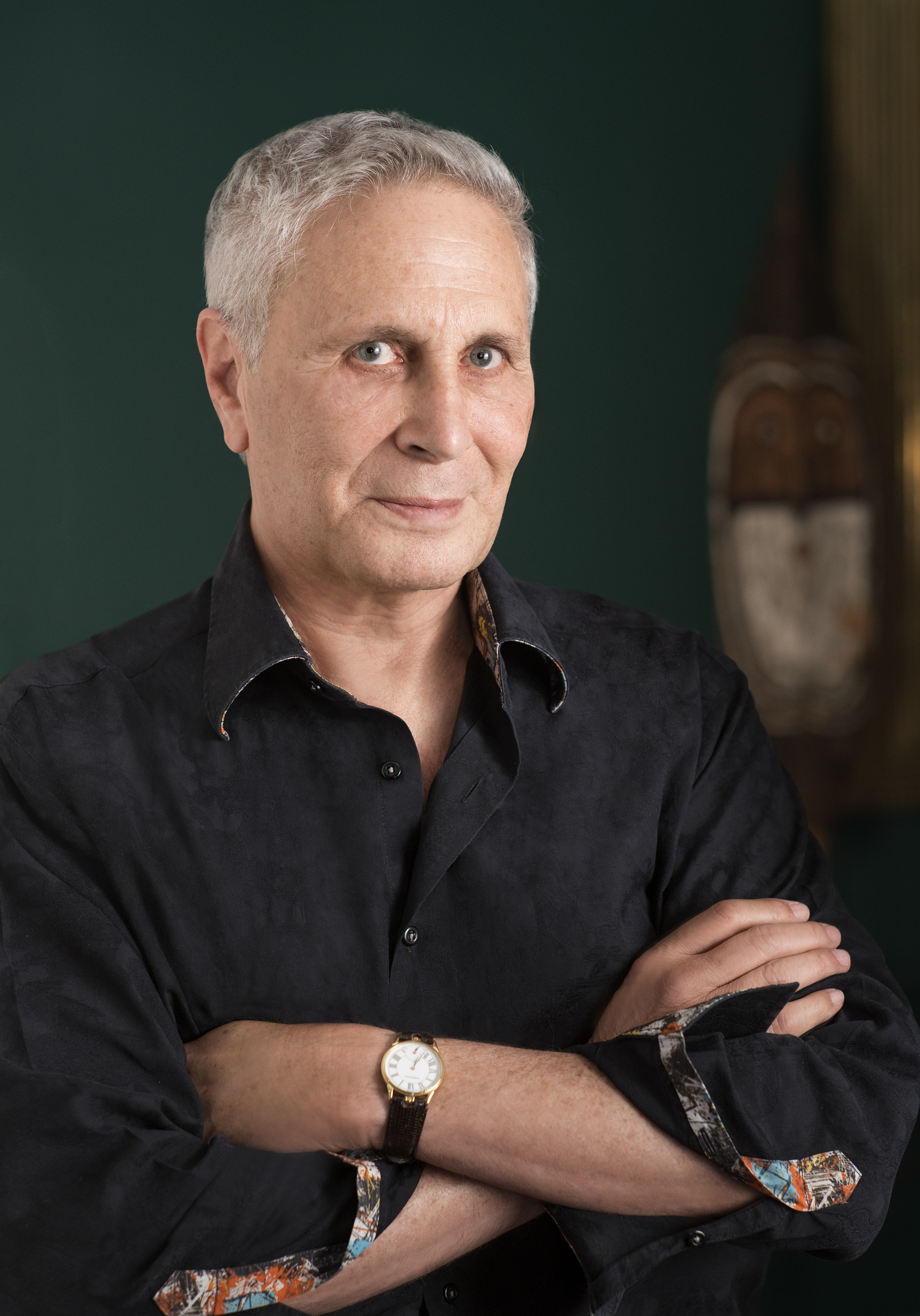
John Corigliano. Photo by J. Henry Fair
That breadth is certainly one of the reasons the Corigliano in important. For last night’s concert, the CMF Orchestra played two pieces that are great entertainment—the Gazebo Dances of 1974, and his recent Triathlon for saxophone and orchestra (2020), played by virtuoso saxophonist Timothy McAllister.
The third piece on the program, One Sweet Morning for voice and orchestra (2011), reaches for greatness, and find it though both texts and their settings. The expressive depth of this piece, commission for the 10th anniversary of the 9/11 attacks, clearly signals Corigliano’s importance. Grammy award winning mezzo-soprano Kelley O’Connor was the soloist.
Opening the program, Gazebo Dances seemed like a continuation of the Tuesday program by the JACK Quartet, titled “New York Stories.” The Dances come straight out of the 1970s New York and Broadway milieu that inspired Leonard Bernstein and others of the times.
Oundjian and the Festival Orchestra captured well the buoyant energy and sweet sentimentality of the Overture movement. The Waltz was just humorous enough, and the dreamy Adagio movement, played with careful attention to balance among the instruments, provided a comforting moment of relaxation before the jolly Tarantella.
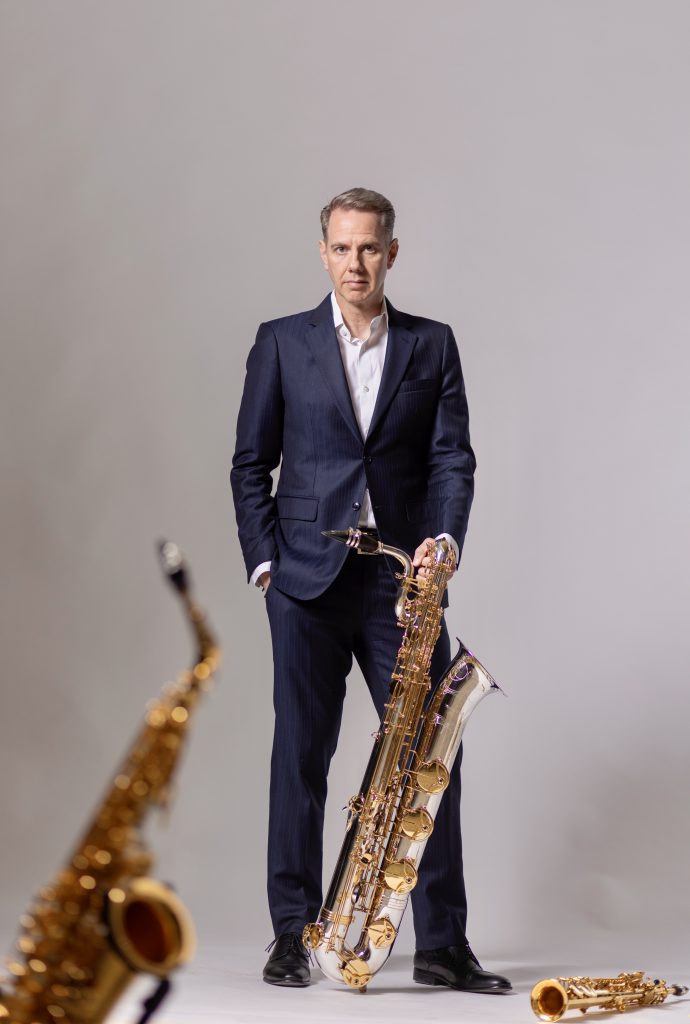
Multi-saxophonist Timothy McAllister
Triathlon requires a saxophonist who is a virtuoso on the soprano, alto and baritone saxes—the three events of the athletic triathlon the concerto represents—and the CMF certainly had that in McAllister. Apparently comfortable in every possible range—and some impossible ones, too—of each instrument, he was unquestionably the medalist of this Triathlon.
The first movement is filled with incredibly virtuosic passages all over the soprano sax. Sadly the balance was not always well judged, but when the soloist emerged from the brassy orchestral texture, blisteringly fast things were going on. McAllister played with silky smoothness on the alto sax for the second movement, even over passages of riverine rapids.
The baritone sax is the boisterous cousin of the other instruments, ideal for all kinds of playful hijinks—and all kind of playful hijinks is what Corigliano asks for and McAllister provided, from loudly slapped keys to slap-tongue blasts. The only thing missing was a return to the screaming heights of the soprano instrument, which is exactly what the score calls for at the end. With a soloist like that, who wouldn’t have fun at the concert?
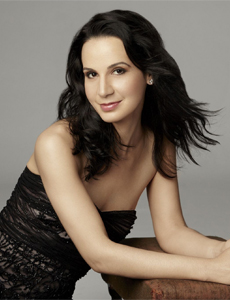
Mezzo-soprano Kelley O’Connor
But it is One Sweet Morning that provided the emotional depths of the evening. Corigliano made inspired decisions picking four poetic texts that lament the horrors of violence and hope for a world without war. The poets could not be more diverse—Polish poet Czesław Miłosz foreseeing the end of the world in 1944, Homer describing the man-to-man brutality of the Trojan War, 8th-century Chinese poet Li Po revealing the anguish of wives and mothers, and pop-song lyricist E.Y. “Yip” Harburg (“Wizard of Oz”) dreaming of a world when “the rose will rise . . . (and) peace will come.”
The texts make an eloquent progression from anguish to brutality to hope, and here is where Corigliano reaches for greatness. Not only has he selected deeply moving poems, he matches each with music that powerfully captures in turn the deep melancholy of Miłosz’s words, the concentrated barbarity described by Homer and Li Po, and the healing grace suggested by Harburg.
Oundjian has a profound grasp of this music, and brought it out through the players. O’Connor sang with control and expressive precision, with no audible strain from the lowest notes to the highest. If she could not be heard during the scenes of war, that was not her fault; the orchestral sound there was as loud as I have heard at Chautauqua, but never uncontrolled.
These three pieces—fun dances, a fervent memorial and a splashy concerto—made up an optimal concert program, and it is one that I will remember as one of my favorite evenings at CMF.
__________
NOTE: The title of John Corigliano’s piece was corrected in the 10th paragraph on 7/14. The correct title is One Sweet Morning, not One Fine Day. We apologize for the error.





 Sharps & Flatirons