Thank you for stopping by.
I’m on vacation until Sept. 7.
Thank you for stopping by.

Thank you for stopping by.
Performances are still available for all works in the 2015 summer season
By Peter Alexander
 Central City Opera (CCO) is going on the road with two small-scale, one-act operas that could not be more different.
The comic romp Don Quixote and the Duchess by Baroque composer Joseph Boidin de Boismortier, and the sober religious parable The Prodigal Son by Benjamin Britten supplement two 2015 summer season mainstage productions. Both shows opened in alternative venues in Central City this week, where they will be repeated later this summer.
Don Quixote and the Duchess
It started with a vacuum sweeper.
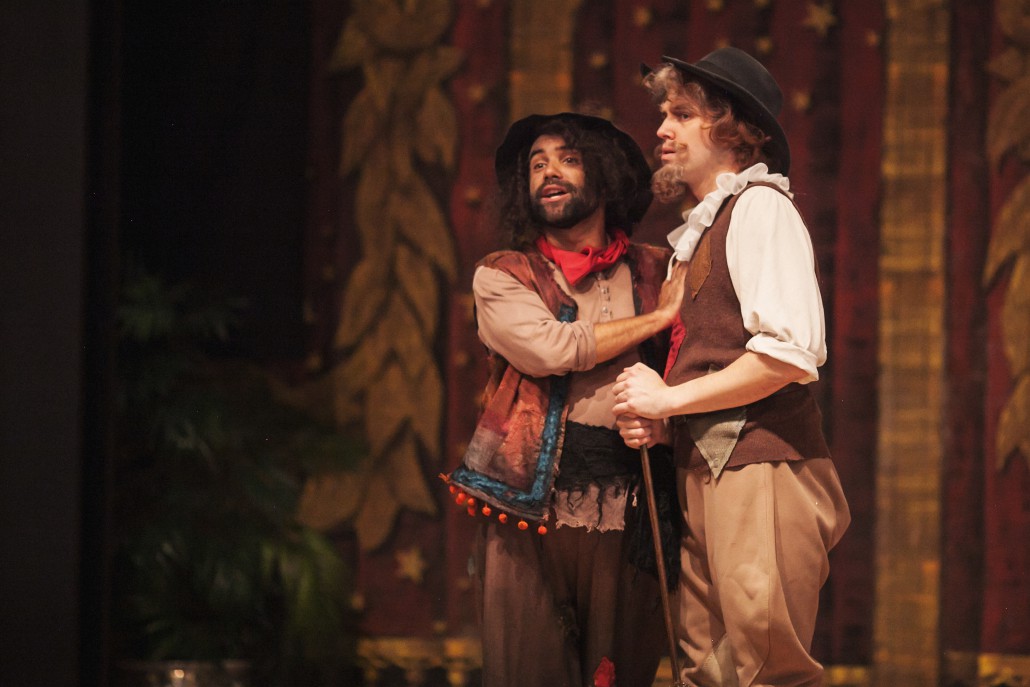
Don Quixote and the Duchess: Michael Kuhn (Sancho) and James Dornier (Don Quixote). Photo by Amanda Tipton.
The servants of the titular Duchess were sweeping up the “castle” as the last of the audience took their seats in Central City’s Atwill Gilman Studio at the Lanny and Sharon Martin Foundry Rehearsal Center, just up the hill from the historic Opera House. The flat floor and hard-backed chairs do not make this an ideal performance space by any means, but any discomfort was quickly forgotten by most as the audience got into the slapstick spirit of director Kyle Lang’s production—starting with that vacuum sweeper and lasting straight though to the end.
Like most French operas from the Baroque era and well into the 19th century, dance was a large component of the score. The music, if not exactly memorable, is at best delightful, rhythmically engaging and expressive. Conductor Christopher Zemliauskas led a well defined, spirited performance by the chamber orchestra and cast.
Since no virtuosic Baroque ballet moves were called for, the young cast of CCO apprentice artists were equal to the director’s modest dance demands, tending more to fun than artistry. They danced, and sang, and mugged when appropriate, with great pleasure and energy, giving the audience a lot to enjoy. This is not a deep or thoughtful work, but it is fun for everyone: the children I saw in the audience were captivated by the colorful costumes and the antics of the cast.
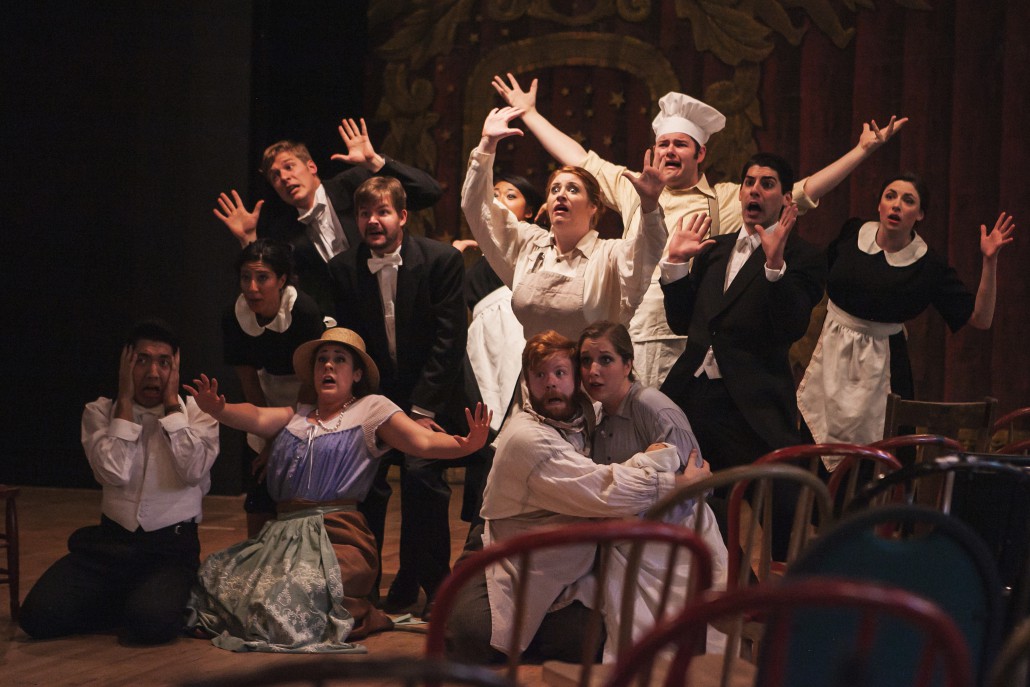
Don Quixote and the Duchess: The ensemble, members of the Bonfils-Stanton Foundation Artists Training Program. Photo by Amanda Tipton.
If there is a problem, it is in understanding of the text. Good diction and projection is a must, but in that space I only made out about 50% of the words. In general the men, with fewer decorations in their musical lines, fared better than the women at conveying the text.
Everyone sang strongly, but one performer stood out: soprano Maya Kherani as Altisidore, the Duchess, who also appears as “The Queen of Japan” (Baroque opera favored foreign characters and locations, but was not strong on geographical accuracy). Her bright, strong voice and fluid dancing were notable strengths of the production. James Dornier as Don Quixote, Michael Kuhn as Sancho, and Joshua Arky as Merlin, aka the Duke, all made strong impressions.
Finally, it is worth noting how many of the archetypes of 18th-century opera are incorporated into, and made fun of in this short and satirical work. There is a hero on a quest (Don Quixote) with a comic sidekick (Sancho); there is a wizard (Merlin) with a cruel servant (Montesinos); there is a magic garden and magical transformations. Never mind that here these are all delusions or deceptions; they were ripe for satire because they figured so prominently in Baroque operas well known to Boismortier’s audience. Most of those works are little known today, but the same elements can be found in operas throughout the 18th century, including Mozart’s Magic Flute, still one of the most popular works in the repertoire.
Don Quixote and the Duchess will be repeated in Central City at 12:30 p.m. Aug. 1, and performed at noon Aug. 6, in First United Methodist Church in Fort Collins. Tickets are available here.
The Prodigal Son
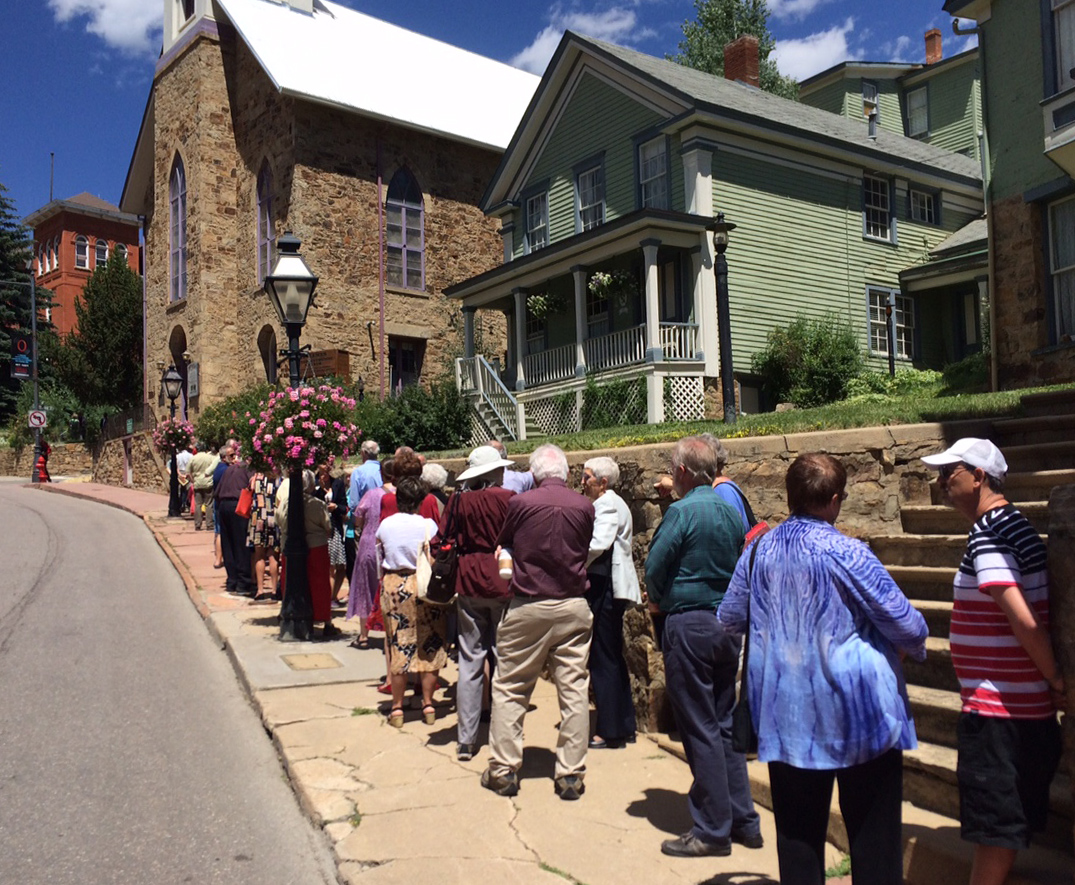
Audience awaiting entrance to the Central City Opera production of The Prodigal Son. Photo by Peter Alexander.
As far removed as possible from Boismortier’s frothy comedy, Britten’s Prodigal Son opens not with highjinks or noise, but with a procession of monks singing unaccompanied chant. This announces immediately that the subject is serious, and the meaning deeply spiritual. And in spite of the somber subject, I was happy to see that the show was sold out, with a line waiting entrance before the curtain. Three cheers for Benjamin Britten and CCO’s adventurous audience!
The Prodigal Son is one of the three “church parables” that Britten composed in the 1960s that reflected the composer’s interest in both medieval liturgical dramas and Japanese Noh plays. These unfamiliar models and the conceit of having the work performed as a play-within-the-play by an all-male cast of monks combine to distance the work emotionally. In this case, the production by director Ken Cazan creatively sought to bridge the gap by bringing the actors into the audience/congregation throughout the performance. People in my row mimed giving alms to the begging choir members who were extending their empty caps.
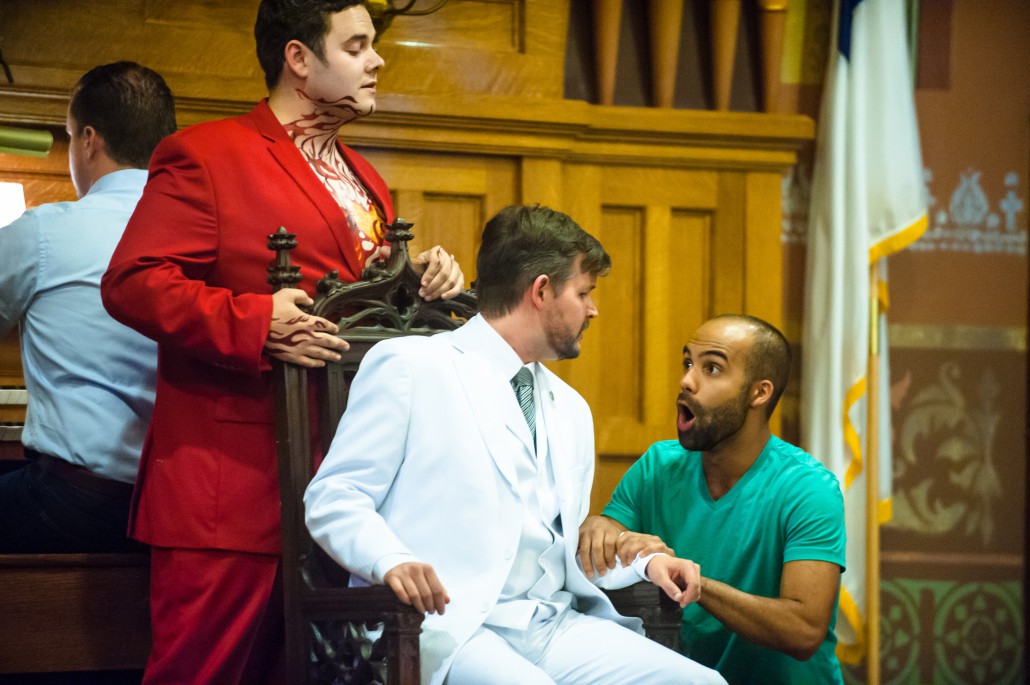
The Prodigal Son: Sheldon Miller (Organist), Bille Bruley (Tempter), Matt Moeller (Father), Michael Kuhn (Younger Son). Photo by Kira Horvath.
Tenor Bille Bruley bravely took the role of the Tempter, a role composed, like most of Britten’s high tenor roles, for the bright, edgy voice of Peter Pears—and made it his own. His strong, clear voice rang out forcefully, especially when warning of the havoc he would create. Indeed, all four lead singers—Bruley, Matt Moeller, Nicholas Ward and Michael Kuhn—were unintimidated by roles that had been originated by some of the best known English singers of their generation.
In Central City’s lovely St. James Methodist Church—the oldest protestant church still in use in Colorado, built in 1859—the words were clear from all the singers, which added greatly to the impact. Britten takes credit for this as well: his sense of instrumental sound and economic use of his small ensemble—alto flute, trumpet, horn, viola, double bass, harp, organ and percussion—provide both a clean canvas for the singers and an expressive dressing for the text.
All the players executed their parts well, but special mention should be made of the virtuoso trumpet and percussion parts that drive much of the music. Because the score was originally written with free meters and was intended to be performed without conductor—a hugely daunting task in most settings—conductor Zemliauskas had a notable challenge providing more regular meters to keep everyone together. Happily, he succeeded admirably.
The Prodigal Son is to be performed at noon July 30 in the First Christian Church in Colorado Springs, and will be repeated in St. James Church in Central City at 12:30 p.m. Aug. 5. Tickets are available here.
Man of La Mancha
I have already reviewed CCO’s superb La Traviata, the first of the mainstage shows to open, in the pages of Boulder Weekly. The production, with Ellie Dehn’s standout performance at Violetta, runs though Aug. 8, with tickets available here.
Filling out the season is Mitch Leigh and Joe Darion’s 1965 musical Man of La Mancha. If you only know this evergreen show through the innumerable community and high school productions, you owe it to yourself to make the drive to Central City. The CCO production of director Paul Curran and designer Court Watson recaptures both the gritty immediacy and the anti-establishment convictions of the ‘60s which were so much a part of the original show.
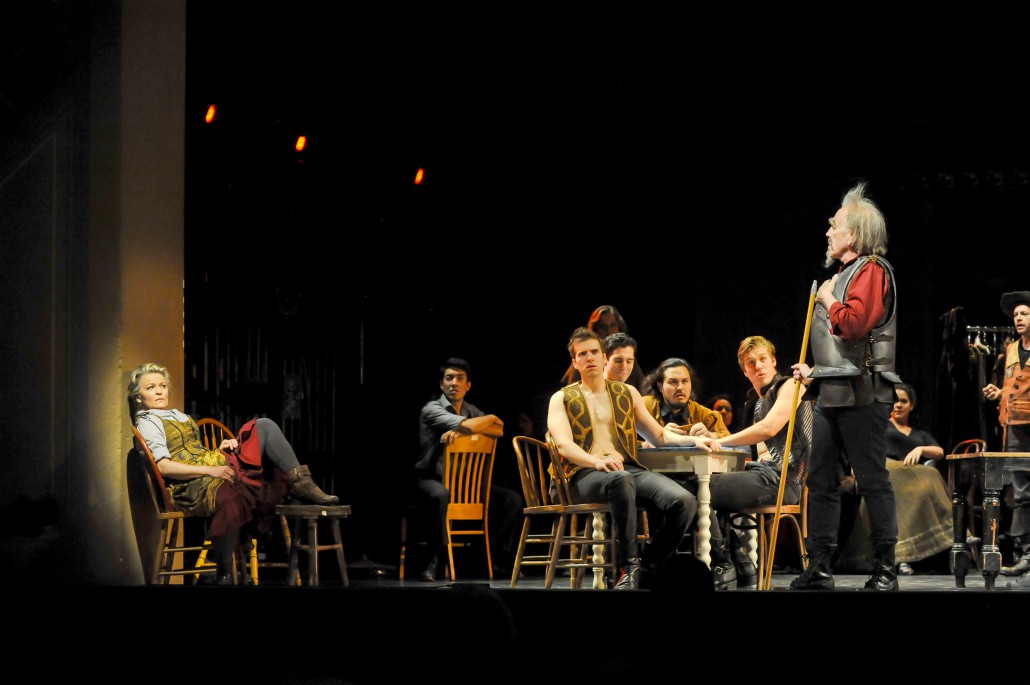
Man of La Mancha: Lucy Schaufer (Aldonza), Andy Berry (Behind in Gray – Carrasco/Duke) and Robert Orth (Don Quixote/Cervantes) with the Ensemble. Photo by Kira Horvath.
Consider: the main character, Cervantes/Don Quixote has been imprisoned by the Inquisition for his failure to conform to the established beliefs. He is accused by his fellow prisoners of being an idealist, a bad poet, and an honest man—common enough descriptions of leaders of the ‘60s counterculture. And at one point, a character says “facts are the enemy of truth,” a line that had great meaning during the civil unrest of the Vietnam war years, when “truths” announced by the establishment were often undermined by facts.
The result is a production that does not gloss over the dark sides of the story. The language does not pull many punches, and there is a painfully graphic rape scene in the second act. At the same time, the show, like the ‘60s radicals that survived into the following decades, refuses to give up its idealism and its hopes. The production leaves one with a greater respect for the creative work of Leigh and Darion, and with much to think about as well.
Man of La Mancha opened July 18; the performance I saw is thus about midway in the show’s run, which continues until Aug. 9. Robert Orth, who has been much praised as Cervantes/Don Quixote, was absent due to a family emergency, and his role was taken by an apprentice understudy, Alexander James York, who took the stage with great assurance and gave a strong performance.
The understudy who saves the performance and jumpstarts a career is one of the oldest clichés of theater, but sometimes impossible dreams come true. York was a commanding presence and sang with a lovely lyrical baritone. I expect to hear him back at Central City in future as a full-fledged artist.
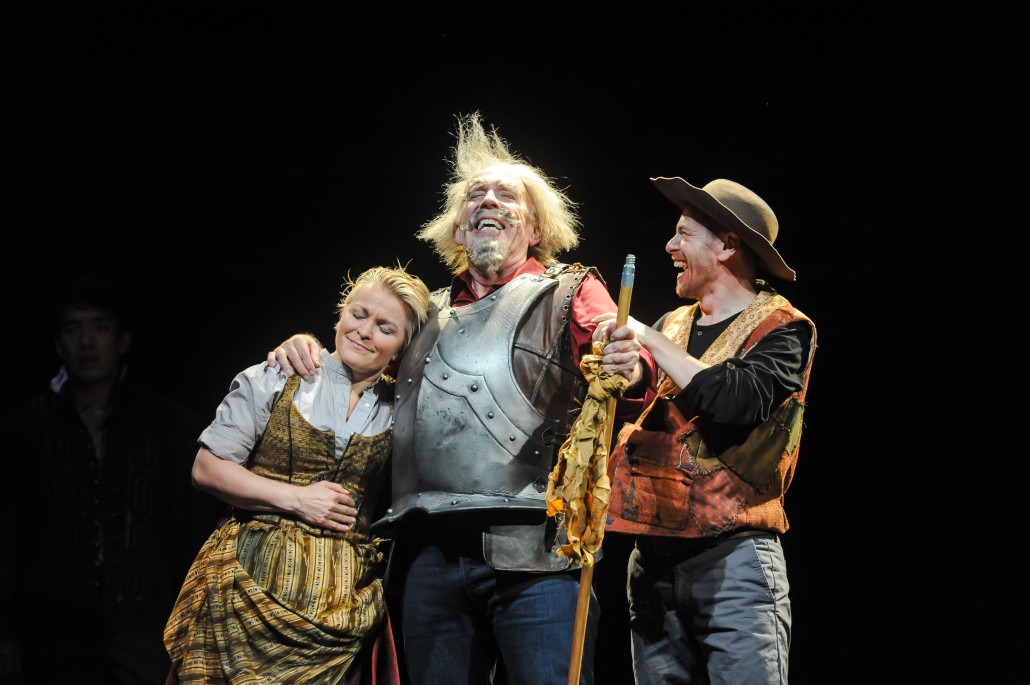
Man of La Mancha: Lucy Schaufer (Aldonza), Robert Orth (Don Quixote/Cervantes), Keith Jameson (Sancho Panza). Photo by Kira Horvath.
The cast of La Mancha is consistently strong. Keith Jameson is a Sancho Panza who could steal any show with his endearing comic persona. In Lucy Schaufer, Central City has an Aldonza who more than holds up her part in the show. Aldonza is a crucial character—her transformation from angry kitchen slut to a loving presence at the end has to be believable and moving. Schaufer grasped the role with great energy and carried the audience with her.
The depth of the cast was on display in the number “I’m only thinking of him,” performed with appropriate sneering glee by apprentice artists Andy Berry, Michael Kuhn and April Martin (all of whom have roles in the one-acts as well). It is a strength of the production that the words are clear throughout.
Comic impact was also provided by Adelmo Guidarelli as the Innkeeper/Governor, Alex Scheuermann as the barber, and many others in the smaller roles that complete the tapestry. The multi-talented Maya Kherani appeared as the Moorish dancer. Mention must also be made of conductor Adam Turner and the excellent CCO orchestra. Hearing a Broadway musical with a full orchestra of the highest quality in the pit is a delight, and it reveals a depth in the music that is not otherwise apparent.
Tickets for the remaining performances of Man of La Mancha are available here.
NOTE: Updated for grammar and clarity July 30.
Igudesman and Joo, who grew up watching Monty Python, bring their music comedy to CMF Saturday
By Peter Alexander
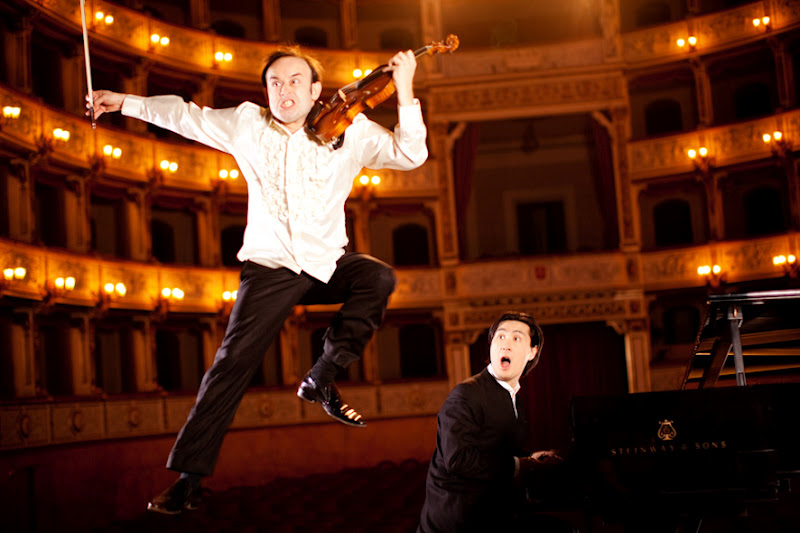
Aleksey Igudesman and Hyung-ki Joo. Photo courtesy of Michael Sachsenmaier.
“We like to have the audacity to attempt to do crazy things.”
Aleksey Igudesman, a Russian-born violinist, is talking about the origin of his music-and-comedy duo with pianist Hyung-ki Joo. “We actually wanted to create a new type of performance which truly embraces music, classical music, but also theater, and comedy, and make a kind of a very special marriage of those three genres,” he says.
In other words, “something completely different”—which makes sense when you know that Igudesman and Joo both grew up watching, and loving, Monty Python.
The music and comedy duo will present their “A Little Nightmare Music” at 7:30 p.m. Saturday, Aug. 1, in the Chautauqua Auditorium as part of this year’s Colorado Music Festival. Terry Jones, he of Monty Python fame and director of Life of Brian and Month Python’s Meaning of Life, called the show “very musical, very engaging and very funny.” You may purchase tickets here.
The first thing to know about Aleksey Igudesman and Hyung-ki Joo—the individuals apart from the duo of Igudesman and Joo—is that they are superb musicians who have their own careers part from their partnership. They perform as soloists and chamber musicians, and both are composers as well.
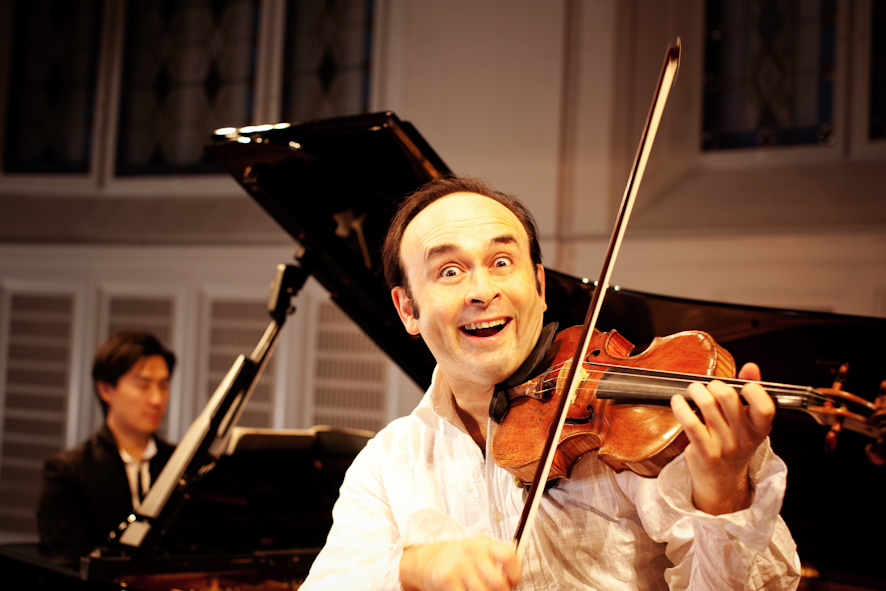
Aleksey Igudesman © Julia Wesely
“I love conducting orchestras, especially my own compositions,” Igudesman explains. “For both of us composition has always been very important. Even in our shows it’s all our arrangements and original compositions, but we write and publish a lot of music outside of the shows as well.
“I’ve also been doing a lot of film music work, whenever I’ve had time. I’ve worked with Hans Zimmer, so that’s always been a fun side thing to do. We worked a lot on the Sherlock Holmes movies together, so all of the fiddling on that was me.”
Professional musicianship is the foundation on which their comedy is built—and make no mistake, they are virtuoso performers. (For example, notice just the quality of playing in this excerpt from one of their shows.) Without the virtuosity, most of their acts would not be possible. Igudesman believes this is one of the things that sets their shows apart from other comedy acts in music—that they are not primarily comedians, but first of all musicians who happen to take comedy seriously, too.
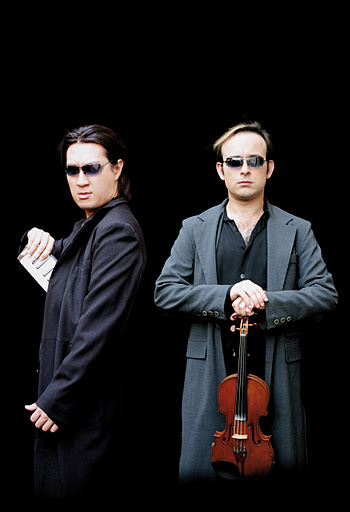
Hyung-ki Joo and Aleksey Igudesman. Photo courtesy of Michael Sachsenmaier.
“We are an act who do music,” he says. “We are musicians, we’re passionate about music, but we are also passionate about humor. We have been very lucky to have wonderful orchestras invite us to perform with them. (They) have taken us seriously because we are very serious about both music and humor.”
Igudesman, who was born in Russia, and Joo, born in England to Korean parents, met when they were both students at the Yehudi Menuhin School in England. Their decision to perform a comedy act was inspired first of all by the many different kinds of music they encountered in school.
“We were inspired by many different things,” Igudesman says. “By reading theater, for example: Chekhov and Bernard Shaw and Oscar Wilde were all full of humor. At the same time we grew up watching Monty Python, we loved Monty Python.
“We were always passionate about classical music, but we were a little estranged about how serious the music business took itself—you know, how serious the whole thing around concerts tended to be. We always found that practically comical, that you’d have all of this passionate music, and people would play and then suddenly between movements nobody says a thing, just a few people cough. Somebody comes on stage, bows, doesn’t say a single word to the public, and then starts playing.”
Igudesman thinks it is a good thing that the worshipful seriousness around classical concerts is starting to change, and that performers talk and interact with audiences more than they did 40 or 50 years ago. “It’s going toward a much better direction,” he says. “In a way, it’s not going forward, because in the 19th century concerts were a lot more fun. (Performers) used to talk to the public, and used to do fun things, funny things between pieces.
“Of course with our shows we take it to the extreme. But we’ve been very lucky, (since) we manage to have a lot of audiences that not only love classical music but also audiences who don’t go to classical music coming to our concerts and then enjoying it and therefore getting into music. That’s a big bonus, I think.”
Igudesman likes to point out that a lot of the classical music they play has its own humor already. “It’s in most works,” he says, adding with a chuckle “maybe a little less so in Brahms’s Requiem.”
Of the music they use in their comedy act, he says, “one has the humor that people understand who know the music, and then there’s the humor that everybody can get. We try to combine that so that nobody is left out, and still to keep all of that on a very high level.
“That mix is very fine, and very difficult to get. That’s why it takes a lot longer than writing a regular piece, because you have to have all of those different levels. And then at the same time we try to make it look like it’s completely spontaneous and we just made it up on the spot, which makes it quite difficult.”
Occasionally, he says, a presenter will ask for a new sketch that might go with a regular concert program being planned a few days after their performance. He generally tells them, “give us year and we’ll see what we can do.”
Because it takes so long to perfect each sketch, he says that they are always working with new material. Even a set show like “A Little Nightmare Music” will have material that is new, or in the process of being fine tuned. “We always do that,” he says. “No two shows are the same. We always try to vary and have fun with them, so the people who come back will always see something new.”
Clearly, just listing a program for “A Little Nightmare Music” would not be helpful—you have to see each show to know what it really is. But if you want a little sample, here is the official preview of “A Little Nightmare Music” on YouTube.
You don’t want to miss Bluebeard’s Castle
By Peter Alexander
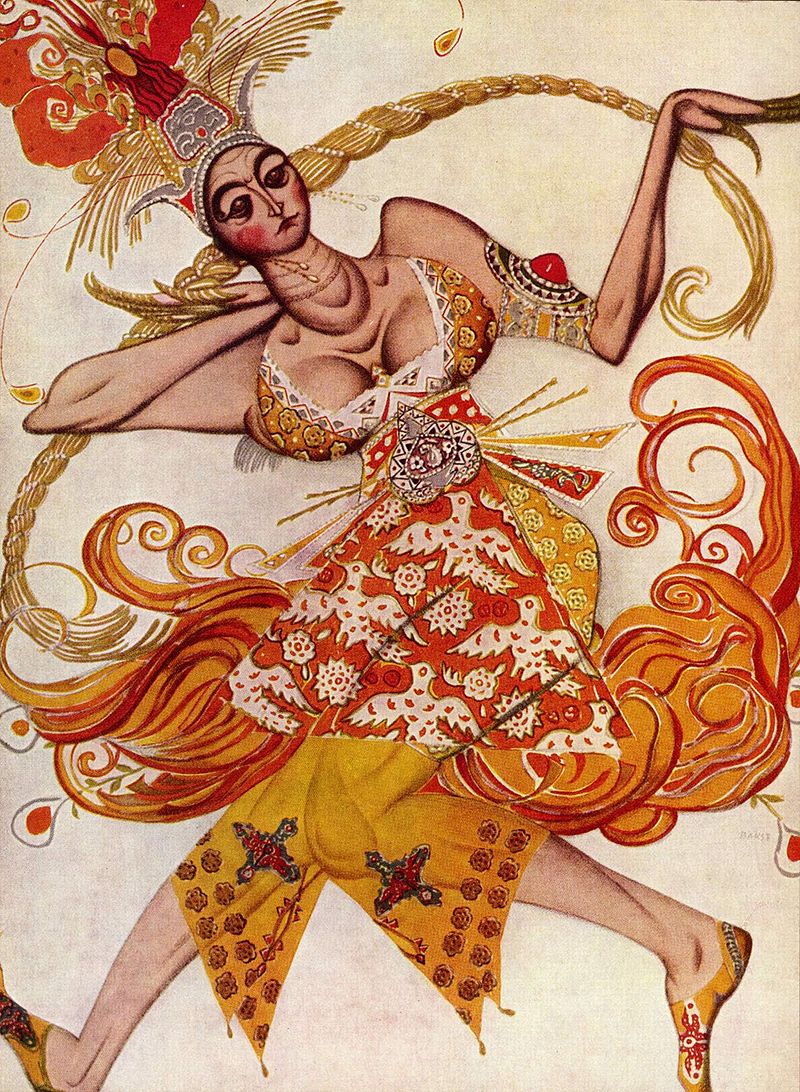
Léon Bakst: ‘Firebird,’ Ballerina, 1910
Conductor Jean-Marie Zeitouni and the Festival Orchestra opened their Colorado Music Festival concert last night (July 23) at the Chautauqua Auditorium with a dramatically and aurally spectacular performance of Stravinsky’s Suite from The Firebird.
And that was before the second half of the concert.
Zeitouni’s careful control of dynamics lends itself to the atmospheric opening of The Firebird, and it intensified the shock at the orchestral thunderclap that opens “The Infernal Dance of the Subjects of Katschei.” Audience members near me literally jumped at the opening percussion salvo.
Contrasting with the dreamy opening, Zeitouni pushed the tempo of the “Infernal Dance” to—and just barely beyond—the safe limits for a full orchestra. This was an exciting, if risky choice, that just barely paid off in performance Thursday night.
After that, the music died to a whisper for the magical entrance of the horn solo at the beginning of the “Lullaby of the Firebird” (better known as the Berceuse). Zeitouni again went for a dramatic tempo, this one at the opposite extreme. The slow buildup from the beginning of the Lullaby to the Finale only added to the magic.
All of the soloists played beautifully, but special notice should be given to the bassoon solos, played with both warmth and expression by section principal Glenn Einschlag. He deserved his solo bow and ovation after the performance.
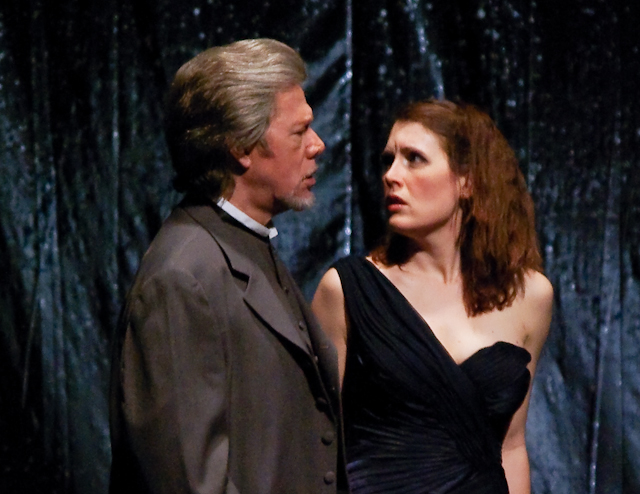
Samuel Ramey and Krisztina Szabó singing “Bluebeard’s Castle”
The focal point of the concert—and one of the focal points of the entire summer—came after intermission, when Zeitouni and the orchestra presented a stunning performance of Bartók’s early opera Bluebeard’s Castle, with baritone Samuel Ramey and soprano Krisztina Szabó in the roles of Duke Bluebeard and his bride, Judith.
Zeitouni was clearly excited when he announced this performance last February. And just last week he reiterated that the opera was for him personally “so important to share with the CMF audience.” It is a powerful work, and one that is not heard often enough. With a score full of colorful cinematic effects, describing both the setting and the inner thoughts of the characters, it is one of Bartók’s most accessible works.
If there is any opera that prospers in a concert performance, it is Bluebeard’s Castle. Because this is psychological drama, the majority of the emotional expression falls to the orchestra, revealing what is going on within the characters in a way that their words do not. In fact, it is not a large leap from Bartók’s opera to the music you hear in any psycho-thriller from Hollywood. Many film composers have learned from the score.
For example, when Bluebeard sings to Judith of the final doors, “You don’t know what’s behind them,” the vocal part is fairly straightforward but the orchestra reveals all of the turmoil within his mind. Or when Judith sings “Give me the key because I love you,” you hear her feelings—both love and the fear she denies—in the orchestra. Putting such music in the hands of a virtuoso orchestra and bringing it up onstage only enhances its impact.

Ramey singing “Bluebeard’s Castle ” with Opera Omaha
One of the true operatic stars of his generation, Ramey is known for the role of Duke Bluebeard, which he seems to have inside his skin. This is not a difficult role to act—on the surface Bluebeard seems almost passive as Judith demands that door after door be opened, and that nothing be hidden from her—but it takes a serious vocal artist to convey Bluebeard’s strength and underlying despair. If he has lost a little to age, Ramey remains a commanding presence. His strong, dark sound is still well suited to the role, and it was a treat to hear him sing one of his signature roles here in Colorado.
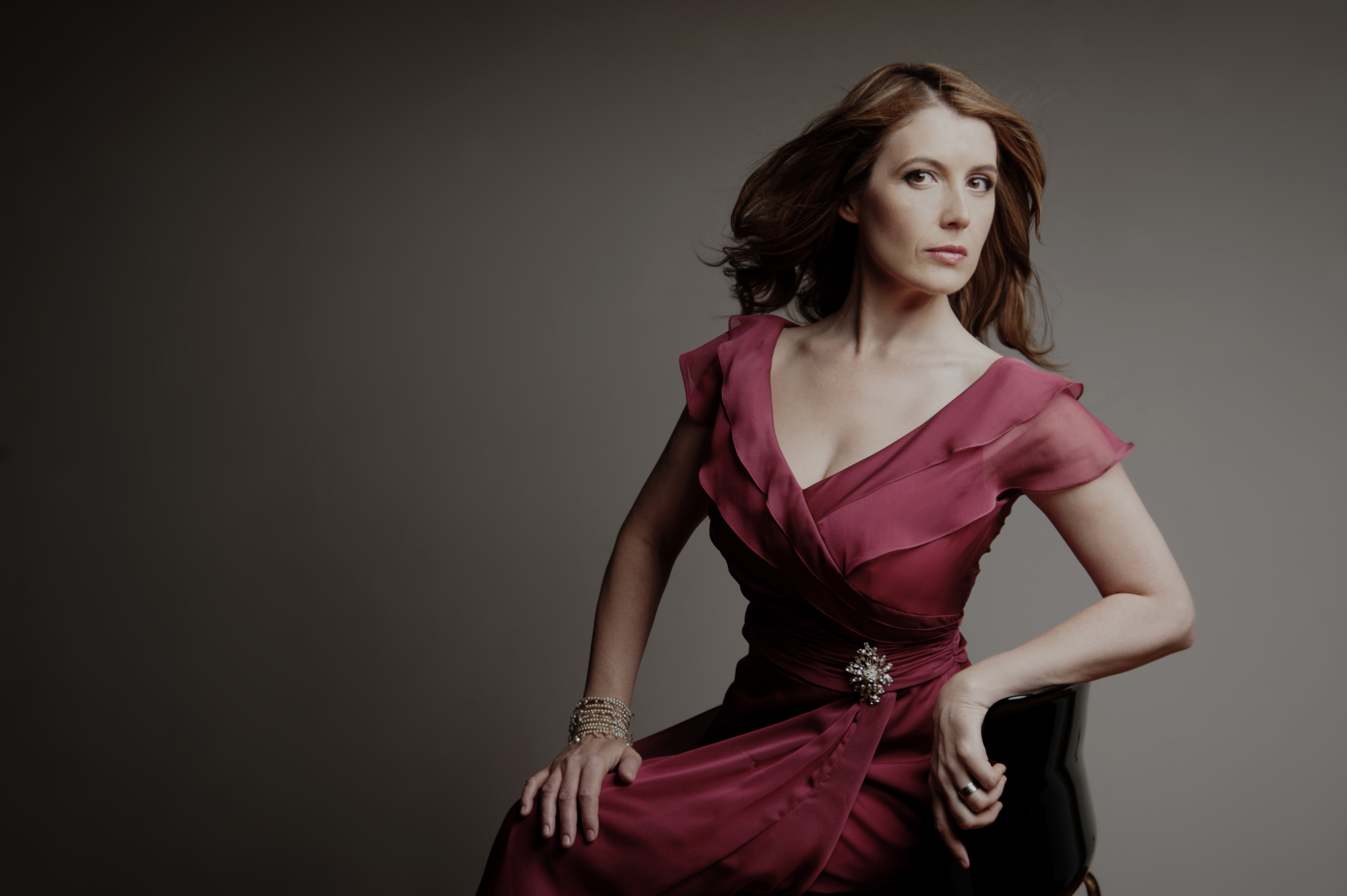
Krisztina Szabo
Szabó is not well known in this country, but the Hungarian-Canadian soprano is ideally cast as Judith. She sings with beauty of tone and great intensity, as Judith becomes ever more desperate to penetrate Bluebeard’s secrets. She is obviously much younger than Ramey, which can be heard in their voices. But this is a symbolic opera, so the difference between them represents not age but the psychological gap between the world-weary duke in his gloomy castle, and the woman who still believes that her love can solve all problems.
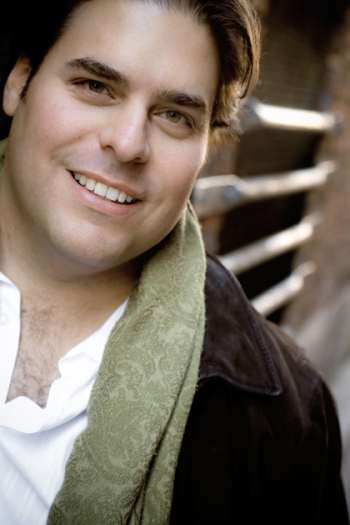
Jean-Marie Zeitouni
But is it the orchestra that carries the emotional weight, and in this respect the performance was powerful and often electrifying. The opening of the fifth door, when Bluebeard’s entire kingdom is revealed to an astonished Judith and the lights blazed brilliantly within the hall, was thrilling. But the thrill was created by more than Bartók’s craggy chords and the full sound of the Festival Orchestra brass.
That moment—in some ways the musical climax of the opera—was prepared by all that went before it. Bartók’s brilliant orchestra effects from scene to scene provide the raw materials, but Zeitouni’s control of the musical flow, and the orchestra’s execution, led carefully and inexorably to that moment. From the opening portrayal of the gloomy castle, through the remarkable musical effects that accompany the opening of each door, down to the slow recession into silence at the end, every scene and every contrasting mood were tellingly conveyed.
Recognition should be given to Chris Christoffersen, who not only sponsored the performance with his wife, Barbara, but also served as an eloquent narrator before both works on the program.
A few minor points: stage lighting was used to enhance to mood of the different rooms in Bluebeard’s Castle. For the most part this was very effective; why then was red lighting used for the second room, Bluebeard’s Armory, when red light representing blood should stream from the first room, the Torture Chamber? The Armory calls for yellowish-red light, representing the bronze armor and weapons. As performed last night, the Torture Chamber was represented with no particular lighting effect at all, while the music for the opening of that room is so dramatic and eerie that it calls out for a lighting effect. This was an opportunity missed.
I suppose that it is inevitable that the singers would be miked, with the orchestra sharing the stage with them and not set below in a pit. For the most part, any amplification was not noticeable, but I still find it regrettable when opera singers, trained to fill a house with the sound of their voice, are artificially amplified.
The projecting of the text above the stage was essential to the audience’s understanding of what they were hearing. But I have very mixed feelings about the Gorey-esque drawings that sometimes accompanied the text. I can’t see what they contributed to the understanding of the story, and to my taste they were somewhere between crude and too cute. I expect others enjoyed them.

Props for Bluebeard?
And finally: could someone give Ramey seven rusty old keys to hand to Szabó? I know this is a concert performance, but the miming of handing over keys is more awkward than not, and a few props would be less distracting than the singers’ empty clasped fists.
Such quibbles aside, all of Boulder should be flocking to Chautauqua tonight. It is a rare opportunity to hear a great and influential work, and to hear it performed at the very highest level. You don’t want to miss it.
# # # # #
Tickets to the July 24 performance of the Firebird/Bluebeard’s Castle performance at the Colorado Music Festival are available here.
NOTE: Edited for clarity on July 24.
Opera Star Samuel Ramey will be gust artist for Bartók’s Bluebeard’s Castle
By Peter Alexander
Samuel Ramey and Krisztina Szabó singing “Bluebeard’s Castle”
Jean-Marie Zeitouni, music director of the Colorado Music Festival (CMF), makes Bartók’s Bluebeard’s Castle sound almost like a Hollywood horror movie.
“The musical score is warning about danger,” he says of the one-act opera, which he will conduct as part of a Festival Orchestra concert Thursday and Friday, July 23 and 24, in the Chautauqua Auditorium. The concert, titled “Beyond Fairy Tales,” will conclude with a concert performance of the opera. Also on the program is Stravinsky’s Firebird Suite, as arranged by the composer in 1919.
Performing the two roles of Duke Bluebeard and his bride Judith will be baritone Samuel Ramey, a world-renowned opera star who agreed to step in as a last-minute substitute, and Hungarian-Canadian soprano Krisztina Szabó. Ramey is well known for his performances of Bluebeard’s Castle at the Metropolitan Opera and his recordings of the role.
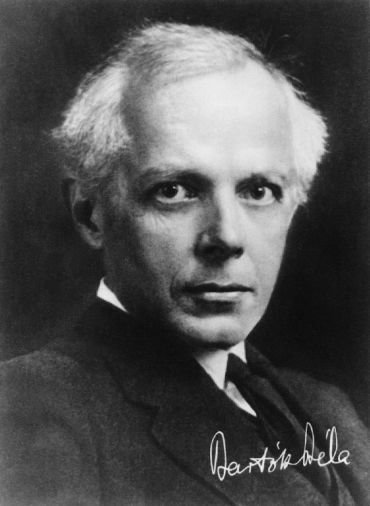
Béla Bartók
In case you don’t recall the story, Duke Bluebeard brings his bride, Judith, to his gloomy castle and instructs her that there are doors that she must never open. Like a horror movie character, of course, she does open the doors — in spite of warnings from the orchestra — and finds evidence of Bluebeard’s bloody past. The opera goes beyond the original fairy tale, however, adding a deeper level of symbolism to the story.
“It’s a deep psychological thriller, initiated as a fairy tale,” Zeitouni says. “Bartók and the librettist seek to understand the psychology of the characters and make them more multi-dimensional.
“It’s a groundbreaking composition, [with] sounds and instrumental colors that were never heard before in a modern symphony orchestra. It’s something that was so important to share with the CMF audience.”
Read more in Boulder Weekly.
Single tickets for the full season now on sale
By Peter Alexander
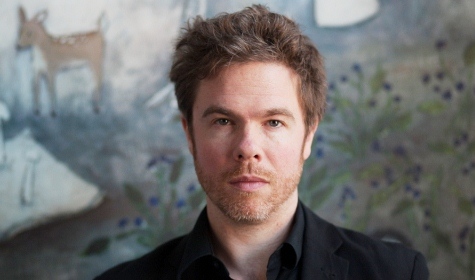
Josh Ritter
The Boulder Philharmonic Orchestra announced today (July 15) that they have filled the last slot in their 2015–16 season with a concert featuring American singer-songwriter Josh Ritter and the Royal City Band.
The concert at 7:30 p.m. Saturday, Oct. 10, in Macky Auditorium, fills a slot that was left open when Gregory Alan Isakoff had to cancel a planned concert on that same date.
Along with Ritter’s concert, the Boulder Phil announced that single tickets to individual concerts are now on sale, either through the orchestra’s Web site or by calling the box office at 303-449-1343, ext. 2.
Ritter was named one of the “100 Greatest Living Songwriters” by Paste magazine in 2006. He grew up in Moscow, Idaho, and attended college at Oberlin College in Ohio, planning to be a neuroscientist. Having been influenced by Johnny Cash and Bob Dylan, he switched to a self-created major involving folk music, and later studied at the School of Scottish Folk Studies in Edinburgh.
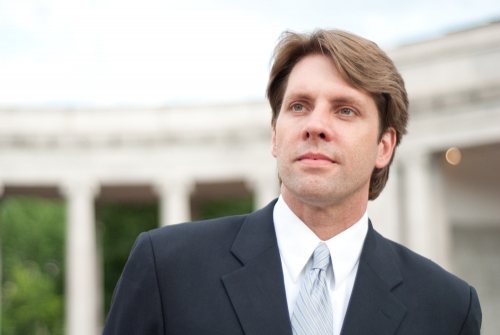
Michael Butterman. Photo by Glenn Ross.
From his very first self-published albums to the current day, Ritter has enjoyed growing success and recognition. He now has seven studio albums, plus several recordings of live performances, and he is also the author of a novel, Bright’s Passage. Ritter and his band have performed with the Boston Pops, New York Pops and the Minnesota Orchestra; their appearance with the Boulder Phil will be their first performance with a symphony in the Western U.S.
A statement released by the Boulder Phil quotes music director Michael Butterman saying that Ritter “is exactly the sort of artist—innovative and original—that resonates with our community and makes for a perfect reflection of the spirit of Boulder.”
The 2015–16 season of the Boulder Phil has been named “Reflections: The Spirit of Boulder!” The season will open at 7 p.m. Sunday, Sept. 13, in Macky Auditorium with a concert featuring the orchestra’s concertmaster and CU faculty member Charles Weatherbee as soloist in The Storyteller by Korine Fujiwara and pianist Gabriela Montero playing Rachmaninoff’s Piano Concerto No. 2.
 The remainder of the season features collaborations with the Boulder Chorale, Colorado nature photographer John Fielder, Boulder Ballet, Cirque de la Symphonie, Central City Opera, the Boulder Bach Festival and choruses from the CU College of Music. You may read about the full 2015–16 season and purchase tickets on the Boulder Phil’s Web page.
Boulder Bach Festival announces “Bach-in-Longmont” performances at the Auditorium in 2015 and ‘16
By Peter Alexander
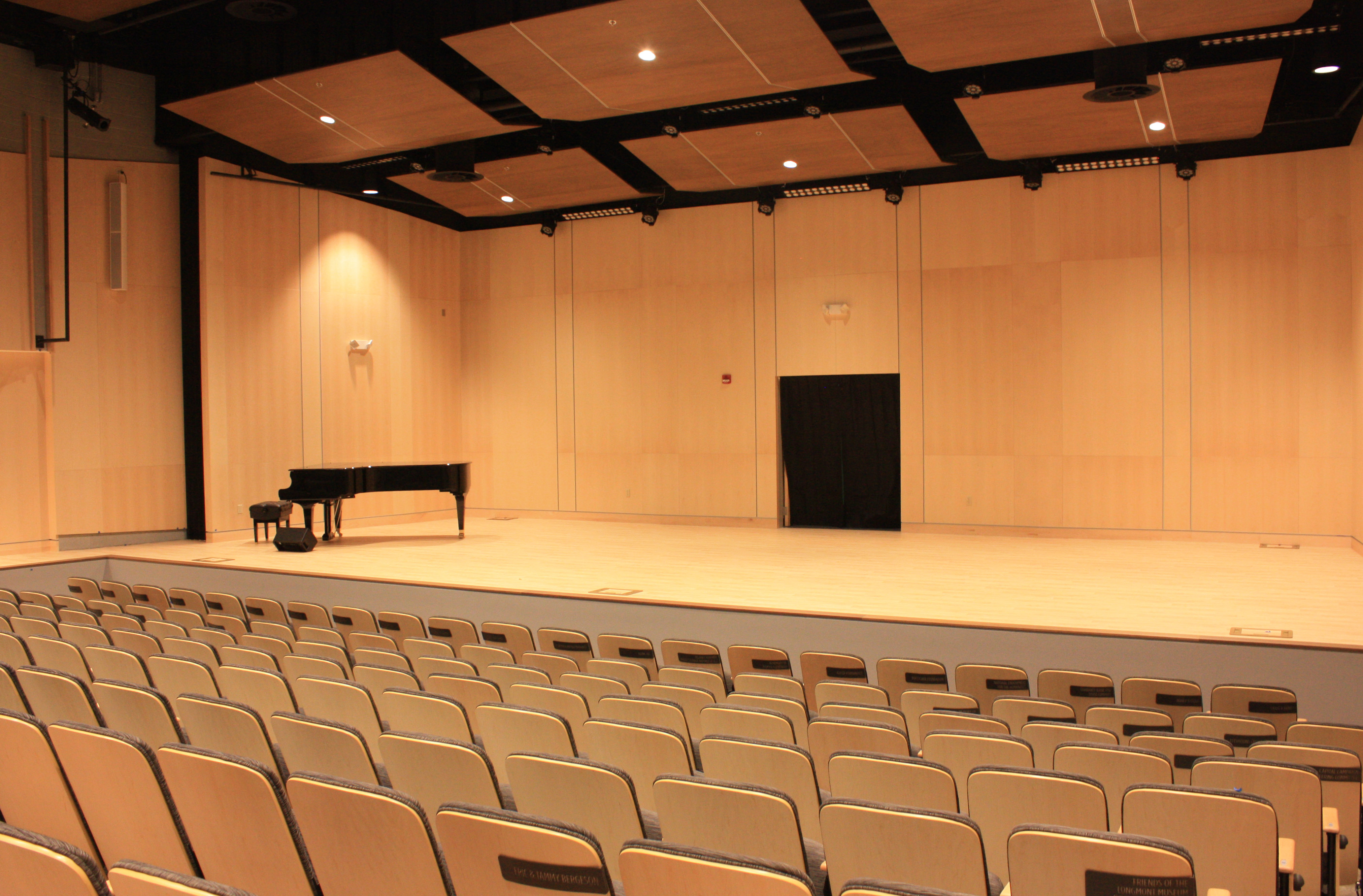
Interior of the new Stewart Auditorium at the Longmont Museum. Photo by Peter Alexander
“Build it and they will come.”
Shoeless Joe must have been talking to the people at the Longmont Museum. They did build it, and already they have started to come.
“It” is a new auditorium, the 250-seat Stewart Auditorium at the Longmont Museum, which was just finished and opened earlier this month. And “they” are performers—some from Boulder—looking for an intimate performance space.
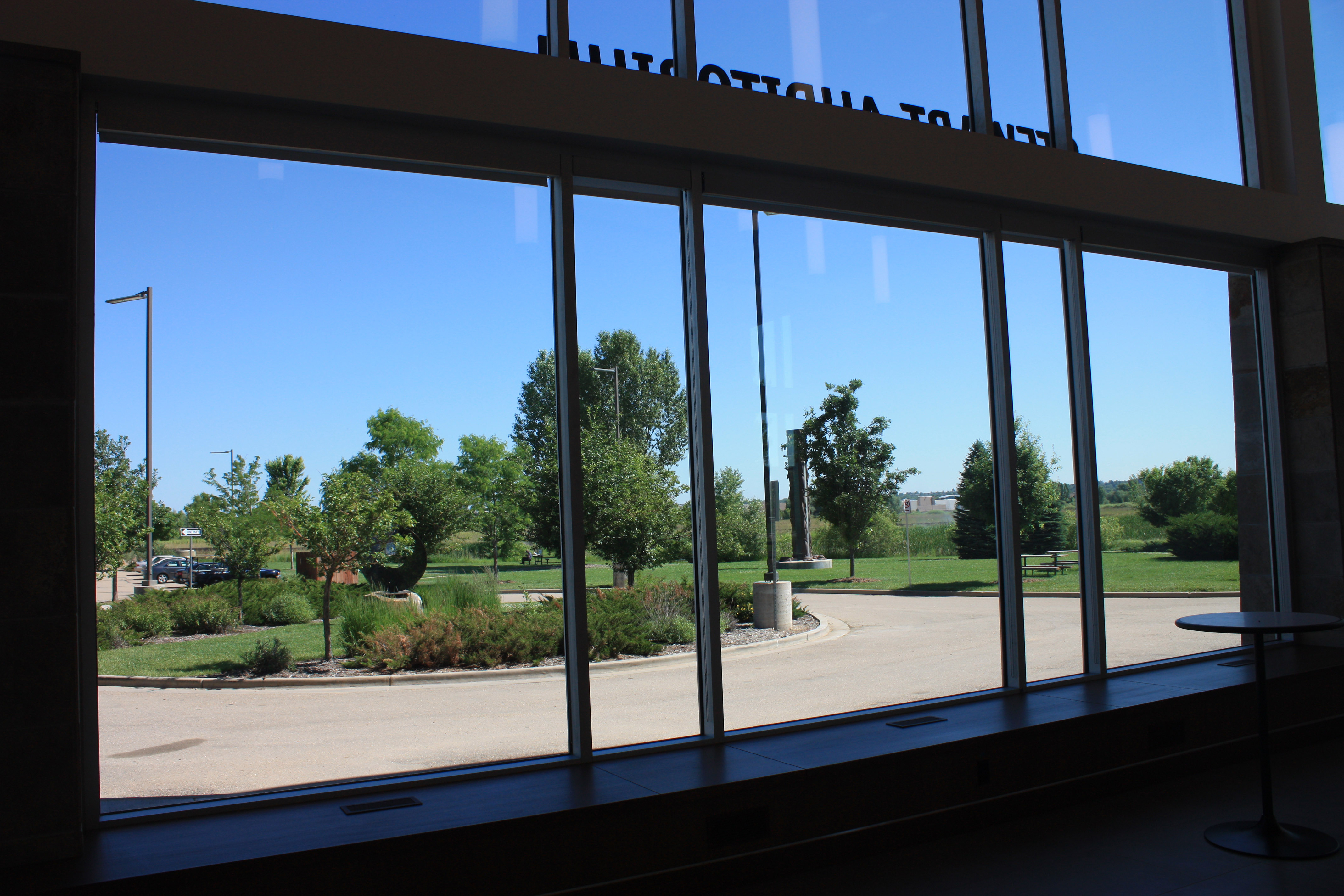
View form the Swan Atrium of the Stewart Auditorium. Photo by Peter Alexander.
The auditorium is part of an expansion of the museum that doubles its pubic space. In addition to the Stewart Auditorium and its Swan Atrium, the expansion also adds the Kaiser Permanente Education Center, with flexible configurations allowing for three classrooms or one large meeting space seating 115.
The expansion was built with funds from a $4.5 million capital campaign that had the support of more than 300 donors. The largest gift came from the Stewart family for whom the auditorium is named.
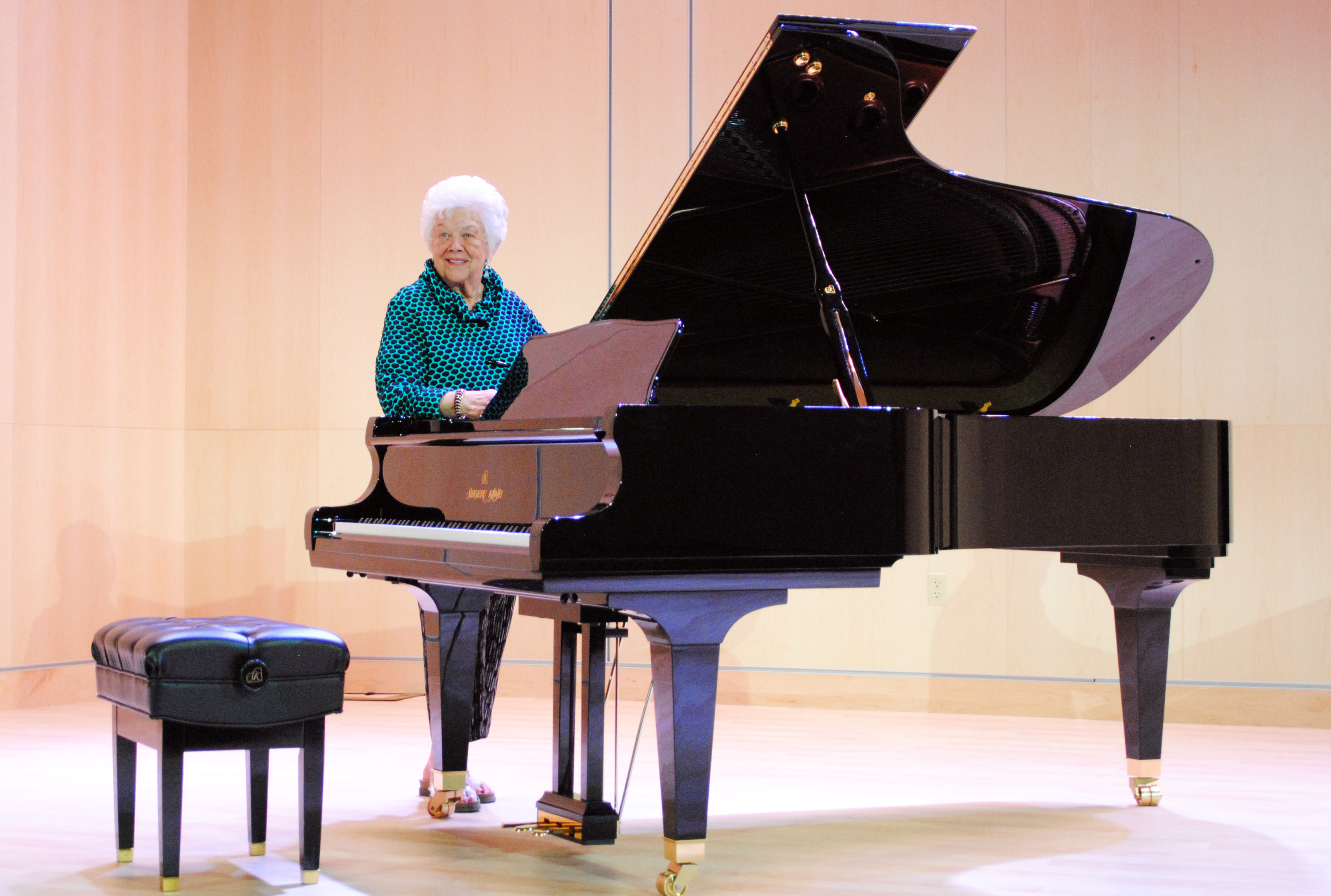
Lila Stewart and the Shigeru Kawai piano that she has given to the Longmont Museum’s Stewart Auditorium
“We couldn’t have done it without the generosity of the Stewart family, who made the largest local gift in our community’s history,” Longmont Museum director Wes Jessup said. The Stewart family, including Lila Stewart, her late husband Bill, and their daughter Linda, were members of the Longmont business community for nearly four decades.
Lila Stewart has added to that original gift with the purchase and donation of the piano that was used during the auditorium’s opening event June 14: a 7-foot-6-inch Shigeru Kawai valued at $75,000. Stewart recently announced the gift of the piano, which was on loan from the Boulder Piano Gallery, in the name of her late daughter Linda Stewart.
Among the performers at the auditorium opening was violinist Zachary Carrettin, director of the Boulder Bach Festival, and pianist Mina Gajić, the festival’s director of education and outreach. Carrettin and Gajić have announced that the Bach Festival will hold three concerts at the Stewart Auditorium during the 2015–16 season. These concerts, which will supplement the Bach Festival’s “home season” in Boulder, will be presented under the heading Bach-in-Longmont.
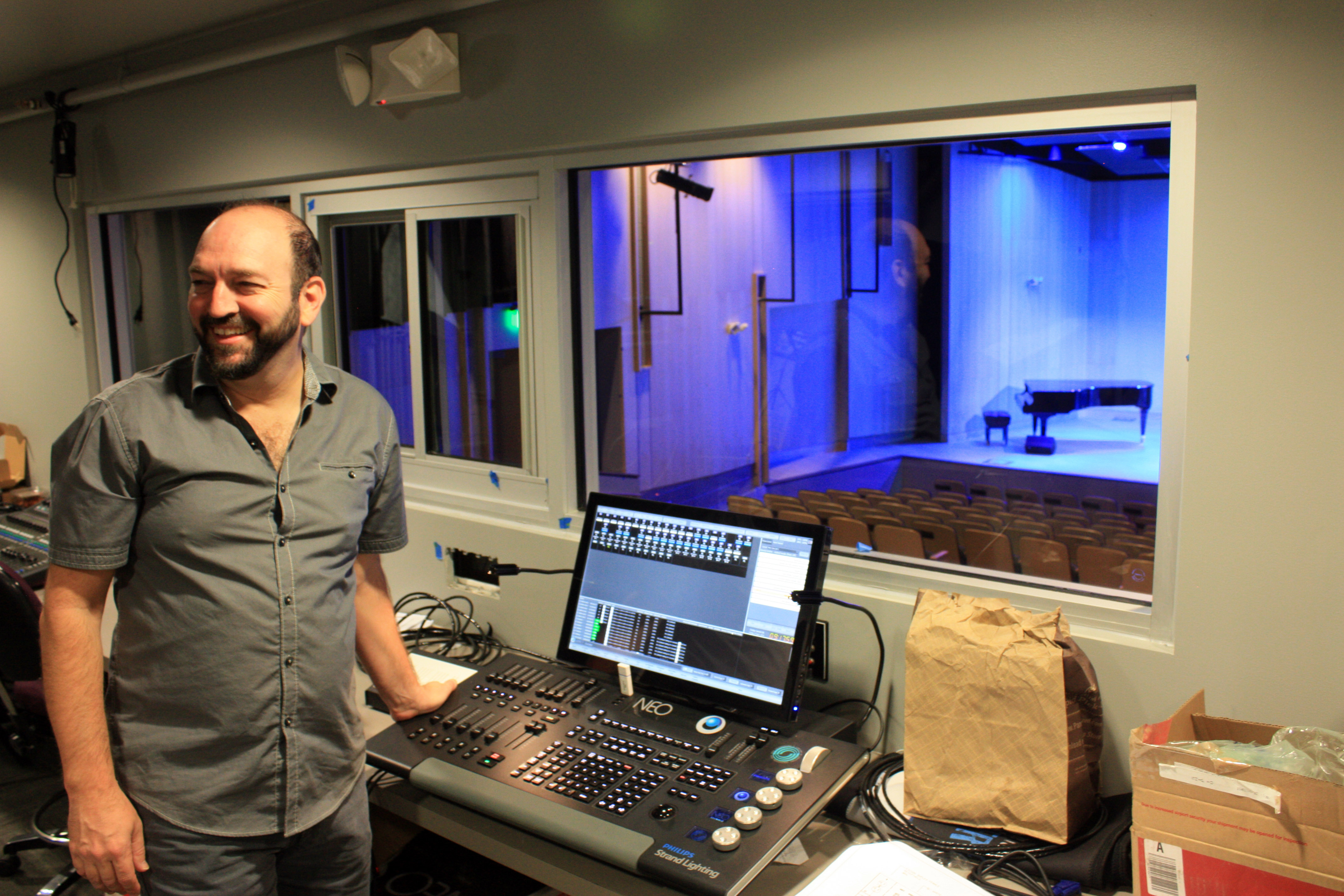
Auditorium manager David Ortolano at the lighting controls of the Stewart Auditorium. Photo by Peter Alexander.
Following the opening weekend, Carrettin commented: “The hall is magnificent! I’m so happy it will be a venue for us, both for the Bach-in-Longmont concerts as well as some of the education events in the Kaiser Permanente Education Center.
“Boulder Bach Festival has developed an audience of Longmont residents through performances in Longmont at the First Lutheran Church and the historic Ryssby Church. With the unveiling of the new Stewart Auditorium, we decided to launch a new series called Bach-in-Longmont. Some programs will be repeated in Boulder or Denver, but the final season concert will only take place in Longmont.”
Carrettin said he was delighted to be bringing some the Bach Festival programs up to Longmont, especially since the opening of the Stewart Auditorium. “Longmont is doing some spectacular things,” he said.
The Bach-in-Longmont concerts scheduled in Stewart Auditorium for 2015–16 will be:
 “Italian Roots”: 7 p.m. Friday, Oct. 16, with harpsichord soloist and Bach scholar Matthew Dirst, Dutch soprano Josefien Stoppelenburg, and violinist Michiko Theurer. The performance will offer an antiphonal presentation of pre-Bach Italian works in a variety of genres, followed by works of Bach that feature Italianate writing, including the D-minor Harpsichord Concerto and Cantata No. 82a, Ich habe genug.
“Venice On Fire”: 7 p.m. Saturday, March 19, 2016. The artists for this performance will be the new Boulder Bach core ensemble of flexible string players performing on electric instruments, led by Carrettin and Theurer.
“Bach, Brahms, and a Grand Érard Piano”: 7 p.m. SUNDAY, MAY 15, 2016, with Carrettin, Gajić and horn player Thomas Jöstlein, associate principal horn of the St. Louis Symphony and a member of the Colorado Music Festival Orchestra. The featured work on the program will be Brahms’ Horn Trio, played on period of instruments of the composer’s lifetime, to be preceded by works of Bach played on a late 19th-century piano. [Please note: The listed date is a change from the previously announced date of Friday, May 20. Sunday, May 15 is the correct date for this performance.]
The Stewart Auditorium was designed by OZ Architecture, the same firm that designed the Longmont Museum’s original 2002 building. Bassett & Associates of Centennial led the construction team. It was designed to provide performance space for small musical ensembles, films, lectures, theatre and dance. Future programming includes the performances by the Boulder Bach Festival, as well as collaborations with Arts Longmont and the Longmont Symphony Orchestra.
In addition to gifts form the Stewart family, other contributions have been made to the piano and the musical program, including a pledge of $5,000 from the Gretchen Beall Community Fund, which is administered by the Longmont Community Foundation. Those funds will go toward the ongoing care of the piano, as well as performances.
Jean-Marie Zeitouni launches his first festival voyage with La Mer
By Peter Alexander
Jean-Marie Zeitouni
“To start a voyage together, we take the sea,” Jean-Marie Zeitouni, the new music director of Boulder’s Colorado Music Festival (CMF), says over iced tea at the historic Chautauqua Dining Hall in Boulder.
He is referring to Debussy’s tone poem La Mer (The Sea), a quintessential piece of musical Impressionism that portrays the surging and ebbing of ocean waves. “I picked La Mer (to open the 2015 festival) for many reasons,” he says.
“First of all it’s a very dear piece to me, growing up in Montréal and having a wonderful orchestra there that played the French repertoire like not many others. Second, it’s part of starting a journey for me with the festival, and to me the sea is intrinsically connected to a voyage.
“And the third reason to pick La Mer is because it’s a virtuoso orchestral piece, and it’s my way of showcasing this wonderful (CMF) orchestra.”
La Mer will open “Welcome Jean Marie,” the first Festival Orchestra concert of the 2015 Colorado Music Festival, at 7:30 p.m. Wednesday, July 1, in the Chautauqua Auditorium, home of the festival since 1978. The program, equally divided between French and Italian music, will also feature the orchestral song cycle Shéhérazade by Ravel, arias from Rossini’s serious operas Tancredi and Semiramide, and Respighi’s brilliant tone poem The Pines of Rome. (CMF tickets)
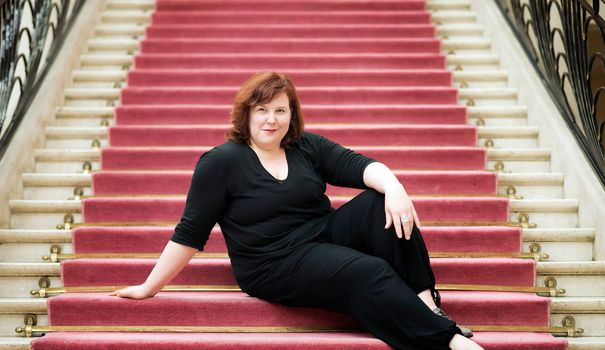
Marie-Nicole Lemieux
The soloist for the vocal works will be Canadian contralto Marie-Nicole Lemieux, a frequent musical collaborator with Zeitouni who is noted for singing Baroque opera and the serious operas of Rossini.
The July 1 program reflects Zeitouni’s unique musical personality in several ways. For one thing, he is half French, and grew up with French musical culture in Montréal. French music speaks to him naturally through language and heritage and experience.
As for the Italian half of the program, he is not Italian himself but he says he has an affinity for Italian culture through proximity. “I am half French and half Egyptian, so it’s Mediterranean,” he says.
The program—and other parts of the festival season as well—also reflect Zeitouni’s deep love and appreciation of vocal music. “I’m an avid opera conductor and opera lover and choral conductor,” he says. “Voice was always a big part of my upbringing.”
In addition to vocal works on Wednesday’s program, Zeitouni has scheduled a concert performance of Bartók’s opera Bluebeard’s Castle later in the summer (July 23 & 24). And the final CMF concert of 2015 will be “A Royal Finish: Choral Masterworks,” including works by Handel and Mozart performed by the CMF Chamber Orchestra, the CMF Chorus and soprano Karina Gauvin (Aug. 9).
“I affectionately call these the vocal pillars, and they are three facets of vocal music: the art song or song with orchestra; the operatic; and the sacred and the choral,” he says “So they are basically covering, not everything of course, but different genres of vocal music.”
Returning to Wednesday’s opening concert, Zeitouni says that working with the Festival Orchestra this summer “is very meaningful. I was happy to reunite with the orchestra. Last year I was a guest conductor, but there was a connection, so I’m looking forward to opening night. In a more formal way, (the orchestra and I) are embracing each other for this relationship. This group is really special.”
Following La Mer, which is familiar to many classical music listeners, Zeitouni, the orchestra and Lemieux will present a work that is not familiar to many: Ravel’s Shéhérazade, a setting of three poems by Léon Leclère. A friend of the composer, Leclère took the pen name Tristan Klingsor from two of Wagner’s characters. Under that name he published 100 poems that were inspired by reading the collection One Thousand and One Nights, and by Rimsky-Korsakov’s well known symphonic suite Scheherazade.
Ravel in turn picked three poems to set for voice and orchestra: Asie (Asia), La flûte enchantée (The enchanted flute) and L’indifférent (The indifferent one). Tim Orr from the Colorado Shakespeare Festival will read each poem before it is performed.
Rossini is best known to American audiences for his comic operas, including The Barber of Seville, but he also had a very successful career writing serious operas that are marked by dramatic and vocally demanding arias for the main characters. Two of his greatest works of this type, Trancredi and Semiramide are both based on works by Voltaire.
Finally, the program closes with a work as familiar, at least, as the Debussy with which it opens: Respighi’s orchestral showpiece The Pines of Rome. As disparate as the program seems at first glance, Zeitouni sees a common thread throughout.
“If you look at the concert as a whole,” he says, “you have La Mer and you have Shéhérazade and you have Rossini epic arias and then the Pines of Rome. All of these pieces evoke images, they are tableaus—tableaus of nature, tableaus of civilization, tableaus of exotic lands. So there’s the idea of images and of going places that are new to us, that are foreign, that are exotic.”
# # # # #
 Colorado Music Festival
Opening Night: Welcome Jean-Marie!
Festival Orchestra, Jean-Marie Zeitouni, conductor
Marie-Nicole Lemieux, contralto, and Timothy Orr, speaker
Debussy: La Mer
Ravel: Shéhérazade
Rossini: Arias from Tancredi and Semiramide
Respighi: Pines of Rome
7:30 p.m. Wednesday, July 1, Chautauqua Auditorium
A preview of more events in the Colorado Music Festival will appear in Boulder Weekly Thursday, July 2.
To see the full CMF program or purchase tickets, visit the CMF Web page.
Poppea wants to be empress, and the emperor wants Poppea.
Glen Asakawa/University of Colorado
By Peter Alexander
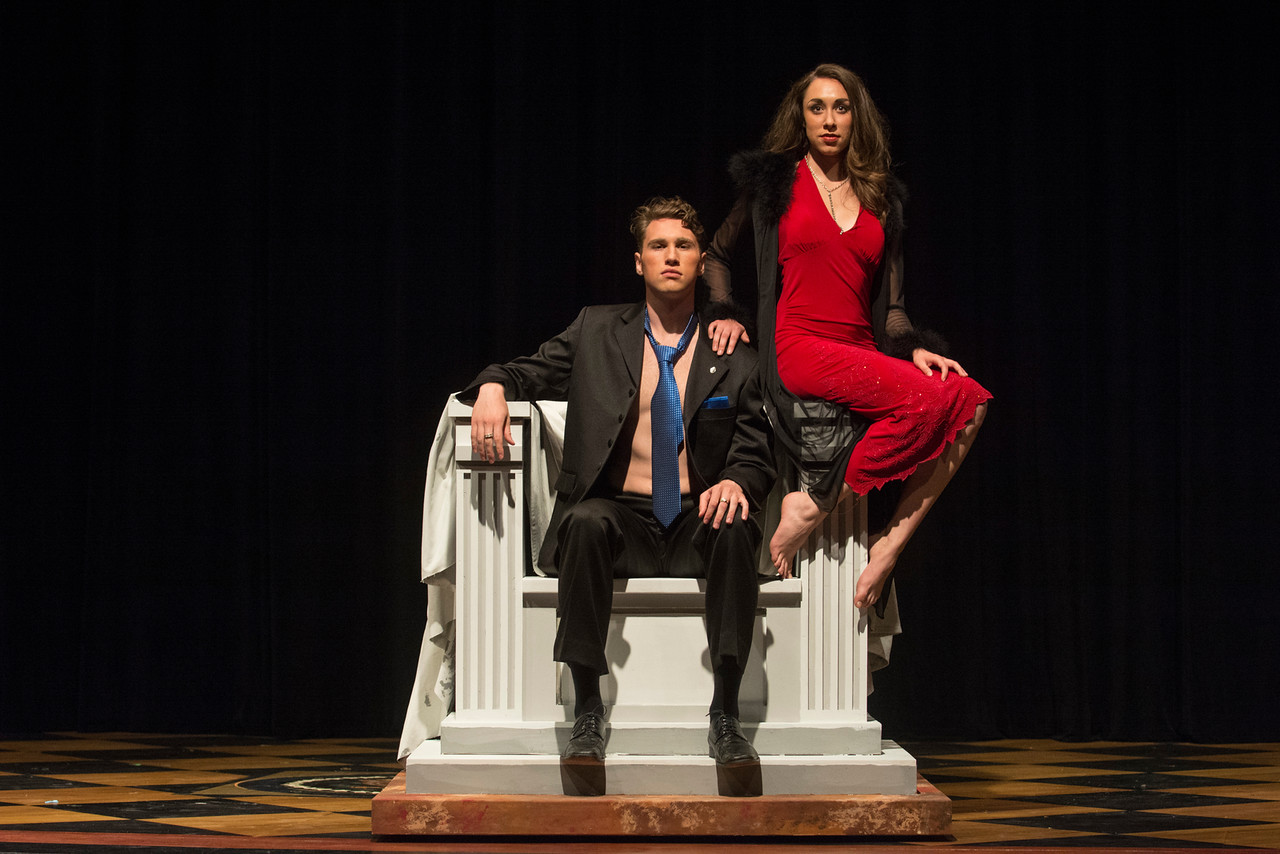
Nero and Poppea were the amoral power couple of 60s AD imperial Rome, and they didn’t care who got in their way. They are the subjects of Claudio Monteverdi’s final operatic masterpiece, The Coronation of Poppea, based on Roman history and written in 1653 for the carnival season in Venice.
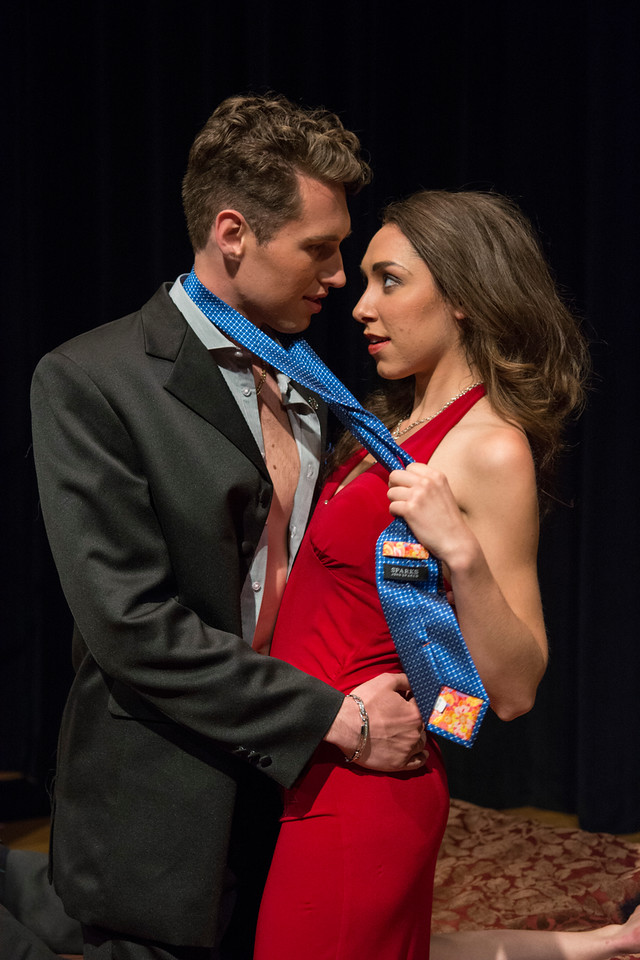
The CU Eklund Opera Program production of The Coronation of Poppea will be presented Thursday–Sunday, April 23–26, in the Music Theater of the Imig Music Building (7:30 p.m. Thursday–Saturday, 2 p.m. Sunday). Leigh Holman will direct, and the music director will be Nicholas Carthy.
The similarity between Nero and Poppea and the characters on a certain popular television series gave Holman an idea how to make the opera more vivid. “Coronation of Poppea is all about sex and politics and power, and if you’ve seen House of Cards, it’s the exact same thing,” she says. “It’s about a power hungry, vicious man and his power-hungry, vicious girlfriend.”
Read more at Boulder Weekly.
# # # # #
Glen Asakawa/University of Colorado
The Coronation of Poppea by Claudio Monteverdi
CU Eklund Opera Program
Leigh Holman director, Nicholas Carthy, music director
7:30 p.m. Thursday–Saturday, April 23–25 and 2 p.m. Sunday, April 26
Music Theater, Imig Music Building
Tickets here or call: 303-492-8008.
Explorations of the the “New World Renaissance”
Ars Nova Singers
By Peter Alexander
“I have seen the map of the world . . . “
Those are the opening words of a lively Italian song of the late 15th century, when that statement meant something. It is even possible that Columbus’s sailors sang those words on the way to a world that was not yet on the European maps.
William Simms with theorbo
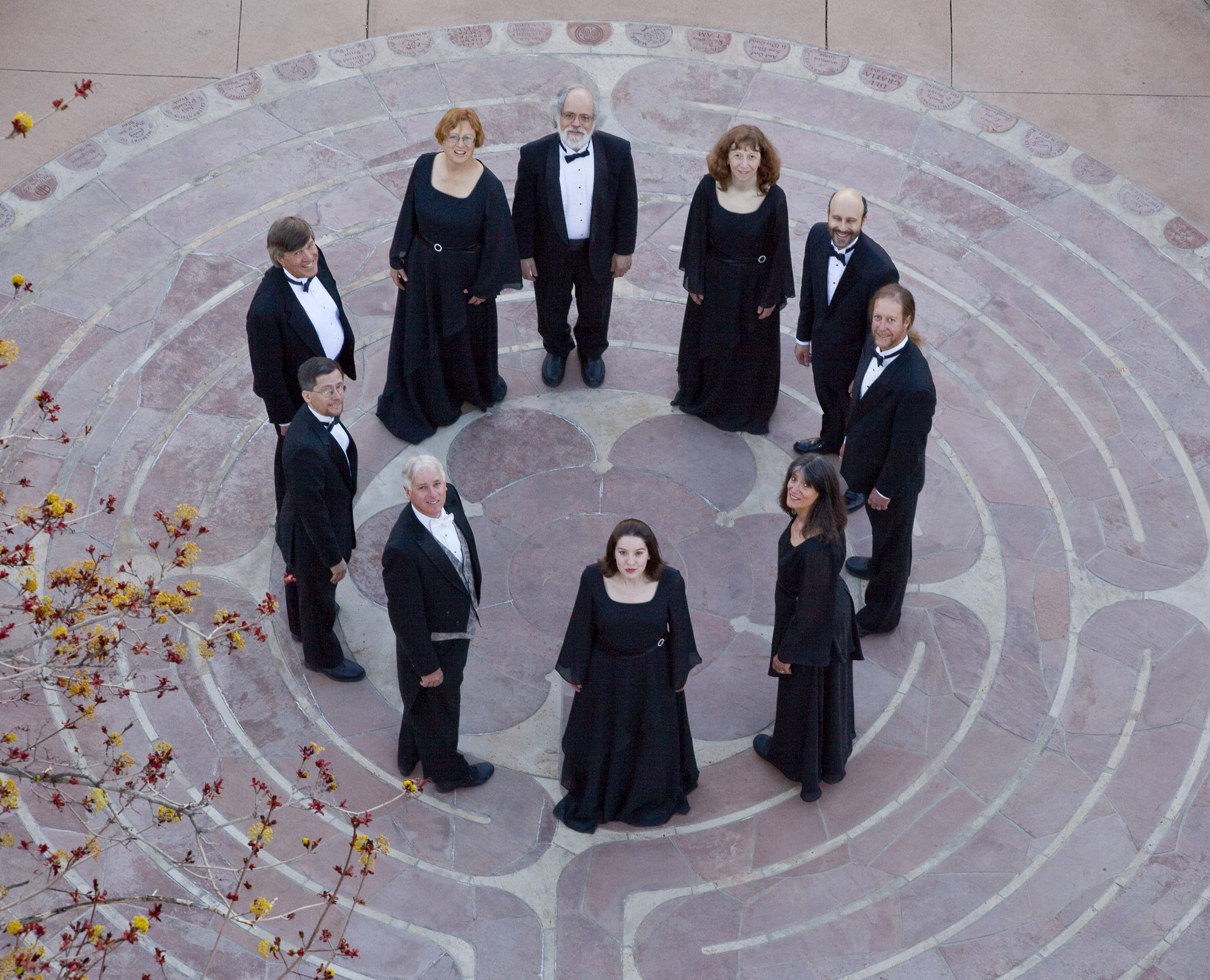
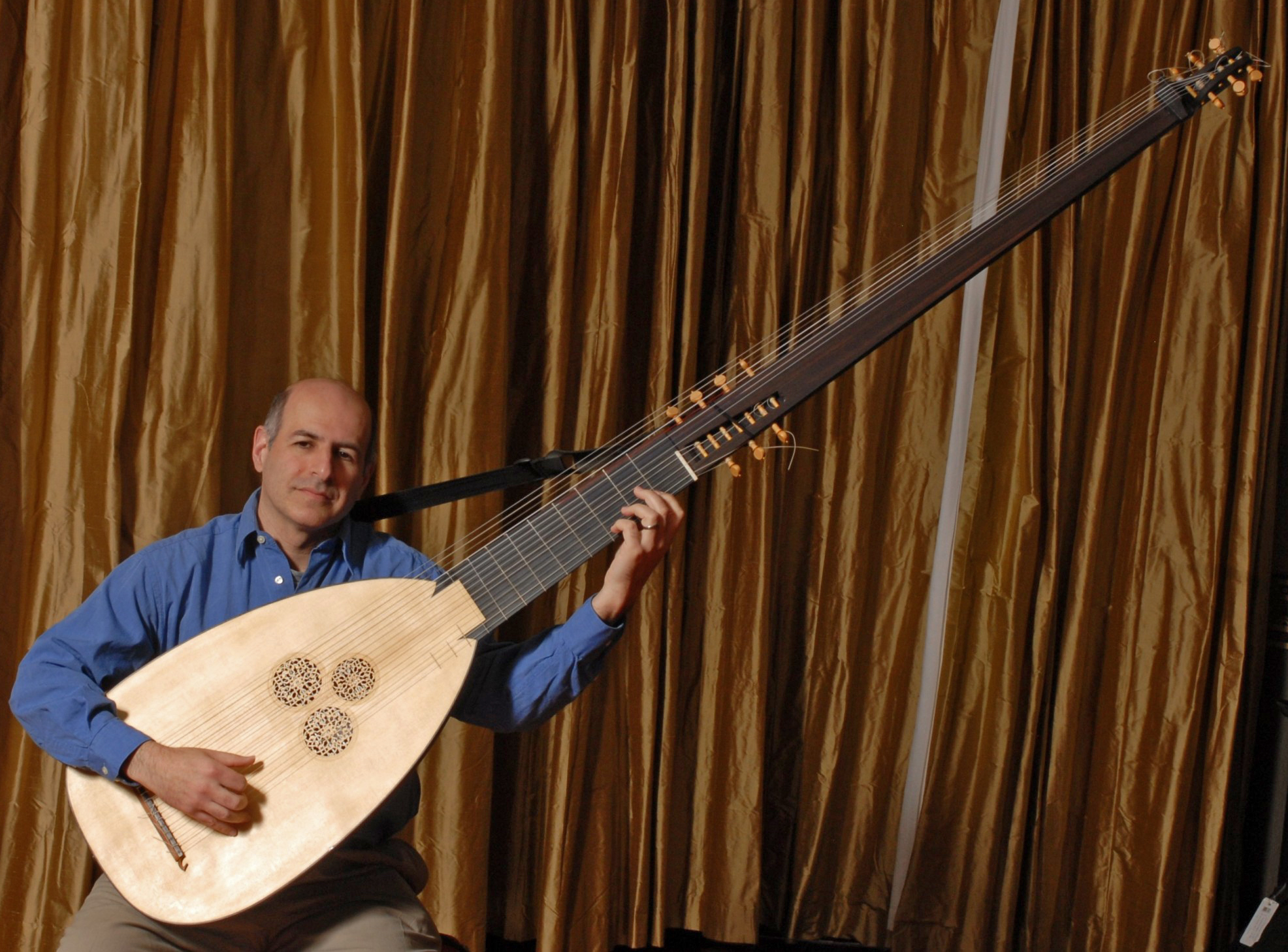
More than 500 year later, the same song will open a concert by Boulder’s Ars Nova Singers, “New World Renaissance,” presented at 7:30 p.m. Friday in Boulder and Saturday in Englewood (tickets available online: http://arsnovasingers.com). Ars Nova’s artistic director Thomas Edward Morgan will conduct the performance, which will feature guest artists Ann Marie Morgan, viola da gamba, and William Simms, theorbo (a long-necked bass lute) and Baroque guitar.
The concert will explore music that was written, or was likely performed in the New World during the 16th and 17th centuries. The featured work, Missa Ego flos campi by Juan Gutiérrez de Padilla, was written for performance at the cathedral in Puebla, Mexico, in the mid-17th century. The program also includes “Hanacpachap cussicuinin,” a hymn written in the Quechua language of the Incan Empire by the Franciscan priest Juan Pérez Bocanegra.
Read more at Boulder Weekly.
# # # # #
 “New World Renaissance”
Ars Nova Singers, Tom Morgan, conductor
Ann Marie Morgan, viola da gamba
William Simms, theorbo and Baroque guitar
7:30 p.m. Friday, April 10, St. John’s Episcopal Church, 1419 Pine St.,, Boulder
7:30 p.m. Saturday, April 11, Bethany Lutheran Church, 4500 Hampden Blvd., Englewood
TICKETS
 Sharps & Flatirons