Emerson Quartet appears on CMF’s Mann Chamber Music Series

Program of Purcell, Walker, Shostakovich and Beethoven, plus Dvořák

By Peter Alexander July 14 at 12:50 a.m.

Last night (July 13) the Colorado Music Festival (CMF) hosted one of the most distinguished string quartets as part of the new Robert Mann Chamber Music series.

It was not, however, the quartet that had been announced. The originally listed Juilliard Quartet was unable to make the trip, and the nine-time Grammy-winning Emerson Quartet came to the rescue, making their CMF debut appearance. That was a happy turn of events, as the Emerson gave a terrific program of their own, entirely worthy of a series named for the legendary violinist.

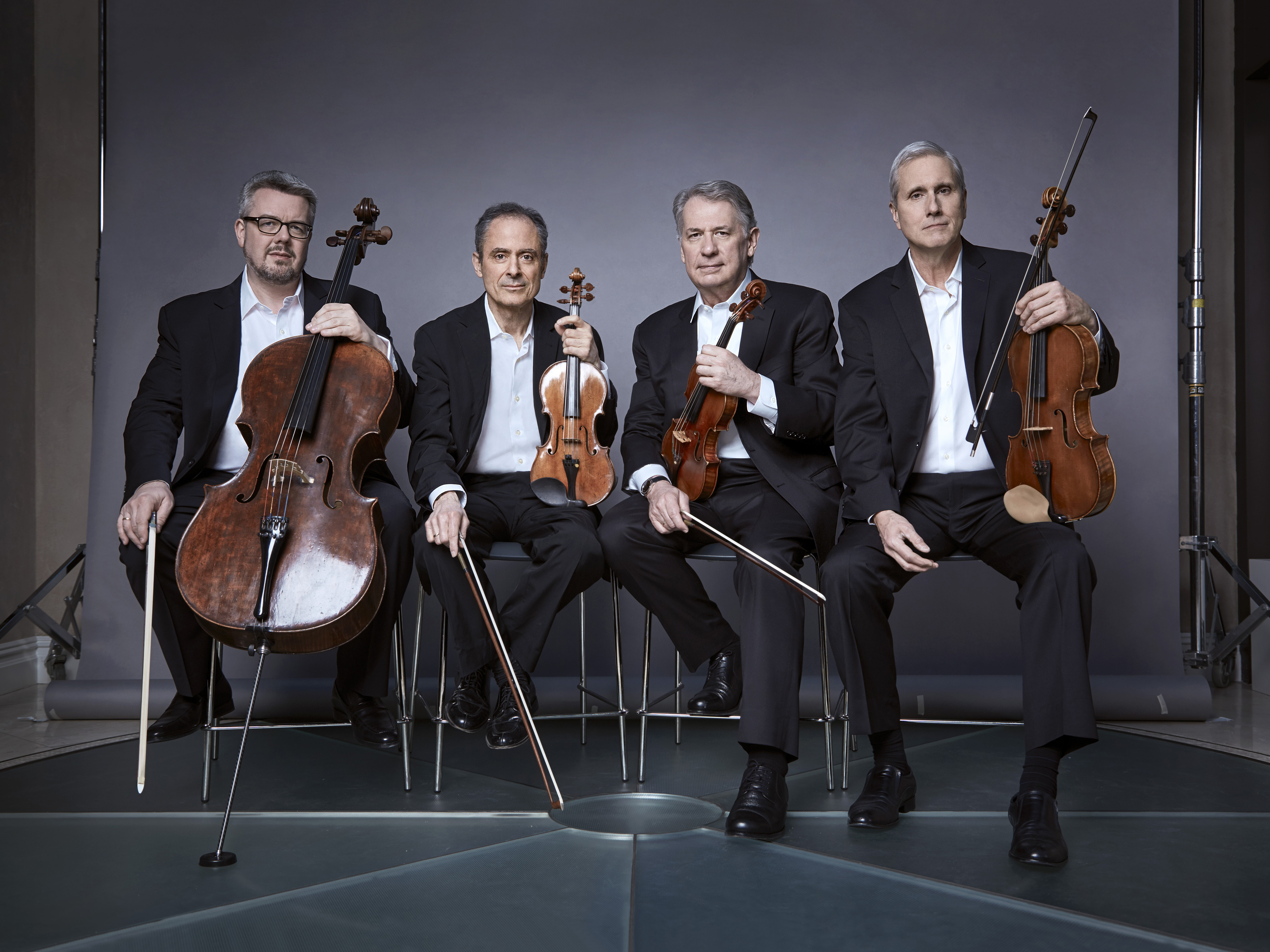
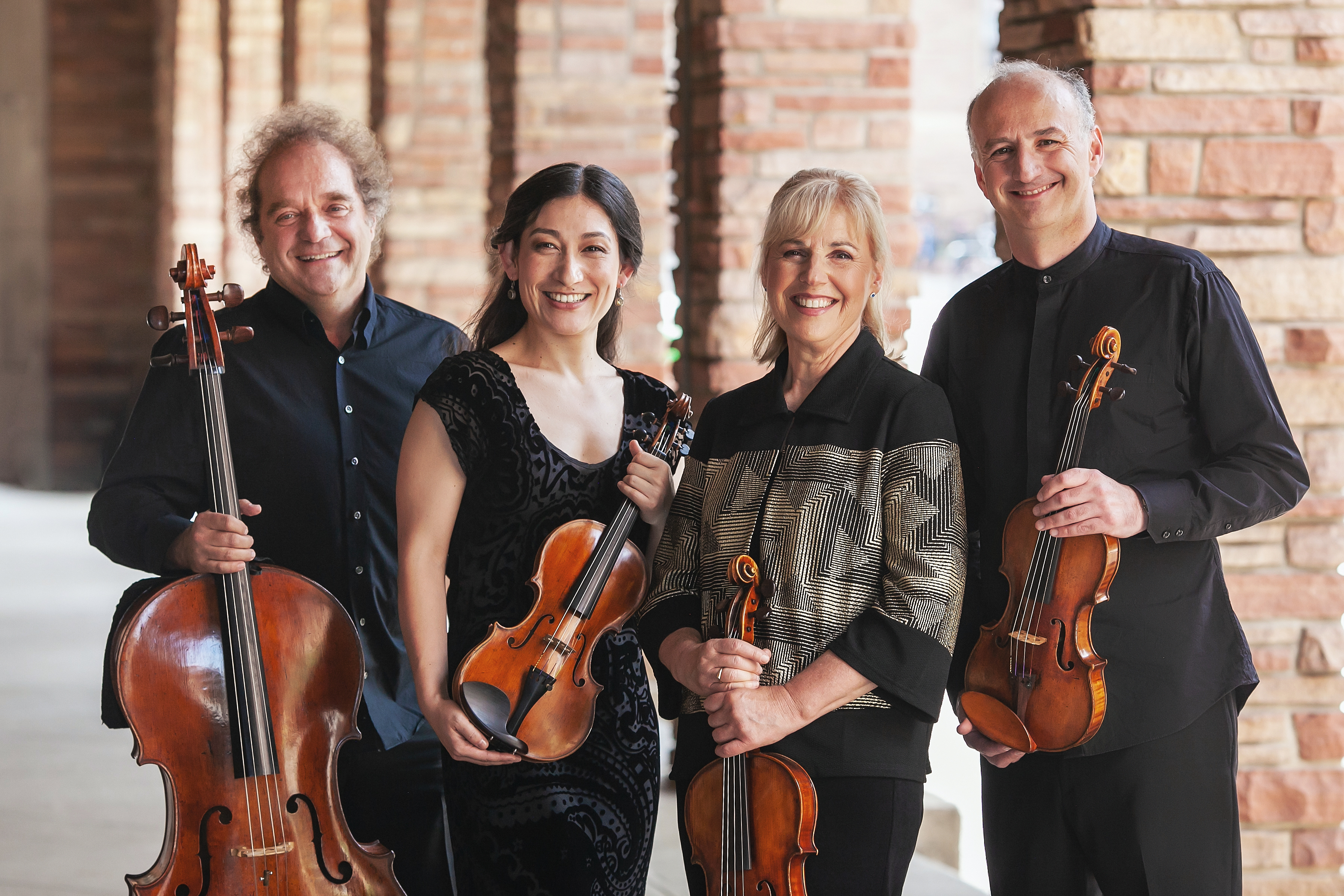
Emerson Quartet. Photo by Jurgen Frank.

The Emerson Quartet opened their program with Henry Purcell’s 17th-centruy Chacony, as edited by Benjamin Britten. This is a curious hybrid piece, one that is neither Baroque nor modern—more of a Baroco-Romantic blend. The performance was lovely, transparent enough to clarify the polyphonic texture but also warm enough to evoke a more Romantic sense of style.

After that brief opener, violinist Eugene Drucker came onstage to talk about the program, providing just enough analysis to give insight into the coming pieces. As he pointed out, the Purcell/Britten established a theme that was carried on by other pieces: music that looks both forward and backward. This applied particularly to the Shostakovich Quartet No. 14, in which the composer pulled serial elements into his personal style, and Beethoven’s String Quartet No. 15, op. 132, which uses an old church mode to express the composer’s thanks to the Deity.

But first the Emerson played the string quartet version of George Walker’s Lyric for Strings. Best known as a piece for string orchestra, it was originally written as part of Walker’s String Quartet No. 1. If you are accustomed to the string orchestra version, it sounds more fragile, and also more intimate when played by a quartet. In the Emerson’s performance, you could hear the players’ affection for this gentle piece, as they caressed the chords and carefully shaped the dynamic contours.

As Drucker explained, Shostakovich’s Fourteenth Quartet is permeated with highly chromatic lines that come out of 12-tone compositional styles. And yet, it is unmistakably Shostakovich’s music in its texture, in its rhythmic shape, and equally in its expressive profile.

Like many of his other quartet movements, the opening Allegretto starts as if striking out on a brisk excursion. But soon the chromatic elements  take the music down some strange and unexpected byways. Happily, the Emerson Quartet seemed completely plugged into the composer’s itinerary and never seemed the least bit lost.

The second movement is an Adagio of brooding intensity. Last night the suppressed turmoil of the music seemed to summon the winds outside the Chautauqua Auditorium. This mini mistral rattled the building and seemed to express what Shostakovich had hidden behind the notes, but it did not rattle the players of the Emerson Quartet who carried on with total aplomb.

The final movement is variegated in texture, mood and affect, contrasts that the Emerson Quartet brought out forcibly. Undisturbed by the continuing tempest without, they maintained their focus and intensity. 

I have little to say about the Beethoven, which received a consistent, polished and utterly coherent performance. This is music that the Emerson, like all first-rank quartets, has played many times. They are performers who know the music intimately and know exactly what they want to do. This performance did not confront the audience with the rude and boisterous Beethoven we sometimes hear. Rather, it had the rough edges polished, and however deeply expressive, it was never uncomfortable.

Hearing this quartet is almost an otherworldly experience, especially the central movement titled “Heiliger Dankgesang eines Genesenen an die Gottheit” (Holy song of thanks of a convalescent to the Deity). Here Beethoven uses the Lydian mode, a kind of scale used in Medieval Gregorian chant but rarely since, to evoke the sacred realms. The Emerson Quartet played those portions of the score with quiet reverence, and contrasted them well with the surrounding material representing his recovery.

These essential contrasts were brought out in a polished way without resorting to crude exaggeration. Was it too polished? Some may like Beethoven in a more aggressive mood, but you could not say this performance was not convincing. 

For an encore, the quartet played one of Dvořák’s Cypresses, quartet arrangements of a set of love songs, a lovely and gentle way to follow up a widely varied program.

Central City Opera’s Rigoletto at Hudson Gardens packs a punch

Fine cast is led by Alisa Jordheim’s radiant Gilda

By Peter Alexander July 12 at 10:45 p.m.

Central City Opera’s second production of the 2021 festival season, Verdi’s Rigoletto, opened Saturday night (July 10) on a beautiful summer evening at Littleton’s Hudson Gardens.

The season had opened the previous Saturday (July 3) with Rodgers and Hammerstein’s Carousel. The locale, chosen when CCO had to move from the close quarters of their opera house in Central City, proved idyllic for the Rigoletto opening. The opera—condensed to a single 100-minute span with no intermission—successfully used the outdoor location in the conception of the production, and mostly successfully moved the time to a near-present that featured a golf-playing Duke, a curse- and bible-brandishing preacher, and news passed by cell phone.

Galeano Salas as the callow, golf-playing Duke of Mantua. All photos by Amanda Tipton.

In updated productions, the Duke of Mantua has been transformed into a Mafia boss in New York’s Little Italy, a Sinatra-like singer in Vegas, and a skirt-chasing politico modeled on Italy’s Silvio Berlusconi. This is a tempting way to convey the dissolution of the Duke’s court to modern audiences, but it offers a problem, too: Rigoletto himself.

In the original setting, Rigoletto’s status as court jester—forced to amuse the Duke and hated by everyone for his cutting tongue—is visibly apparent from his first entrance. There are no modern equivalents that quite capture that level of degradation and humiliation. In the case of the CCO production, effectively stage directed by Jose Maria Condemi, the other updatings worked well, but Rigoletto’s status remained problematic.

Alissa Jordheim as Gilda.

One example: In the second act, Rigoletto’s daughter Gilda flees from the Duke’s bedroom following her ravishment, to find her father among the courtiers. The impact of this scene lies partly in her immediate recognition of the depravity of his status in the court. But here, there is no dress or other sign of his debased status, which diminishes the impact of their reunion.

In just about every other way I found the updating effective. The Duke as a callow and callous ex-frat-boy surrounded by a posse, Monterone as a Bible-thumping televangelist, the tart Maddalena dressed in a scarlet (get it?) corset—these all worked. The informal dress, adapted for outdoor performances on warm summer nights, was effective. Gilda’s swing was a nice touch, suiting the outdoor venue well. This Rigoletto definitely packs a punch.

Sound was the greatest sacrifice to the outdoor venue. A reduced orchestra—eight strings, 22 players in all—is seated beneath a tent behind the stage. Each of the players and singers is individually mic’d, making the sound technician—seated in a stage-side tent of his own—the most important person you don’t see. Conductor John Baril communicates with the singers via video monitors.

But eight strings is not enough to create the weight you want in Verdi’s score, and the amplification only makes the orchestra sound tinny, not hefty. The woodwinds were often under-powered. The singers came across better, always present and easily understood.

One way the opera was condensed was by reducing the cast. The bevy of courtiers around the Duke was reduced to three named roles and some of the larger scenes and choral numbers were cut. The drama does not suffer from such reductions, but the musical breadth of the score does.

Alissa Jordheim as Gilda and Aleksey Bogdanov as Rigoletto

Of the cast members, Alisa Jordheim as Gilda was the star of the night. Her glittering, burnished soprano and splendid vocal technique made her every scene a delight. The tender wonder and brilliant coloratura of “Caro nome,” her anguished cries in the great Act III quartet, and above all her powerful resolve before sacrificing herself for the Duke—all were both musically and dramatically compelling.

Galeano Salas brought a lovely lyric tenor sound to the role of the Duke of Mantua and was at his best on the solo arias. His phrasing became more fluid as the evening wore on, but occasionally his phrasing was more pedestrian, lacking depth of expression.

In the title role, Aleksey Bogdanov sang with a resonant baritone. He was never less than effective, although his portrayal sometimes seemed directed rather than spontaneous. His best moments were his powerful rage in Act II and his final scene as Gilda dies in his arms, prompting his fierce cry of “Ah! La maledizione!” (Ah! The curse!).

John Paul Huckle as Sparafucile and Michelle Monroe as Maddalena.

John Paul Huckle was a menacing and deep-voiced Sparafucile who brought his small but essential role convincingly to life. Michelle Monroe was exactly as coarse and suggestive as she needed to be as Maddalena without losing vocal effectiveness. Together they made the final act a potent highlight. 

As Monterone, Phillip Lopez gave a hard edge to his voice that matched his character’s harsh pronouncements. All the other roles were filled by a small but resilient cast of capable performers who sang well and made even their entrances across the visible spaces around and behind the stage part of the drama.

Sound issues with the amplified orchestra aside, John Baril conducted with style. He knit the through-composed score together with great effectiveness, building powerful momentum where necessary. The final act storm was driven but underpowered. Condemi’s clear direction of the smallish cast helped propel the story ahead.

Kudos to Central City Opera for finding a venue and a way to produce the season. Opera at Hudson Gardens is a unique experience for Colorado audiences, and one well worth taking in. It was a daunting challenge to move the production to a space that was new to the CCO, even as opera was new for the people at Hudson Gardens. If you don’t believe that it was a challenge for all, go to a performance and look at all the lights hung over the stage, then realize that the space is alternating two different shows. 

Rigoletto continues in repertory at Hudson Gardens through July 30. Tickets are available here.

# # # # #

Rigoletto
Music by Giuseppe Verdi, libretto by Francesco Maria Piave

REMAINING PERFORMANCES:

7 p.m. Friday, July 16; Tuesday, July 20; Thursday, July 22; Saturday, July 24; Wednesday, July 28; Friday, July 30
3 p.m. Wednesday, July 14; Sunday, July 18; Tuesday, July 27

Hudson Gardens, Littleton, Colo.

Tickets

Carousel at Central City Opera: a Twisted Tale of Redemption

Production faces dark themes of Rodgers and Hammerstein’s hit show

By Izzy Fincher July 11 at 12:45 p.m.

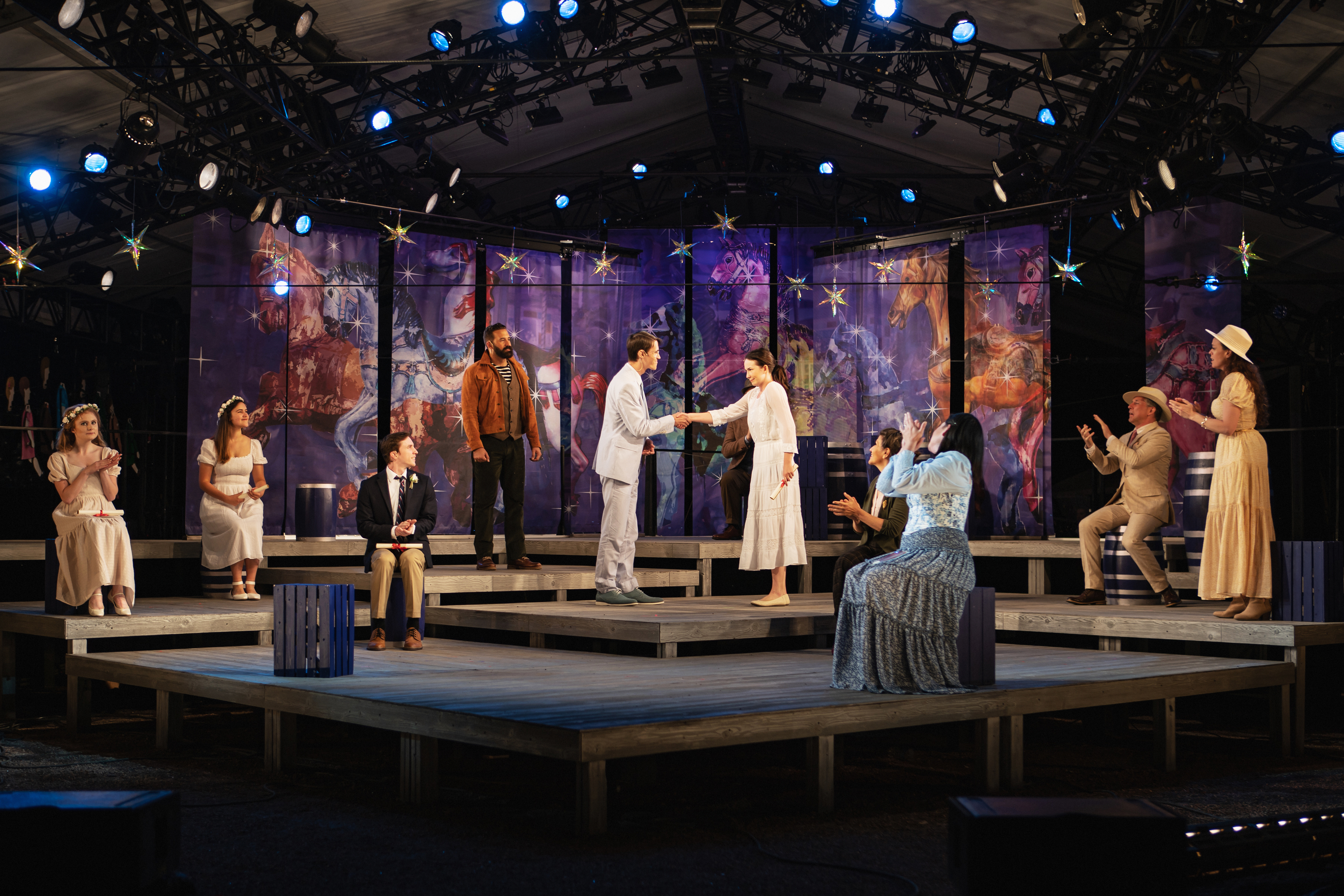
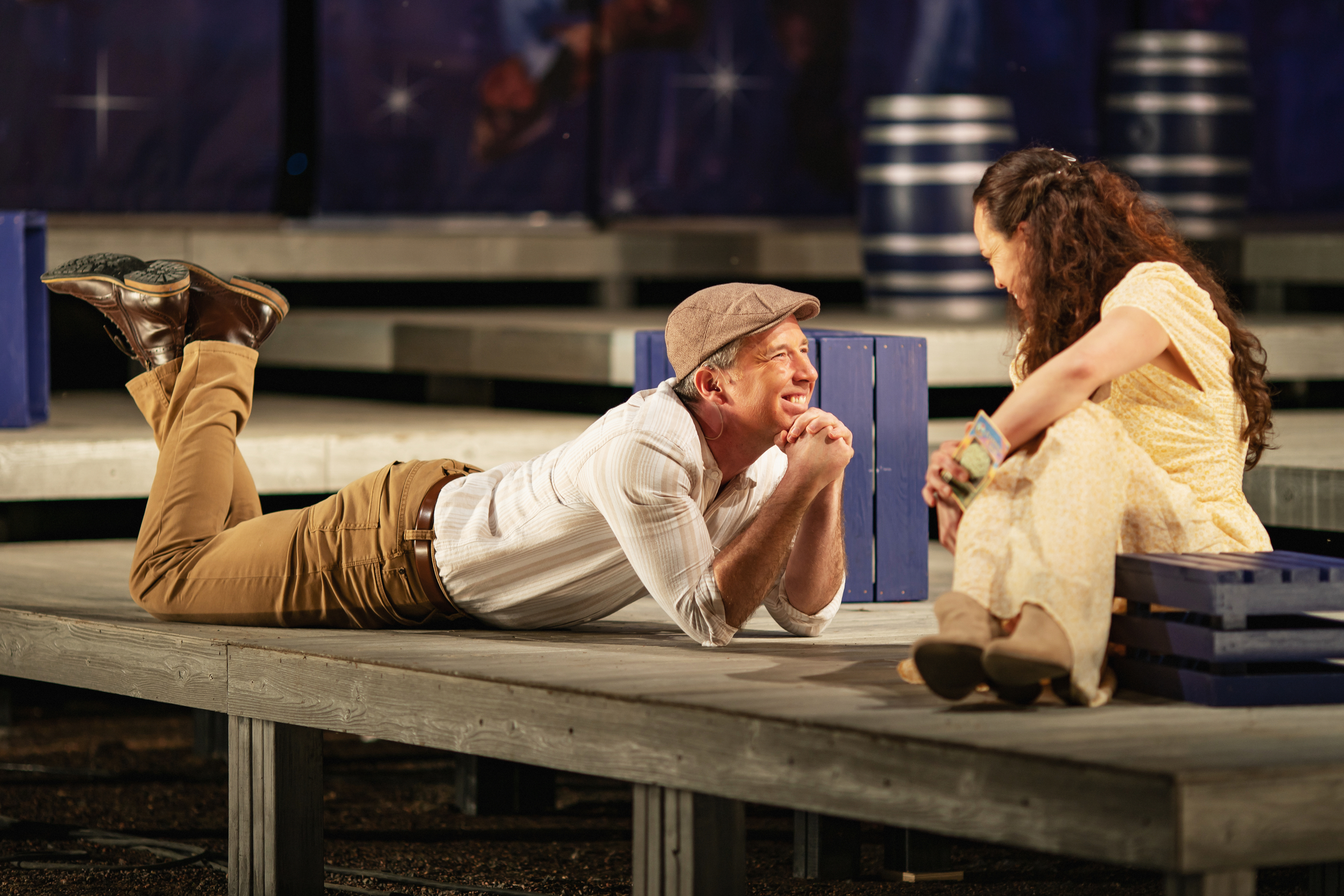
The smell of love—and fresh cut grass—is in the air. Two young lovers gaze into the settling dusk, framed by glowing carousel banners and scintillating plastic stars, cottonwood fluff falling like blossoms.

Yet despite this idyllic opening scene from Rodgers and Hammerstein’s Carousel, the show is filled with dark themes of toxic relationships, domestic abuse, crime and suicide, ending with the bittersweet promise of “You’ll Never Walk Alone.”

Central City Opera’s production, which opened on July 3 at Hudson Gardens in Littleton, Colo., under director Ken Cazan, does not shy away from the darker themes, and it also doesn’t attempt to reframe the outdated storyline for a modern audience. With a minimalistic approach to staging and costumes, the focus is on the abusive relationship between Billy Bigelow (Steven LaBrie) and Julie Jordan (Anna Christy), which unfolds with heartbreaking realism.

Carousel at Central City Opera. Photo by Amanda Tipton.

Carousel, written in 1945, was Rodgers and Hammerstein’s second collaboration after their Broadway hit Oklahoma!. Based on Ferenc Molnár’s 1909 play Liliom, the musical takes place in a small town in Maine in the early 1900s. It depicts the troubled relationship between charming carousel barker Billy and naive millworker Julie, contrasted by the light-hearted love story of Julie’s best friend Carrie Pepperidge (Jennifer DeDominici) and the pious, ambitious fisherman Enoch Snow (Will Ferguson).

From the beginning, the whirlwind romance between Billy and Julie is clearly ill-fated. Billy is lazy, quick-tempered and emotionally stunted, while Julie is a hopeless romantic, too forgiving for her own good. A few months into their marriage, Billy physically abuses Julie, an upsetting yet hardly surprising development. (He later denies it, saying, “I wouldn’t beat a little thing like that—I hit her.”) Later when he learns Julie is pregnant, he decides to commit a robbery to provide for his future family and kills himself when it fails.

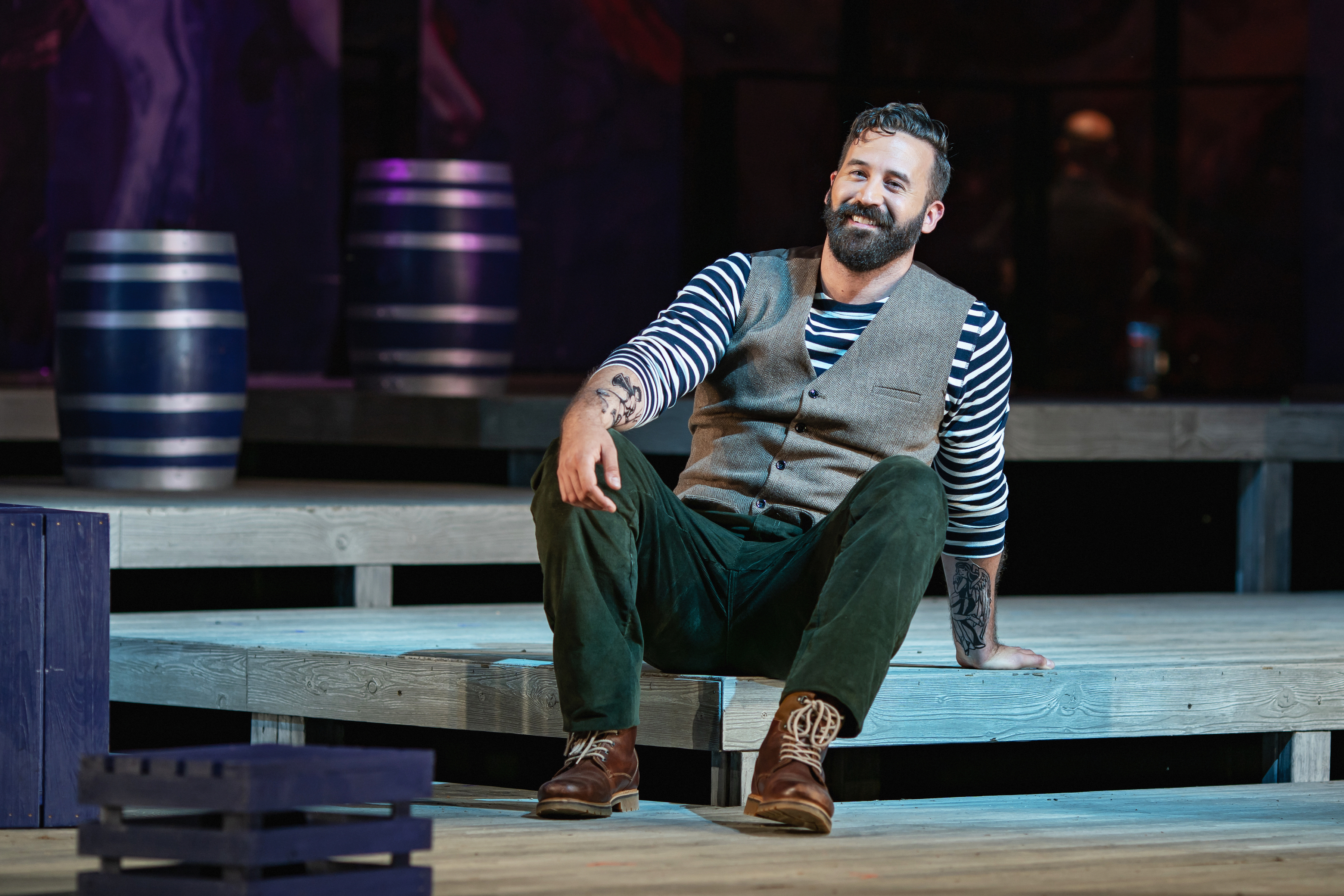
Steven LaBrie as Billy Bigelow. Photo by Amanda Tipton.

Although domestic abuse was largely ignored (and sometimes encouraged) at the time, Rodgers and Hammerstein initially had misgivings about turning Liliom into a musical. After all, a “wife-beater” who abandons his pregnant wife is hardly a sympathetic protagonist. 

So the duo crafted a more optimistic, though morally problematic, ending: while his counterpart Liliom is banished to purgatory, Billy is redeemed and goes to heaven (after abusing his daughter on his second chance and offering a few words of encouragement and an “I love you” on his third). By reframing the dark tale as an uplifting story of redemption, they managed to appeal to mainstream audiences, and the show became an instant hit on Broadway.

However, since the #MeToo movement Carousel revivals have faced intense criticism. The musical has been accused of romanticizing an abusive relationship and having a sympathetic portrayal of Billy as a flawed man worthy of redemption. 

In response, several recent productions have cut a few of Julie’s controversial lines, but these small deletions are a superficial fix at best and to an extent deny the realities of how victims may perceive their abusers. The main issue that productions, including this one, haven’t yet dared to address lies in Billy’s final redemption, even though his abusive nature has not fundamentally changed.

In Central City Opera’s production, Cazan has taken a more hands-off approach to the issue. Julie’s controversial lines remain intact, and the production leaves the moral dilemma of Billy’s redemption unanswered.

In her role as Julie, Christy skillfully portrays a nuanced character, a compassionate girl who loves a cruel man deeply and unconditionally, even when she shouldn’t. In “If I Loved You,” Christy’s sparkling soprano soared across the garden, filled with love and hope. Then as the play progresses, her bright, spirited disposition fades, and she sinks into herself, hiding in an oversized olive sweater draped over her elegant dress. When she is with Billy, she flinches away from him, defiant but afraid.

LaBrie, in his portrayal of Billy, leans into the despicableness of his character. Cutting an imposing figure onstage, LaBrie towers over Christy as Julie, his booming voice and menacing movements evoking a sense of dread. Though he never hits Julie onstage, he seems poised to do so at any moment, like a coiled spring ready to snap. 

Will Ferguson (Enoch Snow) and Jennifer DeDominici (Carries Pipperidge). Photo by Amanda Tipton

Yet, there are also sweet, charming moments early on in “If I Loved You,” the closest Billy ever comes in life to admitting his feelings. In “Soliloquy,” a tender song about his future child (whom he hopes will be a boy, of course), LaBrie captures the essence of Billy, a man riddled with toxic masculinity and prone to self-destructive behavior, unable to express his love for his wife and unborn child in a healthy way.

Despite the difficult material, the show is sprinkled with several funny and heartwarming moments, mostly from Carrie and Enoch. Their relationship is imperfect and at times sexist—Enoch imposes his dream of a big family onto Carrie and blames her for being sexually assaulted by Billy’s crony Jigger Craig. Yet, overall Ferguson portrays Enoch as a good-hearted man, who tries his best to love Carrie, while also providing much-needed comic relief with his infectious guffaw and social awkwardness. 

The ending, however, remains a twisted tale of redemption. With closed eyes, the final sweeping chorus of “You’ll Never Walk Alone” is deeply moving. The uplifting music is almost enough to convince us that Billy deserves to be redeemed. 

Almost. But unless we are as forgiving as Julie, after the music fades, it’s hard to believe that a single moment of kindness could make up for Billy’s sins.

# # # # #

Carousel
Music by Richard Rogers, book by Oscar Hammerstein

Remaining Performances:
7 p.m. Tuesday, July 13; Thursday, July 15; Saturday, July 17; Friday, July 23; Tuesday, July 27; Thursday, July 29\
3 p.m. Wednesday July 7; Sunday, July 11; Sunday, July 25; Thursday, July 29; Sunday, August 1

Hudson Gardens, Littleton, Colo.

Tickets can be purchased here.

Wonderfully modulated Mendelssohn is star of CMF opening night

Festival premieres a work for our times, gives a driven Beethoven performance

By Peter Alexander July 2 at 12:40 a.m.

The 2021 Colorado Music Festival got off to a splendid start last night (June 1).

After the two-year pause from the pandemic, both the audience and the players on the Chautauqua Auditorium stage were clearly thrilled to be sharing music together again. That joy was briefly expressed by CMF executive director Elizabeth McGuire, and then music director Peter Oundjian strode out to get back to business.

Peter Oundjian and the CMF Orchestra.

The concert opened with the world premiere of the strings, harp and timpani version of Aaron Jay Kernis’s Elegy (to those we’ve lost). Originally written for piano, the music came from a deep well of personal experience on the part of the composer, who contracted COVID-19 himself and lost several friends. (You may hear the piano version together with a film by Esther Shubinski here.)

Aaron Jay Kernis

Elegy is music of relative simplicity and comfort, one that recalls other pieces played for memorial occasions. It is consoling throughout except for a brief moment just before the end, when a tumultuous passage briefly evokes the anguish of the pandemic. Oundjian elicited a sweet and flexible performance that captured well the consoling nature of Kernis’s score which has all the ingredients of a work for these times. 

After Kernis took a bow with Oundjian, the conductor introduced violinist Augustin Hadelich for a performance of the Mendelssohn Concerto in E minor. An increasingly celebrated soloist, Hadelich does not overwhelm with volume or sheer flash, but rather with the beauty, precision and delicacy of his playing.

In a wonderfully modulated performance, Hadelich took an overtly Romantic approach to the concerto. He used tempo, dynamics and tone quality to evoke all the kaleidoscopic moods of the score, and he gave the most dramatic and magically captivating reading of the first movement cadenza I have heard. Throughout the concerto, he brought out the sweetness and delicacy of the solo part to an extraordinary degree. 

Augustin Hadelich

In the lyrical second movement, Hadelich showed his ability to sustain attention and the tension of the longest melodic lines. The finale was quite fast, with no loss of accuracy on the soloist’s part. There was one moment of imprecision with the wind players at the very beginning, but otherwise the movement was exceptionally brilliant, as is intended.

For an encore, Hadelich showed that his skills extend well beyond the Classical/Romantic repertoire, playing the “Louisiana Blues Strut” by Coleridge-Taylor Perkinson with an idiomatic and raucous sense of fun that was well appreciated by the CMF orchestra as well as the audience.

The concert concluded with a driven performance of Beethoven’s Seventh Symphony—a holdover from the planned 2020 festival that would have coincided with the 250th anniversary of the composer’s birth. Wagner called the Seventh “the apotheosis of the dance,” and indeed every movement is based on strongly rhythmic ideas. Oundjian—conducting without a score—and the CMF orchestra gave a performance that was always bustling, even if it did not always quite dance.

The pace was brisk from the beginning of the slow introduction, which was precise and efficient, leading to a rushing allegro movement that happily observed the repeats Beethoven expected to hear, but that are often omitted today. Changes of volume or dynamics were used to great effect in the slow movement, although for my taste it has more suspense and pays off better at a slower tempo.

The same was true of the Scherzo and Finale, where the very fast tempos contributed to a loss of detail. Both would dance better with a slightly slower tempo and cleaner texture. The massive ritard in the middle of the Scherzo only emphasized how fast the rest of the movement was. The dynamics were well handled in these movements as well, with one exception. 

Near the end of the finale, for the first time ever Beethoven calls for three f’s in the orchestra, a moment underlined by the full brass section. Clearly intended as the climax of the entire symphony, this moment should startle with its impact. But Oundjian had driven the entire movement so powerfully that Beethoven’s triple-f was just more of the same.

This was an early-summer performance—great players coming together for the first time in nearly two years, playing with great skill and precision, but not yet quite coalescing into a totally polished product. Clearly, the audience caught the excitement of the fast tempos and the joy the players felt at being back on stage. With a little more time together, I expect even more.

CORRECTION: An earlier version of this article stated that the “Louisiana Blues Strut” is by the Black English composer Samuel Coleridge-Taylor. That is incorrect. The composer is American Coleridge-Taylor Perkinson.

AN INTIMATE NIGHT OF BACH WITH THE BOULDER PHIL

Featuring guest conductor/pianist Simone Dinnerstein and soloists

By Izzy Fincher Nov. 15 at 12:45 a.m.

Bach’s expressive, animated melodies poured out of my Bluetooth speakers.

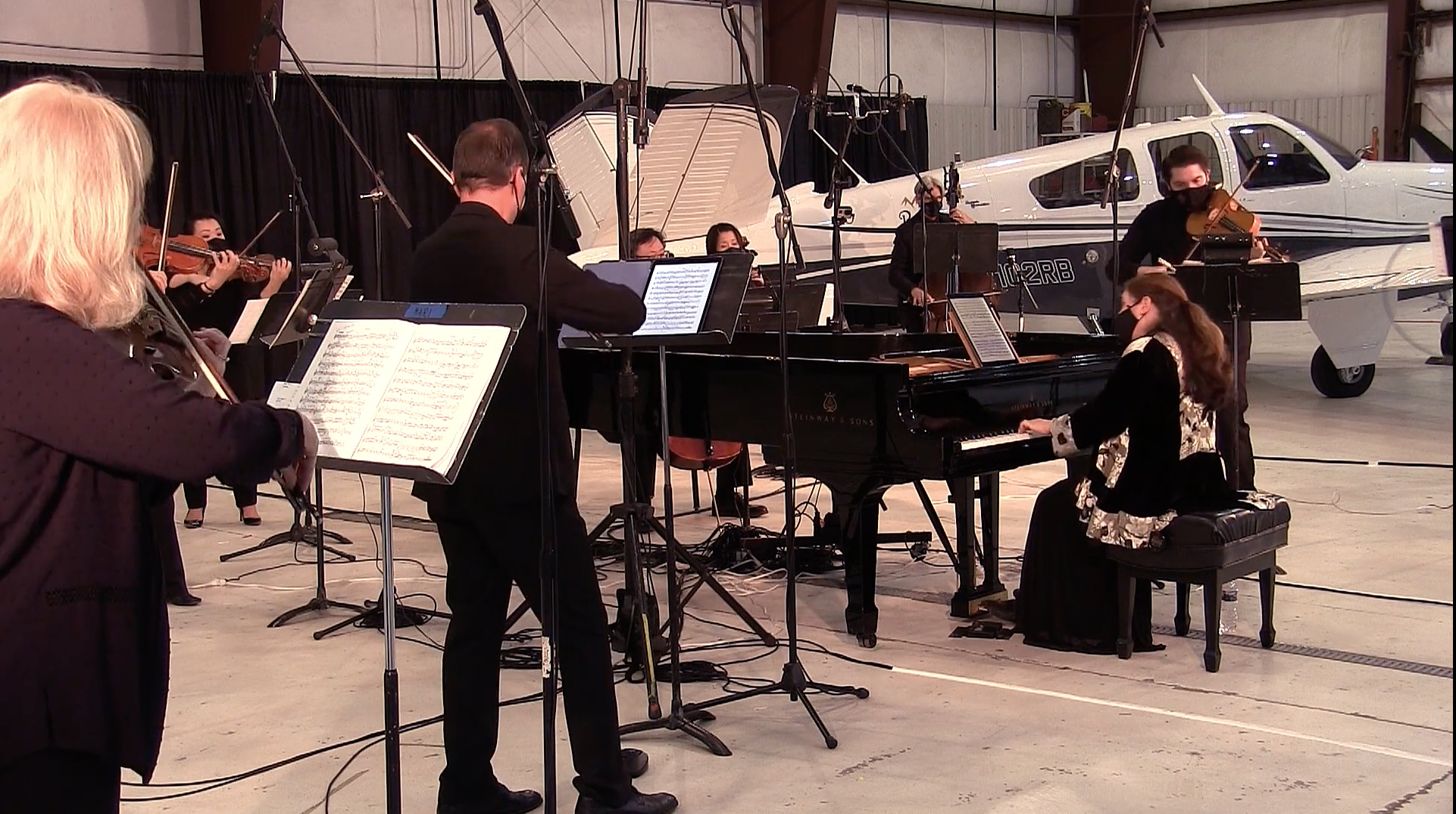
Meanwhile, on Vimeo, musicians played for an empty airport hangar, the only audience a pair of Beechcraft airplanes and a few socially-distanced recording engineers. 

The Boulder Phil launched their second online concert of 2020–21, “The Beauty of Bach,” last night (Nov. 14). The concert, which was pre-recorded at Boulder’s Municipal Airport, featured conductor/pianist Simone Dinnerstein, flutist Christina Jennings and violinist Charles Wetherbee.

Simone Dinnerstein leads the Boulder Phil in Bach (screenshot)

Throughout “The Beauty of Bach,” Dinnerstein shined both as conductor and pianist. Her reputation as a Bach interpreter, which began with her 2007 recording of the Goldberg Variations, is certainly deserved. Her interpretations of Bach are flowing, evocative and lyrical, as she draws out beautiful melodies from Bach’s dense contrapuntal texture. 

“I think that Bach was somebody who was really interested in the sonorities of different instruments,” Dinnerstein said to conductor Michael Butterman in a pre-concert interview. “When I am playing Bach on the piano, I think about lots of other instruments, and in particular, I think a lot about the voice. How would somebody sing a line? Where would they breathe?

“I think about anything besides hammers hitting strings.”

The pre-recorded format enhanced the visuals of Dinnerstein’s performance. The opening wide shot showed the typical audience perspective of a pianist-conductor, Dinnerstein’s back as she faced the orchestra, her facial expressions and at times her hands hidden from view.

Later, alternate camera angles, including close-ups and front-facing shots, showed her expressiveness in a completely new way, from the perspective of the other musicians and Dinnerstein herself. Her facial expressions showed her intense passion for the music—sometimes her eyes even appeared to be shining with emotion.

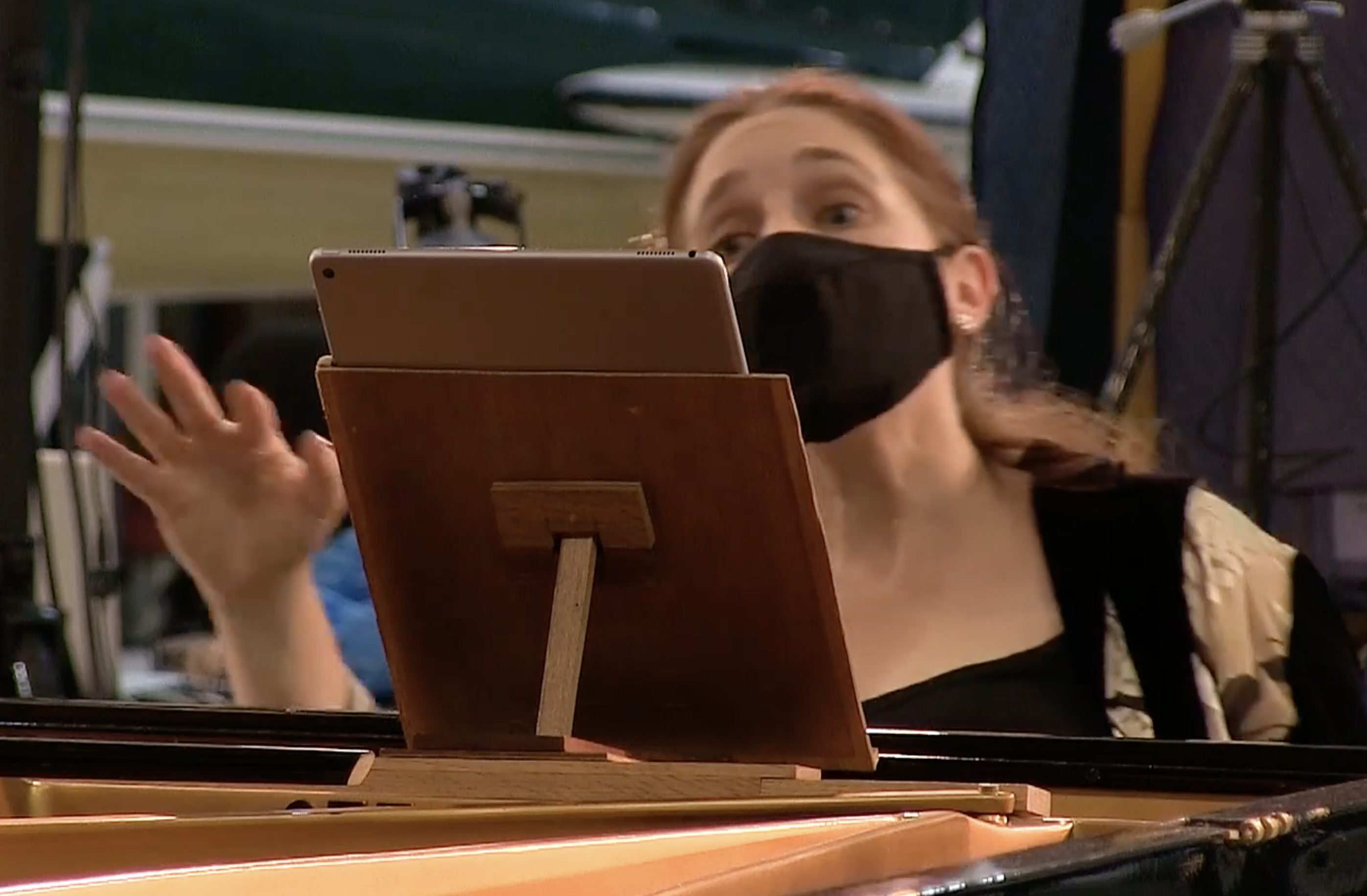
Dinnerstein conducting from the piano (screenshot)

This perspective also highlighted her skill as a conductor, allowing the audience to see her interactions from the perspective of the Boulder Phil musicians. Using a skillful combination of subtle eye cues and whole body gestures, Dinnerstein conveyed her musical intentions clearly and powerfully, despite the black face mask obscuring her facial expressions. 

Dinnerstein played and conducted at her best when collaborating with flutist Jennings for the Orchestral Suite No. 2 in B Minor and Brandenburg Concerto No. 5. This is not surprising, considering Dinnerstein and Jennings have played this program together before, the last time in February at Columbia University, before the first COVID-19 shutdown. According to Jennings, bringing this Bach program back for the Boulder Phil has been both “eerie and wonderful.”

“(The Orchestral Suite) starts with the flute rather hidden,” Jennings said in her interview with Butterman. “Then the flute emerges more and more and becomes more prominent. I love the arrangement that we have created together with different timbres, different parts of the orchestra featured in different movements (and) a rousing finish.” 

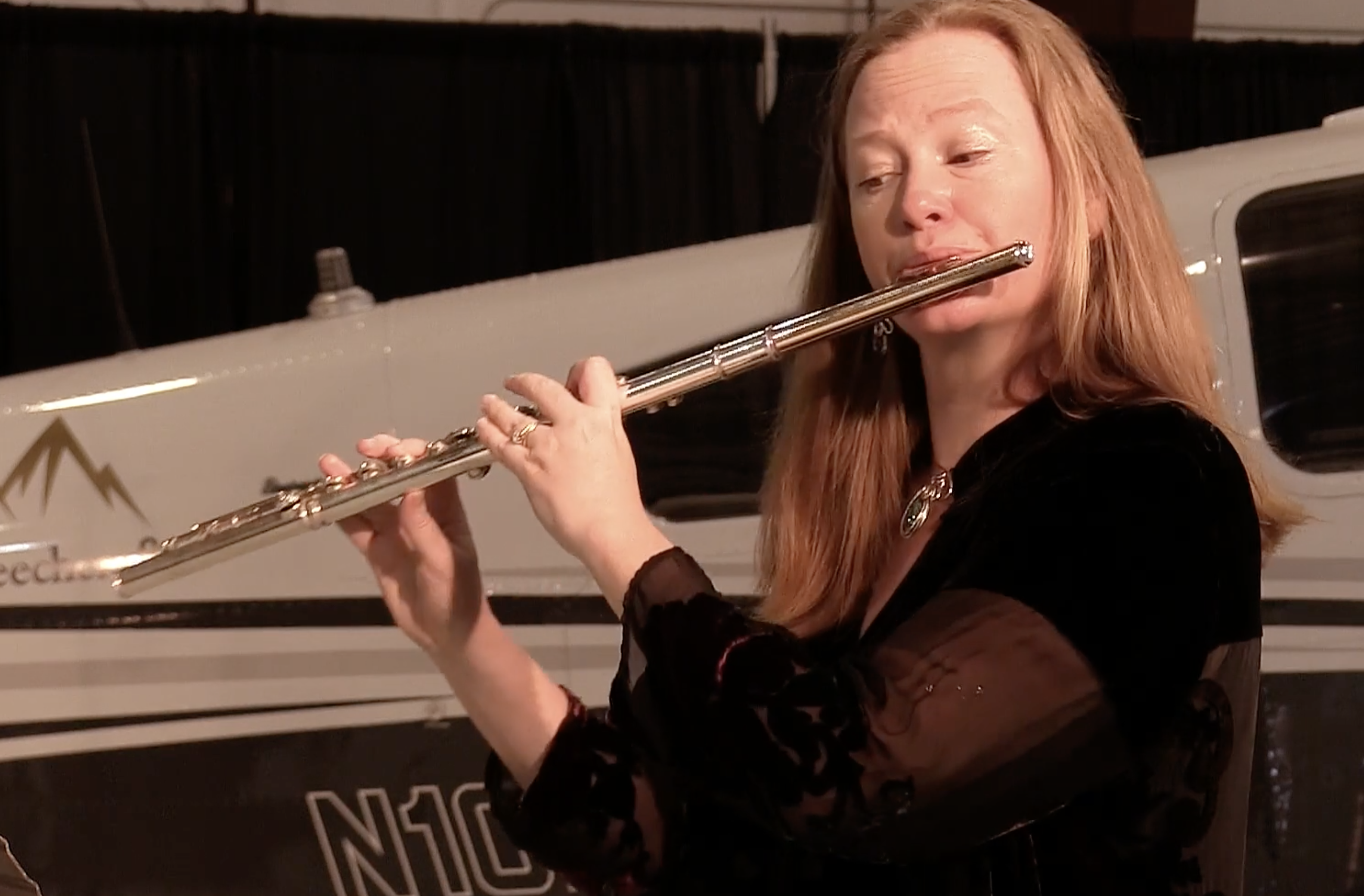
Flutist Christina Jennings (screenshot)

Jennings’ intentions for the Orchestral Suite certainly came through. At the beginning, she blended impeccably with the orchestra, nearly inaudible above the strings, before emerging from the texture with an elegant tone and an air of self-assurance. Her expertly executed trills floated above the entire orchestral texture, naturally melting into a sensitive vibrato. Despite the lightness of touch stylistically, Jennings was still able to dominate musically, her projection almost overpowering the rest of the orchestra and even Dinnerstein at times. 

The final piece of the night, the Brandenburg Concerto would have received a standing ovation, if there had been a live audience. The vivacious melodies paired with Dinnerstein’s pyrotechnic cadenzas were impressive, creating almost palpable excitement through the screen. 

The second “Allegro,” the concerto’s last movement, featured bouncy, energetic melodies on the flute and strings, underpinned by flowing, ostentatious scales on the piano. The gigue-like feel from continuous triplet eighth notes inspired vigorous head-nodding, foot-tapping and perhaps even a bit of clapping and dancing (now acceptable outside of the concert hall).

The Boulder Phil and Jennings, under Dinnerstein’s guidance, captured both the grandeur and intimate expressiveness of Bach’s music. Even with only a computer screen, Bluetooth speaker and unreliable Wi-Fi, “The Beauty of Bach” delivered as promised: a much-needed, beautiful musical experience. 

Boulder Phil season takes flight from Boulder Airport

First concert of an all-online season

By Peter Alexander Oct. 18 at 1 a.m.

The Boulder Philharmonic successfully launched their 2020-21 season of online concerts, “2020-21 Reimagined,” last night (Oct. 17).

Or should I say the season took flight, since the performance was recorded in an airplane hangar at boulder Municipal Airport? The stream, which premiered at 7:30 p.m., will remain available for the next two weeks to people who hold tickets.

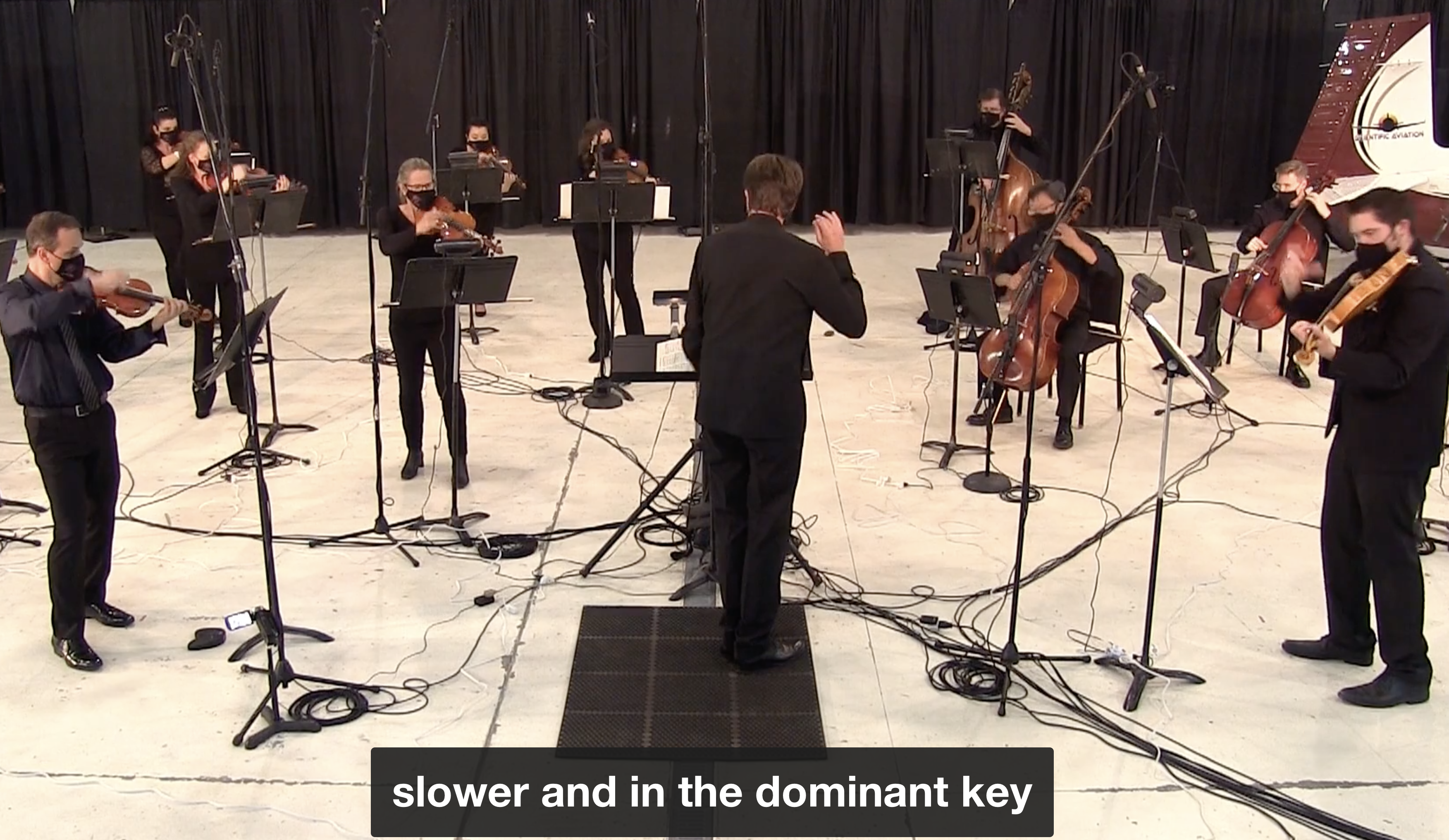
Screenshot: The Boulder Philharmonic streaming from the Brungard Aviation hangar at Boulder Municipal Airport

To allow for responsible safety precautions, the program was entirely music for strings—string players can wear masks—and a small ensemble—if too many are spaced too far apart, the players cannot see and hear one another. Music director Michael Butterman lead the group in three pieces: Strum by Jesse Montgomery; the Simple Symphony of Benjamin Britten; and Max Richter’s recomposition of Vivaldi’s Four Seasons,

In addition to being written for strings, the pieces have another feature in common: like the season, each work has been reimagined in some way. Strum was first written for string quintet, then string quartet, and lastly for string orchestra. Britten mined pieces he wrote as a child for the themes of his Simple Symphony. And post-minimalist composer Richter has created a striking tapestry of music taken from one of the most popular works of the Baroque era, sometimes played as Vivaldi wrote it, sometimes manipulated rhythmically, harmonically, or in other more subtle ways.

Screenshot: Michael Butterman

The performances were what we would expect from the Boulder Phil: all at a professional level, played with commitment and expression. I don’t want to go much beyond that in reviewing the performance, however, since so much of what you hear depends on the equipment you use. Just like a play that is turned into a film, this product represents a separate medium from a live concert, one that that meets the viewer/listener on both the visual and aural levels.

I experienced the concert from a desktop iMac with Logitech Z4 speakers, including a woofer. These are moderately good speakers, certainly much better than what you will hear from built-in sound sources on most desktop or laptop computers, much less tablets or (God forbid!) your smartphone. 

Screenshot: Cellist Charles Lee

I was surprised that the lower pitches came through very well. A short passage by principal cellist Charles Lee was the richest and warmest sounding solo of the program. The sound of the violins, and particularly concertmaster Charles Wetherbee as soloist for Richter/Vivaldi, thinned out as it got higher on the instrument. While not precluding full enjoyment of the music, this does point to the limits of the online concert medium.

A word about the visual presentation: as the Phil’s first online production, I thought the concert was very successful. There were strategically placed cameras giving good visual variety, with closeups of individual players as well as longer shots that made good use of the props available in an airplane hangar (pun intended; I promise, no more aviation jokes).

For the Britten performance, there were closed captions available with information about the piece being played. This was presented as an experiment; I hope it is one that will be repeated with more sophisticated captions. Perhaps a little more explanation of the musical terms would be useful for the many members of the audience who do not have the advantage of years in music school. How many, for example, know the significance of the relative major key? Maybe online music theory lessons will be next.

Screenshot: Closed captions during the online performance

The introductions by Butterman, a conversation between Butterman and Wetherbee, and an introduction to her piece by composer Jesse Montgomery were nice supplements to the performance. Here, the video medium has the advantage over the concert hall: the communication seems more intimate and more personal than in Macky Auditorium.

Montgomery opened the program by introducing her piece, which is, as she said, full of rhythmic drive and clear melodies. Strum is enjoying a run of popularity, likely because it is a well crafted and enjoyable piece to hear, because it can be played by the kind of small ensemble that is easily featured in streaming concert, and—let’s be honest—because as an African-American woman, Montgomery is a composer that orchestras are happy to add to their repertoire in 2020.

Britten’s Simple Symphony—which is not, as Butterman said in spoken program notes, all that simple to play—is infrequently played on symphony programs. It was refreshing to hear it instead of the usual orchestral fare. 

Screenshot: Charles Wetherbee sports the Boulder Phil’s custom face mask

Richter/Vivaldi is both familiar and disorienting. There is much pure Vivaldi, or almost-Vivaldi. But then there are sudden turns, with unexpected harmonies, or most fun to hear, uneven meters. Wetherbee seemed too have mastered his part, although he said it takes extra concentration, because it is often so close to music that is familiar to his fingers.

This concert was definitely up my lonely little alley. I’m the kind of listener who would rather hear something new and unexpected than another familiar classical piece. I am looking forward to both the repertoire, and the visual production of the remainder of the Boulder Phil season. 

# # # # #

Season listing with links to purchase tickets can be found here.

Boulder Phil guest pianist/composer López-Gavilán elicits cheers and applause

Butterman flavors an intriguing program with fiery expression

By Peter Alexander Nov. 4 at 12:15 a.m.

Last night (Nov. 3), conductor Michael Butterman and the Boulder Philharmonic brought their audience a remarkable piece of music that is likely unlike anything they had heard before.

Lopez Gavilan

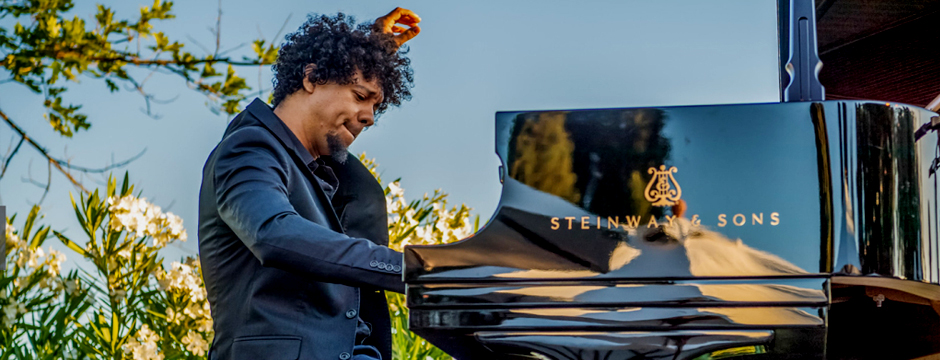
Aldo López-Gavilán

The piece in question is Emporium: Concerto for Piano and Orchestra by the Cuban composer/pianist Aldo López-Gavilán. Butterman first heard Emporium on the radio and was captivated. His description of the piece as having bits and pieces of Philip Glass, Queen’s “Bohemian Rhapsody,” Prokofiev, and the Downton Abbey theme music, among other things, is both intriguing and apt.

As the title suggests, Emporium contains many things, all presented with a Cuban accent. With so much going on, it expands most listeners’ understanding of what a piano concerto might sound like. Last night it was performed by Phil with the composer as the engaging soloist.

The opening movement is dramatic and powerfully scored for both orchestra and piano. At one point I was thinking, ‘are we supposed to hear the piano?’ As the music built to a crashing climax, López-Gavilán, for all his obvious strength as a pianist, disappeared into the overall sound, only to emerge again as the music subsided toward a gentle close.

The impressionistic second movement blends, according to the composer’s notes, a Cuban revolutionary song with American country music as a symbol of peace between peoples. It is a beautiful, impressionistic movement and was beautifully played with lyrical exchanges between pianist and orchestra. The driven, exciting finale got an incisive performance from orchestra and soloist, and elicited raucous approval.

López-Gavilán is an exciting and energetic performer of stunning technical ability, and he is a composer of imagination. He returned to hold the audience spellbound with an astonishing, dense, intricately rhythmic encore that again was unlike anything you are I have likely heard. More cheers, whistles and shouts followed.

The concert opened with Ryan Alaniz, a 9-year-old 4th-grader, delighting the audience as guest conductor while the orchestra played “America the Beautiful.” The audience was invited to sing along, but no one in my section took up the invitation.

MaestroIMG_4402

Michael Butterman

Next was Astor Piazzolla’s Tangazo, a piece that Butterman likes to perform. It is one of the few pieces he has repeated with the Phil, but this time there was a twist: dancers Gustavo Naveira and Giselle Anne of the Boulder Tango Studio performed their own choreography in the narrow space between the orchestra and the edge of the stage.

Their performance was a free dance that responded to the changing moods and tempos of Piazzolla’s music. Like the score, the dance had tango elements throughout. I am not a dance critic, and I am not going to prove it by writing more, except that it was fun to see how artists from another medium responded to Piazzolla’s music. I and the rest of the audience enjoyed their dramatic flair.

After intermission, the orchestra performed Argentinian composer Alberto Ginastera’s Variaciones Concertantes. With each variation devoted to specific solo instruments, it gives the orchestra’s section leaders an opportunity to display their virtuoso skills.

From the opening soulful theme presented by harp and solo cello, through the sequence of variations for woodwinds, strings and brass soloists, the players responded to the challenge. Every solo dazzled. The final variation for full orchestra, set in the style of the high-voltage gaucho dance the malambo, was particularly dynamic.

The concert concluded with Ravel’s ubiquitous Bolèro. Everyone has heard this, in concert, in films and TV, in ice-skating competitions, and almost anywhere else music is used. The Phil’s performance provided what it is called for: a long, slow, carefully controlled crescendo, from the whisper of snare drum at the beginning until the sudden key change that is now so familiar it no longer surprises. Butterman and the players paced the performance nicely, never letting tempo or volume get out of control.

After the appropriately noisy conclusion, Butterman brought forward the snare drummer—who was stationed center stage throughout—for his own bow. After alternating two variations of the same one-measure rhythmic pattern for 15 minutes (or 16 or 17 depending on tempo), he deserved to be applauded.

The Boulder Philharmonic sounded as good last night as I have heard. The strings sound was smooth and warm and at times glossy. The winds played with precision and all the necessary flair in their solos. Butterman brought out the colors and the fiery expression of this intriguing program, which made for a fascinating and enjoyable evening.

CORRECTED Nov. 4 to add the name of the guest conductor, Ryan Alaniz.

Takacs Quartet starts the fall season with near perfect program, beautifully played.

Music by Mozart, Bartók and Dvořák will be repeated tonight

By Peter Alexander Sept. 9 at 1:05 a.m.

Last night (Sept. 8) the Takacs Quartet began the 2019–20 season of major classical music events in Boulder with a near-perfect program: three truly great pieces of music, of contrasting periods and styles, offering different demands to the performers.

03-Takacs-Quartet-Amanda-Tipton-photography

Takács Quartet. Photo by Amanda Tipton,

As mixed programs often do, it began with music from the classical period: Mozart’s String Quartet in C major K465, one of his greatest works. Known as the “Dissonance” Quartet from the chromatic harmonies of the slow introduction, it does not sound particularly dissonant to ears that have heard Wagner and Schoenberg—not to mention Berio and Boulez.

The Takacs took their cue for their interpretation from the cheerful and engaging music that comes after the slow introduction, which they played in a straightforward way. Where some performers prefer to wring all the drama and angst they can from the harmonies, the Takacs takes a more matter-of-fact approach that fits well with all the music that follows. This interpretation makes the quartet comfortably enjoyable, but it risks missing the real challenge that Mozart’s harmonies, extreme for their time, would have posed to his audiences.

Mozart was followed by the Fourth Quartet of Bartók, one of the great works of the early 20thcentury. So well does this work distill all of the core elements of Bartók’s style, it can (and has done) serve for a whole course on the composer. After a brief and witty spoken introduction by first violinist Ed Dusinberre, who outlined the key structural features of the quartet’s five movements, the Takacs players launched into a driven, compelling reading of the quartet.

This is music that requires great energy and rhythmic command, and the Takacs provided that in spades. Thematic relationships that bind the quartet and its symmetrical form together were clearly audible, not buried in the complex textures. The devilish fourth movement conveyed all the wit inherent in Bartók’s headlong, propulsive pizzicato, even if the players were momentarily revealed to be human, after all. The final movement delivered the wild party that Dusinberre promised, ending the quartet with a wonderful flourish straight out of the first movement.

The final piece on the program was Dvořák’s String Quartet in F major, op. 96, known as the “American” Quartet. Written during an idyllic summer in Spillville, Iowa, it one of the composer’s most delightful and perfect works. This is music that smiles.

1893.Panorama1

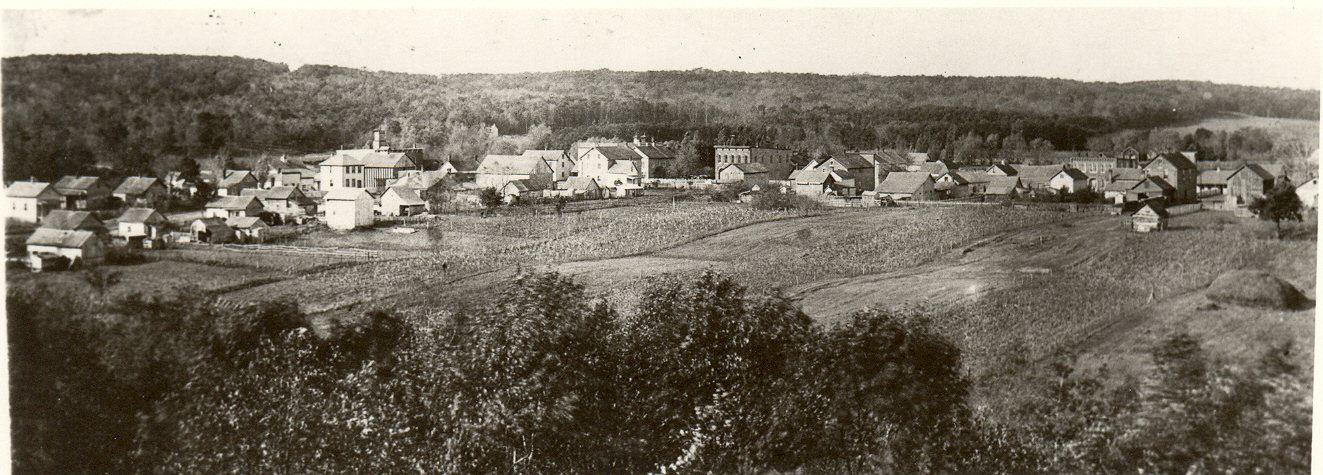
Spillville, Iowa, in 1893, the year of Dvořák’s visit.

As pure music it is thoroughly enjoyable, but for those who know the Spillville legends, the evocation of the open, empty spaces of the American prairie—which Dvořák found to be “sad unto despair”—in the second movement, the quotation of the Scarlet Tanager’s song in the third, and the sound of the organ that Dvořák played in church every morning during the summer in the final movement, the deep nostalgia of the music becomes all the more meaningful.

Once again the Takacs shifted gears to capture the melded American/Bohemian qualities of Dvořák’s most American work, a piece that revels in the countryside and displaced Bohemians Dvořák found in Iowa as well as his love for the countryside and people of his homeland. Written in the open air of the prairie, the music came from deep within Dvořák’s soul. The Takacs’ performance was exemplary.

In fact, it was a joy to hear the whole concert, from first note to last. The Takacs revealed the individuality and character of all three works.

The program will be repeated tonight at 7:30 p.m. in Grusin Music Hall. Limited tickets are available here.

Santa Fe Opera: the familiar, the unfamiliar, and a world premiere

Poul Ruder’s Thirteenth Child is “an opera of expressive breadth and depth”

By Peter Alexander Aug. 4 at 11:45 p.m.

Santa Fe Opera has five operas in production this summer, continuing through Aug. 24. Reviews of three of those productions—Puccini’s La bohème, Bizet’s Pearl Fishers and the world premiere of The Thirteenth Child by Poul Ruders—are below. Reviews of the remaining two productions will appear in a later blog post.

Boheme1

Soloman Howard (Colline), Zachary Nelson (Marcello), Dale Travis (Benoit), Will Liverman (Schaunard), supernumerary, and Mario Chang (Rodolfo) in La Bohème. Photo by Ken Howard for the Santa Fe Opera.

La bohème, the most familiar of the operas on Santa Fe’s 2019 schedule, is certainly enjoyable. The firmly realistic set and production are mostly serviceable, if not spectacular, and the singers range from reliable to impressive. Conductor Jader Bignamini knows when to stretch the tempo and when to push ahead. If he sometimes took the faster bits a little too fast, the excellent orchestra stayed with him, responding well to every push and pull. Their performance was thoroughly idiomatic, always giving the lyric moments time to blossom.

My one criticism of Bignamini’s work is that he was not careful enough to maintain a good balance between stage and pit. He has conducted in Santa Fe before—Rigoletto in 2015—so he should know the theater’s acoustics, but he sometimes allowed the voices to be swallowed by the orchestra.
Boheme3

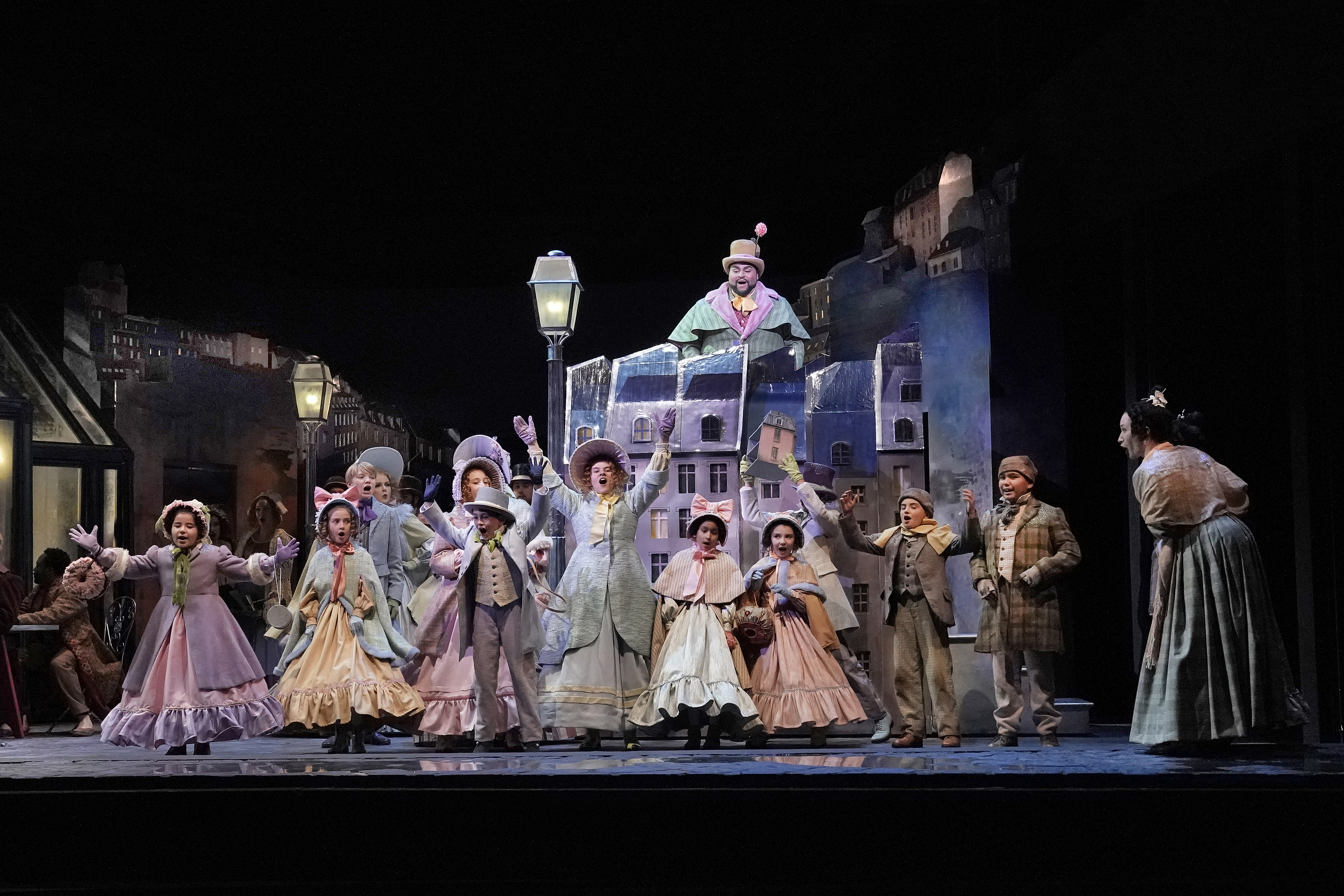
Eliot Page as Parpignol with the Santa Fe Opera Chorus and Children’s Chorus. Photo by Ken Howard.

Scenic designer Grace Laubacher had mixed success adapting to the Santa Fe stage. Her garret, a stand-alone piece that was pushed on for the first act and that visibly cracked apart at Mimi’s death in the third act (symbolizing the emotional shattering of the remaining characters?), was effectively evocative of 19th-century Paris. The second act, using movable pieces that were miniature buildings from one side and flat semi-reflective surfaces on the other, were an uncomfortable solution for the streets outside the Café Momus, with the toymaker Parpignol popping above a multi-story building like Godzilla in Tokyo.
Boheme5

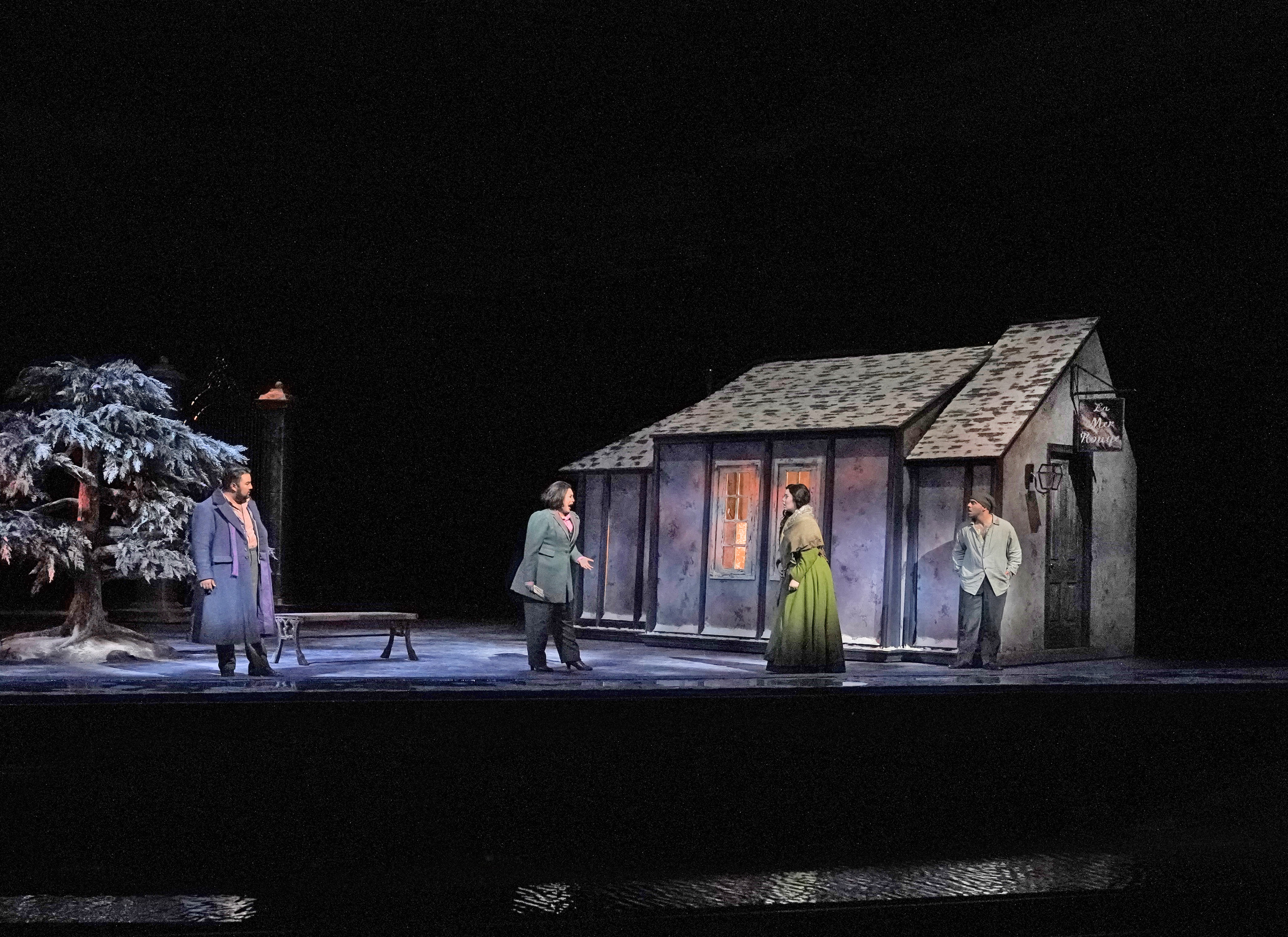
Mario Chang (Rudolfo), Gabriella Reyes (Musetta), Vanesssa Vasques (Mimi) and Zachary Nelson (Marceloo) in Act III of La Bohème. Photo by Ken Howard.

Most successful was the third act. The minimal set pieces—the outside of the cafe, the city gate and a snow-covered tree—were all that was needed. The spare set contributed to the bleakness of the winter scene.

Mary Birnbaum’s direction was ideal for the highjnks of the four artists sharing the garret, capturing their camaraderie well. At other times, however, her ideas got in the way of the story. Having the characters pass downstage of the garret to reach its door proved distracting. Characters did not always seem to interact.

The visual pun of having Musetta enter on inline skates, suggesting how she glides through life and the streets of Paris, might work if the Musetta were comfortable on the skates, but soprano Gabriella Reyes seemed not to be as she careened from light post to light post, sometimes supported by waiters and street people. This was a gimmick too far, both wildly anachronistic and painful to watch.

I have still not puzzled out what was symbolized by having both Mimi and Musetta wander through the garret before their actual entrances in Act IV—perhaps that they are always with Rudolfo and Marcelo even when they aren’t?—nor Musetta’s obvious pregnancy in the same act.
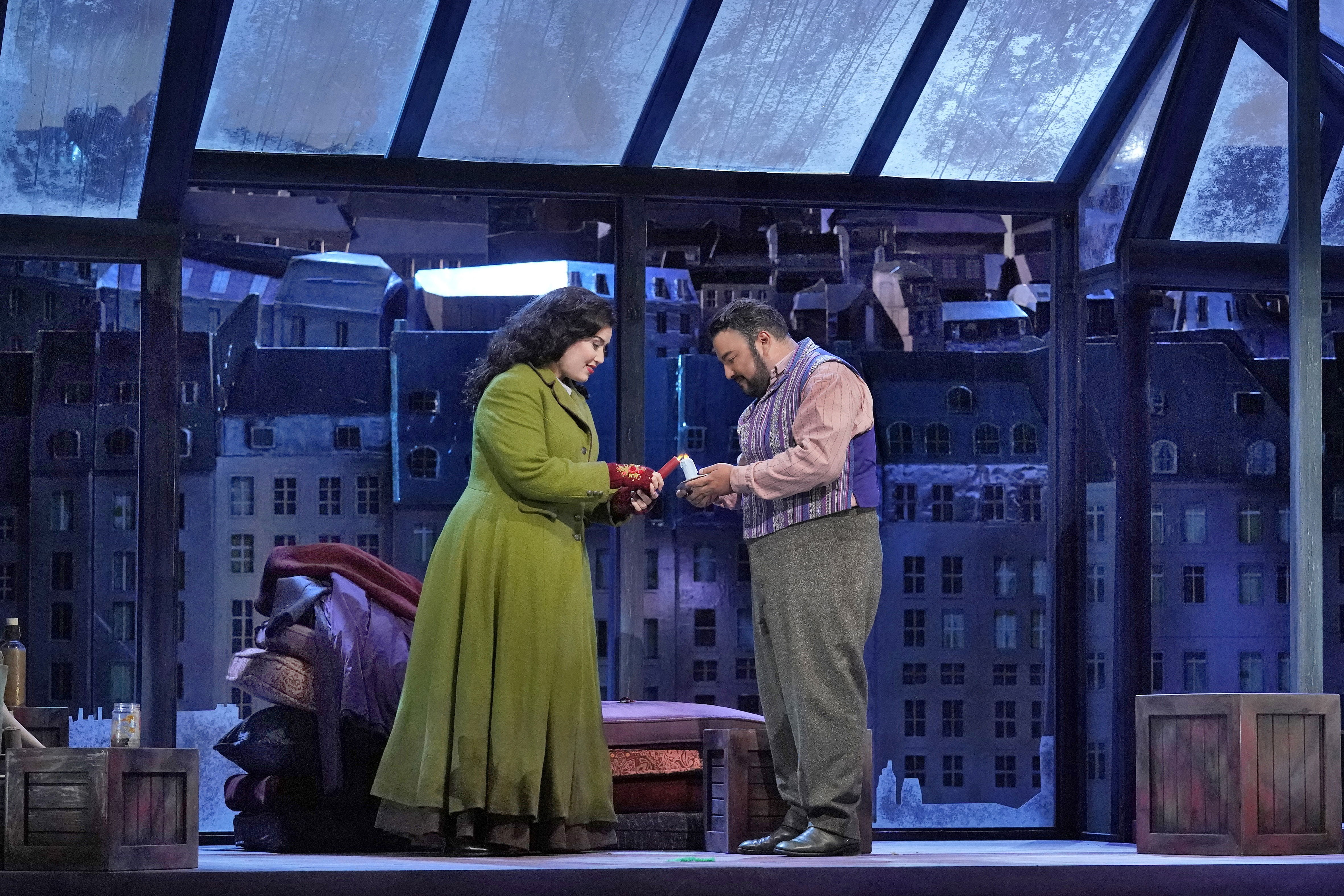
Boheme2

Vanessa Vasquez (Mimi) and Mario Chang (Rodolfo). Photo by Ken Howard.

As Mimi, soprano Vanessa Vasquez was a standout, bringing radiance and beauty to her voice in the early acts, and great expression when she is dying. If her coughing attacks seemed pasted into her interpretation, one cannot fault her vocal expression in the most poignant scenes. Her substantial voice soared easily, bloomed into striking moments of beauty, and became well controlled as she warmed into the role.

Mario Chang had some lovely, ringing high notes as Rodolfo. His voice shone in his duets with Mimi, but he was not consistent. Some entrances were a little rough, the occasional note hit too hard. Nevertheless, he was affecting throughout, and particularly through the Act III reconciliation duet with Mimi.

Zachary Nelson’s Marcello lacked passion. He sang pleasingly but seemed only intermittently engaged in the Act II and III quarrels with Musetta. The other Bohemians—Soloman Howard as Colline and Will Liverman as Schaunard—were solid and effective. Howard’s strong, robust voice could be more consistently controlled, but was used expressively for his “Overcoat” aria in Act IV. Schaunard’s jolly entrance in Act I, bearing money and food for his cold, starving garret-mates, was outstanding, bringing vocal warmth and good cheer to the stage.

I suggested earlier that Reyes as Musetta did not seem comfortable on skates. This must have affected her singing, which was a little cautious in Act II, but much stronger and more expressive in her fight with Marcello in Act III, and even when pregnant in Act IV. She was a solid Musetta who would be better without the skates.

Dale Travis hit all the conventional comic notes, first as the landlord Benoit in Act I and then as the hapless Alcindoro in Act II. Elliot Page was a clear-voiced Parpignol, offering his toys from above the doll houses of the miniature Paris.

# # # # #

Loved by opera aficionados but little known to the broader public, Bizet’s Pearl Fishers is a worthy work by any standards. Written several years before the composer’s final work, Carmen, it is filled with glorious melodies, striking choruses and instrumental numbers that point ahead to that masterpiece.

Santa Fe Opera’s Pearl Fishers, a revival of a production first seen in 2012, brought all of those the musical strengths to the fore. Conductor Timothy Myers elicited beautiful playing from the orchestra while finding all the dramatic high points in the score. The woodwinds in particular were noteworthy, with extraordinary solos from clarinet, flutes and horns.
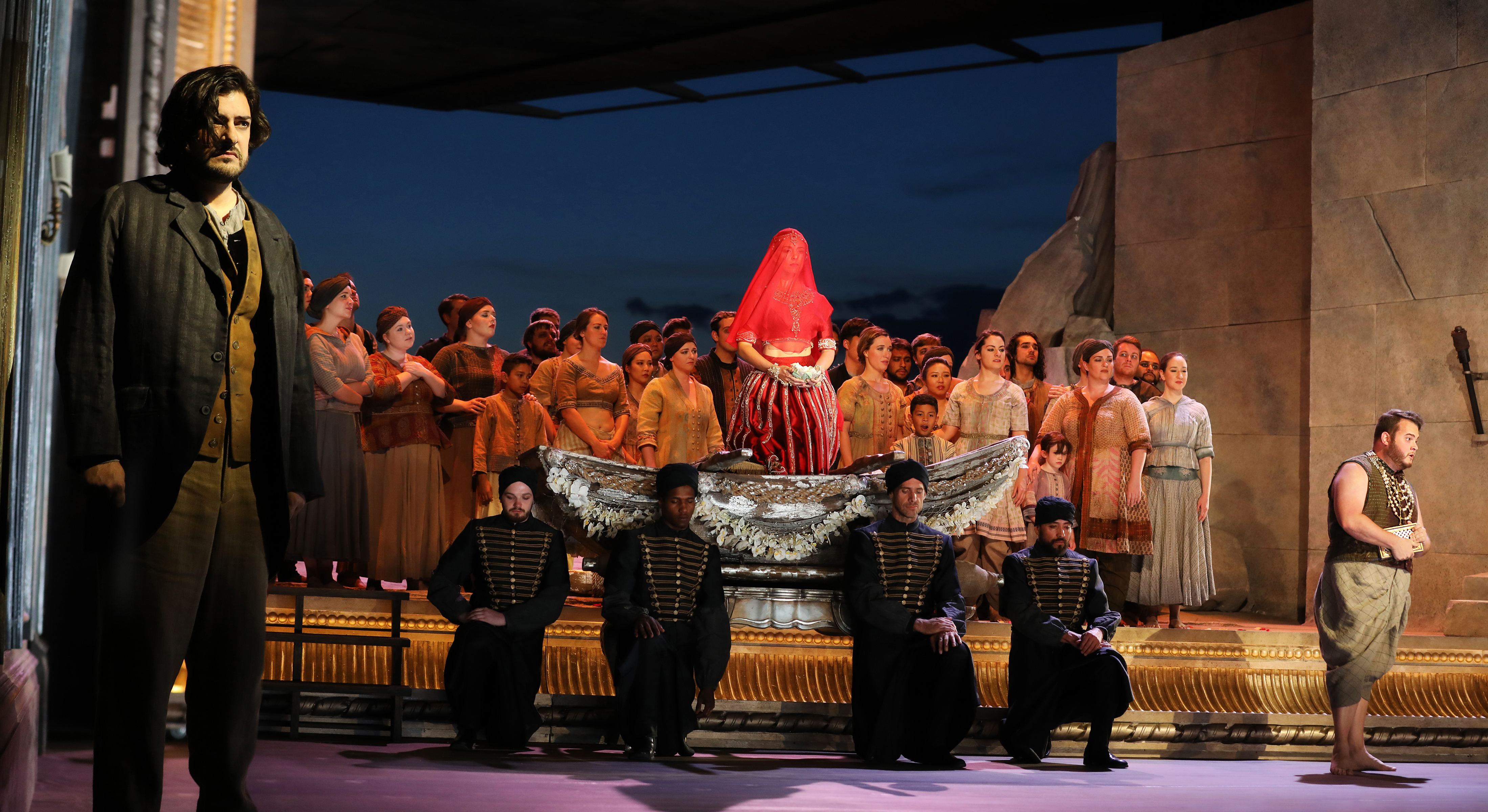
jpg

Ilker Arcayürek (Nadir), Corinne Winters (Leila, veiled), Anthony Clark Evans (Zurga) with the Santa Fe Opera Chorus. Photo by Ken Howard for the Santa Fe Opera.

The choral scenes represent some of Bizet’s best music, anticipating the greats choruses of Carmen.They were powerfully sung, outlining the drama that sets the community of fisherfolk against the forbidden love between Leila, a priestess of Brahma, and Nadir, a hunter. Their liaison that interrupts Leila’s prayer vigil brings disaster on the village and leads to the opera’s dramatic, if unlikely, conclusion.

Pearl Fishers is one of those Romantic operas, along with such better known works as Madama Butterfly, Turandot  and Aida, whose treatment of “exotic” subjects is problematic today. Pearl Fishers is supposedly set in Ceylon, although the locale was originally Mexico and the opera belongs authentically to neither locale.
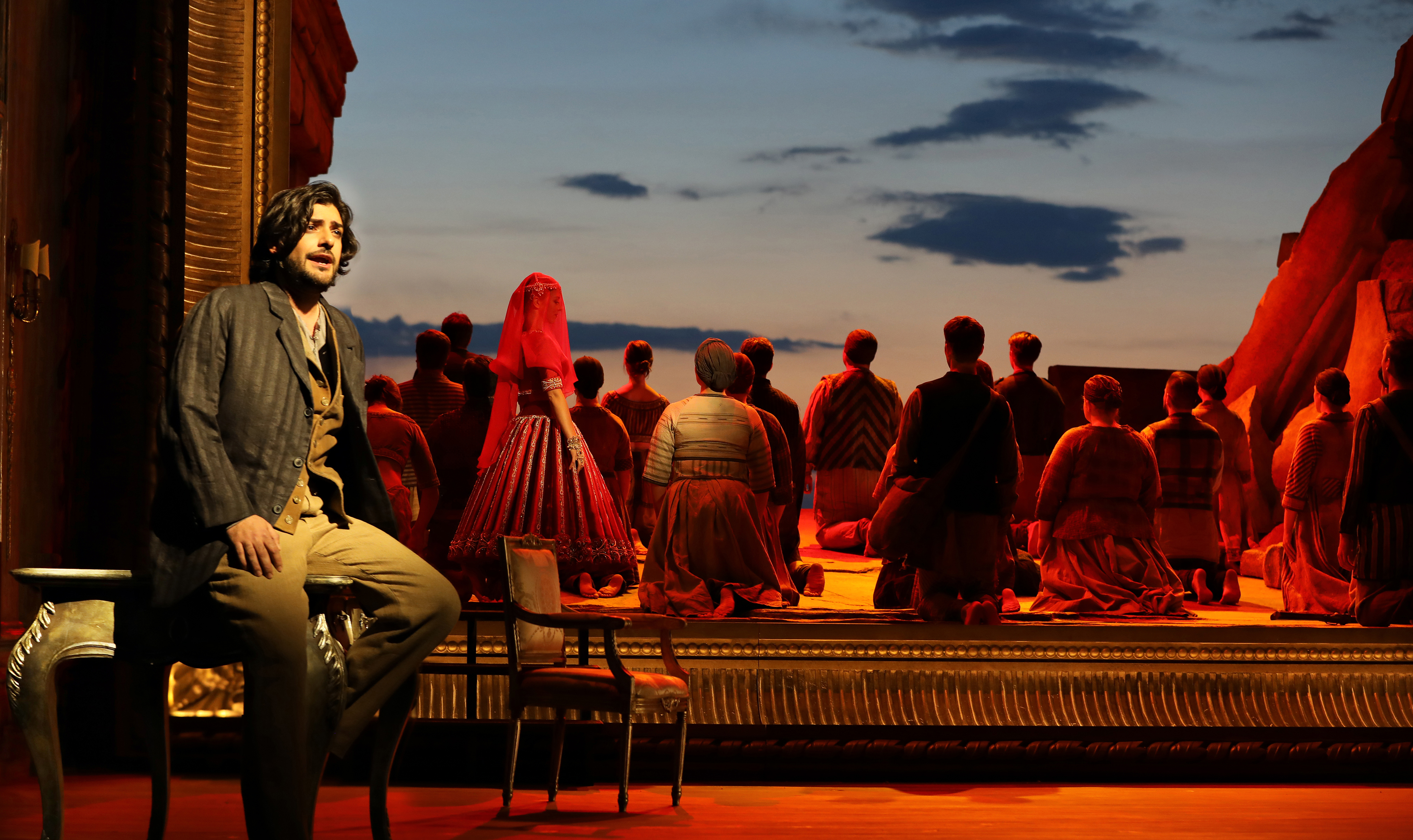
Pearl1

Ceylon viewed through the frame of 19th-century Paris: Ilker Arcayürek (Nadir), Corinne Winters (Leila) and the Santa Fe Opera Chorus. Photo by Ken Howard.

Jean-Marc Puissant’s scenic design for the SFO stage deals with issues of cultural voyeurism in a creative way: the set features a massive picture frame, with everything beyond the frame representing a kind of generic “other” of stone temples and ruins, and everything in front representing the more specific milieu of 19th-century France. In other words, we see the setting through the frame of Bizet’s own time and place.

The stage direction of Shawna Lucey served the plot well. There were distancing elements of ritual that sometimes kept the chorus in front the frame, distracting from action farther upstage, but not to the point of interfering with the singers. She used the spaces onstage well, particularly in the scene when Leila and Nadir are discovered together inside the temple.
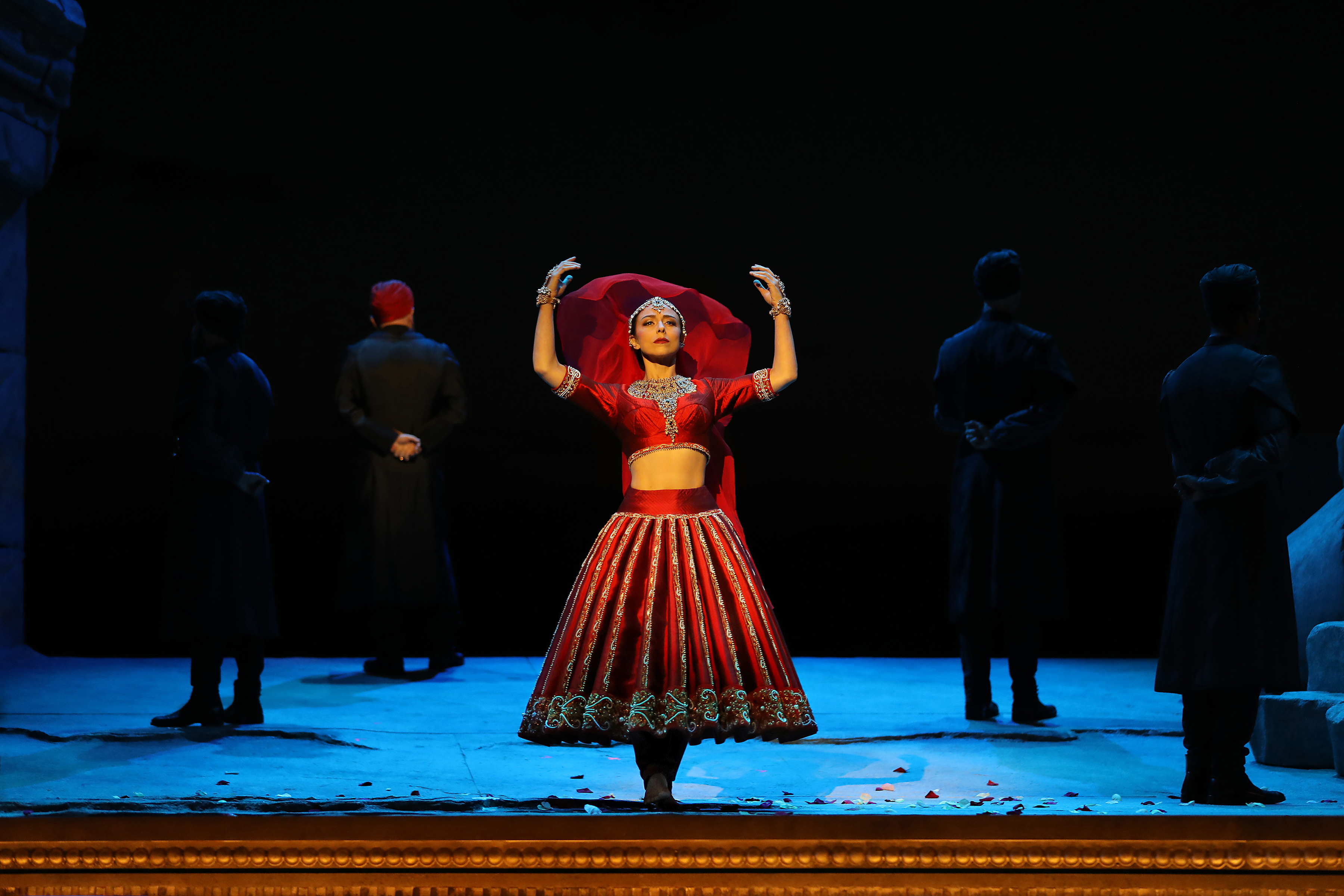
Pearl3

Corinne Winteres (Leila). Photo by Ken Howard.

Soprano Corinne Winters was a radiant Leila, her singing secure and bright, carrying easily over the orchestra in all of her biggest moments. Her Act III duet with Anthony Clark Evans’s Zurga, the leader of the fishers who is Nadir’s rival for her love, is one of the high points of the opera and the season. The rising arc of dramatic intensity is perfectly controlled, leading to a shattering climax. Equally memorable was her Act I aria and prayer at the beginning of her vigil.

Ilker Arcayürek has a light and delicate high tenor voice that is ideal for Nadir, but he struggled with the highest notes, easing into them or reaching for the tops of phrases. He was ardent in his declarations of love and expressive in the most dramatic moments of the opera.

Evans was a solid and forthright Zurga who occupied his critical role well. The best known piece from the opera, his Act I duet with Nadir, “Au fond de temple saint,” was as rousing as called for. In other scenes he was a convincing village leader whose jealousy of Nadir momentarily overcomes his love for Leila and affection for Nadir.

As Nourabad the high priest, Robert Pomakov used his powerful bass voice to dominate the scenes where he denounces Leila and Nadir, and calls for their execution. Elsewhere the character is a cipher, although Pomakov was reliably able in the role.

# # # # #

Danish composer Poul Ruders has written several operas on dark subjects—Kafka’s Trial, Margaret Atwood’s Handmaid’s Tale and and Lars von Trier’s film Dancer in the Dark—but he wanted something different for his fifth opera. He turned to fairy tales, finding a little known story that fit his aim.

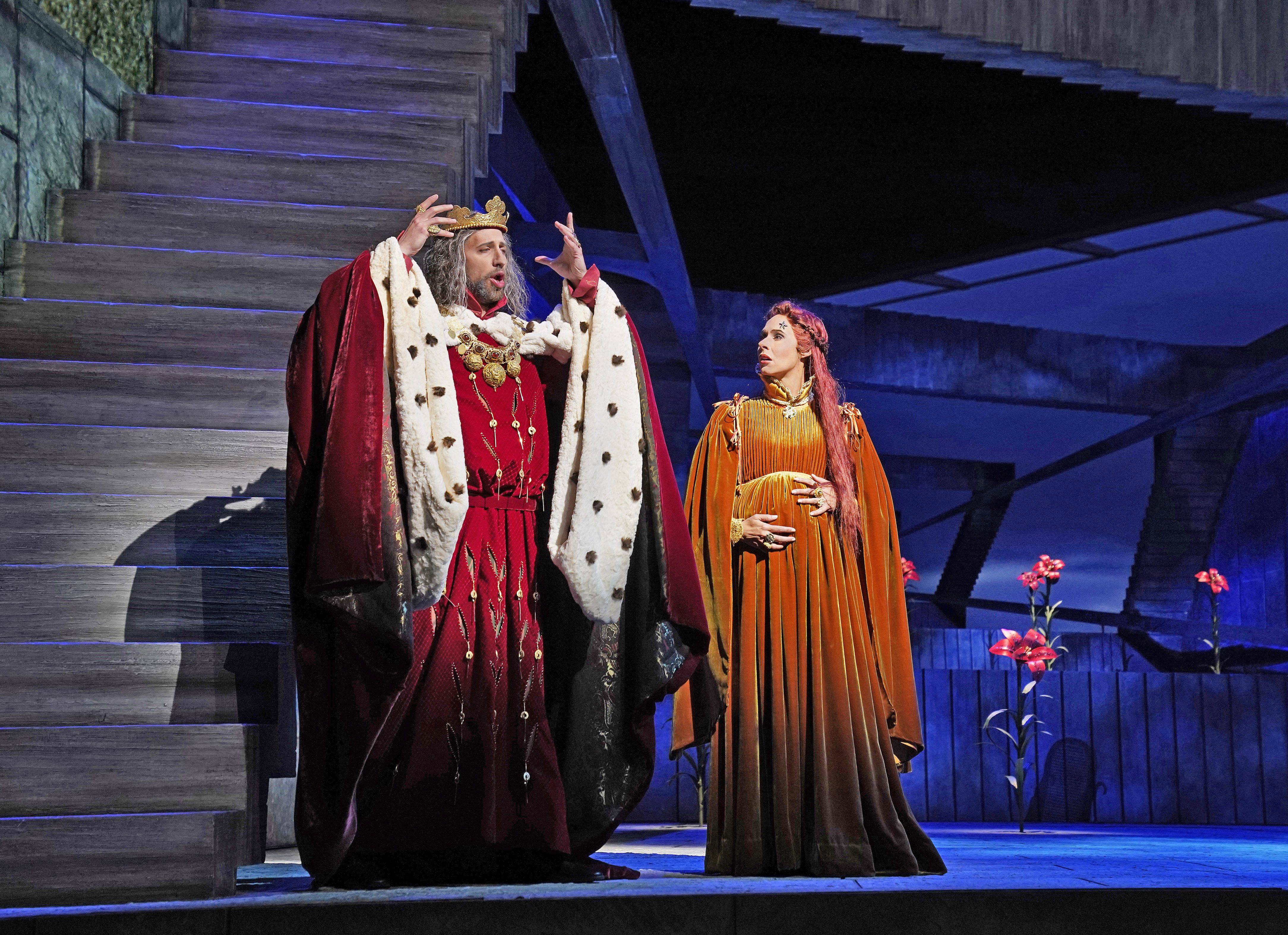
The Thirteenth Child, receiving its world premiere production at Santa Fe this summer, is based on a story by the brothers Grimm, and it takes Ruders in a different direction than those earlier works. The combination of fairy-tale magic, lightly comic moments and a happy ending have elicited a score marked with lyric elements, glowing, consonant orchestral interludes, generally light textures and one delightfully humorous male ensemble for the 12 older brothers of the title character.
Child2

David Leigh (King Hjarne) and Tamara Mumford (Queen Gertrude). Photo by Ken Howard.

Ruders was able to draw on a reservoir of dark and threatening orchestral music when needed, but that vein, so evident in his earlier work, is leavened by the lyrical writing. As presented in Santa Fe, The Thirteenth Child is an accomplished and entertaining work, a fitting achievement for a composer who describes opera as “an emotional affair wrapped in show biz.”

Not all the vocal music is graceful, however. The jagged lines, wide leaps and extreme ranges characteristic of many newer operas are used for emotive passages. Hjarne, the King of Frohagord, is one of the lowest bass roles in the repertoire, and the part of Drokan, the fairy tale’s requisite evil element of the plot, also lies very low, with sudden leaps into falsetto—executed with varying success—to symbolize madness.

I thought the best music in Thirteenth Child surrounded the moments of fairy-tale magic, and the orchestral interludes that set the emotional temperature for the ups and downs of the plot. Human emotions, so often the heart of opera, struck me as less effectively conveyed, particularly the intense moments when Ruders resorted to wide-leaping vocal lines that are hard to distinguish one from another.

Conductor Paul Daniel had the orchestra well in hand, shaping dynamics carefully to reflect the moments of tension and create an effective emotional profile. All of Ruders’s shifting moods, in response to the twists of the plot, were well delineated.

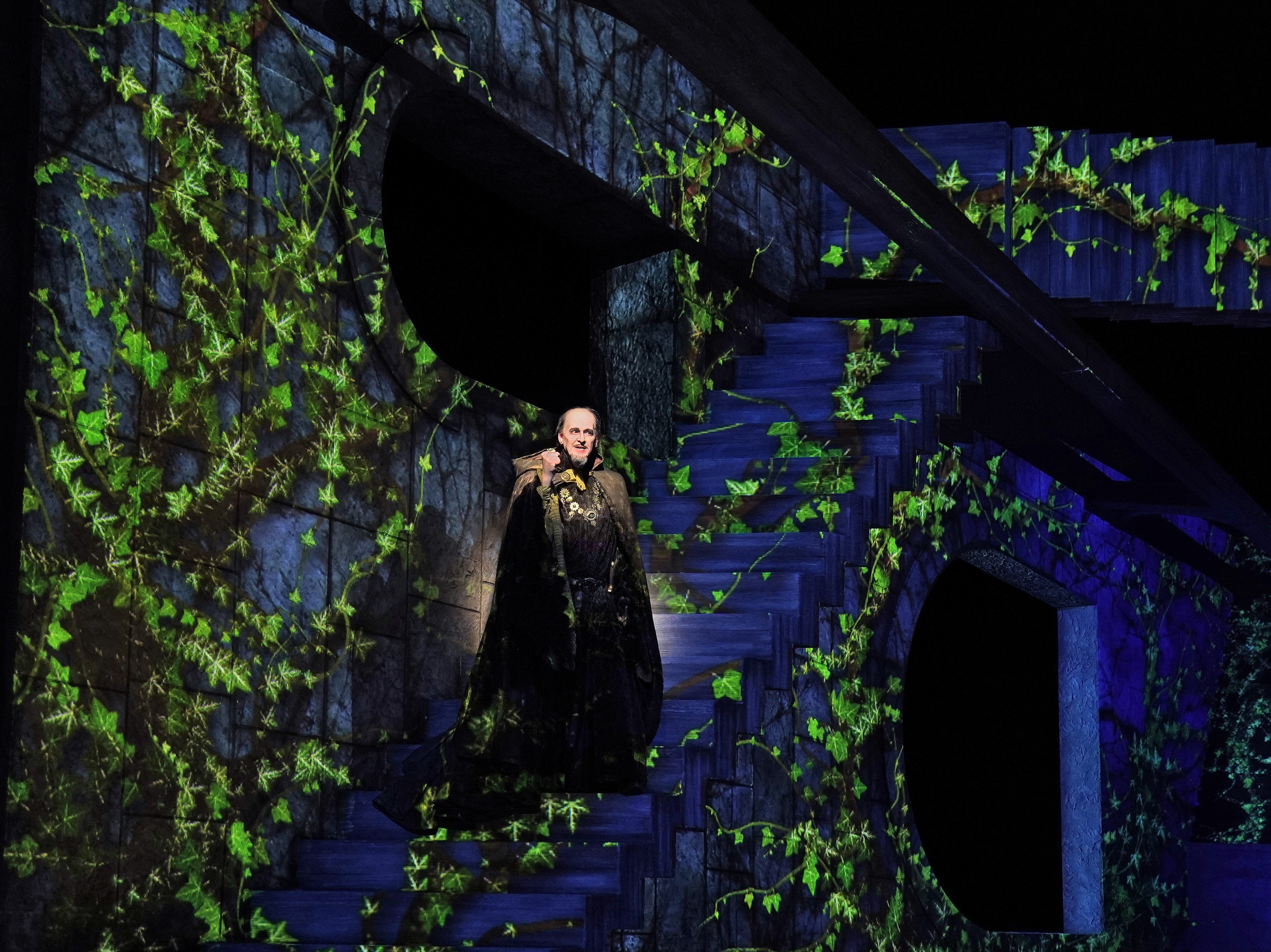
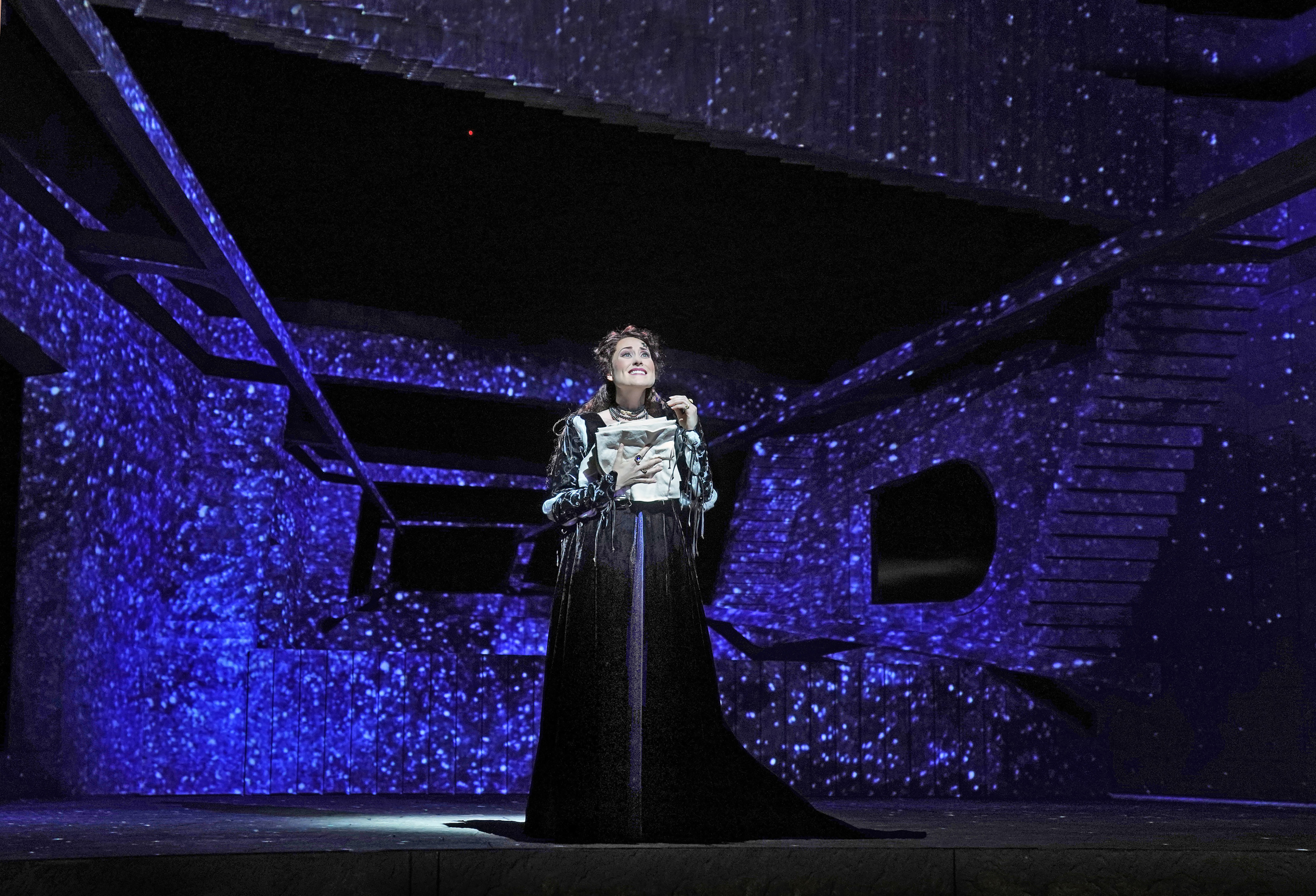
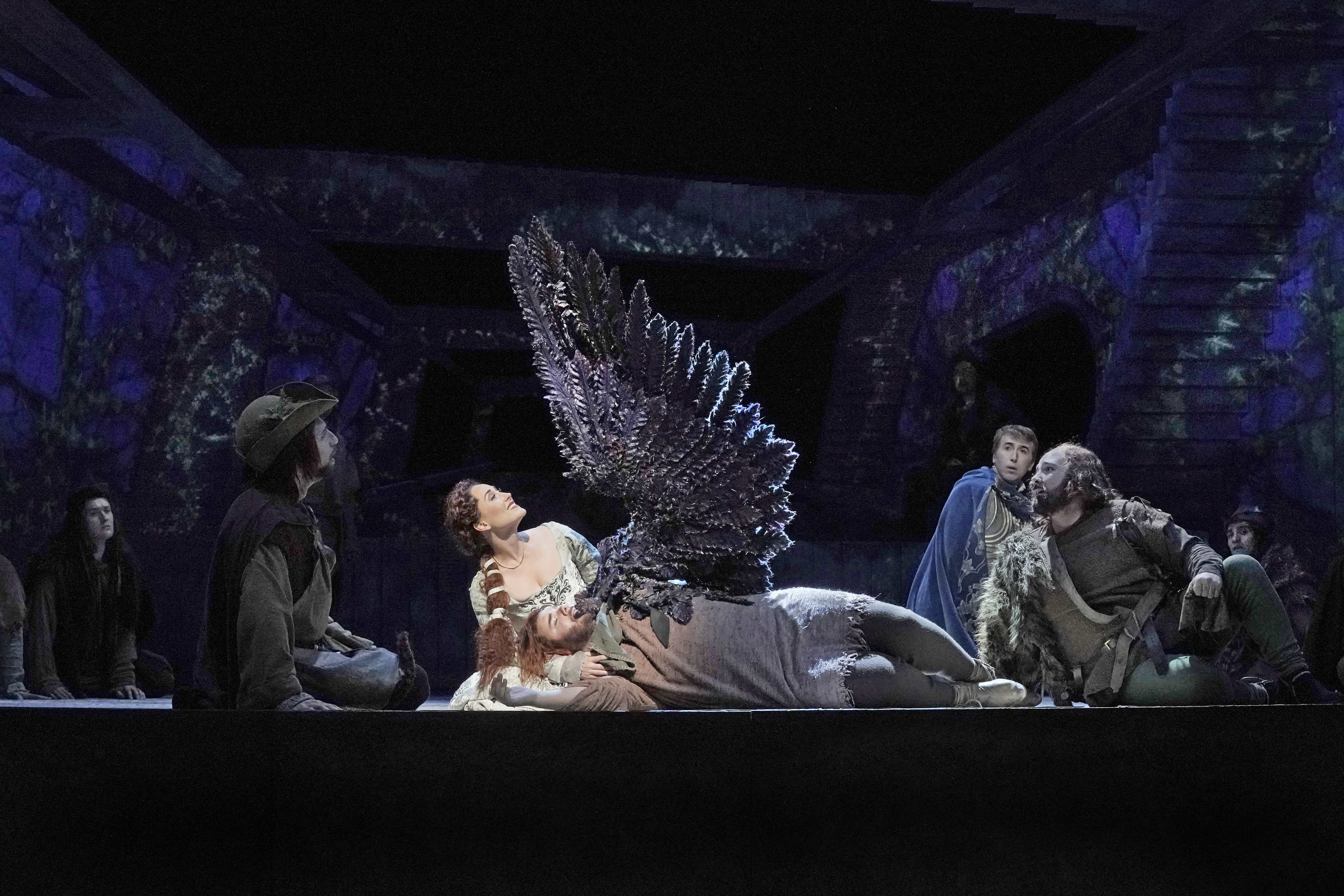
Alexander Dodge’s interesting unit set serves the opera well. The blank walls are used for engaging projections by Aaron Rhyme, including snakes when Drokan is plotting, ravens when the 12 brothers are turned to birds, and red flowers for the magical lilies that protect the kingdom of Frohagord. Other, less specific projections add sparkling beauty to several scenes.

The costumes by Rita Ryack are cinematic medieval on steroids—too much had the opera been realistic but just colorful and flamboyant enough for a fairy tale. My favorite visual effect was Hjarne’s funeral, with black-robed characters—nuns and monks?—with white collars and bright red spears held vertically. This is the best kind of spectacle.
CHild4

Bradley Galvin (Drokan) with elaborate projections. Photo by Ken Howard.

As Hjarne, David Leigh has the shortest time on stage—just the first scene—but his deep bass, clearly heard except for the very lowest notes, was solid and effective. He managed his leaps into falsetto and madness well, providing motivation for all that follows.

Hjarne is driven to obsession by Drokan, the truly evil element of the plot. As portrayed by Bradley Garvin, Drokan was the personification of scheming villainy, hoping to overturn Hjarne’s family, marry his daughter—the thirteenth child of the title—and rule Frohagord. He conveyed Drokan’s dark role in the plot through vocal timbre, ranging from subtle suggestions of evil to overt threat. So effective was he in the role that there was a smattering of applause at his demise.
Child3

Jessica Jones (Lyra). Photo by Ken Howard.

Tamara Mumford lent her rich, warm mezzo-soprano sound to Queen Gertrude, who is a guiding spirit to the story before and after her death. Critical to the first half of the opera, she was a steady presence dramatically and vocally outstanding. The spectral echoes and playback loops of her singing as a spirit are pretty conventional film and TV ghost effects, but reasonably effective in context.

As Lyra, the thirteenth child and heir of Hjarne, Jessica E. Jones was everything  a fairy tale asks a princess to be: winsome, lovely and brave. Her bright and clear voice only complemented the portrayal.

Joshua Dennis as Frederic, who searched for Lyra for seven long years, successfully negotiated the leaps and twists of his challenging part, especially in his lengthy narration of his search. Apprentice artist Bille Bruley was appropriately sympathetic as Benjamin, the youngest of the 12 brothers. His voice was strong, and his diction unusually clear.
Child5

Jessica Jones (Lyra) and Bille Bruley (the dying Benjamin). Photo by Ken Howard.

Benjamin’s heroic death is the only real tragedy of the fairy tale, but it sets up the moral that is told at the end: “No joy without sorrow. . . . Dark days always come, in love we find the light.” This message has inspired Ruders to write an opera of expressive breadth and depth, one that I look forward to seeing and hearing again.

# # # # #

SFO02.Robert Goodwin

Santa Fe Opera. Photo by Robert Goodwin.

Tickets for the remaining performances in Santa Fe can be purchased through the calendar on the Santa Fe Opera Web page.

NOTE: This story was corrected 8.7.19. The Thirteenth Child is Poul Ruder’s fifth opera, not his sixth.

CMF ends 2019 with spectacular performance

Sold out Chautauqua Auditorium cheers orchestra, conductor, choirs and soloist

By Peter Alexander Aug. 4 at 12:23 a.m.

The Colorado Music Festival ended its 2019 season in spectacular fashion last night (Aug. 3).

Peter Oundjian 2017-18 - 3 - credit Malcolm Cook

Peter Oundjian

Music Director Peter Oundjian led the Festival Orchestra in a wonderful performance of a wonderful symphony, Mahler’s Symphony No. 3 for large orchestra, alto soloist, women’s chorus and children’s chorus. At the end of this very long work—about 100 minutes of music—the sold-out Chautauqua Auditorium was cheering, and no doubt already looking forward to Oundjian’s next season with the festival.

Many factors made this a splendid performance, but two in particular should be mentioned. The first was Oundjian’s management of the sprawling work. His control of sound and dynamics across long stretches of music gave impact to every climax of orchestral sound—and there are many. The performance was more than a series of splendid moments—though it could also be heard that way. More than that, it was a whole, each phrase driving to a destination and the whole driving to the end.

Oundjian-c-Sian-Richards

Peter Oundjian. Photo by Sian Richards.

In particular, Oundjian and the players maintained near perfect balance among the parts across long crescendos, so that the orchestra swelled and subsided, bloomed and retracted as one. This is a specially great achievement since so many phrases started from near silence, with remarkably controlled pianissimo phrases that grew over long, long spans of time.

Particularly in the final movement, a long slow movement, he kept careful control as the sound grew to a high point, then fell back to near silence, ascended to an even higher point and fell back again, all with the goal of making the final cadence, with timpani pounding and brass sustaining almost to the point of collapse, the true destination and end point of the entire symphony.

Oundjian exercised a similar control of dynamics and tempo in the other movements, with their many moods from a dawn-like awakening, to a jubilant march, to a pastoral delicacy, The fourth movement’s portent of doom and the fifth movement’s simple joys were equally well achieved.

Calin-Lupano494x208

Concertmaster Calin Lupanu

The second factor is the quality of the individual players in the orchestra, not only to play individual solos beautifully, but to give and take with others in chamber music fashion, and then to play in a section with unanimity of pitch and phrasing and dynamics. There were many wonderful solos, by trombone, by horn, by clarinet and piccolo and on through the wind sections, and including the concertmaster, Calin Lupanu.

brass_jeff_work

CMF Principal Trumpet Jeffrey Work

One solo needs special notice, the long offstage posthorn solo that lends a note of nostalgia and melancholy to the third movement. Principal trumpet Jeffrey Work floated the high notes beautifully, while shaping the individual phrases with exquisite control.

I should also mention the wonderful CMF percussion section, who were in my direct line of sight. Parts of the symphony were a masterclass in soft percussion playing. Everyone noticed the loud climaxes, but who knew that a bass drum could be heard at such a soft level, and make such a delicate musical effect?

Chandler-Eteme

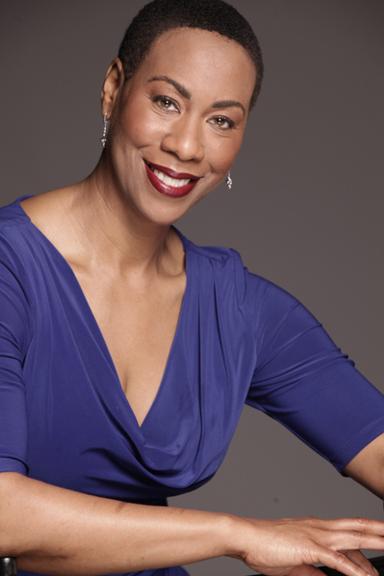
Janice Chamdler-Eteme

The outstanding vocal soloist for the fourth and fifth movements, Janice Chandler-Eteme, is generally billed as a lyric soprano, even though Maher asks for an alto. Clearly the lower range is no obstacle. She found the right sound and expressive palette for both movements, bringing an ominously dark tone to the fourth movement, appropriate for a text that begins “O Man! Take Heed!” And then her sound was enjoyably bright and more forward for the cheerful fifth movement.

The women of the St. Martin’s Festival Singers were solid in their small part, and the Boulder Children’s Chorale rang out bravely with their “Bimm Bamm” imitations of church bells.

But it is the final movement that is the key to the symphony. Under the title “What Love Tells Me,” it is one of Mahler’s longest and most beloved slow movements. Oundjian and the CMF orchestra achieved what everyone aims for, a long arc of sheer beauty leading to an overwhelming finish.

After that, what can we expect next year? You will have to wait for the announcement of the CMF 2020 season after the first of the year to answer that question. In the meantime, there are many fine musical groups in Boulder who would welcome your support.