Carmen Without Context at Chautauqua

Brook’s Tragedy of Carmen flattens a great opera

By Peter Alexander

Peter Brook

Director Peter Brook, who conceived The Tragedy of Carmen

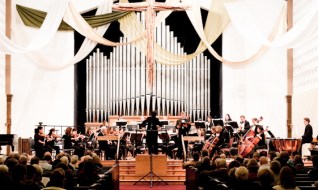
Colorado Music Festival’s performance of The Tragedy of Carmen, Peter Brook’s radical reduction of Bizet’s opera, gave me heightened respect for the work great theater composers do, fitting their music to the demands of the stage.

Unfortunately, that is because so much of the slimmed down work fails to match music and drama as effectively as Bizet did in his original.

To be clear, that was not the fault of the performers. Under the direction of CMF music director Jean-Marie Zeitouni, and with a strong cast of singers, last night’s performance at the Chautauqua Auditorium (July 10) was delivered with emotional force and musical skill. But their commitment was not enough to overcome the limitations of the work.

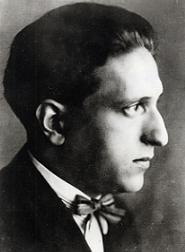
Bizet

Composer Georges Bizet

Zeitouni has described The Tragedy of Carmen as “the pure essence of Carmen, . . . not the regular 40% scotch but more like 97% alcohol, distilling the essence of the passion of the opera.” But for me, the CMF program notes hit closer, saying this version “is best labeled as Carmen Light. Like Bud Light (it) is less filling. But whether the new product tastes great depends on each listener’s palate.”

Fair enough. And my palate, honed by great operas including Bizet’s Carmen (and Colorado’s great craft beers), found the low-calorie version, just like light beers, lacking in taste.

There are several specific shortcomings that I found in the work itself. First, removing so much of the original takes away much of the context in which the drama is played. This has the effect of flattening the characters and their emotions.

Fischer.Carmen

Abigail Fischer, who portrayed the title character in CMF’s Tragedy of Carmen

A pertinent example is the scene in Lilas Pastia’s tavern. In the original, the gypsy dances that open the scene establish the kind of place it is, and provide the atmosphere for the following scene between Carmen and Don Jose. Reducing those dances to a brief flourish by Carmen not only removes the context, the setting and the atmosphere, it forces the story to lurch without respite from emotional punch to emotional punch.

A second problem is the repurposing of music that was written for a specific dramatic or stage context to another, as when the music written for a riot among the cigar girls is used for a fight between Carmen and Micaëla. Such repurposing of music discounts the skill with which the composer tailors his music for the stage. If we have a fight between two characters, it would be better to hear the music Bizet would have written for that more intimate scene, rather than what he wrote for a stage full of people.

de Slayden

Tenor Jason Slayden (not in Carmen)

The extreme condensation results in scenes not having time to breathe and build. In Bizet’s opening scene, there is a long buildup of tension from the moment Carmen throws a flower at Don Jose, to her arrest and her escape. Brook reduces this to a much shorter span of time, dissolving most of the suspense that Bizet so carefully builds in his score.

Brook has made some capricious changes in the plot. For one, there is a mysterious man from Carmen’s past who suddenly interrupts a love scene between Carmen and Don Jose, shouting “She belongs to me.” Only moments later he is killed by Don Jose, offstage. I still don’t know what dramatic purpose he serves. If it were not for the dark music, this would be almost comical.

The most shocking change comes near the end, when a funeral march—not from Carmen—interrupts the dramatic final scene between Carmen and Don Jose, while a projected title tells us that Escamillo has died in the bull ring. This change eviscerates the ending of the story and denies the audience a great musical-dramatic stroke, when the cheers from the bull ring punctuate Jose’s passionate appeals and murder of Carmen.
de-bique_01-304x312

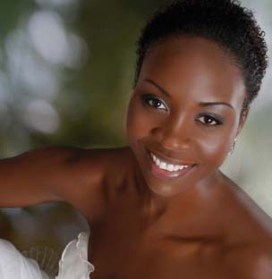
Soprano Janine De Bique

Brook’s version does remove some absurdities of plot that we have tolerated because of the dramatic truth of the opera. For example, we do not have the mountainous, secret smuggler’s lair that everyone in Seville can easily find. But we loose some of Bizet’s best music in the process, and we do not get any compensating dramatic truth, either.

While the work seems questionably conceived, the performers addressed their parts with intensity and commitment. Zeitouni led a decisive performance by the CMF Chamber Orchestra. The singers do not have named roles, only voice types, of which Abigail Fischer was a strong mezzo soprano, essentially the Carmen of the show. The abbreviated performance did not give her the chance to build a fiery, luminous character, but she dominated her scenes, as she should.
BOGDANOV-PHOTO-1-254x300

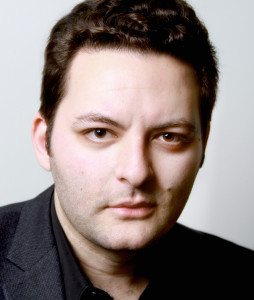
Baritone Aleksey Bogdanov

Jeanine De Bique’s soprano/Micaëla sang warmly, darkly, strongly in a role that is not made more rewarding by Brook’s changes. Baritone Aleksey Bogdanov had the unenviable task of playing two different characters who die before the end, Zuniga and Escamillo. I thought he was especially effective in one of opera’s great star turns, his entrance as the toreador. Tenor Jason Slayden was vocally passionate, if a little stiff dramatically in his scenes as Don Jose.

Chautauqua Auditorium may not be a great venue for theater. Many of the spoken lines were scarcely audible, particularly when the orchestra was playing. The limited performance space left the actors to move almost randomly, with no setting to indicate destination or motivation, and I found their movements around and behind the conductor to be distracting.

I suspect this show is best for people who do not know the original Carmen well and want a distilled taste of the story. Clearly, many in the audience enjoyed it. I cannot begrudge them any pleasure taken from the music and the performance, but you will more likely find me at a future production of Bizet’s full opera—or enjoying a strong local brew.

____________

EDITORIAL NOTE (7/11/16): The CMF program notes for The Tragedy of Carmen do not credit an author. However, it has come to my attention that the portion that I quoted above—Brook’s version “is best labeled as Carmen Light. Like Bud Light (it) is less filling. But whether the new product tastes great depends on each listener’s palate.”—appeared in an Oct. 13, 2013 review by David Abrams of a performance of The Tragedy of Carmen at Syracuse Opera, published online at Opera Today.
‘The most profound music for orchestra’ rounds out Brahms mini-fest at CMF

Wrapping up two nights of full, burnished orchestral sounds at Chautauqua

By Peter Alexander

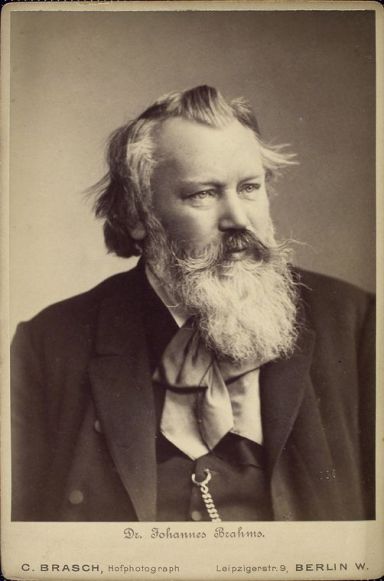
Johannes_Brahms_portraitFour symphonies in two days is a lot of Brahms, but Jean-Marie Zeitouni and the Colorado Music Festival Orchestra pulled it off to the full satisfaction of their audience. Last night’s (July 8) nearly-full house for the second of two concerts stood and cheered and whistled and—was that a horse whinny I heard behind me?
It’s safe to say the audience showed its robust approval.

The second program was shared by the Third Symphony in F major and the 4th Symphony in E minor—two works that, Zeitouni said, “speak to someplace where mortals are not even invited.” Happily, he did invite his mortal audience into the elevated—if not quite otherworldly—performance.

The orchestra filled the Chautauqua Auditorium with the rich tones and well balanced chords of the brass section from the very first notes of the Third Symphony. Their bright, burnished sounds characterized both evenings’ performances, and they particularly suited this work.

The first movement, with its complex textures and overlapping lines, is particularly challenging for conductors and players alike. To their credit, the CMF orchestra played with great transparency, making every inner line in the woodwinds, every passing theme audible.

The shifting chords at the recapitulation—a particular hazard of the movement—were all carefully balanced and matched. In many ways, the performance of this movement was exemplary: Zeitouni and the Festival Orchestra at their very best.

Both the second and third movements gave the players a chance to revel in a relaxed fullness of sound. These movements are perhaps too much the same, but both were played with great delicacy of phrasing and beauty of sound. The Horn solo in the third was especially memorable.

The many thematic fragments of the finale were successfully pulled together and wrapped in a full and cushioning orchestral fabric. Zeitouni’s characteristic transparency of texture made it all work. Once again, the horn playing was beautiful, if slightly overbalancing the rest of the orchestra. The end subsided, as it is written, into a vanishing whisper that became another of the challenges of this symphony successfully overcome.

Jean-Marie-Casual

Jean-Marie Zeitouni

The Fourth Symphony is one of my favorite pieces, even if I don’t quite share Zeitouni’s belief that it is “the most beautiful and profound music ever written for orchestra.” Nonetheless, it is unmistakably beautiful and profound and always welcome on an orchestral program.

The first movement provides a great example of tradeoffs in interpretive decisions. Zeitouni sought out different sound qualities in the different layers of the orchestral texture, with the strings ranging from brilliant to a warm, sustained and singing sound, punctuated by raspy, pecking chords from the woodwinds, and the brass always chorale-like in their warmth and resonance. This brings out the separate lines and ideas, but the tradeoff is a loss of unity and blend.

This was a soaring, lyrical reading of the first movement, not tortured or dramatized as it is sometimes heard. All the layers and sections came together for a surging climax that could have—but didn’t quite—upstage the final close of the symphony.

Sometimes you have to just sit back and enjoy the sound of an orchestra. That was largely the case in the second movement, even when the horns seemed again just more than was needed in contrast to the hushed pianissimos.

The third movement was played in a very direct and straightforward style. Sometimes played with a halting quality, as if there were a gravitational pull holding back the momentum, here it was brisk and bracing, an approach that is in alignment with the rest of Zeitouni’s interpretation.

A set of variations on a simple chord progression, the finale is a throwback to the German Baroque music that Brahms studied and loved. It is certainly one of the great orchestral movements, with the Baroque and Classical and Romantic techniques all coming together in a kind of ideal synthesis that seems to transcend time and styles. This movement does occupy another plane.

The trick is to recognize the joints between the many individual variations, but to get through them without a loss of tension and forward movement. The slower, softer middle variations seemed to relax a little too much, particularly as a beautiful brass chorale died into silence. But—another tradeoff?—the impact was stunning when the full wind section proclaimed the return of the original chords, allegro, forte, fortissimo, kicking the whole thing into an extra gear. You will not hear a more effective ending of Brahms’s Fourth.

Zeitouni has said this is the first of many single-composer mini-festivals to come at CMF. That is the kind of programming that raises the festival above the ordinary, providing both musical pleasure and illumination for Boulder’s audiences. I applaud Zeitouni and the CMF for this commitment and look forward to future installments.

Zeitouni and Festival Orchestra embark on a Brahms voyage

Symphonies 1 & 2 open a two-day mini-festival

By Peter Alexander

Brahms_GardenSeat

Johannes Brahms

Last night (July 7), Jean-Marie Zeitouni and the Colorado Music Festival Orchestra opened a mini-festival of music by Brahms with mostly satisfying performances of the symphonies No. 1 in C minor and 2 in D major.

The mini-festival, titled “Boulder Brahms,” concludes tonight (Friday, July 8) with the two later symphonies, Nos. 3 in F major and 4 in E minor (7:30 p.m., Chautauqua Auditorium). Even more Brahms is on offer next week, when Music Director Laureate Michael Christie returns to Chautauqua for “Bernstein and Brahms,” a concert featuring the Piano Concerto No. 1 D minor with pianist Orion Weiss.

Last night’s performance was marked by an exquisite control of dynamics, with beautiful pianissimos and powerful fortissimos, which is becoming a hallmark of Zeitouni’s performances in Boulder. This was true of both symphonies, but particularly stunning in the Second, which had several passages at a beautiful whisper.

Before the concert began, Zeitouni praised the orchestra for doing “four weeks’ work in four days” with the symphonies. Perhaps that explains why the first three movements of the First Symphony were not fully in the groove. They were unusually ragged for the usually excellent Festival Orchestra, with a few uneven entrances and imprecise intonation. The end of the second movement, with a lovely violin solo from concertmaster Calin Lupanu, was marred by a muffed trumpet entrance.

The finale was another story. The tricky accelerando pizzicati at the beginning were perfectly controlled, creating a great sense of suspense. The famous alp horn theme in the horn section rang out heroically, setting the stage for the Beethovenish allegro theme. Zeitouni’s careful control of tempo and dynamics gave the music all the momentum it needed to forge a powerful ending.

There is a joke that when cheerful, Brahms, known for a melancholy temperament, would sing “The Grave is my Joy.” That does not seem to be Zeitouni’s approach. While very sensitive to surface details, he did not go looking for hidden shadows or probe deeply into the darker moments of the First Symphony, which is marked by Beethoven’s influence.

JMZBowtie

Jean-Marie Zeitouni

The sound, particularly in the brass, was very bright and forward, sometimes a little edgy. Considering Zeitouni’s heritage, it would be too easy to say that this is a French rather than German sound—bright, transparent winds and fleeting strings, as opposed to a more blended, dark and brooding quality. This would not be completely inaccurate, but it would not be the whole picture: Zeitouni’s interpretation is consistent and of a piece, a careful rendering of the symphonies as he hears them.

Gallic, Canadian or personal, the sound worked well in the sunnier Second Symphony. The pastoral opening of the first movement was spun out beautifully, with exquisite dynamic control. The players were untroubled by Zeitouni’s rather brisk tempo, never sounding rushed or frantic. The solo flutist gets extra credit for making the lengthy triplet passage near the end of the exposition and the end of the movement sound utterly calm and peaceful.

The two following movements were fully in the groove, with good balance, clear textures and solid intonation. The second was an oasis of Brahmsian repose, and the third was as graziozo (graceful) as Brahms could ask for, with the winds dancing happily along.

The finale showed all the beauties and limitations of the performance. The opening sotto voce strings perfectly set up the orchestral outburst that the CMF program notes compared to Brahms leaping out and shouting “BOO” to the audience. The whole movement rushed by in a delightful romp, untroubled by any bumps or disturbances that might suggest gloomy depths. It was thoroughly enjoyable. It will surprise no-one that it garnered the expected standing ovation.

The wind players deserved the bows that Zeitouni granted them at the end of the program. I have already mentioned the horns, who were excellent throughout, and the flute. The bassoon, all the other woodwinds, and the full trombone choir were all first rate.

The chance to hear all four Brahms symphonies in two nights is a rare and welcome opportunity. As Zeitouni has said, “By listening to them all together, we get in closer contact with him as a man.” For Boulder’s devoted classical audience, that is more than worth a trip to Chautauqua.

# # # # #

Colorado Music Festival
Jean-Marie Zeitouni, Music Director

Boulder Brahms
Jean-Marie Zeitouni, conductor
Part 2: Symphonies 3 & 4
7:30 p.m. Friday July 8, Chautauqua Auditorium

Brahms and Bernstein
Michael Christie, conductor, with Orion Weiss, piano
Program including Brahms’ Piano Concerto No. 1 in D minor
7:30 p.m. Thursday, July 14
Chautauqua Auditorium

Tickets


Zeitouni, Koh and Festival Orchestra dazzle in CMF opener

Dramatic performances highlight a memorable concert

By Peter Alexander

Jean-MarieNew1

Jean-Marie Zeitouni

Jean-Marie Zeitouni and the Festival Orchestra opened the 2016 Colorado Music Festival (CMF) in dramatic fashion last night (June 30).

The first piece on the program was Beethoven’s Overture to Egmont—literally dramatic music in that it was written to open performances of Goethe’s play of that title. Springing from the same well of passionate idealism as Goethe’s drama of political oppression and martyrdom, Beethoven’s overture adumbrates many of the themes of the play. And from the bold opening unison to the final celebratory coda, Zeitouni squeezed every bit of drama out of the score.

Most impressive were the control of dynamics and phrasing, with carefully placed phrase climaxes and well controlled crescendos throughout. This overture is a bit of a chestnut, but when played as well as it was by the Festival Orchestra, it is a pleasure to hear.

7-Jennifer-Koh-by-Juergen-Frank

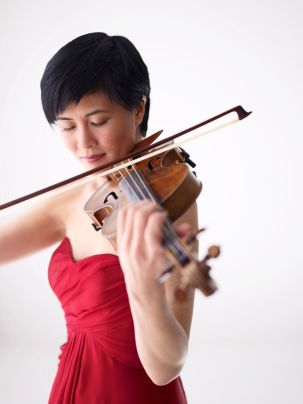
Jennifer Koh

Esa-Pekka Salonen’s Violin Concerto is a work of many extremes, from the most delicate softs of violin harmonics to violent percussion explosions. There were two heroes of last night’s performance: violinist Jennifer Koh, who gave a brilliant, committed performance; and the acoustics in the Chautauqua Auditorium, which accommodated every nuance of the performance and every degree on the dynamic spectrum.

In the most delicate moments—the virtuoso filigree of the opening passages, and the softest violin harmonics that shaded into silence—the hall allowed every note to be heard. And in the moments of manic energy, when the full percussion section opened up at full volume, the wooden walls and roof turned the hall into a vibrating, resonant instrument in its own right. The visceral impact was something that no recording, however powerful, could match.

Of course, even the greatest halls needs great performers, and I don’t want to shortchange Koh’s mastery of this difficult score, or the quality of the Festival Orchestra. The performance was impressive by any standard, and it was one to be remembered.

After intermission, Zeitouni returned to conduct a work from the heart of the French repertoire that is especially close to his heart, the Symphonie Fantastique of Hector Berlioz. Before the concert, Zeitouni had said that the symphony is a kind of a test case for “where an orchestra is as far as its virtuosity and its capacity to express emotional content and color content.”

By those standards, I can only imagine that he was pleased. He was certainly smiling throughout the performance. The Festival Orchestra performed wonderfully, with wide dynamic levels, brilliant orchestra colors, and full-throated fortissimos that filled the hall without distortion.

If a music critic is expected to criticize, I can note that the balance was occasionally less than perfect, as when some lovely horn playing in the introduction covered the first violins. Elsewhere, there was a brief moment of questionable woodwind intonation in the slow movement.

The duo between English horn and oboe at the beginning of the slow movement was magical, with the oboe answers, representing a more distant shepherd, coming from outside the hall. The oboe was not clearly audible at the front of the hall, but there is little else to criticize.

The beautiful playing of the English horn throughout the slow movement was one of the joys of the performance. The unanimity of pitch and articulation within the winds shows what can be accomplished by the best orchestral players. Such purity of intonation led in turn to crystal clear orchestra textures, which reaps benefits for every section.

The multiple timpani of the slow movement evoked distant thunder, and then thundered powerfully for the “March to the Scaffold.” The orchestral outbursts throughout the march were almost shocking in their forcefulness.

Zeitouni’s control of dynamics and tempo led to a nearly crazed “Witches’ Sabbath” movement that Berlioz surely would have loved. The brass, overpowering through sheer volume, earned great applause, but the woodwind parts are just as difficult, and were played equally well. I have never heard a more powerful and convincing close to this symphony, one of the great and original works of the 19th century.

Kansans celebrate the environment and culture of the tallgrass prairie

‘Symphony in the Flint Hills’ is unlike any other classical music event you will find

By Peter Alexander

IMG_1501

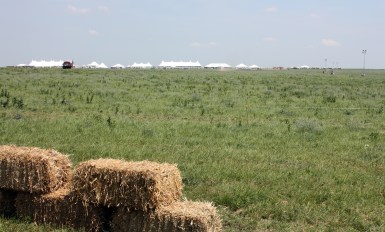
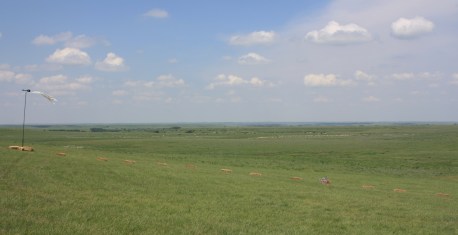
Symphony in the Flint Hills event site from the parking area (all photos by Peter Alexander)

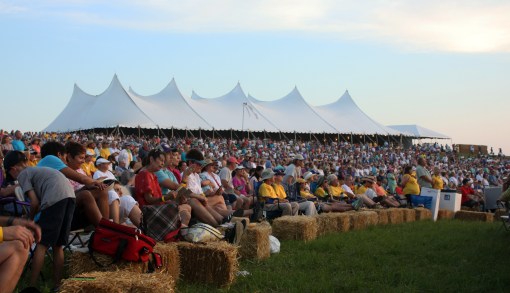
The temperature crept into the low 90s and the swelling crowd kept pouring onto a remote hilltop on the Kansas prairie. Eventually there would be about 7,000 people there, more than twice the population of the county. Tents had been set up, Bar-B-Q was served, there were lectures and prairie walks and covered-wagon rides.

Near the end of the day, cowboys drove a line of cattle across the hillside while the Kansas City Symphony broke into the theme from “The Magnificent Seven.”

It was the 11th “Symphony in the Flint Hills,” held last Saturday (June 11) in South Clements Pasture, about seven miles west of the tiny town of Bazaar, KS (pop. 81). An exuberant celebration of the tallgrass prairie, of all aspects of this unique environment, of Kansas ranching culture, of Kansas itself, the event culminated with a concert by the Kansas City Symphony.

IMG_1555

Symphony in the Flint Hills audience

If you have never attended an outdoor symphony concert on the prairie with 7,000 other people, you should put “Symphony in the Flint Hills” in next year’s calendar: June 10, 2017, at Deer Horn Ranch. (It is moved every year to give the environment time to recover.) You will never find another classical music event quite like it.

“Symphony in the Flint Hills” is first of all about the environment. The Flint Hills represent a unique ecosystem that has remained tallgrass prairie, largely as it was when the first European settlers entered Kansas. Because the rocky, flinty ground was resistant to the plow, it was never tamed by agriculture, as so much of the American prairie has been.

IMG_1509

Flint Hills vista from the concert site

Every year, there is a theme that is explored in the lectures and talks. This year’s theme was “The Future of the Flint Hills,” something worth pondering in a time of environmental challenges and global climate changes.

(The Kansas City Symphony contributed its own happy note to thoughts of the future: the orchestra has just agreed to a new four-year deal with its musicians. In contrast to some other orchestras, the KCS negotiated the new contract without drama. It took only eight meetings, with no attorneys present.)

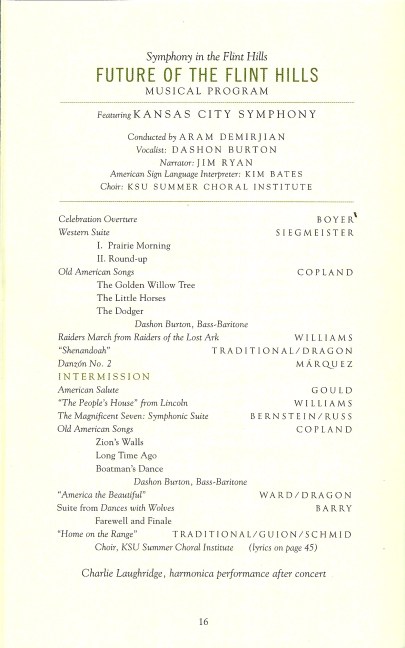
SFH programWhile celebrating the environment, the annual event has always featured a concert by the Kansas City Symphony as one of its highlights. (You may read more about the event and its history here.) The concert draws the largest portion of the audience and offers a attractive blend of light classics, familiar movie themes, and more serious works that fit the locale. As conductor Aram Demirjian put it, it’s “a really fun mix of music that you know and music that you’re going to be glad that you know once you’ve heard it.”
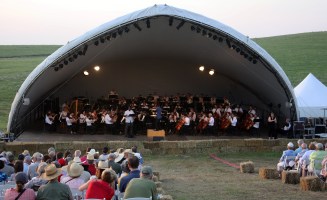
The details of that “fun mix” are never announced in advance, but this year it included music from the films Lincoln, Raiders of the Lost Ark, The Magnificent Seven and Dances with Wolves. (See the full program, left.) There were lush arrangements by Carmen Dragon of “Shenandoah” and “America the Beautiful.”

IMG_1552

Baas-bariton Dashon Burton and the Kansas City Symphony

Most fittingly, the orchestra played “Prairie Morning” and “Round-up” from Ellie Siegmeister’s Western Suite—an attractive and accessible work from 1945 that is doubtless one of those pieces you’d be glad you know once you’ve heard it. Bass-baritone Dashon Burton, a founding member of the adventurous vocal ensemble Roomful of Teeth, gave deeply moving and sonorous performances of six of Aaron Copland’s Old American Songs and was rewarded with cheers from the crowd.

I will not write a full review of the concert, because what I heard was not the orchestra itself, but the sound of the orchestra through the very large speakers mounted either side of the stage. The speakers are very high quality, and the sound engineering was very solid, but some details inevitably got lost. Some passages of fast repeated notes seemed slightly blurred, and in other places the wash of sound—being broadcast out to 7,000 people, after all!—covered differences of timbre among the instruments.

IMG_1560

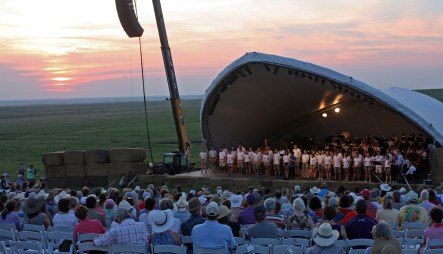
Prairie sunset, audience and symphony, ready to sing “Home on the Range”

As well as I could tell, the orchestra was very tight, the solo parts all very well played. The top trumpet soloist happily lasted the entire concert, which featured exposed high passages in nearly all the film-music selections, with no audible evidence of fatigue. Demirjian led propulsive, exciting performances.

The concert ended, as it always does, with everyone standing to sing along on the Kansas State Song, “Home on the Range.” People joined arms and swayed to the music. This was a communal event of deep significance to the audience, as 7,000 people were brought together by the music, the beautiful vistas, the words of the song. It was a lovely way to end a day on the prairie.

And the skies were not cloudy all day.

# # # # #

You may see all of my photos of the 2016 Symphony in the Flint Hills on my Flickr site.


“Stunningly brilliant” Brahms captivates Stewart Auditorium audience

Boulder Bach Festival unveils the sound of Romanticism

By Peter Alexander

Technical perfection is what musicians strive for in all those hours of practice, but never achieve. In classical music, that perfection would include uncompromised accuracy and control of pitch, and consistency of sound in all registers.

Interestingly, musical instrument makers have aimed for the same qualities, especially the consistency of sound, and they have made great progress over the past 200 years. Much has been gained in the technical capacities and consistency of sound in modern pianos, for example, as well as wind instruments. But much has been lost as well.

What has been lost was demonstrated yesterday (May 15) in a stunningly brilliant performance of the Brahms Horn Trio in E-flat major, op. 40, presented by the Boulder Bach Festival in the Stewart Auditorium in Longmont.

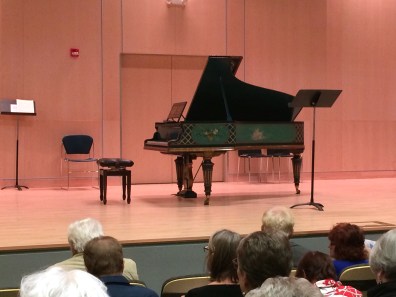
The performance brought together three players: violinist and artistic director of the Bach Festival Zachary Carrettin; pianist Mina Gajic, the festival’s director of education and outreach; and guest artist Thomas Jöstlein playing horn. More crucially, it brought together three instruments that were perfect partners: A violin strung with 19th-century style strings, including pure gut; an 1895 Érard piano; and a natural horn (without valves), made in about 1815. I have never heard a better balanced performance with such disparate instruments.

Erard@Stewart

1895 Érard piano onstage at Stewart Auditorium

The Érard, a beautiful example of the piano maker’s craft in the 19th century, was a critical ingredient. With its remarkably transparent, clear and nuanced sound, it paired with the other instrument as no modern piano could. Gajic could play with full commitment and never overwhelm the other players.

Jöstlein’s natural horn was equally critical to the success of the performance. Its smaller bore and restrained sound never overwhelmed the violin, its closest partner throughout the piece, as a modern large-bore horn, built for a big sound and the ability to cut through a modern orchestra, would do.

Both the piano and the horn brought another quality that we have lost: a sound that varies from register to register, or, in the case of the horn, from note to note. Brahms made expressive use of these differences. As Jöstlein demonstrated before the performance, the sound of the horn could be bright and clear in one phrase, muted and distant in another. And one thing you almost never hear today: the natural horn, which changes pitch by the player moving his hand inside the bell, added a snarling quality to some of the crashing chords that could be suddenly resolved into a clear and pure sound.

zacharycarrettin

Zachary Carrettin

The differences in sound for Carrettin’s violin were less dramatic, but his choice of natural gut for some strings, steel for the highest string, and wound gut for the lowest, gave the instrument a sound that matched the others.

A fourth partner was the space where the music was performed, the intimate Stewart Auditorium of the Longmont Museum. In an interview before the concert, Carrettin had stressed the importance of the hall: “Stewart Auditorium . . . is a 250-seat hall. It’s very much a salon setting, so we don’t have to worry about projecting to a 3,000 seat house. That has in it an authenticity in the way that we can craft the interpretation.”

Gajic

Mina Gajić

The combination of a space where everyone felt in close contact with the performers, and instruments that were perfectly matched freed the performers to play with complete commitment. No punches needed to be pulled, no climaxes pushed too hard, no passages held back in the name of balance. I have rarely heard such excitement as Gajic, Carrettin and Jöstlein generated in the last movement.

The Stewart Auditorium crowd—totally sold out with seats added onstage—gave a standing ovation that went well beyond the expected, dutiful “standing o” we get with too much regularity. They knew they had heard something special, and they reacted in a way we do not usually associate with “original instruments” or “historically accurate” performances. They had heard the door opened into an unfamiliar sound world, and they were captivated.

The short program, played without intermission, had opened with Carrettin and Gajic playing a 19th-century arrangement of Bach’s much-loved “Air on the G String.” As Carrettin explained beforehand, violinists at the time were starting to play with continuous vibrato and used far more portamento, or sliding glissandos, than we are accustomed to hearing.

The performance was fascinating, although not to the taste I developed through mid-20th-century training and listening. As the great violinist Fritz Kreisler said appreciatively of that style of playing, it gave melancholy to the music. That’s not the spirit of the original Bach, but it is the spirit of the late 19th century and Carrettin played with passion. I would not have missed the experience.

Amanda Balestrieri

Amanda Balestrieri

The remainder of the concert was filled with one Bach aria and three Brahms songs, eloquently rendered by soprano Amanda Balestrieri and Gajic (plus Carrettin on the Bach). Balestrieri’s bright, clear sound was ideal for the well controlled filigree of the Bach aria. The Brahms was sung with exemplary expression of the text, and only the slightest push to the highest notes. The lyrical songs formed a lovely companion to the more intense Horn Trio.

As this concert shows, Boulder County now has such musical riches that revelation can strike in almost any concert. This may be a golden age. If you have any interest in classical music, don’t let it pass you by.

At Minnesota Opera, “The Shining” dazzles

World premiere of Paul Moravec’s opera promises future success

By Peter Alexander

The Saturday (May 7) premiere of The Shining by Paul Moravec at the Minnesota Opera was clear evidence of the vigor of contemporary opera in America.

13173843_10153765505072979_4910527002593047546_n

The Shining by Paul Moravec. All photos by Ken Howard for the Minnesota Opera

The opera, based on the Stephen King novel (but resolutely not on the Stanley Kubrick film), has sold out its opening run of four performances. It is a solid piece of work, dramatically effective, musically successful, and destined to be popular. And in the hands of the team from the Minnesota Opera—conductor Michael Christie, stage director Eric Simonson, scenery and properties designer Erhard Rom, the craftsmen of 59 Productions and their many colleagues—The Shining received a stunning production that realized the full potential of the score. The cast was uniformly first rate. At the end, the sold-out Ordway Music Theater audience stood and cheered.

13151477_10153761432822979_8358473026070436581_n

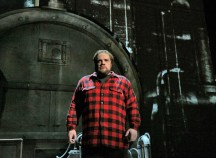
Brian Mulligan as Jack Torrance, with the massive boiler

If you don’t know the story, Jack Torrance, a writer, has taken a job as winter caretaker of the isolated Overlook Hotel (loosely inspired by Estes Park’s Stanley Hotel), a seemingly elegant relic that turns out to be haunted. Jack brings his wife, Wendy, and young son, Danny, with him. Jack and Wendy are hoping to restore their damaged marriage, but under the sway of the hotel and its ghosts, the already fragile Jack turns violent.

Librettist Mark Campbell has done an effective job of reducing King’s 400+ page novel into a two-hour opera. The essential elements of King’s tale are present: the evil spirits that control the hotel, the temperamental boiler that threatens to blow the place to bits, the smothering snow that creates a barrier from rescue, the child with second sight (or the “shining” of the work’s title), and his hair-triggered father’s troubling past. It’s a lot to get into a compact libretto, but Campbell has managed to keep the spirit of the original while necessarily cutting some elements (including several of the haunted rooms, the topiary animals standing guard and the malevolent wasps).

13179410_10153765506357979_1954666156422704678_n

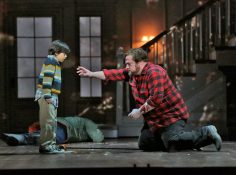
Alejandro Vega as Danny and Brian Mulligan as Jack

There is one significant change that King’s fans will notice, and it is not an improvement. At the end of the novel, Danny confronts his father fearlessly, because he knows something that Jack has forgotten: the boiler, which is close to blowing. When Danny reminds him of this, Jack rushes to the basement, leaving only enough time for the three survivors to escape. In other words, the Overlook has completely taken over Jack, who becomes a tragic figure brought down by his own weakness.

13151382_10153761433622979_8768870567870682339_n

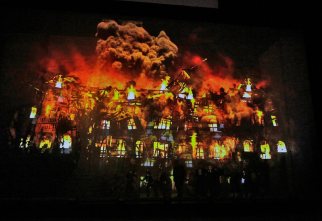
Brian Mulligan as Jack, surrounded by evil spirits just before the boiler destroys the Overlook Hotel

In the opera, Jack allows Danny to go, and when the hotel’s spirits remind him of the boiler, he defies them and decides not to relieve the built-up pressure so that his family can escape. When he chooses to die in the resultant explosion, the story becomes a more conventional one of Jack’s redemption, a point made clear in the staging. In King’s bleaker vision, there is no such redemption.

Moravec has set this tale with accessible, expressive music. The text can be clearly understood, thanks to both composer and cast, and supertitles are often not needed. There are moments of affecting lyrical beauty, particularly the moving (if predictable) final aria by Halloran, the resort’s cook and the story’s rescuer, who reassures Danny that “You’re doing fine by yourself . . . Just fine.” Other major characters—Jack, Wendy, and the spectral figure of Jack’s brutal father—all have expressive music. If the ghostly chorus of evil spirits sounds a little too real, that is a consequence of portraying incorporeal beings with corporeal actors.

13178017_10153765506462979_5945586431432079112_n

The exploding Overlook Hotel

The horror genre is of course a well worked musical field, through opera and especially film. It is probably inevitable that Moravec incorporated some familiar clichés to represent menace, the sinister noises of malevolent spirits, ghostly voices and the ratcheting up of suspense, but it is a testament to his skill as a composer that these clichés are elevated by his score.

The orchestral writing is especially outstanding. The orchestra supports but never obscures the vocal lines. Sounds from the orchestra fit the text and mood, and the final powerful cataclysm is one of the most effective moments of musical pictorialism I can recall. That orchestral explosion and the subsequent relaxation into the comfortable and comforting music of the final scene make a satisfying ending.

13124956_10153765506557979_586500643969602035_n

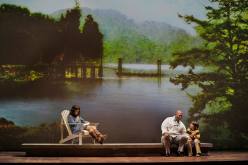
Kelly Kaduce, Arthur Woodley and Alejandro Vega in the final scene

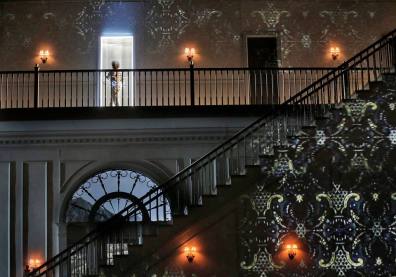
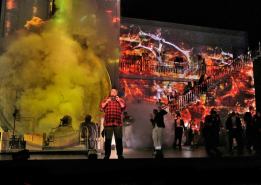
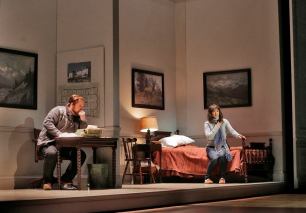
Minnesota Opera’s production is a dazzling tour de force. The beautiful projections that place the actors on a mountain road and beside a peaceful lake are impressive enough, but even more impressive are the scenes in the hotel, with a combination of atmospheric projections that heighten the mood and sliding units that shift (almost) seamlessly from room to room, with only the occasional “thump” to remind us of the stage machinery. Kudos to the designers and 59 Productions for the magic. The hulking boiler and its spectacular destruction of the hotel deserve special notice.

Of the singers, Arthur Woodley is magisterial as Halloran. The hearty cheers he received were well deserved: his robust baritone filled the hall and captured the brief scenes where he appears, at beginning and end.

13178841_10153761432417979_7664365553339574570_n

Brian Mulligan as Jack and Kelly Kaduce as Wendy

As Jack, Brian Mulligan added physical menace to a steel-cored voice. If his rapid swings early in the opera between loving family man and brutal tyrant seemed too precipitous, they were indeed frightening, as they should be. His deterioration in the second act was especially effective, as the Overlook asserts control and less and less of Jack is left. The power of the performance comes from growing intensity of his interpretation rather than any specific musical numbers along the way.

Kelly Kaduce, who sang Wendy Torrance, is deservedly a Minnesota Opera favorite. She sang with expression and beauty of sound, but her role stays long in a limited emotional range, mostly expressing fear of her husband and comfort for her son. Her aria at the beginning, “I never stopped loving you” helps suggest a warmer relationship with Jack, but in that one moment the music doesn’t quite rise to the needs of the text.

It would be remiss not to observe that the teasing and sexy moments between Jack and Wendy are well written, and that both text and actors captured well the mood of King’s novel. In the pared down, two-hour stage presentation they seem too ephemeral, as if squeezed in for relief; expansion of those moments, musically or dramatically, could restore the balance found in the novel’s more thorough back story.

13096261_10153761432437979_1411098242275429888_n

Alejandro Vega (Danny) and Arthur Woodley (Halloran)


Alejandro Vega, the 10-year-old who brings Danny movingly to life, shows great talent. His assurance and the authenticity of his emotional reactions to the story reveal a natural actor, but also one who is skillfully trained and directed in the role. He was on stage for much of the performance, and he was fully the equal of the adults with whom he shared the stage. For later productions this will be a make-or-break role. Vega definitely made it.

Minnesota Opera has put together an able ensemble cast for the other roles as well. Mark Walters as Jack’s father who reaches from beyond the grave to drive his son toward murder; David Walton as the seductive former caretaker and multi-murderer Delbert Grady; Robb Asklof as haughty hotel manager Stuart Ullman; Alex Ritchie as the hotel’s depraved founder Horace Derwent: all were scarily effective.

13124879_10153765505342979_5349882607679914159_n

Wendy, Danny and Jack surrounded by ghosts and ghouls

Christie led the Minnesota Opera’s excellent orchestra with care and sensitivity to the singers. I could not find a serious flaw in the balance, and—considering I had not heard the piece before—the pacing seemed just right. We in Boulder, and now audiences in Minnesota, know that his is an important career.

I have no doubt that The Shining will go on to other productions, especially in the United States where Stephen King’s works loom so large in the popular culture. Many more audiences will stand and cheer.

# # # # #

Minnesota Opera has become one of the most ardent and consistent supporters of new opera in the country. When you consider the record of some of the financially larger companies, their record of world premieres in four of the last five seasons (Kevin Puts, Silent Night, 2011; Douglas J. Cuomo, Doubt, 2013; Kevin Puts, Manchurian Candidate, 2015; and Paul Moravec, The Shining, 2016) puts them in a league with the adventurous Santa Fe Opera and few other professional companies.

And they have announced another premiere next season, Dinner at Eight by William Bolcom, based on the play by George S. Kaufman and Edna Ferber (March 11, 16, 18 and 19, 2017; you may see the entire, enticing season here.) I find it particularly exciting that our own American culture is being mined for operatic subjects, much as European opera has mined their shared culture for generations. This is certainly one of the reasons that contemporary opera is growing in popularity. There is more evidence than The Shining of American opera’s vigor today.

Pro Musica Colorado delivers a performance to be remembered

Shostakovich’s personal expression of suffering anchors a fascinating program

By Peter Alexander

Pro Musica Colorado Chamber Orchestra and conductor Cynthia Katsarelis presented a concert last night in Boulder (Jan. 23) that deserved a far larger audience than it drew.

OLYMPUS DIGITAL CAMERA

Cynthia Katsarellis and the Pro Music Colorado Chamber Orchestra

Perhaps it was the gloomy-sounding topic—music for and by victims of World War II—but the sanctuary of the First United Methodist Church was not quite half filled. Anyone who stayed away missed an extraordinary program and one exceptional performance.

The centerpiece and foundation of the program—and final work of the evening—was Shostakovich’s Chamber Symphony, op. 110, a string orchestra setting of the composer’s String Quartet No. 8. Dedicated to “the victims of fascism and war,” the Quartet is more than that; it is a personal expression of deep suffering, possibly a self-eulogy from a composer who was contemplating suicide.

silver Gelatin Print

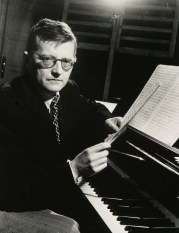
Dmitri Shostakovich

The evidence of the composer’s real intent lies in the quotations from his own works scattered through the score—particularly works written under the oppressive yoke of Stalinism. The quartet’s most prominent theme, D-E-flat-C-B, is an anagram of his own name in German musical notation: DSCH.

As gloomy as that may sound, the Quartet No. 8 is one of Shostakovich’s greatest works, and one of the great string quartets of the 20th century. Last night’s performance was evocative, powerful and beautifully crafted. The unity of performance within the individual sections—corresponding to the four parts of the quartet—was remarkable, in pitch, in rhythm, in phrasing. Katsarelis led the performance with commitment and careful control of the quartet’s emotional flow.

The translation to a string orchestra changes the score in some ways. In the quartet version, the single instruments seem to represent individual voices crying out, a poignant reminder of both Shostakovich’s plight and the individual lives lost in the war. On the other hand, the added force of the orchestra version effectively conveys the weight of oppression. This is most notable with the fierce, pounding three-note motive representing the KGB and their feared late-night knock at the door. That motive, and the anguished passages that follow, were the most powerful moments of the concert.

While I am inclined to prefer the original version, because of its intimacy and because it was the composer’s first intention, last night’s performance made a strong case for the Chamber Symphony version as well. It was a performance to be remembered.

The rest of the program was creatively put together, with three pieces that complimented one another nicely: Bach’s Brandenburg Concerto No. 3; the world premiere of Life Between Lives by D.J. Sparr, loosely derived from the Bach; and the Study for String Orchestra by Pavel Haas, a genuine victim of the Second World War. Unfortunately, none of these works quite reached the heights of the Shostakovich.

The concert opened with the Bach Brandenburg. A delightful score, it was given a sprightly performance, but the church’s acoustics—about which I have complained before—made Bach’s sparkling counterpoint sound tubby and turgid. The closely spaced parts, especially in the lower register, just cannot be heard clearly in that space.

The use of the slow movement from Bach’s G-major Sonata for violin and harpsichord to fill out the Brandenburg’s enigmatic two-chord slow movement was an interesting choice, and one that worked well as it moved nicely into the key-defining chords.

DJ Sparr

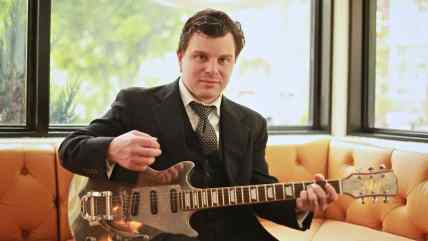
Composer/guitarist D.J. Sparr

Sparr’s Life Between Lives was composed for the Colorado Pro Musica and plays with the same instruments and textures as the Bach. It opens with mysterious chords, representing “Moment before Breath” (as the movement is titled), just before the beginning of life. This movement seems to recall Sparr’s performing career as an electric guitarist, with sounds resembling electric guitar effects transferred to strings.

Slow moving lines hovering within and above the often dissonant chords gradually accumulate, creating a dramatic sense of breath withheld. That texture soon becomes animated by pizzicato rhythms beneath the surface texture. This is the second movement, “Moment Before Thought,” but other than the pizzicato stirrings, the sound is very much like the first movement.

A sudden acceleration signals the last movement, “Life Between Lives,” where the increasing speed is created by a pulsing repetition of notes and chords, still within the same sound palette. The repetitive rhythms provide the only sense of direction, while the lack of contrast casts a pall of timbral monotony over the texture. There is an increase in intensity with an ascending line in the violins; and then the piece stops with, to my ear, no sense of arrival.

PavelHaas

Pavel Haas

Ending the concert’s fist half was Haas’s Study for String Orchestra. A victim of the Nazis who was interned in the Terezín concentration camp and later killed at Auschwitz, Haas is known as part of the missing generation of German and Austrian Jewish musicians who perished in the Holocaust. The Study is a pleasant, entertaining work written under the most difficult of circumstances—in the camp, where it was premiered in 1943.

This is a work that, as Katsarelis has said, “speaks marvelously to the human spirit—and to the power of music.” The performance was on a very high level, especially the fugue that drives the piece to its end. That said, in spite of the work’s history, it is neither as profound nor as moving as the Shostakovich that ended the concert.

In the end, then, Katsarelis and the orchestra gave us a fascinating combination of composers and works, much to think about, some wonderful playing, and one great performance to be remembered.

Pro Musica Colorado opens season with bustle and energy

Larry Graham plays Mozart concerto on a program with a world premiere

By Peter Alexander

Photography by Glenn Ross. http://on.fb.me/16KNsgK

Cynthia Katsarelis, conductor of Pro Musica Colorado

Pro Musica Colorado Chamber Orchestra, the last of the local orchestras to launch the 2015–16 season, got underway in Boulder last night (Nov. 21) with a bustling, energetic program featuring the world premiere of Kurt Mehlenbacher’s Flying Crooked and two major pieces by Mozart.

Cynthia Katsarelis directed the performance in the First United Methodist Church with her usual focus on the overall architecture and momentum of the pieces, and retired CU prof. Larry Graham gave a fluid, nuanced reading Mozart’s C-minor Concerto, K491. The same program had been played Friday night in Denver.

In remarks before the concert began, Mehlenbacher explained that the title Flying Crooked was only applied after the piece was completed. Based on a suggestion from his roommate, it carries no implication that the music should be seen as deliberately descriptive or programmatic.

Be that as it may, the propulsive rhythms that dominate the texture do suggest flying, or other kinds of movement—by turns rushing, loping, flitting and soaring. The thoroughly enjoyable score contains many short episodes that are sometimes contrasting, but the impulsive motor rhythms are rarely absent from the background. Based on this performance, I would urge other smaller orchestras to take up Flying Crooked as an energetic and effective way to open any program.

For better or worse, Mozart’s C-minor Concerto sounded just like what it was: a performance on modern instruments and piano in a highly reverberant space. The First United Methodist sanctuary is a long, rectangular shoebox, perfectly suitable for services but less than ideal for orchestras.

Bass notes in particular tend to spread and muddy the texture, so that every timpani stroke, for example, threatens to cover details in the music. This is not a question of orchestral numbers—with only one string bass and three cellos, the ensemble is well balanced. The timpanist used the appropriate hard mallets for an incisive sound. But there is little players can do when notes continue to resonate too long after they are sounded. Unfortunately, Boulder does not have an ideal small auditorium, so Pro Musica and other groups will continue to rely on churches for the foreseeable future.

(I did not hear the Friday performance in Denver’s First Baptist Church, but I heard reports that the sound was much less problematic there.)

Larry Graham2_Dale_Steadman

Larry Graham. Photo by Dale Steadman.

The lack of clarity aside, Graham played with great facility. He had full command of dynamics and control of the individual voices in the texture, providing as much clarity as possible in the space. His playing was especially lovely in the slow movement, where the softer and thinner orchestral texture allowed him to be distinctly heard throughout. His sparkling performance of the sprightly finale was enhanced by lovely playing from the Pro Musica winds.

Graham has long been a popular fixture on the Boulder classical music scene. It has been reported that this might be his last performance with orchestra, although he seems to be less than emphatic on that subject. His playing is more than effective, and he continues to enjoy intimate concerts, so there should be no hint that he is loosing any ground as a performer. Perhaps the right concerto will be found to entice him back onto the concert stage.

Pro Musica

Pro Musica Colorado

The other Mozart on the program was the Symphony in D major, K504, known as the “Prague” Symphony because of where it was written. It begins with a brooding slow introduction that contains more than a hint of the D minor of Don Giovanni, the opera Mozart was soon to write for the theater in Prague. Katsarelis and Pro Musica brought out all the pathos of the opening gestures before launching on a rhythmically energized performance of the main movement.

The contrast between the dramatic, driven first allegro theme and the tenderness of the second theme was carefully managed and highly effective. Here, the drama inherent in the formal structure of the 18th-century symphony came vividly to life. In the contrapuntal development section, the entrances were well marked, leading to a satisfying climax before settling back down into a gentle transition back to the first theme for the recapitulation.

The slow movement flowed comfortably and smoothly, and as it should the symphony ended with an exuberant romp. Katsarelis’s wise decision to honor the repeats in the finale provided a touch of humor when the piece came scurrying to a definite end, only to launch suddenly and busily back into a developmental passage. The ending was consequently all the more effective the second time.

Making music at a time of tragedy

A personal reflection in the form of a concert review.

By Peter Alexander

12239638_10153709043612365_7450372887197993418_nLast night, the Boulder Philharmonic played a concert.

They played music by Brahms and Charles Denler, the last accompanied by photographs by John Fielder. That was what was on the program, but before the announced program began, they also played the “Nimrod” variation from Edward Elgar’s Enigma Variations as a moment of solace for all of us who were feeling battered by the fierce winds blowing across our world, and as a moment of tribute to those suffering after the atrocities in Paris.

And presumably, since Paris was not even mentioned, for others around the world who are suffering in these terrible times—in Lebanon, in Syria, across Europe, in Africa, and in our own country.

One of the most beautiful four minutes of music I know, “Nimrod” is as fine an offering of solace as musicians could make. It was followed by a long period of silence, as conductor Michael Butterman and members of the orchestra held their positions from the final note. And after a smattering of applause—I will take it as an expression of gratitude for the gesture, rather than anything so routine as reward for the performance—Butterman spoke some touching and very appropriate words about how we all are feeling today.

As one of those affected by the events of the past 36 hours, the past week, the past year, I was both thankful for the opportunity to hear music lovingly played, and aware what a tiny thing a concert is in the world we now live in. Sometimes, just getting on with life is the best thing that we can do—literally the best of many choices. In that respect, the people of Paris may be an example for us all. But sometimes, too, it feels insufficient.

While “Nimrod” was sounding, the familiar words of Leonard Bernstein were projected above the orchestra: ““This will be our reply to violence: to make music more intensely, more beautifully, more devotedly than ever before.”

Sadly, these words are familiar because they seem to be quoted more and more often in these times. They are beautiful, but at some point, they are no longer enough. We will either find a way to get beyond the expression of our ideals and find a way to make a world that will accept difference, one that will make room for all of the world’s children—those of any God you prefer—or this grand experiment of human culture and civilization will come to an end.

It was a meaningful coincidence that the program opened with Brahms’s Schicksalslied (Song of destiny), performed by the orchestra with the Boulder Chorale in celebration of the group’s 50th anniversary. A setting of a poem by Friedrich Hölderlin, the work contrasts the peace of Elysium with human life, where we suffer the batterings of forces we cannot control. The central choral section, essentially a musical depiction of life in a world of chaos, is followed by music that seems to offer comfort and hope.

It turns out Boulder Phil could not have selected a better message for Nov. 14, 2015.

After a satisfying and meaningful performance of Brahms, Butterman and the orchestra turned their attention to music that strives for the same peace that Brahms suggests at the end of the Schicksalslied. The concert premiere of Denler’s Portraits in Season offered meditative music for piano supported and gently amplified by the orchestra. With the composer playing the solo piano part, the performance created a fitting mood of calm and contemplation.

Denler explained before the performance that the piece was not really about the seasons, but about the passages of life and the pleasure that one can find from growing older. This too seemed to fit the mood of the first half of the concert. The beautiful photography of John Fielder projected above the orchestra, and the quotes from Henry David Thoreau that appeared on some slides, added greatly to the pleasure of the occasion, and provided still more food for reflection.

The concert concluded with a mostly satisfying performance of Brahms’s Second Symphony. Here the key of D major casts a layer of light and serenity over the entire work. The audience responded with warmth.

France-Paris-Attacks_Horo-1

Candles and flowers outside La Belle Equipe restaurant in Paris, Nov. 14, 2015.

Leaving the concert hall, one re-enters a world that is not as safe or well ordered as a Brahms symphony. On a personal note, I was all the more thoughtful about humanity’s capacity for inflicting horror because just the day before—near the same time as the attacks in Paris—I happened to visit the site of one of the worst tragedies in our own country’s history: the Sand Creek Massacre by U.S. volunteers of Cheyenne and Arapahoe women, children, and men who were flying the stars and stripes and a white flag.

Suffering, it seems, is ageless. So as we enjoy the best fruits that human culture has to offer, whether it be in the music of Johannes Brahms and Charles Denler, or the photos of John Fielder, or whatever art, music and literature you may enjoy in the coming weeks, we should all take the time to reflect on how precious and fragile is the world we imagine that we live in. If we fail to do so, we may pay a terrible price.

_____

Lightly edited for clarity Nov. 15, 2015.