Boulder Chamber Orchestra features “Boulder Celebrities”

Violinist Ed Dusinberre and violist Richard O’Neill will play Mozart

By Peter Alexander Feb. 27 at 5:15 p.m.

The Boulder Chamber Orchestra (BCO) traces the history of classical music on their next concert (7:30 p.m. Saturday, March 1; details below), with a concerto grosso from the Baroque era, music from the heart of the classical style, and a symphony pointing the way to the early Romantic era.

The concert under conductor Bahman Saless will feature violinist Edward Dusinberre and violist Richard O’Neill from the Takács Quartet playing Mozart’s exquisite Sinfonia Concertante for violin and viola with orchestra. Two of the superstars of the classical music world, Dusinberre and O’Neill are hailed in the concert’s title as “Boulder Celebrities.”
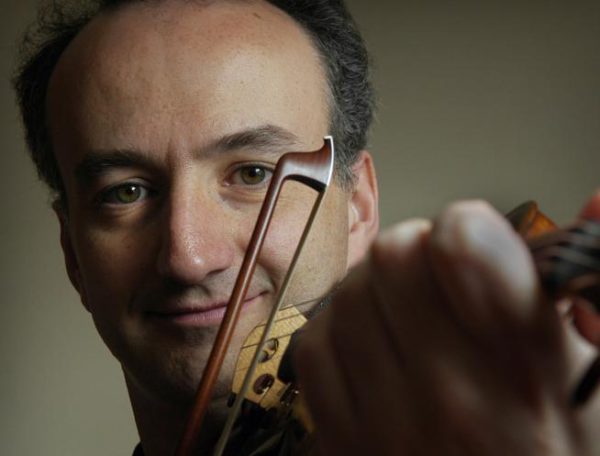
Edward Dusinberre

Works framing the Mozart are the Concerto Grosso in F major attributed to Handel, and Schubert’s Symphony No. 5 in B-flat major. All three are bright and cheerful works, giving the entire concert an uplifting spirit.

With its two soloists, the Mozart stands as the centerpiece of the program. Dusinberre and O’Neill know each other well, having played together in the Takács since the latter joined the group five years ago. In addition to their work in the quartet, they both have concert and recording careers as soloists and both have won a classical music Grammy. 

Mozart’s Sinfonia Concertante is one of the composer’s most loved pieces, and one that O’Neill has played many times. “For some violists it’s the reason they play the viola,” he says. “It’s such an amazing work, and it has been a lifetime dream for me, visiting it through different stages of my life. (There is) the joy of playing it over the years with different orchestras and different violinists, each having their own distinct views on the piece.”

He says he learns from every violinist he plays it with, but this is his first time with Dusinberre. And it’s a special experience playing with someone he knows so well from their work together in the Takács. 

“Part of the magic of being in a string quartet is that you spend so much time with your colleagues, and you get to know them under many different circumstances,” O’Neill says. “I’ve played (the Mozart) with brilliant soloists, but this time with Ed we’ve been able to dig into the more psychological aspects of the music, because we already know each other’s playing pretty well.”
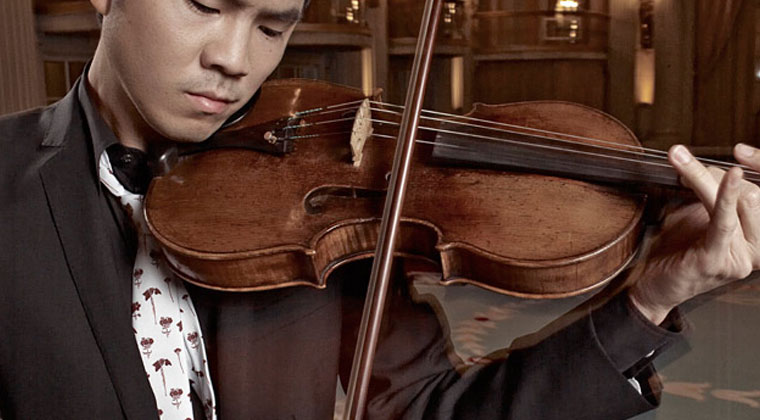
Richard O’Neill

In other words, O’Neill and Dusinberre were able to skip past the early stages of getting to know a musical partner and get down to details right away. The quartet just returned to Boulder from a tour, but they were able to rehearse Mozart together on the road, O’Neill says. Now, “I’m really looking forward to working with the orchestra and Bahman (Saless),” he says.

One thing he urges the audience to tune into with the Sinfonia Concertante is how the two solo parts relate to one another. “Mozart pairs the violin and viola like they’re operatic characters,” he explains. “It’s like a conversation.

“The person that talks first often frames the way the conversation will go. In the first movement,  the violin says, then the viola says, and then the violin says and the viola says. There’s a lot of playful discussion, and then in the recapitulation—the viola says it first!”

The concerto grosso was a form common in the Baroque period, featuring a small group of soloists with orchestra. The Concerto Grosso in F features two oboes with a string orchestra. The soloists will be guest artist Ian Wisekal and BCO member Sophie Maeda. 

The Concerto is “attributed to Handel” because publishers of the time often printed and sold works that had been pirated, or changed the name of the composer, making authenticity uncertain. In the case of this concerto—which is certainly an authentic representative of the Baroque style—it has appeared under Handel’s name and as an anonymous composition.

Schubert wrote his Fifth Symphony in 1816, when he was 19 years old. It is the most classical of Schubert’s symphonies, having been written for a smaller orchestra, with one flute and no clarinets, trumpets or timpani. Schubert was infatuated with Mozart’s music, and wrote in his diary ”O Mozart, immortal Mozart!”

At the time he was unemployed, hanging out with a group of young artists, poets and musicians. The first reading of the symphony was given by this circle of friends in a private apartment, with the first public performance occurring 13 years after Schubert’s death.

The music of the symphony is often described as “Mozartian” in its gracefulness and melodiousness. It conforms closely to the standard four-movement structure of the classical period, with a minuet movement in third place. At the same time, the harmonic palette suggests the Romantic style to come, particularly in Schubert’s works of the remaining 12 years of his life.

But regarding the program’s title, the question of classical musicians being genuine “celebrities” might be debatable—but if it’s possible it would be in Boulder, where the Takács Quartet routinely sells out two performances of every program. 

Superstars or celebrities, Grammy winners both, Dusinberre and O’Neill are always worth hearing.

# # # # #

“Boulder Celebrities”
Boulder Chamber Orchestra, Bahman Saless, conductor
With Edward Dusinberre, violin, and Richard O’Neill, viola

  • Handel: Concerto Grosso in F major, op. 3 no. 4
  • Mozart: Sinfonia Concertante in E-flat major for violin and viola with orchestra, K364
  • Schubert: Symphony No. 5 in B-flat major, D485

7:30 p.m. Saturday, March 1
Boulder Adventist Church, 345 Mapleton Ave.

TICKETS

Boulder Chamber Orchestra strings present “Virtuosity!” with Richard O’Neill

Takács Quartet violist plays music by Telemann and Piazzolla Saturday

By Peter Alexander Feb. 29 at 11:07 p.m.

Violist Richard O’Neill has a wide-ranging background, both geographically and musically.

Richard O’Neill

For example, when he plays as soloist with the Boulder Chamber Orchestra Saturday (7:30 p.m. March 2; details below), he polished one of his pieces by playing with members of Germany’s distinguished early-music ensemble Musica Antiqua Köln, and the other he researched near the docks in Buenos Aires, Argentina.

The first would be the Concerto in G major for viola by the prolific Baroque composer Georg Philipp Telemann; the other is the “Grand Tango,” originally for cello, by Argentine bandoneon player and band leader Astor Piazzolla. Other works on the program, featuring the BCO strings under music director Bahman Saless, are Valse Triste by early 20th-century Czech composer Oskar Nedbal, and Beethoven’s Grosse Fuge (Great fugue), originally the finale of the composer’s String Quartet in B-flat, op. 130.

Two more different composers than Telemann and Piazzolla would be hard to imagine. And yet, O’Neill says, they are not incompatible. “They’re very contrasting, probably on polar opposite ends of the musical timeline,” O’Neill says. “But they share some commonalities—most of all the spirit of the dance.”

The Telemann is the first known true viola concerto, and it is a piece that O’Neill plays often. “I think it’s a gorgeous, amazing piece,” he says.

Georg Philipp Telemann

O’Neill recorded the concerto in 2008 when he was asked to make a recording with members of Musica Antiqua Köln. It was definitely a learning experience for O’Neill, giving him an opportunity to work with a Baroque-style bow that has much less tension on the bow hairs, and to improvise in Baroque music. 

The latter did not come naturally, he admits. “I remember them asking me, ‘play a cadenza, be free! Do whatever you like!’” O’Neill says. “I did something, and it was free for sure! I was stopped and it was like, ‘Who are you, Yo-Yo Ma?’ But it was all said with a smile.

“One thing I learned, things were a lot different when performers and composers were the same person. And it was amazing how prolific (Telemann) was. A lot of times you look at the score and it’s very bare, but in some ways it has everything you need—you just have to understand what you’re going to do.”

His approach to Piazzolla’s music was very different. O’Neill first heard Piazolla’s music when he was a 15-year-old student in Las Vegas, and the Cuarteto Latinoamericano played Piazzolla’s “Four, for Tango.” “I was completely blown away!” he says.

“I had never heard anything like this. It was so rhythmic, so fun, the instruments were doing all of these cool, weird effects like percussive effects and (playing) behind the bridge. I was, ‘what is going on there?’ I found the Kronos (Quartet) recording and listened to it all the time. I fell in love with Piazzolla.”

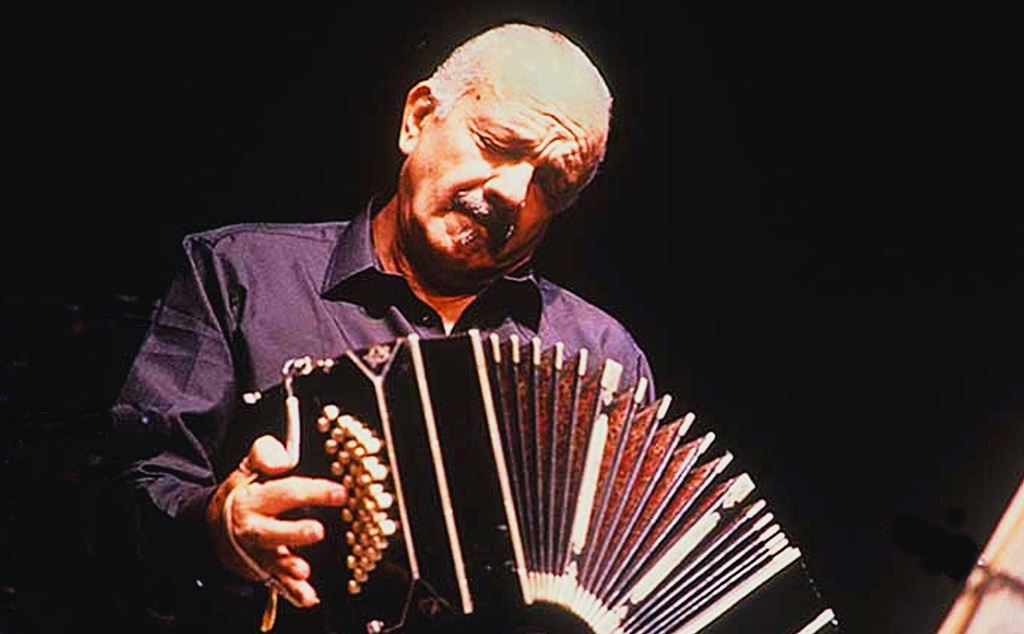
Astor Piazzolla

Later he had the chance to study Piazzolla’s musical origins up close. He was in Buenos Aires, and saw an opportunity to learn more. “I wanted to see what the tango was about,” he says.

“I went down to the docks (in Buenos Aires), where the Argentinian tango was originally from. I was shocked to find out it wasn’t the Parisian version of tango, which is Romantic and dignified. It was actually really rough.  I went to a few tango shows in cafes, but it was mainly the vibe of Buenos Aires that changed me.”

Piazzolla originally wrote the “Grand Tango” for the cellist Mstislav Rostropovich, but the viola arrangement that O’Neill plays fits the instrument very well. “Piazzolla wrote a lot of the (original cello) part very high,” he explains—meaning he can play it at the same pitch on the viola. 

O’Neill loves both pieces he is playing on BCO’s program, but it is the Piazzolla that gets him excited. “The music is just so incredible and evocative,” he says. “It’s almost like it’s so rhythmic that you can’t help being swept away by it.”

Nedbal’s Valse triste is from the ballet Pohadka o Honzov (known in English as the Tale of Simple Johnny). It was composed in 1902 for orchestra, but Nedbal later arranged the Valse for string quartet, in which form it has become especially popular. Trained as a violinist and a composition student of Dvořák, Nedbal was principal conductor of the Czech Philharmonic 1896–1906. 

When Beethoven wrote his String Quartet in B-flat in 1825, he provided an unusual finale: an extensive double fugue that takes up to 16 minutes in performance. That movement was criticized at the time for its complexity and for being “a confusion of Babel.” Since then, however, its standing has risen, to the point that Stravinsky famously said that it “will be contemporary forever.”

Beethoven’s publisher was afraid that such a difficult finale would hinder sales of the quartet, so Beethoven wrote a shorter movement that appeared with the String Quartet in B-flat. He then published the Grosse Fuge separately in 1827. Today it is hailed as one of the composers greatest compositions.

# # # # #

“Virtuosity!”
Boulder Chamber Orchestra, Bahman Saless, conductor
With Richard O’Neill, viola

  • Oskar Nedbal: Valse Triste
  • Telemann: Concerto in G for viola and orchestra
  • Astor Piazzolla: Grand Tango
  • Beethoven: Grosse Fugue, op. 133

7:30 p.m. Saturday, March 2
Seventh-Day Adventist Church, 345 Mapleton, Boulder

TICKETS