Santa Fe Opera presents carnivalesque production of Verdi’s masterpiece
By Peter Alexander Aug. 11 at 1:45 p.m.
Editor’s Note: This is one of several posts covering four of the five operas presented this year at the Santa Fe Opera.
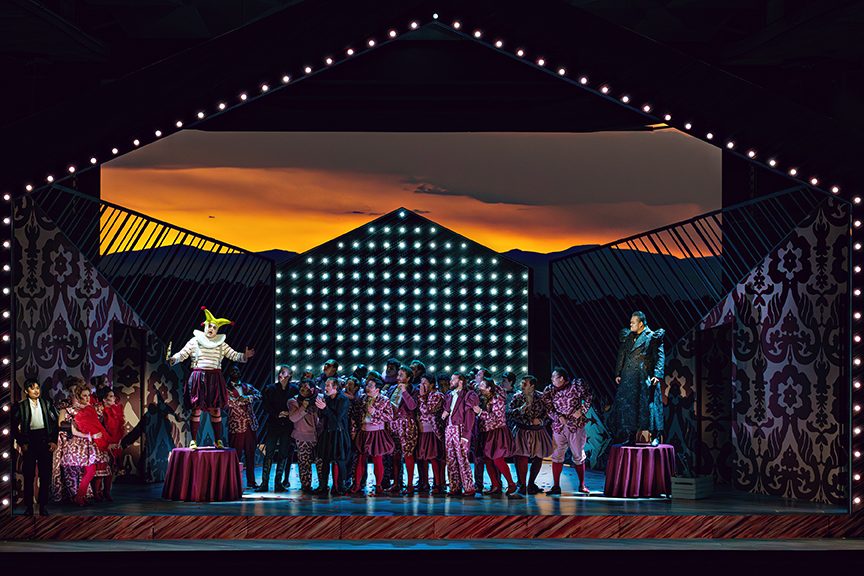
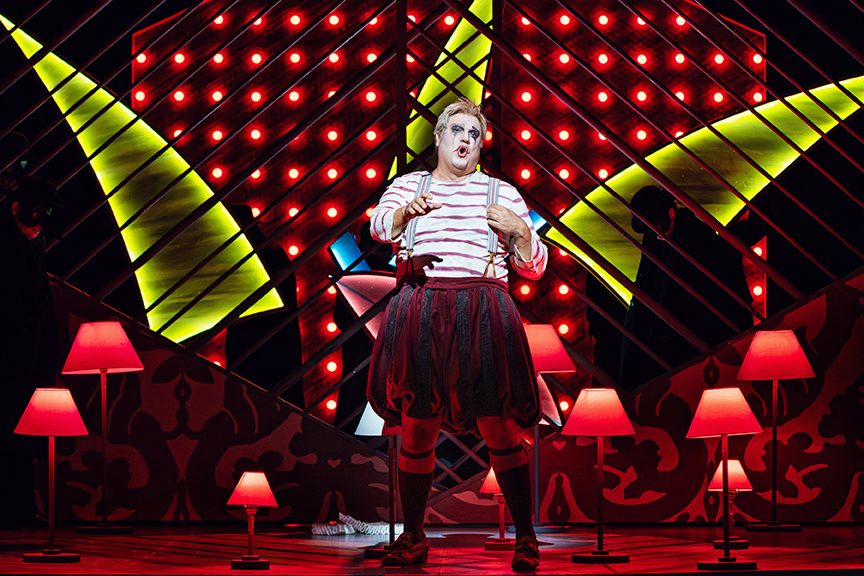
Santa Fe’s new production of Verdi’s Rigoletto opens on a carnivalesque scene: a chorus of courtiers dressed in stylized theatrical garb of mixed styles and periods, including Spanish breeches, Landsknecht jackets with slit sleeves, as well as shirts and pants of no discernible period. A few women sported Marie Antoinette gowns.
Front L-R: Duke Kim (Duke), Michael Chioldi (Rigoletto), Le Bu (Count Monterone), the Santa Fe Opera Chorus; photo by Curtis Brown for the Santa Fe Opera
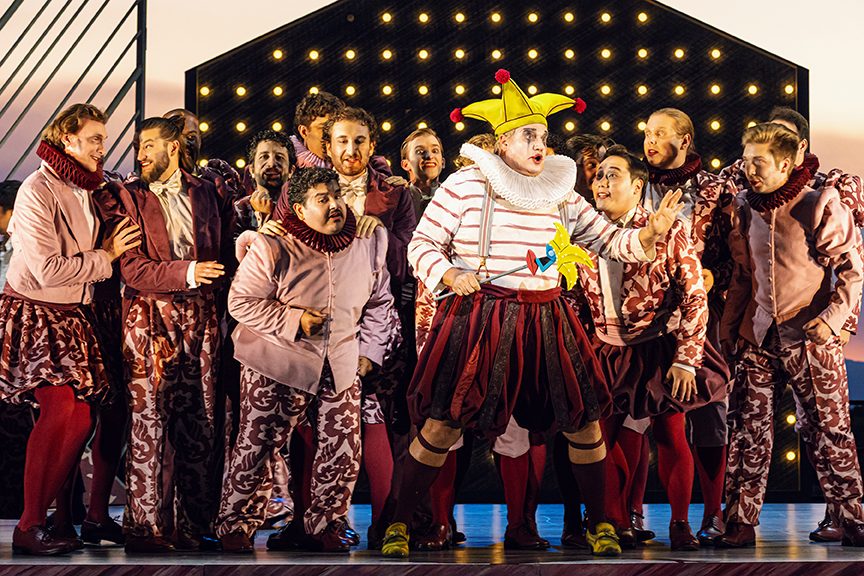
The dark violet color patterns of the essentially anonymous courtiers all match, while named characters—Merullo, Ciprano and the Duke of Mantua—are dressed in black and white. Some jackets clearly have zippers. Rigoletto wears garters with his socks and a stylized jester’s cap. In short, everything catches the eye, nothing pertains to any one period.
Rigoletto (Michael Child) with the decadent tribe of courtiers (The Santa Fe Opera Chorus); photo by Curtis Brown for the Santa Fe Opera
This eclectic mix in Jean-Jacques Delmotte’s costumes is matched by Julien Chavaz’s inventive stage direction where the opera’s high drama and tragedy is mixed with comic touches that lighten some scenes, but sometimes distract from the real business of the singers. The chorus of courtiers are not only dressed alike, they move in lockstep conformity. They move as a pack, sometimes going into silly choreographic moves, showing their inability to break from the decadent tribe at court.
Chavez goes so far as to lightly mock operatic conventions, as when Giovanna mugs to the audience during Gilda and the Duke’s amply repeated goodbyes. There quiet chuckles are welcome, as in the well considered interplay between the assassin Sparafucille and his sister Magdalena in the final act.
On the other hand, the silly choreography for the chorus while the Duke sings his praise of love in the second act is an unnecessary indulgence. The Duke’s aria represents a critical moment, revealing that he has discovered a kind of love from Gilda he has never seen at court. It does not redeem him, but makes him a more rounded person, and should not be downplayed for easy entertainment, whatever the symbolic depth. The same principle could have been applied elsewhere.
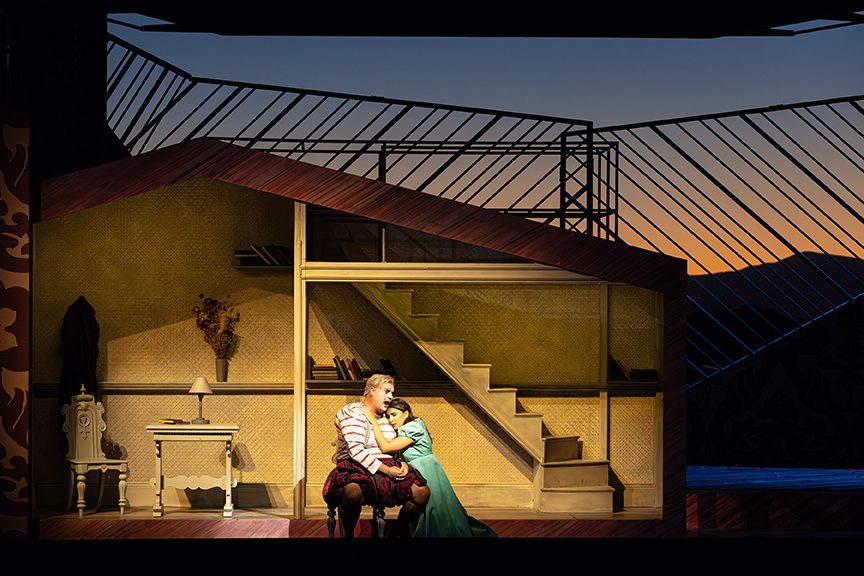
Designer Jaime Vartan’s set for the Duke’s court is abstract, with abstractly decorated mobile flats that are moved around the stage. Scattered among them are colorfully lit pieces that come together at the end to briefly outline the jester’s hat and face, and then disintegrate as the tragedy destroys Rigoletto. The interiors of Rigoletto’s home and Sparafucile’s “tavern” roll on from the wings. Their well designed contrast with the rest of the stage creates a space of warmth and safety in one case, danger and decadence in the other.
Michael Chioldi (Rigoletto), Elena Villalón (Gilda); photo by Curtis Brown for the Santa Fe Opera
Portable lamps are sometimes used realistically, as light for Gilda’s reading, but also abstractly, carried about by the courtiers representing—who knows, enlightenment? The meaning was not clear to me. Why, for example, is Gilda discovered at court after her abduction, upstage, surrounded by lamps that are then moved downstage when Rigoletto orders the courtiers out of the room?
If the design and direction are a mixed bag, the music definitely is not. From the very first notes on Aug. 7, conductor Carlo Montanaro and the Santa Fe Opera orchestra take the drama in their teeth. Beyond the ferocity of the opening and all references to the curse invoked on Rigoletto and the Duke, Montanaro led with consistent flexibility and expressivity in supporting the singers. Musically, this was one of the most gripping Rigolettos I have seen.
Duke Kim’s light tenor warmed and strengthened over the evening, reaching a high level of passion by the end. His Donna e mobile in the last act was exciting, and his duets with Gilda were wonderful. His portrayal of the privileged, devil-may-care nobleman was winning (or fittingly vile, if you will), both musically and dramatically.
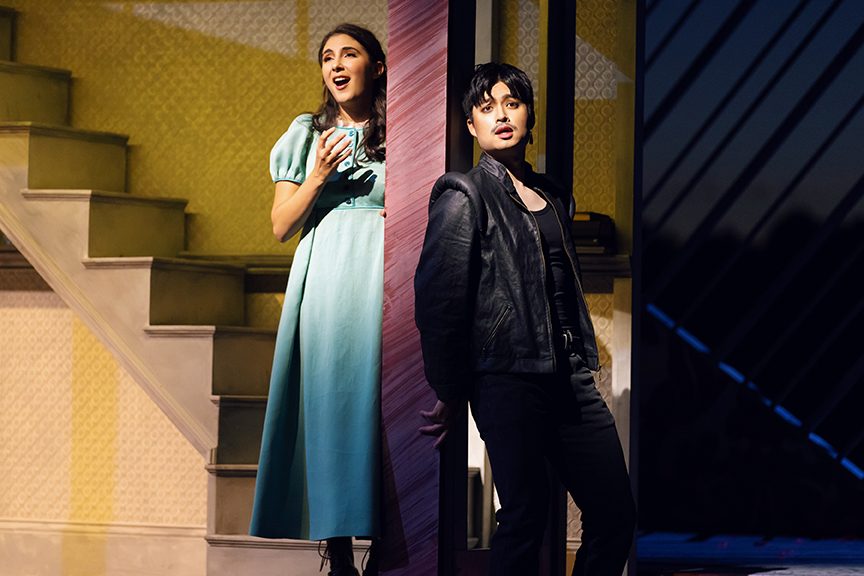
Elena Villalón (Gilda), Duke Kim (Duke); photo by Curtis Brown for the Santa Fe Opera
The star of the evening, as she should be, was the Gilda of Elena Villalón. Caro Nome was a moment of true beauty, and in every powerful duet—with Rigoletto and the Duke—she drove the drama to powerful heights. She carried a warm sound into the softest moments, beautifully holding out the longest phrases. Her acting was first rate, establishing her loving and confused relationship with her father. I particularly liked the touch of showing her reading, making her a full person, a young woman of genuine curiosity and thoughtfulness as well as innocence.
Michael Chioldi (Rigoletto); photo by Curtis Brown for the Santa Fe Opera
A late switch in the cast, Michael Chioldi as Rigoletto used his mature voice to establish a character of great experience and many woes. He mustered the power when needed to convey the depth of Rigoletto’s anguish; every exclamation of the curse was grim and powerful. His closing scene with the dying Gilda was chilling.
Stephano Park made a superb Sparafucile, summoning terror with his deep bass to the lowest note of his name. Marcela Rahal was equally telling as Magdalena, adding a flirtatiousness that fits the character and helps round out the final act. The interactions between brother and sister were more than just singing the notes; there was a touch of teasing in their bother-sister interactions that elicited a few light chuckles.
Le Bu sang the condemned Count Monterone “like thunder.” The named courtiers—Ryan Wolfe and Marcello, Korin Thomas-Smith as Count Ceprao, Mary Beth Zara’s as the perky page, and Ryan Bryce Johnson as Borja, all filled their smaller roles well.
The Santa Fe Opera production of Rigoletto will repeat Aug. 15 and 20. Tickets, if available, can be purchased HERE.
Opera productions seem to go through trends. That was certainly the case at the Santa Fe Opera this summer: of the five productions, only one—the world premiere of The Righteous by Gregory Spears, set in the 1980s—remained in the time period for which it was conceived. The other four—La Traviata, Don Giovani, Der Rosenkavalier and L’elisir d’amore—were shifted forward to more recent times. Proving that time shifts can work in the right circumstances, some of the productions worked very well in their updated periods. Others were less successful.
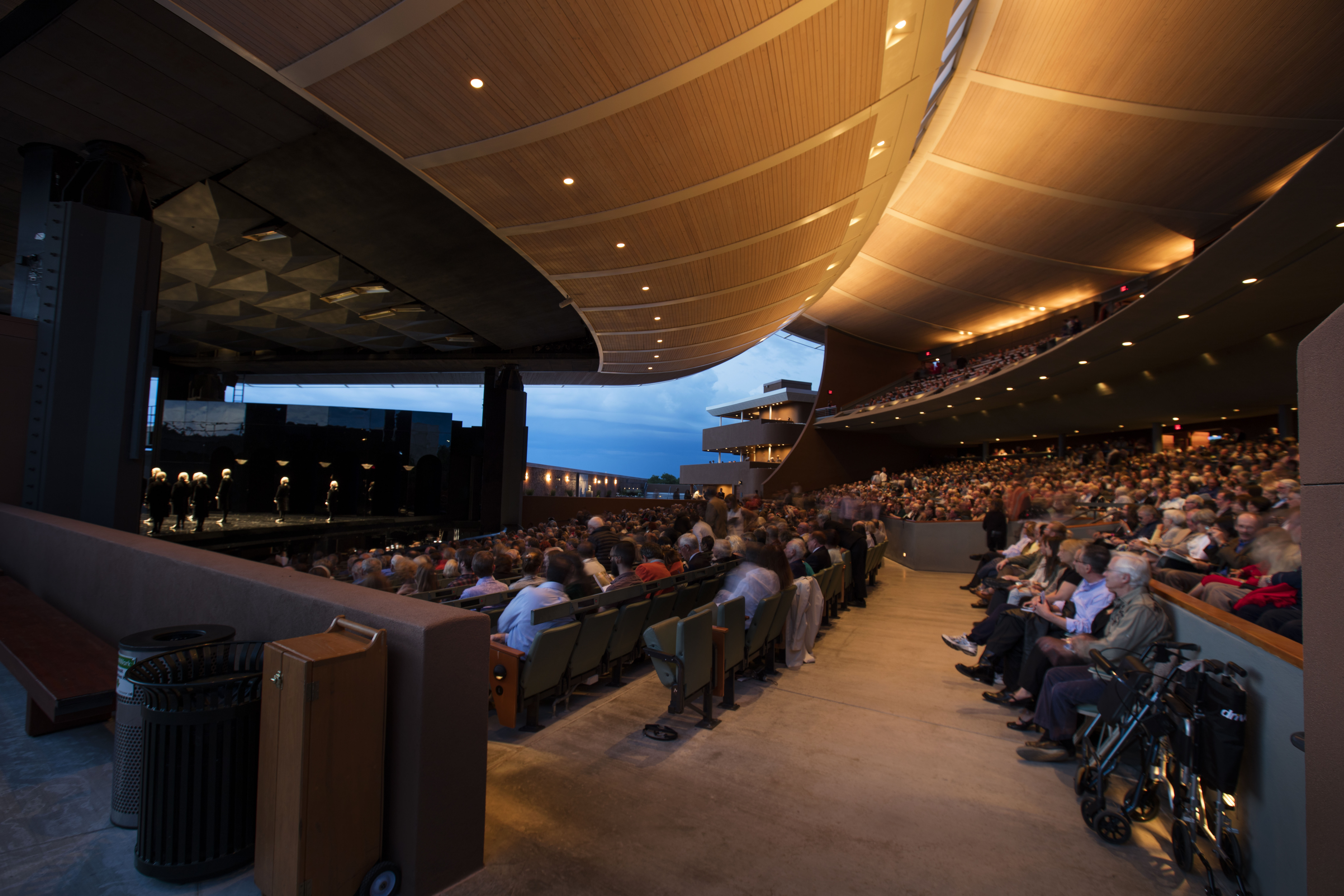
Opera night at Santa Fe. Photo by Kate Russell.
Verdi’s La Traviata, updated to 1930s Paris, is a glittering success in almost every way. Armenian soprano Mané Galoyan is as good a Violetta as I have seen. As Alfredo, Uzbekistan tenor Bekhzod Davronov matches her vocally very well. Stand-in Alfredo Daza, the Mexican baritone rounding out the international cast, is a powerful, if blustery, Giorgio Germont.
Conductor Corrado Rovaris brought out the Italianate nuances of the score without ever overpowering the singers. The performance I heard (Aug. 5) was filled with glorious, touching pianissimo singing, especially from Galoyan, and every word, every note was clearly voiced no matter how softly. Luisa Muller’s direction created a human drama where many productions are satisfied with conventional routine.
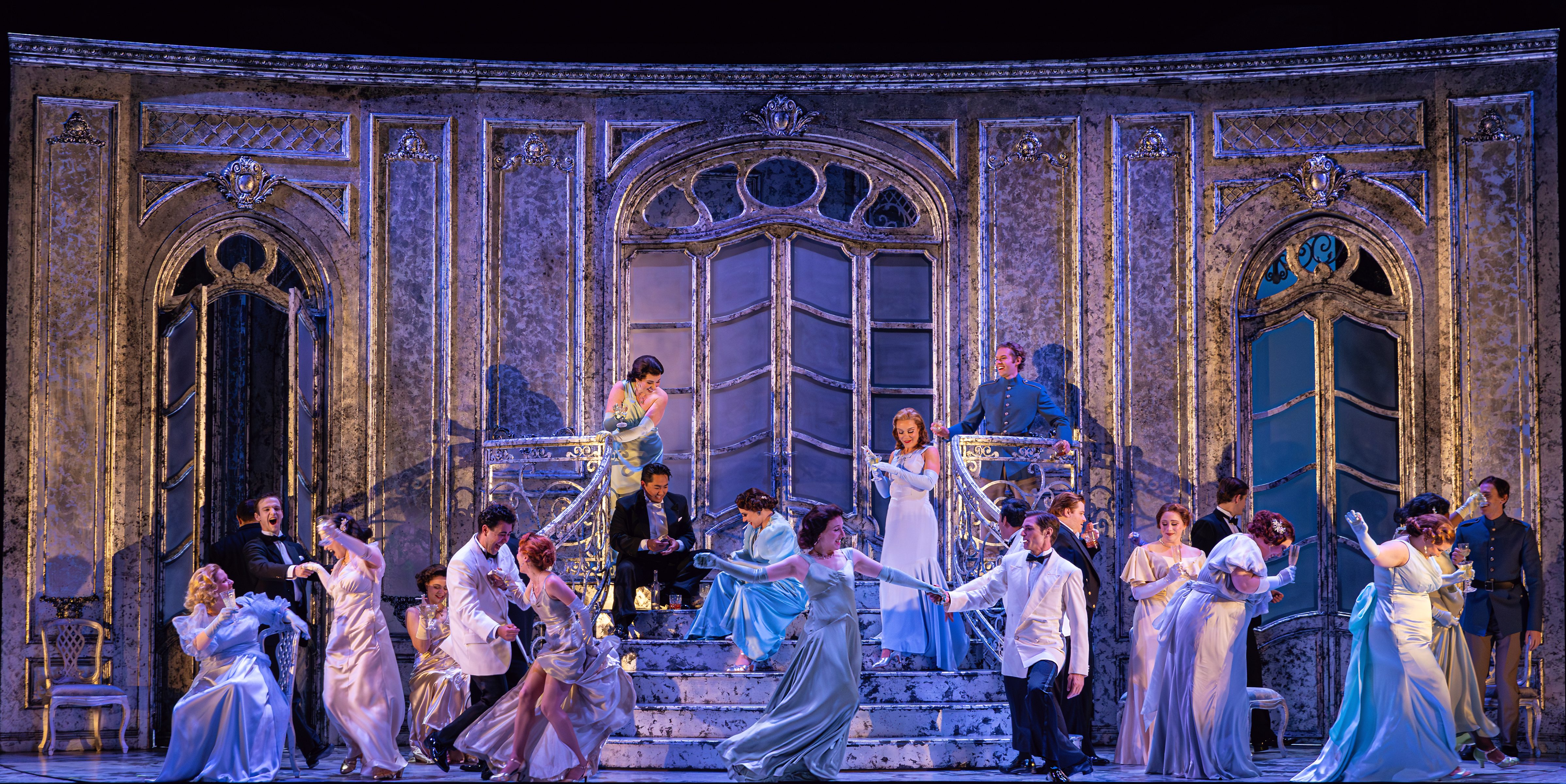
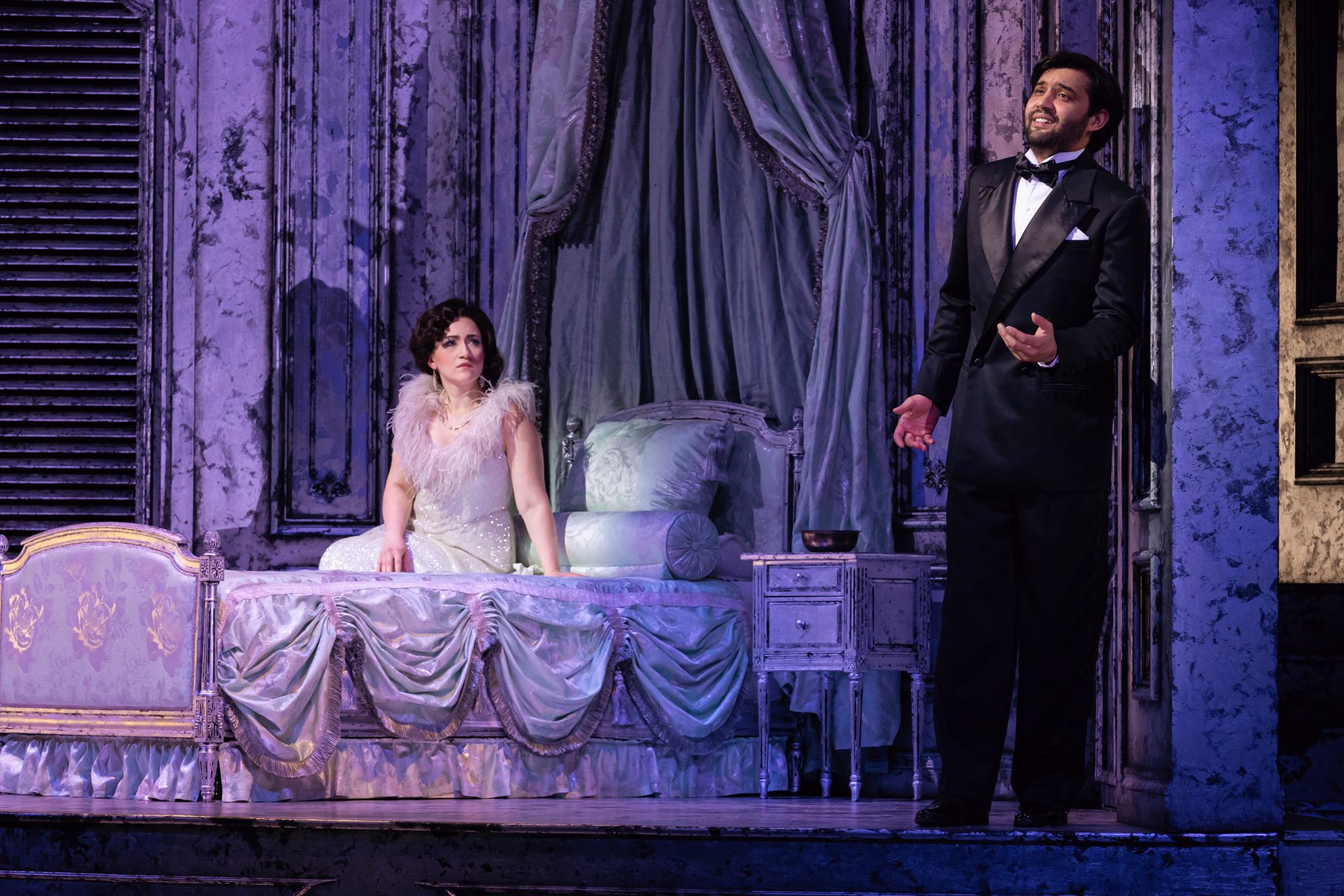
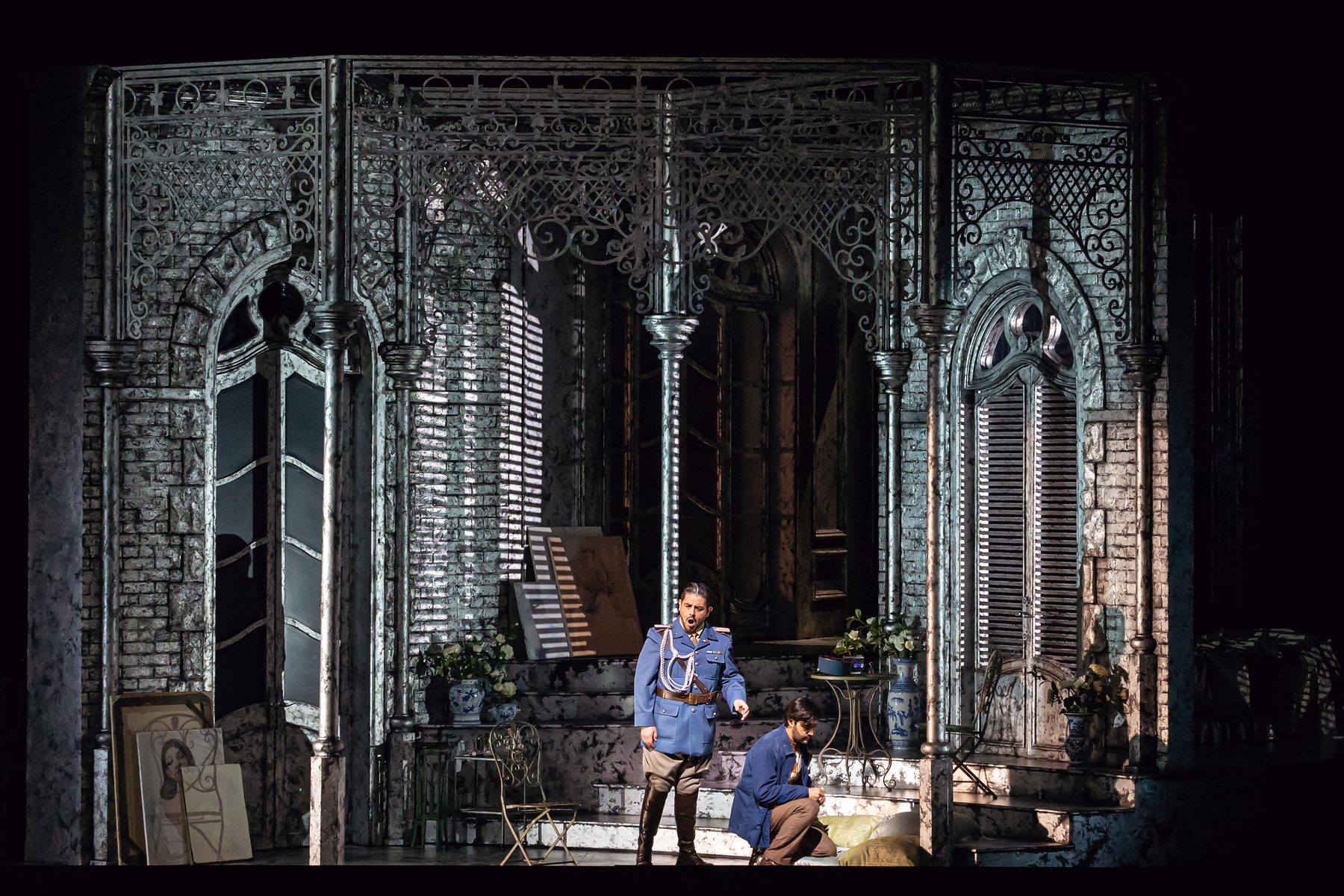
La Traviata set by Christopher Oram. Photo by Curtis Brown.
The set by Christopher Oram places evocative spaces on a turntable. The Parisian interiors are elaborately decorated in silver, with discrete lighting adding a touch of color. The rotating set is used strategically: in the first act, Violetta’s public scenes at the party are placed in an ornate salon, while her private moments and scenes with Alfredo move smoothly to an interior bedroom, a contrast that sets up the following scenes with the public alternating with the private. The lovers’ country retreat is appropriately rustic, neither too grand nor too shabby. The sets and costumes adhere carefully to the 1930s aesthetic.
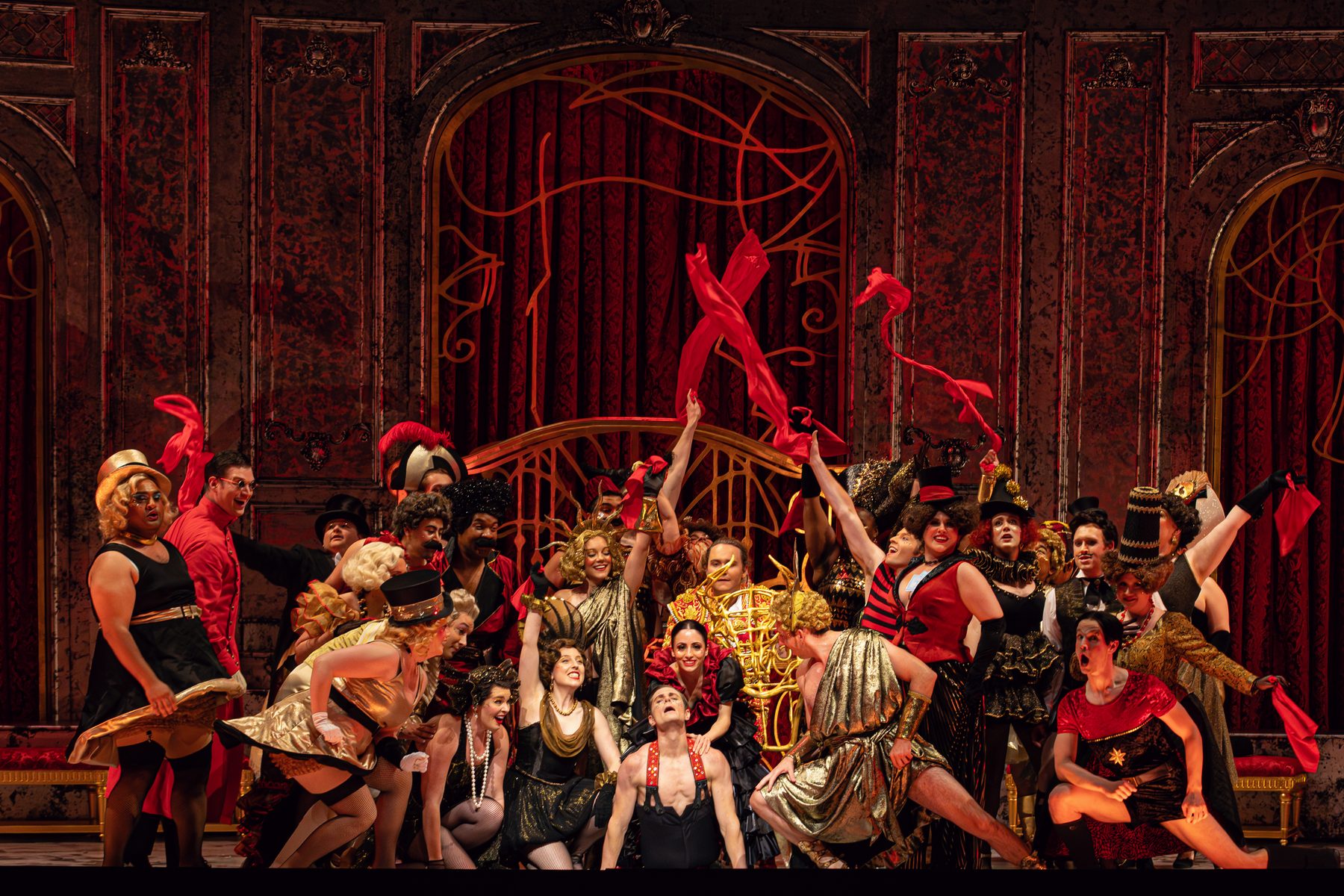
Santa Fe Opera chorus, Act II Scene 2 at Flora Bervoix’s costume party. Photo by Curtis Brown.
A special word for Act II Scene 2, at Flora’s party: Decorated in bright reds, it is a satanic costume party, with characters in various outrageous costumes. Intentionally over the top, the scene evokes every American conception of the Paris of Hemingway, Pound and les années folles (the crazy years) when the arts flourished in spite of a worldwide depression. After the restrained colors of the previous scenes, this hits like a blow to the face, creating exactly the shock that Violetta’s return to her life of decadence implies.
For all the strengths of the production, it is Galoyan’s Violetta that makes the greatest impact. Her bright, focused voice suits the role ideally. Her acting was on a par with her emotive singing, ranging from piercing moments of fury to heartrending fragility. Her delicate pianissimos carried easily and never lost nuance, or flattened out to expressionless undertones. Her most effecting moments were in the second and third acts, when she is overcome by the tragic fate that she can see coming. At the end, her frailty was made tragically real in her singing.
Mané Galoyan (Violetta) and Bakhzod Davronov (Alfredo). Photo by Curtis Brown.
In her director’s notes, Muller describes Traviata as a memory play, with the coming (or remembered) events suggested in tableaux during the Prelude. Violetta, she writes, is “a woman in command of her life choices” who “knows that the end of her life is approaching.” Both the staging and Galoyan’s performance reinforce that conception, making Violetta the emotional center of the opera. The life of a 19th-century courtesan seems remote today, but this is a Violetta current audiences can connect with.
Davronov sang strongly, with a ringing tone that matched well with Galoyan in their duets. If his acting was stiff in the country house scene, that is partly due to the limited space in the set. He sang with great expression and his tragedy was palpable by opera’s end.
Alfredo Daza (Giorgio Germont) and Bakhzod Davronov (Alfredo Germont). Photo by Curtis Brown.
Costumed as a military officer, Daza was an imposing figure, and his large baritone voice commanded the stage from his entrance. He was never a sympathetic figure in his long scene with Violetta, but he is not meant to be. Booked for Dulcamara in l’Elisir d’amore, he has sung Germont before and so was an obvious person to take over the role, which he filled admirably.
Sejin Park was appropriately arrogant as Baron Douphol. Elisa Sunshine sang well and understands her limited role as Violetta’s faithful maid Annina. Kaylee Nichols has a strong voice but didn’t seem dissolute enough for the scandalous Flora Bervoix.
The orchestra played admirably, following Rovaris’s expressive rubatos and supporting the singers well through the softest moments. The party-scene choruses were full voiced and strong, contrasting powerfully with the delicate and reflective moments of the lead singers—another level of contrast between the public and private lives of the characters.
This production, and the performance I saw, would stand out in anyone’s season. In a long history of memorable operas at Santa Fe, it is a production worth seeing and remembering.
* * * * *
The production of Mozart’s Don Giovanni(seen Aug. 6) has been transported to Victorian-era London. In some ways this works well, but in other ways, not.
The updating was inspired largely by the coincidence that Don Giovanni and Dorian Gray of Oscar’s Wilde’s novel The Picture of Dorian Gray share the initials DG, and that both pursue a life of hedonism. Beyond those superficial similarities, it is certainly true, as director Stephen Barlow points out in his notes, that both the world of Don Giovanni and Victorian England were class-bound societies. In the opera, each member of the cast is defined by their standing as nobility or peasantry, impenetrable social levels identified in the music. These musical distinctions put class, which would have been immediately clear to Mozart’s audience, at the heart of the opera, as it was to lives in Victorian England.
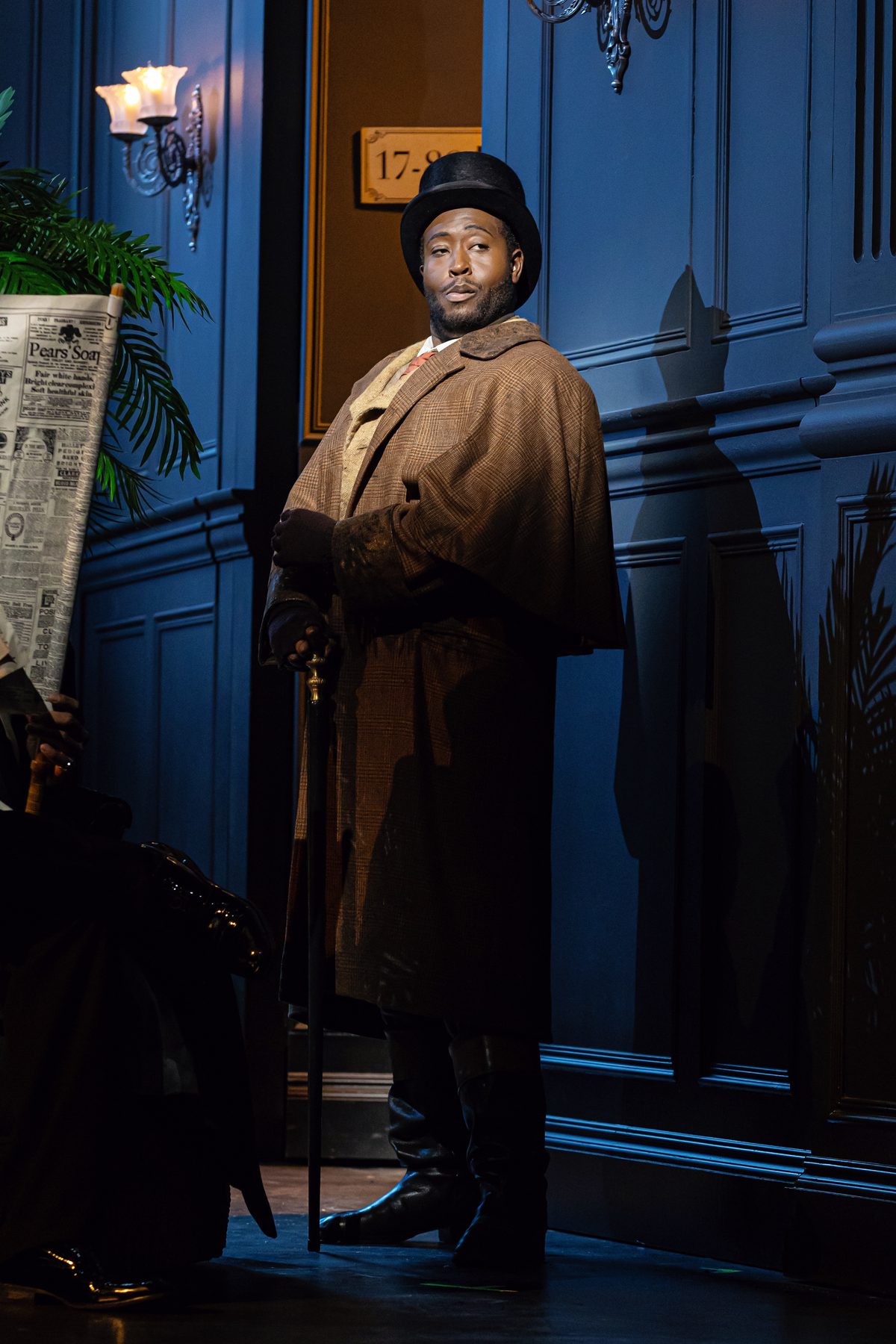
Leporello (Nicholas Newton) in Victorian London. Photo by Curtis Brown.
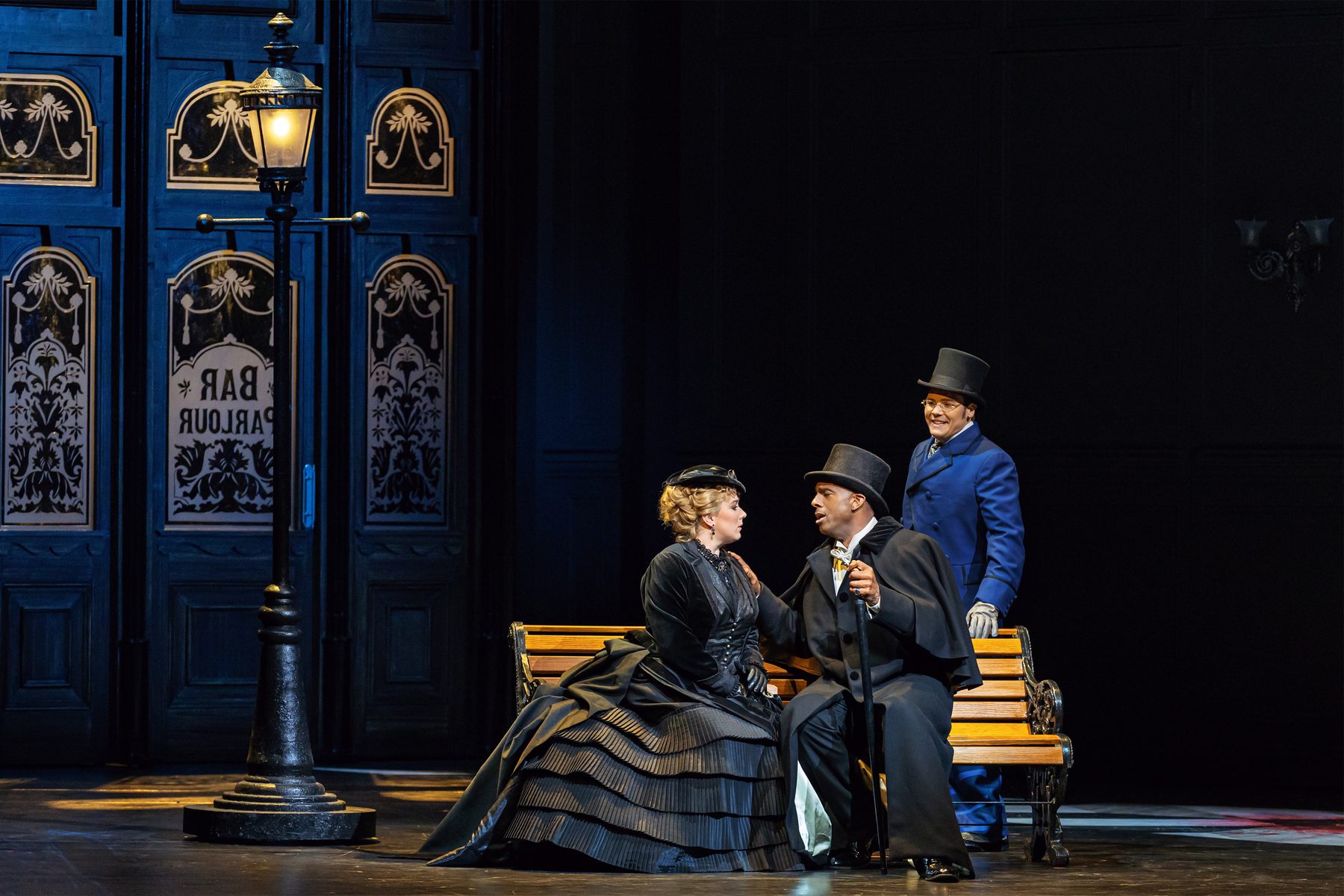
But in other ways, the updating is less successful. To maintain the transformed setting, Don Giovanni sings “Come to your window, my treasure” sitting in the lobby of a posh hotel. Instead of a graveyard, Giovanni “leap(s) over the wall” into an enclosed funeral parlor. And in a particularly baffling decision, there is no statue, only a casket sitting on a pedestal. Leporello sings of the immobile casket, “He looked at us.” There is no statue at all—a consistent feature of Don Juan mythology for centuries—in the final scene. The Commendatore enters through a picture frame as a ghost, again making nonsense of the sung text.
Some of the seat-back English titles strayed from the literal to contribute to the Victorian ambience. “Listen, guv,” Leporello sings to Giovanni, and the “Champagne Aria”—literally “As long as the wine warms the head”—has no mention of wine.
One other quibble: If Giovanni is an English Lord ravishing the women of London, why is England not mentioned in Leporello’s “Catalogue Aria”? And what’s the big deal with Spain? Or do we not expect the stage action to correspond to the text in concept productions?
But the musical performance was strong throughout. Conductor Harry Bicket led a stylish if unhurried performance, sometimes bordering on sluggish. To its credit, the orchestra followed his expressive direction faithfully. Once under way, the strings played with clean ensemble, and the horns sounded particularly bright.
Rachel Fitzgerald (Opening night Donna Anna), Ryan Speedo Green (Don Giovani) and David Portillo (Octavio). Photo by Curtis Brown.
Ryan Speedo Green, one of the leading baritones worldwide, was an ingratiating, seductive Giovanni. His voice, while used expressively, is almost too strong for the part. At times he struggled to keep it under control, and balance with Zerlina and other light-voiced characters was occasionally askew. He delivered all the hedonistic enthusiasm needed for the “Champagne Aria,” and made Giovanni a totally assured libertine.
Rachel Willis-Sørensen, engaged for the the Marschallin in Der Rosenkavalier and standing in as Donna Anna, was another singer who seemed at times out of her fach. Her strong, steely voice tended to get away from her at phrase climaxes, but she effectively conveyed the opera’s most tragic character. She was equally capable of expressively weighty tones and pure, bright high notes.
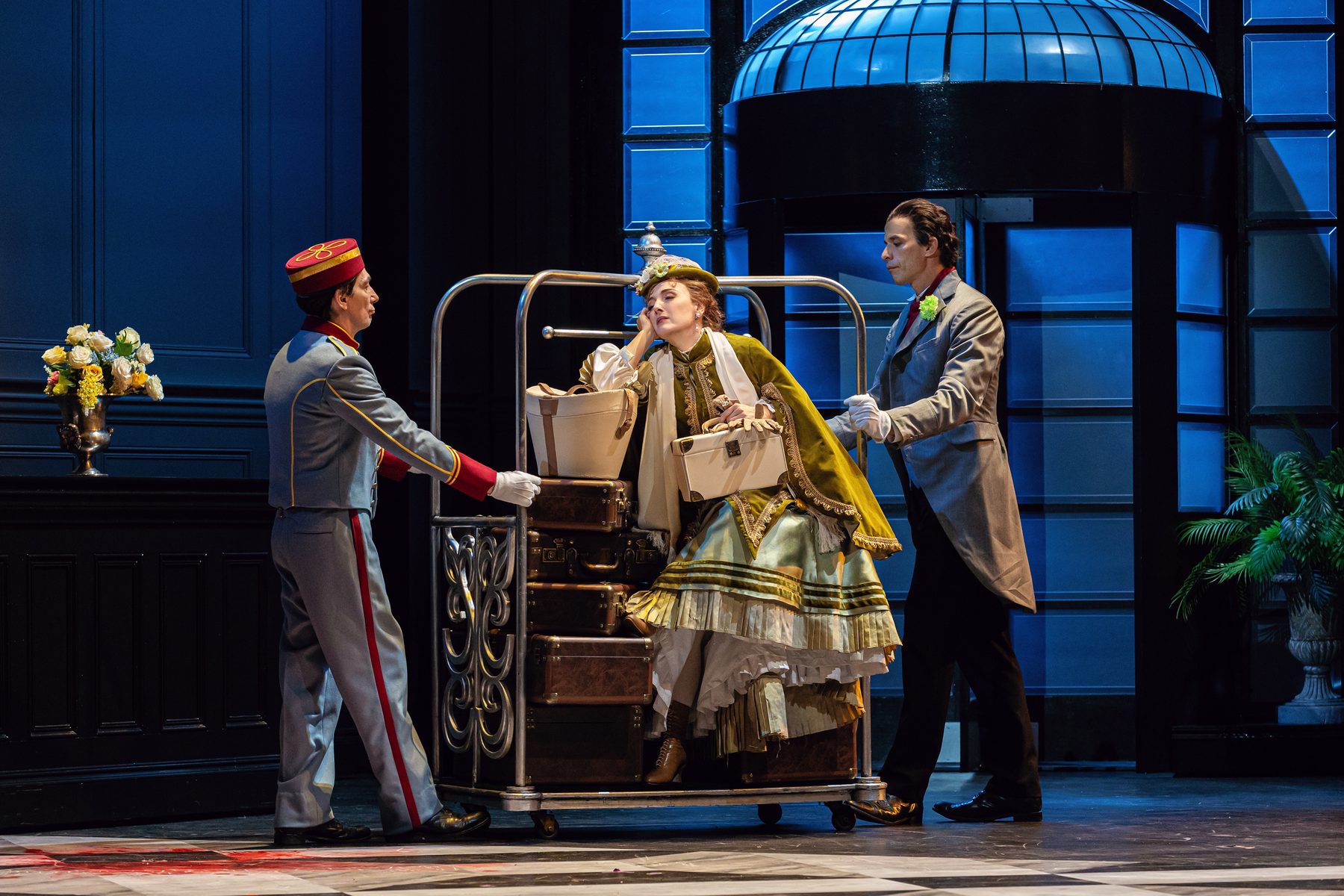
Donna Elvira (Rachael Wilson) and her luggage. Photo by Curtis Brown.
Rachael Wilson’s Donna Elvira was the very essence of the scorned woman. Her dramatic performance and assured singing made Elvira the central character of the unfolding drama, both strong in her confrontations with Giovanni and tragic in her repeated humiliations. She handled the seria aspects of her role with aplomb, with a few stumbles across registers.
Nicholas Newton provided a good comic performance as Leporello. His “Catalogue Aria” was thoroughly entertaining, as he embraced the comic emphasis of the production. David Portillo’s pleasant, light tenor is well suited to the role of Don Ottavio, even though he showed signs of fatigue by the end of a very long opera.
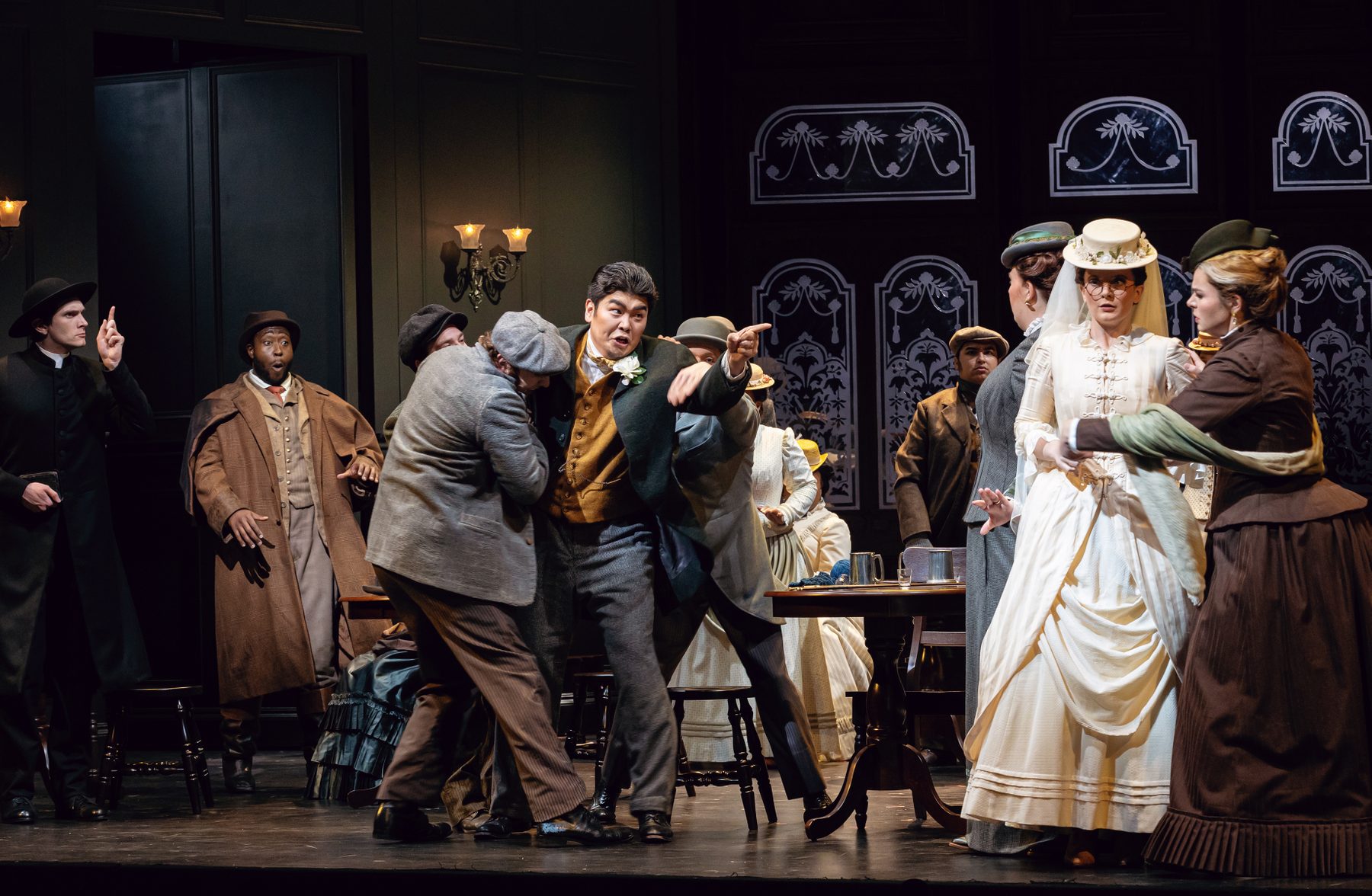
The peasant’s wedding party: William Guanbo Su (Masetto, center), and Liv Redpath (Zerlina, right). Photo by Curtis Brown.
Liv Repdpath was a sweet voiced Zerlina, capturing the character’s innocence well. William Guanbo Su portrayed an angry Masetto whose reconciliation with Zerlina seemed out of reach until the very end. Solomon Howard’s rotund bass suited the Commendatore perfectly.
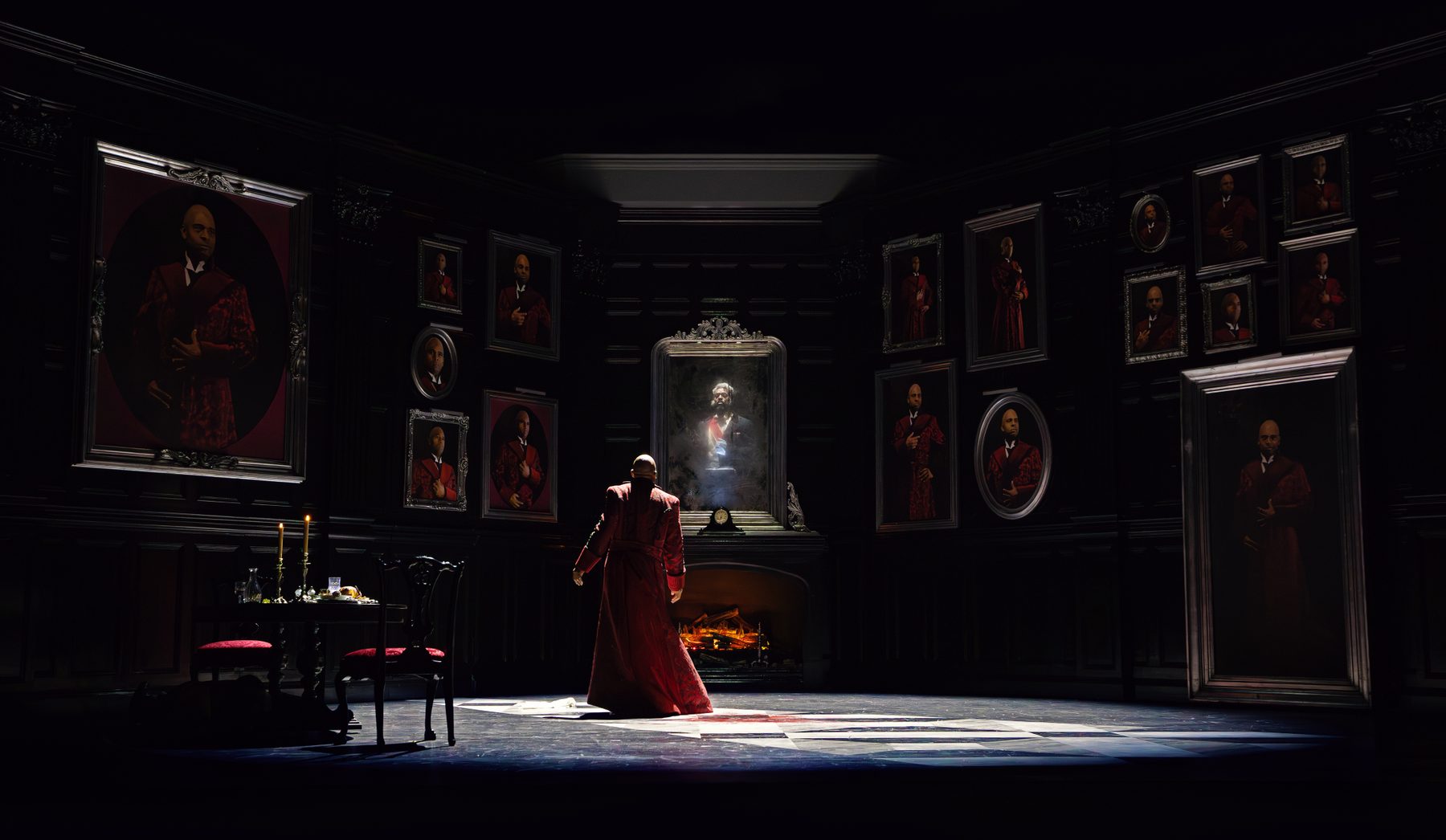
Other notes on the production: a creative set with rotating panels created seamless scene transitions. Don Giovanni’s salon, with walls covered in portraits of the Don recalled the production’s inspiration in The Portrait of Dorian Gray at the same time that it confirmed Giovanni’s narcissism.
A red spot on the floor, marking where the Commendatore dies in the first scene, became a meaningful symbol. From one scene to the next, efforts to scrub it out always failed.
Don Giovanni (Ryan Speedo Green) is confronted by the ghost of the Commendatore (Salomon Howard) in his picture gallery. Photo by Curtis Brown.
Barlow’s production stressed the comic elements of the plot—the opera is labeled a drama giocoso, “comic drama”—but sometimes the resort to burlesque distracted from the singing. The most egregious example was the beginning of Act II, where some clumsy humor with luggage in the background distracted from Elvira’s mournful “Ah taci, ingiusto core.”
I’m not sure what the British Bobby contributes to the last scene, except that it recalls Ottavio’s promise to bring Giovanni to justice. Which raises the question: is the Victorian setting, evoked by Bobbies and street lamps as well as costumes, too familiar to audiences from television? This is not Downton Abbey. I wonder what expectations are raised with such clear signposts in the production.
The Santa Fe Opera Season continues through Aug. 24. A few tickets are still available for some performances. For information and tickets, visit the Santa Fe Opera box office HERE.
‘One of the greatest Italian ensemble operas’ Friday and Sunday
By Peter Alexander Oct. 25 at 5:40 p.m.
“Reverenza!”
That extravagant one-word greeting delivered by Mistress Quickly to the corpulent Sir John Falstaff (“Your reverence!”) sets off all the madcap action of Verdi’s final opera, the comedy Falstaff. A series of hilarious escapades follow, leaving Falstaff dumped in the river at the end of the second act and the butt of a comedic thrashing in the third. In spite of the abuse, it all ends with Falstaff cheerfully proclaiming “All the world’s a jest.” The entire cast joins him for, of all things, a rollicking 10-part fugue.
Melissa Lubecke (Alice Ford) and Andrew Hiers (Falstaff) in Eklund Opera’s Falstaff. Photo by Leigh Holman.
Falstaff will be the fall production of the CU College of Music’s Eklund Opera Company, with performances this coming Friday and Sunday in Macky Auditorium (Oct. 27 at 7:30 p.m., Oct. 29 at 2 p.m.; tickets available HERE). Performances are stage directed by Leigh Holman and conducted by Nicholas Carthy.
The opera is derived from Shakespeare’s Merry Wives of Windsor. Verdi had already retired twice when his publisher passed him the libretto, crafted by the Italian composer Arrigo Boito who also wrote the libretto for Verdi’s Otello. Verdi couldn’t resist, and Falstaff had its premiere in February 1893, when the composer was nearly 80.
The opera has two intertwining plots: Falstaff is trying to woo two wealthy wives in order to get at their fortunes; and one of their husbands, Ford, wants to marry his young daughter Nanetta to his friend Dr. Caius. She, however—in typical comic-opera fashion—is in love with someone her own age, Fenton. And also in comic-opera fashion, the women are far cleverer than the men and hilariously foil both plots.
Falstaff is seldom performed by student opera companies. For one thing, the role of Falstaff requires an experienced singer. As Carthy explains, this is an opera “where, if we get one person in, we can cast around them. So you bring a Falstaff in and it allows you to do one of the greatest Italian ensemble operas there is. Bringing in that one person is a fantastic opportunity to do something (the students) wouldn’t normally do.”
Andrew Hiers. Photo by Anthony Perez.
Eklund Opera has engaged Andrew Hiers (pronounced “hires”), who has performed with the San Francisco Opera Merola program, Opera Colorado, and the St. Petersburg (Fla.) Opera, to sing Falstaff. “He’s really good,” Holman says. “It ups everything a level, both in that it allows the students to do an opera that they might not otherwise be able to do. But also in what he brings, the experience that he has.
“He’s a really great actor, and the students are learning a lot working beside him. Every rehearsal, he’s just going, going, going, never complains, he’s just going. And it’s great for (the students) to see that.”
Other than Falstaff, Holman says, “We had all the other forces, including Quickly, who’s an artist diploma student”—Jenna Clark. That could be a difficult role to cast with students, but Holman says, “she’s really got the gravitas and the voice to pull that off.”
Another challenge is the breakneck pace of the music. “It’s a massive challenge for everybody,” Carthy says. “You don’t have time to do anything before something else comes along. It’s very tough, and we rarely have that sort of pacing in an opera. We’ve done Bohème and Traviata, but even Bohème doesn’t have that wickedness of pace that Falstaff does.”
“I would say the same thing,” Holman says. “It’s a difficult piece. As the director there’s just a lot coming at you.”
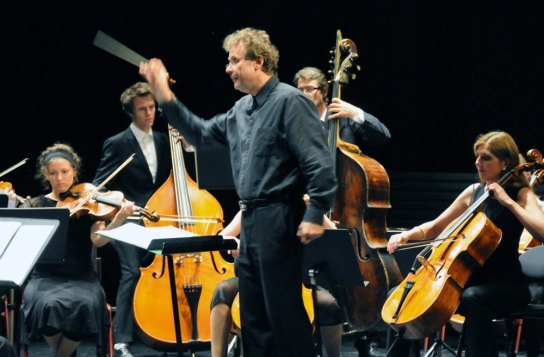
Nicholas Carthy
Carthy points out that the same is true for the orchestra and conductor. “Getting a mostly undergraduate orchestra, many (of whom) have never been in a pit before, to play Verdi or anything approaching Falstaff, is always going to be a challenge,” he says. “It’s this massive challenge to coordinate, but that‘s what I love doing that’s what I’ve spent my life doing.”
After all of Verdi’s dramatic, tragic operas, the speed and lightness of Falstaff is surprising. “It’s got more words, more notes, more melodies than anything else he ever wrote. It’s unlike his other operas in that it’s through-composed—it’s not arias and set pieces,” Carthy says. That lack of arias meant that Falstaff was not an immediate success, but the overall richness of Verdi’s invention has won over critics and musicians alike.
A good example is the love music between Nanetta and Fenton. He has one aria, but otherwise their scenes together are brief, made up of highly distilled lyrical expressions of love that are gorgeous but only last a minute or two. “It’s as if Verdi decided that he had trunks full of melodies to get rid of,” Carthy says. “And so he just threw them all at this thing.”
In Holman’s opinion, this is a do-not-miss performance. “We have wonderful singers with an amazing sense of humor and an amazing sense of comic and dramatic timing,“ she says.
“You’ll laugh the whole time!”
# # # # #
CU Eklund Opera Program Leigh Holman, director Nicholas Carthy, music director
One world premiere, one company premiere, and three favorites
By Peter Alexander Nov. 5 at 11:40 p.m.
The Santa Fe Opera (SFO) has announced their 65th summer festival season, scheduled for July 1 through Aug. 27, 2022.
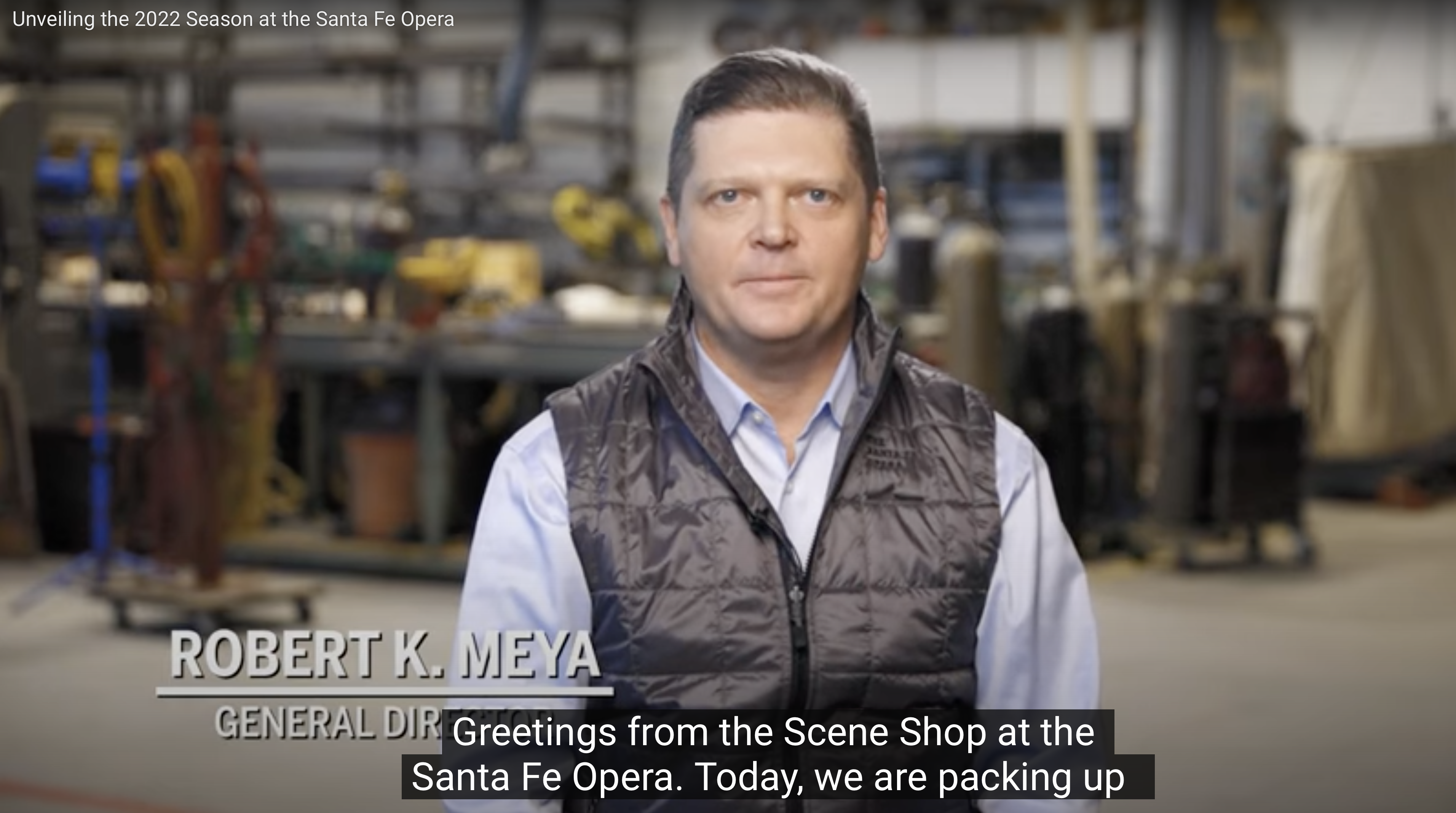
Robert Meya announcing the Santa Fe Opera’s 65th season
The festival will feature a world premiere and a company premiere, as well as three operatic favorites. The announcement was made by SFO general director Robert K. Meya on Thursday, Nov. 4.
Following last year’s reduced season of four productions, the company returns to a full season of five different operas, played in repertoire throughout the summer.
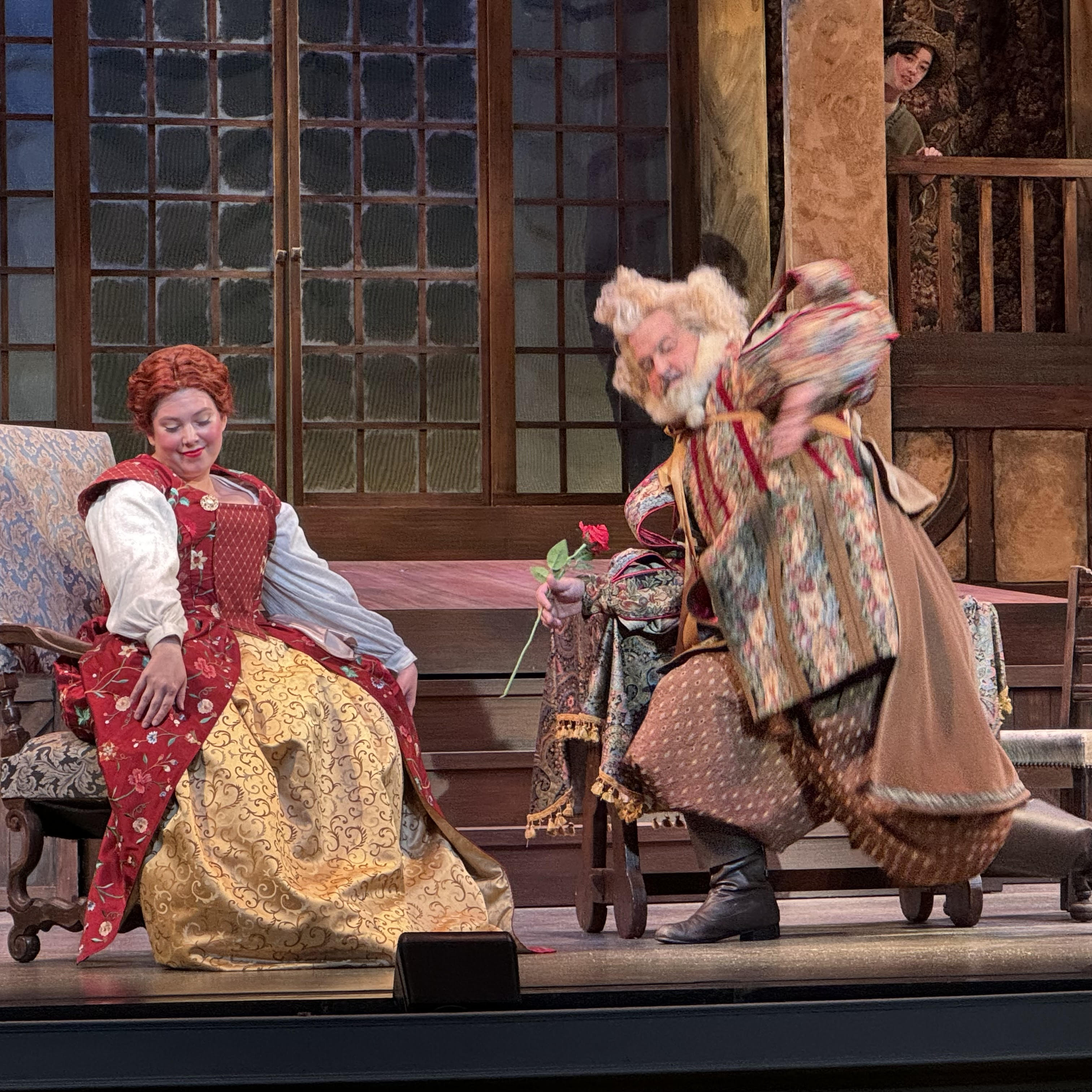
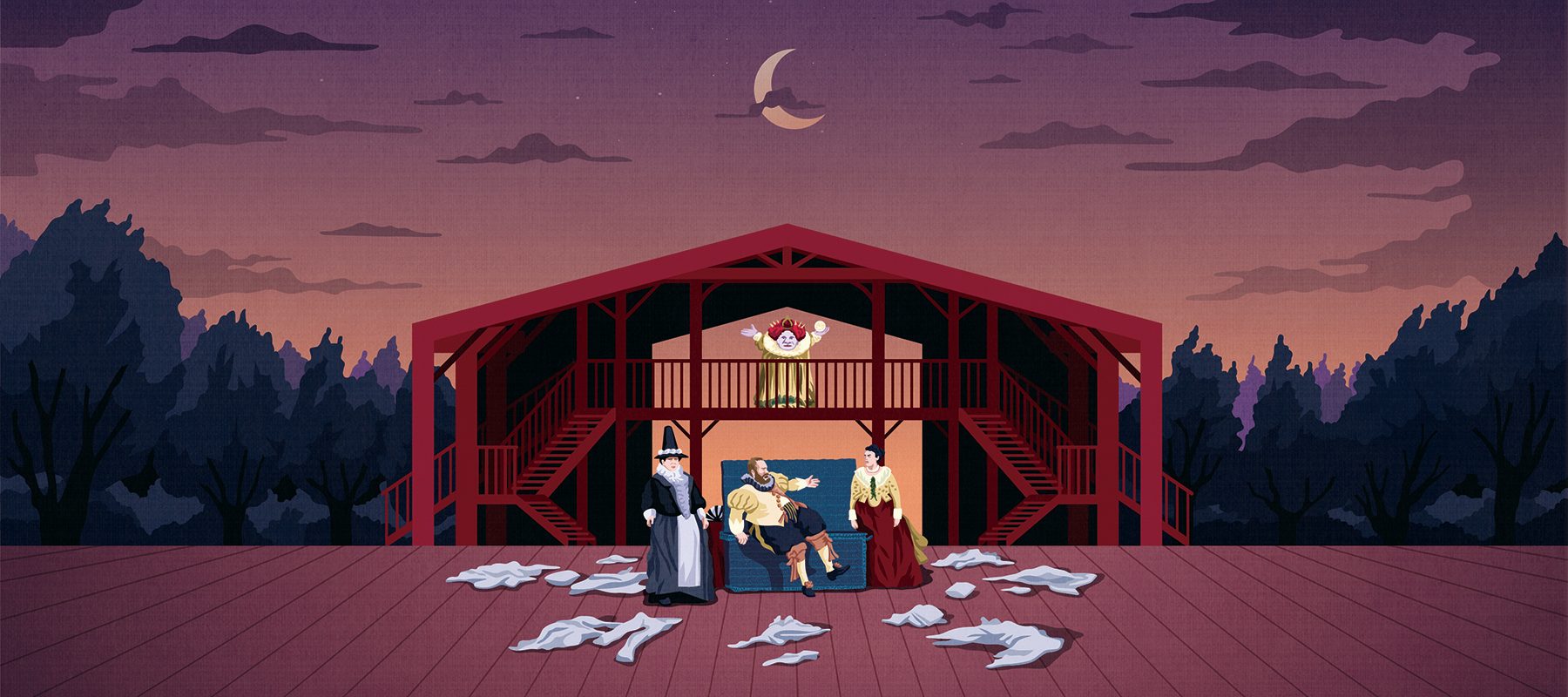
The first of the operatic favorites to be performed in 2022 will be Bizet’s Carmen, opening the season on July 1. That will be followed by Rossini’s Barber of Seville on July 2 and Verdi’s Falstaff on July 16. A co-production with Scottish Opera, Falstaff will be presented in Sir David McVicar’s production, which is set in a wood structure resembling an Elizabethan theater of Shakespeare’s time.
Next in the summer’s rotation will be the company premiere of Wagner’s Tristan und Isolde. This will be the first piece by Wagner to be presented at the SFO since The Flying Dutchman in 1988, and the only Wagner to be presented other than Dutchman. Some performance start times at the SFO shift over the summer season, due to changing times of sunset, but due to length, all performances of Tristan und Isolde will begin at 8 p.m.
Rounding out the summer season will be SFO’s 18th world premiere, M. Butterfly, based on the 1988 Tony Award-winning play by David Henry Hwang, who is also the librettist, with music by Huang Rao. The play and opera were inspired by the true story of a French diplomat who carried on a 20-year affair with a star of the Peking Opera without discovering his lover’s remarkable secret. The production of this new work will recall the SFO’s productions of Puccini’s Madama Butterfly, the opera that has opened all three of the company’s theaters, in 1957, 1968 and 1998.
Promotional art for the Santa Fe Opera/Scottish Opera production of Verdi’s Falstaff
Further information and the full calendar of performances are available at the Santa Fe Opera Web page. Both season subscriptions and individual performance tickets are now on sale through that portal, or by calling the box office at 505-986-5900 9 a.m. to 5 p.m. Monday through Friday (toll-free 1-800-280-4654). Currently, the SFO plans to require proof of vaccination or a negative COVID test for all patrons 12 or older. Full details of the SFO health and safety policies and any updates can be found here.
CU production of La traviata will be in Macky Auditorium Oct. 22–24
By Peter Alexander Oct. 22 at 11:43 a.m.
Nicholas Carthy describes La traviata as “the perfect Verdi opera.”
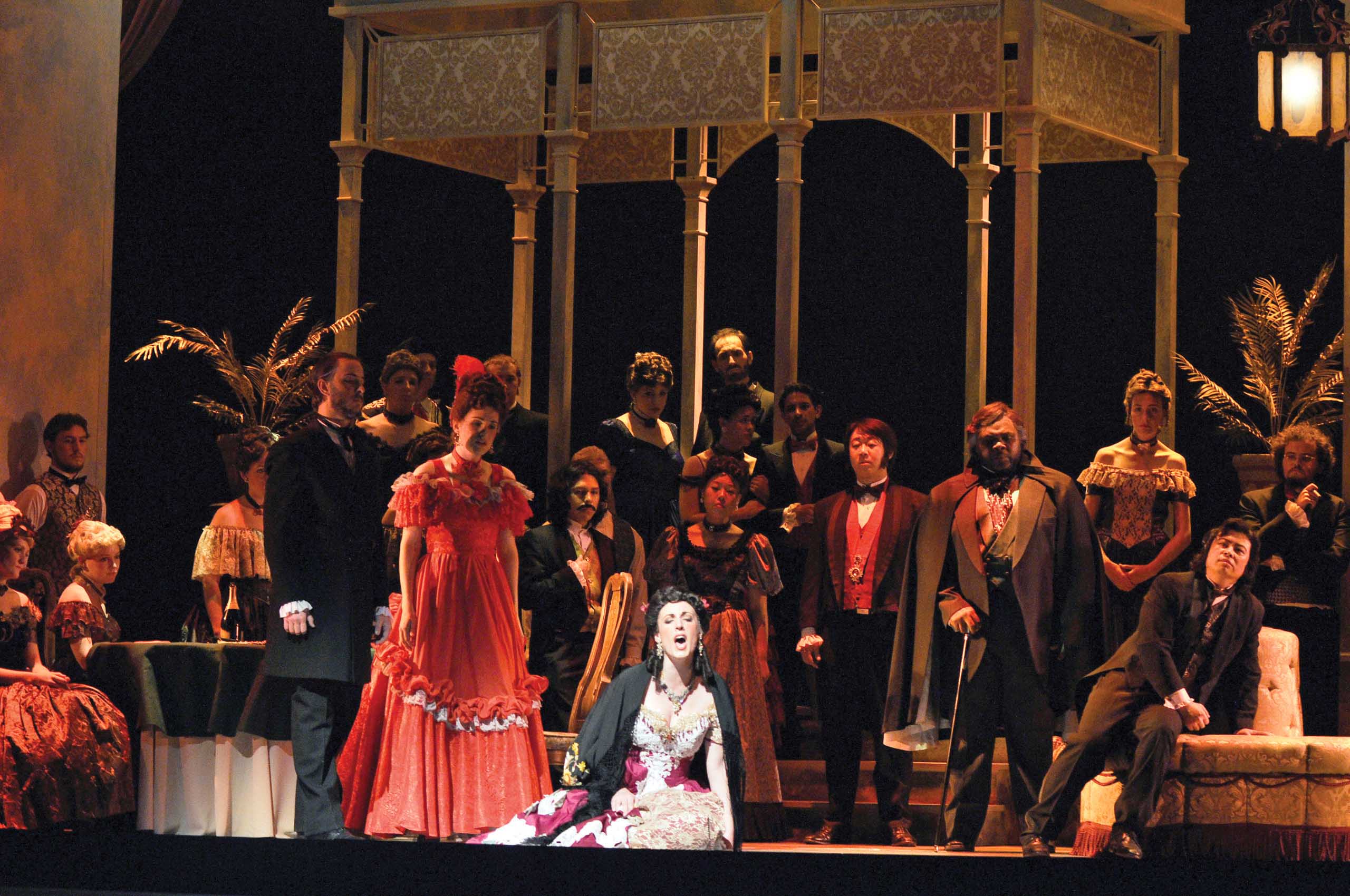
Certainly one of the best known and most loved operas, La traviata is a production of the CU Eklund Opera, to be presented in Macky Auditorium at 7:30 p.m. Friday and Saturday, Oct. 22-23 and 4 p.m. Sunday, Oct. 24. As music director, Carthy will conduct the performances by student singers and the CU orchestra. Leigh Holman, director of Eklund Opera, is the stage director.
The performances will be sung in Italian with projected titles in English. Tickets for all performances are available from the CU Presents Web page. Masks are required in all public indoor spaces on the CU Boulder campus, regardless of vaccination status.
The performances will be sung in Italian with projected titles in English. Tickets for all performances are available from cupresents.org/performances. Masks are required in all public indoor spaces on the CU Boulder campus, regardless of vaccination status.
Photo courtesy of Eklund Opera
Based on the 1848 novel by Alexandre Dumas the younger La Dame aux camélias (The lady of the camelias), La traviata tells the tragic story of Violetta, a high-society courtesan who falls in love with Alfredo, a young man from a respectable family. Alfredo and Violetta move together to the country in search of a quiet life together.
Because of Violetta’s status as a social outcast, Alfredo’s father demands that she leave Alfredo, to clear the way for his younger daughter to have a respectable marriage. Under pressure, Violetta returns to her prior life in Paris, but she is suffering from tuberculosis, which took the lives of a quarter of the adult population of Europe in the 19th century.
The social issues of 19th-century Paris may seem remote, but Carthy says they are easy for today’s students to understand. “The idea of a disease that kills, and a family that disapproves is not terribly far away,” he says.


 Sharps & Flatirons