CU New Opera Workshop presents a show in search of a title

Portions of a new work—for now The Calling—will be performed June 16 & 18

By Peter Alexander June 14 at 11:25 a.m.

Composer Tom Cipullo is seeking a name for his new opera.
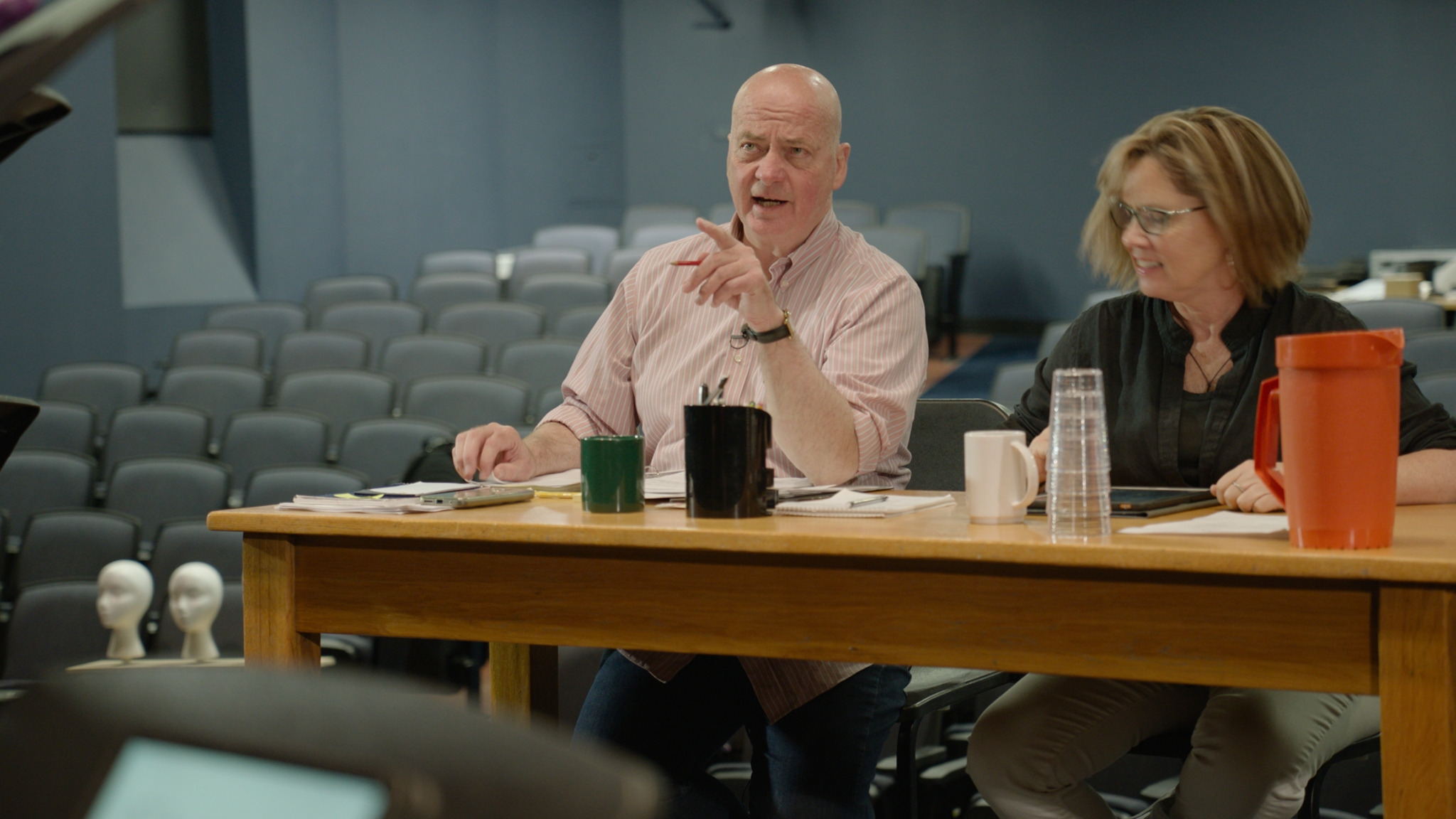
Composer Tom Cipullo (l) and Leigh Holman (r), artistic director of CU’s Eklund Opera program.
Photo by Stabio Productions for CU NOW.

Right now it’s The Calling; before that it was The Next Voice you Hear. His work-in-progress is the subject of the 2023 CU New Opera Workshop (CU NOW) in the College of Music, and the first thing Cipullo wanted to do in the workshop was find the right title.

“I think it was the first thing I said when I arrived here,” he says. “I need a better title!” The Calling was suggested by one of the performers, and so far that is the title that everyone likes best.
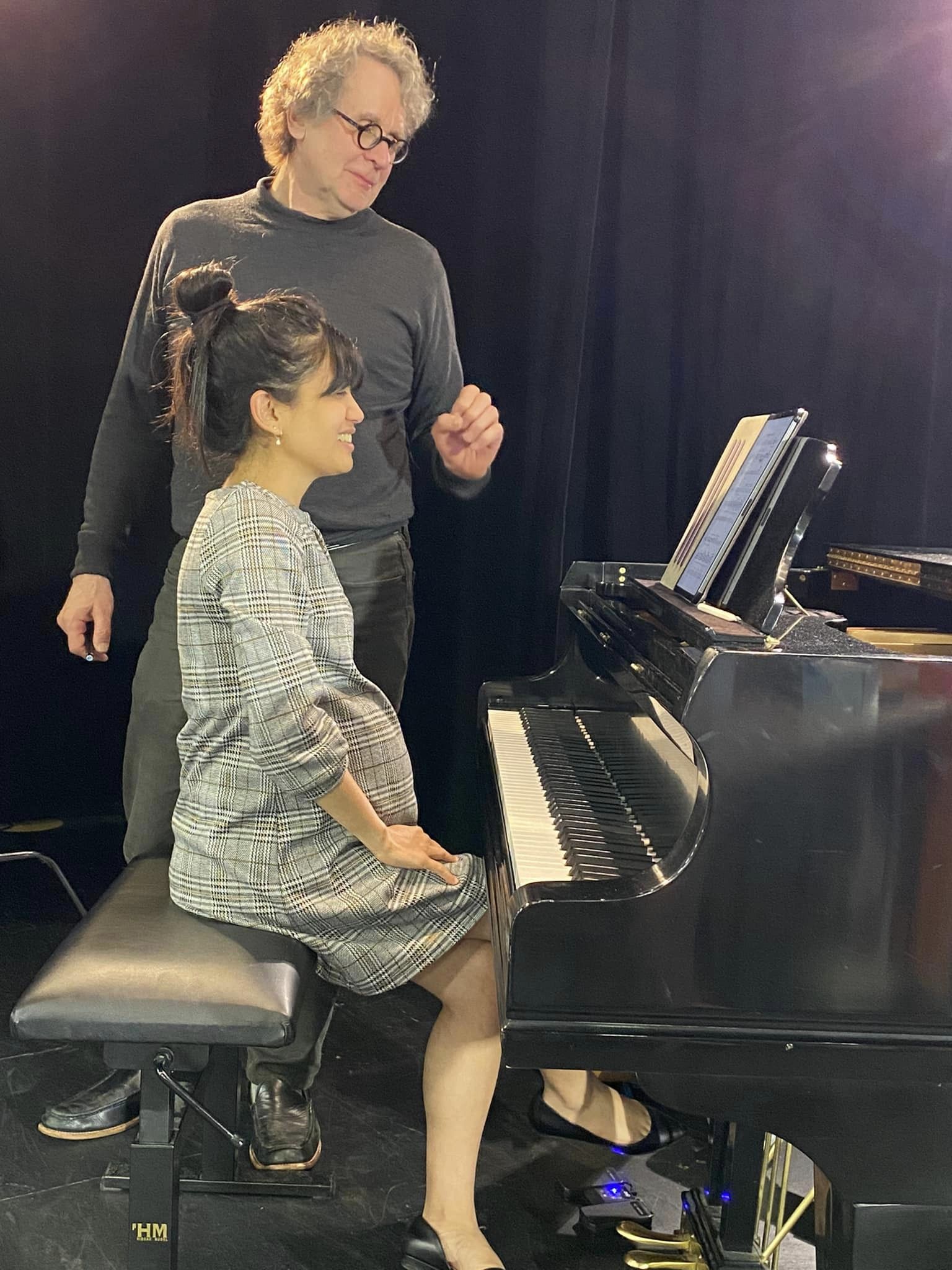
Conductor Nick Carthy (standing) with pianist Nathália Lato.

But whatever you call it, you can catch a preview this Friday and Sunday at the Music Theater in the CU Imig Music Building (7:30 p.m. June 16 and 2 p.m. June 18; admission is free). Portions of the opera-in-progress will be performed by early-career artists from the CU Eklund Opera program under the direction of conductor Nicholas Carthy and stage director Leigh Homan. They will be accompanied by pianist Nathália Kato.

The libretto, written by Cipullo, tells the intertwining stories of three characters: televangelist Pastor Dove; IRS Agent Cordero, who is investigating Dove’s ministry for potential tax violations; and Dolores Caro, an older woman who supports Dove’s ministry.

Two of these characters are based on models. The televangelist was inspired by someone Cipullo won’t name that he saw interviewed about his extravagant lifestyle. “He was so charming and frightening at the same time that I couldn’t take my eyes off of him,” Cipullo says. But he wants you to know he is not trying to mock the televangelist. 

“I was trying to tell his side of it,” he says. “He’s giving to people. Maybe it’s worth it for these people, what he’s giving them. (It makes) me think, the preacher actually believes he’s doing good.”

Dolores, the homebound contributor to the ministry, is partly Cipullo himself. She is surrounded by old-fashioned consumer goods and feeling left behind by the 21st century. “There’s a lot of me in her,” Cipullo admits. Like Dolores, “I still have a landline. And I can’t figure out how to work this (smartphone)!”

The character of the IRS agent was suggested to Cipullo, and he is more of an original creation. As someone who grew up religious and knows both the Bible and literature, Agent Cordero is an ideal foil to Dove.

With these three characters it would be easy to write a biting satire, but that’s not Cipullo’s game. “I hope it’s more nuanced than that,” he says. “The biting satirical way is the way that a lot of people in New York would look at people who give to televangelists, but I’m more interested in what the people who listen to these televangelists get out of it.”

When pressed, Cipullo says that The Calling is neither satire nor comedy, but both—and partly tragedy, in a way. “It’s all of these,” he says. “I think it is a commentary on the condition of the country, with tragic and comic overtones. Any good opera that wants to touch your heart has to have light moments in it.”

Getting the right balance of ingredients is one purpose of CU NOW and similar workshops. Composers can hear portions of their new works and see what works and what doesn’t, and to write new material when required. Often the performers themselves provide ideas that end up in the finished work—and not just the title.

When he arrived for the workshop, Cipullo says, “I had specific things that I was concerned about, and I had various epiphanies. I didn’t really have the title, there was too much wordiness and (I was concerned about) the momentum and how to shape it.
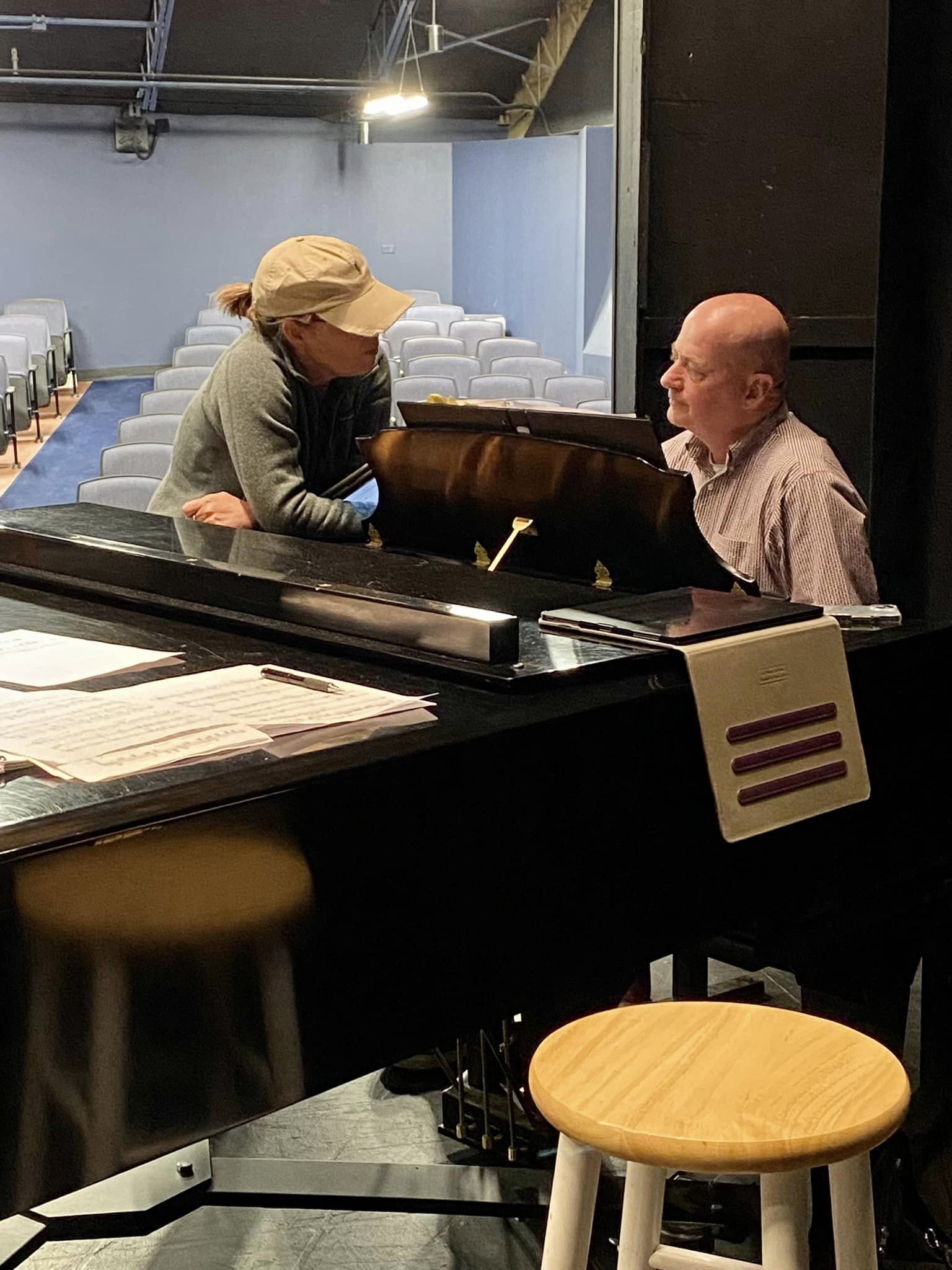
Leigh Holman (l) and composer Tom Cippullo (r) during a rehearsal for ’The Calling.’

“Then there are specific levels—for example, someone’s singing an aria, there are specific musical things. Maybe it’s only a moment, maybe it’s a beat, maybe it’s too long. Maybe something’s wrong. I don’t know what it is, but we have to try to figure out what it is, as a group.”

CU NOW, founded by Holman in 2010, provides a longer working period than most workshops—up to two or three weeks. This gives composers a chance to tackle more changes than they could in a few days, which is valuable to the creative process. Composers who have been part of CU NOW in the past include Cipullo, Kamala Sankaram, Jake Heggie and Mark Adamo.

But Holman makes it clear that CU NOW is first and foremost for the students, giving them experience they will need in their careers. Working with composers, and learning new music on short notice, have become more necessary as more new operas are being produced around the country. At first, she says, the singers struggled to keep up with the changes they had to make overnight. 

But “it’s developed now to they’re begging for music,” she says. “They ask, ‘Did you write me any music last night?’ And Tom is writing new music almost every day and sending it to them every morning, and by 2 o’clock they know it already!”

That experience prepares the students for the facts of professional life today. “This is a golden age of American Opera,” Holman says. “The singers, if they’re going to work, they need to have these skills. When we started, there weren’t other universities doing these workshops and now they’re doing them all over.”

And at this point Cipullo speaks up. “But there’s nothing like this one”! he says.

# # # # # 

CU New Opera Workshop
Leigh Holman, director
Nick Carthy, conductor
Nathália Kato, pianist

The Calling by Tom Cipullo (portions)

Music Theatre, Imig Music Building
7:30 pm. Friday, June 16
2 p.m. Sunday June 18

Free, no tickets required

Portions of new opera to be presented Sunday

Kamala Sankaram’s Joan of the City is inspired by homelessness and Joan of Arc

By Peter Alexander June 17 at 5:23 p.m.

Composer Kamala Sankaram says that many of the pieces she writes start with her own imagination and not the way many operas get written— with a commission for a specific performing organization. 

“They start with a crazy idea that I have” Sankaram says. “Then I talk to people and see who also is crazy.” She then works with the “also crazy” people to bring her idea to life.

Kamala Sankaram

For her latest project, an opera titled Joan of the City that combines themes of homelessness with the Joan of Arc story, those conversations led her to Leigh Holman, director of the Eklund Opera Program at the University of Colorado, Boulder, and the New Opera Workshop (CU NOW).

Sankaram has been in Boulder for the past two weeks, composing music and working with students in the opera program to start turning her “crazy idea” into a site-specific opera that will be premiered next year by Opera Omaha. Completed portions of Joan of the City will be performed at 3 p.m. Sunday (June 19) in the Music Theatre of Imig Music Building.

The performance is free and open to the public, and will take place entirely in the Music Theatre space.

The basic idea of the opera is that not one but five Joans will be fighting, not the English invaders in France, but gentrification and other forces creating homelessness in American cities. Starting in five different places within Omaha, the Joans eventually meet up, as audiences move with them through the city.

Sankaram grew up in Southern California, where the car is king, but after she moved to New York she started walking everywhere. “Whenever I go to a new city I’m walking, and I see the homeless community,” she says. “I think it’s important to have people see what does that feel like, to be walking the city, instead of driving by in a car.

“I started thinking about [homelessness] several years ago, and it has become increasingly problematic and prevalent . . . [in] all places across the United States. So the idea was how do you get people to look and see things that they normally look past.”

Another idea was the use of technology, which features in a lot of Sankaram’s work. It is technology that will allow the onsite performances in Omaha to take place in different places across the city, and also will allow audience members to participate in the performance by playing audio from their cell phones.

The final piece of Sankaram’s “crazy idea” was working with homeless agencies—Mary’s Place in Seattle and Micah House in Omaha—to connect the finished work to the homeless community. With her co-creator of Joan of the City, New York-based hybrid-theater director Kristin Marting, Sankaram and the homeless shelters presented writing workshops for the shelter clients.

Leigh Holman (Photo by Glenn Asakawa/University of Colorado)

The work that came from those workshops became the basis of the text for Joan of the City. “The libretto is all these poems that the shelter clients wrote, and then they’re sort of structured on this overall dramatic arc from the Joan of Arc story,” Sankaram explains. “It starts off as arias and then as the Joans meet each other, it turns into duets and trios and finally a quintet.”

Sankaram’s work is an example of the kind of creative and adventurous projects that CU NOW aims to support. Many new works go through a workshop process, but CU NOW is unique in that it offers a longer than average period for composers to work with performers while refining their work. 

The program is largely Holman’s brainchild. She started CU NOW in 2010, and it has offered several composers the opportunity to refine works that were in development, including It’s a Wonderful Life by Gene Scheer and Jake Heggie, which was premiered by Houston Grand Opera in 2016 and performed by the CU Eklund Opera in 2019.

The composers and works are chosen for CU NOW largely through Holman’s contacts in the professional world. “So far nobody has ever submitted anything (for consideration),” she says. “It’s only been knowing somebody or meeting somebody through relationships, or going to see their operas. I just invite them, and they do it because they want to develop their piece and we can provide the students and the facilities and the musicians.”

In addition to the work that is done by an established composer preparing a new piece, there is simultaneously an educational component for young composers. Under the rubric Composer Fellows’ Initiative (CFI), a composer and librettist have been brought in to work with students to develop both their musical skills and their understanding of stagecraft.

Tom Cipullo

This year, the students have been working with composer Tom Cipullo, whose comic opera Hobson’s Choice was featured at CU NOW in 2019, and librettist Gene Scheer, whose was in Boulder for CU NOW last year (Intelligence, with composer Jake Heggie) as well as 2016 (It’s a Wonderful Life). 

“It’s a marvelously thrilling thing to be a part of,” Cipullo says of CFI. The composers in this year’s program “are extraordinary young musicians,” he says. “CFI gives them a push into writing operas. They have an interest, they’re all talented. How much they’ll pursue it, what works they’ll create, who can say, [but] they jumped in and they’re doing some really good things.”

# # # # #

CU Now Opera Workshop
(CUNOW)
Leigh Holman, director

Kamala Sankaram: Joan of the City (portions)

3 p.m. Sunday, June 19
Imig Music Building, Music Theatre (N1B95)

Free