
Electric guitar, accordion, and piano at the frontier of musical creativity
By Peter Alexander Feb. 20 at 10:30 p.m.
In the about the past two years—specifically since April, 2023—Starkland, a record label located in Boulder, has released three diverse new albums.
In keeping with the label’s stated goal of promoting “alternative classical, experimental, and avant-garde music through the production of high-quality recordings,” these albums feature new music that will appeal to the adventurerous listener. If you want to explore the current frontier of musical creativity, all three albums are worth your time.
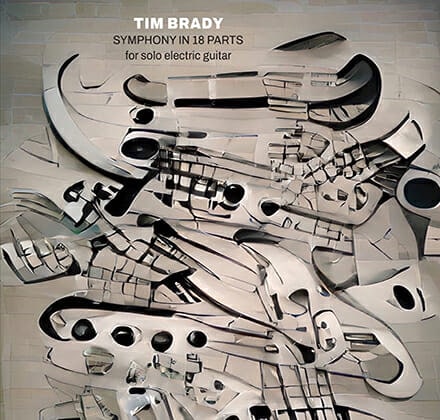
Symphony in 18 Parts for solo electric guitar
Tim Brady, composer, electric guitar
Starkland ST237
Released April 28, 2023
Symphony in 18 parts presents 18 short pieces composed and played by Tim Brady. Ranging from 1’34” to 4’47”, they loosely comprise a single composite work, or “symphony.” With so many short pieces, it offers variety rather than the kind of unity that past composers sought in their symphonies, and that is its strength as well as its weakness.
Brady acknowledged the diversity of his music when he wrote that “each movement (of the Symphony in 18 Parts) has its own world, its own unique way of proceeding, but together they are kaleidoscopic. This is a piece that is designed to feel that it can hold everything within it. That sounds symphonically ambitious to me.”
Indeed it does, and it echoes a well known remark of the Romantic symphonist Gustav Mahler, who wrote that a symphony “must be like the world. It must contain everything.”
One of the most intriguing aspects of Brady’s Symphony is the titles given to the individual movements. The relationship between title and musical content is not always clear, spurring thought and imaginings as one listens to the album, track by track.
A few examples: The first track is titled “minor revolutions.” The music sounds like a post-modern/Baroque prelude, exploring sounds and chords up and down the fingerboard. The Prelude-ish style fits an opening movement, but what is revolutionary? You will have to listen and decide.
Track 6, “only the necessary equipment,” sound like background music for a teen slasher/horror film that could have been titled “entering the basement.” This might lead you to wonder, what IS the necessary equipment?
Particularly provocative is the title of Track 15, “lies beneath the surface.” Here the music suggests an opaque surface that might conceal something beneath. But is “lies” a noun or a verb? Again, that is for you to decide.
My favorite is Track 16, “noise: or who decides what and why.” The aggressive sounds here remind us that the line between noise and music has moved over the centuries. The movement opens with separated masses of sound, gradually developing musical rhythms, and then notes rushing up and down. This is a perfect musical demonstration of a truth I find all encompassing: every dispute can be reduced to two questions: Where do you draw the line, and, as Brady asks, who decides?
The entire album demonstrates a very sensuous approach to musical sound. You won’t find tunes to recall, but you will find lots of evocative soundscapes, each different from the others. And much to think about as you ponder the relationship of titles to music.
Available from Bandcamp.
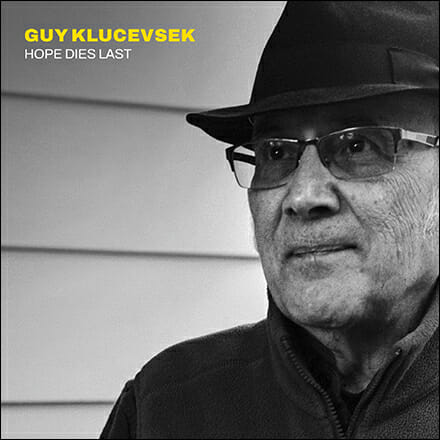
Guy Klucevsek: Hope Dies Last
Starkland ST238
Guy Klucevsek, Alan Bern, Nathan Koci, Will Holshouser, accordions
Bachtopus acccordion quartet: Robert Duncan, Peter Flint, Mayumi Miyaoka and Jeanne Velonis
Jenny Lin, piano, toy piano and celeste
Todd Reynolds and Jeff Gauthier, violins
Margaret Perkins, cello and whistling
Released Dec. 1, 2023
Hope Dies Last is a new collection of music by accordionist Guy Klucevsek, who has been accused by the Village Voice of writing “the world’s most abnormal ‘normal’ music.” I would describe the album as neither “normal” nor “abnormal,” but it is unusual, highly diverse and always intriguing. It joins my collection of favorite Starkland offerings.
Many of the tracks are creative versions of divergent dance types, including the opening “Slango,” a delightfully unbalanced 7/8 version of the tango. That is followed by “Feel the Bern,” a spirited hora written for and performed by Klucevsek’s long-time duo partner Alan Bern.
Several of the tracks are some version of a slow waltz, including the melancholy and stormy title track “Hope Dies Last” and the gently swaying “Seesaw Song.” The “Hornpipe” is exactly that, a carnivalesque dance that if not quite graceful, successfully evokes robust merrymaking.
The final six tracks comprise a suite of pieces that Klucevsek wrote for Industrious Angels, a “hand-crafted-story-spinning-shadow-puppet-memory-play-with-music” created by actor/director Laurie McCants. Her script and Klucevsek’s music were in part inspired by Emily Dickinson’s poetry.
My favorite track—and not just for its unforgettable title—might be the jig-ish “Flying Vegetables of the Apocalypse.” Arranged for the violinist Todd Reynolds from music Klucevsek recorded in 1991, this version calls for both pre-recorded and live violin.
“Flying Vegetables” offers what the liner notes calls three “gnarly bits:” a fast 3/4 section over a 3/4 ostinato, a canon for two violins three beats apart over an ostinato in 5/4, and a canon for three violins one beat apart over an ostinato in 7/4. These delightfully weird sections are followed by a more lyrical section in a relaxed 6/8 meter, all adding up to one of those pieces where you never know what will come at you next.
If you are not familiar with Klucevsek’s “abnormal ‘normal’ music,” I suggest you unpack your curiosity and explore this album. With its remarkable variety of moods and styles, it can keep you engaged from beginning to end.
Download available from Bandcamp.
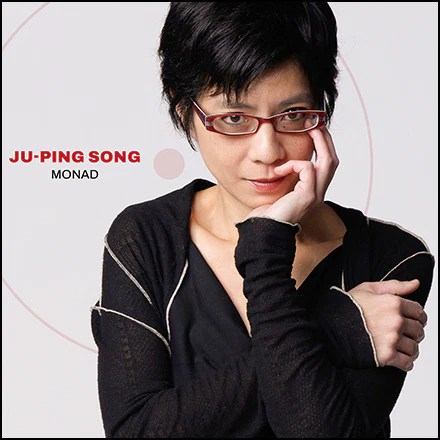
Monad
Ju-Ping Song, prerecorded and live piano
Starkland ST239
Released Dec. 6, 2024
Starkland’s most recent release, Monad, is not quite like the previous albums. Rather than numerous varied, evocative pieces that invite exploration, it is an immersive plunge into four very different sonic worlds.
The album’s four tracks, all performed by pianist Ju-Ping Song, feature pieces by four different composers: Lois V Vierk, Molly Joyce, Kate Moore and Rahilia Hasanova. In different ways, they share a penchant for extreme pianism. As musically and technically challenging as they are, Song rises to meet the demands of all four.
Vierk’s “Spin 2” takes its name from subatomic particles that have the same orientation 180 degrees apart—an image that suggested two grand pianos facing each other with a pianist at each keyboard. Composed for Ursula Oppens and Frederic Rzewski, it was revised by the composer in 2018. For this album, Song recorded both parts.
The score is an exploration of rhythm and sonority that begins with thudding rhythms articulated on the very lowest notes of the piano, contrasted with wispy inside-the-piano strumming of strings. Irregularly accented chords will remind some listeners of Stravinsky’s Rite of Spring. The pounding rhythms gradually fade into chords leaping across the full breadth of the keyboard, and finally into rippling scales and shimmering glissandi.
Divided into sections defined by sonority, “Spin 2” creates a clear shape and sense of momentum as it shifts from one sonority to the next. In no sense “pretty” or melodic, it is a well crafted and intriguing sonic adventure.
Joyce’s “Rave” features a combination of live piano with prerecorded electronic sounds. It begins with long electronic tones overlaying widely separated notes in the piano that are almost indistinguishable from the electronics. Moving almost imperceptibly at the beginning, the music gradually speeds up over the course of the piece. As the piano fragments come faster, the two parts switch roles from foreground to background in ever inventive ways.
The piece ends with strong chords in the piano, now definitively the foreground. This then was the goal all along: full, concluding chords in the piano, a resolution vaguely hinted by the piano part throughout.
Moore describes her “Bestiary” for live piano and recorded soundtrack as a “sonic compilation of grotesque imaginary beasts,” but it is not the kind of literally descriptive music that occurs in Saint-Saëns’s Carnival of the Animals. I could not separate one beast from another in the unchanging musical texture that Song describes accurately as “endlessly repeating and changing chords.”
This is like much of the new music I have heard recently: exploration of an original and creative idea that goes on just too long. I prefer more spice and stronger sonic shapes, but that is personal taste. If you are a listener who can use “endlessly and repeating chords”—Song’s words—to enter a space of contemplation and reverie, you will be rewarded. Taste aside, it should said that this is an attentive performance that brings out the shifting rhythms and tempi of Moore’s detailed score.
Hasanova was born in Baku, Azerbaijan, where she witnessed the brutal “Black January” military attacks on hundreds of civilians by the Russian army in 1990. In her program notes, she writes of the “monad” as a basic unit underlying everything. “All diversity of the Universe and Beyond,” she writes, “is the multiplication of the monad.”
The music tells a more complicated and ominous tale. Written for a single pianist, “Monad” is a piece of powerful intensity nearly 20 minutes long that grows from a single rapid line of detached notes through ever faster and more complex patterns, reaching a point of wild passion and fury, before fading into deep, barely audible tones. Here one senses an expression of the horror Hasanova experienced during Black January.
Song gives a performance of great virtuosity, taking the listener on a compelling journey into bleak places. Here there is musical spice aplenty and a clear profile, but it is a journey without comfort or balm. I admire both the piece and the performance, even while finding the journey daunting.
CD and download available from Bandcamp.
NOTE: Minor typos and grammatical erros corrected 2/21/24.
 Sharps & Flatirons