Rare and well done in Central City

Kurt Weill’s seldom seen Street Scene has it all—music, dance, drama

By Peter Alexander July 23 at 3:20 p.m.

Anyone who loves Broadway theater, drama, bluesy musical numbers and zippy dance routines needs to go into the mountains.

Central City Opera’s production of Street Scene by the German-American composer Kurt Weill has all that and more. A thoroughly strong cast brings the drama to life, and the direction and choreography by Daniel Pelzig hits all the right notes. A realistic setting with no revisionist points to make captures the essence of the 1946 original, a gritty portrait of life in a Manhattan tenement building, with gossipy neighbors, a bullying husband and cheating wife, idealistic young lovers yearning to escape, and a potpourri of ethnicities.

Weill had one of the most remarkable and diverse careers of any 20th-century composer. Following his sensational success in Berlin working with playwright Bertolt Brecht on the jazzy Dreigroschenoper (Threepenny opera) and other works he fled Nazi Germany in 1933 and came to New York in 1935. From that point on, he wrote musicals for Broadway and aimed to create an American opera that combined popular styles with grand opera.
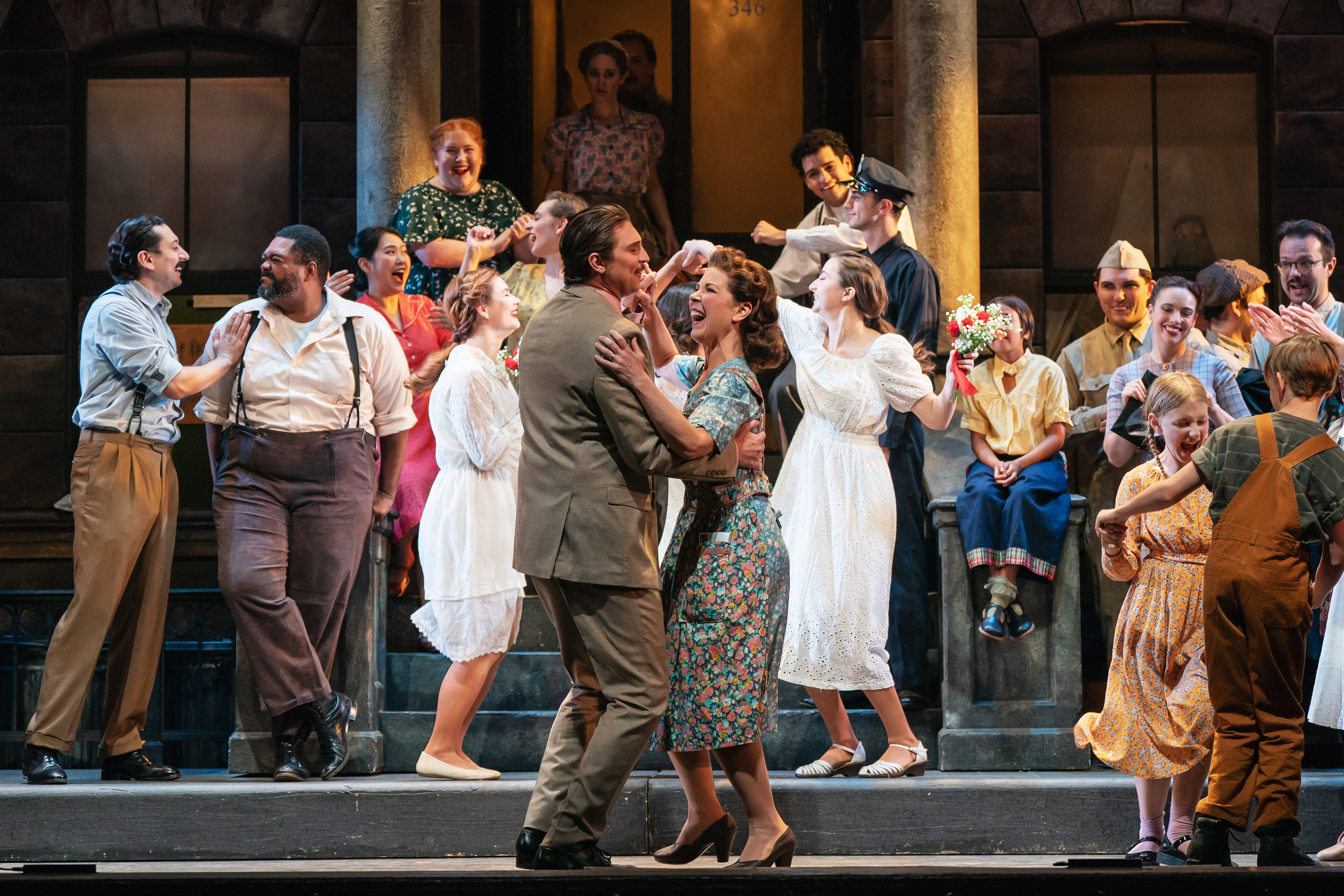
Tenement house neighbors in Street Scene. Image by Amanda Tipton Photography

Street Scene, which opened on Broadway in 1946, may be the closest he came to that goal, and it is certainly one of this finest works. It has an ideal American pedigree, with lyrics by Langston Hughes and a story based on the Pulitzer-prize winning play of the same title by Elmer Rice, who also wrote the book for the opera.

The music is appealing, combining Broadway set pieces like the ensemble for graduating students “Wrapped in a  Ribbon and Tied in a Bow” and the dance number “Moon-faced, Starry-eyed,” with blues-tinged arias, like “Lonely House” sung by the young hero Sam Kaplan, and Puccini-esque arias like “Somehow I could Never Believe” sung by Anna Maurrant.

As great as it is, Street Scene is not often performed—another reason to travel to Central City this summer. Among reasons for its rarity are the challenges it presents, including a cast with more than 30 named roles, each with their own story to tell. Without care, a performance can become loosely episodic. A similar danger is that the most appealing Broadway-style numbers are extraneous to the plot, and can easily seem tacked on.
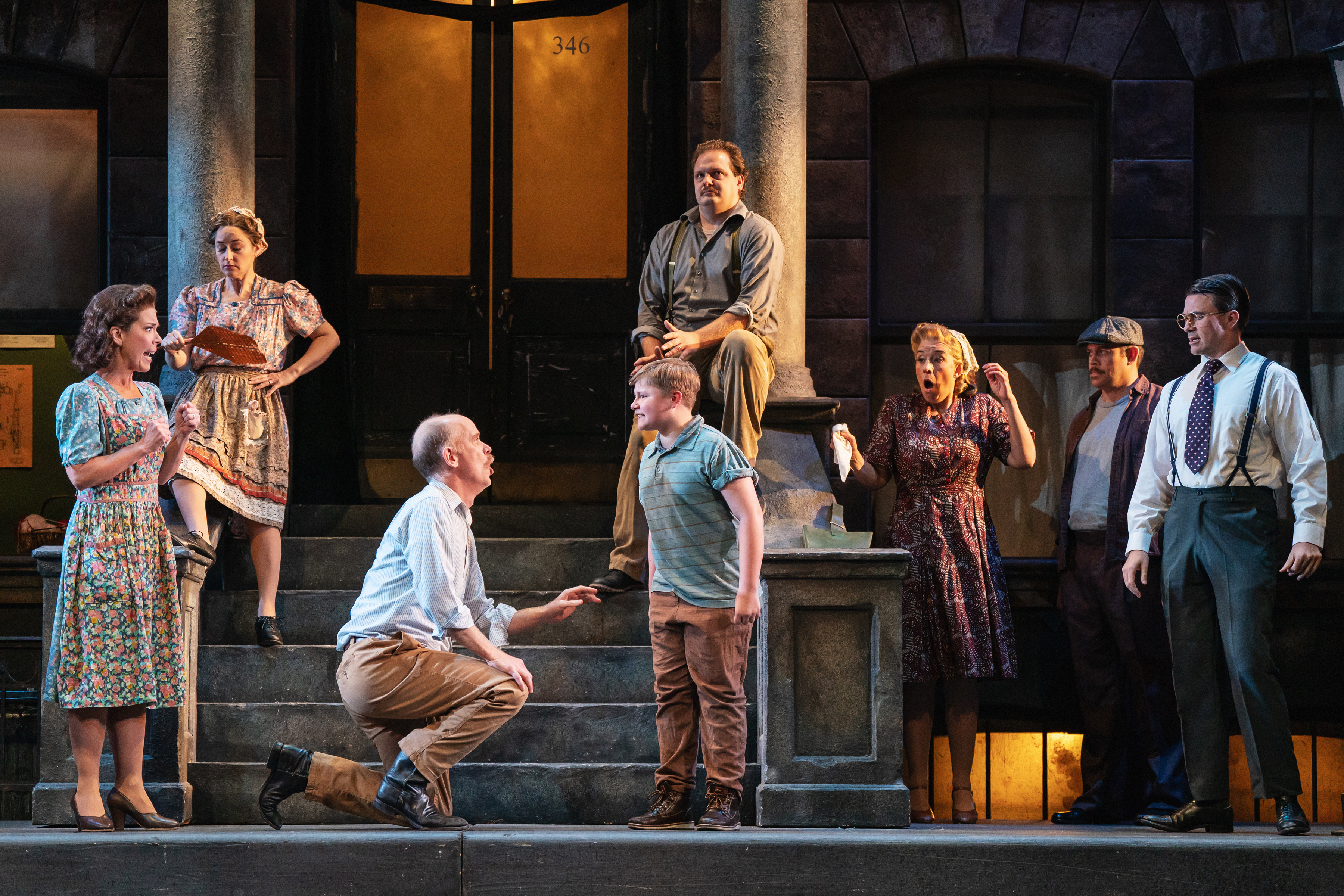
Front steps of the tenement building. Design by David Harwell. Kevin Burdette (Frank Maurant) and Brian Erickson (Willie Maurant). Image by Amanda Tipton Photography

Fortunately, Pelzig’s direction met these difficulties head on. He created a fast-moving show, where the diversity of the tenement community is part of the story, and the numbers were pulled into the musical flow. David Harwell’s set was traditional, with realistic tenement steps and apartment windows on two floors looking out to the street, but it suits the show perfectly. Once again, the gritty realism is part of the plot.

With so many singers, it is not possible to recognize all of the many cast members who made a strong contribution to the show. Of the leading roles, Katherine Pracht in the role of Anna Maurant, the wayward but kindly wife of the building bully, gave a good portrayal of a fragile woman with romantic dreams while living on the brink of disaster. She sang with great expression, but with a strong vibrato that occasionally threatened to obscure the text.
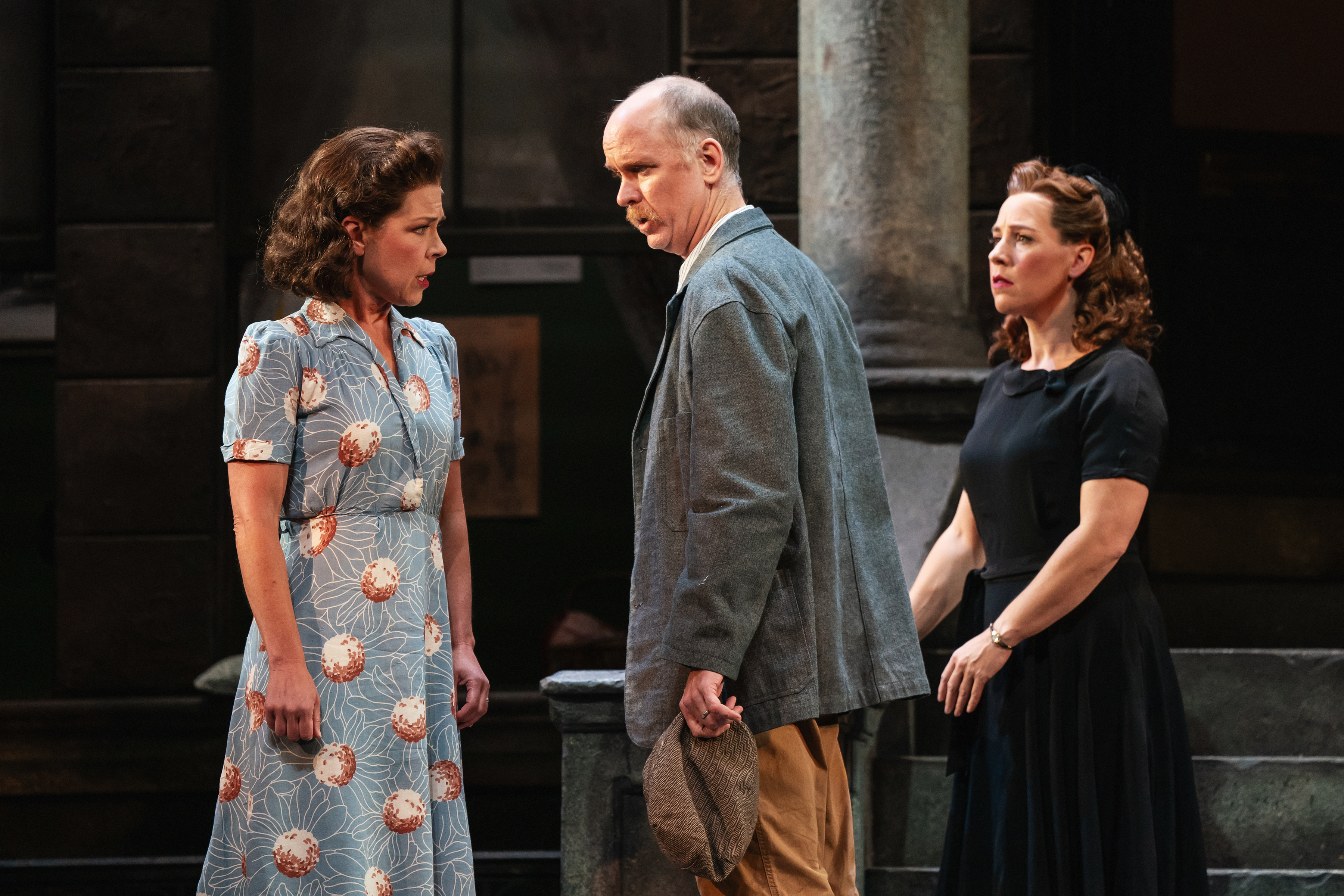
Katherine Pracht (Anna Maurant), Kevin Burdette (Frank Maurant) and Christie Conniver (Rose Maurant) in Street Scene. Image by Amanda Tipton Photography

As her abusive husband, Frank Maurant, Kevin Burdette used a rough edge to his voice to convey the character’s menace. A veteran of bad guy roles, including Claggert in Billy Budd in Central City and Sweeney Todd in Dallas, he softened his portrayal in the final scenes, creating a whole character. If his sudden tenderness seems less than convincing, that is the script and not the performance, which was heartfelt.

Christie Conover was endearing as Rose, the Maurants’ daughter who is pursed by a number of undesirable suitors as well as by Sam, the shy young male romantic lead who cannot quite express his love. She sang with a poised and polished sound that stood out from the more rough-hewn characters. As Sam, Christian Sanders had to reach for some of the high notes, but sang an appealing and well shaped aria in “Lonely House.” Their gradually blooming romantic duet, “Remember that I Care,” offered the opera’s tenderest moments.

I enjoyed the gossiping neighbor ensembles, which become a latter-day Greek chorus commenting on the action. The cast embraced the ethnic types written into the score, rarely overdoing it. Apprentice singer James Mancuso produced a definitively Italian sound as Lippo Fiorentino, the most strongly stereotyped of the neighbors. 
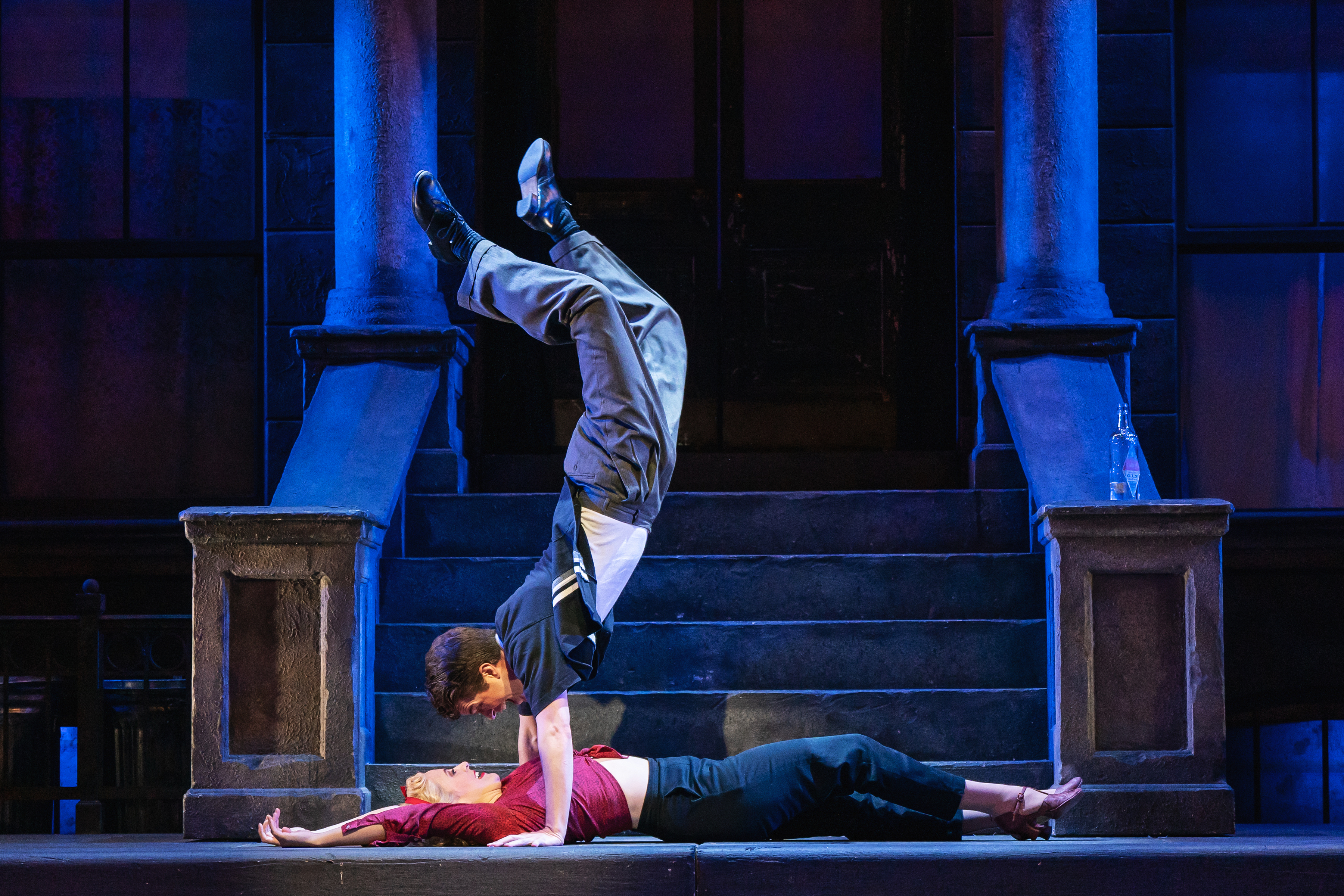
Lauren Gemelli and Jeffrey Scott Parsons in the dance routine “Moon-faced, Starry-eyed.” Image by Amanda Tipton Photography

Bernard Holcomb brought a big, robust voice and a friendly demeanor to the role of Henry Davis, the building janitor. As the overheated lovers in the big dance number, “Moon-faced, Starry-eyed,” Lauren Gemelli and Jeffrey Scott Parsons nearly stole the show with their saucy dialog and athletic dancing.

Members of the Colorado Children’s Chorale sang strongly and conveyed a rowdy sense of fun in their teasing game at the beginning of the second act. Brian Erickson acted strongly in the role of Willie Maurant, Rose’s rowdy little brother.

Conductor Adam Turner led the Central City orchestra in a stylish performance, getting the Broadway idioms right and supporting the singers well. A few times they covered the spoken dialog, but the big musical numbers were all outstanding. In short: this production of Street Scene is a rare opportunity to see an important work of American musical theater done well.


Central City Opera cancels one performance

Saturday’s opening night of Kurt Weill’s Street Scene canceled due to illness

By Peter Alexander July 10 at 5:20 p.m.

Central City Opera has announced that Saturday’s opening of their production of Kurt Weills “American Opera” Street Scene (July 13) would be canceled due to illness.

A statement released by the company today (July 10) stated:

“Due to a number of our artists testing positive for respiratory illness, we are canceling the Saturday, July 13 performance of Street Scene and all opening night activities. Our top priority is always the well-being of our cast, crew, and audience, and this decision was made in consultation with our artists, unions, and local officials in order to ensure everyone’s health and safety.”

The company offers three option to persons who hold tickets for Saturday:

  1. Reschedule your tickets for another date;
  2. Turn the value of your tickets into a tax-deductible gift to the Central City Opera; and
  3. In case neither of the options above are suitable, receive a full refund.

In order to choose one of the three options, the Central City box office is asking patrons to fill out an online form that can be accessed HERE.

The remainder of the Central City Opera season is not affected by the cancellation, including all regularly scheduled performances of Street Scene during the remainder of the summer. You can see the full summer schedule on the Central City Opera calendar page.

You can read more about Central City Operas 2024 season HERE.

Central City offers three works first performed in New York

Pirates of Penzance, Girl of the Golden West and Street Scene on this summer’s bill

By Peter Alexander June 25 at 4:02 p.m.

Central City Opera opens its 2024 festival season Saturday with a staple, not of the grand opera house, but of the English light-opera stage: Gilbert and Sullivan’s delightful and sometimes silly Pirates of Penzance (7:30 p.m. June 29; full summer schedule below).

Opening Night at Central City Opera. Featured in Central City Opera’s 75th anniversary book, “Theatre of Dreams, The Glorious Central City Opera- Celebrating 75 Years.”

The fifth collaboration between author Sir Willam Gilbert and composer Sir Arthur Sullivan, Pirates surprisingly had its official premiere at the Fifth Avenue Theater in New York City Dec. 31, 1879. The show, known for its bumbling police, its only slight less inept pirate gang, and its often parodied Major General’s patter song, has long been one of the most popular of the G&S operettas. 

A 1980 production in Central Park, part of the “Shakespeare in the Park” summer series, was so successful that it was transferred to Broadway. In 1983 it was made into a film with original cast members Linda Ronstadt (Mabel), Kevin Kline (the Pirate King) and Rex Smith (Frederic), plus Angela Lansbury (Ruth). 

At Central City this summer, Pirates shares the rotating repertory bill with two other works also premiered in New York, neither of which is truly part of the core operatic canon: Kurt Weill’s Street Scene, premiered at New York’s Adelphi Theater in 1947; and Puccini’s La fanciulla del West (Girl of the Golden West), premiered at the Metropolitan Opera Dec. 10, 1910.

* * * 

Pirates of Penzance is a typical G&S operetta in the way that it satirizes British habits. The pirates are goofily sentimental, the Major General is preposterously pompous, the police are ridiculously hapless, and Frederic takes his very British devotion to duty to comic extremes. The whole plot turns on two ridiculous misunderstandings: That Frederic was apprenticed by his near-deaf nursemaid to nautical pirates rather than pilots; and that he was apprenticed not for 21 years but until his 21st birthday—which, because he was born on Feb. 29, means not until he is in his 80s.

That he and his chaste bride-to-be Mabel accept this delay with unnaturally bright composure is just one of many implausible turns of plot—as one expects from Gilbert and Sullivan. In addition to the patter song “I Am the very Model of a Modern Major General,” the score contains several memorable songs, including Mabel’s “Poor Wandering One,” which pairs alluring sentiment with brilliant coloratura; and the pirate chorus’s “With Cat Like Tread,” in which they noisily proclaim their intent to creep silently into the Major General’s household. 

* * *

Also written for the popular stage, Kurt Weill’s Street Scene is a different matter entirely. With lyrics by Langston Hughes and a book by Elmer Rice, it is a gritty tale of tenement dwellers on Manhattan’s east side. Among a mix of residents of Swedish, Italian, German and Jewish background there is an abusive husband, an alcoholic, a radical intellectual, gossipy neighbors, a sleazy boss, an adulterous milkman, a birth, an eviction and a double murder.

And of course a pair of young lovers, who survive but are forced apart by the violent events around them.

Weill came to the United States in 1935, after a successful career in his native Germany—particularly works created with playwright Bertolt Brecht including their Dreigroschenoper (Threepenny Opera). In this country Weill wrote several works for the Broadway stage, including Knickerbocker Holiday, Lady in the Dark and Lost in the Stars, but he was always aiming to create a form that combined serious opera with popular theater and song.

The work that came closest to that goal might be Street Scene, which freely mixes operatic elements, such as the aria “Lonely House” sung by the male romantic lead Sam Kaplan, with Broadway entertainment including dance numbers and a lively number for graduating students, “Wrapped in a Ribbon and Tied in a Bow.” Other notable numbers in the score are the “Ice Cream Sextet,” the duet by nursemaids gawking at the scene of the murders, and the dreamy aria “What Good Would the Moon Be,” sung by the female lead, Rose Maurrant.

It is the operatic aspects that have left their mark on Street Scene, which has been performed by opera companies but never returned to Broadway. Even operatic performances are infrequent today, due in part to the large cast that Weill requires—more than 30 named roles.

* * *

The closest thing to a repertoire item this summer, Puccini’s Fanciulla del West has that rarest of serious opera features, a happy ending. No one dies in the course of the opera, and the leading soprano is neither a naive innocent nor a victim; in fact, she is about the strongest character in the opera, who even cheats at cards to reach the opera’s happy end.

The plot features Minnie (soprano), who owns the Polka Saloon; the sheriff Jack Rance (baritone) who hopes in vain to marry Minnie; and the romantic tenor lead, the outlaw Ramerrez, who under the name Dick Johnson becomes Minnie’s true love.

Very much part of the action, Minnie forges her own destiny, first by owning the saloon in a mining camp, and then by playing cards for her lover’s life. Production stage director Fenlon Lamb observes that this is very different from other Puccini soprano roles.

Fenlon Lamb

“Other Puccini heroines are stuck in what society allowed them to be,” she says. “When you transfer things to the Wild West, the rules are gone. All bets are off! And she’s freer to be one of the guys. She’s the girl of the camp, but they all respect her, right to the end.”

The plot is fairly simple: Minnie’s bar is the favorite place for the men of a mining camp to find solace. The arrival of a stranger alarms the sheriff and the Wells Fargo agent, who are looking for the outlaw Ramerrez. Minnie recognizes him from a previous meeting as Johnson and the two fall in love. Later in her cabin Minnie and the sheriff play cards for the outlaw’s life. 

She wins by pulling cards out of her boot, but Johnson/Ramerrez is later captured and brought back to town to be hanged. Just as the noose it put around his neck, Minnie contrives to create a happy ending—but you will have to buy a ticket to know the details.

As a woman, Lamb acknowledges that she might approach female characters differently than men might. “I give a little bit more understanding and support to the female characters,” she says. “I love working with singers, but I especially support the women in my productions. We spend more time figuring out what the heroine is trying to say, through her singing and her actions.”

Another way that Fanciulla differs from most Puccini operas is that there are no big arias. The music has the same lush melodies and Romantic impulses—“it is gorgeous!” Lamb says—but unlike most grand opera, the action never pauses for a stand-alone aria.

Appropriately, the Central City production has moved the setting from the California Gold Rush to Colorado 10 years later. “We’re not the ’49ers, we’re the ’59ers out here” in Central City, Lamb explains. “It gives us the opportunity to use actual pieces and parts from Central City. In doing that, we’ve only changed one word—instead of ‘addio California’ (goodbye California) Minnie says ‘andiamo a California’ (let’s go to California)” before riding into the sunset.

Puccini had never been to the American West, so his knowledge was taken from popular stereotypes and the original story, so not all of his characters ring true. The miners are heavily romanticized and cleaned up for the stage, the Wells Fargo agent is a typical stage villain, but the most difficult characters are Minnie’s Native American servants, Wowkle and Billy Jackrabbit.

They are often treated as crude stereotypes, but compared to many productions, Lamb says, “you can give these characters real depth. We’ve decided that Billy Jackrabbit is a white trader (who) goes into different native camps and understands some of the language, (who) might marry a native woman. It’s getting into what happened at the time and finding ways to tell the story that are not stereotyped.”

Having spent some time in Central City and visited some of the actual mines in the area, Lamb sees a larger picture than the love story at the heart of the opera. “Everybody’s proud of the mining tradition here,” she says.

“The focus [of the production] is on these guys in a mining camp. And there’s a focus on the fragility of this mass of humans, and how are they getting along together. In the end, it’s forgiveness that really saves the day, it’s being able to connect and understand the other person, and their needs, and forgive.

“I think it’s an opportunity to see the strength juxtaposed with fragility of the community, and then forgiveness is pretty much the answer.”

# # # # #

Central City Opera
2024 season
(performances in Central City Opera House)

Sir Willam Gilbert and Sir Arthur Sullivan: Pirates of Penzance
Sung in English with English supertitles

7:30 p.m. Saturday, June 29; Saturday, July 20; Saturday, July 27; 
2 p.m. Wednesday, July 3; Friday July 5; Sunday, July 7; Saturday, July 13; Tuesday, July 16; Wednesday, July 24; Friday, Aug. 2

Single tickets

Giacomo Puccini: La fanciula del West (Girl of the golden West)
Sung in Italian with English supertitles

7:30 p.m. Saturday, July 6; Saturday, Aug. 3
2 p.m. Wednesday, July 10; Friday, July 12; Sunday, July 14; Friday, July 19; Saturday, July 21; Tuesday, July 23; Saturday, July 27; Wednesday, July 31

Single tickets

Kurt Weill: Street Scene
Sung in English with English supertitles

7:30 p.m. Saturday, July 12
2 p.m. Wednesday, July 17; Saturday, July 20; Friday, July 26; Sunday, July 28; Tuesday, July 30; Saturday, Aug. 3

Single tickets

Season Subscription tickets for all three productions

NOTE: Casts and other creative contributors to the productions of Pirates of Penzance, Street Scene and La fanciulla del West are all listed on the Central City Opera Web page.