Santa Fe Opera continues its exploration of Wagner’s music dramas
By Peter Alexander Aug. 11 at 5:35 p.m.
Editor’s Note: This is one of several posts covering four of the five operas presented this year at the Santa Fe Opera.
Die Walküre, the last of the Santa Fe Opera productions I saw this summer (Aug. 8), continues the company’s exploration of Wagner’s music dramas, following the 2022 production of Tristan und Isolde previously reviewed here.
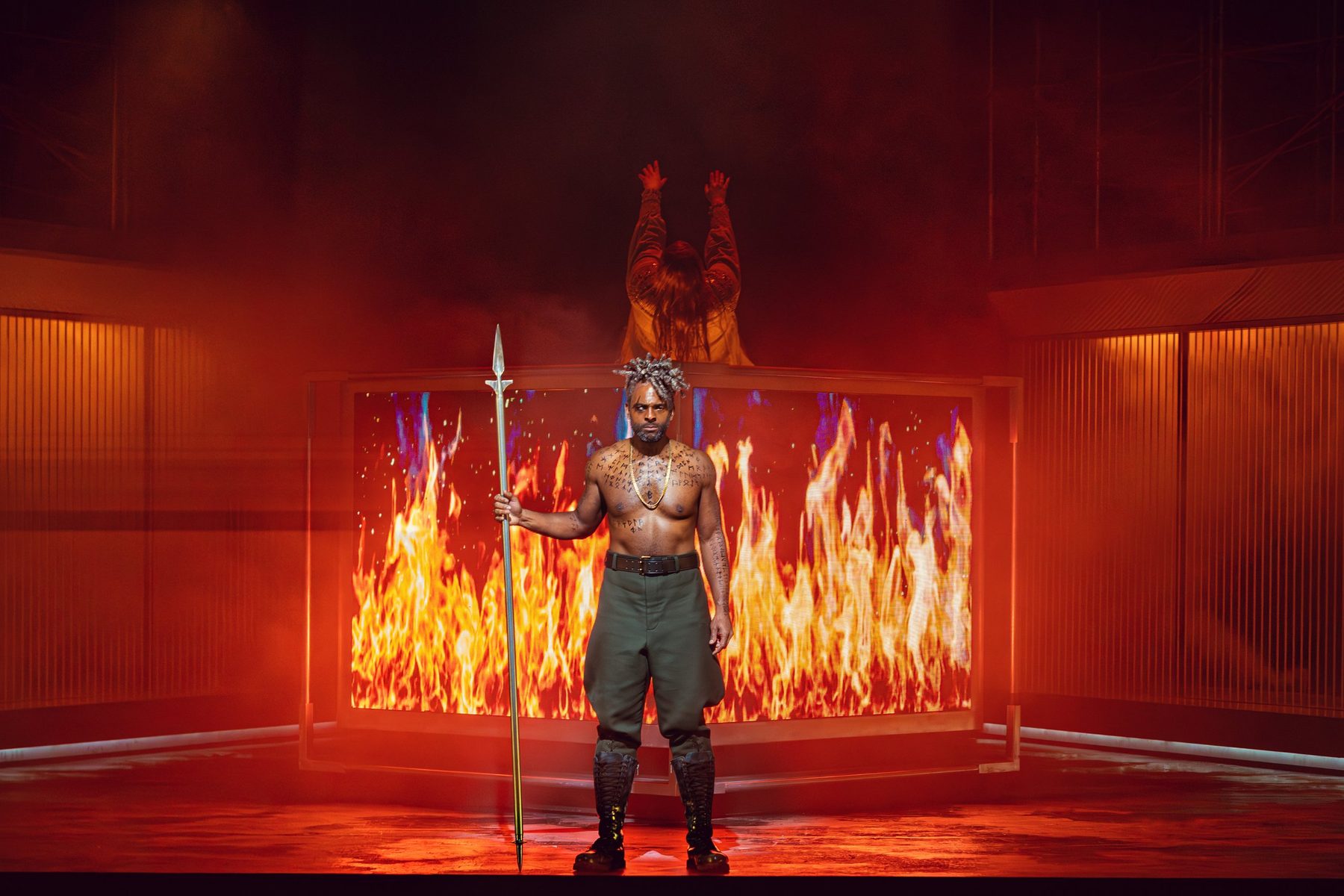
Ryan Speedo Green (Wotan); Back: Tamara Wilson (Brüunhilde); photo by Curtis Brown for the Santa Fe Opera
The performance was marked by excellent singing, flexible but ultimately meaningless settings, and costumes that ranged from impressive to silly. The stage direction was busy, filled with ideas but no overriding concept.
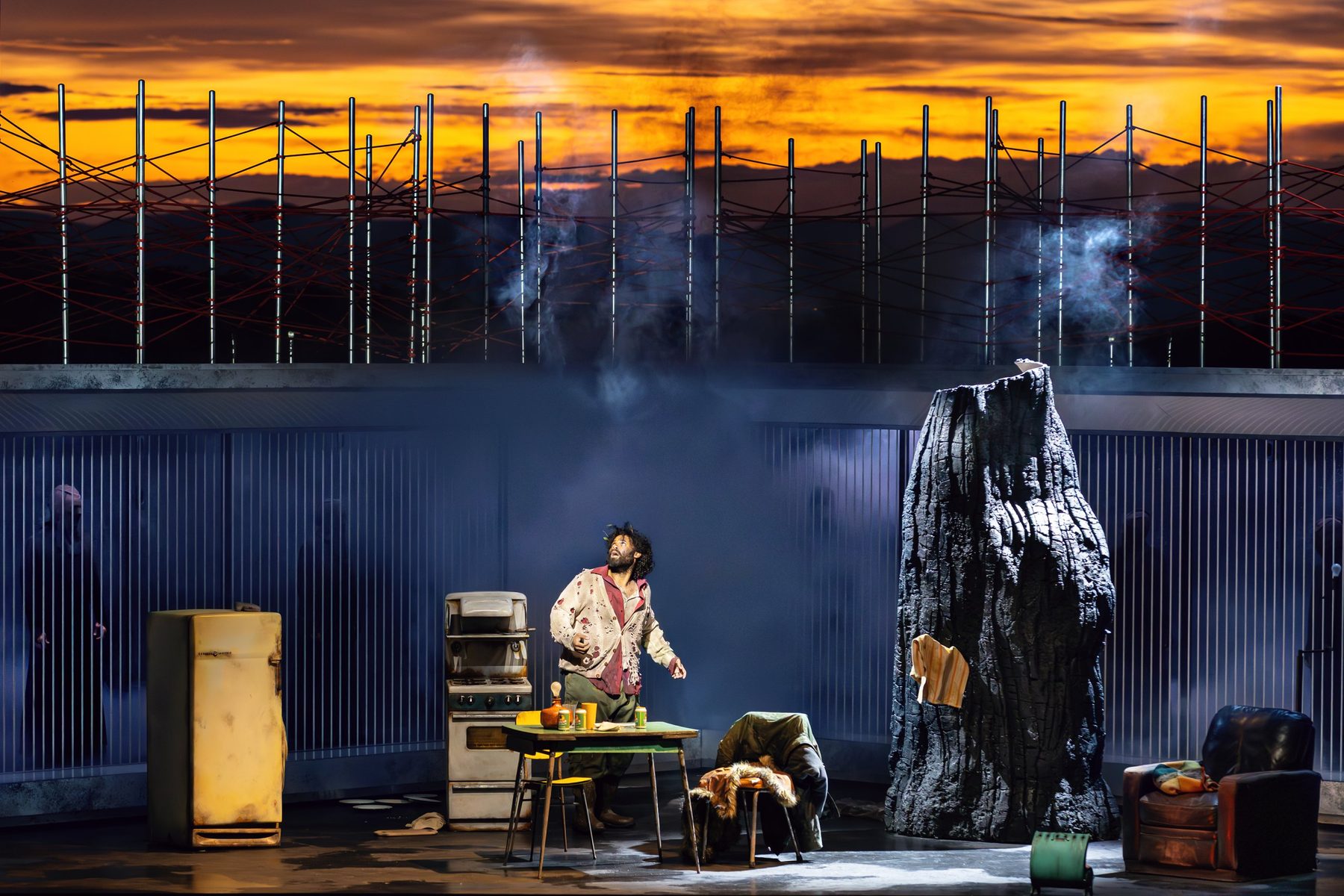
Jamez McCorkle (Siegmund); photo by Curtis Brown for the Santa Fe Opera
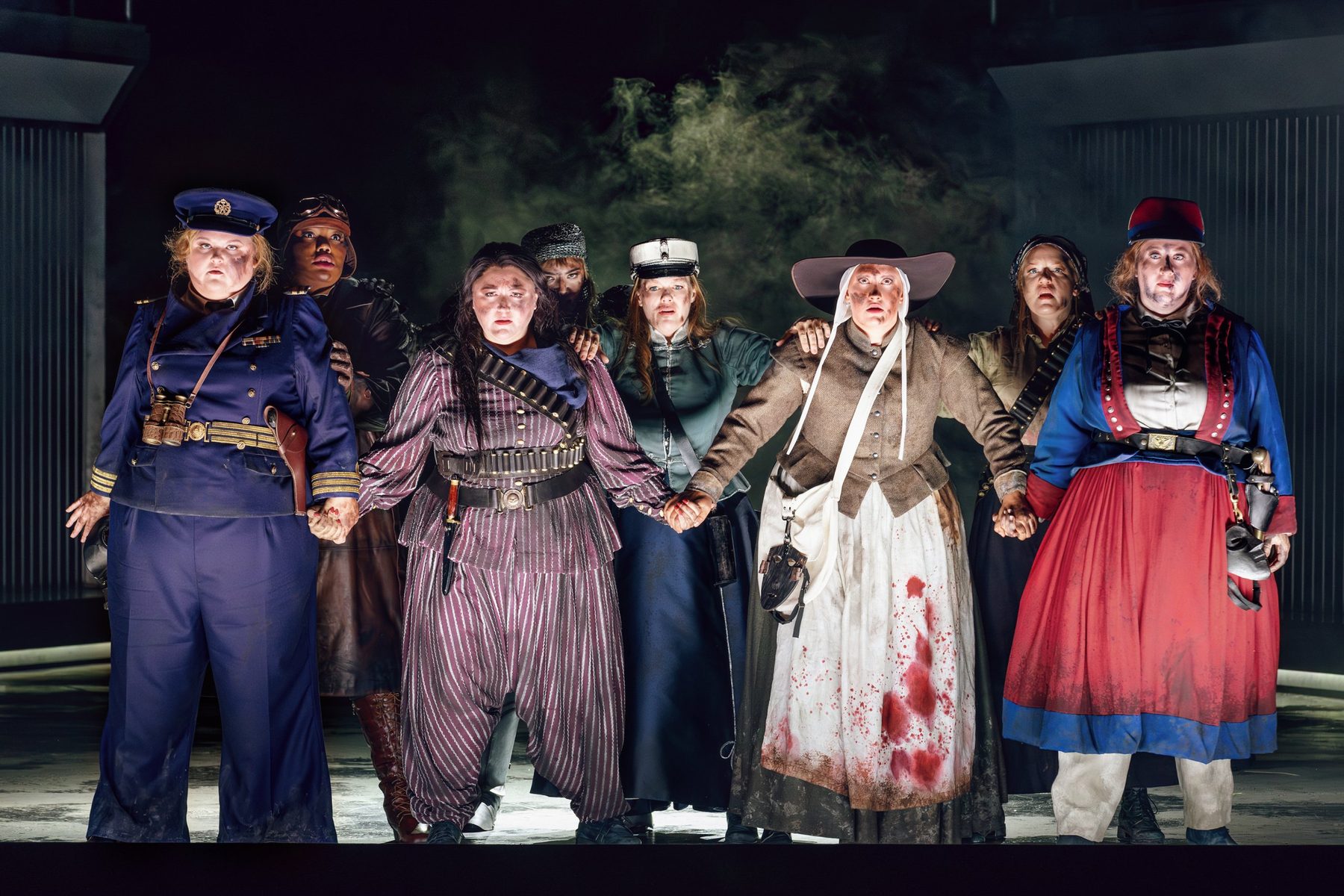
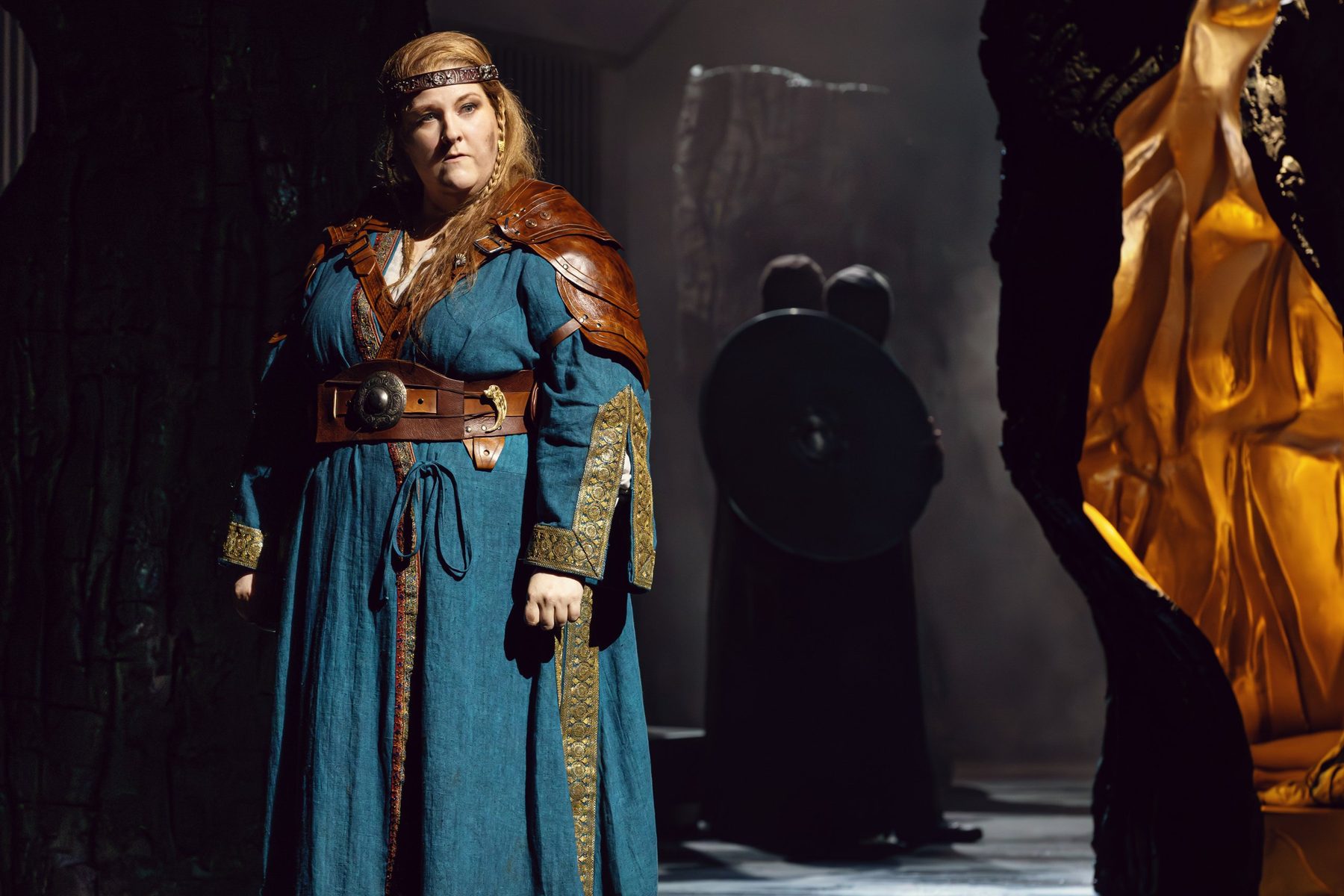
Many operas today are time shifted; I have reviewed several of these at Santa Fe in the past (La Traviata and Don Giovanni, Rosenkavalier and L’elisir d’amore, Tosca). Die Walküre, based in legend, has no set era, but Santa Fe’s current production proposes many different historical time slots for the story. The opening act took place in an abstract space filled with 1950s appliances, Sieglinde wore a contemporary dress, Brünnhilde was clad in generic old-norse gear, and the Valkyries wore different military uniforms from across the globe and representing the middle ages to the 20th century.
L-R: Valkyries Gretchen Krupp, Jasmin Ward, Jessica Faselt, Lauren Randolph, Wendy Bryn Harmer, Deanna Ray Eberhart, Jennifer Johnson Cano, Aubrey Odle; photo by Curtis Brown for the Santa Fe Opera
The set remained abstract throughout—two horizontal panels filled with vertical, elastic cables that characters reach and enter through, that meet mid-stage to open or close as the staging requires. These panels are topped by a walkway with a railing of entangled red ropes, a symbol used throughout to represent marriage—literal ”ties that bind”—as enforced by Fricka. The upper walkway is used by Wotan, Fricka and others, as a viewpoint on the stage action below. As a setting, this is suggestive of nothing at all.
Various non-singing characters appear throughout. There are mysterious figures in black body suits who enter and leave the stage, handle Siegmund’s sword, Brünnhilde’s shield, and move set pieces around. There are actors representing Alberich, who is referred to but not present in the plot; Grimhilde, the Gibichung who will be mother to Alberich’s son Hagen later in the story; Erda, Siegmund’s, Sieglinde’s and the Valkyries’ earth-spirit mother; and other shadowy figures from Ring mythology.
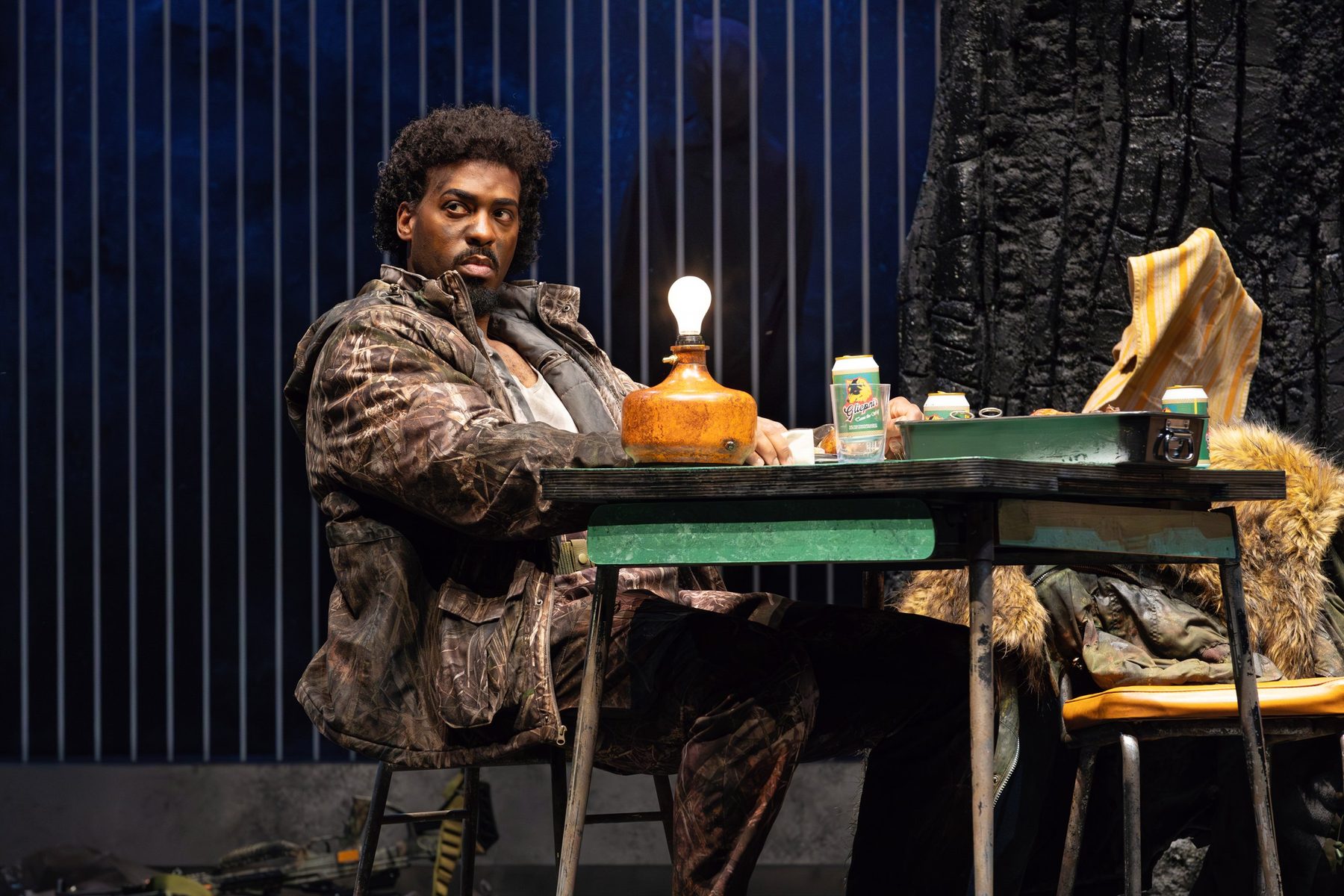
Solomon Howard (Hunding); photo by Curtis Brown for the Santa Fe Opera
None of this clarifies the plot. Clearly, director Melly Still has many ideas about how to present Die Walküre within the Ring Cycle, but her disparate ideas do not add up. At it’s core Die Walküre tells a simple story—Siegmund runs off with his sister Sieglinde and they conceive a child; Sieglinde’s betrayed husband Hunding tracks them down and kills Siegmund.
But there is no story so simple that Wagner and stage directors cannot make it more complicated, which is what happens in Santa Fe. Wagner’s role, having written the libretto based on the Nordic myths, lies with meddling gods and magical weapons.
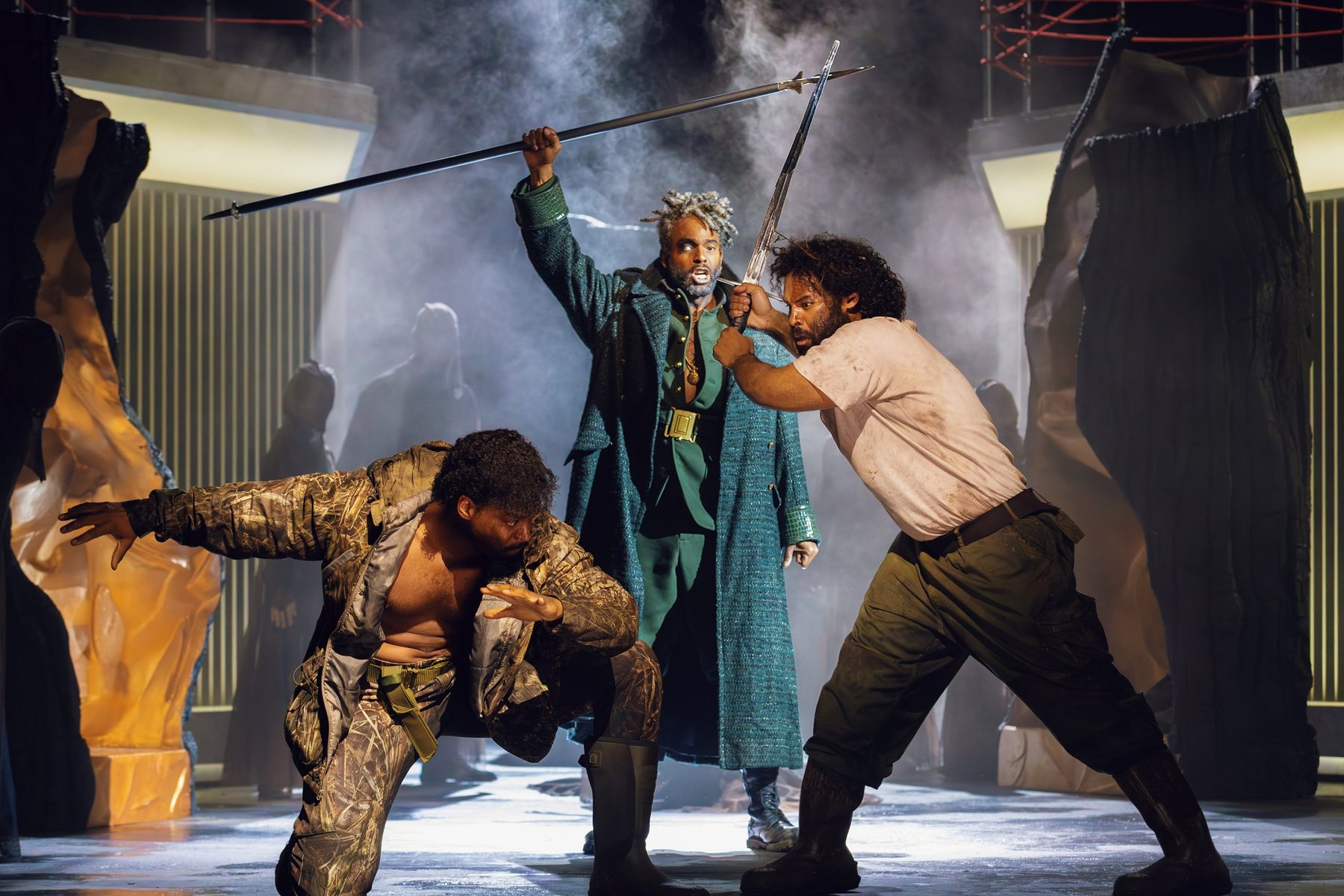
The stage director takes credit for the rest, starting with the black-clad figures, who only obfuscate the plot. While the basic action is clear, one is distracted by dark figures posing mysteriously behind the elastic bands, reaching through them, entering and leaving the stage, handling props. There is broader symbolism at work, but none of this helps to tell the story of Die Walküre. Another intrusion that seemed gratuitous was Wotan’s cadre of “enforcers,” military police characters dressed like Star Wars extras or World War I impersonators.
One moment in particular stands out as a missed opportunity. The first act ends with the walls of Hunding’s hut flying open and spring bursting over the twins/lovers Sieglinde and Siegmund, blessing—as Wotan later argues to Fricka—their incestuous love. Wagner’s music is powerful, soaring and blooming. It is expressing something that needs to be shown. But in Santa Fe, the panels open up and the lovers occupy a bare space on the stage. Of spring there is not the slightest visual sign.
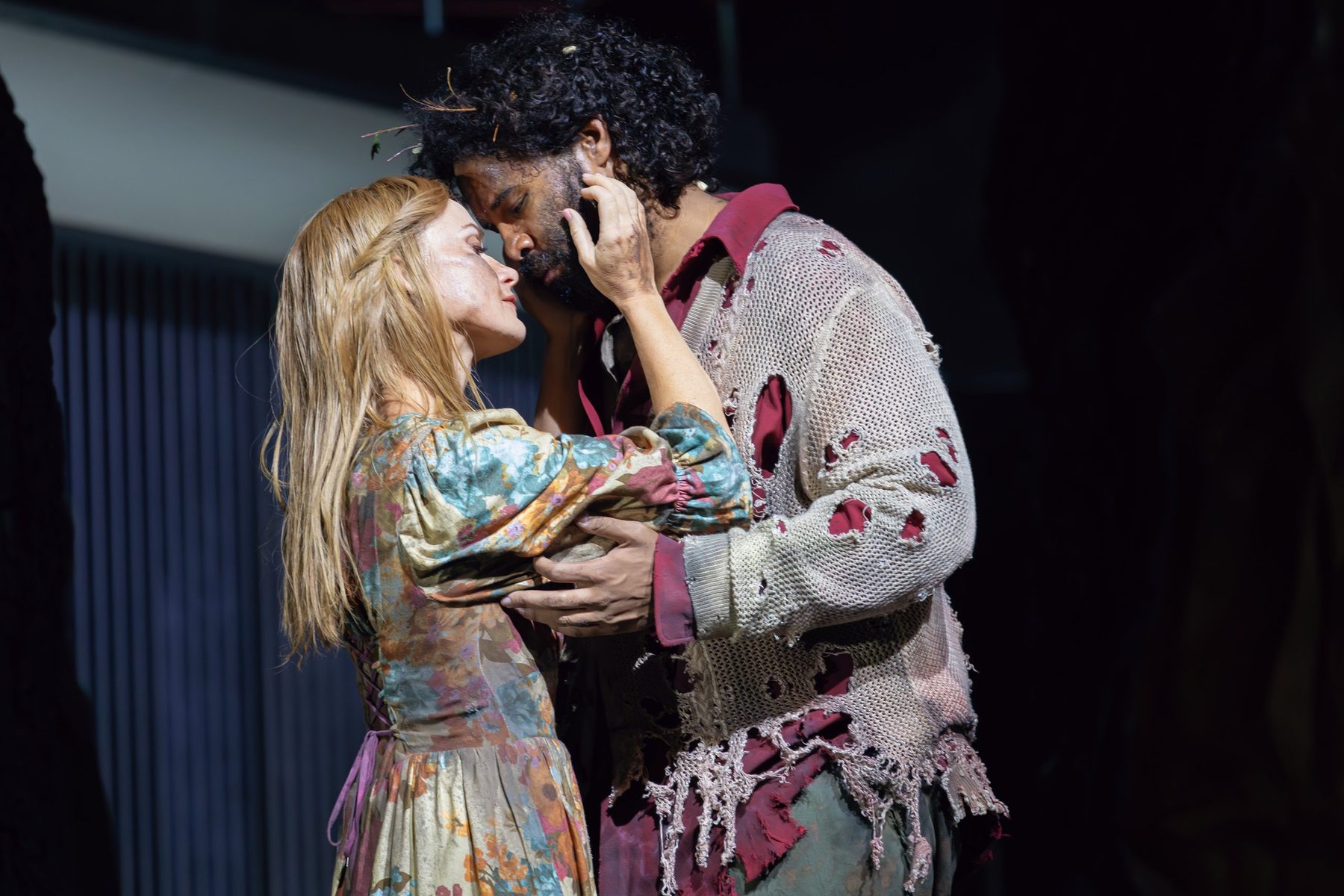
Vida Miknevičiūtė (Sieglinde), Jamez McCorkle (Siegmund); photo by Curtis Brown for the Santa Fe Opera
In the role of Siegmund, Jamez McCorkle reached all of his notes, sang with strong feeling, but allowed a slight bleat enter his voice at crucial moments. This rough edge pushed his voice out, but as often with strained Wagner singers, it did not add beauty to the sound.
Vida Miknevičiūtė portrayed a slight Sieglinde, vulnerable and frightened by her rising feelings. Although light for Wagner, her voice was precise, employed carefully, only occasionally a little wobbly. She sang forcefully through the love duet with Siegmund, rising to steely heights, and melting into her gentler moments.
As Wotan, Ryan Speedo Green was struggling with altitude, or the dry mountain air, or both. While onstage he was handed water through the elastic bands in both acts II and III, and his voice sounded worn by the end of each act. At his best, he was a gruff, confrontational Wotan, consumed by his growing anger at being caught in his own trap. He easily commanded the stage in every appearance. Whatever his struggle, it did not diminish his presence.
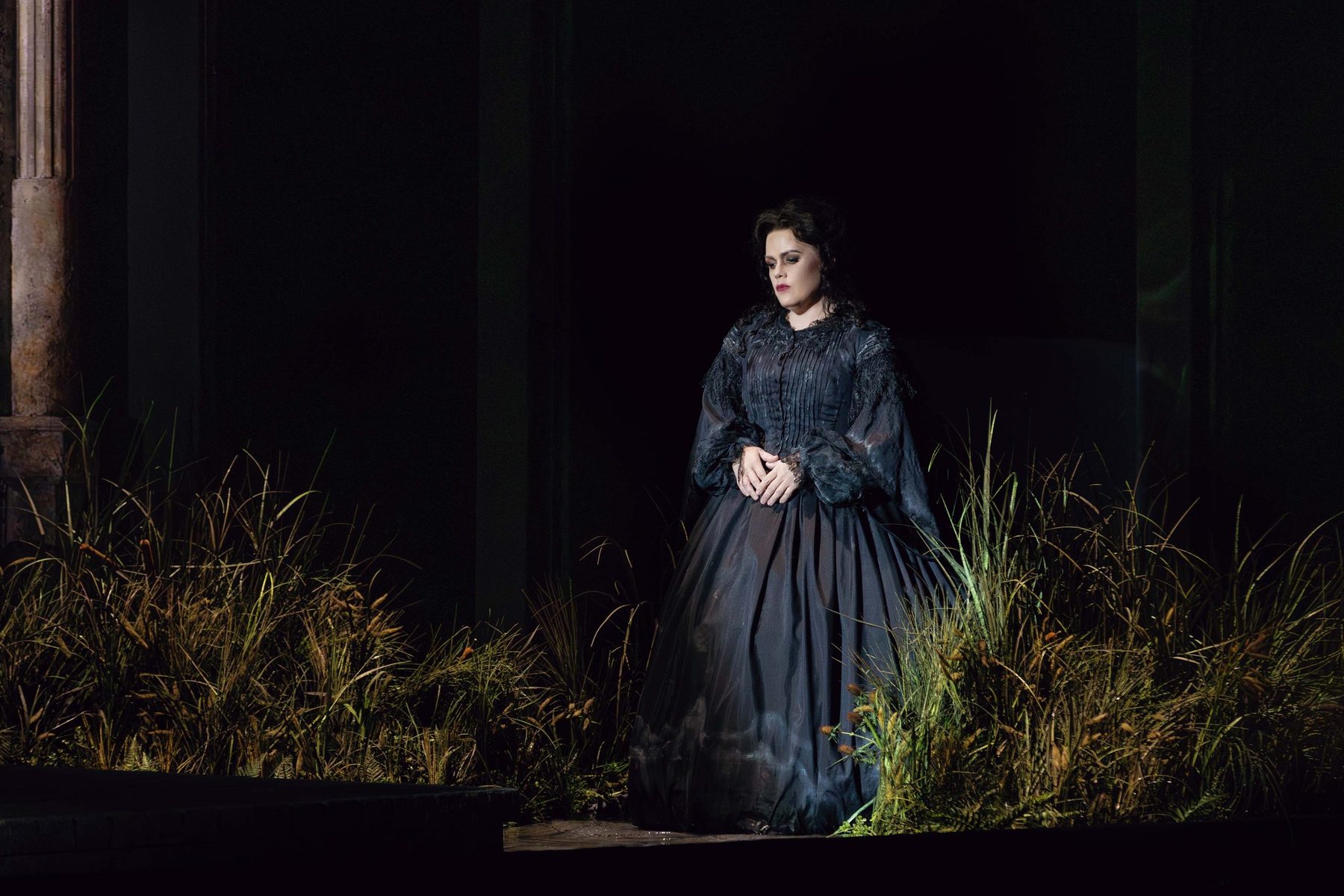
Tamara Wilson (Brüunhilde), photo by Curtis Brown for the Santa Fe Opera
Tamara Wilson’s entrance as Brünnhilde was greeted with cheers. She was a solid member of the cast, singing with force and power, if not quite dominance. Her interactions with Green’s Wotan near the end was a forceful turning point, in both the opera and for the cycle beyond Walküre.
Sarah Saturnino provided a secure vocal element as Fricka. Her long Act II argument with Wotan—for me one of the most interesting portions of a long evening—was deeply engaging. Saturnino sang with genuine depth and expression.
Solomon Howard brought his big, resonant bass voice to the role of Hunding, filling the house with strong tones. His military-fatigue costuming lent an appropriately menacing air, although I hard a hard time getting past his resemblance to Jimi Hendrix. Contemporary costuming has its perils.
Soloman Howard (Hunding), Ryan Speedo Green (Wotan), Jamez McCorkle (Siegmund); photo by Curtis Brown for the Santa Fe Opera
The Valkyrie’s calls rang resoundingly over the orchestra, calling their warrior band together. All were potent contributors to the performance. With Brünnhilde, they displayed an infectious joy of companionship. James Gaffigan conducted with a sure hand, leading a performance steeped in experience and understanding of the score. The orchestra, and especially the expanded brass section so crucial to Wagner, played tirelessly over the music drama’s long duration, providing powerful heights as well as more intimate moments of sensitivity.
The Aug. 8 audience I take to have been about 75% Wagnerphiles—two gentlemen in front of me wore horned helmets of felt—who loved every minute of Wagner’s music. They know the story backwards and forwards, and so could recognize all the references and the crucial turns of the plot. They deservedly cheered the singers.
For those less familiar with the story, it must at times have been a mystery.
Die Walküre will be repeated at the Santa Fe Opera twice more, Aug. 13 and 21. Remaining tickets, if any, are available HERE.
Santa Fe Opera presents carnivalesque production of Verdi’s masterpiece
By Peter Alexander Aug. 11 at 1:45 p.m.
Editor’s Note: This is one of several posts covering four of the five operas presented this year at the Santa Fe Opera.
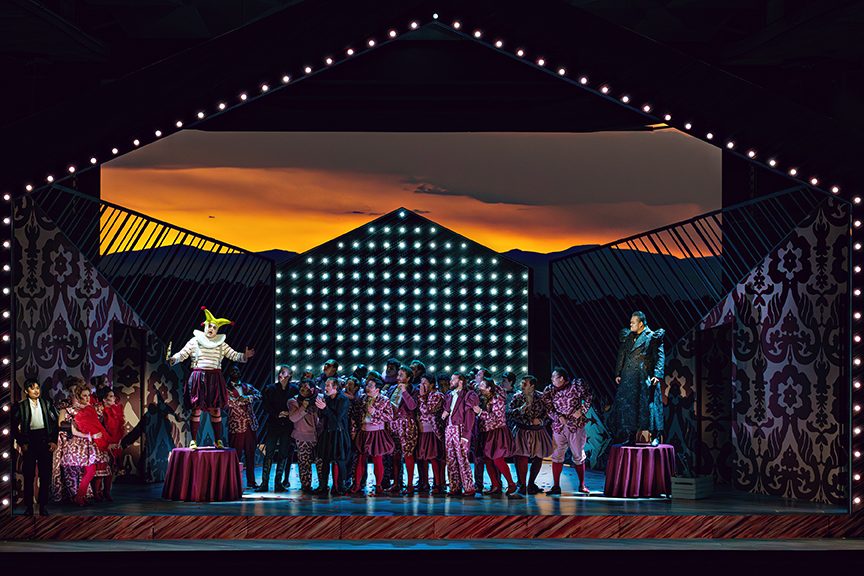
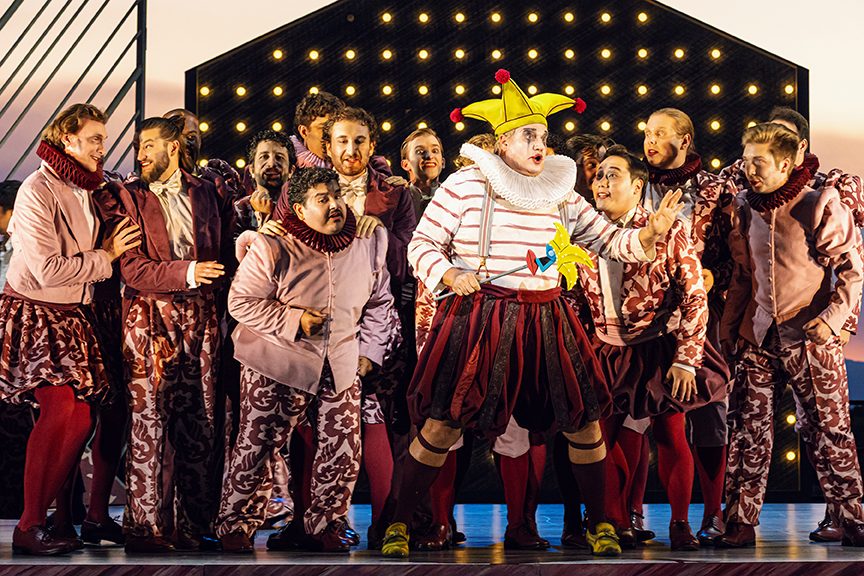
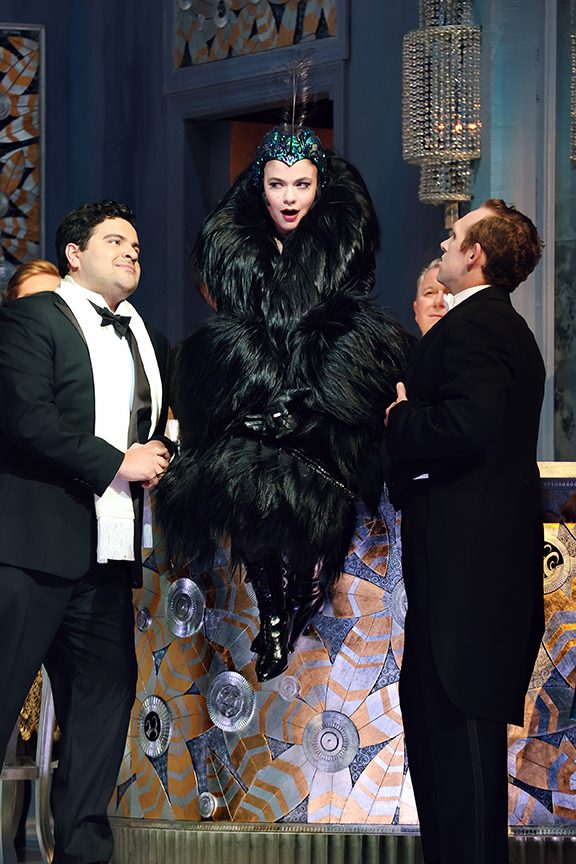
Santa Fe’s new production of Verdi’s Rigoletto opens on a carnivalesque scene: a chorus of courtiers dressed in stylized theatrical garb of mixed styles and periods, including Spanish breeches, Landsknecht jackets with slit sleeves, as well as shirts and pants of no discernible period. A few women sported Marie Antoinette gowns.
Front L-R: Duke Kim (Duke), Michael Chioldi (Rigoletto), Le Bu (Count Monterone), the Santa Fe Opera Chorus; photo by Curtis Brown for the Santa Fe Opera
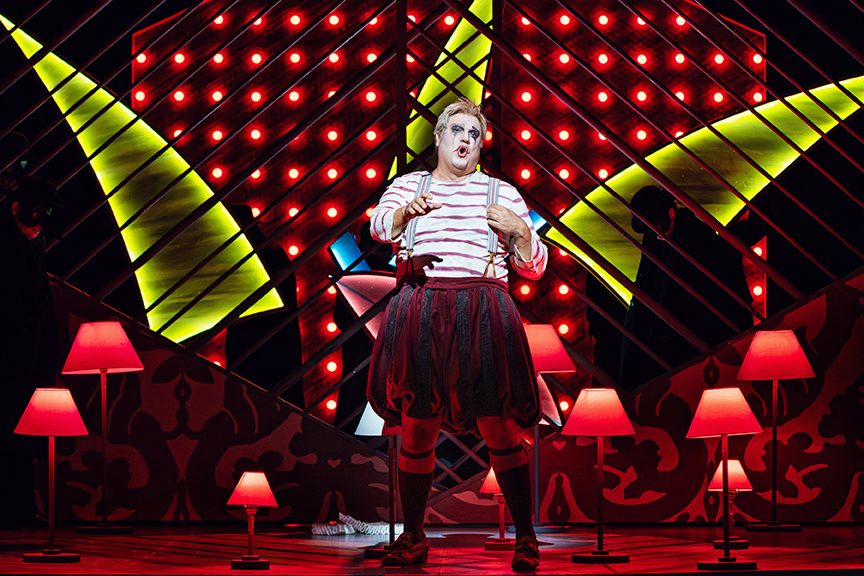
The dark violet color patterns of the essentially anonymous courtiers all match, while named characters—Merullo, Ciprano and the Duke of Mantua—are dressed in black and white. Some jackets clearly have zippers. Rigoletto wears garters with his socks and a stylized jester’s cap. In short, everything catches the eye, nothing pertains to any one period.
Rigoletto (Michael Child) with the decadent tribe of courtiers (The Santa Fe Opera Chorus); photo by Curtis Brown for the Santa Fe Opera
This eclectic mix in Jean-Jacques Delmotte’s costumes is matched by Julien Chavaz’s inventive stage direction where the opera’s high drama and tragedy is mixed with comic touches that lighten some scenes, but sometimes distract from the real business of the singers. The chorus of courtiers are not only dressed alike, they move in lockstep conformity. They move as a pack, sometimes going into silly choreographic moves, showing their inability to break from the decadent tribe at court.
Chavez goes so far as to lightly mock operatic conventions, as when Giovanna mugs to the audience during Gilda and the Duke’s amply repeated goodbyes. There quiet chuckles are welcome, as in the well considered interplay between the assassin Sparafucille and his sister Magdalena in the final act.
On the other hand, the silly choreography for the chorus while the Duke sings his praise of love in the second act is an unnecessary indulgence. The Duke’s aria represents a critical moment, revealing that he has discovered a kind of love from Gilda he has never seen at court. It does not redeem him, but makes him a more rounded person, and should not be downplayed for easy entertainment, whatever the symbolic depth. The same principle could have been applied elsewhere.
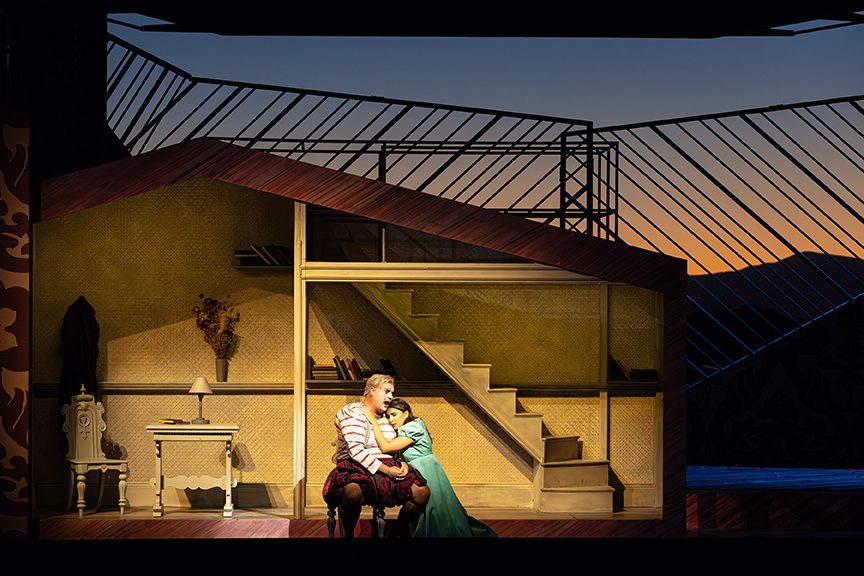
Designer Jaime Vartan’s set for the Duke’s court is abstract, with abstractly decorated mobile flats that are moved around the stage. Scattered among them are colorfully lit pieces that come together at the end to briefly outline the jester’s hat and face, and then disintegrate as the tragedy destroys Rigoletto. The interiors of Rigoletto’s home and Sparafucile’s “tavern” roll on from the wings. Their well designed contrast with the rest of the stage creates a space of warmth and safety in one case, danger and decadence in the other.
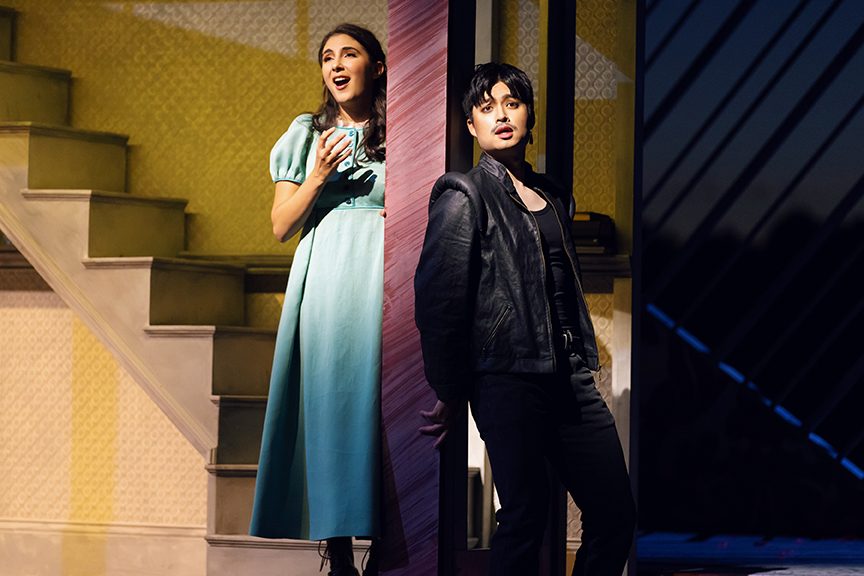
Michael Chioldi (Rigoletto), Elena Villalón (Gilda); photo by Curtis Brown for the Santa Fe Opera
Portable lamps are sometimes used realistically, as light for Gilda’s reading, but also abstractly, carried about by the courtiers representing—who knows, enlightenment? The meaning was not clear to me. Why, for example, is Gilda discovered at court after her abduction, upstage, surrounded by lamps that are then moved downstage when Rigoletto orders the courtiers out of the room?
If the design and direction are a mixed bag, the music definitely is not. From the very first notes on Aug. 7, conductor Carlo Montanaro and the Santa Fe Opera orchestra take the drama in their teeth. Beyond the ferocity of the opening and all references to the curse invoked on Rigoletto and the Duke, Montanaro led with consistent flexibility and expressivity in supporting the singers. Musically, this was one of the most gripping Rigolettos I have seen.
Duke Kim’s light tenor warmed and strengthened over the evening, reaching a high level of passion by the end. His Donna e mobile in the last act was exciting, and his duets with Gilda were wonderful. His portrayal of the privileged, devil-may-care nobleman was winning (or fittingly vile, if you will), both musically and dramatically.
Elena Villalón (Gilda), Duke Kim (Duke); photo by Curtis Brown for the Santa Fe Opera
The star of the evening, as she should be, was the Gilda of Elena Villalón. Caro Nome was a moment of true beauty, and in every powerful duet—with Rigoletto and the Duke—she drove the drama to powerful heights. She carried a warm sound into the softest moments, beautifully holding out the longest phrases. Her acting was first rate, establishing her loving and confused relationship with her father. I particularly liked the touch of showing her reading, making her a full person, a young woman of genuine curiosity and thoughtfulness as well as innocence.
Michael Chioldi (Rigoletto); photo by Curtis Brown for the Santa Fe Opera
A late switch in the cast, Michael Chioldi as Rigoletto used his mature voice to establish a character of great experience and many woes. He mustered the power when needed to convey the depth of Rigoletto’s anguish; every exclamation of the curse was grim and powerful. His closing scene with the dying Gilda was chilling.
Stephano Park made a superb Sparafucile, summoning terror with his deep bass to the lowest note of his name. Marcela Rahal was equally telling as Magdalena, adding a flirtatiousness that fits the character and helps round out the final act. The interactions between brother and sister were more than just singing the notes; there was a touch of teasing in their bother-sister interactions that elicited a few light chuckles.
Le Bu sang the condemned Count Monterone “like thunder.” The named courtiers—Ryan Wolfe and Marcello, Korin Thomas-Smith as Count Ceprao, Mary Beth Zara’s as the perky page, and Ryan Bryce Johnson as Borja, all filled their smaller roles well.
The Santa Fe Opera production of Rigoletto will repeat Aug. 15 and 20. Tickets, if available, can be purchased HERE.
Editor’s Note: This is one of several posts covering four of the five operas presented this year at the Santa Fe Opera.
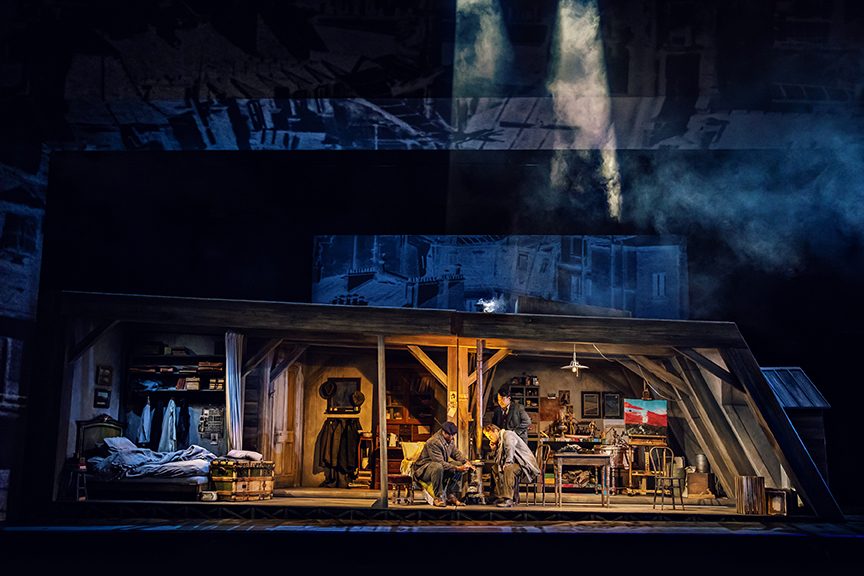
Santa Fe Opera’s production of Puccini’s La Bohème (seen Aug. 6) opens on a standard first-act set: a dingy apartment of Bohemian squalor with views of the Parisian rooftops, here created by projections. Two young men are at work.
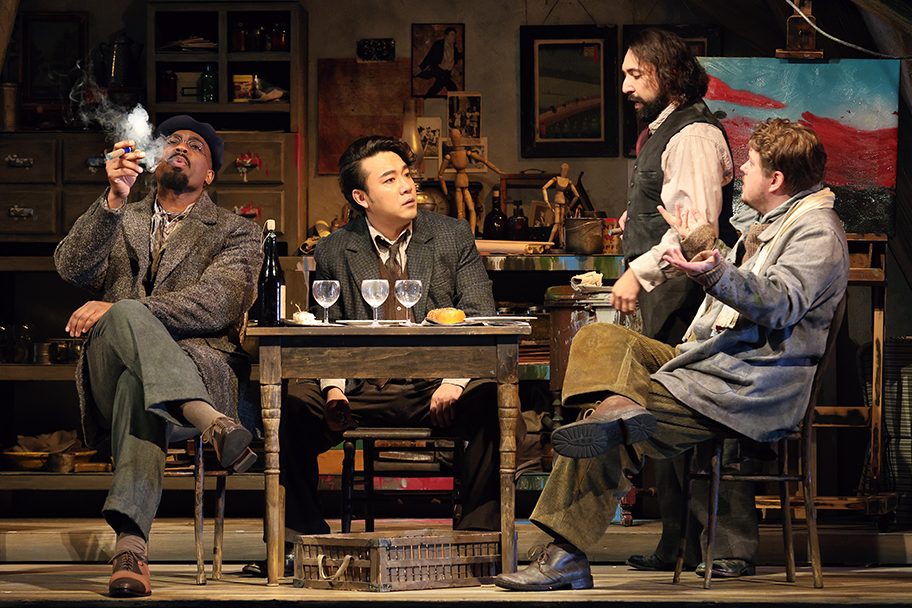
L-R: Soloman Howard (Colline), Long Long (Rodolfo), Szymon Mechliński (Marcello); photo by Curtis Brown for the Santa Fe Opera
The first sign that something is up is when the poet Rudolfo starts pounding on a typewriter. This is not 1830s Paris, and when Mimi enters later in the act, her hair style shows that we are in the 1920s. In many ways this is a good choice: Paris in the ‘20s was a center of the avant garde, young artists were flourishing (think Hemingway and Picasso), and the free lifestyle of the operatic Bohemians was common.
L-R: Efraín Solís (Schaunard), Long Long (Rodolfo), Sylvia D’Eramo (Mimì), Soloman Howard (Colline), Szymon Mechliński (Marcello), Emma Marhefka (Musetta) Kevin Burdette (Alcindoro); photo by Curtis Brown for the Santa Fe Opera
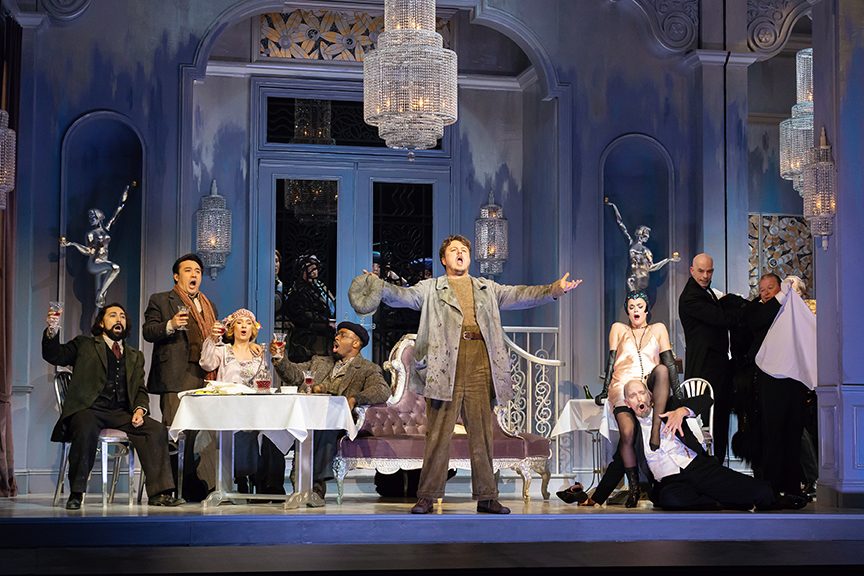
For the most part, the temporal transposition works well, and it provides great opportunities for the costume designs of Costance Hoffman. Indeed, the second act in the streets of Montmatre and inside the Café Momus (transformed from a neighborhood bistro to a five-star restaurant) is a 1920s fashion pageant. The incongruity of grubby Bohemians in such surroundings, with plain people gaping through the windows, becomes part of the humor of the scene. It is good fun, if it does stretch credibility.
The third act continues the time shift: there is a motorized ambulance (doubling as a spot for a streetwalker’s hookups) outside the police post at the gates of the City. The fourth act returns to the first set, through a very clever scenery shift that earned applause. Colline’s overcoat has a definite ‘20s vibe, as does Musetta’s attire.
This visually engaging production replaces one that was presented in Santa Fe in 2019. It is a great improvement, with all the pieces fitting well together.
This is not to say that there are no issues with Allen Moyer’s set. In the second act, the elegant Cafe Momus and its crystal chandeliers require so much space that all the rest of the action—bustling crowds, busy children, the toy seller Parpignol, the act-ending parade—are pushed into narrow margins of the stage. If there is a meaning to the Bohemians being just more Parisians on the street, swallowed up by the Christmas Eve revelries, it is lost here.
L-R: Solomon Howard (Colline), Long Long (Rodolfo), Efraín Solís (Schaunard), Szymon Mechliński (Marcello); photo by Curtis Brown for the Santa Fe Opera
James Robinson’s stage direction meets the vital standard of telling the story. The camaraderie of the Bohemians is well portrayed, and all critical moments of the story are clear. He always handles the movements of actors in confined spaces comfortably.
In the name of realism—or so I assume—there are a few crude touches. Schaunard turns his back to the audience and then takes the chamber pot and throws its liquid contents out the garret window. After the third-act fight between Marcelo and Musetta, Marcelo angrily retreats into the ambulance with a friendly protstitue. Is it my age? I don’t see what these touches add to the opera.
Conductor Iván López Reynoso charged into the opening chords. Brusque and brisk, they propelled a quick tempo that thankfully stretched to accommodate the vocal lines, but for long periods did not let up. At times Reynoso allowed the brass free reign, and the orchestra sometimes covered the singers or pushed them to full volume. Otherwise, he controlled the musical flow well and kept the music moving.
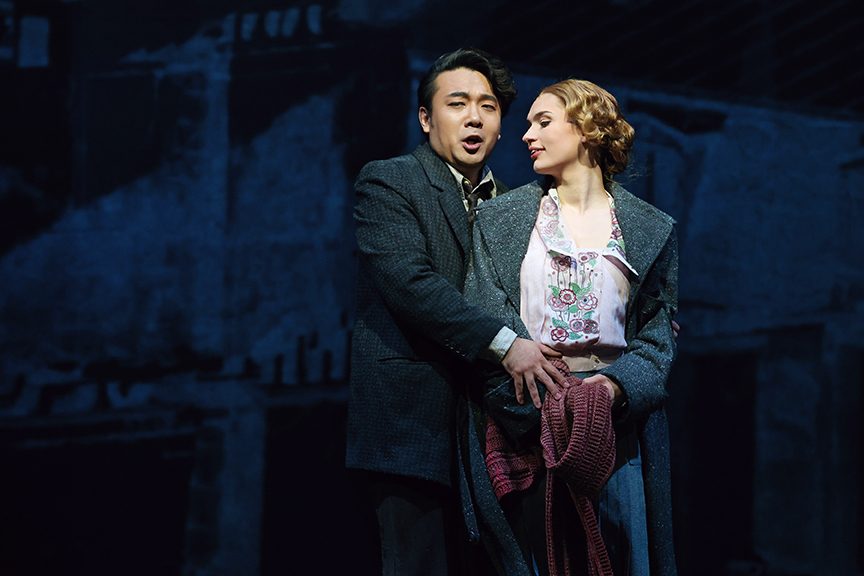
Long Long (Rodolfo), Sylvia D’Eramo (Mimì); photo by Curtis Brown for the Santa Fe Opera
The success of any Bohème depends on the two leading roles, Rudolfo and Mimi. Both Long Long and Sylvia D’Eramo handled their assignments handsomely. Long Long sang with a ringing, Italianate tone, but the sound lacked a sense of freedom and comfort at the margins. Every phrase was delineated and sung with expression, but I did not sense a progression from one act to another. Rudolfo of Act IV was Rudolfo of Act I.
D’Eramo conveyed Mimi’s fragile state from her first entrance. In the softest moments she floated her pianissimos beautifully, and she used her voice well to convey the character’s declining health. I especially enjoyed her transformation from a shy neighbor to a young woman who is warming to the dawn of love in Act I. A blooming orchestra sound sometimes covered her lines, but she was always able to soar above the sound at climactic moments.
As Marcello, Szymon Mechliński sang with a booming if sometimes rough-edged baritone. This suits Marcello, a more rough-edged character than Rudolfo. His was a dominant character among the four artists, at his best in confrontations and combat with Musetta.
Emma Marhefka (Musetta); photo by Curtis Brown for the Santa Fe Opera
In the latter role, Emma Marhefka played the coquette to the nth degree. No character was more vivid throughout, justifying the bystanders who are delighted to spy her in the second act crowd scene. The famous Waltz was more languid than usual, but none the less effective with her rich voice.
Bass Solomon Howard made Colline a strong presence, singing with a resounding quality that only occasionally hit rough spots in the “Overcoat Aria” of Act IV. Efraín Solís was solid in the less prominent role of Schaunard, always part of the happy company of Bohemians. Santa Fe veteran Kevin Burdette brought the supporting roles of Benoît and Alicindoro to comic life, singing as well as ever.
In spite of any reservations, this is a thoroughly enjoyable Bohème. The cast is strong, the sets intriguing, the orchestra excellent, as always. And Santa Fe nights lend themselves perfectly to this drama of bohemian companionship, young love and loss.
Bohème repeats at the Santa Fe Opera Aug. 14, 19 and 23. Tickets are available HERE.
Britten’s The Turn of the Screw in a hauntingly ambiguous production
By Peter Alexander Aug. 10 at 1:15 p.m.
Editor’s Note: This is one of several posts covering four of the five operas presented this year at the Santa Fe Opera.
Benjamin Britten’s The Turn of the Screw is a challenging opera to produce.
Based on the short story by Henry James, it is a ghost story about a governess who cares for two children living on a remote estate. The children, Miles and Flora, are haunted, and lured into mischief or worse, by the spirits of deceased previous caretakers.
Or are they?
Jacquelyn Stucker (The Governess), Brenton Ryan (Prologue), photo by Curtis Brown for the Santa Fe Opera
As James’ story and the opera both make clear, the question is whether the ghosts are real presences, haunting the house and the children, or the products of the governess’ delusions, phantoms of an unbalanced mind. Whole books have been written on this issue; any production that fails to recognize the question has failed.
Jacquelyn Stucker (The Governess), Brenton Ryan (Peter Quint), photo by Curtis Brown for the Santa Fe Opera
In that respect, the current Turn in Santa Fe is the most successful I have seen. The relationships among the governess, the children, and the ghosts of Peter Quint and Miss Jessel, are adeptly handled. The problem is that Quint and Jessel sing, so it is necessary to have living actors onstage. How can they remain figments of the Governess’ imagination, when we, the audience, can see them?
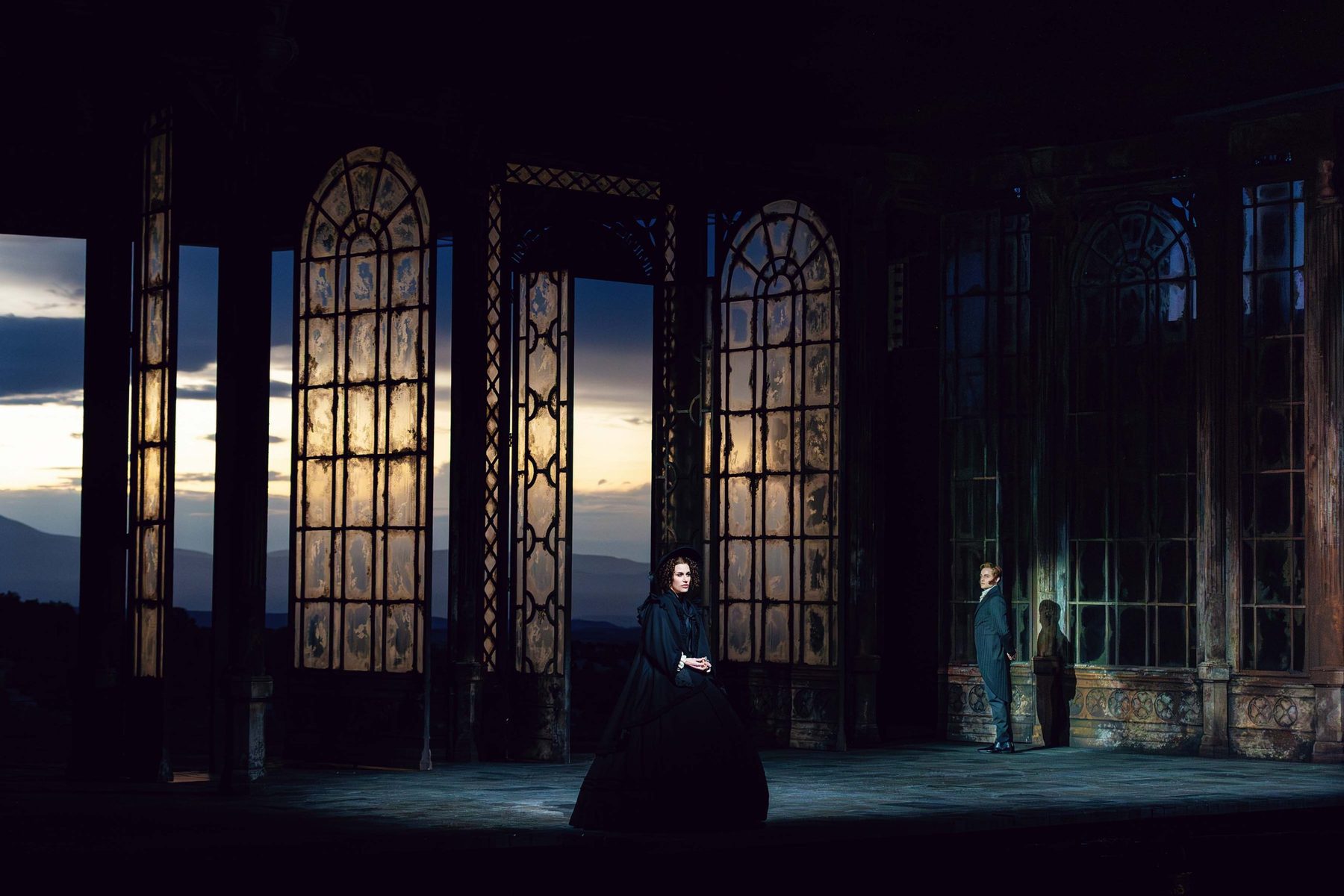
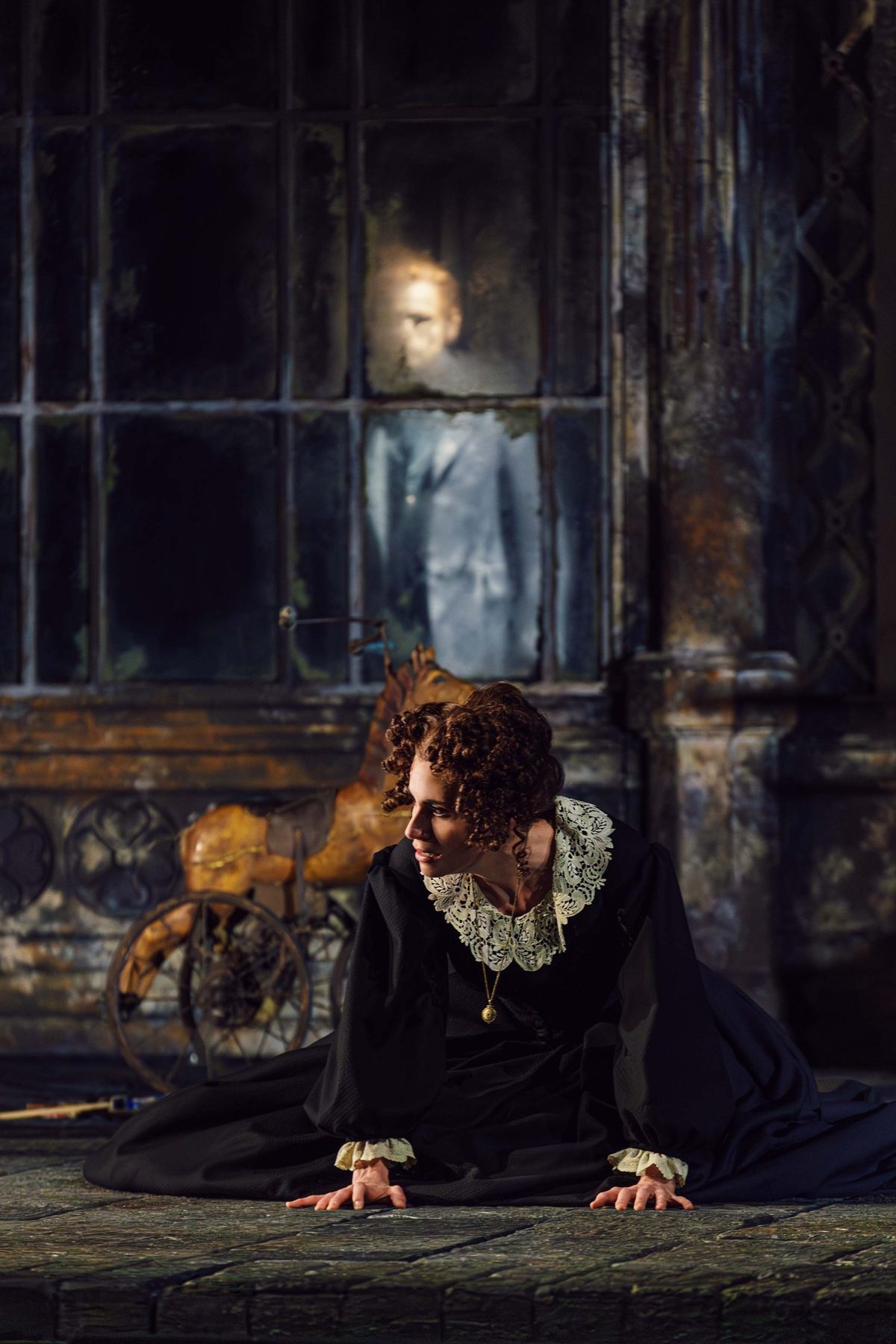
A full description of all the astute choices in the Santa Fe production would require a separate essay, but several critical points illuminate the care taken by stage director Louisa Miller. In his first appearance Quint is only a vague apparition, seen though the window. But after Mrs. Grose, the housekeeper, gives names to what has happened in the past, who Peter Quint and former governess Miss Jessel were, suddenly they are seen more clearly, appearing onstage with the governess. This suggests that Mrs. Grose has stimulated the young governess’ overactive, and possibly paranoid, imagination.
Another telling point is that the children never see the ghosts. When Quint and Jessel are onstage, the children never turn to look at them, in spite of being called by name. Only the governess seems to see and hear the ghosts, and only she speaks to them. So the ghosts, if such they are, remain suggestions more than characters. Anything else can be explained by the fact that Quint and Jessel did interact with—and possibly lead astray—the children in the past. When Quint tells Miles to steal a letter, it could just as reasonably be a young boy’s naughty impulse pushing him to mischief. His later explanation—“I wanted to know what you wrote about us”—rings true.
Annie Blitz (Flora), Everett Baumgarten (Miles), Jacqulyn Stucker, photo by Curtis Brown for the Santa Fe Opera
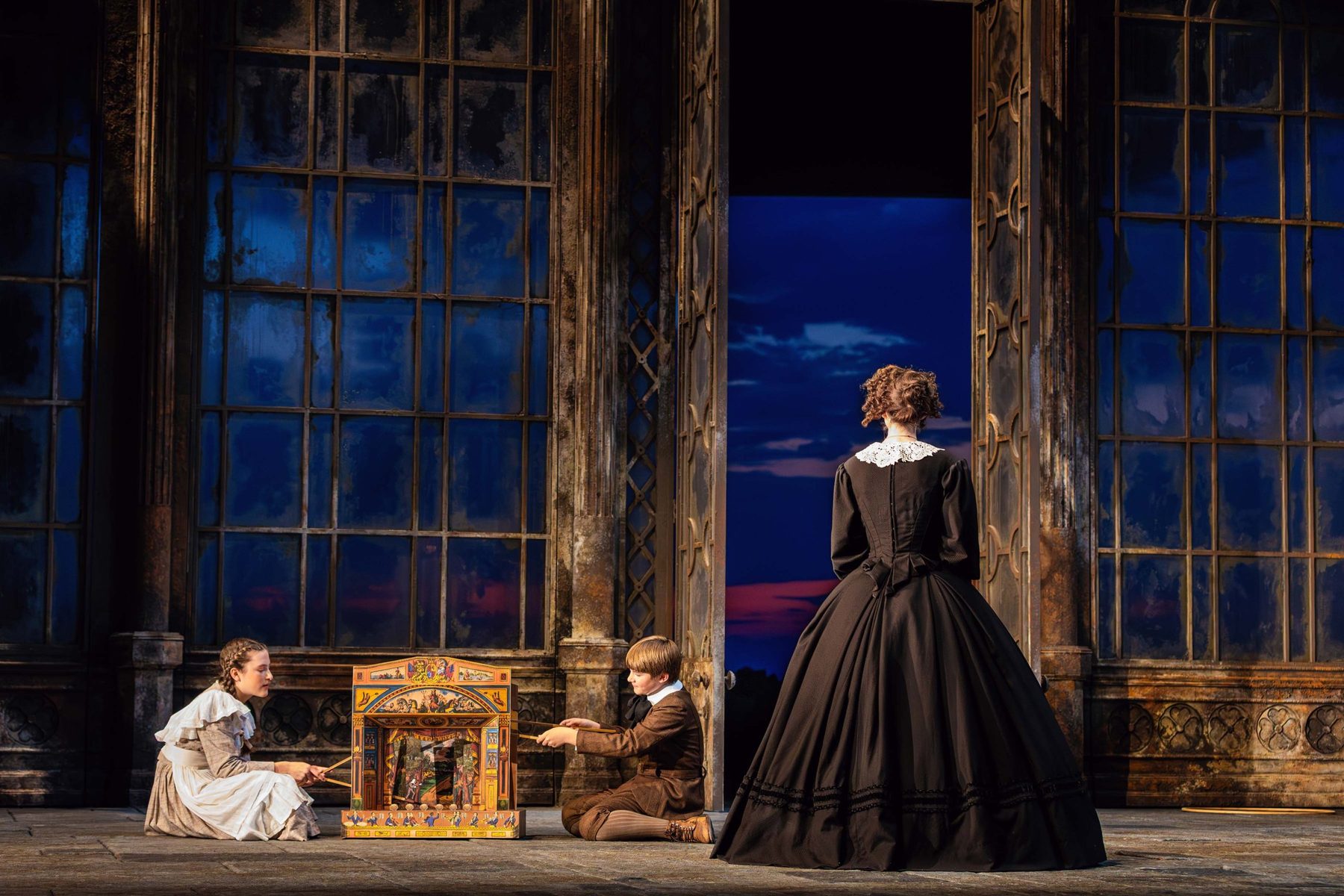
It would be a mistake to overlook one innovation of this production. Britten’s score is divided into scenes and and purely orchestral interludes between them. Miller makes use of the interludes—usually played without action—for symbolic events, or to show the children playing (and kudos for the delightful period play, from hoop trundling to a play theater) with the governess joining in. The plot focuses on the descent to tragedy, ignoring the rest of the children’s lives and their happier interactions with the governess. These pantomime sequences add depth to all of of the characters.
In short, Miller’s direction carefully treads the line between ghost story and psychological case study. (It is useful to recall that Henry James’ brother William is one of the founders of modern psychology). She correctly leaves it to the audience to decide which version of the story is true—or to leave it undecided.
The scenic design is credited to Christopher Oram, as a Canadian Opera Company production that originated at the Garsington Opera in England. It has effectively been fit onto Santa Fe’s stage, where lighting by Malcolm Rippeth successfully adds to the suggestive, murky ambience of the setting.
The Aug. 5 cast was uniformly strong in presenting both music and character. The diction was always clear and understandable, a testament to both Britten’s care in scoring the opera and the singers’ efforts. Brenton Ryan brought a bright tenor voice to both the prologue and the role of Peter Quint. His alluring roulades, tailored for the original Quint of Peter Pears, were unexceptionable. In one of the more telling touches, the staging of the prologue briefly conflates Quint and the absent guardian, raising more questions of motive and reality.
Jacquelyn Stucker was an ideal Governess, with a clear and delicate sound at the outset. She gave a well considered performance; as the opera progressed, she became more unstable and desperate in her characterization, and her tone more brittle and biting in quality. In voice and presence, Jennifer Johnson Cano portrayed a stolid and sometimes baffled housekeeper. She sang with security, blending into the ensemble and never dominating the musical texture.
The two young characters were beautifully performed by treble Everett Baumgarten as Miles and young soprano Annie Blitz as Flora. Baumgarten’s pure sound was always audible, and was alluring in his eerie “Malo, malo.” Blitz’s voice was focused, consistently on pitch but at times piercing.
Wendy Bryn Harmer (Miss Jessel), photo by Curtis Brown for the Santa Fe Opera
Wendy Bryan Harper provided a brooding presence as Miss Jessel. Her slightly pushed tone suggested a character under pressure, never quite at ease. Otherwise, little acting was required, as she drifted phantom-like on and off the stage, usually through the onstage pond that represented both the estate’s lake, and its symbolism as a boundary space between the real and unreal.
It would be hard to overpraise the orchestral players in the pit. Britten’s virtuoso score for an ensemble of 13 players was ably led by conductor Gemma New, who convincingly knit the various musical elements together, from scene to interlude to scene, and brought out the shifting moods of the evocative score. While all the players mastered the virtuoso demands of their parts, special notice should be taken of prominent percussion passages throughout.
NOTE: The 2025 performances of Turnof the Screw have come to an end.
Two entertaining comedies and a grim story from the home front at Central City
By Peter Alexander July 15 at 1:52 p.m.
Central City Opera (CCO) opened their summer season June 28 with a brisk and bubbly production of Rossini’s 1816 comedy The Barber of Seville. The summer’s other stylistically varied productions have now opened: The Knock, a 21st-century tale of life on the home front during the Iraq war, composed in 2020 by Alessandra Verbalov with libretto by Deborah Brevoort, on July 5; and the 1959 Broadway hit Once Upon a Mattress by Mary Rodgers and Marshall Barer, on July 12.
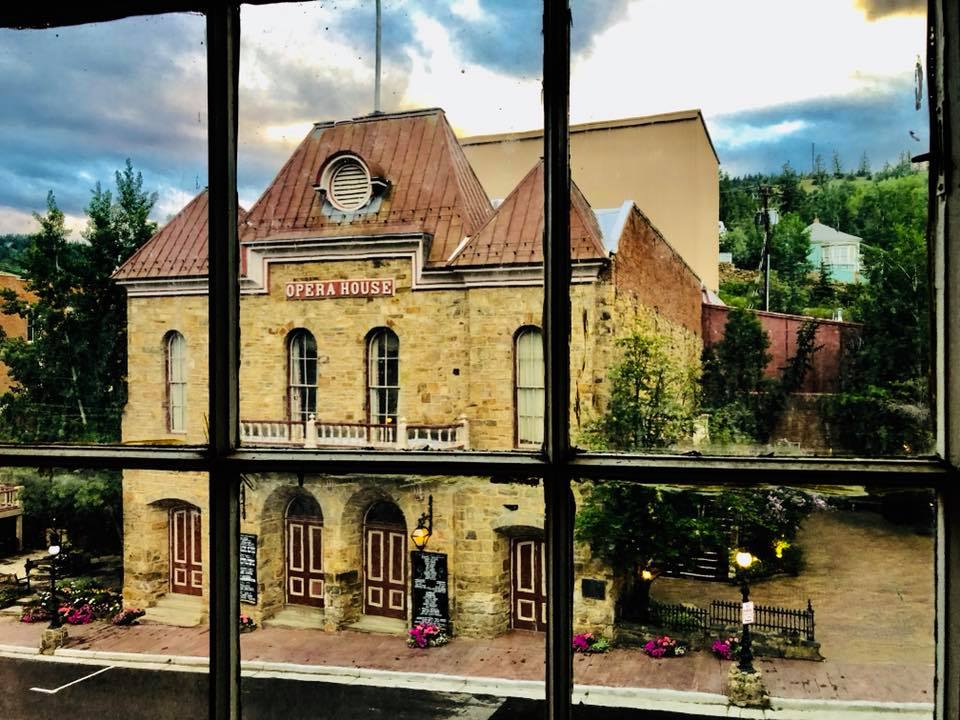
Central City Opera House. Photo by Ashraf Sewailam.
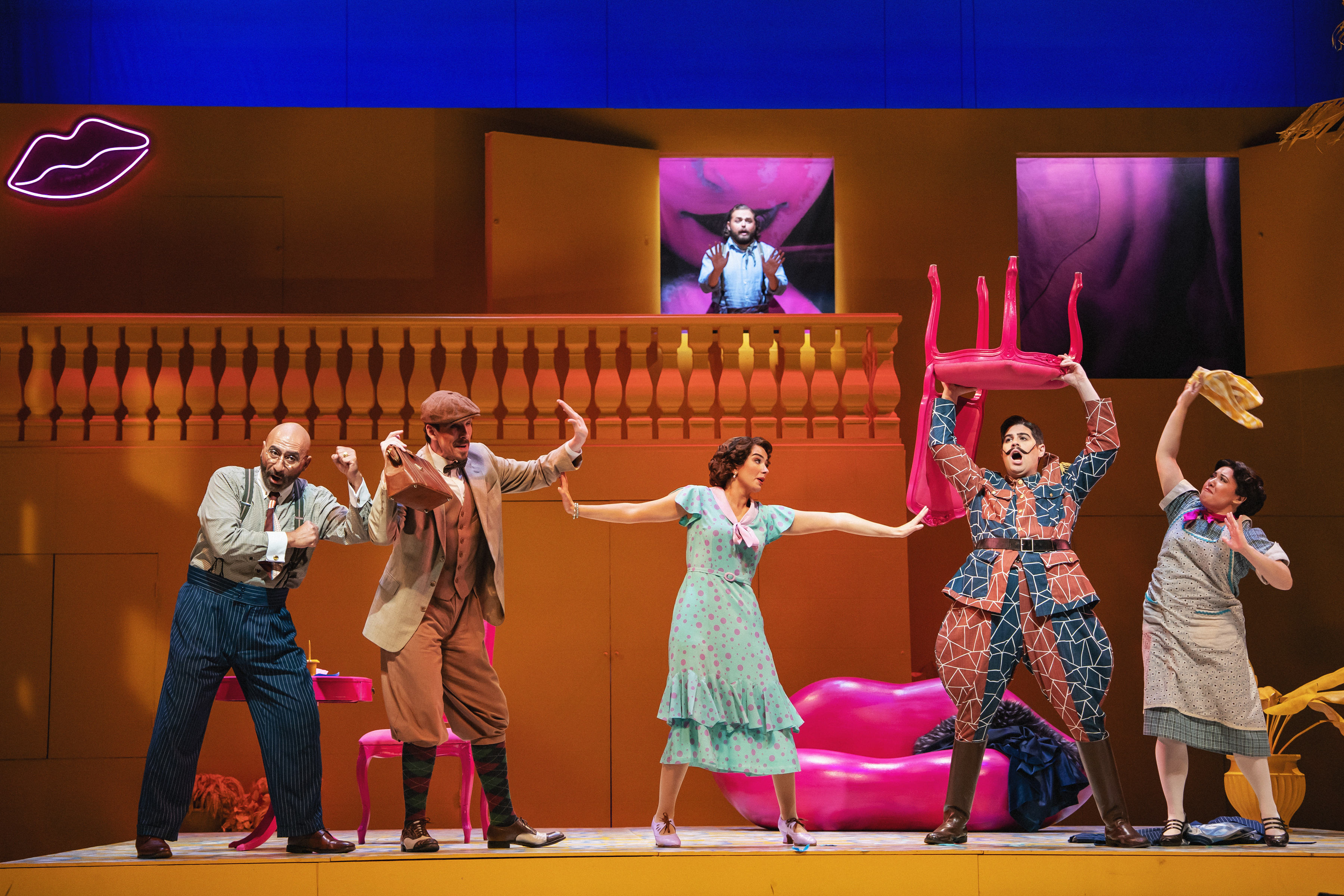
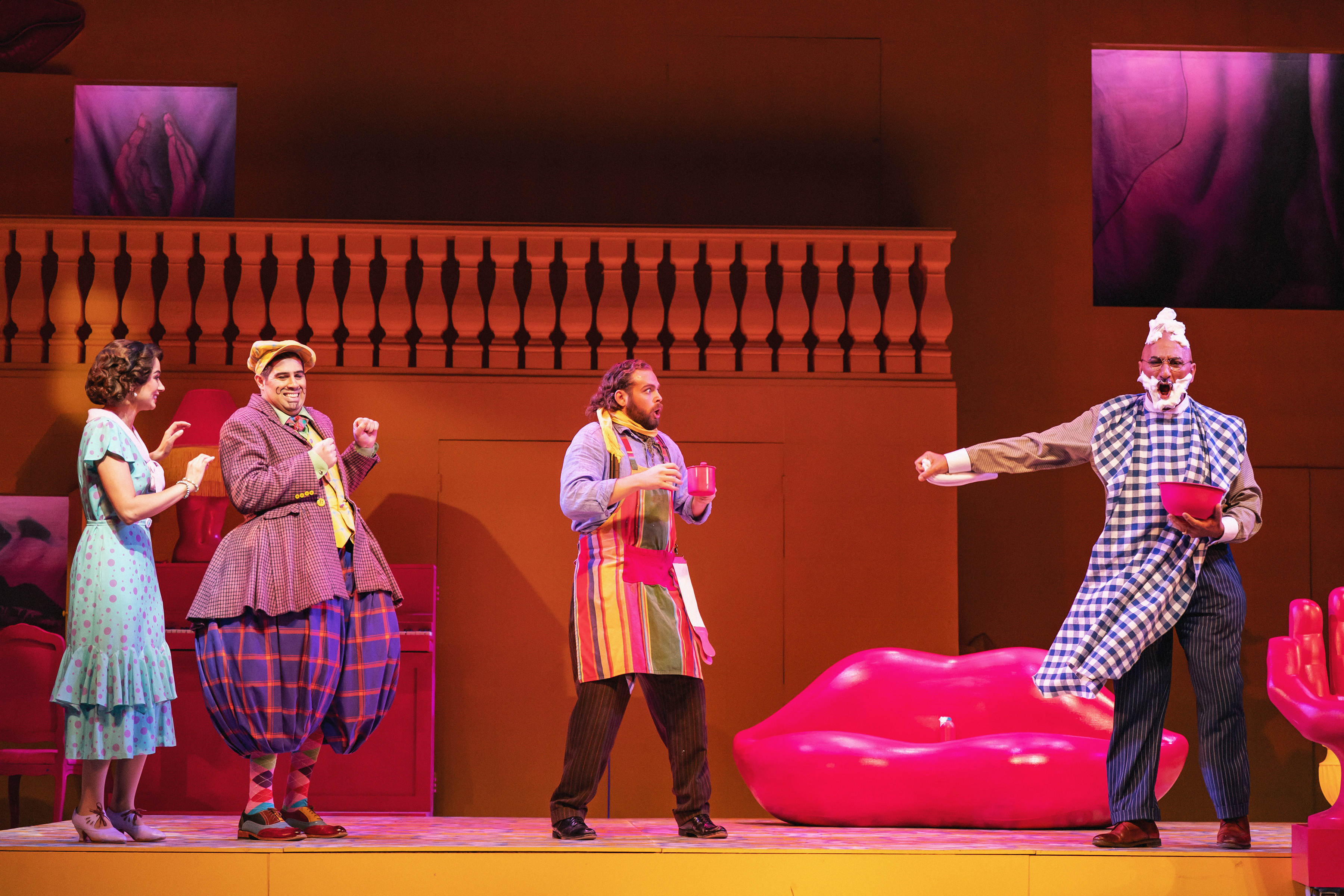
The Barber of Seville is presented with brilliantly colorful sets and costumes that belong to the Opera Theatre of St. Louis. Eric Sean Fogel’s Director’s Notes say that Barber has been placed “in 1930s Spain,” but that concept is almost irrelevant since it hardly touches the story. Stage design by Andrew Boyce reveals Rossini’s raucous comedy dressed up in bright, tropical colors—all yellow and pink on stage, plus a bright red sofa in the form of Rolling-Stones-reminiscent lips.
Costume design is by Lynly Saunders. She describes Barber as an opera “where you can really let loose,” and let loose she does. From police in 1930s-style uniforms—the one period reference that is unmistakable—each with one incongruously colorful sleeve, and giant sunflowers instead of rifles, to ridiculously overpuffed balloon pants and a garishly non-matched coat (or is it “power clashing”?), the costumes reveal a designer gleefully run wild. The crescendo of colors culminates with a joyful competition of surprise costume reveals by Almaviva and Rosina just before opera’s end. I can’t imagine anyone not being delighted by the over-the-top riot of colors.
Barber of Seville cast, L-R: Ashraf Sewailam (Dr. Bartolo), Stefan Egerstrom (Don Basilio), Lisa Marie Rogali (Rosina), Andrew Morstein (Almaviva), and Laura Corina Sanders (Berta); Luke Sutliff (Figaro), above. Image by Amanda Tipton Photography
Stage director Fogel does not shy away from pure farce, but as a cast member reminded me, Barber of Seville is supposed to be farce. There are multiple doors, people popping in and out unexpectedly, pratfalls, a piano wider than the stage, and even a collapsing chair. Whether the manic silliness ever crosses a line will be a matter of individual taste. For me it pushed the line, but the hilarity was irresistible from beginning to end.
The vocally strong cast embraced the production’s style with exuberant energy. As Almaviva, Andrew Morstein had difficulty negotiating registers at the outset and sounded strained at top volume, but was comfortable and sang with expression in his gentler moments. He got stronger across the evening, managing Rossini’s leaps and runs with increasing security, and finished as a winning romantic lead.
Luke Sutliff made a terrific Figaro, filling the theater with his voice and his personality. As Fogel observes in his notes, Figaro is the barber of the title, but the young lovers Almaviva and Rosina want to capture our attention. The direction and Sutliff’s performance make Figaro both the factotum who gets things done in Seville and the mainspring of the opera’s action, as he should be.
Ashraf Sewailum, known locally from previous performances at Central City, the University of Colorado Eklund Opera Company, and numerous concert appearances in Boulder, was brilliantly blustering and periodically baffled as Dr. Bartolo. His full bass voice easily filled Central City’s house. Both his musical phrasing and comic timing made him one of the stars of the show.
L-R: Rosina (Lisa Marie Rogali), Count Almaviva (Andrew Morstein), Figaro (Luke Sutliff) and Dr. Bartolo (Ashraf Sewailam). Image by Amanda Tipton Photography
Mezzo-soprano Lisa Marie Rogali lent her strong, resonant lower register and bright, sweet upper notes to the role of Rosina. Her melting lyricism and confidence in the coloratura passages made her trademark aria “Una voce poco fa” a highlight. Happily she captured the strength and determination of the character, avoiding cliches of the submissive ward and previewing the independent countess of Mozart’s Marriage of Figaro.
Stefan Egerstrom humorously portrayed Don Basilio as a purse-carrying, prancing dandy. His on-target performance was one of the keystones of the interpretation of Barber as farce. Equally fit for her comic role was Laura Corina Sanders as Berta, the unruly servant. She took full advantage of the possibilities the over-the-top production style offered her character.
Louis Lohraseb, who has conducted opera in Rome, Hamburg, Dresden and Berlin, made his Central City Opera debut leading Barber. Under his baton, the orchestra played with stylish restraint, never overpowering the singers. The overture was bright and energetic, despite a few soggy moments.
# # # # #
Nestled between two comedies, Aleksandra Vrebelov’s The Knock tackles the deeply serious question of the hidden pain and tragedies of war. During the 2003–11 Iraq war, American military wives endure a long night of suspense when they are cut off from communication with their husbands in Fallujah. The title refers to the dreaded knock on the door, when a military officer will officially notify one of them of her husband’s death.
Vrebalov’s score was receiving only its second full stage production, since the planned premiere at the 2020 Glimerglass Festival had to be presented on film, due to COVID. The performance at Central City was a fitting regional premiere, as The Knock is set in and around Ft. Carson, Colorado.
Born in Serbia, Vrebalov directly experienced the horrors of war during the 1998–99 Kosovo War and the devastating NATO bombing of her hometown of Novi Sad. This experience stands behind several of her most successful pieces.
In The Knock, her subtle music expresses the rising tension among the military wives at home through steady background chords and ostinato patterns that increase in intensity. A sharp and expressive score, it signals the buildup of despair and fear without resorting to bombast.
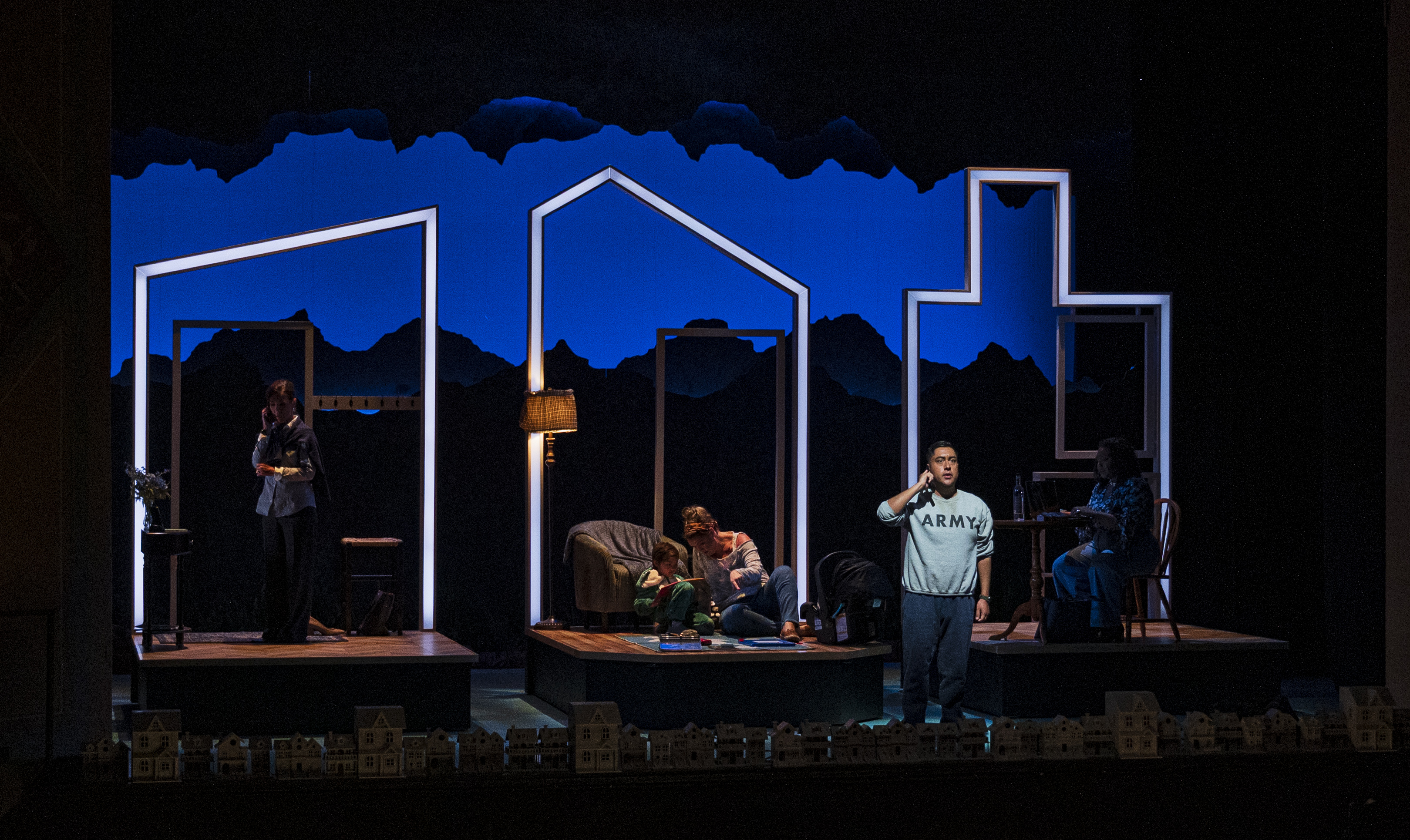
The three houses that form the setting of The Knock. Downstage, Lt. Robert Gonzalez (Armando Contreras) gets the call to deliver “the knock.“ Photo by Lawrence E. Moten III.
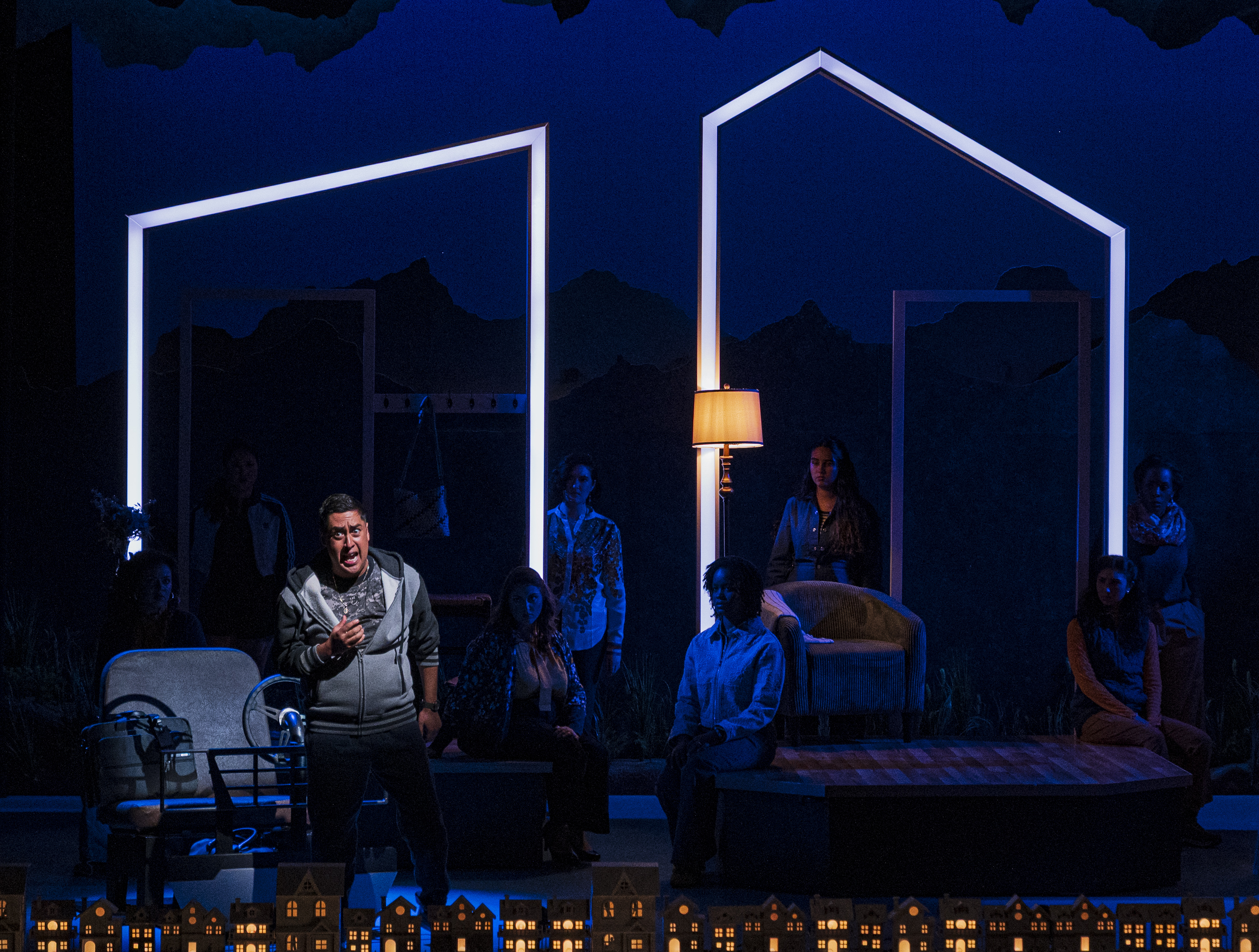
The evocative set by Lawrence E. Moten III comprises brightly lit outlines of three houses, those of Jo, Aisha, and an unnamed other military wife. A row of tiny houses across the front of the stage, sometimes lit from inside, represent the larger community of military families. In the back, the outline of Colorado mountains can be seen against a deep blue late-evening sky that is symbolically lit with stars at show’s end.
Three characters dominate the action. Joella “Jo” Jenner is a young wife and mother of two who is undergoing her first nighttime vigil waiting for word from the battlefield. Portraying a nearly one-dimensional character—the mother terrified for herself and her children—Mary-Hollis Hundley ably expresses Jo’s unease and her fragility.
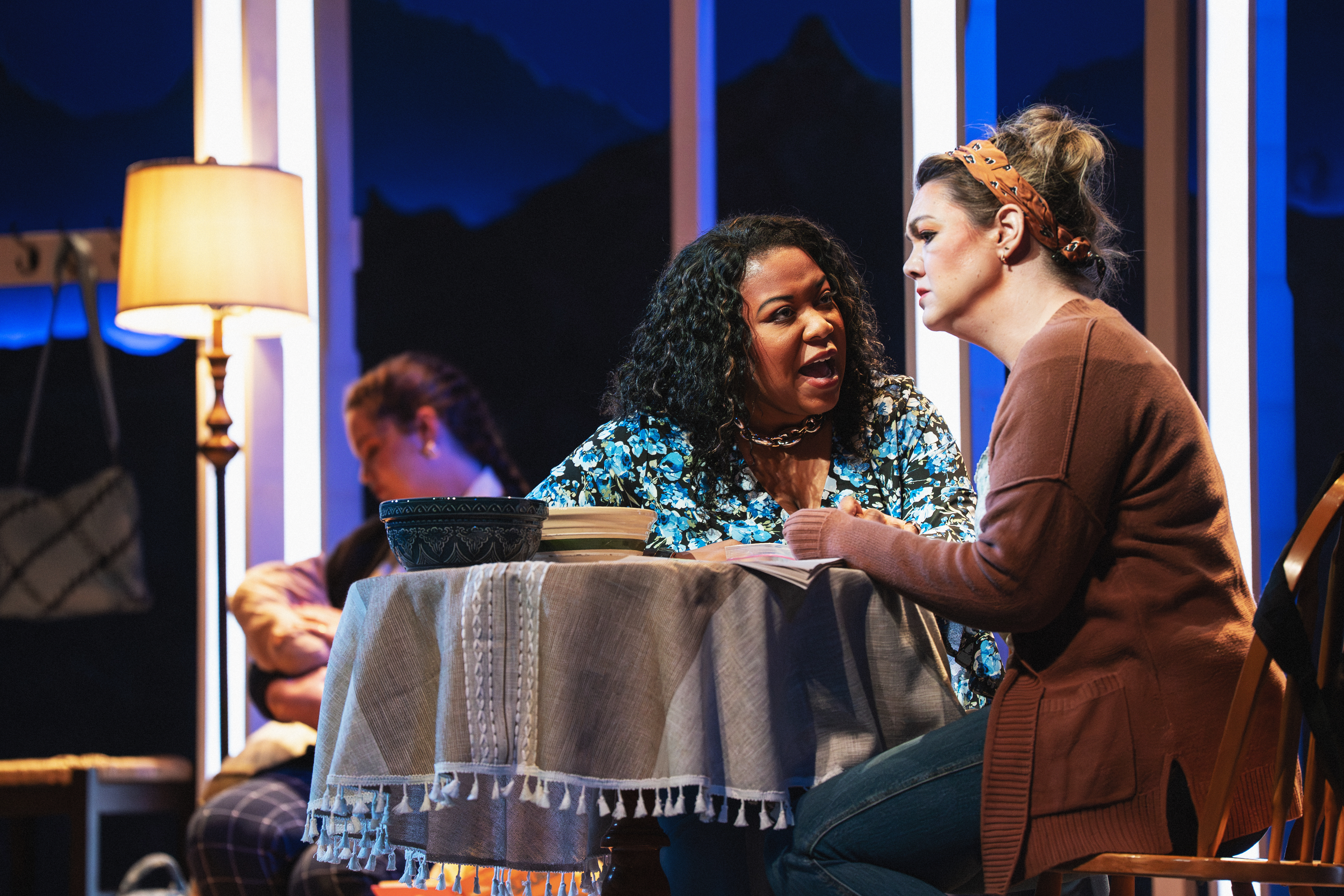
Aishah (Cierra Byrd) tried to console Jo Jenner (Mary-Hollis Hundley). Image by Amanda Tipton Photography
Paired with Jo is Aishah McNair, a more experienced military wife who tries to offer support and perspective to the young mother. Cierra Byrd gave Aishah depth, especially near the end when launching the number “When the person you love is far away,” which blooms into an ensemble number. Her warm, smokey contralto complimented Hundley’s more delicate soprano throughout their scenes together.
Lt. Roberto Gonzalez is a young soldier tormented by being stationed in the U.S. while his comrades face combat. He has been tapped to deliver the mournful news—the knock—for the first time, leaving him nervously trying to fulfill the duties as described in the manual.
Lt. Gonzalez (Armando Contreras) agonizes over his duty to deliver the news of a soldier’s death. Photo by Lawrence E. Moten III.
Baritone Armando Contreras overplayed Gonzalez’s stress, staying at a high volume and almost shouting his way through parts of the role. His repeated invocations of the Virgin de Guadalupe were more than needed, since his sincere faith and apprehension are evident from the start. His lovely singing in the concluding ensembles, when Lt. Gonzalez relaxes into tender feelings for the women he confronts, show that he has a wider range of expression and styles than are heard for most of the opera.
Conductor David Bloom managed the mixed chamber ensemble in the pit comfortably, keeping the music moving through the rather extreme emotional ups and downs of the characters. Moritz’s stage direction effectively kept the action clear, as it moved from separate houses, to one house where the wives gathered, to scenes of Lt. Gonzalez facing his fears while traveling cross country.
The poignant conclusion of the opera—with one wife facing a devastating development and the others embracing relief—provides music that expresses both sentiments, or as the text has it, “Joy and Sorrow.” And the concluding lines describing the folded flag that every war widow receives, “Blue and Stars are All that will Remain,” remind us eloquently of the show’s central point, that the ripples of war’s tragedies spread across society. It is a sobering moment in a powerful piece.
# # # # #
Once Upon a Mattress, which opened Saturday (July 12), was the first full-length Broadway show by Mary Rodgers, daughter of the famed Broadway composer Richard Rodgers who was half of the musical-comedy teams of Rodgers & Hart and Rodgers & Hammerstein. Growing up in so musical an environment, Mary Rodgers naturally took to composing as a teenager, and had a very successful career writing music for children’s records, musicals and reviews, and was the author of several children’s books.
Her one big Broadway hit, Once Upon a Mattress opened in 1959 and perfectly fits the mold of 1940s and ‘50s musicals. It offers ample opportunities for catchy songs, quirky characters, a heavy dose of theatrical silliness, and a thoroughly happy ending. The music is never compelling or deeply memorable, but it is never less than pleasant. The book is full of gags and jokes that elicited hearty laughter from the audience on Saturday.
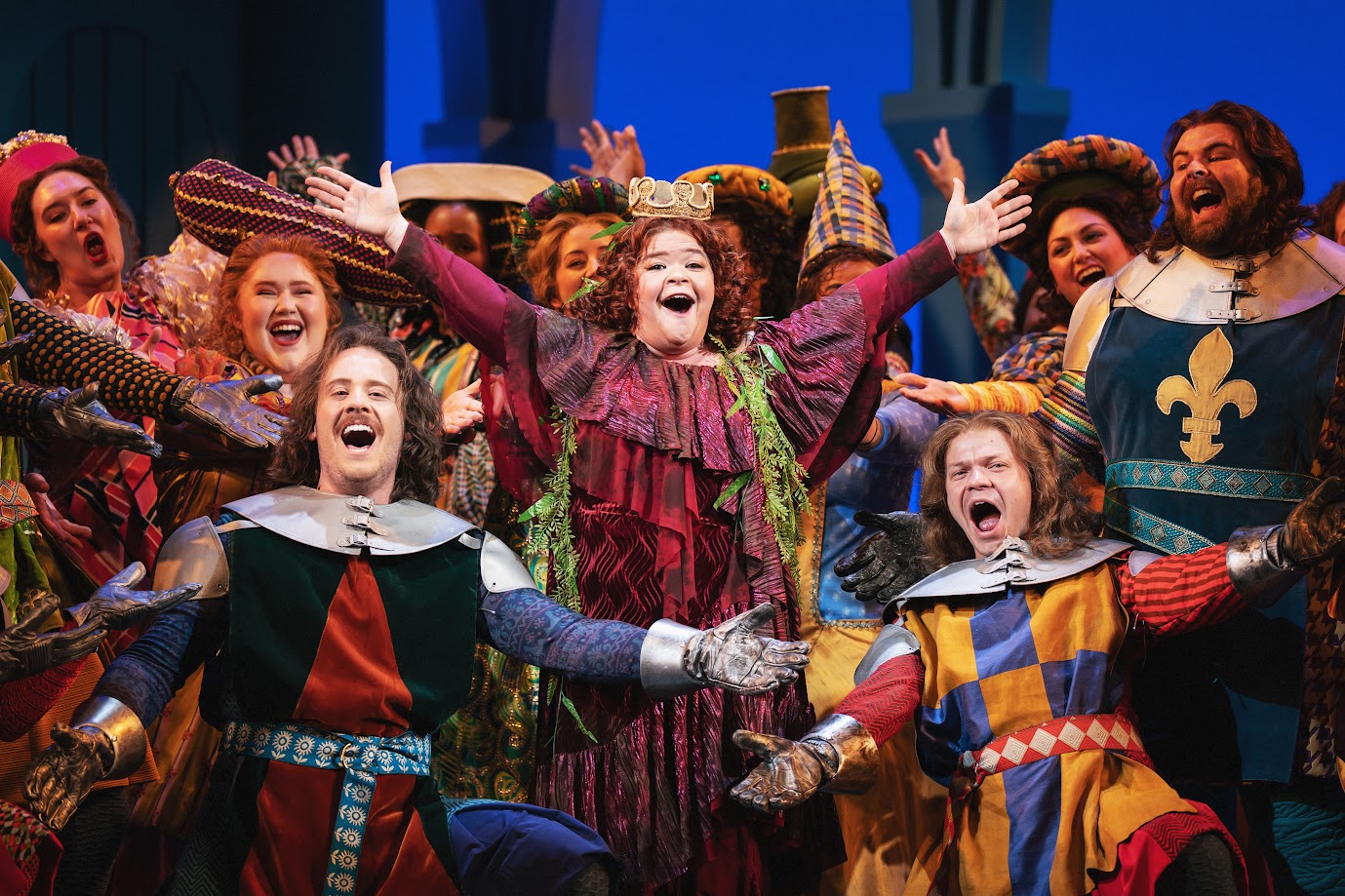
Ensemble cast of Once Upon a Mattress. Princess Winifred (Marissa Rosen) draped with weeds from the moat, center. Image by Amanda Tipton Photography
The plot skates cheerfully on the surface of the Hans Christian Anderson tale of “The Princess and the Pea,” with a goofy young Prince dominated by a despotic mother who will only allow him to marry a proper princess. In the meantime, no one in the kingdom—or is it queendom, since his father is mute?—is allowed to marry until the timid Prince Dauntless the Drab is wed to a suitably, queen-approved mate.
A hopeful candidate shows up in the form of Princess Winifred the Woebegone from a marshy realm—the Broadway debut role of Carol Burnett in 1959. Queen Aggravain has imposed a test on every potential bride, which all have failed. For Winifred she devises the pea under 20 mattresses (actually 14 at Central City), with the expected result.
All of these more or less stereotyped characters were portrayed with the broad humor the show wants. Everyone in the cast had a suitably lyrical musical theater voice, capable of crooning all the ballads and other musical numbers of the score. There are a few solo numbers and many duets and ensemble numbers, all well handled by the consistency solid cast.
Margaret Gawrysiak was everything you could want for Queen Aggravain—imperious, haughty, comically unyielding and too eager by half to rule out potential brides. Michael Kuhn was an ideal Prince, completely under the sway of his controlling mother, with just the right touch of modern nerdiness thrown in. Marissa Rosen made an especially strong impression as Princess Winifred, with just enough of her own nerdiness to captivate Dauntless. She projected the latent athleticism fitting for a princes who, in a moment shocking to the court, “swam the moat” and entered trailing tangles of weeds.
Prince Dauntless the Drab (Michael Kuhn). Image by Amanda Tipton Photography
As the Jester and Minstrel, Alex Mansoori and Bernard Holcomb were well matched stage buddies, either bantering or singing together. Jason Zacher made good use of his short appearances as a wizard who does parlor tricks at random moments. The on-again, off-again couple of Sir Harry and Lady Larken, who have a growing reason for the ban on marriage to be lifted. The couple were well portrayed by Schyler Vargas, who had fun with Sir Harry’s sense of importance, and Véronique Filloux, fittingly flighty as Lady Larken. Together they captured all the traditional nuances of the couple who are happiest while quarreling.
Special mention must be made of Andrew Small, who delighted in his CCO debut as the mute King Sextimus, who has an unfulfilled taste for the ladies in waiting at the court. The son of a musician who played in the CCO orchestra in the 1980s, Small first attended the opera when he was 10, leading to a career on stage. He wrote for the program that performing at CCO is “a deeply meaningful, full-circle moment.”
Seated at the very back of the house I could not always hear the voices over the orchestra. Out from under the balcony and closer to the stage, the sound was probably better. In all other respects conductor Kelly Kuo led a stylish and energetic performance.
The scenic design by Andrew Boyce fits the classic Broadway ambience perfectly, walls and arches suggesting a cartoonish court. The costumes by Elivia Bovenzi Blitz are standard theater-medieval—colors and fabrics no one saw in the middle ages, but pleasantly evocative of make-believe realms.
The stage direction by Alison Fritz, the artistic director of CCO, kept the show moving seamlessly. John Heginbotham’s choreography was handled smoothly by all of the acting/singing/dancing members of the large cast.
Those who love Broadway will relish the opportunity to attend a professional production of Once Upon a Mattress, performed with full orchestra and Broadway-worthy voices. If that’s your dish, go for it! If not, the farcical Barber of Seville and deeply thoughtful The Knock are equally worth a trip into the mountains.
NOTE: Performances of all three shows at Central City continue through the month and into August. The full schedule is listed below.
# # # # #
Central City Opera Remainder of the 2025 Summer Festival Season All performances in the Central City Opera House, Central City, Colo.
Rossini: The Barber of Seville
7:30 p.m. Saturday, July 19 2 p.m. Tuesday, July 15; Friday, July 25; Saturday, July 26; Wednesday, July 30; Sunday, Aug. 3
Aleksandra Verbalov: The Knock
7:30 p.m. Saturday, Aug. 2 2 p.m. Sunday, July 19; Tuesday, July 22
Mary Rodgers and Marshall Barer: Once Upon a Mattress
7:30 p.m. Saturday, July 26 2 p.m. Wednesday, July 16; Friday, July 18; Sunday, July 20; Wednesday, July 23; Sunday, July 27; Tuesday, July 29 Friday, Aug. 1; Saturday, Aug. 2
Tickets for all remaining performances are available on the CCO Web Page.
I was in New York recently. While there, I took the opportunity to meet a friend at the Metropolitan Opera, where we saw the new production of Salome by Richard Strauss.
The production, starring Elza van den Heever in the title role and Peter Mattei as Jochanaan (John the Baptist) has attracted considerable attention, particularly for van den Heever’s performance. The singing I heard on May 24 ranged from solid to outstanding. Colorado native Michelle de Young, who has appeared at the Colorado Music Festival (2017 and ’18), was especially strong as Herodias. Conductor Derrick Inouye did not always manage to keep the orchestra under the singers, especially when they were singing from the back of the Met’s deep stage.
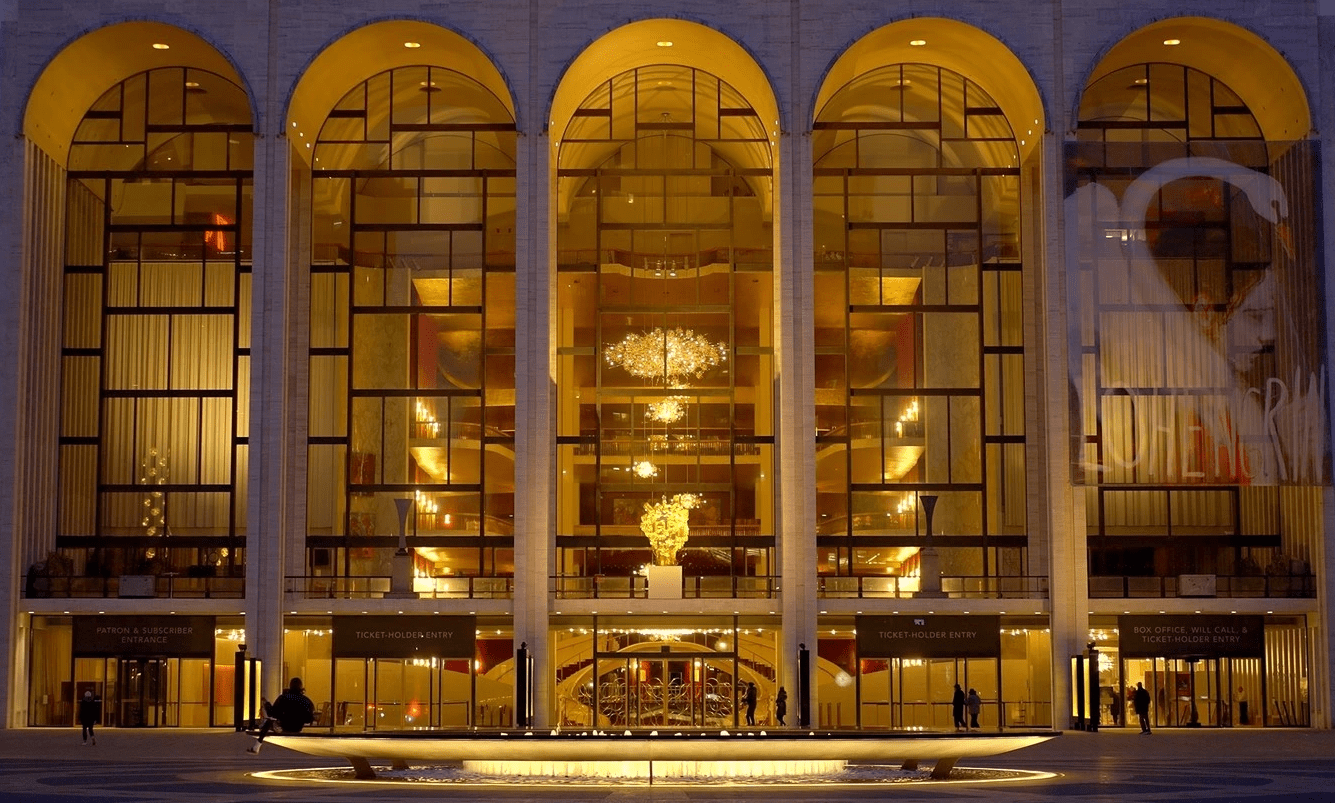
The Metropolitan Opera House at Lincoln Center, New York
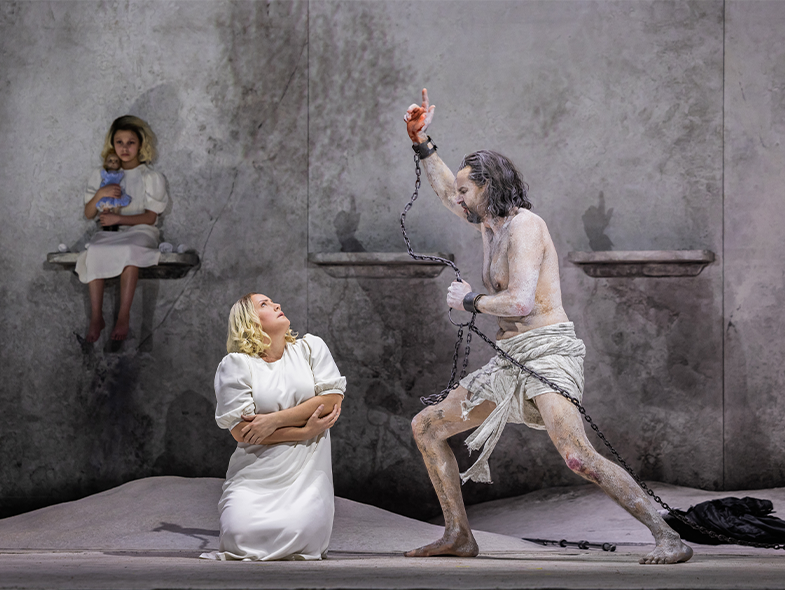
The production by director Claus Guth was in some ways a mess. Transferred to the Victorian era, it featured six young Salomes, all dressed like van den Heever in black velvet with a white collar, ranging in age from about 6 to early teens (the operatic character is supposed to be about 16). These young Salomes entered at various times during the opera, representing the abuse that Saolme has endured throughout her childhood, which explains her perverse sexual obsession with John the Baptist.
The child Salomes enter separately throughout the infamous “Dance of the Seven Veils,” each in turn having a simple black veil removed from her head before exiting. There is no seductive dance before Herod, which subverts the powerful music of the dance. In other mystifying additions, there are ram’s heads worn by members of the court, and a distracting scene of a near-nude woman surrounded by fondling courtiers played out on a raised area at the rear of the stage. The entire opera is placed in a sterile Victorian mansion.
All of which shows us that Herod’s court was degenerate and Salome is a damaged adolescent, which is pretty clear without directorial signposts. These ideas are often needlessly demonstrated in productions I have seen, from Santa Fe to Berlin. (Unsolicited advice for stage directors: Both the text and the music tell us that far better than your ideas will. Trust the music.)
But my purpose here is not writing a review of this production, which offers much scope for commentary. It is rather with a single question: to what extent should a production (and presumably therefore a stage director) honor the written text of the opera?
This is not an idle question, and in one sense Salome provides a good case study. The text of both Oscar Wilde’s English-language play and Strauss’s libretto, which is mostly a straightforward German translation of the play, are clear about one thing: in the confrontation between Salome and John the Baptist, he avoids looking directly at her. “I will not look on you,” he sings. “You are accursed!” And later, as she holds his decapitated head in her hands, she sings “If you had seen me, you would have loved me!”
For some directors, this is apparently just a line that is sung, and they feel free to play the relationship between Salome and John the Baptist as they want you to see it. If they want Salome to be a depraved teen seductress when she confronts John, they may have her writhing all over and around him; I have seen it done that way. Or if they want John to be tormented by her, they will have him grasping her, looking directly into her face, perhaps even twisting in agony with close physical contact; I have seen it played that way, too.
Elsa van den Heever (Salome) and Peter Mattei (John the Baptist) at the Met
I would maintain that both of these stagings contradict the clear text that Strauss set. I believe that to respect the work, the director should honor the text’s clear indication that John turned away from Salome. Perhaps he saw her from the corner of his eye; perhaps she passed in front of him; perhaps he saw her figure when he first came into her presence. But he did not look directly into her face or deliberately interact with her.
That does not rule out interpretations in which he sees her but rejects her, or is in some way aware of her presence and her impact as a seductress. There are many ways to convey what is indicated in the text. But contradicting the text, in order to impose a single interpretation of the characters is unfaithful to the work.
Finally, “Depraved teen seductress” is certainly one way of understanding Salome, but there are others. Bored, spoiled adolescent living in a corrupt society; victim of abuse by a depraved stepfather; a tool in the hands of a scheming mother: any one or all of these are legitimate ways of understanding Salome.
For myself, I prefer a production that allows you to see many possibilities, rather than insisting on only one. But we live in a time of regie-theater, director’s theater, where unique and original interpretations are highly valued. But I still believe that original productions can and should stay faithful to the text of the work being presented.
Opera producer/conductor Sarah Caldwell as Greek tragedy
By Peter Alexander June 11 at 10:15 p.m.
Mark Adamo knows his Greek mythology.
The composer/librettist is known not only for having written an opera on Aristophanes’s Lysistrata, but also having linked Bram Stoker’s Dracula with the Greek myth of the Bacchae as librettist for John Corigliano’s 2021 opera The Lord of Cries. And now Adamo is in Boulder workshopping his opera-in-progress Sarah in the Theater at the University of Colorado New Opera Workshop (CU NOW).
And once again he has found a Greek connection. “This is what happens when you give a 10-year-old Greek mythology to read,” he says.
Mark Adamo. Photo by Daniel Welch
With the first act mostly done, Adamo’s new opera about the opera conducting and producing legend Sarah Caldwell will have semi-staged workshop performances of excerpts this weekend (Friday and Sunday, June 13 and 15; details below). Nick Carthy, music director of the CU Eklund Opera Program will conduct. The performance will cover the first act, but “there will be a surprise,” Adamo says cryptically.
Adamo discovered a parallel between Caldwell’s career and a Greek myth when he first undertook work on the opera. “As I’m sketching out (the opera), I had a sense of what I wanted to do with her as a character,” he says. “I’m asking the question, is there some kind of narrative template that’s going to make sense of the themes in her character, which is that she’s extremely ambitious but she doesn’t see limits. Whatever happens in the theatre is the only thing that matters.
“(I thought) there has to be some kind of pre-existing trope that I can pull from. I don’t know—Icarus! I said, that’s it!”
In the opera, the story of Icarus, who flew too close to the sun and fell to his death, is the subject of an opera within the the opera. It becomes both an opera that Caldwell is rehearsing, revealing her relentlessly focused work ethic, and a symbol of her own high-flying career and ultimate crash.
Caldwell founded the Boston Opera Group, which became the Opera Company of Boston. Against all odds and considerable financial difficulties, she presented a wide range of operas and developed a reputation for producing remarkable results with limited means. Because of her intense focus on her work, she was known both for attracting ardent admirers and for driving others away under duress.
Sarah Caldwell
A synopsis of the opera released by the commissioning organization, Odyssey Opera, states: “Over one sleepless day and night: haunting the theater she created, made legendary, and now, by morning, may lose; the director, conductor, and impresario Sarah Caldwell—brilliant, obsessed, intractable—inspires her artists, fends off creditors, relives her triumphs, and battles with ghosts as we wait to learn if she will be given one final chance to continue the work she lives for or whether demons of self-sabotage have, at last, outrun her luck.”
Adamo is returning to Boulder for his second workshop with CU NOW, following a successful reworking of his opera The Gospel of Mary Magdalen in 2017. “(CU NOW) is the perfect balance of seriousness about the work, and un-seriousness about ego,” Adamo says.
“Nick (Carthy) and our pianists know it cold, but part of the point of the workshop is that you want the flexibility to change things. The magic here is that people came in with a base knowledge of the score, and also not only the ability but the imagination to get it better. I am ‘directing’ this, (but) in real life this is a co-production of me and the singers. Half the ideas on the stage will come from them.”
For all of her impact in the opera world Caldwell might not occur to most composers as the subject of an opera. The original idea came from Gil Rose, conductor of the Boston Modern Orchestra Project and founder of Odyssey Opera, who commissioned Sarah in the Theatre. But make no mistake, Adamo sees her as a great subject for drama. “She’s like Orson Wells,” he says. “It’s a race between the genius and the demons.”
Taking on the roles of both librettist and composer might seem dangerous, because the history of opera is littered with legendary battles between composers and librettists. Adamo sidesteps any conflict between the two parts of his creative mind by starting with an outline of the various characters’ motives and the emotional arc of the story. The emotional development suggests in turn the musical demands of the finished piece.
“By the time you do the first draft of the libretto, it’s coming to the first draft of the score, because you’ve got these musical requirements that you’re trying to write around,” he says. “And then by the time you get to that libretto and by the time you’re setting it, ideally you avoid the composer-librettist clash, because the composer has been there from the beginning.”
The final word on any new opera belongs to the performers who bring it to life. After several weeks of intensive work, Carthy knows where he stands on Sarah in the Theatre. “It’s a great work,” he says.
“It’s really a greek tragedy.”
# # # # #
CU New Opera Workshop (CU NOW) Nick Carthy, conductor
Mark Adamo: Sarah in the Theatre (Act I excerpts with two pianos)
7:30 p.m. Friday, June 13 and 2 p.m. Sunday, June 15 Music Theatre, Imig Music Building Free
CU Eklund Opera and Opera Colorado announce 2025–’26 seasons
By Peter Alexander March 17 at 5:43 p.m.
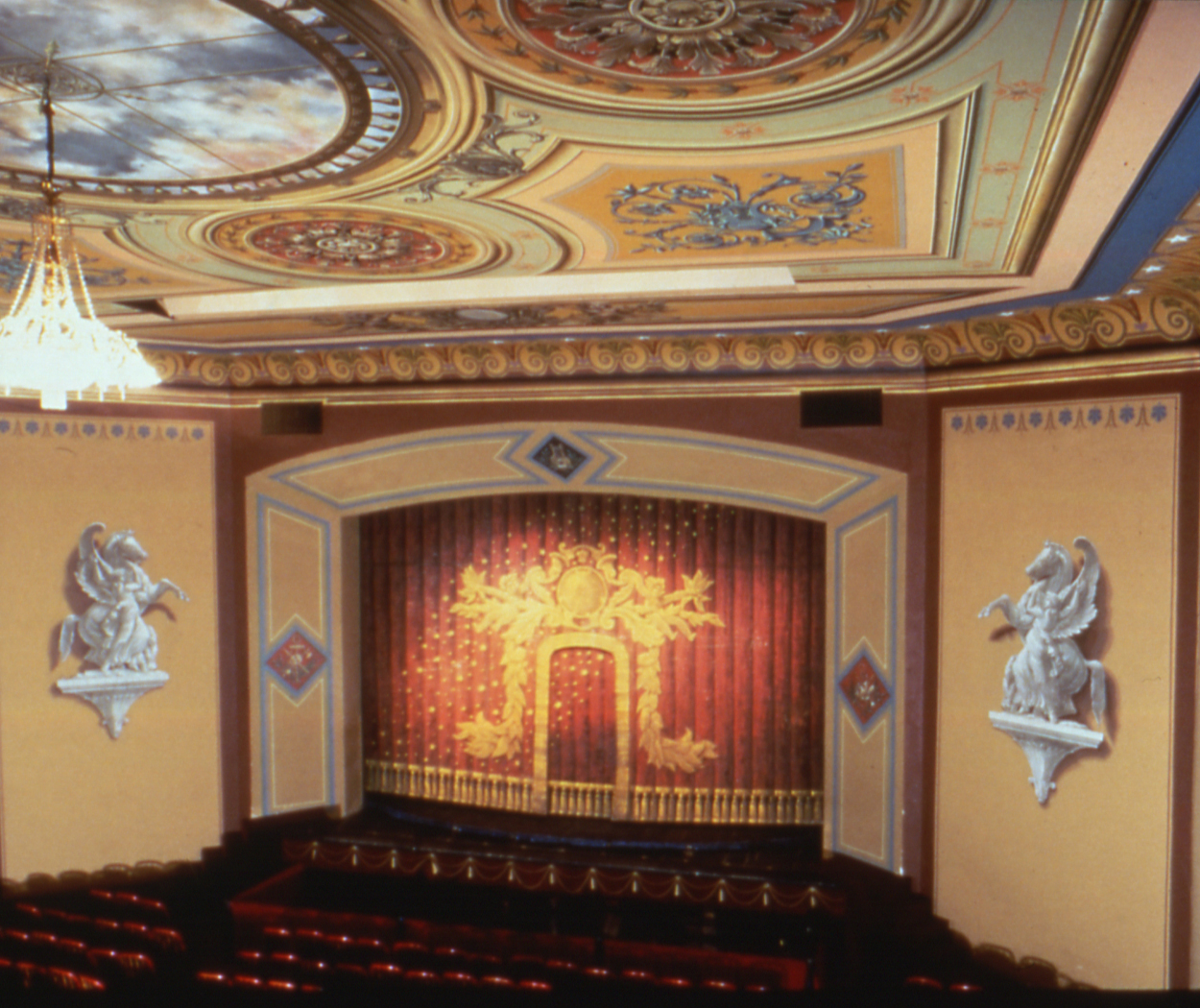
Leigh Holman stepped before the rich, ruby-red curtains at Macky Auditorium yesterday (March 16) afternoon and spoke to the audience.
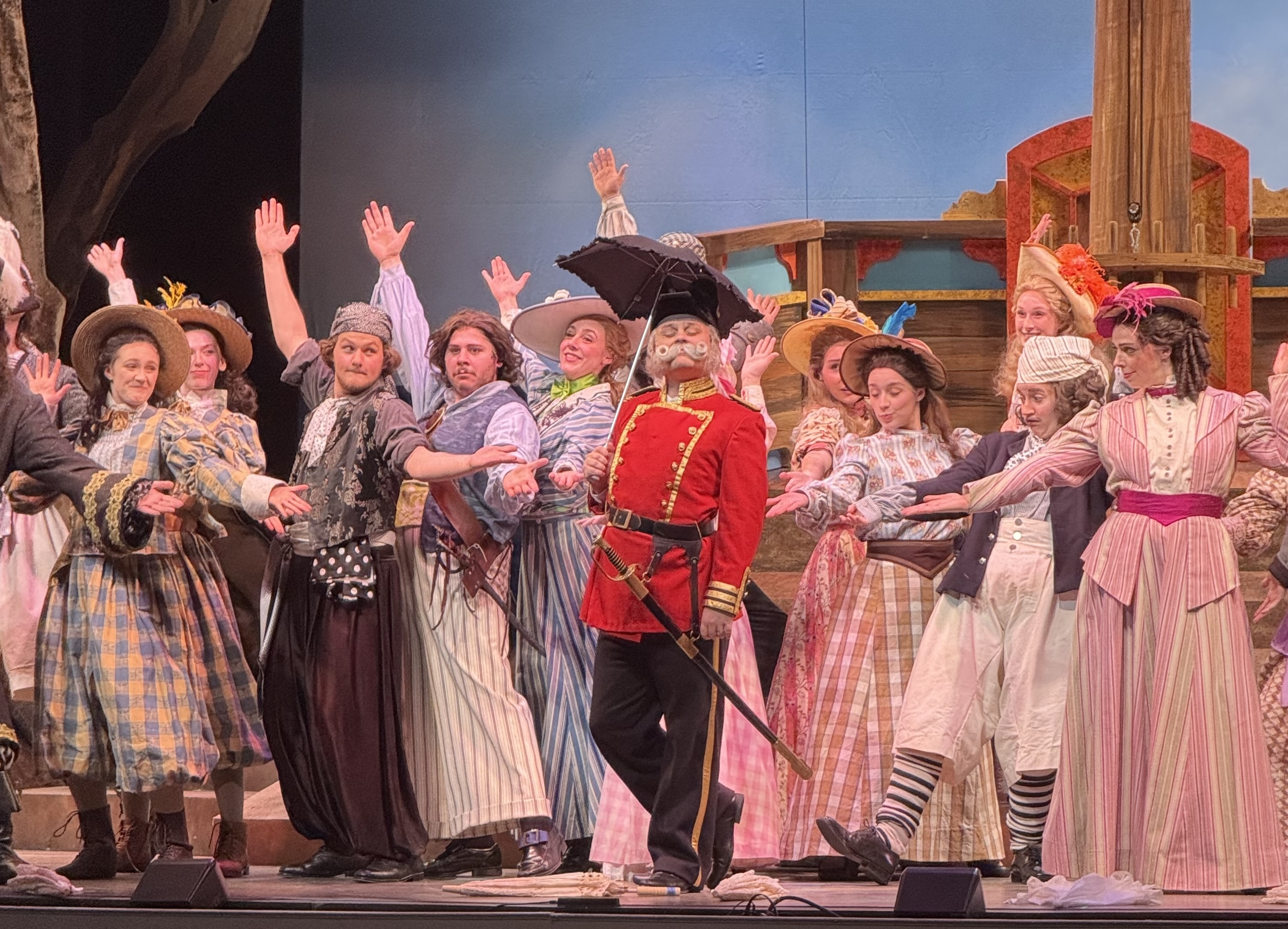
The occasion was the final performance of CU’s production of Gilbert & Sullivan’s Pirates of Penzance. Holman is the director of the Eklund Opera Program at CU-Boulder, and in addition to welcoming the full house in Macky, she made an announcement of interest to opera lovers in the area. She named the works in Eklund Opera’s 2025–26 season—or most of them.
Leigh Holman
The fall production, she said, will be one of the most successful operas of the past 25 years, Jake Heggie’s Dead Man Walking. Premiered in 2000 by the San Francisco Opera it has since been performed in dozens of productions, at CU in in 2007, Central City Opera in 2014, at the Metropolitan Opera in New York, Houston Grand opera, in university and regional productions around the country, and major houses around the world.
Based on the memoir of the same name by Sister Helen Prejean, Dead Man Walking features a libretto by playwright Terrence McNally. The plot revolves around Prejean’s death-row ministry with a convict who was executed for murder in Louisiana in 1984.
Homan then announced that in April, 2026, the Eklund program will present Leoš Janáček’s folk-ish Cunning Little Vixen, a charming and harsh tale of life in the animal world. Finally, she said that the third production, appearing in the March time slot, would be a musical comedy presented in conjunction with the CU program in musical theatre. Contractual obligations, common with the performance of musicals, prevent the release of the show’s title at this time.
Opera Colorado in Denver also has announced the operas that will be their main stage productions in the 2025–’26 season. November will see performances of Verdi’s La Traviata, and in May Opera Colorado will present Puccini’s Madama Butterfly. In the meantime, there will be semi-staged concert performances of Verdi’s Il Trovatore featuring a full cast with the Opera Colorado orchestra and chorus, 7:30 p.m. Saturday, April 26, and 2 p.m. Sunday, May 4, in the Ellie Caulkins Opera House at the Denver Performing Arts Complex.
Ellie Caulkins Opera House, Denver
The company’s Calendar of Events lists the dates for all performances and access to the box office for the purchase of individual tickets for the remainder of this season, as well as subscriptions for the ’25–’26 season.
Central City Opera House
Central City Opera’s summer 2025 season has already been announced, but if you missed it, this year’s summer festival at the Opera House in Central City will feature Rossini’s Barber of Seville, Aleksandra Verbelov’s contemporary The Knock, inspired by events during the 2003–’11 Iraq War, and the 1959 Broadway hit Once Upon a Mattress, recently revived in New York and Los Angeles to great acclaim.
The full summer calendar, and access to the purchase of subscriptions and group bookings can be found HERE. Individual tickets will go on sale April 1.
Not in Colorado but within a reasonable day’s drive for people in the Boulder area, the Santa Fe Opera presents productions in a unique and stunning outdoor theater in the New Mexico mountains. Productions for the summer of 2025 will be Puccini’s La Bohème, Mozart’s Nozze di Figaro (Marriage of Figaro), Verdi’s Rigoletto, Benjamin Britten’s Turn of the Screw and Wagner’s Die Walküre.
Santa Fe Opera. (c)Bob Godwin/rgbphotography@mac.com
The full calendar for the Santa Fe Opera is located HERE. Tickets can be purchased through the company’s 2025 Season page.
NOTE: At the request of the Eklund Opera Program, a quote that that could potentially identify the musical to be presented in March, 2026, was removed from the fifth paragraph of this story as of March 13, 2025.
The perennially popular Pirates of Penzance puts in at Macky for the weekend
By Peter Alexander 10:40 p.m. March 12
CU’s Eklund Opera Program will present Gilbert and Sullivan’s hilarious Pirates of Penzance Friday through Sunday in Macky Auditorium (March 14–16; details below), and conductor Nicholas Carthy wants everyone to know what to expect.
“It’s a comedy,” he says. “This is not (Shakespeare’s) Henry V! It’s supposed to be ridiculous.”
Reese Phillips as Major-General Stanley. Photo by Andrew Konopak.
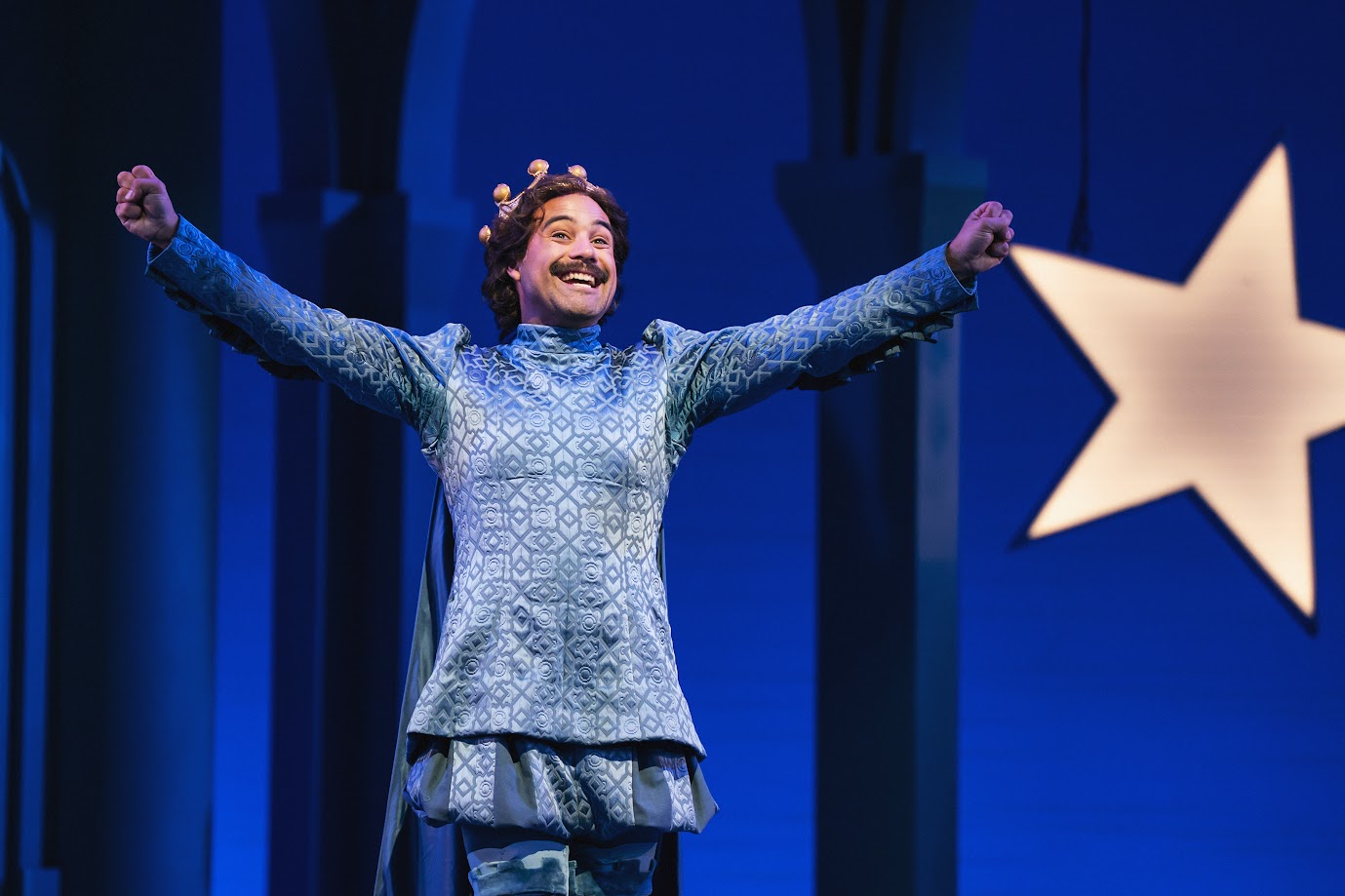
And ridiculous it is, in some ways. If you don’t know the story, the callow youth Frederic has been apprenticed to a band of soft-hearted pirates through a confusion between a “pirate” and a ship’s “pilot.” He is bound until his 21st birthday, but because he was born on Feb. 29, that won’t happen until he is in his 80s.
Due to his exaggerated sense of duty, Frederic cheerfully agrees to remain with the pirate band for 60-plus more years, even though he has to postpone marriage to his true love Mabel, one of many wards of the pompous Major-General Stanley. After misadventures with the curiously ineffective pirates and the bumbling police, the day is saved when Frederic’s nursemaid Ruth reveals that the “pirates” are actually noblemen.
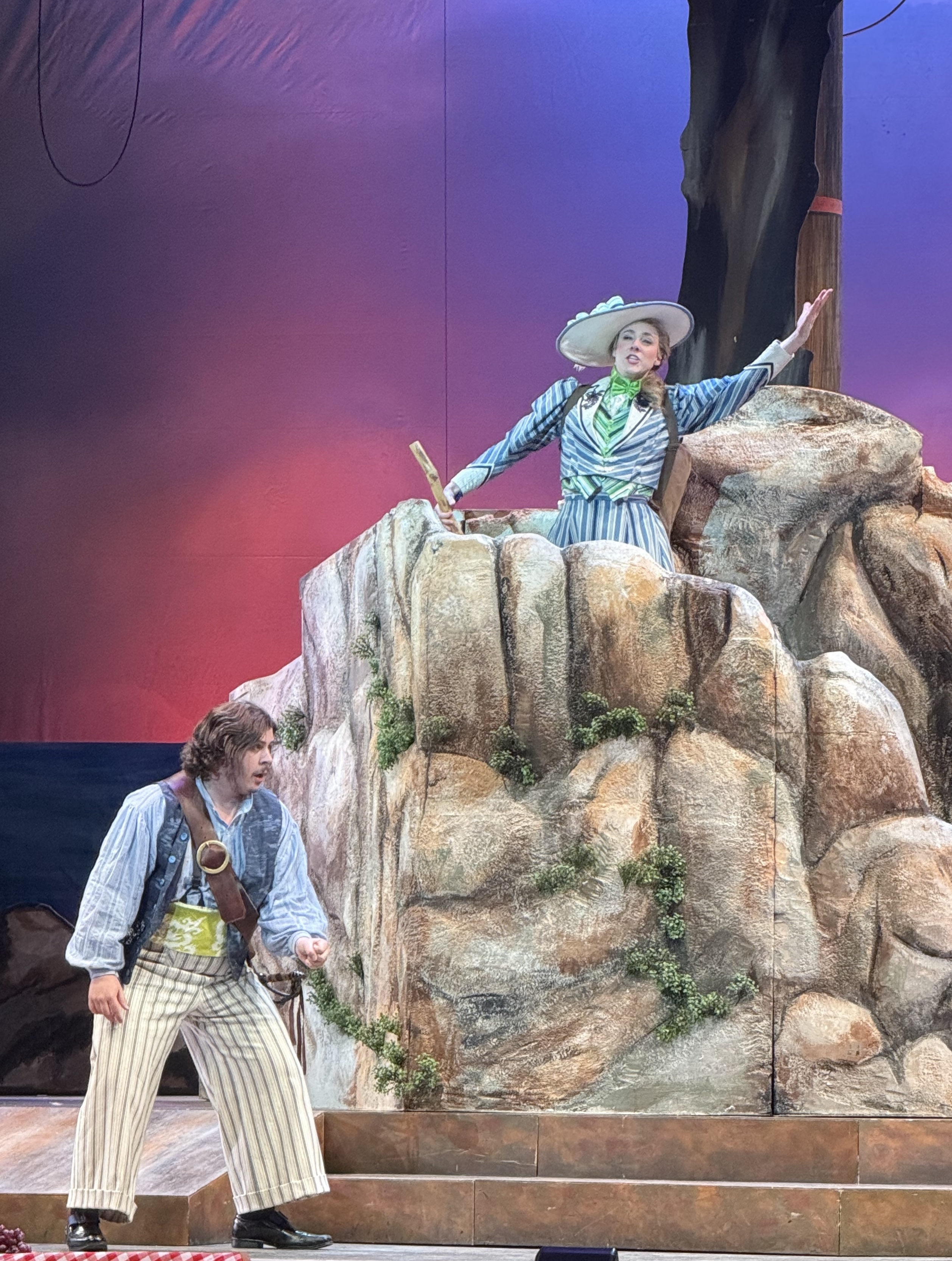
Davian Raggio (Frederic), Madison Falkenstine (Mabel). Photo by Andrew Konopak.
When they declare their loyalty to Queen Victoria, the way is cleared for Frederic and Mabel to marry.
The CU production is stage directed by Leigh Holman, director of the Eklund Opera Program, with choreography by Laura Malpass. The production uses the same sets as previous CU performances in 2014, but with new costumes by Holly Jenkins Evans and new lighting design by Jonathan Dunkle.
“It will look different,” Holman says, “but in terms of interpretation, we took the same approach as last time. There are many different levels where the show can entertain. There are Gilbert & Sullivan fans that know all the intricacies, and there are people that will learn it as they’re sitting there. Other people will see the slapstick, and they’ll enjoy it too.”
The show must have wide appeal, since it has been selling exceptionally well. According to Holman, “the last show that reached this (many) ticket sales was West Side Story.”
There are several specific aspects of Pirates that Holman and Carthy hopes the audience will recognize. For one, there are clues that the pirates are really from the upper class. For one, “they’re drinking sherry at the beginning,” Carthy says. “If they were real pirates they would be drinking rum.”
At the same time, there is sharp satire of the upper classes. As Carthy puts it, the performers are “having a nod and a wink at the audience, saying, ‘we know what these people are like, and you do too, don’t you?’ Both the audience and the people onstage are in on the joke.”
That pointed satire explains why Gilbert’s text was not popular with the Queen and nobility, even though Sullivan’s music was. “These little barbs against royalty were what Queen Victoria disapproved of,” Carthy says, “which is why Sullivan got knighthood and Gilbert didn’t.”
In one example, the Pirate King, himself a noble, takes a particularly brutal jab at the rigidly “respectable” upper classes. Speaking of piracy, he says, “I don’t think much of our trade, but compared with respectability, it is relatively honest.”
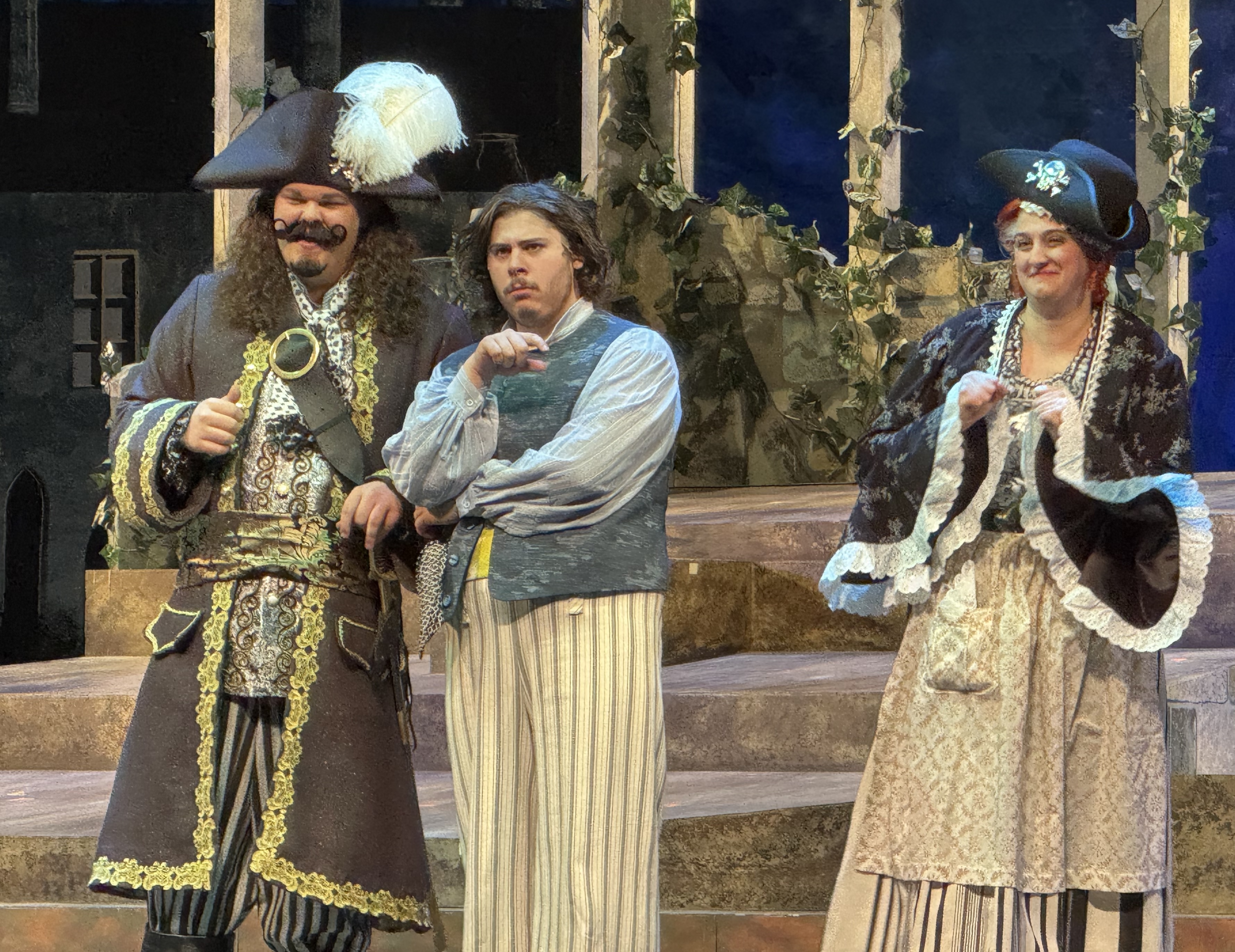
James Robinson (Pirate King), Davian Raggio (Frederic), Carrina Macaluso (Ruth). Photo by Andrew Konopak.
Satire of the upper classes appears in all cultures. It is central to much British literature, but also dates from Roman and Greek theater into the 20th-century. “Gilbert and Sullivan’s policemen are exactly the same as Monty Python’s policemen,” Carthy says. “They are of a particular class and accent—that is a thread through the ages.”
It is also important to know that Sullivan aimed higher than writing popular potboilers. “Sullivan wanted to be a serious composer and ended up hating Gilbert,” Carthy says. “He wanted to stop (working with Gilbert), but then he lost money in a market crash and had to sign on for another five years.”
Musical evidence of Sullivan’s aspirations is found in throughout the show. “There are little bits of Sullivan as a serious composer, and not just this sort of thing, that we remember him for,” Carthy says, singing an oom-pah accompaniment.
In some places, there are even traces of serious opera, including hints of Donizetti and Rossini. Holman finds these passages especially expressive. “The love duet (between Mabel and Frederic) is beautiful,” she says. “It’s the most sincere thing in the show. That piece is just gorgeous.”
She also hopes you will notice the choreography. “It’s a beast to choreograph, with so much movement,” she says. “Malpass has taken predominantly non-dancers and done amazing jobs with them. (In this show), there’s always something to see, lots of physicality (as well as) great singing!”
Carthy admits that Pirates does not always conform to modern sensibilities. “It’s a piece of its age,” he says. But he believes its comedy is universal, transcending Victorian sensibilities. “It’s quirky but it works, and it suggests a little depth,” he says.
“Above all, it knows what its audience wants.”
# # # # #
University of Colorado Eklund Opera Leigh Holman, stage director; Nicholas Carthy, conductor
W.S. Gilbert and Arthur Sullivan: The Pirates of Penzance
7:30 p.m. Friday, March 14, and Saturday, March 15 2 p.m. Sunday, March 16 Macky Auditorium
Boulder Opera pairs brutal tragedy with effervescent comedy
By Peter Alexander Feb. 6 at 3:00 p.m.
Boulder Opera Company (BOC) will present a double bill of two operas by Puccini at the Dairy Arts Center this weekend (Friday, Saturday and Sunday, Feb. 7–9; details below).
Two more contrasting operas could hardly be imagined. Il Tabarro is a rarely performed, gritty and brutal tragedy of betrayal and murder; and Gianni Schicchi is a popular, frothy burlesque of a comedy contrasting avarice with young love. They are two thirds of a triptych of one-act operas known in Italian as Il Trittico.
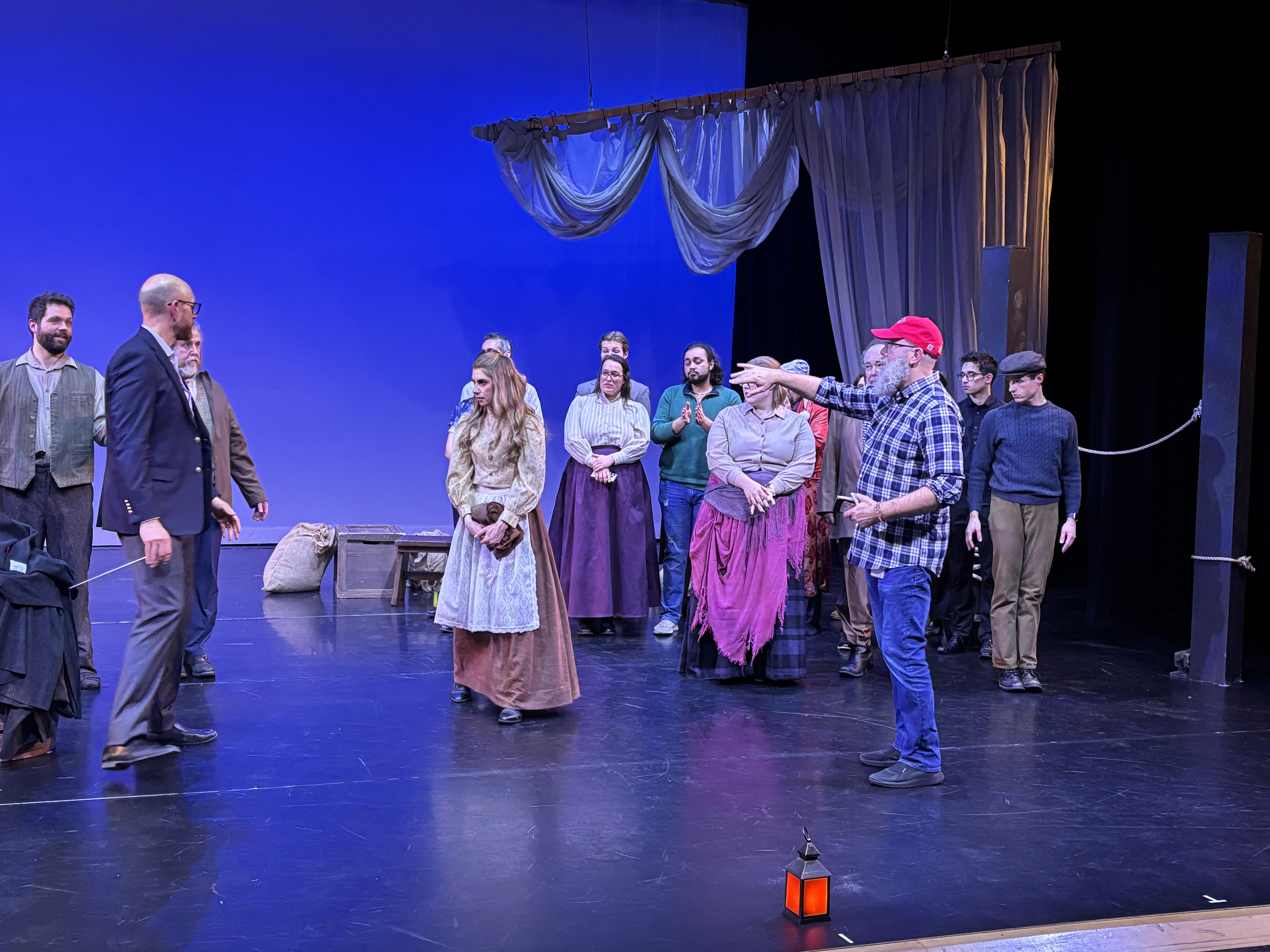
BOC dress rehearsal of Il Tabarro. Conductor Brandon Matthews (left, with baton) and stage director Gene Roberts (right, in red hat)
The triptych also includes Suor Angelica, a tender tale of faith and redemption. All three operas were first performed by the Metropolitan Opera in 1918.
BOC’s productions of Il Tabarro and Gianni Schicchi will be stage directed by Gene Roberts, who returns to Boulder having directed several of the company’s recent productions. An ensemble orchestra will be conducted by Brandon Matthews.
“We get to experience quite a landscape of emotion,” Roberts says of the pairing of two such disparate stories. These two operas are not usually heard together, he adds. “(Il Tabarro) is a treat to see, because unless it’s performed with all three of the operas, it is very rarely done.
“They’re all wonderful works but you need a trio of dramatic voices to do Il Tabarro. The soprano, the tenor and the baritone need to have quite a bit of heft to their voices.”
Il Tabarro is the story of Michele and Giorgetta, who have lost a child before the opera opens. They operate a barge that has just arrived in Paris, where the stevedores are unloading their cargo. Over the course of the evening, Michele and Giorgetta argue, and it becomes clear that Giorgetta is having an affair with Luigi, one of the stevedores. When Giorgetta leaves, Michele confronts Luigi, and during a fight strangles him.
Michele conceals Luigi’s body under his cloak. When Giorgetta returns hoping to reconcile, Michele opens his cloak, and Luigi’s body falls at her feet.
“It’s truly a tragedy that leaves us with emotional whiplash, because it all happens so fast,” Roberts says. “In this relatively short piece, boy is there some dramatic singing! All three of (the leads)—you could hear them in any opera house in the world!
“There are big, meaty arias for the tenor and the baritone. When he has realized that his wife is having an affair, Michele just pours out his heart in a beautiful aria. The baritone doesn’t often get arias in Puccini operas, so that’s a wonderful treat.”
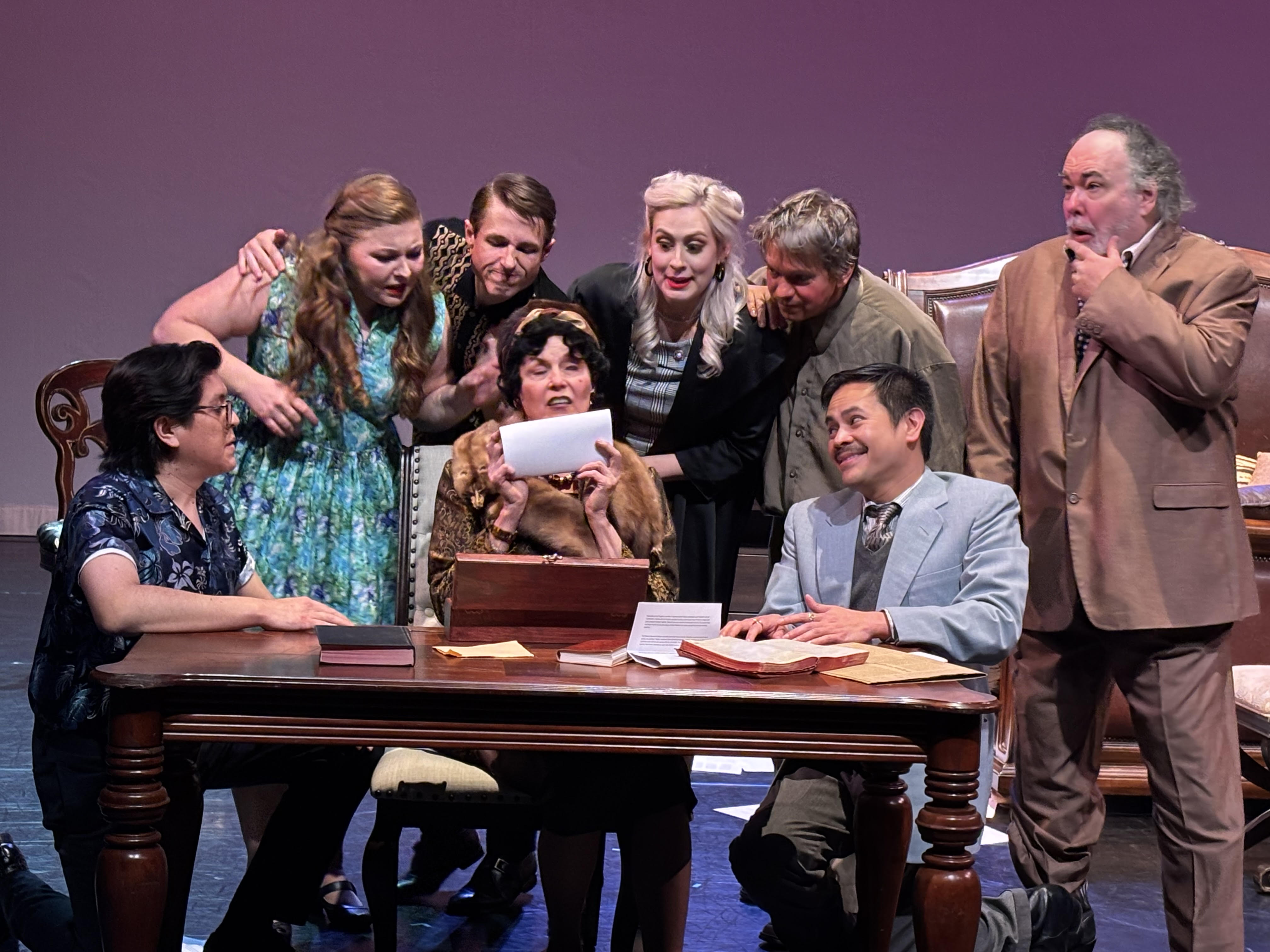
BOC production of Gianni Schicchi
The story of Gianni Schicchi is both simpler and more chaotic. Busoso Donati, a rich man living in Florence—the location is central to the plot—has died, and his relatives arrive at his apartment to learn who has inherited his riches. When it turns out that he has left everything to a monastery, they start on a wild effort to change the will before anyone learns that Donati has died.
In the end, Gianni Schicchi, a neighbor whose daughter Lauretta is in love with Donati’s young cousin Rinuccio, arrives and saves the day by impersonating Donati and changing the will before a notary. But instead of rewarding the greedy relatives, Schicchi leaves the best items to himself, to be passed on to the young lovers who can now get married. The greedy relatives go on a frantic whirlwind, grabbing everything they can as they rush out of the apartment.
“There are moments throughout this where you are taken along in the chaos that the greed of this family brings on in a delightful way,” Roberts says. When suddenly “everyone remembers they’re supposed to be sad about it, you hear the crying in the orchestra, way overdone. They’re all sobbing and crying and then when they find out they’ve been disinherited, the big explosions (and the) chaos of looking for the will takes us up and down like the world’s largest roller coaster.”
Gianni Schicchi is an ensemble opera, with give and take among the characters as they argue and fight over Donati’s riches, but there is a moment of calm when you will hear one of the most loved of all Puccini’s arias. Lauretta persuades her father to help the family, in order to enrich Rinuccio, singing “O mio babino caro” (Oh my dear daddy)—an aria beloved of all sopranos and opera audiences worldwide.
Both operas will receive realistic productions, with no extra interpretations added. “(Puccini’s) verismo style was all about the realism of life,” Roberts says. “Il Tabarro was originally set in 1910, and that’s where we’ve got it. Gianni Schicchi was originally written to be in the year 1299, and we updated that one to 1955, but it’s still about avarice and greed at the death of a wealthy relative.”
With a reduced orchestra and simple scenery, BOC productions are produced inexpensively, but Roberts is excited about the singers. “Come to the Dairy Center,” he says after a rehearsal.
“I can’t believe I just heard that level of singing, right here in Boulder!”
# # # # #
Puccini Double Bill Boulder Opera Company, Brandon Matthews, conductor Gene Roberts, stage director
Puccini: Il Tabarro (The cloak) —Gianni Schicchi
7 p.m. Friday, Feb. 7 and Saturday, Feb. 8 3 p.m. Sunday, Feb. 9 Dairy Arts Center






 Sharps & Flatirons