Boulder Symphony teams with Kim Robards Dance

Beethoven’s Ninth Symphony, with or without choreography

By Peter Alexander May 15 at 5:48 p.m.

The end of the concert season is prime time for orchestras to tackle the big works.
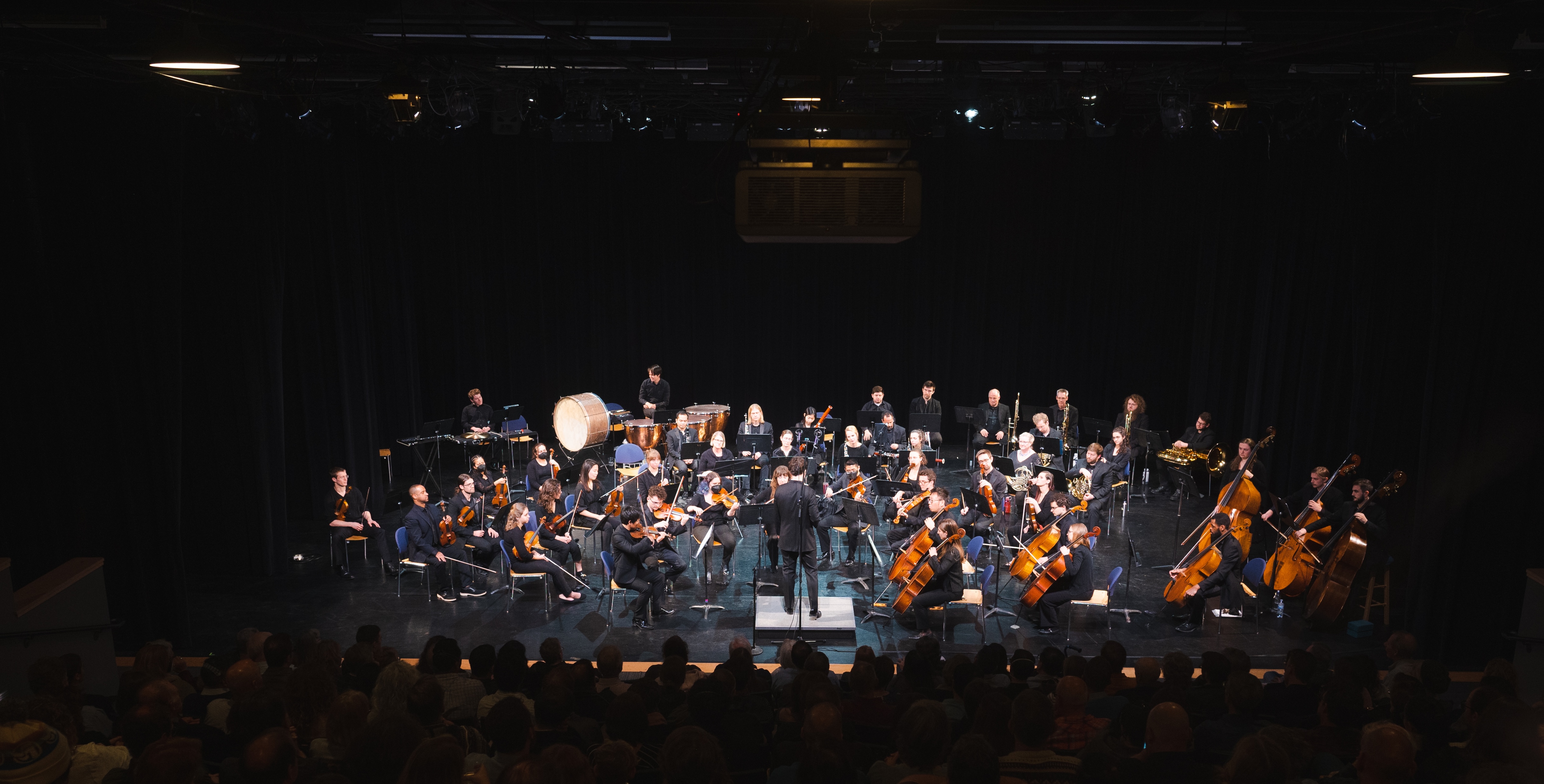
Boulder Symphony with conductor Devin Patrick Hughes

Toward the end of the 2024–25 season, in Boulder County we’ve had the Longmont Symphony presenting J.S. Bach’s Mass in B minor with the Boulder Chamber Chorale, and the Boulder Philharmonic with the full Boulder Chorale presenting Beethoven’s Missa Solemnis. And now conductor Devin Patrick Hughes and the Boulder Symphony step up with their own choral forces for Beethoven’s Ninth Symphony on the weekend. 
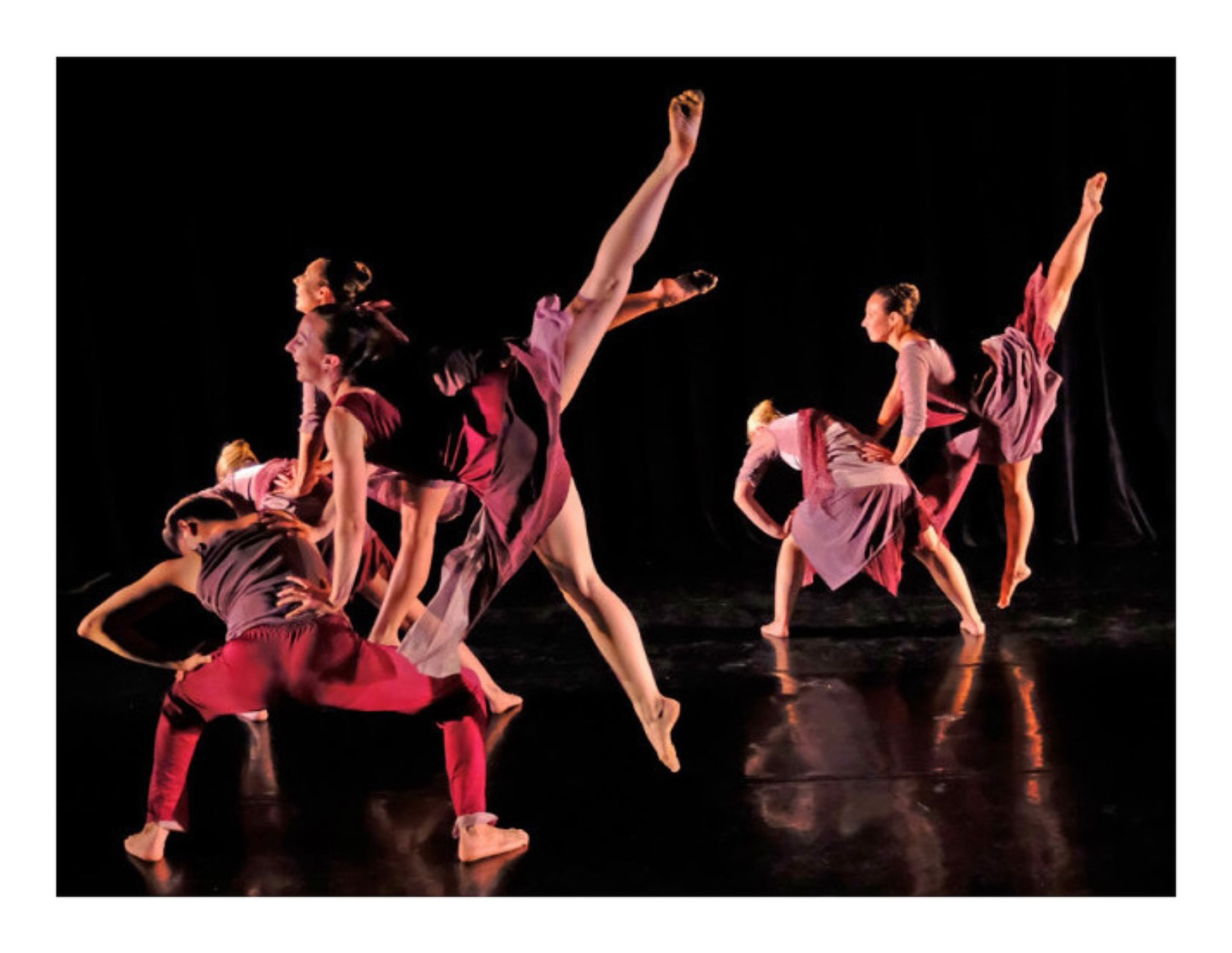
Kim Robards Dance

You can have your performance with or without choreography. The Ninth Symphony will be presented in partnership with Kim Robards Dance in a performance titled “Unstruck Sound” on Saturday (7:30 p.m. May 17 at the Waymire Dome in Brighton; details below). A second performance of the music alone will be presented by the orchestra and chorus Sunday (4 p.m. May 18 at Grace Commons in Boulder; details below).

Both performances will be conducted by Hughes, who is Boulder Symphony’s music director. Soloists for the symphony’s finale are Kyrie Laybourn, soprano; Kristin Gornstein, alto; Cody Laun, tenor; and Graham Anduri, bass. The performances will open with the Overture in E minor of the 19th-century French composer Louise Farrenc.

The last symphony that Beethoven completed, the Ninth was written over two years, 1822–24. Both its length—an hour or a little more—and the fact that it includes a chorus in the final movement marked it as a unique and radical work from its every first performance in Vienna. The concluding choral movement, based on Schiller’s poem “Ode to Joy,” has made it a first choice for celebrations around the globe. 
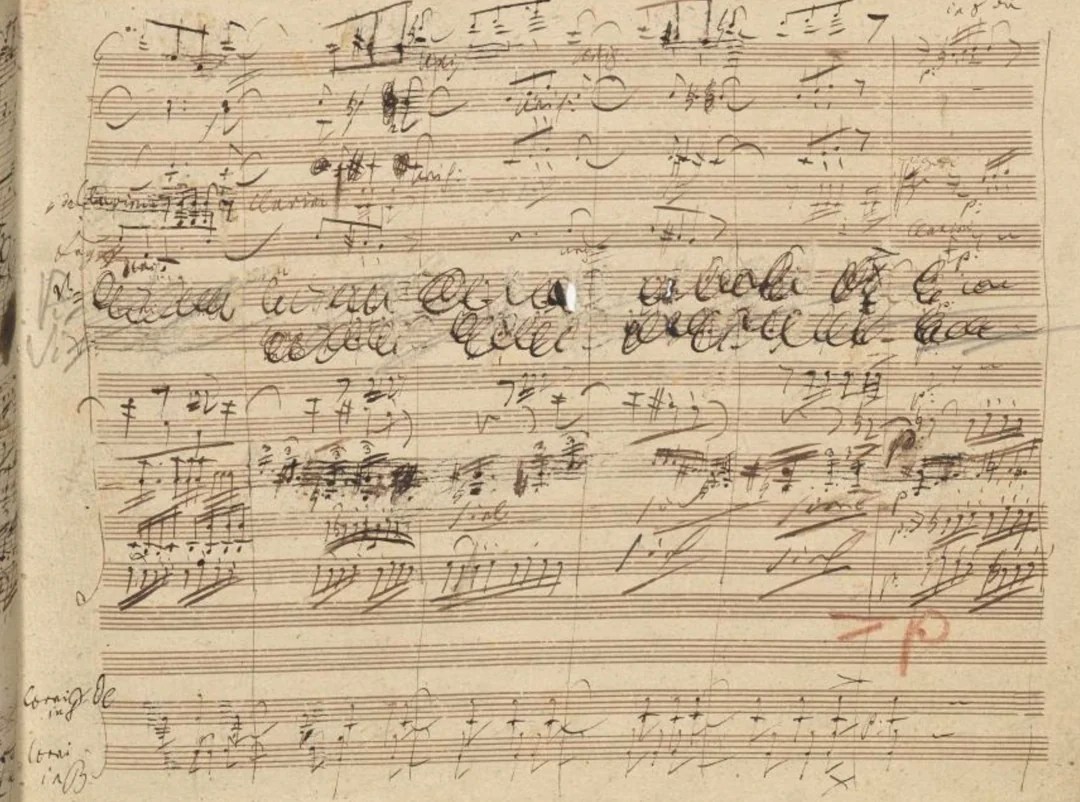
The manuscript of Beethoven’s 9th Symphony

It is also regarded as the culminating work in Beethoven’s career. The composer had expressed an interest in setting the “Ode to Joy” as early as 1792, an idea that can therefore be said to have occupied his thoughts for most of his life. Set in the somber key of D minor, that symphony progresses from a mysterious and powerful first movement, to a turbulent and disquieting scherzo, a beautiful and placid slow movement and the joyous choral finale in D major.

The work’s premiere in May of 1824 is one of the most famous performances in history. The nearly totally deaf Beethoven stood next to the conductor, watching the players and indicating tempos. At the end of the performance, the composer was unable to hear the tumultuous applause from the audience, and the alto soloist had to come forward and lead him to the edge of the stage so that he could see the response. 

The Symphony was perhaps most famously performed by in Berlin with Leonard Bernstein conducting on Christmas Day 1989, with the text of the finale altered to an “Ode to Freedom” as a celebration of the removal of the Berlin Wall. That was an international event, but the Ninth Symphony is selected for all kinds of major occasions, because of the text that celebrates the brotherhood of man. As such, it is also viewed as the ideal piece for the end of a season.
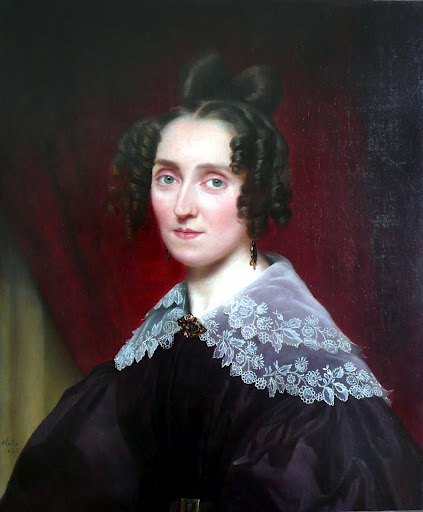
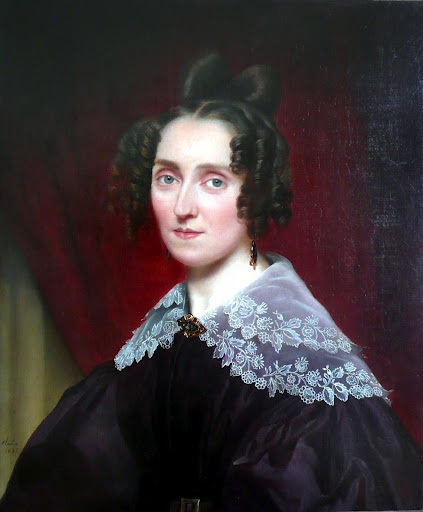
Louise Farrenc. Portrait (1835) by Luigi Rubio

Farrenc studied composition at the Paris Conservatory in the early 19th century, at a time when women had to study privately as they were not allowed to enroll in composition classes. Equally accomplished as a virtuoso pianist and composer, she became the first women teaching at the Conservatory, when she was appointed professor of piano in 1842. She held that position for 30 years. As a composer she wrote works for piano and chamber music, as well as three symphonies and two concert overtures.

Kim Robards Dance describe themselves as a “professional, multi-generational modern dance company.” The company was founded in Denver in 1987. A performance in New York was praised in the Times for “old-fashioned virtues, like a strong sense of craft and an affinity for lyrical movement and big musical scores.” There are fewer bigger scores than Beethoven’s Ninth, which has rarely if ever been danced.

# # # # #

Boulder Symphony, Devin Patrick Hughes, conductor
Chorus directed by Dana Vachharajani
With Kyrie Laybourn, soprano; Kristin Gornstein, alto; Cody Laun, tenor; and Graham Anduri, bass

  • Louise Farrenc: Overture in E minor, op. 23
  • Beethoven: Symphony No. 9 in D minor, op. 125

7:30 p.m. Saturday, May 17
Waymire Dome, 9755 Henderson Rd., Brighton
Performance with Kim Robards Dance, Kim Robards, choreographer

TICKETS

4 p.m. Sunday, May 18
Grace Commons, 1820 15th St., Boulder
(Musical performance only)
TICKETS

GRACE NOTES: Piano quintets and and a family concert

Little known Quintet by Louise Farrenc and Prokofiev’s much loved Peter and the Wolf

By Peter Alexander Jan. 16 at 12:10 a.m.

The Boulder Piano Quartet will be joined by bassist Susan Cahill, a member of the Colorado Symphony, for a program of piano quintets Friday (7 p.m. Jan. 17; details below) at the Academy, University Hill.

The concert, to be held in the Academy’s Chapel Hall, will be free. Audience members are asked to RSVP HERE prior to the concert. All the works on the program are for a quintet of piano with with one each violin, viola, cello and string bass, whereas most piano quintets are set for piano with a string quartet of two violins, viola and cello.

Louise Farrenc, portrait by Luigi Rubio (1835)

The performance will open with a quintet by Louise Farrenc, a 19th-century French composer who seems to be having a “moment” now. Though not widely known to American audiences, she has had several recent performances. Her Sextet for piano and winds was performed last Saturday (Jan. 11) on a Boulder Chamber Orchestra Mini Chamber concert, and her Third Symphony was performed in May on the Colorado Pro Musica’s farewell concert. Many of her works have recently been recorded, including music for piano, chamber music and symphonies (see listing HERE). 

A pioneer among women pianists and composers, Farrenc was a successful concert pianist. She became the first woman appointed to the permanent faculty of the Paris Conservatory in 1842, a position she held for 30 years.

The Piano Quintet in C minor by Vaughan Williams is one of his least known works, largely because the composer removed it from his catalogue of compositions after World War I, presumably because he was no longer satisfied with it. It remained unperformed for more than 80 years until the composer’s widow allowed a performance, and subsequent publication, to honor the 50th anniversary of the composer’s death.

Schubert’s “Trout” Quintet is the best known of the piano quintets with string bass. It takes its name from the fourth movement, a set of variations on the theme from Schubert’s song “Die Forelle” (The trout). The performance Friday will only feature that one movement, ending the program on a familiar and cheerful note.

# # # # #

Boulder Piano Quartet
Igor Pikayzen, violin; Matthew Dane, viola; Thomas Heinrich, cello; and David Korevaar, piano|With Susan Cahill, bass

  • Louise Farrenc: Piano Quintet No. 2 in E major, op. 31|
  • Ralph Vaughan Williams: Piano Quintet in C minor
  • Schubert: Piano Quintet in A major (“Trout”): 4. Andantino

7 p.m. Friday, Jan. 17
Chapel Hall, Academy University Hill

Free: RSVP HERE

# # # # #

The Longmont Symphony Orchestra will present its annual Family Concert, featuring Prokofiev’s masterful setting of the Russian folk tale Peter and the Wolf, Saturday afternoon (4 p.m. Jan. 18; details below) in Vance Brand Auditorium.

The concert will be led by the LSO music director, Elliot Moore. Cameron A. Grant will narrate. In addition to the Prokofiev score, the program features selections from The Carnival of the Animals by Saint-Saëns.

Subtitled “A symphonic tale for children,” Prokofiev’s Peter and the Wolf illustrates the tale of a young boy who evades the dangerous wolf, with characteristic themes for each character in the story, including Peter, his grandfather, Peter’s animal friends, the hunters and of course, the wolf. 

Prokofiev wrote an explanatory note for the score: “Each character of this tale is represented by a corresponding instrument in the orchestra: the bird by a flute, the duck by an oboe, the cat by a clarinet playing staccato in a low register, the grandfather by a bassoon, the wolf by three horns, Peter by the string quartet, the shooting of the hunters by the kettle drums and bass drum.”

Grant is a prominent attorney in Longmont, where he is a managing shareholder in the firm Lyons & Gaddis, but he is also familiar with the performing world. He holds an undergraduate degree in English and vocal music performance from Colorado College, and attended the Aspen Opera Theater Center. He has appeared with the Longmont Symphony as narrator for family concerts in the past, most recently in January, 2024.

# # # # #

Family Concert: Peter and the Wolf
Longmont Symphony Orchestra, Elliot Moore, conductor
With Cameron A. Grant, narrator

  • Saint-Saëns: Selections from Carnival of the Animals
  • Prokofiev: Peter and the Wolf

4 p.m. Saturday, Jan. 18
Vance Brand Auditorium

TICKETS

GRACE NOTES: Chamber music on the weekend

Music for winds from the BCO, quartets and quintet from the Takács Quartet

By Peter Alexander Jan. 10 at 1:45 p.m.

The Boulder Chamber Orchestra (BCO) will present a program of French music for piano and winds for its third Mini-Chamber program of the season Saturday (7:30 p.m. Jan. 11; details below).

The orchestra’s current artist-in-residence, pianist Jennifer Hayghe, will be joined by members of the BCO to perform works by Vincent d’Indy, Albert Roussel, Francis Poulenc, Florent Schmitt and Louise Farrenc.

BCO artist in residence Jennifer Hayghe

The program that was curated by Hayghe offers an opportunity to hear pieces and composers that are little known to American audiences. French music in particular is less often programmed here than German and Austrian works. The least familiar, and the earliest of the composers is Farrenc, who lived in the 19th century. A successful concert pianist, she became the first woman to hold a permanent position at the Paris Conservatory, which she maintained for 30 years, from 1842 to 1872.

All the other composers lived and worked in the 20th century. The most familiar is probably Poulenc, who died in 1963. Known for his opera Dialogues des Carmélites (Dialogue of the Carmelites), his Organ Concerto and his choral Gloria, he also wrote a large number of pieces for chamber ensembles.

The other three composers—d’Indy, Roussel and Schmitt—were active in the first half of the 20th century. Offering a rare taste of a time and place that rarely shows up in concert programs in the U.S., Mini-Chamber 3 is a welcome opportunity for the chamber music audience to expand their horizons beyond the routine.

# # # # #

Boulder Chamber Orchestra Mini-Chamber 3
Jennifer Hayghe, artist in residence, piano
With Rachelle Crowell, flute; Brittany Bonner, one; Kellan Toohey, clarinet; Kaori Uno-Jack, bassoon; and Devon Park, horn

  • Vincent d’Indy: Sarabande et menuet, op. 72
  • Albert Roussel: Divertissement, op. 6
  • Francis Poulenc: Trio for oboe, bassoon and piano
  • Florent Schmitt: Sonatine en trio, op. 85
  • Louise Farrenc: Sextet in C minor, op. 40

7:30 p.m. Saturday, Jan. 11
Boulder Adventist Church, 345 Mapleton Ave., Boulder

TICKETS

# # # # #

The Takács Quartet will be joined by pianist Margaret McDonald to present one of the preeminent chamber works of the 19th century, Brahms’s Quintet in F minor for piano and strings.

The program will also feature Beethoven’s early String Quartet No. 1 in F major, op. 18 no. 1—actually the second quartet of the set to be written—and the String Quartet no. 1 by Stephen Hough, which was written for the Takács.

Hough’s quartet was first written to be heard alongside the Ravel String Quartet and Ainsi la nuit (Thus the night), a string quartet by the French composer Henri Dutilleux. Hough subtitled the quartet “Les Six Rencontres” (The six re-encountered), a reference to a group of early 20th-century composers active in France that did not include either Ravel or Dutilleux. Hough wrote that the subtitle “has in it a pun and a puzzle: the six movements as an echo of ‘Les Six,’ although there are no quotes or direct references from those composers; and ‘encounters’ which are unspecified.”

Margaret McDonald, guest pianist with the Takács Quartet

The six movements of the quartet have titles that indicate places, presumably in the Montparnasse district of Paris, where an encounter with a composer from “The Six” might have occurred: On the boulevard, in the park, at the hotel, at the theater, in the church and at the market. The Takács Quartet premiered “Les Six Rencontres” in Costa Mesa, Calif., Dec. 8, 2021.

One of the best known major pieces of chamber music from the 19th century, Brahms F minor Piano Quintet evolved through several forms before being finished as a quintet. It was first written as string quintet, a version that the composer later destroyed, and then as a duet for two pianos, and finally as a quintet for string quartet with piano. All of this stretched over six years, prior to the Quintet’s premiere in 1868.

# # # # #

Takács Quartet
With Margaret McDonald, piano

  • Beethoven: String Quartet in F Major, op. 18 no. 1
  • Stephen Hough: String Quartet No. 1, “Les Six Rencontres” (The six re-encountered)
  • Johannes Brahms: Piano Quintet in F Minor, op. 34

4 p.m. Sunday, Jan. 12
7:30 p.m. Monday, Jan. 13
Grusin Music Hall

In-person and streaming TICKETS