Longmont Symphony Pops Concert features musical portraits of the West
By Peter Alexander April 29 at 5:22 p.m.
The Longmont Symphony and conductor Elliot Moore will end the 2024-25 concert season with their annual Pops Concert, Saturday at the Vance Brand Civic Auditorium (7 p.m. May 3; details below).
The program offers what the orchestra calls “an exciting trip out west”—or, since we are in Colorado, you might think of it as a musical step out the door and into the wide open spaces around us. Included are fiddle tunes, musical descriptions of the Grand Canyon and an 1878 cattle drive, and music to a cowboy ballet.
Richard Hayman, for many years chief musical arranger or the Boston Pops Orchestra, contributes Pops Hoedown. A collection of well known fiddle tunes including “The Devil’s Dream,” “Chicken Reel,” “Turkey in the Straw,” “Rakes and Mallow” and others, Pops Hoedown evokes the high spirits of a Saturday night barn dance.
Disney’s 1958 film Grand Canyon won the Academy Award for best short film. The music written for the film by composer/arranger Ferde Grofé lived on long past the film itself in the form of the Grand Canyon Suite. Of the five movements of the full suite, the LSO will play the most familiar: “On the Trail,” describing the steady gait of donkeys into the canyon and their race back to the barn; and a movement depicting an afternoon “Cloudburst.”
The 1972 Western film The Cowboys starred John Wayne, Bruce Dern, Colleen Dewhurst and Slim Pickens. The music for the film was one of John Williams’s earlier film scores, and the Overture Williams wrote drawn from the film creates an intense, uptempo portrayal of a cattle drive and the young cowboys who are the film’s subjects.
Agnes de Mille’s ballet Rodeo had its premiere in 1942 at the Metropolitan Opera House, receiving 22 curtain calls. The success was due not only to de Mille’s inventive choreography—which led to her selection to choreograph Rogers and Hammerstein’s Broadway hit Oklahoma—but also the music by Aaron Copland. Subtitled “The Courting at Burnt Ranch,” the ballet tells the story of the romance between the Cowgirl and the Champion Roper.
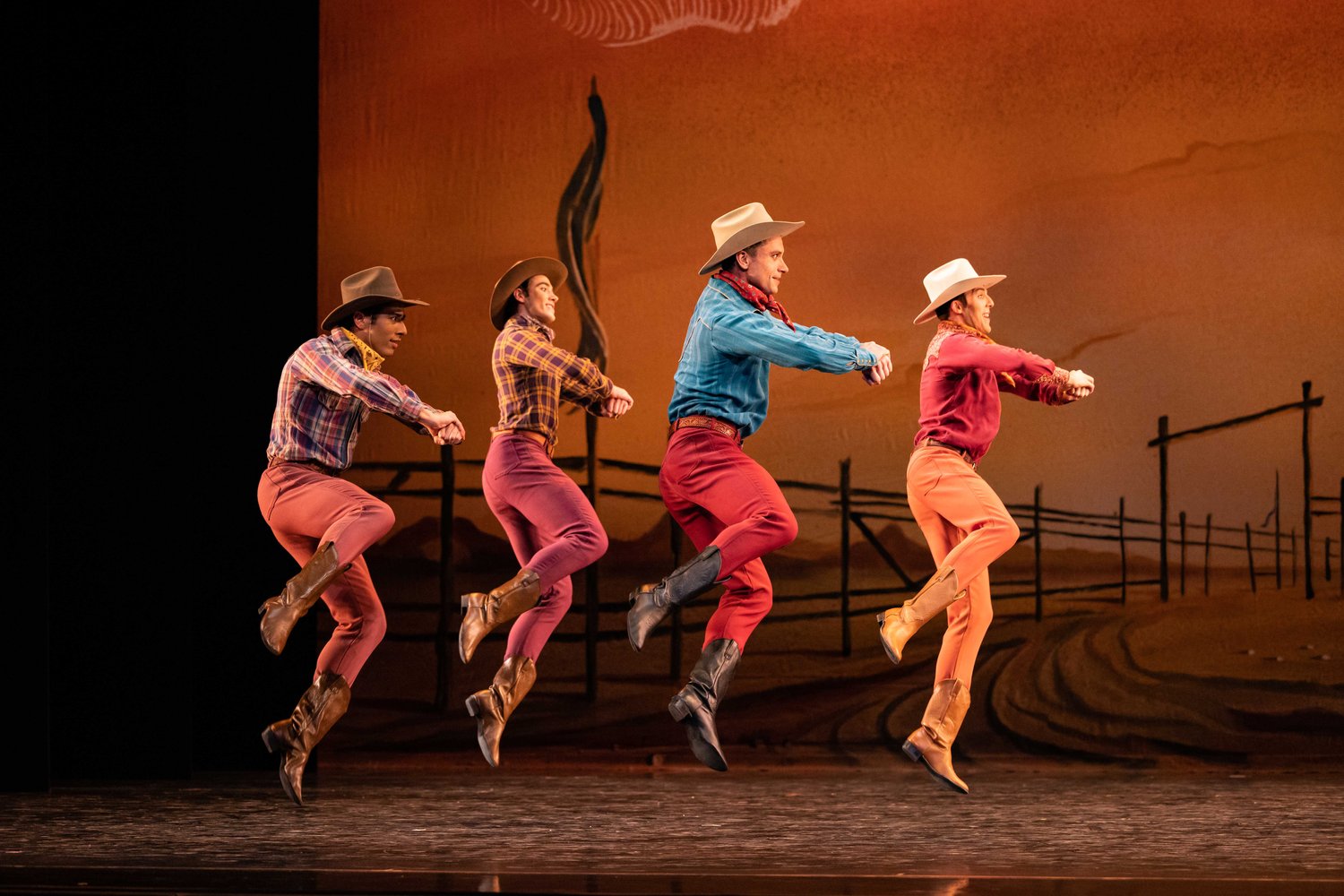
Vinicius Lima, Joseph Lynch, Brian Waldrep (“Head Wrangler”) and Tyler Gum (“Champion Roper”) in “Buckaroo Holiday” from Aaron Copland’s and Agnes de Mille’s Rodeo. Photo by Beau Pearson.
From its use in the orchestral suite and television commercials, Copland’s “Hoedown” from Rodeo has become instantly recognizable as musical Americana. Copland incorporates several fiddle tunes into the “Hoedown,” including “Bonaparte’s Retreat” and “Miss McLeod’s Reel.” The LSO will play the full ballet score, including sections titled “Buckaroo Holiday,” “Corral Nocturne,” “Ranch House Party” and “Saturday Nigh Waltz.”
In addition to these popular pieces inspired why the American West, the LSO Pops program includes Leroy Anderson’s Fiddle Faddle,The American Frontier by Calvin Custer and Cowboy Rhapsody by Morton Gould.
# # # # #
“Pops: A Western Hoedown“ Longmont Symphony Orchestra, Elliot Moore, conductor
Leroy Anderson: Fiddle Faddle
Richard Hayman: Pops Hoedown
Ferde Grofé: Grand Canyon Suite
Calvin Custer: The American Frontier
John Williams: Overture to The Cowboys
Morton Gould: Cowboy Rhapsody
Aaron Copland: Rodeo
7 p.m. Saturday, May 3, Vance Brand Civic Auditorium
The Longmont Symphony Orchestra (LSO) and conductor Elliot Moore end their season with one of the most significant pieces by J.S. Bach, his monumental Mass in B minor.
The performance of this large-scale work will be Saturday evening at Vance Brand Civic Auditorium in Longmont (7 p.m. April 12; details below). Moore and the LSO will team up with the Boulder Chamber Chorale, a select group from the Boulder Chorale directed by Vicki Burrichter. Soloists will be soprano Dawna Rae Warren, countertenor Elijah English, tenor Joseph Gaines and baritone Andy Konopak.
Choral settings of the Mass ordinary—the five texts sung every week in Catholic church services, as opposed to texts that vary with the liturgical calendar—had a long history in Europe. However, Bach’s setting is too long to be easily incorporated into a normal service, which is why it is generally performed as a concert piece rather than a liturgical mass.
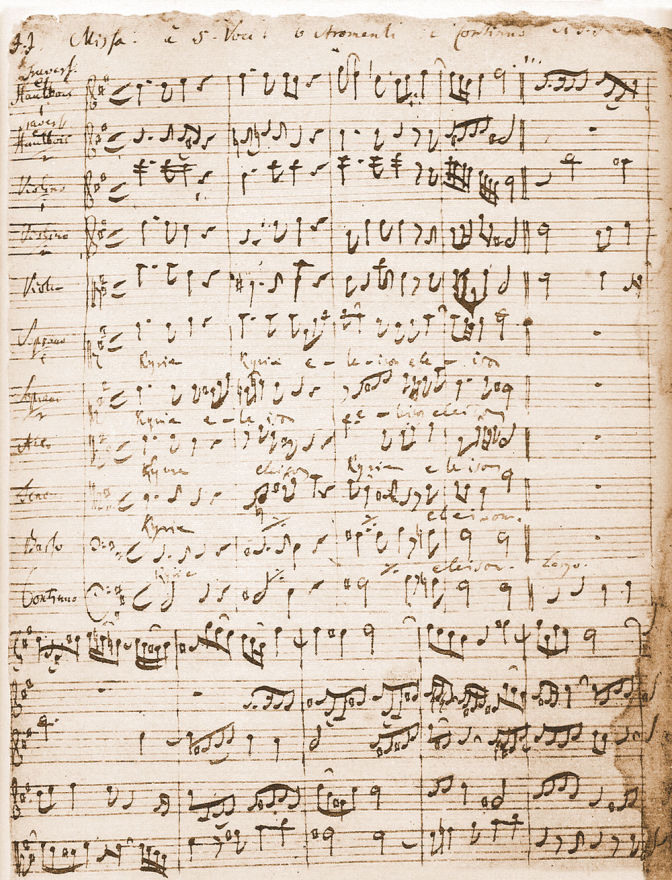
Bach’s manuscript of the B-minor Mass
The structure and composition history of the Mass are complicated. The final work as we know it today comprises the main sections of the Catholic Mass ordinary—Kyrie, Gloria, Credo, Sanctus and Agnus Dei—in 27 separate movements for orchestra, choir and soloists. Bach composed the first two portions of the Mass, Kyrie and Gloria, in 1733. These are the portions that are common to both Catholic and Lutheran services and were theoretically usable at the Lutheran Thomaskirche in Leipzig where Bach was employed.
Bach presented those two movements to the incoming Elector of Saxony, a Catholic ruler, in 1733. He did not compose the remaining portions of the Mass, which were exclusive to the Catholic services, until the final years of his life. Some of the music was newly composed, but other movements were reworkings of music from earlier cantatas and other works.
It is remarkable that a piece written over so many years with many different sources would emerge as a unified work universally revered as one of Bach’s crowning achievements. But the entire B-minor Mass was probably never performed in Bach’s lifetime, and clearly would not have been suitable for a service in Bach’s church. It includes music written over 35 years of the composer’s lifetime, assembled and re-appropriated into a final form dictated by the structure of the Catholic Mass, by a resolutely Lutheran composer.
# # # # #
“A Magnum Opus” Longmont Symphony Orchestra, Elliot Moore, conductor With the Boulder Chamber Chorale, Vicki Burrichter, direcotr; Dawna Rae Warren, soprano; Elijah English, countertenor; Joseph Gaines, tenor; and Andy Konopak, baritone
J.S. Bach: Mass in B minor
7 p.m. Saturday, April 12 Vance Brand Civic Auditorium
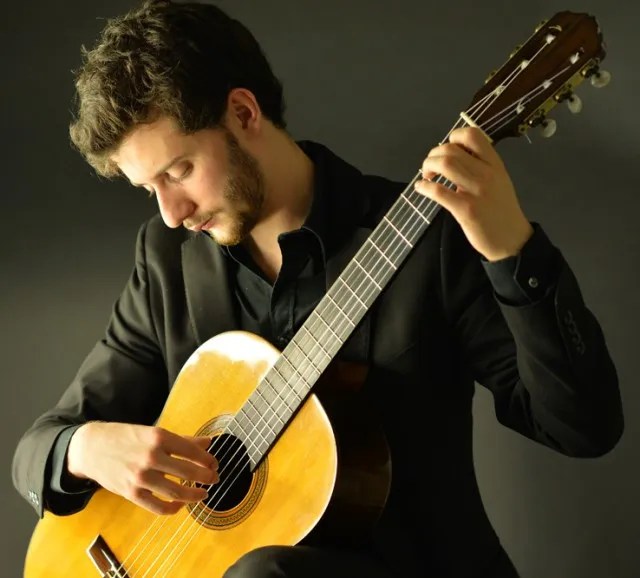
The Takács Quartet and guitarist Nicoló Spera will come together over the weekend for concerts in Grusin Hall on the CU Campus (Sunday, April 13, and Monday, April 14; details below).
Their joint performance of the Quintet for guitar and string quartet by Giacomo Susani will be framed by two works from the standard string quartet repertoire, Haydn’s late Quartet in G major, op. 77 no. 1, written in 1799; and Dvořák’s Quartet in F major, op. 96, composed during the composer’s visit to the Czech immigrant community of Spillville, Iowa, in the summer of 1893.
Giacomo Susani
Susani keeps very busy, with a performing career on guitar in Europe and the United States, a compositional career, and as artistic director of the Homenaje International Guitar Festival in Padova, Italy. As a performer he has released four recordings on the Naxos label. He conducted the world premier of his Concerto for 10-string guitar and orchestra in Boulder this past December, with Spera and the Boulder Chamber Orchestra. The Guitar Quintet was written in 2016.
Listeners may be familiar with the string and guitar quintets of Luiggi Boccherini, the best known but not the only works for that combination of instruments. There were several written in the 20th century, including one by Italian composer Mario Castelnuovo-Tedesco. That work is recognized in the last of Susani’s three movements, “Omaggio a Castelnuovo-Tedesco” (Homage to Castelnuovo-Tedesco). The first two movements are titled respectively “La Tempesta” (The storm) and “Liberamente, non trope lento” (Freely, not too slow).
At the age of 67 Haydn began a set of string quartets commissioned by the wealthy aristocratic patron and music lover Prince Lobkowitz. He completed two quartets of a likely set of six, but other projects intervened before he could complete a larger set. The two quartets were published as Op. 77 nos. 1 and 2, and were his final completed string quartets. He only completed two movements of another planned quartet, published in 1806 as Op. 103.
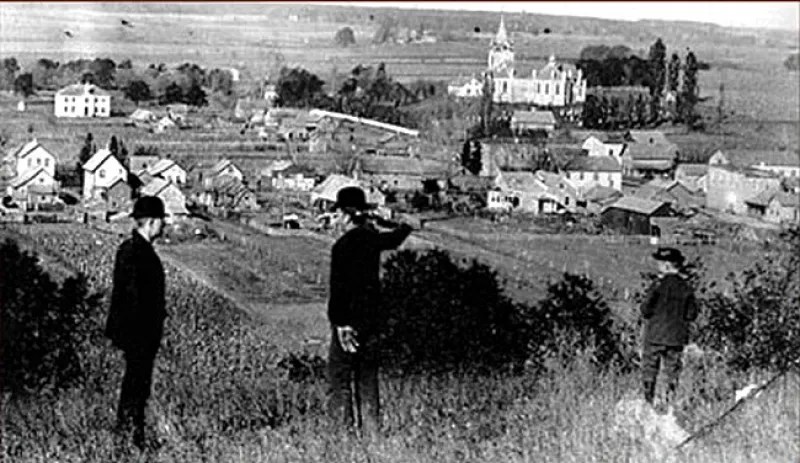
Spillville, Iowa, in 1895, shortly after Dvořák’s visit
Dvořák wrote many of his best known pieces in the United States. He spent the years 1892–95 as director of the National Conservatory of Music in New York. Intrigued by the idea of a village of Czech immigrants on the Western plains, he spent an idyllic summer in the tiny village of Spillville, Iowa, in 1893. While in the United States he wrote his Symphony No. 9, “From the New World” and his Cello Concerto in New York, and a string quartet and string quintet, now known as the “American” Quartet and Quintet, in Spillville.
Spillville was very much a Czech community, with the people speaking Czech and observing Czech customs that Dvořák found congenial. He frequently played the organ at the local church, which is still standing, and made many friends in the community.
Dvořák was deeply moved in Spillville, especially by the emptiness of the prairie, perhaps reflected in the Quartet’s melancholy slow movement, and the singing of birds, quoted in the scherzo. Attempts to connect the Quartet’s uncomplicated musical style to American influences have met skepticism. The composer himself once wrote, “I wanted to write something for once that was very melodious and straightforward . . . and that is why it all turned out so simply.
“And it’s good that it did.”
# # # # #
Takács Quartet with Nicoló Spera, guitar
Haydn: String Quartet in G Major, op. 77 no. 1
Giacomo Susani: Quintet for Guitar and String Quartet
Dvořák: String Quartet in F Major, op. 96 (“American”)
4 p.m. Sunday, April 13, and 7:30 p.m. Monday, April 14 Grusin Hall
Boulder and Longmont symphonies at home, Kodo at Mackey
By Peter Alexander Feb. 12 at 11:15 a.m.
The Boulder Symphony joins with the Niwot High School Symphony Orchestra for a performance of the spirited Danzón No. 2 of Arturo Márquez Saturday and Sunday (Jan. 15 and 16; details below) at the Dairy Arts Center.
Other works on the program, performed by the Boulder symphony, will be a Concerto for Violin titled “Paths to Dignity” by Lucas Richman, featuring violinist Mitchell Newman; and Brahms’s Symphony No. 2 in D major. Devin Patrick Hughes will conduct.
Richman has had an extensive career as a conductor. He currently leads the Bangor Symphony Orchestra in Bangor, Maine, and was previously music director of the Knoxville Symphony in Tennessee. He has also conducted scores for a number of films, including the Grammy-nominated score for The Village.
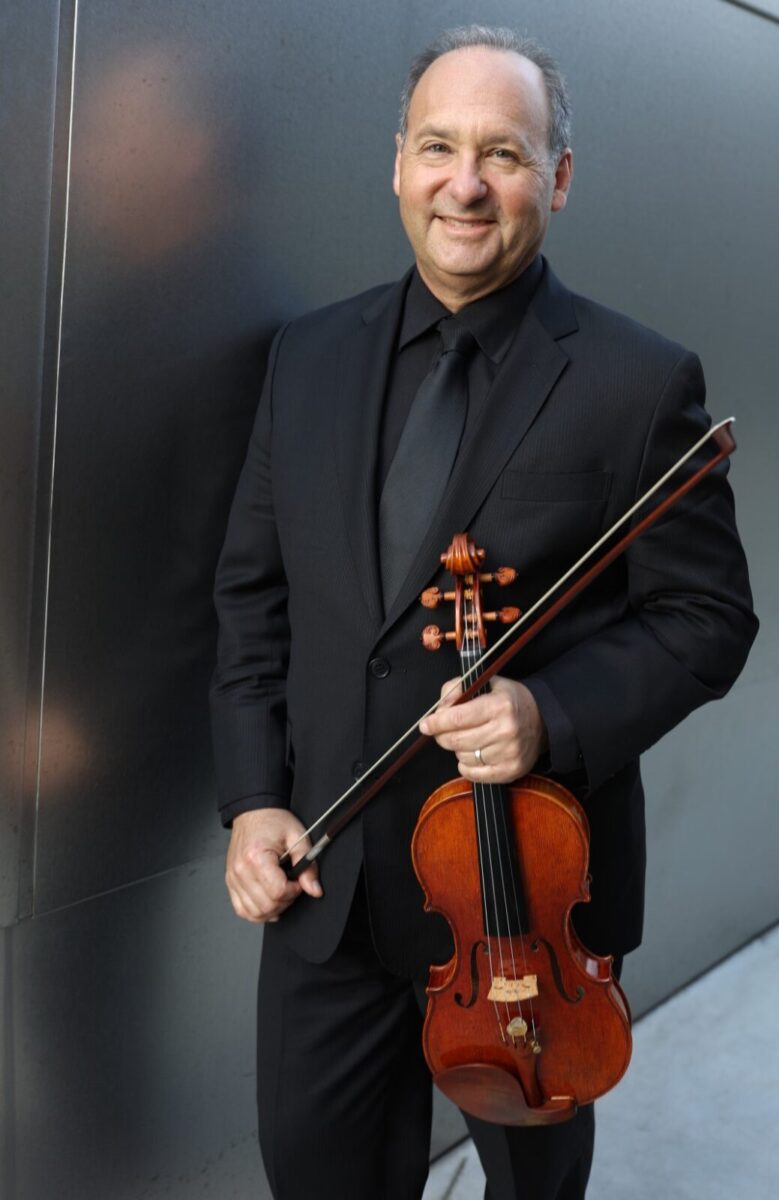
Mitchell Newman
As a composer, he wrote Behold the Bold Umbrellaphant based on poetry by Jack Prelutsky, which the Longmont Symphony presented with Prelutsky in 2018. His Violin Concerto “Paths to Dignity” was inspired by the lives of homeless people and composed for Newman, a longtime advocate for the homeless and member of the violin section of the Los Angeles Philharmonic.
The concerto has four movements that share a seven-note motive representing the word “DIGNITY.” The first movement, titled “Our Stories,” uses various instruments to represent homeless persons who are answered in turn by the violin. The second movement, “Fever Dreams/Move,” describes the disturbed dreams of a veteran suffering from PTSD who is living on the streets.
The third movement, “Shelter for My Child,” uses a musical representation of the Hebrew word “Tzadek,” which means “justice.” The finale, “Finding Home,” reiterates the “Tzadek” motive and concludes with variations on the “DIGNITY” theme.
An activist in bringing music to underserved communities, Newman was named a mental health hero by the California State Senate, and founded “Coming Home to Music,” a program that brings classical music to the homeless. He retired from the L.A. Phil in 2020 and currently teaches at Temple University.
# # # # #
“Harmony for Humanity” Boulder Symphony, Devin Patrick Hughes, conductor With Mitchell Newman, violin Featuring the Niwot High School Symphony Orchestra
Arturo Márquez: Danzón No. 2
Lucas Richman: “Paths to Dignity” Concerto for Violin
Brahms: Symphony No. 2 in D major
7:30 p.m. Saturday Feb. 15, and 2 p.m. Sunday, Feb. 16 Dairy Arts Center
Also on Saturday, the Longmont Symphony Orchestra (LSO) offers a program titled “The Light after the Storm” (7 p.m. Feb. 15, details below) in which a vivid musical storm, the last of the Four Sea Interludes from the opera Peter Grimes by Benjamin Britten, leads to the sunny skies of Brahms’s Second Symphony.
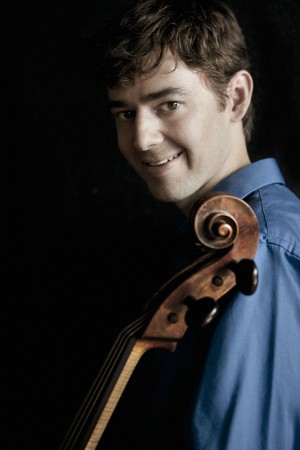
Clancy Newman. Photo by Lisa-Marie Mazzucco
Between these two contrasting works on the program is the Cello Concerto of Sir Edward Elgar, which will be performed by Clancy Newman. The LSO will be conducted by Elliot Moore.
Britten was inspired to write Peter Grimes while he was in exile from England as a conscientious objector living in the United States during World War II. While in the U.S., he read George Crabbe’s narrative poem The Borough, which describes a village on the east coast of England and its colorful inhabitants. The poem inspired Britten not only to write an opera based on the solitary Grimes, one of Crabbe’s most distinctive characters, but also to return to England. He finished the opera after his return, in 1943.
Peter Grimes was premiered to great acclaim in June 1945, shortly after the end of the war in Europe. The Four Sea Interludes—“Dawn,” “Sunday Morning,” “Moonlight” and “Storm”—are taken from the interludes Britten wrote to fill scene changes during the opera, and they contain some of the most vividly descriptive music he ever composed.
Written shortly after World War I, the Cello Concerto was Elgar’s last completed major work. The first performance was under-rehearsed and considered a failure, but later the Concerto became one of the staples of the cello repertoire. It achieved a higher level of popularity when it was famously recorded by cellist Jacqueline du Prè in 1965.
A composer and a cellist, Newman has appeared with the LSO once before, in November, 2023. The winner of the International Naumburg Competition in 2001 and an Avery Fisher Career Grant in 2004, he has performed as a soloist, with the Chamber Music Society of Lincoln Center and Musicians from Marlboro.
# # # # #
“The Light after the Storm” Longmont Symphony, Elliot Moore, conductor With Clancy Newman, cello
Benjamin Britten: Four Sea Interludes from Peter Grimes
Kodō, the renowned taiko drumming ensemble from Japan, will present a program from their current “One Earth Tour 2025” at 7:30 p.m. Saturday, Feb. 15, at Macky Auditorium.
The performance is part of the Artist Series from CU Presents. Limited seats are available.
The Japanese word “kodo” has a double meaning that reflects the group’s ethos. It can mean “heartbeat,” which suggests the primal role of rhythm, but as written with different characters, it means both “drum” and “child.” The program title “Warabe” also refers to a child or children, or can refer to children’s songs. Or as the group’s program notes state, the performers are “forever children of the drum at heart.”
The “Warabe” program refers back to the repertoire and the aesthetics of the earliest incarnation of Kodō, when they were first formed out of another drumming ensemble in the 1980s. After several years of touring, they founded a village on Sado Island, off the west coast of Japan near the city of Niigata. Since their three sold-out performances at the 1984 Olympic Arts Festival in Los Angeles, Kodō has been recognized as a global phenomenon.
Today Kodō has its own cultural foundation and a North American organization known as Kodō Arts Sphere America. In addition to their world-wide performances, they present workshop tours that open the world of taiko drumming to ever larger audiences.
# # # # #
Kodō: One Earth Tour 2025 “Warabe” Kodō, Yuichiro Funabashi, director Dance arrangements by Koki Miura
Little known Quintet by Louise Farrenc and Prokofiev’s much loved Peter and the Wolf
By Peter Alexander Jan. 16 at 12:10 a.m.
The Boulder Piano Quartet will be joined by bassist Susan Cahill, a member of the Colorado Symphony, for a program of piano quintets Friday (7 p.m. Jan. 17; details below) at the Academy, University Hill.
The concert, to be held in the Academy’s Chapel Hall, will be free. Audience members are asked to RSVP HERE prior to the concert. All the works on the program are for a quintet of piano with with one each violin, viola, cello and string bass, whereas most piano quintets are set for piano with a string quartet of two violins, viola and cello.
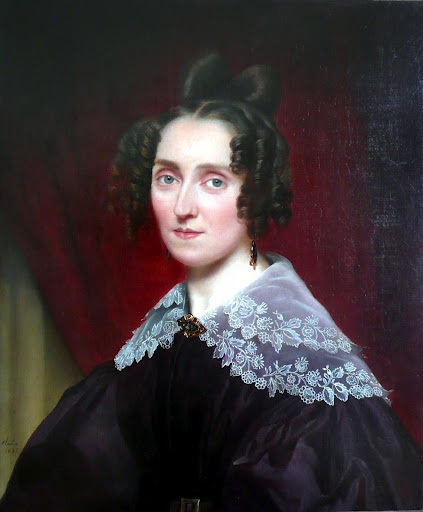
Louise Farrenc, portrait by Luigi Rubio (1835)
The performance will open with a quintet by Louise Farrenc, a 19th-century French composer who seems to be having a “moment” now. Though not widely known to American audiences, she has had several recent performances. Her Sextet for piano and winds was performed last Saturday (Jan. 11) on a Boulder Chamber Orchestra Mini Chamber concert, and her Third Symphony was performed in May on the Colorado Pro Musica’s farewell concert. Many of her works have recently been recorded, including music for piano, chamber music and symphonies (see listing HERE).
A pioneer among women pianists and composers, Farrenc was a successful concert pianist. She became the first woman appointed to the permanent faculty of the Paris Conservatory in 1842, a position she held for 30 years.
The Piano Quintet in C minor by Vaughan Williams is one of his least known works, largely because the composer removed it from his catalogue of compositions after World War I, presumably because he was no longer satisfied with it. It remained unperformed for more than 80 years until the composer’s widow allowed a performance, and subsequent publication, to honor the 50th anniversary of the composer’s death.
Schubert’s “Trout” Quintet is the best known of the piano quintets with string bass. It takes its name from the fourth movement, a set of variations on the theme from Schubert’s song “Die Forelle” (The trout). The performance Friday will only feature that one movement, ending the program on a familiar and cheerful note.
# # # # #
Boulder Piano Quartet Igor Pikayzen, violin; Matthew Dane, viola; Thomas Heinrich, cello; and David Korevaar, piano|With Susan Cahill, bass
Louise Farrenc: Piano Quintet No. 2 in E major, op. 31|
Ralph Vaughan Williams: Piano Quintet in C minor
Schubert: Piano Quintet in A major (“Trout”): 4. Andantino
7 p.m. Friday, Jan. 17 Chapel Hall, Academy University Hill
The Longmont Symphony Orchestra will present its annual Family Concert, featuring Prokofiev’s masterful setting of the Russian folk tale Peter and the Wolf, Saturday afternoon (4 p.m. Jan. 18; details below) in Vance Brand Auditorium.
The concert will be led by the LSO music director, Elliot Moore. Cameron A. Grant will narrate. In addition to the Prokofiev score, the program features selections from The Carnival of the Animals by Saint-Saëns.
Subtitled “A symphonic tale for children,” Prokofiev’s Peter and the Wolf illustrates the tale of a young boy who evades the dangerous wolf, with characteristic themes for each character in the story, including Peter, his grandfather, Peter’s animal friends, the hunters and of course, the wolf.
Prokofiev wrote an explanatory note for the score: “Each character of this tale is represented by a corresponding instrument in the orchestra: the bird by a flute, the duck by an oboe, the cat by a clarinet playing staccato in a low register, the grandfather by a bassoon, the wolf by three horns, Peter by the string quartet, the shooting of the hunters by the kettle drums and bass drum.”
Grant is a prominent attorney in Longmont, where he is a managing shareholder in the firm Lyons & Gaddis, but he is also familiar with the performing world. He holds an undergraduate degree in English and vocal music performance from Colorado College, and attended the Aspen Opera Theater Center. He has appeared with the Longmont Symphony as narrator for family concerts in the past, most recently in January, 2024.
# # # # #
Family Concert: Peter and the Wolf Longmont Symphony Orchestra, Elliot Moore, conductor With Cameron A. Grant, narrator
Saint-Saëns: Selections from Carnival of the Animals
Pinocchio, Winter reveries, Messiah and Swingin’ Brass
By Peter Alexander Dec. 10 at 2:50 p.m.
Boulder Opera Company will present four performances of The Adventures of Pinocchio by English composer Jonathan Dove over the coming weekend (Dec. 14 and 15; details below).
Based on the familiar book by Italian author Carlo Collodi, Dove’s one-hour opera tells the story of the wooden puppet who becomes a boy in 20 brief scenes that range from Gepetto’s hut to the Blue Fairy’s cottage, Funland and the inside of a big fish. Described by Boulder Opera as “A magical opera for all ages,” The Adventures of Pinocchio will be accompanied by an ensemble orchestra led by music director Mario Barbosa, and stage directed by Zane Alcorn.
Zane Alcorn
In the company’s press release, Alcorn is quoted saying “Pinocchio is is a coming-of age story meant to subtly teach children how selfishness will always harm you. Whenever Pinocchio makes a selfish choice like skipping school, lying or going to Funland, he is punished rather quickly, but when he helps the community and saves this father, this leads to the ultimate reward, becoming a real boy.”
The moral of the story is, he says, “those who help others help themselves.”
Dove is highly regarded composer of operas, choral works and instrumental music. His opera Flight, based on the real-life experiences of a refugee trapped in the Charles DeGaulle Airport in Paris for 18 years, has been widely performed around the world, including a premiere at the Glyndebourne Festival, at the Opera theatre of St. Louis, Des Moines Metro Opera, Seattle Opera and the Museum of Flight in Washington, D.C.
The Adventures of Pinocchio was commissioned by Opera North and Sadler’s Wells and first performed in Leeds, U.K., Dec. 21, 2007. It has subsequently been performed by Minnesota Opera as well as companies in Germany, South Korea and Russia.
# # # # #
Boulder Opera Mario Barbosa, conductor, and Zane Alcorn, stage director
Jonathan Dove: The Adventures of Pinocchio
2 and 4 p.m. Saturday, Dec. 14 1 and 3 p.m. Sunday, Dec. 15 eTown Hall
All the constituent groups of the Boulder Chorale will come together to perform “Winter Reverie,” this year’s edition of their annual Holidays program, Saturday and Sunday in Boulder (Dec. 14 and 15; details below).
Also appearing with the Chorale will be the Boulder Philharmonic String Quartet: Yenlik Weiss and Reagan Kane, violin; Lee Anderson, viola; and Kimberlee Hanto, cello.
In addition to the full Concert Chorale and the adult Chamber Chorale, the performance will feature all four age groups from the Boulder Children’s Chorale: Bel Canto, Volante, Prima Voce and Piccolini. They will each sing alone and together, including a concluding piece with the full adult Concert Chorale.
Boulder Chorale and Children’s Chorales at a previous holidays program. Photo by Glenn Ross.
The program opens with the combined children’s groups performing an arrangement of Leroy Anderson’s evergreen Holiday favorite, “Sleigh Ride.” Other performances by the children’s groups include the Jewish traditional song “Maoz Tzur,” “Winter Dreams’ by the prolific composer PINKZEBRA, and the youngest singers performing “Chrissimas Day” with auxiliary percussion accompaniment.
The adult Chamber Chorale will perform Morten Lauridsen’s setting of the James Agee text “Sure on this Shining Night” and the Magnificat setting of Latvian composer Ēriks Ešenvalds. In addition to traditional holiday numbers, the program also features works by CU faculty member Daniel Kellog and Norwegian composer Ole Gjeilo. The program concludes with the combined adult and children’s ensembles performing in English and Spanish David Kantor’s “Night of Silence/Noche de Silencio,” which incorporates the familiar carol “Silent Night.” Audience members will be invited to sing along.
The director of the adult choirs and co-artistic director of the Boulder Chorale is Vicki Burrichter. Guest director for this concert is Larisa Dreger. Co-artistic director Nathan Wubbena is director of the Children’s Chorale and leads Bel Canto, the oldest children’s group. Directors of the other children’s groups are Anna Robinson, Prima Voce; Larisa Dreger, Volante; and Melody Sebald, Piccolini.
# # # # #
“Winter Reverie” Boulder Chorale and children’s chorales, Vicki Burrichter and Nathan Wubbena, co-artistic directors With the Boulder Philharmonic String Quartet and collaborative pianists Susan Olenwine, Caitlin Strickland, Matthew Sebald, Margaret Schraff and Joanna Lynden
Leroy Anderson: “Sleigh Ride” (arr. Hawley Ades)
Jewish Traditional: “Maoz Tzur” (arr. Matt Podd)
Mary Donnelly and George L.O. Strid: “Winter’s Beauty”
Christina Witten Thomas: “Snow Song”
PINKZEBRA: “Winter Dreams”
Morten Lauridsen: “Sure on This Shining Night”
Ēriks Ešenvalds: Magnificat
English Traditional: “Chrissimas Day” (arr. Shirley W. McRae)
Irish Traditional: “Frosty Weather” (arr. Margaret Scharff)
French Traditional: “Pat-a-Pan” (arr. Andy Beck)
Andrew Parr: “Winter’s Stillness”
Jewish Traditional: “Hanerot Halalu: These Chanukah lights we kindle” (arr. Becky Slage Mayo)
Daniel Kellog: “Sim Shalom
Ola Gjeilo: “Ecce Novum” — “Tundra”
David Kantor: “Night of Silence” (arr. Nathan Wubbena)
3 p.m. Saturday, Dec. 14 and 5 p.m. Sunday, Dec. 15 First United Methodist Church, Boulder Livestream 5 p.m. Sunday, Dec. 15
The Longmont Symphony Orchestra (LSO) will perform Handel’s Messiah for their annual Holiday “Candlelight Concert” on Saturday (4 p.m. Dec. 14), in the Vance Brand Civic Auditorium. Elliot Moore will conduct.
A longstanding seasonal offering from the LSO, the “Candlelight Concert” has presented Handel’s oratorio in some years, including 2019 and 2022. The latter year also featured a Messiah singalong for audience members to sing the popular choral numbers with the LSO. In other years they have offered “A Baroque Christmas” or other Holiday-themed performances.
Although not strictly a Christmas piece, since the entire oratorio goes through the Easter story and the Resurrection, Messiah is undoubtedly one of the most popular pieces of the Christmas season. The first section tells the Christmas story in music that has touched audiences since the first performance in Dublin in 1742.
# # # # #
Candlelight Concert Longmont Symphony Orchestra and Longmont Chorale, Elliot Moore, conductor With Julianne Davis, soprano; Elijah English, countertenor; Charles Moore, tenor; and Andy Konopak, bass-baritone
The Boston Brass brings their Holiday show, “Christmas Bells are Swingin’,” to Macky Auditorium at 7:30 p.m. Saturday, Dec. 14. They will be joined for the performance by the Brass All-Stars Big Band, an ensemble recruited by the Boston Brass from local musicians, including members of the CU College of Music Faculty.
Founded in 1986, the Boston Brass performs brass quintet arrangements of classical music and jazz standards as well as original works for brass. They have toured throughout the United States and to more than 30 countries world wide. In addition to they quintet performances, they also perform with orchestras, bands and jazz bands.
Boston Brass
Their numerous recordings include one released in 2007 with the same title as their Macky program—“Christmas Bells are Swingin’”—recorded with the Syracuse University Wind ensemble. Pieces on both the CD and the Macky concert program include arrangements of three dances from The Nutcracker, the Sousa-carol blend “Jingle Bells Forever,” and Irving Berlin’s “White Christmas.”
Other works on the concert program are Stan Kenton’s arrangement of “Joy to the World” and several familiar Christmas Carols, including “God Rest Ye Merry Gentlemen,” “Angels We Have Heard on High,” and “The Holy and the Ivy.”
The Boston Brass’s latest album, titled “Joe’s Tango,” features the world premiere of Five Cities Concerto by Jorge Machain. Recorded with the University of Nevada-Las Vegas Wind Orchestra, the album also features New York Philharmonic trombonist Joe Alessi performing with the Boston brass.
# # # # #
“Christmas Bells are Swingin’” Boston Brass and Brass All-Stars Big Band
Anon.: “God Rest Ye Merry Gentlemen” (arr. Ralph Carmichael)
John Henry Hopkins, Jr.: “We Three Kings of Orient Are” (arr. Carmichael)
Traditional: “Angels We Have Heard on High” (arr. Carmichael)
Tchaikovsky: Dances from The Nutcracker (arr. J.D.Shaw)
Robert W. Smith: “Jingle Bells Forever” (arr. Shaw)
“The Grinch” (arr. William Russell)
“Ho, Ho, Ho” (arr. Rick DeJonge)
Traditional: The Twelve Days of Christmas (arr. Carmichael)
Leroy Anderson: “Sleigh Ride” (arr. Shaw)
Jack Rollins: “Frosty the Snowman” (arr. Shaw)
Franz Xaver Gruber: “Silent Night” (arr. Chris Castellanos)
Anon.: “Good King Wenceslas” (arr. Carmichael)
Henry Gauntlett: “Once in Royal David’s City” (arr. Carmichael)
Traditional: “The Holly and the Ivy” (arr. Carmichael)
The CU-Boulder College of Music’s annual “Holiday Festival” has limited tickets still available for the four performances Friday through Sunday (Dec. 6–8 in Macky Auditorium; details below).
The annual holiday extravaganza features orchestras, bands, jazz ensembles and world music groups and individual performers from the School of Music, in addition to faculty and guests. Based on previous years, it is almost a certainty that the performances will sell out by the weekend. If you wish to attend, move fast!
# # # # #
“Holiday Festival” Performers from the CU College of Music: —Chamber Singers, Coreen Duffy, conductor —Holiday Festival Chorus, Coreen Duffy and Elizabeth Swanson, conductors —Holiday Festival Orchestra, Gary Lewis and Matthew Dockendorf, conductors —Trumpet Ensemble, Ryan Gardner conductor —Holiday Festival Jazz, Brad Goode, conductor —Holiday Festival Brass, Elias Gillespie conductor —West African Highlife Ensemble, Maputo Mensah, director —Andrew Garland, baritone; Daniel Silver, clarinet; and Bobby Pace, carillon
The “Gentle Nutcracker,” a sensory-friendly, abridged version of Tchaikovsky’s Nutcracker ballet presented by Boulder Ballet and the Longmont Symphony Orchestra (LSO) for individuals with special needs and their families, has limited tickets available for Saturday’s performance in Longmont’s Vance Brand Auditorium (1 p.m. Dec. 7; details below).
The same is true for one performance of the full Nutcracker ballet, Saturday at Vance Brand (4 p.m. Dec. 7). While Sunday’s performance is sold out, a few more tickets are available for Saturday. All performances will be led by the LSO music director Elliot Moore.
# # # # #
Boulder Ballet with the Longmont Symphony, Elliot Moore, conductor
Ars Nova Singers will celebrate the winter solstice with “Light/Shadow,” a program featuring rarely heard seasonal music that welcomes the return of light after winter’s darkness. A series of four concerts in Denver, Boulder and Longmont opens Saturday at the St. Paul Community of Faith in Denver with conductor Tom Morgan (Dec. 7; full concert details below).
Additional performances will be Sunday, Dec. 8 in Longmont; Thursday Dec, 12 at Mountain View Methodist church in Boulder; and Friday, Dec. 13, at First Church in Boulder. All performances are at 7:30 p.m. In addition to the Ars Nova Singers, the performances will feature violist Matthew Dane and flutist Christine Jennings.
Highlights of the program will include the Magnificat by the Estonian composer Arvo Pärt, featuring the composer’s “tintinnabuli” style. This style, which Pärt introduced in the 1970s, combines a chant-like voice moving in stepwise motion with a “tintinnabular voice” that moves mostly in arpeggios. One of Pärt’s most popular works, the Magnificat is characterized by its gentle lyricism and calm mood.
Also noteworthy on the program is the U.S. premiere of the Vocalise for viola and choir by the Bulgarian composer Emil Tabakov. Known as both a conductor and composer in Bulgaria, Tabakov has written extensively for large ensembles, including 10 symphonies and a Concerto of Orchestra as well as a number of concertos. In that respect, the restrained and meditative Vocalise is exceptional among his works.
Also on the program are pieces by the African-American composer B.E. Boykin, Shira Cion, the American singer/songwriter/actress Sara Bareilles, and arrangements of seasonal music by Morgan.
# # # # #
“Light/Shadow” Ars Nova Singers, Tom Morgan, conductor With Matthew Dane, viola, and Christina Jennings, flute
Phillipe Verdelot: Beata es Virgo Maria
Anton Bruckner: Virga Jesse floruit
Joan Szymko: Illumina le tenebrae
B. E. Boykin: O magnum mysterium
Arvo Pärt: Magnificat
Emil Tabakov: Vocalise for solo voila and choir (U.S. premiere)
Abbie Betinis: “Be Like the Bird”
John Rutter: Musica Dei donum
Mykola Leontovych: “Carol of the Bells”
Italian Carol: Dormi, dormi (arr. Guy Turner)Israeli song: Ma navu (arr. Shira Cion)
“The Angels and the Shepherds” (arr. Paulus/Morgan)
Sara Bareilles/Ingrid Michaelson: “Winter Song” (arr. Morgan)
Traditional “The Holly and the Ivy” (arr. Morgan)
7:30 p.m. Saturday, Dec. 7 St. Paul Community of Faith, 1600 Grant St., Denver
7:30 pm. Sunday, Dec. 8 United Church of Christ, 1500 9th Ave., Longmont
NOTE: Matthew Dane is the correct name of the guest violist for this concert. The original posting had his name correctly in the text by misspelled as “Dance” in the program listing below.
Low Ticket Warning for Dec. 1 Nutcracker in Macky; limited Longmont tickets still available
By Peter Alexander Nov. 26 at 12:05 a.m.
What would the Holiday season be without Tchaikovsky’s beloved ballet The Nutcracker?
For many families, something would definitely be missing from their celebrations. The Boulder Philharmonic and Boulder Ballet open their annual performances of Nutcracker this weekend, with performances Saturday and Sunday (Nov. 30 and Dec. 1; details below), but they are warning that the Sunday matinee, an especially popular time for families to attend events together, has a limited number of tickets left.
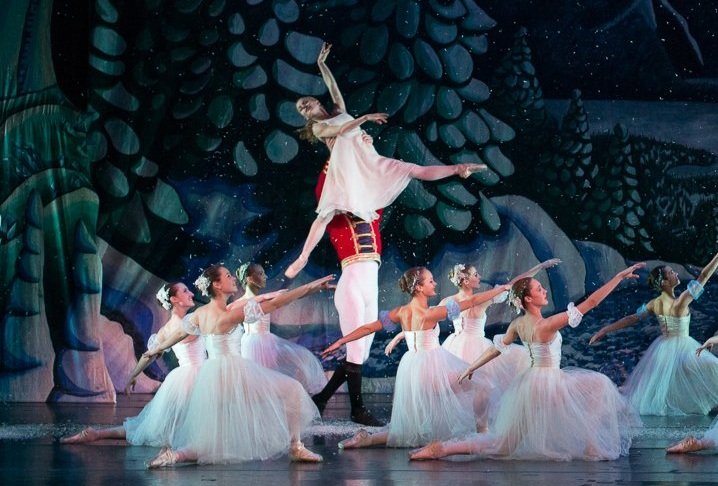
Boulder Ballet production of The Nutcracker
If you do miss the Boulder performances, however, you need not despair! Boulder ballet will also present The Nutcracker in Longmont the following weekend (Dec. 7 and 8; details below) with the Longmont Symphony. Tickets are limited but still available for those performances.
The Boulder Ballet and the Longmont Symphony will also present their annual “Gentle Nutcracker,” an abbreviated and sensory-friendly one-hour version of the ballet at 1 p.m. Saturday, Dec. 7. These performances are designed for individuals with special needs and their families.
In addition to the performances of the full ballet, Boulder Ballet will also feature additional events. As part of a theme titled “Unlocking Tradition,” the stage curtain will be left open until 10 minutes before the performance begins. This will offer audience members a glance behind the scenes, as they will be able to see dancers, musicians and stage crew preparing for the performance.
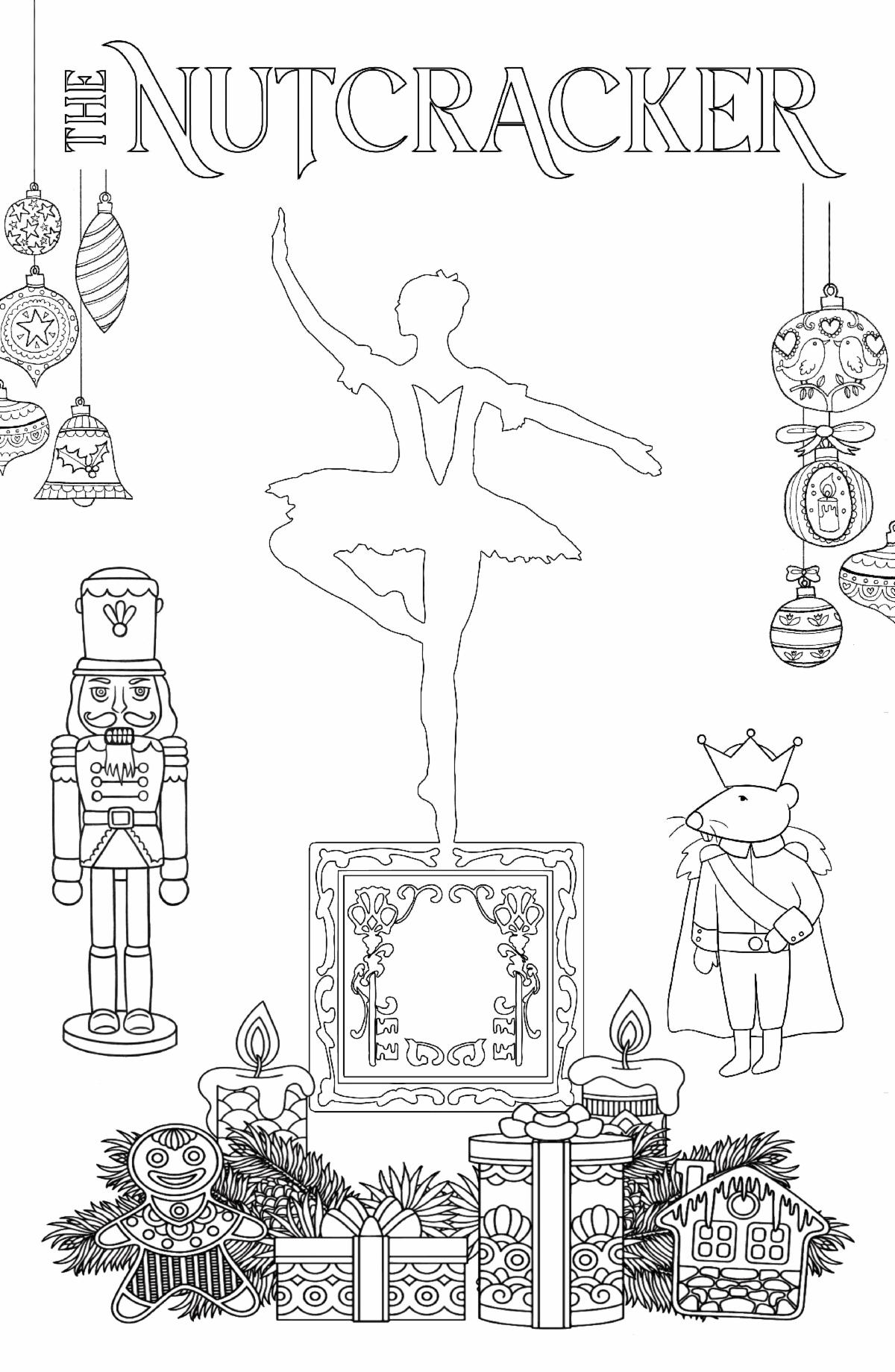
For the performance with the Boulder Philharmonic in Macky Auditorium, there will be a coloring contest for children. A line drawing of characters and images from The Nutcracker has been posted online. Children attending each performance are invited to color the drawing, and bring their colored pages to the performance for a chance to win a Nutcracker doll.
Tchaikovsky: The Nutcracker Ballet
Boulder Ballet with the Boulder Philharmonic, Gary Lewis, conductor
The Nutcracker 1 and 6:30 p.m. Saturday, Nov. 30 1 p.m. Sunday, Dec. 1 LOW TICKETS Macky Auditorium
Longmont Symphony hosts violinist Andrew Sords Saturday
By Peter Alexander Nov. 14 at 9:24 p.m.
The Longmont Symphony Orchestra (LSO) returns to its long-time home venue, Vance Brand Civic Auditorium at Skyline High School, at 7 p.m. Saturday (Nov. 16; details below) for their second concert of the 2024–25 season.
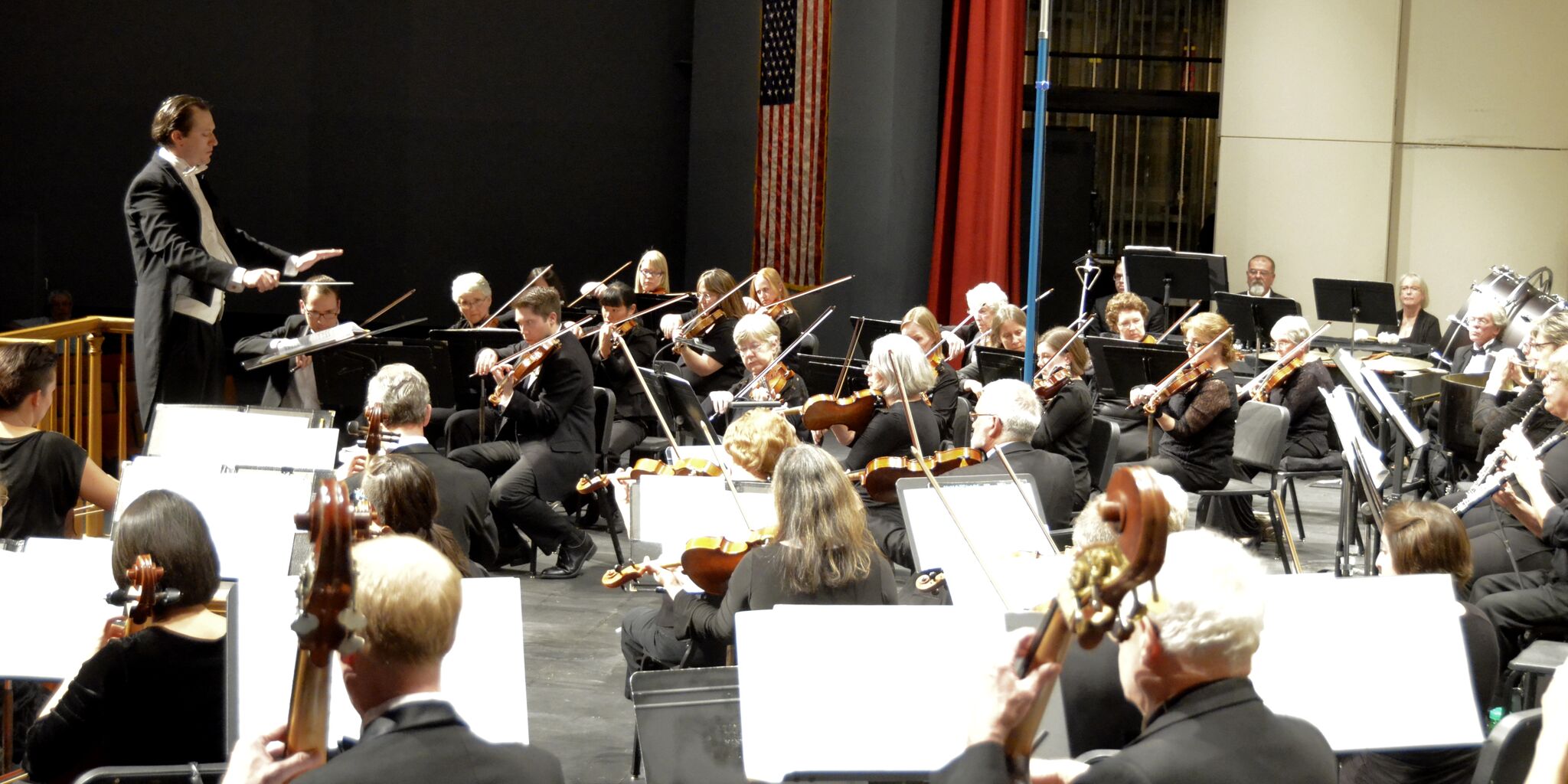
Conductor Elliot Moore with the Longmont Symphony Orchestra
The opening concert on Oct. 7 was in the Longmont High School Auditorium while Vance Brand Auditorium was under repair. Saturday’s concert, titled “An Evening of Romance,” will be conducted by Elliot Moore, the LSO’s music director. Featured soloist Andrew Sords will perform Max Bruch’s Scottish Fantasy.
Other works on the program will be Mendelssohn’s Overture The Hebrides (also known as Fingal’s Cave); Debussy’s impressionist tone poem Prélude à l’après-midi d’un faune (Prelude to the afternoon of a faun); and the Suite from Der Rosenkavalier by Richard Strauss. The concert will be preceded at 6 p.m. by a pre-concert talk by Moore.
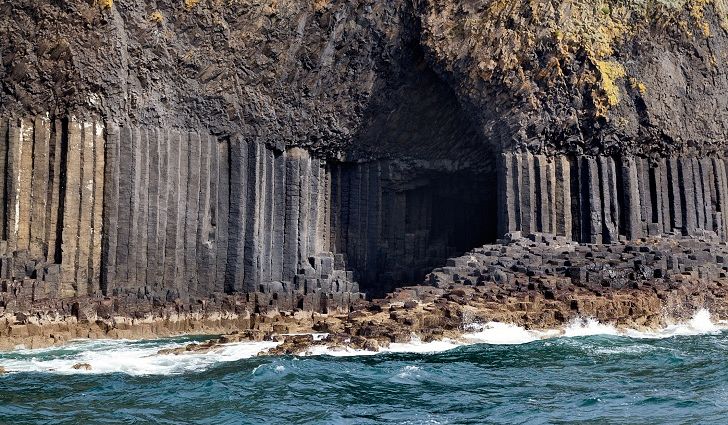
Entrance to Fingal’s Cave, Staffa
The Concert Overture The Hebrides is one of Mendelssohn’s most popular works. It was inspired by Mendelssohn’s 1829 visit to the island of Staffa off the coast of Scotland. Staffa is famous for it’s basalt formation known as “Fingal’s Cave.” The music was written to stand alone as a concert overture. As such it is virtually a symphonic poem inspired by the spectacular cave.
The German composer Max Bruch wrote his Fantasie für die Violine mit Orchester und Harfe unter freier Benutzung schottischer Volksmelodien—happily just known as The Scottish Fantasy—for the great Spanish violin virtuoso Pablo de Sarasate. Bruch had never been to Scotland when he wrote the Fantasy in 1879–80, but he had seen a book of Scottish folk songs in a library in Munich.
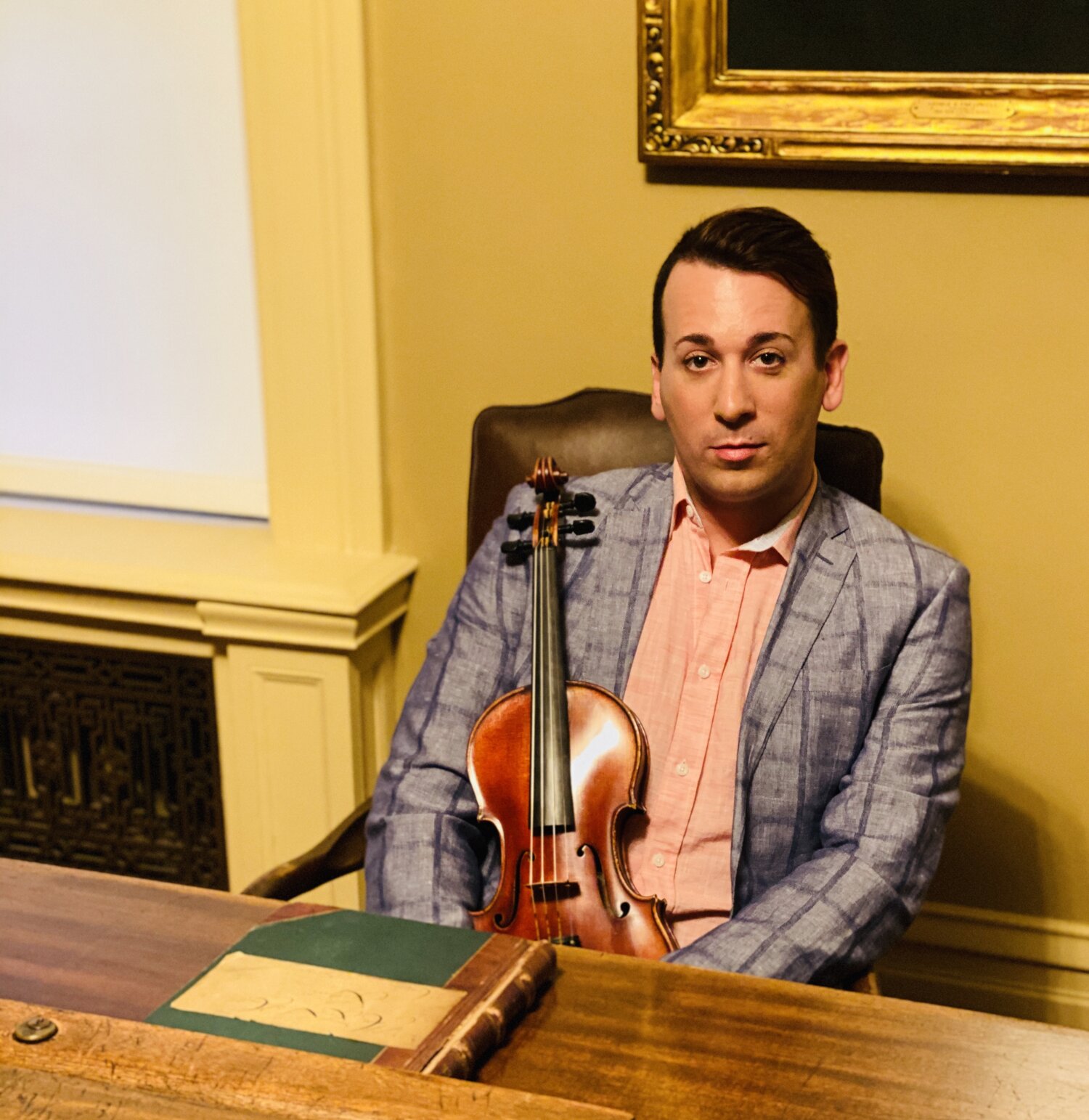
Violinist Andrew Sords
Although titled a fantasy, the work is structured in four movements much like a traditional concerto, and in some performances it was in fact called “Concerto for Violin (Scotch)” and “Third Violin Concerto (with free use of Scottish melodies).” Each of the movements is based on a separate Scottish folk song.
Debussy’s atmospheric Prelude to the Afternoon of a Faun is known for its languid opening flute solo and its role in establishing the impressionist style in music—as conductor and composer Pierre Boulez wrote, “the flute of the faun brought new breath to the art of music.” Debussy wrote the Prelude in 1894 and it achieved greater fame and notoriety when it was given a highly suggestive treatment by the Russian dancer Vaslav Nijinsky in 1912.
Richard Strauss’ comic opera Der Rosenkavalier—a nearly untranslatable word that means loosely “the rose cavalier”—is one of Strauss’ greatest and most popular operas. It was written to a libretto by the Austrian writer Hugo von Hofmannstal in 1909–10 and premiered in Dresden in 1911. Its comic situations and deep exploration of the characters’ personalities make it one of the most human and touching operas in the repertoire.
The opera itself was quickly translated into other languages and performed widely in Europe soon after the premiere. The Viennese-style waltzes and other memorable numbers from the opera have been popular as music for orchestral concerts, as reflected in the suite.
The American violinist Andres Sords has had a highly successful career as a soloist, appearing with nearly 300 orchestras on four continents. He also performs in a trio with John Walz, cello and Timothy Durkovic, piano, in addition to solo recital appearances. He grew up in Shaker Heights, Ohio, and studied at the Cleveland Institute of Music and Southern Methodist University in Dallas.
# # # # #
“An Evening of Romance” Longmont Symphony Orchestra, Elliot Moore, conductor With Andrew Sords, violin
Mendelssohn: The Hebrides Concert Overture
Max Bruch: Scottish Fantasy
Debussy: Prélude à l’après-midi d’un faune (Prelude to the afternoon of a faun)
Longmont Symphony, Ars Nova Singers launch 2024-25 seasons
By Peter Alexander Oct. 1 at 4:55 p.m.
The Longmont Symphony Orchestra (LSO)and conductor Elliot Moore open “Sound in Motion,” their 2024–25 concert season, Saturday evening (7 p.m. Oct. 5; details below) with two American works and a orchestral showpiece.
Breaking from the pattern of previous seasons, the opening night concert will be held at the Longmont High School Auditorium. An abbreviated version of the same program will be presented Sunday afternoon at 4 p.m. at Frederick High School.
All remaining LSO concerts during the season, including the Christmas-season Nutcrackers, will be held in the usual venue of Vance Brand Civic Auditorium.
Pianist Spencer Myer
Soloist for the Longmont HS performance will be pianist Spencer Myer, a faculty member at the Indiana University Jacobs School of Music, who will play George Gershwin’s Concerto in F for piano. The program begins with the Overture to another American masterpiece, Bernstein’s musical stage work Candide. Ending the program is Ravel’s familiar orchestration of Mussorgsky’s Pictures at an Exhibition.
Bernstein’s Candide was originally composed in 1956 for Broadway, although today it is considered an operetta rather than a musical. The original show was not a success on dramatic grounds, in spite of the brilliant music Bernstein wrote, including the popular coloratura soprano aria “Glitter and Be Gay.” Various revisions of the original show have included textual contributions by lyricist Richard Wilbur plus Lillian Hellman, Stephen Sondheim, Dorothy Parker, John LaTouche and Bernstein himself.
Today the operetta is gaining ground among opera companies, but regardless of its fluctuating fate, the Overture has been a popular program number from the beginning. Full of brilliant flourishes, delightful tunes and heady syncopations, it is the ideal concert opener.
Gershwin’s Piano Concerto was commissioned by the conductor Walter Damrosch, who attended the Feb. 12, 1924 premiere of Rhapsody in Blue. The very next day Damrosch contacted Gershwin to ask him for a piano concerto, which he was able to complete over a period of three months in the summer of 1925.
Audiences have always liked the concerto, which is today considered one of the essentials of the American music repertoire. The score incorporates jazz elements, but is much closer to the traditional format of a concerto with orchestra than is the Rhapsody. It appears on concert programs, has been featured in films, has been recorded by numerous pianists, and has even been featured in ice skating routines.
The program closes with the Mussorgsky/Ravel Pictures at at Exhibition, one of the best known and most loved showpieces for orchestra.
The program for the performance in Frederick will include the Overture to Candide and Pictures at an Exhibition only.
# # # # #
Opening Night Longmont Symphony Orchestra, Elliot Moore, conductor With Spencer Myer, piano
Leonard Bernstein: Overture to Candide
George Gershwin: Piano Concerto in F
Mussorgsky: Pictures at at Exhibition (arr. Ravel)
7 p.m. Saturday, Oct. 5 Longmont High School Auditorium
Encore performance: 4 p.m. Sunday, Oct. 6 Frederick High School Auditorium (same program minus the Gershwin Concerto)
Boulder’s Ars Nova Singers embark on a season of “Contrasts” this weekend with a concert titled “Here/There.”
The opening concert, “Here/There,” will be presented Sunday at the Diary Arts Center in Boulder (4 p.m. Oct. 6; details below). The program features music from here and there not only geographically—that is, from different parts of the world—but also chronologically, from both the present (here) and the past (there). Featured composers include Henry Purcell, Anton Bruckner, Benjamin Britten, and György Ligeti, as well as contemporary women composers Sheena Phillips and Dale Trumbore.
Ars Nova Singers. Conductor Thomas Morgan kneeling front left.
Conductor Tom Morgan wrote in a news release, “Dark and light, motion and stasis, intimate and universal, deeply familiar and refreshingly new—our season searches for the balance point in all of these.” In addition to “Here/There,” the season includes concerts titled “Light/Shadow,” “Lost/Found,” “Science/Fantasy” and “Time/Eternity” (see the full season HERE).
Although the choir’s name—Ars Nova, or “new art”—refers in history to a musical style from the 14th century, the group has specialized in a broader range of music, specifically the Renaissance and the 20th and 21st centuries. For this program there is no music from the Renaissance, but the old is represented by “Music for a While” by the English Baroque composer Henry Purcell (1659–1695).
There is a rare—for Ars Nova Singers—piece from the late Romantic period, Anton Bruckner’s Os justii (The mouth of the righteous) composed in 1879. A sacred motet setting of a text from Gregorian chant, it was written for the choirmaster at St. Florian Abbey, one of the largest monasteries in Austria.
Other works on the program range from the early 20th century—Ravel’s Trois beaux oiseaux (Three beautiful birds)— right up to today with works by the living American composers Frank Ticheli, Jake Runestad and Dale Trumbore, among others (full program listed below).
The performance, a benefit celebrating the past and future of Ars Nova Singers, will be preceded by a 3 p.m. reception in the Dairy Arts Center lobby.
Ars Nova Singers bill themselves as “an auditioned vocal group specializing in a cappella music of the Renaissance and the 20th/21st centuries” that aims “to delight, inspire, and enlighten our audiences.”
# # # # #
Here/There Ars Nova Singers, Thomas Morgan, conductor
Henry Purcell: “Music for a While”
Dale Trumbore: “Love is a sickness”
Bruckner: Os justi (The mouth of the righteous)
Ravel: Trois beaux oiseaux (Three beautiful birds)
Luigi Denza: “Call Me Back” (arr. Morgan)
György Ligeti: Lux aeterna (Eternal light)
Sam Henderson: “Moonswept”
Sheena Philips: “Circle of Life”
Sarah Quartel: “Sing, My Child”
Frank Ticheli: “Earth Song”
Jake Runestad: “Let My Love Be Heard”
Britten: “Advance Democracy”
4 p.m. Sunday, Oct. 6 Gordon Gamm Theater, Dairy Arts Center
Programs feature piano quartet, acrobatics and film music
By Peter Alexander May 1 at 4:38 p.m.
The Boulder Piano Quartet presents it’s final concert of the 2023-24 season Friday featuring music by Dvořák and the 19th-century French musical prodigy Mélanie Hélène Bonis Domange, known as Mel Bonis (7 p.m. May 3 at the Academy University Hill; further details below).
This will be the fourth and final performance this concert season to feature a guest violinist with the Quartet, appearing in place of their former violinist Chas Wetherbee, who died in 2023. The guest violinist for this performance will be Hilary Castle Green.
Mel Bonis
This program is the second time that the Boulder Quartet has played music by Bonis, who is virtually unknown in the United States. About a year ago in May 2023, they played her Second Piano Quartet. This year they are playing her First Quartet in B-flat major.
Born in 1858, Bonis taught herself to play piano and entered the Paris Conservatory at 16. She was in the same class with Debussy, and studied composition with Cesar Franck. At the time women were not expected to be composers, and Bonis was urged by her parents to marry an older businessman. Because he didn’t like music, she gave up composing for a number of years.
Later she met a former classmate who encouraged her and connected her with publishers, which led her to begin writing music again. She wrote the First Piano Quartet soon after, in 1901. When the composer Camille Saint-Saëns heard the Quartet, he is supposed to have said “I never thought a woman could write such music.” After her husband died in 1918, Bonis devoted herself to music.
Dvořák won the Australian State Prize for composition—in effect a grant to allow artists the time for creative work—in 1875. At 34 years of age he was still relatively unknown to the larger musical world, even though he had written four symphonies, seven string quartets, three operas, and other works. During that year he wrote a number of larger pieces, including his Symphony No. 5, his Serenade for Strings and the Piano Quartet No. 1 in D major.
The Quartet is in the standard classical chamber-music structure of three movements, arranged fast, slow, fast. Unlike other quartets of the time, the piano is not placed separate from, or against the strings, as if it were a chamber concerto. Instead the four parts are more fully integrated. Though only three movements, the Quartet is an expansive work. It was not performed for nearly five years, however, having its premiere in Prague in 1880.
# # # # #
Boulder Piano Quartet: Matthew Dane, viola, Thomas Heinrich, cello, and David Korevaar, piano, with guest violin Hilary Castle Green
Mel Bonis: Piano Quartet No. 1 in B-flat major
Dvořák: Piano Quartet No. 1 in D major, op. 23
7 p.m. Friday, May 3, Academy Chapel Hall, Academy University Hill Admission free with advance reservations
# # # # #
The Boulder Philharmonic will continue its relationship with the performing group Cirque de la Symphonie with two performances Saturday in Macky Auditorium (2 and 7:30 p.m. May 4; details below).
Classical music’s answer to Cirque du Soleil, Cirque de la Symphonie presents aerialists, jugglers, ribbon dancers, acrobats, contortionists and other acts to the accompaniment of classical music performed live on stage. Macky Auditorium will be especially rigged for the aerial acts, and the front of the stage reserved for other performers. The performance of selected short classics will be conducted by Renee Gilliland, associate director of orchestras at CU Boulder.
Renee Gilliland
This will be the fifth time that the Boulder Phil has hosted Cirque de la Symphonie at Macky. Their last previous appearance was in 2018. While limited tickets are still available for both scheduled performances Saturday, previous Cirque performances have sold out.
Gilliland earned a Doctor of Musical Arts in orchestral conducting and literature from CU Boulder, a Master of Music in viola performance with an outside area in conducting from the Indiana University Jacobs School of Music, and a Bachelor of Music in music education and certificate of violin performance from the University of Texas at Austin Butler School of Music. She was also awarded an Artist Diploma in orchestral conducting from the University of Denver where she was assistant conductor of the Lamont School of Music Symphony and Opera Theater orchestras.
She was formerly music director of the CU Anschutz Medical Orchestra and associate conductor of the Denver Philharmonic.
# # # # #
“Cirque Returns” Boulder Philharmonic Orchestra, Renee Gilliland, conductor With Cirque de la Symphonie
NOTE: Indications of which pieces are played by the orchestra alone without Cirque performance added 5/2.
# # # # #
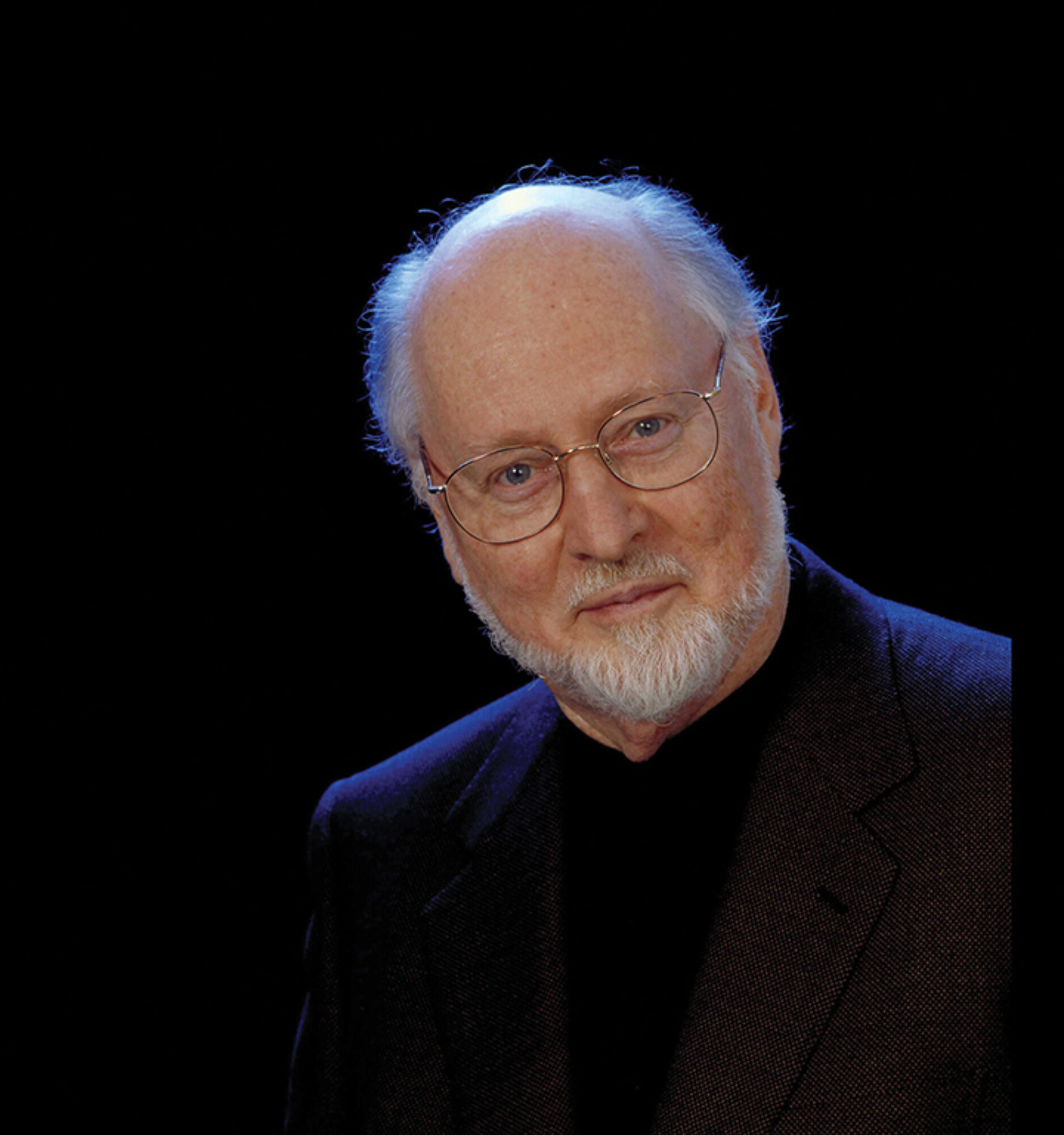
The Longmont Symphony Orchestra (LSO) concludes its 2023-24 concert season Saturday (May 4) with “A Tribute to John Williams,” featuring the music of one of Hollywood’s greatest film composers.
John Williams
The Pops Concert, at 7 p.m. in Longmont’s Vance Brand Civic Auditorium, will be under the direction of the LSO’s music director, Elliot Moore. The program will include music from the soundtracks for Star Wars, Jurassic Park, E.T. and Harry Potter, among other popular films.
With more than 1100 tickets already sold, there are only a few seats left at time of posting. Because of the size of crowd expected, the LSO advises attendees to arrive early. Overflow parking from the Skyline High School lot will be available at the Timberline School lot, on Mountain View Avenue.
# # # # #
Tribute to John Williams Longmont Symphony Orchestra, Elliot Moore, conductor
Music of John Williams
7 p.m. Saturday, May 4 Vance Brand Civic Auditorium, Longmont










 Sharps & Flatirons