Effective, powerful Samson et Delilah at Opera Colorado

Production opened Saturday, continues next week May 7, 10, 12

By Peter Alexander May 6 at 12:10 p.m.

Opera Colorado opened an effective and at  times powerful production of Saint-Saens’s Samson et Delilah Saturday (May 4) at the Ellie Caulkins Opera House in Denver.

The final production of 2023–24 season, Samson et Delilah will run for a total of four performances, with additional shows scheduled for 7:30 p.m. May 7 and 10, and 2 pm Sunday, May 12.

The production is a traditional take on the story, meaning there are no attempted updatings or imposed psychological meanings. Sets and costumes represent Biblical times—“as much as you can set something in Biblical times and be accurate,” in the words of stage director Keturah Stickann.

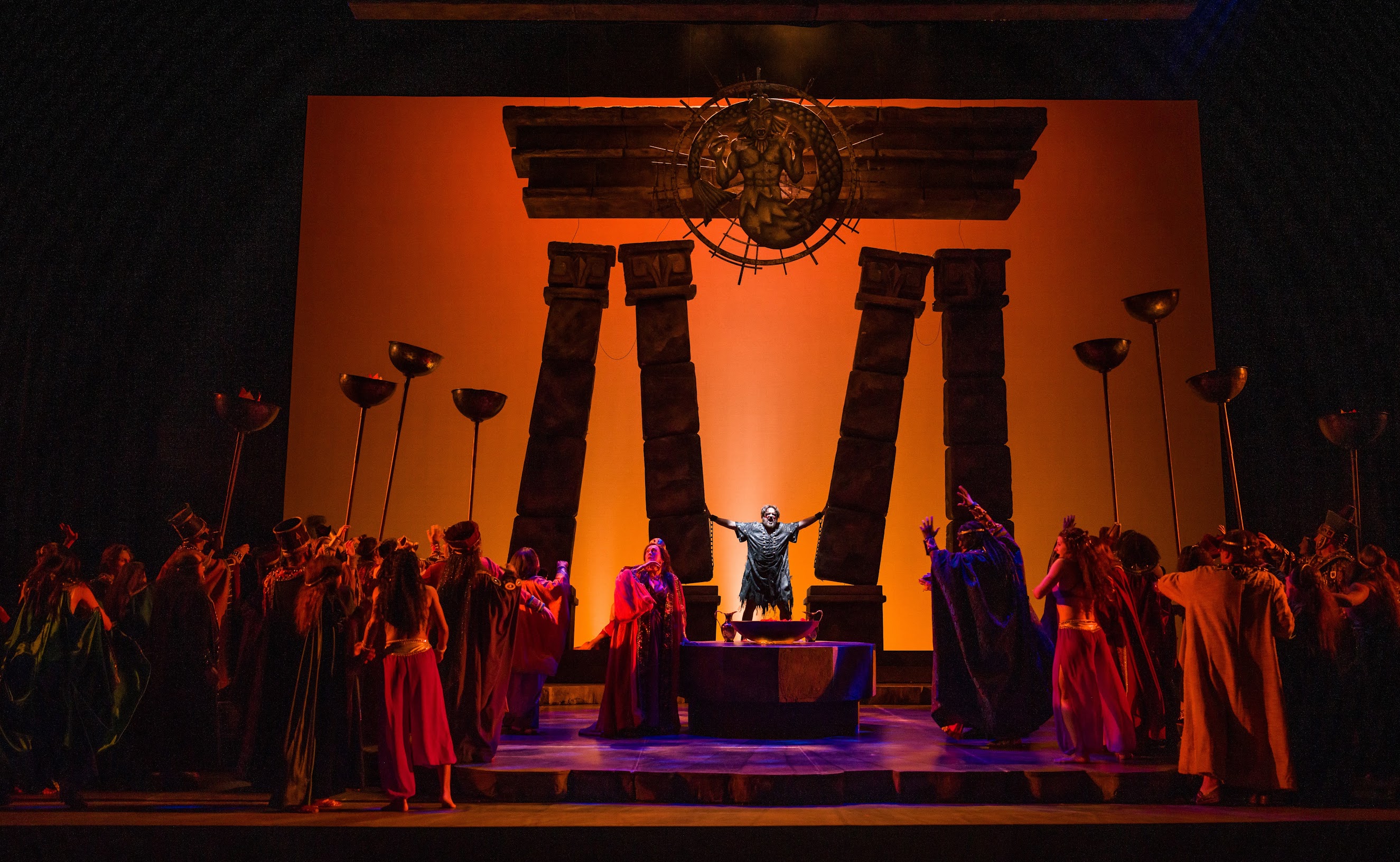
Act III of Opera Colorado’s production of Samson et Delilah. Photo by Matthew Staver for Opera Colorado.

The sets by Peter Dean Beck are evocative of the locations without devolving into middle-eastern kitsch. The first act opens on a nicely lit scene of the suffering Hebrews, in a public square under captivity by the Philistines. Here the set leaves plenty of space for the limited action that takes place, which is useful with so much of that act being otherwise static choral singing. Most impressive is the final scene, with the requisite pillars of the temple looming over the stage. The final collapse of the Philistine’s temple is simply accomplished but effective.

Stickann’s staging is never less than serviceable, which is what is needed for an opera with no hidden motives or deep psychological drama: everything that happens is out in the open. In the first act, the limited movements helped vary the stand-and-sing choral material. Repeated raised-arm gestures by the chorus are overdone but expressive of the repeated pleas of the Hebrews. Otherwise, the action moves smoothly. 

The second act confrontations  of Delilah with the High Priest and with Samson are well dramatized. However, the end of the act does not follow the libretto. In this production, Delilah gives Samson a magic potion, he passes out, and she takes a knife given to her by the High Priest and cuts Samson’s hair. But the libretto is clear: the hair cutting does not take place on stage for the simple reason that she never hears Samson’s secret onstage. 

What Saint-Saëns and the libretto indicate is that Delilah and Samson go into her house, where she seduces him and learns his secret during an orchestral interlude. Delilah calls for the Philistine soldiers who take Samson away. It’s  not clear if she has cut off his hair in her house, or the Philistines do so later, but it does not happen onstage. That is awkward, but a magic potion is too easy a way out. The composer’s version is better.
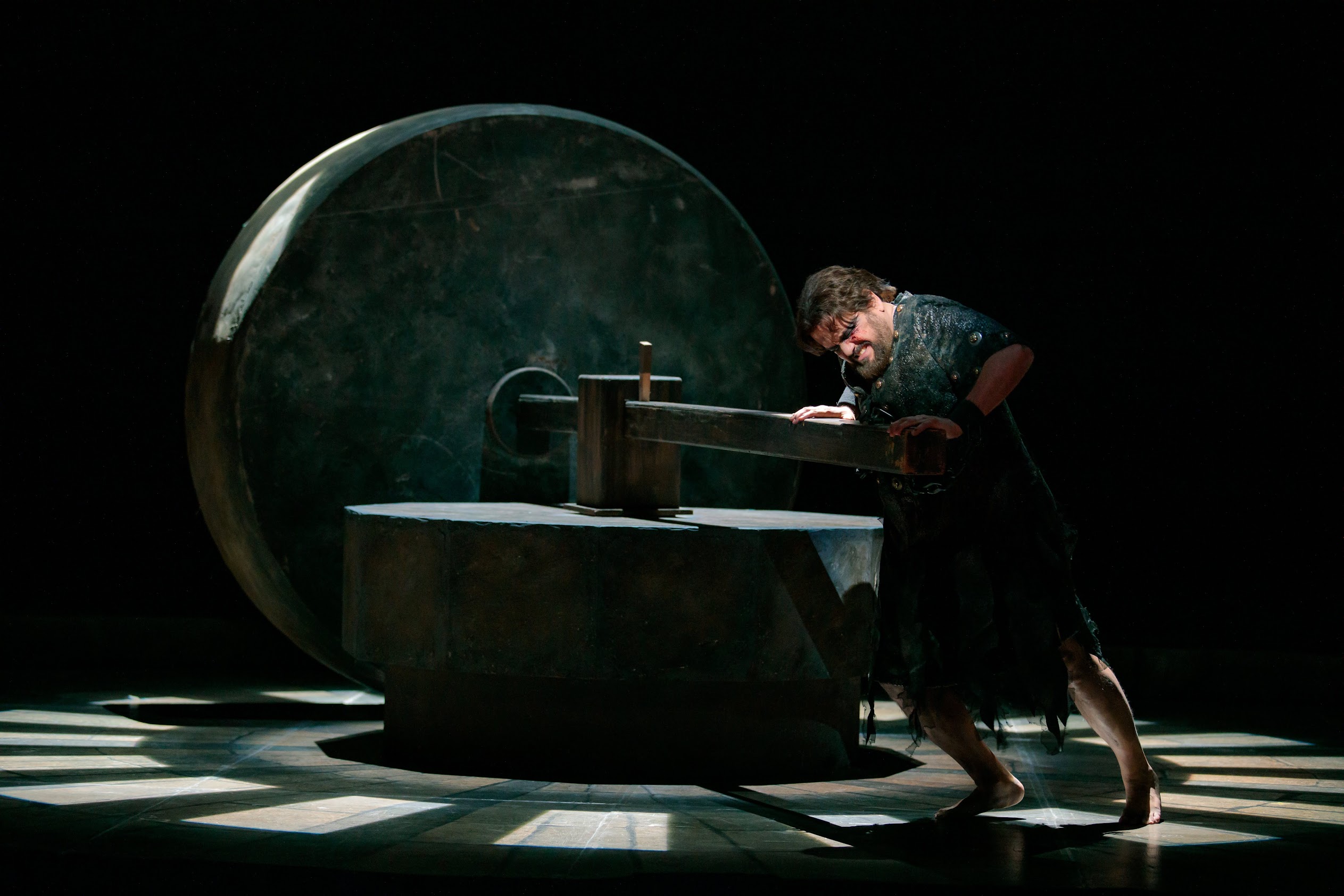
Rafael Davila as Samson. Photo by Matthew Staver for Opera Colorado

The final act is the best part of the evening. The first sene, of Samson pushing a mill wheel, is uncomplicated but moving. The destruction of the temple in the final scene works well on stage. Again, there’s not anything complicated to direct: there is a dance (the famous Bacchanale), Samson is brought in and mocked by the Philistines, then he moves between the pillars and brings down the temple. I was happy to see that the child who guides the blinded Samson was not forgotten: Samson sends him out of the temple before it collapses.

A fine cast gave top-flight performances. As Samson, tenor Rafael Davila made the strongest impression, singing with a solid, heroic-tenor quality. He consistently sang the words expressively, but did not always convey Samson’s internal struggle between his feelings for Delilah and his religious convictions. He was at his best in the final scene, creating great pathos while pushing the mill wheel and ringing out his denunciations of the Philistines at the end.
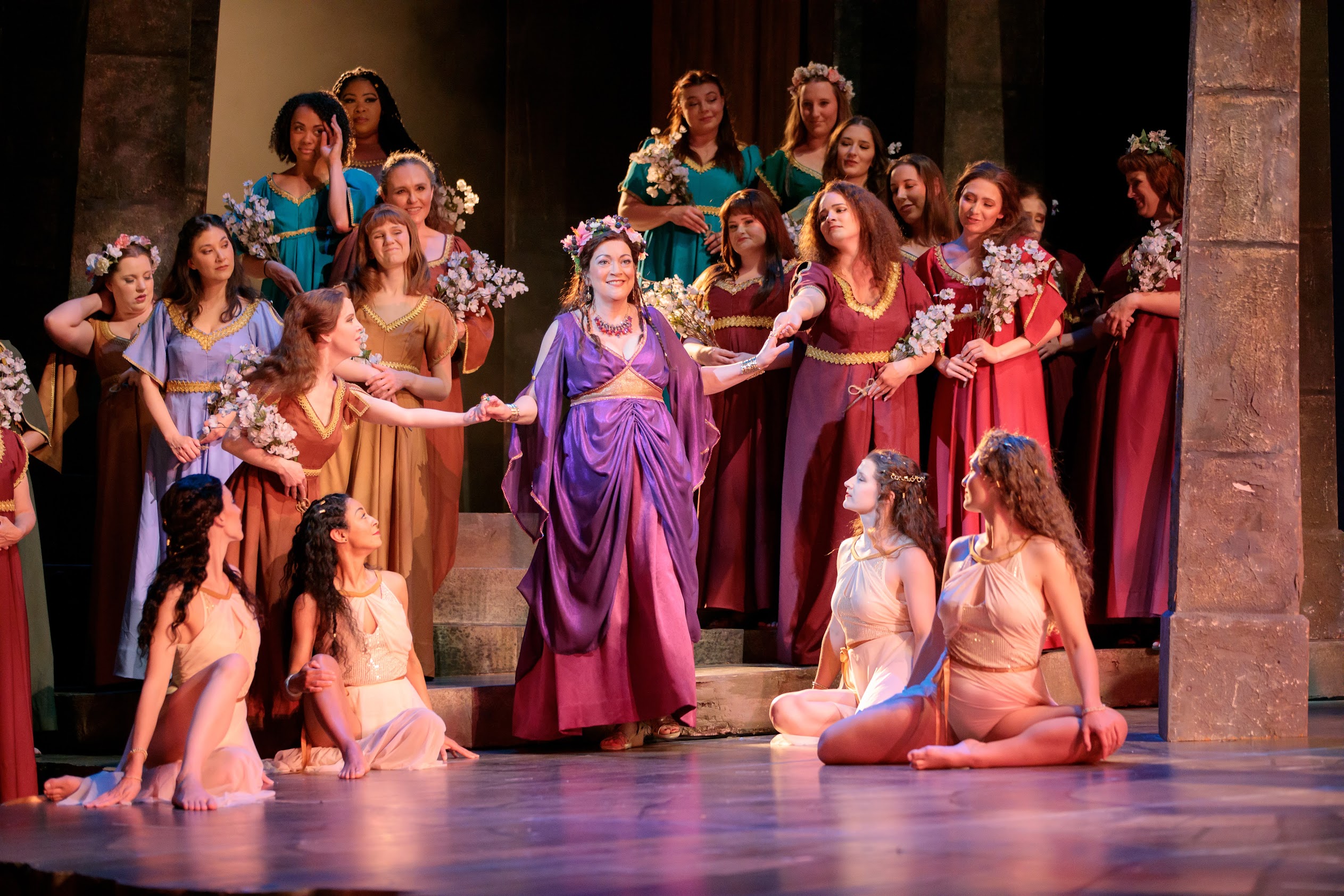
Katherine Goeldner as Delilah (center) with Philistine maidens and dancers in Act I of Samson et Delilah. Photo by Matthew Staver for Opera Colorado.

As Delilah, Katherine Goeldner brought extensive experience to her performance, including a prior appearance as Delilah at Virginia Opera. She no longer has the bright, focused tone of a young singer, but she had all the strength Saturday night to carry off the climactic moments. She sang with firmness of tone and great expression. And her Delilah is multilayered: aristocratic, calculating in her seduction of Samson, and vicious in her mockery in the final scene.

Nmon Ford was a tall, imposing High Priest, capturing both the authority and the evil implicit in the Biblical narrative. He brought a powerful and orotund, if occasionally rough-hewn sound to his portrayal. In the small part of Abimelech, the Philistine ruler who is killed by Samson in the first act, Christian Zaremba provided a dark, sometimes tight bass. Turner Staton was a solid Old Hebrew in his Act I dialog with Samson.

I am not dance critic, but I thought the dancers were smoothly integrated in the first act, more disconnected in the Bacchanale. The singers of the Opera Colorado chorus gave their lengthy, critical numbers a rich sound and secure ensemble.

The orchestra under conductor Ari Pelto propelled the action effectively, especially in Act II where the woodwinds shone in their prominent roulades. The full orchestral sound and expression supported the story throughout. The only reservation would be the Bacchanale, which was too fast. It is a frenzied dance, but taken too fast it looses clarity and precision, and the sudden tempo change near the end, which should be an explosion of sound and fury, looses its impact. Nevertheless, audience granted the expected spontaneous applause.

Tickets to additional performances may be purchased HERE.
Opera Colorado presents Saint-Saëns’ “Samson et Delilah”

The opera is based on, and different from, the familiar Biblical story

By Peter Alexander May 2 at 4:30 p.m.

The Biblical story of Samson’s betrayal by Delilah, and his violent revenge, is one of the best known dramatic tales from the Old Testament. It has been dramatized many times in film and music.

One of the most successful of those dramatizations will be presented by Opera Colorado over the next two weeks: Camille Saint-Saëns’s Samson et Delilah. The production opens Saturday, May 4, with additional performances May 7, 10 and 12 (details below).

Opera Colorado’s production of Samson and Delilah. Photo by Matthew Staver for Opera Colorado.

Performances will be conducted by Ari Pelto, Opera Colorado’s music director. Stage direction is by Keturah Stickann, with sets by Peter Dean Beck. The role of Samson will be sung by tenor Rafael Davila, Delilah by mezzo-soprano Katherine Goeldner.

The production will be a traditional one, Stickann said. “We are not updating in any conscious way,” she says. “We are set in Biblical times, as much as you can set something in Biblical times and be accurate.”

Most of the opera’s story will be familiar to anyone who knows the Biblical narrative. Samson has superhuman strength. The Philistines want to know the source of his strength so they can defeat him. Eventually Delilah learns that his strength comes from his hair. His hair is cut, he is captured by the Philistines, then blinded and enslaved. In the final act he destroys the Philistine temple. 

That much is familiar, but there are some significant differences, particularly in the character of Delilah. In the Bible (Judges 16), she betrays Samson for money—1100 pieces of silver from each of several Philistine officials. In the opera, however, she acts more out of loyalty to the Philistine people and priests and declines gold offered by the high priest.

“If you look at what is written on the page, in the opera, she is very much an agent of the Philistines,” Stickann says. “That is not the way that she comes across in the Biblical story. Ultimately you have to tell the story that’s on the page.”

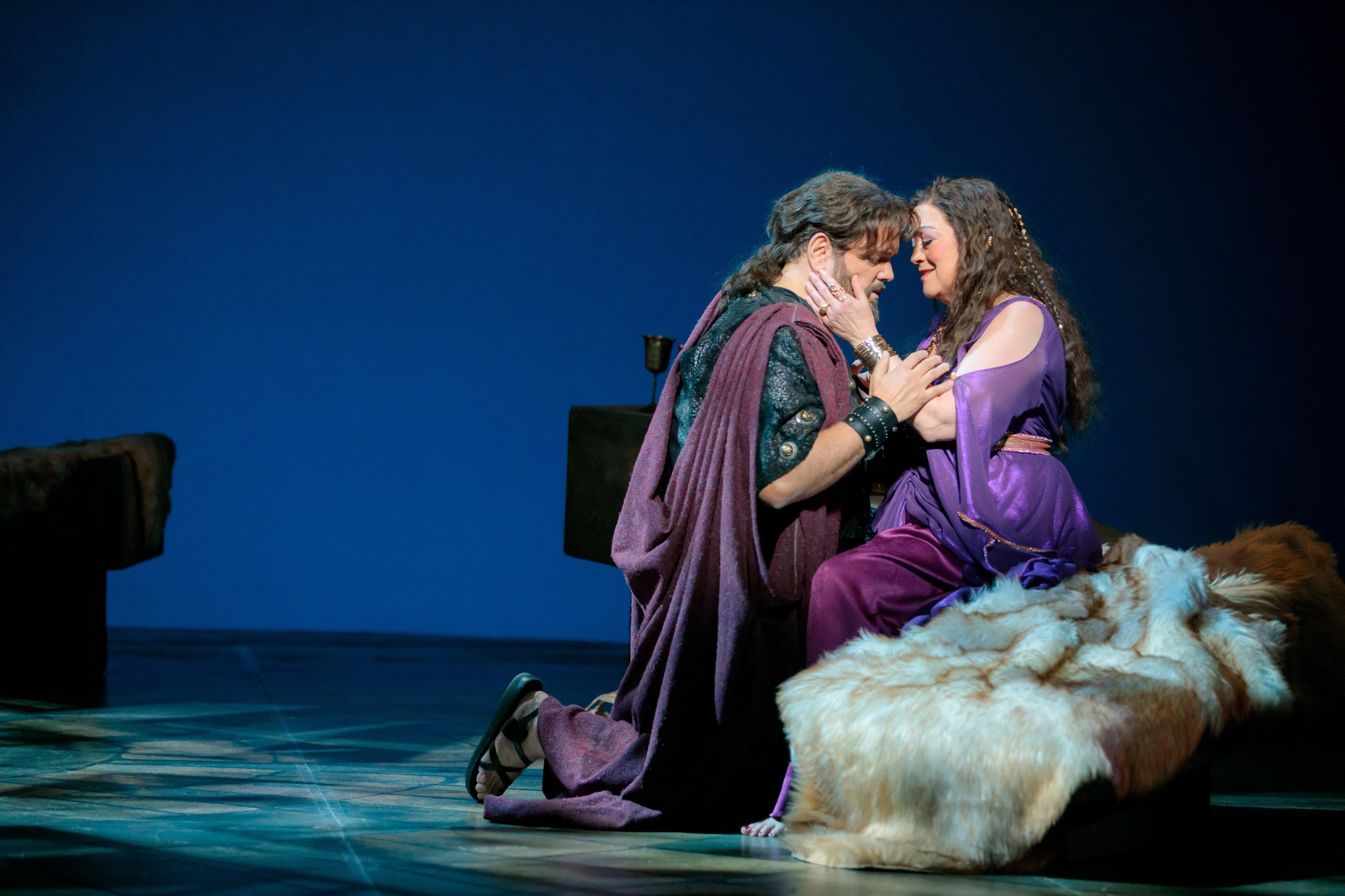
Rafael Davila (l.) and Katherine Goeldner (r.) as Samson and Delilah in Opera Colorado’s production of “Samson and Delilah.” Photo by Matthew Staver for Opera Colorado.

Stickann said that she and Goeldner, who will sing the role of Delilah, talked at length about the character. “She’s a mata-hari creature in this opera,” Stickann says. “She’s a spy for her people (and) is trying desperately to help her people.”

Goeldner agrees, but also sees many layers to Delilah. “She can be seen as just an evil vamp, but that’s too simple and uninteresting,” she says. “She’s not just sultry, she’s complicated. She’s mostly manipulating Samson. This is the fourth time she has tried to get his secret, and he’s lied to her three times. And yet he keeps coming back for more!

“She does love Samson in a way, but I think it’s the way Carmen loves Don Jose (in Bizet’s opera Carmen)—he’s useful and as soon as he stops being useful she’s done with him.”

Along with Carmen and Amneris in Aida, Delilah is one of the major starring roles for mezzo-sopranos. She dominates the second act and her actions drive the plot. As a result, it is one of the most coveted roles for mezzos.

“Getting to do Delilah once in a mezzo’s career is a huge thing,” Goeldner says. “The second act, you’ve got aria, gigantic duet, another gigantic duet, one of the most famous arias in the operatic repertoire—she’s on the entire time. It is one of the most demanding roles in the mezzo repertoire. It’s far more demanding than Carmen for example, which I’ve done a bunch.”

Her second act aria, “Mon cour s’ouvre à to voix” (My heart opens at the sound of your voice) is one of two frequently performed selections from Samson et Delilah. The other is the frenetic Danse Bacchanale in the third act, usually performed as a ballet as was expected in French opera of the 19th century, and a source of many standard musical gestures associated with the Middle East.

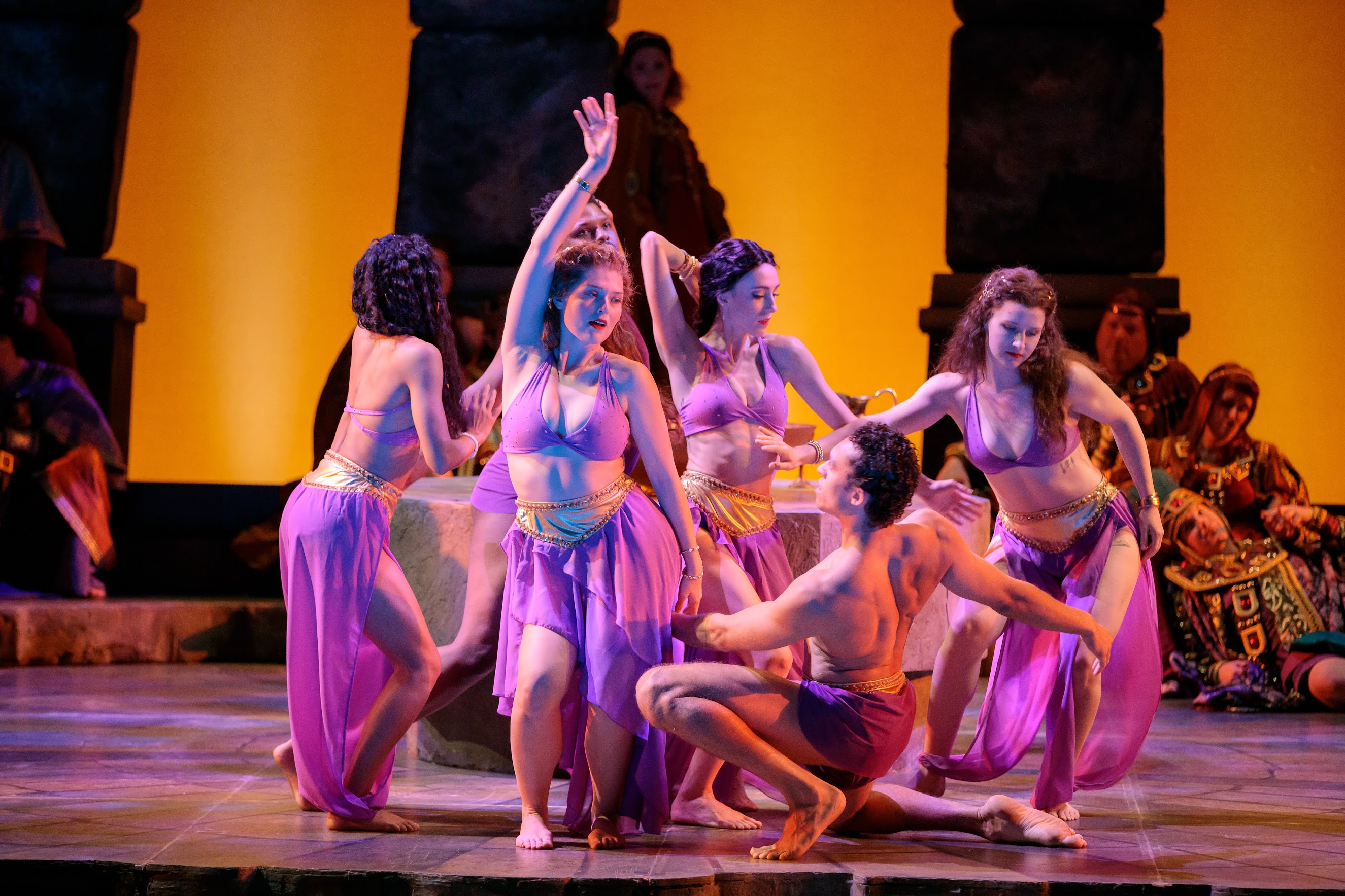
Dancers in Opera Colorado’s production of Samson and Delilah. Photo by Matthew Staver for Opera Colorado.

One of the challenges of presenting Samson et Delilah, and one that is visible to the audience, is that it was originally conceived as an oratorio rather than an opera. That idea survives in the large choral numbers in the first and third acts, which are great music but dramatically static.

“It is the problem of the piece,” Stickann says. “Sometimes the drama comes directly from the music. We do a little movement at the beginning of the long choral pieces, and then we sink into it a little bit. It gets more active, but this is the way that Saint-Saëns designed it. My challenge as a director is to make it work, that it is a seamless piece of theater.”

Stickann is excited about the Opera Colorado production of the opera. “It’s a terrific cast, the chorus is working at peak, and we have some spectacular dancers in this production. (And) The audience in Denver enjoys grand opera.”

Her perspective comes form having worked in 30 states and several countries overseas, and having lived in Missouri, San Diego, New York, and now Knoxville, Tenn. “It’s not just my upbringing in the Midwest,” she says. “It’s my experience in the South, my experience on the West Coat, my experience on the East Coast. These different places have definitely colored the way that I work.

“Every one of them has given me something, every one has a different way of being, [and] I grow a little bit more every time I move.”

# # # # #

Samson et Delilah by Camille Saint-Saëns
Libretto by Ferdinande Lemaire
Opera Colorado
Ari Pelto, conductor; Keturah Stickann, director

7:30 p.m.Saturday, May 4, Tuesday, May 7 and Friday, May 10
2 p.m. Sunday, May 12

Ellie Caulkins Opera House, Denver Performing Arts  Complex

TICKETS