Clarinetist Kellan Toohey plays Concerto by Gerald Finzi
By Peter Alexander Jan. 21 at 11:12 p.m.
The Boulder Chamber Orchestra will present a concert Saturday featuring their string section (7:30 p.m. Jan. 25; details below), playing one of the great masterworks for strings, Dvořák’s Serenade for Strings.
The concert, under the direction of Bahman Saless, will also feature clarinetist Kellan Toohey playing the Concerto for clarinet and strings by British composer Gerald Finzi. The program also includes the Serenade for Strings by 20th-century Swedish composer Dag Wirén.
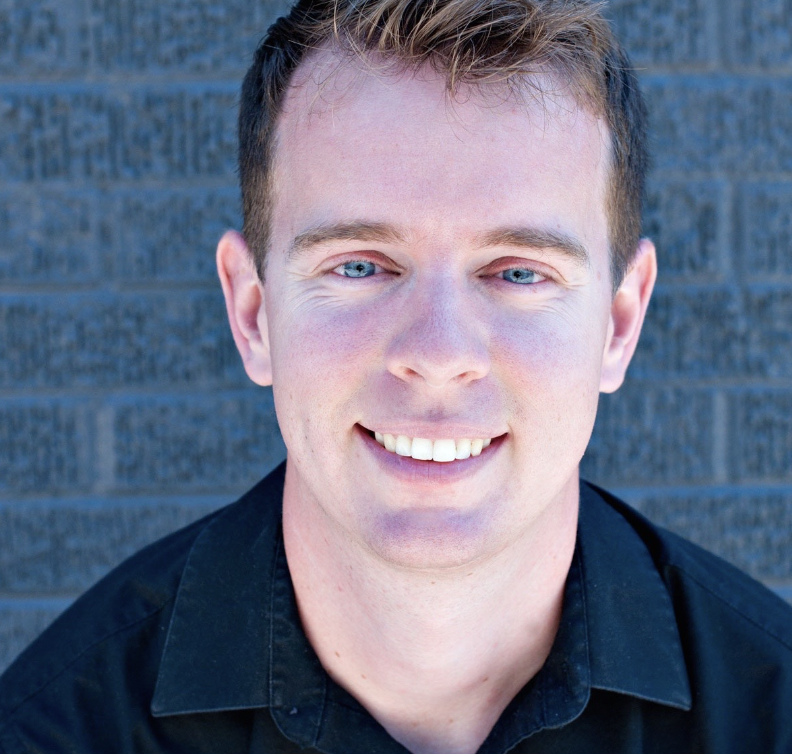
Kellan Toohey
Known mostly as a composer of songs and choral music, Finzi also wrote concertos for clarinet and cello, a Grand Fantasia and Toccata for piano and orchestra, and other instrumental pieces.
The Clarinet Concerto was written in 1949 for the Three Choirs Festival located in turn in the English cities of Gloucester, Hereford and Worcester, with which Finzi had a long association. The concerto is in three movements, of which the Adagio second movement is the expressive core. The quick rondo finale incorporates an English folk song. Finzi himself conducted the premiere, performed in Hereford by the London Symphony strings and clarinetist Frederick Thurston.
Wirén studied at the Stockholm Conservatory 1926–31, and won a state award that allowed him to live and study in Paris for several years. He wrote a number of orchestral works, including five symphonies and other concert works. His music is generally accessible to audiences, mixing traditional elements with modernist and innovative impulses.
His Serenade for Strings, composed just after his return to Sweden from Paris in 1937, is his most widely performed work. The composer wrote in his notes for the score, “The purpose of this little Serenade is simply to amuse and entertain, and if the listener, when the last note has faded, feels cheerful and happy, then I have reached my goal.”
Dvořák won the Austrian State Prize in music in 1875—the first of three times that he received that award and the support it offered young composers. It was those awards that gave Dvořák the freedom to purse his work as a composer. One of the judges of the competition was Brahms, who later became an important champion of Dvořák and introduced him to the German publisher N. Simrock.
In the months after winning the award, Dvořák composed his Fifth Symphony, several pieces of chamber music, and the Serenade for Strings. The Serenade was completed in only 12 days in May, 1875, but not performed until December 1876. One of his most tuneful and cheerful works, the Serenade has remained popular since the first performances. Dvořák was proud enough of the work that he included it with his application for his third state award in 1877.
In addition to performing as the principal clarinetist of the BCO, Toohey also plays with the Fort Collins Symphony, the Wyoming Symphony and the Cheyenne Symphony. He holds a doctorate from CU Boulder and has recorded a CD of music for clarinet and piano by Colorado composers, Scenes from Home.
Programs outside the norm, from the 18th to the 21st centuries
By Peter Alexander Sept. 18 at 10:05 p.m.
The Boulder Bach Festival (BBF) and guest artists will take audiences back to 18th-century Venice in a program entitled “Anonimo Veneziano” (Anonymous Venetian) 4 p.m. Saturday, Sept. 21, at the Dairy Arts Center in Boulder.
The program, with the BBF’s music director/violinist Zachary Carretin and the COmpass REsonance ensemble (CORE Ensemble), will feature violinist Nurit Pacht from NewYork, harpsichordist Chris Holman from Cincinnati, and theorbist Keith Barnhart, an historical plucked instruments specialist who is also the BBF’s educational coordinator.
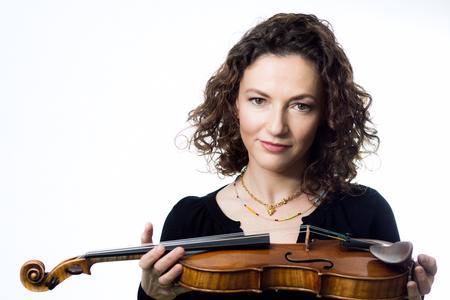
Nurit Pacht
The program opens with the famous Adagio attributed to 18th-century Italian composer Tomaso Albinoni and featured in many film scores. In fact, the Adagio was composed by 20th-century Italian musicologist Remo Giazotto. A scholar of Albinoni’s music Giazotto claimed that the Adagio was based on a fragment of an Albononi trio sonata that he found on a manuscript that has since mysteriously disappeared.
The remainder of the program will be filled out with genuine Albinoni works, the complete Sinfonie e Concerti a cinque (Sinfonias and concertos for five instruments), op. 2, that were published in Venice in 1700. This important collection is rarely performed complete. The BBF performance, which will be played without intermission, is expected to take approximately 75 minutes.
Pacht holds a degree in historical performance from the Juilliard school and is known as a specialist in both music by living composers, including works written for her, and music of the Baroque. She was a top prize winner in the Irving Klein International Music Competition in California, the Tibor Varga International Violin Competition in Switzerland, and the Kingsville International Music Competition in Texas. She has toured widely in Europe and the United States. She teaches privately in New York City.
# # # # #
“Anonimo Veneziano” Boulder Bach Festival CORE Ensemble, Zachary Carrettin, conductor/violinist With Nurit Pracht, violin, Chris Holman, harpsichord, and Keith Barnhart, theorbo
Remo Giazotto: “Adagio in G minor by Tomaso Albononi”
Tomaso Albinoni: Sinfonie e Concerti, op. 2
4 p.m. Saturday, Sept. 21 Dairy Arts Center Gordon Gamm Theater
The Boulder Chamber Orchestra’s (BCO)chamber concert titled “Mixed Timbres,” postponed from last April due to the power outage caused by high winds, will be presented at 7:30 p.m. Saturday, Sept. 21, in the Boulder Seventh-Day Adventist Church.
The concert will feature the BCO’s 2023-24 artist-in-residence, pianist Hsing-ay Hsu, performing with two members of the orchestra—cellist Julian Bennett and clarinetist Kellan Toohey. All four works on the program use the ensemble of piano, clarinet and cello, a mix of timbres that has a limited but interesting repertoire.
Hsing-ay Hsu
Beethoven’s Op. 11 is one of the earliest works for the combination. It is sometimes known as the “Gassenhauer Trio,” taken from the popularity of the theme that Beethoven uses for variations in the final movement. In Vienna, a Gassenhauer (from Gasse, an alleyway) referred to a simple song that was so popular that it was heard all over town. The theme Beethoven used was taken from a popular music theater work, L’amor marinaro (Seafaring love) by Joseph Weigl.
Brahms’s Trio op. 114 is one of four chamber works the composer wrote for the clarinetist Richard Mühlfeld in the last years of his life. Brahms’s admiration for Mühlfeld’s playing was reflected in the comment of one of the composer’s friends who wrote that in the Trio, “it is as though the instruments were in love with each other.”
Like Brahms’s Trio, Fauré’s D minor Trio was one of his last compositions. Although Fauré originally planned the Trio for piano, clarinet and cello, it was published as a traditional piano trio, with violin in place of the clarinet. The BCO performance of the first movement restores the instrumentation that Fauré first imagined for the trio.
Emily Rutherford’s “Morning Dance” for piano, clarinet and cello was commissioned by Toohey in 2017. A native of Colorado, Rutherford is a graduate of Westmont College in Santa Barbara, Calif., and the Longy School of Music in Los Angeles.
# # # # #
“Mixed Timbres” Hsing-ay Hsu, BCO Artist in residence, piano With Boulder Chamber Orchestra members Kellan Toohey, clarinet, and Julian Bennett, cello
Gabriel Fauré: Piano Trio in D minor, I. Allegro ma non troppo
Beethoven: Trio in B-flat major for piano, clarinet and cello, op. 11
Brahms: Trio in B-flat for piano, clarinet and cello, op. 114
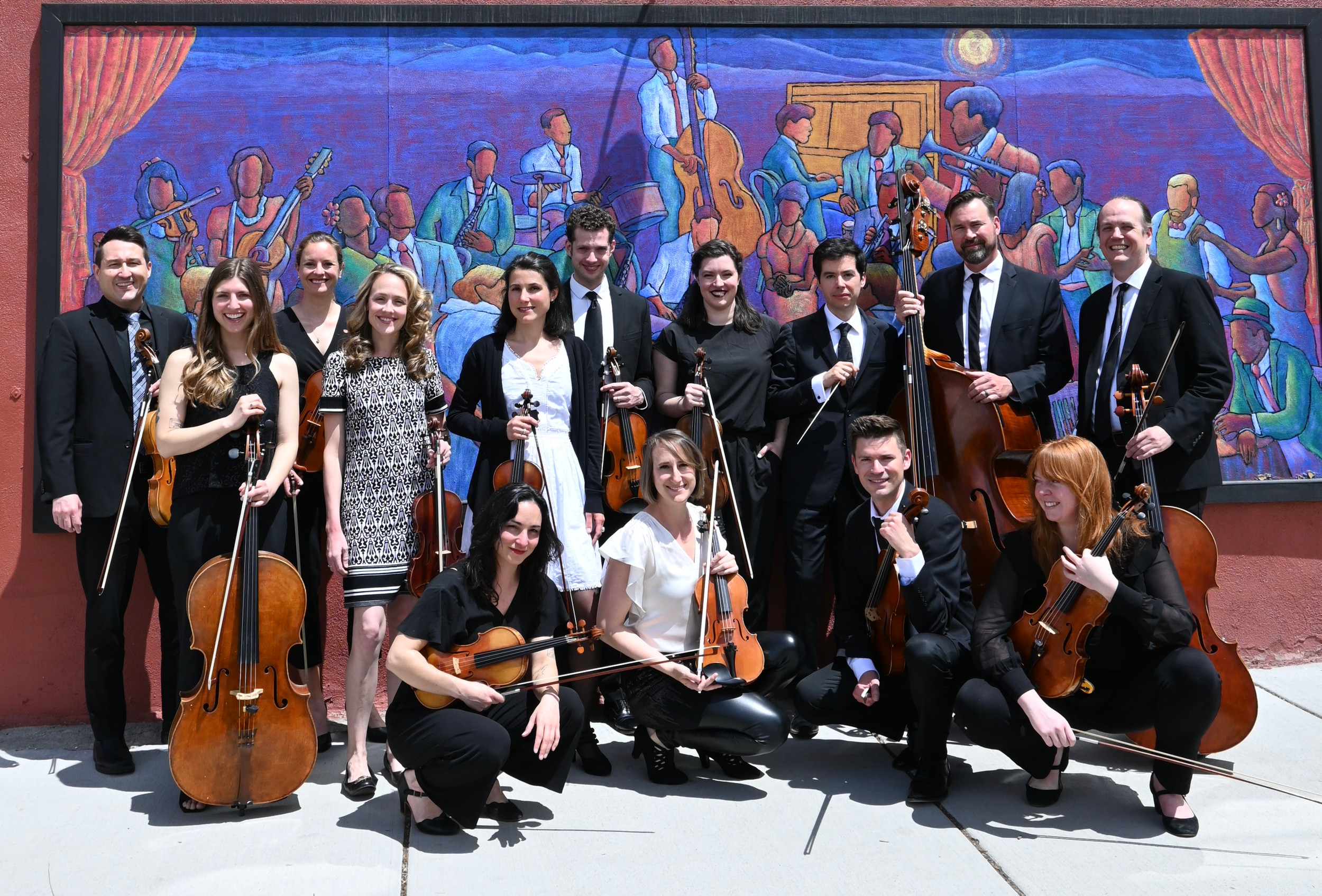
The Sphere Ensemble, a 14-member string ensemble, will celebrate the 100th anniversary of the premiere of Gershwin’s Rhapsody in Blue in 1924 with performances of their own all-strings arrangement of the Rhapsody.
The program, presented Saturday in Boulder and Sunday in Denver (Sept. 21 and 22; details below), will also include works by other jazz musicians including James P. Johnson, Hazel Scott and Winton Marsalis. Also on the program are arrangements of music from the Squirrel Nut Zippers, The Turtles and Andrew Bird; and pieces by Shostakovich, Stephen Foster and the classical-era composer Christoph Willibald Gluck, among others.
Sphere Ensemble
In addition to the live performances, a live stream will be available from 7:30 p.m. Saturday, Sept. 21 through 10 p.m. Sunday, Sept. 29.
This kind of eclectic programming, mixing sources and genres, is typical of the Sphere Ensemble, often in arrangements made by members of the ensemble. The “About” page on their Website explains, “We prioritize music by composers that are often overlooked in classical music programs. . . . From classical to classic rock, from baroque to hip hop, Sphere always chooses music that excites us.”
# # # # #
“Bridges” Sphere Ensemble
Aldemaro Romero: Fuga con Pajarillo
Dmitri Shostakovich: Prelude and Fugue in D-flat Major (arr. Chris Jusell)
Stephen Foster: “Jeanie with the Light Brown Hair” (arr. Alex Vittal)
Squirrel Nut Zippers: The Ghost of Stephen Foster (arr. Sarah Whitnah)
Andrew Bird: Orpheo Looks Back (arr. Sarah Whitnah)
C.W. Gluck: Orfée et Eurydice, Danses des Ombres Heureuses
Brenda Holloway: You’ve Made Me So Very Happy (arr. David Short)
The Turtles: Happy Together (arr. Dave Short)
James Price Johnson: Charleston (arr. Alex Vittal)
Hazel Scott: “Idyll” (arr. Sarah Whitnah)
Wynton Marsalis: “At the Octoroon Balls” —“Rampart St. Rowhouse Rag”
George Gershwin: Rhapsody in Blue (arr. Alex Vittal)
The Boulder Philharmonic Orchestra will have a new series of intimate performances during the 2024-25 season, designed to bring their musicians into more informal spaces and give audiences the opportunity to hear them in smaller groups.
The repertoire will be a little different from the Macky concerts, too, featuring music by pop sensations from Lizzo to Taylor Swift alongside pieces by living composers including Philip Glass and Jessie Montgomery. And just for fun, they might throw in some Vivaldi as well.
These concerts, collectively the “Shift” series, will feature several different programs, each presented first at Planet Bluegrass in Lyons and then taken to small venues in Longmont and Boulder. The first program, played by a string quartet of principal players from the orchestra, opens next Wednesday at Planet Bluegrass (7 p.m. Sept. 25; details below). Titled “Groove,” it will be repeated at the Dickens Opera House in Longmont at 6:30 p.m.Monday, Nov. 25.
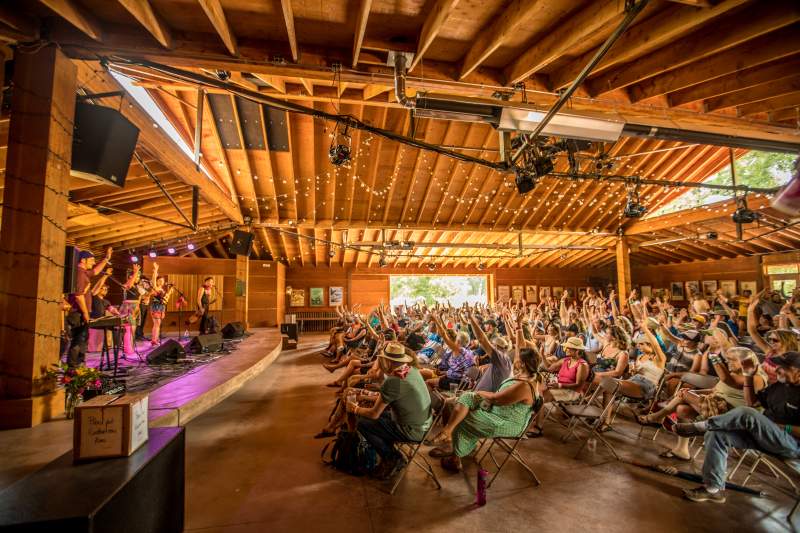
Wildflower Pavilion at Planet Bluegrass, Lyons
The second program, also for string quartet, is titled “Americana: Redefined” and will be presented in October and February. A third program featuring a brass quintet from the orchestra, “Brass & Brews,” will be presented in October and April; see the Boulder Phil Web page for details on all currently scheduled performances.
Mimi Kruger, the Boulder Phil’s executive director, said, “The idea is that people can get to know our musicians and these composers and connect in a different way. These are obviously smaller venues, but also a little bit more casual.”
She said that discussions about ways to showcase the individual musicians of the orchestra led them to look for new venues. “The idea came up to launch it through Planet Bluegrass (because) they have a series at the Wildflower Pavilion,” she said. “We’re doing all three there, but we also wanted to take them to other venues, so the first two will get repeated at Dickens Opera House in Longmont—that’s a great little place!”
The Phil’s Web page says pretty much the same thing, in more promotional language: “The Shift Series lifts the facade of the stereotypical orchestral concert . . . in unique venues along the Front Range.”
Kruger recommends watching for future announcements, as further performances are under consideration, featuring the orchestra’s woodwind players.
# # # # #
“GROOVE” Boulder Philharmonic string players: Ryan Jacobsen and Hilary Castle-Green, violin; Stephanie Mientka, viola; and Amanda Laborete, cello
Takashi Yoshimatsu: Atomic Hearts Club Quartet, Movement I
Justin Bieber: “Peaches” (arr. Alice Hong) 3’
Dinuk Wijeratne:Two Pop Songs on Antique Poems: “Letter from the afterlife”
Carlos Simon: “Loop”
Michael Begay: “Forest Fires”
Lizzo: “Good As Hell” (arr. Alice Hong)
Jessie Montgomery: “VooDoo Dolls”
Philip Glass: String Quartet No. 3: VI “Mishima/Closing”4’
Taylor Swift: “All Too Well” (arr. Alice Hong)
Wijeratne: Two Pop Songs on Antique Poems: “I will not let you go”
Ed Sheeran: “Shape of You” (arr. Alice Hong)
Due Lipa: “Dance the Night” (arr. Zack Reaves)
Jessica Meyer: “Get into the NOW”: III. “Go Big or Go Home”
Mini-Chamber 4 with pianist Hsing-ay Hsu and BCO members
By Peter Alexander April 2 at 11 a.m.
The Boulder Chamber Orchestra (BCO) will present their 2023-24 artist in residence, pianist Hsing-ay Hsu, performing with members of the orchestra on a mini-chamber concert Saturday (8 p.m. April 6; details below).
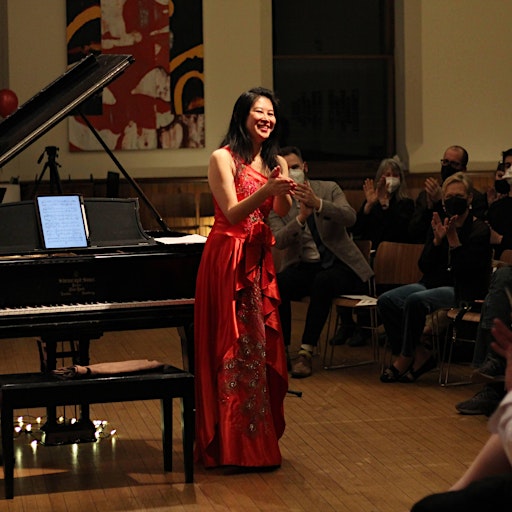
Pianist Hsing-ay Hsu
The performance, titled “Mixed Timbres,” will be the fourth and final mini-chamber concert of the 2023-24 season. The program features works for piano with clarinet and cello, with cellist Chas Bernard and clarinetist Kellan Toohey from the orchestra.
Beethoven’s Op. 11 is the earliest work on the program, and one of the earliest works for the combination of piano, clarinet and cello. It is sometimes known as the “Gassenhauer Trio,” taken from the popularity of the theme that Beethoven uses for variations in the final movement. In Vienna, a Gassenhauer (from Gasse, an alleyway) referred to a simple song that was so popular that it was heard all over town.
The theme Beethoven used was taken from a popular music theater work, L’amor marinaro (Seafaring love) by Joseph Weigl. The same tune was used for variations by several other composers, including Paganini and Johann Nepomuk Hummel.
Brahms’s Trio op. 114 is one of four chamber works the composer wrote for clarinet in the last decade of his life. All were written for the clarinetist Richard Mühlfeld, whose playing inspired Brahms to resume composing after he had planned to stop writing new pieces. Brahms’s admiration for Mühlfeld’s playing was reflected in the comment of one of the composer’s friends who wrote that in the Trio, “it is as though the instruments were in love with each other.”
Like the Trio of Brahms, Fauré’s D minor Trio was one of his last compositions. Although Fauré originally planned the Trio for piano, clarinet and cello, it was published as a traditional piano trio, with violin in place of the clarinet. In that form it was premiered in 1922 by the leading piano trio of the time, that of Alfred Cortot, Jacques Thibaud and Pablo Casals. The BCO Mini-Chamber performance of the first movement restores the instrumentation that Fauré first imagined for the trio.
Emily Rutherford’s “Morning Dance” for piano, clarinet and cello was commissioned by BCO clarinetist Kellan Toohey in 2017. A native of Colorado, Rutherford is a graduate of Westmont College in Santa Barbara, Calif., and the Longy School of Music in Los Angeles. Her works have been performed in California and by Denver’s Stratus Chamber Orchestra.

 Sharps & Flatirons