
Thoroughly enjoyable Bohème at the Santa Fe Opera
By Peter Alexander Aug. 11 at 10:35 a.m.
Editor’s Note: This is one of several posts covering four of the five operas presented this year at the Santa Fe Opera.
Santa Fe Opera’s production of Puccini’s La Bohème (seen Aug. 6) opens on a standard first-act set: a dingy apartment of Bohemian squalor with views of the Parisian rooftops, here created by projections. Two young men are at work.
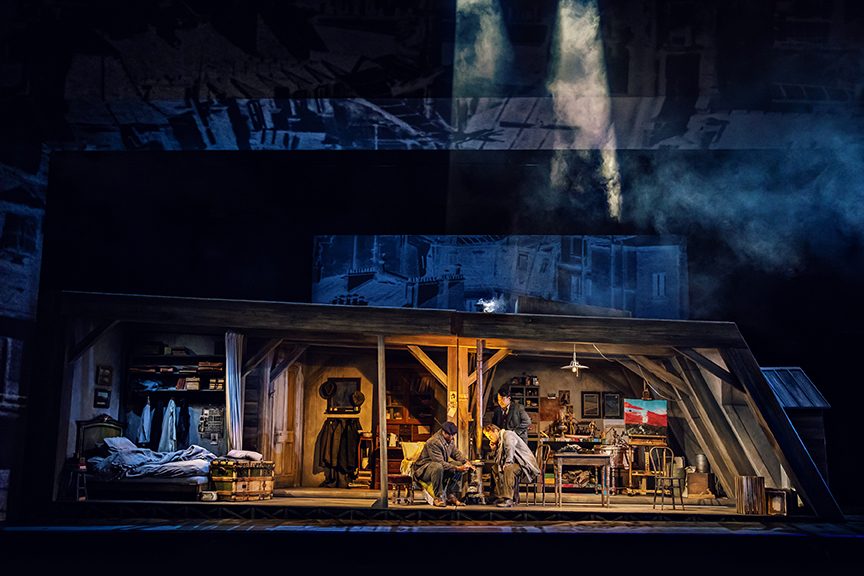
The first sign that something is up is when the poet Rudolfo starts pounding on a typewriter. This is not 1830s Paris, and when Mimi enters later in the act, her hair style shows that we are in the 1920s. In many ways this is a good choice: Paris in the ‘20s was a center of the avant garde, young artists were flourishing (think Hemingway and Picasso), and the free lifestyle of the operatic Bohemians was common.
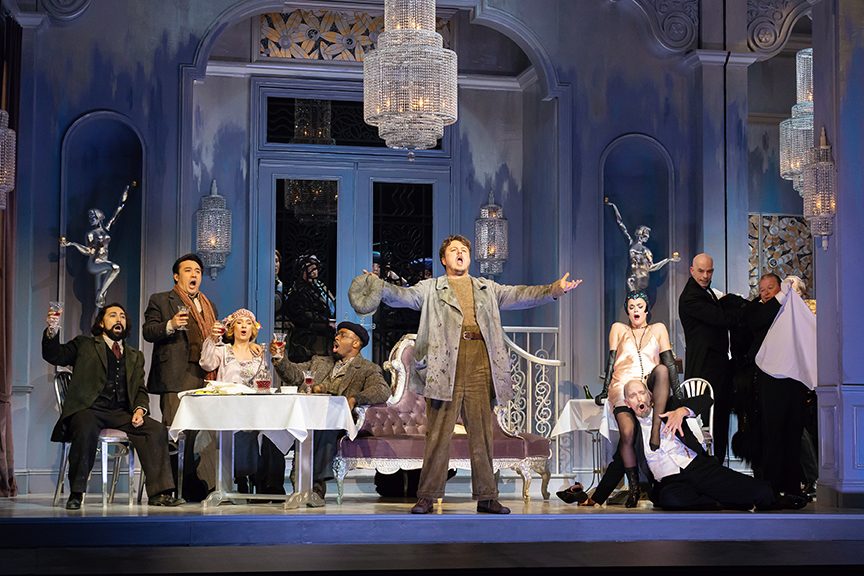
For the most part, the temporal transposition works well, and it provides great opportunities for the costume designs of Costance Hoffman. Indeed, the second act in the streets of Montmatre and inside the Café Momus (transformed from a neighborhood bistro to a five-star restaurant) is a 1920s fashion pageant. The incongruity of grubby Bohemians in such surroundings, with plain people gaping through the windows, becomes part of the humor of the scene. It is good fun, if it does stretch credibility.
The third act continues the time shift: there is a motorized ambulance (doubling as a spot for a streetwalker’s hookups) outside the police post at the gates of the City. The fourth act returns to the first set, through a very clever scenery shift that earned applause. Colline’s overcoat has a definite ‘20s vibe, as does Musetta’s attire.
This visually engaging production replaces one that was presented in Santa Fe in 2019. It is a great improvement, with all the pieces fitting well together.
This is not to say that there are no issues with Allen Moyer’s set. In the second act, the elegant Cafe Momus and its crystal chandeliers require so much space that all the rest of the action—bustling crowds, busy children, the toy seller Parpignol, the act-ending parade—are pushed into narrow margins of the stage. If there is a meaning to the Bohemians being just more Parisians on the street, swallowed up by the Christmas Eve revelries, it is lost here.
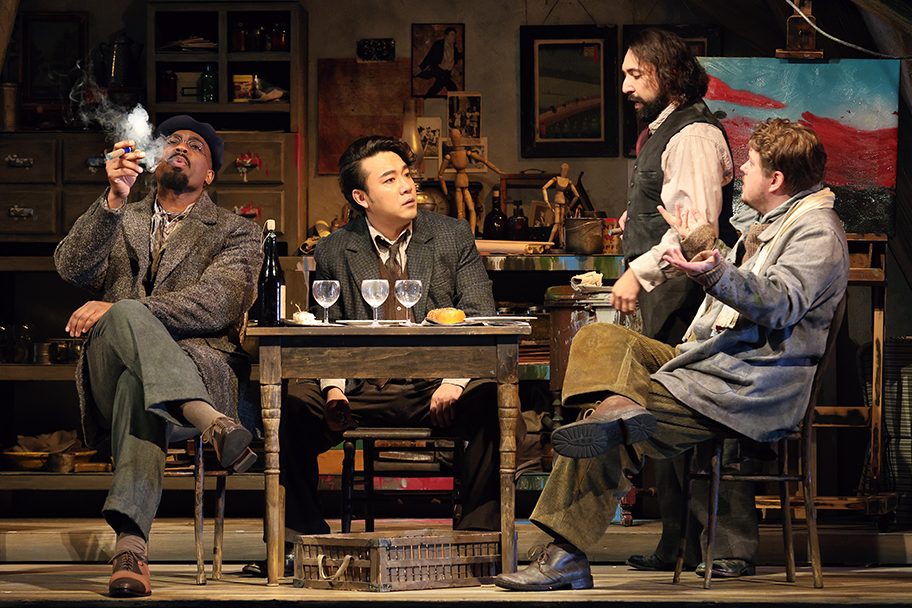
James Robinson’s stage direction meets the vital standard of telling the story. The camaraderie of the Bohemians is well portrayed, and all critical moments of the story are clear. He always handles the movements of actors in confined spaces comfortably.
In the name of realism—or so I assume—there are a few crude touches. Schaunard turns his back to the audience and then takes the chamber pot and throws its liquid contents out the garret window. After the third-act fight between Marcelo and Musetta, Marcelo angrily retreats into the ambulance with a friendly protstitue. Is it my age? I don’t see what these touches add to the opera.
Conductor Iván López Reynoso charged into the opening chords. Brusque and brisk, they propelled a quick tempo that thankfully stretched to accommodate the vocal lines, but for long periods did not let up. At times Reynoso allowed the brass free reign, and the orchestra sometimes covered the singers or pushed them to full volume. Otherwise, he controlled the musical flow well and kept the music moving.
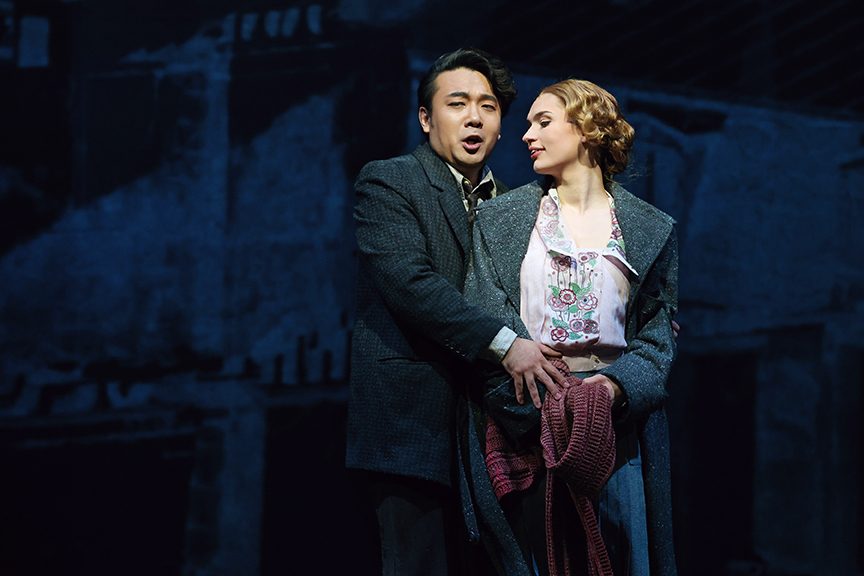
The success of any Bohème depends on the two leading roles, Rudolfo and Mimi. Both Long Long and Sylvia D’Eramo handled their assignments handsomely. Long Long sang with a ringing, Italianate tone, but the sound lacked a sense of freedom and comfort at the margins. Every phrase was delineated and sung with expression, but I did not sense a progression from one act to another. Rudolfo of Act IV was Rudolfo of Act I.
D’Eramo conveyed Mimi’s fragile state from her first entrance. In the softest moments she floated her pianissimos beautifully, and she used her voice well to convey the character’s declining health. I especially enjoyed her transformation from a shy neighbor to a young woman who is warming to the dawn of love in Act I. A blooming orchestra sound sometimes covered her lines, but she was always able to soar above the sound at climactic moments.
As Marcello, Szymon Mechliński sang with a booming if sometimes rough-edged baritone. This suits Marcello, a more rough-edged character than Rudolfo. His was a dominant character among the four artists, at his best in confrontations and combat with Musetta.
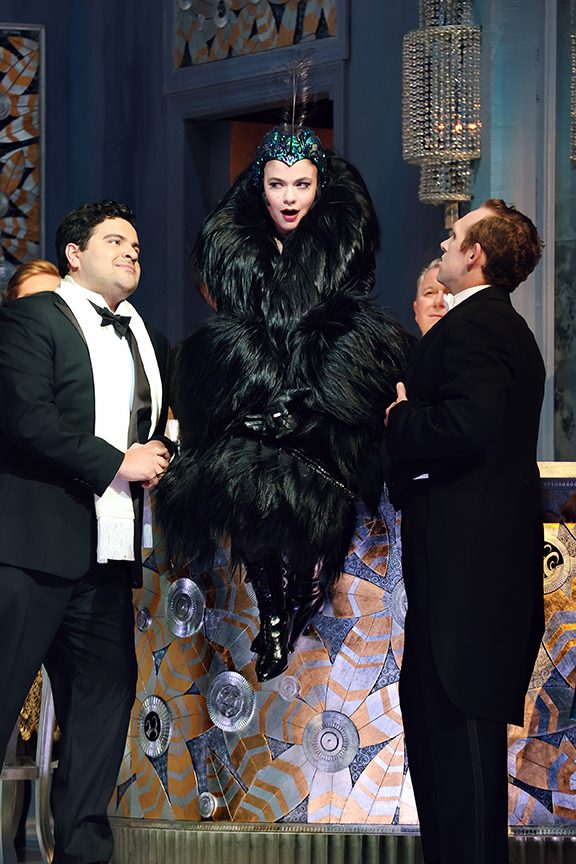
In the latter role, Emma Marhefka played the coquette to the nth degree. No character was more vivid throughout, justifying the bystanders who are delighted to spy her in the second act crowd scene. The famous Waltz was more languid than usual, but none the less effective with her rich voice.
Bass Solomon Howard made Colline a strong presence, singing with a resounding quality that only occasionally hit rough spots in the “Overcoat Aria” of Act IV. Efraín Solís was solid in the less prominent role of Schaunard, always part of the happy company of Bohemians. Santa Fe veteran Kevin Burdette brought the supporting roles of Benoît and Alicindoro to comic life, singing as well as ever.
In spite of any reservations, this is a thoroughly enjoyable Bohème. The cast is strong, the sets intriguing, the orchestra excellent, as always. And Santa Fe nights lend themselves perfectly to this drama of bohemian companionship, young love and loss.
Bohème repeats at the Santa Fe Opera Aug. 14, 19 and 23. Tickets are available HERE.
 Sharps & Flatirons