
Santa Fe Opera presents carnivalesque production of Verdi’s masterpiece
By Peter Alexander Aug. 11 at 1:45 p.m.
Editor’s Note: This is one of several posts covering four of the five operas presented this year at the Santa Fe Opera.
Santa Fe’s new production of Verdi’s Rigoletto opens on a carnivalesque scene: a chorus of courtiers dressed in stylized theatrical garb of mixed styles and periods, including Spanish breeches, Landsknecht jackets with slit sleeves, as well as shirts and pants of no discernible period. A few women sported Marie Antoinette gowns.
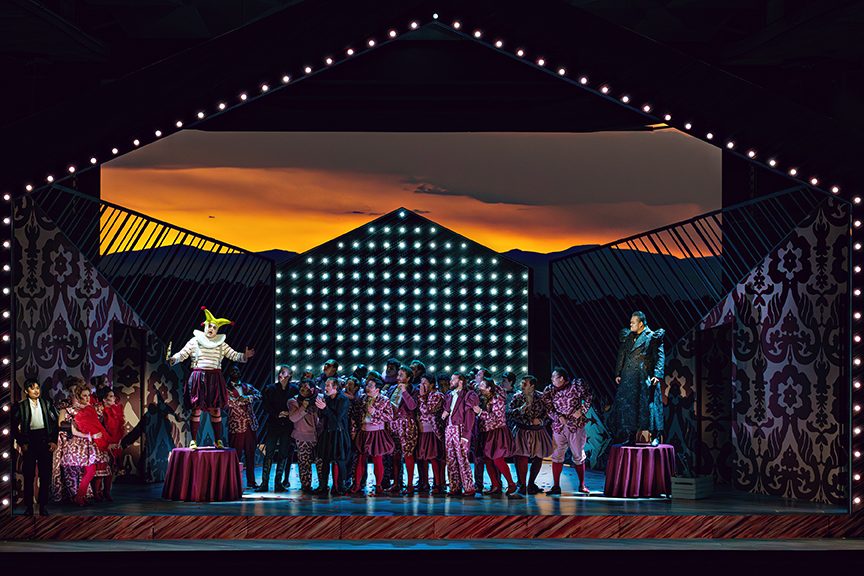
The dark violet color patterns of the essentially anonymous courtiers all match, while named characters—Merullo, Ciprano and the Duke of Mantua—are dressed in black and white. Some jackets clearly have zippers. Rigoletto wears garters with his socks and a stylized jester’s cap. In short, everything catches the eye, nothing pertains to any one period.
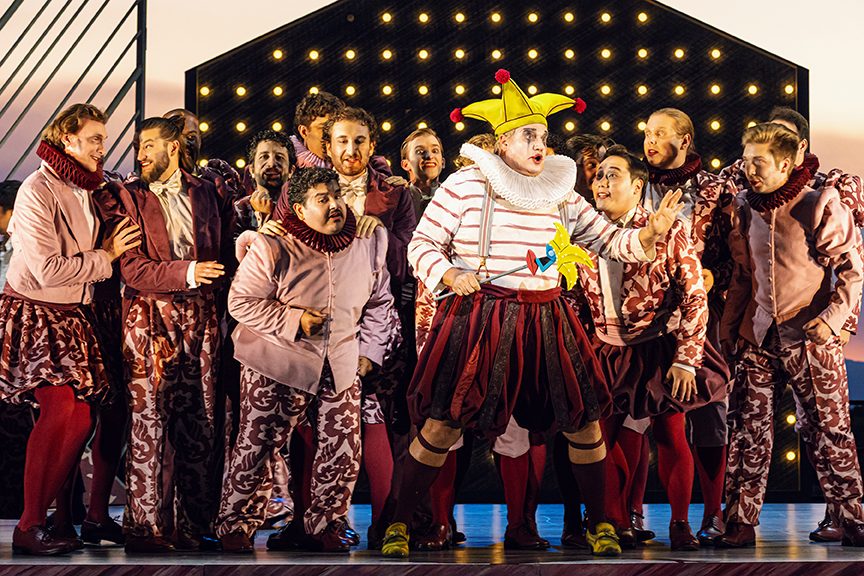
This eclectic mix in Jean-Jacques Delmotte’s costumes is matched by Julien Chavaz’s inventive stage direction where the opera’s high drama and tragedy is mixed with comic touches that lighten some scenes, but sometimes distract from the real business of the singers. The chorus of courtiers are not only dressed alike, they move in lockstep conformity. They move as a pack, sometimes going into silly choreographic moves, showing their inability to break from the decadent tribe at court.
Chavez goes so far as to lightly mock operatic conventions, as when Giovanna mugs to the audience during Gilda and the Duke’s amply repeated goodbyes. There quiet chuckles are welcome, as in the well considered interplay between the assassin Sparafucille and his sister Magdalena in the final act.
On the other hand, the silly choreography for the chorus while the Duke sings his praise of love in the second act is an unnecessary indulgence. The Duke’s aria represents a critical moment, revealing that he has discovered a kind of love from Gilda he has never seen at court. It does not redeem him, but makes him a more rounded person, and should not be downplayed for easy entertainment, whatever the symbolic depth. The same principle could have been applied elsewhere.
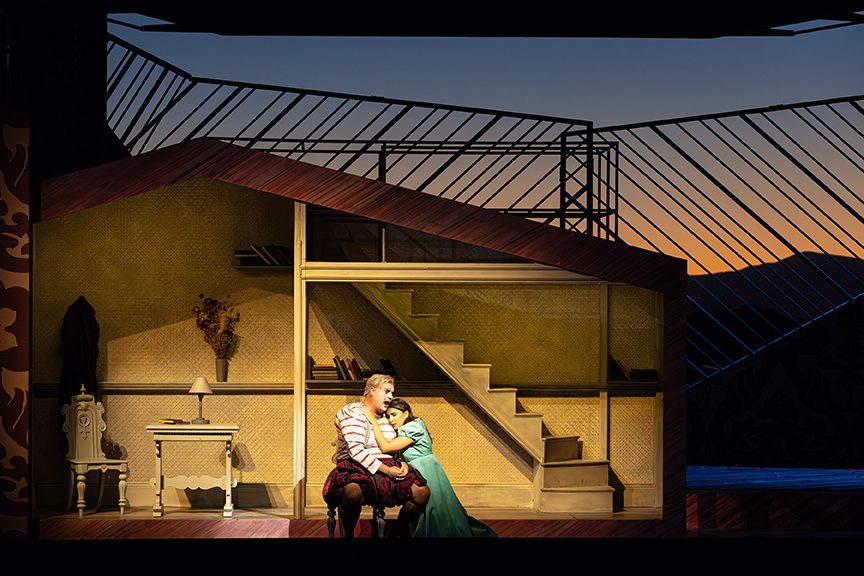
Designer Jaime Vartan’s set for the Duke’s court is abstract, with abstractly decorated mobile flats that are moved around the stage. Scattered among them are colorfully lit pieces that come together at the end to briefly outline the jester’s hat and face, and then disintegrate as the tragedy destroys Rigoletto. The interiors of Rigoletto’s home and Sparafucile’s “tavern” roll on from the wings. Their well designed contrast with the rest of the stage creates a space of warmth and safety in one case, danger and decadence in the other.
Portable lamps are sometimes used realistically, as light for Gilda’s reading, but also abstractly, carried about by the courtiers representing—who knows, enlightenment? The meaning was not clear to me. Why, for example, is Gilda discovered at court after her abduction, upstage, surrounded by lamps that are then moved downstage when Rigoletto orders the courtiers out of the room?
If the design and direction are a mixed bag, the music definitely is not. From the very first notes on Aug. 7, conductor Carlo Montanaro and the Santa Fe Opera orchestra take the drama in their teeth. Beyond the ferocity of the opening and all references to the curse invoked on Rigoletto and the Duke, Montanaro led with consistent flexibility and expressivity in supporting the singers. Musically, this was one of the most gripping Rigolettos I have seen.
Duke Kim’s light tenor warmed and strengthened over the evening, reaching a high level of passion by the end. His Donna e mobile in the last act was exciting, and his duets with Gilda were wonderful. His portrayal of the privileged, devil-may-care nobleman was winning (or fittingly vile, if you will), both musically and dramatically.
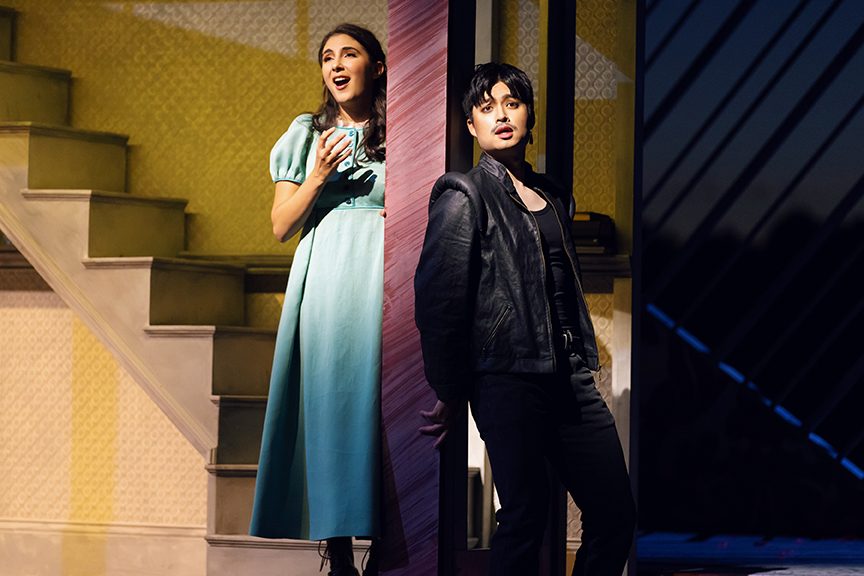
The star of the evening, as she should be, was the Gilda of Elena Villalón. Caro Nome was a moment of true beauty, and in every powerful duet—with Rigoletto and the Duke—she drove the drama to powerful heights. She carried a warm sound into the softest moments, beautifully holding out the longest phrases. Her acting was first rate, establishing her loving and confused relationship with her father. I particularly liked the touch of showing her reading, making her a full person, a young woman of genuine curiosity and thoughtfulness as well as innocence.
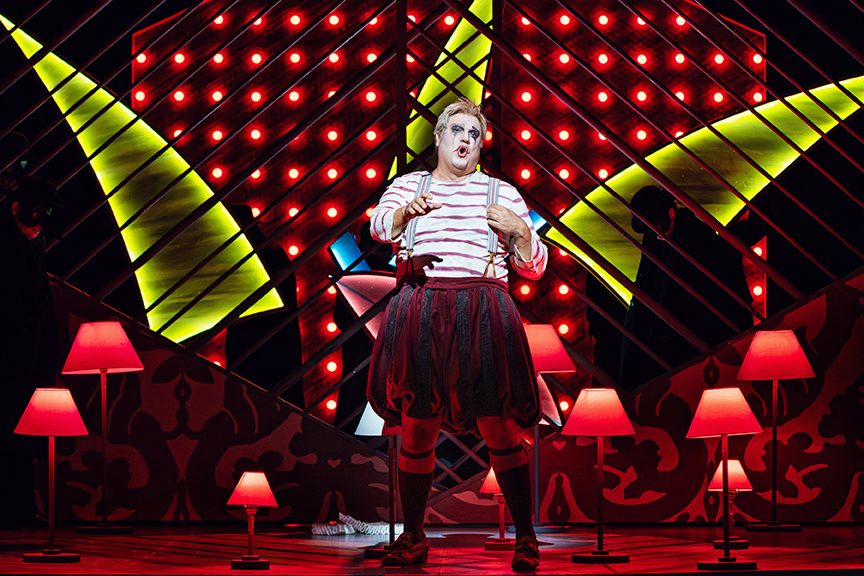
A late switch in the cast, Michael Chioldi as Rigoletto used his mature voice to establish a character of great experience and many woes. He mustered the power when needed to convey the depth of Rigoletto’s anguish; every exclamation of the curse was grim and powerful. His closing scene with the dying Gilda was chilling.
Stephano Park made a superb Sparafucile, summoning terror with his deep bass to the lowest note of his name. Marcela Rahal was equally telling as Magdalena, adding a flirtatiousness that fits the character and helps round out the final act. The interactions between brother and sister were more than just singing the notes; there was a touch of teasing in their bother-sister interactions that elicited a few light chuckles.
Le Bu sang the condemned Count Monterone “like thunder.” The named courtiers—Ryan Wolfe and Marcello, Korin Thomas-Smith as Count Ceprao, Mary Beth Zara’s as the perky page, and Ryan Bryce Johnson as Borja, all filled their smaller roles well.
The Santa Fe Opera production of Rigoletto will repeat Aug. 15 and 20. Tickets, if available, can be purchased HERE.
 Sharps & Flatirons