
—David Rutherford, candidate for Music Director of the Longmont Symphony
By Peter Alexander
Each of the four candidates for music director of the Longmont Symphony will conduct a concert during the 2016–17 season. When each candidate visits Longmont, I will take the opportunity to introduce him (and yes, they are all male). The questions will include serious questions about the job of a music director, but also questions that help introduce each of them to the reader. I hope this will give a clearer picture of the strengths of each candidate.
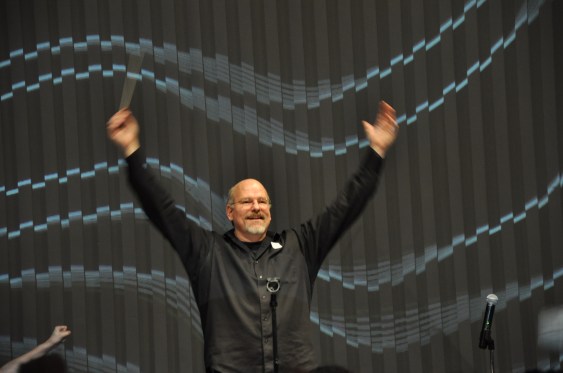
David Rutherford
The third candidate, David Rutherford, will conduct the LSO on Saturday, Feb. 25. Rutherford is well known in Colorado for his position on air with Colorado Public Radio’s Classical Music station, and in Longmont as rehearsal conductor and conductor of family concerts with the LSO.
His program will be: Danzon No. 2 by Arturo Marquez; Five Bagatelles, Op. 23, by Gerald Finzi, with Stephanie Zelnick, clarinet; Symphony No. 2 in D major by Johannes Brahms.
Here are his answers to the questions I asked:
What first attracted you to the Longmont Symphony?
Years ago [former LSO music director] Bob Olson had programmed the Peter Schickele version of Beethoven’s Fifth where there’s two sports commentators, a play-by-play and a color commentator along with the orchestra, and I got a call to come play one of the commentators. So I came up and did that, and that’s how I first met Bob. There was a need for a substitute rehearsal conductor, and I said, “If you ever need anyone to fill in, let me know.” Bob said “Sure, go ahead and bring him in for a rehearsal.” Bob liked my work, so he asked me to do that again in the next season. He continued to like my work until he was using me exclusively [for rehearsals].
It was never my intent to overplay my role. I was hired as a rehearsal conductor, and that’s what I was. My job was to serve Bob and to serve the orchestra, and to get them ready for him coming in. And I was always really happy in that role.
How do you think about programming for a community orchestra? What would a season of the LSO with David Rutherford look like?
The audience has to be kept in mind so that they get to hear things that they expect to hear and also get introduced to new works that are worth hearing. So in any one of my programs you would find familiar and unfamiliar, in a balance that makes sense for that particular program.
A community orchestra is different from a professional orchestra in that these folks aren’t getting paid—or not very much. The reason they’re there is that they want to play—so, programming works for them that they really enjoy playing. Together we can enjoy exploring and making great music together, so that when we’re done with our process and we invite the audience in, sharing music with them and them sharing the experience with us, we all really enjoy what we’re doing.
I like to program in themes, and find music that helps you understand this theme, whatever it might be, in new ways. The nice thing about music is that it helps us understand other experiences. And so music always helps us to understand the rest of our lives.
There have recently been alarm bells for classical music and orchestras, especially the larger orchestras that have had serious labor disputes. Do you think that these problems will affect community orchestras as well? And if not, what do you think are the challenges for the smaller orchestras?
I would say that the challenges are very different. Because, once again, this is not a job for [the orchestra members]. Most everybody in a community orchestra is coming from work to something that they enjoy. The people are coming because they really love it and want to make music. And so the orchestra institution in this case exists much more for the players.
In balance, the reason a professional orchestra exists is not for the players, it’s for the audience. In a community orchestra, the orchestra exists in large part just for the players. Now that’s not to say that there is not thought of the audience. In fact, when the audience realizes, ‘Hey, these guys really love it,’ and the music that they’re making is really good, then the audience is brought along for the ride, and together then we become a larger community surrounding this music-making activity.

David Rutherford
How do you balance and prepare for the various aspects of the conductor’s job: the musical requirements, the social demands with the public, and the diplomatic demands with contributors, the board and musicians?
Isn’t that the thing about conducting? That it is so multi-faceted, and even when you’re standing up on the podium just doing the conducting thing, there are so many things happening simultaneously. I always describe the conductor’s mind as being in three time zones simultaneously. Because you’re creating the music in your mind ahead of the moment that it happens, and then there is the moment that it happens, and then there’s after it happens you are evaluating what just happened.
That’s analogous to so many things about conducting. Because you’re a cheerleader, you’re an advocate, you’re a disciplinarian, you’re a psychologist, a counselor—and that’s all still just standing on the podium! But then you’re also working with the board, and you’re working with patrons, and you’re working with the audience. And I think what it all comes down to is understanding as a conductor that your role is as a servant in all of these aspects, that you serve the orchestra. As a conductor, the role is to help orchestra members to overcome whatever little issues are here and there, and to come to that point where they can do what they want to do. So you’re serving them.
You’re also serving the audience in helping them to understand what’s going on, and to program in a way that they’re included. And serving the board, making sure that the orchestra that is on stage is the orchestra that the board thinks it is, and that’s a communication issue. So you’re serving the board in giving them the information that they need, and giving them the understanding of the orchestra that they need so that they can continue to do the work that they do. And patrons, in working with them, it’s serving them and trying to figure out how it is that they can understand the orchestra as an asset to our community. It is really the role of a servant in all situations.
About you now: Where did you grow up?
In two places, but both in Colorado. I was born at Rose Memorial Hospital in Denver, and we lived in Littleton until I was 8, in third grade. We moved up to Grand Lake. So I grew up, really, up in the mountains. I went to elementary school, junior high and high school in Granby, driving that 16 mils every day from Grand Lake to Granby.
Did you come from a musical family?
My mom played a little piano, my dad played folk guitar, so I know a bunch of old cowboy songs because of him.
I played trumpet in elementary school. In 7th grade I was able to play in the high school band if I switched to horn, so in 7th grade I switched to horn and played all the way through my first year of college. But in high school the big thing is to play in jazz band. So I told my band director, “I want to play in the jazz band!” He sent me home with a book and an electric bass and I started playing in jazz band the next day. That’s how I got started playing bass.
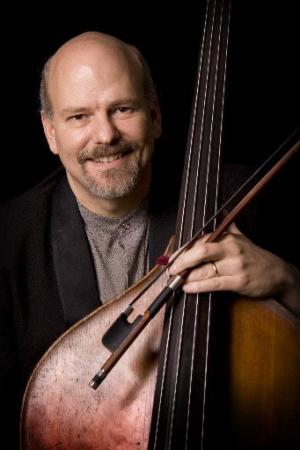
David Rutherford
I went to UNC for the jazz program. But they said, you can’t major in this (miming electric bass), you have to play this (miming upright bass). By the fall of my second year I had really pretty much fallen in love with playing orchestra bass. And so by the time I was a senior I was playing in six orchestras.
Who are your musical mentors?
First and foremost would be Elza Daugherty, the long-time music education professor at UNC, for his understanding of how it is that we each individually have our own stories and our own connections with music.
Howard Skinner, the long-time conductor of the Greeley Philharmonic and dean of the School of Music at UNC, for his incredible musicality. He was very organized, very professional. I studied conducting with him and he was really amazing—and still is.
And third would be my bass teacher Ed Krolick, who has since passed away. But he taught me to think while I play. He would continually ask you, ‘OK, you just did this. Why did you do that?’ What he’s teaching me is that everything you do in music—that nothing’s left to chance. He also taught me how to play the bass, but he taught me to think while I play.
Are there any conductors today whose work you especially admire?
You know there’s a lot. I think Andrew Litton really is a terrific conductor. I think John Eliot Gardner is really amazing in getting what he does out or orchestras. And I really like his approach to that transitional, even late Romantic stuff, the Brahms, the recordings that he’s done with the Romantic & Revolutionary Orchestra. I just think he’s terrific. Yannick Nezit-Seguin is amazing. You could go on and on and on!
Moving on the sillier questions: Do you have a favorite food?
My favorite restaurant in Denver right now is Café Brazil in Denver. I’ve never been in a restaurant that puts more flavor in its food than Café Brazil. It’s at 44th and Lowell. And so that’s really terrific. I like Asian food. I met my wife when I was living in Hawaii, and I miss the Korean barbecue that’s in Hawaii.
As you know, Colorado is an outdoor recreation state. What is your favorite activity outdoors?
I love to hunt and to hike and to camp. Backpacking is really terrific. I like bicycling. Any excuse I can get to head up into the mountains, because growing up in the mountains—I can’t be a conductor year-round in the mountains, but if I could, I would! I love the fresh air, and when I’m hunting I love being the only person within a mile of where I’m standing. There’s a solitude and a solace and a beauty in the quiet that I miss.
Do you follow any sport or team?
I am the quintessential fair-weather fan of the Rockies and the Broncos. I don’t always watch.

 Sharps & Flatirons