
Cellist David Requiro, oboists Sarah Bierhaus and Max Soto featured Sunday
By Peter Alexander Feb. 8 at 8:10 p.m.
The Boulder Philharmonic Orchestra often brings renowned soloists to Macky Auditorium.
In recent years, their guests have included pianists Angela Cheng, Simone Dinnerstein and Garrick Ohlsson; violinists Rachel Barton Pine, Anne Akiko Meyers and Hilary Hahn; cellists Astrid Schween and Zuill Bailey; and the Marcus Roberts Trio. Local artists have not been ignored—the late concertmaster Charles Wetherbee was a repeat soloist, and Grammy-winning violist, CU faculty and Takács Quartet member Richard O’Neill played with the orchestra in 2022.
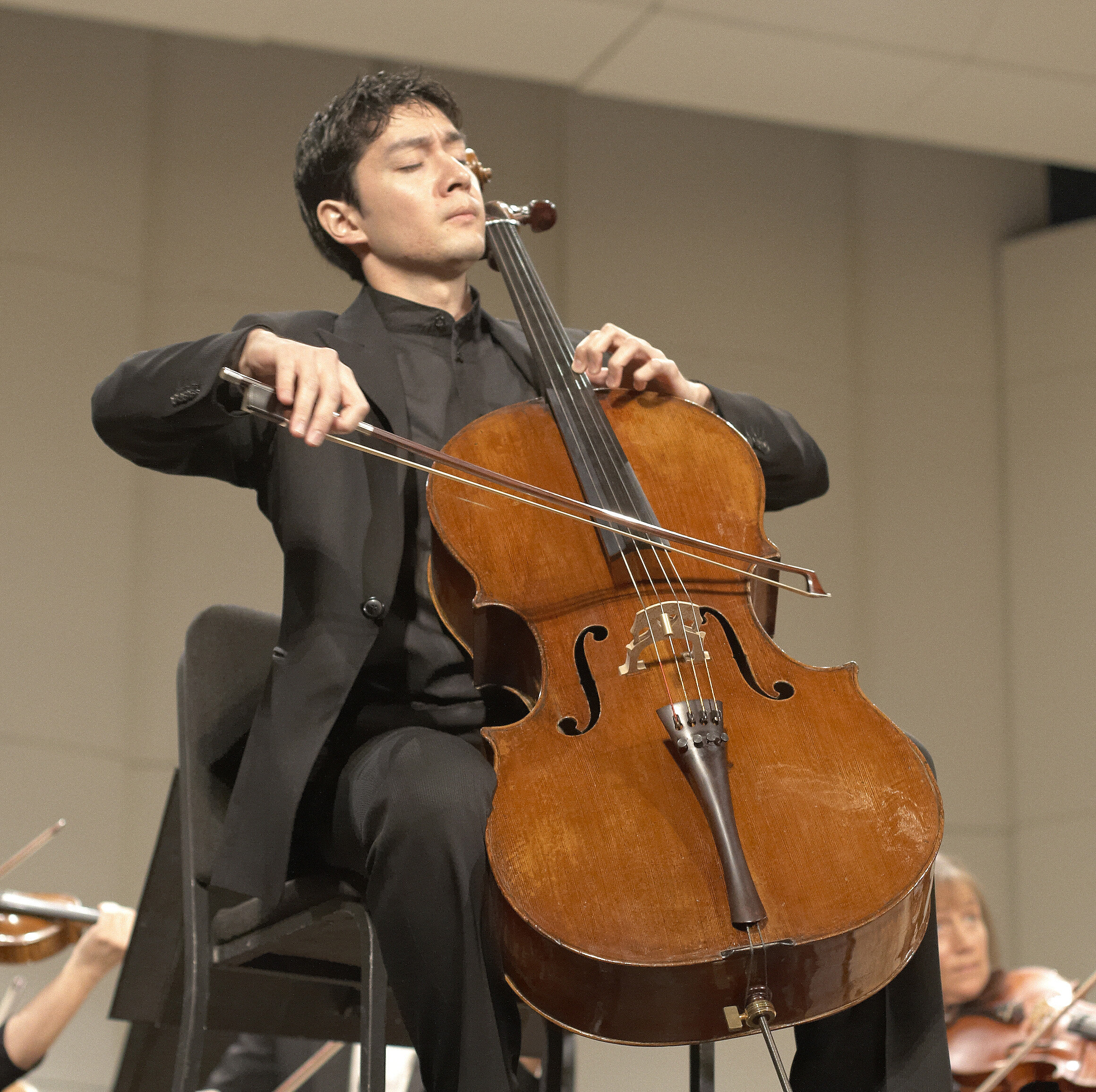
But now conductor Michael Butterman and the orchestra have devoted their next concert to presenting local artists as soloists. Under the title “The Best of Boulder,” the performance at 7 p.m. Sunday (Feb. 11 in Macky Auditorium; details below) will feature cellist David Requiro from the CU College of Music playing Tchaikovsky’s Variations on a Rococo Theme; and oboists Sarah Bierhaus—the Phil’s principle oboist—and Max Soto in composer Viet Cuong’s Extra(ordinarily) Fancy.
Other works on the program are Caroline Shaw’s Entr’acte as the opener, and Mozart’s “Jupiter” Symphony—his last and one of his most celebrated works—as the concert’s finale.
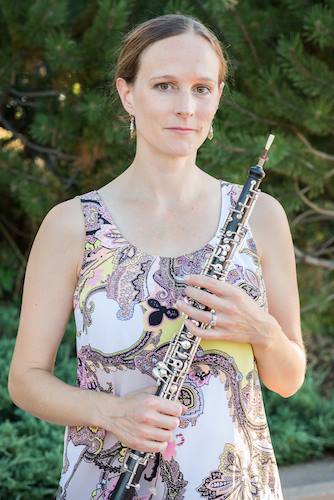
Cuong was born in California and grew up in Georgia. He has written in program notes that Extra(ordinarily) Fancy, a concerto for two oboes and orchestra, was partly inspired by Baroque-era oboe concertos by Vivaldi and Albinoni.
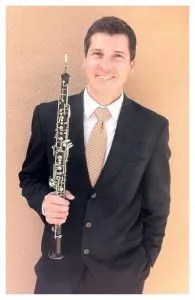
“After a short Vivaldi-esque introduction that establishes the main melodic ideas of the piece, the oboists go at it,” he wrote. “They mock each other, squawk at each other, and even talk over each other. The orchestra observes and joins in as the oboists continually bicker back and forth, all culminating in a reconciliation where the once-hesitant oboist learns (and even enthusiastically performs) a few multiphonics [a distorted sound that produces more than one pitch] alongside the other oboist.”
Tchaikovsky drew both inspiration and comfort from Mozart. He once wrote in a letter, “I not only love Mozart, I worship him . . . It is to Mozart that I am obliged for the fact that I have dedicated my life to music.” His orchestral Suite No. 4 was written as a tribute to Mozart, and came to be known as “Mozartiana.”
Another work that shows his reverence for Mozart and the classical style is his Variations on a Rococo Theme, composed in 1876 with the assistance of cellist Wilhelm Fitzenhagen. In fact, Fitzenhagen made numerous changes in the piece, including changing the order of variations and adding details in the solo part. It was Fitzenhagen’s version that was ultimately published.
The theme is not from the Rococo period, but is one that Tchaikovsky wrote in the style of that period, roughy 1740–70 between the Baroque and Classical eras. After the theme there are seven variations (excluding one that Fitzenhagen cut out) in varying moods, but all in a graceful and loosely classical style. More genial than some of Tchaikovsky’s music, this has proven one of his most popular pieces.

One of the most successful composers today, Caroline Shaw became the youngest winner of the Pulitzer Prize in music in 2013, and she is a member of the Grammy-winning vocal ensemble Roomful of Teeth. Also a violinist, she has written a number of works for string quartet, including Entr’acte. Although the inspiration may not be obvious to the listener, she wrote Entr’acte after hearing one of Haydn’s quartets, and later arranged it for string orchestra. She wrote of Haydn’s quartet, “I love the way some music suddenly takes you to the other side of Alice’s looking glass, in a kind of absurd, subtle, Technicolor transition.”
Mozart wrote his last three symphonies—Nos. 39, 40 and 41—potentially for a concert series during the summer of 1788, although there is no definite evidence that the Symphony No. 41 was played at that time. By the early 19th century, it was known as the “Jupiter Symphony”—perhaps so named by the English impresario Johann Peter Salomon but definitely not by Mozart.
The four movements follow the standard classical structure of Haydn, Mozart and Beethoven. The most striking movement is the finale, a quintuple fugue that is both a vivid demonstration of the composer’s mastery of counterpoint and a brilliant ending to the symphony—and any concert.
# # # # #
“The Best of Boulder”
Boulder Philharmonic Orchestra, Michael Butterman, conductor
With David Requiro, cello; Sarah Bierhaus, oboe; and Max Soto, oboe
- Caroline Shaw: Entr’acte
- Viet Cuong: Extra(ordinarily) Fancy
- Tchaikovsky: Variations on a Rococo Theme
- Mozart: Symphony No. 41 in C major, K551 (“Jupiter)
7 p.m. Sunday, Feb. 11
Macky Auditorium
NOTE: A correction was made on Feb. 9. An earlier version of this story misspelled two names. It is Caroline Shaw, not Carolyn, and Wilhelm Fitzenhagen, not William Fitzhagen.
 Sharps & Flatirons