CU NOW explores new opera by Mark Adamo

Opera producer/conductor Sarah Caldwell as Greek tragedy

By Peter Alexander June 11 at 10:15 p.m.

Mark Adamo knows his Greek mythology.

The composer/librettist is known not only for having written an opera on Aristophanes’s Lysistrata, but also having linked Bram Stoker’s Dracula with the Greek myth of the Bacchae as librettist for John Corigliano’s 2021 opera The Lord of Cries. And now Adamo is in Boulder workshopping his opera-in-progress Sarah in the Theater at the University of Colorado New Opera Workshop (CU NOW).

And once again he has found a Greek connection. “This is what happens when you give a 10-year-old Greek mythology to read,” he says.
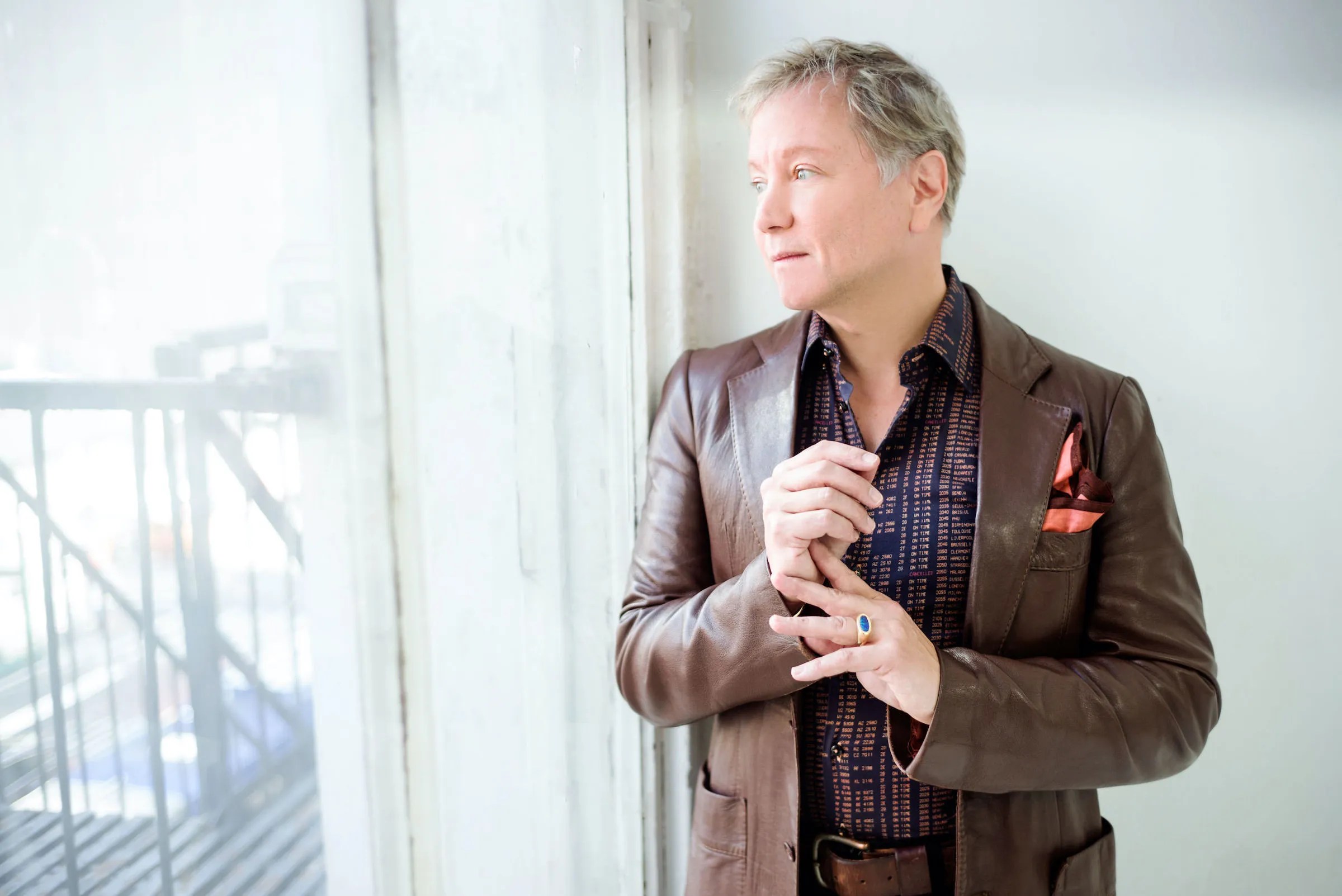
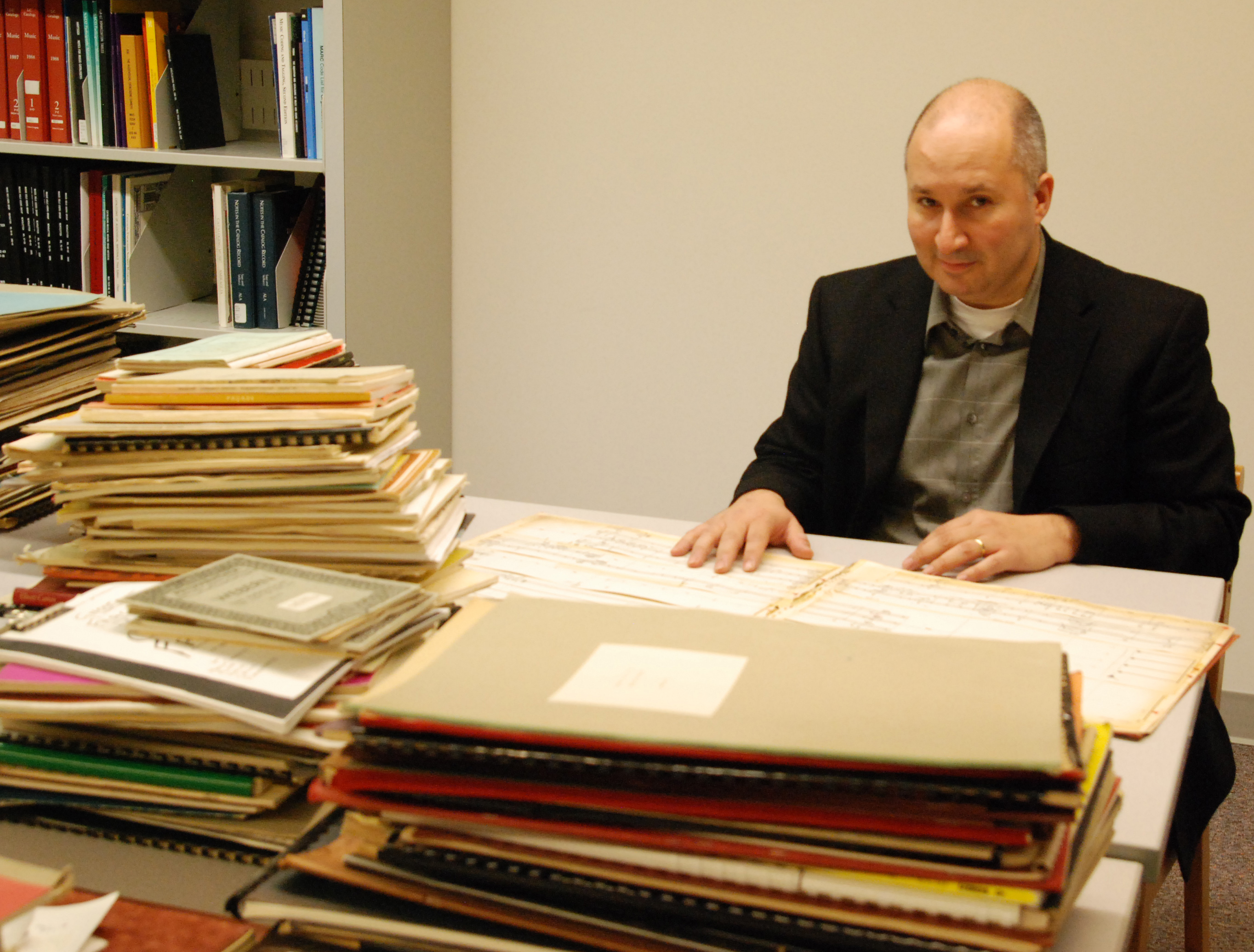
Mark Adamo. Photo by Daniel Welch

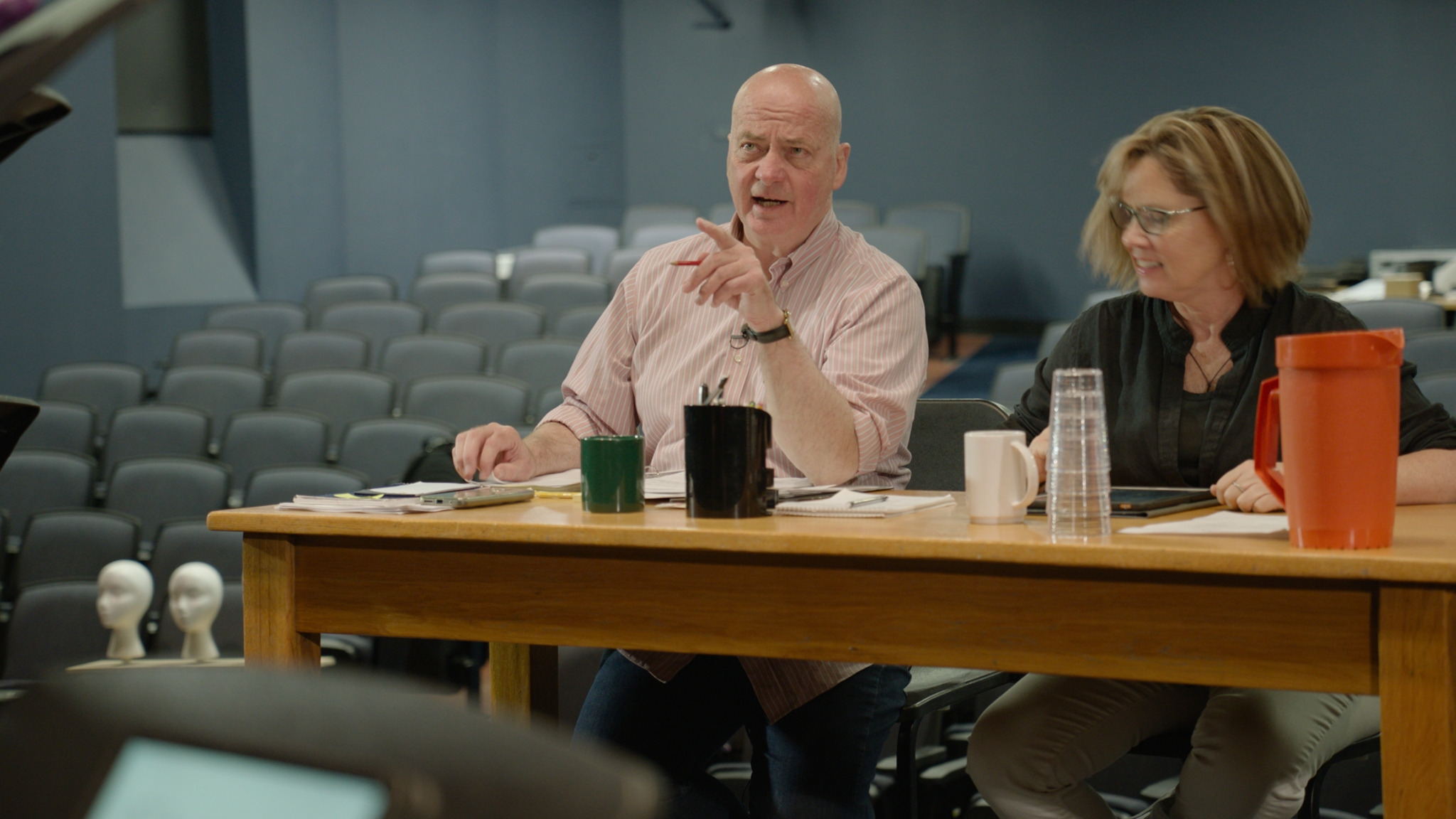
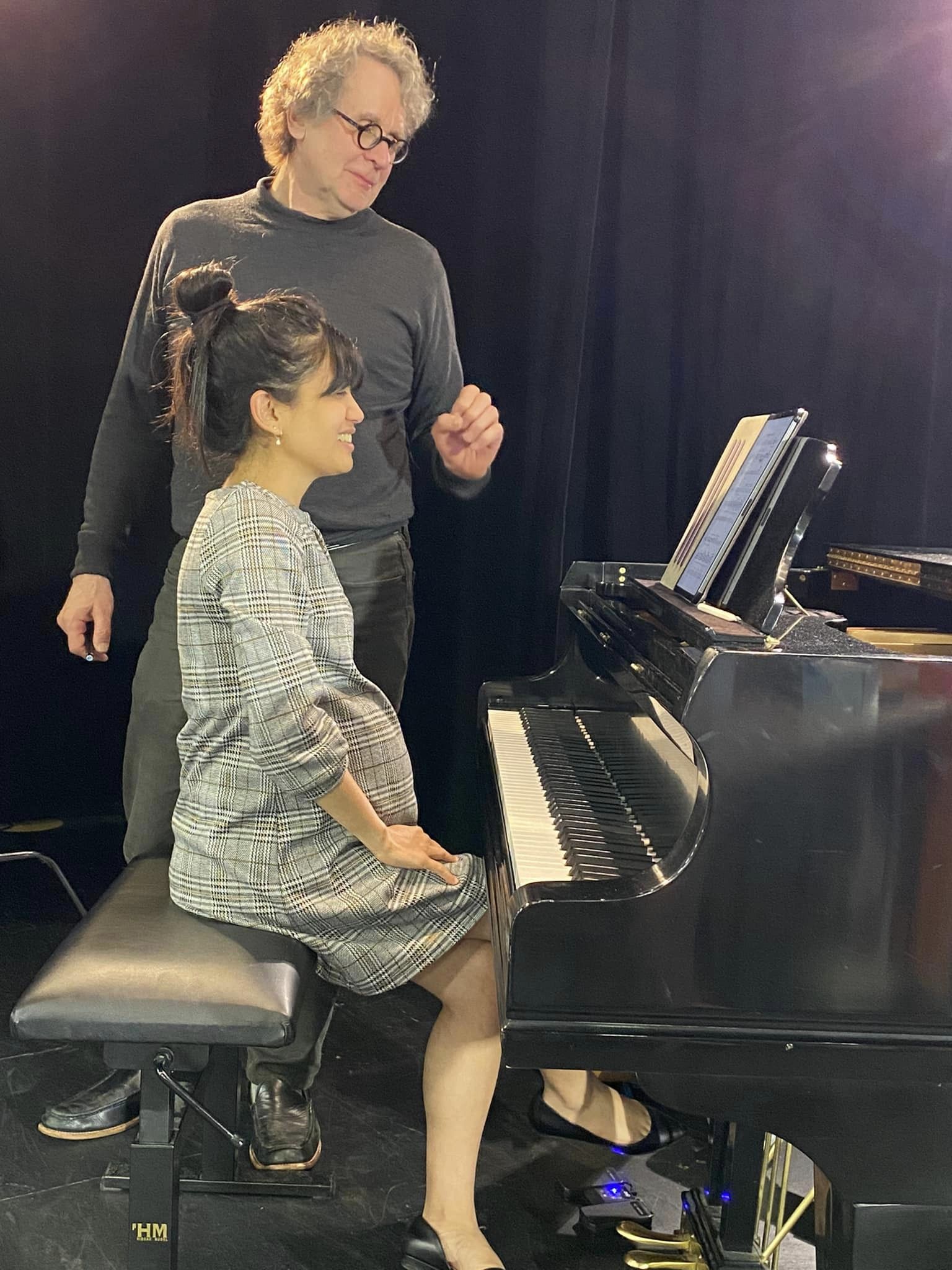
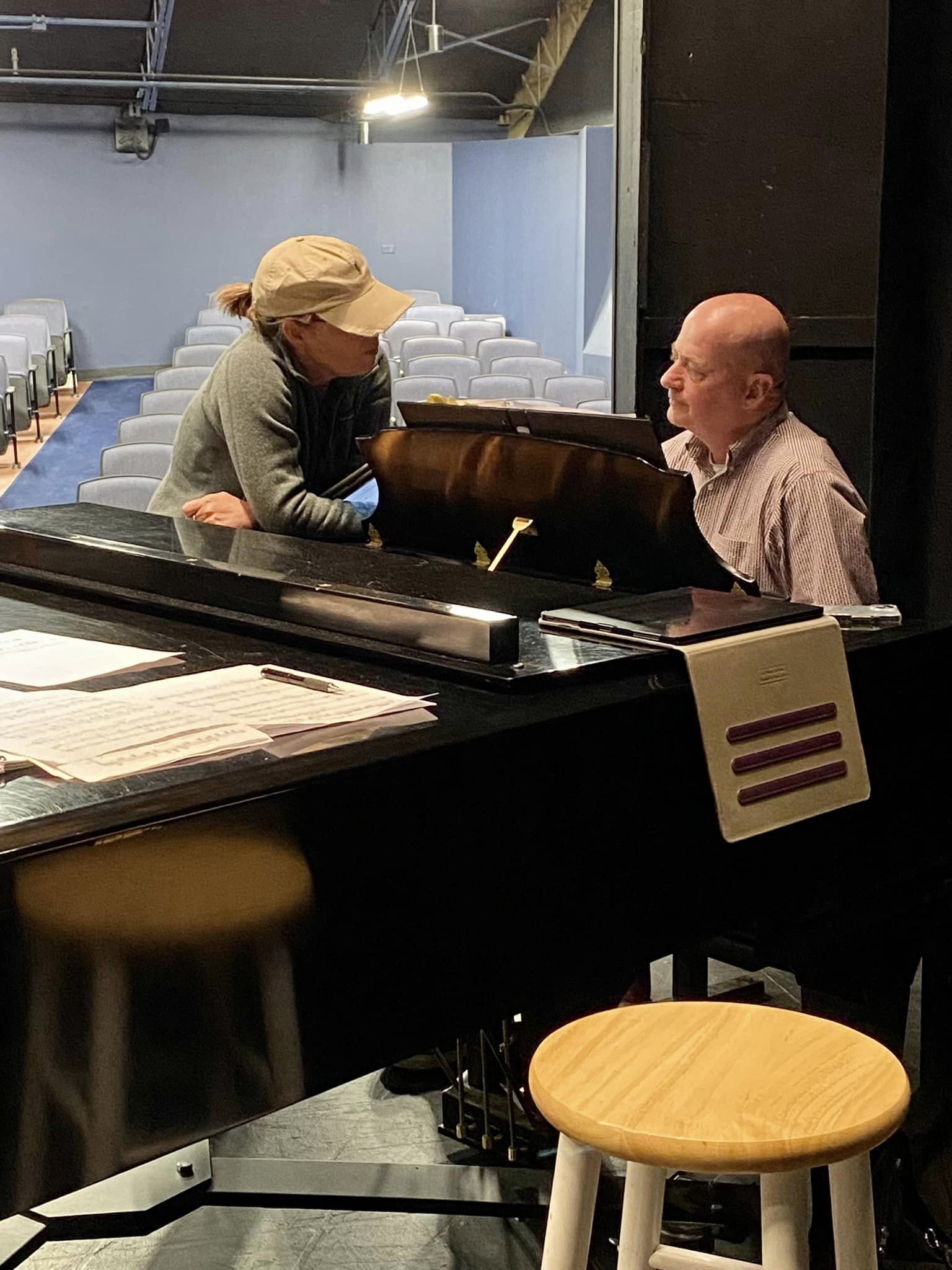
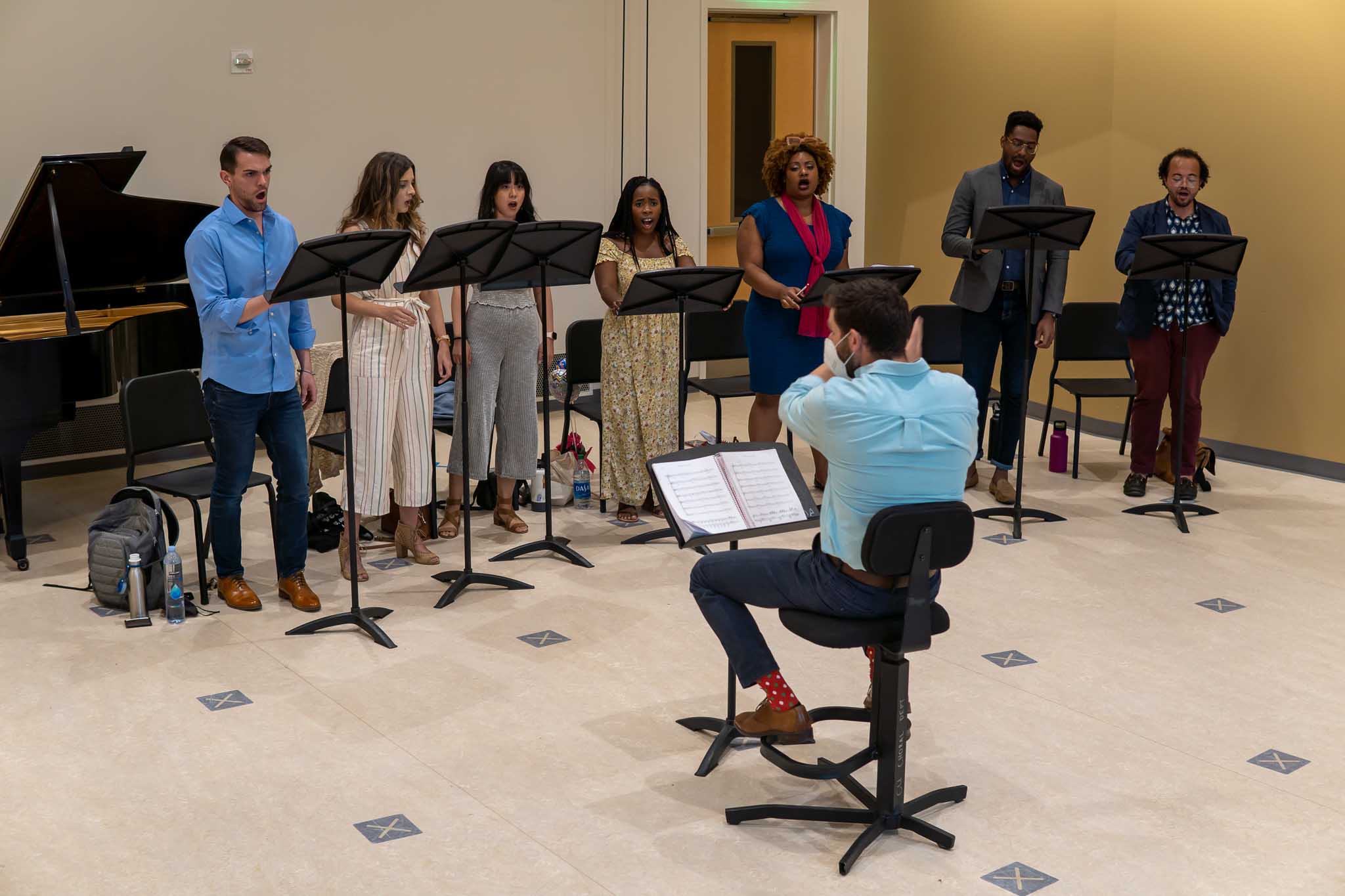
With the first act mostly done, Adamo’s new opera about the opera conducting and producing legend Sarah Caldwell will have semi-staged workshop performances of excerpts this weekend (Friday and Sunday, June 13 and 15; details below). Nick Carthy, music director of the CU Eklund Opera Program will conduct. The performance will cover the first act, but “there will be a surprise,” Adamo says cryptically.

Adamo discovered a parallel between Caldwell’s career and a Greek myth when he first undertook work on the opera. “As I’m sketching out (the opera), I had a sense of what I wanted to do with her as a character,” he says. “I’m asking the question, is there some kind of narrative template that’s going to make sense of the themes in her character, which is that she’s extremely ambitious but she doesn’t see limits. Whatever happens in the theatre is the only thing that matters.

“(I thought) there has to be some kind of pre-existing trope that I can pull from. I don’t know—Icarus! I said, that’s it!”

In the opera, the story of Icarus, who flew too close to the sun and fell to his death, is the subject of an opera within the the opera. It becomes both an opera that Caldwell is rehearsing, revealing her relentlessly focused work ethic, and a symbol of her own high-flying career and ultimate crash.

Caldwell founded the Boston Opera Group, which became the Opera Company of Boston.  Against all odds and considerable financial difficulties, she presented a wide range of operas and developed a reputation for producing remarkable results with limited means. Because of her intense focus on her work, she was known both for attracting ardent admirers and for driving others away under duress.
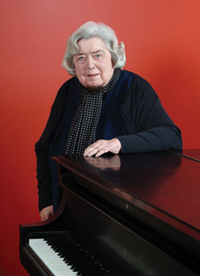
Sarah Caldwell

A synopsis of the opera released by the commissioning organization, Odyssey Opera, states: “Over one sleepless day and night: haunting the theater she created, made legendary, and now, by morning, may lose; the director, conductor, and impresario Sarah Caldwell—brilliant, obsessed, intractable—inspires her artists, fends off creditors, relives her triumphs, and battles with ghosts as we wait to learn if she will be given one final chance to continue the work she lives for or whether demons of self-sabotage have, at last, outrun her luck.”

Adamo is returning to Boulder for his second workshop with CU NOW, following a successful reworking of his opera The Gospel of Mary Magdalen in 2017. “(CU NOW) is the perfect balance of seriousness about the work, and un-seriousness about ego,” Adamo says.

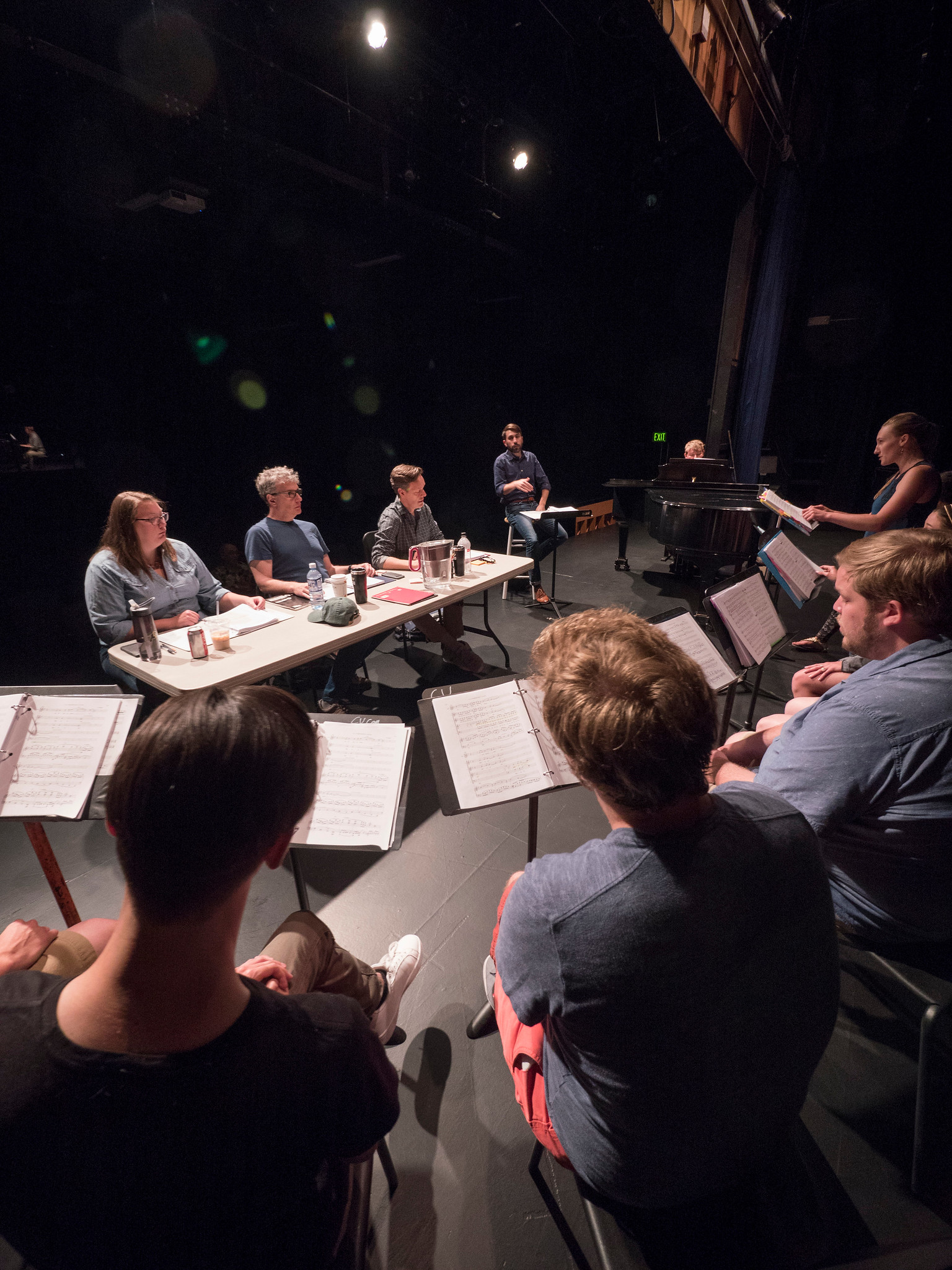
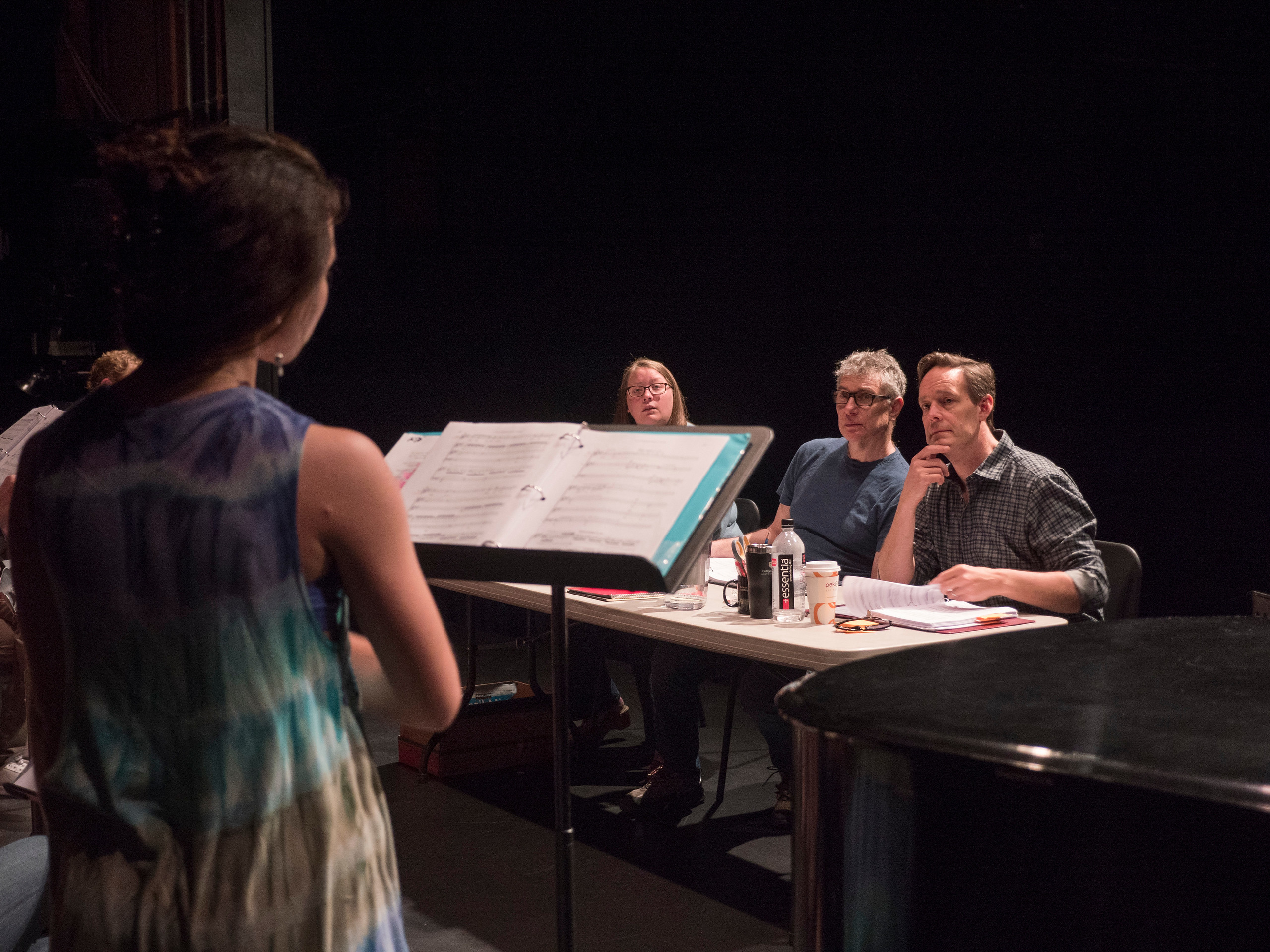
“Nick (Carthy) and our pianists know it cold, but part of the point of the workshop is that you want the flexibility to change things. The magic here is that people came in with a base knowledge of the score, and also not only the ability but the imagination to get it better. I am ‘directing’ this, (but) in real life this is a co-production of me and the singers. Half the ideas on the stage will come from them.”

For all of her impact in the opera world Caldwell might not occur to most composers as the subject of an opera. The original idea came from Gil Rose, conductor of the Boston Modern Orchestra Project and founder of Odyssey Opera, who commissioned Sarah in the Theatre. But make no mistake, Adamo sees her as a great subject for drama. “She’s like Orson Wells,” he says. “It’s a race between the genius and the demons.”

Taking on the roles of both librettist and composer might seem dangerous, because the history of opera is littered with legendary battles between composers and librettists. Adamo sidesteps any conflict between the two parts of his creative mind by starting with an outline of the various characters’ motives and the emotional arc of the story. The emotional development suggests in turn the musical demands of the finished piece.

 “By the time you do the first draft of the libretto, it’s coming to the first draft of the score, because you’ve got these musical requirements that you’re trying to write around,” he says. “And then by the time you get to that libretto and by the time you’re setting it, ideally you avoid the composer-librettist clash, because the composer has been there from the beginning.”

The final word on any new opera belongs to the performers who bring it to life. After several weeks of intensive work, Carthy knows where he stands on Sarah in the Theatre. “It’s a great work,” he says.

“It’s really a greek tragedy.”

# # # # #

CU New Opera Workshop (CU NOW)
Nick Carthy, conductor

Mark Adamo: Sarah in the Theatre (Act I excerpts with two pianos)

7:30 p.m. Friday, June 13 and 2 p.m. Sunday, June 15
Music Theatre, Imig Music Building
Free
“Popular Entertainment” anchors 2024 CU NOW

Gene Scheer and Bill Van Horn conjure a musical play from an 18th-century sequel

By Peter Alexander June 12 at 11:50 p.m.

“If it’s a success, write a sequel!”

That’s the commentary of theater veteran Bill Van Horn, who is helping turn just such a sequel from the 18th century into a modern-day operetta—or “popular entertainment about history,” as he describes it. The work in question brings together Van Horn as librettist with Gene Scheer as song writer. Their Polly Peachum, based on the sequel that English dramatist John Gay wrote to his own hugely successful Beggar’s Opera of 1728, will be presented by the CU New Opera Workshop (CU NOW) Friday and Sunday (June 14 and 16; details below)

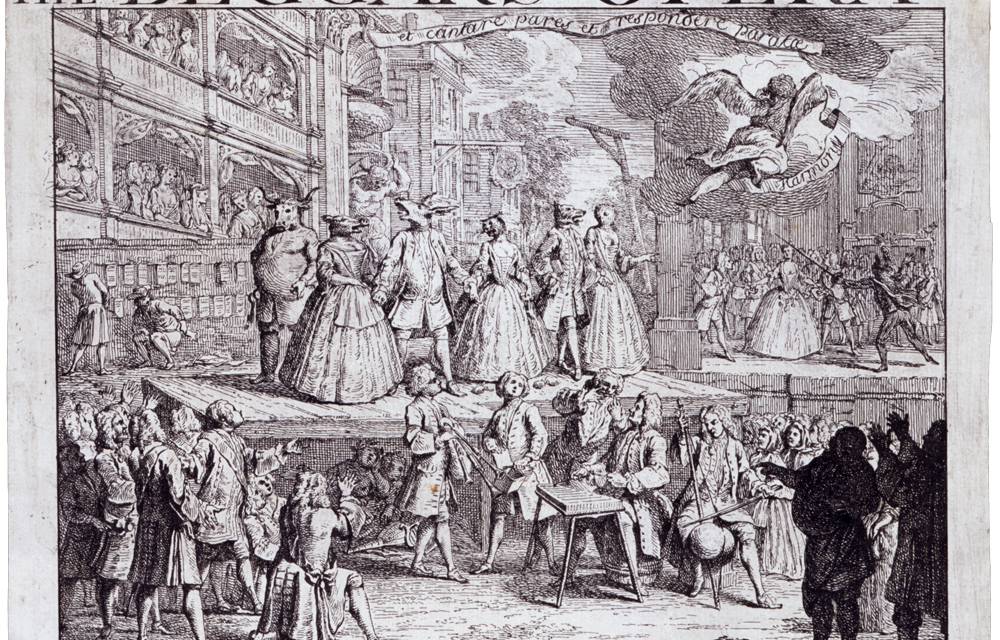
18th-century outdoor performance of Gay’s Beggar’s Opera, engraving by William Hogarth

Between the two performances of Polly Peachum CU NOW will present operatic scenes by composition students Alan Mackwell, Holly McMahon and Joshua Maynard. As part of CU NOW they have participated in the Composer Fellows’ Initiative (CFI), working on their own operatic works with composer Tom Cipullo.

Gene Scheer (l) and Jake Heggie (r) at CU NOW, 2018 (Photo by Glenn Asakawa/University of Colorado)

Scheer and Van Horn are both widely experienced in the theater. Scheer has been at CU NOW before, working on new operas as librettist with composer Jake Heggie (Wonderful Life, If I Were You, Intelligence). He has also written librettos for other works by Heggie (Two Remain, Radio Hour) and other composers including Jennifer Higdon (Cold Mountain), and he has written songs and other musical works of his own.

Although he has never been to Colorado before, Van Horn has done almost everything in the theater except, he says, “count money.” As he tells the story, “I started just showing up at theaters saying ‘Is there anything you need to be done?’ Eventually you get asked to be in a play, and I’d sort of take up residence in different theaters.” From that unconventional start, he has gone on to translating plays and operettas, writing plays, adapting plays and directing plays.

The idea for the modern Polly Peachum arose more than 30 years ago, when Scheer was playing the central role of Macheath—aka “Mack the Knife”—in Kurt Weill’s Threepenny Opera, a 20th-century adaptation of Gay’s Beggar’s Opera. His mother gave him a book of The Beggar’s Opera, where he learned that Gay had written a sequel titled Polly Peachum, named for a character in both works.

Bill Van Horn (Photo by Mark Garvin)

“The problem is that the play Polly is not that good,” Scheer says. “I got the idea of doing a prequel. I showed this to (Van Horn), and we developed the idea together, the making of The Beggar’s Opera, in which the world of government intrigue, ham actors, and Jonathan Wild, who was the inspiration for Macheath,” are blended.

Leigh Holman, the director of CU NOW and CU’s Ecklund Opera Program, says that “(Scheer) told me about this piece two or three years ago, and we’ve been trying to find the right time to bring him here. This was the right time, so we’re so excited for him do this. It’s been amazing so far. This piece has been great for (the students).”

Both Scheer and Van Horn praise the contributions the students have made in rehearsals. “They’re extraordinary,” Scheer says. “They’re teaching us as we teach them. They are all extraordinary singers, they’re extraordinarily well trained.”

“They’re going to be indelibly on my mind as the characters, forever, because they’re the first ones to do it,” Van Horn adds. “It’s in the best tradition of old-school summer stock, where everybody does a little bit of everything. That’s the best kind of theater!”

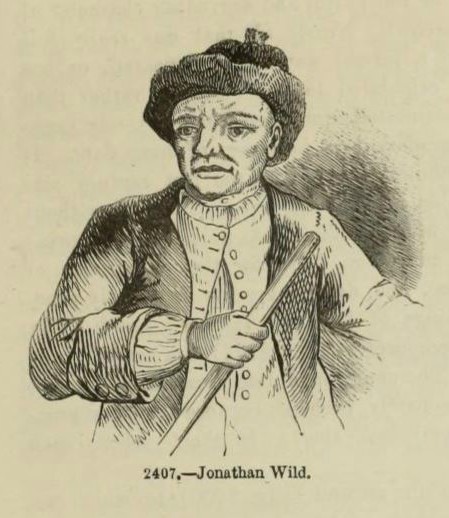
Johnathan Wild, book illustration

In Scheer and Van Horn’s Polly fictional characters, such as Polly Peachum, are combined with real-life characters, including the dramatist Gay and Wild. Of these, it is Wild who is the most outlandish and theatrical character.

“Wild was the ‘thieftaker general’,” Van Horn explains. “He bought things that people stole and then told the owner, ‘I can get this back for you.’” He charged the true owners what seemed like a small portion of the items’ actual value, but the thieves were all working for him and he accumulated an enormous fortune.

“The thieves of London would bring the stolen goods to his warehouse,” Scheer says. “Wild would publish what he had, and people would come and buy possessions that had been stolen from them.”

In the end, Wild got cocky and careless. He was eventually arrested, convicted and sentenced to be hanged in Tyburn Square in London. His hanging in 1725 was a sensational public event that attracted thousands, but Wild drugged himself before the hanging. Although he did not succeed in killing himself, he was in a coma when hanged—which is one way the stage plot diverges from history.

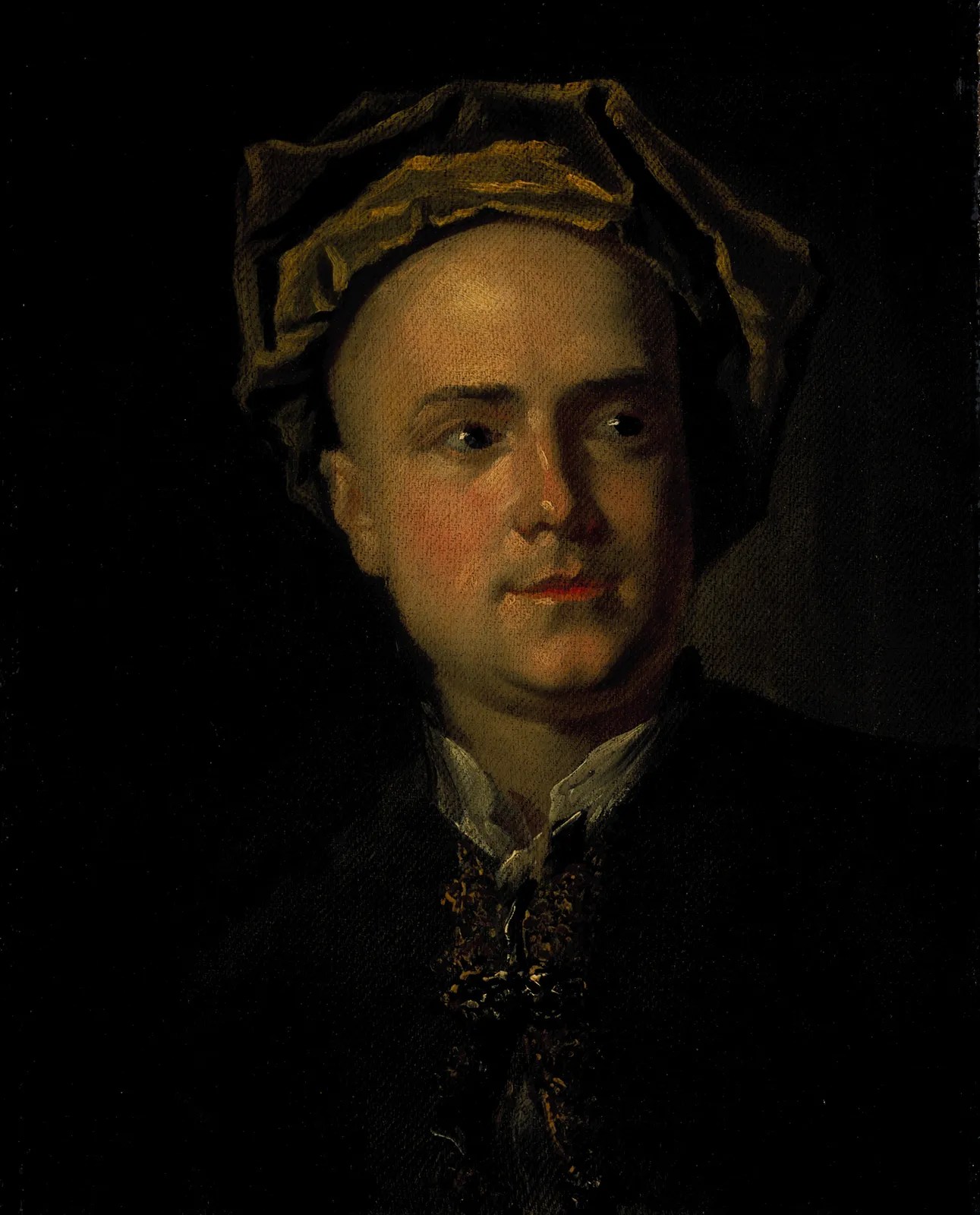
John Gay, oil painting by William Aikman in the Scottish National Portrait Gallery, Edinburgh

In Scheer and Van Horn’s version, the fictional Polly Peachum works for the historical Wild, and the two are lovers. When Wild is arrested, his gang is pursued and Polly hides out in the warehouse. Meanwhile Gay’s manuscript for The Beggar’s Opera is stolen and he goes to the warehouse to purchase it back. Instead he meets Polly, who joins his theater company as a way of hiding from the police. She becomes Gay’s muse as he completes The Beggar’s Opera and they fall in love.

In the meantime, Wild is supposed to be hanged, but instead of taking laudanum, as history has it, he gives it to the minister who comes to administer the last rites. The minister is hanged in his place, and Wild escapes. Polly thinks he is dead until he shows up at the theater. His sudden appearance creates a conventional love triangle, with Polly forced to choose between Wild, the fugitive, and Gay, the theater manager. 

If that sounds familiar, it’s still the same old story. Or as Van Horn says, “If you recognize any parallels with Casablanca, it’s intentional.”

And performances are free.

# # # # #

CU New Opera Workshop (CU NOW)  2024

Polly Peachum
Music by Gene Scheer, book and lyrics by Bill Van Horn and Gene Scheer

7:30 Friday, June 14
2 p.m. Sunday, June 16

Composer Fellows’ Initiative (CFI): Scenes
7:30 p.m. Saturday, June 15

All performances in the Music Theater, Imig Music Building.
Admission is FREE.

CU New Opera Workshop presents a show in search of a title

Portions of a new work—for now The Calling—will be performed June 16 & 18

By Peter Alexander June 14 at 11:25 a.m.

Composer Tom Cipullo is seeking a name for his new opera.

Composer Tom Cipullo (l) and Leigh Holman (r), artistic director of CU’s Eklund Opera program.
Photo by Stabio Productions for CU NOW.

Right now it’s The Calling; before that it was The Next Voice you Hear. His work-in-progress is the subject of the 2023 CU New Opera Workshop (CU NOW) in the College of Music, and the first thing Cipullo wanted to do in the workshop was find the right title.

“I think it was the first thing I said when I arrived here,” he says. “I need a better title!” The Calling was suggested by one of the performers, and so far that is the title that everyone likes best.

Conductor Nick Carthy (standing) with pianist Nathália Lato.

But whatever you call it, you can catch a preview this Friday and Sunday at the Music Theater in the CU Imig Music Building (7:30 p.m. June 16 and 2 p.m. June 18; admission is free). Portions of the opera-in-progress will be performed by early-career artists from the CU Eklund Opera program under the direction of conductor Nicholas Carthy and stage director Leigh Homan. They will be accompanied by pianist Nathália Kato.

The libretto, written by Cipullo, tells the intertwining stories of three characters: televangelist Pastor Dove; IRS Agent Cordero, who is investigating Dove’s ministry for potential tax violations; and Dolores Caro, an older woman who supports Dove’s ministry.

Two of these characters are based on models. The televangelist was inspired by someone Cipullo won’t name that he saw interviewed about his extravagant lifestyle. “He was so charming and frightening at the same time that I couldn’t take my eyes off of him,” Cipullo says. But he wants you to know he is not trying to mock the televangelist. 

“I was trying to tell his side of it,” he says. “He’s giving to people. Maybe it’s worth it for these people, what he’s giving them. (It makes) me think, the preacher actually believes he’s doing good.”

Dolores, the homebound contributor to the ministry, is partly Cipullo himself. She is surrounded by old-fashioned consumer goods and feeling left behind by the 21st century. “There’s a lot of me in her,” Cipullo admits. Like Dolores, “I still have a landline. And I can’t figure out how to work this (smartphone)!”

The character of the IRS agent was suggested to Cipullo, and he is more of an original creation. As someone who grew up religious and knows both the Bible and literature, Agent Cordero is an ideal foil to Dove.

With these three characters it would be easy to write a biting satire, but that’s not Cipullo’s game. “I hope it’s more nuanced than that,” he says. “The biting satirical way is the way that a lot of people in New York would look at people who give to televangelists, but I’m more interested in what the people who listen to these televangelists get out of it.”

When pressed, Cipullo says that The Calling is neither satire nor comedy, but both—and partly tragedy, in a way. “It’s all of these,” he says. “I think it is a commentary on the condition of the country, with tragic and comic overtones. Any good opera that wants to touch your heart has to have light moments in it.”

Getting the right balance of ingredients is one purpose of CU NOW and similar workshops. Composers can hear portions of their new works and see what works and what doesn’t, and to write new material when required. Often the performers themselves provide ideas that end up in the finished work—and not just the title.

When he arrived for the workshop, Cipullo says, “I had specific things that I was concerned about, and I had various epiphanies. I didn’t really have the title, there was too much wordiness and (I was concerned about) the momentum and how to shape it.

Leigh Holman (l) and composer Tom Cippullo (r) during a rehearsal for ’The Calling.’

“Then there are specific levels—for example, someone’s singing an aria, there are specific musical things. Maybe it’s only a moment, maybe it’s a beat, maybe it’s too long. Maybe something’s wrong. I don’t know what it is, but we have to try to figure out what it is, as a group.”

CU NOW, founded by Holman in 2010, provides a longer working period than most workshops—up to two or three weeks. This gives composers a chance to tackle more changes than they could in a few days, which is valuable to the creative process. Composers who have been part of CU NOW in the past include Cipullo, Kamala Sankaram, Jake Heggie and Mark Adamo.

But Holman makes it clear that CU NOW is first and foremost for the students, giving them experience they will need in their careers. Working with composers, and learning new music on short notice, have become more necessary as more new operas are being produced around the country. At first, she says, the singers struggled to keep up with the changes they had to make overnight. 

But “it’s developed now to they’re begging for music,” she says. “They ask, ‘Did you write me any music last night?’ And Tom is writing new music almost every day and sending it to them every morning, and by 2 o’clock they know it already!”

That experience prepares the students for the facts of professional life today. “This is a golden age of American Opera,” Holman says. “The singers, if they’re going to work, they need to have these skills. When we started, there weren’t other universities doing these workshops and now they’re doing them all over.”

And at this point Cipullo speaks up. “But there’s nothing like this one”! he says.

# # # # # 

CU New Opera Workshop
Leigh Holman, director
Nick Carthy, conductor
Nathália Kato, pianist

The Calling by Tom Cipullo (portions)

Music Theatre, Imig Music Building
7:30 pm. Friday, June 16
2 p.m. Sunday June 18

Free, no tickets required

Portions of new opera to be presented Sunday

Kamala Sankaram’s Joan of the City is inspired by homelessness and Joan of Arc

By Peter Alexander June 17 at 5:23 p.m.

Composer Kamala Sankaram says that many of the pieces she writes start with her own imagination and not the way many operas get written— with a commission for a specific performing organization. 

“They start with a crazy idea that I have” Sankaram says. “Then I talk to people and see who also is crazy.” She then works with the “also crazy” people to bring her idea to life.

Kamala Sankaram

For her latest project, an opera titled Joan of the City that combines themes of homelessness with the Joan of Arc story, those conversations led her to Leigh Holman, director of the Eklund Opera Program at the University of Colorado, Boulder, and the New Opera Workshop (CU NOW).

Sankaram has been in Boulder for the past two weeks, composing music and working with students in the opera program to start turning her “crazy idea” into a site-specific opera that will be premiered next year by Opera Omaha. Completed portions of Joan of the City will be performed at 3 p.m. Sunday (June 19) in the Music Theatre of Imig Music Building.

The performance is free and open to the public, and will take place entirely in the Music Theatre space.

The basic idea of the opera is that not one but five Joans will be fighting, not the English invaders in France, but gentrification and other forces creating homelessness in American cities. Starting in five different places within Omaha, the Joans eventually meet up, as audiences move with them through the city.

Sankaram grew up in Southern California, where the car is king, but after she moved to New York she started walking everywhere. “Whenever I go to a new city I’m walking, and I see the homeless community,” she says. “I think it’s important to have people see what does that feel like, to be walking the city, instead of driving by in a car.

“I started thinking about [homelessness] several years ago, and it has become increasingly problematic and prevalent . . . [in] all places across the United States. So the idea was how do you get people to look and see things that they normally look past.”

Another idea was the use of technology, which features in a lot of Sankaram’s work. It is technology that will allow the onsite performances in Omaha to take place in different places across the city, and also will allow audience members to participate in the performance by playing audio from their cell phones.

The final piece of Sankaram’s “crazy idea” was working with homeless agencies—Mary’s Place in Seattle and Micah House in Omaha—to connect the finished work to the homeless community. With her co-creator of Joan of the City, New York-based hybrid-theater director Kristin Marting, Sankaram and the homeless shelters presented writing workshops for the shelter clients.

Leigh Holman (Photo by Glenn Asakawa/University of Colorado)

The work that came from those workshops became the basis of the text for Joan of the City. “The libretto is all these poems that the shelter clients wrote, and then they’re sort of structured on this overall dramatic arc from the Joan of Arc story,” Sankaram explains. “It starts off as arias and then as the Joans meet each other, it turns into duets and trios and finally a quintet.”

Sankaram’s work is an example of the kind of creative and adventurous projects that CU NOW aims to support. Many new works go through a workshop process, but CU NOW is unique in that it offers a longer than average period for composers to work with performers while refining their work. 

The program is largely Holman’s brainchild. She started CU NOW in 2010, and it has offered several composers the opportunity to refine works that were in development, including It’s a Wonderful Life by Gene Scheer and Jake Heggie, which was premiered by Houston Grand Opera in 2016 and performed by the CU Eklund Opera in 2019.

The composers and works are chosen for CU NOW largely through Holman’s contacts in the professional world. “So far nobody has ever submitted anything (for consideration),” she says. “It’s only been knowing somebody or meeting somebody through relationships, or going to see their operas. I just invite them, and they do it because they want to develop their piece and we can provide the students and the facilities and the musicians.”

In addition to the work that is done by an established composer preparing a new piece, there is simultaneously an educational component for young composers. Under the rubric Composer Fellows’ Initiative (CFI), a composer and librettist have been brought in to work with students to develop both their musical skills and their understanding of stagecraft.

Tom Cipullo

This year, the students have been working with composer Tom Cipullo, whose comic opera Hobson’s Choice was featured at CU NOW in 2019, and librettist Gene Scheer, whose was in Boulder for CU NOW last year (Intelligence, with composer Jake Heggie) as well as 2016 (It’s a Wonderful Life). 

“It’s a marvelously thrilling thing to be a part of,” Cipullo says of CFI. The composers in this year’s program “are extraordinary young musicians,” he says. “CFI gives them a push into writing operas. They have an interest, they’re all talented. How much they’ll pursue it, what works they’ll create, who can say, [but] they jumped in and they’re doing some really good things.”

# # # # #

CU Now Opera Workshop
(CUNOW)
Leigh Holman, director

Kamala Sankaram: Joan of the City (portions)

3 p.m. Sunday, June 19
Imig Music Building, Music Theatre (N1B95)

Free

Composer Jake Heggie will bring ‘Intelligence’ to Grusin Hall

CU New Opera Workshop will preview new opera written for Houston Grand Opera

By Peter Alexander June 15 at 11:30 p.m.

Six years ago composer Jake Heggie was in the Smithsonian Institution when a docent told him what his next opera should be.

The composer of the successful operas Dead Man Walking, Moby Dick and It’s a Wonderful Life, Heggie usually has no trouble finding his own subjects. “My first response was ‘Yay! I’ve never heard that before!’” he says. But six years later, Intelligence, his opera based on that very idea, is being workshopped at the University of Colorado, Boulder, in preparation for its premiere in a future season of the Houston Grand Opera. 

Composer Jake Heggie (L) and librettist Gene Scheer (R)
Photo by David Starry

As Heggie tells the story, “We were [at the Smithsonian] doing some events, and this docent pulls me aside. He said ‘Have you ever heard of Elizabeth Van Lew and Mary Bowser?’ I said no, and he goes ‘You need to look them up, and that should be your next opera.’ And he walked away.”

Heggie and Scheer started doing research into the two women, and the more they learned the more interested they became. Heggie recalls, “I started Googling and I was like ‘Gee!’ And I remember Gene calling me and saying, ‘Jake, it’s an incredible story!’”

The two women were spies for the Union during the Civil War. Van Lew was a white abolitionist living in Richmond, Virginia, the capitol of the Confederacy. Bowser—who went by several names including Mary Jane Richards—was a former slave of the Van Lew family who had been freed, educated in the North, and then travelled to Liberia in Africa as a missionary. She returned to Virginia, even though her freedom there was illegal, and joined a spy ring operated by Van Lew.

As women, they were able to operate without raising suspicion—no one expected women to be dangerous. That was doubly true for Richards/Bowser, who was virtually invisible in the Southern society of the time so long as she acted like an uneducated slave. On one occasion she went into the Confederate White House on the pretext of collecting laundry and managed to read the papers in Jefferson Davis’s study. What she read there was passed on to Union generals.

“Her story, aside from the aspect of being a spy, is just amazing,” Scheer says. “We are weaving various aspects of her life and Van Lew’s life, focused on the Civil War. There are pivotal points that are known historical facts that we could thread together. And these facts became the springboard for us to create the story.”

Early on Heggie realized that one thing was missing for the opera. “We needed to have not only a woman’s perspective, but we needed and African-American woman’s perspective, because we are two white guys,” he explains. 

“I thought, what if this had an element of movement and dance? I started thinking about the dance world and I called friends and I said, ‘Do you know of a choreographer/director or a company that would be right for an opera that is a hybrid of these things?’”

L-R: Heggie, Scheer, and Jawole Will Jo Zollar at a rehearsal on the CU campus. Photo by David Starry.

They all gave Heggie the same name: Jawole Willa Jo Zollar, founding artistic director of the dance troupe Urban Bush Women. He wrote her an email to ask if she would be interested. She was in the middle of other projects so could not respond immediately, but once she talked to Heggie she was drawn in.

“I became so intrigued by not only the story, but their point of view and what they wanted to do,” Zollar says. “It felt  right for me, and it also felt like the right time for me to engage in a project like that.”

Heggie is thrilled at the contributions Zollar makes to the project. When they began the workshop, he says, “it became even clearer, first of all, this is exactly right, and everyone was right to tell us exactly the right person. We hit it off and liked each other right away. She is helping conceive the whole thing.”

“We all have different perspectives from our lived experiences, individually, and then our history collectively,” Zollar says. “That’s what I bring with me. What I was really intrigued by was Mary Jane as this woman who had been freed, which means that there is a certain way of carriage in her body, and now is in a house where she is enslaved, and so she has to carry that. I’m intrigued by her ability to code switch.”

The workshop has involved the dancers from Urban Bush Women, who have gotten together for the first time since the pandemic. This return to working in person has made CU NOW a joyful as well as intense time for the participants.

Scenes from Intelligence will be performed in run-throughs Friday, June 18, and Sunday, June 20. Heggie and librettist Gene Scheer will be present and will participate in talkback sessions after the performances. In addition to the CU students who are singing most of the parts, three guest artists fill roles that did not fit any of the current students: Jasmine Habersham and Raehann Bryce-Davis are singers affiliated with Houston Grand Opera, and Aaron Jenkins is a CU alumnus.

CU NOW was started in 2010 by Eklund Opera director Leigh Holman as an educational experience for the students. “It has been said that this is the golden age of American opera,” she says. “I feel if we don’t educate our students about creating new opera, it’s akin to malpractice.

“CU NOW was started, and I keep it going, for the education of our students.”

Often, as the composer hears their piece being performed, they decide to change parts of the score, or the singers may suggest ideas that improve a given vocal line or part. The composer might make the change on the spot, and ask the student to learn the new music for the next day’s rehearsal.

“Our students never had that experience before CU NOW,” Holman says. “Never before had they been given a brand new piece of music and told, ‘learn this by tomorrow.’ They can’t listen to a recording of how to do it, so it has really built their skills.”

Today most major opera companies are doing new works. CU NOW has given students the experience to successfully learn new works, and several graduates of the program have sung premieres or workshops at Minnesota Opera, Santa Fe Opera, and other companies. 

“That’s why we started this,” Holman says.

Singers rehearsing Heggie and Scheer’s Intelligence for CU NOW. Photo by David Starry.

# # # # #

CORRECTION: An earlier version of this story stated that the readings of excepts from Intelligence are open to the general public. They are not. Due to campus-wide COVID restrictions, attendance is by invitation only.

CU NOW presents scenes from Tom Cipullo’s comedy ‘Hobson’s Choice’

Performances June 14 and 16 will be free and open to the public

By Peter Alexander June 13 at 1 p.m.

Leigh Holman, director of the University of Colorado Eklund Opera Theater, has made Boulder a mecca for composers.

CU_Now_Rehearsal32GA-X4

2018 CU NOW Workshop rehearsal. Photo by Glenn Asakawa, CU Presents

Every June for the past 10 years, prominent composers have brought operas in progress to the CU New Opera Workshop (CU NOW), where they can spend two to three weeks hearing their work sung by students, making changes, and polishing the score.

This year, the opera to be workshopped will be a comedy, Hobson’s Choice by Tom Cipullo.Selected scenes will be performed with piano at 7:30 p.m. Friday and 2 p.m. Sunday, June 14 and 16. Additionally, new scenes by CU composition students will be performed at 7:30 p.m. Saturday, June 15. All performances will be in the Music Theater of the CU Imig Music Building, and will be open to the public free of charge.

“It’s such a great opportunity,” Cipullo says. “A lot of workshops you work with people, but you don’t work with them for 17 days. What did you put in the water that these young people suddenly don’t have lives?” he says laughing. “They’re on call six hours a day.”

Read more in Boulder Weekly.

# # # # #

CU New Opera Workshop festival (CU NOW)
Leigh Holman, director
Jeremy Reger, director of music

Hobson’s Choice, Music and libretto by Tom Cipullo
7:30 p.m. Friday June 14, Music Theatre
2 p.m. Sunday, June 16, Music Theatre

Opera scenes by CU Boulder composition students
7:30 p.m. Saturday, June 15
Music Theatre

Performances are free and open to the public.

CU NOW presents selections from new opera by Jake Heggie and Gene Scheer

If I Were You’ addresses questions of identity, life and death

By Peter Alexander June 14 at 6:30 p.m.

Jake Heggie, composer of the opera Dead Man Walking, and Gene Scheer, who wrote librettos for Heggie’s Moby Dick and It’s a Wonderful Life, are hard at work again.

CU_Now_Rehearsal10GA-X5

CU NOW Rehearsal. L to R: Erin Hodgson, assistant to the composer and librettist; Gene Scheer, librettist; Jake Heggie, composer (photo by Glenn Asakawa)

Their latest project, an opera that addresses existential questions about identity, life and death, has brought them to Boulder and CU Eklund Opera’s New Operatic Workshop (CU NOW). Selected excerpts from the new work, If I Were You, will be presented to the public for free, performed by CU student singers.  The Composer Fellows’ Initiative (CFI), a separate project of CU NOW will present four short operas by CU composition students: three 8-minute works and one 30-minute work.

CU NOW invites a composer and librettist every year to come to Boulder for a couple of weeks in June as they develop a new opera and work with student singers. The composers have the opportunity to hear portions of their own work and make changes as necessary before it’s complete. As part of his association with CU NOW, Heggie has also been working with the students whose works will be presented by the Composer Fellows’ Initiative.

If I Were You, as Heggie describes it, is “a modern-day Faust story” with an overlay of Gothic romance. “It’s about a disillusioned young man who wishes he could be anyone else,” he says. Heggie and Scheer will decide which portions of the opera to perform during the workshop. They will introduce the musical excerpts to the audience and explain the plot as they go along.

Read more in Boulder Weekly.

# # # # #

CU New Opera Workshop festival (CU NOW)
Leigh Holman, director
Jeremy Reger, director of music


If I Were You (selected excerpts)
Libretto by Gene Scheer
Music by Jake Heggie
Adam Turner, guest conductor

7:30 p.m. Friday, June 15, and 2 p.m. Sunday, June 17
Music Theater, CU Imig Music Building

Composer Fellows’ Initiative (CU NOW—CFI)
Daniel Kellogg, managing director
Four short operas by student composers
Steven Aguillo, guest music director
Bud Coleman, stage director

7:30 p.m. Saturday, June 16
ATLAS Blackbox, Roser ATLAS Center

Performances free and open to the public


Eklund Opera, guest director Garfein selected semifinalist for national award

The American Prize in Stage Direction honors CU’s 2017 Magic Flute

By Peter Alexander March 28 at 2:20 p.m.

Magic_Flute_PR103GA

Michael Hoffman and Katia Kotcherguina in the CU Eklund Opera production of The Magic Flute (Photo by Glenn Asakawa/University of Colorado)

The American Prize recently announced 13 semi-finalists for the 2017–18 prize for stage directors, including Herschel Garfein for his direction of the CU Eklund Opera’s production of Mozart’s Magic Flute, performed in Macky Auditorium March 17–18, 2017.

The American Prize is a series of national competitions in the performing arts that was founded in 2009. Every year awards are given in 16 categories, including composition, soloists, chamber ensembles, orchestras, opera companies, theater companies and stage directors.

The winners represent the best performance in each category, as determined by the judges. The panel of judges in the opera categories includes soprano Sharon Sweet and mezzo-soprano Susanne Mentzer, both artists who have performed at opera houses around the world, including New York’s Metropolitan Opera. Winners will receive a modest cash prize and award certificate.

Garfein

Herschel Garfein

Garfein is a stage director, opera librettist and two-time Grammy Award-winning composer. He teaches music composition and script analysis at the Steinhardt School of Culture, Education, and Human Development of New York University, where he has won an NYU Teaching Excellence Award.

In addition to his stage direction, Garfein also adapted the English dialog for The Magic Flute. He has written librettos for Sister Carrie and Elmer Gantry with composer Robert Aldridge, and both music and libretto for an operatic adaptation of Tom Stoppard’s Rosenkrantz and Guildenstern are Dead that was presented as part of the CU New Opera Workshop (CU NOW) program.

Read more about The American Prize on their Web page.  The full list of semi-finalists may be seen here.

The American Prize is administered by Hat City Music Theater, a 501(c)3 non-profit arts organization based in Danbury, Conn.

LIVESTREAM: You can see Jake Heggie’s opera that was workshopped at CU

It’s a Wonderful Life available Friday–Saturday, Nov. 10–11, from Indiana University

By Peter Alexander

It’s a Wonderful Life, the opera by Jake Heggie and librettist Gene Scheer based on the beloved film of the same title, was workshopped in Boulder as part of the CU New Opera Workshop (CU NOW) in June, 2016. The world premiere followed at the Houston Grand Opera.

IMG_0441

CU NOW workshop of Jake Heggie’s “It’s a Wonderful Life,” June 2016. Heggie is at the far right, in blue. Photo by Peter Alexander

Now Boulder audiences will be able to see that original production, in a revised version of the score, through livestreaming from the Jacobs School of Music at Indiana University. Performances will be available live at 5:30 p.m. Mountain Time (7:30 p.m. EST), Friday and Saturday, Nov. 10 and 11. The performances will be streamed from the Musical Arts Center on the IU campus in Bloomington.

All live streams and archived performances from the Jacobs School of Music are available here.

31830526994_2139d9ce8d_z

Houston Grand Opera production of “It’s a Wonderful Life.” Photo by Brian Mitchell.

It’s a Wonderful Life was commissioned by Houston Grand Opera, with the Jacobs School of Music and the San Francisco Opera, all of whom will share the original production. The world premiere was in Houston Dec. 2, 2016. Indiana performances will be Nov. 10, 11, 16 and 17, with the first two streamed live.

31830522644_92a7ae93c8_z

Jake Heggie (left) with librettist Gene Scheer. Photo by Brian Mitchell.

The San Francisco Opera will present It’s a Wonderful Life during the 2018–19 season. After that, the next scheduled performances, and the first new production will be presented in Boulder by the CU Eklund Opera program in 2019.

Since the Houston opening, Heggie and Scheer have made a number of revisions to the opera. Heggie is currently in Bloomington observing rehearsals, to make sure that the changes work well on stage.

“The spots where it needed revision seemed very clear to me and to Gene, once we saw the production [in Houston],” Heggie says. “We cut a lot of material but we also rewrote, and I added new material where it was needed.”

Compared to the version performed in Houston and the workshop performances in Boulder, there are some major changes. “The whole prologue is cut way down so we get right into the story,” Heggie says. “We’ve tightened things up to make sure that we’re always telling the story.”

32673289055_9f5cedec9c_z

Houston Grand Opera production of “It’s a Wonderful Life.” Photo by Brian Mitchell.

Heggie has also written some new material. “I expanded two arias, one for George and one for Mary in Act I that really help them open their hearts, and then I’ve added a beautiful—I think—duet between Mary Bailey and Claire the angel in Act II,” he says.

While Heggie has made revisions in earlier operas, he says these are the most extensive changes he’s ever made. “We cut an entire character—Mr. Gower, the pharmacist,” he explains. “We realized that we actually didn’t miss anything. We got all of the information we needed elsewhere, and the thing is that in opera you’ve got to move things along so that there’s time for the music to tell the story.”

The result of all these changes is that the opera has been tightened to a total running time of less than two hours. Heggie expects that these will be the last changes he will make, meaning that the version livestreamed from Bloomington will be the same for both San Francisco and the CU production. “My hope is that we’re really set after IU, and that we don’t have to do any more tinkering or trimming,” he says.

Indiana University’s other performances online

The Jacobs School of Music livestreaming site is a broad resource for classical music audiences, and especially opera fans. The school has a long and distinguished history of high-quality opera productions and other performances, dating back more than 50 years. Past opera productions and concert performances of both classical music and jazz from the Jacobs School of Music are available on demand.

musical-arts-center

The Musical Arts Center at Indiana University, the venue for the Jacobs School of Music Opera Theater performances.

All but the very oldest of the archived opera streams include subtitles throughout. According to Philip Ponella, the Leonard Phillips and Mary Wennerstrom Director of the William and Gayle Cook Music Library at IU and director of Music Information Technology for the Jacobs School of Music, performances are generally archived if copyright restrictions allow, and left on the site for as long as practical. The project is still being developed, and policies may change.

The current site has performances archived, available on demand, from the past eight seasons. Opera performances on the site include standard repertoire, including Don Giovanni, Carmen and La Bohéme; less familiar rarities including Puccini’s La Rondine and L’Étoile by Emmanuel Chabrier; new works including The Tale of Lady Th Kính by P.Q. Phan; and several operas by Handel.

Phil.Ponella

Philip Ponella

Ponella says that it is important for the school to provide public access to their performances, and they encourage access to their streams from around the country. “First of all, many of us are concerned about the future of classical music and opera and the kind of things that we do here,” Ponella says. “One thing [Jacobs School of Music] Dean Gwyn Richards says that resonates with many of us is, how can we be more relevant to more people.

“The other part is, we like to think that this is one of the best music schools in the United States, and when you’re not located in New York or Boston or Los Angeles, sometimes that’s a hard sell. This gives us the opportunity to walk the walk, and not just say this is a really great school.”

Ponella points out that the livestreamed performances also include a pre-performance presentation given by a musicology Ph.D. student in the school, presented 30 minutes before the livestream is scheduled to start. “As Dean Richards says, whenever we can, we show that we’re not just about performance but our academics are of equal quality. And the fact that we stream at this high level of quality points to the kind of institutional resources that we’re drawing upon as well.

“We’ve got a very large pipe out to the internet that many institutions don’t have access to, and (we have a) recording arts program and audio engineers.”

Classical Music Livestreamed from Indiana, Boulder, and around the World

IU is only one source of livestreamed performances available from around the world. In addition to the performances from the Jacobs School of Music, in Boulder faculty Tuesdays and other performances from the CU College of Music are available online.

{89e5dc98-e755-b0b6-fe1e-05ed1e350ccf}

Bavarian State Opera in Munich.

Opera is available from many different sources, mostly by subscription but with occasional free performances. Livestreaming from individual companies include the Metropolitan Opera, The Vienna State Opera, and the Bavarian State Opera in Munich . There are also sites that bring operas from many different companies, such as OperaVision with productions from several European countries. A careful Google search will turn up other sites.

With so many different sources of performances that you can watch live from home, wearing your PJs and enjoying a bowl of popcorn or a glass of wine, for the classical music lover it really can be a wonderful life.

I’ll meet you at the computer!

31830518774_71bba62dc1_z

Houston Grand Opera production of “It’s a Wonderful Life.” Photo by Brian Mitchell.

CU NOW rewards audiences, composers and performers

Adamo’s Gospel of Mary Magdalene is getting an intimate makeover

By Peter Alexander

IMG_0440

2016 CU NOW rehearsal. Photo by Peter Alexander

CU NOW, the University of Colorado Eklund Opera Program’s annual New Opera Workshop, is one of the most rewarding events on the Boulder classical music scene.

It is an opportunity to see how operas are put together. It is an opportunity to hear new works, often before their professional world premieres, and possibly, through feedback sessions with the composer, to influence the final product. And falling between the end of the main music season and the beginning of the summer festivals, it comes at a time when the classical scene is starting to get dry.

And that’s just the benefits for the audience. It almost goes without saying that the composer has the reward of seeing his work in an informal setting, where he can tweak the score and make improvements, and the singers reap the reward of learning a new work and preparing it for the composer. I count that a win-win-win.

Usually a workshop for completely new works, the NOW program goes in a different direction this year. Composer Mark Adamo is in Boulder to re-work his Gospel of Mary Magdalene, which was premiered by the San Francisco Opera in 2013 (under conductor Michael Christie, known locally for his years at the Colorado Music Festival). Following the somewhat controversial premiere, Adamo decided to revise the opera to make it smaller in scope than the San Francisco production, more intimate, more human.

Mark.Adamo

Composer Mark Adamo

Or as he was quoted in the CU press release, he wanted the show to be “more witty and modern, a lot closer to Godspell.”

Complete performances of the re-worked Gospel of Mary Magdalene will be free and open to the public, 7:30 p.m. Friday and 2 p.m. Sunday in the Imig Music Building Music Theater. The cast and ensemble of CU students and alumni will be accompanied by piano and harp.

Knowing the history of CU Now, Adamo says he was unsure about bringing a work that had already had a premiere, and a grand one at that, to Boulder. “Leigh (Holman, director of the Eklund Opera Program) talked to me about this, because ordinarily CU NOW does pieces before they’re given a premiere,” he says. “I wanted to revisit this because I’m not sure that the show that we staged (in San Francisco) was entirely the show that I meant.

Leigh.Holman

Leigh Holman

“It was a beautiful production, it was brilliantly cast, it was a beautiful set, it was a beautiful design, the direction was very sensitive, and yet . . . I didn’t feel like the tone was what I hoped for. And so Leigh said ‘we’re absolutely the place for that.’”

Adamo wrote both the libretto and the music for The Gospel of Mary Magdalene. The opera places Mary Magdalene at the center of the story, making her an important influence on Jesus’ teachings. Adamo’s libretto is based in part on the Gnostic Gospels, early Christian texts that were discovered in 1945. Not accepted by most Christian traditions, the Gnostic Gospels suggest that Jesus and Mary were lovers, and later married, and that Jesus was illegitimate.

The libretto grew out of Adamo’s own research, which was so thorough that the libretto even contains footnotes, some of which are sung. One important part of his goal was to counteract anti-female ideas of some Christian traditions. The opera opens with modern characters expressing their unease with the negativity toward sex and women that they have encountered in the church.

Cory.Weaver.Mary-M

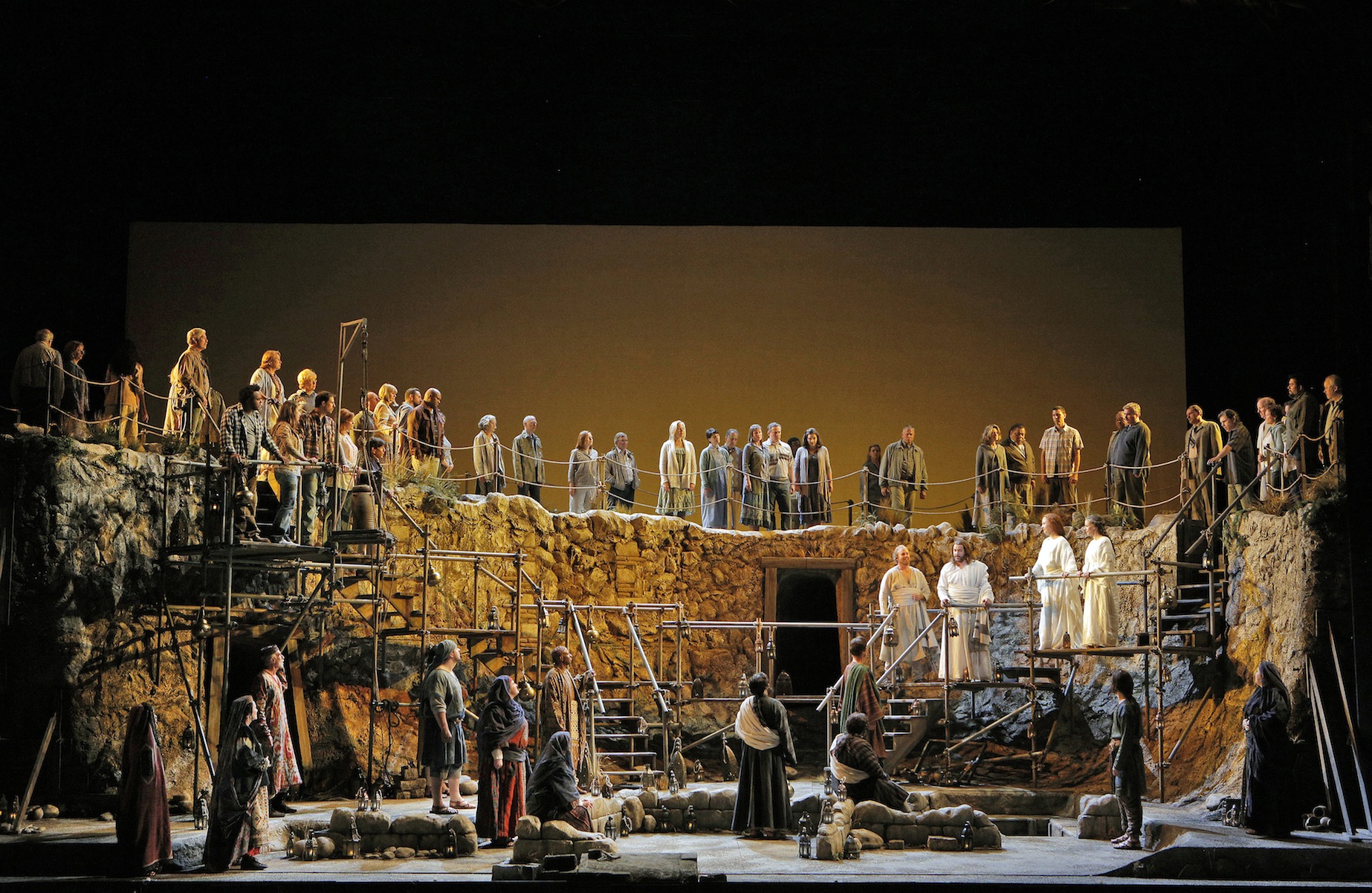
San Francisco Opera production of The Gospel of Mary Magdalene. Set by David Korins. Photo by Cory Weaver.

In the San Francisco production, which Adamo describes as “more King of Kings, if you will, that kind of Biblical spectacular look,” the modern characters got much less emphasis than he wanted. “Given the grandeur and the somberness of the setting, it was a stage that you could not do anything remotely personal, or witty,” he says.

To shift the focus back to the modern characters, and their relationship with the Biblical characters they conjure from their imaginations, Adamo cut the cast from 72 including chorus down to 16. “In San Francisco we had the five seekers (modern believers) and the chorus in modern dress, and then the Biblical characters, and all the supporting characters,” he explains. All of that has been reduced to the four principals—Yeshua (Jesus), Mary Magdalene, Miriam (Mary) and Peter—plus a dozen ensemble singers who take the other roles.

The original production was 2½ hours of music, plus intermission, which some listeners found to be ponderous. Adamo says he has reduced that to under 2½ hours including intermission. “Here’s the joke,” he says, “Nothing has been cut. A five-minute opening has been added, and the running time is shorter than in San Francisco.”

gs-adamo-portrait

Mark Adamo

“It starts with me,” he admits. “I had under-marked the tempos to so dramatic a degree that when I went back to the score in preparation for this production, I was looking at the metronome markings and saying, ‘what was I thinking? Are these tempos sponsored by Ambien?’

“All of this needs to move much more conversationally. When I met with (conductor) Andrew (Bisantz), I said, ‘assume the metronome markings you’ve got are 12 (beats per minute) slow.’”

Finally, Adamo wanted a setting that was not as monumental as the San Francisco production. “Is there a setting that is illustrative of the concerns of the show, that allows more nimbleness and a wider variety of dramatic tones?” he asks. “I did come up with that,” he says, adding slyly, “I’ll leave the surprise for you if you see the show.”

Adamo is particularly happy that the smaller number of singers and the more intimate setting has shifted the emotional focus of the performance. “For the most part, the stress is squarely on what the performers are doing and how they are defining the space and the emotional terms of the piece, rather than anything more elaborate,” he says.

“That and making the whole stage into a group, rather than principals and then a chorus, have been the principal innovations, and it has been a delight.”

# # # # #

CU NOW
Leigh Holman, founder and artistic/general director

The Gospel of Mary Magdalen
By Mark Adamo
Andrew Bisantz, conductor

7:30 p.m. Friday, June 16
2 p.m. Sunday, June 18
Music Theatre, Imig Music Building, CU

Free and open to the public

Advisory: These performances include adult content, sexual situations, and a stylized suggestion of violence, and may not be suitable for children.