Operas in the mountains, from 1816 to 2020

Two entertaining comedies and a grim story from the home front at Central City

By Peter Alexander July 15 at 1:52 p.m.

Central City Opera (CCO) opened their summer season June 28 with a brisk and bubbly production of Rossini’s 1816 comedy The Barber of Seville. The summer’s other stylistically varied productions have now opened: The Knock, a 21st-century tale of life on the home front during the Iraq war, composed in 2020 by Alessandra Verbalov with libretto by Deborah Brevoort, on July 5; and the 1959 Broadway hit Once Upon a Mattress by Mary Rodgers and Marshall Barer, on July 12.
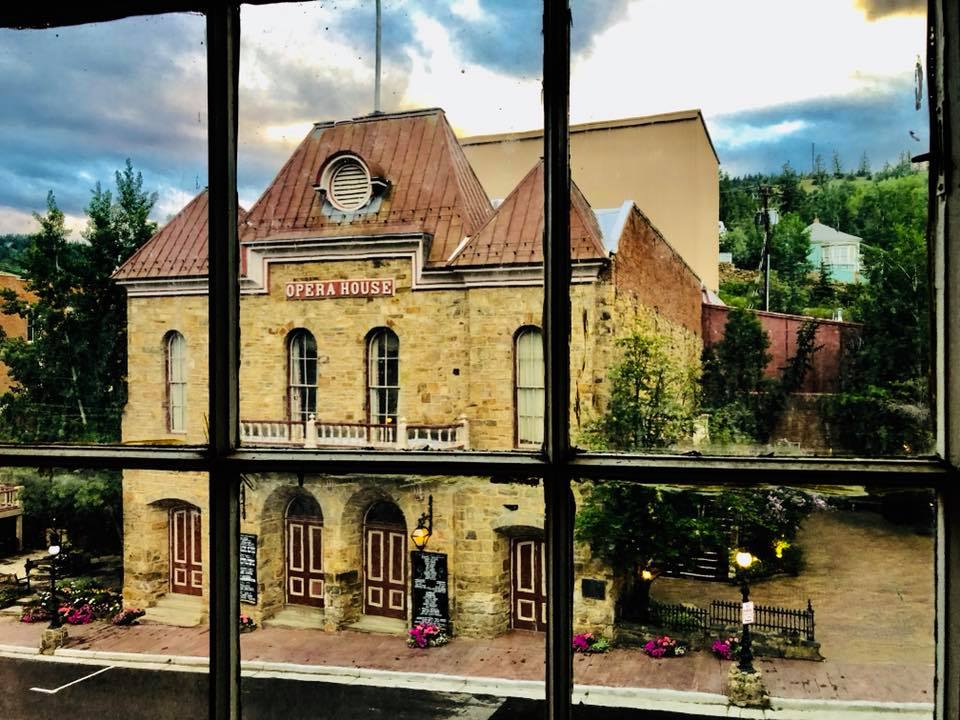
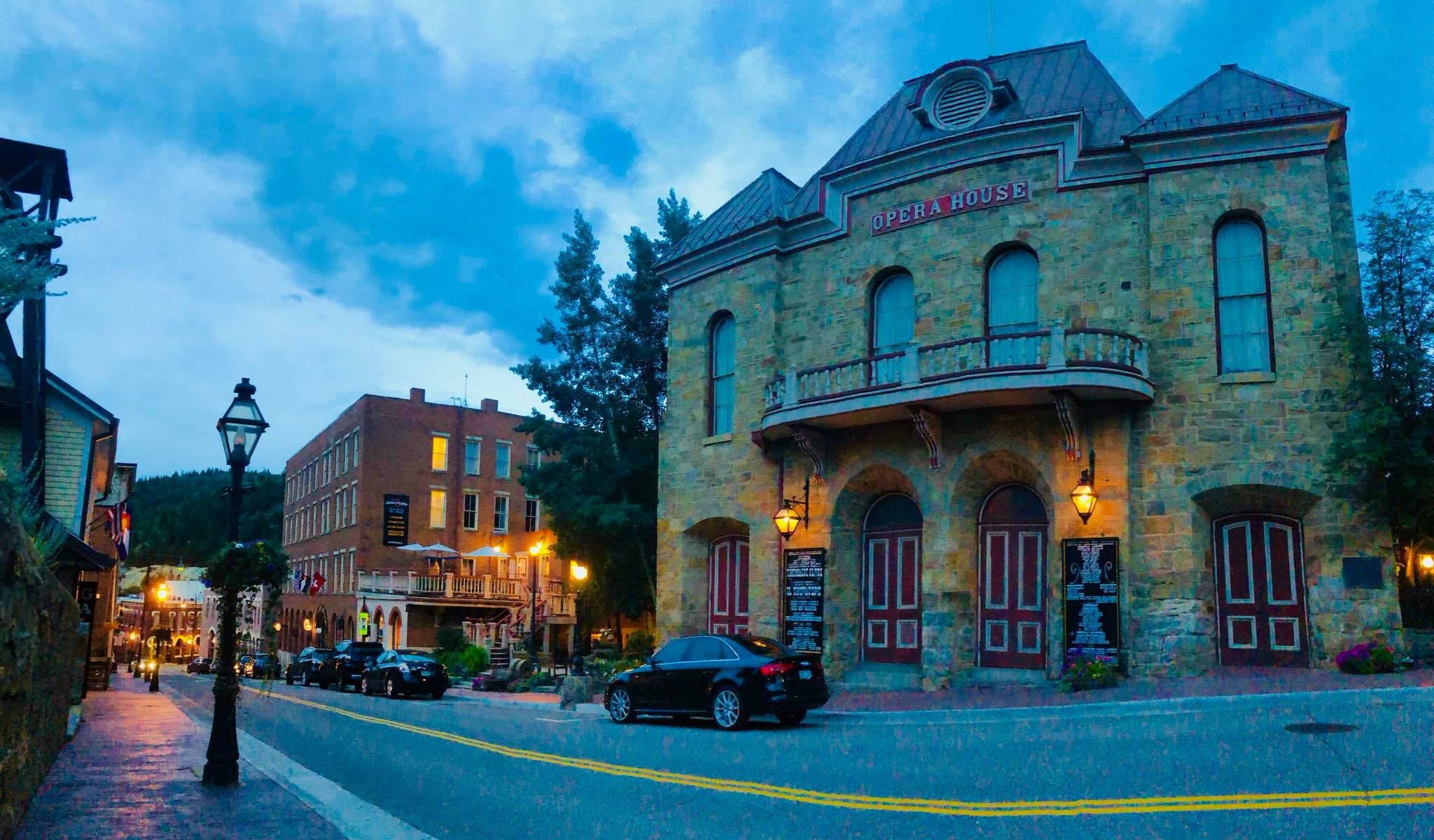
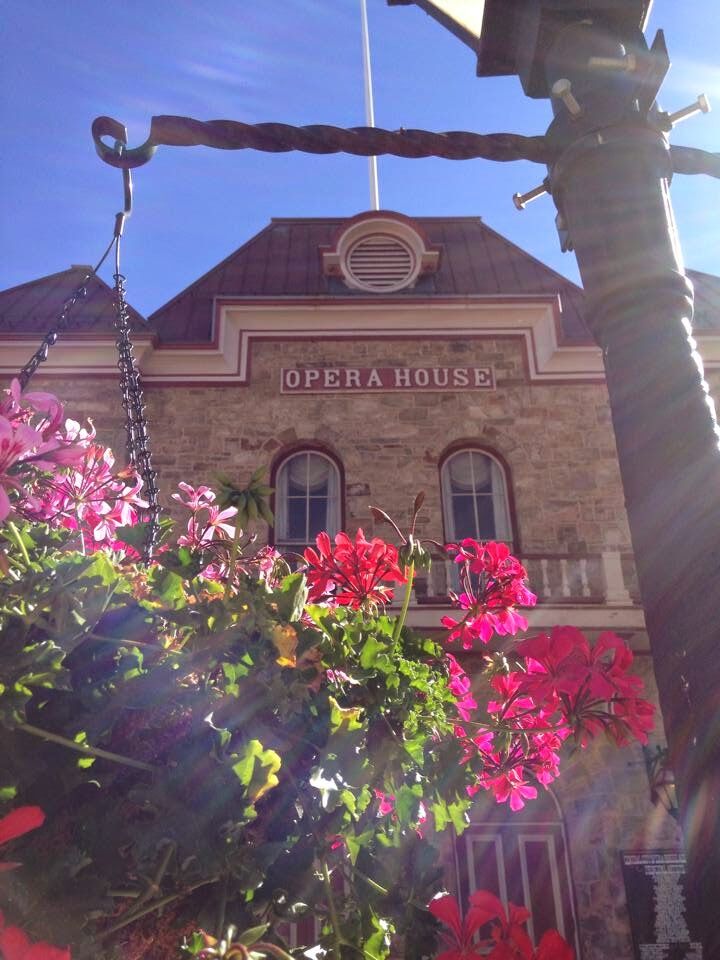
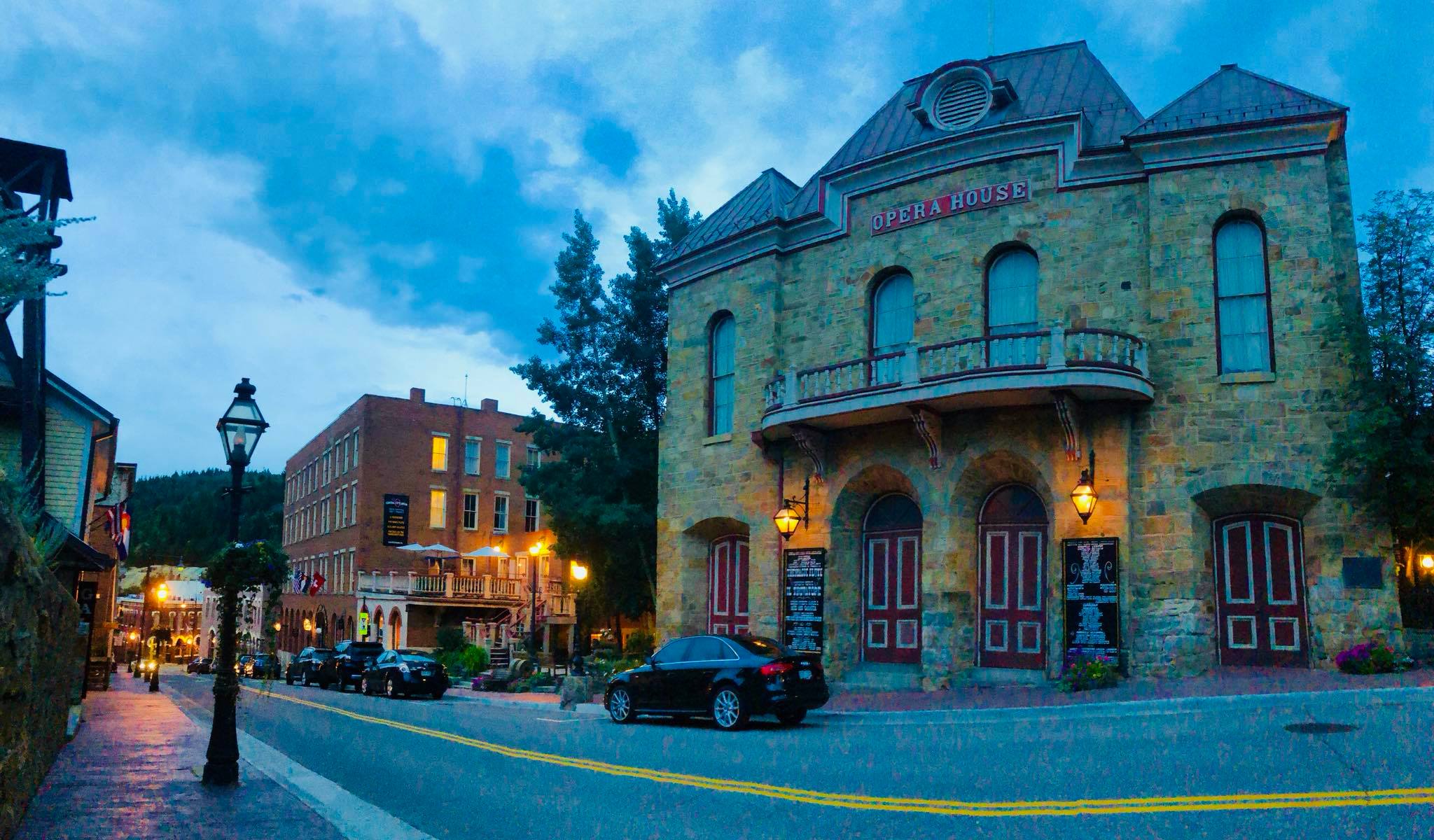
Central City Opera House. Photo by Ashraf Sewailam.

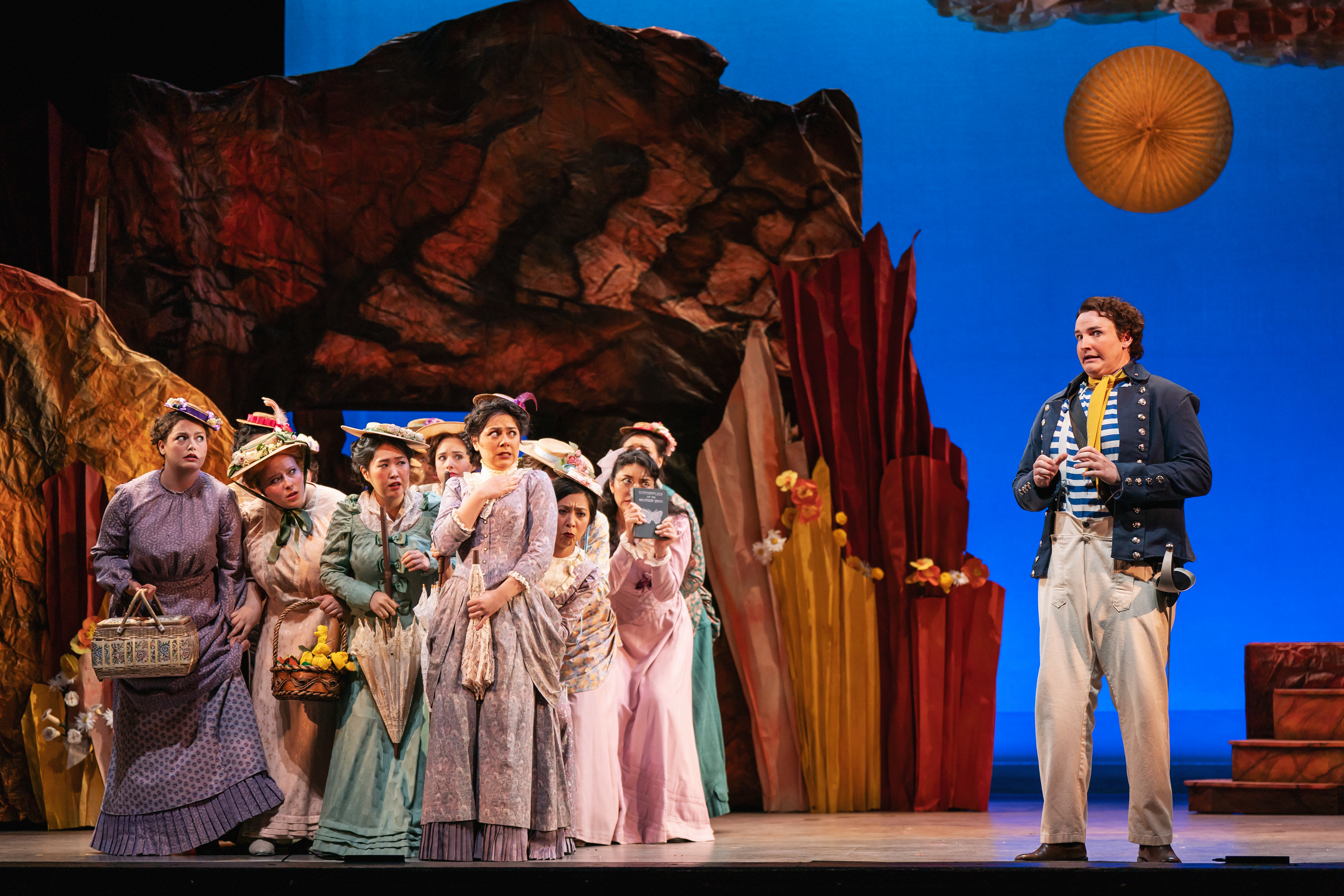
The Barber of Seville is presented with brilliantly colorful sets and costumes that belong to the Opera Theatre of St. Louis. Eric Sean Fogel’s Director’s Notes say that Barber has been placed “in 1930s Spain,” but that concept is almost irrelevant since it hardly touches the story. Stage design by Andrew Boyce reveals Rossini’s raucous comedy dressed up in bright, tropical colors—all yellow and pink on stage, plus a bright red sofa in the form of Rolling-Stones-reminiscent lips.

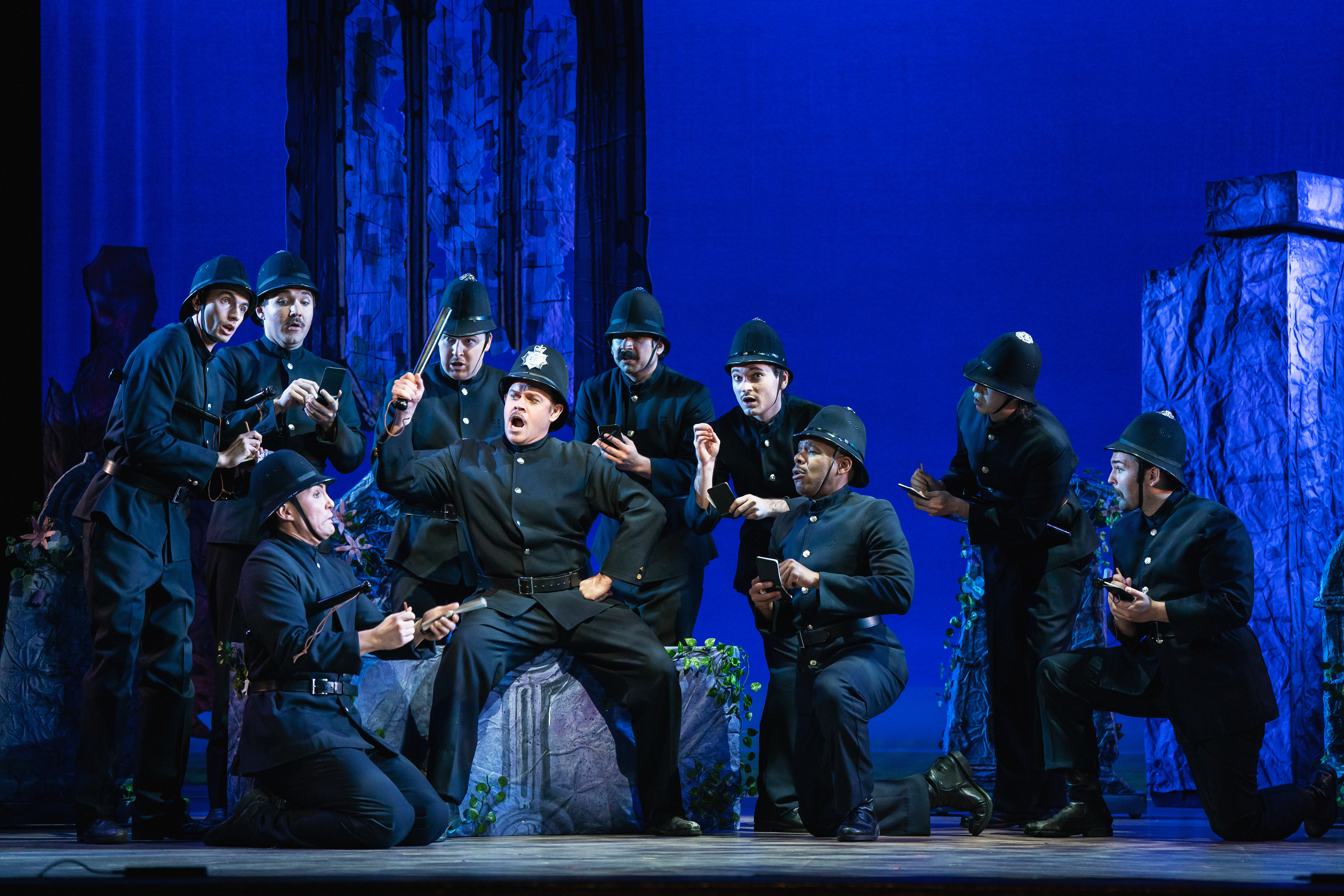
Costume design is by Lynly Saunders. She describes Barber as an opera “where you can really let loose,” and let loose she does. From police in 1930s-style uniforms—the one period reference that is unmistakable—each with one incongruously colorful sleeve, and giant sunflowers instead of rifles, to ridiculously overpuffed balloon pants and a garishly non-matched coat (or is it “power clashing”?), the costumes reveal a designer gleefully run wild. The crescendo of colors culminates with a joyful competition of surprise costume reveals by Almaviva and Rosina just before opera’s end. I can’t imagine anyone not being delighted by the over-the-top riot of colors.
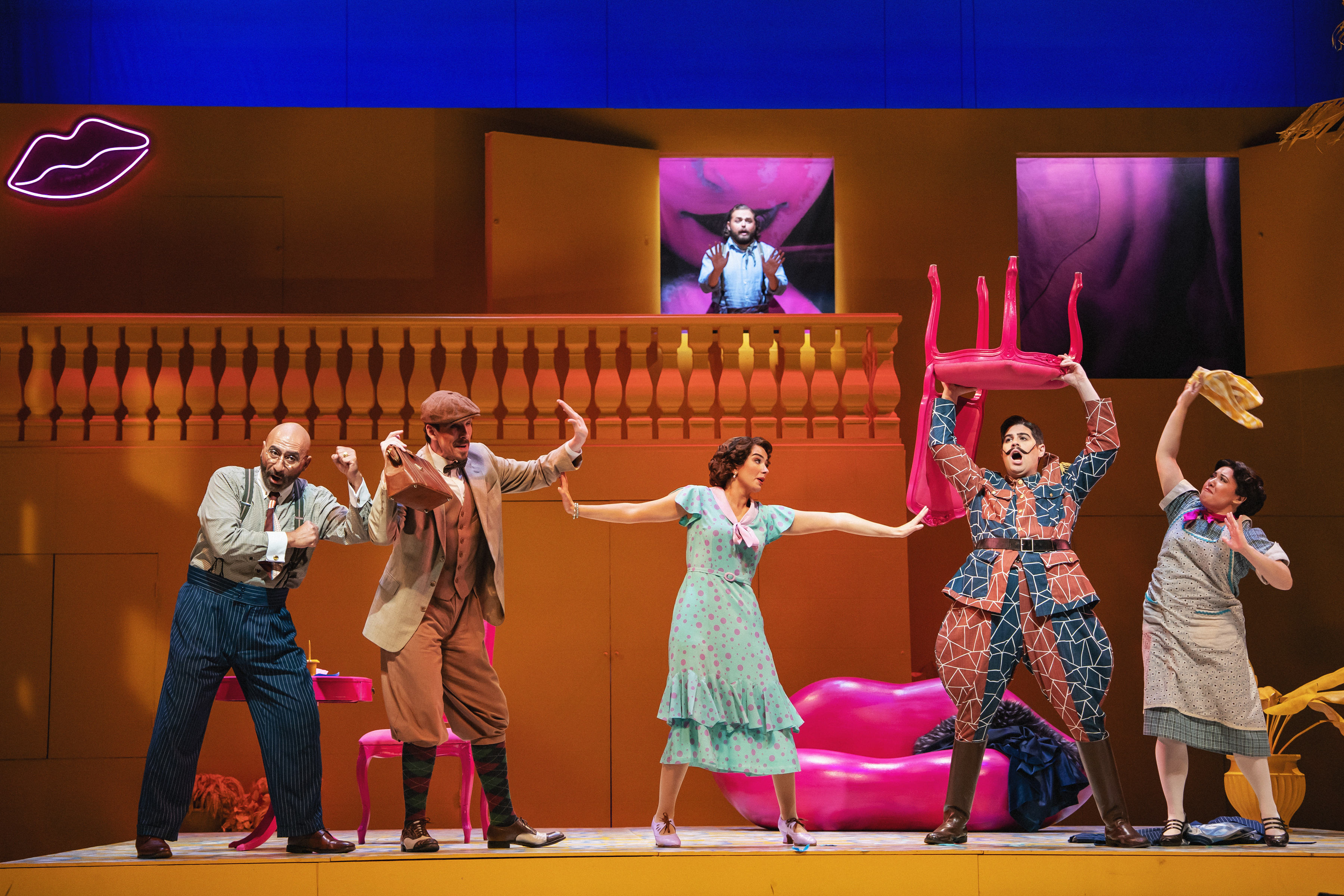
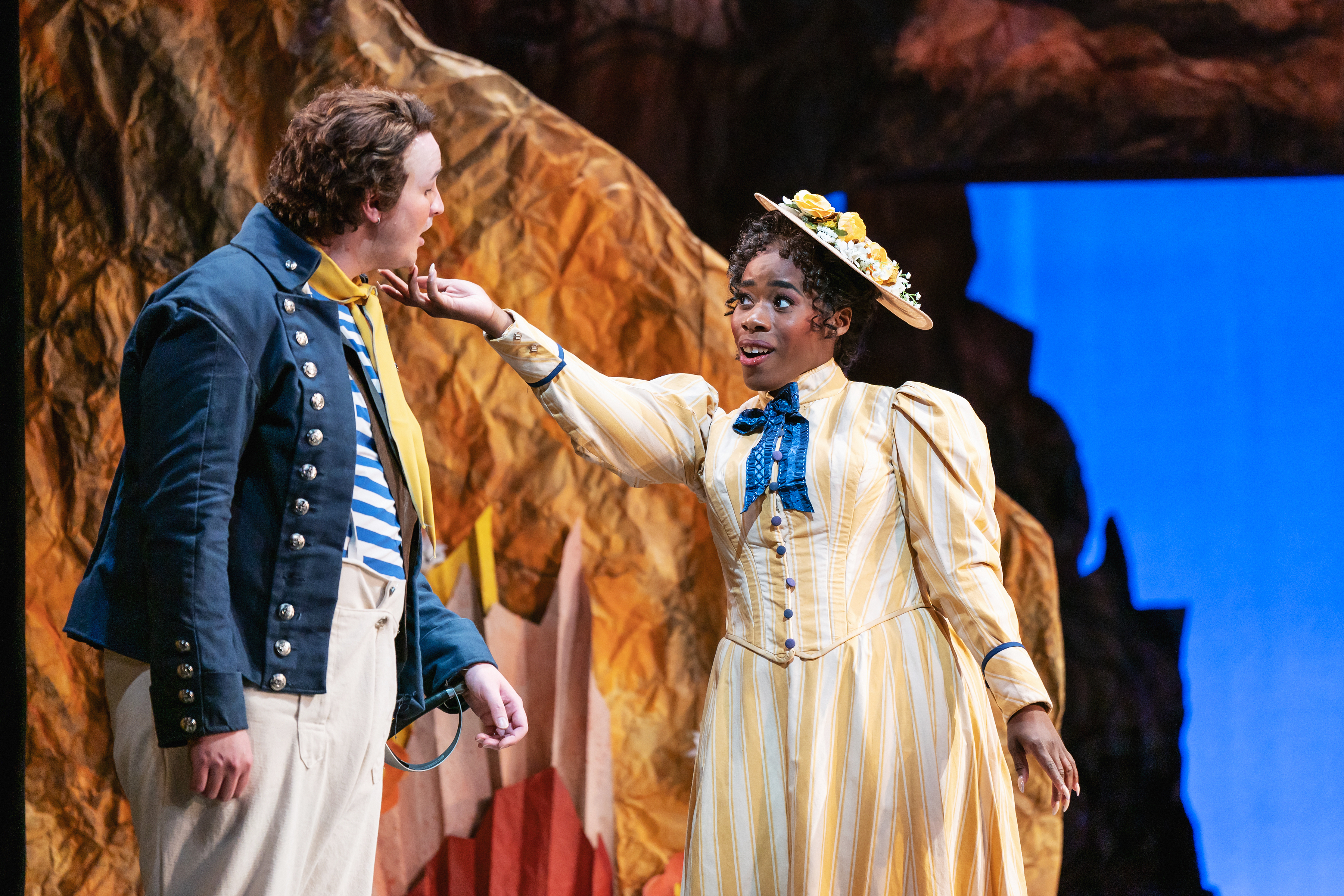
Barber of Seville cast, L-R: Ashraf Sewailam (Dr. Bartolo), Stefan Egerstrom (Don Basilio), Lisa Marie Rogali (Rosina), Andrew Morstein (Almaviva), and Laura Corina Sanders (Berta); Luke Sutliff (Figaro), above. Image by Amanda Tipton Photography

Stage director Fogel does not shy away from pure farce, but as a cast member reminded me, Barber of Seville is supposed to be farce. There are multiple doors, people popping in and out unexpectedly, pratfalls, a piano wider than the stage, and even a collapsing chair. Whether the manic silliness ever crosses a line will be a matter of individual taste. For me it pushed the line, but the hilarity was irresistible from beginning to end. 

The vocally strong cast embraced the production’s style with exuberant energy. As Almaviva, Andrew Morstein had difficulty negotiating registers at the outset and sounded strained at top volume, but was comfortable and sang with expression in his gentler moments. He got stronger across the evening, managing Rossini’s leaps and runs with increasing security, and finished as a winning romantic lead.

Luke Sutliff made a terrific Figaro, filling the theater with his voice and his personality. As Fogel observes in his notes, Figaro is the barber of the title, but the young lovers Almaviva and Rosina want to capture our attention. The direction and Sutliff’s performance make Figaro both the factotum who gets things done in Seville and the mainspring of the opera’s action, as he should be.

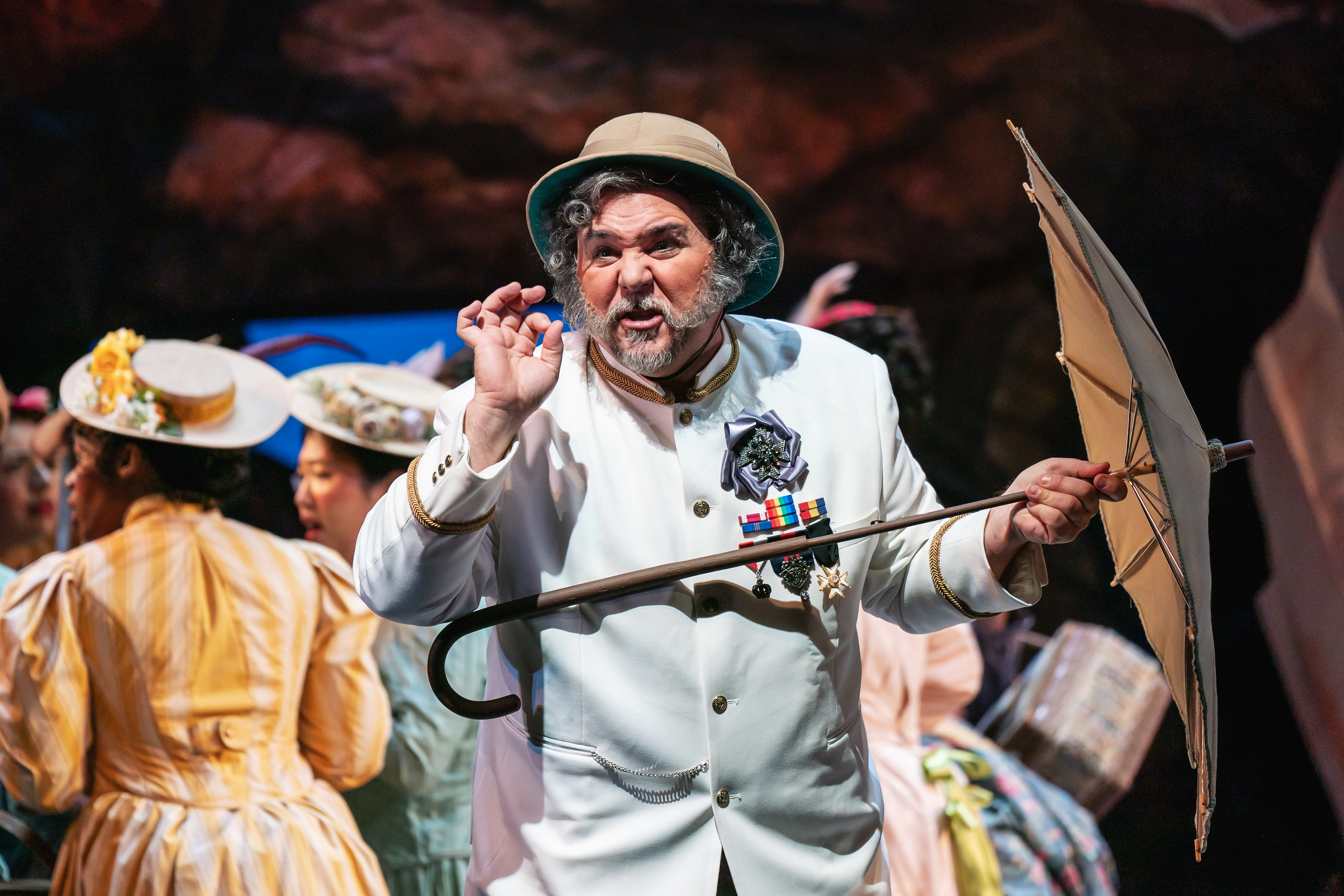
Ashraf Sewailum, known locally from previous performances at Central City, the University of Colorado Eklund Opera Company, and numerous concert appearances in Boulder, was brilliantly blustering and periodically baffled as Dr. Bartolo. His full bass voice easily filled Central City’s house. Both his musical phrasing and comic timing made him one of the stars of the show.
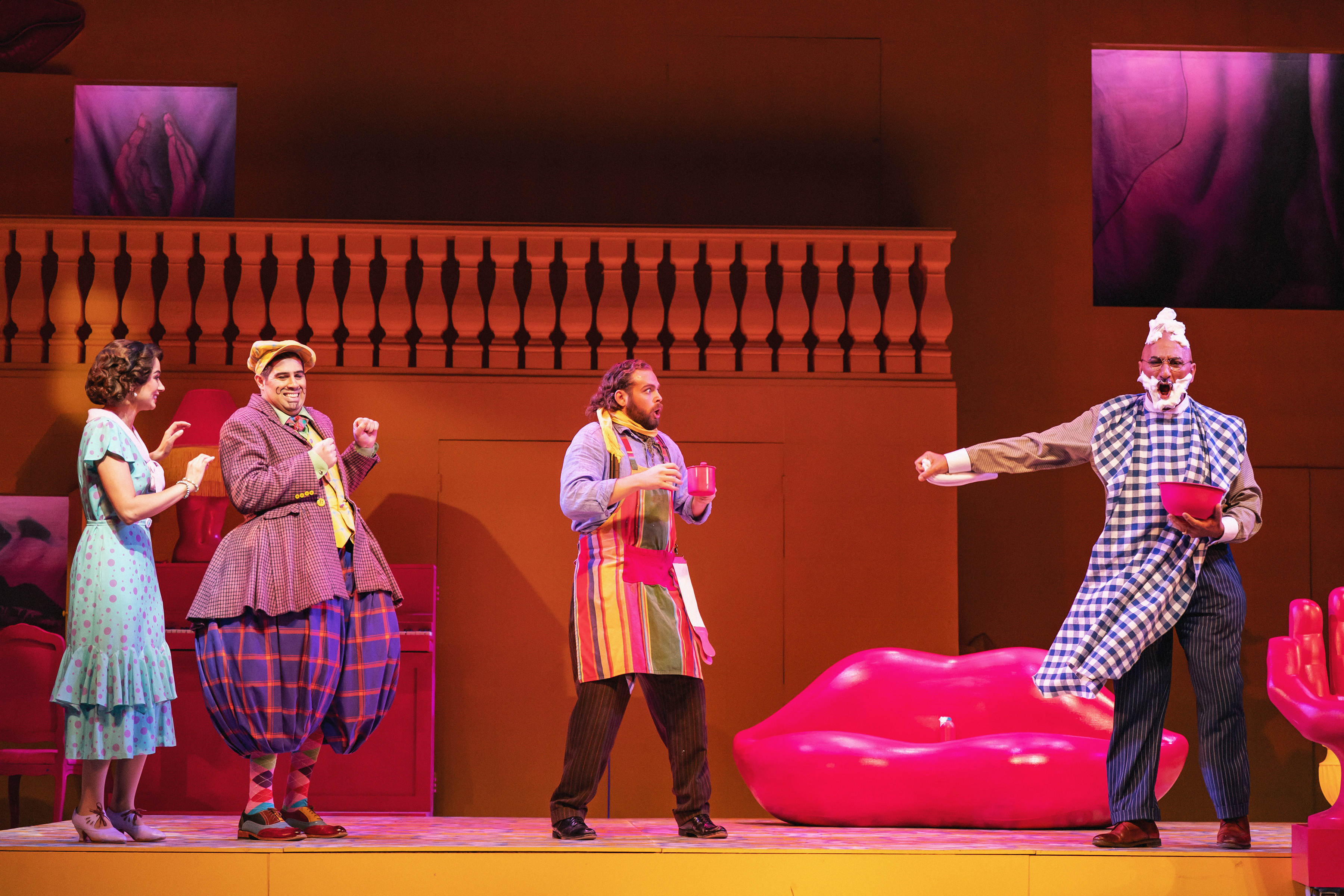
L-R: Rosina (Lisa Marie Rogali), Count Almaviva (Andrew Morstein), Figaro (Luke Sutliff) and Dr. Bartolo (Ashraf Sewailam). Image by Amanda Tipton Photography

Mezzo-soprano Lisa Marie Rogali lent her strong, resonant lower register and bright, sweet upper notes to the role of Rosina. Her melting lyricism and confidence in the coloratura passages made her trademark aria “Una voce poco fa” a highlight. Happily she captured the strength and determination of the character, avoiding cliches of the submissive ward and previewing the independent countess of Mozart’s Marriage of Figaro.

Stefan Egerstrom humorously portrayed Don Basilio as a purse-carrying, prancing dandy. His on-target performance was one of the keystones of the interpretation of Barber as farce. Equally fit for her comic role was Laura Corina Sanders as Berta, the unruly servant. She took full advantage of the possibilities the over-the-top production style offered her character.

Louis Lohraseb, who has conducted opera in Rome, Hamburg, Dresden and Berlin, made his Central City Opera debut leading Barber. Under his baton, the orchestra played with stylish restraint, never overpowering the singers. The overture was bright and energetic, despite a few soggy moments.

# # # # #

Nestled between two comedies, Aleksandra Vrebelov’s The Knock tackles the deeply serious question of the hidden pain and tragedies of war. During the 2003–11 Iraq war, American military wives endure a long night of suspense when they are cut off from communication with their husbands in Fallujah. The title refers to the dreaded knock on the door, when a military officer will officially notify one of them of her husband’s death.

Vrebalov’s score was receiving only its second full stage production, since the planned premiere at the 2020 Glimerglass Festival had to be presented on film, due to COVID. The performance at Central City was a fitting regional premiere, as The Knock is set in and around Ft. Carson, Colorado.

Born in Serbia, Vrebalov directly experienced the horrors of war during the 1998–99 Kosovo War and the devastating NATO bombing of her hometown of Novi Sad. This experience stands behind several of her most successful pieces.

In The Knock, her subtle music expresses the rising tension among the military wives at home through steady background chords and ostinato patterns that increase in intensity. A sharp and expressive score, it signals the buildup of despair and fear without resorting to bombast.
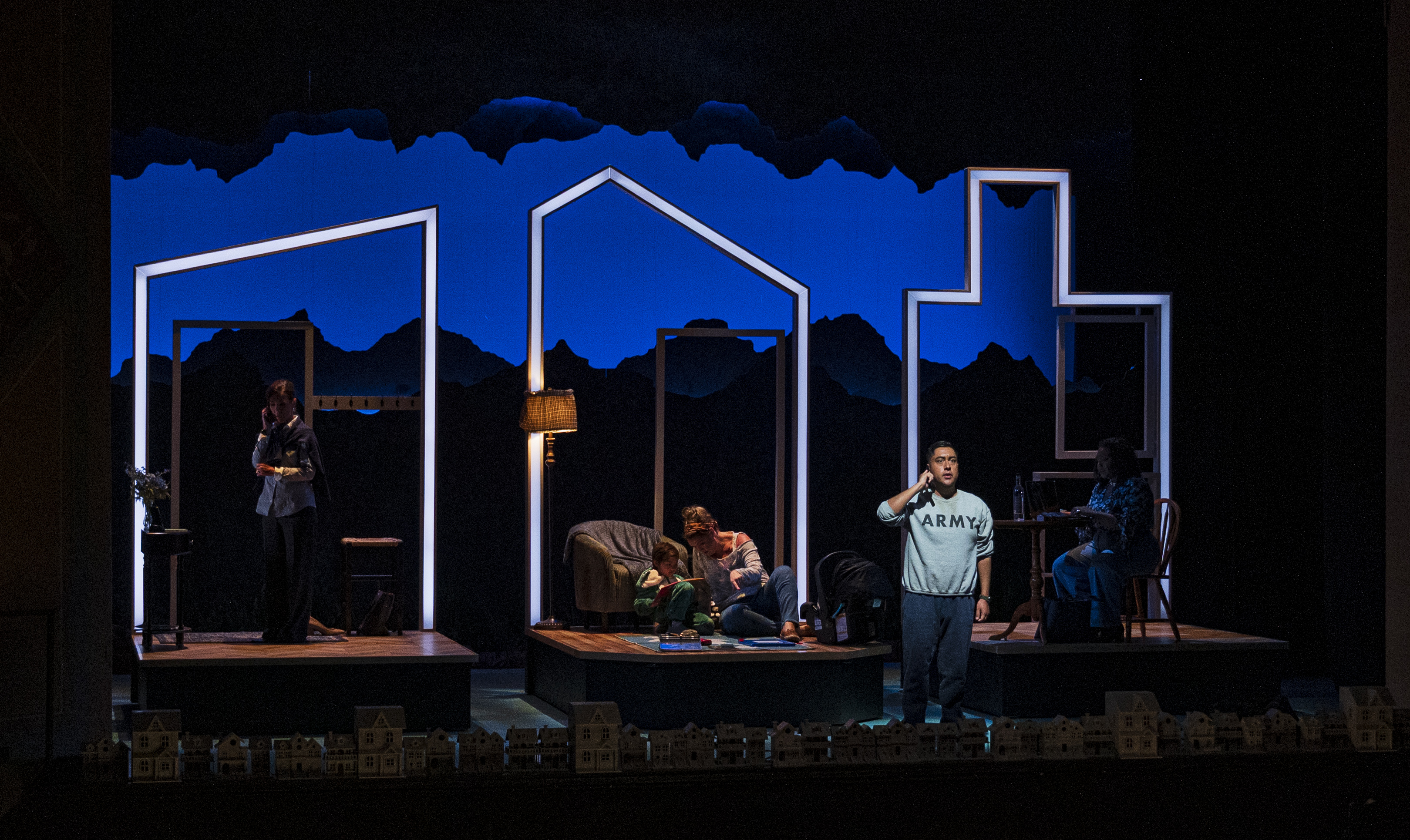
The three houses that form the setting of The Knock. Downstage, Lt. Robert Gonzalez (Armando Contreras) gets the call to deliver “the knock.“ Photo by Lawrence E. Moten III.

The evocative set by Lawrence E. Moten III comprises brightly lit outlines of three houses, those of Jo, Aisha, and an unnamed other military wife. A row of tiny houses across the front of the stage, sometimes lit from inside, represent the larger community of military families. In the back, the outline of Colorado mountains can be seen against a deep blue late-evening sky that is symbolically lit with stars at show’s end.

Three characters dominate the action. Joella “Jo” Jenner is a young wife and mother of two who is undergoing her first nighttime vigil waiting for word from the battlefield. Portraying a nearly one-dimensional character—the mother terrified for herself and her children—Mary-Hollis Hundley ably expresses Jo’s unease and her fragility.
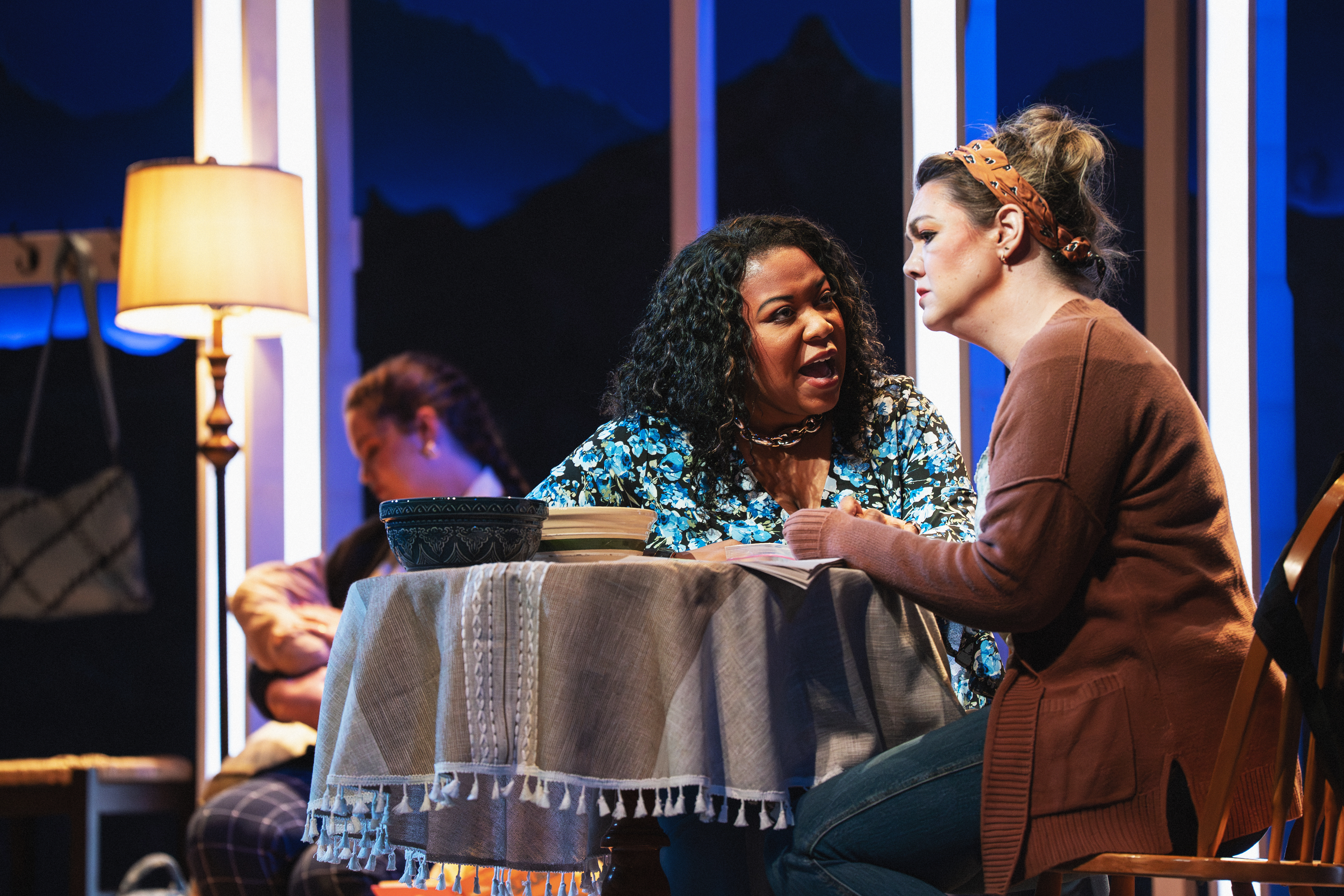
Aishah (Cierra Byrd) tried to console Jo Jenner (Mary-Hollis Hundley). Image by Amanda Tipton Photography

Paired with Jo is Aishah McNair, a more experienced military wife who tries to offer support and perspective to the young mother. Cierra Byrd gave Aishah depth, especially near the end when launching the number “When the person you love is far away,” which blooms into an ensemble number. Her warm, smokey contralto complimented Hundley’s more delicate soprano throughout their scenes together.

Lt. Roberto Gonzalez is a young soldier tormented by being stationed in the U.S. while his comrades face combat. He has been tapped to deliver the mournful news—the knock—for the first time, leaving him nervously trying to fulfill the duties as described in the manual.
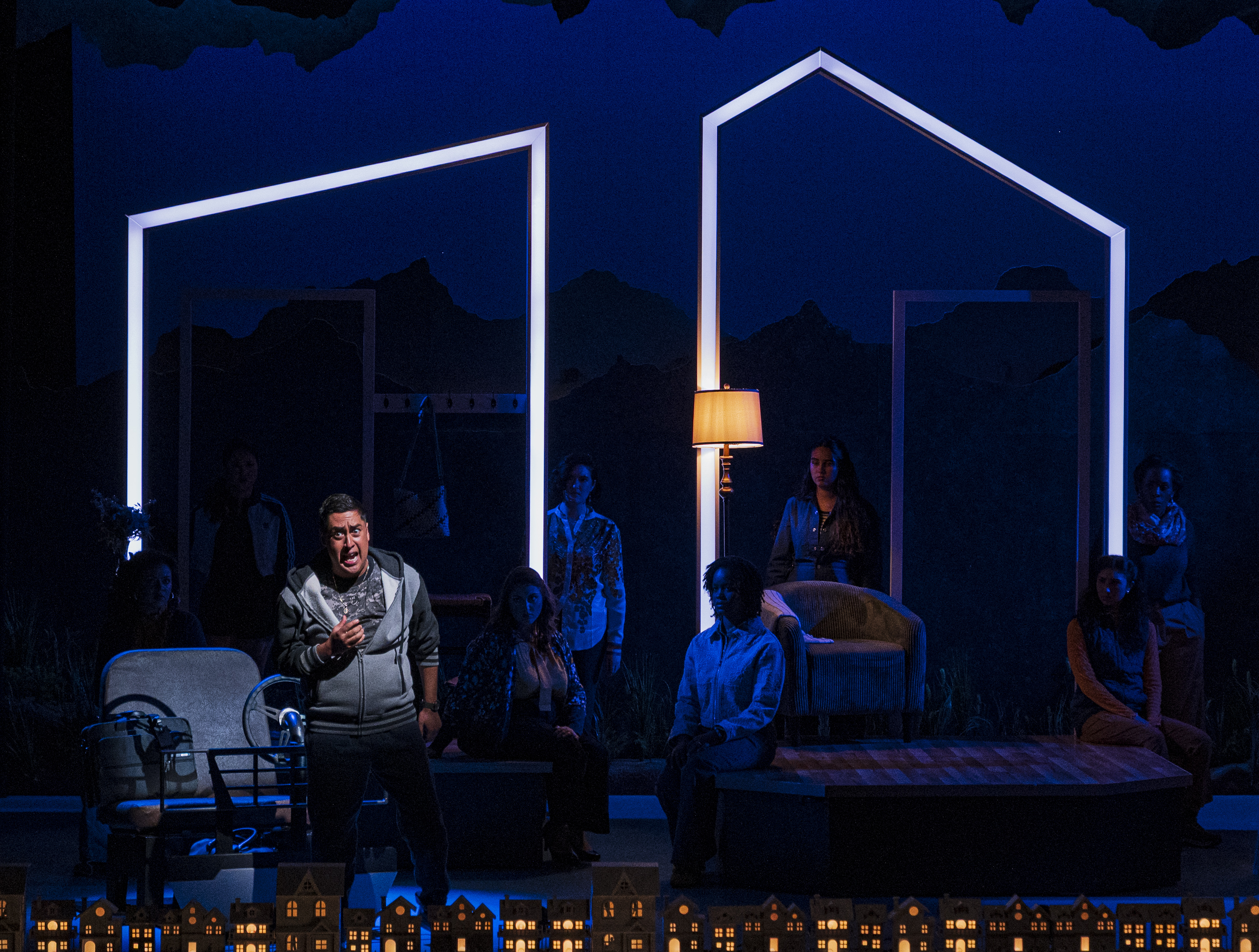
Lt. Gonzalez (Armando Contreras) agonizes over his duty to deliver the news of a soldier’s death. Photo by Lawrence E. Moten III.

Baritone Armando Contreras overplayed Gonzalez’s stress, staying at a high volume and almost shouting his way through parts of the role. His repeated invocations of the Virgin de Guadalupe were more than needed, since his sincere faith and apprehension are evident from the start. His lovely singing in the concluding ensembles, when Lt. Gonzalez relaxes into tender feelings for the women he confronts, show that he has a wider range of expression and styles than are heard for most of the opera.

Conductor David Bloom managed the mixed chamber ensemble in the pit comfortably, keeping the music moving through the rather extreme emotional ups and downs of the characters. Moritz’s stage direction effectively kept the action clear, as it moved from separate houses, to one house where the wives gathered, to scenes of Lt. Gonzalez facing his fears while traveling cross country.

The poignant conclusion of the opera—with one wife facing a devastating development and the others embracing relief—provides music that expresses both sentiments, or as the text has it, “Joy and Sorrow.” And the concluding lines describing the folded flag that every war widow receives, “Blue and Stars are All that will Remain,” remind us eloquently of the show’s central point, that the ripples of war’s tragedies spread across society. It is a sobering moment in a powerful piece.

# # # # #

Once Upon a Mattress, which opened Saturday (July 12), was the first full-length Broadway show by Mary Rodgers, daughter of the famed Broadway composer Richard Rodgers who was half of the musical-comedy teams of Rodgers & Hart and Rodgers & Hammerstein. Growing up in so musical an environment, Mary Rodgers naturally took to composing as a teenager, and had a very successful career writing music for children’s records, musicals and reviews, and was the author of several children’s books.

Her one big Broadway hit, Once Upon a Mattress opened in 1959 and perfectly fits the mold of 1940s and ‘50s musicals. It offers ample opportunities for catchy songs, quirky characters, a heavy dose of theatrical silliness, and a thoroughly happy ending. The music is never compelling or deeply memorable, but it is never less than pleasant. The book is full of gags and jokes that elicited hearty laughter from the audience on Saturday.
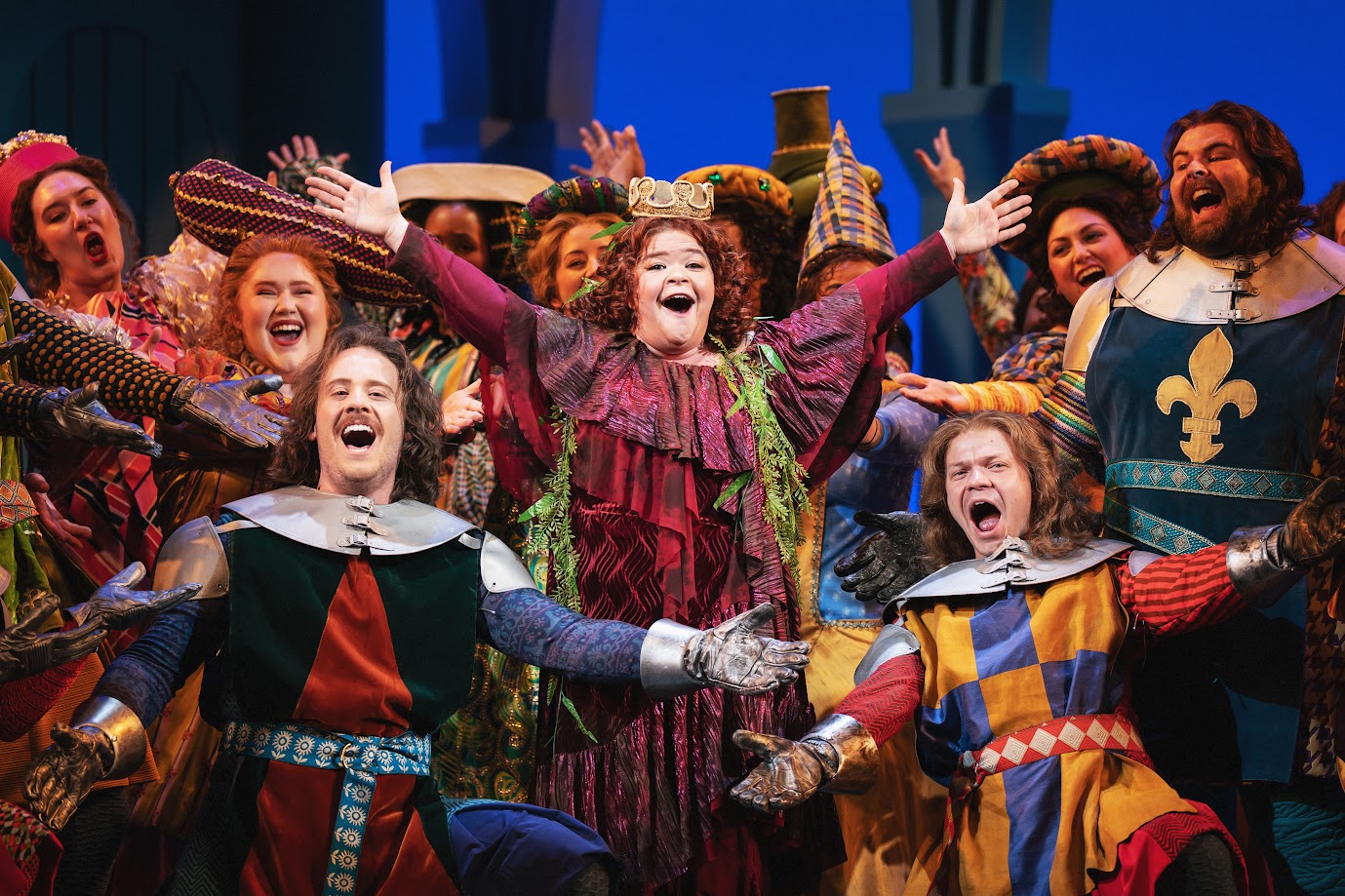
Ensemble cast of Once Upon a Mattress. Princess Winifred (Marissa Rosen) draped with weeds from the moat, center. Image by Amanda Tipton Photography

The plot skates cheerfully on the surface of the Hans Christian Anderson tale of “The Princess and the Pea,” with a goofy young Prince dominated by a despotic mother who will only allow him to marry a proper princess. In the meantime, no one in the kingdom—or is it queendom, since his father is mute?—is allowed to marry until the timid Prince Dauntless the Drab is wed to a suitably, queen-approved mate. 

A hopeful candidate shows up in the form of Princess Winifred the Woebegone from a marshy realm—the Broadway debut role of Carol Burnett in 1959. Queen Aggravain has imposed a test on every potential bride, which all have failed. For Winifred she devises the pea under 20 mattresses (actually 14 at Central City), with the expected result.

All of these more or less stereotyped characters were portrayed with the broad humor the show wants. Everyone in the cast had a suitably lyrical musical theater voice, capable of crooning all the ballads and other musical numbers of the score. There are a few solo numbers and many duets and ensemble numbers, all well handled by the consistency solid cast. 

Margaret Gawrysiak was everything you could want for Queen Aggravain—imperious, haughty, comically unyielding and too eager by half to rule out potential brides. Michael Kuhn was an ideal Prince, completely under the sway of his controlling mother, with just the right touch of modern nerdiness thrown in. Marissa Rosen made an especially strong impression as Princess Winifred, with just enough of her own nerdiness to captivate Dauntless. She projected the latent athleticism fitting for a princes who, in a moment shocking to the court, “swam the moat” and entered trailing tangles of weeds. 
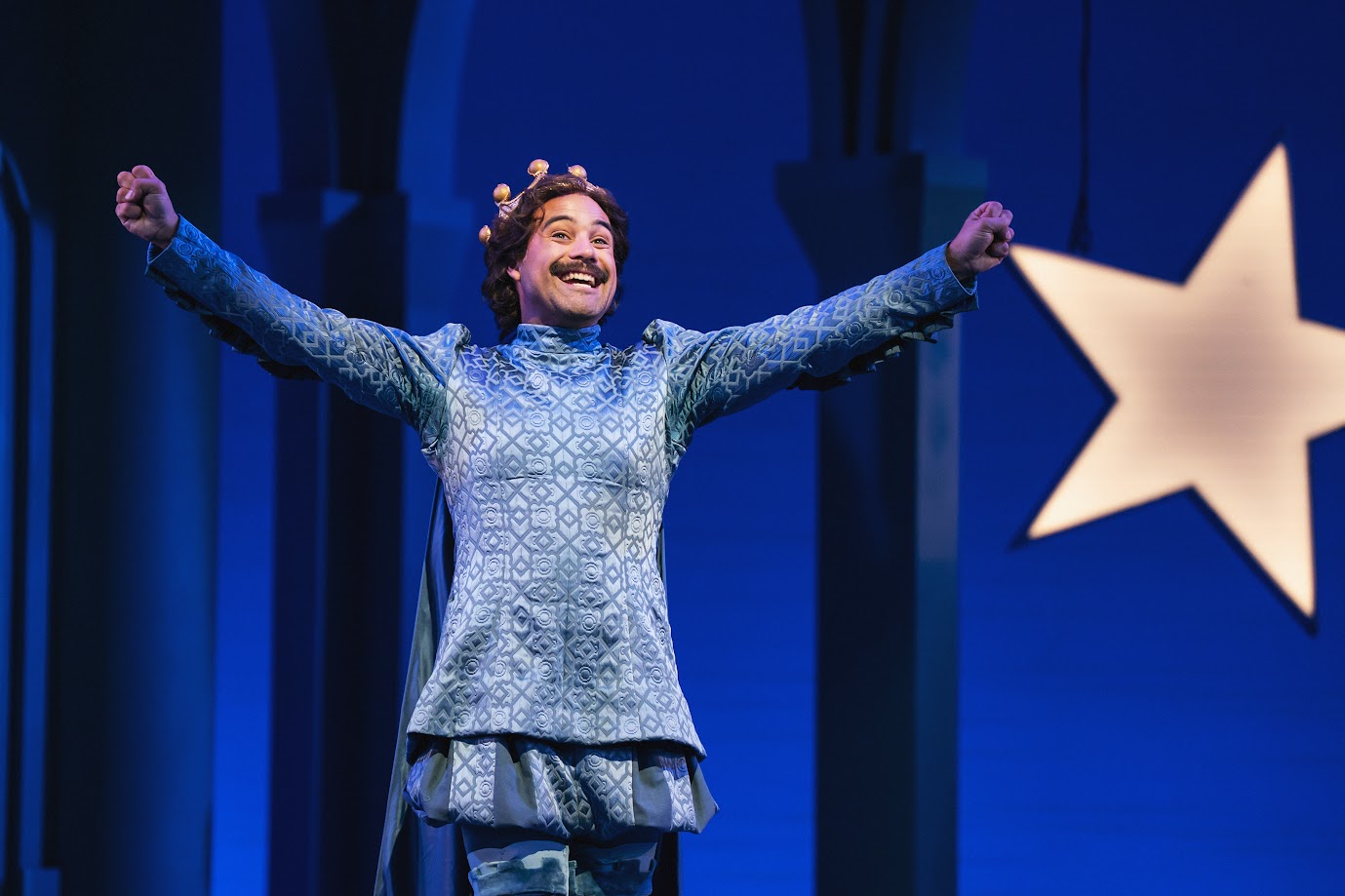
Prince Dauntless the Drab (Michael Kuhn). Image by Amanda Tipton Photography

As the Jester and Minstrel, Alex Mansoori and Bernard Holcomb were well matched stage buddies, either bantering or singing together. Jason Zacher made good use of his short appearances as a wizard who does parlor tricks at random moments. The on-again, off-again couple of Sir Harry and Lady Larken, who have a growing reason for the ban on marriage to be lifted. The couple were well portrayed by Schyler Vargas, who had fun with Sir Harry’s sense of importance, and Véronique Filloux, fittingly flighty as Lady Larken. Together they captured all the traditional nuances of the couple who are happiest while quarreling.

Special mention must be made of Andrew Small, who delighted in his CCO debut as the mute King Sextimus, who has an unfulfilled taste for the ladies in waiting at the court. The son of a musician who played in the CCO orchestra in the 1980s, Small first attended the opera when he was 10, leading to a career on stage. He wrote for the program that performing at CCO is “a deeply meaningful, full-circle moment.”

Seated at the very back of the house I could not always hear the voices over the orchestra. Out from under the balcony and closer to the stage, the sound was probably better. In all other respects conductor Kelly Kuo led a stylish and energetic performance.

The scenic design by Andrew Boyce fits the classic Broadway ambience perfectly, walls and arches suggesting a cartoonish court. The costumes by Elivia Bovenzi Blitz are standard theater-medieval—colors and fabrics no one saw in the middle ages, but pleasantly evocative of make-believe realms.

The stage direction by Alison Fritz, the artistic director of CCO, kept the show moving seamlessly. John Heginbotham’s choreography was handled smoothly by all of the acting/singing/dancing members of the large cast. 

Those who love Broadway will relish the opportunity to attend a professional production of Once Upon a Mattress, performed with full orchestra and Broadway-worthy voices. If that’s your dish, go for it! If not, the farcical Barber of Seville and deeply thoughtful The Knock are equally worth a trip into the mountains. 

NOTE: Performances of all three shows at Central City continue through the month and into August. The full schedule is listed below. 

# # # # #

Central City Opera
Remainder of the 2025 Summer Festival Season
All performances in the Central City Opera House, Central City, Colo.

Rossini: The Barber of Seville

7:30 p.m. Saturday, July 19
2 p.m. Tuesday, July 15; Friday, July 25; Saturday, July 26; Wednesday, July 30; Sunday, Aug. 3

Aleksandra Verbalov: The Knock

7:30 p.m. Saturday, Aug. 2
2 p.m. Sunday, July 19; Tuesday, July 22

Mary Rodgers and Marshall Barer: Once Upon a Mattress

7:30 p.m. Saturday, July 26
2 p.m. Wednesday, July 16; Friday, July 18; Sunday, July 20; Wednesday, July 23; Sunday, July 27; Tuesday, July 29 Friday, Aug. 1; Saturday, Aug. 2

Tickets for all remaining performances are available on the CCO Web Page.

Coming opera seasons in Colorado

CU Eklund Opera and Opera Colorado announce 2025–’26 seasons

By Peter Alexander March 17 at 5:43 p.m.

Leigh Holman stepped before the rich, ruby-red curtains at Macky Auditorium yesterday (March 16) afternoon and spoke to the audience.

The occasion was the final performance of CU’s production of Gilbert & Sullivan’s Pirates of Penzance. Holman is the director of the Eklund Opera Program at CU-Boulder, and in addition to welcoming the full house in Macky, she made an announcement of interest to opera lovers in the area. She named the works in Eklund Opera’s 2025–26 season—or most of them.

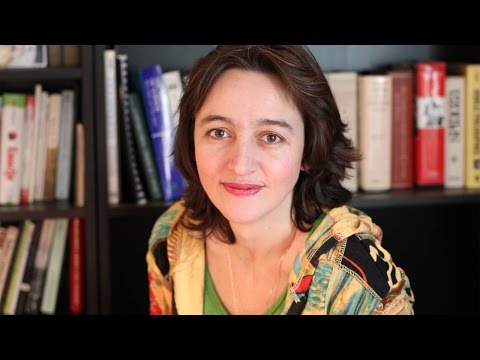
Leigh Holman

The fall production, she said, will be one of the most successful operas of the past 25 years, Jake Heggie’s Dead Man Walking. Premiered in 2000 by the San Francisco Opera it has since been performed in dozens of productions, at CU in in 2007, Central City Opera in 2014, at the Metropolitan Opera in New York, Houston Grand opera, in university and regional productions around the country, and major houses around the world. 

Based on the memoir of the same name by Sister Helen Prejean, Dead Man Walking features a  libretto by playwright Terrence McNally. The plot revolves around Prejean’s death-row ministry with a convict who was executed for murder in Louisiana in 1984.

Homan then announced that in April, 2026, the Eklund program will present Leoš Janáček’s folk-ish Cunning Little Vixen, a charming and harsh tale of life in the animal world. Finally, she said that the third production, appearing in the March time slot, would be a musical comedy presented in conjunction with the CU program in musical theatre. Contractual obligations, common with the performance of musicals, prevent the release of the show’s title at this time.

Opera Colorado in Denver also has announced the operas that will be their main stage productions in the 2025–’26 season. November will see performances of Verdi’s La Traviata, and in May Opera Colorado will present Puccini’s Madama Butterfly. In the meantime, there will be semi-staged concert performances of Verdi’s Il Trovatore featuring a full cast with the Opera Colorado orchestra and chorus, 7:30 p.m. Saturday, April 26, and 2 p.m. Sunday, May 4, in the Ellie Caulkins  Opera House at the Denver Performing Arts Complex. 

Ellie Caulkins Opera House, Denver

The company’s Calendar of Events lists the dates for all performances and access to the box office for the purchase of individual tickets for the remainder of this season, as well as subscriptions for the ’25–’26 season. 

Central City Opera House

Central City Opera’s summer 2025 season has already been announced, but if you missed it, this year’s summer festival at the Opera House in Central City will feature Rossini’s Barber of Seville, Aleksandra Verbelov’s contemporary The Knock, inspired by events during the 2003–’11 Iraq War, and the 1959 Broadway hit Once Upon a Mattress, recently revived in New York and Los Angeles to great acclaim.

The full summer calendar, and access to the purchase of subscriptions and group bookings can be found HERE. Individual tickets will go on sale April 1.

Not in Colorado but within a reasonable day’s drive for people in the Boulder area, the Santa Fe Opera presents productions in a unique and stunning outdoor theater in the New Mexico mountains. Productions for the summer of 2025 will be Puccini’s La Bohème, Mozart’s Nozze di Figaro (Marriage of Figaro), Verdi’s Rigoletto, Benjamin Britten’s Turn of the Screw and Wagner’s Die Walküre

Santa Fe Opera. (c)Bob Godwin/rgbphotography@mac.com

The full calendar for the Santa Fe Opera is located HERE. Tickets can be purchased through the company’s 2025 Season page. 

NOTE: At the request of the Eklund Opera Program, a quote that that could potentially identify the musical to be presented in March, 2026, was removed from the fifth paragraph of this story as of March 13, 2025.

Central City Opera announces full summer season

Broadway show Once Upon a Mattress added to the 2025 schedule

By Peter Alexander Jan. 5 at 5:45 p.m.

Central City Opera House. Photo by Ashraf Sewailam.

Central City Opera has announced their full summer 2025 season, adding the Mary Rodgers musical comedy Once Upon a Mattress to the two operas previously announced.

The season will open June 28 with Rossini’s comic masterpiece The Barber of Seville. Always a favorite with audiences, Barber returns to the Central City stage for the first time in 12 years. 

The second opera of the summer will be the one-act opera The Knock by composer Aleksandra Vrebalov and librettist Deborah Brevoort. Named for the expression military families use for notifications of soldiers’ deaths, this patriotic opera explores feelings of hope and heartache during the Iraq war. The Knock was commissioned by the Glimmerglass Festival and Cincinnati Opera through a grant from the Mellon Foundation. 

The Cincinnati Opera production in the summer of 2023, directed by CCO’s artistic director Alison Moritz, sold out five performances and an added matinee.

Based on the Hans Christian Andersen fairy tale “The Princess and the Pea,” Once Upon a Mattress opened off Broadway in May, 1959, and moved to Broadway later the same year. The musical score is by Mary Rodgers, with lyrics by Marshall Barer and book by Barer, Jay Thompson and Dean Fuller. A novelist as well as screenwriter and composer, Mary Rodgers is the daughter of the famed Broadway composer Richard Rodgers.

That original production starred Carol Burnett in her first Broadway role, and received Tony Award nominations for Best Musical and Best Actress in a Musical (Burnett). A recent popular revival starring Sutton Foster and Michael Urie played on Broadway July 31 to Nov. 30, 2024, with additional performances at the Ahmanson Theatre in Los Angles in December and January. 

All three shows will be performed in repertory at the Central City Opera house between June 28 and Aug. 3 (see the full schedule below). They open with 7:30 p.m. performances on successive Saturdays, starting June 28. Most successive performances are 2 p.n. matinees, as listed in the schedule below. All performances will be in the historic Central City Opera House.

Subscription renewals are currently available for prior subscribers, and the Central City Box Office is taking requests for new subscriptions. Ticket sales to single performances will begin at a later date.

# # # # #

Central City Opera
Summer 2025 Festival Schedule
All performances in the Central City Opera House

Gioachino Rossini: The Barber of Seville

7:30 p.m. Saturday, June 28, Saturday, July 19
2 p.m. Wednesday, July 2; Friday, July 4; Sunday, July 6; Saturday, July 12; Tuesday, July 15; Friday, July 25; Sunday, July 26; Wednesday, July 30; Sunday, Aug. 3

Aleksandra Vrebalov and Deborah Brevoort: The Knock

7:30 p.m. Saturday, July 5; Saturday, Aug. 2
2 p.m. Wednesday, July 9; Friday, July 11; Sunday, July 13; Saturday, July 19; Tuesday, July 22

Mary Rodgers and Marshall Barer: Once Upon a Mattress

7:30 p.m. Saturday, July 12; Saturday, July 26
2 p.m. Wednesday, July 16; Friday, July 18; Sunday, July 20; Wednesday, July 23; Saturday, July 27; Tuesday, July 29; Friday, Aug. 1; Saturday, Aug. 2

Subscription renewals are currently available HERE, and new subscribers can join a waiting list. Sales of tickets to single performances will open later.

Central City Opera announces 2025 season

A barber, a regional first and a Broadway show

By Peter Alexander Oct. 31 at 2:20 p.m.

The Central City Opera (CCO) has announced its 2025 summer season—or at least two thirds of it.

As in recent years, there will be two operas and a Broadway musical performed in the historic opera house in Central City. For 2025 the two operas will be Rossini’s enduring comic masterpiece The Barber of Seville, and a new work by Serbian-American composer Aleksandra Vrebalov, The Knock

The Broadway musical has not been announced, although a recent news release from CCO says, coyly, “We won’t be shy about announcing the title of the Golden-Age musical comedy after it ends its limited run on Broadway in January.” I won’t speculate, but you can fuel your imagination by looking up the shows currently on Broadway.

The French playwright Pierre Beaumarchais wrote three plays about the cagey character of Figaro, starting with The Barber of Seville. It was adopted several times as an opera, including a popular version by Giovanni Paisiello. When Rossini’s version premiered in Rome in 1816 it was booed on opening night but—thanks to the brilliant score—soon vanquished all previous versions. 

In the play and opera, Figaro cleverly outwits the elderly Dr. Bartolo, who has designs on his young ward, Rosina, and arranges her marriage to her lover, Count Almaviva. In addition to several comic ensemble scenes, the score includes Figaro’s famous entry aria “Largo al factotum” and Rosina’s virtuosic showpiece “Una voce poco fa.”

Aleksandra Vrebalov

Born in Serbia, Vrebalov came to the United States to study in 1995 and became a U.S. citizen in 2005. She holds a doctorate in music from the University of Michigan. Her works have been performed by the Kronos Quartet, Glimmerglass Opera with Cincinnati Opera, the English National Ballet and the Belgrade Philharmonic, among others. 

A patriotic story of military wives awaiting news of their deployed husbands, The Knock is Verbalov’s third opera. It was commissioned by the Cincinnati Opera, but due to the COVID pandemic the stage premiere was postponed. The first performance was recorded on film with the Glimmerglass Festival Orchestra. That performance was directed by Alison Moritz, now the artistic director of Central City Opera. 

The CCO production will represent a regional premiere, following sold-out onstage performances in Cincinnati.

Rare and well done in Central City

Kurt Weill’s seldom seen Street Scene has it all—music, dance, drama

By Peter Alexander July 23 at 3:20 p.m.

Anyone who loves Broadway theater, drama, bluesy musical numbers and zippy dance routines needs to go into the mountains.

Central City Opera’s production of Street Scene by the German-American composer Kurt Weill has all that and more. A thoroughly strong cast brings the drama to life, and the direction and choreography by Daniel Pelzig hits all the right notes. A realistic setting with no revisionist points to make captures the essence of the 1946 original, a gritty portrait of life in a Manhattan tenement building, with gossipy neighbors, a bullying husband and cheating wife, idealistic young lovers yearning to escape, and a potpourri of ethnicities.

Weill had one of the most remarkable and diverse careers of any 20th-century composer. Following his sensational success in Berlin working with playwright Bertolt Brecht on the jazzy Dreigroschenoper (Threepenny opera) and other works he fled Nazi Germany in 1933 and came to New York in 1935. From that point on, he wrote musicals for Broadway and aimed to create an American opera that combined popular styles with grand opera.

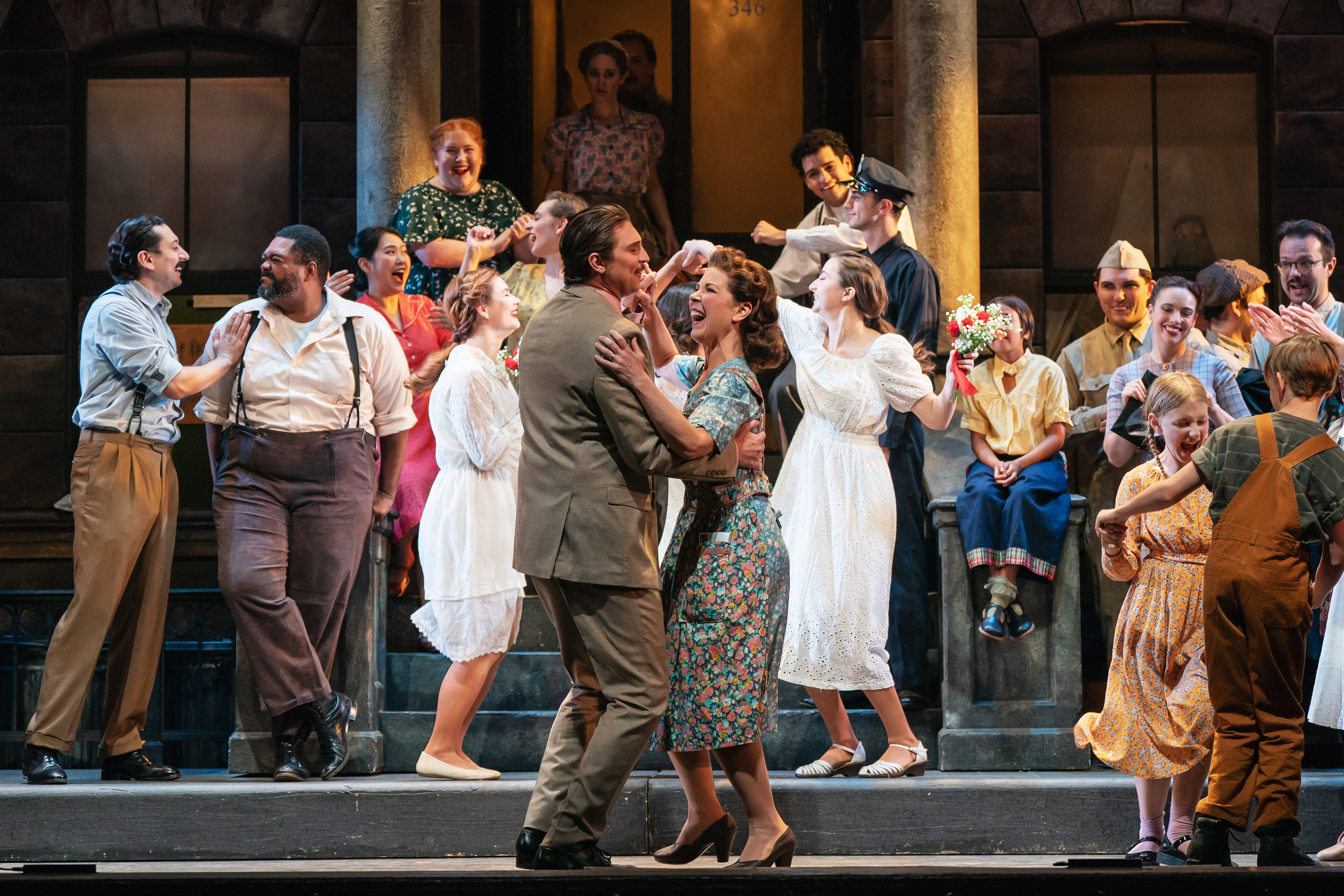
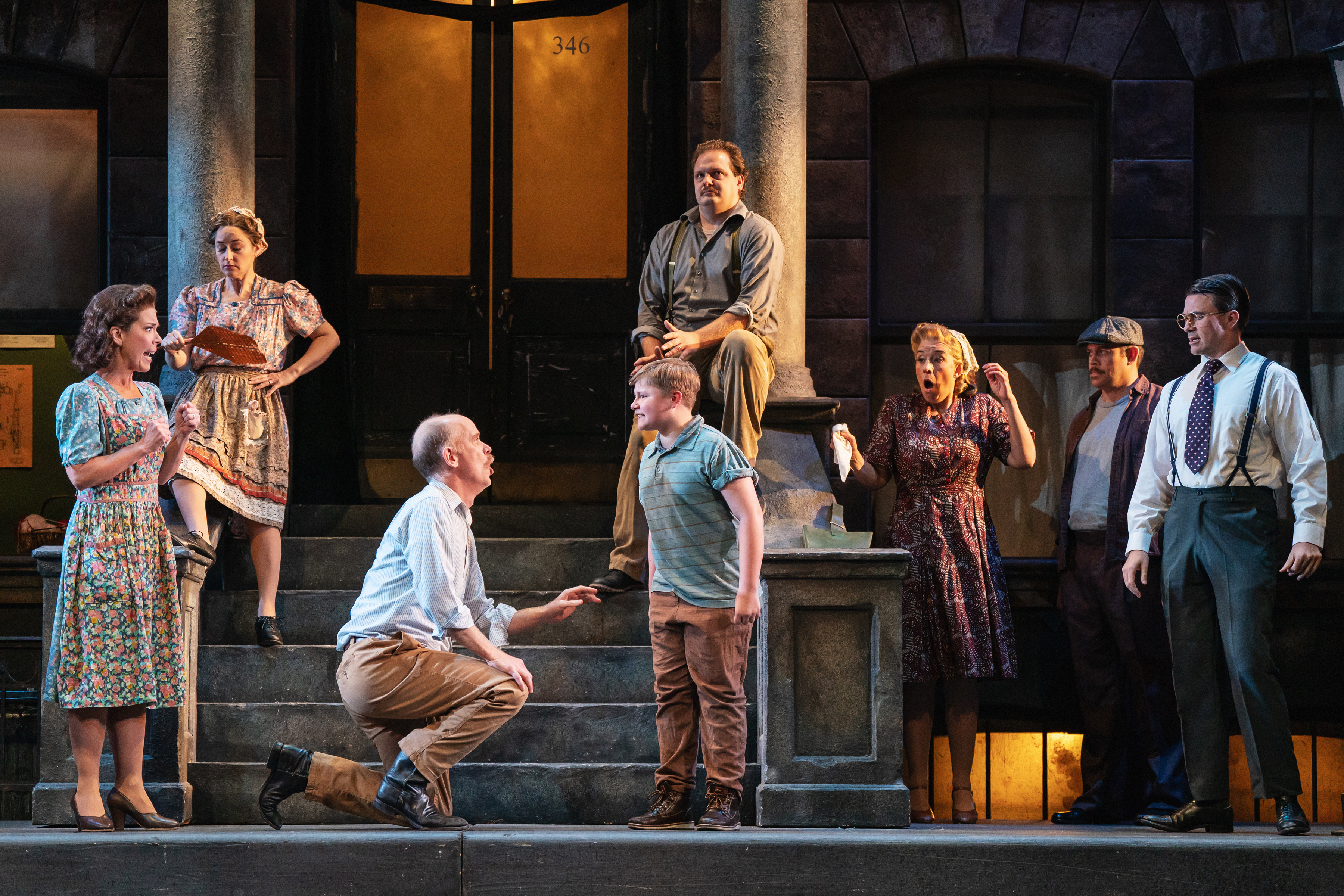
Tenement house neighbors in Street Scene. Image by Amanda Tipton Photography

Street Scene, which opened on Broadway in 1946, may be the closest he came to that goal, and it is certainly one of this finest works. It has an ideal American pedigree, with lyrics by Langston Hughes and a story based on the Pulitzer-prize winning play of the same title by Elmer Rice, who also wrote the book for the opera.

The music is appealing, combining Broadway set pieces like the ensemble for graduating students “Wrapped in a  Ribbon and Tied in a Bow” and the dance number “Moon-faced, Starry-eyed,” with blues-tinged arias, like “Lonely House” sung by the young hero Sam Kaplan, and Puccini-esque arias like “Somehow I could Never Believe” sung by Anna Maurrant.

As great as it is, Street Scene is not often performed—another reason to travel to Central City this summer. Among reasons for its rarity are the challenges it presents, including a cast with more than 30 named roles, each with their own story to tell. Without care, a performance can become loosely episodic. A similar danger is that the most appealing Broadway-style numbers are extraneous to the plot, and can easily seem tacked on.

Front steps of the tenement building. Design by David Harwell. Kevin Burdette (Frank Maurant) and Brian Erickson (Willie Maurant). Image by Amanda Tipton Photography

Fortunately, Pelzig’s direction met these difficulties head on. He created a fast-moving show, where the diversity of the tenement community is part of the story, and the numbers were pulled into the musical flow. David Harwell’s set was traditional, with realistic tenement steps and apartment windows on two floors looking out to the street, but it suits the show perfectly. Once again, the gritty realism is part of the plot.

With so many singers, it is not possible to recognize all of the many cast members who made a strong contribution to the show. Of the leading roles, Katherine Pracht in the role of Anna Maurant, the wayward but kindly wife of the building bully, gave a good portrayal of a fragile woman with romantic dreams while living on the brink of disaster. She sang with great expression, but with a strong vibrato that occasionally threatened to obscure the text.

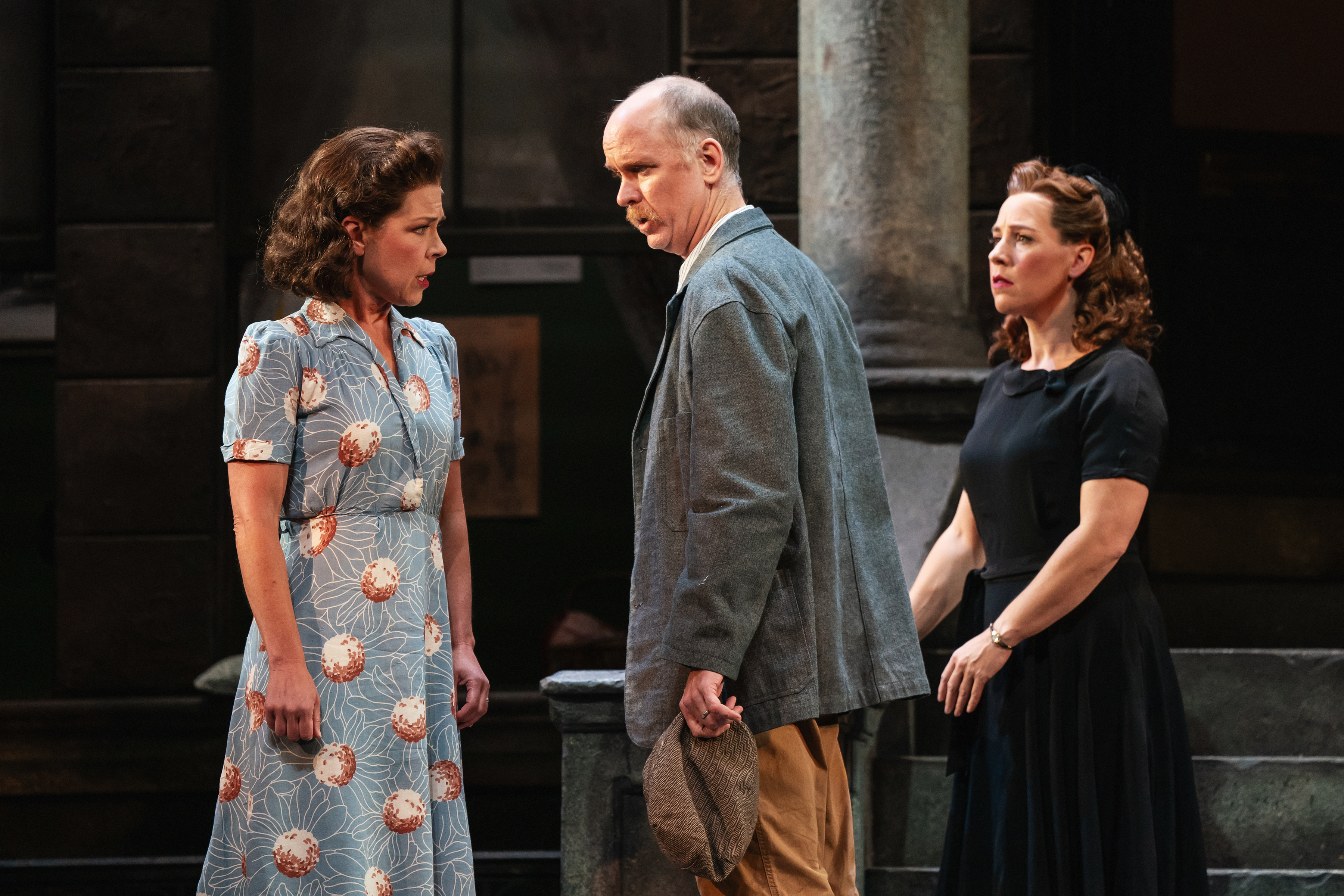
Katherine Pracht (Anna Maurant), Kevin Burdette (Frank Maurant) and Christie Conniver (Rose Maurant) in Street Scene. Image by Amanda Tipton Photography

As her abusive husband, Frank Maurant, Kevin Burdette used a rough edge to his voice to convey the character’s menace. A veteran of bad guy roles, including Claggert in Billy Budd in Central City and Sweeney Todd in Dallas, he softened his portrayal in the final scenes, creating a whole character. If his sudden tenderness seems less than convincing, that is the script and not the performance, which was heartfelt.

Christie Conover was endearing as Rose, the Maurants’ daughter who is pursed by a number of undesirable suitors as well as by Sam, the shy young male romantic lead who cannot quite express his love. She sang with a poised and polished sound that stood out from the more rough-hewn characters. As Sam, Christian Sanders had to reach for some of the high notes, but sang an appealing and well shaped aria in “Lonely House.” Their gradually blooming romantic duet, “Remember that I Care,” offered the opera’s tenderest moments.

I enjoyed the gossiping neighbor ensembles, which become a latter-day Greek chorus commenting on the action. The cast embraced the ethnic types written into the score, rarely overdoing it. Apprentice singer James Mancuso produced a definitively Italian sound as Lippo Fiorentino, the most strongly stereotyped of the neighbors. 

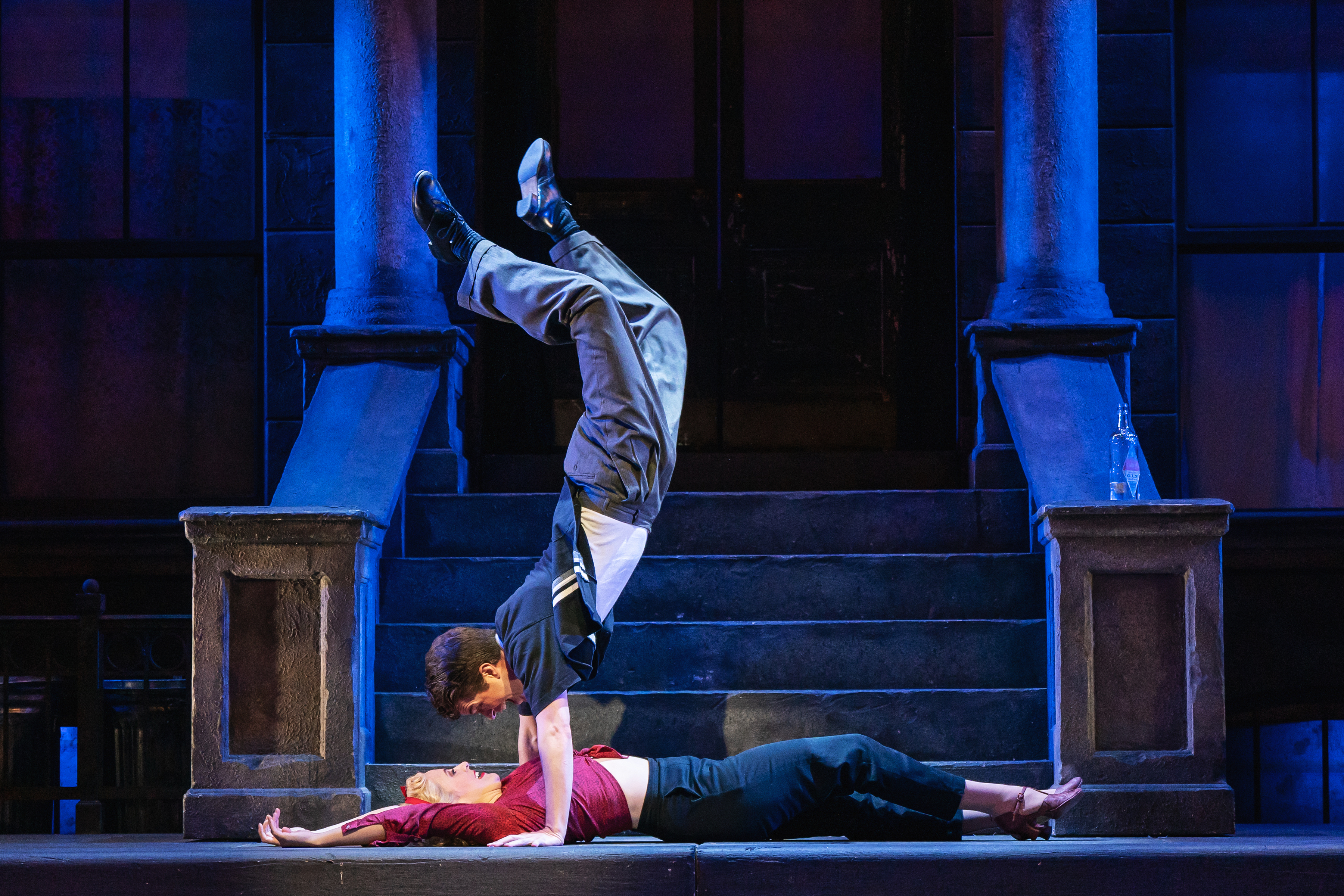
Lauren Gemelli and Jeffrey Scott Parsons in the dance routine “Moon-faced, Starry-eyed.” Image by Amanda Tipton Photography

Bernard Holcomb brought a big, robust voice and a friendly demeanor to the role of Henry Davis, the building janitor. As the overheated lovers in the big dance number, “Moon-faced, Starry-eyed,” Lauren Gemelli and Jeffrey Scott Parsons nearly stole the show with their saucy dialog and athletic dancing.

Members of the Colorado Children’s Chorale sang strongly and conveyed a rowdy sense of fun in their teasing game at the beginning of the second act. Brian Erickson acted strongly in the role of Willie Maurant, Rose’s rowdy little brother.

Conductor Adam Turner led the Central City orchestra in a stylish performance, getting the Broadway idioms right and supporting the singers well. A few times they covered the spoken dialog, but the big musical numbers were all outstanding. In short: this production of Street Scene is a rare opportunity to see an important work of American musical theater done well.

Two operas worth a trip into the mountains

Pirates and desperados at Central City Opera

By Peter Alexander July 16 at 3:48 p.m.

Central City Opera’s performance of Gilbert & Sullivan’s Pirates of Penzance (July 13) started with a delightful, well nuanced reading of the Overture, and from there went from one entertaining moment to another. 

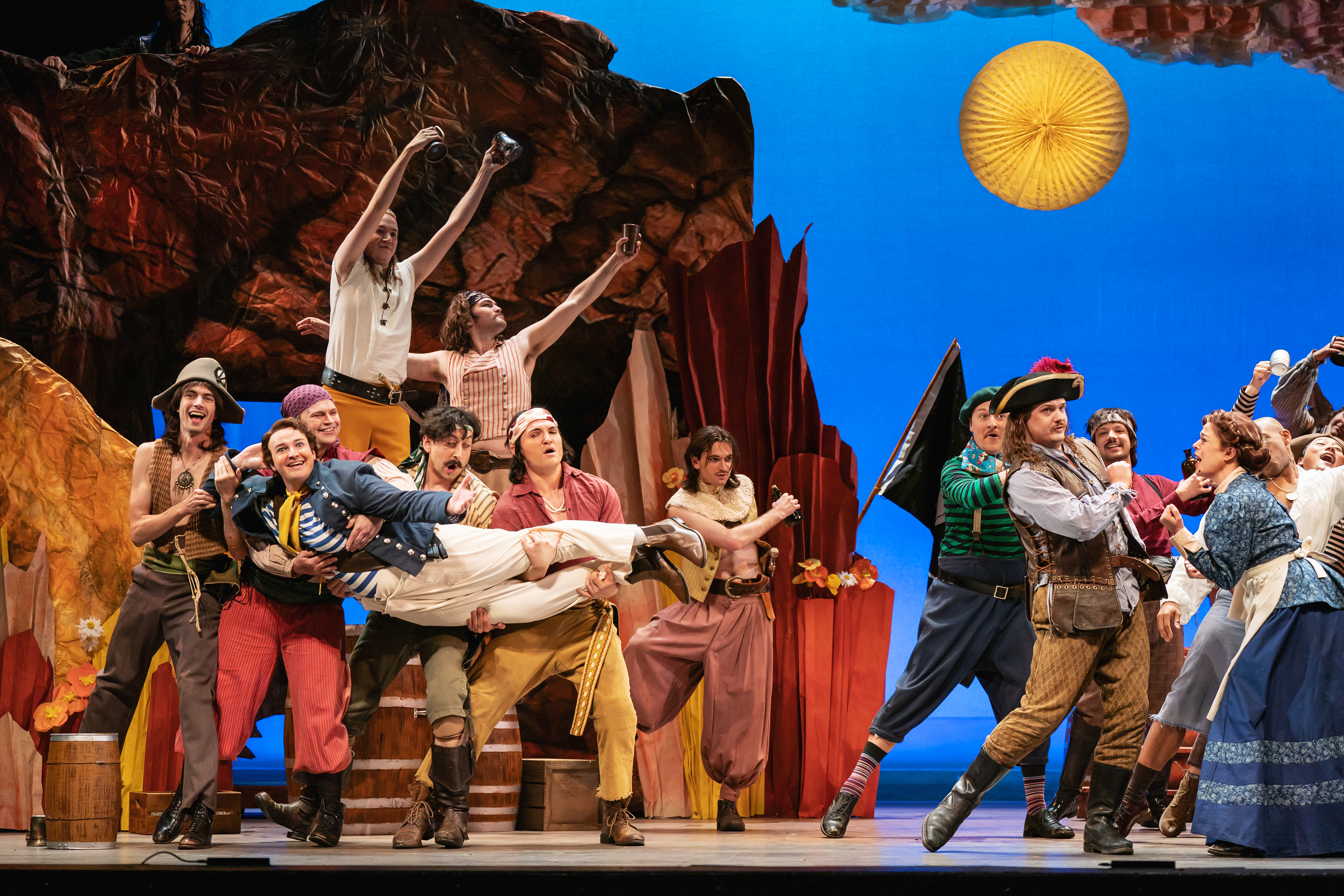
The Pirates of Penzance holding Frederic, the heartthrob hero. Image by Amanda Tipton Photography

The cast conveyed the silly and satirical spirit of the popular G&S operetta. Even 145 years later, their soft-hearted pirates, ineffectual police, sentimental lovers and ridiculous misunderstandings—all delightful skewerings of British stereotypes in 1879—can still delight audiences, even as far removed from Albion as in a Colorado mining town that was barely 20 years old when Pirates premiered in New York City.

The attractive and practical stage settings from Papermoon Opera Productions, known for their creative use of paper in building scenery, worked well on Central City’s small stage, leaving space for pirates, police and Major General Stanley’s many daughters to move about. Direction by Kyle Lang both honored and departed appropriately from the traditions of G&S comedy. Some of the shtick preserved in traditional English productions was replaced by more up to date shtick—such as young women competing to provide CPR and mouth-to-mouth on the heatthrob hero. 

The Major General daughters and Frederic (Chris Mosz) in Pirates of Penzance. Image by Amanda Tipton Photography

Lang handled the three groups of characters well, including enjoyable moments when the chorus burst off the stage into the audience or entered through the back of the house. There was a little too much of the daughters moving here and there in a tight clump, a consequence of the small stage at CCO, but otherwise the handling of the the different groups contributed well to the comedy.

If at times the humor was overacted, it never crossed the line into gross parody—quite. The greatest flaw was the uneven adoption of a British accent, noticeable only on certain words. Especially ripe for modification was the vowel sound “o” as “eeow” as in “Altheeow” or “You may geeow.” Even this simplified Biritishism was unevenly applied, with some actors (Jennifer DeDominici as the nursemaid Ruth) applying it thicker than others (Alex DeSocio as the Pirate King). Used consistently it might have been a useful class distinction (working class vs. nobility, as the pirates turn out to be), but English class accents are more varied than non-English casts are likely to convey. It was noticeable, but distracted little from enjoyment of the comedy.

The cast was full of strong comic-opera voices. Pirate King DeSocio has a robust voice and, like most of the cast and chorus, sang with clear diction. His stage movements were fluid, no doubt due to Lang’s choreography as well as stage direction. 

Frederic (Chris Mosz) and Mabel (Jasmine Habersham). Image by Amanda Tipton Photography

As the romantic lead Frederic, Chris Mosz sang with a strong but edgy tenor sound and a rapid vibrato that cut through orchestra and chorus. His voice was more than powerful enough for the small Central City house, but more tenderness would be welcome.

Jasmine Habersham handled Mabel’s coloratura flights with firm accuracy. Her bright, clear voice came on a little too forcefully at first, but in the second act melted nicely into the warm, lyrical passages. Her “Poor Wand’ring One,” one of the highlights of any performance, was especially lovely, first smooth then popping the top notes.

Adelmo Guidarelli as the pompous Major General. Image by Amanda Tipton Photography

As Ruth, DeDominici is fairly young, and as presented onstage far too attractive, for the joke about her age (supposedly 47) to work. When Frederic first sees the General’s daughters, he exclaims that she misled him in saying she was attractive (“I’ve been told so,” she says coyly). Otherwise, she was effective and funny as the hard-of-hearing nursemaid whose error in apprenticing Frederic to a pirate rather than a nautical pilot launches the whole plot.

Baritone Adelmo Guidarelli was an appropriately self-important Major General. He was first-rate at everything the role requires: pomposity, patter song and comic timing. Milking it for all it was worth, he breezed through the accelerated reprise of his well known patter song (“I am the Very Model of the Modern Major General”; one cannot complain about dropped final consonants at that speed!), and weeped equally comically in the second act.

Andrew Harris and his bumbling bobbies. Image by Amanda Tipton Photography

Andrew Harris’s booming bass made a powerful effect as the bombastic, if less than dauntless Sargeant of Police. The policeman’s chorus added their own touch of humor, waddling in and out and about, singing as forcefully as required. The entire chorus—pirates, daughters and police—deserve mention for their musical performance filling the house at times, or dissolving into softer moments. 

The small orchestra under Brandon Eldredge was excellent from the overture on, supporting but never drowning the singers. Tempos were brisk, but only in the Major General’s encore breakneck.

If you are a fan of light opera, you will want to see CCO’s Pirates of Penzance. You can’t do better than to see Gilbert & Sullivan in an opera house built in their lifetimes. But if you go, be warned: repairs on I-70 create massive slowdowns and outright stoppages between Denver and Idaho Springs. Choose another route into the mountains. 

# # # # # 

Gilbert and Sullivan’s hapless pirates are tenderhearted, and as it turns out so are the gritty goldminers in Puccini’s Fanciulla del West (Girl of the Golden West).

The romanticized story, based on wild west myths and set in a location Puccini never saw, has the miners singing sentimental songs about home and wanting to see “mama” again, and in the end forgiving the outlaw Ramerrez, removing the noose from his neck and allowing him to walk away with Minnie, the love of his life—and theirs.

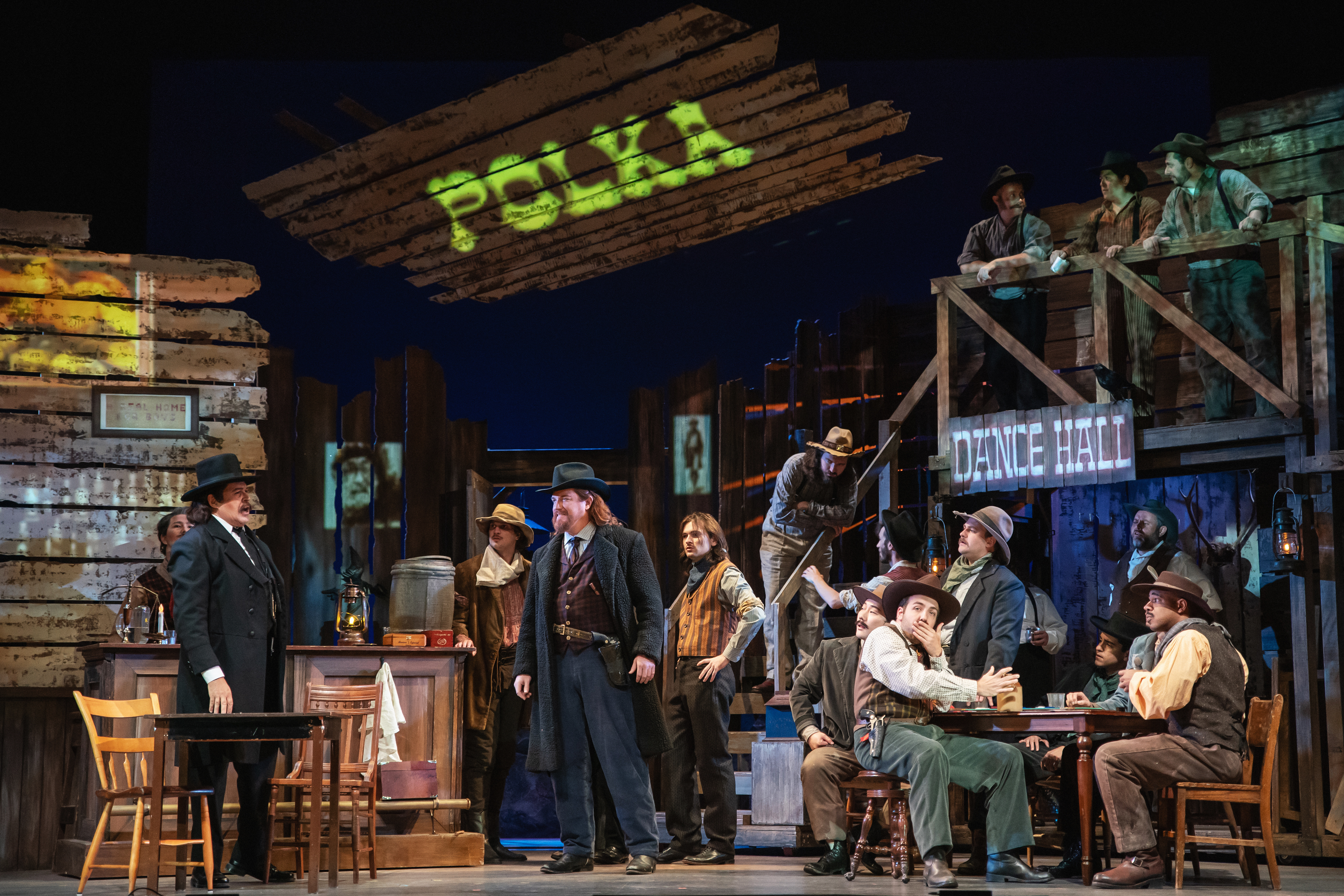
Jack Rance (Grant Youngblood, L) and Wells Fargo agent Ashby (Christopher Job, R) in the Polka Saloon. Image by Amanda Tipton Photography

With a strong cast and thoughtful production, CCO’s Fanciulla is well worth the trip into the mountains. Transferred from the California gold fields to Central City in the 1860s, the revised setting makes perfect sense with only the slightest of changes in the text (Ramerrez and Minnie are “returning to California” instead of “leaving California” at the end). Occasional projections suggest the Central City location.

The sets by Papermoon Opera Production are refreshingly downscale and simple, much closer to the reality of a mining camp than the large-scale sets major opera companies often choose to provide. Made largely with paper and cardboard, the sets are evocative of a time and place the people in Central City know well, having models right outside the theater. Minnie’s Polka saloon is appropriately ramshackle, as is her cabin, and the final scene is placed, as written, in a forest. The simplified sets, based in goldfield reality, helped bring the drama to the fore.

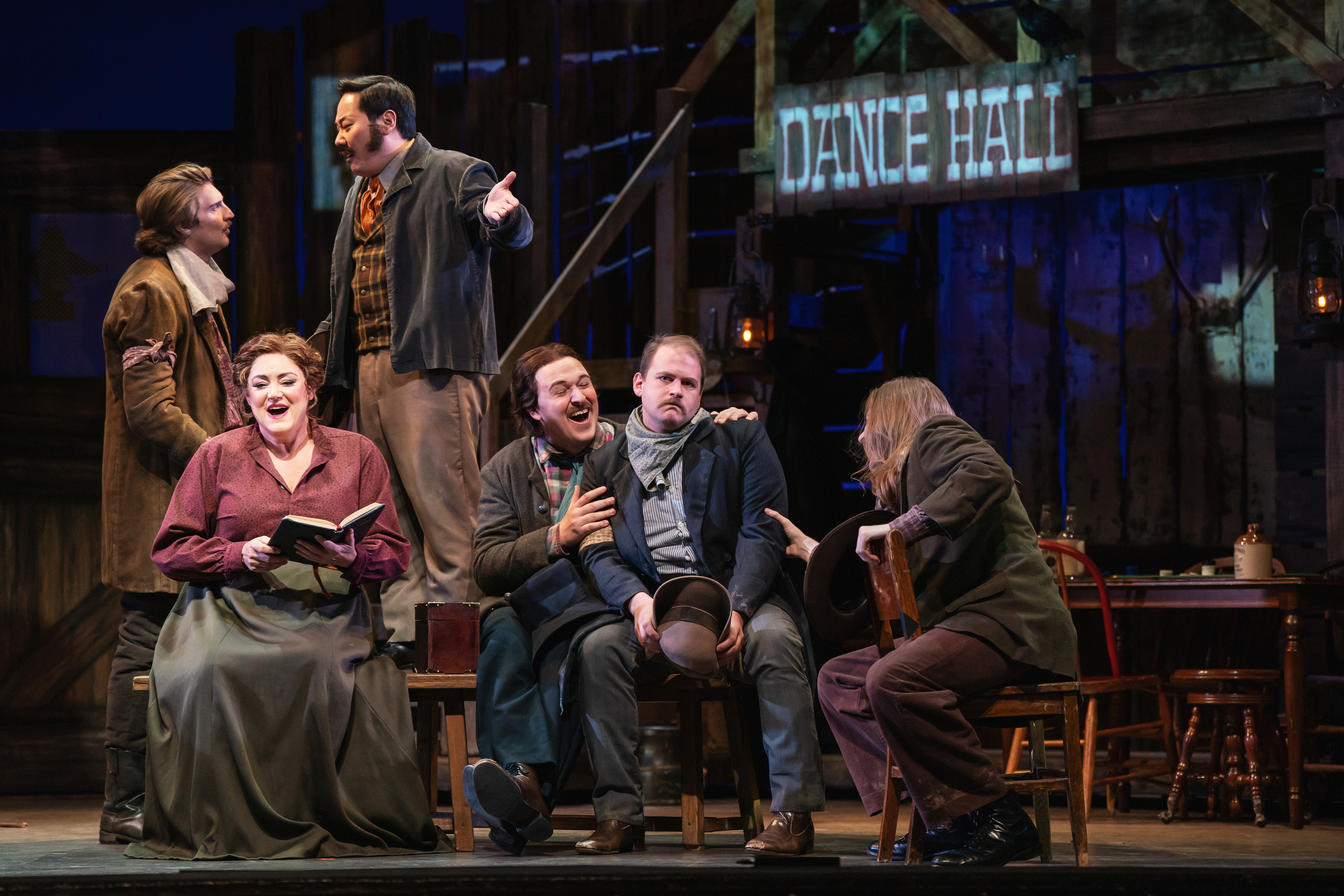
Minnie (Kara Shay Thomson) reading the Bible to the miners. Image by Amanda Tipton Photography

In the title role of Minnie, the “Fanciulla” who commands the Polka saloon, Kara Shay Thomson offered a large, powerful voice. Hers is the critical role, controlling the plot throughout; she is the one Puccini heroine who is never a victim but survives by being the strongest character in town. She was superb throughout.

At her best Thomson produced a bright, shining soprano, only occasionally sliding into the top notes. Her Bible-reading scene with the miners was well modulated, gentle or soaring as needed. In Act II she was girlish with her lover Ramerrez and defiant before the Sheriff Jack Rance, always in control musically and dramatically. Her brief scene in the final act, when she faces down Rance again and persuades the miners to release the outlaw Ramerrez for her, she continued to dominate the action.

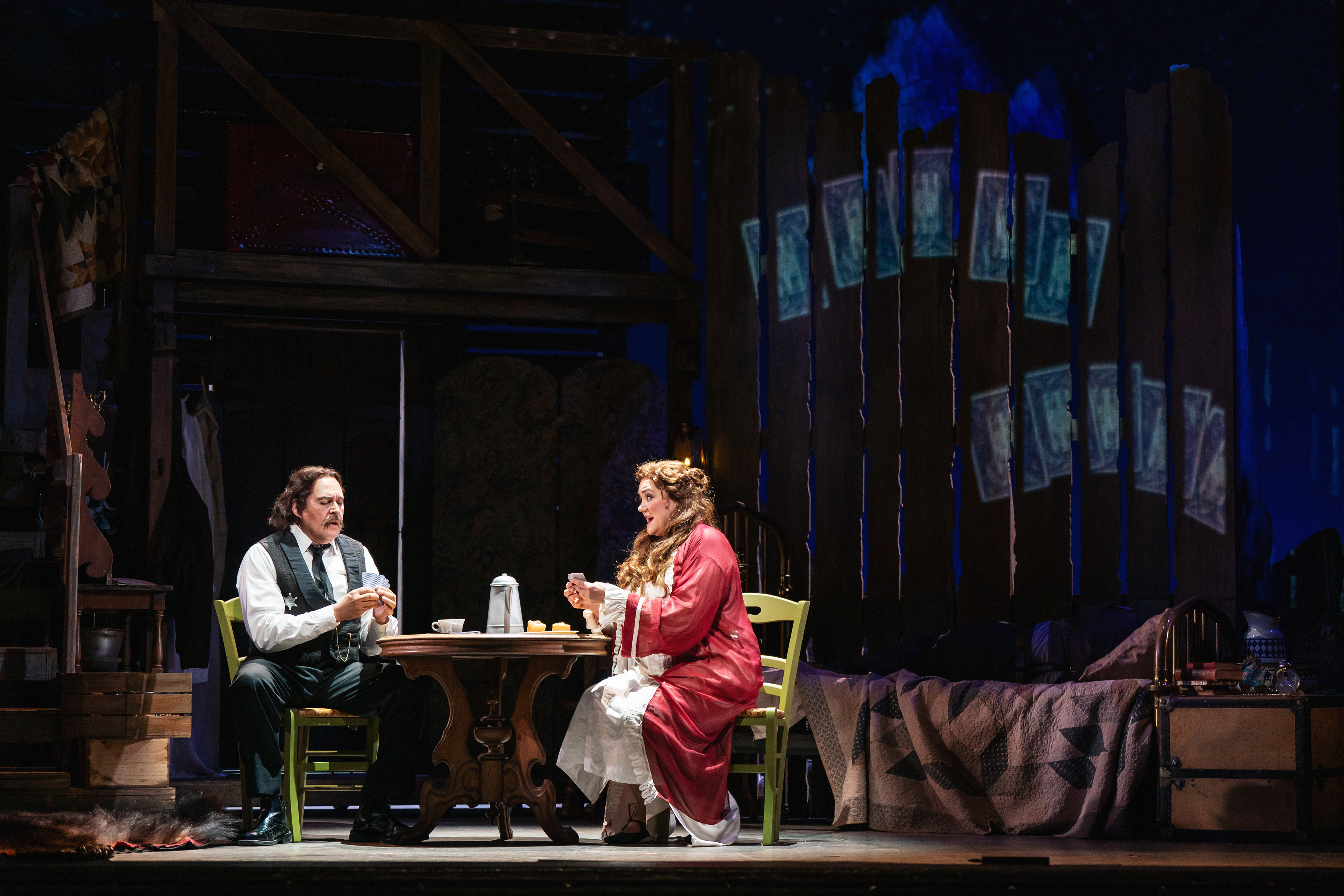
The fatal card game: Rance (Grant Youngblood) and Minnie (Kara Shay Thomson). Image by Amanda Tipton Photography

As Rance, baritone Grant Youngblood filled the stock role—spurned lover, blustering villain—effectively. In the standard black hat and suit he was every inch the bullying lawman, showing his obsession with Minnie any time he was onstage. He made the second act showdown a dramatic highpoint, and sang solidly throughout. 

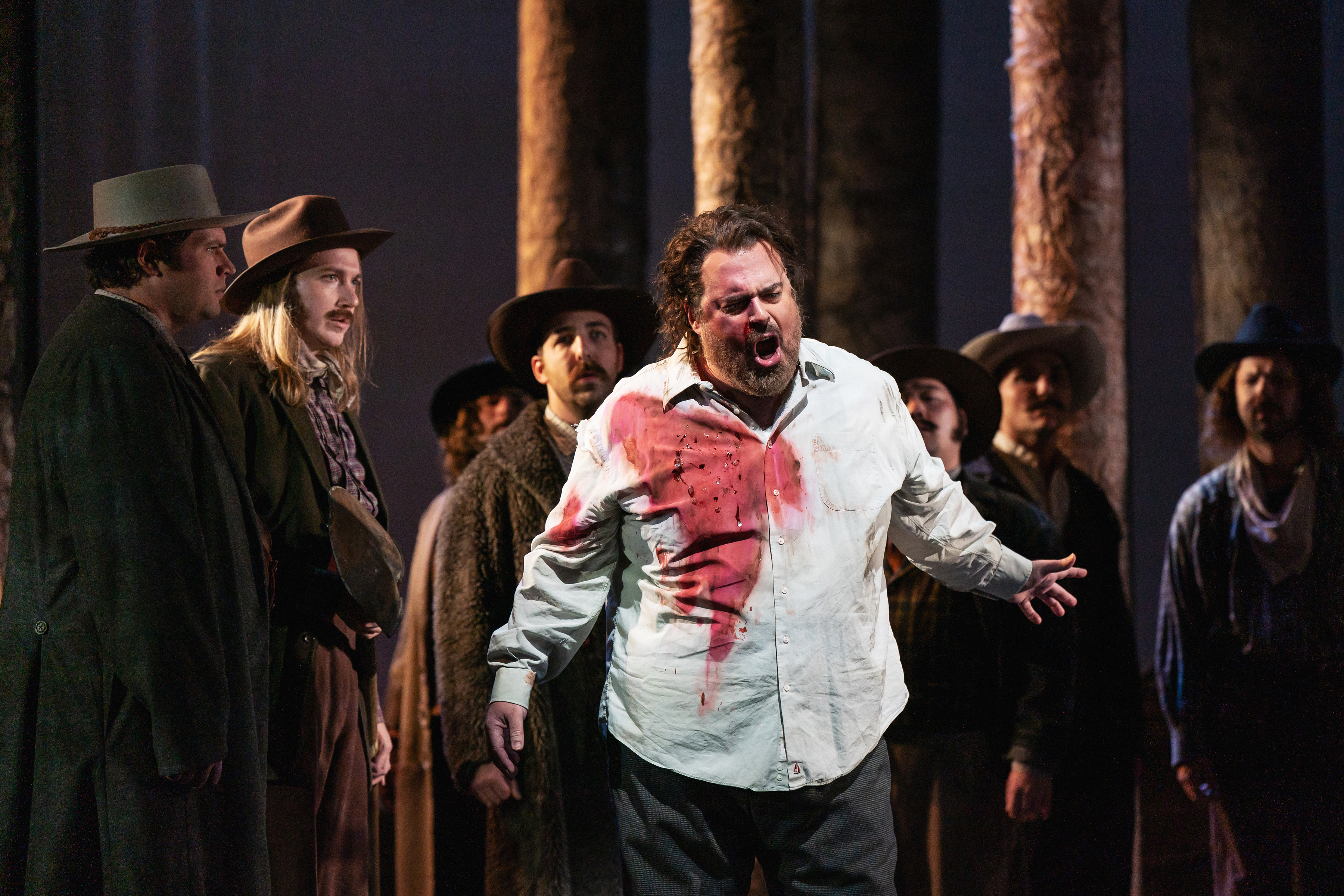
As lead tenor Dick Johnson/Ramerrez—the last of the three corners of the love triangle to enter the stage—Jonathan Burton expressed more with this singing than his acting. He was able to belt out the soaring climaxes of his individual numbers with a ringing tone, and conveyed musically his growing love for Minnie. His one aria, “Che’lla mi creda libero e lontano,” the keystone of the final act, was warmly received. His stage presence was not always assured, however, and he relied too often on an artless grin to make himself look guiltless.

Supporting roles were all filled ably. At the performance I saw (July 14), apprentice artist Nicholas Lin filled in capably as Nick, the bartender-of-all-trades. Christopher Job used his deep bass and a gritty sound to create the menacing character of Ashby, the Wells Fargo agent who only wants to catch the bandit.  Matthew Cossack sang expressively as Sonora, the most sympathetic of the miners.

Jonathan Burton as Johnson/Ramerrez, singing his final-act aria. Image by Amanda Tipton Photography

A special word should go to Steele Fitzwater and apprentice artist Xochitl Hernandez as the couple Billy Jackrabbit and Wowkle. Too often portrayed as racist, native American stereotypes, here they were characters with dignity. In this production directed by Fenlon Lamb, Billy is a white man who has had a child by an Indian woman, an historically viable and interesting choice that puts a more subtle spin on characters traditionally based on narrow, hidebound notions of the American Indian. Both sang well.

Lamb’s direction made good use of the space available, like Pirates expanding briefly into the house. The action was clear, and the second act conveyed the rising tension powerfully. The card game—one of Puccini’s greatest moments of suspense, created with the simplest of musical means—was exquisitely melodramatic. The chorus—all men, naturally—generated excitement in the final act, filling the hall with sound. Conductor Andrew Bisantz led the outstanding CCO orchestra with a fine feeling for the ebb and flow of Puccini’s flexible musical fabric.

__________

Both Pirates of Penzance and Fanciulla del West continue in repertory through the remainder of the Central City Opera summer season, which ends August 4. The calendar is listed HERE, and tickets may be purchased through the CCO Web page.

The production of Kurt Weill’s Street Scene, originally scheduled to open July 13, will open Wednesday, July 17. A review will appear next week.

Central City Opera cancels one performance

Saturday’s opening night of Kurt Weill’s Street Scene canceled due to illness

By Peter Alexander July 10 at 5:20 p.m.

Central City Opera has announced that Saturday’s opening of their production of Kurt Weills “American Opera” Street Scene (July 13) would be canceled due to illness.

A statement released by the company today (July 10) stated:

“Due to a number of our artists testing positive for respiratory illness, we are canceling the Saturday, July 13 performance of Street Scene and all opening night activities. Our top priority is always the well-being of our cast, crew, and audience, and this decision was made in consultation with our artists, unions, and local officials in order to ensure everyone’s health and safety.”

The company offers three option to persons who hold tickets for Saturday:

  1. Reschedule your tickets for another date;
  2. Turn the value of your tickets into a tax-deductible gift to the Central City Opera; and
  3. In case neither of the options above are suitable, receive a full refund.

In order to choose one of the three options, the Central City box office is asking patrons to fill out an online form that can be accessed HERE.

The remainder of the Central City Opera season is not affected by the cancellation, including all regularly scheduled performances of Street Scene during the remainder of the summer. You can see the full summer schedule on the Central City Opera calendar page.

You can read more about Central City Operas 2024 season HERE.

Central City offers three works first performed in New York

Pirates of Penzance, Girl of the Golden West and Street Scene on this summer’s bill

By Peter Alexander June 25 at 4:02 p.m.

Central City Opera opens its 2024 festival season Saturday with a staple, not of the grand opera house, but of the English light-opera stage: Gilbert and Sullivan’s delightful and sometimes silly Pirates of Penzance (7:30 p.m. June 29; full summer schedule below).

Opening Night at Central City Opera. Featured in Central City Opera’s 75th anniversary book, “Theatre of Dreams, The Glorious Central City Opera- Celebrating 75 Years.”

The fifth collaboration between author Sir Willam Gilbert and composer Sir Arthur Sullivan, Pirates surprisingly had its official premiere at the Fifth Avenue Theater in New York City Dec. 31, 1879. The show, known for its bumbling police, its only slight less inept pirate gang, and its often parodied Major General’s patter song, has long been one of the most popular of the G&S operettas. 

A 1980 production in Central Park, part of the “Shakespeare in the Park” summer series, was so successful that it was transferred to Broadway. In 1983 it was made into a film with original cast members Linda Ronstadt (Mabel), Kevin Kline (the Pirate King) and Rex Smith (Frederic), plus Angela Lansbury (Ruth). 

At Central City this summer, Pirates shares the rotating repertory bill with two other works also premiered in New York, neither of which is truly part of the core operatic canon: Kurt Weill’s Street Scene, premiered at New York’s Adelphi Theater in 1947; and Puccini’s La fanciulla del West (Girl of the Golden West), premiered at the Metropolitan Opera Dec. 10, 1910.

* * * 

Pirates of Penzance is a typical G&S operetta in the way that it satirizes British habits. The pirates are goofily sentimental, the Major General is preposterously pompous, the police are ridiculously hapless, and Frederic takes his very British devotion to duty to comic extremes. The whole plot turns on two ridiculous misunderstandings: That Frederic was apprenticed by his near-deaf nursemaid to nautical pirates rather than pilots; and that he was apprenticed not for 21 years but until his 21st birthday—which, because he was born on Feb. 29, means not until he is in his 80s.

That he and his chaste bride-to-be Mabel accept this delay with unnaturally bright composure is just one of many implausible turns of plot—as one expects from Gilbert and Sullivan. In addition to the patter song “I Am the very Model of a Modern Major General,” the score contains several memorable songs, including Mabel’s “Poor Wandering One,” which pairs alluring sentiment with brilliant coloratura; and the pirate chorus’s “With Cat Like Tread,” in which they noisily proclaim their intent to creep silently into the Major General’s household. 

* * *

Also written for the popular stage, Kurt Weill’s Street Scene is a different matter entirely. With lyrics by Langston Hughes and a book by Elmer Rice, it is a gritty tale of tenement dwellers on Manhattan’s east side. Among a mix of residents of Swedish, Italian, German and Jewish background there is an abusive husband, an alcoholic, a radical intellectual, gossipy neighbors, a sleazy boss, an adulterous milkman, a birth, an eviction and a double murder.

And of course a pair of young lovers, who survive but are forced apart by the violent events around them.

Weill came to the United States in 1935, after a successful career in his native Germany—particularly works created with playwright Bertolt Brecht including their Dreigroschenoper (Threepenny Opera). In this country Weill wrote several works for the Broadway stage, including Knickerbocker Holiday, Lady in the Dark and Lost in the Stars, but he was always aiming to create a form that combined serious opera with popular theater and song.

The work that came closest to that goal might be Street Scene, which freely mixes operatic elements, such as the aria “Lonely House” sung by the male romantic lead Sam Kaplan, with Broadway entertainment including dance numbers and a lively number for graduating students, “Wrapped in a Ribbon and Tied in a Bow.” Other notable numbers in the score are the “Ice Cream Sextet,” the duet by nursemaids gawking at the scene of the murders, and the dreamy aria “What Good Would the Moon Be,” sung by the female lead, Rose Maurrant.

It is the operatic aspects that have left their mark on Street Scene, which has been performed by opera companies but never returned to Broadway. Even operatic performances are infrequent today, due in part to the large cast that Weill requires—more than 30 named roles.

* * *

The closest thing to a repertoire item this summer, Puccini’s Fanciulla del West has that rarest of serious opera features, a happy ending. No one dies in the course of the opera, and the leading soprano is neither a naive innocent nor a victim; in fact, she is about the strongest character in the opera, who even cheats at cards to reach the opera’s happy end.

The plot features Minnie (soprano), who owns the Polka Saloon; the sheriff Jack Rance (baritone) who hopes in vain to marry Minnie; and the romantic tenor lead, the outlaw Ramerrez, who under the name Dick Johnson becomes Minnie’s true love.

Very much part of the action, Minnie forges her own destiny, first by owning the saloon in a mining camp, and then by playing cards for her lover’s life. Production stage director Fenlon Lamb observes that this is very different from other Puccini soprano roles.

Fenlon Lamb

“Other Puccini heroines are stuck in what society allowed them to be,” she says. “When you transfer things to the Wild West, the rules are gone. All bets are off! And she’s freer to be one of the guys. She’s the girl of the camp, but they all respect her, right to the end.”

The plot is fairly simple: Minnie’s bar is the favorite place for the men of a mining camp to find solace. The arrival of a stranger alarms the sheriff and the Wells Fargo agent, who are looking for the outlaw Ramerrez. Minnie recognizes him from a previous meeting as Johnson and the two fall in love. Later in her cabin Minnie and the sheriff play cards for the outlaw’s life. 

She wins by pulling cards out of her boot, but Johnson/Ramerrez is later captured and brought back to town to be hanged. Just as the noose it put around his neck, Minnie contrives to create a happy ending—but you will have to buy a ticket to know the details.

As a woman, Lamb acknowledges that she might approach female characters differently than men might. “I give a little bit more understanding and support to the female characters,” she says. “I love working with singers, but I especially support the women in my productions. We spend more time figuring out what the heroine is trying to say, through her singing and her actions.”

Another way that Fanciulla differs from most Puccini operas is that there are no big arias. The music has the same lush melodies and Romantic impulses—“it is gorgeous!” Lamb says—but unlike most grand opera, the action never pauses for a stand-alone aria.

Appropriately, the Central City production has moved the setting from the California Gold Rush to Colorado 10 years later. “We’re not the ’49ers, we’re the ’59ers out here” in Central City, Lamb explains. “It gives us the opportunity to use actual pieces and parts from Central City. In doing that, we’ve only changed one word—instead of ‘addio California’ (goodbye California) Minnie says ‘andiamo a California’ (let’s go to California)” before riding into the sunset.

Puccini had never been to the American West, so his knowledge was taken from popular stereotypes and the original story, so not all of his characters ring true. The miners are heavily romanticized and cleaned up for the stage, the Wells Fargo agent is a typical stage villain, but the most difficult characters are Minnie’s Native American servants, Wowkle and Billy Jackrabbit.

They are often treated as crude stereotypes, but compared to many productions, Lamb says, “you can give these characters real depth. We’ve decided that Billy Jackrabbit is a white trader (who) goes into different native camps and understands some of the language, (who) might marry a native woman. It’s getting into what happened at the time and finding ways to tell the story that are not stereotyped.”

Having spent some time in Central City and visited some of the actual mines in the area, Lamb sees a larger picture than the love story at the heart of the opera. “Everybody’s proud of the mining tradition here,” she says.

“The focus [of the production] is on these guys in a mining camp. And there’s a focus on the fragility of this mass of humans, and how are they getting along together. In the end, it’s forgiveness that really saves the day, it’s being able to connect and understand the other person, and their needs, and forgive.

“I think it’s an opportunity to see the strength juxtaposed with fragility of the community, and then forgiveness is pretty much the answer.”

# # # # #

Central City Opera
2024 season
(performances in Central City Opera House)

Sir Willam Gilbert and Sir Arthur Sullivan: Pirates of Penzance
Sung in English with English supertitles

7:30 p.m. Saturday, June 29; Saturday, July 20; Saturday, July 27; 
2 p.m. Wednesday, July 3; Friday July 5; Sunday, July 7; Saturday, July 13; Tuesday, July 16; Wednesday, July 24; Friday, Aug. 2

Single tickets

Giacomo Puccini: La fanciula del West (Girl of the golden West)
Sung in Italian with English supertitles

7:30 p.m. Saturday, July 6; Saturday, Aug. 3
2 p.m. Wednesday, July 10; Friday, July 12; Sunday, July 14; Friday, July 19; Saturday, July 21; Tuesday, July 23; Saturday, July 27; Wednesday, July 31

Single tickets

Kurt Weill: Street Scene
Sung in English with English supertitles

7:30 p.m. Saturday, July 12
2 p.m. Wednesday, July 17; Saturday, July 20; Friday, July 26; Sunday, July 28; Tuesday, July 30; Saturday, Aug. 3

Single tickets

Season Subscription tickets for all three productions

NOTE: Casts and other creative contributors to the productions of Pirates of Penzance, Street Scene and La fanciulla del West are all listed on the Central City Opera Web page.

Alison Moritz looks back and ahead

New artistic director at Central City has experience and hopes for CCO

By Peter Alexander March 22 at 6:20 p.m.

Alison Moritz’s career in opera started with a hot-air balloon.

The new artistic director of Central City Opera (CCO), Moritz saw her first opera in St. Louis when she was nine. It was Offenbach’s La belle Hélène, a very Parisian spoof of the the story of Helen of Troy. At nine, the innuendo did not make much of an impression. 

“I think the sexual politics went over my head,” she says. “I was just impressed by the hot-air balloon onstage!”

Alison Moritz: Destined for opera?

Balloon or no balloon, she might have been destined for a career in opera. That first experience really clicked with someone who says she was “an indoor kid [who] loved everything artistic. I was really obsessed with story and picture and music.”

Her first ambition was to be a film animator. “I did see an opera when I was nine, and the whole world just made sense to me,” she explains. “It just felt so magical and exceptional, but also incredibly familiar.”

That early sense of familiarity soon led to a near obsession with opera. “When I was in 8th grade I saw my first production of Traviata and I went back and saw it five times! My parents went with me to the first two performances, and after that they would drop me off in the parking lot and say, ’See you three and a half hours.’ 

“I used to say I had to work in opera because I couldn’t afford to see opera as much as I wanted to. I had to find a way to sit in—I never get tired of it.”

Her path into directing was not something that she saw from the outset, however. “Initially, it was not clear what my contribution [to opera] could be,” she says. “When you’re not a singer, at the time I was growing up, there were fewer roles for women in production, there were fewer roles for women in leadership.”

Moritz attended Washington University in St. Louis, where she studied music and art history. She did some work in art administration, and production work backstage, but she thought that might be a hobby and she would work in another field. An internship with Opera America gave her insight into the American opera scene, and while living in New York she attended all the opera and theater that she could afford in standing room.

A turning point came when a friend who went to some performances with her, but did not work in opera, told Moritz, “The way you think about this is someone’s job.”

“That was the first time that I thought maybe I could do this,” she says. “I was really lucky—I went back to school to get  a degree in opera stage direction at the Eastman School of Music. When I arrived there I knew a lot about opera but I had very little experience. And I’m proudly grateful that they saw potential in me, and fostered that.”

From Eastman her career as a stage director has only grown. Today, she can claim directing credits from Lyric Opera of Kansas City, the Glimmerglass Festival, Opera Omaha, Ravinia, Tanglewood, Portland Opera and Opera Colorado, among many others. 

Moritz says that she approaches her work principally through the music. “My job as a director is to really help contemporary audiences see what’s so special about the music,” she says. “It’s really key for the director to bring the story and the visuals and the relationships amongst people and ideas together, so that we’re making a case for these beautiful documents. That’s always been my approach.”

She believes that growing up a Midwesterner—“in a flyover state,” she says—affects her perspective on opera. “I’ve never had the point of view that the only great opera in America is in the largest coastal companies. They’re incredibly important, but to be able to produce things locally and regionally I think is important, and fundamental to what makes Central City such an exciting place to work and to watch opera.

“The other Midwestern thing about me is I’ve always been creative, but through the lens of pragmatism. I know the cost of wood when we’re building the set. We’ve got to make some nitty-gritty decisions in order to be able to make great art. The Midwesterner in me is always looking to see how long will this take to rehearse, how many days do we need to do X, Y and Z, and that keeps me pretty grounded.”

For the coming summer, Moritz already has long established engagements at Cincinnati and Glimerglass in upstate New York, but after this year her new job will mean she has to forego summer directing jobs outside Central City. “This year there’s a little bit of a time-share, [but] I’m really confident that I’ll be able to spend meaningful time with the audiences at the top of the mountain,” she says. “For future seasons, I will be at Central City the entire summer.”

Central City Opera House. Photo by Ashraf Sewailam.

Looking ahead, Mortiz envisions creating cooperative relationships with other opera companies where she might have directing work outside of the Central City season. “I’m excited about the prospect of creating more co-productions [with other companies] and being able to bring the best of American opera here to Central City,” she says. “I’m really optimistic and excited about the future. I’m really happy to have my boots on the ground and to get to work. 

“We’re all very excited to re-imagine and to dream and continue creating a great atmosphere at Central City for both artists and audiences.”

NOTE: Information Central City Opera’s summer 2024 festival season can be found on the CCO Web page.

Alison Moritz appointed artistic director of Central City Opera

An experienced stage director, Moritz will direct one production per season

By Peter Alexander Feb. 20 at 6:10 p.m.

The Central City Opera has announced the appointment of the accomplished stage director Alison Moritz as their new artistic director.

Alison Moritz

Moritz was selected after a national search led by Jonathan West, on behalf of Management Consultants for the Arts and CCO’s volunteer search committee, chaired by Joshua Navarro from the CCO board of directors. The position had been open since the summer of 2023.

In a written announcement, Moritz commented “I am deeply honored to join Central City Opera as the new artistic director. My previous experiences with the company have been incredibly rewarding, and I am excited to build upon that foundation as we embark on this new chapter together.”

CCO president and CEO Scott Finlay stated, “I’m thrilled to welcome Alison Moritz to Central City Opera as our new Artistic Director! Her talent and vision align perfectly with our goals, and I couldn’t be more excited to have her on board.”

Moritz has previously appeared as stage director at CCO, including the 2019 production of Puccini’s Madama Butterfly. As AD she will oversee the company’s artistic and production staff for the upcoming 2024 Festival (June 29–Aug. 4; see the CCO Web page for more information), and will direct one production per season starting with the 2025 Festival. 

Moritz’s recent productions have been described as “enchantingly cheeky” (Washington Post), “elegantly sexy” and “raw, funny, surreal, and disarmingly human” (Opera News). She has recently directed productions for Washington National Opera, Lyric Opera of Kansas City, the Glimmerglass Festival, Opera Omaha, Ravinia, Tanglewood, Bard Music Festival, and Portland Opera. Previous engagements have been on the directing staffs at Santa Fe Opera, Seattle Opera, Opera Theatre of St. Louis, Minnesota Opera, Atlanta Opera, and Wolf Trap Opera.

Moritz succeeds former AD Pamela Pantos, who was released from the position in July 2023, and Pelham (Pat) Pearce, who had been AD for 26 years when he left the post in 2022.