GRACE NOTES: Season-ending programs

BCO celebrates an anniversary, Ars Nova celebrates eternity

By Peter Alexander May 20 at 8:35 p.m.

NOTE: The following post covers events for the next two weeks. I will be traveling with the Longmont Concert Band for a performance in Carnegie Hall May 25 and not back in Colorado until June 1. —Ed.
The Boulder Chamber Orchestra (BCO) and their conductor, Bahman Saless, wrap up their 20th-anniversary 2024–25 season with a “Grand Finale” in Macky Auditorium Saturday (7:30 p.m. May 24; details below).

Fresh back from a performance at Carnegie Hall’s Zankel Hall venue, the BCO will be joined by pianist Adam Zukiewicz and soprano Sylvia Schranz in a varied program, selected to celebrate the group’s anniversary. The program will be anchored by Saint-Saëns’ Piano Concerto No. 5 (“Egyptian’), which Zukewicz played a week ago in New York.
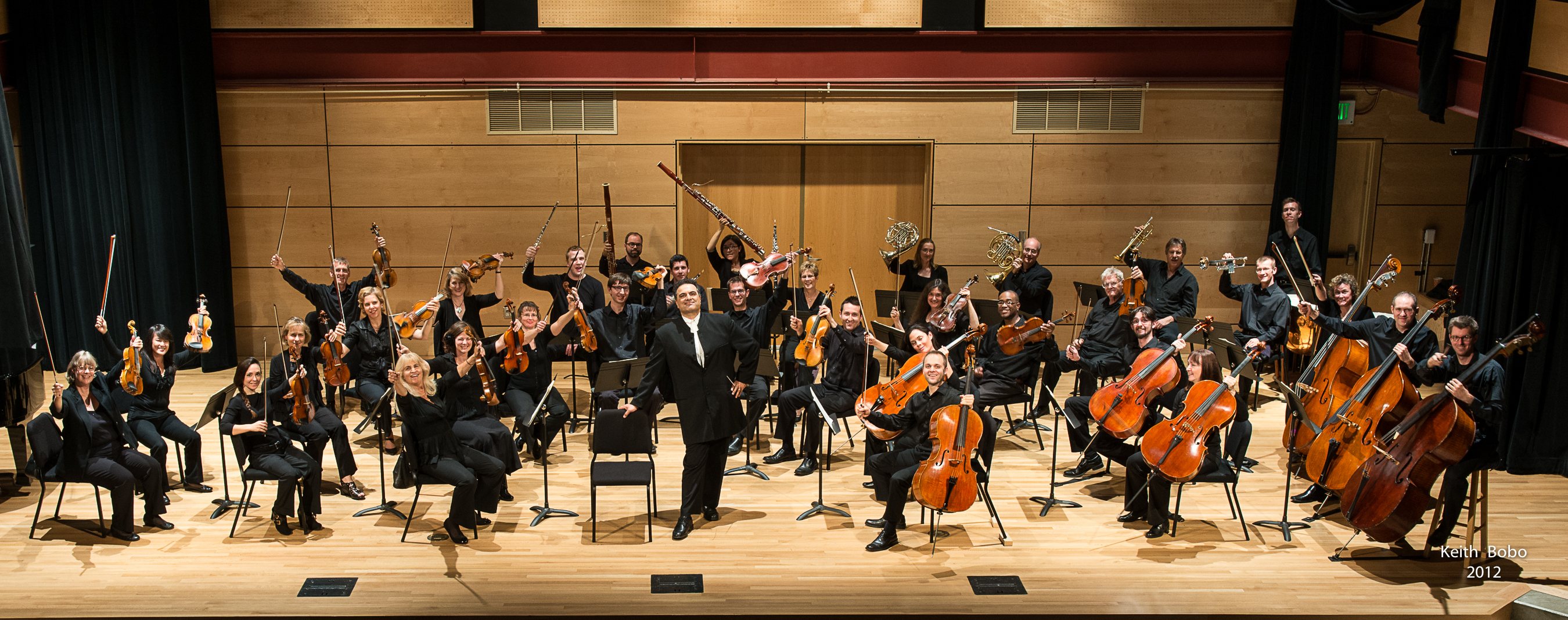
Boulder Chamber Orchestra and conductor Bahman Saless

A review of the New York concert said that BCO “could hold its own with any orchestra, anywhere,” and praised Zukiewicz’s “lively rendering” of the Concerto. Other works on Saturday’s program reflect the BCO’s eclectic programming over the past 20 years, ranging from Strauss waltzes to dances by Dvořák and Shostakovich, and a patriotic romp based on the National Anthem by the largely forgotten American composer Dudley Buck.

Saint-Saëns’ “Egyptian” Piano Concerto is a suitable choice for the BCO’s celebration, as it was written as a celebration of the composer’s own 50th-anniversary in 1896. Saint-Saëns wrote the concerto in Egypt, where he often spent his winter vacations. It features various exotic elements, particularly the slow movement that includes a song the composer heard sung by Nile boatmen.
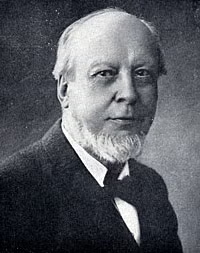
Dudley Buck

Trained as a pianist in Germany, Buck was a classmate of Edvard Grieg, Leoš Janáček and Arthur Sullivan. His Festival Overture on The American National Air began life as a set of Concert Variations on “The Star Spangled Banner” for solo organ. Though largely forgotten today, Buck was widely known in the late 19th century as a composer, organist and composer, and as the author of Buck’s New and Complete Dictionary of Musical Terms.

The Strauss waltzes recall the years that the BCO performed concerts during the Holidays that included music familiar from the popular Vienna Philharmonic New Year’s concert. On Saturday, these works will be the Overture to Die Fledermaus, the Emperor Waltz and Frühlingstimme (Voices of Spring) by Johann Strauss II. The program concludes with two Slavonic Dances by Dvořák (see full program below).

# # # # # 

“Grand Finale”
Boulder Chamber Orchestra, Bahman Saless, conductor
With Adam Zukiewicz, piano, and Sylvia Schranz, soprano

  • Dudley Buck: Festival Overture on the American National Air
  • Saint-Saëns: Piano Concerto No. 5 in F major (“Egyptian”)
  • Johann Strauss II: Overture to Die Fledermaus
  • Khachaturian: Waltz from Masquerade
  • Strauss: Emperor Waltz
  • Shostakovich: Waltz No. 2 from Suite for Jazz Orchestra
  • Strauss: Frühlingstimme (Voices of spring)
  • Dvořák: Slavonic Dances op. 72 no. 10 and op. 46 no. 8

7:30 p.m. Saturday, May 24, Macky Auditorium

TICKETS

# # # # #

Boulder’s ever adventurous Ars Nova Singers will present the last of their 2024–25 season concerts at the end of the month, with performances of significant a cappella works from the 20th century (Friday, May 30 in Longmont, Saturday, May 31 in Denver, and Sunday June 1 in Boulder; see times and concert details below).

Titled “Time/Eternity,” the program concludes a season characterized by programs that have embraced contrasts: “Here/There,” “Light/Shadow,” “Lost/Found” and “Science/Fantasy.” In each case, Ars Nova’s director Tom Morgan has found a creative and fun way to realize the two conflicting concepts in music, from pieces that were literally lost and and later rediscovered for “Lost/Found,” to a Victorian-era steampunk-inspired program for “Science/Fantasy.”
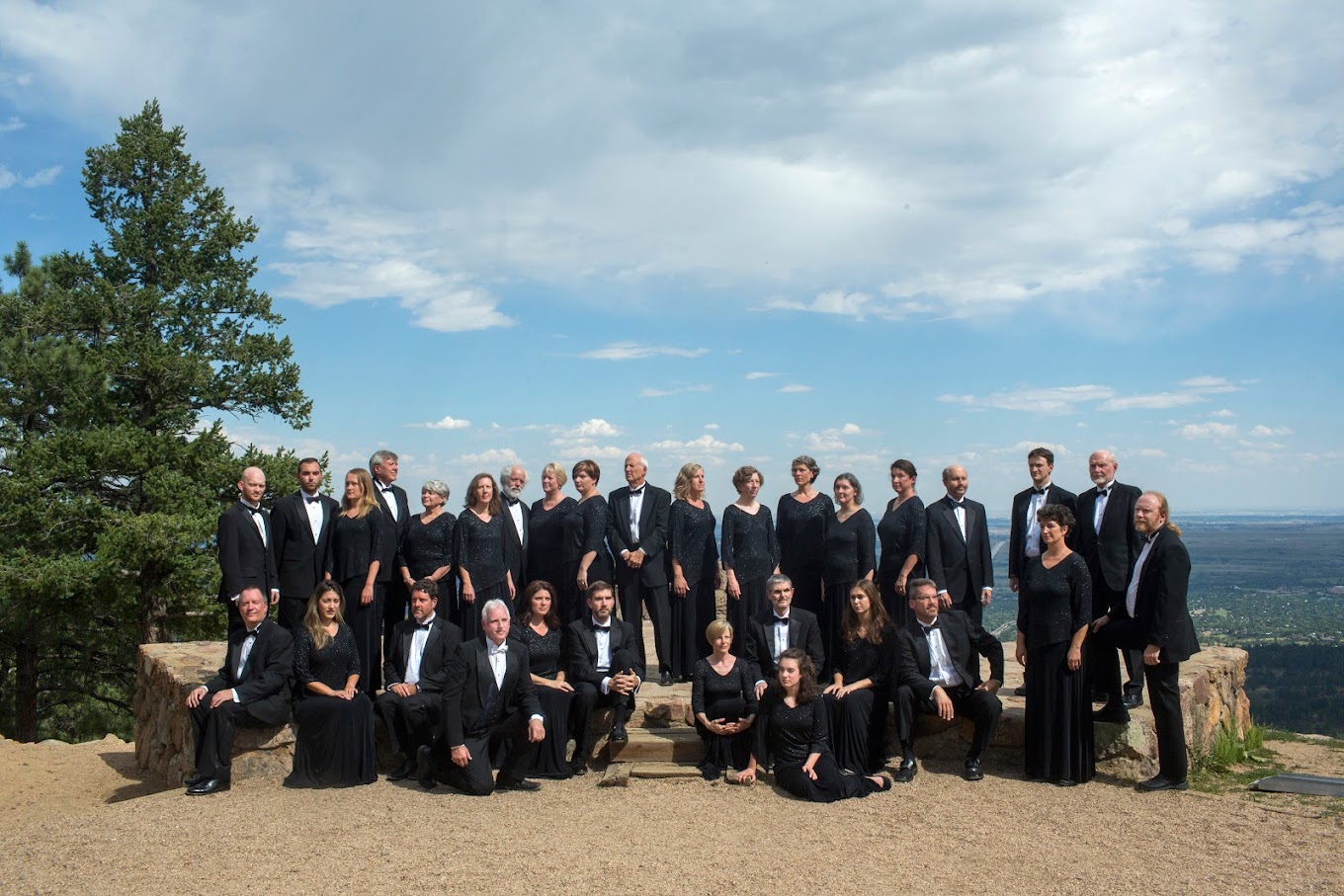
Ars Nova Singers with conductor Tom Morgan (kneeling, fourth from left)

For the current program, “Time/Eternity,” the program features two contemporary works modeled on church music dating back to at least the Renaissance, thus representing both eternity and modern time in each work. The first of these is the Mass for Double Chorus by Swiss composer Frank Martin. Written in 1922 and 1926, the Mass is a setting of the traditional five movements of the ordinary of the liturgical mass—that is, the texts that are sung at nearly every mass and not subject to variation across liturgical seasons.
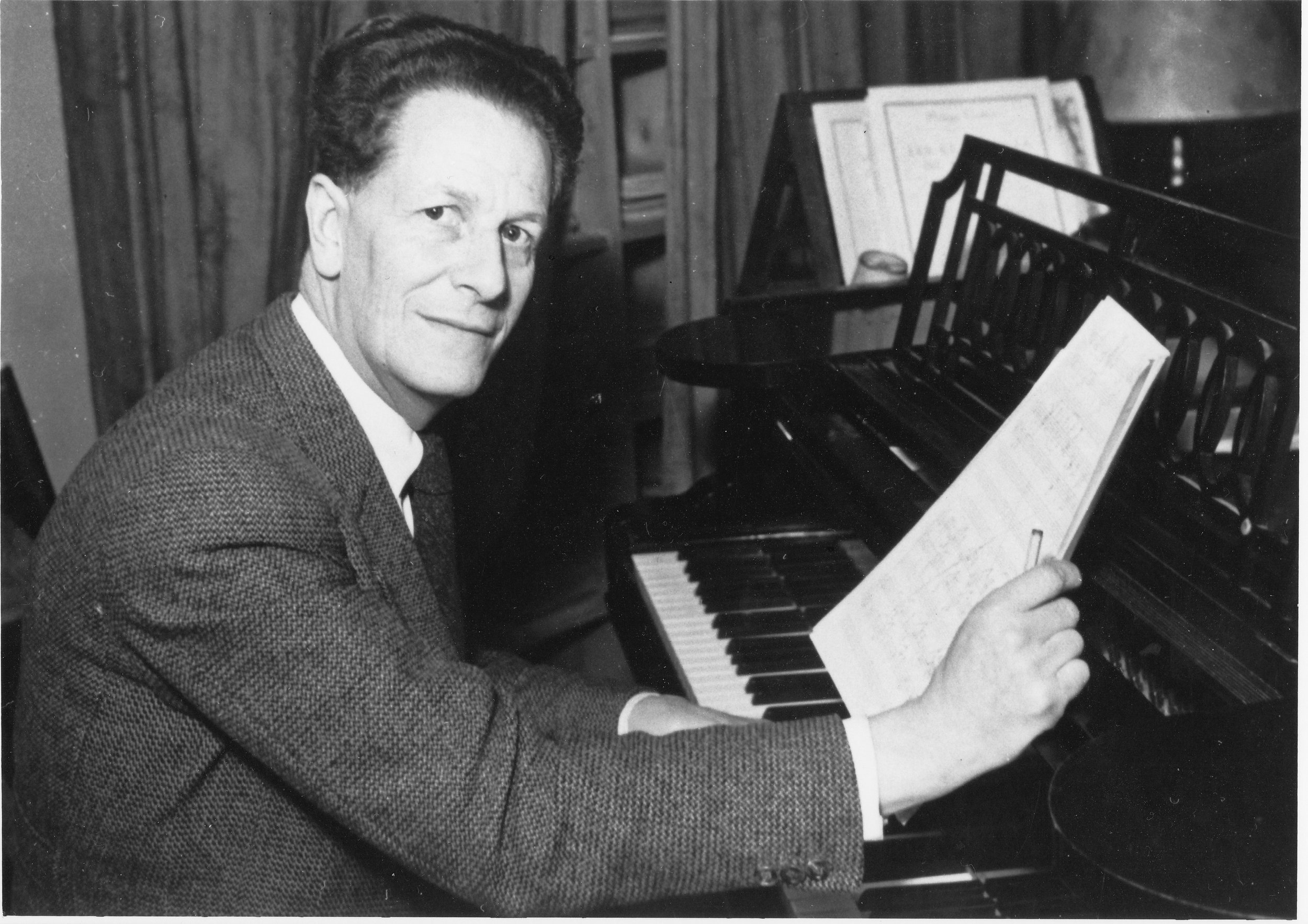
Composer Frank Martin

The Mass combines techniques typical of Renaissance mass settings, such as the use of a double chorus, fugal passages and imitative techniques across the choruses, together with modern stylistic elements that Martin was exploring. After he completed the Mass, Martin put the score away, considering it an early attempt at composition. He later consented to a performance in the 1960s, and today it is considered one of the most significant choral works of the 20th century.

The English composer Herbert Howells’ Requiem, written in 1932, is likewise based on traditional liturgical texts, in this case combined with other sacred texts from the Psalms and other sources. Although written for a single a cappella chorus, the Requiem sometimes divides the full chorus into two separate choirs. While using texts with a long liturgical history, the Requiem clearly has a musical style from the mid-20th century, using polytonality and chord clusters.

John Bawden, an active choral director and author of A Directory of Choral Music, wrote that “Howells’ music is much more complex than other choral music of the period. . . Long, unfolding melodies are seamlessly woven into the overall textures; the harmonic language is modal, chromatic, often dissonant and deliberately ambiguous. The overall style is free-flowing, impassioned and impressionistic, all of which gives Howells’ music a distinctive visionary quality.”

# # # # #

“Time/Eternity”
Ars Nova Singers, Tom Morgan, conductor

  • Frank Martin: Mass for Double Choir
  • Herbert Howells: Requiem

7:30 p.m. Friday, May 30
United Church of Christ, Longmont

7:30 p.m. Saturday, May 31
St. Paul Lutheran Church, Denver, and Livestream

7:30 p.m. Sunday, June 1
Mountain View United Methodist, Boulder

In-person and livestream TICKETS

Effective, powerful Samson et Delilah at Opera Colorado

Production opened Saturday, continues next week May 7, 10, 12

By Peter Alexander May 6 at 12:10 p.m.

Opera Colorado opened an effective and at  times powerful production of Saint-Saens’s Samson et Delilah Saturday (May 4) at the Ellie Caulkins Opera House in Denver.

The final production of 2023–24 season, Samson et Delilah will run for a total of four performances, with additional shows scheduled for 7:30 p.m. May 7 and 10, and 2 pm Sunday, May 12.

The production is a traditional take on the story, meaning there are no attempted updatings or imposed psychological meanings. Sets and costumes represent Biblical times—“as much as you can set something in Biblical times and be accurate,” in the words of stage director Keturah Stickann.

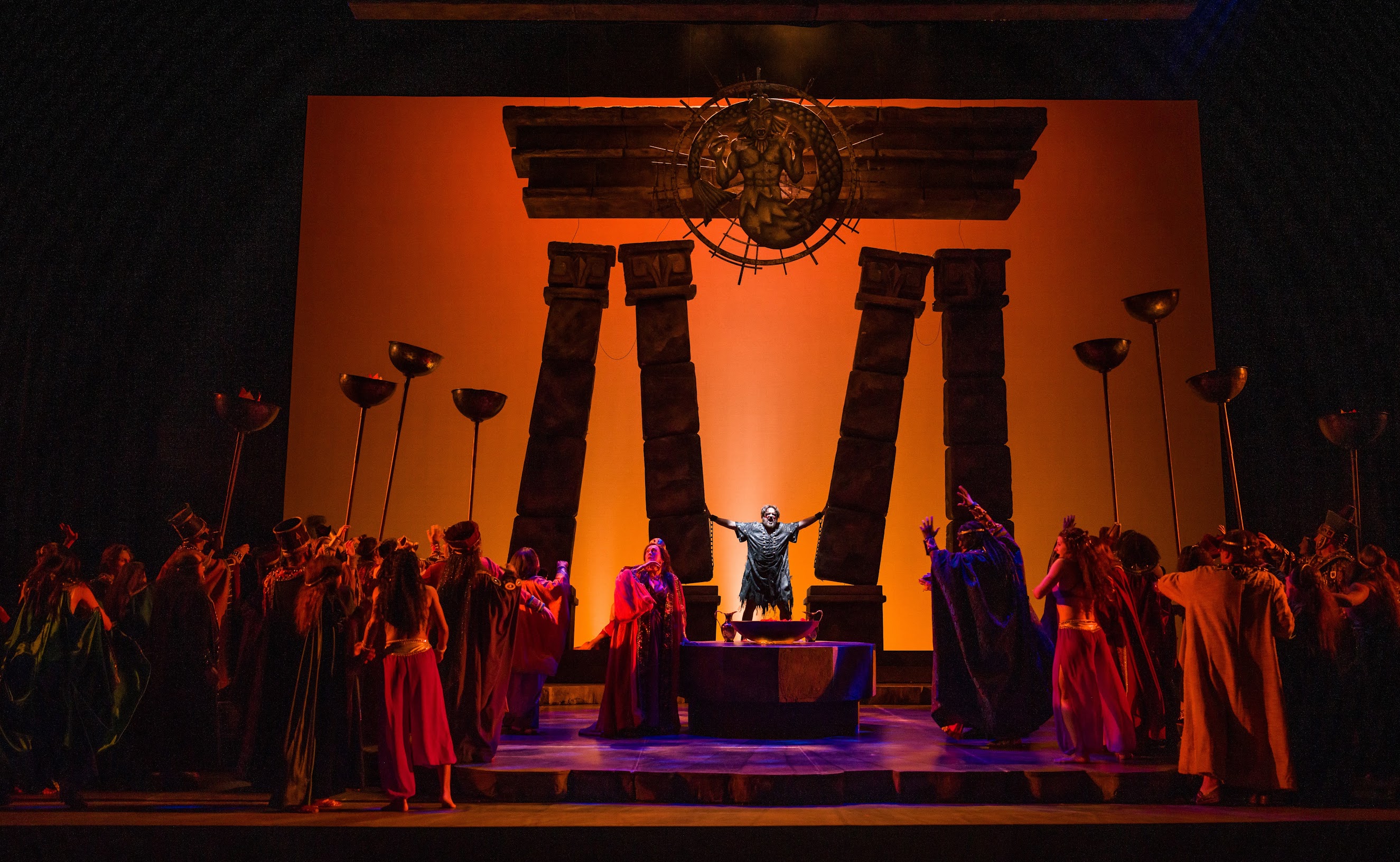
Act III of Opera Colorado’s production of Samson et Delilah. Photo by Matthew Staver for Opera Colorado.

The sets by Peter Dean Beck are evocative of the locations without devolving into middle-eastern kitsch. The first act opens on a nicely lit scene of the suffering Hebrews, in a public square under captivity by the Philistines. Here the set leaves plenty of space for the limited action that takes place, which is useful with so much of that act being otherwise static choral singing. Most impressive is the final scene, with the requisite pillars of the temple looming over the stage. The final collapse of the Philistine’s temple is simply accomplished but effective.

Stickann’s staging is never less than serviceable, which is what is needed for an opera with no hidden motives or deep psychological drama: everything that happens is out in the open. In the first act, the limited movements helped vary the stand-and-sing choral material. Repeated raised-arm gestures by the chorus are overdone but expressive of the repeated pleas of the Hebrews. Otherwise, the action moves smoothly. 

The second act confrontations  of Delilah with the High Priest and with Samson are well dramatized. However, the end of the act does not follow the libretto. In this production, Delilah gives Samson a magic potion, he passes out, and she takes a knife given to her by the High Priest and cuts Samson’s hair. But the libretto is clear: the hair cutting does not take place on stage for the simple reason that she never hears Samson’s secret onstage. 

What Saint-Saëns and the libretto indicate is that Delilah and Samson go into her house, where she seduces him and learns his secret during an orchestral interlude. Delilah calls for the Philistine soldiers who take Samson away. It’s  not clear if she has cut off his hair in her house, or the Philistines do so later, but it does not happen onstage. That is awkward, but a magic potion is too easy a way out. The composer’s version is better.

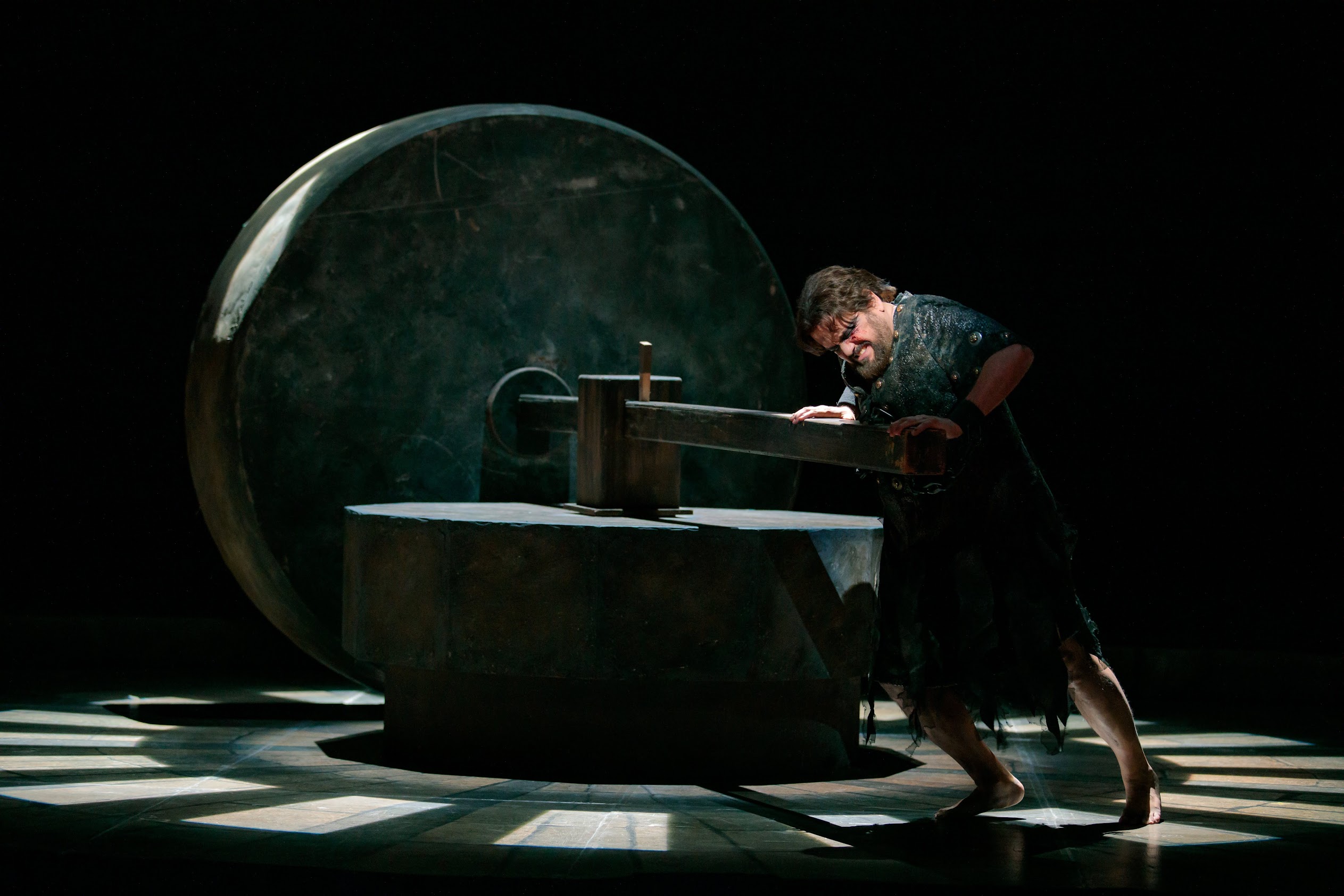
Rafael Davila as Samson. Photo by Matthew Staver for Opera Colorado

The final act is the best part of the evening. The first sene, of Samson pushing a mill wheel, is uncomplicated but moving. The destruction of the temple in the final scene works well on stage. Again, there’s not anything complicated to direct: there is a dance (the famous Bacchanale), Samson is brought in and mocked by the Philistines, then he moves between the pillars and brings down the temple. I was happy to see that the child who guides the blinded Samson was not forgotten: Samson sends him out of the temple before it collapses.

A fine cast gave top-flight performances. As Samson, tenor Rafael Davila made the strongest impression, singing with a solid, heroic-tenor quality. He consistently sang the words expressively, but did not always convey Samson’s internal struggle between his feelings for Delilah and his religious convictions. He was at his best in the final scene, creating great pathos while pushing the mill wheel and ringing out his denunciations of the Philistines at the end.

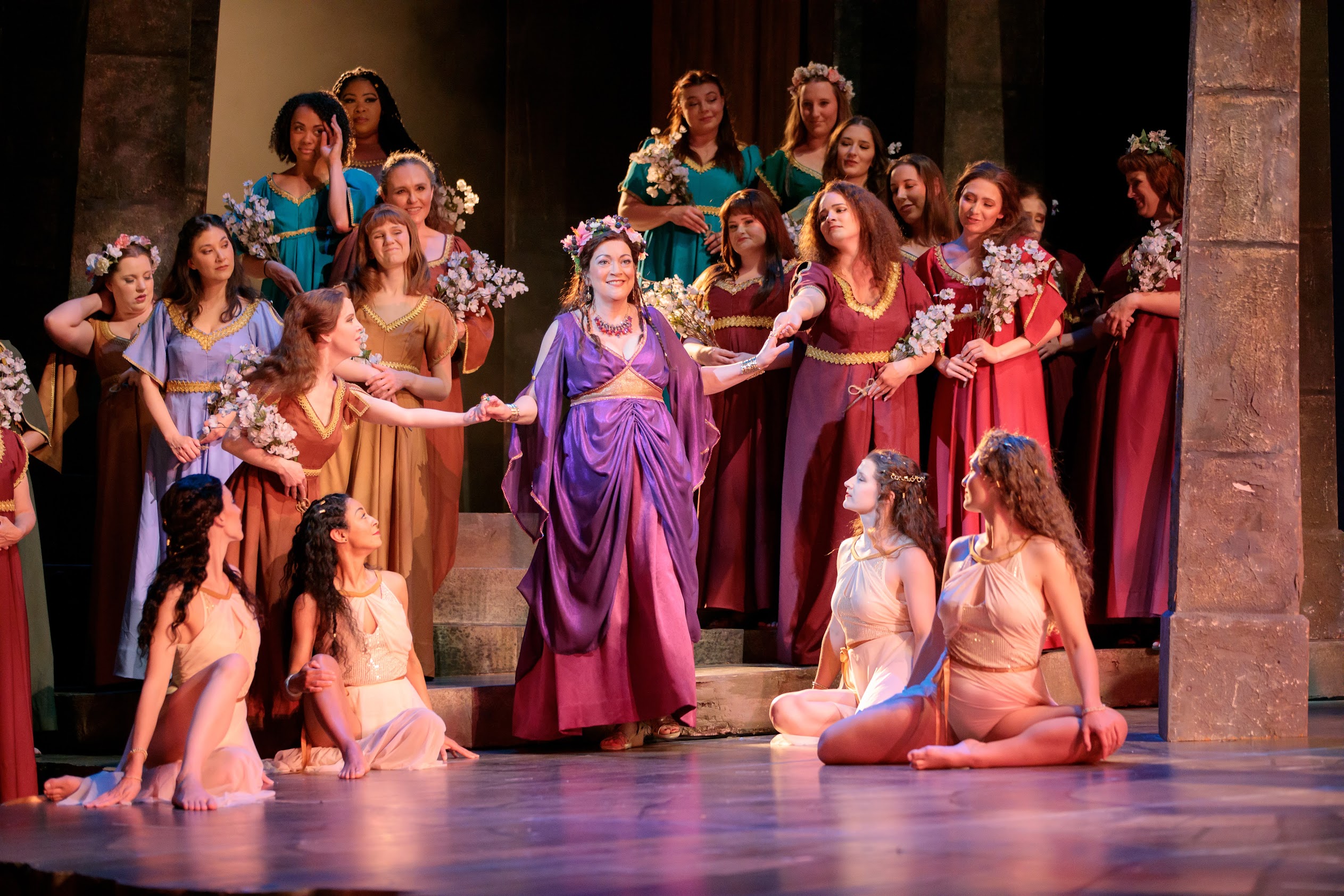
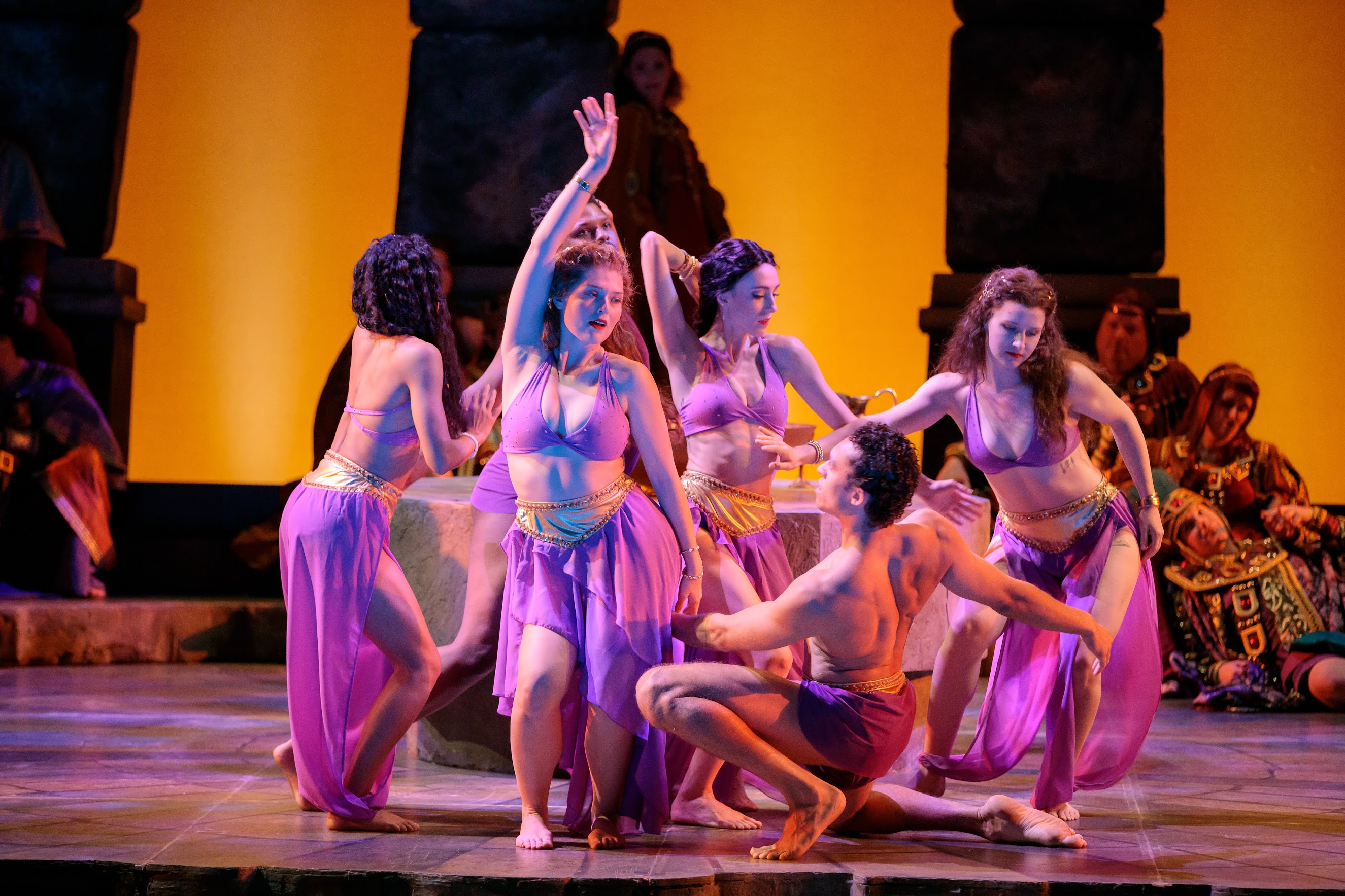
Katherine Goeldner as Delilah (center) with Philistine maidens and dancers in Act I of Samson et Delilah. Photo by Matthew Staver for Opera Colorado.

As Delilah, Katherine Goeldner brought extensive experience to her performance, including a prior appearance as Delilah at Virginia Opera. She no longer has the bright, focused tone of a young singer, but she had all the strength Saturday night to carry off the climactic moments. She sang with firmness of tone and great expression. And her Delilah is multilayered: aristocratic, calculating in her seduction of Samson, and vicious in her mockery in the final scene.

Nmon Ford was a tall, imposing High Priest, capturing both the authority and the evil implicit in the Biblical narrative. He brought a powerful and orotund, if occasionally rough-hewn sound to his portrayal. In the small part of Abimelech, the Philistine ruler who is killed by Samson in the first act, Christian Zaremba provided a dark, sometimes tight bass. Turner Staton was a solid Old Hebrew in his Act I dialog with Samson.

I am not dance critic, but I thought the dancers were smoothly integrated in the first act, more disconnected in the Bacchanale. The singers of the Opera Colorado chorus gave their lengthy, critical numbers a rich sound and secure ensemble.

The orchestra under conductor Ari Pelto propelled the action effectively, especially in Act II where the woodwinds shone in their prominent roulades. The full orchestral sound and expression supported the story throughout. The only reservation would be the Bacchanale, which was too fast. It is a frenzied dance, but taken too fast it looses clarity and precision, and the sudden tempo change near the end, which should be an explosion of sound and fury, looses its impact. Nevertheless, audience granted the expected spontaneous applause.

Tickets to additional performances may be purchased HERE.

Opera Colorado presents Saint-Saëns’ “Samson et Delilah”

The opera is based on, and different from, the familiar Biblical story

By Peter Alexander May 2 at 4:30 p.m.

The Biblical story of Samson’s betrayal by Delilah, and his violent revenge, is one of the best known dramatic tales from the Old Testament. It has been dramatized many times in film and music.

One of the most successful of those dramatizations will be presented by Opera Colorado over the next two weeks: Camille Saint-Saëns’s Samson et Delilah. The production opens Saturday, May 4, with additional performances May 7, 10 and 12 (details below).

Opera Colorado’s production of Samson and Delilah. Photo by Matthew Staver for Opera Colorado.

Performances will be conducted by Ari Pelto, Opera Colorado’s music director. Stage direction is by Keturah Stickann, with sets by Peter Dean Beck. The role of Samson will be sung by tenor Rafael Davila, Delilah by mezzo-soprano Katherine Goeldner.

The production will be a traditional one, Stickann said. “We are not updating in any conscious way,” she says. “We are set in Biblical times, as much as you can set something in Biblical times and be accurate.”

Most of the opera’s story will be familiar to anyone who knows the Biblical narrative. Samson has superhuman strength. The Philistines want to know the source of his strength so they can defeat him. Eventually Delilah learns that his strength comes from his hair. His hair is cut, he is captured by the Philistines, then blinded and enslaved. In the final act he destroys the Philistine temple. 

That much is familiar, but there are some significant differences, particularly in the character of Delilah. In the Bible (Judges 16), she betrays Samson for money—1100 pieces of silver from each of several Philistine officials. In the opera, however, she acts more out of loyalty to the Philistine people and priests and declines gold offered by the high priest.

“If you look at what is written on the page, in the opera, she is very much an agent of the Philistines,” Stickann says. “That is not the way that she comes across in the Biblical story. Ultimately you have to tell the story that’s on the page.”

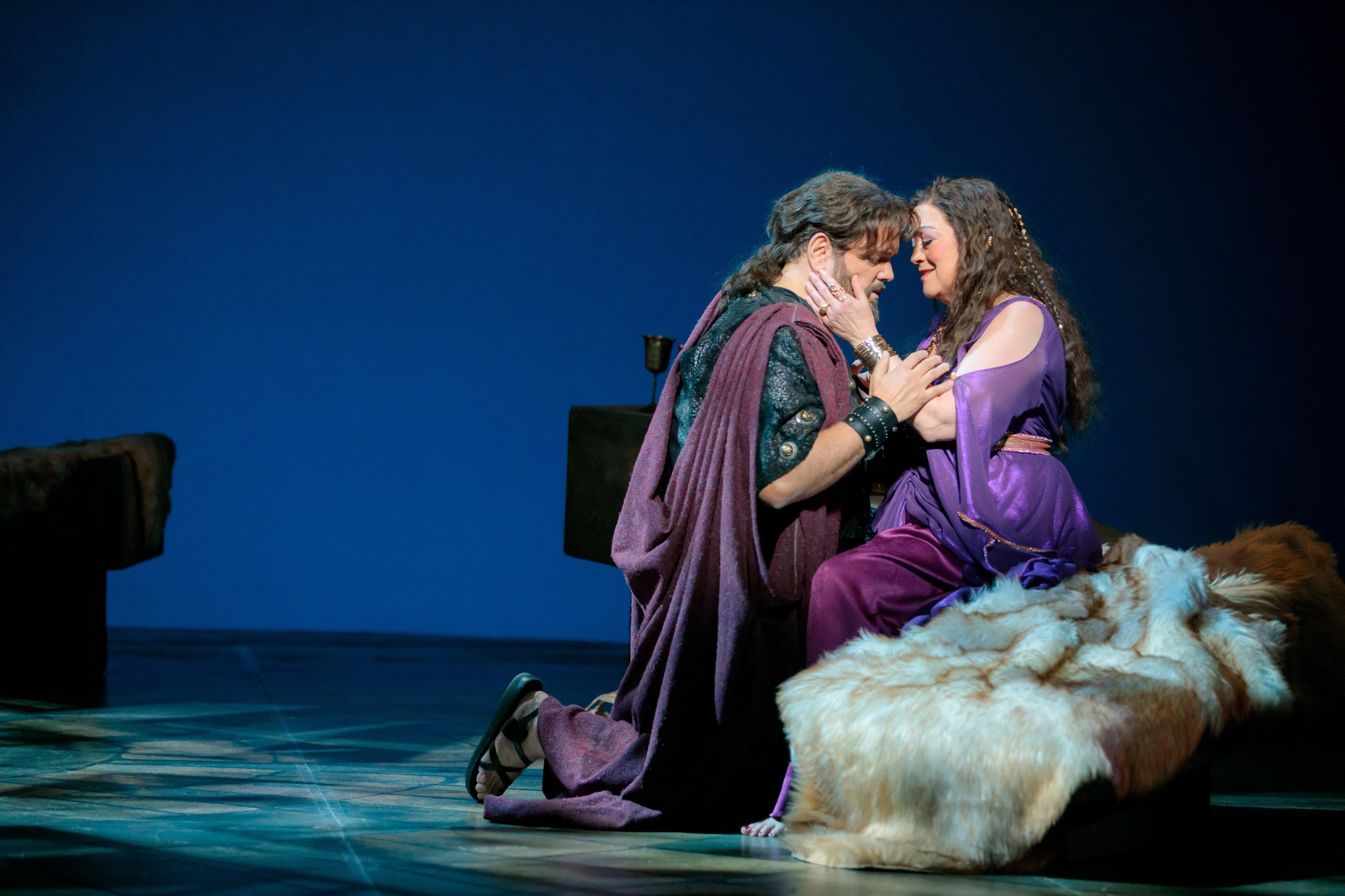
Rafael Davila (l.) and Katherine Goeldner (r.) as Samson and Delilah in Opera Colorado’s production of “Samson and Delilah.” Photo by Matthew Staver for Opera Colorado.

Stickann said that she and Goeldner, who will sing the role of Delilah, talked at length about the character. “She’s a mata-hari creature in this opera,” Stickann says. “She’s a spy for her people (and) is trying desperately to help her people.”

Goeldner agrees, but also sees many layers to Delilah. “She can be seen as just an evil vamp, but that’s too simple and uninteresting,” she says. “She’s not just sultry, she’s complicated. She’s mostly manipulating Samson. This is the fourth time she has tried to get his secret, and he’s lied to her three times. And yet he keeps coming back for more!

“She does love Samson in a way, but I think it’s the way Carmen loves Don Jose (in Bizet’s opera Carmen)—he’s useful and as soon as he stops being useful she’s done with him.”

Along with Carmen and Amneris in Aida, Delilah is one of the major starring roles for mezzo-sopranos. She dominates the second act and her actions drive the plot. As a result, it is one of the most coveted roles for mezzos.

“Getting to do Delilah once in a mezzo’s career is a huge thing,” Goeldner says. “The second act, you’ve got aria, gigantic duet, another gigantic duet, one of the most famous arias in the operatic repertoire—she’s on the entire time. It is one of the most demanding roles in the mezzo repertoire. It’s far more demanding than Carmen for example, which I’ve done a bunch.”

Her second act aria, “Mon cour s’ouvre à to voix” (My heart opens at the sound of your voice) is one of two frequently performed selections from Samson et Delilah. The other is the frenetic Danse Bacchanale in the third act, usually performed as a ballet as was expected in French opera of the 19th century, and a source of many standard musical gestures associated with the Middle East.

Dancers in Opera Colorado’s production of Samson and Delilah. Photo by Matthew Staver for Opera Colorado.

One of the challenges of presenting Samson et Delilah, and one that is visible to the audience, is that it was originally conceived as an oratorio rather than an opera. That idea survives in the large choral numbers in the first and third acts, which are great music but dramatically static.

“It is the problem of the piece,” Stickann says. “Sometimes the drama comes directly from the music. We do a little movement at the beginning of the long choral pieces, and then we sink into it a little bit. It gets more active, but this is the way that Saint-Saëns designed it. My challenge as a director is to make it work, that it is a seamless piece of theater.”

Stickann is excited about the Opera Colorado production of the opera. “It’s a terrific cast, the chorus is working at peak, and we have some spectacular dancers in this production. (And) The audience in Denver enjoys grand opera.”

Her perspective comes form having worked in 30 states and several countries overseas, and having lived in Missouri, San Diego, New York, and now Knoxville, Tenn. “It’s not just my upbringing in the Midwest,” she says. “It’s my experience in the South, my experience on the West Coat, my experience on the East Coast. These different places have definitely colored the way that I work.

“Every one of them has given me something, every one has a different way of being, [and] I grow a little bit more every time I move.”

# # # # #

Samson et Delilah by Camille Saint-Saëns
Libretto by Ferdinande Lemaire
Opera Colorado
Ari Pelto, conductor; Keturah Stickann, director

7:30 p.m.Saturday, May 4, Tuesday, May 7 and Friday, May 10
2 p.m. Sunday, May 12

Ellie Caulkins Opera House, Denver Performing Arts  Complex

TICKETS

Music from Haydn to Mariachi on a busy weekend

Boulder Phil, Boulder Chorale and Takács Quartet 

By Peter Alexander April 25 at 10:05 p.m.

It’s spring and thoughts at the Boulder Philharmonic turn to romance.

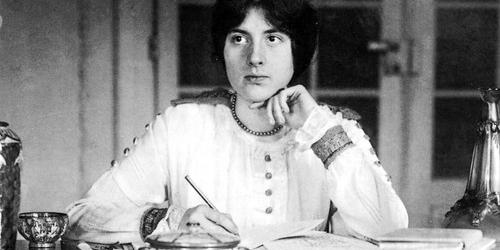
Their next concert under music director Michael Butterman, titled in fact “Spring Romance,” features a fleet and evocative musical meditation on the season, D’un matin de printemps (Of a spring morning) by Lili Boulanger. 

Also on the program to be performed Saturday (April 27; details below) at Macky Auditorium, Spanish/Mallorcan violinist Francisco Fullana will perform Saint-Saëns’s Violin Concerto No. 3 with the orchestra. The program concludes with Tchaikovsky’s Symphony No. 5.

Lili Boulanger

The younger sister of the famous music teacher Nadia Boulanger, Lili died at the tragically young age of 24. The first female winner of the Prix de Rome composition prize, Lili showed precocious musical talent as young as four, when she accompanied her older sister to classes at the Paris Conservatoire. Long overshadowed by Nadia’s success, Lili and her music have become more prominent in recent years. 

Written in 1918, D’un matin de printemps was one of the last works she completed. It was written in versions for solo violin, flute, and piano, for piano trio, and for orchestra. The score’s origin as a solo piece is reflected in passages traded among first chair string players. 

A native of Mallorca, a Spanish island in the Mediterranean, Fullana won an Avery Fisher Career Grant in 2018. A versatile performer, he performs both 19th-century Romantic repertoire with major orchestras world wide, and early music that he has played as artist-in-residence with the ensemble Apollo’s Fire.

Dedicated to and premiered by the Spanish virtuoso Pablo de Sarasate, Saint-Saëns’s Third Concerto is one of his most frequently performed pieces for violin and orchestra. Characterized by colorful themes and virtuoso flourishes, it has often been chosen by young violinists as a debut concerto. The most striking moment comes at the beginning of the finale, when the violinist plays a recitative-like passage before proceeding to an energetic main theme.

One of the composer’s most popular works, Tchaikovsky’s Fifth Symphony is also one of his most emotionally wrought symphonies. Often gripped with insecurity, Tchaikovsky initially thought the Fifth Symphony was a failure. “There is something repellant about it,” he wrote. After Brahms heard it and praised the symphony, however, Tchaikovsky wrote “I have started to love it again.”

The symphony’s dramatic progression has suggested to many listeners that there is an underlying story, or program. The composer, however, insisted that the Fifth—unlike the Fourth and Sixth symphonies—was not programmatic. Regardless of what any listener hears within the score’s drama, however, its emotional force has made it one of the most popular pieces in the orchestral repertoire.

# # # # #

“Spring Romance”
Boulder Philharmonic Orchestra, Michael Butterman, conductor
With Francisco Fullana, violin

  • Lili Boulanger: D’un matin de printemps (Of a spring morning)
  • Saint-Saëns: Violin Concerto No. 3
  • Tchaikovsky: Symphony No. 5

7 p.m. Saturday, April 27
Macky Auditorium

TICKETS

# # # # #

While the Boulder Philharmonic is thinking about Spring, the Boulder Chorale and conductor Vicki Burrichter are musically off to Mexico for a Fiesta de las Luces (Festival of lights).

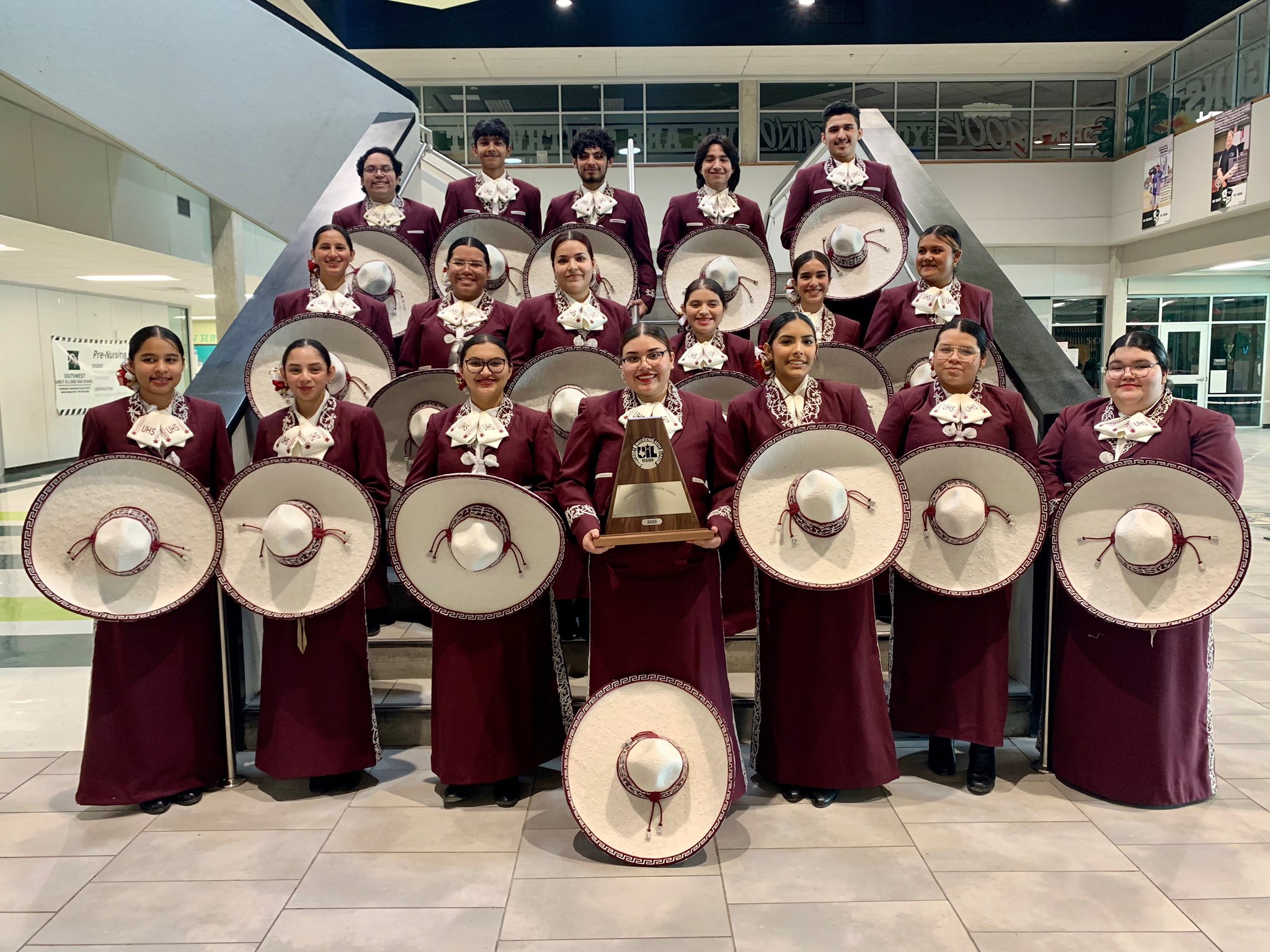
Their next program, to be presented Saturday and Sunday in Boulder and Longmont (April 27 and 28; see below) features Los Coyotes, an award-winning Mariachi Band from Uvalde, Texas, High School, as well as the Boulder Chorale’s children’s choir Bel Canto. The program is a celebration of Mexican culture in music, including both Mariachi music and other Mexican songs.

Los Coyotes, Uvalde High School, Texas

Founded in 1999, Los Coyotes won the Texas University Interscholastic League (UIL) Mariachi Championship in 2023. The outcome of the championship included a powerful feature article in Rolling Stone Magazine one year ago. The article brought out, among other things, the consoling impact of Mariachi music in Uvalde after the school shooting of 2022, and how a small program had grown into state champions under their current director, Albert Martinez.

As part of their visit to Colorado to perform with the Boulder Chorale, Los Coyotes have presented a workshop for local Mariachi students at Longmont’s Skyline High School, and have other appearances planned in addition to their concerts with the Boulder Chorale. Their full schedule is available HERE.

Each performance listed below will be preceded at 3:30 p.m. by a presentation by Burrichter and Martinez.

# # # # #

Fiesta de las Luces: Songs of Mexico
Boulder Chorale, Vicki Burrichter, conductor
With Los Coyotes, Mariachi band from Uvalde, Texas, High School, Albert Martinez, director;  and the Boulder Children’s Choir Bel Canto

Program of Mariachi music and Mexican songs arranged for chorus

4 p.m. Saturday, April 27 at First United Methodist Church, Boulder
4 p.m. Sunday, April 28, at Vance Brand Civic Auditorium, Longmont

TICKETS

# # # # #

The Takács Quartet wraps up their 2023–24 season of campus concerts Sunday and Monday (April 28 and 29; see details below). This was the quartet’s 49th season. 

The Sunday performance is sold out, but a few tickets are still available at the time of posting for Monday’s performance, and tickets are also available for the livestream of Sunday’s concert, which will be available online through Monday, May 6.

The program comes from the heart of the Classical/Romantic repertoire, opening with string quartets by Haydn and Schubert. To close out the concert, two additional CU music faculty members—violist Erika Eckert and cellist Meta Weiss—join the quartet to perform Brahms’s String Sextet in G major.

Most of Haydn’s string quartets were published in sets of six, which was the standard for most printed music at the time. Each published set generally has an opus number for the full set, with works numbered 1–6 within the set. The Quartet in D minor, op. 42, is an exception, however, as it stands alone as a single work issued as op. 42. 

It has been speculated that because it is a relatively simple quartet, Op. 42 might have been part of a planned set of three shorter works that were commissioned by two Spanish nobles, but never completed. It is in the standard four movements, in the order Andante ed innocentemente (walking speed and innocently), Minuet—Trio, Adagio and Presto.

Schubert’s String Quartet in B-flat was written in 1814, when the composer was only 17. It was never published during Schubert’s lifetime, so when it finally came out in 1863, it was given the late opus number of 168, even though it was an early work. Schubert wrote the quartet very quickly, completing the first movement in only four and a half hours, and the entire quartet in nine days. With such speed, it is not surprising that it is one of seven quartets Schubert completed in little more than a year.

Takács Quartet. Image by Amanda Tipton Photography.

All his life Brahms was wary of being compared to Beethoven. That likely why it took him 14 years to complete his first symphony, published when he was in his 40s, and why he destroyed his first 20 attempts at writing a string quartet. It is also sometimes speculated that he completed his two string sextets before his three quartets because they were not easily compared Beethoven’s masterful string quartets.

In any case, the Sextet in G major was written when Brahms was living comfortably near the resort town of Baden-Baden. The first movement contains a musical reference to the first name of the singer Agathe von Siebold, to whom Brahms had been briefly engaged some years before. Her significance to the composer is indicated by the fact that when he finished that movement, her wrote in a letter, “Here I have freed myself from my last love.”

Surprisingly, the Sextet was first performed in Boston in October 1866, a month before the European premiere in Zurich.

# # # # #

Takács Quartet
With Erika Eckert, viola, and Meta Weiss, cello

  • Haydn: String Quartet in D minor, Op. 42
  • Schubert: String Quartet in B-flat Major, D112
  • Brahms: String Sextet No. 2 in G Major, Op. 36

4 p.m. Sunday, April 28 SOLD OUT
7:30 p.m. Monday, April 29

Grusin Music Hall, CU Imig Music Building

TICKETS for live performances and for online stream of Sunday’s performance