
Britten’s The Turn of the Screw in a hauntingly ambiguous production
By Peter Alexander Aug. 10 at 1:15 p.m.
Editor’s Note: This is one of several posts covering four of the five operas presented this year at the Santa Fe Opera.
Benjamin Britten’s The Turn of the Screw is a challenging opera to produce.
Based on the short story by Henry James, it is a ghost story about a governess who cares for two children living on a remote estate. The children, Miles and Flora, are haunted, and lured into mischief or worse, by the spirits of deceased previous caretakers.
Or are they?
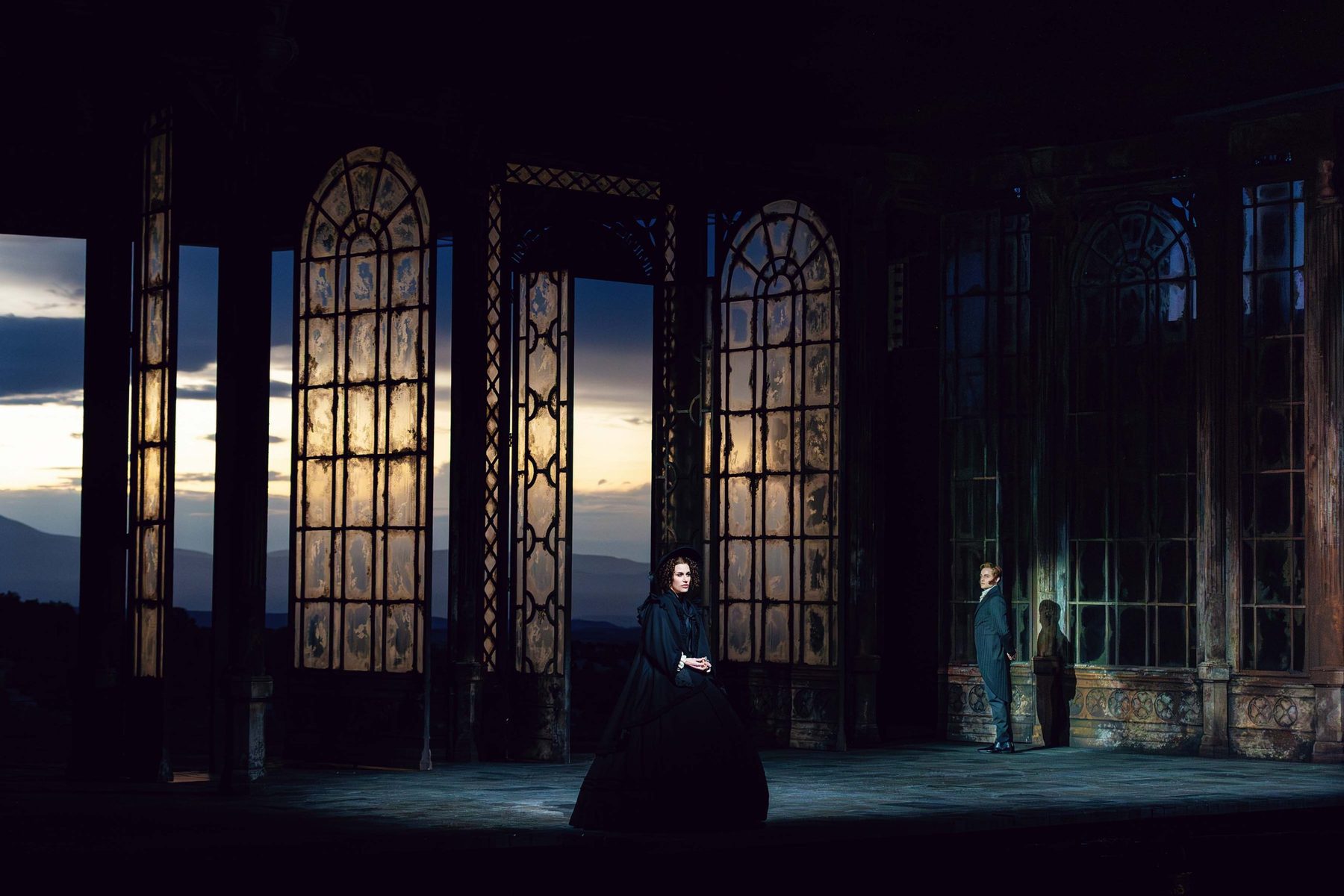
As James’ story and the opera both make clear, the question is whether the ghosts are real presences, haunting the house and the children, or the products of the governess’ delusions, phantoms of an unbalanced mind. Whole books have been written on this issue; any production that fails to recognize the question has failed.
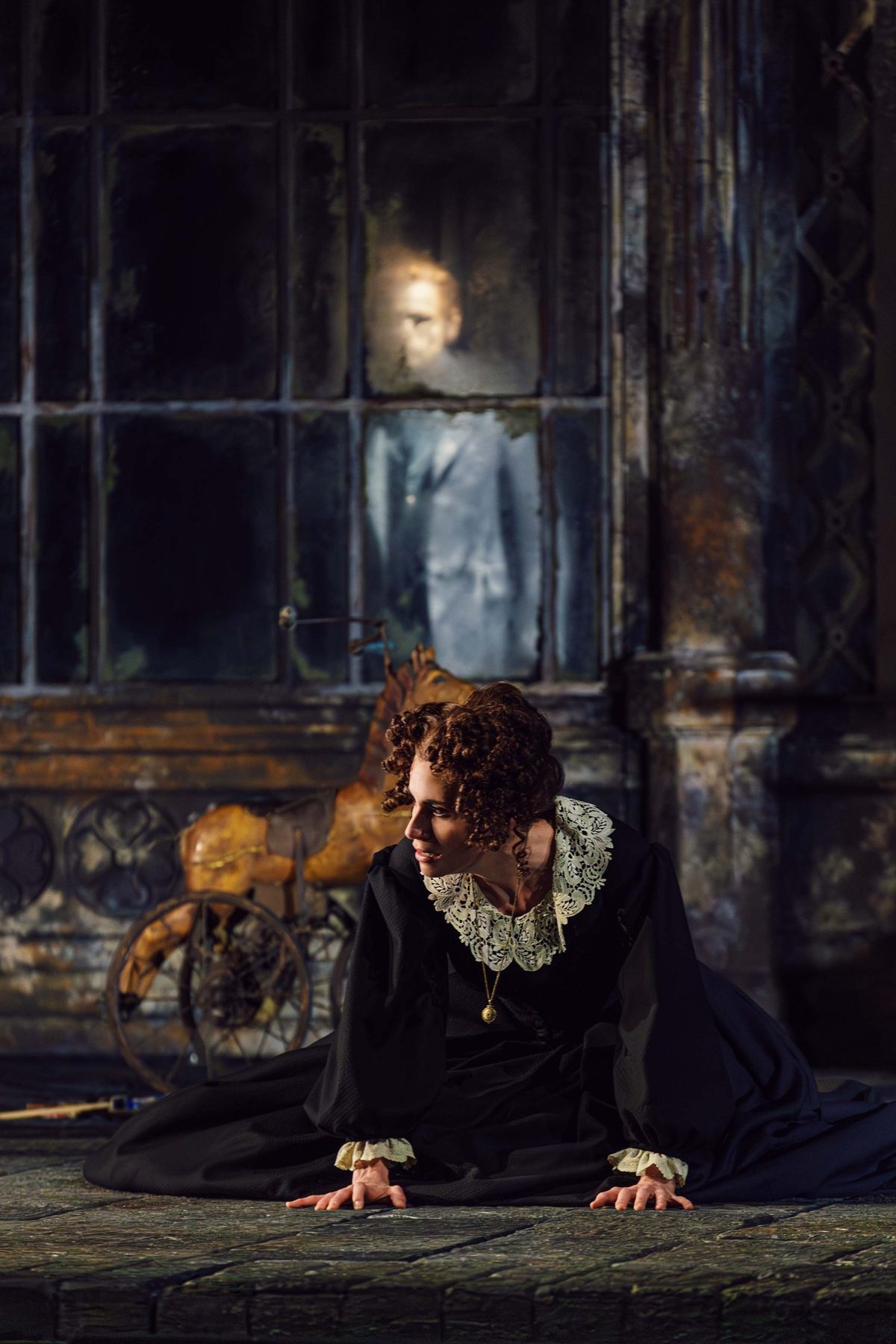
In that respect, the current Turn in Santa Fe is the most successful I have seen. The relationships among the governess, the children, and the ghosts of Peter Quint and Miss Jessel, are adeptly handled. The problem is that Quint and Jessel sing, so it is necessary to have living actors onstage. How can they remain figments of the Governess’ imagination, when we, the audience, can see them?
A full description of all the astute choices in the Santa Fe production would require a separate essay, but several critical points illuminate the care taken by stage director Louisa Miller. In his first appearance Quint is only a vague apparition, seen though the window. But after Mrs. Grose, the housekeeper, gives names to what has happened in the past, who Peter Quint and former governess Miss Jessel were, suddenly they are seen more clearly, appearing onstage with the governess. This suggests that Mrs. Grose has stimulated the young governess’ overactive, and possibly paranoid, imagination.
Another telling point is that the children never see the ghosts. When Quint and Jessel are onstage, the children never turn to look at them, in spite of being called by name. Only the governess seems to see and hear the ghosts, and only she speaks to them. So the ghosts, if such they are, remain suggestions more than characters. Anything else can be explained by the fact that Quint and Jessel did interact with—and possibly lead astray—the children in the past. When Quint tells Miles to steal a letter, it could just as reasonably be a young boy’s naughty impulse pushing him to mischief. His later explanation—“I wanted to know what you wrote about us”—rings true.
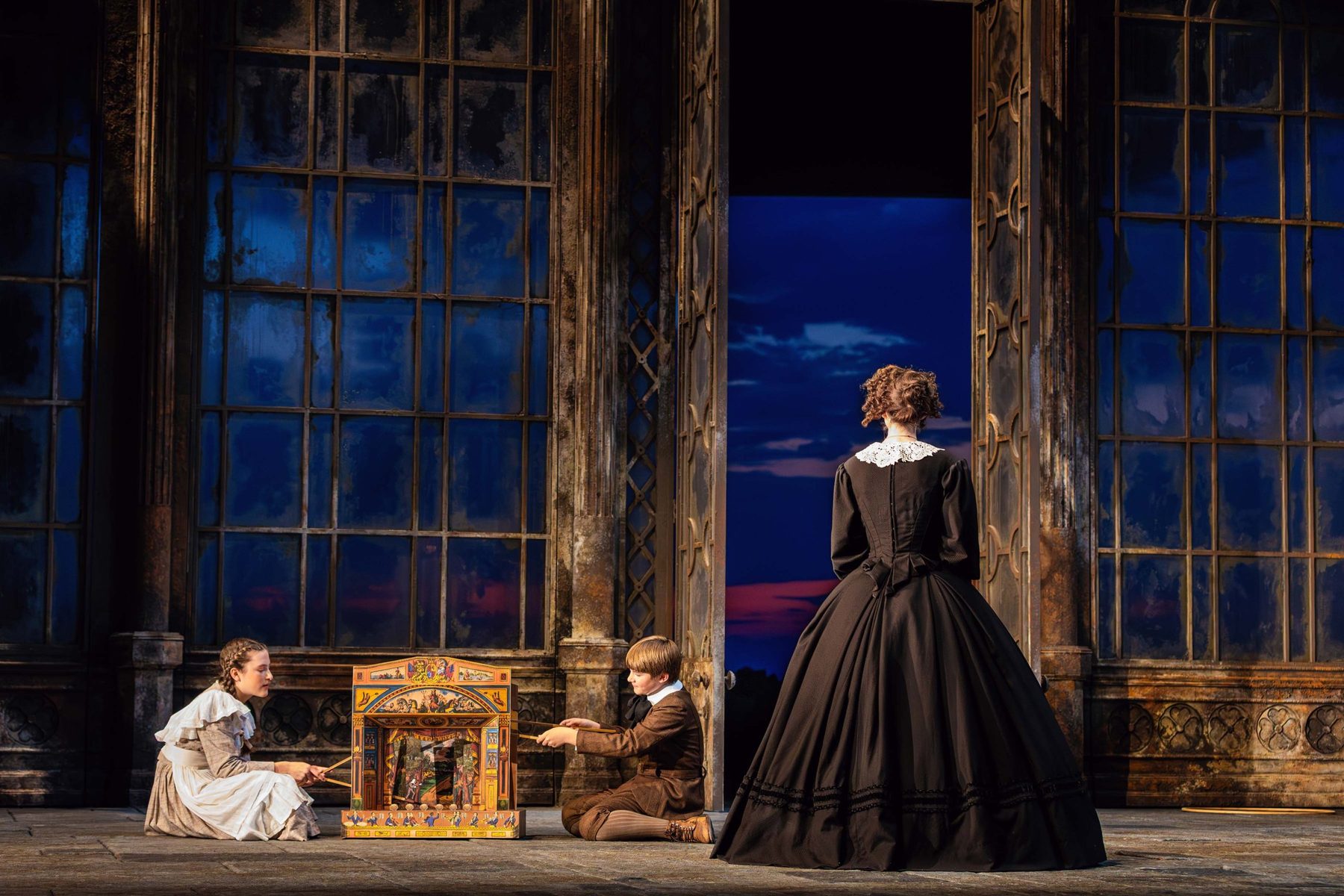
It would be a mistake to overlook one innovation of this production. Britten’s score is divided into scenes and and purely orchestral interludes between them. Miller makes use of the interludes—usually played without action—for symbolic events, or to show the children playing (and kudos for the delightful period play, from hoop trundling to a play theater) with the governess joining in. The plot focuses on the descent to tragedy, ignoring the rest of the children’s lives and their happier interactions with the governess. These pantomime sequences add depth to all of of the characters.
In short, Miller’s direction carefully treads the line between ghost story and psychological case study. (It is useful to recall that Henry James’ brother William is one of the founders of modern psychology). She correctly leaves it to the audience to decide which version of the story is true—or to leave it undecided.
The scenic design is credited to Christopher Oram, as a Canadian Opera Company production that originated at the Garsington Opera in England. It has effectively been fit onto Santa Fe’s stage, where lighting by Malcolm Rippeth successfully adds to the suggestive, murky ambience of the setting.
The Aug. 5 cast was uniformly strong in presenting both music and character. The diction was always clear and understandable, a testament to both Britten’s care in scoring the opera and the singers’ efforts. Brenton Ryan brought a bright tenor voice to both the prologue and the role of Peter Quint. His alluring roulades, tailored for the original Quint of Peter Pears, were unexceptionable. In one of the more telling touches, the staging of the prologue briefly conflates Quint and the absent guardian, raising more questions of motive and reality.
Jacquelyn Stucker was an ideal Governess, with a clear and delicate sound at the outset. She gave a well considered performance; as the opera progressed, she became more unstable and desperate in her characterization, and her tone more brittle and biting in quality. In voice and presence, Jennifer Johnson Cano portrayed a stolid and sometimes baffled housekeeper. She sang with security, blending into the ensemble and never dominating the musical texture.
The two young characters were beautifully performed by treble Everett Baumgarten as Miles and young soprano Annie Blitz as Flora. Baumgarten’s pure sound was always audible, and was alluring in his eerie “Malo, malo.” Blitz’s voice was focused, consistently on pitch but at times piercing.
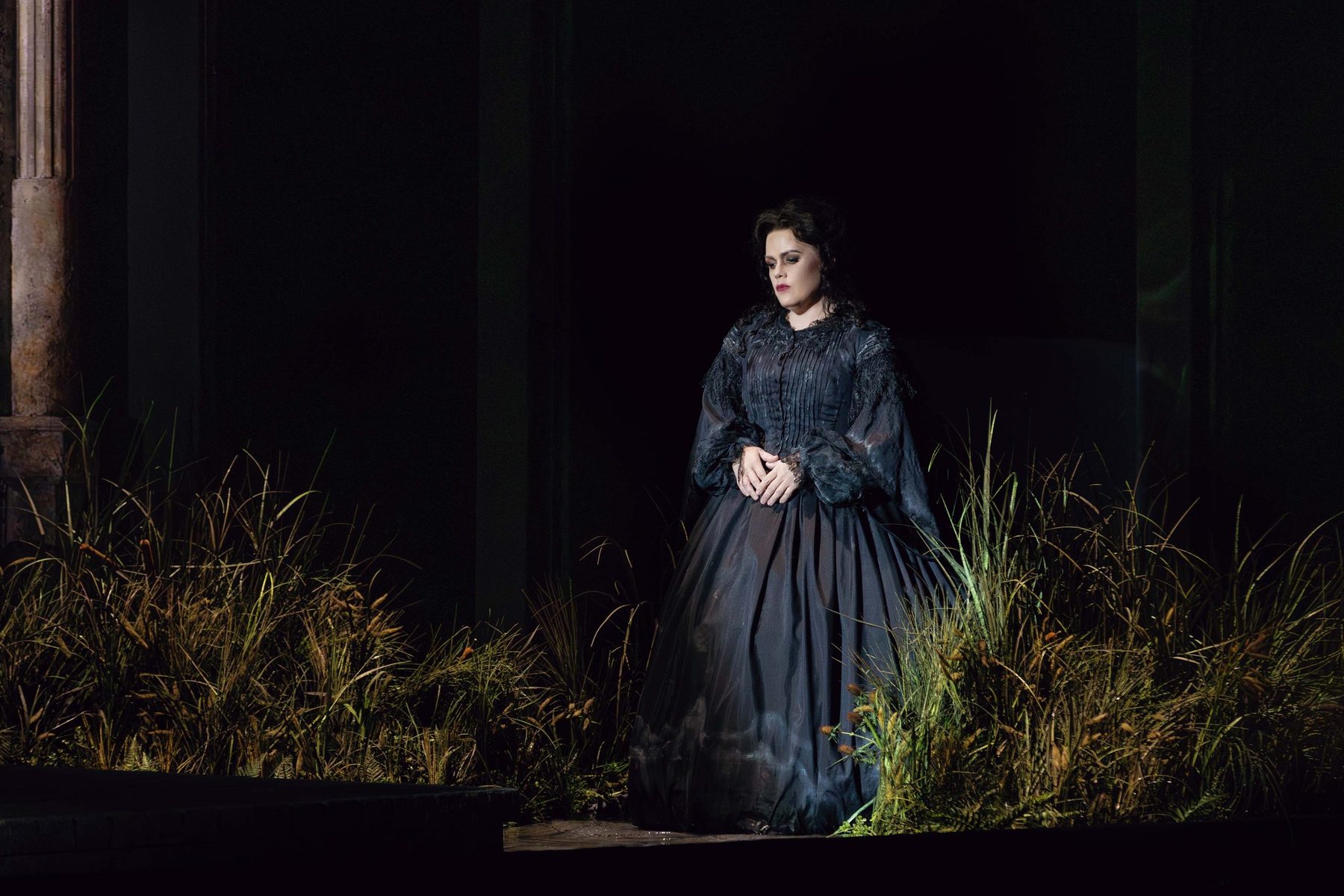
Wendy Bryan Harper provided a brooding presence as Miss Jessel. Her slightly pushed tone suggested a character under pressure, never quite at ease. Otherwise, little acting was required, as she drifted phantom-like on and off the stage, usually through the onstage pond that represented both the estate’s lake, and its symbolism as a boundary space between the real and unreal.
It would be hard to overpraise the orchestral players in the pit. Britten’s virtuoso score for an ensemble of 13 players was ably led by conductor Gemma New, who convincingly knit the various musical elements together, from scene to interlude to scene, and brought out the shifting moods of the evocative score. While all the players mastered the virtuoso demands of their parts, special notice should be taken of prominent percussion passages throughout.
NOTE: The 2025 performances of Turn of the Screw have come to an end.


 Sharps & Flatirons