
Takács Quartet, Faculty Tuesday concerts have begun for 2023–24
By Peter Alexander Sept. 14 at 10:30 p.m.
You may still be stuck in a Summer mood—I know I am—but on the CU campus and around the Imig music building, Fall is well under way.
Even more reliable signs of the season than the turning of the leaves, the College of Music’s Faculty Tuesday series and the Takács Quartet’s campus concert series are already ongoing for the 2023-24 year. The Takács will play music of Haydn, Bartók and Beethoven Sunday afternoon and Monday evening (4 p.m. Sept. 17 and 7:30 pm. Sept. 18 in Grusin Hall), in their customary two-performance pairing. They have one more program during the fall (Nov. 5 and 6; program below) and more performances after the first of the year.
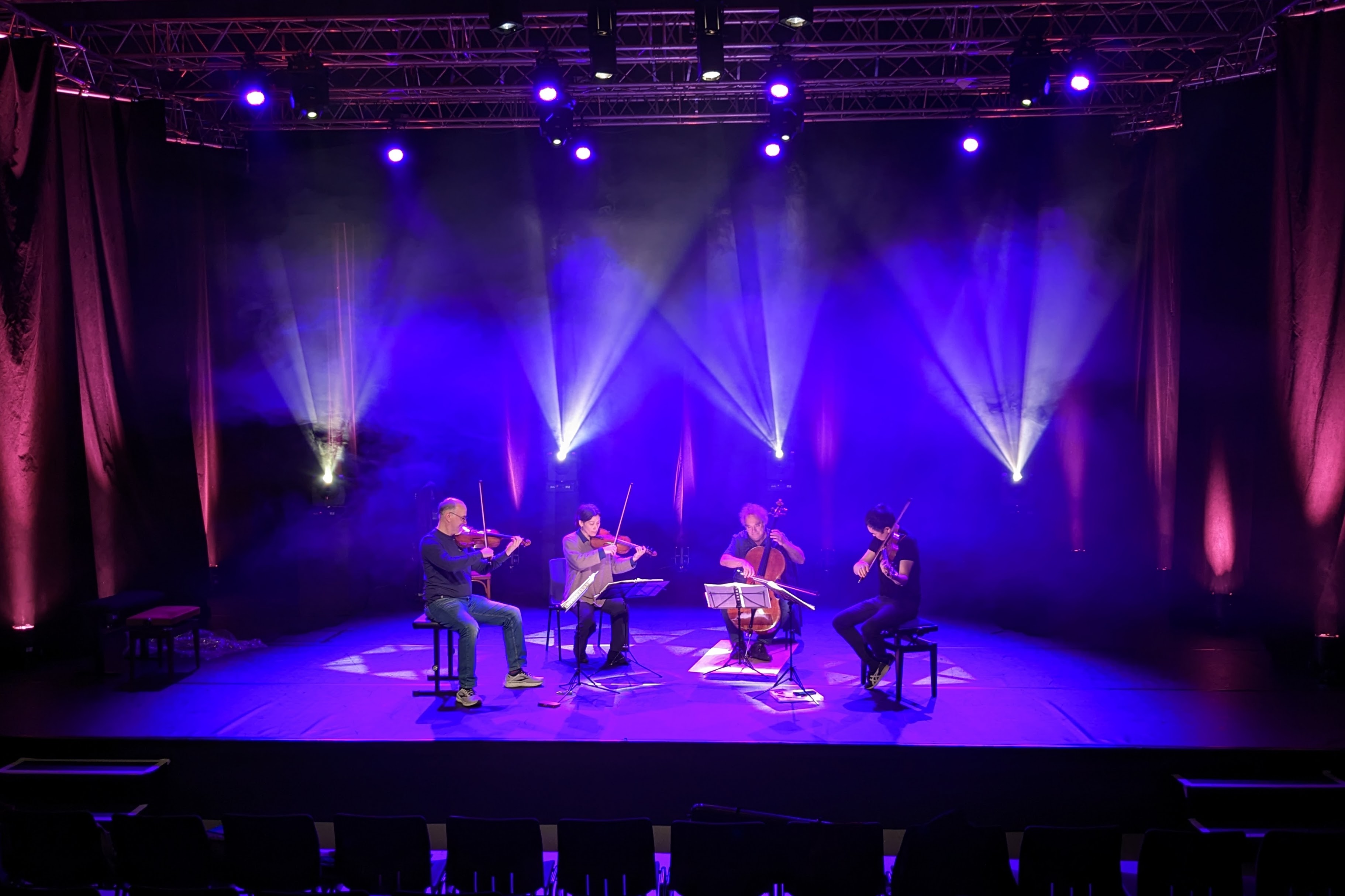
Then next Tuesday (7:30 p.m. Sept. 19, also in Grusin), the quartet’s second violinist Harumi Rhodes and pianist Hsiao-Ling Lin will present the music of Robert Schumann and Beethoven on a faculty Tuesday recital titled “MEMORIA.” The centerpiece of the program features visual art by Michiko Theurer with three short pieces by Kaija Saariaho, performed with cellist Meta Weiss.
The Faculty Tuesday series continues nearly weekly for the remainder of the academic year; listings of all College of Music concerts can be found on the school’s Web page. All Faculty Tuesday performances are free and open to the public.
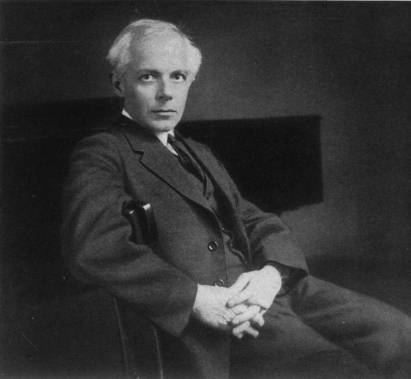
Both fall performances by the Takács will feature works by Hungarian composer Béla Bartók. The original membership of the Takács Quartet was entirely Hungarian: the quartet was founded in Budapest by students at the Franz Liszt Academy, and the music of their fellow-Hungarian Bartók was home territory for them. Cellist András Fejér, the one original member and one Hungarian in the Takács today says that is still the case, and has been through all changes in personnel in the group’s history.
“Absolutely,” Fejér says. “Ed (Dusinberre) was the first (new member) with us, and we learned and re-learned them together. And what we found with him, and also with all the new partners, was an immense hunger to enjoy and to interpret in a meaningful way.”
That does not mean that the Takács’s interpretation of Bartók’s quartets doesn’t change. “When we put them to rest for a while and then start practicing again, the questions we ask are completely different,” Fejér says. “Any given problem gets a different light, and we’ve been changing in the interim period. That’s what makes this whole process so fresh and alive and fascinating all of these decades.”
But one thing that remains consistent, he says, is their view of Bartók not as an aggressive modernist but as a Romantic composer. “In spite all the dissonance, we still feel he is a wonderfully Romantic composer,” he says. “Even when it sounds harsh, you realize it should’t sound harsh, it should sound like a village piece, or lonesome mourning. If we attack from that angle, one can discover millions of wonderful things!”
The other composer present in both concerts during the fall semester is Joseph Haydn. For two reasons, Haydn is also central to the Takács’s work. First, Haydn has his own Hungarian connections, having been born on the border between Austria and Hungary and spent long periods of his life in Hungary at the castle of Prince Esterhazy. And he is considered the creator of the string quartet, having written nearly 70 quartets starting before it was a recognized concert genre.

Fejér wants the audience to realize what a creative composer Haydn was. “Just because Haydn is often the first piece we are playing at our concerts, doesn’t mean that it’s a warm-up piece,” he says. “It’s extremely inventive, full of the most wonderful characters. I cannot emphasize (enough) the originality of the pieces, and we are just happy enjoying it. Sometimes even today I cannot quite believe how wonderfully dense—or densely wonderful—they are!”
The other composer represented in the fall programs is Beethoven, whose Quartet in E minor, op. 59 no. 2 is on the opening program Sunday and Monday. That is the second of the three “Rasumovsky” Quartets, written for the Russian Ambassador in Vienna around 1808. In his honor, it includes a Russian folk tune that also appears in Mussorgsky’s opera Boris Gudonov.
Information on the full Takács season and box office information can be found on the Takács Quartet listing through CU Presents. Tickets are available for both in-person attendance in Grusin Hall and for streaming access to the performances.
# # # # #
Takács Quartet
Fall concert series, 2023
(All concerts in Grusin Hall)
4 p.m. Sunday, Sept. 17
7:30 p.m. Monday, Sept. 18
- Joseph Haydn: String Quartet in D Major, Op. 71, No. 2
- Béla Bartók: String Quartet No. 5
- Ludwig van Beethoven: String Quartet in E Minor, Op. 59, No. 2
4 p.m. Sunday, Nov. 5
7:30 p.m. Monday, Nov. 6
- Béla Bartók: String Quartet No. 1
- Joseph Haydn: String Quartet in C Major, Op. 20 No. 2
- Béla Bartók: String Quartet No. 4
TICKETS for Takács quartet concerts on the CU campus are available from CU Presents.
 Sharps & Flatirons