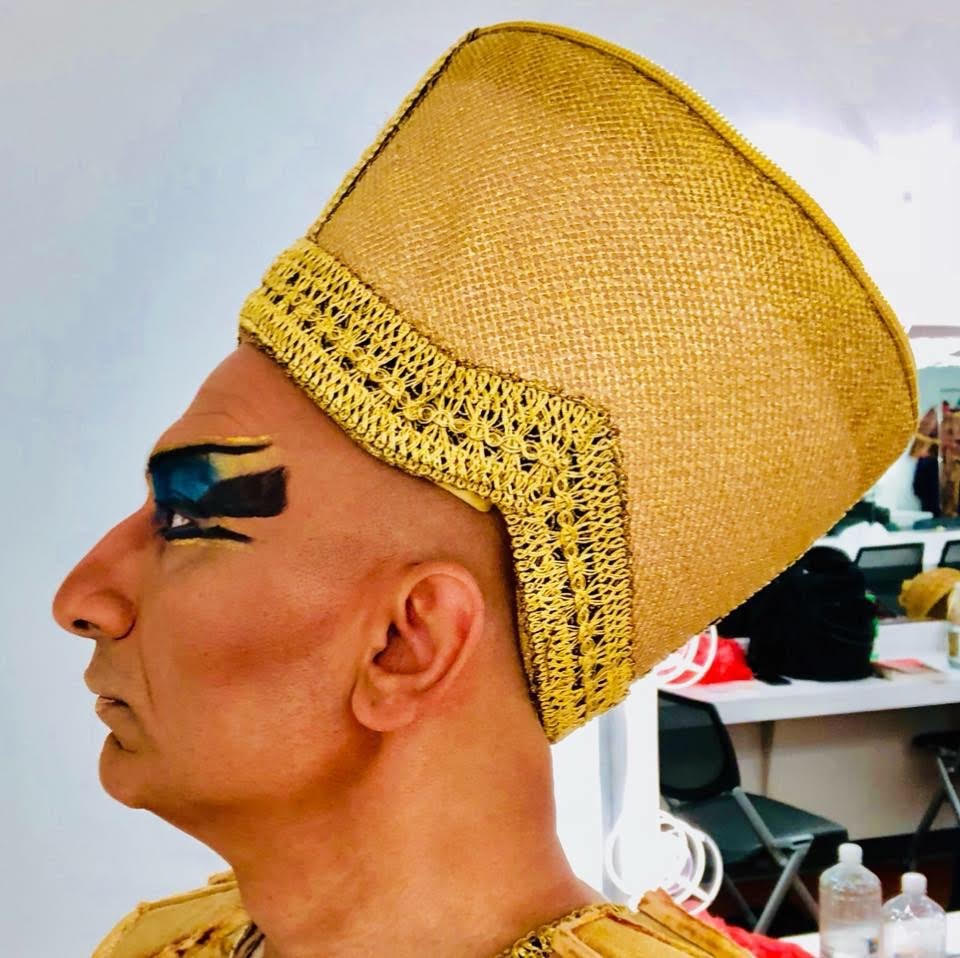
Operas in the mountains, from 1816 to 2020

Two entertaining comedies and a grim story from the home front at Central City

By Peter Alexander July 15 at 1:52 p.m.

Central City Opera (CCO) opened their summer season June 28 with a brisk and bubbly production of Rossini’s 1816 comedy The Barber of Seville. The summer’s other stylistically varied productions have now opened: The Knock, a 21st-century tale of life on the home front during the Iraq war, composed in 2020 by Alessandra Verbalov with libretto by Deborah Brevoort, on July 5; and the 1959 Broadway hit Once Upon a Mattress by Mary Rodgers and Marshall Barer, on July 12.
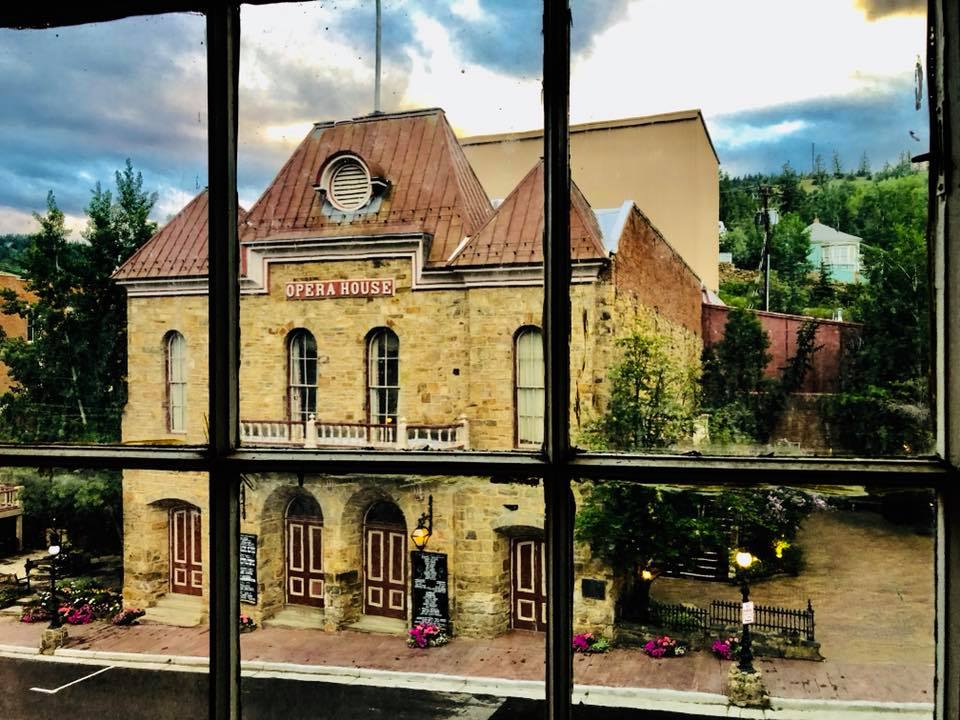
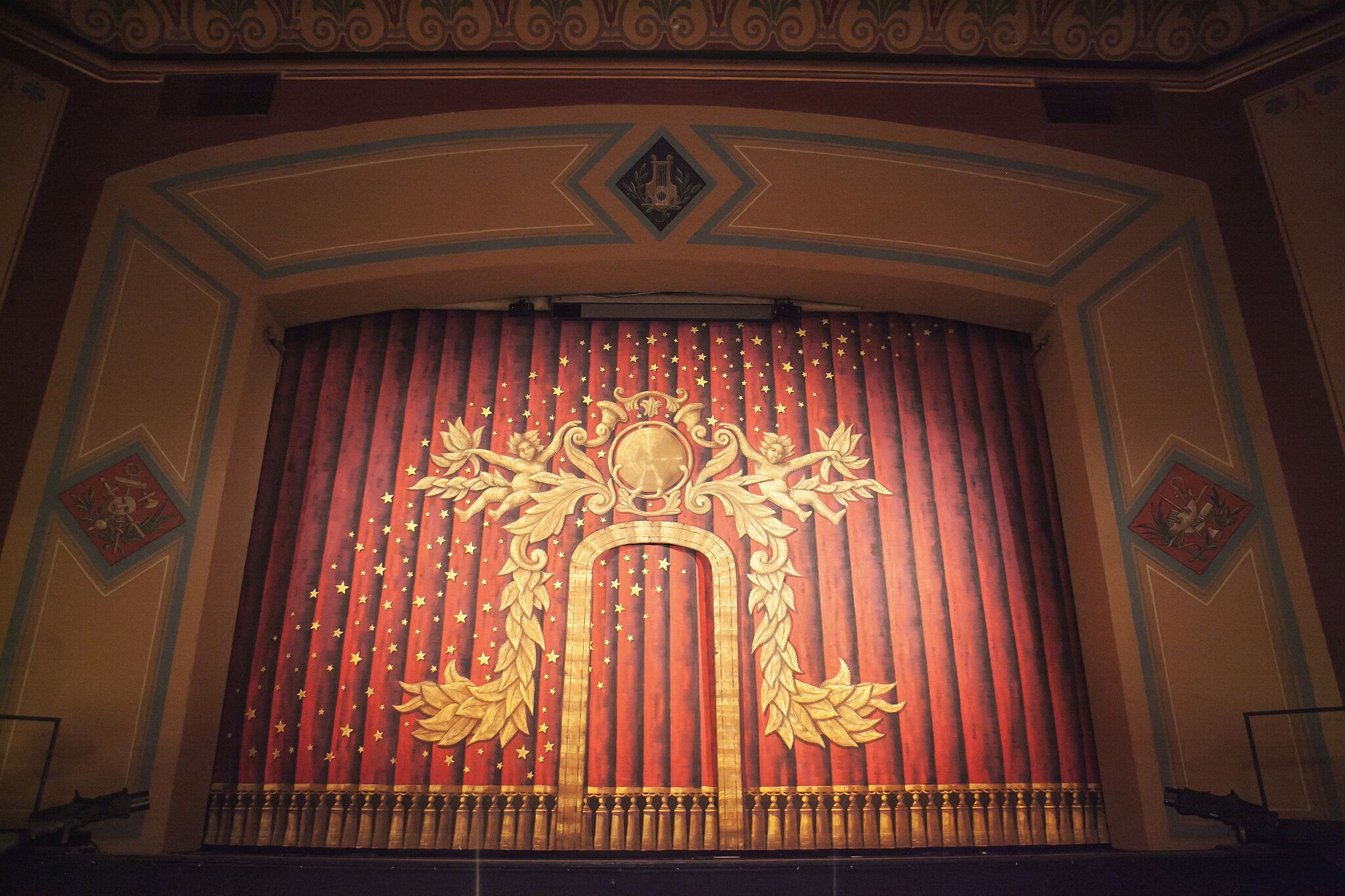
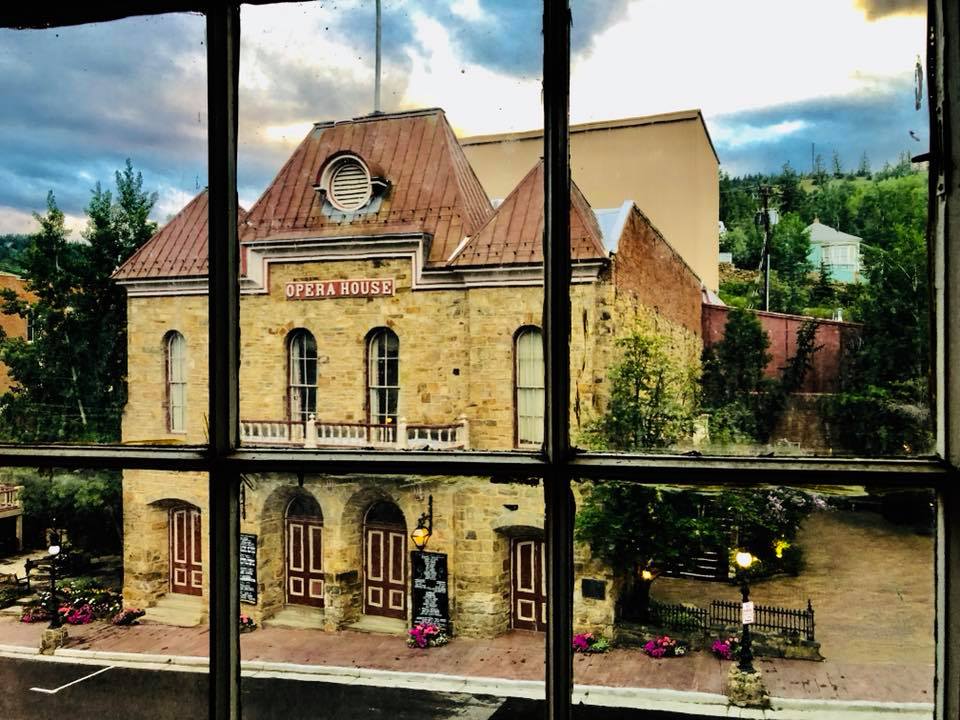
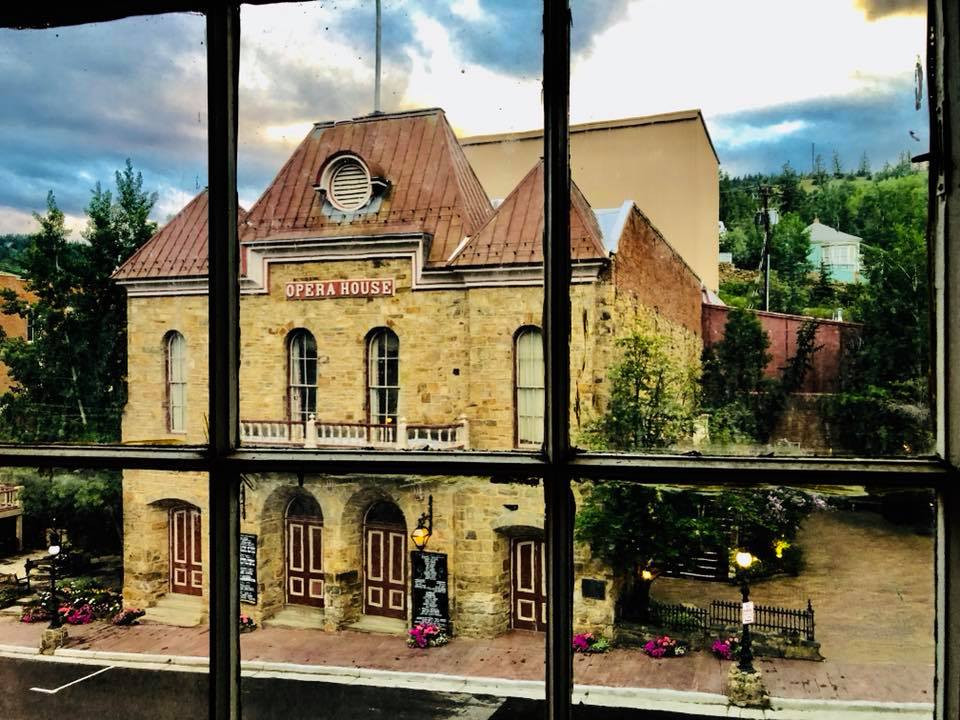
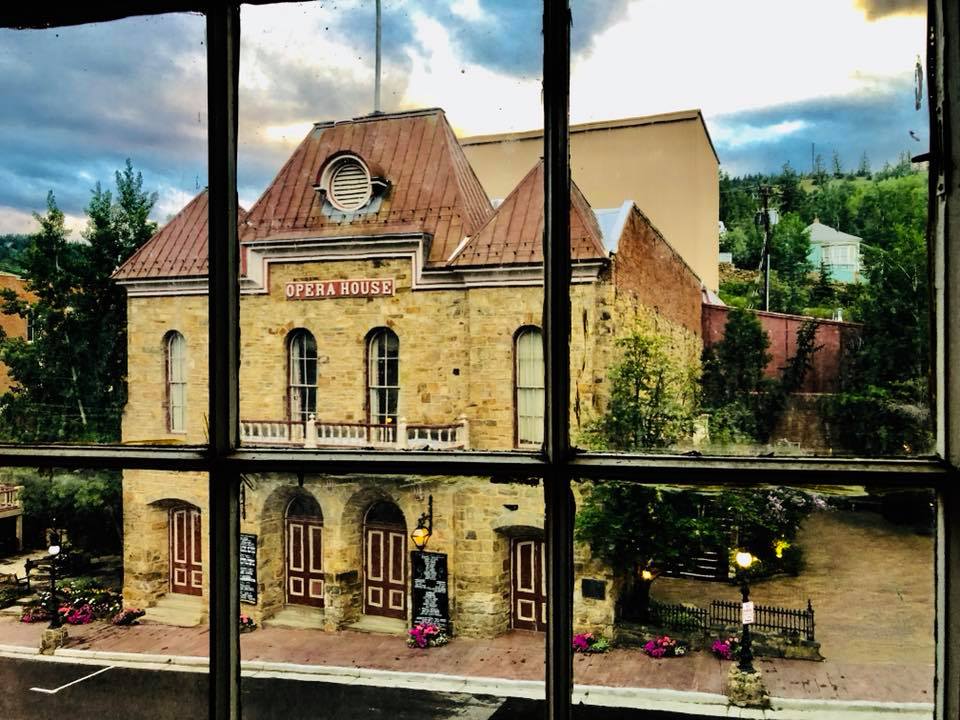
Central City Opera House. Photo by Ashraf Sewailam.

The Barber of Seville is presented with brilliantly colorful sets and costumes that belong to the Opera Theatre of St. Louis. Eric Sean Fogel’s Director’s Notes say that Barber has been placed “in 1930s Spain,” but that concept is almost irrelevant since it hardly touches the story. Stage design by Andrew Boyce reveals Rossini’s raucous comedy dressed up in bright, tropical colors—all yellow and pink on stage, plus a bright red sofa in the form of Rolling-Stones-reminiscent lips.

Costume design is by Lynly Saunders. She describes Barber as an opera “where you can really let loose,” and let loose she does. From police in 1930s-style uniforms—the one period reference that is unmistakable—each with one incongruously colorful sleeve, and giant sunflowers instead of rifles, to ridiculously overpuffed balloon pants and a garishly non-matched coat (or is it “power clashing”?), the costumes reveal a designer gleefully run wild. The crescendo of colors culminates with a joyful competition of surprise costume reveals by Almaviva and Rosina just before opera’s end. I can’t imagine anyone not being delighted by the over-the-top riot of colors.
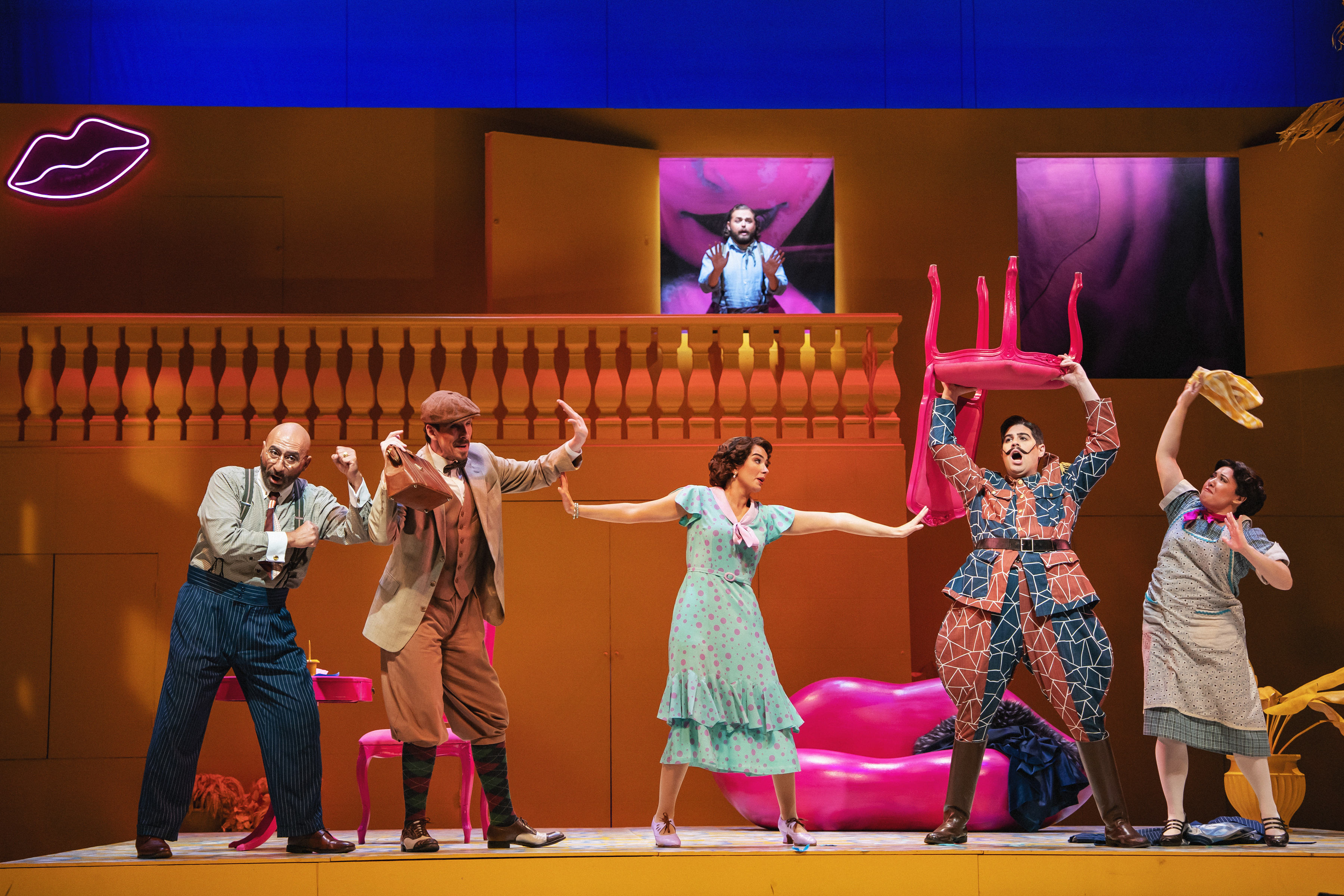
Barber of Seville cast, L-R: Ashraf Sewailam (Dr. Bartolo), Stefan Egerstrom (Don Basilio), Lisa Marie Rogali (Rosina), Andrew Morstein (Almaviva), and Laura Corina Sanders (Berta); Luke Sutliff (Figaro), above. Image by Amanda Tipton Photography

Stage director Fogel does not shy away from pure farce, but as a cast member reminded me, Barber of Seville is supposed to be farce. There are multiple doors, people popping in and out unexpectedly, pratfalls, a piano wider than the stage, and even a collapsing chair. Whether the manic silliness ever crosses a line will be a matter of individual taste. For me it pushed the line, but the hilarity was irresistible from beginning to end. 

The vocally strong cast embraced the production’s style with exuberant energy. As Almaviva, Andrew Morstein had difficulty negotiating registers at the outset and sounded strained at top volume, but was comfortable and sang with expression in his gentler moments. He got stronger across the evening, managing Rossini’s leaps and runs with increasing security, and finished as a winning romantic lead.

Luke Sutliff made a terrific Figaro, filling the theater with his voice and his personality. As Fogel observes in his notes, Figaro is the barber of the title, but the young lovers Almaviva and Rosina want to capture our attention. The direction and Sutliff’s performance make Figaro both the factotum who gets things done in Seville and the mainspring of the opera’s action, as he should be.

Ashraf Sewailum, known locally from previous performances at Central City, the University of Colorado Eklund Opera Company, and numerous concert appearances in Boulder, was brilliantly blustering and periodically baffled as Dr. Bartolo. His full bass voice easily filled Central City’s house. Both his musical phrasing and comic timing made him one of the stars of the show.
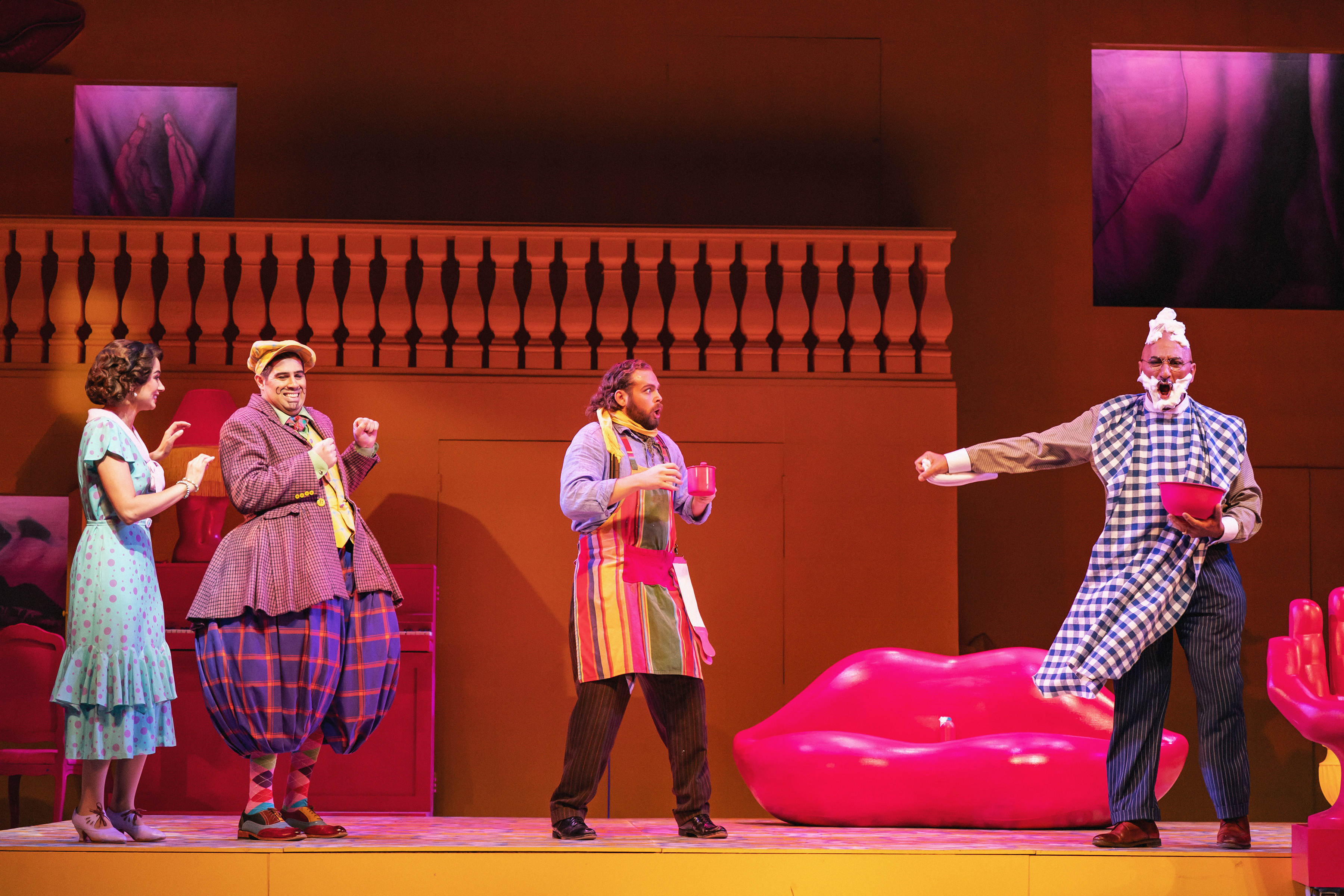
L-R: Rosina (Lisa Marie Rogali), Count Almaviva (Andrew Morstein), Figaro (Luke Sutliff) and Dr. Bartolo (Ashraf Sewailam). Image by Amanda Tipton Photography

Mezzo-soprano Lisa Marie Rogali lent her strong, resonant lower register and bright, sweet upper notes to the role of Rosina. Her melting lyricism and confidence in the coloratura passages made her trademark aria “Una voce poco fa” a highlight. Happily she captured the strength and determination of the character, avoiding cliches of the submissive ward and previewing the independent countess of Mozart’s Marriage of Figaro.

Stefan Egerstrom humorously portrayed Don Basilio as a purse-carrying, prancing dandy. His on-target performance was one of the keystones of the interpretation of Barber as farce. Equally fit for her comic role was Laura Corina Sanders as Berta, the unruly servant. She took full advantage of the possibilities the over-the-top production style offered her character.

Louis Lohraseb, who has conducted opera in Rome, Hamburg, Dresden and Berlin, made his Central City Opera debut leading Barber. Under his baton, the orchestra played with stylish restraint, never overpowering the singers. The overture was bright and energetic, despite a few soggy moments.

# # # # #

Nestled between two comedies, Aleksandra Vrebelov’s The Knock tackles the deeply serious question of the hidden pain and tragedies of war. During the 2003–11 Iraq war, American military wives endure a long night of suspense when they are cut off from communication with their husbands in Fallujah. The title refers to the dreaded knock on the door, when a military officer will officially notify one of them of her husband’s death.

Vrebalov’s score was receiving only its second full stage production, since the planned premiere at the 2020 Glimerglass Festival had to be presented on film, due to COVID. The performance at Central City was a fitting regional premiere, as The Knock is set in and around Ft. Carson, Colorado.

Born in Serbia, Vrebalov directly experienced the horrors of war during the 1998–99 Kosovo War and the devastating NATO bombing of her hometown of Novi Sad. This experience stands behind several of her most successful pieces.

In The Knock, her subtle music expresses the rising tension among the military wives at home through steady background chords and ostinato patterns that increase in intensity. A sharp and expressive score, it signals the buildup of despair and fear without resorting to bombast.
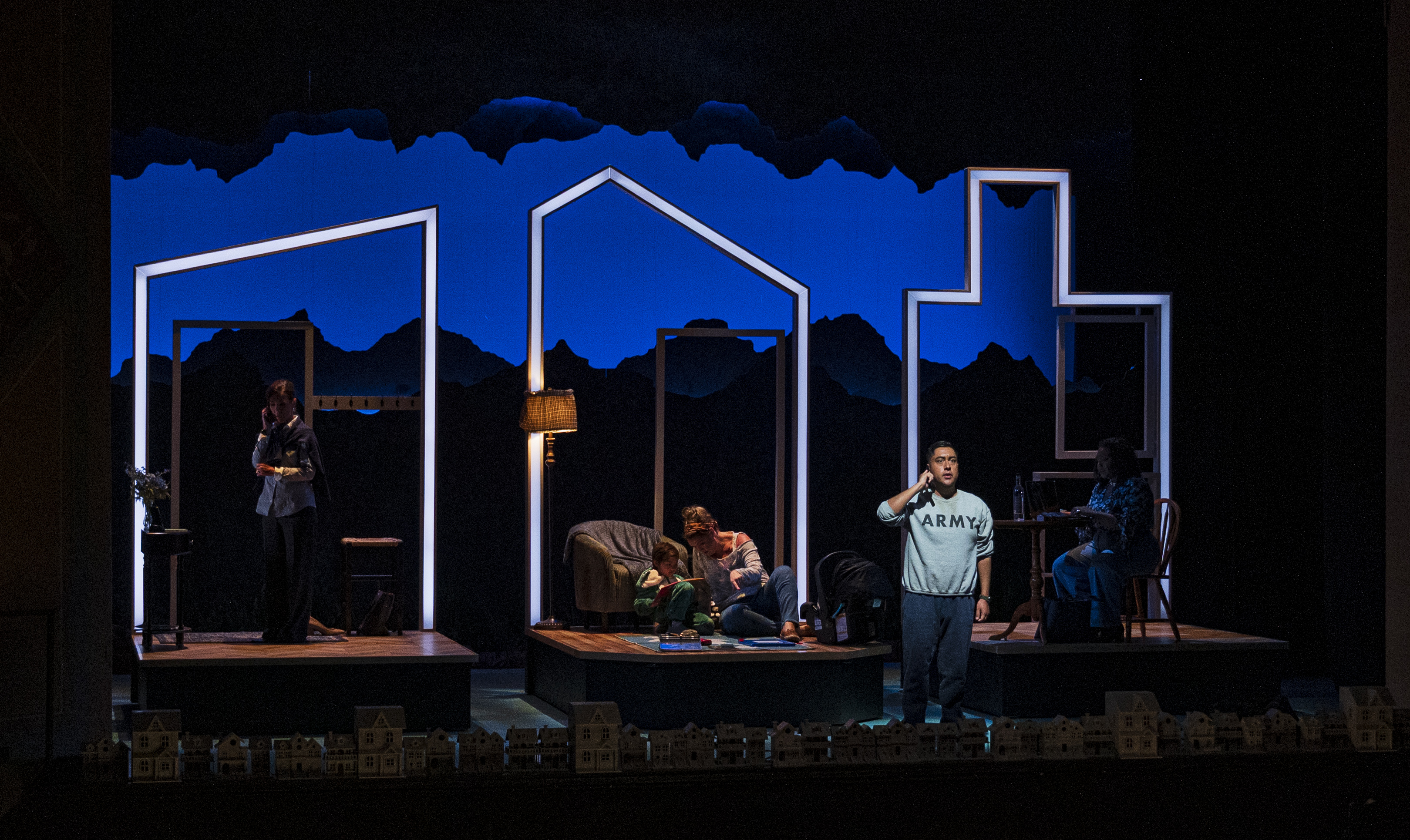
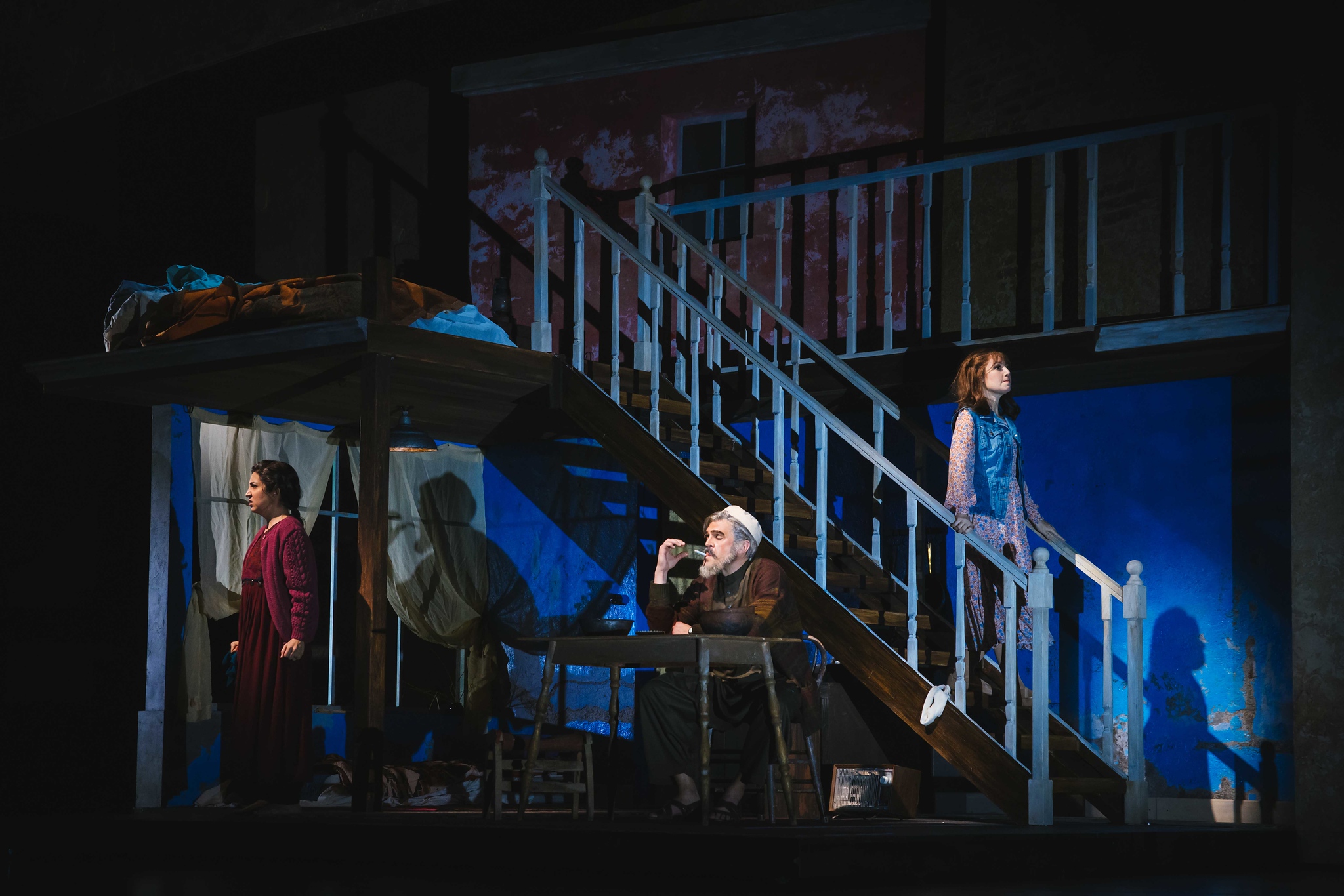
The three houses that form the setting of The Knock. Downstage, Lt. Robert Gonzalez (Armando Contreras) gets the call to deliver “the knock.“ Photo by Lawrence E. Moten III.

The evocative set by Lawrence E. Moten III comprises brightly lit outlines of three houses, those of Jo, Aisha, and an unnamed other military wife. A row of tiny houses across the front of the stage, sometimes lit from inside, represent the larger community of military families. In the back, the outline of Colorado mountains can be seen against a deep blue late-evening sky that is symbolically lit with stars at show’s end.

Three characters dominate the action. Joella “Jo” Jenner is a young wife and mother of two who is undergoing her first nighttime vigil waiting for word from the battlefield. Portraying a nearly one-dimensional character—the mother terrified for herself and her children—Mary-Hollis Hundley ably expresses Jo’s unease and her fragility.
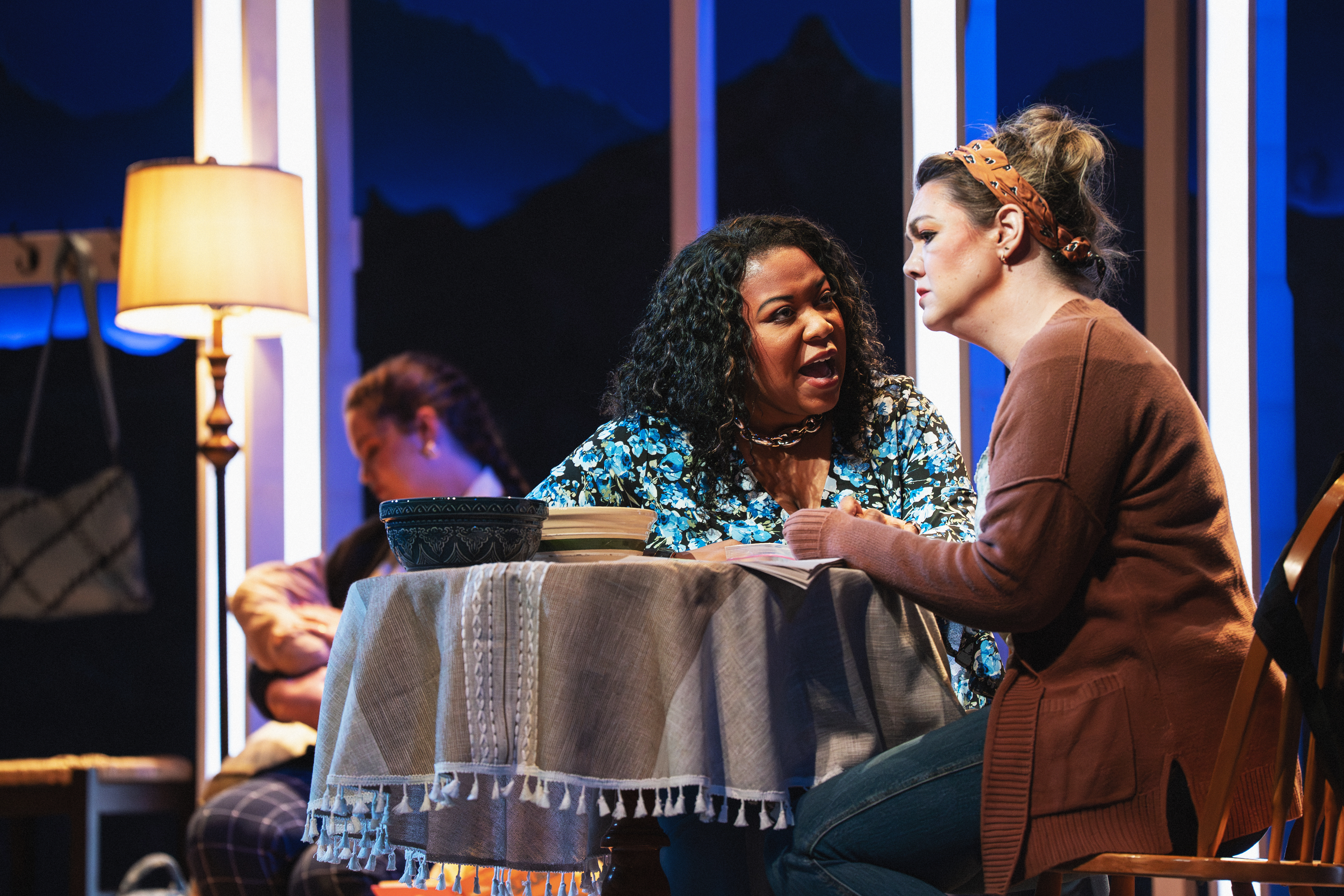
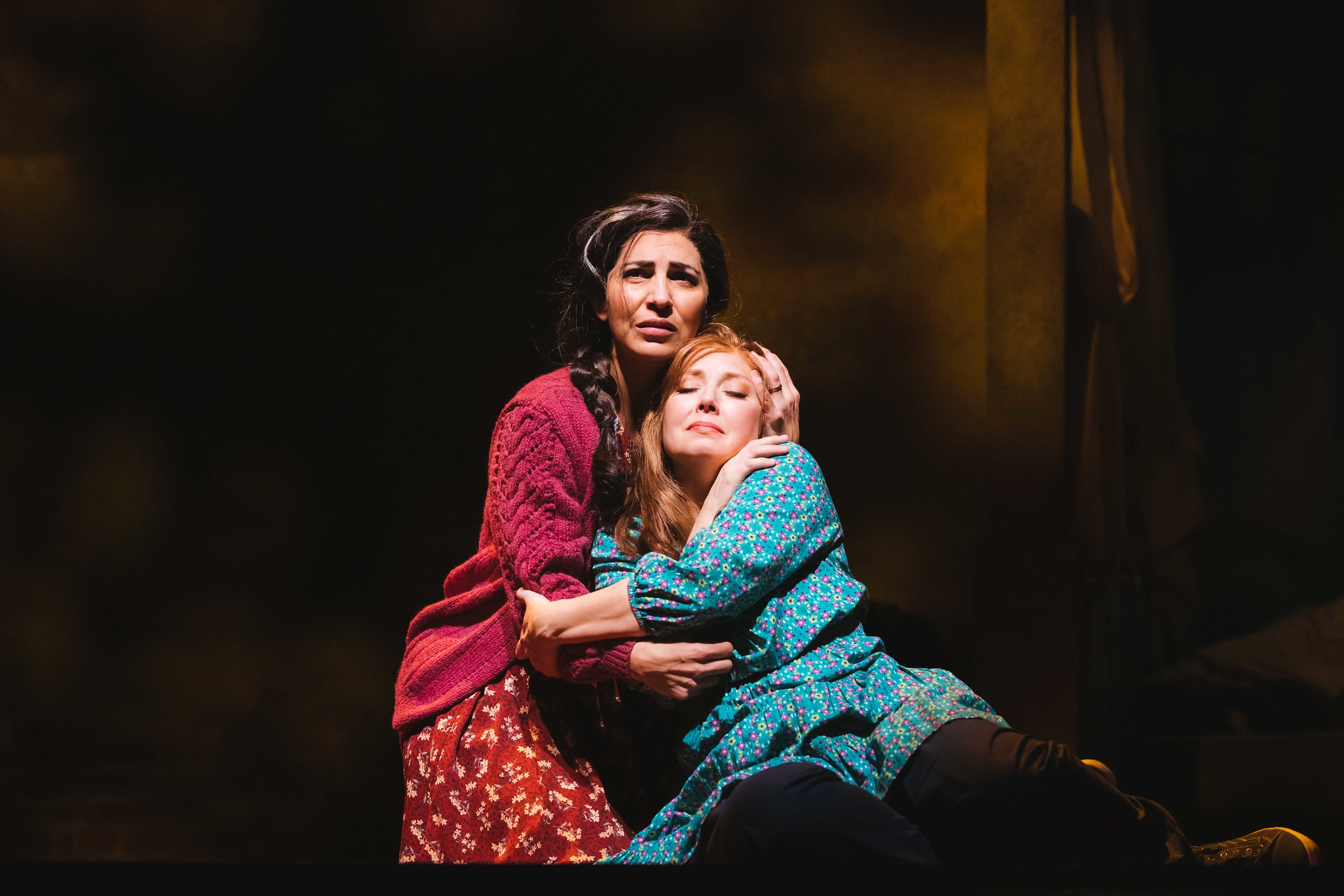
Aishah (Cierra Byrd) tried to console Jo Jenner (Mary-Hollis Hundley). Image by Amanda Tipton Photography

Paired with Jo is Aishah McNair, a more experienced military wife who tries to offer support and perspective to the young mother. Cierra Byrd gave Aishah depth, especially near the end when launching the number “When the person you love is far away,” which blooms into an ensemble number. Her warm, smokey contralto complimented Hundley’s more delicate soprano throughout their scenes together.

Lt. Roberto Gonzalez is a young soldier tormented by being stationed in the U.S. while his comrades face combat. He has been tapped to deliver the mournful news—the knock—for the first time, leaving him nervously trying to fulfill the duties as described in the manual.
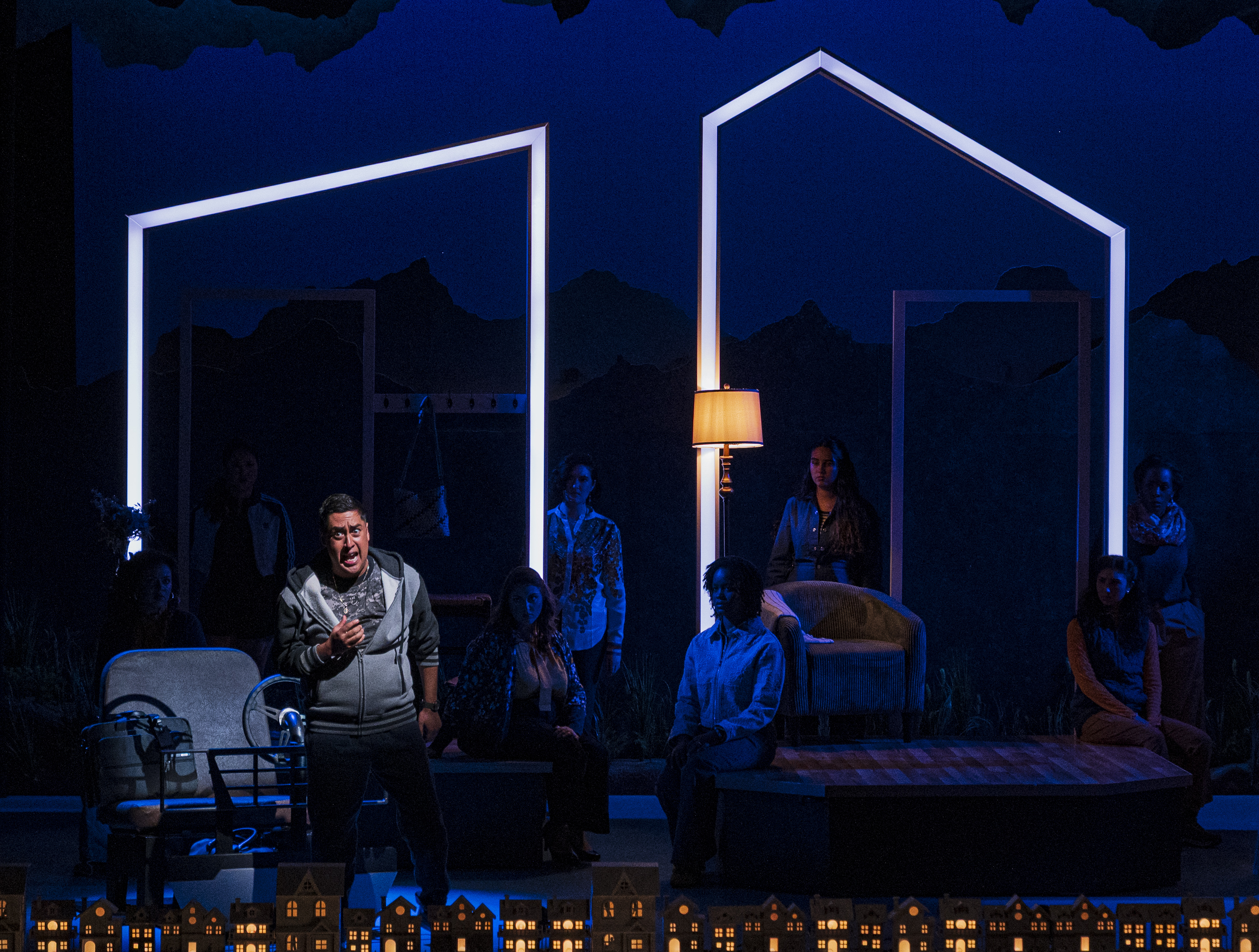
Lt. Gonzalez (Armando Contreras) agonizes over his duty to deliver the news of a soldier’s death. Photo by Lawrence E. Moten III.

Baritone Armando Contreras overplayed Gonzalez’s stress, staying at a high volume and almost shouting his way through parts of the role. His repeated invocations of the Virgin de Guadalupe were more than needed, since his sincere faith and apprehension are evident from the start. His lovely singing in the concluding ensembles, when Lt. Gonzalez relaxes into tender feelings for the women he confronts, show that he has a wider range of expression and styles than are heard for most of the opera.

Conductor David Bloom managed the mixed chamber ensemble in the pit comfortably, keeping the music moving through the rather extreme emotional ups and downs of the characters. Moritz’s stage direction effectively kept the action clear, as it moved from separate houses, to one house where the wives gathered, to scenes of Lt. Gonzalez facing his fears while traveling cross country.

The poignant conclusion of the opera—with one wife facing a devastating development and the others embracing relief—provides music that expresses both sentiments, or as the text has it, “Joy and Sorrow.” And the concluding lines describing the folded flag that every war widow receives, “Blue and Stars are All that will Remain,” remind us eloquently of the show’s central point, that the ripples of war’s tragedies spread across society. It is a sobering moment in a powerful piece.

# # # # #

Once Upon a Mattress, which opened Saturday (July 12), was the first full-length Broadway show by Mary Rodgers, daughter of the famed Broadway composer Richard Rodgers who was half of the musical-comedy teams of Rodgers & Hart and Rodgers & Hammerstein. Growing up in so musical an environment, Mary Rodgers naturally took to composing as a teenager, and had a very successful career writing music for children’s records, musicals and reviews, and was the author of several children’s books.

Her one big Broadway hit, Once Upon a Mattress opened in 1959 and perfectly fits the mold of 1940s and ‘50s musicals. It offers ample opportunities for catchy songs, quirky characters, a heavy dose of theatrical silliness, and a thoroughly happy ending. The music is never compelling or deeply memorable, but it is never less than pleasant. The book is full of gags and jokes that elicited hearty laughter from the audience on Saturday.
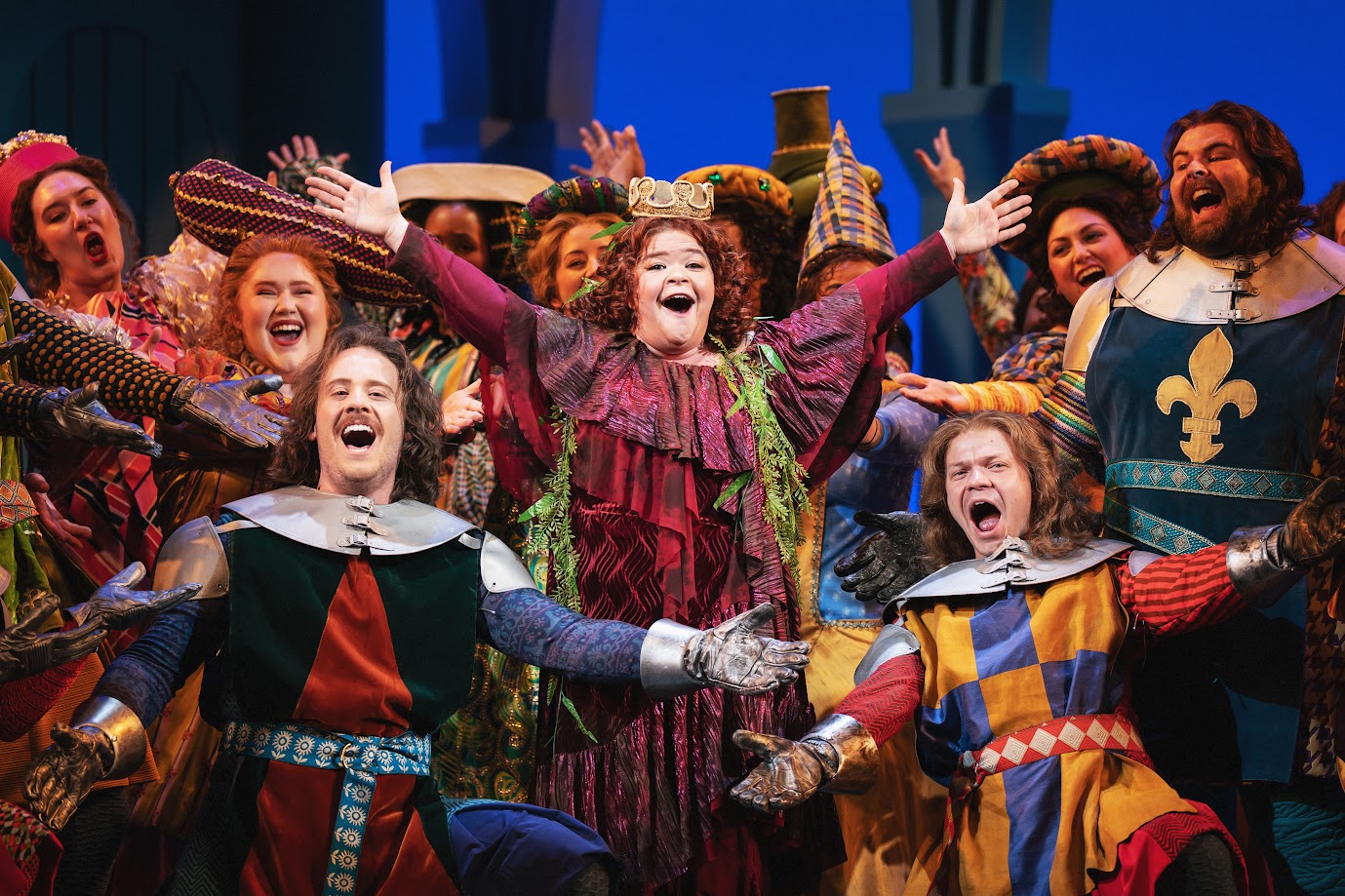
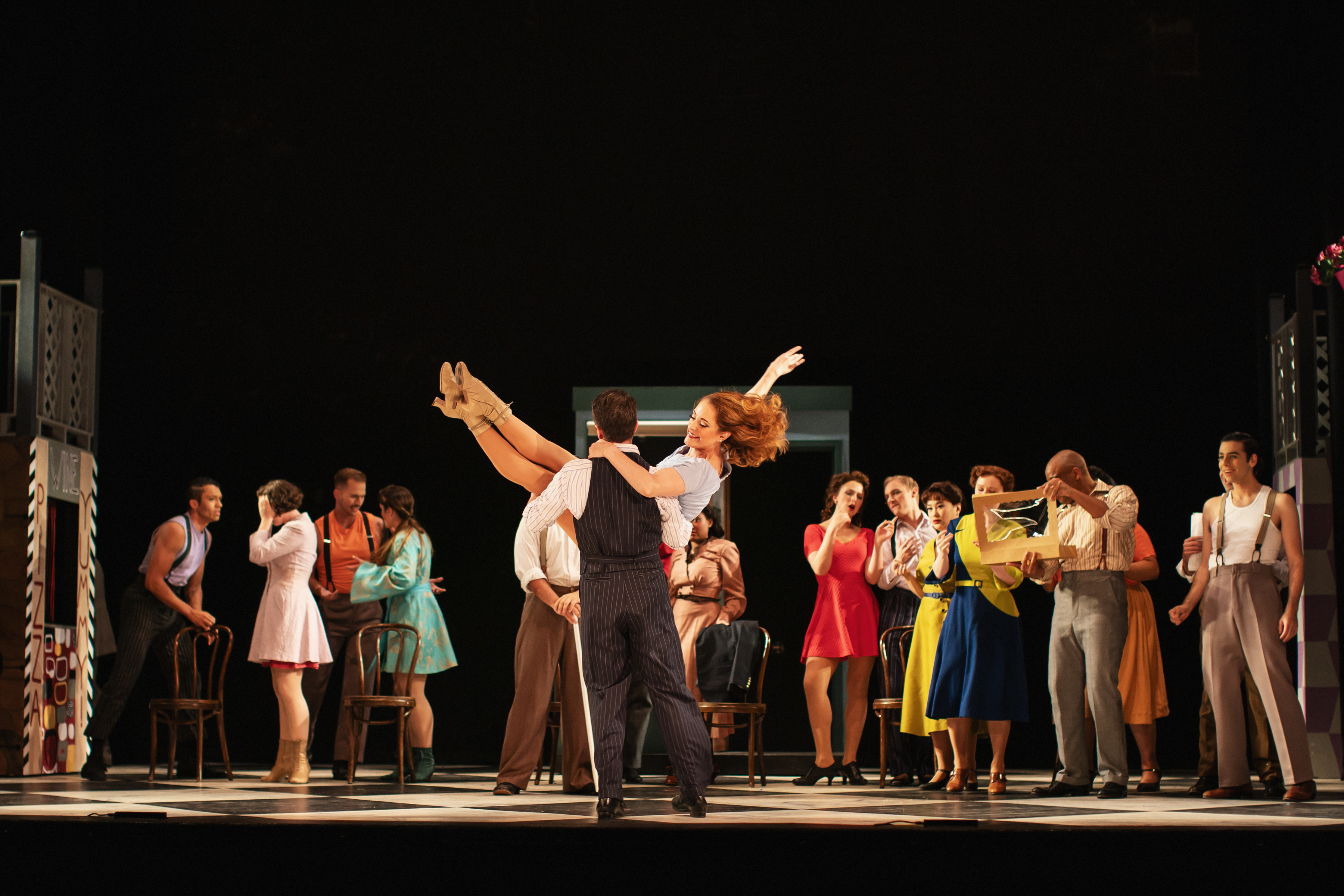
Ensemble cast of Once Upon a Mattress. Princess Winifred (Marissa Rosen) draped with weeds from the moat, center. Image by Amanda Tipton Photography

The plot skates cheerfully on the surface of the Hans Christian Anderson tale of “The Princess and the Pea,” with a goofy young Prince dominated by a despotic mother who will only allow him to marry a proper princess. In the meantime, no one in the kingdom—or is it queendom, since his father is mute?—is allowed to marry until the timid Prince Dauntless the Drab is wed to a suitably, queen-approved mate. 

A hopeful candidate shows up in the form of Princess Winifred the Woebegone from a marshy realm—the Broadway debut role of Carol Burnett in 1959. Queen Aggravain has imposed a test on every potential bride, which all have failed. For Winifred she devises the pea under 20 mattresses (actually 14 at Central City), with the expected result.

All of these more or less stereotyped characters were portrayed with the broad humor the show wants. Everyone in the cast had a suitably lyrical musical theater voice, capable of crooning all the ballads and other musical numbers of the score. There are a few solo numbers and many duets and ensemble numbers, all well handled by the consistency solid cast. 

Margaret Gawrysiak was everything you could want for Queen Aggravain—imperious, haughty, comically unyielding and too eager by half to rule out potential brides. Michael Kuhn was an ideal Prince, completely under the sway of his controlling mother, with just the right touch of modern nerdiness thrown in. Marissa Rosen made an especially strong impression as Princess Winifred, with just enough of her own nerdiness to captivate Dauntless. She projected the latent athleticism fitting for a princes who, in a moment shocking to the court, “swam the moat” and entered trailing tangles of weeds. 
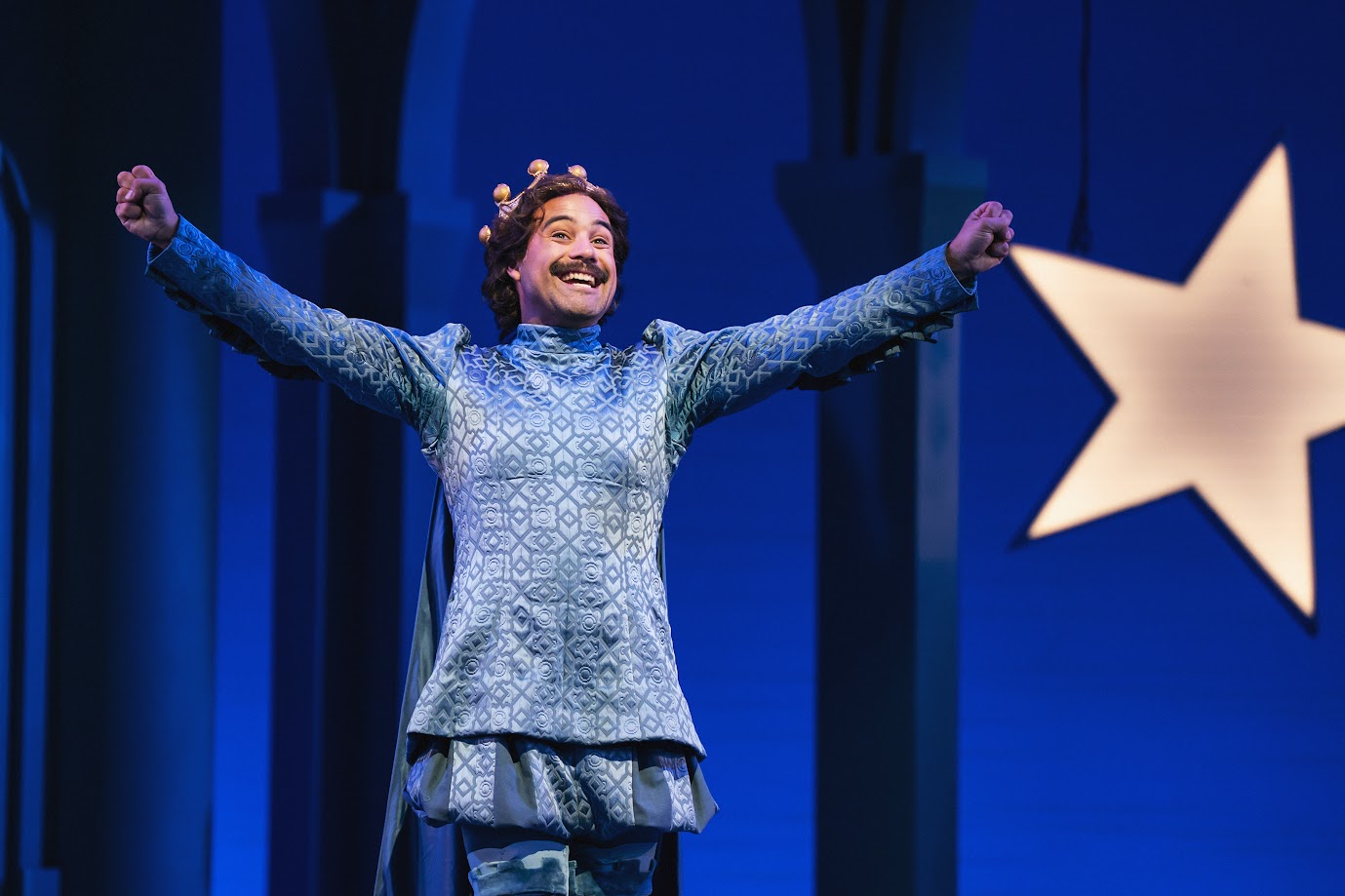
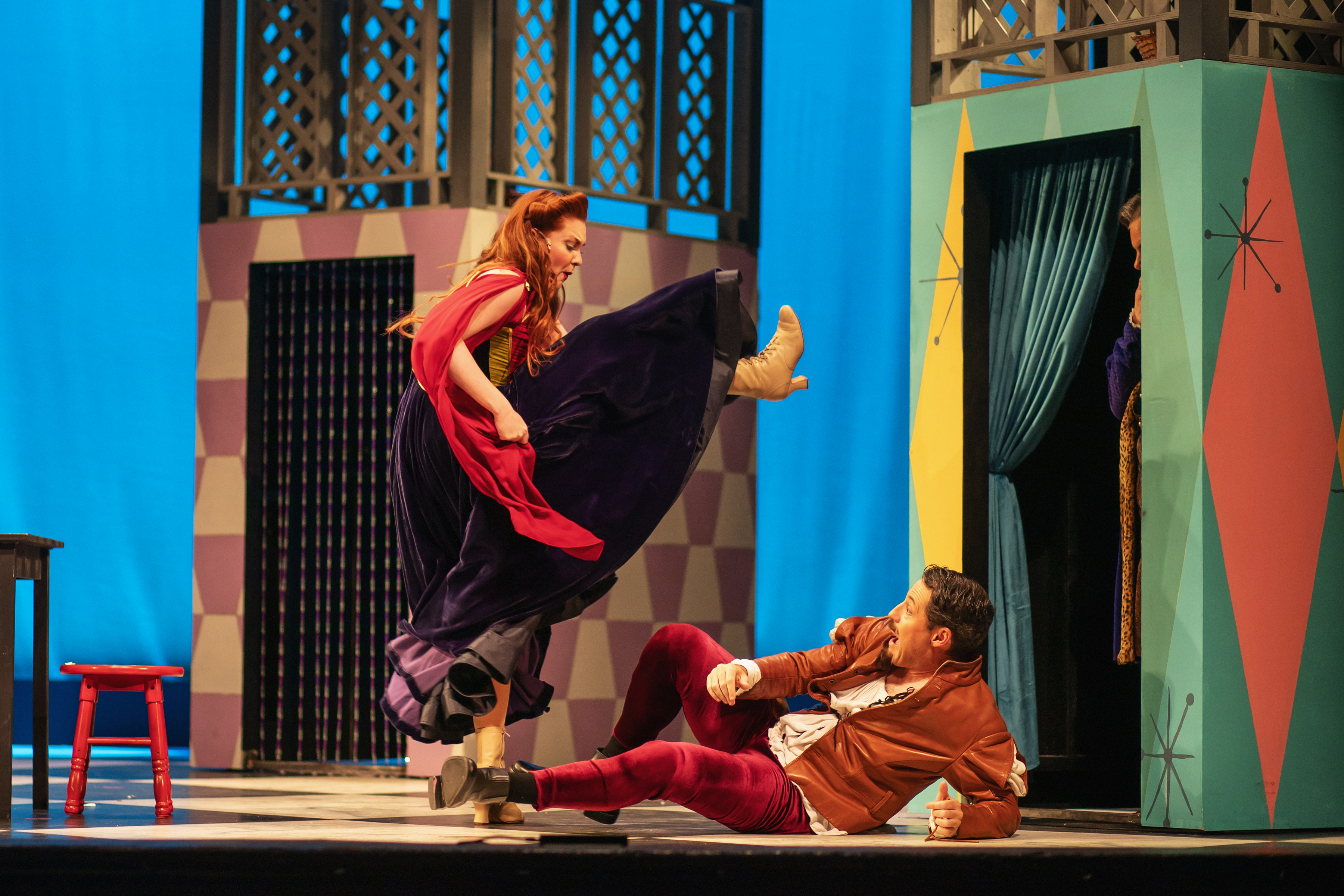
Prince Dauntless the Drab (Michael Kuhn). Image by Amanda Tipton Photography

As the Jester and Minstrel, Alex Mansoori and Bernard Holcomb were well matched stage buddies, either bantering or singing together. Jason Zacher made good use of his short appearances as a wizard who does parlor tricks at random moments. The on-again, off-again couple of Sir Harry and Lady Larken, who have a growing reason for the ban on marriage to be lifted. The couple were well portrayed by Schyler Vargas, who had fun with Sir Harry’s sense of importance, and Véronique Filloux, fittingly flighty as Lady Larken. Together they captured all the traditional nuances of the couple who are happiest while quarreling.

Special mention must be made of Andrew Small, who delighted in his CCO debut as the mute King Sextimus, who has an unfulfilled taste for the ladies in waiting at the court. The son of a musician who played in the CCO orchestra in the 1980s, Small first attended the opera when he was 10, leading to a career on stage. He wrote for the program that performing at CCO is “a deeply meaningful, full-circle moment.”

Seated at the very back of the house I could not always hear the voices over the orchestra. Out from under the balcony and closer to the stage, the sound was probably better. In all other respects conductor Kelly Kuo led a stylish and energetic performance.

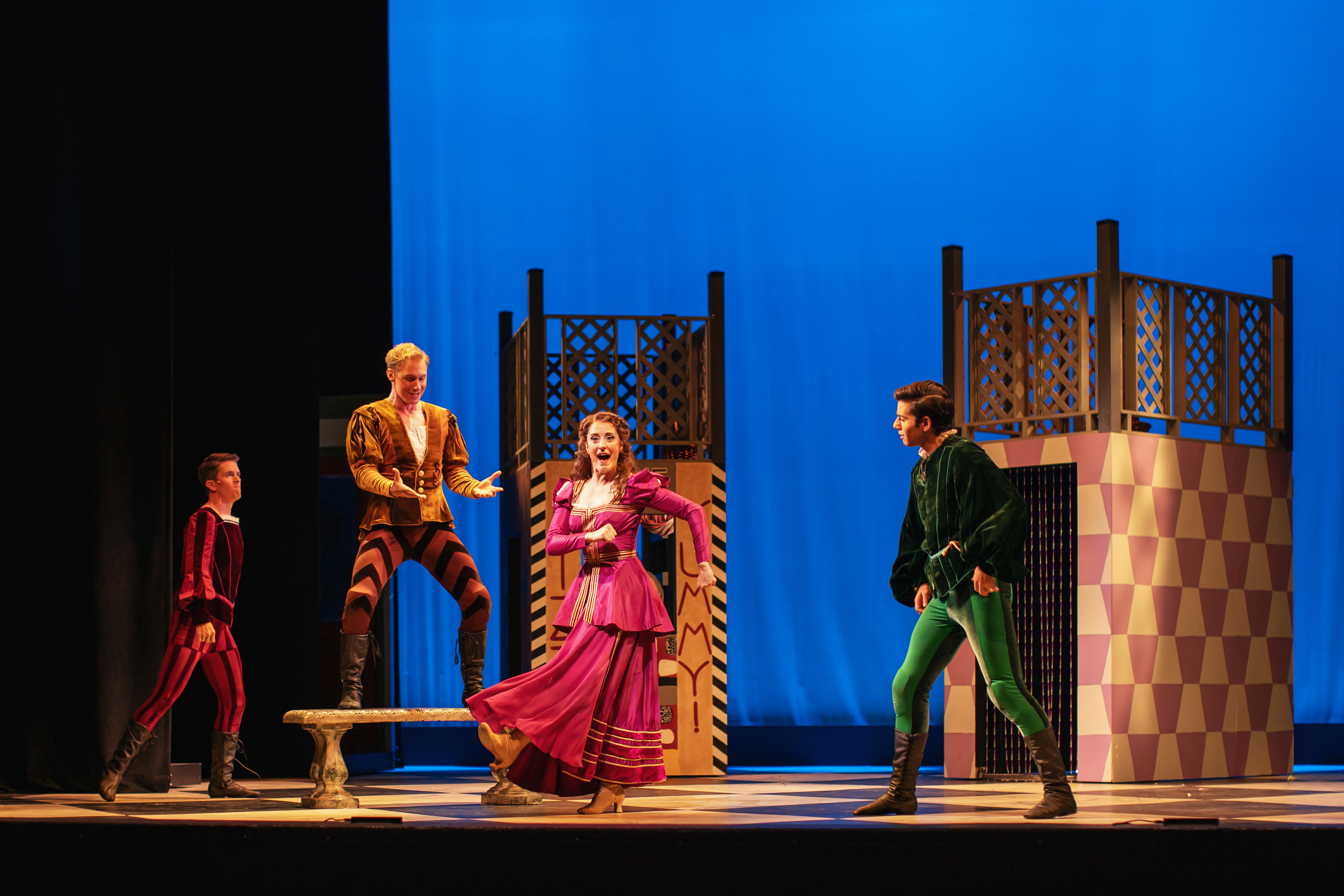
The scenic design by Andrew Boyce fits the classic Broadway ambience perfectly, walls and arches suggesting a cartoonish court. The costumes by Elivia Bovenzi Blitz are standard theater-medieval—colors and fabrics no one saw in the middle ages, but pleasantly evocative of make-believe realms.

The stage direction by Alison Fritz, the artistic director of CCO, kept the show moving seamlessly. John Heginbotham’s choreography was handled smoothly by all of the acting/singing/dancing members of the large cast. 

Those who love Broadway will relish the opportunity to attend a professional production of Once Upon a Mattress, performed with full orchestra and Broadway-worthy voices. If that’s your dish, go for it! If not, the farcical Barber of Seville and deeply thoughtful The Knock are equally worth a trip into the mountains. 

NOTE: Performances of all three shows at Central City continue through the month and into August. The full schedule is listed below. 

# # # # #

Central City Opera
Remainder of the 2025 Summer Festival Season
All performances in the Central City Opera House, Central City, Colo.

Rossini: The Barber of Seville

7:30 p.m. Saturday, July 19
2 p.m. Tuesday, July 15; Friday, July 25; Saturday, July 26; Wednesday, July 30; Sunday, Aug. 3

Aleksandra Verbalov: The Knock

7:30 p.m. Saturday, Aug. 2
2 p.m. Sunday, July 19; Tuesday, July 22

Mary Rodgers and Marshall Barer: Once Upon a Mattress

7:30 p.m. Saturday, July 26
2 p.m. Wednesday, July 16; Friday, July 18; Sunday, July 20; Wednesday, July 23; Sunday, July 27; Tuesday, July 29 Friday, Aug. 1; Saturday, Aug. 2

Tickets for all remaining performances are available on the CCO Web Page.

Central City Opera looks to the future

Summer 2024 Festival calendar has been set, and the new CEO is thinking ahead

By Peter Alexander Dec. 7 at 10:45 a.m.

Things are definitely back on track at Central City Opera (CCO).

Opening Night at Central City Opera. From “Theatre of Dreams, The Glorious Central City Opera- Celebrating 75 Years.“

The labor unrest from last summer has been settled, and the summer season for 2024 has been officially set and announced. A new CEO is in place, and a search is underway for a new artistic director, replacing Pelham (“Pat”) Pearce, who led the company for more than 20 years. And with things on an even keel, the CCO administration and artistic staff are looking to the future.

The 2024 season will comprise three major productions. As announced previously, the three shows will be Gilbert and Sullivan’s Pirates of Penzance, one of the most popular of the G&S operettas; Puccini’s American frontier fable Fanciulla del West (Girl of the Golden West), transported from the California gold fields of 1849 to the Colorado Gold Rush days in Central City a decade later; and Street Scene, a hybrid opera/musical by Kurt Weill about New York tenement life, based on Elmer Rice’s Pulitzer Prize-winning play of the same name, with lyrics by Langston Hughes.

Since the three productions were announced last summer, CCO has established the full schedule for the summer’s performances, which is listed below. Subscription sales for the summer will begin Jan. 1, and single tickets will go one sale April 1.

Scott Finlay

In the meantime, new CEO Scott Finlay “sees blue skies on the horizon” for the company, he says. “There’s a lot of support out there for CCO and folks are very excited on the future here, and that feels good.”

Finlay came to CCO in 2010 as a grant writer and later associate director of development. After a stint as senior director of development at the CU College of Music, he returned to CCO as vice-president for development, the position he held until he was selected CEO last summer.

Everyone on the artistic side of the company that I have spoken with was enthusiastic about Finlay’s appointment. Coming after a period of uncertainty, his experience as the company’s development officer, together with his background both as a singer and as a fundraiser, is the kind of reassuring presence that CCO needs.

Ken Cazan, who has stage directed numerous productions at CCO, wrote in an email, “I am happy that someone as positive and supportive as Scott Finlay will be the new CEO of CCO. Scott has been a stalwart fundraiser for CCO on and off for years and a friend to all of the artists who have worked there. I hope and believe that he will be able to lead CCO into a new and adventurous era, free and clear of the baggage that was left behind.”

Ashraf Sewailam, who has both sung and stage directed for CCO, is very clear about his feelings. “I think he is the perfect choice,” he says. “He already has established relationships (with CCO’s supporters) and he can only stand to improve on that. And he’s a good person. He wants to serve well the art form as well as the establishment that he works for.”

Finlay says that all the feedback he received after his appointment was positive. “I’ve received a lot of e-mails and calls and facebooks posts from artists, and they are optimistic that we are moving in the right direction,” he says. 

That’s important in the wake of last year’s labor issues. Addressing the fallout from those events, Finlay says “It’s no secret to anyone that we’ve gone through a couple of years of rocky starts and stops, especially with the AGMA (American Guild of Musical Artists union) negotiations that were going on at the beginning of the year. And I’m happy to report that we are on a different page and a different chapter with them now. 

“I think that my relationships and my leadership and reputation will reinforce and shore up the trust that (the artists) have with this company.”

Looking to the future, Finlay sees the hiring of a new artistic director as the next milestone for the company. “We launched that search and it’s ongoing right now. I’m excited to see who the candidates are and where we might be moving forward.”

Of first importance is the artistic quality of the company, of course, but Finlay recognizes other attractions that make Central City Opera unusual. “We are known for artistic excellence, we put a fantastic product on the stage,” he says. “But the real juju for this company is the setting. . . . The location plays a large role in your experience of the art form.”

Looking farther into the future, Finlay knows where he wants CCO to be in five or 10 years. “We’ve got to explore alternative revenue streams, that’s one thing. Without financial stability we can’t do anything artistically. So my first job is to get us financially stable. The City of Central is going through somewhat of a renaissance right now, there are some businesses coming in, lots of construction, lots of renovation of the old buildings. I think that there’s some opportunity up there.”

Apart from the business side of his job, Finlay remains committed to opera, both as an art form and as a part of the community where it takes place. Engagement with the public around the themes of the operas being presented, is definitely part of his plan. “Community engagement is critical for us,” he says. “I really want to see that our work is meaningful.

“One of the things that I have been saying for a long time and I hope I get to say louder now, is that we as Central City Opera have a job. We hope that we can make people lovers of Central City Opera, but I think that we should try to make people lovers of opera. Opera matters, and we’re the ones who have to put that out there.”

Just one more thing: Finlay is committed to the health of CCO as an organization and the quality of the workplace. “We’ve gone through a couple of years, and we’ve lost a lot of staff, a lot of good people, and I’m excited to turn that tide and move things forward in a different kind of motion,” he says. “I want people to love working here, and I think I can do that.

“I want to make this the best place to work in the Denver area.”

# # # # #

Central City Opera
Summer 2024 Festival Season

Central City Opera House Interior

Sir Willam Gilbert and Sir Arthur Sullivan: Pirates of Penzance

7:30 p.m. Saturday, June 29; Saturday, July 20; Saturday, July 27; 

2 p.m. Wednesday, July 3; Friday July 5; Sunday, July 7; Saturday, July 13; Tuesday, July 16; Wednesday, July 24; Friday, Aug. 2

Giacomo Puccini: La fanciula del West (Girl of the golden West)

7:30 p.m. Saturday, July 6; Saturday, Aug. 3

2 p.m. Wednesday, July 10; Friday, July 12; Sunday, July 14; Friday, July 19; Saturday, July 21; Tuesday, July 23; Saturday, July 27; Wednesday, July 31

Kurt Weill: Street Scene

7:30 p.m. Saturday, July 12

2 p.m. Wednesday, July 17; Saturday, July 20; Friday, July 26; Sunday, July 28; Tuesday, July 30; Saturday, Aug. 3

Current subscribers may renew their subscriptions now through Dec. 8. Renewal packets will be sent by mail.

New subscriptions will go on sale Jan. 1, 2024, and may be ordered HERE, or call the box office at 303-292-6700.

Single tickets will go on sale April 1, 2024, through the CCO WEB PAGE, or call the box office at 303-292-6700.

Two tragic operas and a witty musical in Central City

Kiss Me Kate, Roméo et Juliette, Otello comprise a Shakespearean trifecta

By Peter Alexander July 21 at 7:10 p.m.

Cole Porter’s racy Kiss Me Kate is the apotheosis of the ‘40s musical: spicy, jazzy, witty, full of spiffy dance and raucous fun.

It is also a work filled with the stereotypes of the era that in 2023 push the bounds of taste and acceptability. The current production at Central City Opera, under the direction of veteran Ken Cazan, certainly conveys the style and fun of the ‘40s musical. Whether it avoids all of the pitfalls will be a matter of taste.

Kiss Me, Kate at Central City Opera. All images by Amanda Tipton Photography

The production is flawlessly cast with Broadway-style performers. Cazan’s direction takes the show as it is and capitalizes on all its strengths. The pit orchestra, under the direction of Adam Turner, plays smoothly and with a natural sense of style. The set, by Matthew S. Crane, serves the script well, moving easily between scenes onstage and backstage.

Kiss Me, Kate at Central City Opera.

This is no mean accomplishment, as the stage at the Centra City Opera House is really small. A few well chosen items, easily moved in and out, convey the superficial glamour of the stage setting and the contrasting shabbiness of the backstage. Especially noteworthy is choreographer Daniel Pelzig’s staging of the ensemble number “Too Darn Hot” which opens the second act and manages to offer a full production number in spite of the cramped quarters for dancers.

My only real complaint is the use of amplification for the sung numbers. I assume this is done to balance the singers with the orchestra, but the transition from natural speaking voices onstage to disembodied singing voices coming from everywhere and nowhere is jarring. When they happen, naturally sung choral numbers are a relief.

The leading couple of Jonathan Hays as Fred Graham/Petruchio and Emily Brockway as Lilli Vanessi/Kate sparred delightfully. If anything, Hays, all smooth baritone and pleasant crooning, could be more obnoxious. His “Were Thine That Special Face” was a musical highlight, but there were times I wanted more disdain toward Lilli. He is supposed to be a jerk.

Emily Brockway as Lilli Vanessi/Kate and Jonathan Hays as Fred Graham/Petruchio in Kiss Me, Kate

Brockway embellished her light and lovely voice well with a snarling rage, particularly in her showstopper “I Hate Men.” The fight scene between her and Hays is a hilarious highlight, as it should be, with neither holding back. Special credit should go here to fight choreographer Matt Herndon, although I have it on good authority that the sound was deafening in the orchestra pit below the stage.

Lauren Gemelli as Lois/Bianca was just the kind of brassy dame—to adopt the sexist language of the time—that every ‘40s musical needs. Her hit number “Always True to You in my Fashion” was an ideal representation of her loose but lovable character. Jeffrey Scott Parsons was an audience favorite as Bill/Lucentio, for both his smooth tenor and his fluid dance moves, especially the tap dance at the top of Act II.

General Harrison Howell is one of the show’s most obvious stereotypes, brought up to date with a few script additions. Matthew Cossack fulfilled the stereotype of the Southern military martinet and sang his one number, “From This Moment On,” well. Likewise Adelmo Guidarelli and Isaiah Feken as the central-casting gangsters, who found individual ways to personify the dim-witted and swaggering thugs. Their in- and comically out-of-character “Brush up Your Shakespeare” was perfectly enjoyable.

On the subject of stereotypes, it is the sexist tropes that are the most troubling. The relationship between a man-hating harridan and the man who will dominate her, the kernel of so much stale humor, is unavoidable as it is built into the script. In defense of book authors Sam and Bella Spewack, and with a nod to Shakespeare, this show brings a deft touch to the old story. Cazan and Brockway did what they could to make Lilli/Kate more than a doormat, and at the end the traditional obsequious groveling submission to Fred/Petrucchio was reversed, with Fred raising her back up and kneeling at her feet.

Is that enough to redeem a fundamentally misogynist premise? I guess it depends on your own ratio of laughs to cringes. I enjoyed the show, but not without reservations.

# # # # #

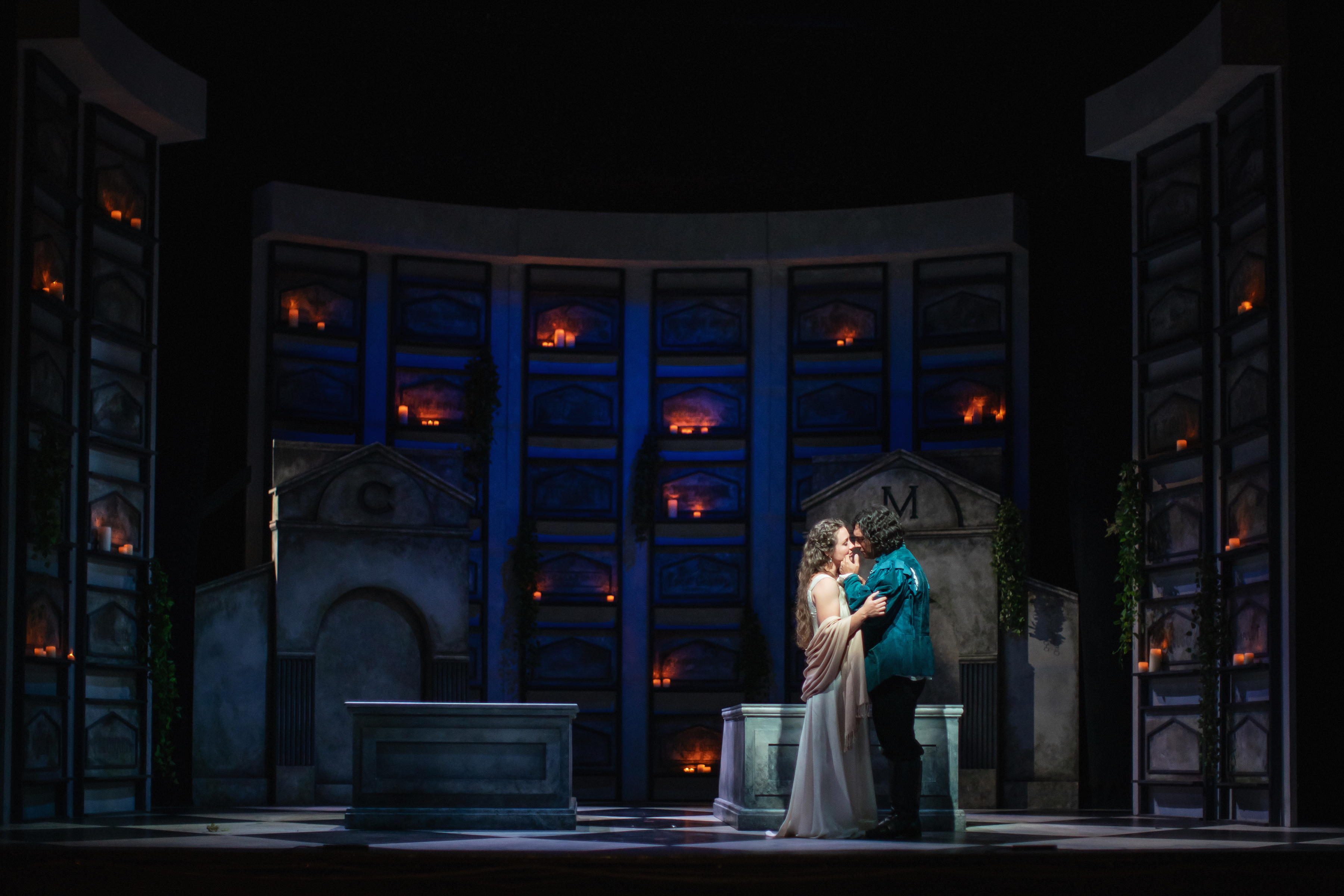
Central City’s production of Gounod’s Roméo et Julietteis set in the crypt of the Capulet family, where Juliette’s body will be placed and where she and Romeo will both die.

This unit set designed by Matthew S. Crane serves the entire opera, with two large, raised catafalques that double as serving tables and beds in other scenes. The setting serves a symbolic purpose: with its high walls on the small Central City stage, it portrays physically the claustrophobia of living in a society where hatred seals off half of your neighbors, and it represents how the hatred between Capulet and Montague has turned all of Verona into a boneyard.

Madison Leonard as Juliette and Ricardo Garcia as Roméo in Matthew S. Crane’s effectively claustrophobic set. All images by Amanda Tipton Photography

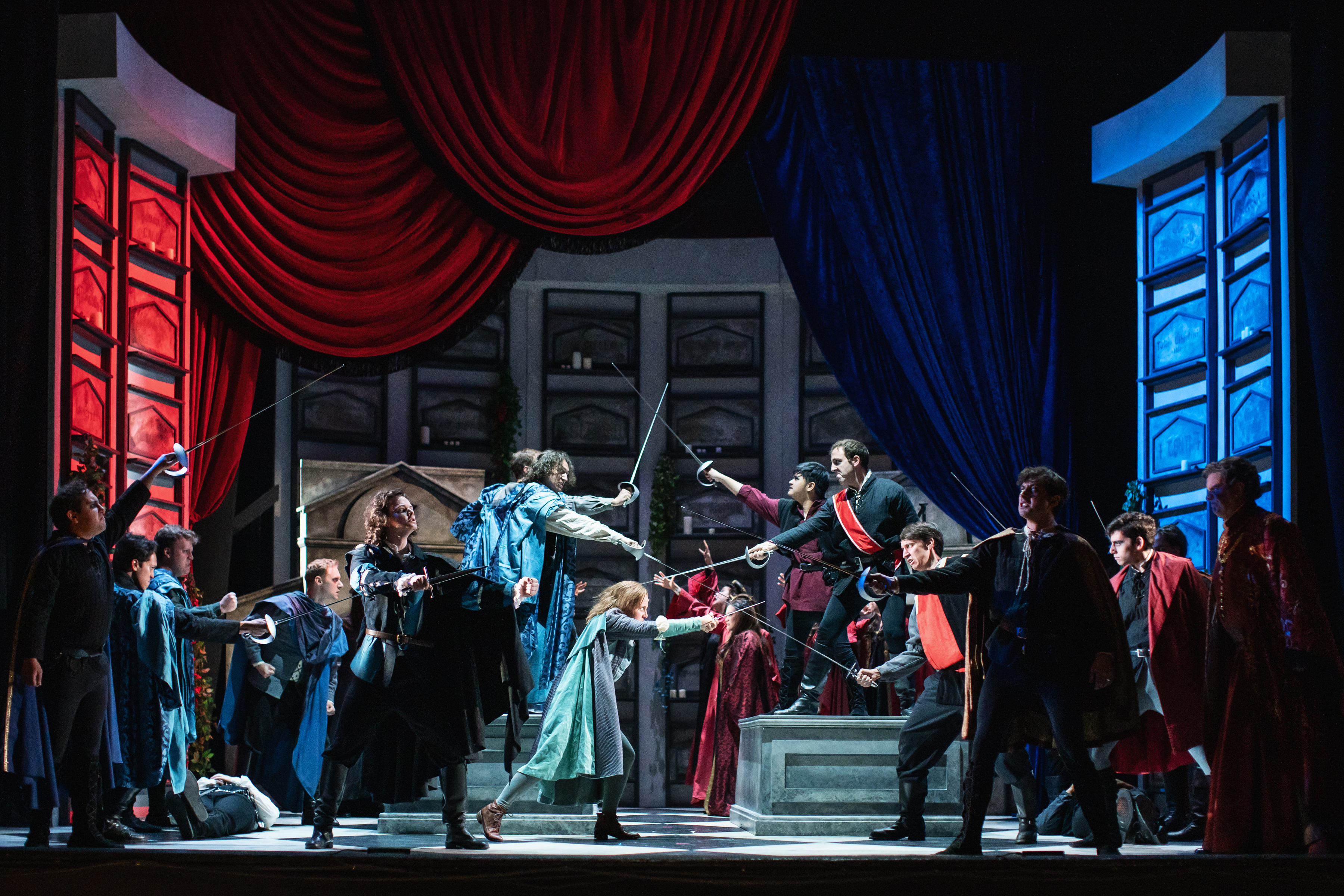
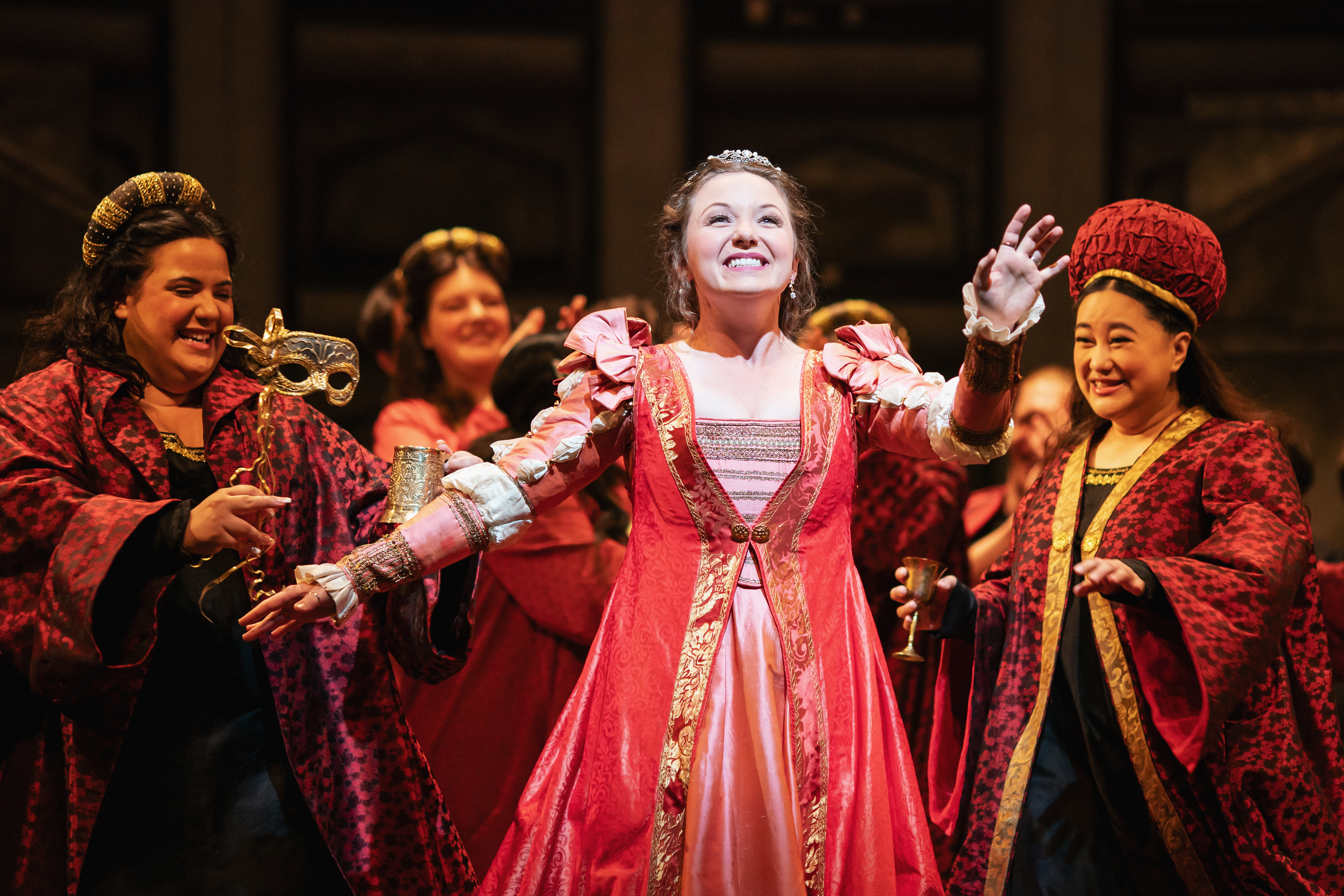
But it barely contains a French Grand opera. The intimate scenes worked best, while larger scenes became so full of singers that they were almost static. The Capulet ball in Act I and the Act III fight were especially challenging. The latter was a directorial tour de force, with the combatants swirling around the stage so fluidly one almost forgot how small the space is. Fight choreographer Matt Herndon has his hands full.

Fight scene from Act II

Director Dan Wallace Miller adheres closely to Shakespeare’s characters, notably the fact that Roméo and Juliette are young teens—she explicitly not yet 14, he probably about 17. Miller writes in his Director’s Note about the “teenagers’ hurricane of uncontrollable emotion,” which makes more sense to them than the curdled adult world of hatred and violence they see around them.

This sounds exactly right, and the singers—Madison Leonard as Juliette and Ricardo Garcia as Roméo—do a remarkable job of acting like teens. Particularly revealing were the moments right after their balcony scene when they couldn’t tear themselves apart. Likewise, the wedding scene is an appropriate mixture of joy, impatience and reverent wonder. The point was well made that they were adolescents who had known each other less than a day and were at the mercy of their abruptly aroused lust.

But the fundamental problem with the opera (and many others from the 19th century) is that the music written for young characters requires mature adult artists. No 13-year-old can sing Juliette’s music. So while the singers performed admirably as young lovers, the musical performances revealed their age and experience.

Madison Leonard as the teenaged Juliette at the Capulet’s ball

Still, the music is gorgeous. Leonard as Juliette has a full voice that commands the stage and fills the house. The first act Waltz was graceful if not quite girlish. Her singing throughout was bright and focused. Her performance of the poison scene was particularly effective, with mercurial mood changes, terror, and beautifully sung lyric outbursts.

As Roméo, Garcia has an expressive, soaring tenor that was occasionally strained on top. In an opera largely defined by its duets, he was a worthy partner for Leonard. Their duet concluding the balcony scene was especially beautiful.

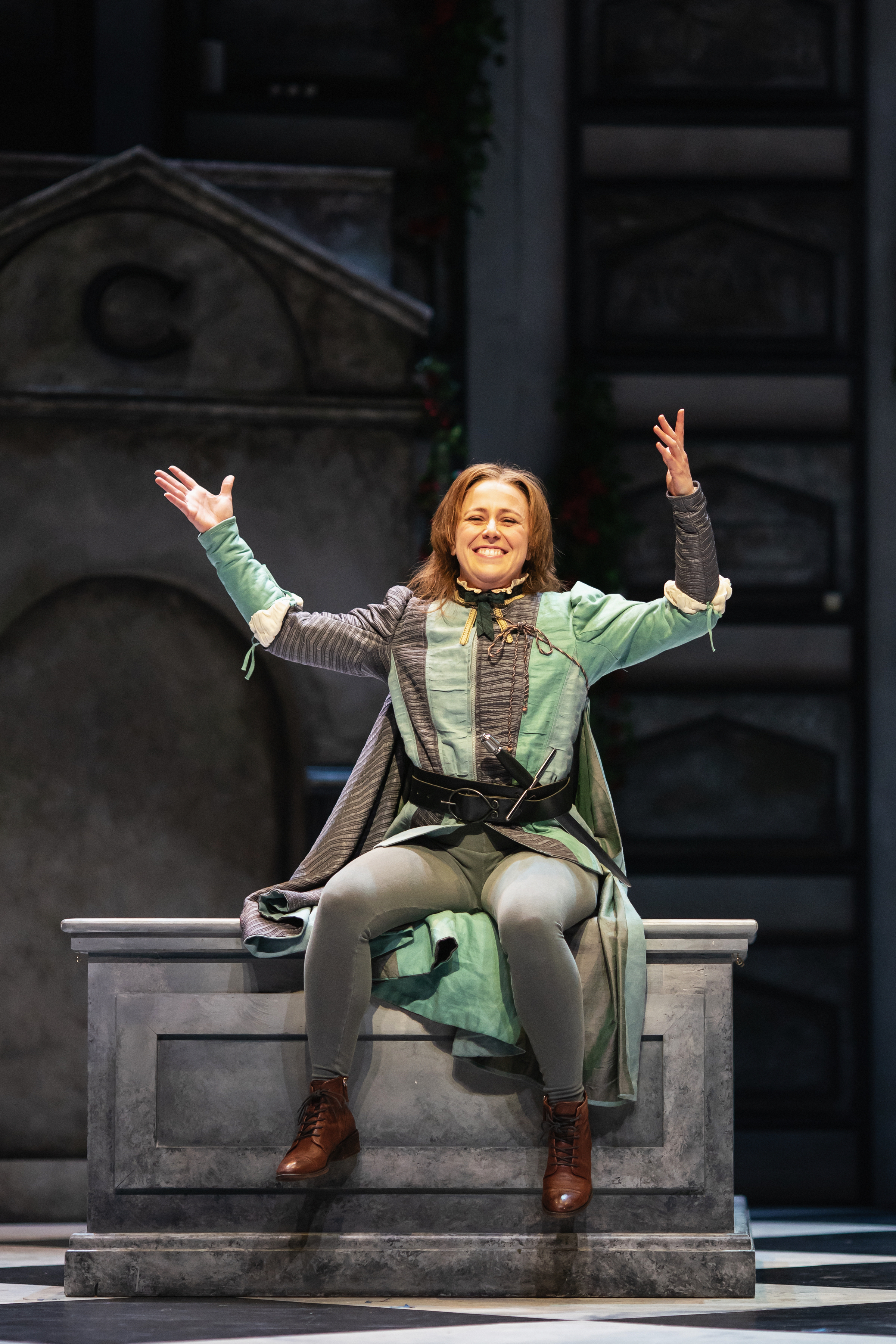
Sable Stout as Stéphano

In the smaller roles, Skyler Schlenker brought a big voice to his portrayal of Count Paris. As Tybalt, Kameron Alston sang with a penetrating, edgy tenor, while his opponent from the Montagues, Shea Owens as Roméo’s pal Mercutio, sang with power and a nice ring at the top. Boulder’s Wei Wu lent his fine, rich bass to a slightly tipsy Frère Laurent. 

Soprano Sable Stout had fun in the trousers role as Roméo’s page Stéphano, in spite of a moment or two of unsettled pitch. Mezzo-soprano Sarah Neal was sympathetic as Juliette’s nurse, Gertrude. Bass Adam Cioffari made Juliette’s father, Count Capulet, a benevolent host in Act I and a vengeful head of the Capulets after Tybalt’s death.

Brandon Eldredge led the orchestra, which had been conducted by CCO Music Director John Baril in earlier performances, with sensitivity to the emotional sweep of the score. The chorus, which Eldredge prepared, was ragged in the prologue that lays out the hatred between families, but offered a rich and homogenized sound afterward.

# # # # #

Long before “The Three Tenors” became a world-wide phenomenon, there was Rossini’s Otello.

Composed in 1816, Rossini’s opera—based loosely on Shakespeare’s play as translated into French—was premiered in Naples, where the company apparently had a surplus of strong tenors. Rossini obligingly wrote highly decorated tenor parts for three of the characters: Otello, his nemesis Iago, and Rodrigo, his rival for Desdemona’s love.

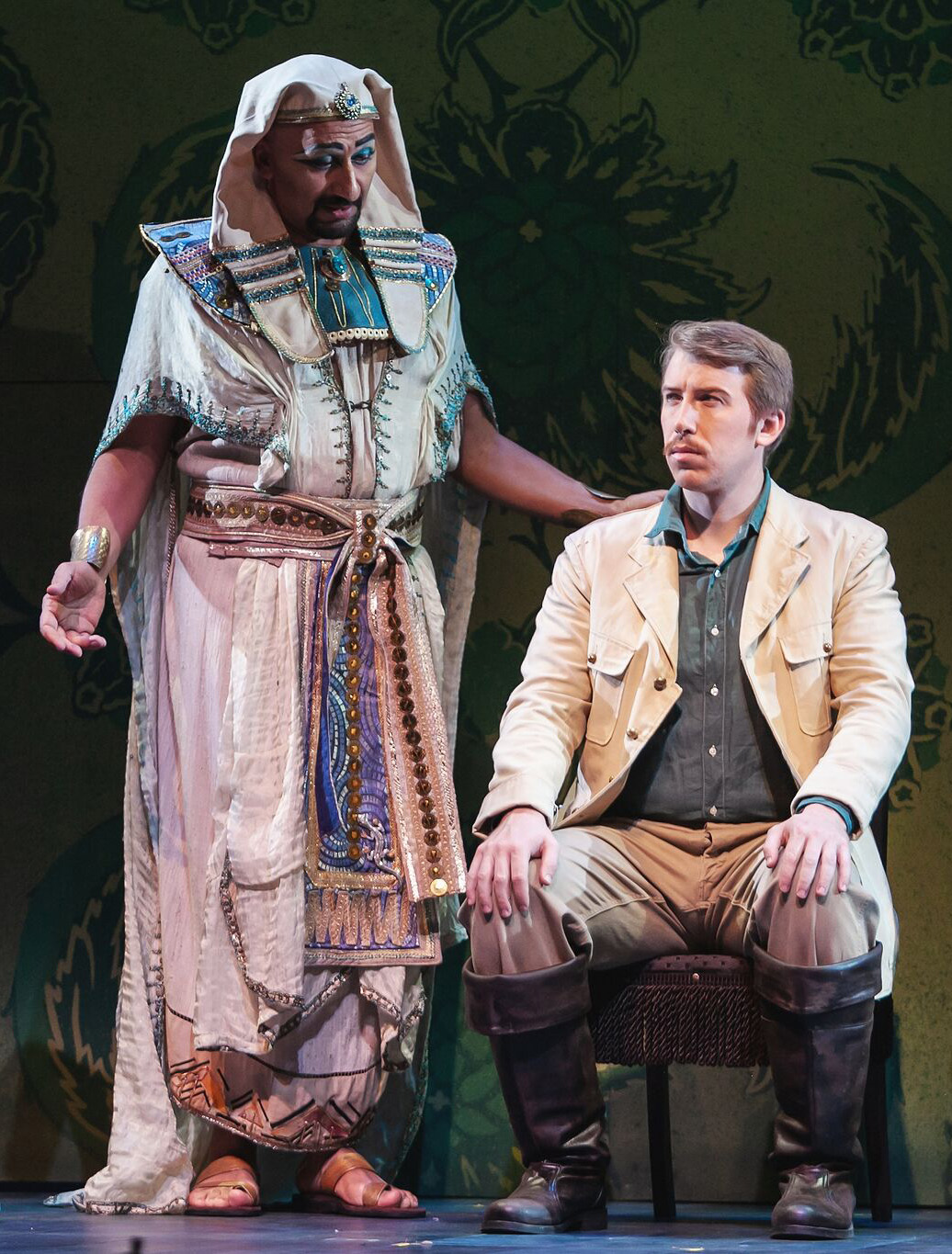
Christopher Bozeka (Rodrigo) and Bernard Holcomb (Iago) sing one of the many tenor duets in Otello. All images by Amanda Tipton Photography

This casting is both the glory and the curse of Rossini’s Otello. The score is filled with stirring arias and duets for tenors in the elaborate style Rossini’s early tenor roles, but finding three tenors up to the challenges in not easy. This is one reason that this opera is not heard often today. The other is that it was surpassed in drama, music and popularity 71 years after its premiere by Verdi’s masterpiece on the same subject.

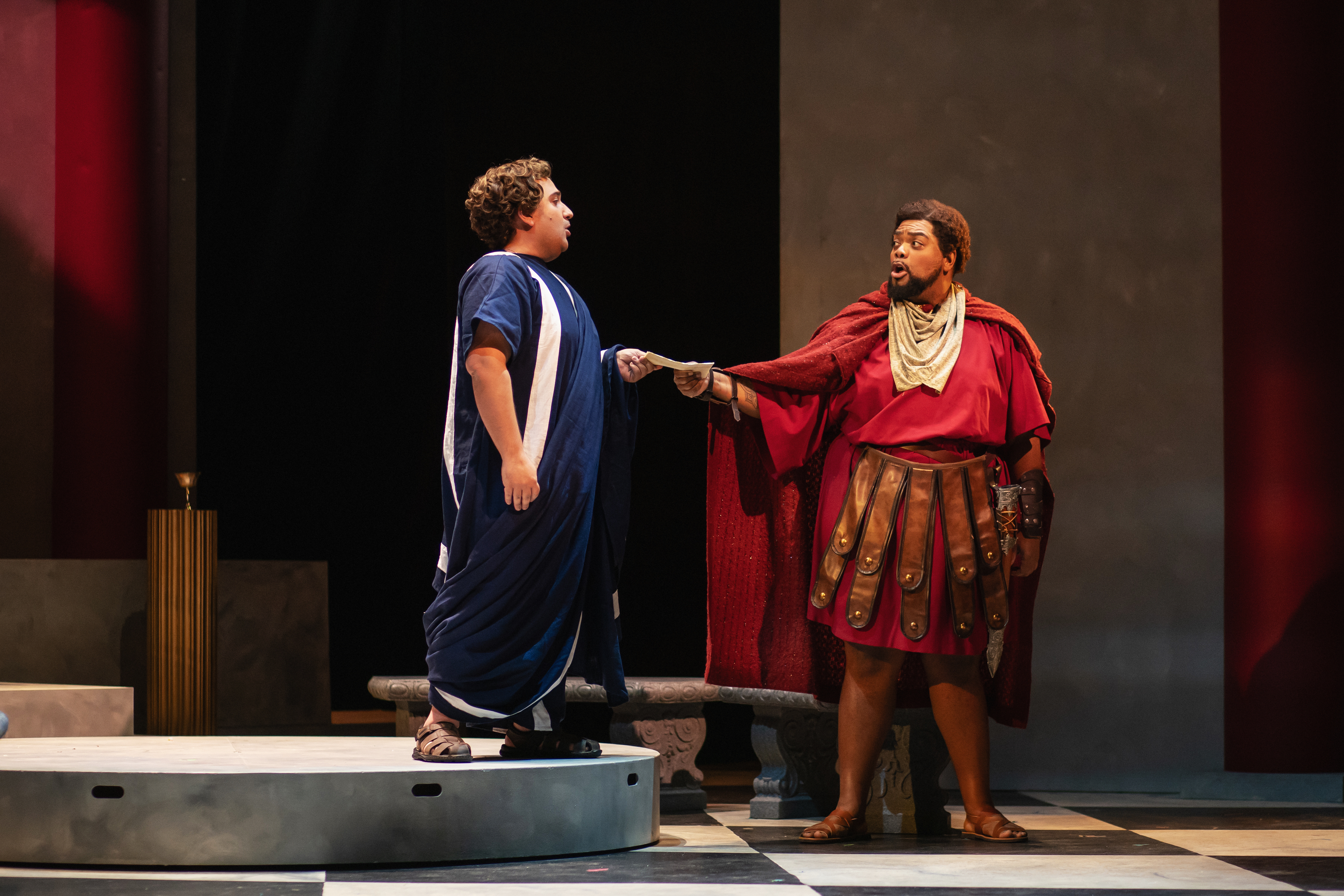
Nonetheless, Rossini’s three-tenor Otello remains a great opera, full of musical fireworks and potent drama. On that basis, Central City’s production is a welcome opportunity to hear a genuine rarity. It does not quite tell the story that is familiar from Shakespeare’s play and Verdi’s opera. For one thing, it all takes place in Venice; for another the marriage between Otello and Desdemona is secret, opposed by her father who prefers the White Rodrigo to the Black Otello as a match. And Rodrigo is promoted to a major character, one of the three tenors.

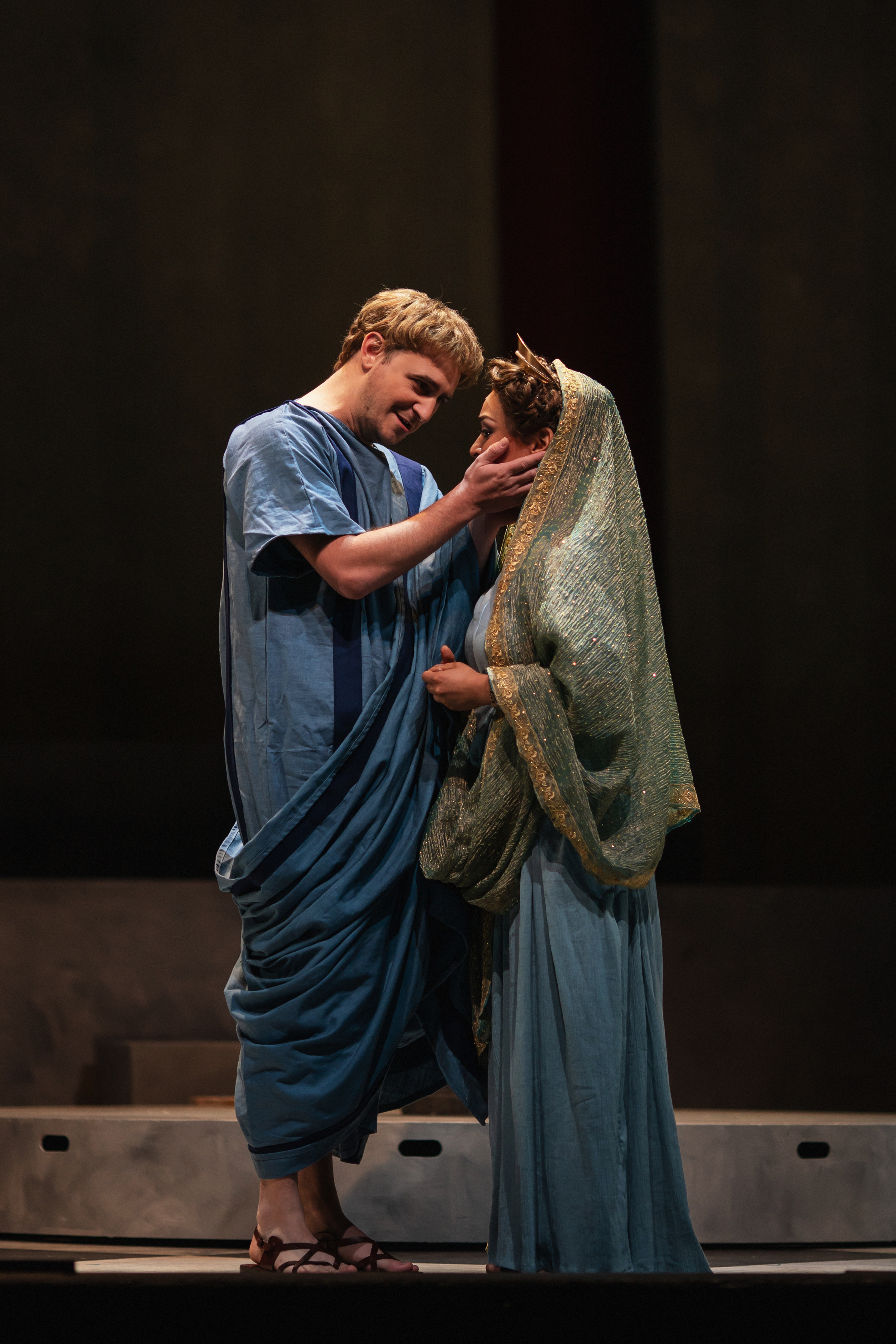
Elmiro (Federico de Michelis)tries to persuade his daughter Desdemona (Ceciia Violetta López) to marry Rodrigo

But the biggest difference is that Otello’s downfall comes not from jealousy but racism. Both the text, where Otello is referred to repeatedly as “The African,” and the staging, where characters repeatedly wash their hands after contact with Otello, point to the pervasive racism of the world in which he lives. Stage director Ashraf Sewailam explains that Otello himself came to “believe the narrative” of his own inferiority.

An extra layer is provided by the coincidence that in CCO’s cast, Otello and Iago are performed by Black singers. Sewailam does not fail to make use of this opportunity: action during the Overture make it clear that Iago has been rejected, romantically and otherwise, because of his skin color, which fuels his hatred of Otello. At the same time, his skin color enables him to feign friendship with Otello. He also pretends to help Rodrigo, while laying a trap for Otello to believe that Desdemona has betrayed him.

In the production it is all much clearer than my synoptic outline. Sewailam does an excellent job of keeping actions and motivations clear. He also faces down the opera’s greatest difficulty—the large number of musical numbers where the actors sing but no action takes place. He finds various ways of keeping attention on the stage, some quite successful and others looking more like busywork designed to disguise the static action.

The setting is moved from Venice to Imperial Rome. Done on the basis that the Empire allowed peoples of all nations to succeed on merit, this is a distinction that makes no difference. Matthew S. Crane’s unit set is perfectly serviceable. Plot twists are carefully laid out in performance, both by Sewailam’s thoughtful direction and by the three tenors, who are all capable singing actors.

In the title role Kenneth Tarver is a figure of strength, vocally and dramatically, who is twisted into turning that strength against himself. With his lightning-fast roulades he handles Rossini’s lines comfortably. As a character, he is never less than dignified and controlled.

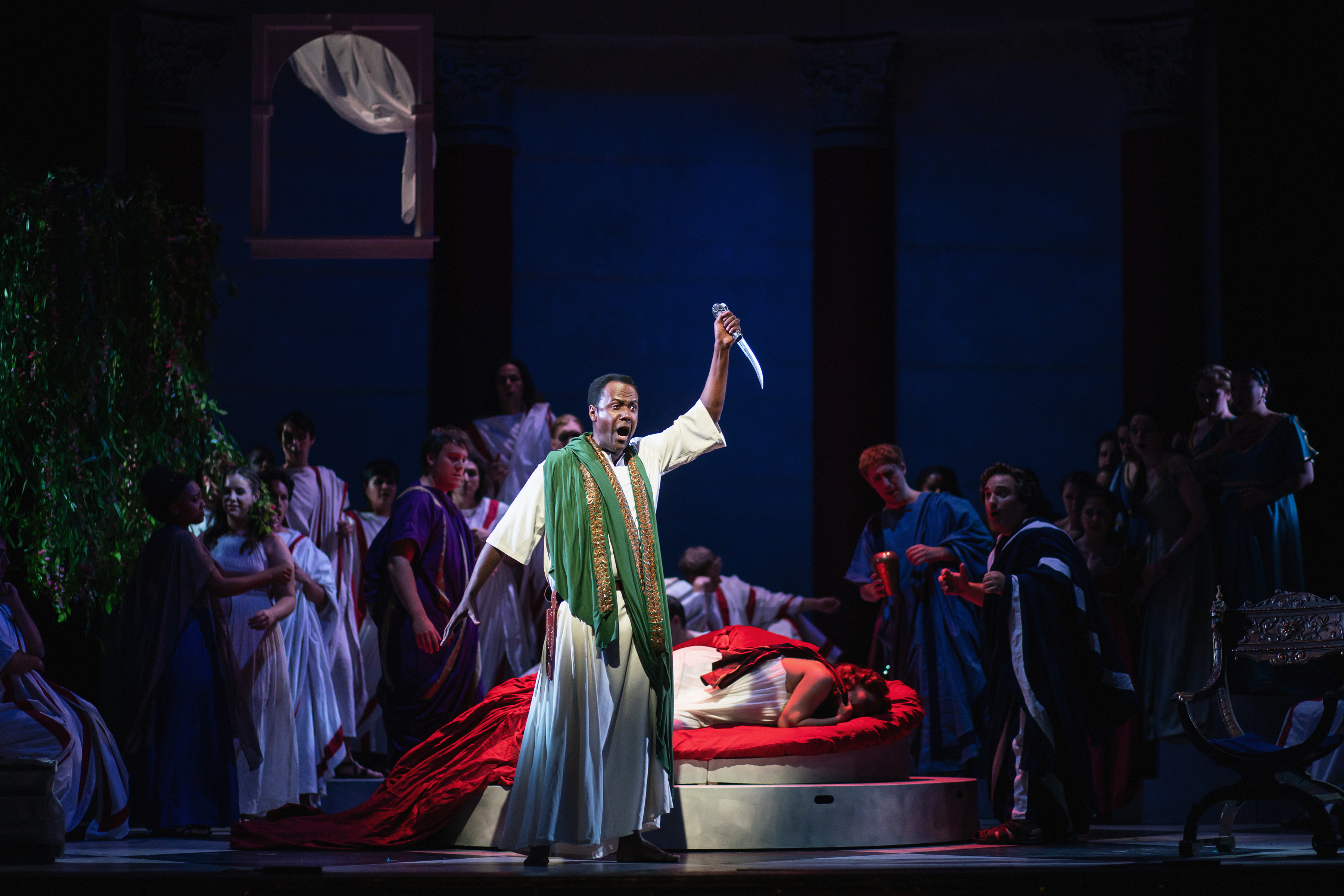
Kenneth Tarver as Otello, shortly after his murder of Desdemona (Cecilia Violetta López)

Christopher Bozeka (Rodrigo) sings with ease into his highest registers, not always cleanly but with great feeling. He effectively uses facial expressions to connect with the audience and announce his rarely failing hopes—illicitly encouraged by Iago—to turn Desdemona to his wishes. Bernard Holcomb as the treacherous Iago has at times the cleanest execution, and always projects the cunning ease of the true villain. The various duets featuring two of the tenors—a distinguishing feature of Otello—are rousing highlights.

Desdemona has her own spectacular moments that she carries off comfortably, to the top of her range. She delivers the “Willow Song,” the one aria sung outside of full performances, affectingly. Federico de Michelis’s well rounded bass lends weight to Elmiro, Desdemona’s father, making him so convincing a racist enemy of Otello that his conversion at opera’s end—part of a rapid turn of events that also unmasks Iago’s treachery—is scarcely credible. Hilary Ginther is a warm and sympathetic Emilia.

Under John Baril, the orchestra gives a sprightly and stylish performance of Rossini’s score. Special credit goes to the sparkling woodwinds and horn players for their solo turns.

# # # # #

All three productions on the summer schedule—Kiss Me Kate, Roméo et Juliette, Otello —are presented in attractive productions, their stories cleanly told and well sung. Any one of them makes for a good summer excursion to the mountains, but if you can only make one trip to Central City, see Otello. It is a true rarity that is worth hearing, and its story of the harm done by thoughtless racism still resonates. And where else outside reruns can you hear three tenors?

# # # # #

Central City Opera
Remaining performances of the 2023 Season
All performances in the Central City Opera House

Roméo et Juliette
By Charles Gounod, Jules Barbier and Michel Carré
John Baril, conductor, and Dan Wallace Miller, stage director

Performed in French with English supertitles

2 p.m. Friday July 28; Sunday, July 30; Wednesday, Aug. 2; Saturday, Aug. 5

Kiss Me, Kate
By Cole Porter, Samuel and Bella Spewack
Adam Turner, conductor, and Ken Cazan, stage director
Performed in English with English supertitles

7 p.m. Saturday, July 29; Saturday, Aug. 5
2 p.m. Wednesday, Saturday, July 22; Wednesday, July 26

Otello
By Gioachino Rossini and Francesco Berio di Salsa
John Baril, conductor; Ashraf Sewailam, stage director
Performed in Italian with English supertitles

7 p.m. Saturday, Friday, Aug. 4
2 p.m. Wednesday, July 23; Saturday, July 29; Sunday, Aug. 6

TICKETS

CORRECTION: The original version of this review inadvertently omitted the name of tenor Kameron Alston, who sang the role of Tybalt in Roméo at Juliette. I apologize for the oversight, which has been corrected as of 7.27.23.

Artists comment on change of leadership at Central City Opera

Two stage directors point to the company’s future

By Peter Alexander July 19 at 1:45 p.m.

Central City Opera House. Photo by Ashraf Sewailam.

Two of the three stage directors who helped produce this summer’s performances at Central City Opera (CCO) have given comments on the recent departure of CEO Pamela Pantos and the future of Central City Opera. (See: CEO Pamela Pantos’ employment at Central City Opera has ended.)

Ken Cazan

Ken Cazan, professor of opera and resident stage director at the University of Southern California Thornton School of Music, is the senior director of the three. He has been a feature of the CCO artistic community for many years. Last December when CCO was embroiled in a contract dispute with the American Guild of Musica Artists (AGMA), he wrote a letter to Pantos stating his unwillingness to work for the company until the dispute was resolved. Subsequently the two other directors signed the letter as well. The dispute was resolved at the last minute.

For the 2023 season, Cazan directed the production of Cole Porter’s classic musical Kiss Me, Kate. After yesterday’s surprise announcement that Pantos was leaving CCO, he wrote the following: “I’m glad it’s over. Now, hopefully, the company will wipe the slate clean and start from the ground up to recreate itself.

“At the moment it is totally up to the board and I pray that they have the fortitude to look at the company and its mission through a very fresh, clear lens. It is the perfect time to reimagine who and what they are and how they fit into the Colorado, American and international arts landscapes. I have so many thoughts on the huge potential for the company to move forward and grow artistically in this moment. It just takes guts and trusting a new artistic mentality—whoever that may be.

“Let the Managing Director and the new Artistic Director (a must position and one that was sorely missed this summer) create a new world within and around CCO, one that hopefully reaches out and invites in a new, fresh audience while being grateful for the guidance and support of current and past generations.”

Ashraf Sewailam

Ashraf Seawilam was the most junior of the three stage directors. Although he has sung at Central City and around the world, the CCO production of Rossini’s Otello was his first fully professional directing job. He wrote: “To me—and many of my colleagues share this sentiment—the priority now is to concentrate on performing the rest of the festival not only successfully, but brilliantly.

“I won’t speak about the circumstances under which we put this excellent season together. The company and its great history will move on from this episode. The tremendous efforts put together by the artists, creatives, and crew in order to produce this season in spite of the ‘obstacles’ should be what’s in the limelight now, not what we left behind. In the end it’s why we’re here: The art and artists who make it happen.

“Come and see the shows! You will not be disappointed.”

Details of the remaining performances and access to ticket sales may be found here.

‘Brush up your Shakespeare’ at Central City Opera

2023 Summer Season features three mainstage adaptations of the Bard

By Peter Alexander June 22 at 11:57 a.m.

Central City Opera (CCO) returns to a three-production mainstage season this summer for the first time in more than 10 years with three musical works based on Shakespeare.

Opening Night at Central City Opera. Featured in Central City Opera’s 75th anniversary book, “Theatre of Dreams, The Glorious Central City Opera- Celebrating 75 Years.”

The 2023 Festival season runs from Saturday, June 24, until Sunday, Aug. 6, with the three works performed in rotating repertory (see full list of dates below). The three works are musical adaptation of Shakespeare’s Romeo and Juliet by French composer Charles Gounod, which stays close to the original plot in most respects (opens June 24); an opera by Rossini based on a French version of Othello that differs in significant ways from Shakespeare’s play (opens July 15); and Cole Porter’s Broadway hit Kiss Me, Kate, which uses Shakespeare’s Taming of the Shrew as a plot device in a broadly comic tale of feuding actors, interlocking love triangles and ruthless but luckless gangsters (opens July 1).

First to open is Gounod’s Roméo et Juliette, the closest of the three works to Shakespeare (performances June 24–Aug. 5). First performed in 1859, it was a huge success from the outset, with more than 300 performances over the next decade, and it remains popular today. This is largely due to the combination of a story that is familiar and much loved, and a beautifully written Romantic score.

“The music is fantastic!” director Dan Wallace Miller says. “Of all the adapted Shakespeare, its the one that fits the mold of French grand opera the best. It’s inherently French, and it has the sumptuous, flowing quality you expect.”

Dan Wallace Miller

The opera has most of the major plot points of the play—the hatred between Montagues and Capulets, the Capulets’ ball where Romeo and Juliet fall instantly in love, the balcony scene, the deaths of Mercutio and Tybalt, and the deaths of the lovers in Juliet’s tomb. There are only a few differences from the original, Miller says.

For one, the play opens with a scene that is missing in the opera, a brawl between the Montagues and Capulets that sets the tone for the violence between the two families. “The other huge difference,” Miller says, “is that because this is an opera, you gotta have the final duo!” Instead of Juliet waking up to find Romeo’s corpse and then stabbing herself, as in the play, Juliet wakes up as Romeo is not quite dead yet. Only after their duet does he die, and then she kills herself.

Taking inspiration from Wieland Wagner’s minimalist stagings at Bayreuth after World War II, the opera is played in a bare unit set that represents the inside of a mausoleum. Different locations are suggested by changes in lighting, by moss, and by flowers, but the setting also symbolizes the pointless hatred that turns all of Verona into a mausoleum.

“The idea is that the ghosts will keep reliving this tragic story up until the point where humanity itself has forgotten that any of these people ever existed,” Miller says. “The people involved in the conflict don’t know what instigated it in the first place, but it has resulted in centuries of blood and tragedy.”

Miller also stresses that Romeo and Juliet are both children—she is specifically not yet 14, and he is probably a little older. “They are adolescents,” he says. “They are not the platonic ideal of romance. Romeo goes to the Capulet ball, and the first woman he sees he falls in love with. The realization that Juliet is the daughter of his enemy is a further turn-on—lust spurred on by rebellion.”

A challenge to the performers is the contradiction between very young characters and music that requires seasoned professionals. “It’s about adolescent love, but my God it’s so difficult to sing,” Miller says. “It’s absolute fireworks!

“Both Ricardo Garcia and Madison Leonard, who are singing Romeo and Juliet, are just doing a phenomenal job. It is so endearing to see that spark of adolescent glee in every interaction they have.”

# # # # #

Kiss Me, Kate (performances July 1–26) was Cole Porter’s greatest success. It opened on Broadway in 1948 and ran for more than 1000 performances, followed by a London West End production in 1951, and several subsequent revivals up to 2019.

The show is about actors trying to mount a musical version of The Taming of the Shrew, in which different cast members have different stakes in the show. Producer/director/star Fred Graham needs a success in order to revive a floundering career; co-star and ex-wife Lilli Vanessi is engaged to the influential General Harrison Howell, but also caught between her genuine love for Fred and his arrogant mistreatment of her. Bill, the boyfriend of younger actress Lois Lane, is involved with gangsters who attempt to hold the production hostage for his debts.

Ken Cazan

The entanglement of these different dilemmas creates lively theatrical humor. “The wit of (Kiss Me, Kate) is very sophisticated, acerbic, clever stuff,” stage director Ken Cazan says. “It’s amazing, the whole thing. But some of it’s dated. Something I have to deal with in 2023 is the misogyny that’s just through the roof.”

Cazan points to the original ending of the show, where Lois goes face down before Fred, as a sign of submission. He will talk to the cast and ask how they want to play that scene. “I think we’ll probably do a 180 from that,” he says. “I’m fascinated to talk to Emily (Brockway) and Johnathan (Hays), the two principals, and say, what happens after this?

“It’s up to them to perform it and I don’t want to force them into anything.” So if you want to know how this production turns out, you’ll have to see it!

In addition to the ending, the script is full of lines that are very troublesome in 2023—even the cheery tune sung by the gangsters, “Brush up your Shakespeare.” One line that is almost always changed today is when Lois sings to Bill, “Won’t you turn that new leaf over, So your baby can be your slave?” People from casual friends to CCO audience members to Pamela Pantos, managing director of Central City Opera, have told Cazan that they hate that line. It will be changed, he says, as it almost always is today.

The conception of the female roles is something else Cazan wants to modernize. He specifically mentioned Lauren Gemelli, the actor playing Lois/Bianca. “She’s so often done as a bubble headed sexpot, which is tremendously dated,” he says. “Lauren walked in (to her audition) and you could see the brains behind the manipulation. I’m very excited to work with her.”

The feuding between Fred and Lilli is supposedly based on real life. The show’s original producer, Arnold Saint-Subber, had seen on- and off-stage battles between legendary husband-and-wife actors Alfred Lunt and Lynn Fontanne in a 1935 production of Taming of the Shrew. He later asked married writers Bella and Samuel Spewack to write a script based on Lunt and Fontanne, and they brought in Cole Porter to write the music.

It turned out to be a brilliant partnership. “Every song was a hit!” Cazan says. “I love it!”

# # # # #

The final show to open this summer will be Rossini’s Otello (performances July 15–Aug. 6). While based loosely on the same characters, this is not Shakespeare’s Othello that you may be familiar with. First performed in 1820, Rossini’s opera was based on a 1792 adaptation by French playwright Jean-François Ducis.

His Shakespearean adaptations in French included not only Othello, but Hamlet, Macbeth and Roméo et Juliette. Working in the late 18th century, Ducis was subject to the rigid rules of classical French theater, to the extent that some of his plays differed extensively from the original.

For his play, and subsequently Rossini’s opera, Ducis transferred the action entirely to Venice. In other differences, Otello and Desdemona are engaged but not married; Desdemona has another suitor, Rodrigo; Iago, another rejected suitor, pretends to support Rodrigo; and jealousy is less of a motivating factor than the racism that Othello encounters. As director Ashraf Sewailam explains, “Otello is referred to as ‘l’Africano’ multiple times by white characters, so the racist stuff is unambiguous.”

Ashraf Sewailam

To shine a light on the racism, the production has been placed in classical times, where we can more easily notice its impact. “The central idea, staging it in ancient Rome, I credit to (CCO executive director) Pamela Pantos,” Sewailam explains. That setting avoids contemporary political sensitivities, while clearly highlighting racial animus within a diverse society.

The opera is not often performed today, for a variety of reasons. The greatest is simply that it has been overshadowed by Verdi’s Otello, which was first performed in 1887, 67 years after Rossini’s opera. Another reason is that it calls for four virtuoso tenors who can sing in Rossini’s highly decorated style. There are tenors today who can sing those roles, but as Sewailam comments, “they have to get them all four at the same time, obviously.”

Sewailam has sung several roles at Central city Opera, but this will be his first appearance as director. He has directed smaller productions and scenes before—at San Diego Opera and dell’Arte Opera Ensemble in New York, among others—but he says directing a mainstage production in Central City is “a breakthrough for my directing.”

He sees the unfamiliar variant of the plot as an opportunity rather than an obstacle. “It’s a chance to highlight a different version of the plot,” he says. Instead, “the challenge is how the opera is structured musically.” Using singer’s slang, he says “the opera is really a ‘park and bark’ structure”—meaning a series of static arias where singers show off their vocal prowess without advancing the plot. But Sewailam has found plenty in the text for the production to transcend “park and bark.”

Like his fellow directors, he is excited about the singers he will be working with. “The cast is amazing!” he says. “We have quite a few twists and turns. We have a Black Iago, which presents both a problem and an opportunity, to mine the psychology of Iago and see what we can do with it.

“We are not contriving something that’s not there, but we want to mine everything to make it as compelling as possible.”

# # # # #

Central City Opera
2023 Season
All performances in the Central City Opera House

Roméo et Juliette
By Charles Gounod, Jules Barbier and Michel Carré
John Baril, conductor, and Dan Wallace Miller, stage director
Performed in French with English supertitles

7 p.m. Saturday, June 24; Friday, June 30
2 p.m. Sunday, July 2; Saturday, July 8; Wednesday, July 12; Saturday, July 15; Friday, July 21; Friday July 28; Sunday, July 30; Wednesday, Aug. 2; Saturday, Aug. 5

Kiss Me, Kate
By Cole Porter, Samuel and Bella Spewack
Adam Turner, conductor, and Ken Cazan, stage director
Performed in English with English supertitles

7 p.m. Saturday, July 1; Friday, July 7; Saturday, July 29; Saturday, Aug. 5
2 p.m. Wednesday, July 5; Sunday, July 9; Friday, July 14; Sunday, July 16; Saturday, July 22; Wednesday, July 26

Otello
By Gioachino Rossini and Francesco Berio di Salsa
John Baril, conductor; Ashraf Sewailam, stage director
Performed in Italian with English supertitles

7 p.m. Saturday, July 15; Friday, Aug. 4
2 p.m. Wednesday, July 19; Sunday, July 23; Saturday, July 29; Sunday, Aug. 6

Individual performance and season TICKETS 

NOTE: Minor typos, punctuation and style errors corrected 6/22.

Central City Opera’s Shakespeare summer: To be or not to be?

Summer 2023 festival season in question due to ongoing contract disputes

By Peter Alexander May 1 at 2:05 p.m.

Note: This article goes into some detail about the ongoing and contentious conflict between the Central City Opera and the American Guild of Musical Artists, which threatens the upcoming 2023 summer festival season of the opera. I believe that it is important for the true extent of the dispute to be known and understood by musicians, potential audience members, and other interested people. For full clarity, issues at stake are presented here as objectively as possible. However, it should be noted that representatives of the union and artists who have appeared at Central City Opera spoke to me freely and on the record; to date the opera company has not made anyone available for an interview. This article reflects the information I have been given.

Disclosure: Several of the artists quoted below are personal friends. While I was on a friendly footing with Pelham Pearce, artistic director of Central City Opera until last June, I do not have a personal relationship with any of the current CCO media representatives or administrative staff.

CENTRAL CITY OPERA (CCO) announced its planned 2023 summer festival season of three operas on Nov. 15, 2022. This was a return to the more ambitious summer festival that CCO had abandoned after 2012 due to declining income, and later COVID. All three operas planned for the coming season are based on Shakespeare: Gounod’s Roméo et Juliette, Rossini’s Othello and Cole Porter’s classic musical Kiss Me Kate.

Now the entire season may be in jeopardy due to a contract dispute between the opera company and the American Guild of Musical Artists (AGMA), representing both leading singers and the apprentice artists at CCO.

Central City Opera House. Photo by Ashraf Sewailam.

No one is saying that the season is likely to be canceled, but it’s hard to find optimism among the artists and the leadership at AGMA, who admit to being prepared for a possible work stoppage. I am still awaiting comments from CCO management, but with rehearsals slated to start late this month, the timeline is short.

In the words of AMGA’s national executive director Sam Wheeler, from a video message released April 18, “If we’re going to reach a deal, the clock is ticking.” And he stated in an interview the same day, “at the moment we’re nowhere near an agreement.”

The previous contract between AGMA and CCO expired in August, 2022, toward the end of the summer festival season. Prior to that, the CCO Board of Directors had hired Pamela Pantos as president and chief executive officer of the company. At that time, longtime director of the company Pelham Pearce remained as artistic director.

Just before the 2022 season opened, Pearce suddenly resigned via a statement on his personal Facebook page that said only “I have resigned as Artistic Director of the Central City Opera.” Pearce has made no further comment, and there has been no clarification from any source of his reasons for leaving the company where he had worked since 1996. Whatever his reasons, there had been a complete change of management before the AGMA contract expired in August.

# # # # #

HERE IS HOW the dispute between CCO and AGMA has played out since then: The two parties began negotiations for a new contract Nov. 1, 2022. On Dec. 6, AGMA published on their Web page a letter that they had sent to the CCO Board of Directors. It claimed that “prior to contract expiration, CCO management committed several violations of the CBA (Collective Bargaining Agreement) that resulted in the company not paying more than $12,000 to Apprentice Artists.”

The letter also claimed that “several artists have come forward detailing disturbing conduct ranging from public body shaming to sexual harassment, to overt threats of retaliation for union activity.” The letter further noted that CCO had retained Littler Mendelson P.C., which was described as “a notorious union-busting law firm.” Finally, the letter listed several proposals from CCO that were described as “unprecedented and draconian.” (You may read the entire letter here.)

Central City Opera responded on Dec. 14 by releasing “Facts About Our Ongoing Collective Bargaining Negotiations,” in which they expressed their disappointment at “unfounded assertions being made by some AGMA leaders and members.” None of the specific points raised by AGMA were directly answered, except to state that CCO has “policies and reporting procedures to protect everyone on staff from harassment and discrimination.” (This notice may be read here.)

The next day—Dec. 15, 2022—AGMA released a brief statement of their own. “Central City Opera’s latest statement is nothing more than a transparent attempt to distract from their own misconduct,” it stated (posted on the Web here).

Ken Cazan, a stage director with longtime association with CCO, had been engaged to direct the summer 2023 production of Kiss Me Kate. Near the end of the year Cazan wrote a letter to Pantos as executive director of CCO in which he stated his unwillingness to work on the summer productions until the issues had been resolved.

At his invitation, the summer’s other two directors, Dan Wallace Miller (Roméo) and Ashraf Sewailam (Othello) also signed the letter, which was posted publicly Dec. 20. This is meaningful because the three directors have very different stakes in the coming season. While Cazan is a senior stage director with a safe faculty position at the University of Southern California Thornton School of Music, Miller works for a small opera company and Othello is Sewailam’s first contract as stage director. (Read their letter here.)

After more negotiations, the next public exchange between the parties was in April. On April 14, while negotiations were ongoing, CCO issued a new 14-paragraph statement headed “Update on the Ongoing Negotiations with AGMA.” The document contests several previous statements from AGMA.

Two issues in particular have been vigorously contested. First, the statement reads, “AGMA claims publicly that CCO owes money to artists using the phrase ‘Pay Your Artists.’ There are no legal or contractual grounds for these claims regarding payments owed; CCO honors its contracts and pays its artists.”

Second, the company raises what appears to be a new issue, claiming that “AGMA has requested that all CCO artists become AGMA members and pay AGMA’s initiation fee and dues, effectively denying CCO artists the right to choose whether or not to join AGMA.”

Finally, the “Update” includes a series of statements preceded by the heading “FACT”. These essentially are statements of CCO’s position on the disputed issues with AGMA, which AGMA contends are not facts. Since no supporting document are included, it is difficult to verify the factual nature of the statements. (The full “Update” is online here.)

The following Tuesday, April 18, AGMA placed a video online responding to CCO’s “Update.” The “Video Message Regarding the Ongoing Labor Dispute with Central City Opera” was recorded by Wheeler, speaking from notes but without a visible script. This is the most detailed statement released by either side, and therefore some portions need to be quoted directly. In his opening, Wheeler says bluntly, “There is a lot in (CCO’s “Update”) that is either false, misleading, or completely out of context.”

He quotes written statements from several of AGMA’s negotiators calling into question CCO’s sincerity. For example, one negotiator reported “they have been confrontational . . . and purposely wasted our time repeatedly over the last six months.” Another statement reads, “Central City’s negotiating team repeatedly speaks to our staff in a haranguing and dismissive manner, and it is clear that their lawyers have little knowledge of how the opera industry actually works.”

Wheeler talks at some length about the $12,000 AGMA claims is owed to apprentice artists. He covers one of the specific sources of the $12,000, fees to apprentice artists for performances “outside of the regular opera season.” He reads directly from the contract in support of AGMA’s position, adding that “Central City said in their statement last week that there is ‘no basis’ in the contract that they owe any money to anybody.” Outside of the specific language in the contract quoted by AGMA, I have seen no specific documentation supporting either side’s position.

The “Video Message” continues with more details about the issues of union membership and fees, among other contractual specifics. It also refers to one of the basics of most performing artists’ union contracts, what is known as “pay or play.” This is the proposition that once an artist has been given a contract, if their appearance were cancelled capriciously the payment must still be made.

Wheeler says “Central City is trying to destroy pay-or-play. What does that mean practically? It means that if Central City were to get rid of an artist for a bad reason or a discriminatory reason and not pay out their contract, AGMA would not be able to do anything about it.” (You may watch Wheeler’s entire “Video Message” here.)

# # # # #

I HAVE SPOKEN directly with people from AGMA, artists who have appeared at Central City Opera, and attorneys with knowledge of labor law. Based on those conversations I will attempt to clarify some of the disputed topics.

First, it should be noted that there are two issues still in dispute from AGMA’s previous contract with CCO. One is the $12,000 that AGMA says is owed to apprentice artists. AGMA’s justification is laid out in Wheeler’s “Video Message.” Wheeler also notes that five arbitrations of those payments are pending through the not-for-profit American Arbitration Association. In the meantime, Wheeler says “we’re going to keep pursuing these grievances under the contract to make sure that the artists who were there last summer get what they’re entitled to.”

Most of the $12,000 is for performances that the apprentices gave outside the schedule of performances in the opera house proper. Wheeler and AGMA say that the contract requires the company to pay each apprentice “an honorarium of $60 per performance, in addition to all other compensation.” This would cover events such a donor events, community events, and other occasions that come up every year over the course of the season. As Wheeler explains the union’s view, “we negotiated this in 2019 and in 2022. Central City simply did not pay this honorarium.”

The company has only said “CCO has always paid its artists and production staff in full,” with no further details. The word that is circulating, with no attribution, is that the company stopped honoring that clause when the previous contract ran out. AGMA says the company is obligated to observe the contract beyond that original term, so long as negotiations are ongoing, a position that appears to be supported by law.

The other issue from the past season is the complaints of sexual harassment and body shaming. These reported incidents are apparently being investigated, and until a conclusion has been reached, neither side can comment.

The issue of union membership deserves careful explanation. As stated, CCO’s claim that AGMA wants all artists to become union members is hard to reconcile with the union’s position that it is by contract an “agency shop” in every state that does not have “right to work” laws, which includes Colorado. 

“Agency shops” are workplaces covered by union contract where the employees may either join the union or pay an “agency fee” that covers the union’s costs for negotiating and defending the contract that applies to all workers, both union members and non-members. By law, an agency shop cannot require employees to join the union, although they can and do require them to pay the agency fee. In other words, AGMA could not legally require artists to join the union.

In other words, when CCO says “AGMA is attempting to expand its representation to its artists who are currently not subject to its membership rules and who have never before been required to pay AGMA initiation fees or dues,” they are claiming something that AGMA denies, that they say they have never demanded in their contracts, and that could potentially be illegal.

I have talked to union members who work in non right-to-work states—stage hands, musicians, and others—and they all agree that paying the agency fee is routine. Many people choose to join the union, since they are paying the fee anyway, but others do not. And as far as AGMA specifically is concerned, Miller calls AGMA’s dues “more reasonable than any other entertainment union in the business. . . . It’s not a lot of money.”

Another serious sticking point for the artists is “pay-or-play.” As explained above, this is contract language requiring the company to pay artists for all scheduled performances. This prevents artists from being dropped from a performance at a late moment or for capricious reasons. Wheeler says “Central City is currently trying to undermine pay-or-play, and that’s really one of the bedrocks of the AGMA contracts across the country. It’s what allows our members to be secure.”

“We have to have pay-or-play protection,” Cazan says. “Otherwise they can fire us on a whim.” Every professional opera singer I know has confirmed that this is standard practice across the industry, and it is essential for their financial wellbeing in a business where contracts are signed years in advance. If a singer is dismissed or a contract is cancelled soon before a performance, the singer has no possibility of finding another engagement for the time period of the canceled contract.

Another issue raised by Wheeler in the “Video Message” is new demands that were raised by the company at the last minute. According to Wheeler, the “Update” from CCO was actually released while talks were ongoing on April 14. “[W]hile we were in talks, they released (a) statement, in the middle of the bargaining session,” he says. “They came back . . .  and proposed for the first time cutting paragraph after paragraph after paragraph of long existing contract language. They called these their ‘additional initial proposals,’ which is not anything I had ever heard of before. Once you’ve been at the table for six months, you don’t add more proposals.”

In their December letter to CCO board members, AGMA referred to Littler Mendelson as a “union busting” law firm. So far as I know neither the CCO board nor administration have commented. But you don’t have to look far to find the firm’s reputation. They have  become well known as the firm representing Starbucks in their fight against unionization, and they have represented other major corporations—including MacDonalds, Apple, Delta Airlines and Nissan—in their anti-union battles.

John Logan, director of labor and employment studies at San Francisco State University and a visiting scholar at the Berkeley Labor Center, has written that “Littler is now the nation’s largest law firm specializing in union avoidance activities.” Littler’s own Web page states explicitly that they “excel in union avoidance,” and “for unionized clients, we bargain tenaciously.” If CCO did not know that they were engaging a notoriously anti-union law firm, they had not done their research.

I keep hearing one question from people I talk with: Where is the CCO board in all of this? The answer is “mostly silent.” And “nobody knows for sure.”

As noted above, AGMA had approached the board with a letter early in the negotiating process (Dec. 6, 2022). As Wheeler explained, “early on in this process we had a suspicion that maybe the board was not aware of this approach that would be taken at the table, because it was such a departure from what we’ve done over the last 80 years. So very early on in the process in November, our bargaining committee wrote a letter to the board.

“The board did not respond to that letter of our committee, which is why we went public in December. . . . So we have not had any substantive discussion with the board.”

As a veteran approaching his 21st year with CCO, Cazan is more emphatic when he says “I’m very concerned that the board is backing the opera company 100% and hasn’t contacted any of us who have been involved in that company for years to ask us what we’re feeling, or what we’re thinking. And it seems as if what the artists think and feel simply doesn’t matter.”

Likewise, Sewailam says “The board’s silence is deafening.” He sees this as the continuation of an old tradition in the arts. “Artists were always considered the help by patronage,” he says. “I wonder if nothing has changed over the past 200, 300 years. Are artists still the help and should know their places, and just be grateful?”

# # # # #

AT THIS TIME, the status of the 2023 season remains unclear. Central City Opera is going ahead with plans and promotions, and the stage directors continue to work on their respective productions. “We’re having our meetings and having our discussions,” Sewailam says. “Everybody’s keeping a very quote-unquote ‘polite’ decorum.” But as for prospects for the summer season, “I really don’t know.”

“I would like to think it will happen,” Cazan says. But, “I’m not holding my breath.” He’s also concerned what the mood will be if the season goes forward as planned. “All of us are dreading what the mentality will be this summer,” he says. “This is a very frightening situation to be walking back into.”

AGMA executive director Wheeler shares Cazan’s hopes. “I am an optimist by nature,” he says. “Central City Opera is a jewel of the opera world. It would be a real shame if we were not able to reach an agreement. And so we are hopeful that we can change course and get on the track to have a deal before folks show up to work, but at the moment we have to prepare for the worst, given where things are.”

Clearly, many uncertainties remain about the future at CCO. But in the midst of the tense negotiations and difficult relationships, Sewailam is certain of a few things. For one, “It’s all about standing together,” he says. “If we stand together, the season can’t go.”

As for the demands that he sees coming from the company, he does not believe that they are compatible with the historical positions of AGMA and its artists. “I don’t think the company can have their way and continue being an AGMA signatory,” he says.

“That’s what I’m sure of.”

NOTE: Comments on this post require prior approval by the site administrator. Comments with egregious personal attacks will not be approved. I am happy to host a discussion of the issues, but not the trading of insults. Thank you for your understanding.

Correction: The original post said April 18 was a Monday. It was a Tuesday, as the corrected post indicates. There have also been corrections to minor typos.

NOTE: Further developments in the dispute will be followed here as they occur. That includes any events in the negotiating process, any new statements from either side, and the final disposition of the 2023 season.

CU College of Music recognizes two outstanding artists

Bass/baritone Ashraf Sewailam, writer/guitarist Izzy Fincher honored by the College of Music

By Peter Alexander April 27 at 7:01 p.m.

The University of Colorado College of Music recently announced honors for students and alumni. Two of the honorees—bass/baritone Ashraf Sewailam and writer/guitarist Izzy Fincher—may be familiar to readers of the Sharpsandflatirons blog, as their names have appeared here many times.

Ashraf Sewailam (CU-Boulder BM ’94, MM ’96, DMA ’08) has been selected to receive the College of Music’s 2023 Distinguished Alumnus Award. As a freelance operatic bass/baritone, Sewailam has appeared around the United States at the Minnesota Opera, Seattle Opera, Washington Concerto Opera and the Metropolitan Opera, among others. His international career has taken him to New Zealand and Australia, and he was a member of the Cairo Opera Company in his native Egypt for eight years.

Ashraf Sewailam

In announcing the award, the College of Music wrote that Sewailam is “an internationally recognized and prize-winning opera star (whose) extensive travels . . . include roles on the world’s most prestigious stages. . . . Sewailam’s stunning career stands out for its range. From serving as a voiceover actor for Disney when he was still living in Cairo . . . to winning over audiences around the world, Sewailam is ‘one of our most successful voice alums,’ according to associate professor of opera Leigh Holman.”

The announcement also states, “Sewailam credits his career accomplishments and accolades directly to the education, professional connections and personal relationships he gained while studying at the College of Music. ‘I couldn’t have started my professional career without having been situated at CU Boulder,’ he says.”

Sewailam first appeared in Sharpsandflatirons in January 2017, when he appeared in a performance of the Pro Musica Chamber Orchestra singing the music of Shostakovich. He has since been noted for performances with the Boulder Bach Festival and at Central City Opera, including roles in The Magic Flute and Il Trovatore. 

Most recently, Sewailam was reviewed here in Seattle Opera’s world premiere production of Sheila Silver’s A Thousand Splendid Suns, where I wrote that he “sang beautifully, using his resonant bass to create contrast with the violence that surrounds his family.” He is scheduled to direct Central City Opera’s production of Rossini’s Othello this summer. 

Izzy Fincher

Among current undergraduate students, the College of Music singled out Izzy Fincher as their outstanding graduating senior. Fincher will graduate with a BM in classical guitar performance, a BA in journalism and a business minor, and has also been named outstanding graduate of the CU College of Media, Communications and Information. 

Outstanding students in the College of Music are selected each semester based on academic merit, a strong record of musicianship and a record of service and leadership. Fincher will be recognized and deliver a speech at the College of Music commencement ceremony on May 11.

Fincher served an internship with Sharpsandflatirons in the fall of 2020, writing both news articles on the limited events taking place during the COVID shutdown, and opinion pieces on “The White Male Frame” in classical music and “Reflections of a Female, Japanese-American Classical Guitarist.” Since then she has continued to write occasional preview articles and reviews, and she served as both a reporter and editor for the CU Independent. Her senior guitar recital April 23 reflected her research work on female composers of music for guitar.

After graduation, Fincher will attend the University of Wisconsin-Milwaukee to pursue a master’s degree in classical guitar performance under René Izquierdo. An outstanding and insightful writer, her presence at Sharpsandflatirons will be missed. 

Powerful new opera by Sheila Silver premieres at Seattle Opera

Story of a friendship that bridges suffering during Afghan wars

By Peter Alexander March 6 at 11:48 p.m.

Seattle Opera has premiered a powerful and deeply affecting new opera by the composer Sheila Silver. 

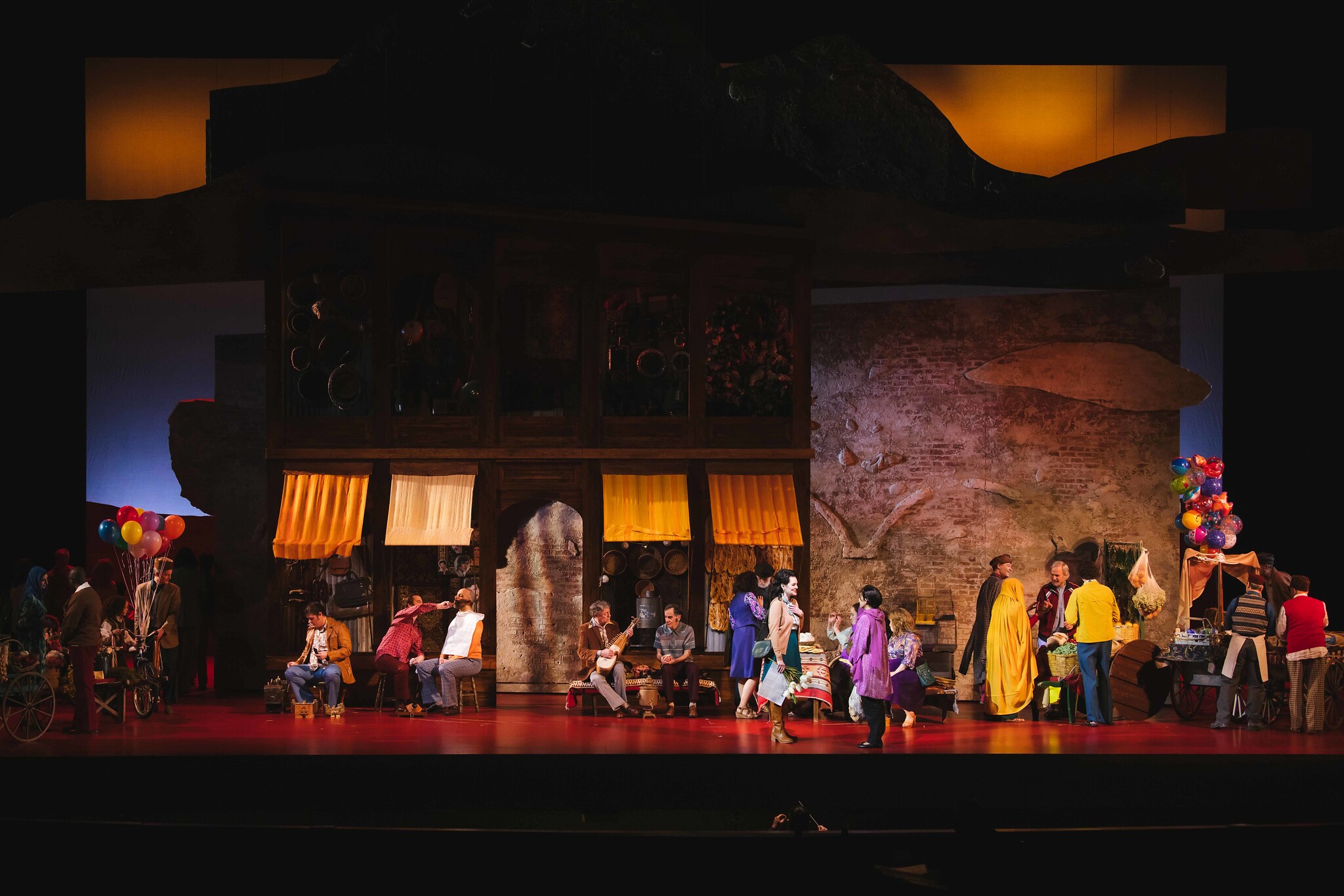
The Market scene from Seattle Opera’s production of A Thousand Splendid Suns. Photo by
Sunny Martini

A Thousand Splendid Suns, which premiered at McCaw Hall Feb. 25, is based on the novel of the same name by Afghan-American writer Khaled Hosseini. It tells the story of Mariam and Leila, two Afghan women a generation apart who share the same abusive husband and forge a friendship that bridges deep suffering and personal sacrifice.

Composer Sheila Silver

Hosseini’s novel has been skillfully adapted by librettist Stephen Kitsakos, keeping the major characters and focusing the emotional arc of the story. A tough read, the book vividly describes the suffering, especially of women, amidst the horrors of the Soviet-Afghan war and the takeover by the Taliban. 

The opera portrays the same events, but Silver’s evocative music provides a sense of beauty that allays some of the brutality inherent in the plot. Silver—a composer previously unknown to me—studied Hindustani music in India for this opera and skillfully incorporates south Asian elements to evoke the setting. 

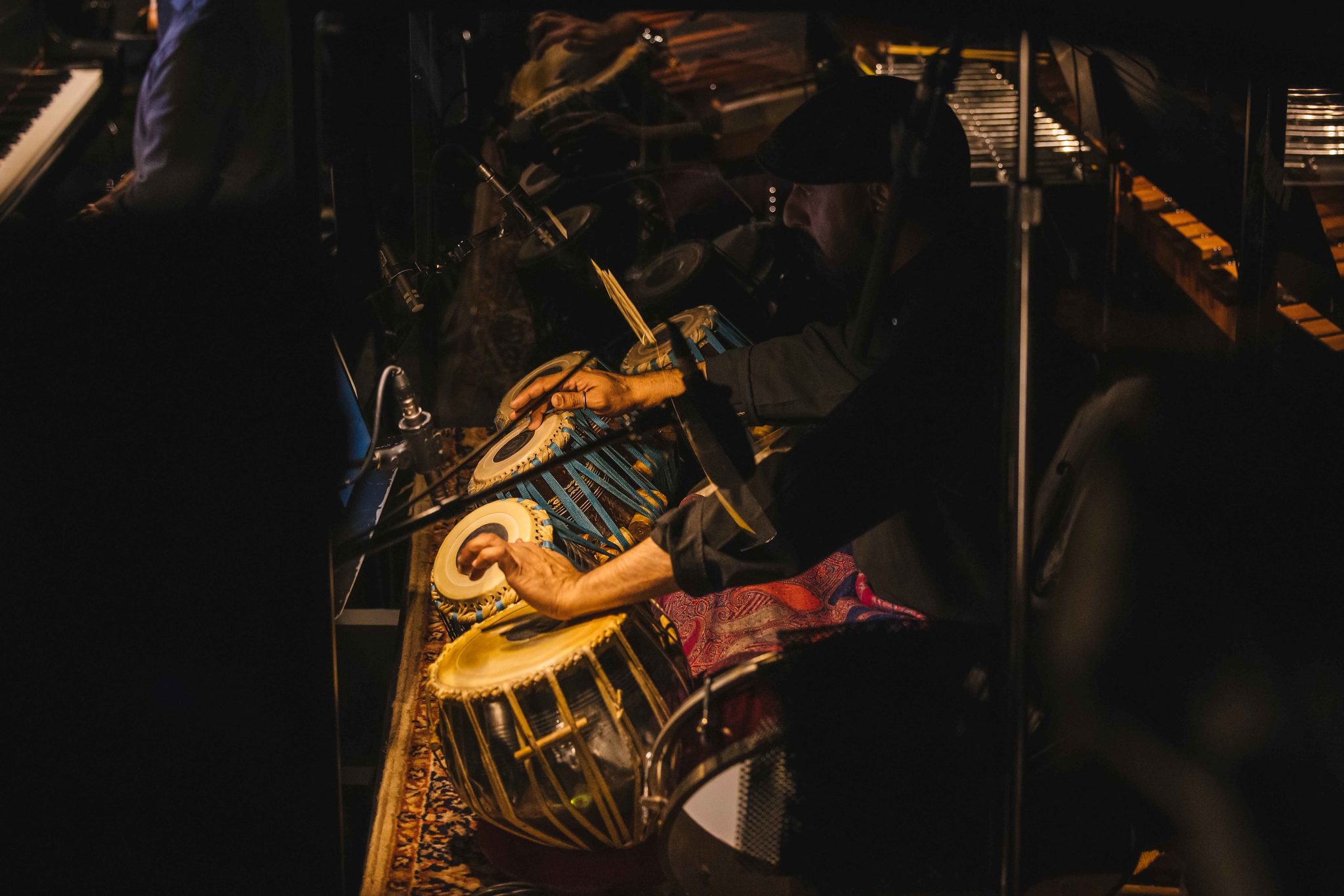
The orchestra, enhanced by various hand drums, Tibetan bowls, bansuri flutes and sparkling percussion, creates moods convincingly. This is especially notable in the beautiful passages depicting nighttime, and at the end, when the otherwise bleak final scene is infused with a bright serenity and hope.

Mariam (Karin Mushegain) and Laila (Maureen McKay). Photo by Sunny Martini.

If the vocal lines are less memorable, they fit the text well and are imminently singable, with no treacherous leaps or jagged lines. Extreme registers are reserved for extreme emotions. Duets between Mariam and Laila are especially moving. This is an opera that communicates directly with the audience and should be accessible to most listeners.

Mariam, the older of the two women, carries the emotional weight of the opera, as she progresses from a spirited teenager, through disillusionment to seething resentment and a final moment of fury. Seattle Opera is fortunate to have mezzo-soprano Karin Mushegain for this crucial role. The night I attended (March 3), Mushegain not only carried the opera handily; she provided a vivid portrayal of Mariam at every stage, singing with conviction and strength. Hers is an impressive talent, vocally and dramatically.

Laila is a more conventional operatic part—a young girl overcome with a love that she holds onto and that gives her the courage to survive. Soprano Maureen McKay brought a lovely sound to this more limited role, singing brightly and sensitively. Her love interest, Tariq, has the most conventional music of all. Rafael Moras sang his ardent declarations of love with a soaring Italianate tenor that was not out of place. Laila’s and Tariq’s duets were among the highlights.

Rasheed (John Moore, center) at home with Mariam (Karin Mushegain, l.) and Laila (Maureen McKay, r.). Photo by Sunny Martini.

Another crucial role is Rasheed, the brutal husband of Mariam and Laila. He is the opera’s villain, treating both women with cruelty. John Moore used his baritone to convey Rasheed’s roughness, but moderated his sound to a more tender, lyrical style, first for Laila and then for his son, whom he favors above his wives and daughter. He so effectively conveyed the ugliness of Rasheed’s character that his death was the first I have seen applauded in an opera house.

Laila (Maureen McKay) and Hakim (Ashraf Sewailam). Photo by Sunny Martini.

Ashraf Sewailam, known to some readers here as a CU graduate and veteran of Central City Opera, portrayed one of the few likable male characters—Laila’s refined and progressive father, Hakim. He sang beautifully, using his resonant bass to create contrast with the violence that surrounds his family. The smaller parts were all filled effectively, raising the entire cast to a high level.

The production was stage directed by Roya Sadat, an Afghan film producer and director who was chosen for her insight into the culture and environment of Afghanistan. She made good use of the space provided by set designer Misha Kachman. 

The realism of Kachman’s designs contributed to the impact of the opera, as they recalled photos we have seen of the violence in Afghanistan. Coincidentally, the opera appears just as Taliban control, apparently broken after the opera ends, has returned with renewed oppression of women. Thus A Thousand Splendid Suns is again as timely as ever.

The sets were at times minimal but always highly effective. One scene set in a neighborhood market was especially eye-catching. Deft touches included the turning of the wall of Rasheed’s house to show how the blank exterior conceals the troubled interior. A swing, hung from a disembodied tree branch, served to remind the audience that there were always children near the center of the action.

A special word about lighting designer Jen Schriever: there were moments of mesmerizing beauty in her lighting plot, particularly in the portrayal of night and the colors of the sky. In the splendidly lit final scene, Mariam seemed both radiant and weightless.

Deep Singh plays tabla in A Thousand Splendid Suns at Seattle Opera. Photo by Sunny Martini.

Conductor Viswa Subbaraman held the disparate musical threads together well: singers, orchestra, south Asian instruments. Hearing an opera for the first time it is difficult to judge interpretation, but the momentum never flagged. Thanks to Silver’s effective scoring, the singers were largely audible, with heavy brass sounds reserved for moments of violence or threat. Sound designer Robertson Whitmer should be recognized for pulling the hand drums and the bansuri flutes, each in isolated spaces that were miked, into balance with the full orchestra.

Representatives of other opera companies attended Seattle’s performances. I hope they will take up A Thousand Splendid Suns in the coming seasons. A powerful telling of an ultimately beautiful story, it delves into the human tragedy that often accompanies the news. The Seattle audience’s response, whether applauding Rasheed’s death or gasping at the unexpected reappearance of a character, showed how deeply they were drawn into the story.

# # # # #

A Thousand Splendid Suns by Sheila Silver
Libretto by Stephen Kitsakos
Seattle Opera
Viswa Subbaraman, conductor
Roya Sadat, stage director

Remaining performances:
7:30 p.m. Wednesday, March 8
TICKETS

7:30 p.m. Saturday, March 11
TICKETS

Central City Opera plans season of three Mainstage shows

Summer 2023 will feature Shakespearean subjects, June 24–Aug. 6

By Peter Alexander Nov. 16 at 10:50 a.m.

Central City Opera returns to their pre-COVID schedule of three Mainstage productions in their main house for the 2023 summer festival season, with three different works all based on Shakespeare: Roméo et Juliette by Charles Gounod, Otello by Rossini, and Kiss Me Kate, Cole Porter’s 1948 Broadway spinoff from Shakespeare’s Taming of the Shrew.

Central City Opera House. Photo by Ashraf Sewailam.

The six-week summer season also features the return of CU graduate Ashraf Sewailam to Central City, but in this case as the stage director of Otello, rather than as a singer. Another CU graduate, bass Wei Wu who was recently featured in the CU Eklund Opera production of La Bohème, will have a role in Gounod’s Roméo et Juliette. 

The season will open June 24, 2023, with the three productions running in rotating repertoire through Aug. 6. All three will be sung in their original language: Otello in Italian, Roméo et Juliette in French, and Kiss Me Kate of course in English. Season tickets will go on sale Dec. 1. Single ticket sales will begin March 1, 2023. Visit the Central City Opera Web page for more details, including cast and production credits. 

Written in 1816, when the composer was only 24, Rossini’s Otello is the earliest of the three works on the 2023 season. It is not often performed today, partly because of the difficulty of casting three difficult tenor roles: Otello, Iago and Rodrigo.

The interior of Central City Opera’s theater

Unlike Shakespeare’s play and the Verdi’s better known opera on the same subject, Rossini’s Otello takes place entirely in Venice. In another departure from the other works, in Rossini’s opera Rodrigo is a major character, the son of the Doge of Venice. He had been promised Desdemona’s hand in marriage, but before the curtain she and Otello had been married in secret. A major dramatic turning point is her father’s disapproval of the marriage.

As in Shakespeare and Verdi, Iago deliberately uses Rodrigo to stir up Otello’s suspicions of his wife. All three versions end with Otello stabbing Desdemona, and then his own death when Iago’s treachery and his wife’s innocence are revealed.

Gounod’s opera was premiered in Paris in 1859, and had  more than 300 performances by 1868, including its first performance in the US. The story and the incidents are similar to Shakespeare’s well known play, with Roméo and Juliette falling in love and getting secretly married. There is a duel between Roméo and Tybalt, who is killed by Roméo. The story ends with the familiar scene at Juliette’s tomb.

The story of Porter’s Kiss Me Kate is less a re-telling of Shakespeare than it is a comedic spinoff. The plot revolves around a company presenting musical version of The Taming of the Shrew, with ongoing feuds between the actors playing Petrucchio and Katherine, who are also ex-spouses. The musical includes portions of the play set to music, but also rehearsals, backstage scenes, a side-plot involving gangsters, and a happy ending with lovers united and re-united. Among the songs remembered from the show are “Another Openin’, Another Show,” “Where is the Life that Late I Led,” “Always True to You in My Fashion” and “Brush Up your Shakespeare.”

Kiss Me Kate is considered Porter’s response to Rodger and Hammerstein’s groundbreaking, fully-integrated musical Oklahoma! The winner of the very first Tony Award for Best Musical in 1949, Kiss Me Kate was Porter’s only show to run more than 1000 performances. Although very much a show of its time it has never lost its popularity, and has been revived several times to great success. The most recent Broadway revivals were in 1999 with Brian Stokes Mitchell and Marin Mazzie, and 2019 with Will Chase and Kelli O’Hara.

CORRECTION: 11/21 The automatic spell corrector change of Ashraf Seawila’s name to “Ashram” was corrected. The correct spelling of his given name is Ashraf.

Performers during the pandemic: Ashraf Sewailam

CU graduate had to postpone Metropolitan Opera debut

By Peter Alexander Dec. 23 at 12:45 p.m.

It is the best of resumes, it is the worst of resumes.

Reflecting on his situation during the pandemic, bass Ashraf Sewailam muses, “I was one of the quote unquote lucky artists who never had to do anything but perform. But I discovered how unlucky that was, not to have anything to fall back upon.”

Asrhaf Sewailam (l) in Central City Opera’s Magic Flute (2018) with tenor Joseph Dennis. Photo by Amanda Tipton.

Sewailam, a CU graduate who has sung extensively in the area, at the Central City Opera, with the Boulder Bach Festival and the Pro Musica Colorado Chamber Orchestra, as well as CU operas, found himself without work when the pandemic occurred. Even a planned December online program of Messiah arias with the Longmont Symphony had to be cancelled. He ended up doing deliveries for Amazon, until a broken foot put an end to that, too.

“Lots of my colleagues, when they first went to New York had to do other jobs to keep body and soul together—secretarial jobs or finance, banks, or even waiting tables,” he says. “All of this is actually good experience to have to fall back on. I have this super-impressive resume, in academia and performance, but I couldn’t get myself hired in anything that needed previous experience, so this was big wake-up call.”

It was an especially tough time for Sewailam to call a halt in his opera career because he had contracts and roles upcoming that would be impressive additions to that resume, and likely have led to more work. He was in rehearsal for a production of Aida at Virginia Opera when things suddenly were shut down.

Sewailam rehearsing Aida with Virginia Opera (2020). Photo courtesy of Ashraf Sewailam.

“We had just made a promotional TV appearance about the show, and then we got back to the hotel to change into rehearsal garb, and we got the call that it was cancelled,” he says. “It was sad because it’s an excellent production.”

And that’s only the beginning of what Sewailam had planned for 2020 and ’21. “Right after that I had a Bohème in Seattle, and then I was directing [Donizetti’s] Anna Bolena in New York in the summer,” he says. “And then I had [Rossini’s] Cenerentola (Cinderella) with Minnesota opera in the spring of 2021, [and Donizetti’s] Elixir of Love in Amsterdam.”

The biggest disappointment of all, however, was that he had a contract at the Metropolitan Opera in New York for three roles during the fall—the kind of breakthrough contract that all opera singers dream about. “The Met is the pinnacle of the mountain that we’re climbing,” he says. “And who knows what would have materialized in early 2021 before the Cenerentola because stuff just jumps into my lap.”

Like most of us, Sewailam also had personal affairs to take care of during the pandemic. In his case, family issues took a lot of time and travel back and forth to his home country of Egypt.

“The situation is that I provide for mom there, while my sister manages the situation on the ground,” he says. “My mom has Alzheimer’s, and my sister had a cancer scare. I basically jumped on a plane and went to Egypt and stayed there for two months, mid-May to mid-July, and then early September to early October.

Ashraf Sewailam (l) with his siblings Reham and Ahmed in Egypt during the summer. Photo courtesy of Ashraf Sewailam.

“Logistically [travel] was difficult. Security provisions [in Egypt] are much tighter and it was a little rattling to go through it. Then when I came home I took care of a couple of elderly friends, so I travelled to Seattle and up and down the California coast. I had to keep getting tested [for Covid] just to be able to look after my friends. And I’ve been fine so far.”

When he came back to Boulder, Sewailam took the job delivering packages, so he could continue supporting his mother and sister in Egypt. But with all the travel he has hardly done any singing since the pandemic began—just one streamed performance of “Some Enchanted Evening,” done remotely from Cairo with pianist Mohamed Shams in New York.

Sewailam in costume as Ramfis in Aida, Opera Theater of the Rockies, 2018. Photo courtesy of Ashraf Sewailam.

The lack of singing and being cut off from the field for so long concerns Sewailam. “Singers are professional athletes,” he says “You’ve got to keep stretching yourself, keep practicing,. You’ve got to keep seeking the right advice, because this is one of the most opinionated careers. Everybody has an opinion about the art form, about the singers in it, definitely about you and your voice, and everybody loves to opine.”

As for the future, “there were irons in the fire well into late 2022,” Sewailam says. But even if those and the prior contracts that were cancelled turn into firm offers later, there’s no guarantee that he would be able to accept all of them. 

“Once things open up and companies start re-scheduling themselves, a lot of us might end up having to choose between gigs that we were already contracted for, that they would get rescheduled at the same time,” he says.

“That would be sad, because not only did we loose all the money from all those gigs, as well as the artistic gratification, but also you end up losing all of that money all over again, and then we would end up suffering for that.”

In other words, the return to live performing could be the best of times, but it could bring serious dilemmas, too.