CU Quartet in residence will play Grusin Hall Sept. 18–19 and October 30–31
By Peter Alexander Sept. 14 at 11:18 p.m.
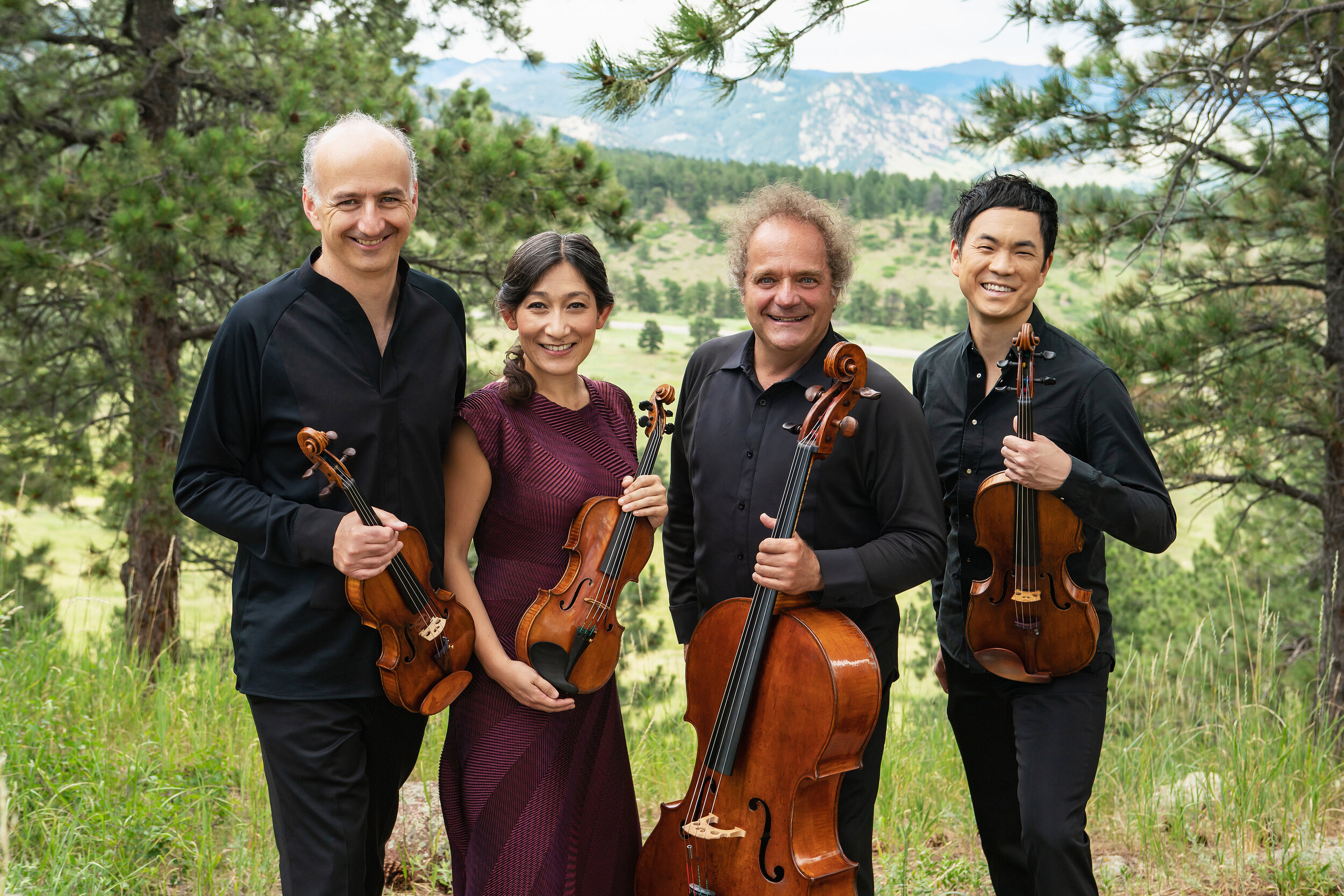
It’s hard to keep up with the Takács Quartet.
Takács Quartet. Image by Amanda Tipton Photography
The CU quartet-in-residence is celebrated worldwide, giving them access to the top classical festivals. Over the past summer, they played the Colorado Music Festival in Boulder, the Tanglewood Festival in Lennox, Mass., the Edinburgh Festival in Scotland, at the Snape Maltings in Aldeburgh, England—a venue made prominent by composer Benjamin Britten and tenor Peter Pears—and the Luberon Festival in France.
But now they are back in Boulder, and their local fans can look forward to their annual series of campus concerts, starting this weekend with an all-Beethoven program (4 p.m. Sunday, Sept. 18 and 7:30 p.m. Monday, Sept. 19 in Grusin Concert Hall). Other events during the fall semester will be concerts Oct. 30 and 31, featuring music by Britten, Bartók and Mozart; and concerts Nov. 6 and 7 by the Ivalas Quartet, who concluded a two-year residency with the Takács in May (program tba; other details and ticket information below).
Between the September and October concerts, the Takács will be touring in Japan and Korea. “We’re looking forward to that,” Takács cellist András Fejér says. “They always bring a special joy because they regard culture and classical music very highly, and they are treating us as such wonderful friends.”
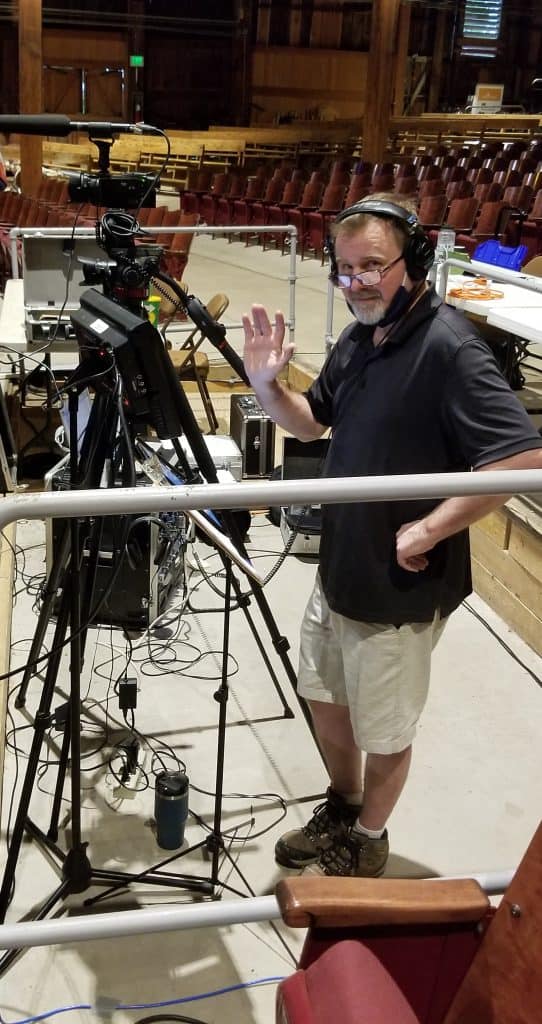
Sound engineer Michael Quam at the Colorado Music Festival
Just this month the quartet released its latest recording, featuring works of Joseph Haydn. The CD, of quartets opp. 42, 77 nos. 1 and 2, and 103, was recorded in the Lone Tree, (Colo.) Arts Center. “We had probably the top American producer, Judy Sherman, and a wonderful, wonderful sound engineer, Mike Quam, whom we got to know at the Colorado Music Festival,” Fejér says.
In addition to working for the Colorado Music Festival, Quam lives and has a recording studio in Boulder. “He’s the most wonderful all-around sound man anywhere,” Fejér says. “We never met anyone like him, so we were very happy.”
In case you are wondering, in addition to the touring and recording and campus concerts, Fejér says “we always make time for (our students)! We have a wonderful new ensemble-in-residence and they are eager and hungry. That’s always a great encouragement for us, because teaching is wonderful!”
The Takács has of course played all of the Beethoven quartets, many times. In the case of the upcoming concert, the choice of an all-Beethoven program is partly from the exploration of familiar repertoire with the ensemble’s newest member, violist Richard O’Neill. “We need to re-learn the Beethoven with our new member,” Fejér says.
“He’s full of great ideas and he’s got an encyclopedic memory. He’s a great, great all-around artist, so we are very happy to be listening to new ideas, new solutions. It’s all a new dynamic, which I am enjoying tremendously.”
The three quartets chosen for the September concerts span the major periods of Beethoven’s life: Op. 18 no. 5 from Beethoven’s very first set of six quartets published in 1801, in the sparkling key of A major; Op. 95 in the gloomier key of F minor, known as the “Serioso” Quartet, from 1810; and Op. 127 in E-flat major, from 1825.
“We love these pieces,” Fejér says. “They are wonderful pieces. Maybe the audience is not jumping on its feet because of the final effect, but it doesn’t take away from the overall greatness.”
The Quartet op. 127 provides unique challenges, Fejér explains. “Some ensembles might not program it because it’s not so spectacular. It’s so deep, and herein lies the difficulty. Its first and last movement are extremely soft, piano, pianissimo, very ethereal, up in the clouds. It takes work and rehearsing and it’s not easy to make it flow and make it light, ethereal and transparent.”
Fejér explains that the Takács usually has three main areas of work when they rehearse. First is “what we play on tour, which might be pieces we already played many times. And then there’s practicing and getting familiar with new or newish pieces, (and finally) the ones we are planning to record.”
What that means is that rehearsing the program for the October concert will mostly come a little later. About that program—Britten’s String Quartet No. 1, Bartók’s String Quartet No. 6 and Mozart’s String Quartet in D major, K499—Fejér declines to comment right now.
“I might refrain trying to be smart about Britten at this point,” he says. “We recorded (his quartets) eight or nine years ago, but we haven’t played them again. So basically now we’re relearning and discussing what’s new and what’s changed, and what we wish to be changed.
“What matters is how we feel about it today or the next week, so we can be even more convincing and find even more joy in bringing it together.”
# # # # #
Takács Quartet
Beethoven: String Quartet in A Major, Op. 18 no. 5 —String Quartet in F Minor, Op. 95 —String Quartet in E-flat Major, Op. 127
4 p.m. Sunday, Sept. 18 7:30 p.m. Monday, Sept. 19 Grusin Hall, Imig Music Building In person and live-stream tickets HERE
Takács Quartet
Benjamin Britten: String Quartet No.1
Bartók: String Quartet No. 6
Mozart: String Quartet in D major, K499
4 p.m. Sunday, Oct. 30 7:30 p.m. Monday, Oct. 31 Grusin Hall, Imig Music Building In person and live-stream tickets HERE
Ivalas Quartet
Program TBA
4 p.m. Sunday, Nov. 6 7:30 p.m. Monday, Nov. 7 Grusin Hall, Imig Music Building In person and live-stream tickets HERE
______________
NOTE: Due to spell checker error “encyclopedic” first appeared as “encyclopedia.” Corrected on 9/15.
Falstaff and Barber of Seville each worth the trip down I-25
By Peter Alexander Aug. 10 at 11:08 p.m.
Verdi’s Falstaffis the greatest of all comic operas. The combination of Shakespeare and Verdi at the very peak of his musical powers have produced a masterwork of scintillating humor and extraordinary beauty. And in baritone Quinn Kelsey, currently starring in the Santa Fe Opera’s splendid co-production with Scottish Opera, it has found an ideal interpreter. The rest of the terrific ensemble cast nearly reaches his level, with Elena Villalón’s Nanetta especially noteworthy.
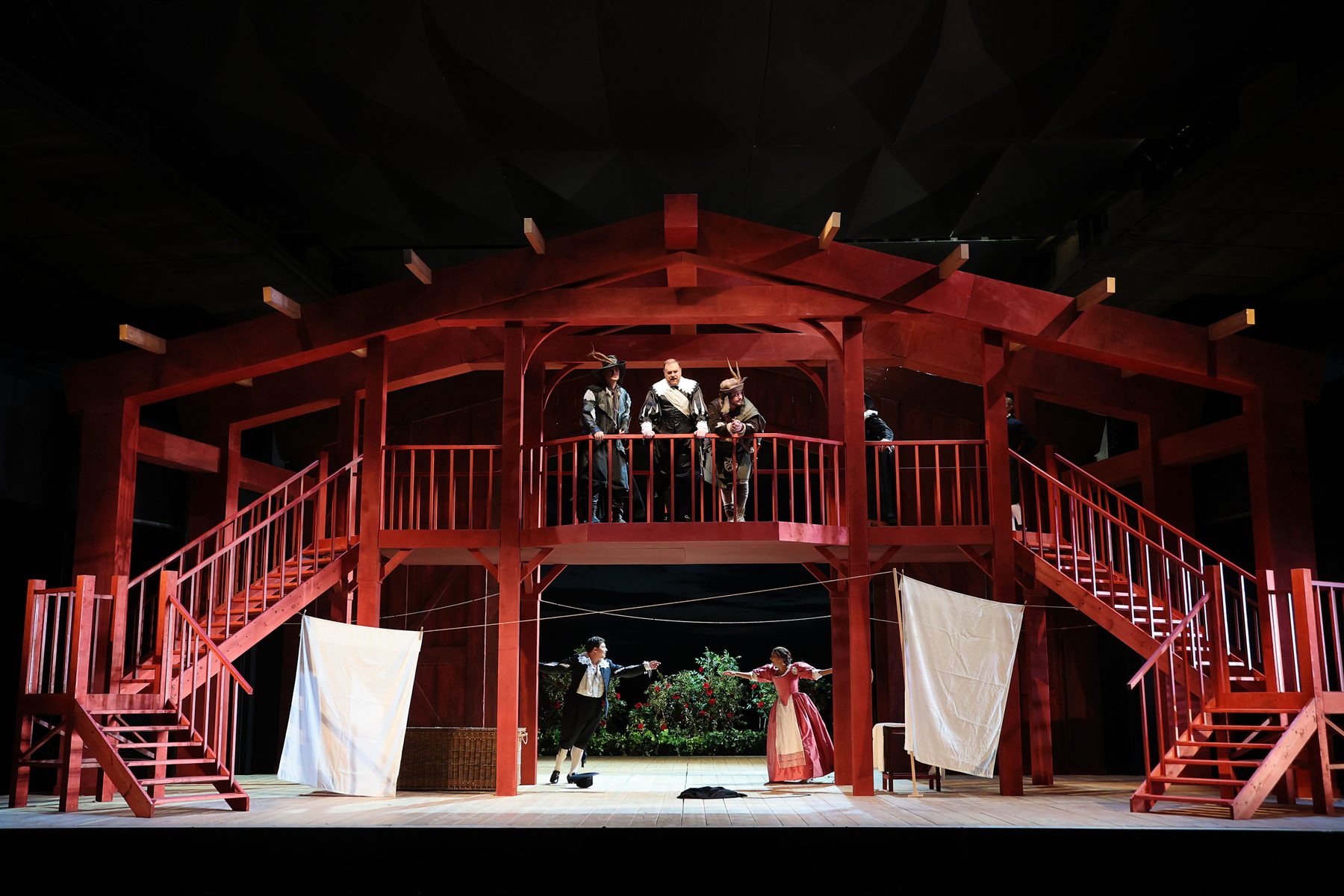
McVicar’s Shakespearean set for Falstaff, with part of Santa Fe’s excellent ensemble cast. All photos by Curtis Brown for the Santa Fe Opera.
Sir David McVicar’s set, a simple wooden structure of two stories and multiple staircases, recalls the theater of Shakespeare’s time. Furniture and props are moved on and off to change the scene from The Garter Inn—opening in Falstaff’s bedroom with various hangers-on under and in the bed with the portly knight—to the garden and the interior of Ford’s home, to Windsor Park. Only the last scene with Hearn’s Oak hulking behind the framework of the set posed any difficulties.
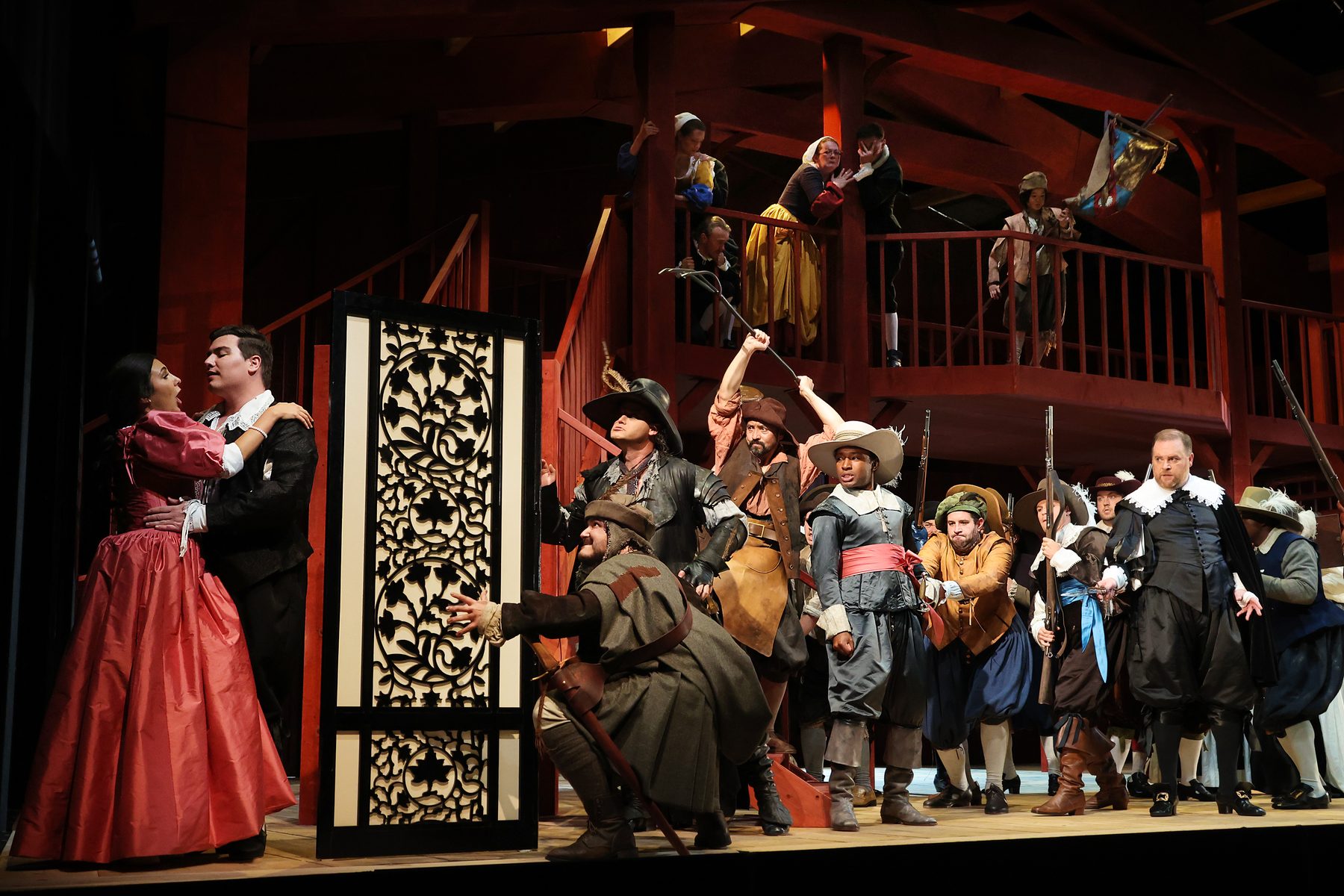
“Rollicking chaos” with Nanetta (Elena Villalón) and Fenton (Eric Ferring) behind the screen while the men prepare to pounce.
As stage director, McVicar showed a deft comic touch with individual characters. Moments of rollicking chaos, as in the first scene in Falstaff’s bedroom and the second act climax with Ford searching his home while Falstaff hides in the famous laundry basket, were especially delightful.
Occasionally McVicar supplied extraneous touches that distracted from the principal singers, such as bustling servants and a gardener raking the ground upstage from the merry wives at the outset of the second scene. At such moments, directors should trust the music and dispense with superfluous ideas. Happily, the distractions were few, and otherwise the direction served the comedy well.
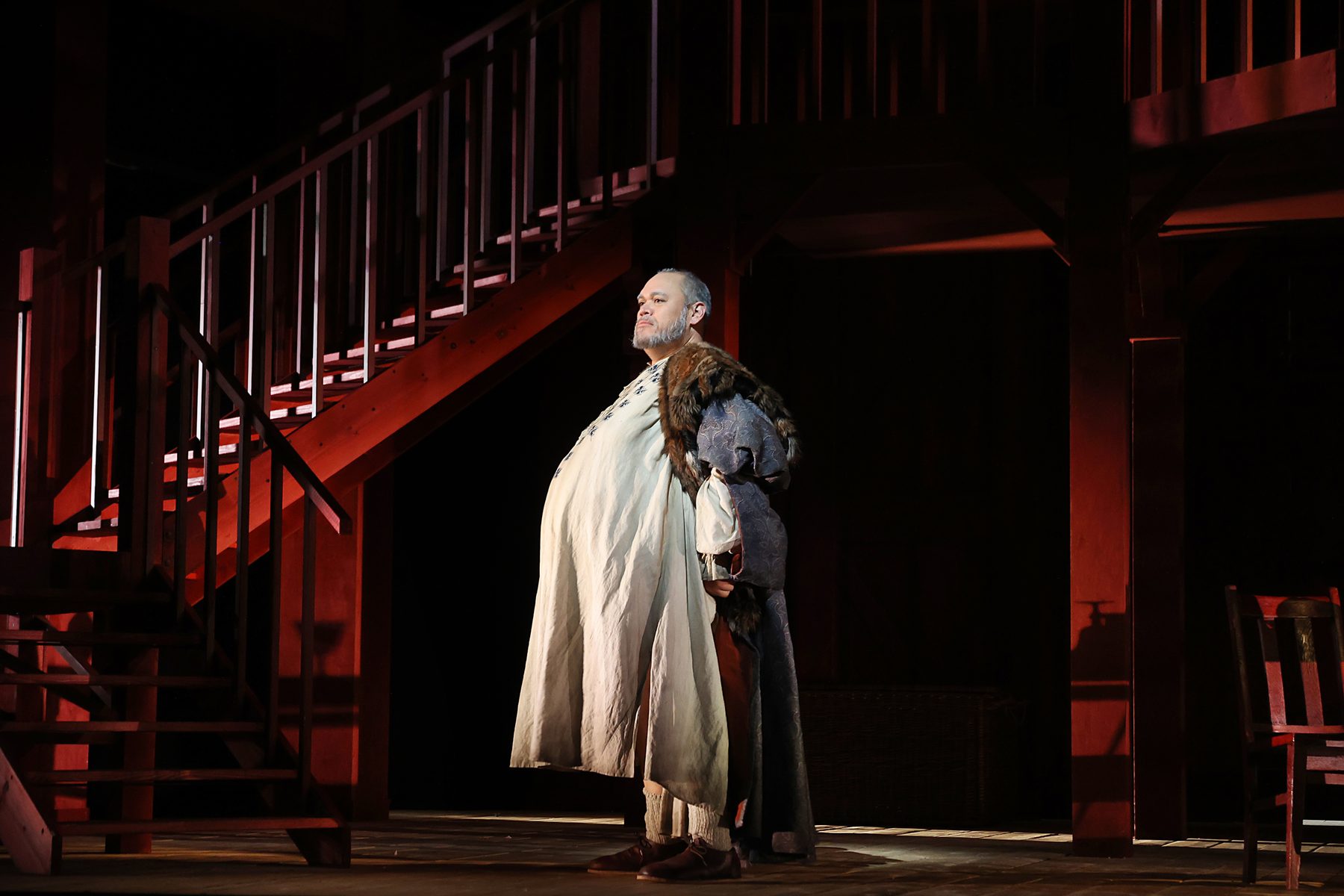
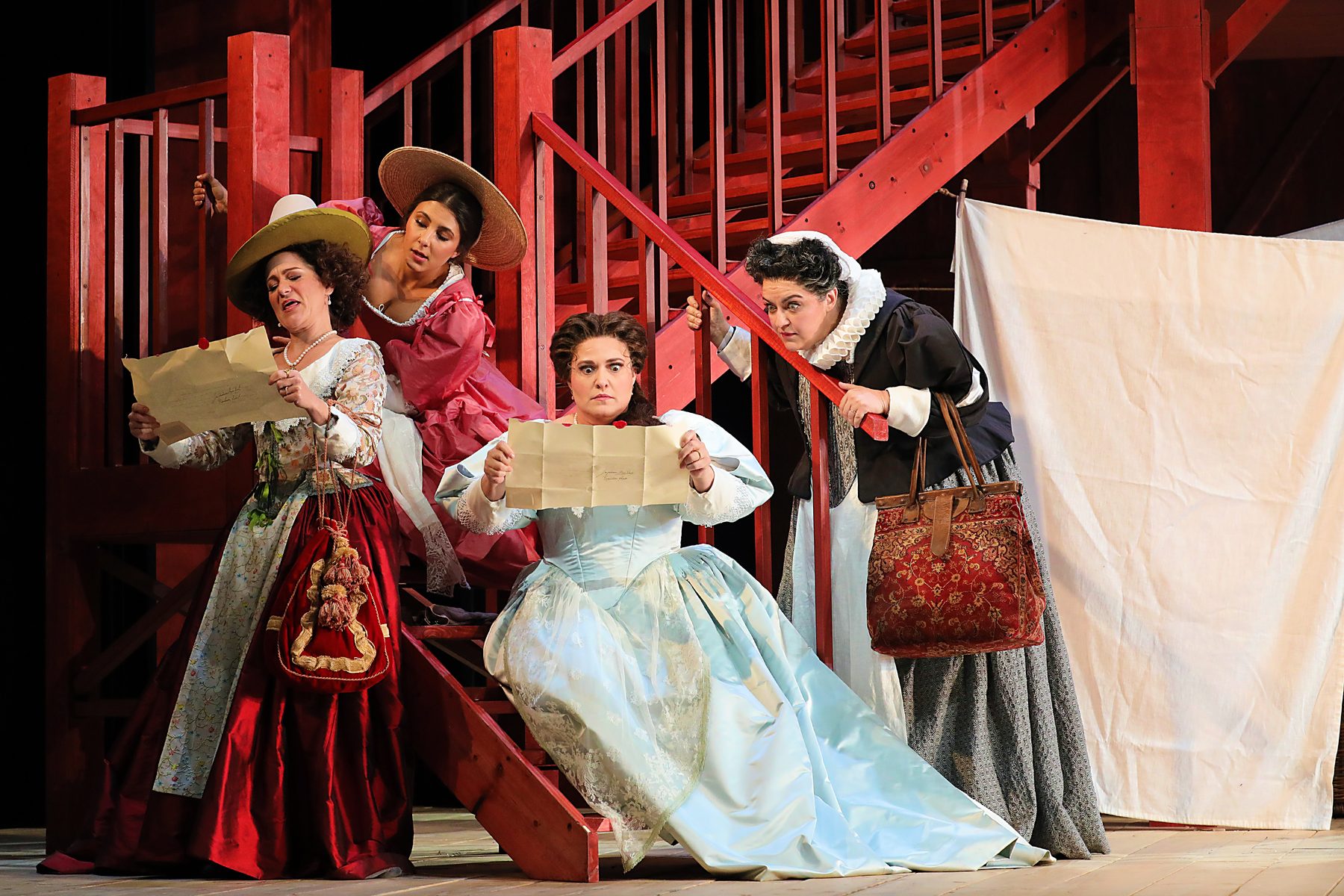
The costumes were generic Elizabethan with comic touches, such as Falstaff’s grotesque codpiece when he goes to visit Mistress Ford. Individual touches helped identify the multiple characters who appear in the ensembles, including a witches hat for Mistress Quickly—who not coincidentally is costumed as a witch in the Windsor Park scene—and delicious pink and red for Nanetta, exchanged for bridal white at the end.
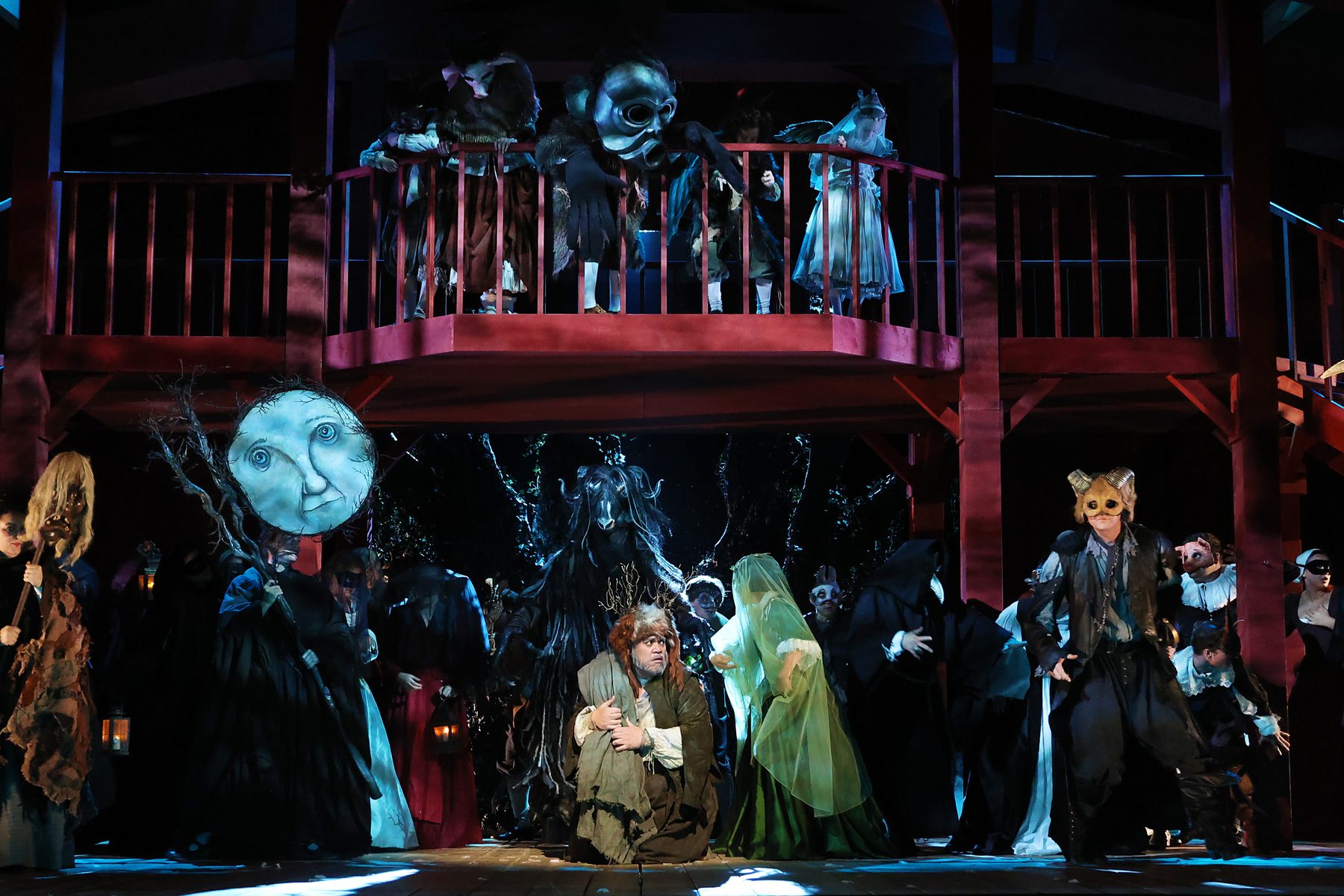
Falstaff (Quinn Kelsey) cowers before the extravagantly costumed ensemble in the Hearn’s Oak scene.
The dazzling variety of costumes for the final scene at Hearn’s Oak included everything from a moon-faced queen, a horse and a demon borrowed from Hieronymus Bosch. This might be overkill, but I for one relished every excess in this scene. It is, after all, the culmination of a lavish comedy. It is a scene about excess, the excess that drives Falstaff and Ford both to realize their overreach and accept being the brunt of the joke. Any comic opera that ends with a comic fugue deserves climactic excess.
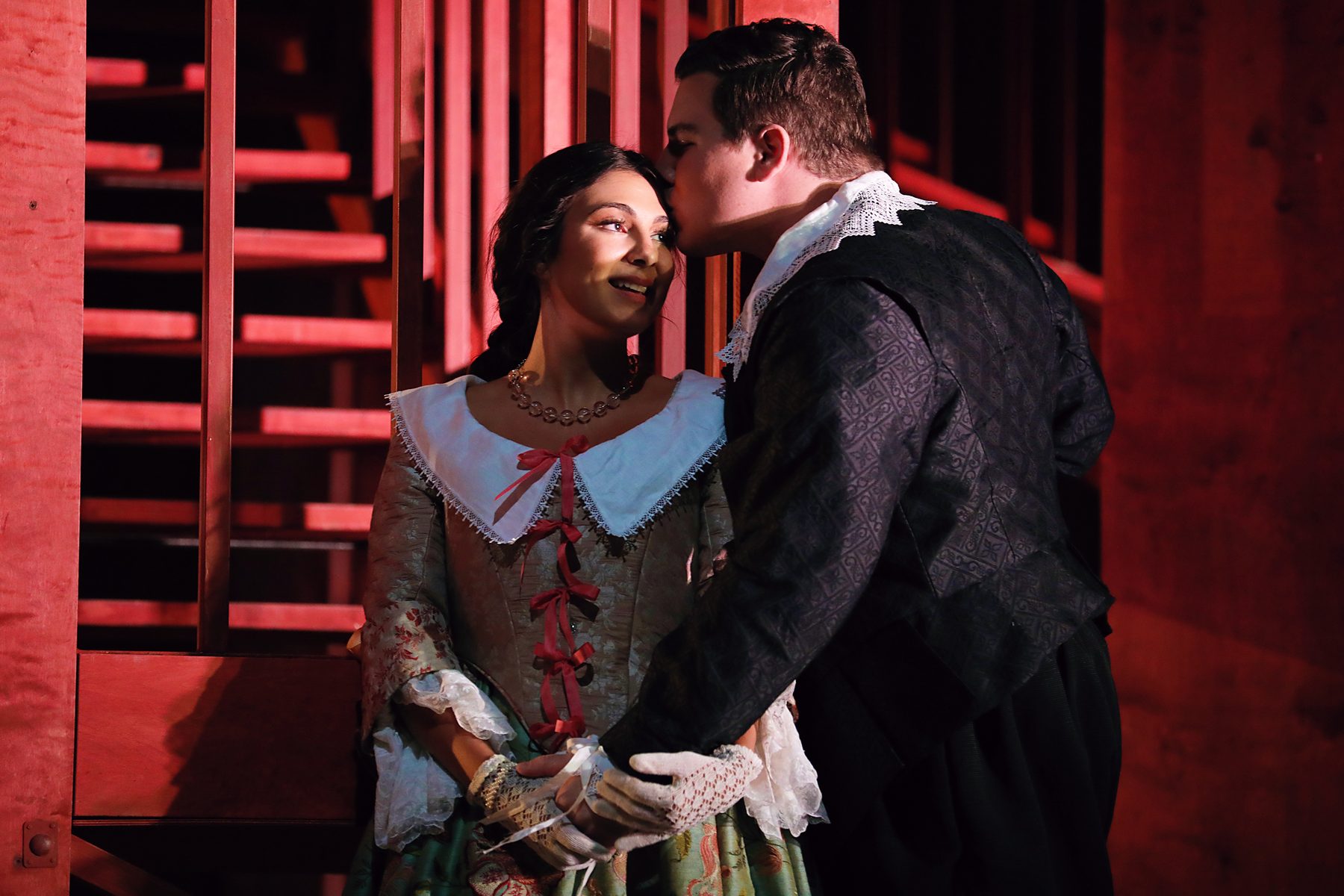
Under conductor Paul Daniel the Santa Fe Opera orchestra played brilliantly. Daniel led the players through every twist and turn of the score, bringing out the full force of the winds when appropriate, but also moderating the gentle moments. The brief, distilled glimpses of love music between Nanetta and Fenton were handled with grace and tenderness, the delicacy of the ensemble scenes presented on the point of a needle.
Quinn Kelsey as Falstaff.
Kelsey presented a virtual masterclass on vocal control and interpretation. He was boisterous and full of braggadocio at the outset, but singing with grace, even tenderness if required, full of extravagant self-pity after his bath in the Thames, by turn terrified, indignant and hilariously self-mocking at the end. He has mastered every nuance of the role and will doubtless claim a place as one of the great interpreters of Falstaff.
Villalón brought a lovely, soaring soprano to Nanetta, floating gently to her top notes in her exchanges with Fenton, then exercising restrained control of the music and the stage in her Act III aria. She was a Nanetta that the audience could fall in love with, as they should.
Elena Villalón and Eric Felling as the love interests Nanetta and Fenton.
Eric Felling was a winning Fenton, bringing a ringing sound and eloquent phrasing to his Act III aria. Alexandra LoBianco negotiated the role of Alice Ford nimbly, singing with a bright sound that could either blend with the other wives or soar above the full ensemble. As a comedienne, she was clearly in control of the gathering plot from beginning to end. As her husband, Ford (or “Master Fountain”), Roland Wood was comically on target, fitting well into the ensembles and eliciting sympathy in his soliloquy. His voice was sometimes pinched, with a occasional hint of a wobble.
The other characters handled their comic assignments well. Brian Frutiger was a satisfying Dr. Caius, filing well a smaller part that in lesser hands can too easily be overlooked. Megan Marino sang Meg Page prettily. Thomas Cifullo and Scott Conner were well matched comic partners as Bardolfo and Pistola, enlivening every scene with their hijinks. As Mistress Quickly, Ann McMahon Quintero made her character real, in spite of lacking the hefty chest voice that would project better over the orchestra.
Alice Ford and Meg Page receive identical letters from Falstaff: l-r Megan Marino (Meg), Elena Villalón Nanetta), Alexandra LoBianco (Alice) and Ann McMahon Quintero (Mistress Quickly).
But it is first of all Falstaff, and then the ensemble performance that carry the opera. Nothing showed the SFO’s success better than the final ensemble with Falstaff starting the great fugue “All the world’s a joke and only the jolly are wise,” everyone joining in turn with a perfect moral for a perfect comedy. As the performance came to a joyous climax, the musical summation of Verdi’s life in the theater, no one could leave without a feeling of satisfaction.
# # # # #
Close behind Falstaff as a great comic opera is Rossini’s Barber of Seville (Aug. 6). It doesn’t have Shakespeare as a source, but it does have Beaumarchais, who provided the literary source for two great operas in Barber and Mozart’s Nozze di Figaro. And while Rossini’s opera features the standard comic situations of the time, the composer’s skill and wit raise Barber into the highest realms of musical entertainment—a level that is exuberantly matched by SFO’s hilarious production.
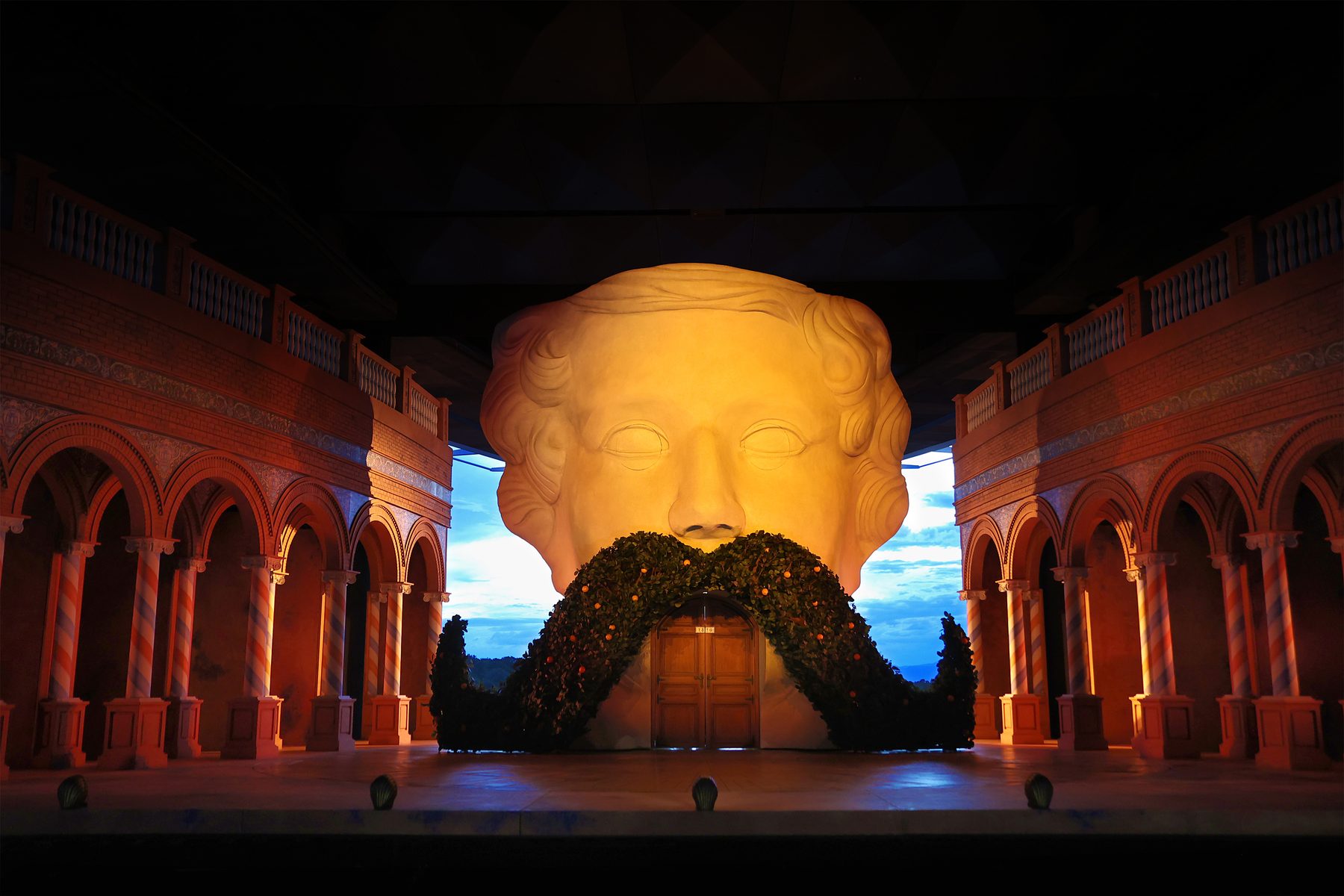
Dr. Bartolo’s house, mustache in place, on the Santa Fe Opera stage.
Santa Fe’s set is a marvel of invention. Upon entering the theater, the audience is greeted by a large topiary mustache at the back of the stage. During the overture, a sculptured head rises from behind and below the stage. The night I attended the audience applauded and laughed with delight when the head proved a perfect fit to the mustache. Together head and mustache moved down to the middle of the stage, representing the façade of Dr. Bartolo’s house, with the head later revolving 180° to reveal the house’s interior.
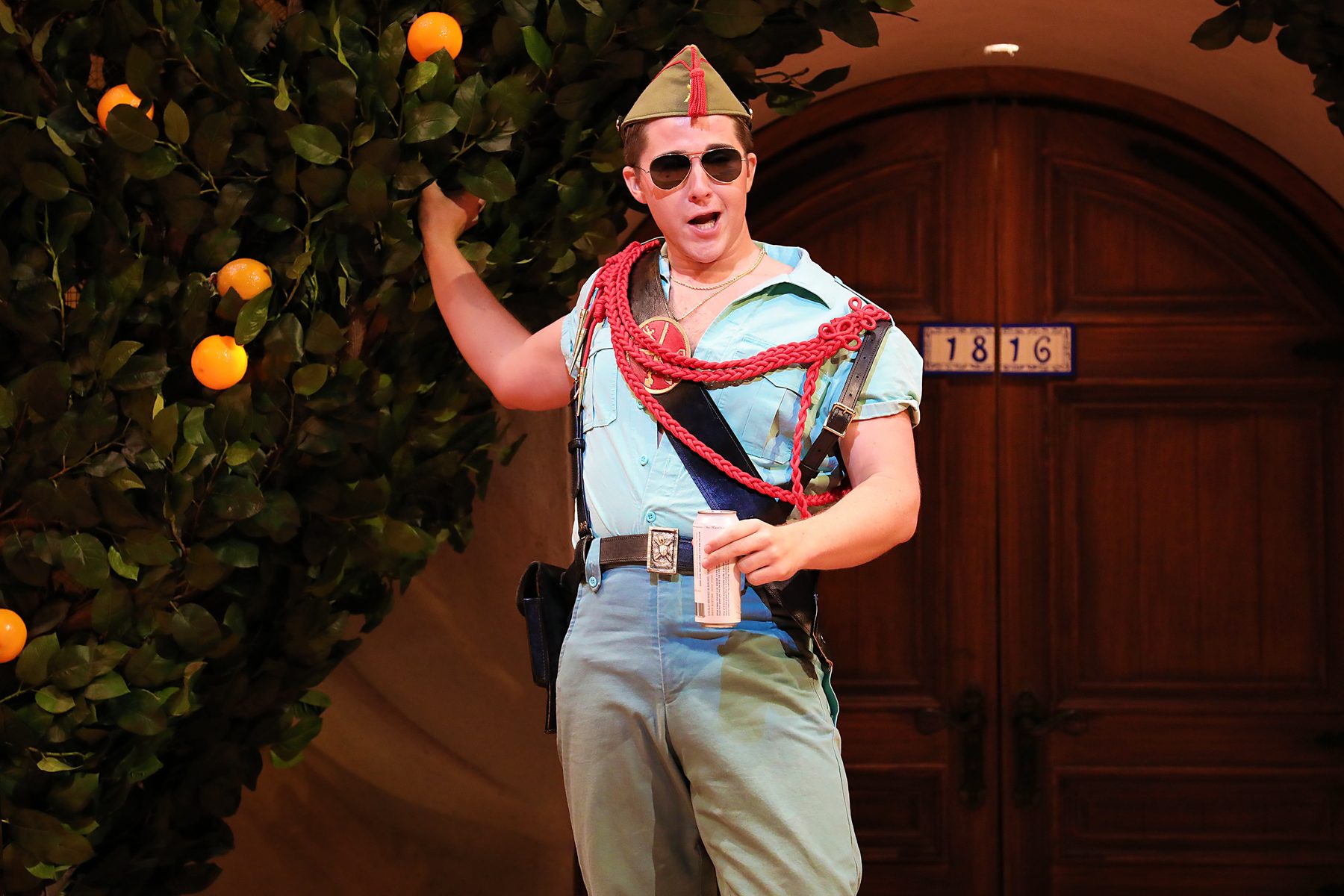
Almaviva (Jack Swanson) masquerading as a soldier.
That is only a small part of the inventiveness of the production, which uses period settings and costumes spiced with anachronistic details, including a plastic garbage bag, a computer (with an orange instead of apple as logo), cell phones and headphones. When disguised as the student Lindoro, Count Almaviva wears jeans, a down jacket and a “Sevilla” hoodie. Later he sports aviator glasses when disguised as a soldier, and enters Bartolo’s house in the final act as a Mormon missionary, singing “Peace and happiness be with you.”
Hilarity is piled upon hilarity, all in the gleeful spirit of Rossinian comedy. Thanks to the direction and design team of Stephen Barlow (stage direction) and Andrew D. Edwards (scene and costume design) the comedy never flags, sometimes pushing the limits but never undermining the plot and music, nor crossing the line into self-indulgence. I cannot remember a more raucously entertaining evening of operatic comedy.
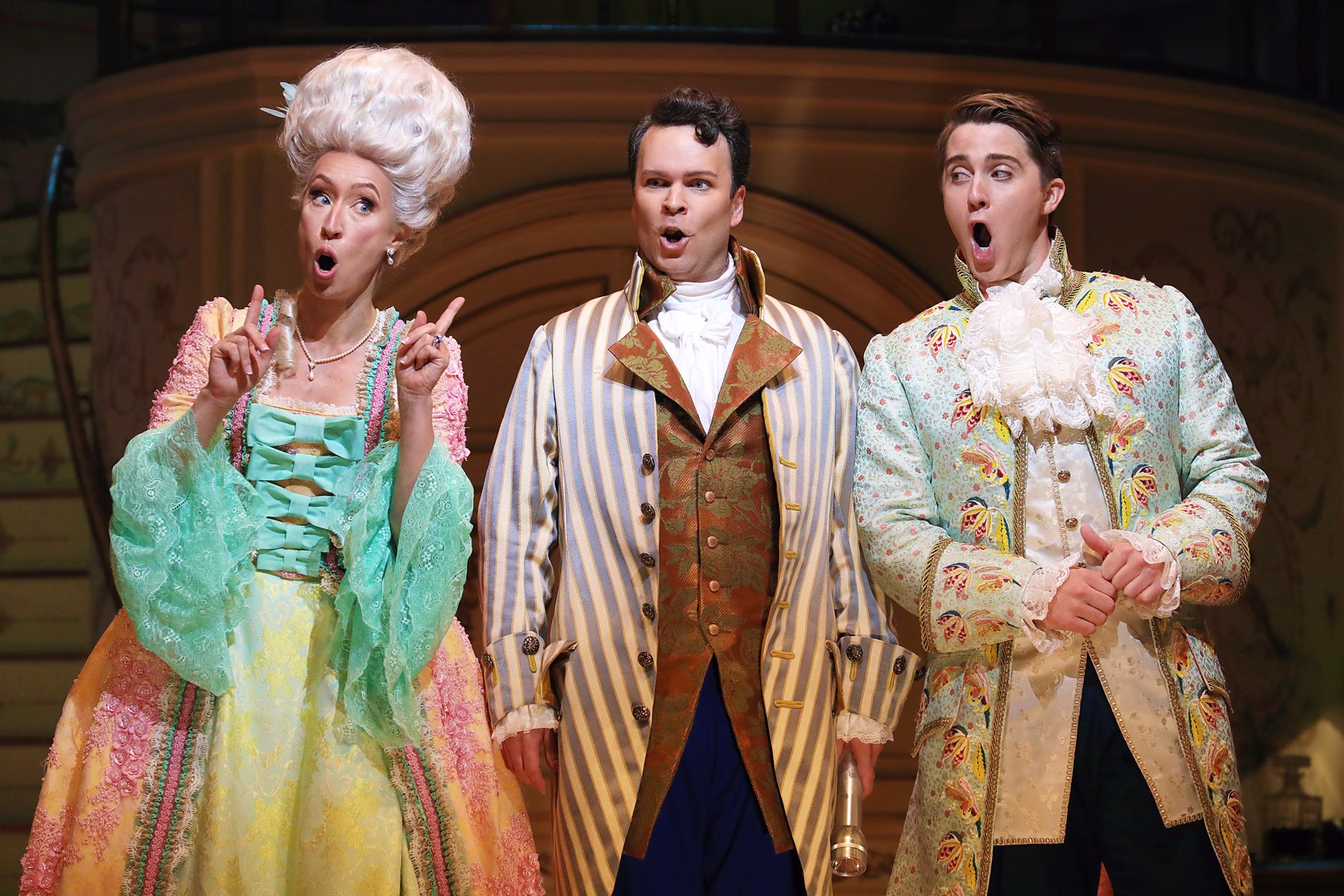
Emily Fons (Rosina), Joshua Hopkins (Figaro) and Jack Swanson (Almaviva).
The cast had full command of the Rossinian style, with Jack Swanson (Almaviva) and Emily Fons (Rosina) particularly agile and clean in their delivery of the flighty lines that sink many a tenor and mezzo. Swanson had great comic energy and onstage chemistry with Joshua Hopkin’s self-possessed, strutting Figaro. Fons captured attention anytime she was on stage and followed her character’s emotional twists and turns from boredom, to confidence, to (briefly) fury, to joy at opera’s end.
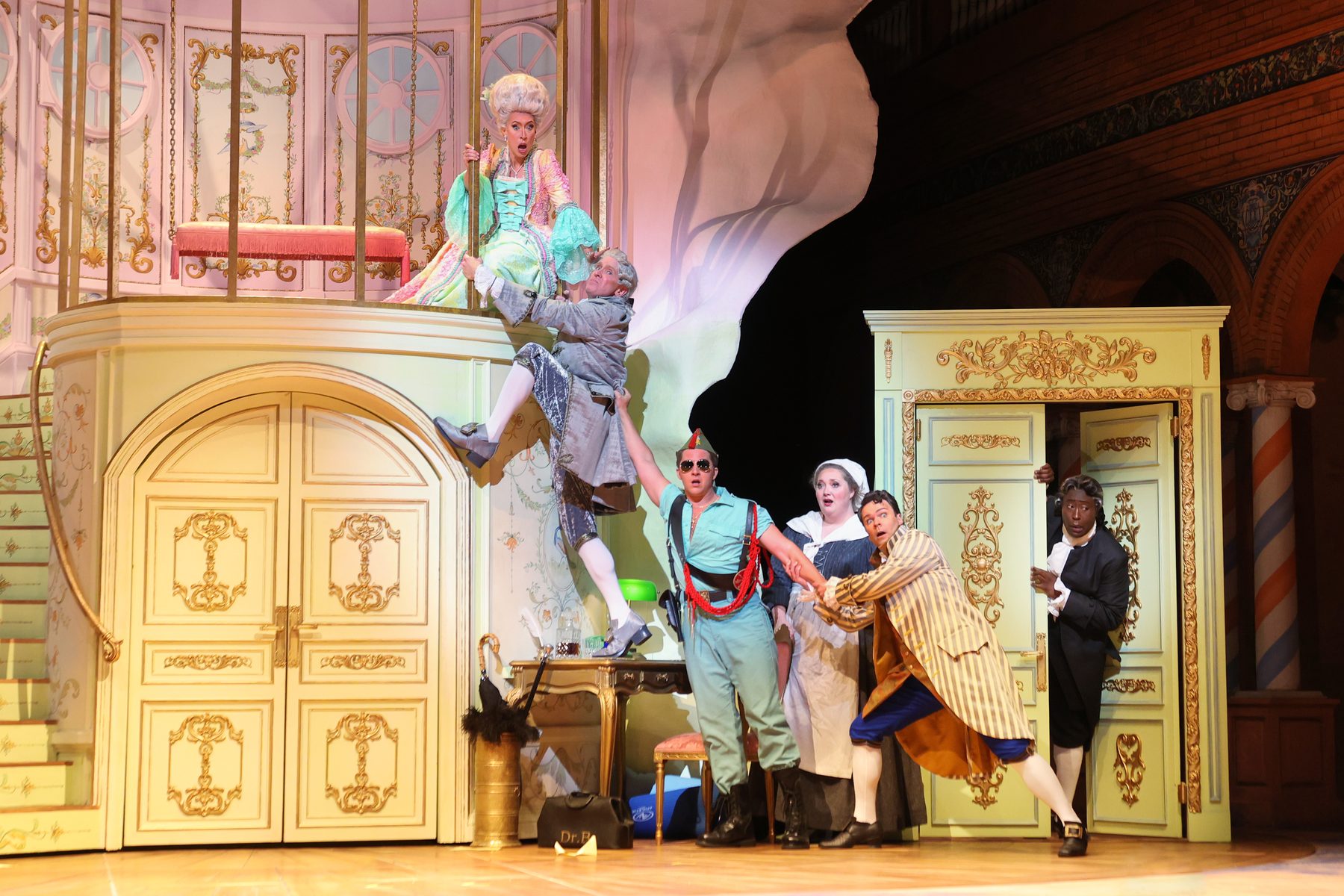
Kevin Burdette (Bartolo) climbs the wall, with Rosina (Emily Fons) above; Almaviva (Jack Swanson), Berta (Murella Parton), Figaro (Joshua Hopkins) and Basilio (Nicholas Newton) below.
Kevin Burdette as Dr. Bartolo proved a master of physical comedy as well as a versatile and polished singer. Far from the stiff diplomat he played in M. Butterfly, he was agile and flexible, singing while attempting yoga poses (more anachronistic merriment), while climbing the walls (literally) or sliding out of a chair. Every moment he was on stage was a potential moment of unexpected laughs.
Nicholas Newton (subbing for Ryan Speedo Green) was vocally imposing and on target as the pompous but venal Don Basilio, always available to the highest bidder. He provided the best updated joke of the entire show, producing his “Orange”-brand computer as he sang about how to harness the rapid spread of slander.
Berta tales a star turn (Murella Parton).
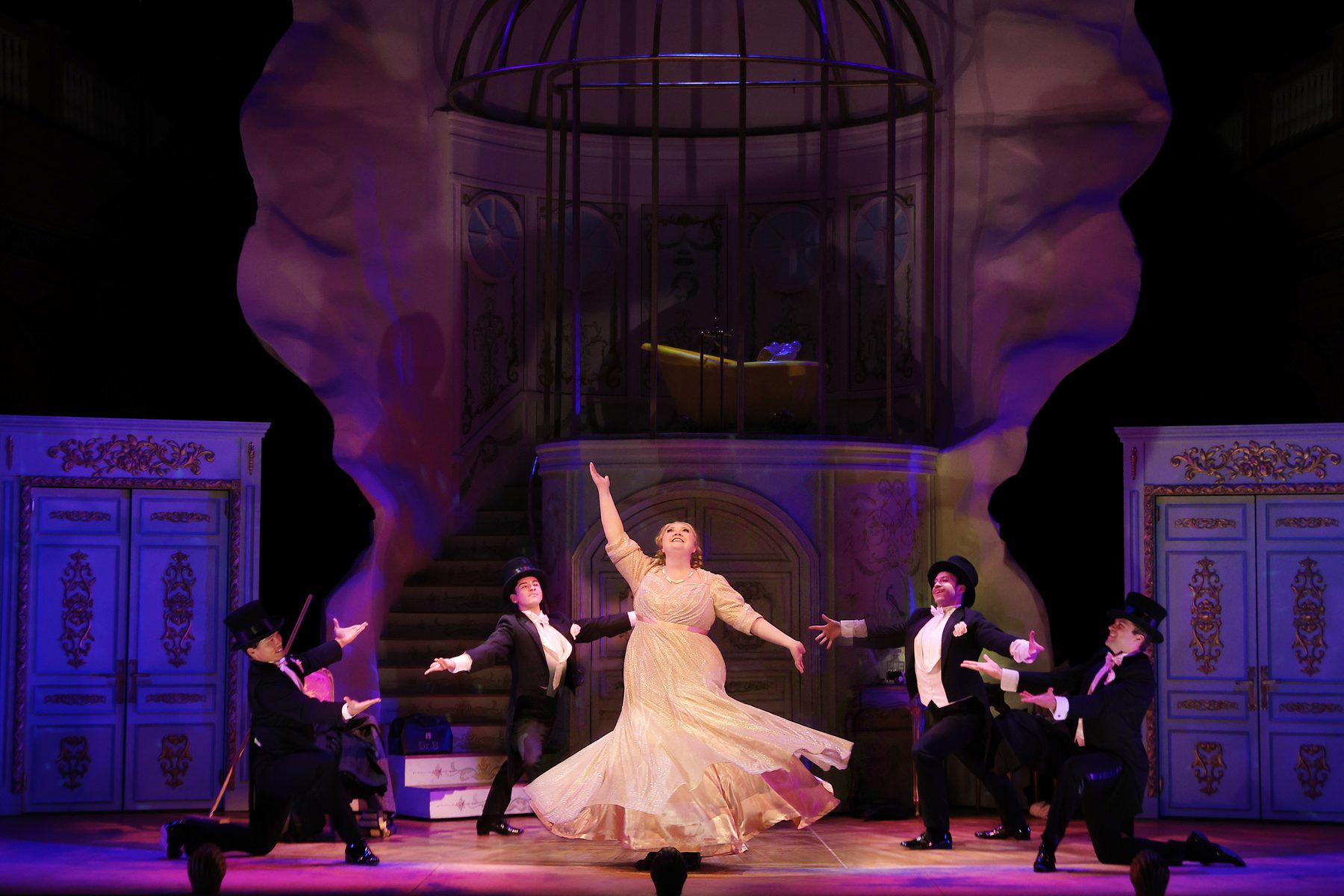
SFO apprentice artist Murella Parton brought energy and liveliness to the role of Berta, Bartolo’s housekeeper. Always a figure of calm and good sense in the midst of the comic madness, she exploded out of her shell and enchanted the audience during her one aria, when she unexpectedly became a figure of glamour, swirling in a sparkly dress accompanied by four top-hatted dancers.
Conductor Iván López-Reynoso elicited a crisp and transparent sound from the orchestra. A worthy partner of the singers, he kept a brisk and sparkling pace that matched their comic energy. Once again the orchestra outdid itself.
In these two comic masterpieces, Falstaff and Barber of Seville, the Santa Fe Opera has delivered two peerless productions. Each is well worth the trip to New Mexico. If there are tickets left by the time you read this, they may be found HERE.
Central City Opera has released the following statement, cancelling all performances through July 24:
In consultation with our medical partners and in order to protect the health and safety of patrons, artists and staff, all Festival performances scheduled for Tuesday, July 19 through Sunday, July 24 have been cancelled.
Due to recently reported COVID-19 cases in the company, Central City Opera has made the difficult decision to cancel all festival performances for this week. We appreciate your understanding and flexibility as we navigate these challenging circumstances in order to protect the health and safety of our community.
We sincerely apologize for this disappointment and inconvenience. We are working with our medical consultants to ensure we are taking the appropriate steps when we resume performances. We hope that we can reseat as many patrons as possible for the following week’s performances, but we may not be able to guarantee that all patrons will be reseated.
Details for ticket holders may be found on the CCO Web page.
Principal cello and principal clarinet will be featured soloists Dec. 11
By Peter Alexander Dec. 9 at 10 a.m.
There are lots of Christmas concerts in Boulder this time of year, but only one is offering chocolate along with the music.
The Boulder Chamber Orchestra has paired with Boulder’s Piece, Love & Chocolate for their concert Saturday (7:30 p.m. Dec. 11 at the Boulder Seventh-day Adventist Church), and while the program does not feature a single carol, who can turn down the sweets?
The occasion for the chocolates is the performance of Symphonic Chocolates by Maxime Goulet, a piece that suggests—requires?—a specific kind of chocolate with each of its four movements. For the rest of the program, conductor Bahman Saless wanted to feature members of the BCO as soloists.
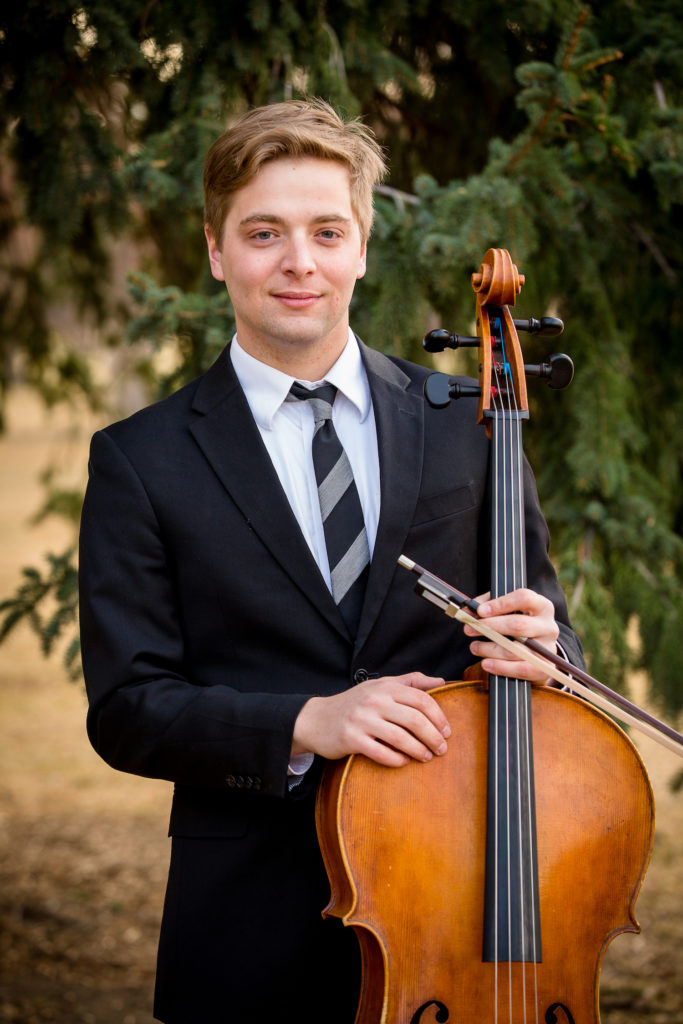
Joseph Howe
“It’s really important to support our principal musicians,” he says. “We had planned during the COVID year to do two pieces (featuring BCO players). I decided that in the spirit of the orchestra being a family that it would be appropriate to do both of them on the same night.”
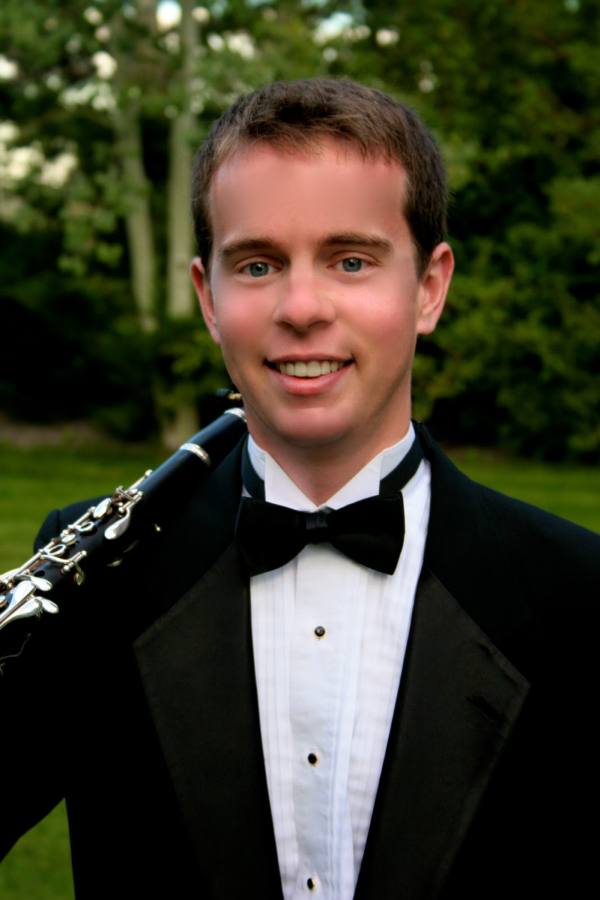
The two solo pieces will be Tchaikovsky’s Variations on a Rococo Theme, played by principal cellist Joseph Howe, and Mozart’s Clarinet Concerto, played by principal clarinetist Kellan Toohey. For the former, Saless points out, Howe and the BCO will perform the original version, which is not often heard today.
The cellist who played the premiere and the score’s dedicatee, Wilhelm Fitzhagen, considered the Variations to be ”his” piece. He changed the order of the variations and cut Tchaikovsky’s final variation, all without consulting the composer. Tchaikovksy reportedly hated the changes, but didn’t challenge them, and ever since it has been Fitzhagen’s revised version that has usually been performed.
The original version “is hard to get now” Saless says. “We had to get it from somewhere else—it’s out of print.” Nevertheless, some scholars and performers prefer the original version, because the order of the variations seems to follow a more logical musical development.
Allan Toohey
Mozart’s Clarinet Concerto was one of the composer’s very last completed pieces, composed shortly before his death in 1791. It was written for Anton Stadler, a personal friend of the composer and one of the very first virtuoso clarinet players. He performed on an instrument that had an extended range, making it possible to play a few notes lower than the modern instrument. It also had a very primitive fingering system with only a few keys, making it remarkable that the piece could be played at all. Today it is regarded as the first great solo piece for the instrument and is often played for professional clarinet auditions.
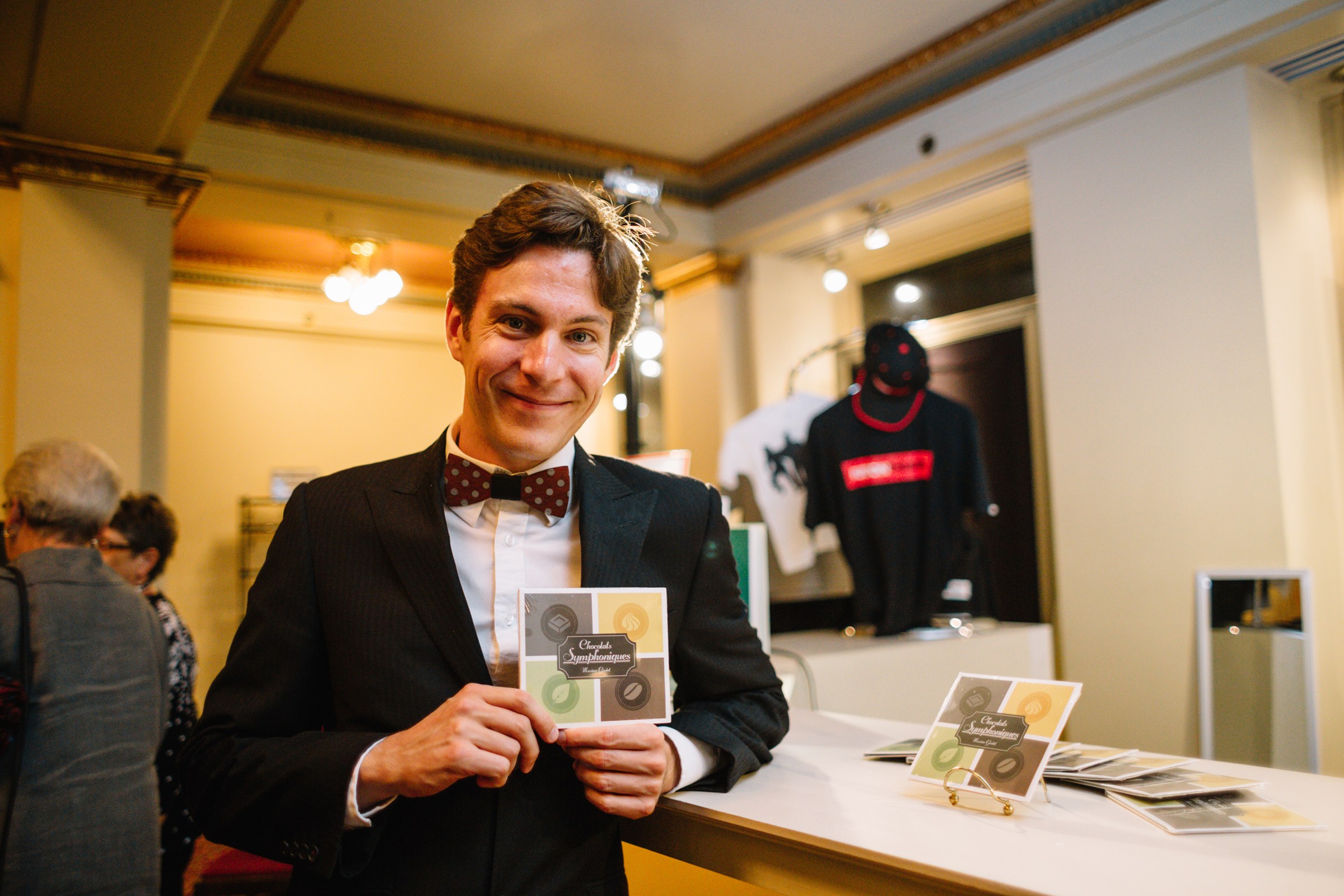
But back to the chocolates! Goulet describes his Symphonic Chocolates as “a work meant to accompany a chocolate tasting . . . an orchestral suite in four short movements in which each movement evokes a different flavor of chocolate.” The four flavors are described musically, and “the audience is invited to eat four small chocolates while each movement of the corresponding flavor is being played.”
The four movements and their descriptions in Goulet’s program notes are: “1. Caramel Chocolate: A long lyrical melody supported by a rich and enveloping sonority; 2. Dark Chocolate: An intense habanera of desire and seduction, spiced up with a dissonant bitterness; 3. Mint Chocolate: A delicate freshness with icy cold sonorities; 4. Coffee-infused Chocolate: An espresso tempo with a Brazilian flavor.”
Maxime Goulet
For the BCO performance, Boulder’s Piece, Love and & Chocolate will provide a box of four small chocolates of the described varieties which can be purchased with the tickets to the concert. The chocolates will be given out at the concert to ticket holders who purchased them.
If you don’t recognize the name, Goulet is active both as a composer of concert music and of music for video games. He was staff composer for Gameloft 2007–13, and has written the music for games including “Warhammer 40,000: Eternal Crusade,” “The Amazing Spider Man” 1 and 2, “Brothers in Arms 2: Global Front” and “Brothers in Arms 3: Sons of War.”
# # # # #
“A Gift of Music:” Celebrating the Season with BCO Stars Boulder Chamber Orchestra, Bahman Saless, conductor
Maxime Goulet: Symphonic Chocolates
Tchaikovsky: Variations on a Rococo Theme (original version) Joseph Howe, cello
Mozart: Concerto in A for clarinet and orchestra Kellan Toohey, clarinet
7:30 p.m. Saturday, Dec.11 Boulder Seventh-Day Adventist Church TICKETS (admission and the chocolates may be purchased separately) NOTE: See BCO COVID policies on their home page.
What is one thing COVID has not closed down this year? The flood of Holiday-themed concerts in December.
This is in stark contrast to last year, when there were virtually no live concerts anywhere. Holiday music-making, if any, was done online. But now Boulder has returned to near normal, and there is no space or time to give individual coverage to all the concerts. Here is a compilation of most local classical concerts, all of them available for live attendance and some with streaming as well (details and ticket information are below; check each group’s Web page for COVID requirements):
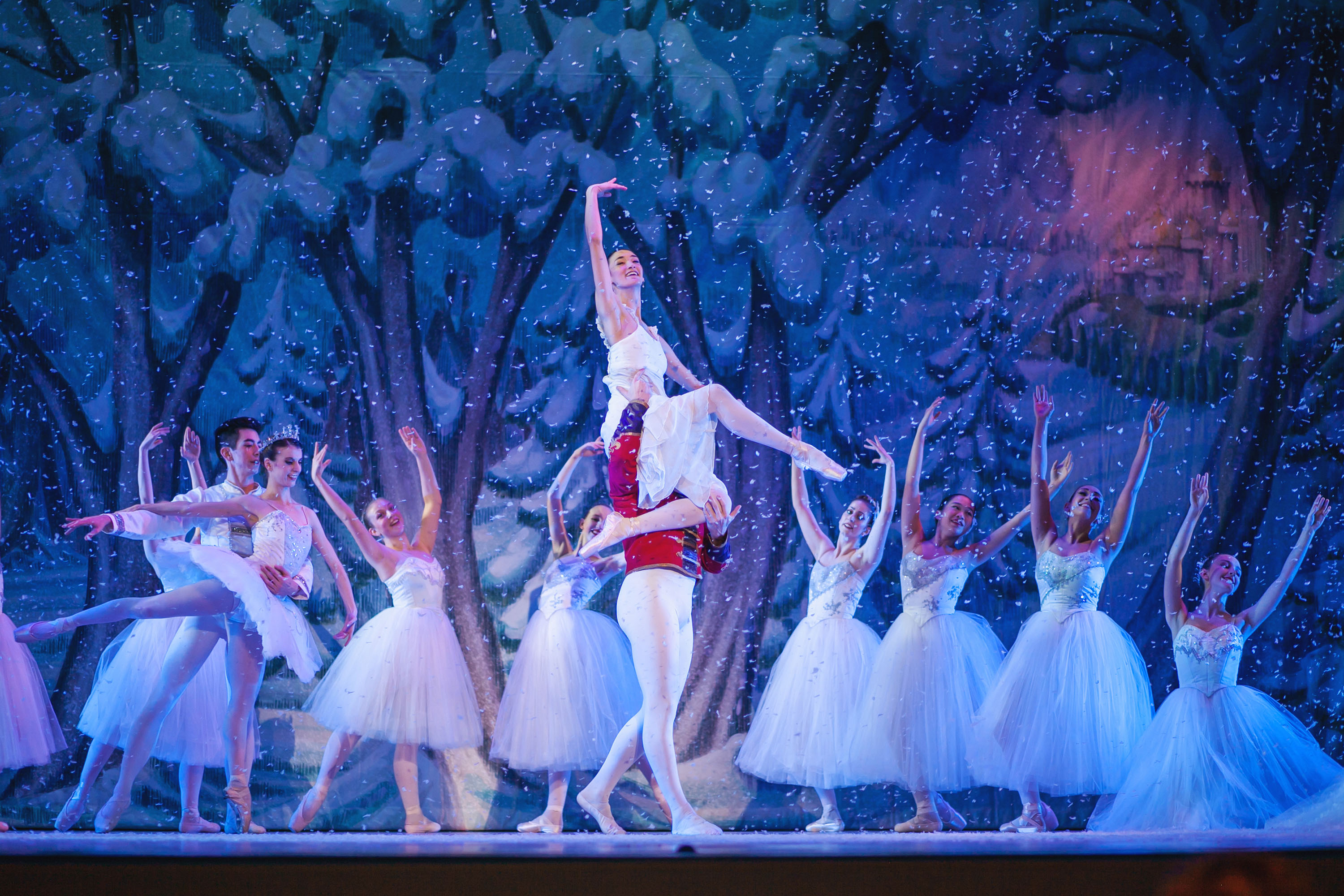
Boulder Ballet Nutcracker (2018). Image by Amanda Tipton Photography
The Nutcracker returns to Longmont in performances by the Longmont Symphony and Boulder Ballet (Dec. 3–5). Performances of this perennial family favorite also include a sensory-friendly “Gentle” Nutcracker performance that will be under one hour with both dramatic and musical elements as well as lighting adapted for special needs children.
Boulder Ballet’s production of The Nutcracker almost had to be cancelled for the second year running, until supporters of the ballet and the symphony raised funds to support the performances. LSO executive director Catherine Beeson released a statement, saying “The thought of our communities having to miss a second year of this holiday tradition was too disappointing to consider. We are so grateful to Boulder Ballet and LSO patrons, supporters and sponsors who stepped up to fill the gap.”
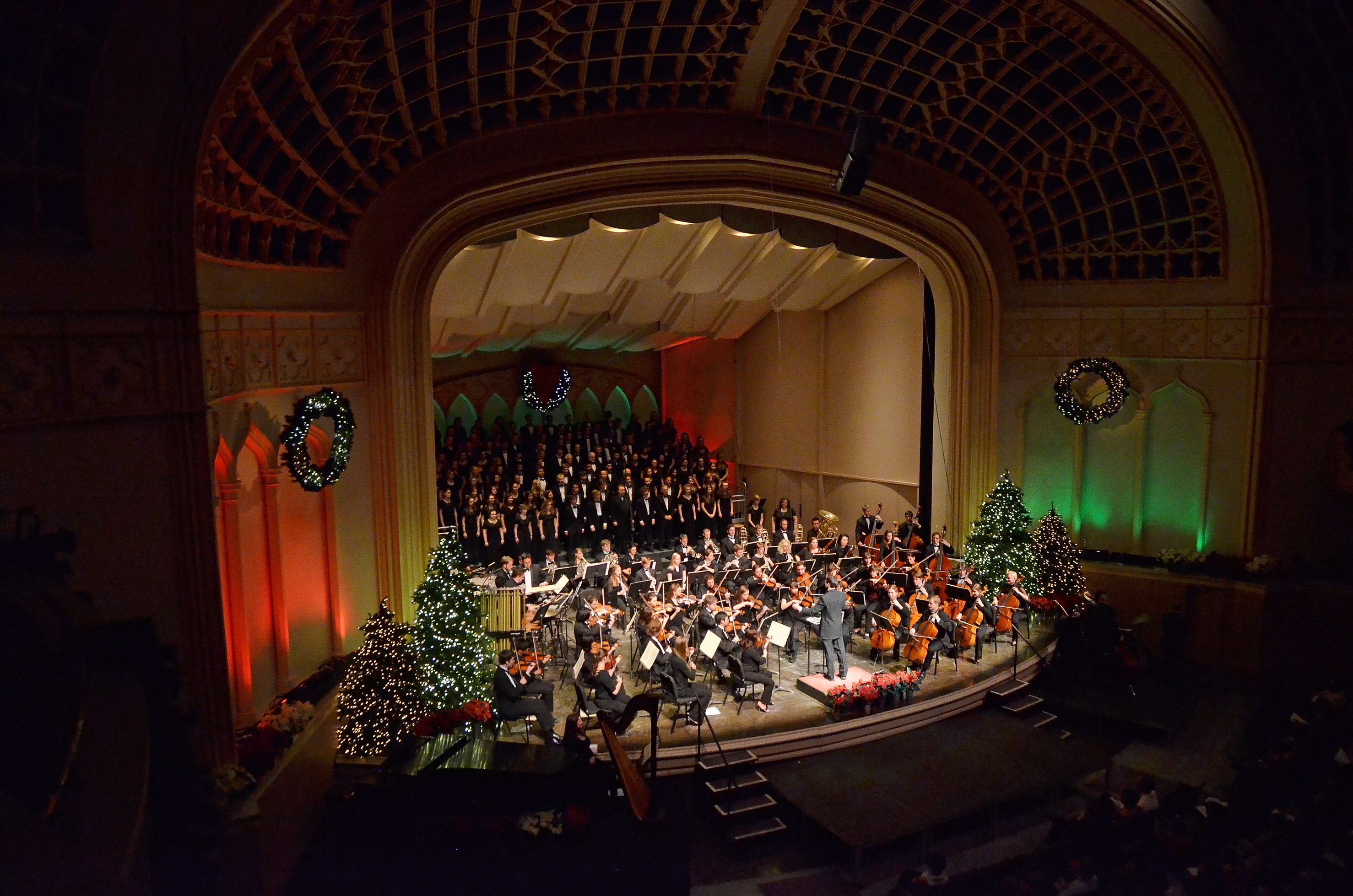
The CU Holiday Festival (Dec. 3–5), featuring CU College of Music ensembles, is one of the oldest musical traditions in Boulder, dating back decades. Performing groups this year will be the Holiday Brass, the Holiday Festival Orchestra, Chamber Singers, Holiday Festival Choral Union, West African Highlife Ensemble, Holiday Festival Jazz, and the Magari Quartet.
The 2013 Holiday Concert put on by the College of Music in Macky Auditorium at the University of Colorado Boulder. (Photo by Casey A. Cass/University of Colorado)
There will be some very familiar Holiday music—“Ding, Dong Merrily on High,” “Do You Hear What I Hear?” and the perennial favorite, Leroy Anderson’s “Sleigh Ride.” But there will also be some unusual selections, including the Spanish villancico “Ríu, ríu, chíu,” the Gloria from the Misa Criolla (Creole Mass) by the Argentinian composer Ariel Ramírez, and a Nigerian Christmas song, “Betelehemu” (Bethlehem). The program will conclude with the “Hallelujah” chorus from Handel’s Messiah.
The Holiday Festival often sells out. That may be different this year, with COVID restriction still in place, but check availability before making plans.
There will be two performances of Handel’s Messiah in Boulder this year: One by conductor Cynthia Katsarelis with the Pro Musica Colorado Chamber Orchestra and Boulder Chamber Chorale (Dec. 4), and one by conductor Zachary Carrettin and performers of the Boulder Bach Festival (Dec. 17 and 19).
Both organizations will present only the Christmas portion of Messiah; Pro Musica Colorado will add the “Hallelujah” chorus. Theirs will be the more traditional style of performance, with full chorus. The Boulder Bach Festival will present Messiah with only one on a part in both orchestra and chorus; in other words, the choral parts will all be sung by a quartet of vocal soloists rather than a traditional chorus.
The Ars Nova Singers will present their Holiday program, “Made Merry,” in Denver (Dec. 10), Longmont (Dec. 12) and Boulder (Dec. 16 and 17).
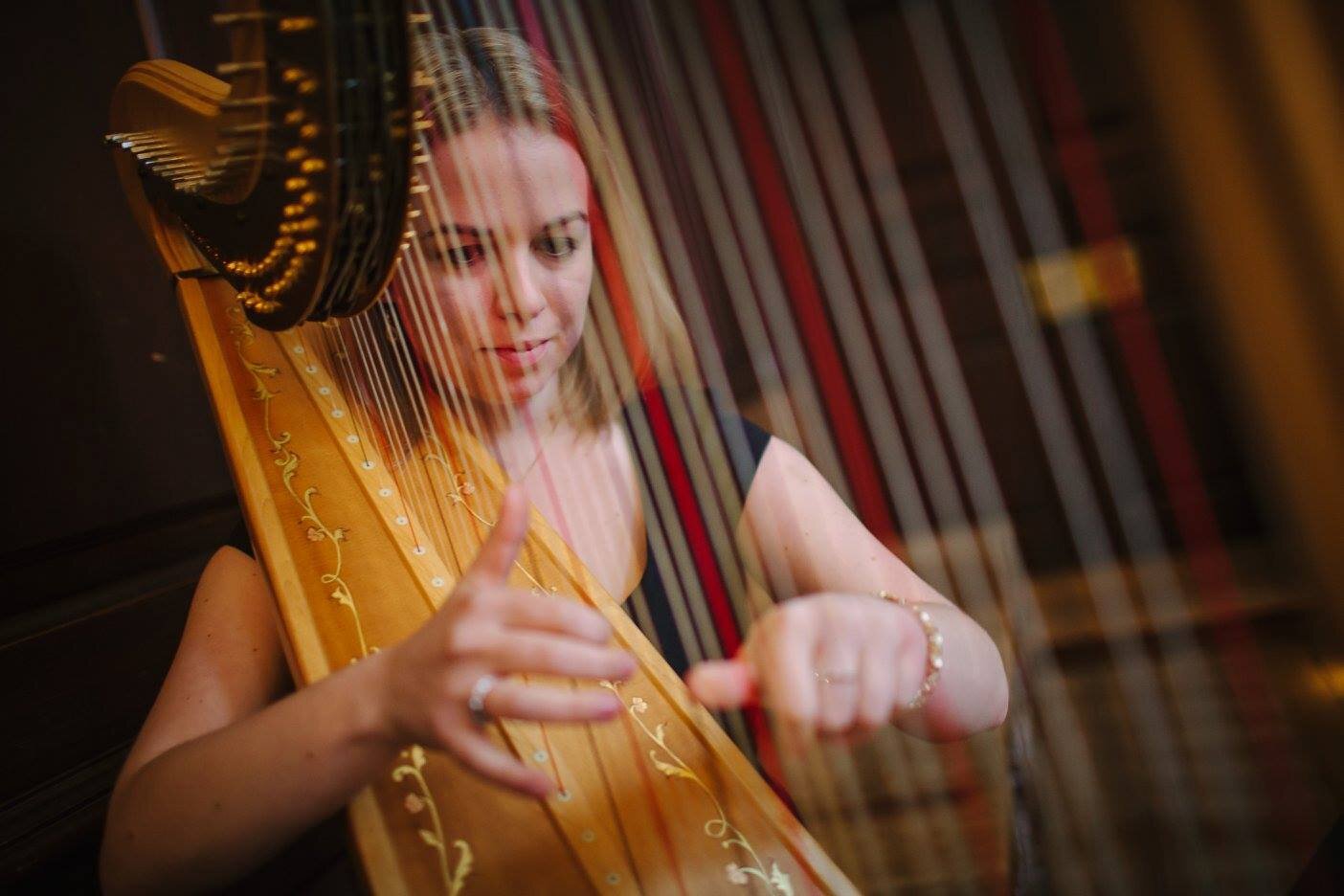
Harpist Kathryn Harms
Under the direction of Thomas Edward Morgan, the Ars Nova Singers will be joined by guest artist Kathryn Harms on harp. The program follows the usual pattern for Ars Nova Holiday concerts: a mix of new arrangements and recent compositions with more traditional tunes.
Featured works will include Variations on “Lo How a Rose” by Hugo Distler, a prominent composer of sacred music in early 20th century Germany, whose short life illustrates the tragedy of his times. Torn between his revulsion for the Nazi regime and the prominent positions he was granted, he took his own life in 1942 at the age of 34.
Other works on the program are Morgan’s arrangement of “What Child is This?,” Benjamin Britten’s arrangement of “In the Beak Midwinter,” Jeffrey Van’s arrangement of the Mexican carol “El Rorro” (The babe) and contemporary English composer Jonathan Dove’s setting of “The Three Kings” by Dorothy Sayers.
The Longmont Symphony’s annual Candlelight concert, this year titled “A Baroque Christmas,” will be presented at 4 p.m. Sunday, Dec. 19 at the Westview Presbyterian Church in Longmont. Elliot Moore will conduct, with soprano soloist Ekaterina Kotcherguina.
Music by familiar Baroque composers will comprise the majority of the program, including Corelli’s Concerto Grosso op. 6 no. 8, known as the “Christmas Concerto” and J.S. Bach’s Third Brandenburg Concerto. Kotcherguina will sing arias from Handel’s Messiah, including “I know that my redeemer liveth” and “Rejoice Greatly.”
She will also sing “The Holy City,” a Victorian-era ballad that was extremely popular and widely performed around the turn of the 20th century, and that has been called “the most pirated piece prior to the internet.” Published under the name Stephen Adams, it was actually the work of English composer and singer Michael Maybrick.
According to legend, the song got a group of drunken prisoners released by a judge, it was mentioned in James Joyce’s Ulysses, and via a spiritual titled “Hosanna” its melody found its way into Duke Ellington’s Black and Tan Fantasy. It continues to be performed, often under the title “Jerusalem.”
# # # # #
Longmont Symphony and Boulder Ballet Tchaikovsky: The Nutcracker
Pro Musica Colorado Chamber Orchestra, Cynthia Katsarelis, conductor With the Boulder Chamber Chorale and vocal soloists George Frideric Handel: Messiah
7:30 p.m., Saturday, Dec. 4, First United Methodist Church, Boulder
Tickets for in-person and live-streamed performance
Ars Nova Singers, Thomas Edward Morgan, conductor “Made Merry”
7:30 p.m. Friday, Dec. 10, St. Paul Community of Faith, Denver 4:30 p.m. Sunday, Dec. 12, United Church of Christ, Longmont 7:30 p.m. Thursday, Dec. 16, First United Methodist Church, Boulder 7:30 p.m. Friday, Dec. 17, First United Methodist Church, Boulder
Online event Sept. 25 replaces a planned fundraising gala
By Peter Alexander Sept. 21 at 9:30 p.m.
Thomas Morgan, music director of Boulder’s Ars Nova Singers, says “sitting on a beach in Maui sounds like a pretty good idea.”
Napili Bay, Maui, Hawaii
“All of us want to be traveling right now,” he continues, speaking after a year when most of us stayed in place. And while you and I may not be able to drop everything and fly to Hawaii, Morgan has the answer: he has programmed a piece of music that captures the Maui beach experience. “Napili Bay 2 p.m.” by J.A.C. Redford will be presented as part of an online performance by Ars Nova Saturday (Sept. 25).
“This piece is really evocative of [the beach at Napili Bay],” he says. “It’s spectacularly well written for the choir, and the chorus really loves to sing it. It’s a wonderful piece.”
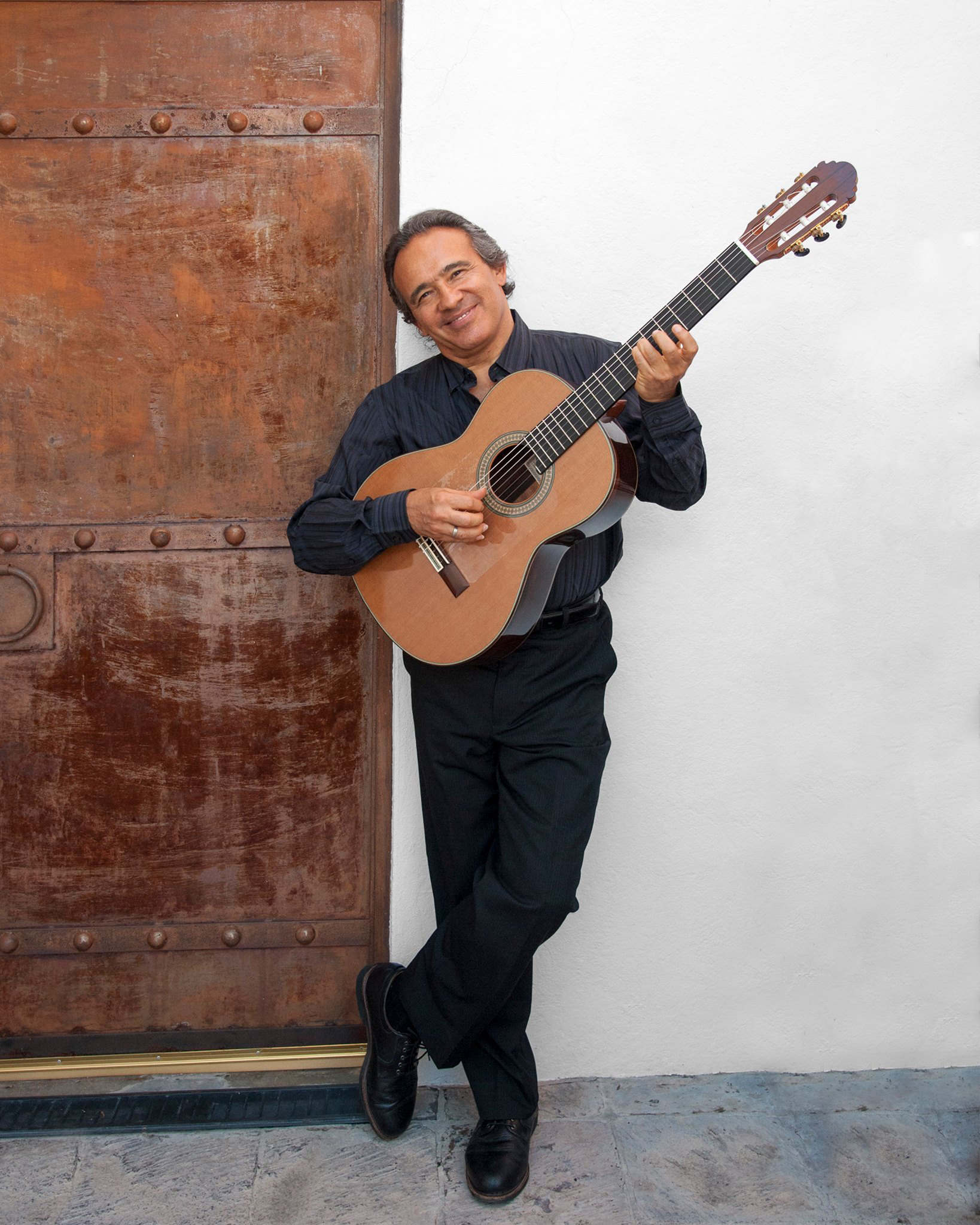
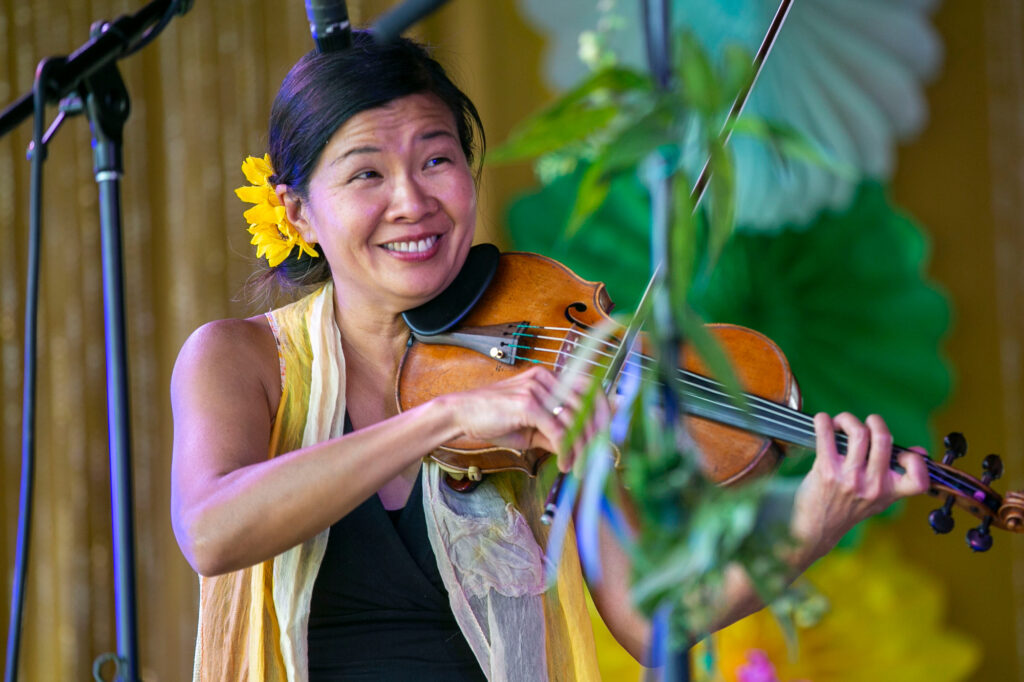
The performance is part of “Sounds from the Soil: A Salon” to be streamed on YouTube at 7:30 p.m. Saturday, Sept. 25, and will remain available through Wednesday, Oct. 13. The program, which was recorded at Lone Hawk Farm in rural Boulder County, features Morgan conducting Ars Nova, plus the Duende Trio of mezzo-soprano Shannon Pennell, violinist Mintze Wu, and guitarist Alfredo Muro. Information and tickets can be found here.
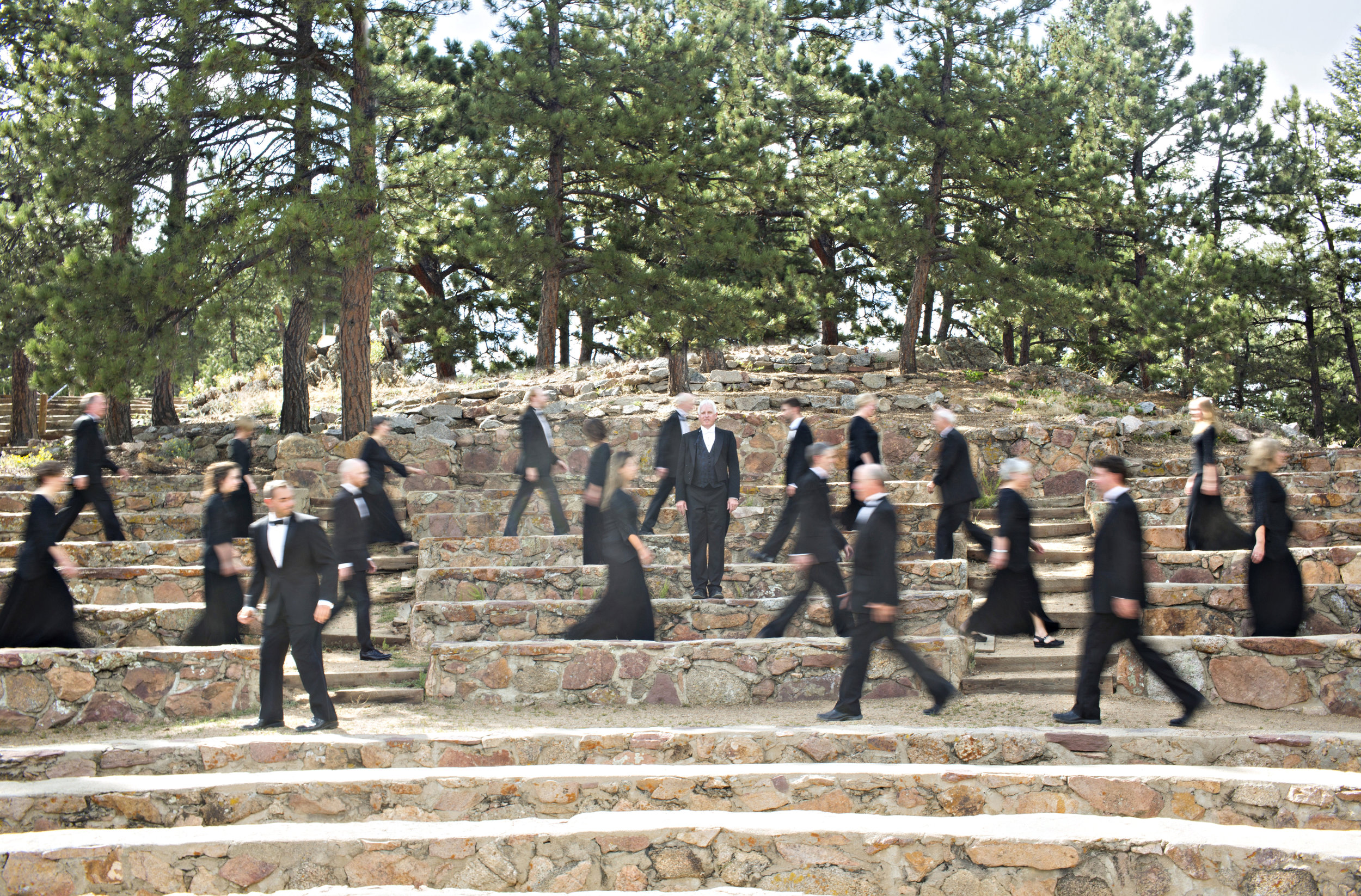
Ars Nova Singers, Thomas Morgan, director (center)
The program developed from Ars Nova’s planned fall gala, a fund-raising event to kick off the 2021–22 season. The gala was scheduled for Sept. 11, but “we realized that probably wasn’t going to be an appropriate time to do a fundraiser, indoors,” Morgan says. “Fortunately, we were able to make the change and not do it as an in-person event. We kept the date and took the choir out [to Lone Hawk Farm] and recorded both indoors and outdoors.”
Lone Hawk Farm is a working organic farm and event venue located in the country between Boulder and Longmont. The program is a collection of pieces that are new to Ars Nova and others they have performed before. Among the latter is Crucifixus by Antonio Lotti a Baroque piece that was on Ars Nova’s very first concert in March 1986. Morgan says he wanted to perform the Crucifixus because “it connects to our very first concert, so it’s like beginning again after this current wave of the pandemic.
“It’s a wonderful eight-voice piece that builds in a really elegant way with a lot of suspensions and resolutions. It’s a really fun piece for the choir to sing.”
Alfredo Muro
The members of the Trio Duende all have prior connections to Ars Nova. Pennell is a member of the choir, and both Wu and Muro have played with the group before. The trio is intriguingly multi-cultural: Pennell is a Coloradan living in Lyons, Muro is from Peru, and Wu is a native of Taiwan who used to live in Lyons and now resides in Carbondale, Colo. Wu in particular is a shape shifting musician who has performed everything from Bach to Celtic fiddling—sometimes on the same program—and now has taken up bossa nova.
“The first time the trio got together was 2014,” Wu explains. At the time, she was living in Lyons, where she organized the eclectic “Sound of Lyons” music festival. They recently got together again in Carbondale, where Wu lives now and has curated the Garden Music series. That was where Morgan heard them and invited them to play for the Ars Nova gala/online “Salon.”
Mintze Wu
The name Trio Duende comes from the Spanish word meaning “soul” or “passion.” It was a word that Muro’s wife used to describe how the three musicians perform together. “She was talking about when we play together there is this quality of passion, of being very inspired,” Wu says. “And so we decided to use that name.”
For the online performance, Trio Duende presents three pieces, including Antonio Carlos Jobim’s iconic bossa novaGarota de Ipanema (Girl from Ipanema). Wu and Muro will also play a duo, and Muro will play solo pieces on guitar.
Thomas Morgan
Morgan talks about other pieces that Ars Nova will perform: “I should probably mention Samuel Coleridge-Taylor‘s little motet ‘Summer is Gone,’” he says. “Coleridge-Taylor was a British composer of African descent. He achieved a lot of success as a composer, including three tours of the United States in the early 1900s. This little piece is based on the poem ‘Bitter for Sweet’ by Christina Rosetti. It’s perfect for this time of year and for the changing of season. It’s just a beautiful little piece.
“Our recording of it was done right near sunset at a beautiful location out in the country. It really looks good.”
# # # # #
Sounds from the Soil: A Virtual Salon Ars Nova Singers Thomas Edward Morgan, artistic director and conducto Trio Duende, guest artists: Shannon Pennell, mezzo-soprano, Mintze Wu, violin, and Alfredo Muro, guitar
Antonio Lotti: Crucifixus
Cary John Franklin: “The Merry-Go-Round at Night”
Sibelius, arr. Blake Morgan: “This is My Song”(Finlandia)
J.A.C. Redford: “Napili Bay, 2 p.m.”
Samuel Coleridge-Taylor:“Summer is Gone”
Josef Rheinberger: Abendlied —Ars Nova
Antonio Carlos Jobim and Vinicius de Moraes: Garota de Ipanema (The Girl from Ipanema)
Luiz Bonfa and Antonio Maria: Manha de Carnaval (Morning of Carnival)
Baden Powell and Vinicius de Moraes: Samba Em Preludio —Trio Duende
Instrumental works —Mintze Wu, violin, and Alfredo Muro, guitar
7:30 p.m. Saturday, Sept. 25 TICKETS NOTE: This event will premiere on YouTube. A performance link will be sent to ticket-buyers just before showtime, valid to watch through October 13.
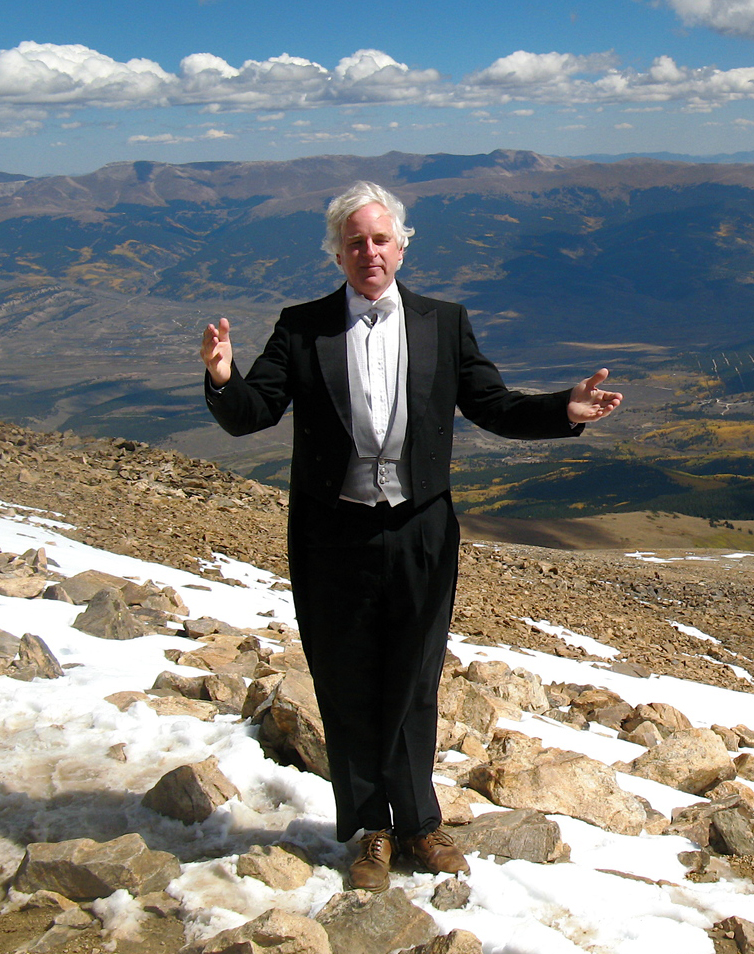
From “Decadence and Debauchery” to fifth symphonies to a hike in the mountains, the 2021 Colorado MahlerFest will cover a lot of ground, literally and figuratively
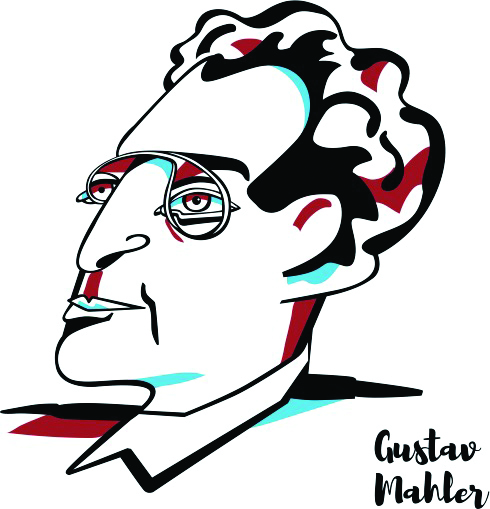
Over five days, Tuesday–Saturday Aug. 24–28, concerts, films and a symposium will explore the music of Gustav Mahler, his contemporaries and heirs, in venues from the Dairy Arts Center to the Huntington Bandshell and Mackey Auditorium. Composers will include Mahler’s European contemporaries and successors Korngold and Krenek, but also American ragtime musicians Scott Joplin and James Reese Europe (see the full schedule here).
Program includes works by Bach, Mozart, Beethoven and more
By Peter Alexander May 4 at 2:40 p.m.
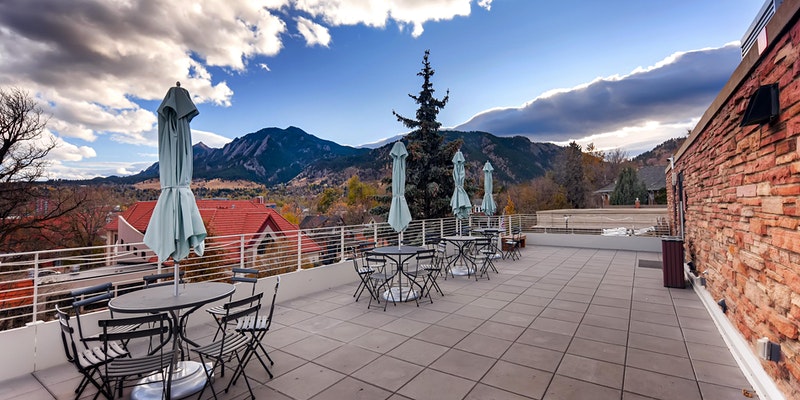
The Ajax Ensemble, one of Boulder’s many small classical ensembles that should not be overlooked, is playing a program at the Museum of Boulder rooftop Saturday (June 5).
Boulder Museum rooftop
With a capacity of 60, the rooftop performance is already sold out, but lucky for you, it will be repeated next Wednesday, June 9. The concert will take place on the museum’s rooftop from 5 to 6:30 p.m. It will be preceded by a “Walk Around the Museum” for ticketholders from 4 to 5 p.m., and followed by a Q&A period with the artists from 6:30 to 7 p.m.
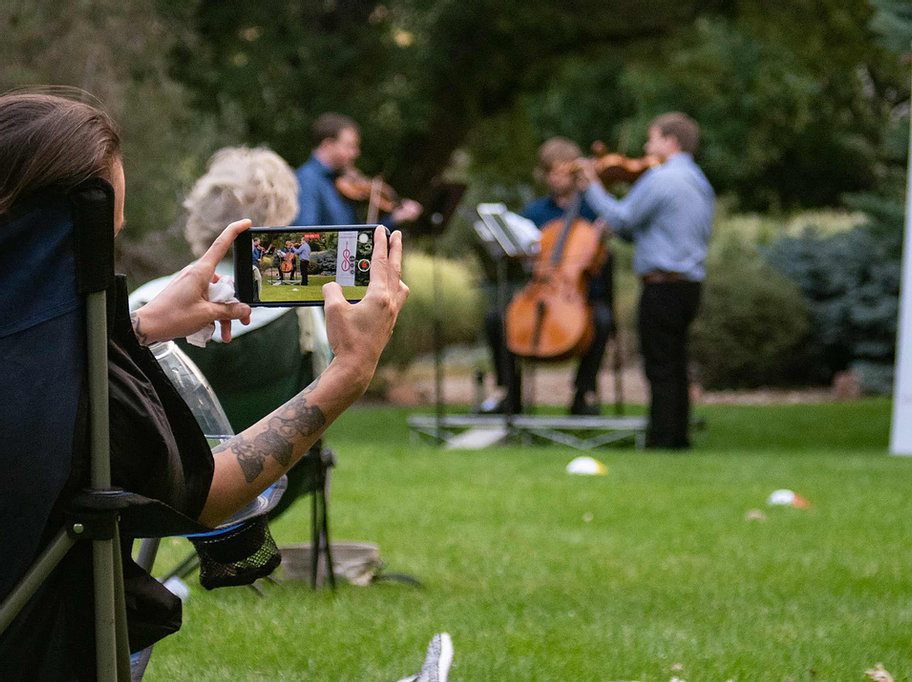
There will be another opportunity to hear this same program, when—weather permitting—the Ajax Ensemble performs at the Linden HOA Park, 3750 Lakebriar Drive in North Boulder from 6:30 to 8 p.m. Sunday, June 6.
Ajax will perform as a string trio comprised of violinist Tom Yaron, violist Tanner Menees, and cellist Joseph Howe. Yaron and Howe are graduates of the CU Boulder College of Music, and all three players are active in the Boulder musical scene, and with experience performing world wide.
Ajax Ensemble in an earlier outdoor concert
The program for June 5, 6 and 9 will feature the following works:
J.S. Bach: Selections from the “Goldberg” Variations
Schubert: String Trio No. 1 in B-flat, D471
Ernst von Dohnányi: String Serenade, movements I, II and IV
Mozart: Divertimento in E-flat Major, K563, movements I and IV
Gideon Klein: Trio for violin, viola, and cello
Beethoven: String Trio in E-flat Major, op. 3
The rooftop performances are presented by the Boulder Museum in partnership with Concertize, a Boulder-based company that provides concert-planning services and access to performers in the Boulder area. They serve as concert managers for Ajax, and state that their goal is “making music happen in more places, from vaccine clinics to concert halls.”
Tickets for all Concertize events are available on their Web page. Tickets for the Museum of Boulder events can also be purchased through their Web page.
Correction: The correct identification for the performing group is Ajax Ensemble, not Ajax Trio, and the violist will be Tanner Menees, not Joshua Ulrich.
A conversation with Bob Balsman of the Longmont Performing Arts Initiative and Longmont City Councilman Tim Waters
By Peter Alexander May 25 at 4:35 p.m.
Members and advocates of the Longmont arts community have proposed a new Performing Arts Center for the city, to be built in conjunction with a Convention and Events Center. With the support of Visit Longmont and the City of Longmont, private funds were raised for a feasibility study conducted by Johnson Consulting, a real estate and consulting firm with experience in the planning of performance venues. Their feasibility study was recently submitted to and accepted by the Longmont City Council. If carried through, this project would have enormous impact on performing arts organizations and audiences in Longmont and throughout Boulder County.
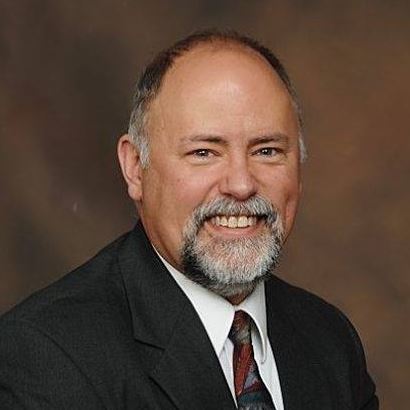
Bob Balsman
To clarify some of the questions surrounding the project, I sat down—virtually—with Bob Balsman, president of the Longmont Performing Arts Initiative (LPAI, pronounced l’PIE) and Longmont City Councilman Tim Waters, who is one of several supporters of the project in city government. Here is a lightly edited version of our conversation.
Bob Balsman, you are president of LPAI, which played a role in the proposed project from the very beginning. Exactly what is LPAI?
BB: The Longmont Performing Arts Initiative is an association made up of several of Longmont’s major non-profit performing arts groups: The Centennial State Ballet, the Longmont Chorale, the Longmont Concert Band, the Longmont Symphony Orchestra, the Longmont Youth Symphony, and the Long’s Peak Chorus. Together we have hundreds of people that participate directly in the performing arts, and we all perform before thousands of people in the greater Longmont area.
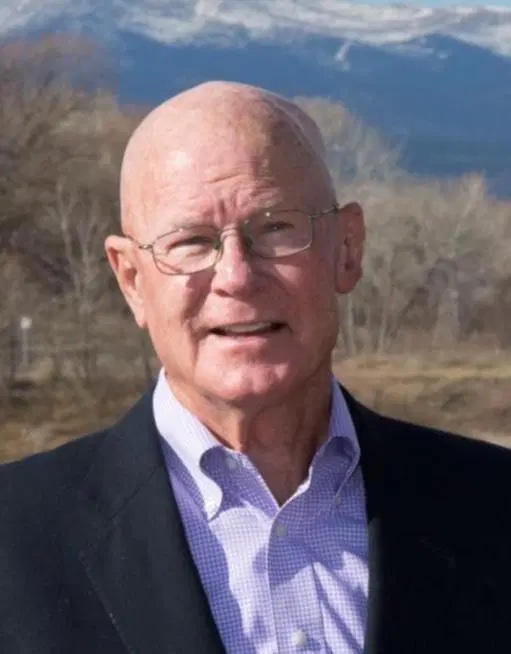
Tim Waters
Tim Waters, I assume most people reading this will know what the City Council is. But I believe politics is relatively new for you.
TW: My professional life put me at the nexus of research and leadership and policy and politics, without ever running for elective office. I turned the page from retirement into a new chapter and started attending City Council meetings so [city councilor Marcia Martin] would have somebody to process the issues with. The more I attended, the more interested I got in the issues. When Brian Bagley was elected mayor, the seat for Ward 1 opened up, and since I had been attending meetings, I thought, you know, this is kind of interesting.
Please describe the project that we’re talking about.
BB: We’re working towards the construction of a performing arts facility in Longmont. Our overall hope is to see Longmont have a new venue in the range of somewhere between 1000 and 1500 seats, and later that we would also have a smaller venue of about 500 seats.
And the plan is to combine the performing arts facility with a convention and events center?
BB: Event space is desperately needed in Longmont ever since the Plaza closed a couple of years back and now has been sold. There is no suitable space for gatherings of 200 or more people—even a large-scale wedding reception, not to mention conventions and trade shows. Visit Longmont has estimated that in the past couple of years alone they’ve lost out on 2.6 million dollars worth of business. So these are significant needs in the community.
Where do we stand now on the project?
BB: We first started work on this publicly back in 2018, I believe it was, when we spoke before City Council about the needs for such a center. Since then, members of LPAI have formed into a nonprofit, raised more than half the cost of a feasibility study. That study [performed by Johnson Consulting] has now been completed with a presentation to the City Council, so we’re looking forward to the next steps as soon as those numbers are finalized and validated by city staff.
With the two facilities together, what is the cost of the proposed facility?
BB: According to the feasibility study, that is estimated to be up to $158 million. That’s a pretty big price tag, but we were encouraged when the consultants said those were high estimates, and that they had seen quality venues constructed for 25% less.
Where will that money come from?
TW: We’ve seen the estimates of $105 to $158 million, and I think the City ought to have an investment in that. I think the private sector ought to have an investment in that. LPAI will have to organize a capital campaign to raise private sector money. But I don’t think a project like this can or should be accomplished without an investment by the city. How big a bite that will be is going to depend on a whole lot of variables. With today’s interest rates, we could probably generate $65 million or so of city revenue without having to raise taxes. It’s not simple, but there’s a way to get there.
Also, the projected site is in an opportunity zone. There may be an investor out there who would like to move some money to avoid capital gains taxes somewhere else into a project like this. The City could aggregate the land and then lease it to a developer. That could substantially lower the top-line cost, on a 30-year lease in a public-private partnership. So there are a variety of funding mechanisms to get it done.
Where is the projected site for the facility?
BB: In the feasibility study, there were five different locations that were identified, and a couple were ruled out for various reasons, including that they’re not even in the City proper right now. The prime location that was identified was in southern downtown near the First and Main intersection, what’s called the “Building Steam” area. That area was identified because of certain advantages, which include the overlap of a few different incentive zones, to help make the financing easier. And there’s also mention of transportation that’s going to be there, nearby parking that will help the facility.
What does it mean that the consultant’s reports was ‘accepted’ by the City Council?
TW: It’s a great question. We accepted the report, and tasked the staff with investigating it.
BB: That was a unanimous acceptance, and then they directed again unanimously for City staff to investigate the numbers, which means double-check everything. Then will be the next steps, how do we get from ‘OK, we know what’s recommended’ to we open the doors some time down the road.
What will those next steps look like?
TW: In terms of steps going forward, if the city is going to invest, then LPAI, in partnership with others, needs to come back with decisions that have to be made. These aren’t problems, they’re just areas where we need to make decisions, like how to we think about governance of the facility, what does the business plan look like, what are the assumptions that have to be made such as if you’re going to have a successful business plan, then you need to have this number of performances and this kind of occupancy—which gets into some of the numbers the consultants had.
On that question, who will be responsible for operating the facility?
BB: You know, one of the better models that we have seen is the formation of a nonprofit governing entity that can make all of these decisions for the facility, while another entity actually operates it.
TW: So LPAI as a nonprofit contracts with a manager—there are people out there in the business of managing these kinds of facilities, booking talent and implementing a business plan. I would assume what you do is contract a pro.
BB: None of us in LPAI operate our own venues. We can see what looks like a good decision or a bad decision, but the hands-on, day-to-day work is not something that we are accustomed to. So you have a governing body making policy decisions, LPAI or some other group, and then you have operational staff.
I know that the facility is intended not only for LPAI members and other local groups, but for touring acts as well.
BB: The intention is not to just provide the six LPAI groups with a home. To make it work economically, and to benefit the community, the intention is to bring in outside groups that right now, everybody goes out of Longmont to see because they just do not come to town. You see an awful lot of touring acts that really have nowhere to go in Longmont. For example, you could think of jazz artists like Michael Bublé or Diana Krall. Why don’t you see these people come to Longmont? Because in Longmont, the only places which are large enough to hold an audience for any performer of this caliber, to make it economical, are churches and schools.
People might ask about the school auditoria. Can they accommodate touring shows?
BB: There are some that were built for performances, but you run into many scheduling conflicts for their intended purposes, which is education. Hosting performances is not their deal, and that’s not why people pay taxes to support the schools. There’s another obstacle in that only three of them, I’m told, have dedicated tech staff.The others are operated largely by volunteers.
When you talk about touring shows, that raises the possibility of bringing in audiences from outside Longmont.
BB: I see a performing arts hall drawing from all of the surrounding communities.
That should have an economic impact on Longmont as well.
BB: In the feasibility study the consultants identified an annual impact to Longmont of, a positive impact of $8 million injected into the local economy just by having these facilities. If the project is built in phases, that’s $6.5 million per year for Phase I, and then hotel stays go up by about $21,000 some, plus sales and hotel taxes coming back to the city of about $621,000 per year. And then jobs, just Phase I, it’s an estimated 173 new jobs, or $5.6 million per year in increased earnings.
By the time you get to Phase II, you get taxes that come back from sales and hotel taxes of $872,000 per year, and 245 total jobs. That’s some pretty impressive statistics. When you first see that big price tag, you think how are we going to get to there and this is nothing but a expense, but no, it’s not just an expense. The reason that these things get built is that they are a catalyst. Yeah, it costs something to build them, but then you get an annual return back into the economy
Are there other benefits to the community that we should talk about?
TW: We currently have no place in Longmont to bring kids who might aspire for, if not a career at least a lifetime in the arts. There is no venue to take them to say ‘imagine yourself here.’ I can imagine in a performing arts facility like we’re talking about bringing world-class entertainment to town, with an educational outreach task that goes with every one of them. That expands the horizons and the education experience of all the kids in this community, in ways that we simply don’t get a chance to do right now. So, let’s imagine that we could bring Hamilton here. What an educational opportunity for every kid in this town, whether you aspire to be an artist or not, to look at American history thorough the arts. And that’s just the tip of the iceberg. There are so many ways that the lives of our children can and should be enriched that simply aren’t options for us today in Longmont.
Are there misconceptions about this project that should be corrected?
TW: Right off the top is, ‘If you do this there’s a bunch of other things we can’t do. If you do this, we won’t serve well our most disadvantaged residents.’ That’s a misconception that somehow we either lack the resources or the capacity to do this. The argument, if you do this you can’t do something else, I think is a bogus argument. I think it’s a scarcity mentality and a view of the world as a zero-sum experience,. I just don’t see it that way.
I think another misconception is that that ultimately it will serve an elite constituency in Longmont. On the contrary, we have a bunch of people in this town, children in particular. This serves the entire community.
BB: I’d say it’s definitely not elitist. Longmont’s performing arts scene does include more than the LPAI organizations. We have other groups, such as Bario E’ in town that’s from Puerto Rico, for example. And other groups that represent other ethnic groups. And aside from that, none of these people are paid to do what they do. This is all a grass-root effort. What you’re looking at when you see LPAI and the other groups around town is a large-scale volunteer effort. People want to be involved in these groups. It’s certainly not just for the advantaged.
Thank you both for spending some time with me and answering my questions.
You may access the feasibility study that was presented to the Longmont City Council and other documents here.
A statement on the Longmont Center by City Council Member Marcia Martin is here.


 Sharps & Flatirons