Five pieces form the 20th and 21st centuries dazzle audience
By Peter Alexander July 12 at 12:46 a.m.
Last night (July 11) was a wonderful evening for a concert in Boulder: moderating temperatures, gentle breezes, and a late lingering dusk.
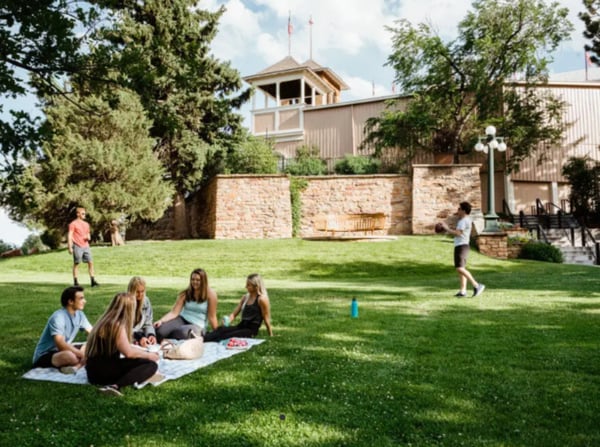
Afternoon on the grounds outside the Chautauqua Auditorium.
If you were fortunate enough to be at the Chautauqua Auditorium, only a single helicopter overflight disturbed the mood of an equally wonderful performance of music composed since 1950. The program was played by the JACK Quartet, a group known for their exemplary performances of contemporary concert music.
Last night’s program, titled “New York Stories,” was part of the Colorado Music Festival’s Robert Mann Chamber Music Series. The performances lived up to JACK’s reputation and then some. The five pieces they played were strikingly varied, but the character of every piece emerged powerfully. Every transition was precise and controlled, and the unity of interpretation across the group was magical.
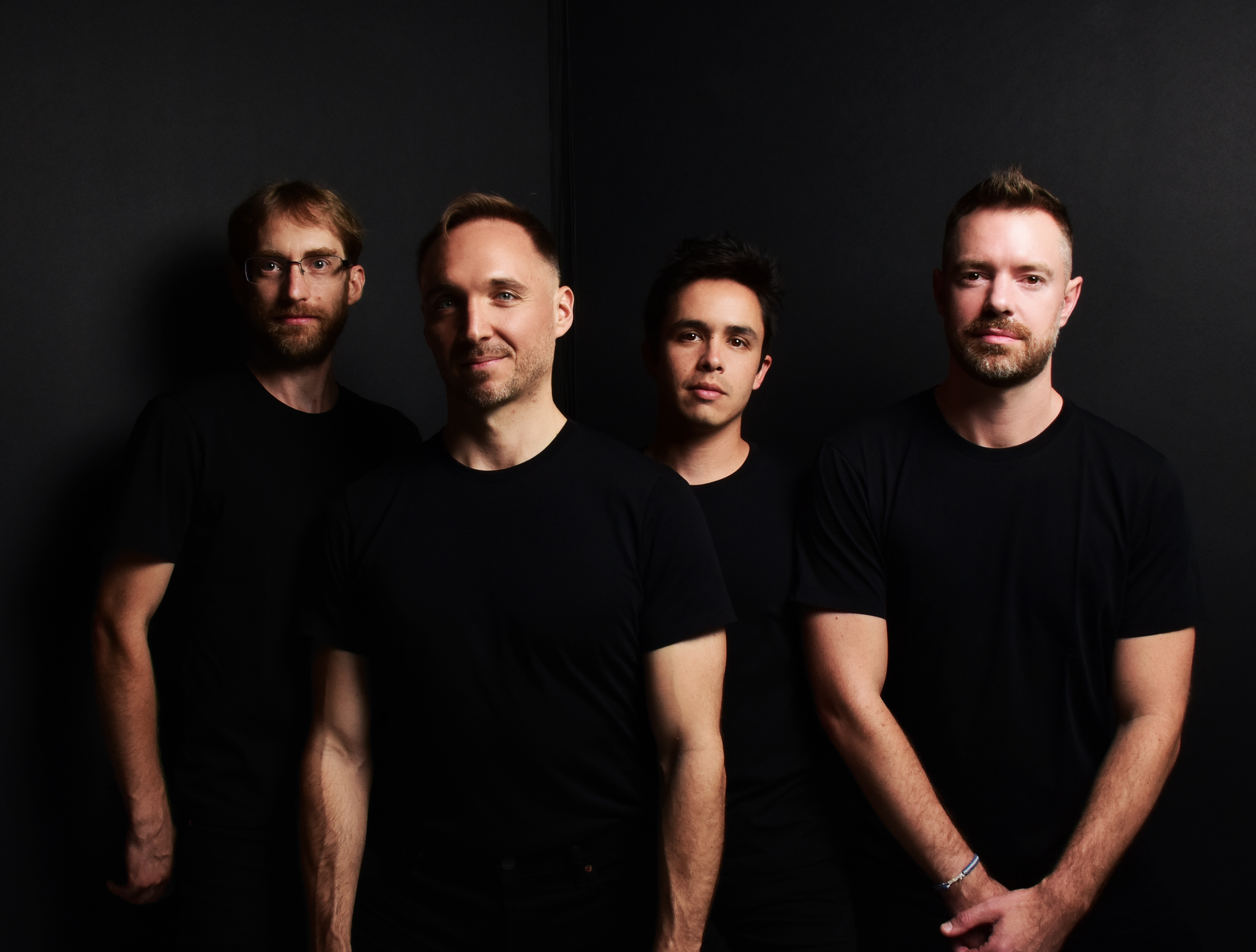
JACK Quartet. Photo by Shervin Lainez.
The concert opened with the only piece not by a living composer, Morton Feldman’s Structures for String Quartet from 1951. No recording can do justice to Feldman’s score, which is marked “as softly as possible.” You have to hear it live in a large hall, where you can physically feel the intimacy of the sound and let yourself be pulled into the world of Feldman’s music. The concentration of the players, and the balance they managed at such low volume was electrifying.
This performance would have pleased John Cage—he of 4’33” of silence—as it requires the listener to acknowledge the sound world around him. The cries of children in Chautauqua Park, the rustling of leaves outside and the murmuration of people inside, all became part of the experience, and served to elevate the music the more intently one listened.
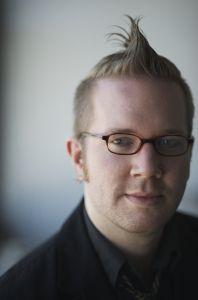
Caleb Burhans. Photo by Liz Linder
Contritus by Caleb Burhans was composed in 2010 to a commission from the quartet. The piece comprises three prayers of contrition that flow together in a single movement. It starts at about the volume of the Feldman, and you realize how intently you are attending to the music when it rises from just audible to a thunderous medium soft (mp).
The control of volume and the emotional ebb and flow here was remarkable, proving again the JACK’s finesse in music of the greatest delicacy. Indeed, if all caps represents shouting, maybe they should rename themselves “jack.” For me, and others I heard from, this was the most moving piece of the evening.
The music of Philip Glass is so well known to followers of new music—from tours by the Philip Glass Ensemble, to movie scores and operas—that his Fifth String Quartet (1991) was the least captivating piece on the program. Yet JACK found entirely the character of Glass’s music, the throbbing pulse, the surge and flows with in energized texture, and the sudden shifts in character.
As ever the music was at time hypnotic, conducive to reflection, always pleasing. But with Glass, I am never sure how much it adds up to. As section follows section, it’s hard to identify an overall structure, even when musical ideas return for the end. But if you enjoy Glass, this was a performance to be prized.
After an intermission, JACK returned to play Caroline Shaw’s appealing Entr’acte. Shaw is one of the most interesting composers working today, one who keeps the listener enough off balance that you never know what could be next. And whatever it is, it usually wears a smile and takes you by surprise.
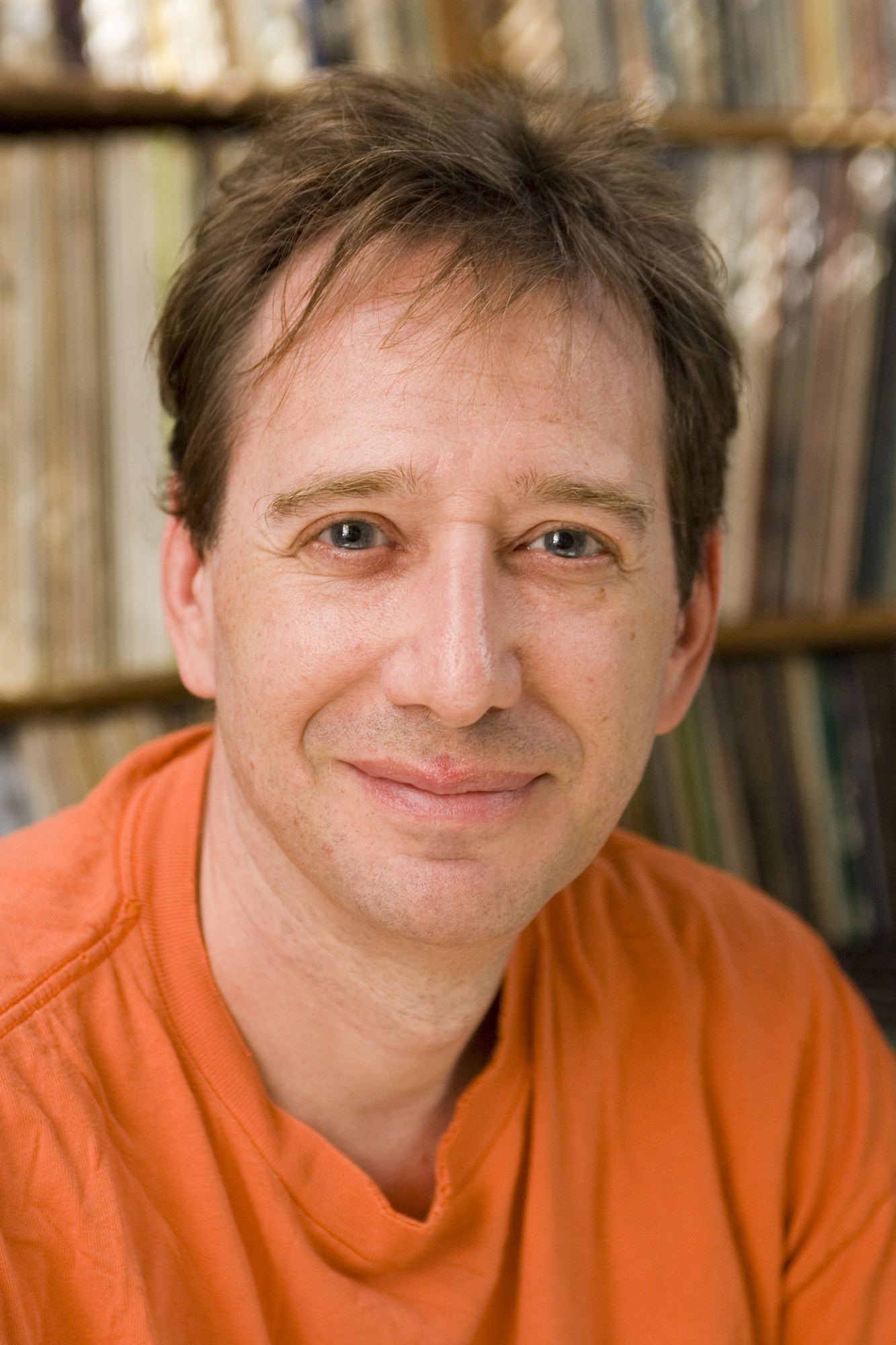
John Zorn
Entr’acte was inspired by Haydn minuets, and indeed contains Haydnesque moments of gentle humor as the music fades into and out of silence (silence again!). The more you think about Haydn while listening, the more you enjoy the piece. I could not imagine it played with more care , delicacy, or effectiveness.
The program closed with the most “New York” of the five pieces, John Zorn’s The Remedy of Fortune (2016). Here, it helps to know what the piece was composed for the Met Cloisters museum of medieval art and architecture in Upper Manhattan. In this score you can hear the bustle and cacophony of the streets of New York, with moments that recall the calm of the museum and the music of the Middle Ages.
As difficult and disordered as the music sometimes sounds, it was all under the fingers of the JACK Quartet players. One should listen beyond the frantic surface to hear the streams within in the notes. When heard in that spirit the performance was dazzling, and worthy of the cheers and standing ovation from the faithful audience of contemporary music fans. One wishes that more people had heard such a consummate performance, before strolling out into the cooling twilight at Chautauqua Park.
Superstar Joshua Bell shines, dramatic “Pictures” grasp audience
By Peter Alexander June 30 at 1:08 a.m.
The 2023 Colorado Music Festival summer concert series got under way last night (June 29) with an orchestra program that was everything music director Peter Oundjian had promised.
“I think its important,” he has said, that the festival should open with “a very welcoming opening night.” Which indeed it was: an opening flourish, a warm romantic violin concerto warmly played, and a popular orchestra showpiece. Could you ask for more?
Carlos Simon. Photo by Terrance Ragland.
The concert opened with an exciting piece not even two years old, Motherboxx Connection by American composer Carlos Simon. Commissioned by the Sphinx Organization and the University of Michigan Symphony, it was premiered in January, 2022.
Conceived as part of a multi-movement work titled TALES, Motherboxx Connection evokes, in the words of the composer, “multi-faceted aspects of blackness.” All scurry and brilliance, the score exploits the full orchestra. There are rushing strings; syncopated bursts of sound from the brass; chattering woodwinds; and punctuating percussion. Here it was played with brio and precision, providing a sparkling introduction to the 2023 festival.
The musical high point of the evening came with the introduction of violinist Joshua Bell to play Bruch’s dramatic and lushly Romantic Violin Concerto in G minor. Bell is known for his skill with the 19th-centruy Romantic style, and this concerto, composed in 1866, is a perfect match for his playing.
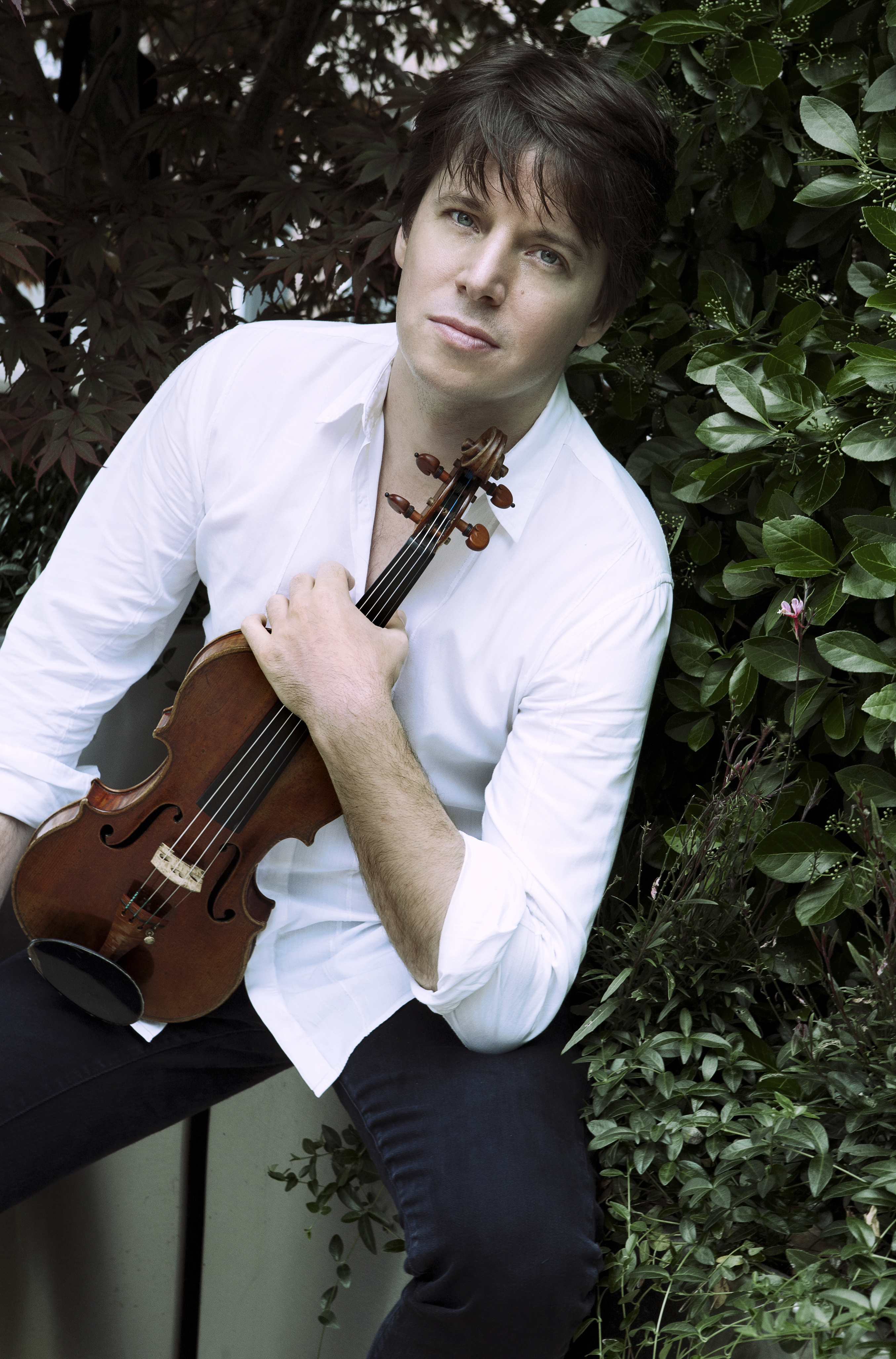
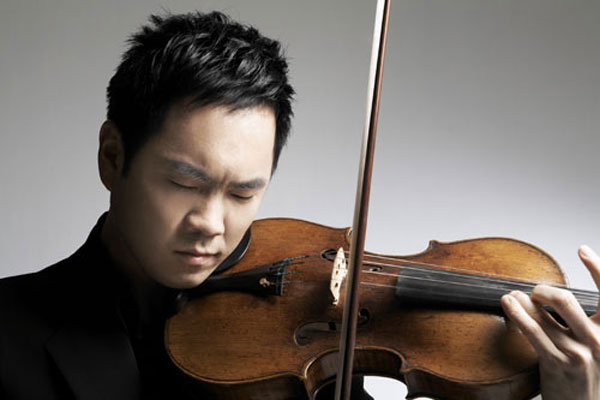
Joshua Bell. Photo by Lisa Marie Mazzucco.
From the very first note, deep in the violin’s lower register, Bell’s playing had a penetrating warmth and richness that brought the most lyrical moments to life. Here was the greatest virtue of the performance: the lyrical passages sang, and even the softest moments were well projected. Nor was Bell averse to the more heroic moments of this dramatic work, playing them with flair and intensity.
Conductor Peter Oundjian and the orchestra found all the drama and impact in the score. Bell was so well in accord with their interpretation that when not playing toward the audience, he often turned to Oundjian or the orchestra as if to connect more deeply with the other musicians on stage.
If there were any criticism of the performance, it would be that Bell’s playing was so controlled and lyrically shaped that the blazing finale seemed almost subdued. Indeed, you may hear more fiery performances of the Concerto, but you will never hear one more expressive and deeply felt.
Bell and Oundjian had an orchestral encore prepared, and it was one that spoke to the violinist’s strengths: the “Meditation” from Massenet’s opera Thaïs. Bell’s ability to sustain long, rhapsodic melodic lines and spin the softest phrases into silence made an unforgettable performance.
The concert concluded with Mussorgsky’s great showpiece Pictures at an Exhibition in the familiar Ravel orchestration. Never afraid to use the full force of brass and percussion, Oundjian achieved powerfully dramatic effects. I have never heard a more forthright and forceful opening “Promenade”: more than a stroll through the galleries, this was more of a robust hike. But all the better to contrast with the music that followed.
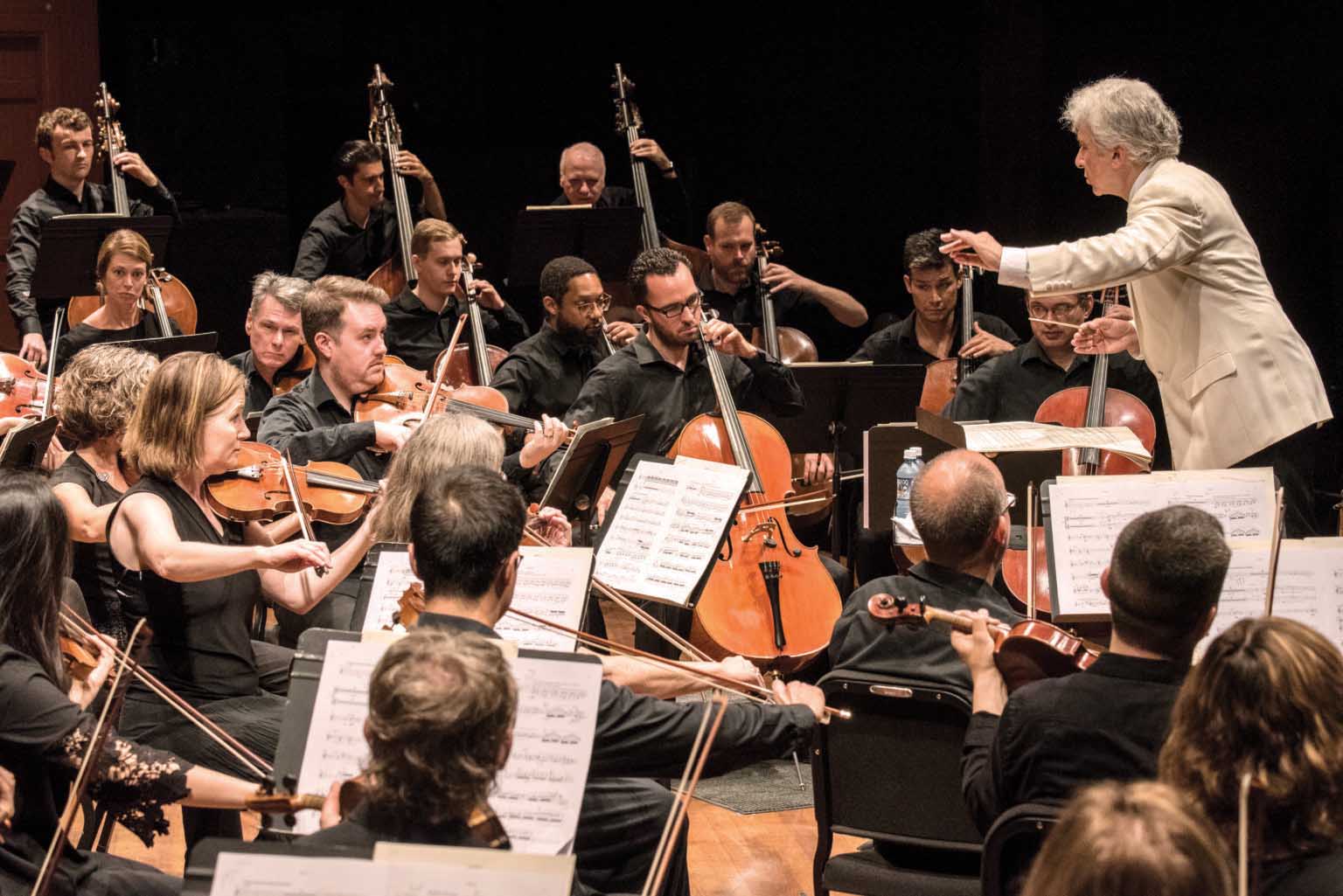
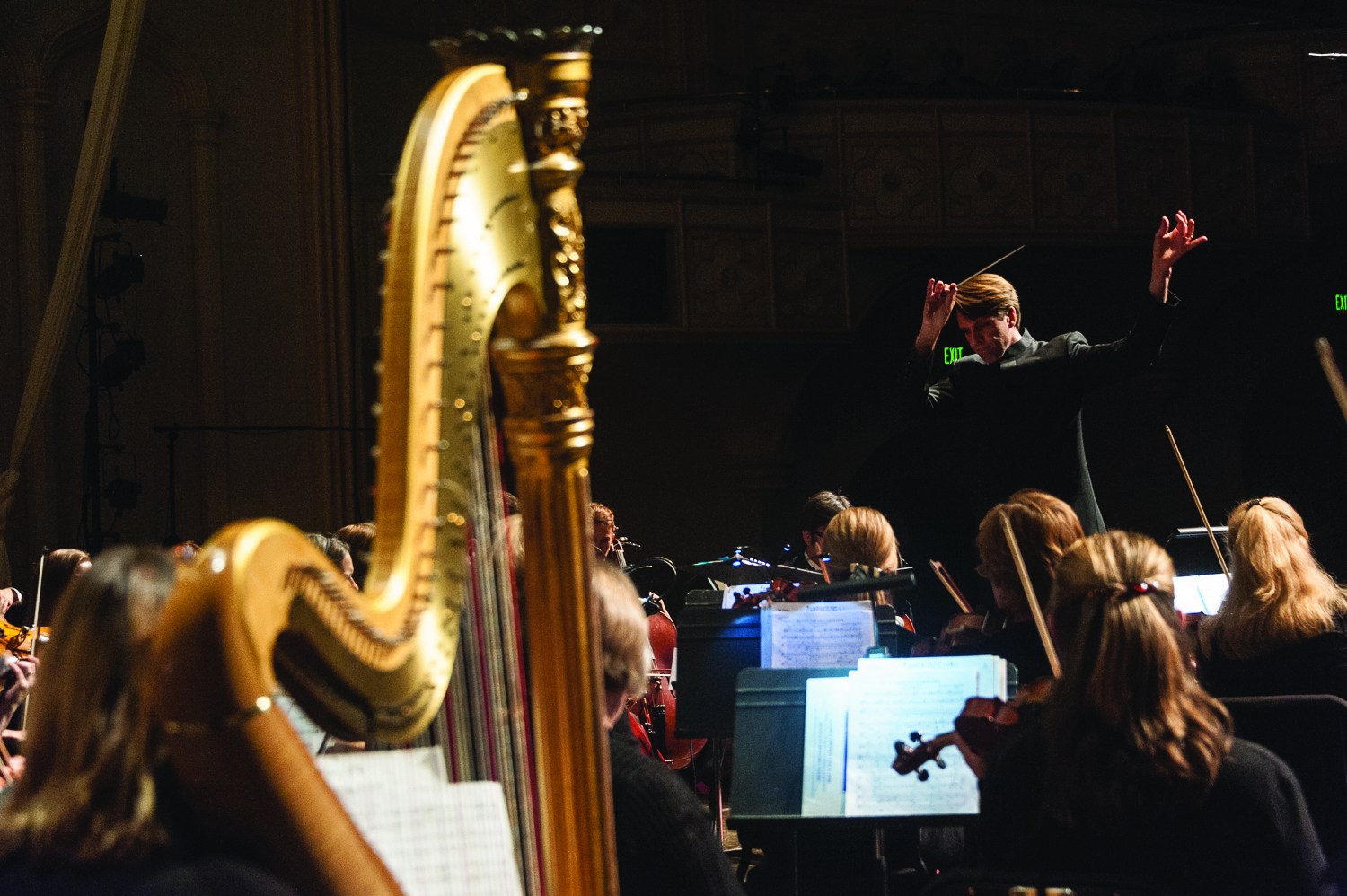
Conductor Peter Oundjian with the CMF Orchestra. Photo by Michael Ensminger.
From the boisterous “Children’s Quarrel” at the Tuileries, to the lumbering oxcart of “Bydlo,” to the delicate “Ballet of Unhatched Chicks,” Oundjian and the orchestra found a strongly characterized sound for each movement. The catacombs were suitably hushed and eerie, and I’m not sure I have ever heard a more violent “Baba Yaga’s Hut.” The entrance into the final sketch, “The Great Gate of Kiev,” was carefully held back, allowing the music to build over time.
With careful control, the “Great Gate” can hardly fail, and it did not. The climactic final chords had exactly the effect that Oundjian—and Ravel—wanted. The audience went away energized. And the festival is off to a scintillating start.
NOTE: The same program will be repeated tonight (June 30) at 6:30 p.m. Ticket are available from the Chautauqua Box Office.
A FINAL DRAMATIC TOUCH: Only in Boulder? Departing patrons were greeted by blazing lights, flashing police cruisers, and a detour from the sidewalk. During the concert a bear had taken up residence in a tree on the Chautauqua grounds. This was just the extra drama a music festival should have at the base of the Flatirons!
Story of a friendship that bridges suffering during Afghan wars
By Peter Alexander March 6 at 11:48 p.m.
Seattle Opera has premiered a powerful and deeply affecting new opera by the composer Sheila Silver.
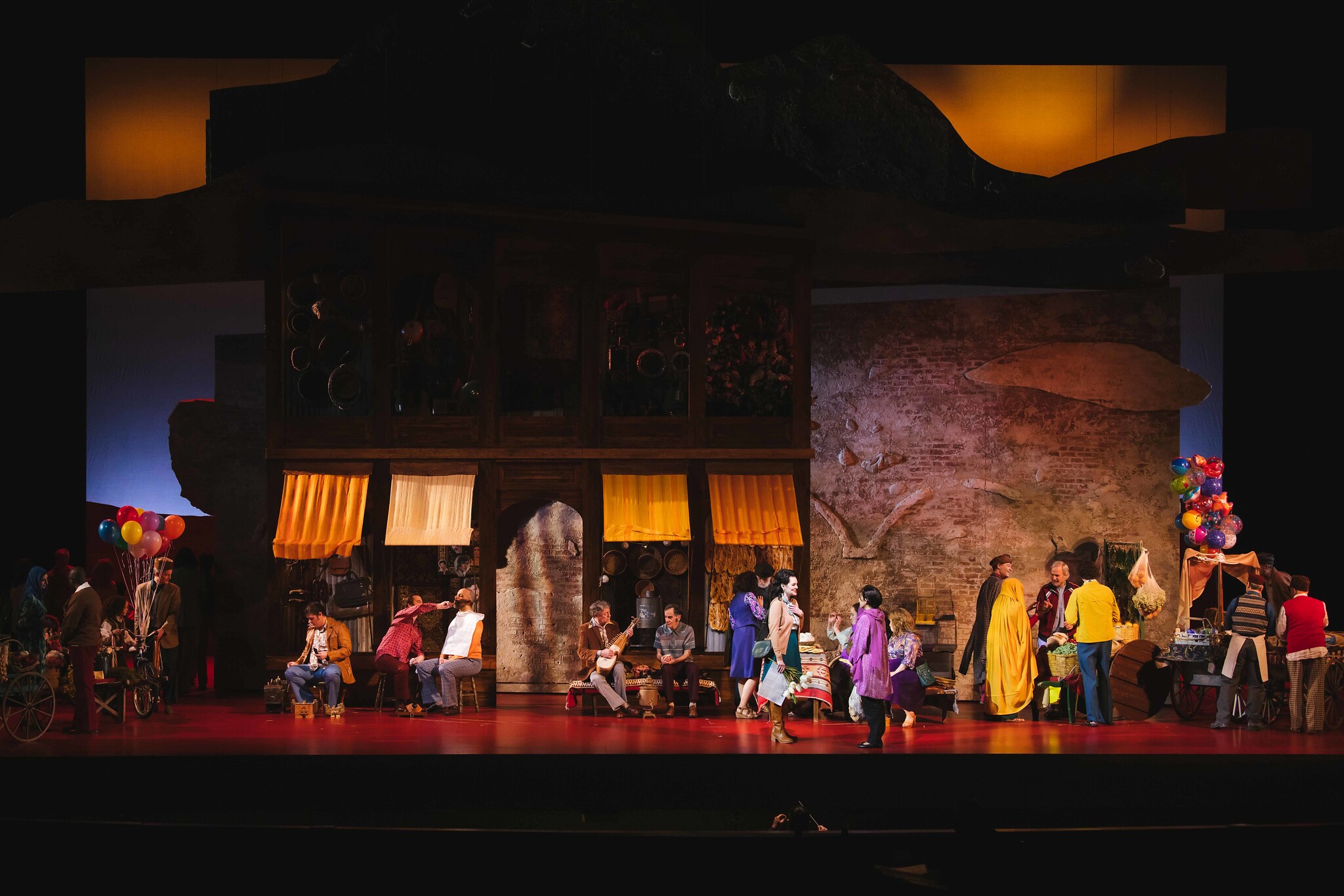
The Market scene from Seattle Opera’s production of A Thousand Splendid Suns. Photo by Sunny Martini
A Thousand Splendid Suns, which premiered at McCaw Hall Feb. 25, is based on the novel of the same name by Afghan-American writer Khaled Hosseini. It tells the story of Mariam and Leila, two Afghan women a generation apart who share the same abusive husband and forge a friendship that bridges deep suffering and personal sacrifice.
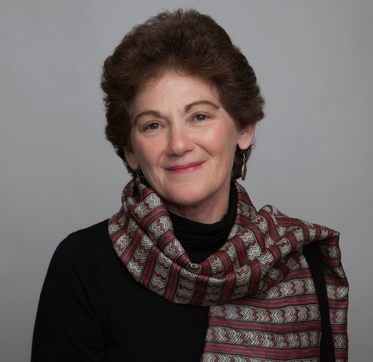
Composer Sheila Silver
Hosseini’s novel has been skillfully adapted by librettist Stephen Kitsakos, keeping the major characters and focusing the emotional arc of the story. A tough read, the book vividly describes the suffering, especially of women, amidst the horrors of the Soviet-Afghan war and the takeover by the Taliban.
The opera portrays the same events, but Silver’s evocative music provides a sense of beauty that allays some of the brutality inherent in the plot. Silver—a composer previously unknown to me—studied Hindustani music in India for this opera and skillfully incorporates south Asian elements to evoke the setting.
The orchestra, enhanced by various hand drums, Tibetan bowls, bansuri flutes and sparkling percussion, creates moods convincingly. This is especially notable in the beautiful passages depicting nighttime, and at the end, when the otherwise bleak final scene is infused with a bright serenity and hope.
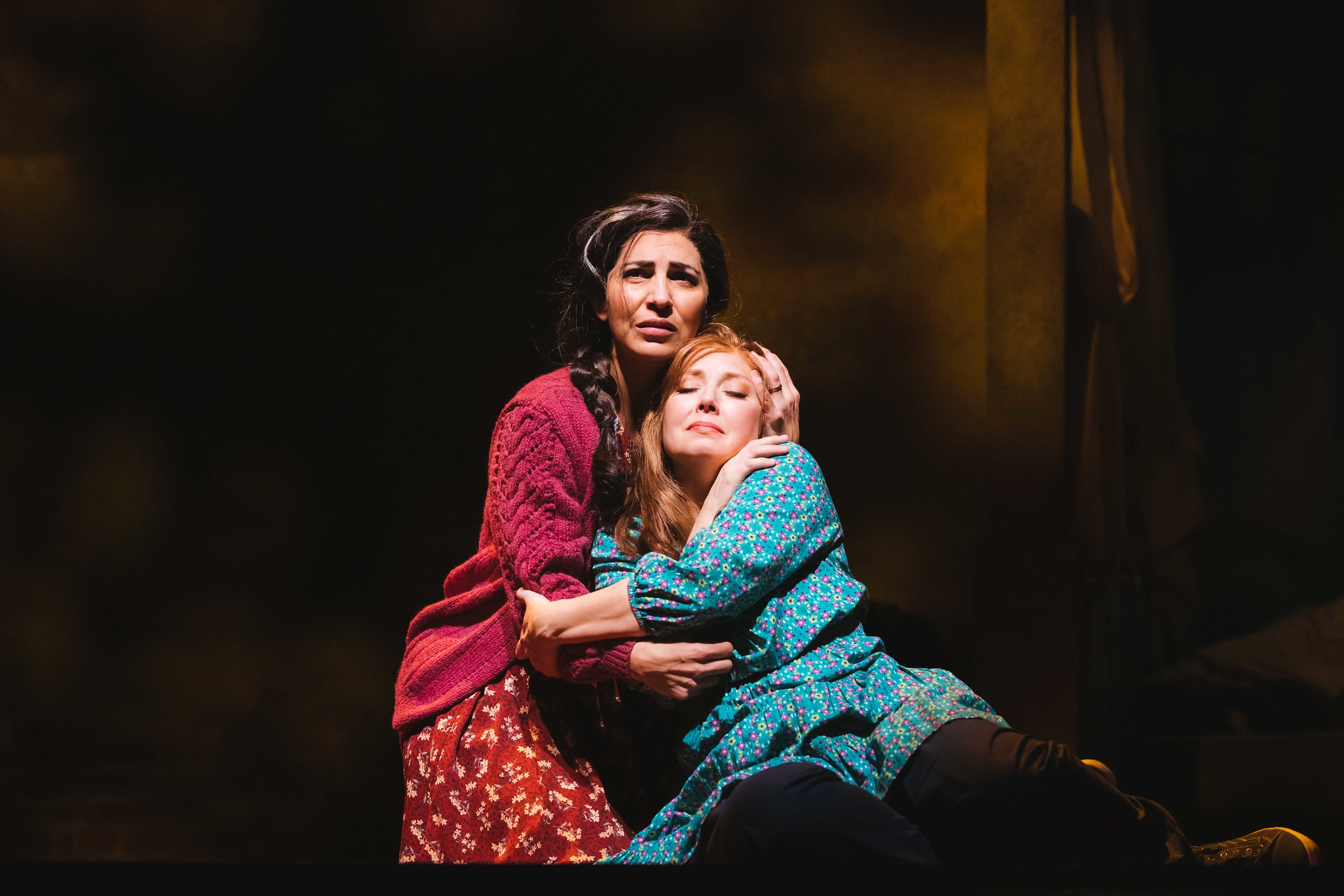
Mariam (Karin Mushegain) and Laila (Maureen McKay). Photo by Sunny Martini.
If the vocal lines are less memorable, they fit the text well and are imminently singable, with no treacherous leaps or jagged lines. Extreme registers are reserved for extreme emotions. Duets between Mariam and Laila are especially moving. This is an opera that communicates directly with the audience and should be accessible to most listeners.
Mariam, the older of the two women, carries the emotional weight of the opera, as she progresses from a spirited teenager, through disillusionment to seething resentment and a final moment of fury. Seattle Opera is fortunate to have mezzo-soprano Karin Mushegain for this crucial role. The night I attended (March 3), Mushegain not only carried the opera handily; she provided a vivid portrayal of Mariam at every stage, singing with conviction and strength. Hers is an impressive talent, vocally and dramatically.
Laila is a more conventional operatic part—a young girl overcome with a love that she holds onto and that gives her the courage to survive. Soprano Maureen McKay brought a lovely sound to this more limited role, singing brightly and sensitively. Her love interest, Tariq, has the most conventional music of all. Rafael Moras sang his ardent declarations of love with a soaring Italianate tenor that was not out of place. Laila’s and Tariq’s duets were among the highlights.
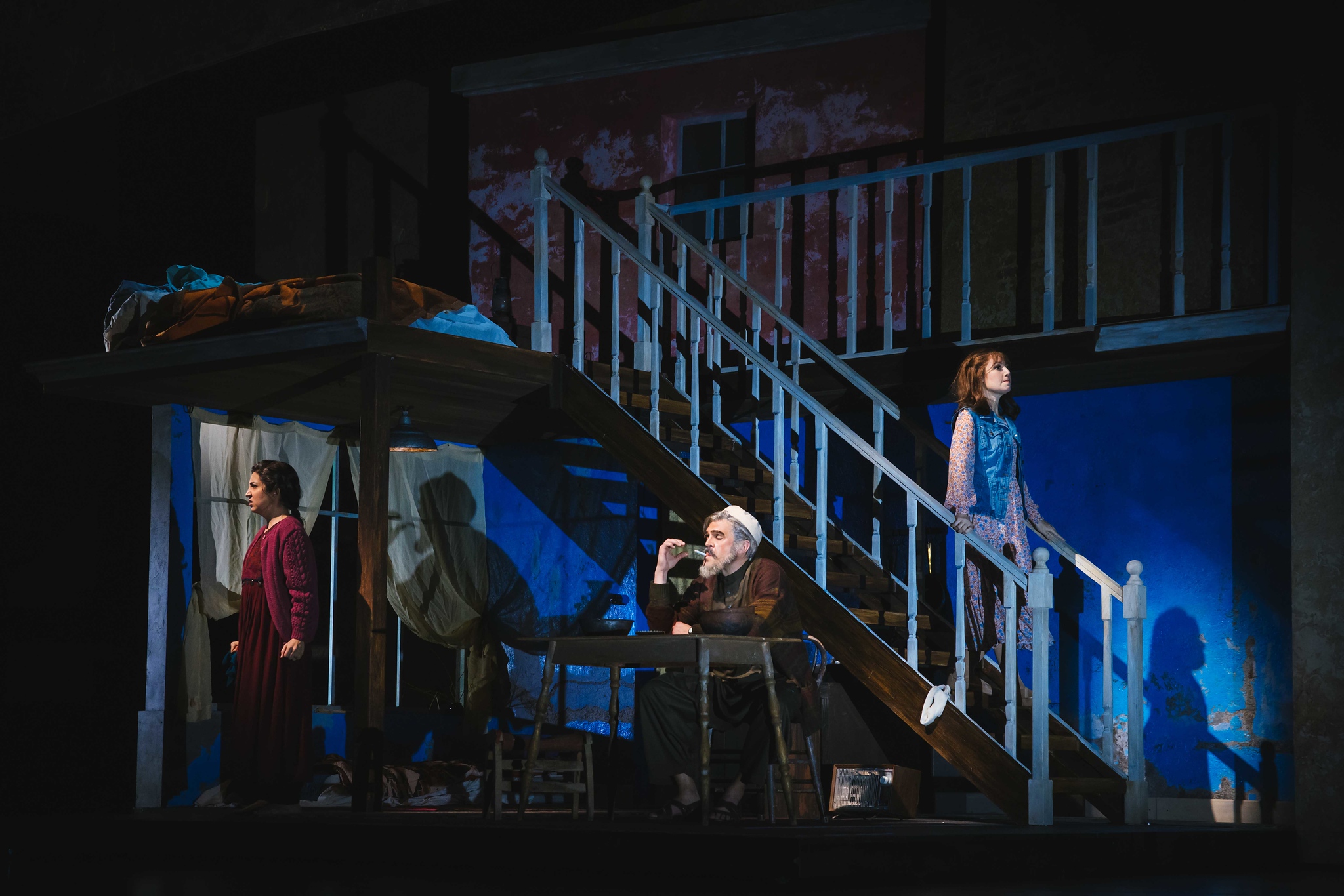
Rasheed (John Moore, center) at home with Mariam (Karin Mushegain, l.) and Laila (Maureen McKay, r.). Photo by Sunny Martini.
Another crucial role is Rasheed, the brutal husband of Mariam and Laila. He is the opera’s villain, treating both women with cruelty. John Moore used his baritone to convey Rasheed’s roughness, but moderated his sound to a more tender, lyrical style, first for Laila and then for his son, whom he favors above his wives and daughter. He so effectively conveyed the ugliness of Rasheed’s character that his death was the first I have seen applauded in an opera house.
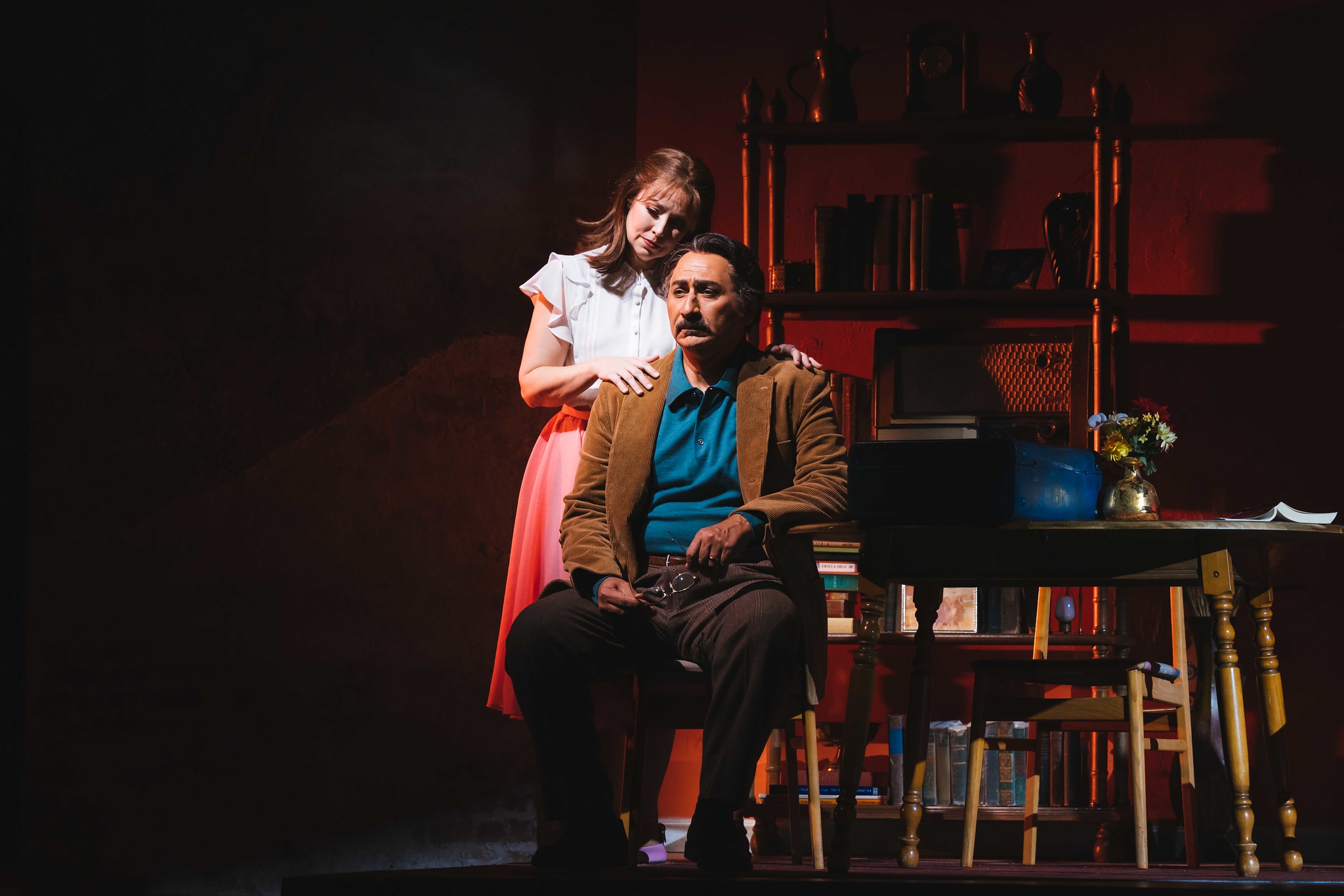
Laila (Maureen McKay) and Hakim (Ashraf Sewailam). Photo by Sunny Martini.
Ashraf Sewailam, known to some readers here as a CU graduate and veteran of Central City Opera, portrayed one of the few likable male characters—Laila’s refined and progressive father, Hakim. He sang beautifully, using his resonant bass to create contrast with the violence that surrounds his family. The smaller parts were all filled effectively, raising the entire cast to a high level.
The production was stage directed by Roya Sadat, an Afghan film producer and director who was chosen for her insight into the culture and environment of Afghanistan. She made good use of the space provided by set designer Misha Kachman.
The realism of Kachman’s designs contributed to the impact of the opera, as they recalled photos we have seen of the violence in Afghanistan. Coincidentally, the opera appears just as Taliban control, apparently broken after the opera ends, has returned with renewed oppression of women. Thus A Thousand Splendid Suns is again as timely as ever.
The sets were at times minimal but always highly effective. One scene set in a neighborhood market was especially eye-catching. Deft touches included the turning of the wall of Rasheed’s house to show how the blank exterior conceals the troubled interior. A swing, hung from a disembodied tree branch, served to remind the audience that there were always children near the center of the action.
A special word about lighting designer Jen Schriever: there were moments of mesmerizing beauty in her lighting plot, particularly in the portrayal of night and the colors of the sky. In the splendidly lit final scene, Mariam seemed both radiant and weightless.
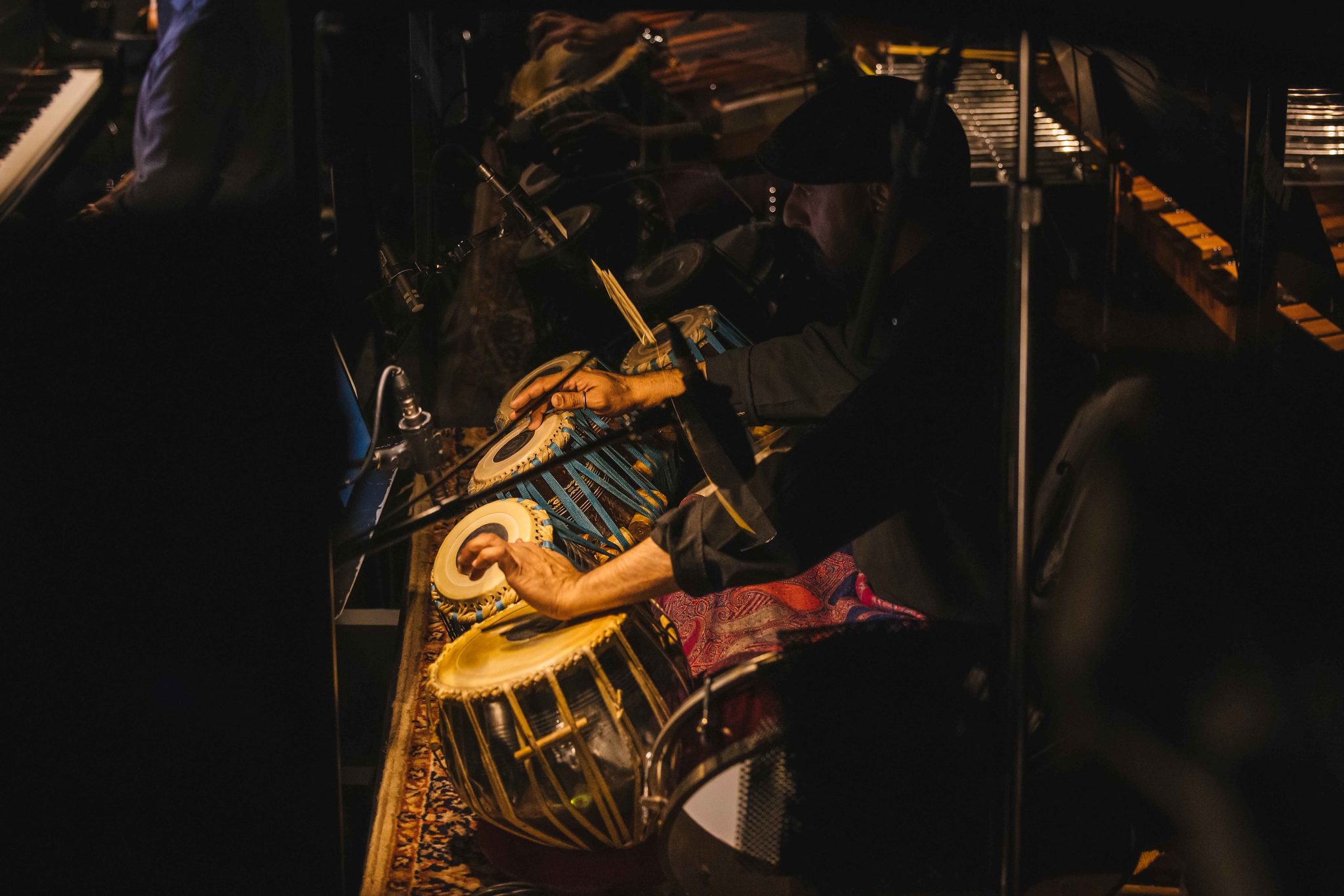
Deep Singh plays tabla in A Thousand Splendid Suns at Seattle Opera. Photo by Sunny Martini.
Conductor Viswa Subbaraman held the disparate musical threads together well: singers, orchestra, south Asian instruments. Hearing an opera for the first time it is difficult to judge interpretation, but the momentum never flagged. Thanks to Silver’s effective scoring, the singers were largely audible, with heavy brass sounds reserved for moments of violence or threat. Sound designer Robertson Whitmer should be recognized for pulling the hand drums and the bansuri flutes, each in isolated spaces that were miked, into balance with the full orchestra.
Representatives of other opera companies attended Seattle’s performances. I hope they will take up A Thousand Splendid Suns in the coming seasons. A powerful telling of an ultimately beautiful story, it delves into the human tragedy that often accompanies the news. The Seattle audience’s response, whether applauding Rasheed’s death or gasping at the unexpected reappearance of a character, showed how deeply they were drawn into the story.
# # # # #
A Thousand Splendid Suns by Sheila Silver Libretto by Stephen Kitsakos Seattle Opera Viswa Subbaraman, conductor Roya Sadat, stage director
Remaining performances: 7:30 p.m. Wednesday, March 8 TICKETS
Opera Colorado opened their new production of Erich Wolfgang Korngold’s Die tote Stadt under difficult circumstances Saturday (Feb. 26): last- minute vocal paralysis of the star soprano, Sara Gartland.
Her indisposition was capably overcome with the help of dramatic soprano Kara Shay Thomson and some artful directorial sleight-of-hand. Thomson, who didn’t have time to learn the staging but knew the music, sang from the pit while Gartland acted the role onstage.
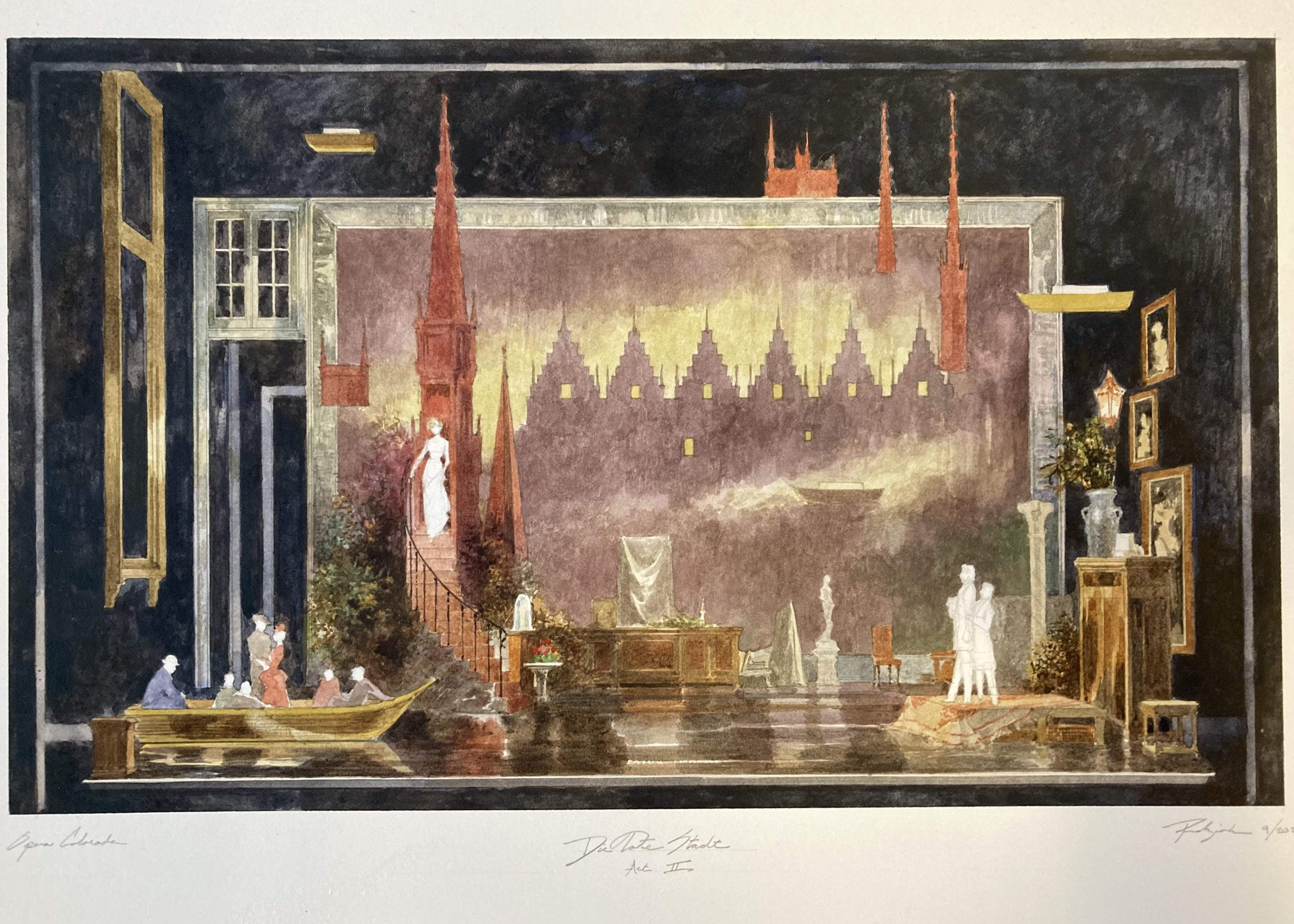
Die tote Stadt: Act II scene rendering by Robert Perdziola
Korngold wrote Die tote Stadt in 1920, when he was only 23, and later went on to write hugely successful Hollywood film scores, winning two Academy Awards. Unsurprisingly, the score of Tote Stadt has an expressive immediacy that connects with audiences.
The opera, too long neglected, soared in a beautifully designed and conceived production that featured a generally strong cast. Conductor Ari Pelto kept things well under control. He and the orchestra seemed comfortable with Korngold’s cinematic and emotionally descriptive style.
Robert Perdziola’s beautiful and evocative designs colorfully combined the interior of protagonist Paul’s apartment and a replica the O.L.V.-Kerk (Church of Our Lady) church tower in Bruges, Belgium, the symbolically “dead city” of the opera’s title. A large scrim at the back allowed for spectral appearances from his fantasies, including his beloved late wife Marie and a procession of nuns that appear during his fevered dreams.
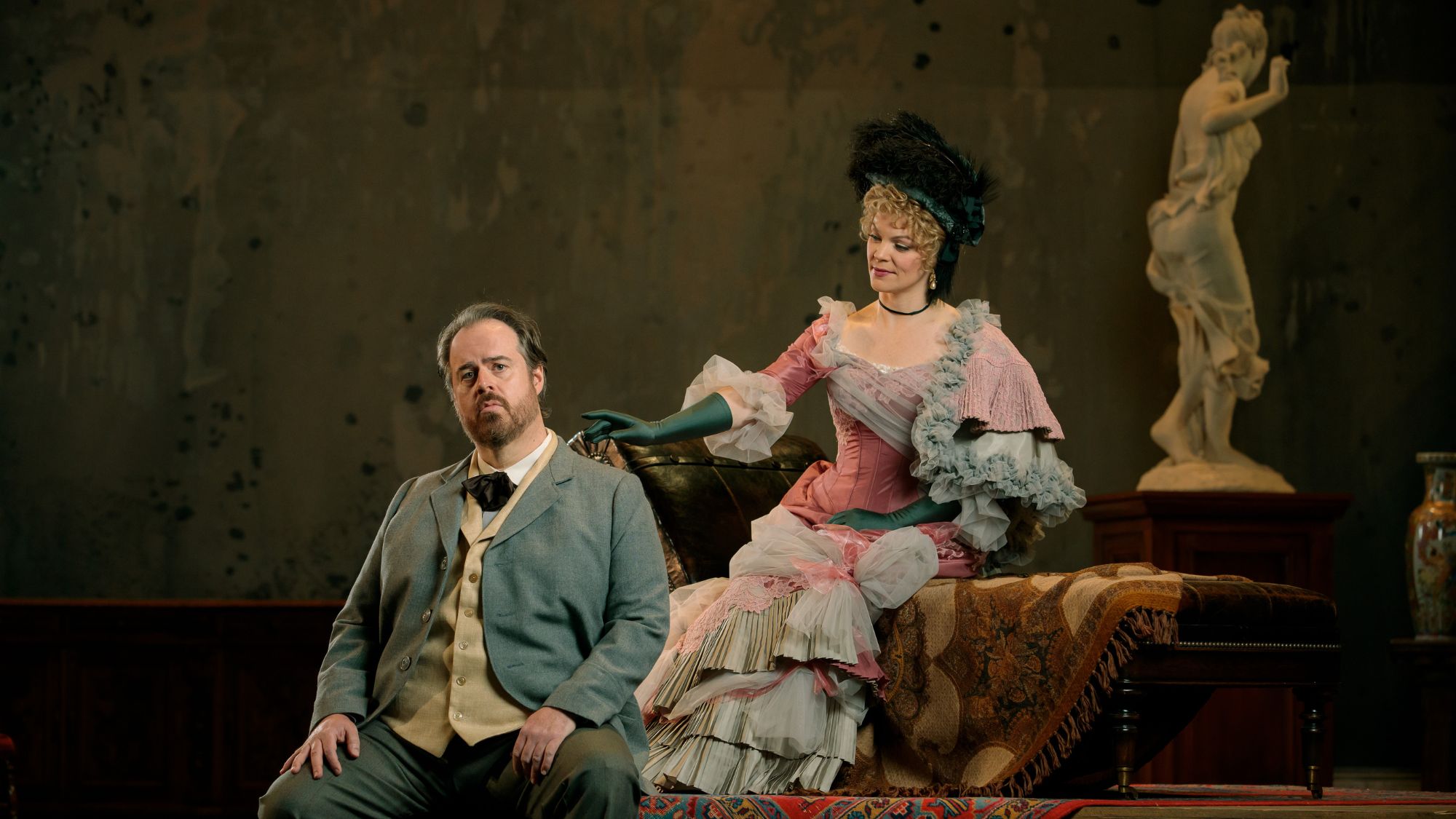
Jonathan Burton (Paul) and Sara Gartland (Marietta/Marie). Photo courtesy of Opera Colorado
This unit set served all three acts effectively, with plenty of room for the scene to shift from Paul’s artist’s studio to the canals of Bruges. A boat with dancers and commedia dell’arte characters and the procession of nuns parade in and out of the scene, as they do through Paul’s nightmares.
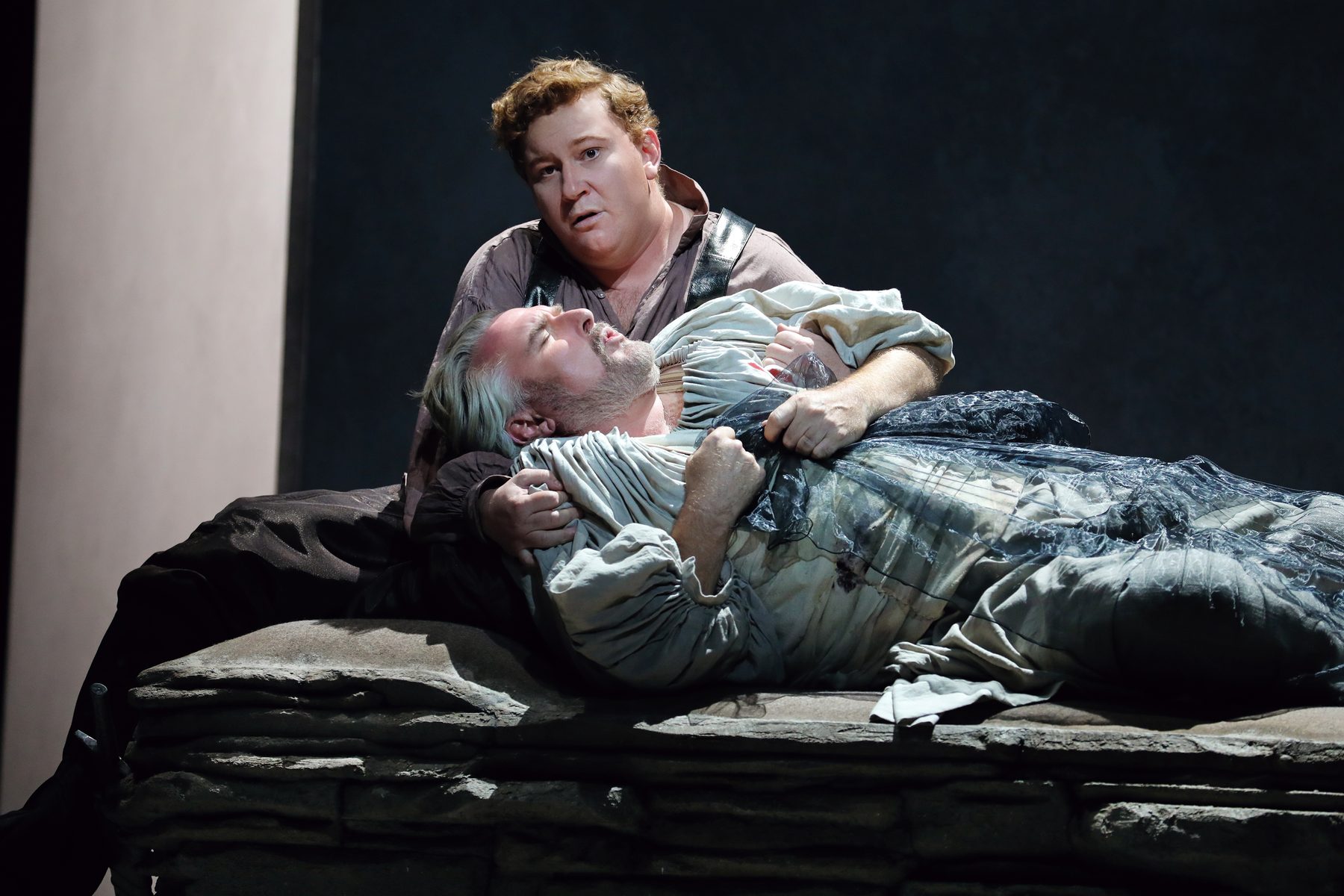
With a ringing sound and a secure top, tenor Jonathan Burton was effective in the long and difficult role of Jonathan, a young artist who suffers delusions that Marie has returned to life. His belief that the dancer Marietta is Marie reincarnated is the dramatic crux of the opera and places Paul at the emotional center. The Heldentenor demands of the part stressed his voice by the end, although the resigned reflection of his final scene came through affectingly.
He was a better singer than actor; the intensity of his role, as Paul spins into madness, came through more potently in his singing than his movements or posture. That may be why a moment that should be chilling—when a maddened Paul dreams that he has strangled Marietta and, imagining the corpse at his feet, sings “now she is exactly like Marie”—elicited out-of-place laughter from the audience.
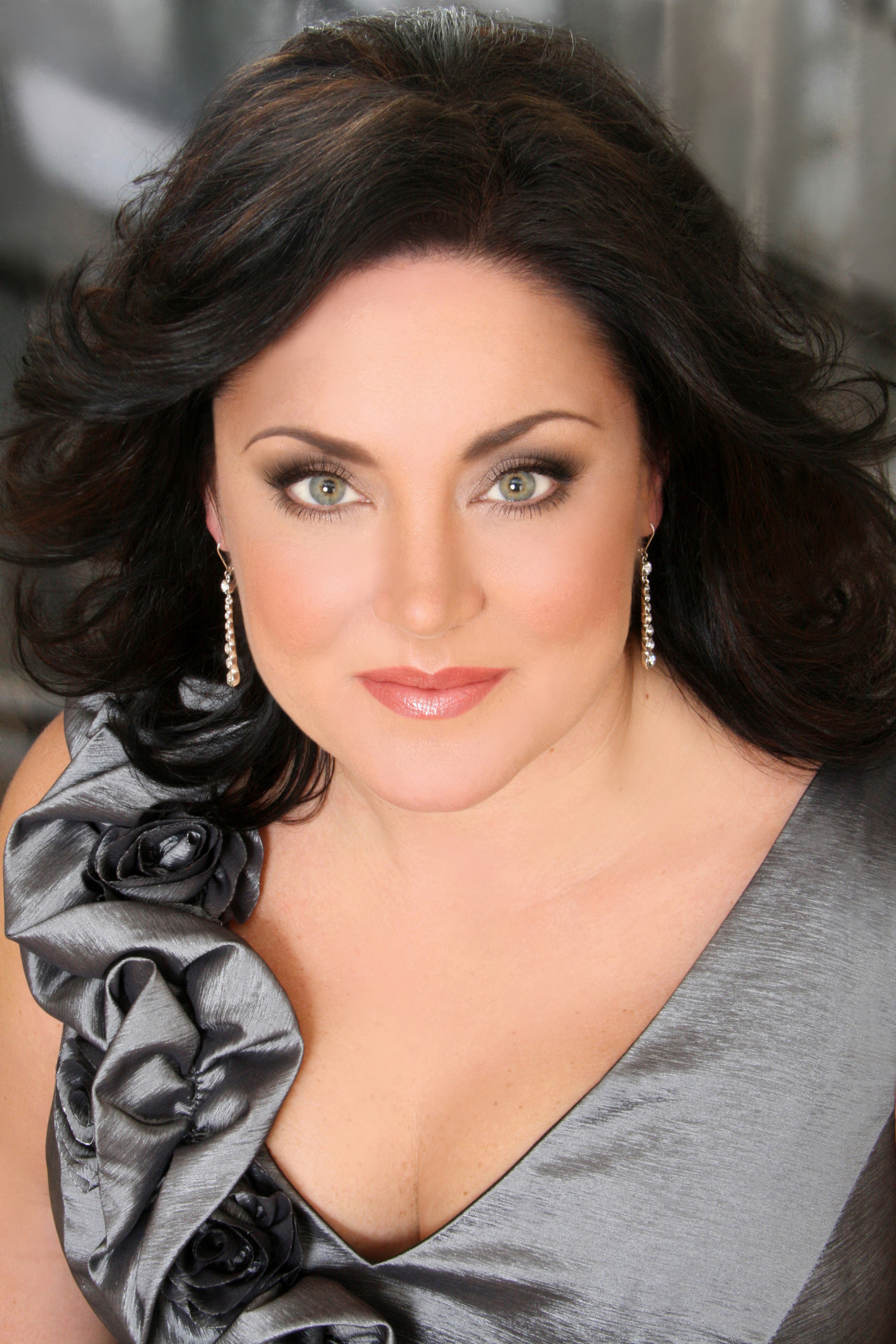
Kara Shay Thomson. Photo by Devon Cass
Singing as Maria/Marietta, Kara Shay Thomson was at a disadvantage standing in a corner of the pit. Neither elevated above the orchestra nor singing out toward the audience, she was not always clearly audible. If the words were sometimes muffled, she sang the role with confidence and solid sound, ascending comfortably to the highest reaches of the part.
The vocally indisposed Sara Gartland was the very image of the dancer Marietta. She moved comfortably about the stage, and her emotions were often visible in her posture. It is difficult to maintain the intensity of a role when only mouthing the words, and she did not always succeed, but her dance scene in Act II was effective.
Baritone Daniel Belcher has a bright, steely voice well suited to his part as Frank, Paul’s friend. He ably conveyed Frank’s stability and groundedness in dealing with Paul’s delusions. As Brigitte, Paul’s housekeeper, Elizabeth Bishop’s warm, plush voice helped shape her role as a caretaker. She had the best diction of the cast; otherwise you would have had difficulty relying on the German text to follow the story. Young tenor Jonathan Johnson made a solid impression as Viktorin, director of Marietta’s dance company.
Stage direction by Chas Rader-Shieber served the story. The large stage area never looked too wide as the singers interacted. Only when the singing Marietta was in the pit on one side of the stage while the acting Marietta was on the other was there any (unavoidable) awkwardness.
NOTE: In the second act, Marietta dances a scene with shrouded nuns that might not make sense to modern viewers. This scene comes from a French grand opera, Robert le diable (Robert the devil) by Giacomo Meyerbeer. In that original scene—a third-act ballet that would have been familiar to Korngold’s 1920s audiences—dead nuns rise from their graves to perform a scandalous dance celebrating drinking, gambling and lust. The choice of this scene to fuel Paul’s imagination of Marietta and her company is deliberately provocative and suggests Marietta’s debased character, Paul’s derangement, or both.
Before the curtain, Opera Colorado artistic director Greg Carpenter came onstage to thank the opera company’s board for agreeing to present his “favorite opera.” I join in his appreciation, for being able to see an opera that I had never before seen live, produced on a high professional level.
If you love opera, you should not miss the opportunity to see this engaging, late-Romantic work that is rarely performed in the United States. Three performances remain at Opera Colorado (Feb. 28, Match 3 and March 5; details and tickets HERE).
# # # # #
Opera Colorado Die tote Stadt by Erich Wolfgang Korngold Libretto by Paul Schott (Erich and Julius Korngold) Ari Pelto, conductor; Chas Rader-Shieber, director
REMAINING PERFORMANCES: 7:30 p.m. Tuesday, Feb. 28, and Friday, March 3 2 p.m. Sunday, March 5
Ellie Caulkins Opera House, Denver Performing Arts Complex
Performances in tonight in Boulder, Denver Dec. 16–18
By Izzy Fincher Dec. 15 at 11:12 a.m.
A grand procession of extravagantly dressed kings moved through the church.
King Balthazar took the lead, dressed in a crimson robe and headdress covered with gold. Then, came King Kaspar, clad head-to-toe in gold and jewels, and finally King Melchior, with a silky, turquoise and plum colored cape and plumed warrior’s helmet. They each carried luxurious gifts intended for the baby Jesus, including gold, frankincense and myrrh.
This scene took place during Central City Opera’s performance of Amahl and the Night Visitors by Gian Carlo Menotti last night (Dec. 13) at Boulder’s First United Methodist Church. The performance, directed by Iliana Lucero Barron and conducted by John Baril, offered a heart-warming interpretation of the seasonal classic, filled with the magic of the holiday spirit.
Aside from the luxurious Magi’s costumes, the production took a minimalistic approach, letting Menotti’s masterfully written music shine through as the central storytelling element. The performance will be repeated in Boulder tonight before heading to Denver for three shows, Dec. 16–18.
Originally commissioned by NBC as the first opera for television in 1951, Menotti’s Amahl and the Night Visitors has since become a beloved Christmas tradition. It tells the story of Amahl, a poor shepherd boy with a disability who lives with his widowed mother. One fateful night, the three Magi stop at Amahl’s house to rest on their way to Bethlehem, leading to a miraculous encounter that changes the young boy’s life.
Over the past 70 years, the opera is said to have been performed more than 2,500 times—in a wide variety of settings from professional opera houses to amateur church and school performances. Over the years, the brief one-hour opera in English, originally intended for children, has proved accessible and enjoyable for diverse audiences of all ages.
For this traveling production, Baron wanted to keep the props and sets to a minimum, to more easily adapt to different venues and offer creative flexibility to the performers. This approach resulted in a rather bare-bones aesthetic. Onstage, the main set piece for Amahl’s house consisted of a wooden door frame, surrounded by stacks of firewood and topped with a hanging sheet. Nearby, stood a few makeshift wooden chairs. This simple set left the stage looking almost too empty, though the church’s massive wooden overhanging cross and towering pipe organ filled out the space.
In the opening scene, Kason Nicholas, a boy soprano from the Colorado Children’s Chorale, established himself as a charming Amahl. Though he seemed a bit hesitant at first, his excitement and well-placed comedic timing soon proved endearing. With his light, clear voice, Nicholas required amplification in the large chapel, especially singing alongside the powerful mezzo-soprano Jennifer DeDominici as his mother. During their duets, their voices sounded well-balanced for the most part, though a few times Nicholas’ higher notes clipped slightly with the mic.
DeDominici delivered a convincing, nuanced interpretation of Amahl’s mother, realistically portraying her struggle as a single impoverished mother trying to care for a mischievous son with a disability. Her powerful, expressive voice projected through the chapel, commanding Amahl’s and the audience’s attention as her patience wore thin.
Yet, in brief moments, she showed glimpses of tender love for her son, such as in “Have You Seen a Child” when the three Magi’s descriptions of the holy Christ Child remind her of Amahl. In the final scene, DeDominici shined during one of the opera’s few deeper moments, as she grappled with her inner turmoil and feelings of desperation, love and greed before attempting theft for the sake of her son.
Accompanying these strong soloist performances, Baril’s orchestra, sprawled across the front section of the church pews, sounded wonderful. As the conductor, Baril took full advantage of Menotti’s adept score writing, exploring the different colors and personalities within the music for each character and perfectly timing the comedic musical interchanges with the singers’ lyrics and blocking. In addition, the shepherds chorus and the First United Methodist Church choir sang skillfully and with passion, aiding in the collaborative effort.
The three Magi, played by Paul Griggsby, Javier Abreu and Jonathan Hays, and their page, Jerome Síbulo, gave solid performances as well. In stark contrast to the humble lives of Amahl and his mother, the kings stood out as symbols of opulence, with their lavish costumes and props as the most eye-catching part of the show. They embodied the grace of nobility, singing clearly and powerfully with a beautiful blend as a cohesive unit. Throughout the opera, they played their crucial role well.
Despite bringing splendor into Amahl’s simple world, the Magi show him and his mother that the true meaning of the Christmas miracle lies not in wealth but in forgiveness, grace and love.
# # # # #
Gian Carlo Menotti: Amahl and the Night Visitors Central City Opera, John Baril conductor and Iliana Lucero Barron, director
Remaining performances:
7:30 p.m. Wednesday, 14 First United Methodist Church, Boulder TICKETS
7:30 p.m. Friday and Saturday, Dec. 17 and 18 2 p.m. Sunday, Dec. 18 Trinity Methodist Church, Denver TICKETS
Folkish new piece by UC grad Ben Morris, “utterly enjoyable” concerto by Florence Price
By Peter Alexander Nov. 20 at 12:15 a.m.
Last night (Nov. 19) conductor Cynthia Katsarelis and the Pro Musical Colorado Chamber Orchestra opened their 2022-23 concert season in the newly-renovated sanctuary of the Mountain View Methodist Church in Boulder.
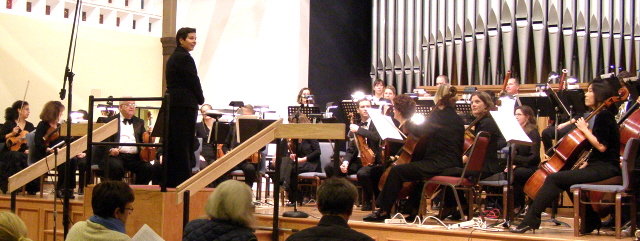
Cynthia Katsarelis and the Pro Musica Colorado Chamber Orchestra
Venue renovations often bring gains and losses, and this was no exception. This is worth noting, because the Mountain View church is being used more as a concert venue. It is a visually attractive space, and offers about the best parking of any venue in Boulder.
The carpet has been removed and replaced with a hard wood floor, and the pews have been replaced with reasonably comfortable chairs, which is all to the good. The sound is much more lively than before, and it may take performers a while to adjust to the new acoustic. Balance is problematic, as the strings had a hard time being heard over the boosted wind sounds. The wood floor certainly beefed up the bass, although not always in a helpful way. In time performers will likely adjust to the increased resonance.
Ben Morris
The concert opened with the world premiere of The Hill of Three Wishes by Ben Morris, winner of the 2021 CU composition Competition. Reflecting the legend of Helgafell , a magical hill in Iceland that grants three wishes to anyone who can walk to the top without looking back, the score has an attractive folkish quality. It is written in a modal style that avoids harsh dissonance and welcomes listeners.
Morris makes great use of instrumental sounds to create a mythic quality that Katsarelis compared to The Lord of the Rings. Opening brass gestures establish the setting. An ancient Icelandic folk song adds a sense of timelessness, and at the end the music drifts atmospherically into silence. From the score I couldn’t tell if Morris was granted his wishes—did he, like Orpheus, submit to the temptation to look back?—but the hike is clearly a pleasant one. The brief score should find willing performers and audience enjoyment.
Another rare adventure was provided by the Piano Concerto in One Movement by Florence Price, whose music from the early 20th century was once forgotten but is being rediscovered. The first African American woman to have her music performed by a major orchestra when her First Symphony was premiered by the Chicago Symphony in 1933, Price was a skilled and accomplished composer. The concerto is symbolic of her fate: the full orchestral setting was lost and only rediscovered in 2019. Pro Musica is among the first to perform it as originally written.
The concerto is, however, misnamed as it is not truly in one movement. There is a clear cadence and break between the first and second movements, and the dramatic transition from the slow movement to the lively finale parallels many classical concertos. Like many of Price’s works, the score draws on her African American heritage, from the bluesy trumpet and trombone riffs at the outset, to the slow movement that channels dozens of great spirituals, and the juba dance finale that could easily be mistaken for a Joplinesque rag. This is a unique and valuable part of our country’s musical history.
Jennifer Hayghe
Pianist Jennifer Hayghe gamely tackled the difficult solo part—Price herself was a virtuoso pianist—but while she started with a resounding first entrance, at other times balance issues prevented her playing from being clearly heard. Moments of lighter orchestration, with the piano against one or two winds, worked best. As well as I could hear, Hayghe carried off the solo part handily. Special notice should go to flutist Michelle Stanley, oboist Miriam Kapner and cellist Carole Whitney (if the program is to be trusted) for their solos in the second movement.
The finale had compelling energy, but as performed it was essentially an orchestral dance movement with the piano playing along. This is an utterly enjoyable movement, whether it shows off the pianist to full advantage or not. Katsarelis, Hayghe and the Pro Musica deserve our gratitude for bringing a valuable but rarely heard piece to the Boulder audience. Now that the original score has been reassembled, others should take up this concerto.
The concert concluded with a spirited reading of Beethoven’s powerful, popular Seventh Symphony. Audiences are used to hearing it played by larger ensembles, but a smaller orchestra like Pro Musica can bring a welcome muscularity and clarity to this and other classical scores. Once again, however, the lively acoustic was sometimes problematic. The fast rhythmic figures of the first movement and rapid passages in the strings were sometimes obscured by the punctuating chords or lost in the general resonance of the space.
Katsarelis followed all the road signs of Beethoven’s score, outlining both the structure and the drama of the piece. While some dynamic differences were swallowed in the overall resonance, she kept the tempo and maintained the thrust all the way to the end. That’s just what Beethoven calls for, and it provided a rousing culmination for the concert.
The Boulder Philharmonic opened their 2022-23 season last night with a carefully curated and varied program that brought Colorado Governor Jared Polis to Macky Auditorium.
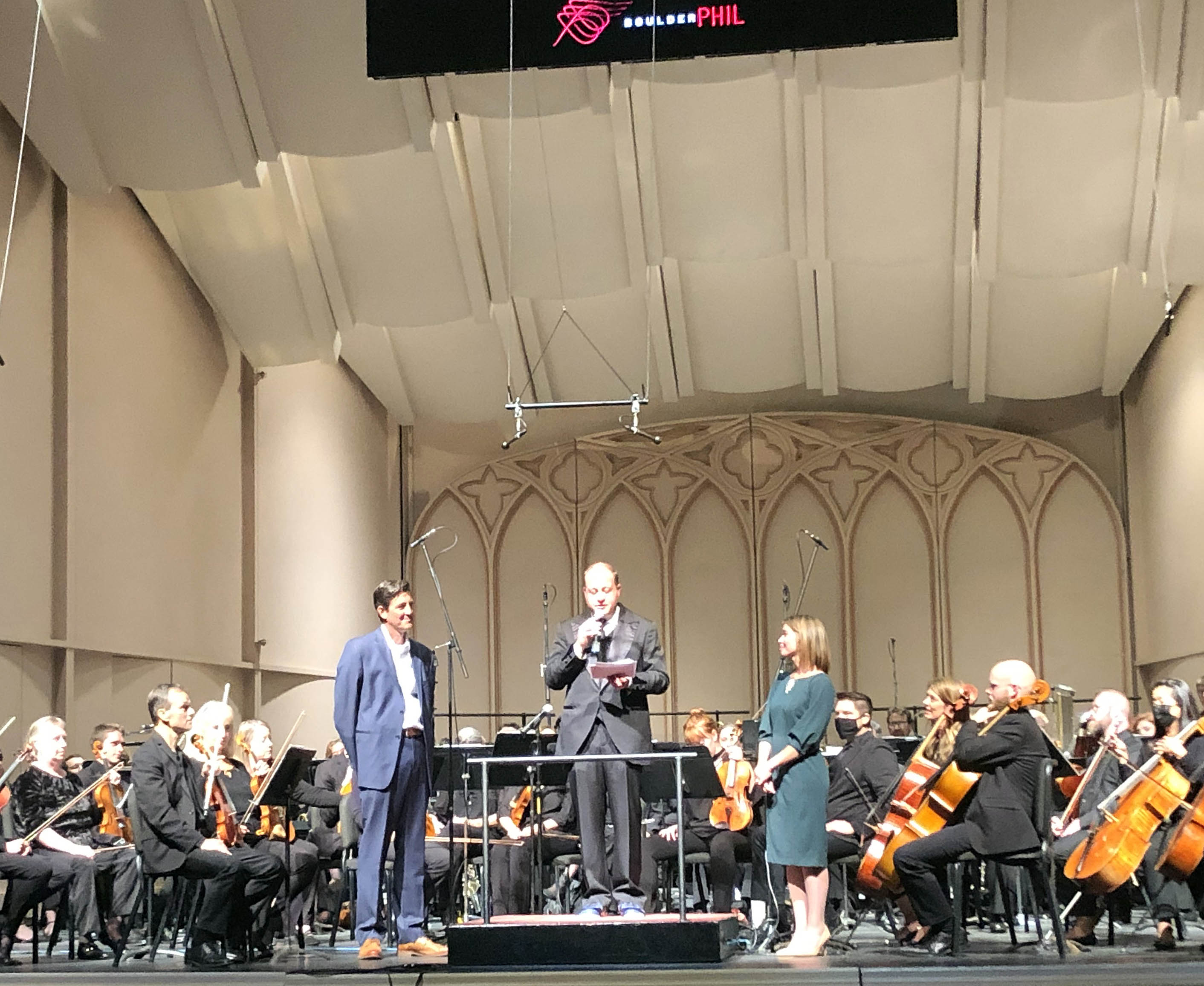
Governor Jared Polis (c) congratulates the Boulder Phil on its 65th anniversary season before last night’s concert. With him are Jonathan Koehn (l), Boulder’s chief sustainability and resilience officer, and Boulder Phil executive director Sara Parkinson (r).
Speaking from the stage before the concert, Governor Polis honored the orchestra for its 65th anniversary season and thanked the players for their artistry during the COVID pandemic. Polis was there with Jonathan Koehn, Boulder’s chief sustainability and resilience officer, also to recognize the concert’s environmental theme, “Hymn to the Earth.”
Michael Butterman then led the orchestra through a program designed to consider climate change as a challenge and a result of hubris and heedlessness. That message was most conspicuous in the world premiere of Ozymandias: To Sell a Planet by composer Drew Hemenger. Identified as an “environmental oratorio,” the score calls for orchestra, chorus and tenor soloist. The music encompasses a wide range of moods, so that the transition from one movement to the next is often dramatic.
Drew Hemmenger
In five movements it traverses an arc from coexistence with nature to the damage done by the industrial revolution, to a portrait of a society on the verge of collapse, the current state of the environment and finally, a warning of a potential apocalypse to come. The first movement, “Spring is Come,” uses a text from Chief Sitting Bull. This movement essentially an environmental anthem, declaring that “our animal neighbors [have] the same right as ourselves to inhabit the land.” This movement could easily stand alone as an effective choral/orchestral piece with a benign environmental message.
This jaunty and affirming movement is followed by a setting of Wordsworth’s “The World is Too Much With Us,” an impassioned plea to recognize that “we are out of tune” with the natural world, written at the outset of the industrial revolution. Here tenor Matthew Plenk made a strong impression, managing well transitions from intense anguish to quiet despair. His voice has a penetrating quality that gets edgy when pushed too far, but is otherwise effective.
I had to step out for a moment and so missed the rhythmically charged third movement for orchestra alone, but caught the rest of the oratorio. The third movement incorporates a pedantic UN panel report on the environment (“Oceanic uptake of CO2 has resulted in acidification”), spoken by the chorus. This academic verbiage is effectively combined with words from environmental activist Greta Thunberg and saddened words from Chief Tecumseh.
Alas, this movement cannot avoid pounding away at the moral, and it casts a didactic shadow over the rest of the piece. The final movement, a setting of Shelley’s darkly prophetic sonnet, Ozymandias, is again very emphatic.
Hemenger employs a loosely tonal/modal style that speaks directly to the audience with no difficulty. He translates the message of the text directly into musical expression, but the preachy message will not be to everyone’s taste. A few people walked out during the fourth movement and at the end, but whether it was a political or aesthetic protest is uncertain. A handful in the audience stood at the end, and their numbers grew with each curtain call by Butterman and Plenk.
On the whole I judge Ozymandias to be a skillful score that accomplishes just what it aims at. The message will be welcome in some venues, but whether the piece as a whole will go on to more extensive familiarity remains to be seen. It was played well by the Phil and sung with conviction by the newly formed Boulder Philharmonic Chorus.
Boulder Phil. Music Director Michael Butterman
The concert had begun with Global Warming by Michael Abels, a piece infused with folkish-tunes and intricate rhythms. The solos in the wind section and percussion were notable, and the opening and ending exchanges between concertmaster Charles Wetherbee and assistant principal cellist Ethan Blake were played with elan. This is a pleasing, short piece that made an ideal opening for the program.
The second half of the concert began with an aptly dark reading of the Overture to Mozart’s Don Giovanni, the first of two pieces that expressed the dangerous heedlessness of the legendary Don Juan figure. The performance was a little muddy where lightness and clarity are called for, leaving some of the inner voices unclear.
Next up was Siegfried’s Trauermusic (Funeral march) from Wagner’s music drama Götterdämmerung. Here the Philharmonic’s brass section shone, playing with great depth and darkness of tone. The Phil does not have the number of strings to match the weight of the brass, but this was a well paced and pleasing performance.
Butterman saved the best for last with Richard Strauss’ orchestral tone poem Don Juan. The outstanding quality of the performance showed that the Phil’s wind players will rise to the challenges of a virtuoso orchestral score. Individual solos were outstanding, and the horn section clearly relished playing the soaring theme that portrays Don Juan’s charismatic presence—a ringing tune all horn players know from student days and truly love to perform, just as audiences love to hear it.
For the most part, Butterman’s construction of the program worked well. His pacing and control of each piece seemed convincing. Nevertheless, the extreme variety of styles on the program was double-edged: the wide range of moods was always interesting, but it created a slightly fractured effect overall.
Reviews of Carmen, M. Butterfly and Tristan und Isolde
By Peter Alexander Aug. 8 at 10:38 p.m.
The 2022 summer season at the Santa Fe Opera features three very different operas about three very different experiences of love—Bizet’s Carmen, the word premiere of Huang Ruo’s M. Butterfly, and Wagner’s Tristan und Isolde—as well as two of the great operatic comedies, Rossini’s Barber of Seville and Verdi’s Falstaff. First the love stories, if that’s what they are; I will write about the comedies in a later post.
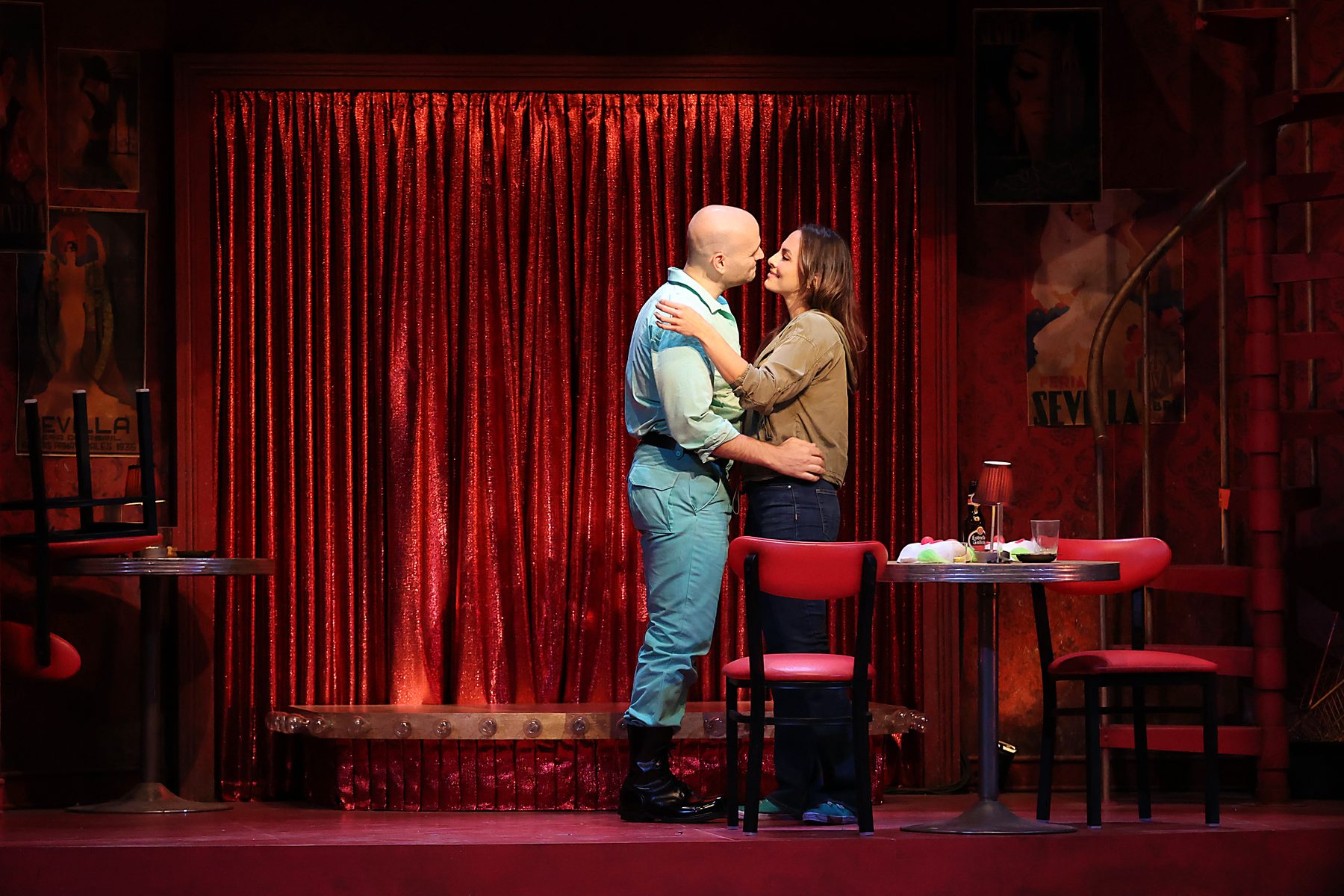
Michael Fabiano as Don José and Isabel Leonard as Carmen. Photo by Curtis Brown. All photos courtesy of the Santa Fe Opera.
Carmen (I saw the performance of Aug. 2) is about a soldier’s obsessive love for a free-spirited woman. Don José is subject to the most violent passions over which he has no control, while Carmen remains an independent women who makes her own decisions right to the end, though it cost her her life. The score contains some of the most memorable music opera can offer. In Santa Fe the music was mostly in evidence, but the production was a confounding mishmash.
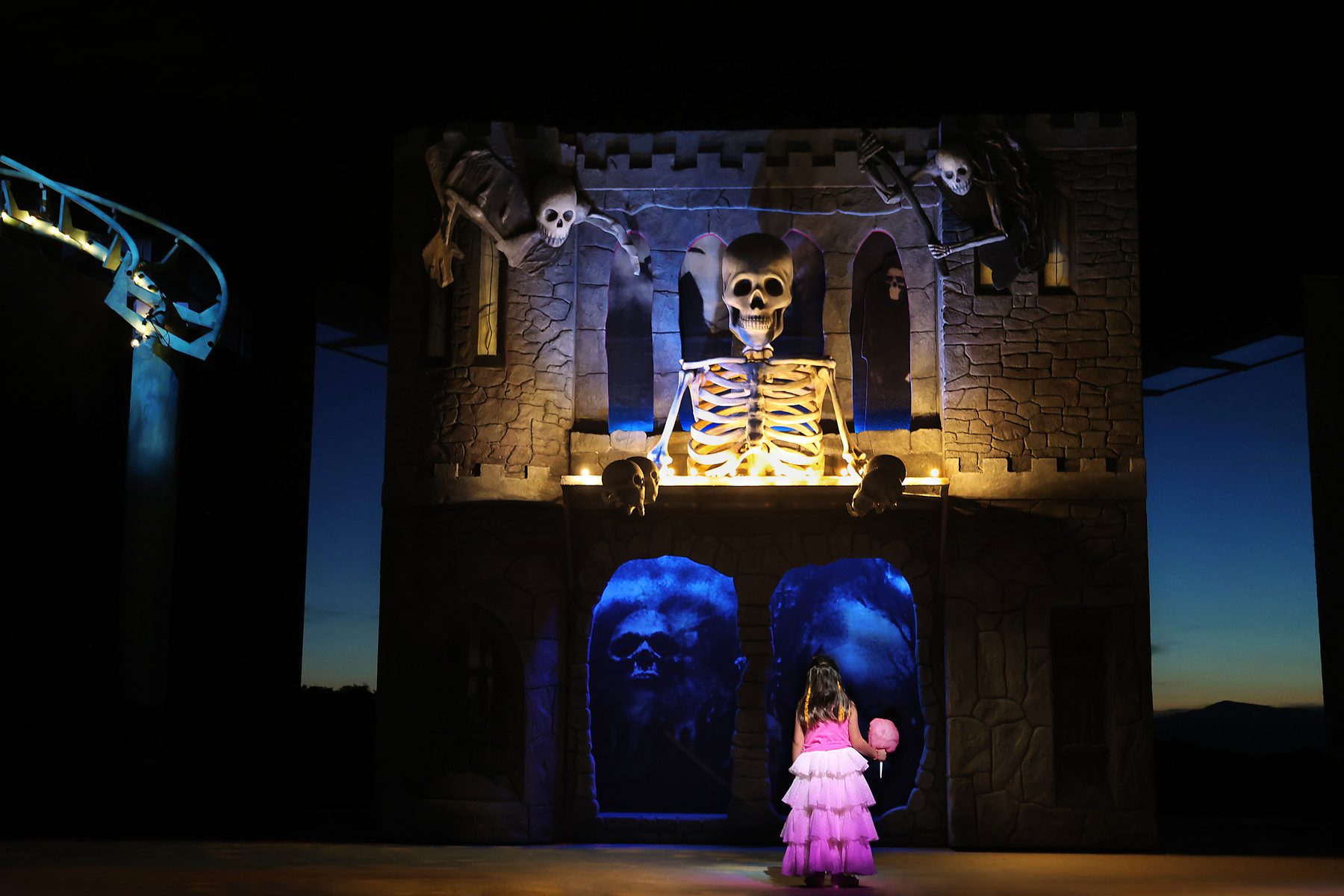
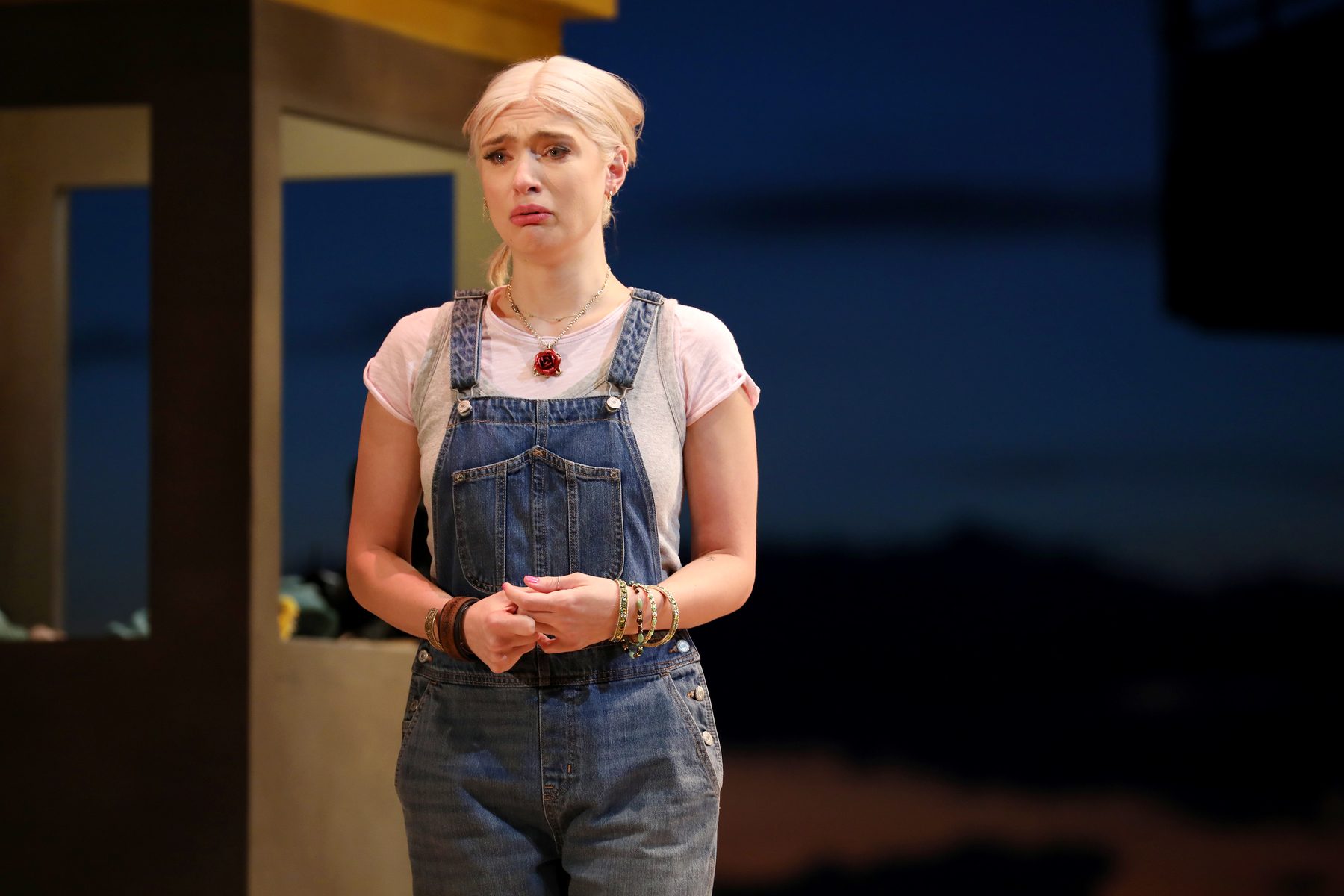
Director Mariame Clément and designer Julia Hansen had lots of ideas, but they added up to confusion more than concept. All four scenes were placed on the grounds of an abandoned third-rate carnival, with remnants of a roller-coaster track framing the stage, a solitary bumper car downstage left, randomly placed ticket booths and other suggestions of a long-forgotten fairgrounds. The costumes were somewhere between the 1970s and the present day, with Micaela dressed in bib overalls and a backpack, Carmen in drab student outfits, the smugglers in undistinguished modern dress. The soldiers were dressed in bland pale-green.
Isla Burdette as the child on the set of Santa Fe Opera’s Carmen. Photo by Curtis Brown.
Most confounding was a solitary child dancer, unidentified in the program but actually the seven-year-old daughter of bass Kevin Burdette who appeared in two of the summer’s other productions. She appeared repeatedly, sometimes pantomiming the music as in the opening prelude, at other times engaging with the characters. She bravely did all that was asked of her and moved with winning grace, but came across as just another idea that had no obvious point.
There were other gratuitous ideas throughout—smugglers carrying their contraband in upscale shopping bags, jugglers and tumblers among the Roma band, unmotivated entrances and exits by the chorus—but the evening was redeemed by the musical performance. The standout was Michael Fabiano as an ardent, impulsive Don José. He sang with a strong, expressive voice that commanded attention.
Isabel Leonard’s Carmen did not quite match his interpretation. She has a smoky voice that suits Carmen well, but lacked fire in her scenes with José. Her best moments were the Act I habanera, which elicited a strong ovation in spite of some aimless direction, and the card scene in Act III. At other times the directors left her looking lost on stage.
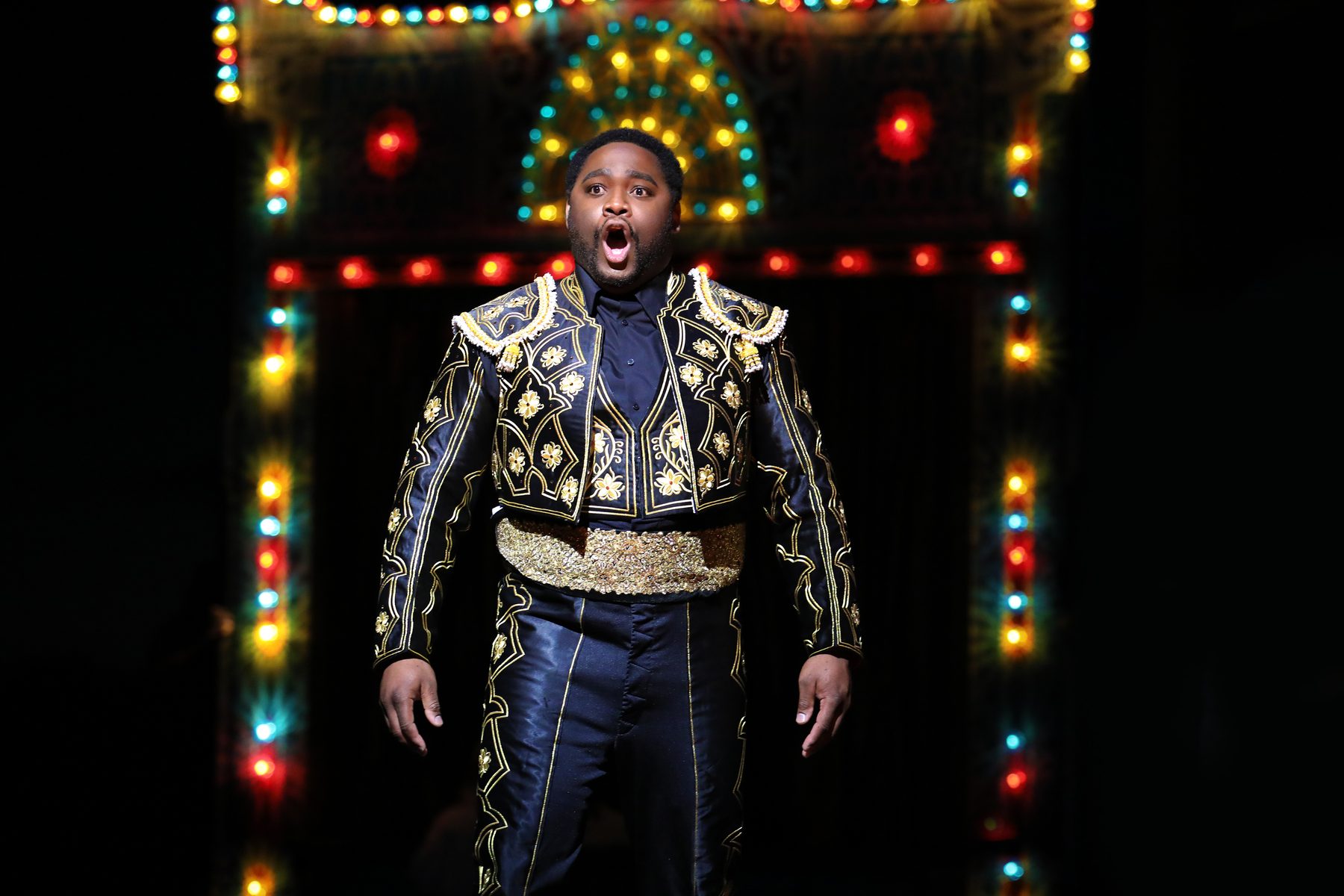
Michael Sumuel as Escamillo. Photo by Curtis Brown.
Michael Sumuel has a strong, commanding voice as Escamillo. He conveys the swagger and self-assurance one wants in the toreador, although the staging did not always work in his favor. Sylvia D’Eramo sang with sweetness of tone and expression as Micaëla, but had to push to be heard. Her lovely Scene 3 aria was marred by having the chorus of Roma women crowd around her for what should be an introspective moment of courage and fear.
The other roles in the Roma band—Magdalena Ku´zma and Kathleen Felty as Frasquita and Mercédes, Luke Sutliff and Anthony León as Dancaïre and Remendado—were handled ably, with sparkling precision in the treacherous quintet. David Crawford was vocally strong as the arrogant Lt. Zuniga, bringing out his contempt for Don José and his officer’s sense of entitlement toward Carmen.
Sylvia D’Eramo as Micaëla. Photo by Curtis Brown.
Conductor Harry Bicket kept the pace well and held all the tricky ensemble numbers together, including the quintet, just. The orchestral preludes were played with beauty and expression by the orchestra, particularly the flute and harp duo before Act III. The Santa Fe Opera chorus lent their weight and outstanding voices to their scenes, particularly before the bullfight in the final scene.
A word about the version that is being performed: Santa Fe is using the dialog that was used at the first performance in Paris, rather than the recitatives composed later by Ernest Giraud. The spoken text gives some useful background that is missing in the later version. One significant cut has been made: the charming children’s chorus that accompanies the changing of the guard has been removed. Apart from he loss of music that Carmen fans will miss, the appearance of José onstage seems sudden and unexplained.
# # # # #
If Carmen is about love as obsession, Huang Ruo’sM. Butterfly(Aug. 3) is about love as deception. Based on David Henry Hwang’s Tony-winning play of the same name, M. Butterfly adapts the true story of a French diplomat in Beijing who carried on a multi-year love affair with a Chinese opera singer without ever knowing that “she” was in fact a man. They both were later arrested in Paris for espionage after the diplomat shared official documents with his lover.
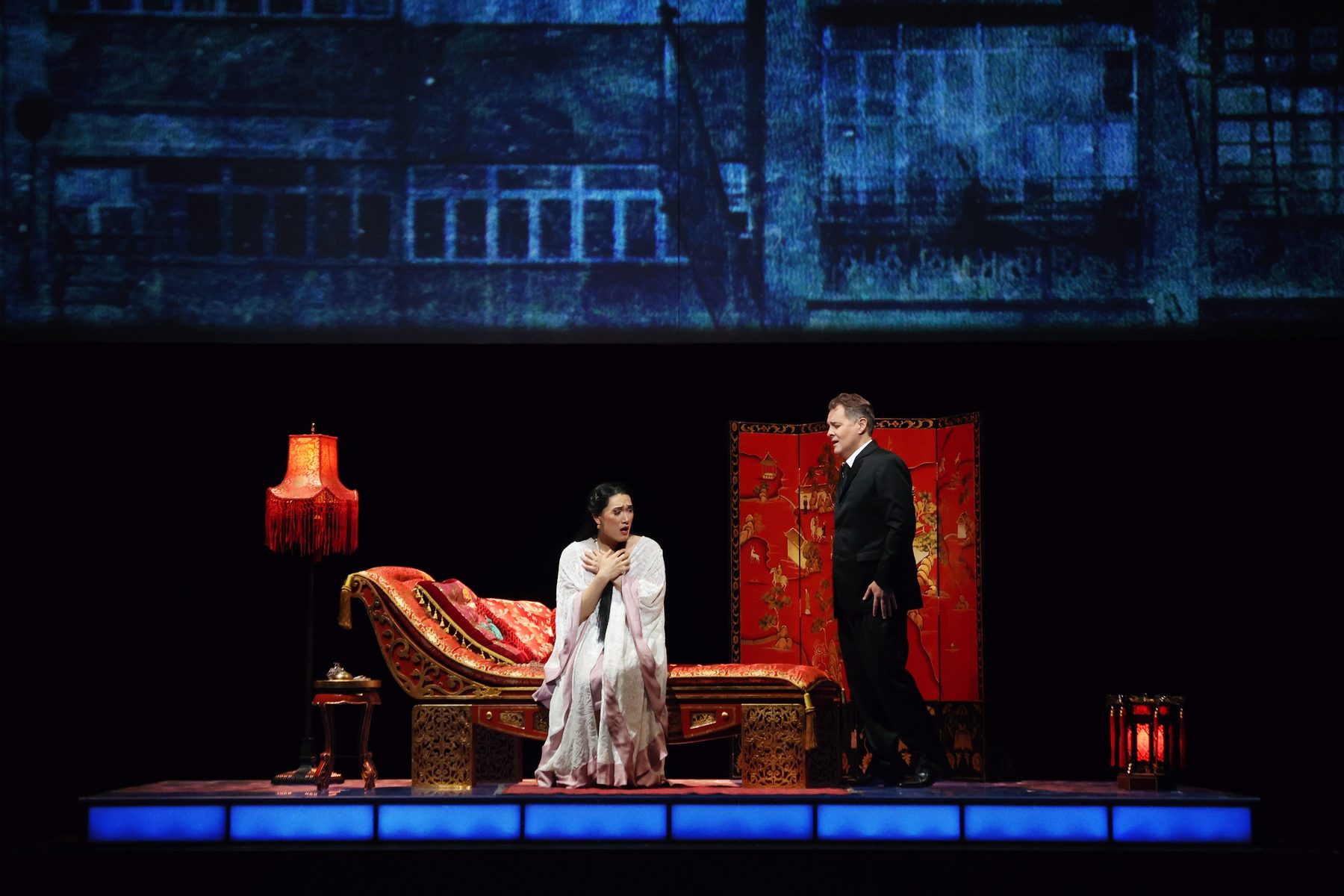
Kangmin Justin Kim as Song Liling and Mark Stone as René Gallimard in Song’s Beijing apartment. Photo by Curtis Brown.
Ruo’s score skillfully keeps the voices prominent at all times, so that the text—thanks to the careful diction throughout by the excellent Santa Fe Opera cast—is always understandable. Credit is especially due to baritone Mark Stone in the huge role as the French diplomat, named René Gallimard in the opera, and countertenor Kangmin Justin Kim as his lover, Song Liling in the opera. Both their dialog and their individual arias were clearly sung.
Ruo sets the text with expressive vocal lines that are supported emotionally and musically by the orchestra. The result is a score of eloquent melodic speech, effectively exploring the leading characters’ emotional journeys and Gallimard’s self-deception in fascinating depth. Choruses add drama, and arias by the two leading characters add emotional depth without lingering in the memory.
There are missed opportunities in the score. For example, Song’s “I am your Butterfly” is an emotional turning point, and could be occasion for musical emphasis, but simply repeating the phrase is not enough to make the moment climactic. The pair of arias by the two lovers in the second act are memorable, but they are eloquent without reaching lyrical beauty. While Ruo does not shy away from atonality and dissonance, the music is always in service of the text, so that the opera remains “accessible” to all but the most hidebound conservatives.
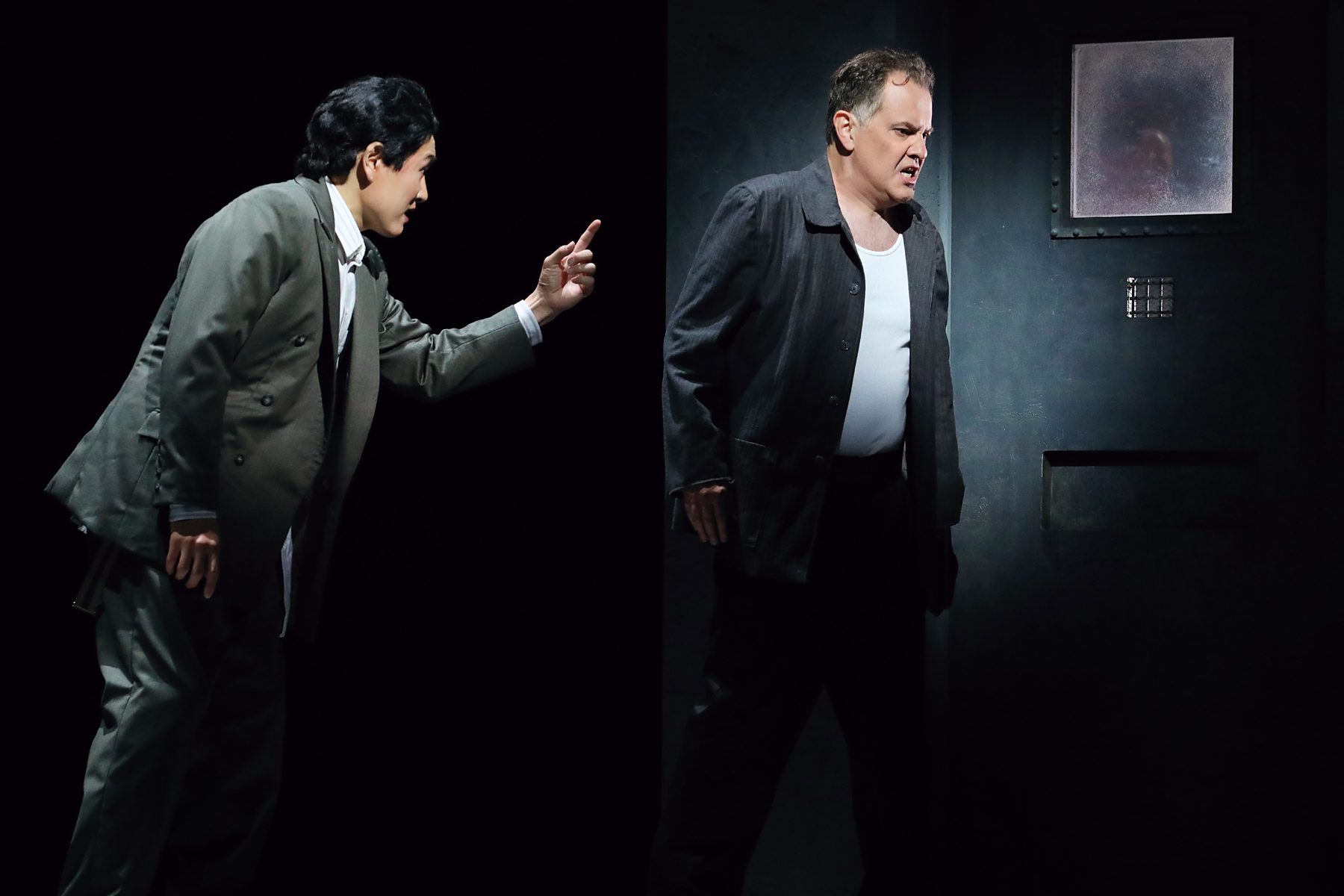
Song Liling (Kangmin Justin Kim), revealed to be a man, confronts Gallimard (Mark Stone) in prison. Photo by Curtis Brown.
The powerful exploration of human interiority and capacity for self-deception make M. Butterfly an important new opera. The reveal of Song’s true gender is a shattering moment. My one criticism of the score is that the musical texture is so unvaried that it approaches monotony. Individual voices move in heightened speech over well-crafted orchestra support; every chorus is set with all parts in rhythmic unison. While this aids intelligibility, it does not add variety to the texture.
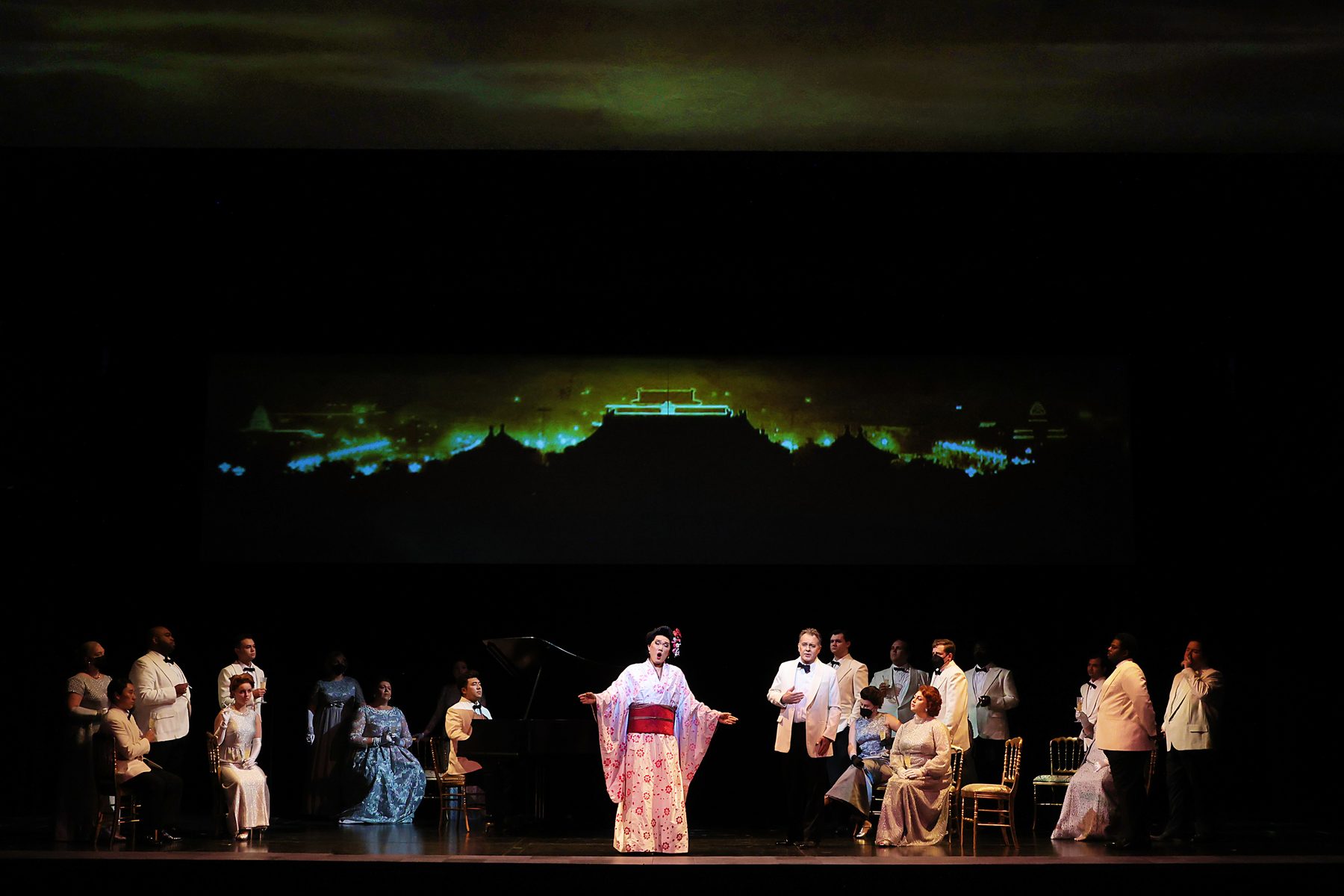
The opera opens with a headline projected on the stage, “France Jails Two in Odd Case of Espionage” while the chorus, representing stunned Parisians at a cocktail party, mock Gallimard for his sexual gullibility. This virtuoso setting of gossip and laughter sets the stage for the following story and shows off the Santa Fe Opera chorus. The rest of the story is told in flashback, with Gallimard in prison recalling the course of his affair with Song. A series of connected scenes, effectively evoked by projections and moving panels, carry the story from Gallimard’s arrival in Beijing, to the Chinese Opera, to Song’s apartment and back to Paris and the courtroom where the lovers are convicted of espionage.
As the title suggests, both the story and the music contain references to Puccini’s Madame Butterfly, representing the history of Western objectification of all Asian women, regardless of nationality. Ranging from direct quotation of the familiar aria “Un bel di” to subtle evocations of harmony and texture integrated into Ruo’s contemporary style, these Puccinian “Easter eggs” can be found throughout the opera, all the way to the very end when Gallimard chooses self-delusion over reality and envisions himself as Butterfly.
Kangmin Justin Kim as Song Liling sings Puccini at for Western diplomats in Bejing. Photo by Curtis Brown.
Various musical gestures recur through the score and help guide the listener through the labyrinth of emotions. Particularly striking was a nervous figure in the brass that appeared repeatedly as Gallimard fell into delusion, both as a lover and simultaneously as a diplomat trying to serve French interests in China.
The direction of James Robinson and designs by Allen Moyer (scenery) and James Schultz (costumes) kept the various locations and the plot line clear and supported the emotional arc. Dancers under choreographer Seán Curran made outstanding contributions to the opera both as Chinese cultural revolutionaries and dressers assisting Gallimard in his opera-ending transformation into Puccini’s Butterfly.
Conductor Carolyn Kuan managed the difficult task of evoking strength and power from the players where needed while keeping the orchestra subordinate to the voices. She maintained tight ensemble and evoked a rich orchestral sound while maintaining momentum to the very final chords.
Stone has by far the largest part. This is a major role for any baritone, not to be undertaken lightly. Singing with a resonant sound and conviction he made Gallimard a sympathetic character. Kim negotiated the countertenor register with both beauty of sound and enough strength to match Stone’s sound. His “Un bel di” announces his skill in the soprano register from the outset, and he never flags to the very final bars.
Kevin Burdette as the French Ambassador and Mark Stone as Gallimard. Photo by Curtis Brown.
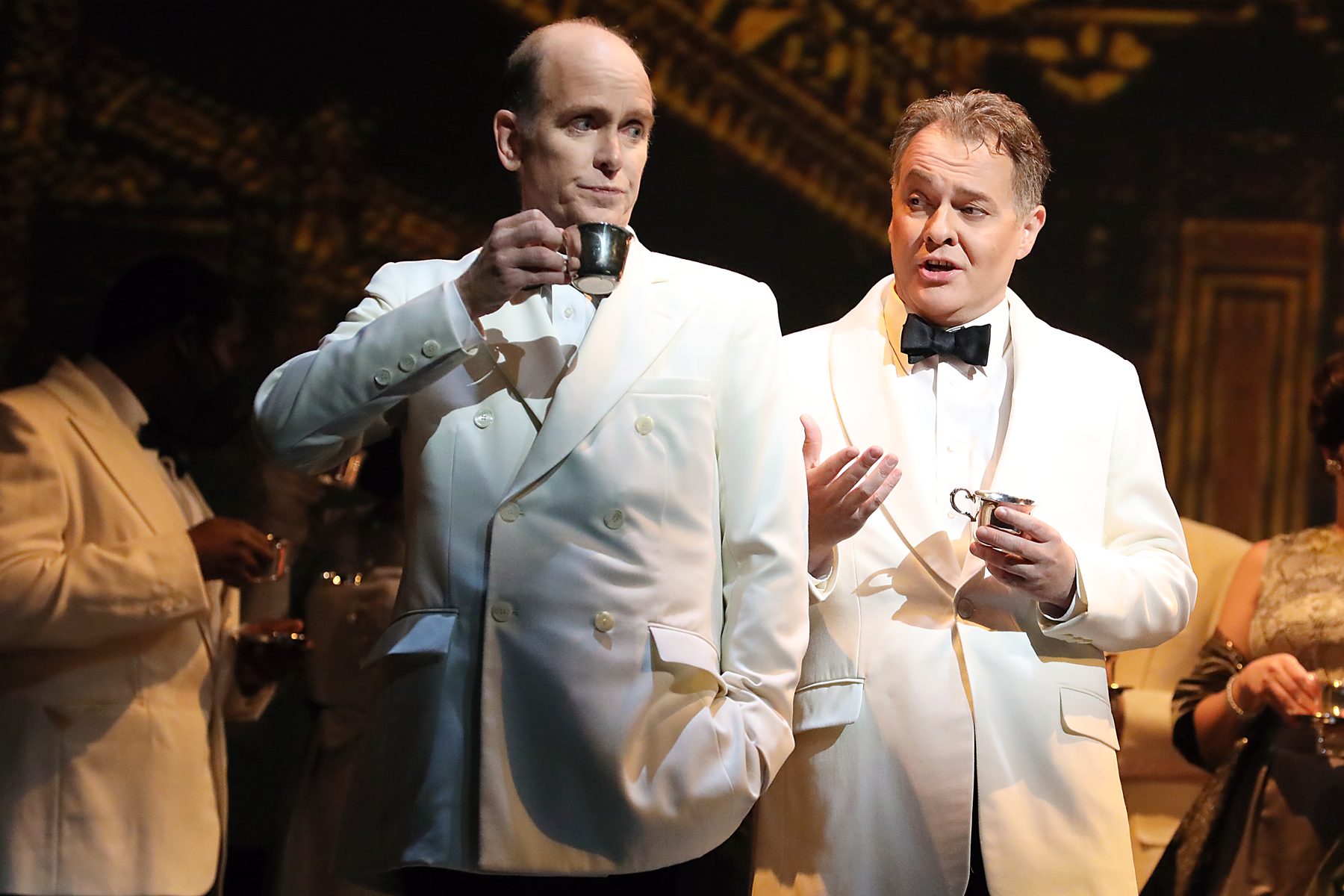
Kevin Burdette sang with an edgy sound that underscored the French ambassador’s distrust of Gallimard, equally appropriate when he appears later as the judge in Gallimard’s trial. Joshua Dennis made an effective brief appearance as Gallimard’s disdainful childhood friend, Marc, in a scene that illuminates Gallimard’s insecurity. Hung Wu struck the right tone of arrogant command as the communist party cadre Shu Fang.
There can be a special magic in the Santa Fe Opera’s open-air theater when music, drama and the capricious high desert weather work together. During the two lovers’ first night together, Song declaims “Ah, beautiful night.” And it was.
# # # # #
Richard Wagner’sTristan und Isolde (Aug. 5) is not really an opera about romantic love. The subject that inspired the composer and inhabits the opera from beginning to end is Arthur Schopenhauer’s philosophical notion of physical love as a yearning for oblivion—the “love death” with which the opera ends—and the corollaries of night as the realm of love and day as the realm of shallow reality. That was the opera’s underlying subject, but that said, there is enough action to provide a dramatic framework on which Wagner hung his lengthy monologues about day, night, love and death.
The Santa Fe Opera has long wanted to produce Tristan, a goal finally reached this summer. The only previous Wagner opera at Santa Fe was Flying Dutchman in the 1970s and ‘80s. Continuing this trend, the company has announced Dutchman again for the 2023 season.
Santa Fe’s abstract set for Tristan und Isolde, made of folding panels, with Tamara Wilson (Isolde) and Simon O’Neill (Tristan) Photo by Curtis Brown.
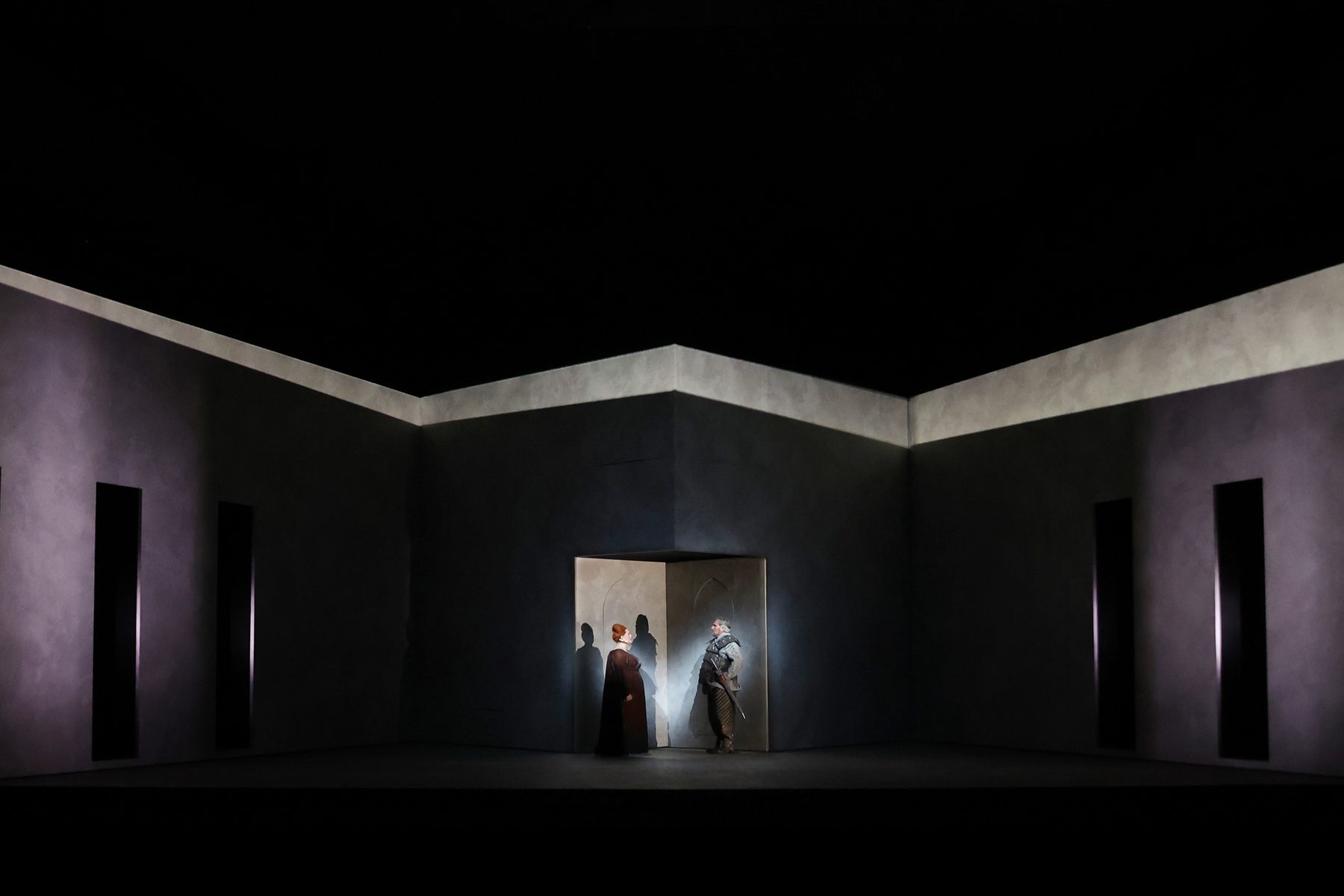
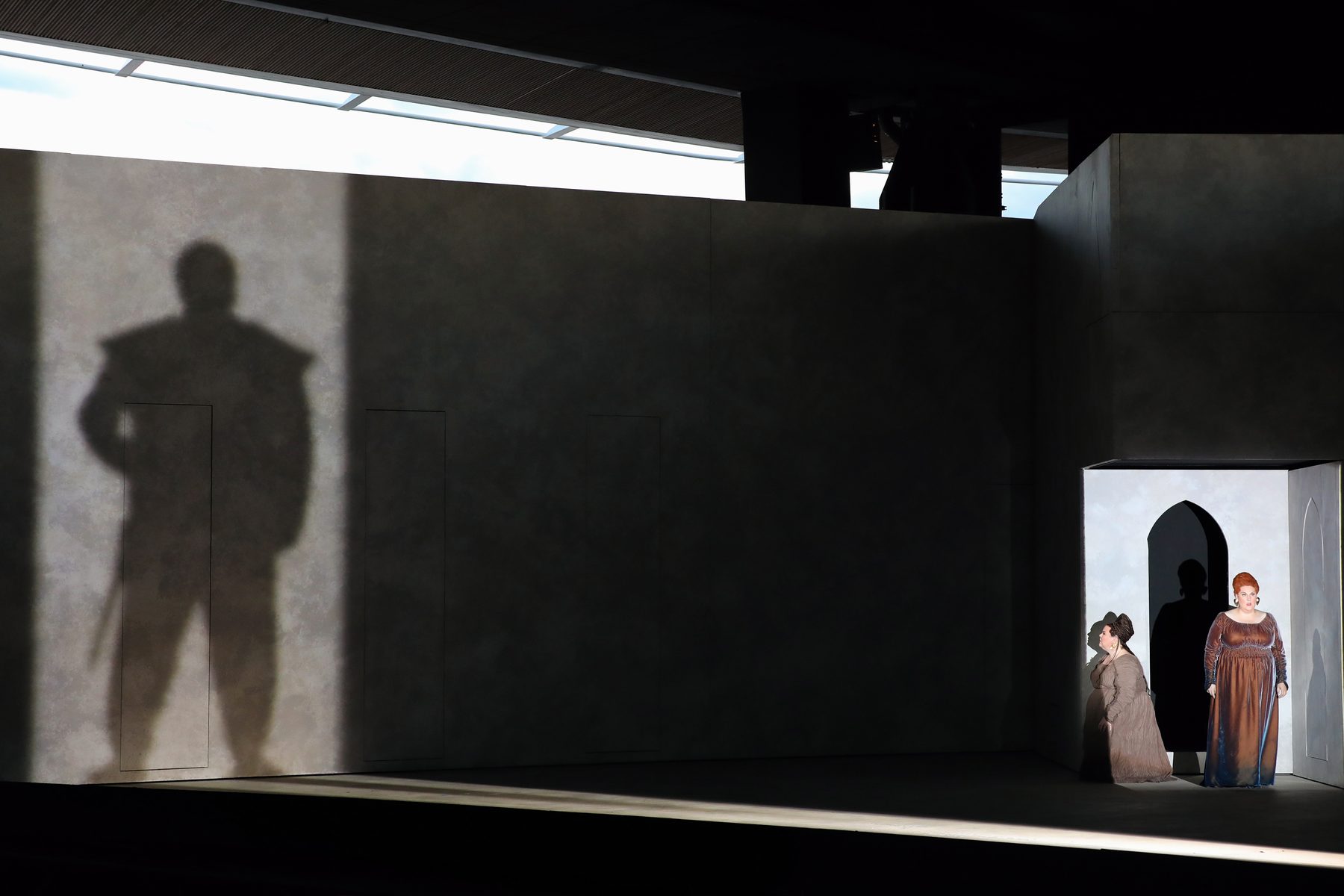
Most Tristan productions today, including Santa Fe’s, feature abstract sets—no ship, no sails, no rocky cliffs. This lack of specific place helps bring the deeper subject to the surface, serving Wagner’s underlying purpose. Here the well-engineered set by Charlap Hyman & Herrero comprised large panels that fold, shift, and open to create the spaces in which the action takes place.
So far so good, but abstract sets can create dramatic problems. In the first act, Tristan sings “If I left the helm, who would guide us to King Marke’s shore?”—while strolling across an empty stage with no helm in view. Other scenes that seem to contradict the text occur during the opera’s 4 1/2 hours.
John Torres’s powerful lighting in Tristan und Isolde. Photo by Curtis Brown.
A critical element of the production was John Torres’s lighting design that reinforced the text’s emphasis on light and dark, effectively tying libretto and set together. Most dramatically, as day breaks in the second act while Tristan and Isolde remain in the raptures of love, they remain enveloped in a penumbra of shadow while the dawn, threatening their imminent discovery, gradually fills the rest of the set.
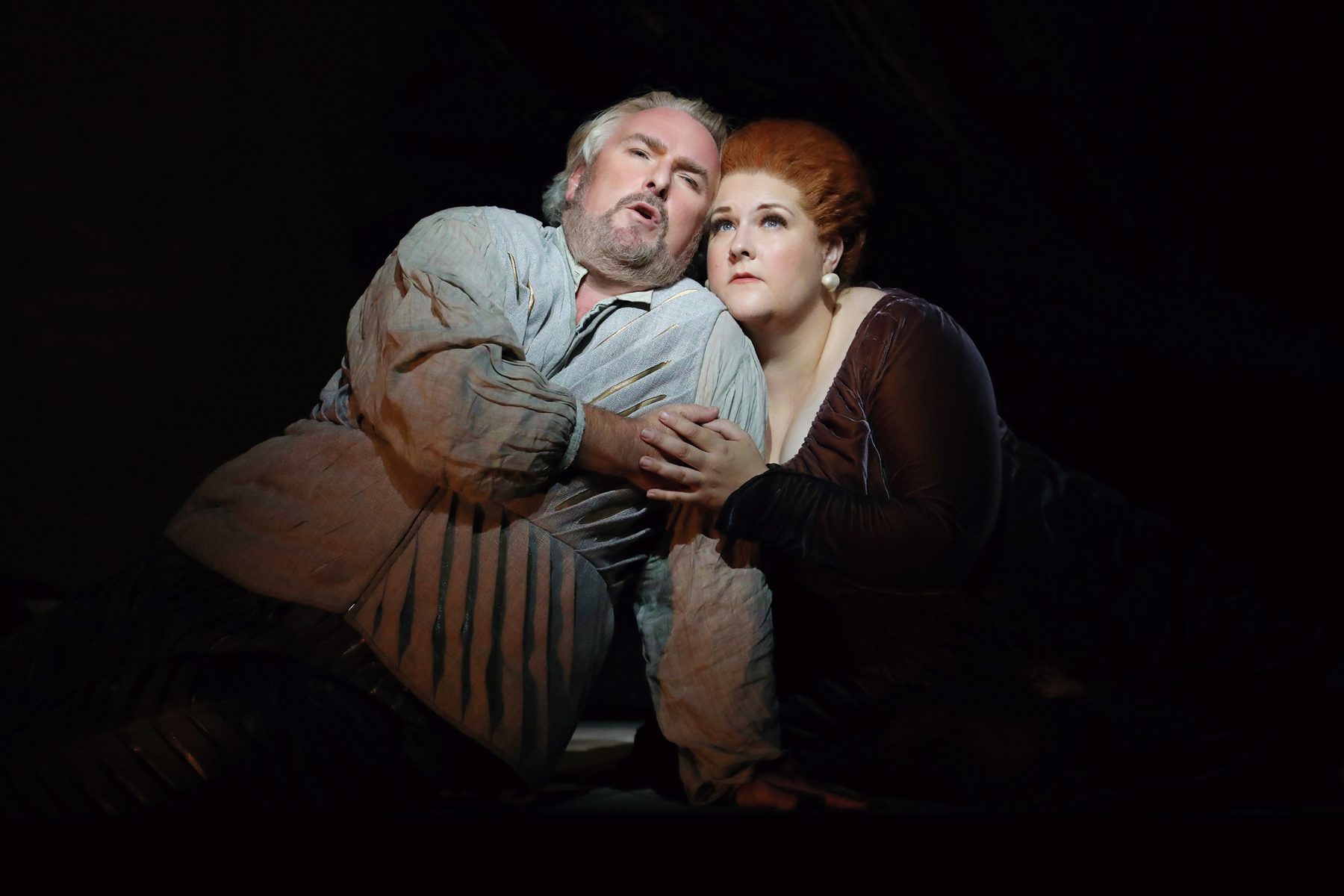
Santa Fe has assembled an exceptionally strong cast. The three largest roles, Tristan, Isolde and Brangäne—all in their Santa Fe Opera debuts—were uniformly strong and well matched. Tamara Wilson brought a soaring, powerful voice to the role of Isolde. Her vocal expression ranged from palpable anger and fierce hatred at the outset to intense passion and her crucial transformation to ecstasy.
Simon O’Neill (Tristan) and Tamara Wilson (Isolde)/ Photo by Curtis Brown.
Simon O’Neill is a true heldentenor, with just the heft and edge to cut through the orchestra. The love duets with Isolde rose to the heights of passion. He sang expressively throughout, although his onstage presence tended to be wooden. His best moments were in his lengthy monologue as he faces the coming of night and death in the final act; ironically, he was more alive in his death scene than in the earlier acts.
Jamie Barton was outstanding in the crucial role of Isolde’s maid Brangäne. Whether resisting Isolde’s despair, warning of betrayal, or embracing her own despair at having disobeyed her mistress, she was dramatically solid and vocally splendid.
Eric Owens as King Marke. Photo by Curtis Brown.
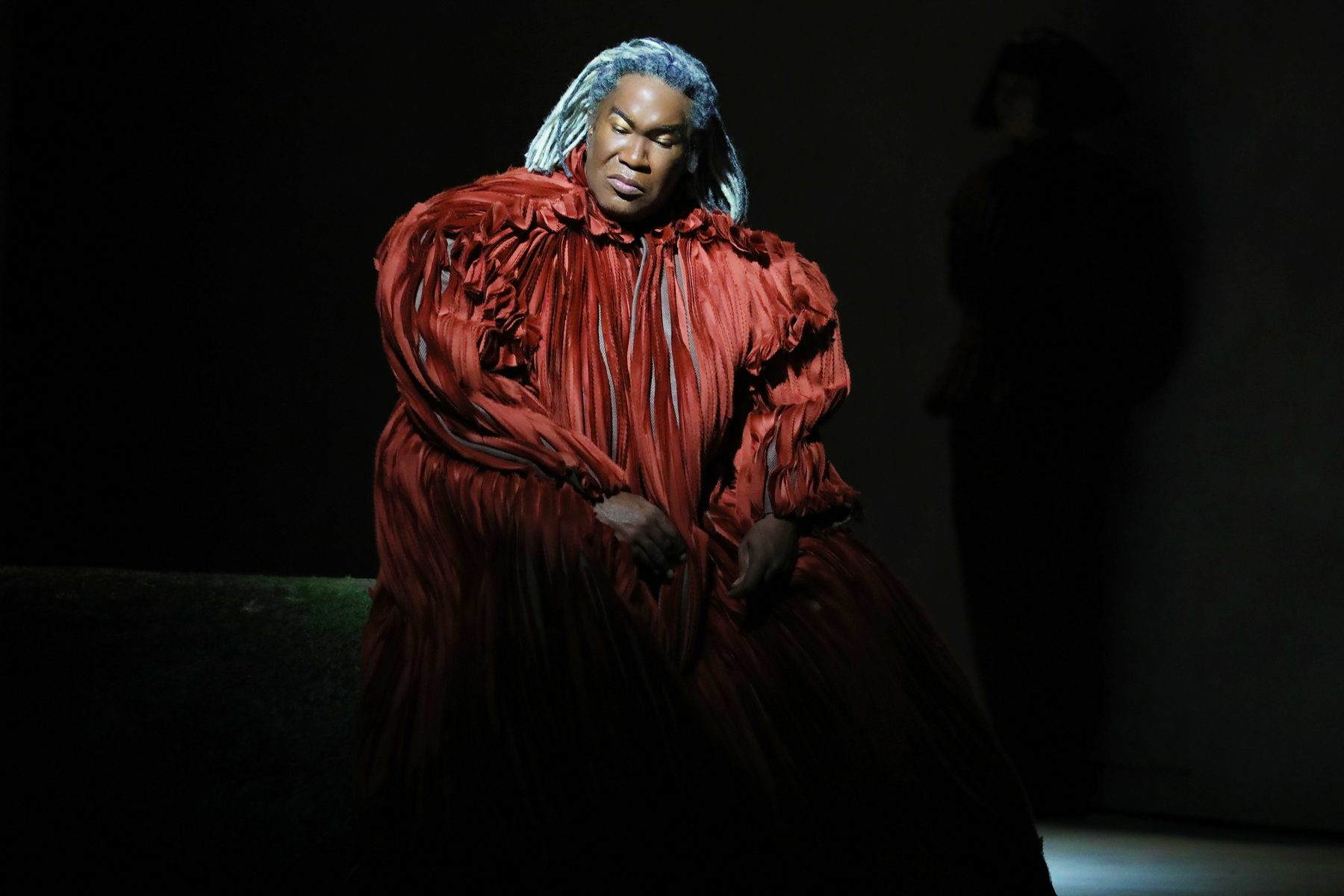
Nicholas Brownlee, a former SFO apprentice who sang Mozart’s Figaro here in 2021, filled the role of Kurwenal. Solid, imposing, he rarely sang below forte. While this reveals the character’s strength, more nuance would be welcome. Eric Owens brought dignity to the betrayed and forgiving King Marke. He was somber and rich-voiced in his Act II monologue, but sometimes blurry in pitch.
Tristan provides a real challenge for stage directors: the pacing is not theatrical. In fact, the score is often more like a tone poem with voices, as action that only needs a moment is stretched into long reflective musical passages, virtual whole movements on betrayal, passion, or death. In that respect, it resembles Berlioz’s Roméo et Juliette (which Wagner knew well, and from which he borrowed several ideas including the music for the consumption of the love potion) more than any previous opera.
One good example is King Marke’s lengthy monologue when he discovers Tristan and Isolde’s betrayal. This passage is an eloquent reflection of his emotional state, but all he really says (to Tristan) is “I raised you from childhood, and yet you betrayed me!” The musical expression is powerful, but dramatically nothing happens for ten whole minutes.
Nicholas Brownlee (Kurwenal, above) and Simon O’Neill (Tristan) in Tristan’s death scene. Photo by Curtis Brown.
Limited by the pace of Wagner’s score, the stage direction by Zack Winokur and Lisenka Heijboer Castañón was necessarily more stately than dramatic. Nonetheless, they kept the focus on the important characters and made the action clear.
James Gaffigan led the Santa Fe orchestra with a welcome sense of direction. The music never lagged, and the orchestral sound was as exciting as Wagner requires. Two members of the orchestra deserve special notice: Michael Taylor Eiffert played the numerous bass clarinet solos with surprising delicacy (disclosure: as a clarinetist I was especially enthralled by his playing); and Julia DeRosa played the extensive Act III English horn solos with flowing beauty.
The moment that everyone awaits—those hardy enough to stay to the end—is of course the Liebestod when Isolde undergoes transformation by grief and ecstasy. Wilson sailed through the carefully paced scene, ending as she should on the crest of the wave before literally disappearing into the night and Wagner’s metaphoric oblivion.
NOTE: Remaining dates for the 2022 season at the Santa Fe Opera can be found on the SFO Web page.
CORRECTION (8/10): As originally posted, the article gave the title of Huang Ruo’s opera incorrectly as M Butterfly. There should a period after the M: M. Butterfly.
All-English program features Walton Viola Concerto, works by Elgar and Anna Clyne
By Peter Alexander May 15 at 12:10 a.m.
The Boulder Philharmonic finished the 2021–22 classical concert series with sound and fury last night (May 14).
Conductor Michael Butterman and the Boulder Philharmonic in Macky Auditorium. Photo by Glenn Ross.
No, that is not a criticism. The first piece listed on the program was Anna Clyne’s Sound and Fury, inspired in part by Macbeth’s soliloquy featuring that phrase. In practice, though, Clyne was preceded by an “off-menu special,” in the words of conductor Michael Butterman: Elgar’s familiar “Pomp and Circumstance” March No. 1, in honor of the region’s recent graduates.
The performance was led by an honorary guest conductor, Boulder’s outstanding arts patron Gordon Gamm. Looking dapper in a fedora, Gamm did a creditable job of getting things started and holding the orchestra together. Indeed, the only audible error—one out-of-place note—cannot be laid to the conductor.
Butterman preceded Clyne’s Sound and Fury with a helpful music-appreciation style introduction, with an explanation of it’s connection to “The Scottish Play” and illustrations from a Haydn symphony quoted in the score. The performance was strongly profiled, with contrasting sections nicely characterized and distinguished, lacking only the precision necessary for clarity in the skittering string parts and the full depth of sound that a larger orchestra could provide.
The recorded voice speaking the “Tomorrow, and tomorrow, and tomorrow” soliloquy near the end was not always intelligible, but it did show how those words fit into the scheme of the piece. This is a new piece (2019) that is definitely comprehensible and enjoyable for the classical audience, and I would welcome hearing it again.
Violist Richard O’Neill
A friend told me about this concert, “The Walton Concerto won’t sell any tickets.” If that’s right, I’m sorry for anyone who was not sold a ticket because they don’t know Walton’s music. They missed a fun piece, and a stunning performance by violist Richard O’Neill, the newest member of the Takács Quartet. Where is their sense of fun, of adventure, interest in new things? This is not difficult music.
Composed in 1929, the Viola Concerto shows the composer’s quirky style to good advantage. At times lush, at times shifting, surging and dying away, its kaleidoscopic episodes and unexpected turns provide an ideal palette for an instrumental soloist of O’Neill’s qualities.
His performance was glittery (and no, I don’t mean his shoes) and perfectly assured. Visibly reacting to every twist and turn of the orchestra part, he showed in both gesture and musical interpretation his connection with the players. Utterly at ease playing all the virtuoso material the concerto throws at the soloist, O’Neil gave a solo performance of the highest caliber.
Here the issues were of balance, both within the orchestra and (from where I was sitting) with the soloist. The boisterous second movement was my favorite, but the more gentle moments were equally well played. Two profound tributes to O’Neil: he held the audience in silence for at least 20 second at the end of the concerto, and it was the orchestra, stamping their feet, that brought him back for his final curtain call.
Again channeling his inner Leonard Bernstein, Butterman gave an insightful introduction to Elgar’s “Enigma” Variations, showing how the variations brought their subjects—the composer’s friends—to life. This to me is a better preparation for the audience than program notes about “the return of the subsidiary theme” or “remote tonalities.”
Elgar’s “Enigma,” one of the greatest sets of orchestral variations of the Romantic or any period, received the best orchestral performance of the evening—maybe because it is a piece well known to all orchestral pros. Rehearsal time then can be devoted to details of interpretation, of unity, of sound. Butterman found the telling elements in each variation and brought out their individual characters.
As one hopes and expects, the familiar “Nimrod” variation swelled calmly from shimmering pianissimo strings to a rich, full orchestral climax before falling back. Other variations had the sparkle, or the weight, to communicate character and meaning. This is a fun piece for brass, who enjoyed their moments of grandeur, and for the timpanist, who brought both visual and aural flash to the performance.
Finally, this program had many of the ingredients of a successful concert: some exploration, a dazzling soloist, a great piece of music. I happily note the inclusion of a living female composer in the stew. It’s a recipe musical organizations should follow.
Longmont resident Michael Udow’s Ancient Echoes inspired by archaeological finds
By Peter Alexander April 24 at 12:15 a.m.
NOTE: I usually do not review ensembles that are not fully professional. This performance by the semi-pro Longmont Symphony rates an exception because it includes a world premiere, which always deserve media attention.
Last night (April 23) the Longmont Symphony Orchestra (LSO) gave the first performance of a piece that was inspired by archaeological discoveries in the state of Colorado. Michael Udow’s Ancient Echoes makes use of four stones discovered in Great Sand Dunes National Park and elsewhere in the San Luis Valley that archeologist Marilyn Mortorano discovered to be ancient lithophones, or musical instruments made of stone. (Read the full story here.)
Great Sand Dunes NP and the San Luis Valley. Photo by Peter Alexander
Under conductor Elliot Moore, the LSO gave a careful reading of Udow’s atmospheric score. Soloist Anthony Di Sanza, once Udow’s percussion student at the University of Michigan, was all over the front of the stage, switching among four different percussion setups that included the four ancient stones, a modern mallet instrument with tuned granite bars—Udow’s personal creation for this one piece—a vibraphone, drums from North Africa and Japan, German cowbells and temple gongs, among other instruments.
There can be no doubt that Udow knows the percussion instruments intimately that he writes for. They were all used effectively, and Di Sanza gave a virtuosic performance on all of them. It was clearly as much fun for him running from one setup to another, as it was for the audience watching and listening.
Percussion soloist Anthony Di Sanza
The score opens with a dreamy, evocative passage that made good use of the quiet plinking sounds of the ancient stones. From there the score moves from one set of instruments to another, each representing a different culture or part of the world. The score is highly episodic, as each set of instruments brings forth its own musical style and mood.
Udow used the orchestra well, but did not resist falling into Hollywood-style Orientalist cliches to support some of the instruments, and I am not sure that his series of musical vignettes adds up to more than the sum of its highly individual parts. But the result is certainly a showpiece for the soloist, and one that may prove irresistible to other percussionists in the future.
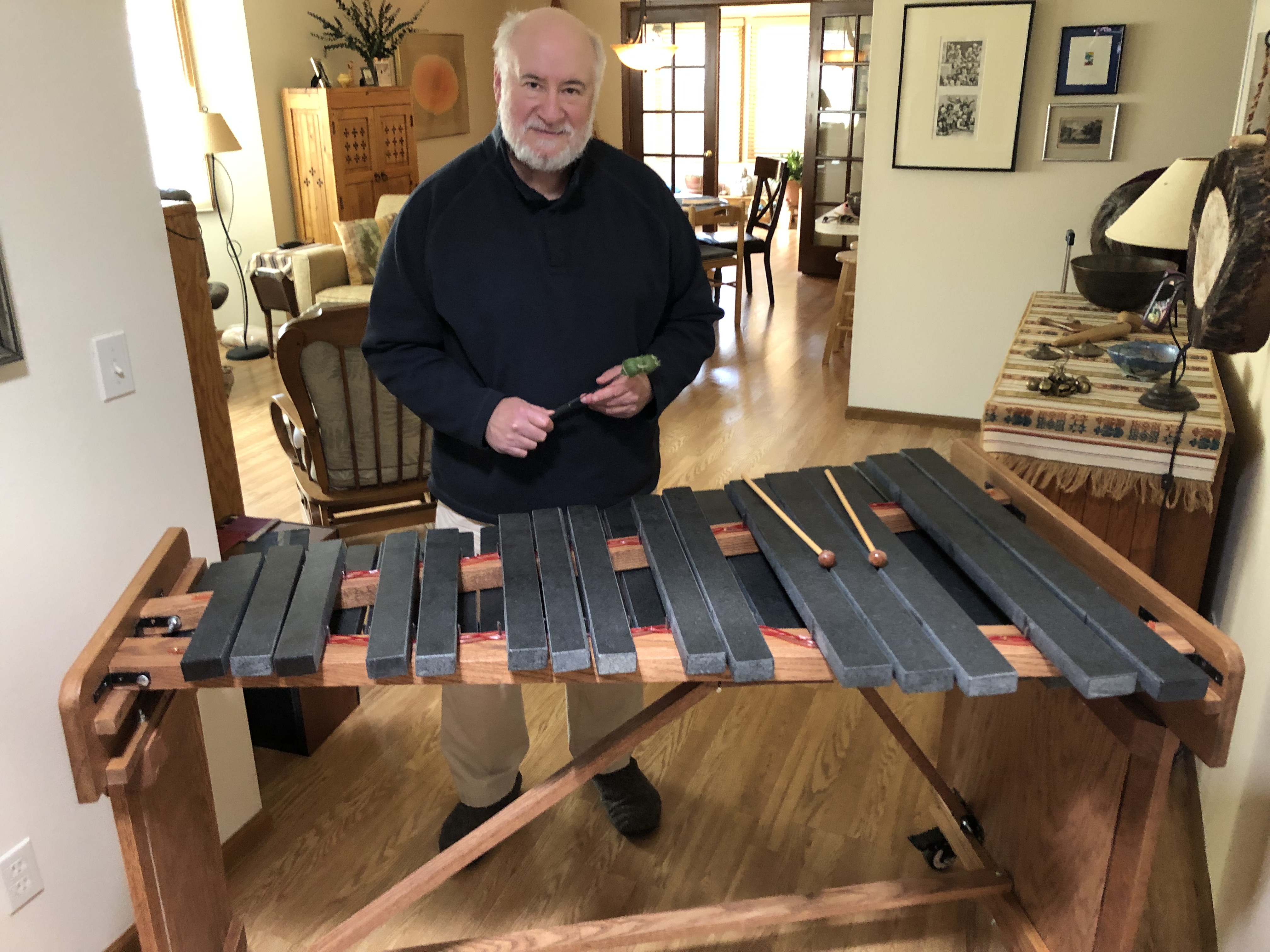
Michael Udow with his granite lithophone, created for his score Ancient Echoes. Photo by Peter Alexander.
Udow’s modern granite lithophone is bound for a percussion collection in Indianapolis, where it will be available for Di Sanza and other professional percussionists who wish to perform Udow’s score. With it containing so many fun licks, I would not dare to guess where we will hear it next.
Following a standing ovation, Di Sanza and his former teacher Udow gave an energetic handclapping encore that was great fun, if perhaps a minute too long.
For the rest of the concert, Moore led the LSO in first Stravinsky’s Firebird Suite, and later to close the program Brahms’s Symphony No. 1. The Firebird performance had a strong expressive profile, capturing well the essence of each scene. There were some especially nice solos in the woodwinds, if a few issues of balance overall.
The Brahms was the least satisfying of the three pieces, needing better balance—again—and more rhythmic precision, especially within the string sections. In a modern concert hall and with modern winds, Brahms really needs a larger string section than most small-budget orchestras can provide, and that was the case here. But it should be noted that the LSO has grown in quality over Moore’e five years in Longmont, and Moore brought the symphony to an energetic conclusion. It was greeted warmly by the audience.






 Sharps & Flatirons