Santa Fe Opera presents carnivalesque production of Verdi’s masterpiece
By Peter Alexander Aug. 11 at 1:45 p.m.
Editor’s Note: This is one of several posts covering four of the five operas presented this year at the Santa Fe Opera.
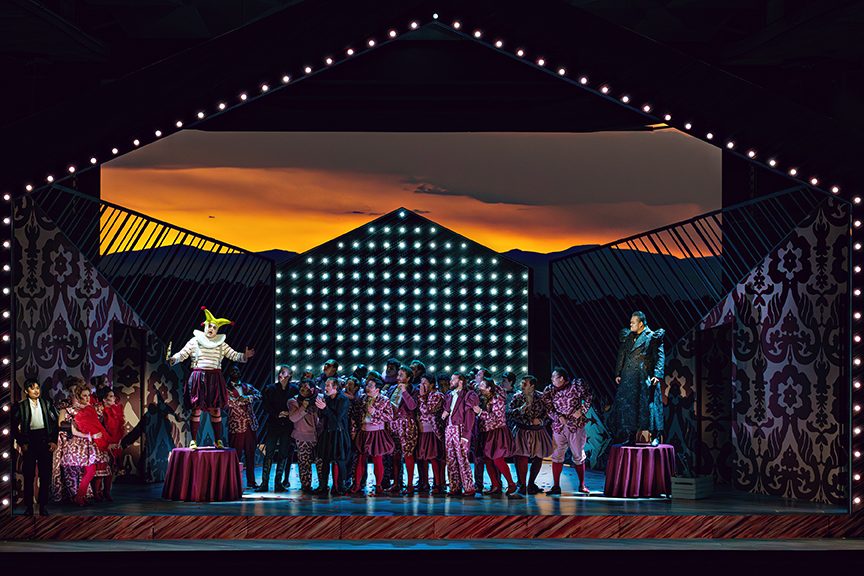
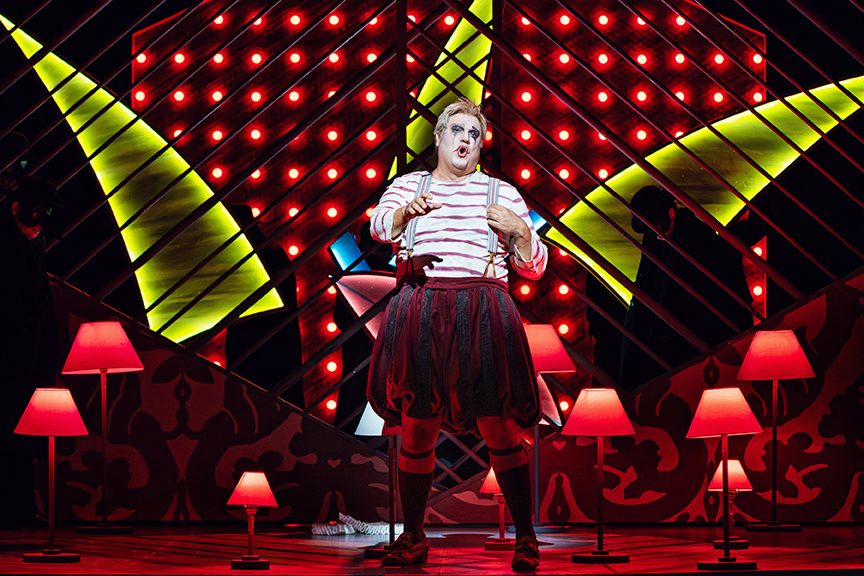
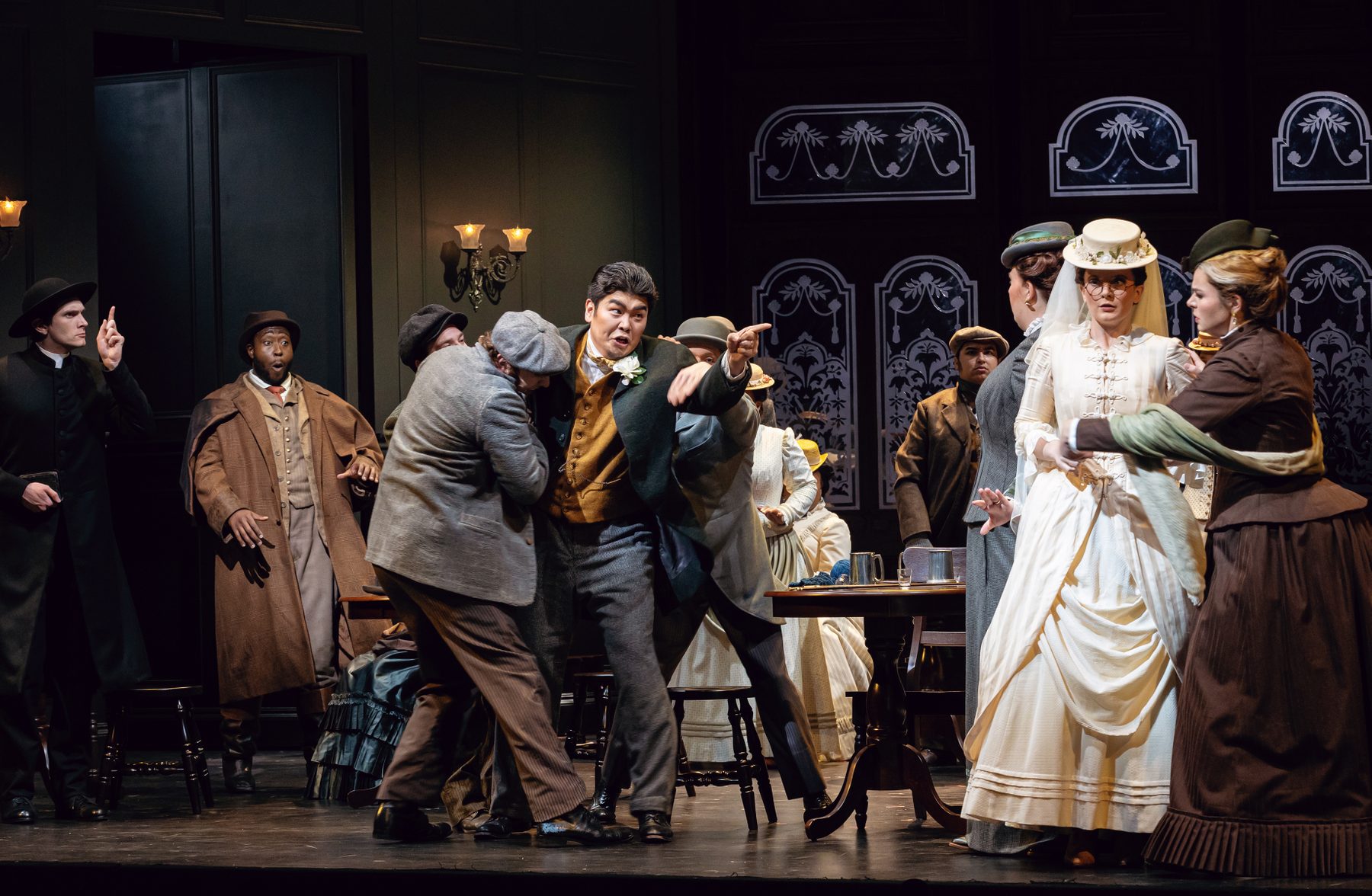
Santa Fe’s new production of Verdi’s Rigoletto opens on a carnivalesque scene: a chorus of courtiers dressed in stylized theatrical garb of mixed styles and periods, including Spanish breeches, Landsknecht jackets with slit sleeves, as well as shirts and pants of no discernible period. A few women sported Marie Antoinette gowns.
Front L-R: Duke Kim (Duke), Michael Chioldi (Rigoletto), Le Bu (Count Monterone), the Santa Fe Opera Chorus; photo by Curtis Brown for the Santa Fe Opera
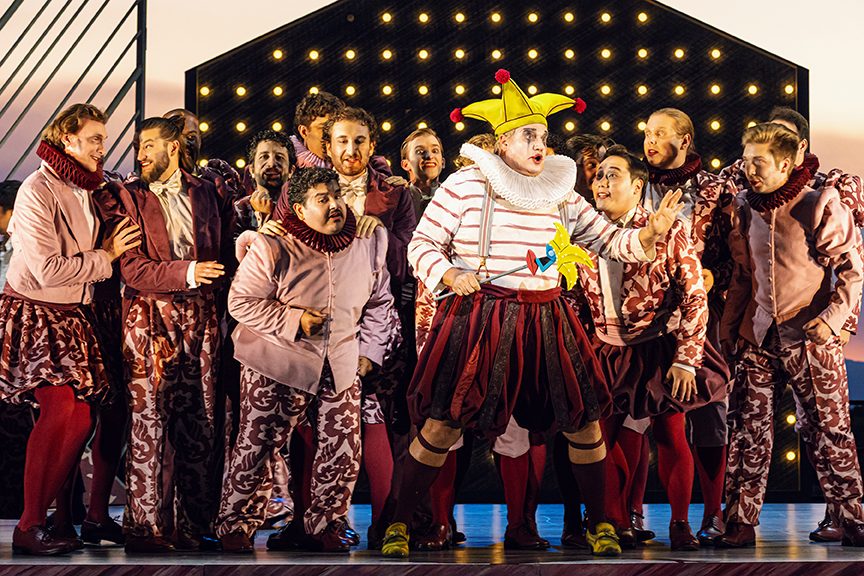
The dark violet color patterns of the essentially anonymous courtiers all match, while named characters—Merullo, Ciprano and the Duke of Mantua—are dressed in black and white. Some jackets clearly have zippers. Rigoletto wears garters with his socks and a stylized jester’s cap. In short, everything catches the eye, nothing pertains to any one period.
Rigoletto (Michael Child) with the decadent tribe of courtiers (The Santa Fe Opera Chorus); photo by Curtis Brown for the Santa Fe Opera
This eclectic mix in Jean-Jacques Delmotte’s costumes is matched by Julien Chavaz’s inventive stage direction where the opera’s high drama and tragedy is mixed with comic touches that lighten some scenes, but sometimes distract from the real business of the singers. The chorus of courtiers are not only dressed alike, they move in lockstep conformity. They move as a pack, sometimes going into silly choreographic moves, showing their inability to break from the decadent tribe at court.
Chavez goes so far as to lightly mock operatic conventions, as when Giovanna mugs to the audience during Gilda and the Duke’s amply repeated goodbyes. There quiet chuckles are welcome, as in the well considered interplay between the assassin Sparafucille and his sister Magdalena in the final act.
On the other hand, the silly choreography for the chorus while the Duke sings his praise of love in the second act is an unnecessary indulgence. The Duke’s aria represents a critical moment, revealing that he has discovered a kind of love from Gilda he has never seen at court. It does not redeem him, but makes him a more rounded person, and should not be downplayed for easy entertainment, whatever the symbolic depth. The same principle could have been applied elsewhere.
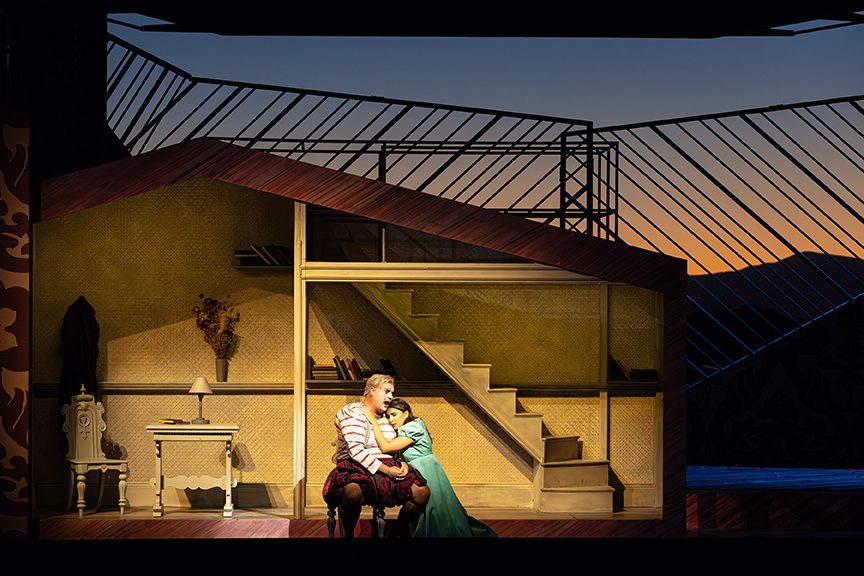
Designer Jaime Vartan’s set for the Duke’s court is abstract, with abstractly decorated mobile flats that are moved around the stage. Scattered among them are colorfully lit pieces that come together at the end to briefly outline the jester’s hat and face, and then disintegrate as the tragedy destroys Rigoletto. The interiors of Rigoletto’s home and Sparafucile’s “tavern” roll on from the wings. Their well designed contrast with the rest of the stage creates a space of warmth and safety in one case, danger and decadence in the other.
Michael Chioldi (Rigoletto), Elena Villalón (Gilda); photo by Curtis Brown for the Santa Fe Opera
Portable lamps are sometimes used realistically, as light for Gilda’s reading, but also abstractly, carried about by the courtiers representing—who knows, enlightenment? The meaning was not clear to me. Why, for example, is Gilda discovered at court after her abduction, upstage, surrounded by lamps that are then moved downstage when Rigoletto orders the courtiers out of the room?
If the design and direction are a mixed bag, the music definitely is not. From the very first notes on Aug. 7, conductor Carlo Montanaro and the Santa Fe Opera orchestra take the drama in their teeth. Beyond the ferocity of the opening and all references to the curse invoked on Rigoletto and the Duke, Montanaro led with consistent flexibility and expressivity in supporting the singers. Musically, this was one of the most gripping Rigolettos I have seen.
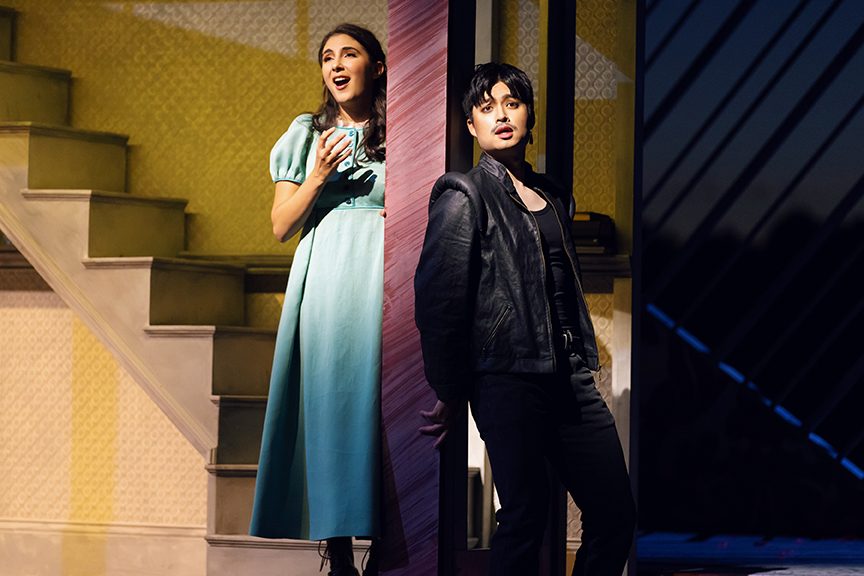
Duke Kim’s light tenor warmed and strengthened over the evening, reaching a high level of passion by the end. His Donna e mobile in the last act was exciting, and his duets with Gilda were wonderful. His portrayal of the privileged, devil-may-care nobleman was winning (or fittingly vile, if you will), both musically and dramatically.
Elena Villalón (Gilda), Duke Kim (Duke); photo by Curtis Brown for the Santa Fe Opera
The star of the evening, as she should be, was the Gilda of Elena Villalón. Caro Nome was a moment of true beauty, and in every powerful duet—with Rigoletto and the Duke—she drove the drama to powerful heights. She carried a warm sound into the softest moments, beautifully holding out the longest phrases. Her acting was first rate, establishing her loving and confused relationship with her father. I particularly liked the touch of showing her reading, making her a full person, a young woman of genuine curiosity and thoughtfulness as well as innocence.
Michael Chioldi (Rigoletto); photo by Curtis Brown for the Santa Fe Opera
A late switch in the cast, Michael Chioldi as Rigoletto used his mature voice to establish a character of great experience and many woes. He mustered the power when needed to convey the depth of Rigoletto’s anguish; every exclamation of the curse was grim and powerful. His closing scene with the dying Gilda was chilling.
Stephano Park made a superb Sparafucile, summoning terror with his deep bass to the lowest note of his name. Marcela Rahal was equally telling as Magdalena, adding a flirtatiousness that fits the character and helps round out the final act. The interactions between brother and sister were more than just singing the notes; there was a touch of teasing in their bother-sister interactions that elicited a few light chuckles.
Le Bu sang the condemned Count Monterone “like thunder.” The named courtiers—Ryan Wolfe and Marcello, Korin Thomas-Smith as Count Ceprao, Mary Beth Zara’s as the perky page, and Ryan Bryce Johnson as Borja, all filled their smaller roles well.
The Santa Fe Opera production of Rigoletto will repeat Aug. 15 and 20. Tickets, if available, can be purchased HERE.
Editor’s Note: This is one of several posts covering four of the five operas presented this year at the Santa Fe Opera.
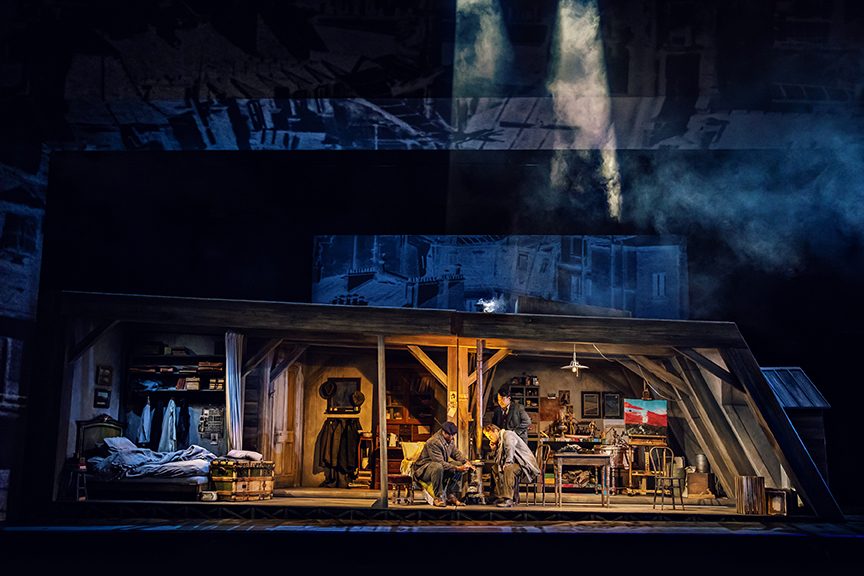
Santa Fe Opera’s production of Puccini’s La Bohème (seen Aug. 6) opens on a standard first-act set: a dingy apartment of Bohemian squalor with views of the Parisian rooftops, here created by projections. Two young men are at work.
L-R: Soloman Howard (Colline), Long Long (Rodolfo), Szymon Mechliński (Marcello); photo by Curtis Brown for the Santa Fe Opera
The first sign that something is up is when the poet Rudolfo starts pounding on a typewriter. This is not 1830s Paris, and when Mimi enters later in the act, her hair style shows that we are in the 1920s. In many ways this is a good choice: Paris in the ‘20s was a center of the avant garde, young artists were flourishing (think Hemingway and Picasso), and the free lifestyle of the operatic Bohemians was common.
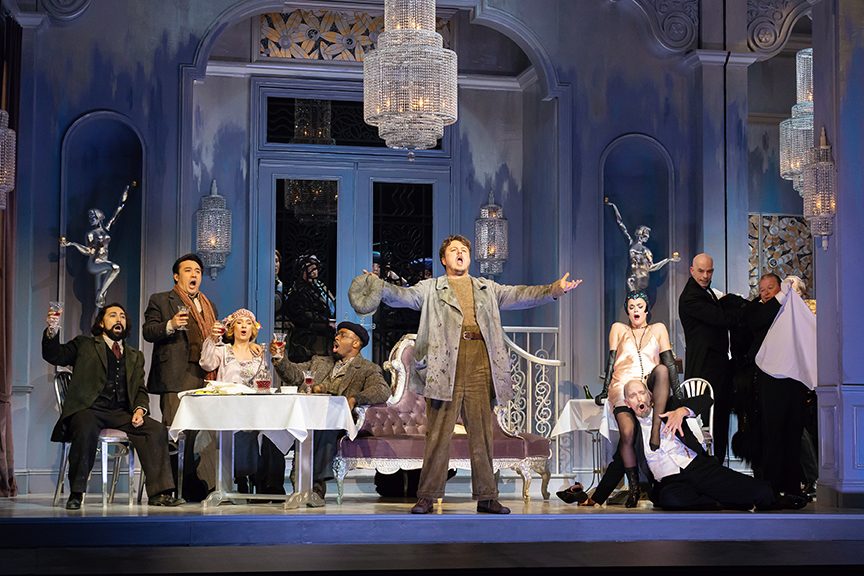
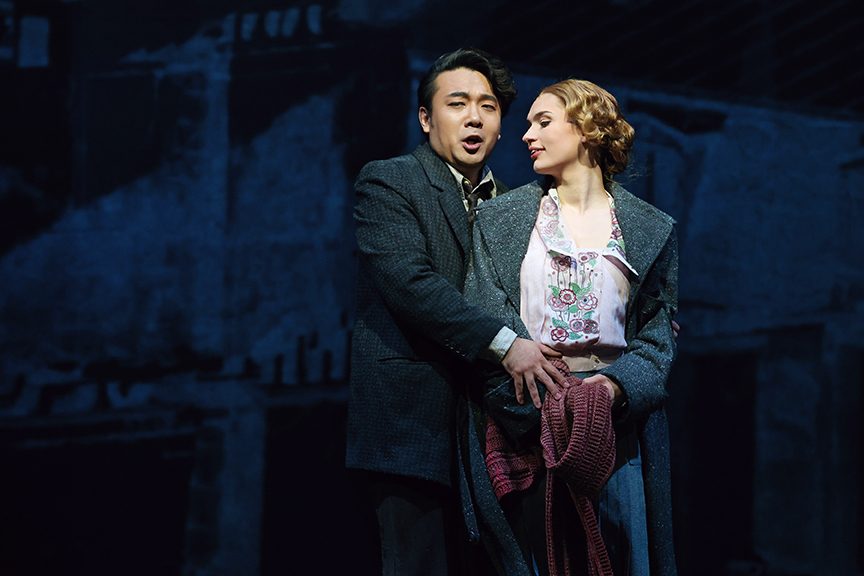
L-R: Efraín Solís (Schaunard), Long Long (Rodolfo), Sylvia D’Eramo (Mimì), Soloman Howard (Colline), Szymon Mechliński (Marcello), Emma Marhefka (Musetta) Kevin Burdette (Alcindoro); photo by Curtis Brown for the Santa Fe Opera
For the most part, the temporal transposition works well, and it provides great opportunities for the costume designs of Costance Hoffman. Indeed, the second act in the streets of Montmatre and inside the Café Momus (transformed from a neighborhood bistro to a five-star restaurant) is a 1920s fashion pageant. The incongruity of grubby Bohemians in such surroundings, with plain people gaping through the windows, becomes part of the humor of the scene. It is good fun, if it does stretch credibility.
The third act continues the time shift: there is a motorized ambulance (doubling as a spot for a streetwalker’s hookups) outside the police post at the gates of the City. The fourth act returns to the first set, through a very clever scenery shift that earned applause. Colline’s overcoat has a definite ‘20s vibe, as does Musetta’s attire.
This visually engaging production replaces one that was presented in Santa Fe in 2019. It is a great improvement, with all the pieces fitting well together.
This is not to say that there are no issues with Allen Moyer’s set. In the second act, the elegant Cafe Momus and its crystal chandeliers require so much space that all the rest of the action—bustling crowds, busy children, the toy seller Parpignol, the act-ending parade—are pushed into narrow margins of the stage. If there is a meaning to the Bohemians being just more Parisians on the street, swallowed up by the Christmas Eve revelries, it is lost here.
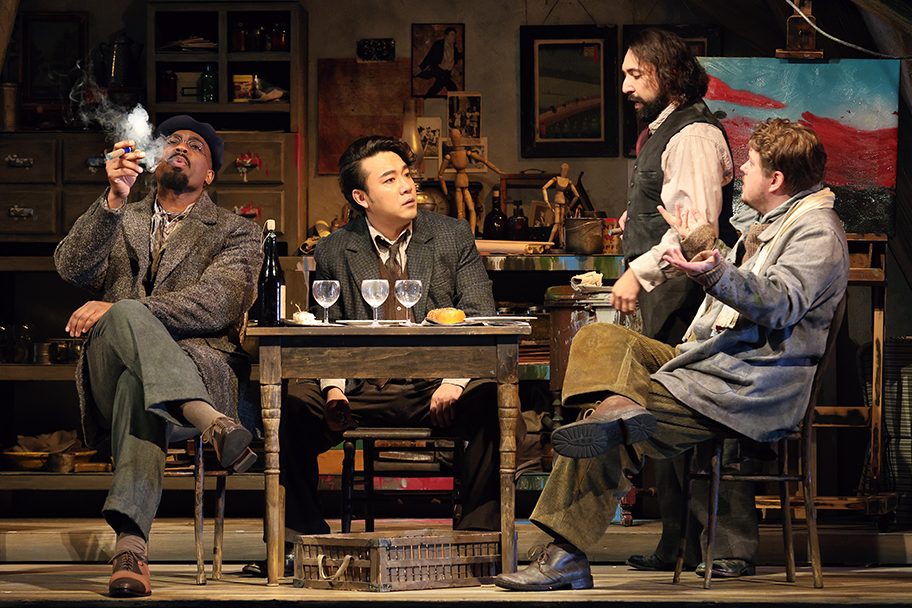
L-R: Solomon Howard (Colline), Long Long (Rodolfo), Efraín Solís (Schaunard), Szymon Mechliński (Marcello); photo by Curtis Brown for the Santa Fe Opera
James Robinson’s stage direction meets the vital standard of telling the story. The camaraderie of the Bohemians is well portrayed, and all critical moments of the story are clear. He always handles the movements of actors in confined spaces comfortably.
In the name of realism—or so I assume—there are a few crude touches. Schaunard turns his back to the audience and then takes the chamber pot and throws its liquid contents out the garret window. After the third-act fight between Marcelo and Musetta, Marcelo angrily retreats into the ambulance with a friendly protstitue. Is it my age? I don’t see what these touches add to the opera.
Conductor Iván López Reynoso charged into the opening chords. Brusque and brisk, they propelled a quick tempo that thankfully stretched to accommodate the vocal lines, but for long periods did not let up. At times Reynoso allowed the brass free reign, and the orchestra sometimes covered the singers or pushed them to full volume. Otherwise, he controlled the musical flow well and kept the music moving.
Long Long (Rodolfo), Sylvia D’Eramo (Mimì); photo by Curtis Brown for the Santa Fe Opera
The success of any Bohème depends on the two leading roles, Rudolfo and Mimi. Both Long Long and Sylvia D’Eramo handled their assignments handsomely. Long Long sang with a ringing, Italianate tone, but the sound lacked a sense of freedom and comfort at the margins. Every phrase was delineated and sung with expression, but I did not sense a progression from one act to another. Rudolfo of Act IV was Rudolfo of Act I.
D’Eramo conveyed Mimi’s fragile state from her first entrance. In the softest moments she floated her pianissimos beautifully, and she used her voice well to convey the character’s declining health. I especially enjoyed her transformation from a shy neighbor to a young woman who is warming to the dawn of love in Act I. A blooming orchestra sound sometimes covered her lines, but she was always able to soar above the sound at climactic moments.
As Marcello, Szymon Mechliński sang with a booming if sometimes rough-edged baritone. This suits Marcello, a more rough-edged character than Rudolfo. His was a dominant character among the four artists, at his best in confrontations and combat with Musetta.
Emma Marhefka (Musetta); photo by Curtis Brown for the Santa Fe Opera
In the latter role, Emma Marhefka played the coquette to the nth degree. No character was more vivid throughout, justifying the bystanders who are delighted to spy her in the second act crowd scene. The famous Waltz was more languid than usual, but none the less effective with her rich voice.
Bass Solomon Howard made Colline a strong presence, singing with a resounding quality that only occasionally hit rough spots in the “Overcoat Aria” of Act IV. Efraín Solís was solid in the less prominent role of Schaunard, always part of the happy company of Bohemians. Santa Fe veteran Kevin Burdette brought the supporting roles of Benoît and Alicindoro to comic life, singing as well as ever.
In spite of any reservations, this is a thoroughly enjoyable Bohème. The cast is strong, the sets intriguing, the orchestra excellent, as always. And Santa Fe nights lend themselves perfectly to this drama of bohemian companionship, young love and loss.
Bohème repeats at the Santa Fe Opera Aug. 14, 19 and 23. Tickets are available HERE.
Anne Akiko Meyers plays moving new work by Eric Whitacre at CMF
By Peter Alexander July 18 at 1:20 a.m.
The Colorado Music Festival Orchestra presented a program of deeply expressive music last night (July 17), including a new work for violin and string orchestra by the American composer Eric Whitacre.
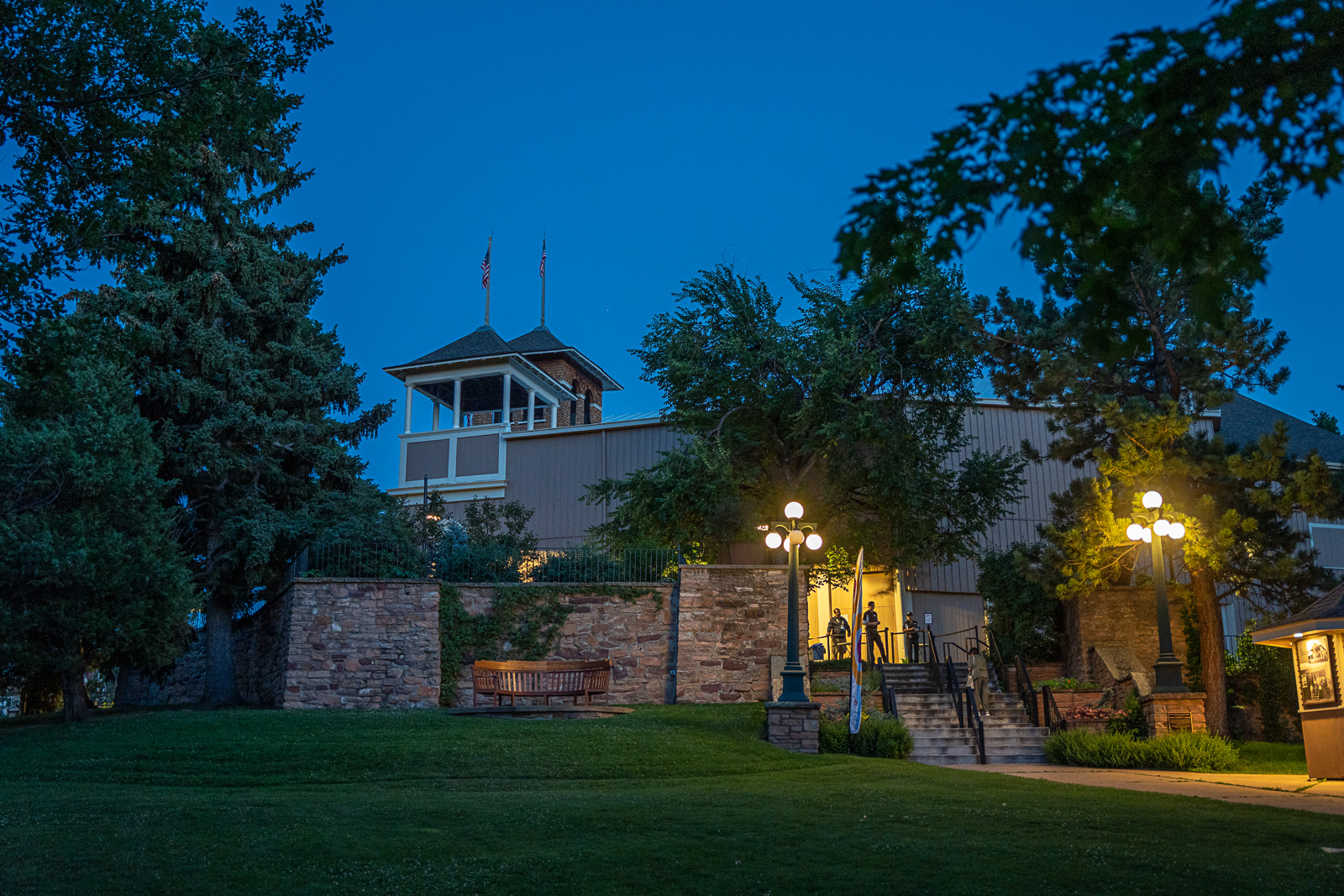
Chautauqua Auditorium. Photo by Geremy Kornreich.
The program, under the direction of music director Peter Oundjian, featured the violinist Anne Akiko Meyers as soloist. In addition to Whitacre’s The Pacific Has No Memory, Meyers gave a polished and captivating performance of Ravel’s virtuoso showpiece Tzigane.
The concert opened with Aaron Copland’s beloved Appalachian Spring. Written for the Martha Graham Dance Company, the music features kaleidoscopic changes of mood, from moments of quiet contemplation to moments of exuberant energy. These are more than changes of feeling; the music should reflect—or better yet—activate movement.
Oundjian and the Festival Orchestra ably captured that spirit. The quiet moments projected a delicate calmness of spirit. The hushed opening was a little hurried, but elsewhere the shifts of mood were well marked, the animated passages bursting with energy. In their solos, the winds played with great delicacy—especially the fluid clarinet solos of principal Louis DeMartino.
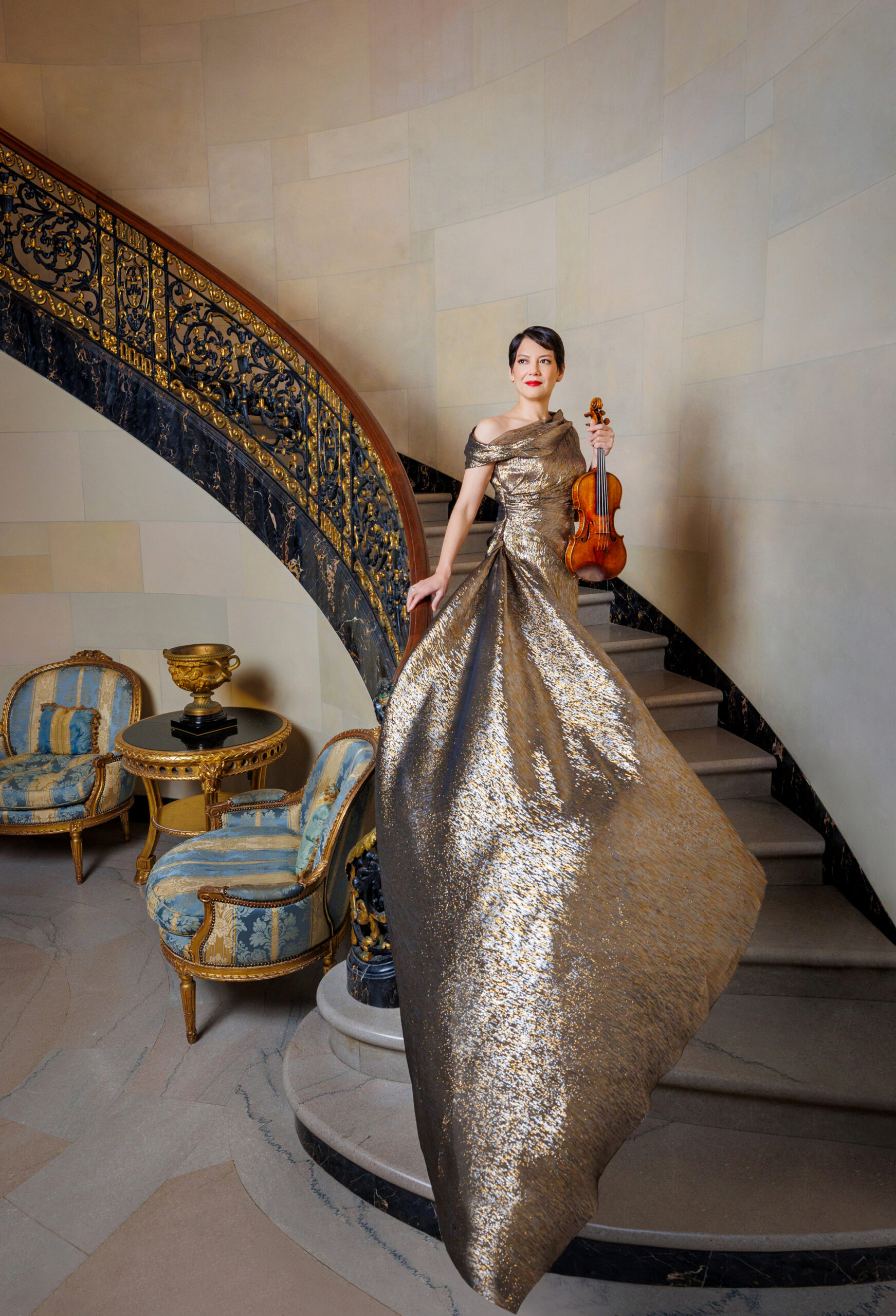
Anne Akiko Meyers
After the Copland, Meyers came on the stage for Tzigane, a colorful exploration of Roma fiddle tunes. From the first note, Meyers opened the floodgates of expression. Her identification with the music’s passionate spirit was reflected in her facial expressions and her dancing movements as she played. The performance was pure entertainment on the highest level.
Meyers introduced Whitacre’s piece by telling of her personal experience during the January fires in Southern California, when she and her family had to evacuate their Pacific Palisades home. Whitacre’s score memorializes the terrible losses in those fires.
In writing the music, he was inspired by the film The Shawshank Redemption, in which a character dreams of a beach on the Pacific Ocean, which he says “has no memory.” Whitacre used that thought as the source of the music’s title, The Pacific Has No Memory, and to symbolize the washing away of harsh memories.
The music is suffused in a feeling of loss, but also consolation. In its gentle beauty, the score formed an oasis of calm at the center of the concert. No doubt reflecting her own sense of loss, Meyers gave a performance of deep expressivity.
After intermission, Oundjian has chosen works from the 19th-century that portray lovers from Shakespeare, but of wildly divergent types. First was the Overture to Béatrice and Bénédict by Berlioz. Based on Much Ado About Nothing, Berlioz’s opera follows the mad adventures of two lovers who engage in happy disputes and cheerful sparring, before finding a happy ending.
The music is flighty, protean in its moods and extreme in its contrasts. Oundjian and the Festival Orchestra embraced all the fickle leaps and bounds of the score, making it come vividly to life. As always, the Festival Orchestra negotiated the most extreme contrasts of volume, including the faintest pianissimos.
This is French music at its most effervescent, something I wish we heard more of in Boulder. And if you want to know the source of Berlioz’s uniquely mercurial style, listen to Rameau—something you are sadly unlikely to hear in the concert hall.
The second Shakespearean subject does not have a happy ending: Tchaikovsky’s Fantasy Overture Romeo and Juliet. Incorporating what Oundjian considers “one of the most beautiful melodies ever,” this one of the most eminent of war horses. But more than the love theme, memorable as it is, Tchaikovsky’s music expresses the conflict between the families, the street brawl, Juliet’s funeral procession, and the fateful blow of tragedy.
From the breathless emotion of adolescent infatuation, the love theme builds into struggle, then into transfiguration, and what one hopes is sorrowful realization and reconciliation. All of that is present in the music, and in the performance by the Festival Orchestra. In all—familiar works well played, a new work beautifully introduced, a brilliant soloist—this was one of the most invigorating concerts I have heard at CMF.
The program will be repeated at 6:30 tonight (July 18) at the Chautauqua Auditorium. Tickets are available HERE.
Two entertaining comedies and a grim story from the home front at Central City
By Peter Alexander July 15 at 1:52 p.m.
Central City Opera (CCO) opened their summer season June 28 with a brisk and bubbly production of Rossini’s 1816 comedy The Barber of Seville. The summer’s other stylistically varied productions have now opened: The Knock, a 21st-century tale of life on the home front during the Iraq war, composed in 2020 by Alessandra Verbalov with libretto by Deborah Brevoort, on July 5; and the 1959 Broadway hit Once Upon a Mattress by Mary Rodgers and Marshall Barer, on July 12.
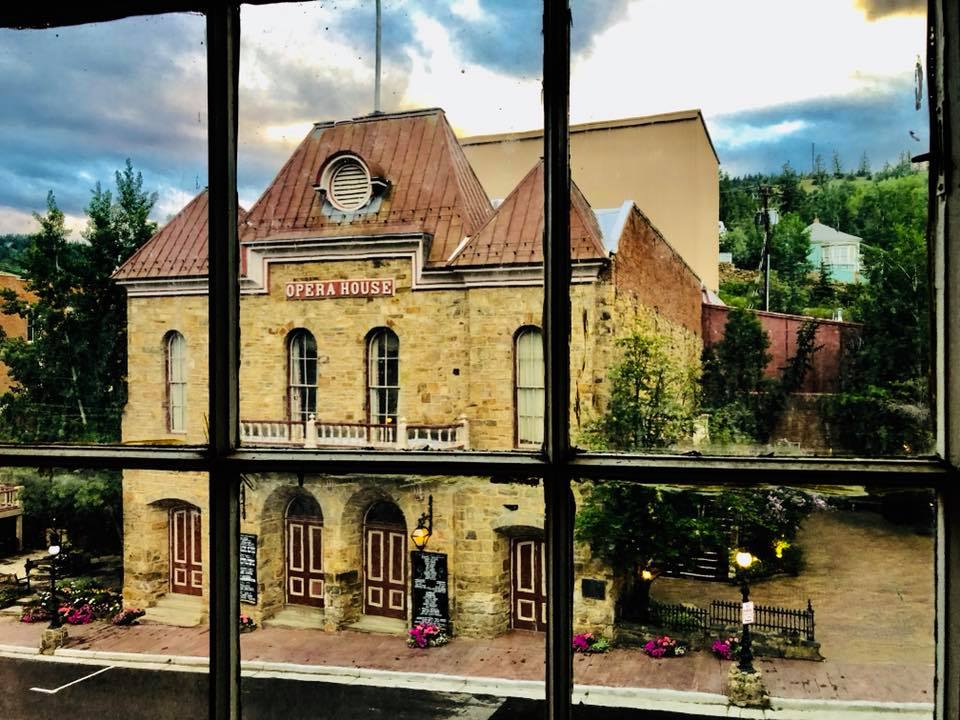
Central City Opera House. Photo by Ashraf Sewailam.
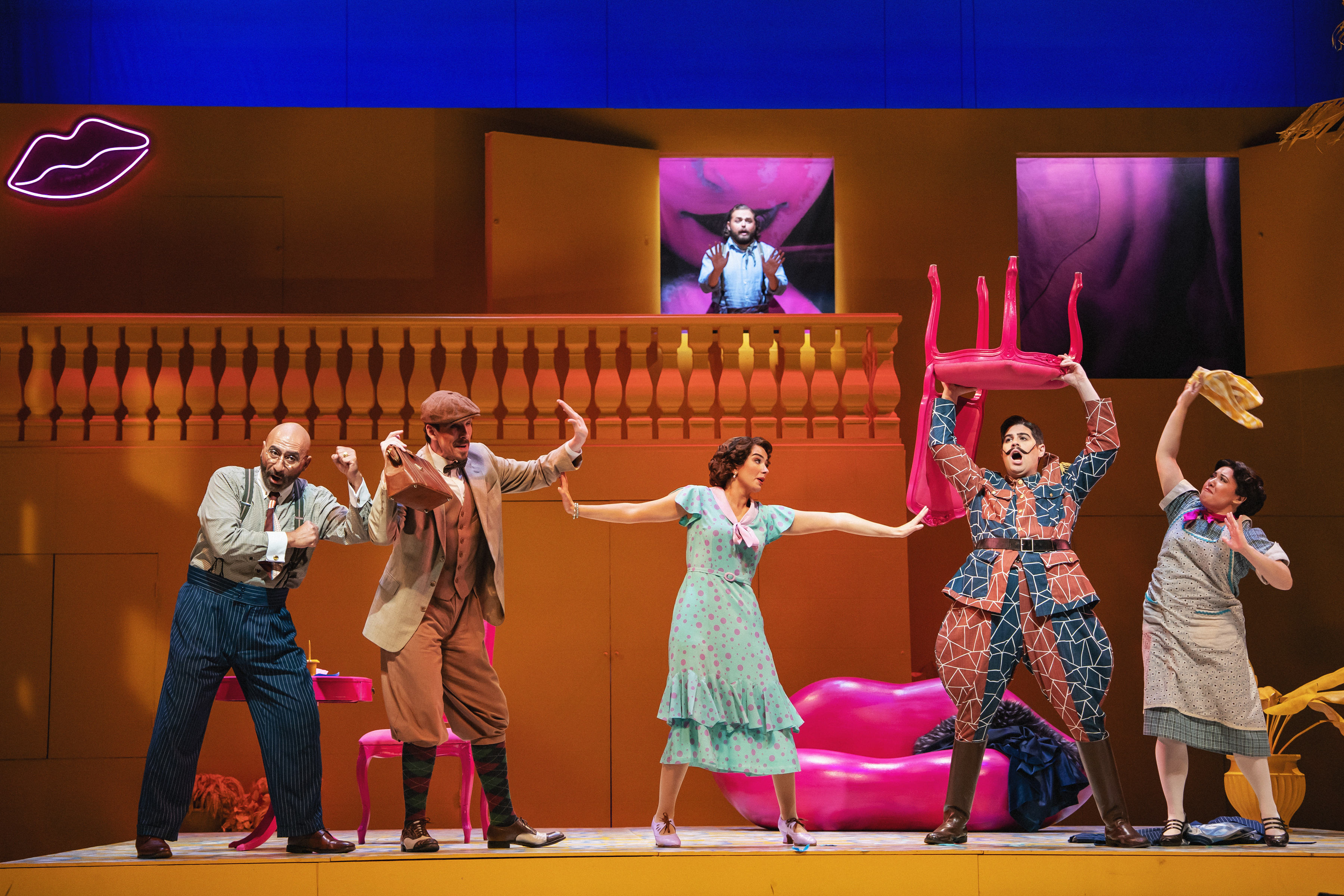
The Barber of Seville is presented with brilliantly colorful sets and costumes that belong to the Opera Theatre of St. Louis. Eric Sean Fogel’s Director’s Notes say that Barber has been placed “in 1930s Spain,” but that concept is almost irrelevant since it hardly touches the story. Stage design by Andrew Boyce reveals Rossini’s raucous comedy dressed up in bright, tropical colors—all yellow and pink on stage, plus a bright red sofa in the form of Rolling-Stones-reminiscent lips.
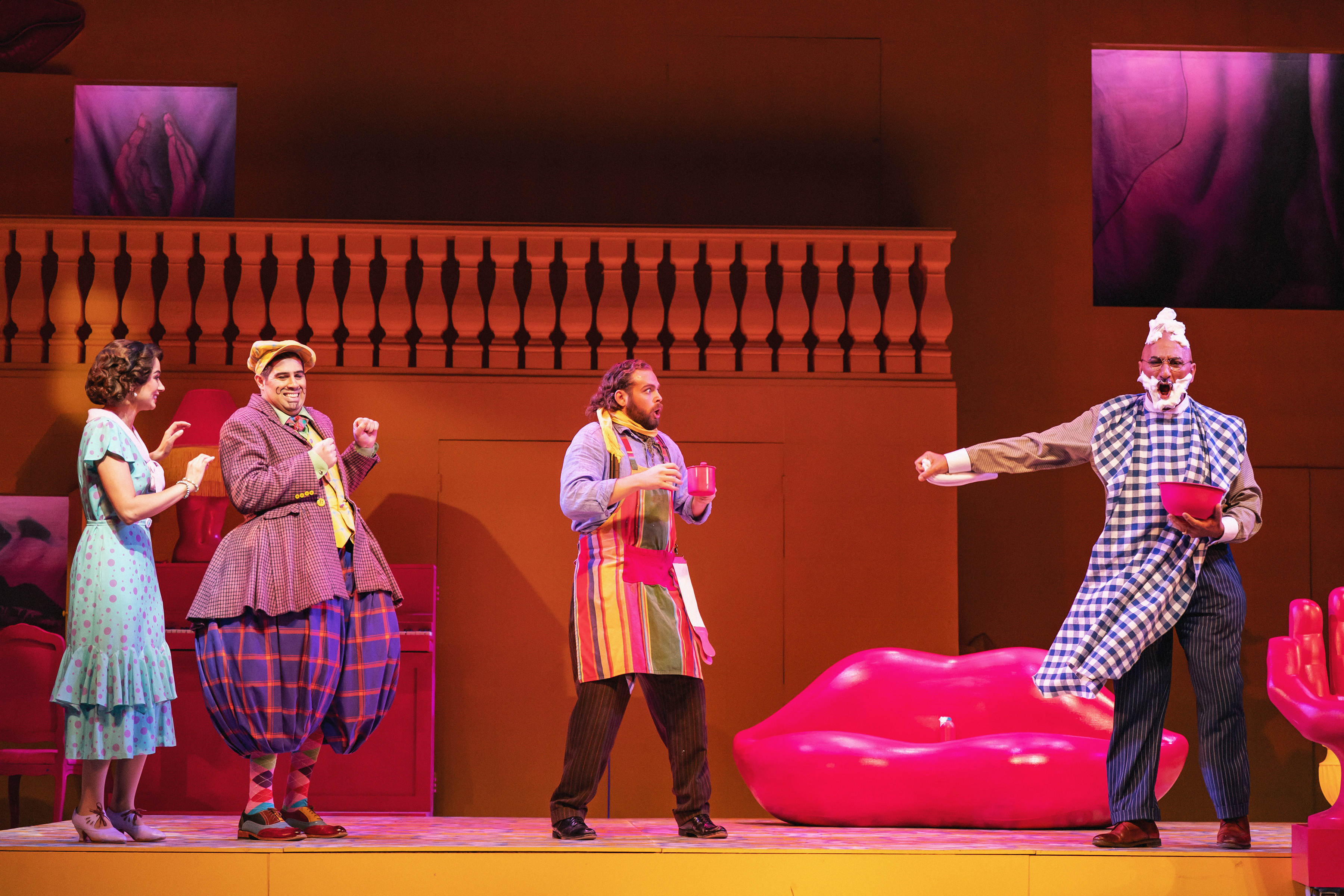
Costume design is by Lynly Saunders. She describes Barber as an opera “where you can really let loose,” and let loose she does. From police in 1930s-style uniforms—the one period reference that is unmistakable—each with one incongruously colorful sleeve, and giant sunflowers instead of rifles, to ridiculously overpuffed balloon pants and a garishly non-matched coat (or is it “power clashing”?), the costumes reveal a designer gleefully run wild. The crescendo of colors culminates with a joyful competition of surprise costume reveals by Almaviva and Rosina just before opera’s end. I can’t imagine anyone not being delighted by the over-the-top riot of colors.
Barber of Seville cast, L-R: Ashraf Sewailam (Dr. Bartolo), Stefan Egerstrom (Don Basilio), Lisa Marie Rogali (Rosina), Andrew Morstein (Almaviva), and Laura Corina Sanders (Berta); Luke Sutliff (Figaro), above. Image by Amanda Tipton Photography
Stage director Fogel does not shy away from pure farce, but as a cast member reminded me, Barber of Seville is supposed to be farce. There are multiple doors, people popping in and out unexpectedly, pratfalls, a piano wider than the stage, and even a collapsing chair. Whether the manic silliness ever crosses a line will be a matter of individual taste. For me it pushed the line, but the hilarity was irresistible from beginning to end.
The vocally strong cast embraced the production’s style with exuberant energy. As Almaviva, Andrew Morstein had difficulty negotiating registers at the outset and sounded strained at top volume, but was comfortable and sang with expression in his gentler moments. He got stronger across the evening, managing Rossini’s leaps and runs with increasing security, and finished as a winning romantic lead.
Luke Sutliff made a terrific Figaro, filling the theater with his voice and his personality. As Fogel observes in his notes, Figaro is the barber of the title, but the young lovers Almaviva and Rosina want to capture our attention. The direction and Sutliff’s performance make Figaro both the factotum who gets things done in Seville and the mainspring of the opera’s action, as he should be.
Ashraf Sewailum, known locally from previous performances at Central City, the University of Colorado Eklund Opera Company, and numerous concert appearances in Boulder, was brilliantly blustering and periodically baffled as Dr. Bartolo. His full bass voice easily filled Central City’s house. Both his musical phrasing and comic timing made him one of the stars of the show.
L-R: Rosina (Lisa Marie Rogali), Count Almaviva (Andrew Morstein), Figaro (Luke Sutliff) and Dr. Bartolo (Ashraf Sewailam). Image by Amanda Tipton Photography
Mezzo-soprano Lisa Marie Rogali lent her strong, resonant lower register and bright, sweet upper notes to the role of Rosina. Her melting lyricism and confidence in the coloratura passages made her trademark aria “Una voce poco fa” a highlight. Happily she captured the strength and determination of the character, avoiding cliches of the submissive ward and previewing the independent countess of Mozart’s Marriage of Figaro.
Stefan Egerstrom humorously portrayed Don Basilio as a purse-carrying, prancing dandy. His on-target performance was one of the keystones of the interpretation of Barber as farce. Equally fit for her comic role was Laura Corina Sanders as Berta, the unruly servant. She took full advantage of the possibilities the over-the-top production style offered her character.
Louis Lohraseb, who has conducted opera in Rome, Hamburg, Dresden and Berlin, made his Central City Opera debut leading Barber. Under his baton, the orchestra played with stylish restraint, never overpowering the singers. The overture was bright and energetic, despite a few soggy moments.
# # # # #
Nestled between two comedies, Aleksandra Vrebelov’s The Knock tackles the deeply serious question of the hidden pain and tragedies of war. During the 2003–11 Iraq war, American military wives endure a long night of suspense when they are cut off from communication with their husbands in Fallujah. The title refers to the dreaded knock on the door, when a military officer will officially notify one of them of her husband’s death.
Vrebalov’s score was receiving only its second full stage production, since the planned premiere at the 2020 Glimerglass Festival had to be presented on film, due to COVID. The performance at Central City was a fitting regional premiere, as The Knock is set in and around Ft. Carson, Colorado.
Born in Serbia, Vrebalov directly experienced the horrors of war during the 1998–99 Kosovo War and the devastating NATO bombing of her hometown of Novi Sad. This experience stands behind several of her most successful pieces.
In The Knock, her subtle music expresses the rising tension among the military wives at home through steady background chords and ostinato patterns that increase in intensity. A sharp and expressive score, it signals the buildup of despair and fear without resorting to bombast.
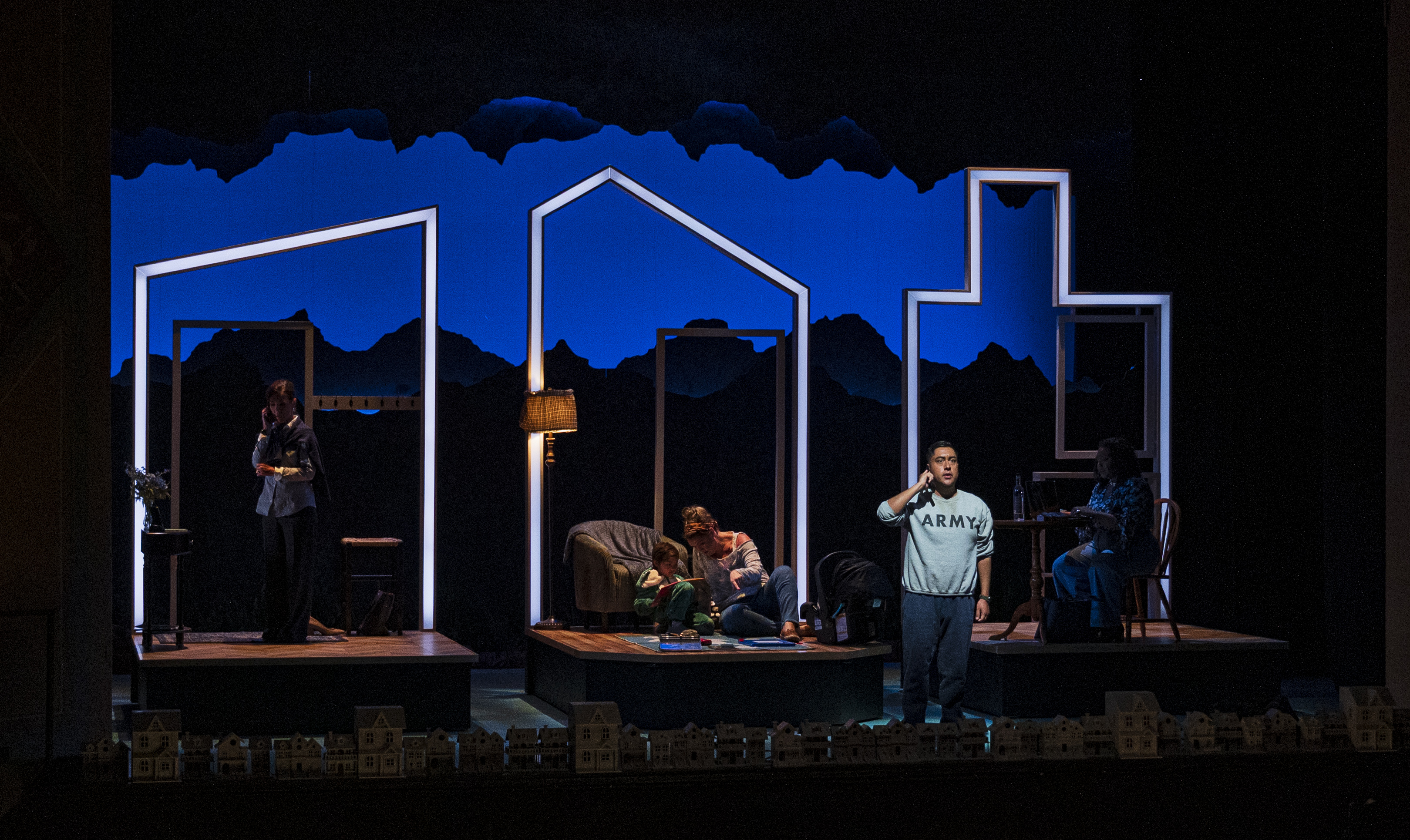
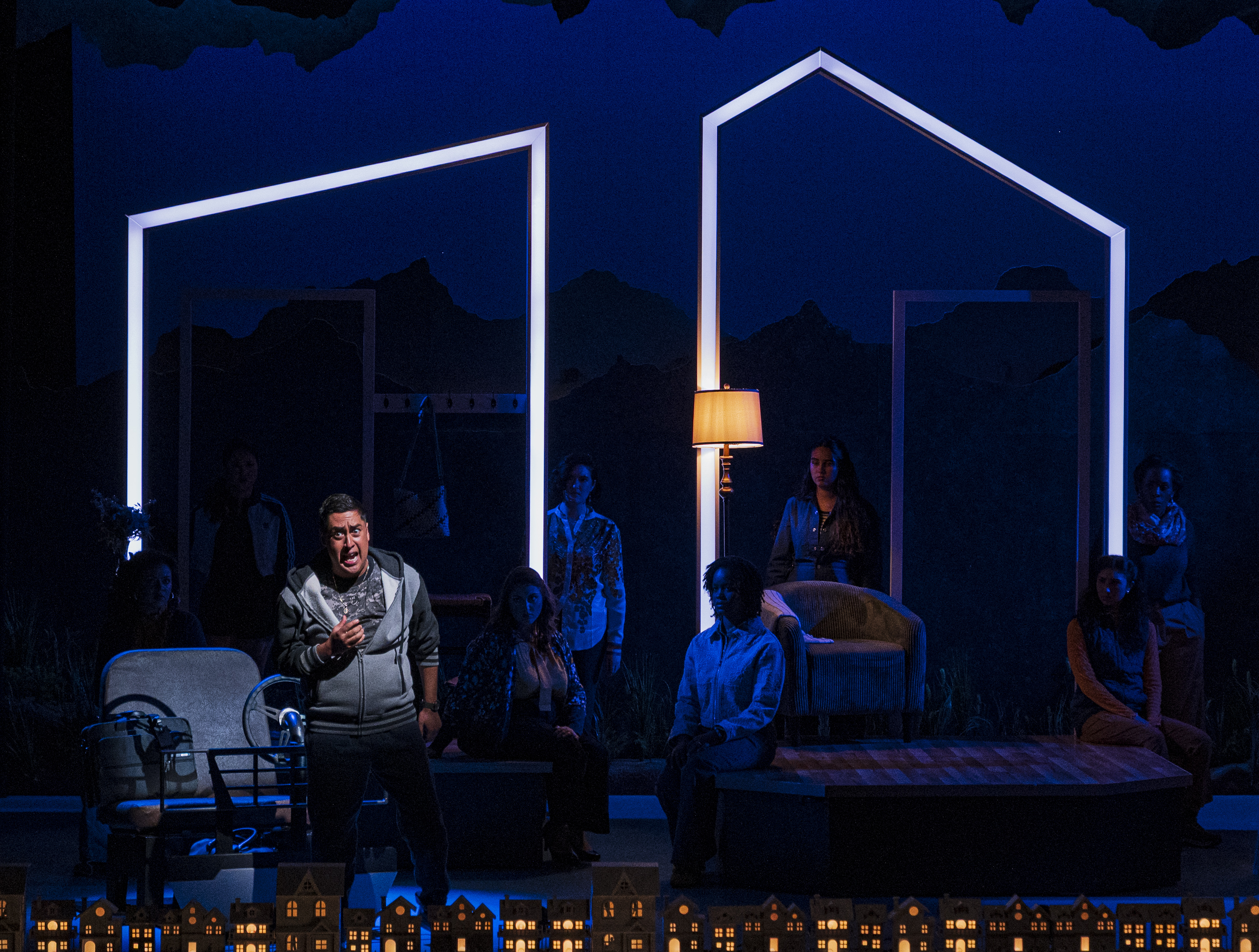
The three houses that form the setting of The Knock. Downstage, Lt. Robert Gonzalez (Armando Contreras) gets the call to deliver “the knock.“ Photo by Lawrence E. Moten III.
The evocative set by Lawrence E. Moten III comprises brightly lit outlines of three houses, those of Jo, Aisha, and an unnamed other military wife. A row of tiny houses across the front of the stage, sometimes lit from inside, represent the larger community of military families. In the back, the outline of Colorado mountains can be seen against a deep blue late-evening sky that is symbolically lit with stars at show’s end.
Three characters dominate the action. Joella “Jo” Jenner is a young wife and mother of two who is undergoing her first nighttime vigil waiting for word from the battlefield. Portraying a nearly one-dimensional character—the mother terrified for herself and her children—Mary-Hollis Hundley ably expresses Jo’s unease and her fragility.
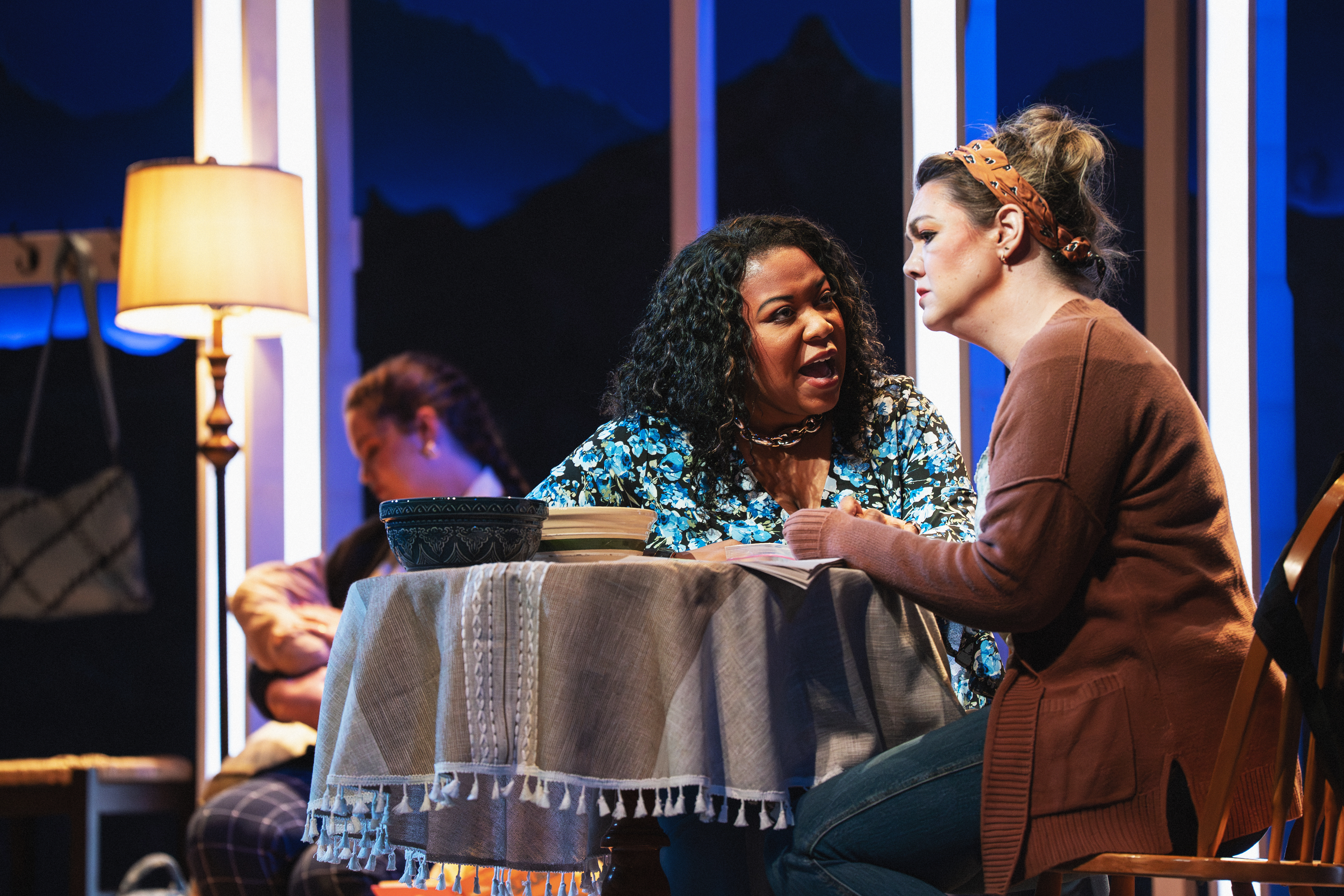
Aishah (Cierra Byrd) tried to console Jo Jenner (Mary-Hollis Hundley). Image by Amanda Tipton Photography
Paired with Jo is Aishah McNair, a more experienced military wife who tries to offer support and perspective to the young mother. Cierra Byrd gave Aishah depth, especially near the end when launching the number “When the person you love is far away,” which blooms into an ensemble number. Her warm, smokey contralto complimented Hundley’s more delicate soprano throughout their scenes together.
Lt. Roberto Gonzalez is a young soldier tormented by being stationed in the U.S. while his comrades face combat. He has been tapped to deliver the mournful news—the knock—for the first time, leaving him nervously trying to fulfill the duties as described in the manual.
Lt. Gonzalez (Armando Contreras) agonizes over his duty to deliver the news of a soldier’s death. Photo by Lawrence E. Moten III.
Baritone Armando Contreras overplayed Gonzalez’s stress, staying at a high volume and almost shouting his way through parts of the role. His repeated invocations of the Virgin de Guadalupe were more than needed, since his sincere faith and apprehension are evident from the start. His lovely singing in the concluding ensembles, when Lt. Gonzalez relaxes into tender feelings for the women he confronts, show that he has a wider range of expression and styles than are heard for most of the opera.
Conductor David Bloom managed the mixed chamber ensemble in the pit comfortably, keeping the music moving through the rather extreme emotional ups and downs of the characters. Moritz’s stage direction effectively kept the action clear, as it moved from separate houses, to one house where the wives gathered, to scenes of Lt. Gonzalez facing his fears while traveling cross country.
The poignant conclusion of the opera—with one wife facing a devastating development and the others embracing relief—provides music that expresses both sentiments, or as the text has it, “Joy and Sorrow.” And the concluding lines describing the folded flag that every war widow receives, “Blue and Stars are All that will Remain,” remind us eloquently of the show’s central point, that the ripples of war’s tragedies spread across society. It is a sobering moment in a powerful piece.
# # # # #
Once Upon a Mattress, which opened Saturday (July 12), was the first full-length Broadway show by Mary Rodgers, daughter of the famed Broadway composer Richard Rodgers who was half of the musical-comedy teams of Rodgers & Hart and Rodgers & Hammerstein. Growing up in so musical an environment, Mary Rodgers naturally took to composing as a teenager, and had a very successful career writing music for children’s records, musicals and reviews, and was the author of several children’s books.
Her one big Broadway hit, Once Upon a Mattress opened in 1959 and perfectly fits the mold of 1940s and ‘50s musicals. It offers ample opportunities for catchy songs, quirky characters, a heavy dose of theatrical silliness, and a thoroughly happy ending. The music is never compelling or deeply memorable, but it is never less than pleasant. The book is full of gags and jokes that elicited hearty laughter from the audience on Saturday.
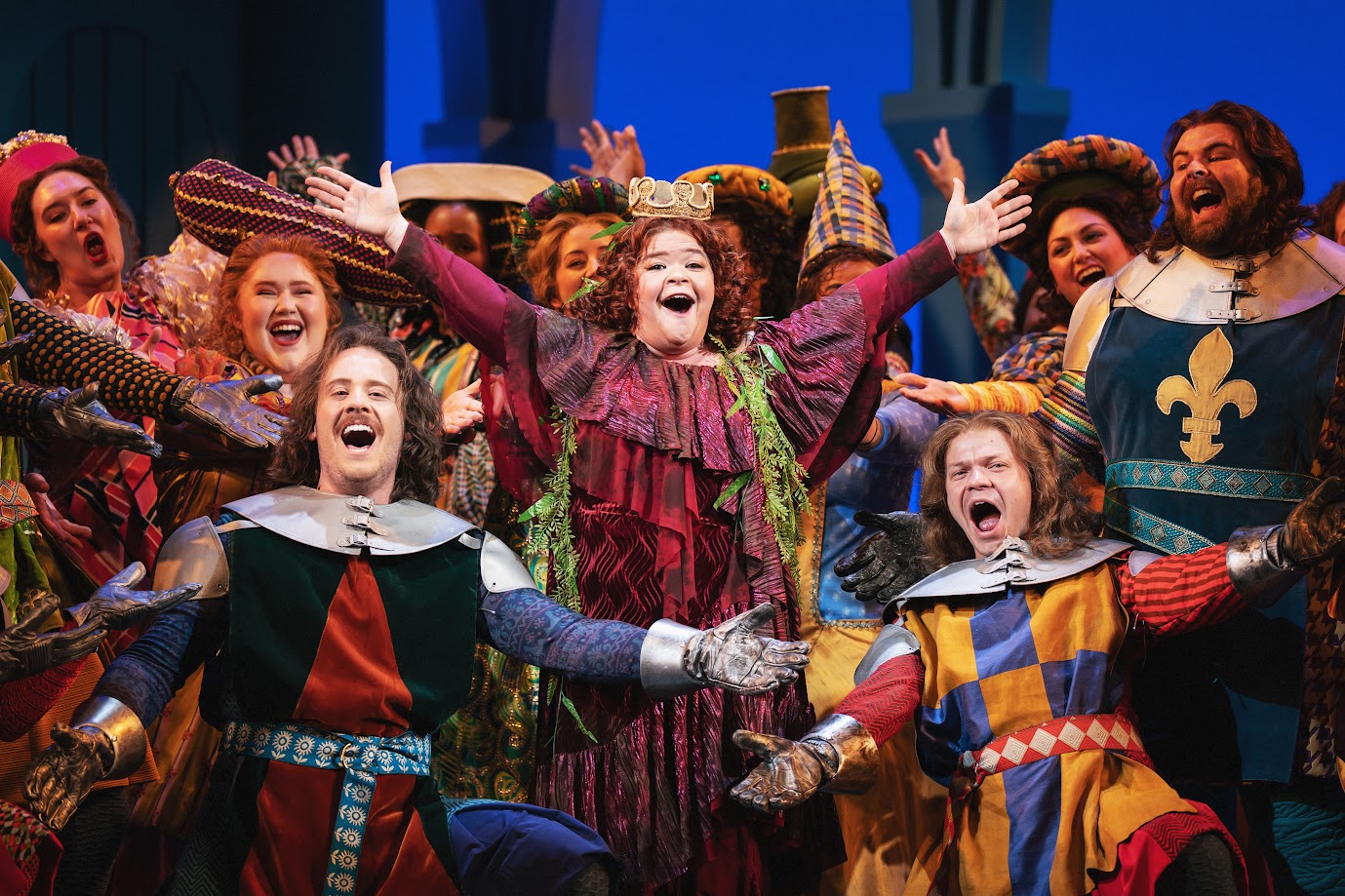
Ensemble cast of Once Upon a Mattress. Princess Winifred (Marissa Rosen) draped with weeds from the moat, center. Image by Amanda Tipton Photography
The plot skates cheerfully on the surface of the Hans Christian Anderson tale of “The Princess and the Pea,” with a goofy young Prince dominated by a despotic mother who will only allow him to marry a proper princess. In the meantime, no one in the kingdom—or is it queendom, since his father is mute?—is allowed to marry until the timid Prince Dauntless the Drab is wed to a suitably, queen-approved mate.
A hopeful candidate shows up in the form of Princess Winifred the Woebegone from a marshy realm—the Broadway debut role of Carol Burnett in 1959. Queen Aggravain has imposed a test on every potential bride, which all have failed. For Winifred she devises the pea under 20 mattresses (actually 14 at Central City), with the expected result.
All of these more or less stereotyped characters were portrayed with the broad humor the show wants. Everyone in the cast had a suitably lyrical musical theater voice, capable of crooning all the ballads and other musical numbers of the score. There are a few solo numbers and many duets and ensemble numbers, all well handled by the consistency solid cast.
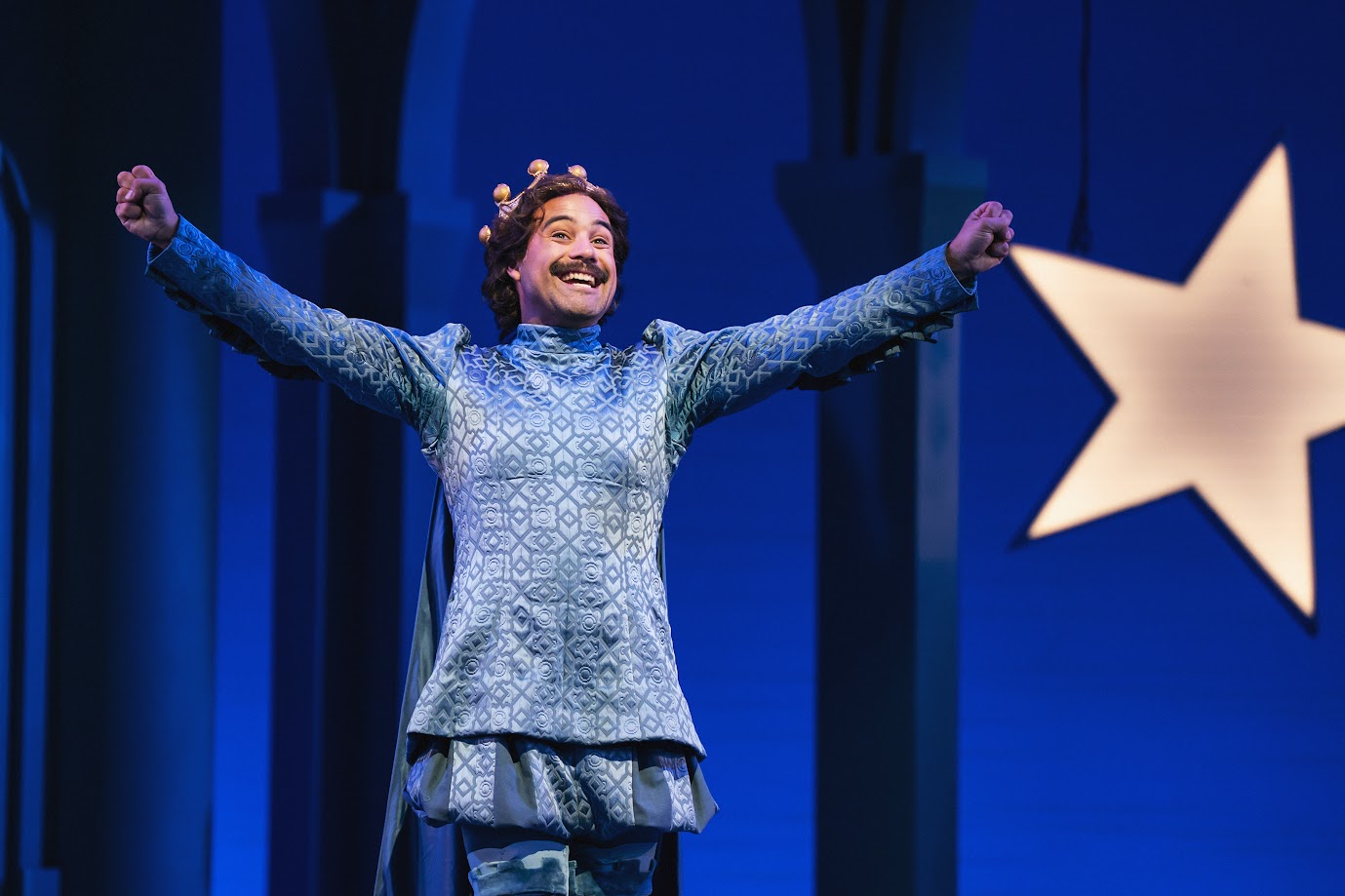
Margaret Gawrysiak was everything you could want for Queen Aggravain—imperious, haughty, comically unyielding and too eager by half to rule out potential brides. Michael Kuhn was an ideal Prince, completely under the sway of his controlling mother, with just the right touch of modern nerdiness thrown in. Marissa Rosen made an especially strong impression as Princess Winifred, with just enough of her own nerdiness to captivate Dauntless. She projected the latent athleticism fitting for a princes who, in a moment shocking to the court, “swam the moat” and entered trailing tangles of weeds.
Prince Dauntless the Drab (Michael Kuhn). Image by Amanda Tipton Photography
As the Jester and Minstrel, Alex Mansoori and Bernard Holcomb were well matched stage buddies, either bantering or singing together. Jason Zacher made good use of his short appearances as a wizard who does parlor tricks at random moments. The on-again, off-again couple of Sir Harry and Lady Larken, who have a growing reason for the ban on marriage to be lifted. The couple were well portrayed by Schyler Vargas, who had fun with Sir Harry’s sense of importance, and Véronique Filloux, fittingly flighty as Lady Larken. Together they captured all the traditional nuances of the couple who are happiest while quarreling.
Special mention must be made of Andrew Small, who delighted in his CCO debut as the mute King Sextimus, who has an unfulfilled taste for the ladies in waiting at the court. The son of a musician who played in the CCO orchestra in the 1980s, Small first attended the opera when he was 10, leading to a career on stage. He wrote for the program that performing at CCO is “a deeply meaningful, full-circle moment.”
Seated at the very back of the house I could not always hear the voices over the orchestra. Out from under the balcony and closer to the stage, the sound was probably better. In all other respects conductor Kelly Kuo led a stylish and energetic performance.
The scenic design by Andrew Boyce fits the classic Broadway ambience perfectly, walls and arches suggesting a cartoonish court. The costumes by Elivia Bovenzi Blitz are standard theater-medieval—colors and fabrics no one saw in the middle ages, but pleasantly evocative of make-believe realms.
The stage direction by Alison Fritz, the artistic director of CCO, kept the show moving seamlessly. John Heginbotham’s choreography was handled smoothly by all of the acting/singing/dancing members of the large cast.
Those who love Broadway will relish the opportunity to attend a professional production of Once Upon a Mattress, performed with full orchestra and Broadway-worthy voices. If that’s your dish, go for it! If not, the farcical Barber of Seville and deeply thoughtful The Knock are equally worth a trip into the mountains.
NOTE: Performances of all three shows at Central City continue through the month and into August. The full schedule is listed below.
# # # # #
Central City Opera Remainder of the 2025 Summer Festival Season All performances in the Central City Opera House, Central City, Colo.
Rossini: The Barber of Seville
7:30 p.m. Saturday, July 19 2 p.m. Tuesday, July 15; Friday, July 25; Saturday, July 26; Wednesday, July 30; Sunday, Aug. 3
Aleksandra Verbalov: The Knock
7:30 p.m. Saturday, Aug. 2 2 p.m. Sunday, July 19; Tuesday, July 22
Mary Rodgers and Marshall Barer: Once Upon a Mattress
7:30 p.m. Saturday, July 26 2 p.m. Wednesday, July 16; Friday, July 18; Sunday, July 20; Wednesday, July 23; Sunday, July 27; Tuesday, July 29 Friday, Aug. 1; Saturday, Aug. 2
Tickets for all remaining performances are available on the CCO Web Page.
Well shaped performance of “the greatest First Symphony”
By Peter Alexander July 11 at 12:24 a.m.
The world premiere of an engaging concerto for saxophone by American composer Joan Tower topped the bill at the Colorado Music Festival last night (July 10).
The Festival Orchestra was conducted by CMF music director Peter Oundjian, with Steven Banks as saxophone soloist. Tower was present for the premiere performance of her new score, and spoke briefly before the performance.
Titled Love Returns, the score is derived from a piece for solo piano titled Love Letter that Tower wrote in memory of her late husband after his death in 2022. Poignant, well constructed and emotionally coherent, Love Returns should become part of the concert repertoire for saxophone.
The first of the work’s six movements starts tenderly, with beautiful string sounds providing a warm embrace for the soloist. Over the next three movements, the music grows in intensity, reaching an uneasy high point built from nervous swirls in the saxophone. The Fifth movement is a solo cadenza, developing jumpy fragments of scales.
A virtuosic series of edgy passages leads into the final movement, where the nervous swirls loosen and return to the calm of the work’s opening. This creates a perceptible expressive arc, while the gentle ending suggests a moment of acceptance before the music settles into silence.
With a sweet tone and flawless technique, Banks gave an exemplary performance. The fluidity of his rapid passagework was remarkable, and he moved smoothly through all the shifts of mood and style. He has the ability to fade to silence in even the highest register. If recorded, his performance would create the standard for this valuable new work.
The concert opened with Aaron Copland’s Outdoor Overture, a strongly profiled work written for students at the High School of Music and Art in New York. To recognize the work’s origin, Oundjiuan turned over the podium to the CMF’s young assistant conductor Stefano Boccaci, who lead a bracing performance.
Copland’s alternating sections of vigor and delicacy were well marked. As appropriate for a school piece, all sections of the orchestra have opportunities to step forward. The bright trumpet solos of principal Jeffrey Work were acknowledged at the end, but every section earned recognition.
The concert ended with Brahms Symphony No. 1, which Oundjian likes to call “the greatest first symphony ever written.” Before the performance, he also noted that Brahms took 21 years to complete the symphony, during which time he progressed from a callow young musician to an experienced composer of international rank.
Oundjian and the Festival Orchestra gave a well shaped, controlled performance. The tense introduction to the first movement promised the drama to come. Throughout the engrossing first movement, the music surged from the tiniest pianissimos to full Brahmsian fortes. Oundjian convincingly varied the tempo to match the expressive needs of the score.
The slow second movement was carefully played but never came alive. The third movement projected relaxed good cheer, especially in the strolling music played by the woodwinds. Drama came to the fore again in the finale, which Oundjian built carefully to the climax. I heard bravos and cries of “Oh My God” at the end, signaling how well the symphony reached the audience.
The program will be repeated at 6:30 tonight (July 11) at the Chautauqua Auditorium. Tickets are available through the CMF Web Page.
Festival-opening concert ends with a crashing wave of sound
By Peter Alexander July 4 at 12:30 a.m.
It was July 3, and the fireworks started early at Chautauqua.
They were musical fireworks, as the 49th Colorado Music Festival (CMF) got underway last night with music by Russian composer Igor Stravinsky, literally titled “Fireworks” (Feu d’artifice). CMF music director Peter Oundjian conducted the Festival Orchestra in a fleet, bright performance of Stravinsky’s sparkling showpiece for orchestra.
Music director Peter Oundjian with the Festival Orchestra. Photo by Geremy Kornreich
The brief opener was followed by soloist Hélène Grimaud performing Brahms’s First Piano Concerto. Before the performance, Oundjian said that the performance would represent the young Brahms—he was 21 when he started it—rather than the older, bearded Brahms we often see in photographs. I suppose he meant that the more muscular passages were imbued with youthful energy and strongly contrasted with the more tender passages.
The acoustics in the Chautauqua Auditorium flatter the orchestra more than the soloist, whose detailed, expressive playing was not always clearly heard. Here the pianist’s case is not helped by the fact that the piece went through several iterations, including a symphony. Consequently, the solo part does not always stand apart from the orchestra.
No live performance can match the balance of a carefully engineered recording, but it’s too bad Grimaud could not always overcome the orchestral sound. What I heard of her playing was forceful and arresting. The contrasts within the music were well delineated, providing a firm sense of form and movement to the performance.
The first movement was marked by the bright clarity of the woodwinds and the rich warmth of strings. Grimaud provided a well controlled profile of the lines and passages of the expressive slow movement, and took hold of the finale’s boisterous rondo theme from the very first. Even when the balance was less than ideal, you had the sense that she was in control of the music’s momentum. The audience, as CMF audiences do, responded with effusive enthusiasm.
The second half of the concert was devoted to music by Ravel, who this year celebrates the 150th anniversary of his birth. A great orchestrator, Ravel understood the orchestra so well that his music almost plays itself. That is, if you can play it—which Festival Orchestra can.
The two pieces presented last night, Suite No. 2 from Daphnis and Chloé and Bolero, are essentially about sound. The orchestra created magic from the very first gentle, rippling sounds in the woodwinds at the start of the Suite. The music surged to a strong climax in the full orchestra, followed by several evocative scenes of a more placid nature.The solo flute, Viviano Cuplido Wilson played her extensive solos with a warm, controlled sound and received individual recognition by Oundjian during the ovation.
Bolero is a piece that is heard not enough and too much. We don’t hear it often enough as written, but we hear it too often in cheesy arrangements that don’t honor the carefully calculated shape composed by Ravel.
Ravel’s score is about two things: an unchanging tempo as the theme is repeated, and a crescendo that reaches its climax at the very end. The CMF performance started as softly as any I have heard, to the point that I wasn’t actually sure when the first notes were played.
Once the piece starts, it is entirely in the hands of the players to control both the tempo—mainly the responsibility of the snare drummer—and the crescendo. With Oundjian’s careful attention, the Festival Orchestra created a steady, growing wave that crashed over the audience with the very final note.
NOTE: The opening concert will be repeated at 6:30 p.m. Sunday (July 6). The full schedule and tickets are available on the CMF Web page.
Concert features world premiere, Bluegrass violin concerto, “New World” Symphony
By Peter Alexander Jan. 13 at 12:30 a.m.
Michael Butterman returned to the Boulder Philharmonic Orchestra yesterday (Jan. 12) to conduct an interesting and worthwhile program, having missed the fall season due to cancer treatments.
Newly bald from chemo therapy, Butterman was welcomed by the Macky Auditorium audience with cheers and applause. He led the full program with his usual energy.
First was the world premiere of Wind, Water, Sand by Stephen Lias, inspired by Colorado’s Great Sand Dunes National Park. It is the third national park-inspired piece by Lias premiered by the Phil, after Gates of the Arctic (2014) and All the Songs that Nature Sings (Rocky Mountain, 2017). Unlike those works, Wind, Water, Sand does not have images to accompany the score. Lias has explained that he wanted this work to spur the listener’s imagination, instead of being linked to specific images of the park.
He also said the music expresses the flow of the three elements that created the park—the wind, the water, and the sand. There are closely related musical ideas that flow at various speeds, just as the three elements flow at different rates within the park.
The score opens with energetic ideas that are wonderfully evocative of motion. The intricate, rippling quality of these opening gestures suggest the wind flowing over the dunes, or the ripples of the stream that runs alongside the dunes. Thereafter, the orchestral sound is colorful and suggestive, but rarely specific enough to signal wind or water.
The bustling opening gives way to a greater stillness, punctuated by outbursts of sound that I found evocative more of a summer storm than any of the three elements. Exciting contributions from the percussion animate this section, along with dramatic gestures from the brass that evolve into something that seems grander than sand dunes.
Whatever one imagines, the piece is well structured from beginning to end. With its busy opening, its central section that grows in grandeur, and a return to the opening soundscape, it creates a satisfying whole.
People around me talked of the score having a cinematic quality—I heard mentions of Indiana Jones and Studio Ghibli; clearly the music struck home. On the basis of its musical qualities alone, Wind, Water, Sand deserves a future in concert halls.
Next Butterman introduced violinist Tessa Lark, who performed a piece written for her by Michael Torke. Titled Sky: Violin Concerto, it combines the structure and musical drama of the classical concerto with musical styles that reflect Lark’s fiddling skills from her native Kentucky.
Lark occupied the concerto’s unique sound world like it was home—which in a way it is. She played the dazzling first movement with fire and a Bluegrass virtuosity that elicited spontaneous applause between movements. The wistful second movement—as it is labelled in the score—presents a series of meditative ideas skillfully knit together. And the final movement, now “spirited,” gave Lark the chance to play flashy fiddling licks with energy and bravura.
The performance was not always ideally balanced in Macky’s uneven acoustic, but that seemed not to detract from the listeners’ enjoyment. Lark’s energetic body language, including bends and emphatic stomps, added to the overall excitement. The audience called Lark back for an encore that combined her country singing skills with down-home fiddling.
The concert concluded with another piece from America, if not by a living American: Dvořák’s Symphony No. 9, “From the New World.” Butterman and the orchestra gave an expressive performance, marked by strategic variations of tempo. If a little more than I would like, these touches marked out the expressive contours of the familiar symphony.
The best moment was provided by the brass chorale at the outset of the second movement, resonant and reverent. The movement also featured an eloquent English horn solo on the famous “Goin’ Home” theme that was later adopted into a pseudo-spiritual by one of Dvořák’s pupils. Butterman tore into the final movement at a speedy pace, but again used strategic variations of tempo to outline the expressive contours.
The winds played strongly throughout, giving the symphony a muscular core, but occasionally overpowering the strings. All the wind solos were well played, including the treacherous horn solos and lovely contributions from the flute and clarinet.
CORRECTION 1/13: The composer Stephen Lias’ name was incorrectly listed as Michael in the first version of this review.
Reviews of The Righteous, Der Rosenkavalier and L’elisir d’amore
By Peter Alexander Aug. 14 at 10:25 p.m.
The Santa Fe Opera premiere of The Righteous, a new opera by Gregory Spears to a libretto by Tracy K. Smith that I saw Aug. 7, offered some memorable singing, a skillful and expressive orchestral score, fine direction by Kevin Newbury, flexible set designs by Mimi Lien, and intermittent drama.
Anthony Roth Costanzo (Jonathan, l.) and Michael Mayes (David) in Gregory Spears’ The Righteous. Photo by Curtis Brown.
The plot is a tale of faith, betrayal and torn loyalties that shatter relationships and create family conflicts. The central character is David, a charismatic preacher widely known for his compassion. Surrounding him are his childhood friend Jonathan, a struggling gay man; Jonathan’s father Paul and sister Michele; David’s friend Sheila and her husband Eli. (If you are seeing Biblical implications in the names, that is entirely intentional.)
Jennifer Johnson Cano (Michele), Michael Mayes (David) and Elena Villalón (Sheila). Photo by Curtis Brown.
The situation offers possibilities for strong emotions, as David betrays his first wife (Michele) and breaks up another marriage pursuing an affair with Sheila, then gives up the ministry for a compromising career in politics. Along the way he turns his back on Jonathan, who is portrayed as a gay man lost in the treacherous waters of the 1980s AIDS crisis.
Unfortunately, the opera does little more than skate on the surface of these opportunities. The obvious issues of the time are touched—gay rights, women, AIDS, the war on drugs, racial justice, youth culture—but thrown up as tokens without depth or nuance. The opera boils down to a family drama, with faith and politics serving as context.
David’s farewell to Jonathan. Anthony Roth Costanzo (Jonathan, front) and Michael Mayes (David). Photo by Curtis Brown.
The potential emotional depths are sounded periodically in arias from the first act, where most of the action plays out. The second act turns into dry conversations about ‘80s politics. Both Michele and Sheila, David’s first and second wives, have arias exposing their feelings, but only at the very end do we get insight into David’s feelings. After Jonathan walks away from him to move to California, David questions how his choices have ruined his relationship with Jonathan, whom he loves deeply if platonically, and wonders if he has betrayed his principles.
In a stirring final scene with chorus, David asks God “What did I mistake for you?” and concludes “Life is long and wisdom slow.” This truism is certainly suggested by David’s trajectory, and the final chorus is stirring, building to some of the most impactful music of the opera. But a powerful ending does not redeem the dramatically stagnant scenes before it.
Spears writes effectively for orchestra, and it is the orchestral music that defines the opera’s progress. The setting and mood for each scene are established in the orchestra, which sets moods and outlines the action. But the vocal parts fall into an unfortunate pattern in contemporary opera: musical declamation of the text with wide leaps defining emotional high points, but little to remember. Both Michele and Sheila have emotive arias in the first act that delineate their respective dilemmas, but they are scarcely distinguishable one from the other.
Michael Mayes (David) and Jennifer Johnson Cano (Michele). Photo by Curtis Brown.
Of a generally strong cast, Michael Mayes was a standout as David. Both vocally and dramatically the center of every scene where he appears, he was thoroughly believable as a charismatic leader who would be tapped for political office. He had strength to spare all the way to the final choral apotheosis, his and Spears’s strongest moment, his confessional musings cutting through the powerful Santa Fe Opera chorus.
As Jonathan, the countertenor Anthony Roth Costanzo handled the wandering lines and leaps of his part cleanly and eloquently. His early portrayal of an angry post-adolescent was spot on, but I did not see him mature over the course of the opera, which spans 11 years. And I have to ask: is it succumbing to stereotypes to cast the gay man as a countertenor, who will always sound younger and more feminine than the other characters?
Elena Villalón (Sheila). Photo by Curtis Brown.
The leading women were all first-rate. As Sheila, Elena Villalón sang her first act profession of faith, “If I were a man of God,” with as much expression as the declamatory setting allowed. She handled the wide range of her part well, hitting all the leaps with accuracy and soaring smoothly into her highest rage. Jennifer Johnson Cano was a sympathetic Michele who sang with great conviction in her emotional confrontation with her husband. The rest of her part has little musical interest, but she did all that could be expected of a character who exists only to be betrayed and has no other defined qualities.
Greer Grimsley portrays Paul, Jonathan’s and Michele’s father and the governor of a “southwestern state” dependent on the oil economy (more Texas than New Mexico), as a conventional politician, full of self assurance and certainty of belief. Beyond swagger and a cowboy hat, there is little evidence of his personality.
As Paul’s wife Marilyn, Wendy Bryn Harmer was vocally solid. She created the perfect political wife, totally composed—big hair and all; it is the 1980s—in charge behind the scenes and basking in her husband’s success. Brenton Ryan was thoroughly real as the political consultant CM, always at the governor’s side and never at a loss.
Nicholas Newton (Jacob) and Michael Mayes (David). Photo by Curtis Brown.
In the role of Jacob, minister of a black church in a poorer—i.e., segregated—part of town, Nicholas Newton sang with power and conviction as he confronted David, by the second act a governor who on political grounds now wants to punish the poor and the black for the crack epidemic.
Jazmine Saunders and Natasha Isabella Gesto were perfectly in character as Sheila’s daughter and college friend, Shannon and Deirdre, young women of conviction who are facing an uncertain future in a turbulent time. Andrew Turner has little to do as Eli, Sheila’s abandoned husband who spends most of the opera on military deployment. The little he has he did with serious demeanor and commitment.
Lien’s set moved easily from one location to another with rotating side panels and a few movable pieces clearly defining each space. Kevin Newbury’s direction helped illuminate relationships and contexts. Demario Simmons’s costumes were faithful to a time period that I for one can recall, portraying the free-wheeling youth culture as well as the uptight political world. De Souza managed the orchestra with sensitivity and careful attention to the score, finding the right balance and style as scene followed scene.
The Righteous offers some powerful musical moments that punctuate a halting drama, especially in the women’s Act I arias and the final choral scene. These moments are moving and musically effective, but the drama does not live up to their impact.
* * * * *
Santa Fe’s Der Rosenkavalieris a shared production with Garsington Opera and Irish National Opera. It is visually striking, sometimes beautiful, but the last scene is so elaborate it took a 35-minute intermission to set it up, so that the performance ended after midnight (Aug. 8–9).
Rosenkavalier set by Gary McCann on the Santa Fe Opera stage. Photo by Curtis Brown.
The direction by Bruno Ravella shied away from neither the erotic content of the opera, nor the humor. At times this was welcome, since we are not as prudish today as in 1911, when Richard Strauss’ most loved opera was first performed. (Some early productions were forbidden to have a bed onstage in the first act.) And it is described as a comic opera.
But any performance requires a careful balancing act, because the opera also includes serious topics including aging, the treatment of women by men, the true meaning of love and the different meanings of nobility. The production leans too far in the comic direction. As an audience member whom I overheard said, “They could have done ten percent less.”
For example, consider Fanninal, the nouveau riche father of Sophie, the ingenue who captures Octavian’s heart. Like many new arrivals in the moneyed class, he is a little bit ridiculous. But Ravella directs him as a buffoon. This gets some easy laughs in the Second Act, when Sophie’s fiancé, the boorish Baron Ochs, arrives to claim his bride. But going too far in this direction undermines the role Fanninal plays in the deeply emotional final scenes.
Matthew Rose (Barons Ochs) in the final act. Photo by Curtis Brown.
The entire Third Act has to be handled carefully. If the burlesqueries designed to entrap Ochs and free Sophie from her disastrous engagement are too ridiculous, the audience will laugh (as they did here), but the transition to the profound sentiments of the final trio becomes difficult. There is plenty of fun to be had without a stage full of visibly “pregnant” women, an over-the-top musical band with a Simon Rattle look-alike conductor, and similar excesses. As much as I enjoyed the performance, a lighter touch here—“ten percent less”—would have been better.
The action for this production has been transferred to the 1950s, with the younger characters—mostly Sophie, since Octavian is usually in uniform—dressed for the ‘60s. The ‘50s dress works well, excepting only the Marchallin’s overdone white-and-silver ensemble in the final act. Sophie’s outfits perfectly captured the innocent teen of a wealthy ‘50s family. (Disclosure: I knew girls like that.)
But this updating has one big problem: 1950s Vienna was nothing like the 1740s Vienna of Strauss’ opera. All of Europe had been devastated by World War II; palaces were destroyed and life was hard. No one in postwar Vienna had swarms of liveried servants, as in the Marschallin’s and Fanninal’s homes. Altogether, the production portrays a style of life that never returned.
Further, the class divisions between nobility and the common people were not as strict as in the 18th century. Marriage regulations, a minor point in the plot, would have been unlike those of the 1740s. This destroys any credibility of the 1950s setting.
There are intentional mistranslations in the seat-back titles, designed to fit with the later period—a common occurrence with updated productions. In the libretto, the Marschallin invites Octavian to ride alongside her carriage in the Prater; the titles said that they could walk together. On the other hand, the Marchallin’s proto-feminist inclinations, when she tells Octavian “Don’t be like other men,” or “I’m starting to dislike all men,” fit better in the 20th century than the era of Empress Maria Theresa.
Rachel Willis-Sørensen (Marschallin) and Paula Murrihy (Octavian). Photo by Curtis Brown.
In the critical role of the Marschallin, Rachel Willis-Sørensen gave a memorable performance. She was able to sustain her luscious lines at the softest volume and sing at full volume without losing control. Her posture standing still at the end of her Act I monologue conveyed more than any affected pose. If she had less impact in the final act, that is because of the madness right before her entrance, and her frankly awkward gown.
In her movement and bearing, Paula Murrihy looked the part of the 17-year-old boy Octavian as well as anyone I have seen. Her voice was a little too lush and womanly to convince entirely, especially in the louder passages when her vibrato spread uncomfortably. Pitch placement was careful throughout, and the softer passages flowed smoothly. Her scenes with the Marschallin and with Sophie made the shock of discovering a girl his own age meaningful and deeply moving. I confess; I cannot see the final scene without getting a little misty, and I did here.
Ying Fang (Sophie). Photo by Curtis Brown.
Ying Fang was a delightful Sophie, moving with either girlish glee or the hesitant fragility of an adolescent trying to make her way in an adult world. Her facial expressions as she exchanged glances with Octavian would capture anyone’s heart, while her voice soared beautifully into the highest registers in their duets, always the touchstones of any Rosenkavalier performance. Musically and theatrically, she became the very essence of a convent girl on the threshold of adulthood.
Matthew Rose thoroughly embraced the comic aspects of Baron Ochs, just as his garish costumes captured the bad taste of the formerly rich provincial. He blazed though Ochs’s dense text in Act I capably, his sturdy bass always solid, even to the lowest notes that are the main obstacle of the role. Ochs must be fun for any bass, as it seemed to be for Rose.
Conductor Karina Cannelakis. Photo by Curtis Brown.
Within the limits imposed by the direction, Zachary Nelson filled the role of Fanninal admirably. Perfectly foolish in Act II, he was more dignified and human in the final act. The Italian tenor of David Portillo soared easily through his one aria, cutting through all the distracting craziness at the Marchallin’s levee (did they have those in the ‘50s?). Bernard Siegel and Megan Marino brought the scheming Valzacchi and Annina to life, making them the slippery characters they are supposed to be (and their types exist in every era).
The ultimate foundation of any performance of Rosenkavalier is the orchestra. Conductor Karina Cannelakis led a beautiful, expressive performance, showing a deep appreciation and understanding of Strauss’ late Romantic score, pulling out all the emotion that the orchestra can project. The orchestra responded with an idiomatic Romantic sound and performance, soaring strings, resounding brass and skittering woodwinds as required.
Yes, it ended late, but it was worth it for the transformative uplift of the end. And the last word goes, as it does in the opera, to a child, here played by Maximilian Moore. A welcome delight as Cupid, he was a worthy replacement for the original racist trope of the Marschallin’s servant. No dropped handkerchiefs here, just a sprite popping from the floor to wave a rose as Strauss’ music skips happily to its close.
* * * * *
Donizetti’s L’elisir d’amore (The elixir of love), coming after four operas with serious moments and strong emotions, was the perfect comic finale for the season (seen Aug. 9).
Luke Sutliff (Sgt. Belcore). Photo by Curtis Brown.
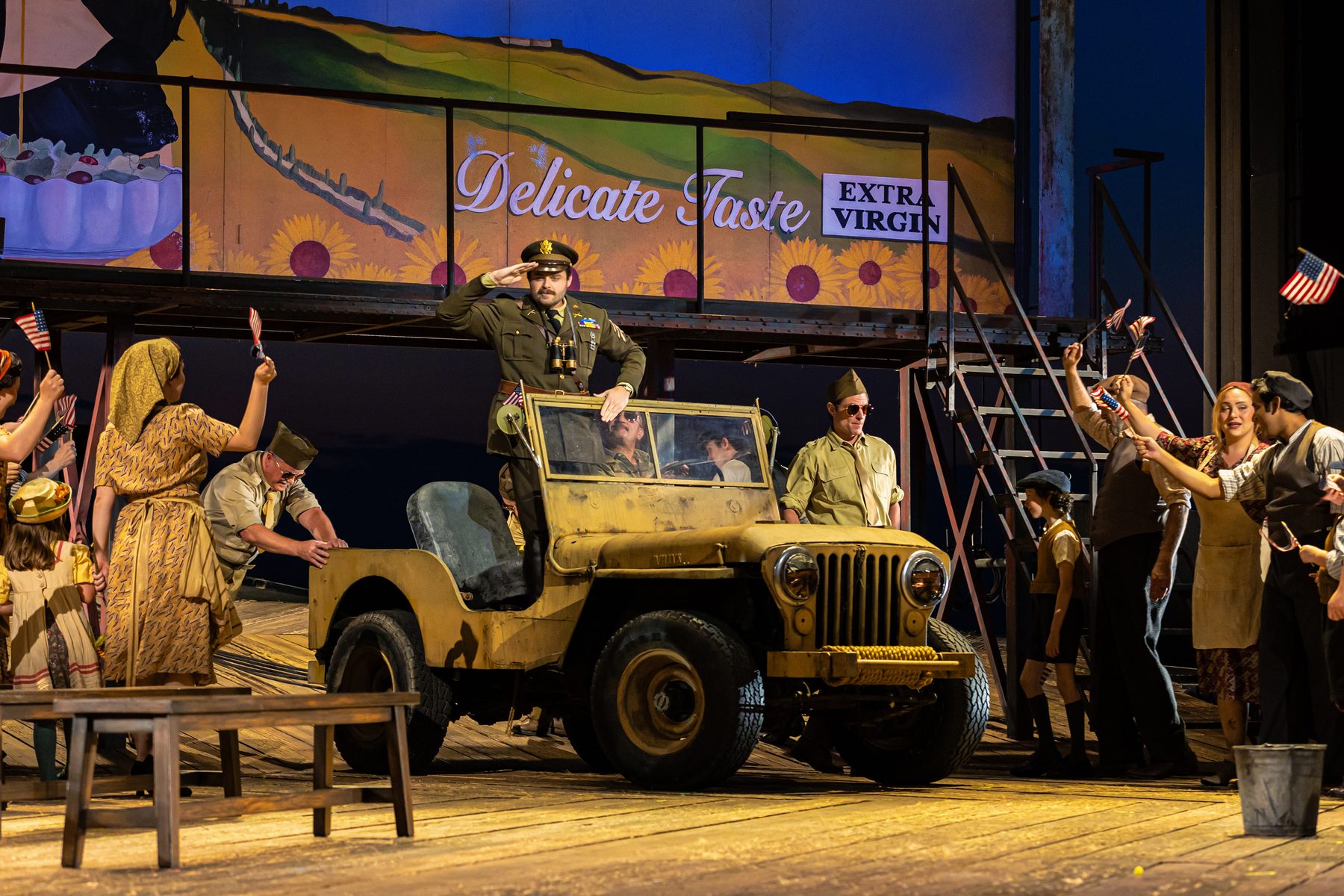
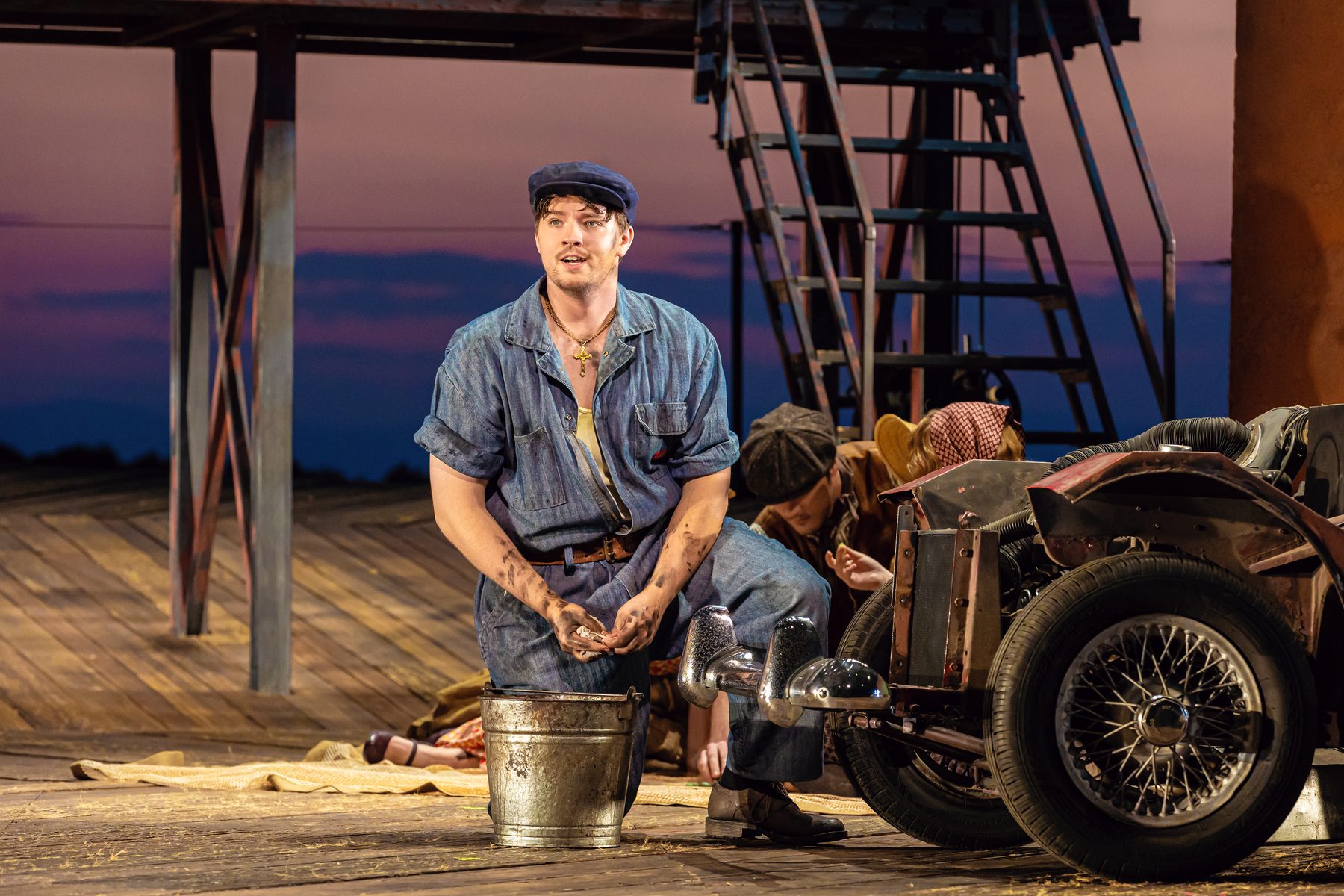
The production is full of raucous comedy that fits the spirit of the original. Here the only serious thought is the message not to run away from your true feelings. This moral is conveyed through ridiculous situations and one-dimensional, but strikingly funny, characters. It is a fun, colorful production, in keeping with both the buoyant spirit of Italian comic opera and the period selected for the production, Italy after World War II. Nemorino’s bright red sports car provided several especially funny moments. Sergeant Belcore and the soldiers drove in on a jeep. A priest entered on a motor scooter.
While the period provided good comedy and never got in the way of the fun, it created one huge logical hole that has to be ignored as it cannot be reconciled. A turning point in the opera comes when Nemorino, desperate to buy the wine he thinks is Isolde’s love potion, enlists in Belcore’s regiment for the bonus he will receive.
But, as shown in the production, Italy after the war was occupied by the U.S Army. Belcore is an American soldier. And no Italian peasant could have enlisted in the American Army. In case you miss this giant hole in the plot, Belcore displays an Uncle Sam recruitment poster. So what seems at first a clever and amusing updating turns out to be impossibly anachronistic.
Jonah Hoskins (Nemorino). Photo by Curtis Brown.
To be fair, the audience laughed throughout, either unaware of, or happy to ignore, the illogic at the core of the plot. Do stage directors—in this case the otherwise successful Stephen Lawless—not think about such issues? Or do they expect the audience not to care?
From the beginning Jonah Hoskins sang with an emotive tenor, his smooth, Italianate style only marred by a tight, nasal sound when pushed. His “Una furtive lagrima” was sung with sincerity of feeling and was rewarded with cheers.
Yaritza Véliz (Adina). Photo by Curtis Brown
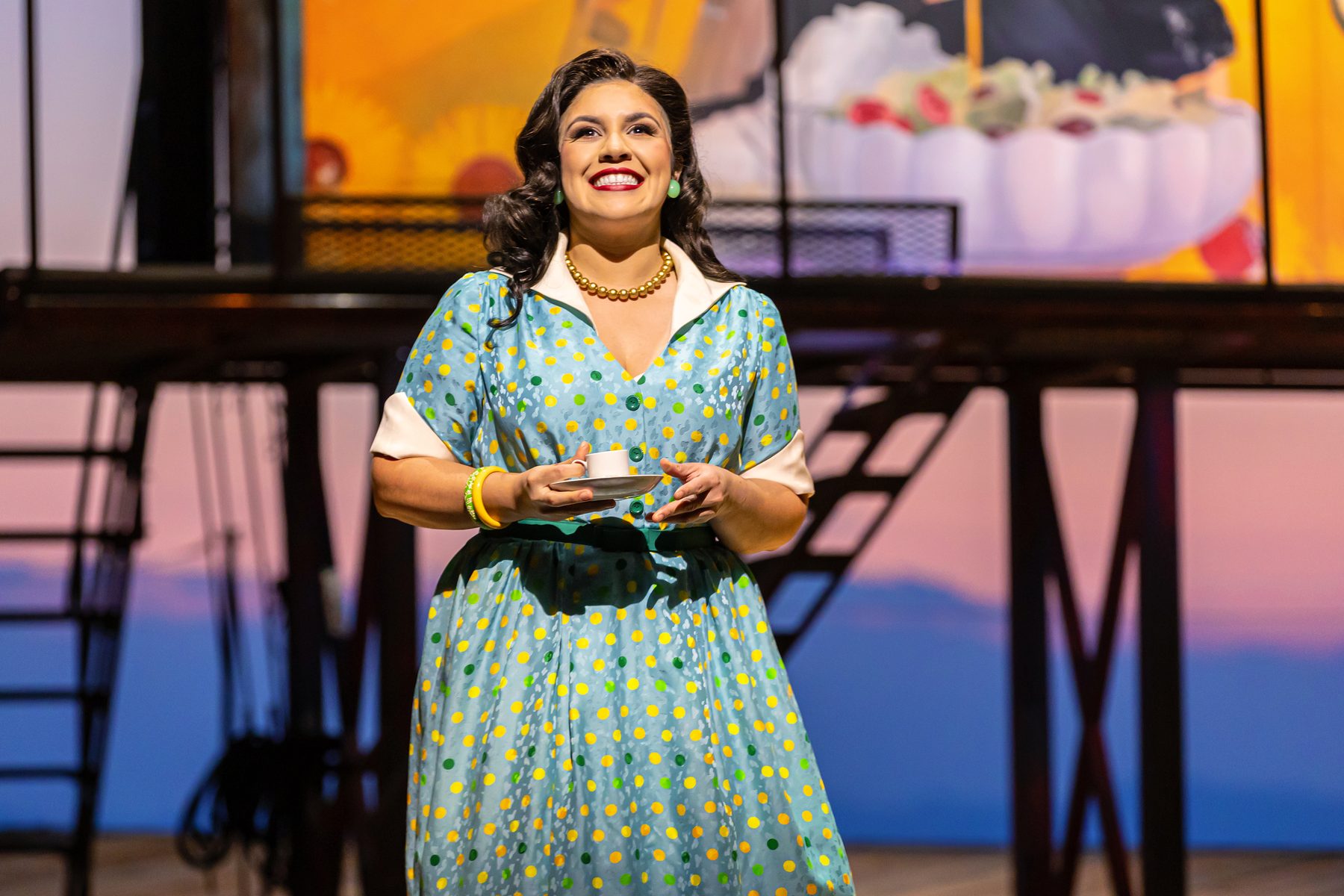
Yaritza Véliz was a first-rate Adina, singing with a bright sound and gleaming coloratura. She floated buoyantly through her arias with no sign of strain. In a nuanced performance, her attraction to Nemorino was hinted throughout, making their apparent alienation all the more poignant, and the final reconciliation (including a quick, laugh-inducing make-out session in the sports car) more credible and satisfying.
Luke Sutliff shone as a bragging and swaggering Belcore, with a resounding voice and cocky manner. You cannot be surprised at the end when this lusty sergeant happily surrenders Adina, because “the world is full of women.”
Alfredo Daza (Dulcamara). Photo by Curtis Brown.
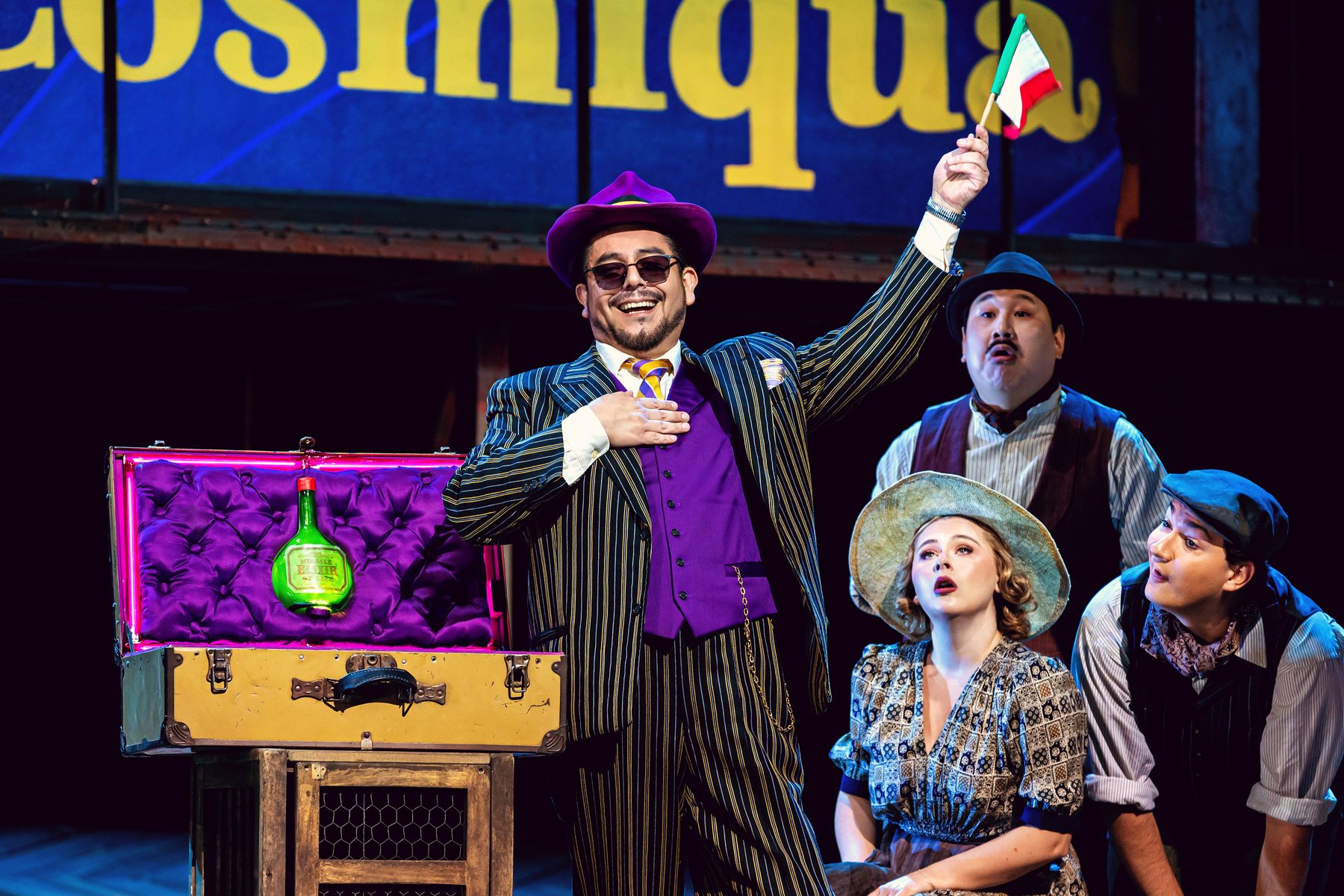
In the role of “Doctor” Dulcamara, Alfredo Daza, earlier the stern Giorgio Germont in La Traviata, was here an artful snake oil salesman, always with an eye on the main chance. Daza has the booming baritone that Dulcamara needs as he hawks his quack miracle cure to the credulous villagers. Caddie J. Bryan was charming as she played the awkward Gianetta with comic zest.
In his stage direction, Lawless found many original comic touches without resorting to formulaic slapstick or tired shtick. Conductor Roberto Kalb kept the performance moving ahead with great energy and zest. The Santa Fe Opera chorus was as usual terrific.
The Santa Fe Opera season concludes Aug. 24. To check ticket availability for remaining performances, visit the Santa Opera box office HERE.
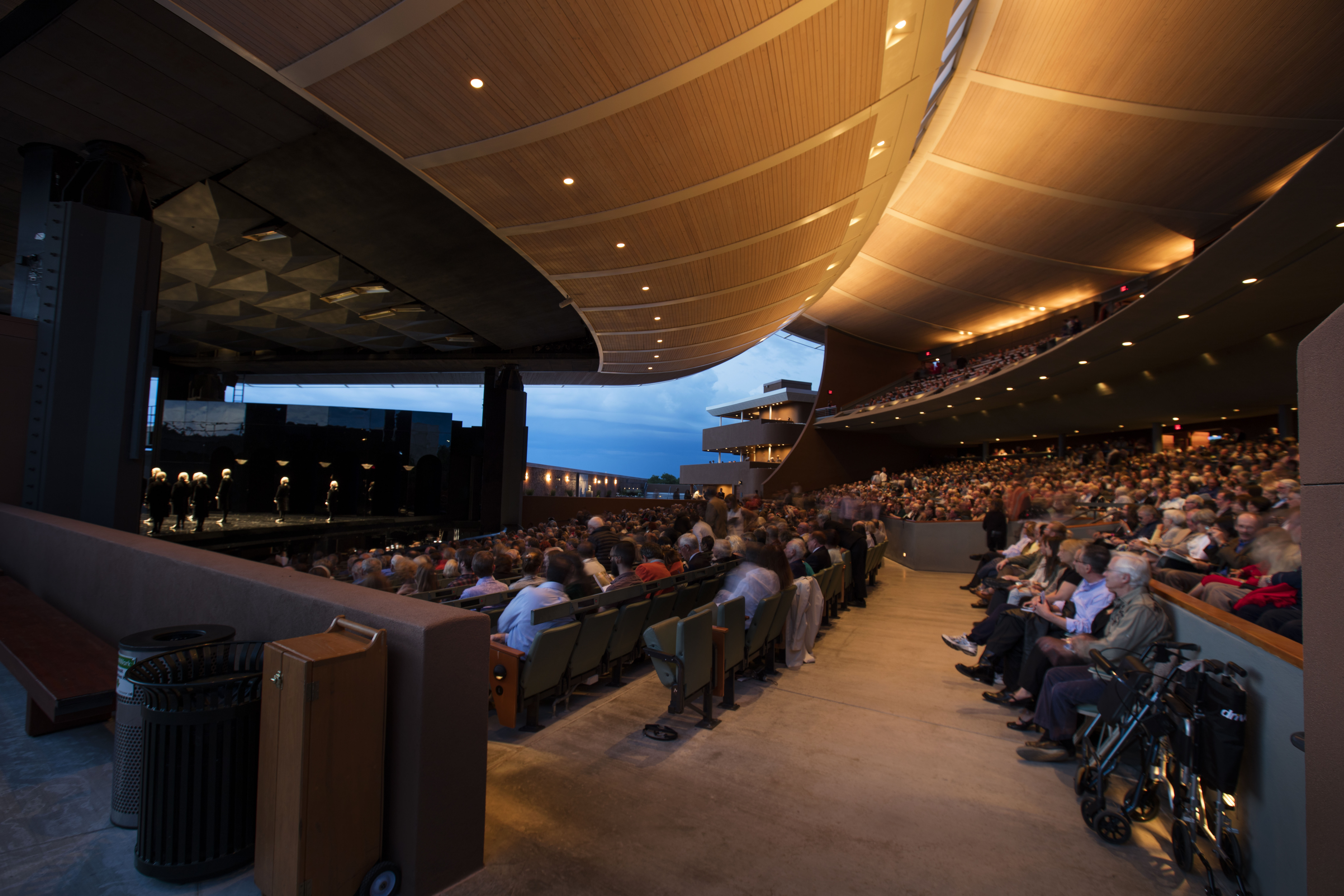
Opera productions seem to go through trends. That was certainly the case at the Santa Fe Opera this summer: of the five productions, only one—the world premiere of The Righteous by Gregory Spears, set in the 1980s—remained in the time period for which it was conceived. The other four—La Traviata, Don Giovani, Der Rosenkavalier and L’elisir d’amore—were shifted forward to more recent times. Proving that time shifts can work in the right circumstances, some of the productions worked very well in their updated periods. Others were less successful.
Opera night at Santa Fe. Photo by Kate Russell.
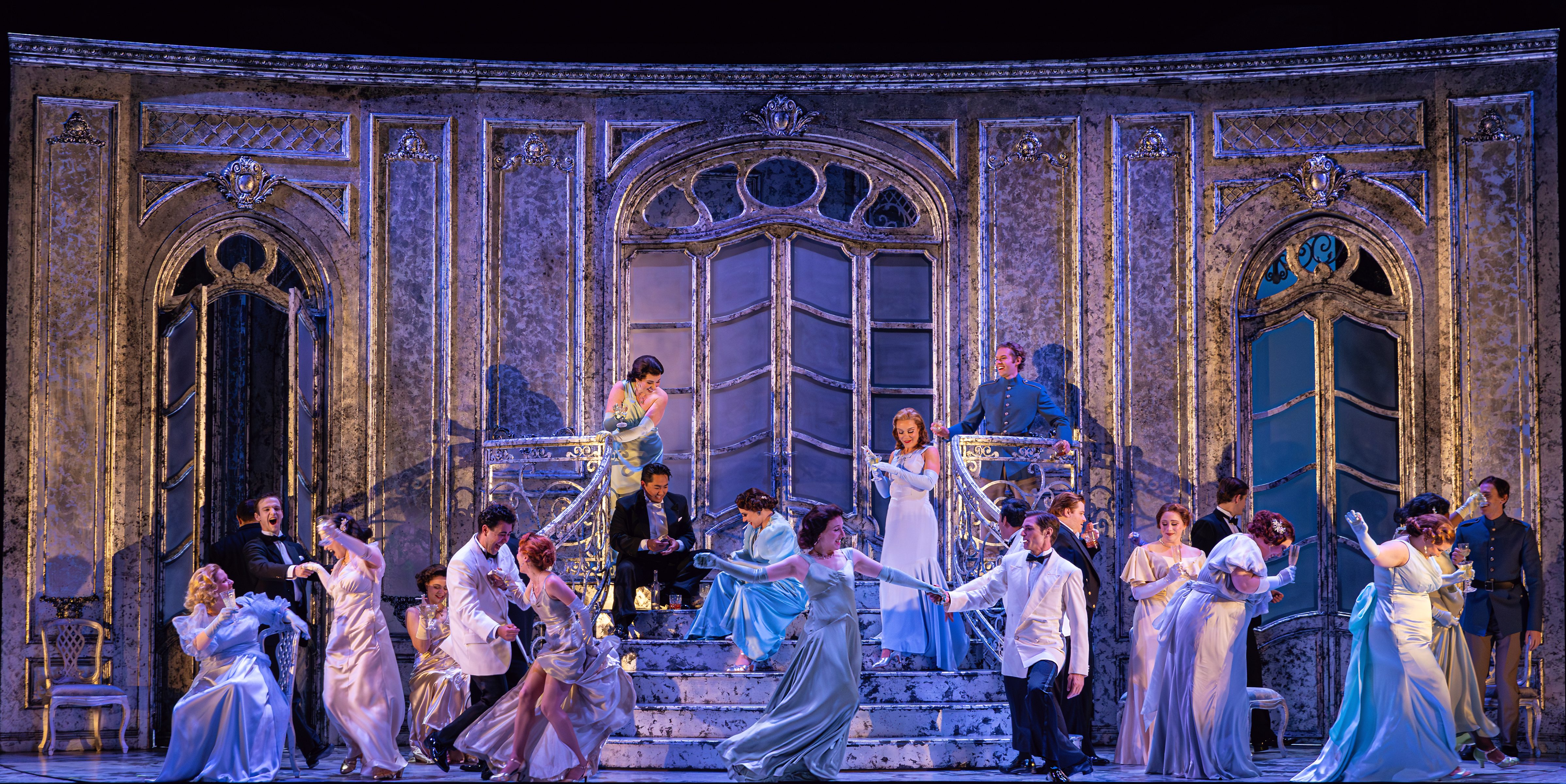
Verdi’s La Traviata, updated to 1930s Paris, is a glittering success in almost every way. Armenian soprano Mané Galoyan is as good a Violetta as I have seen. As Alfredo, Uzbekistan tenor Bekhzod Davronov matches her vocally very well. Stand-in Alfredo Daza, the Mexican baritone rounding out the international cast, is a powerful, if blustery, Giorgio Germont.
Conductor Corrado Rovaris brought out the Italianate nuances of the score without ever overpowering the singers. The performance I heard (Aug. 5) was filled with glorious, touching pianissimo singing, especially from Galoyan, and every word, every note was clearly voiced no matter how softly. Luisa Muller’s direction created a human drama where many productions are satisfied with conventional routine.
La Traviata set by Christopher Oram. Photo by Curtis Brown.
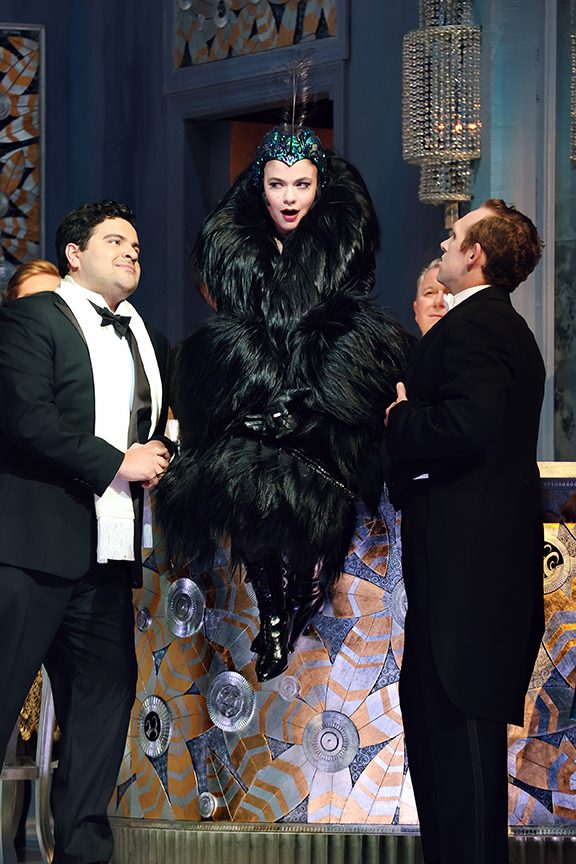
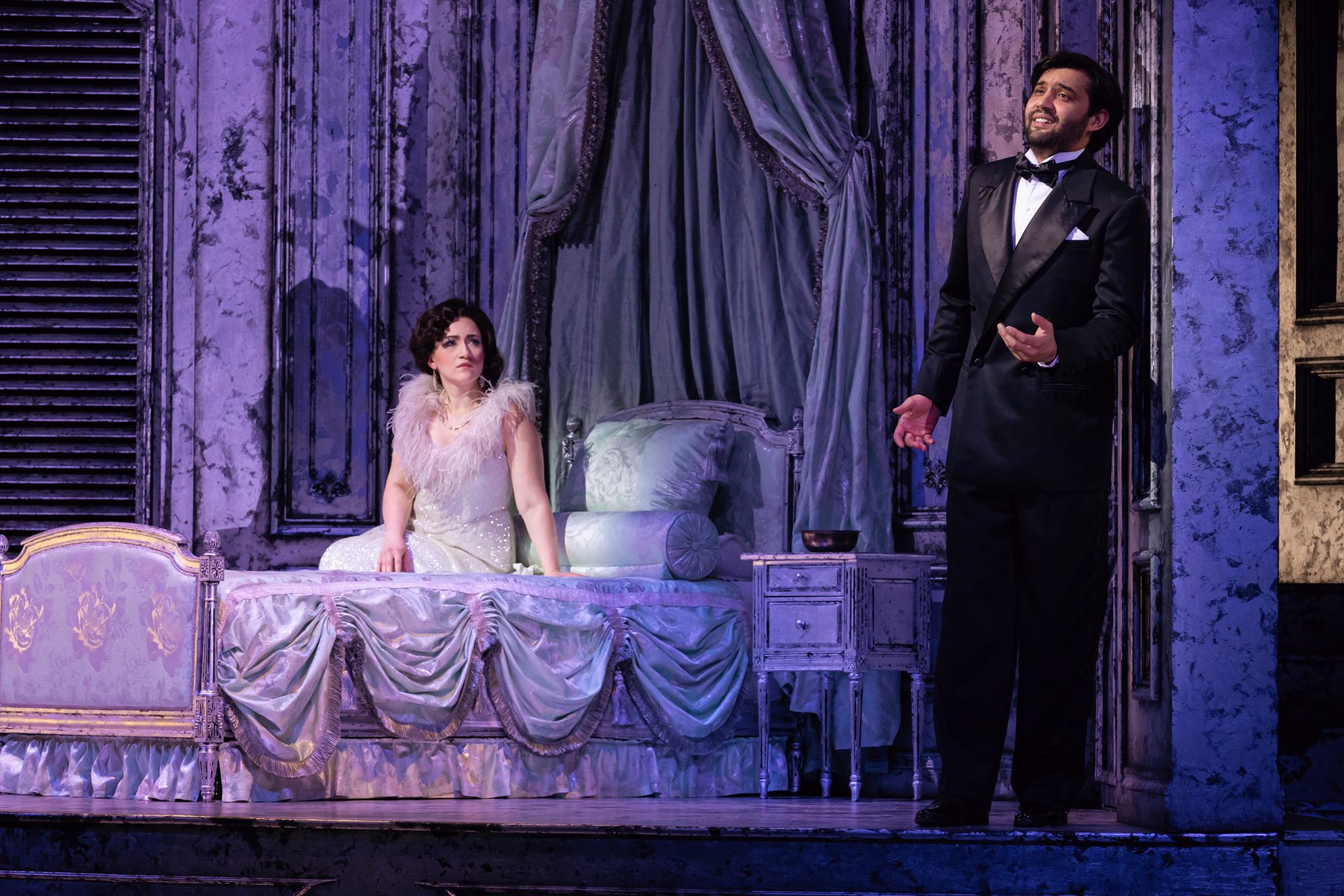
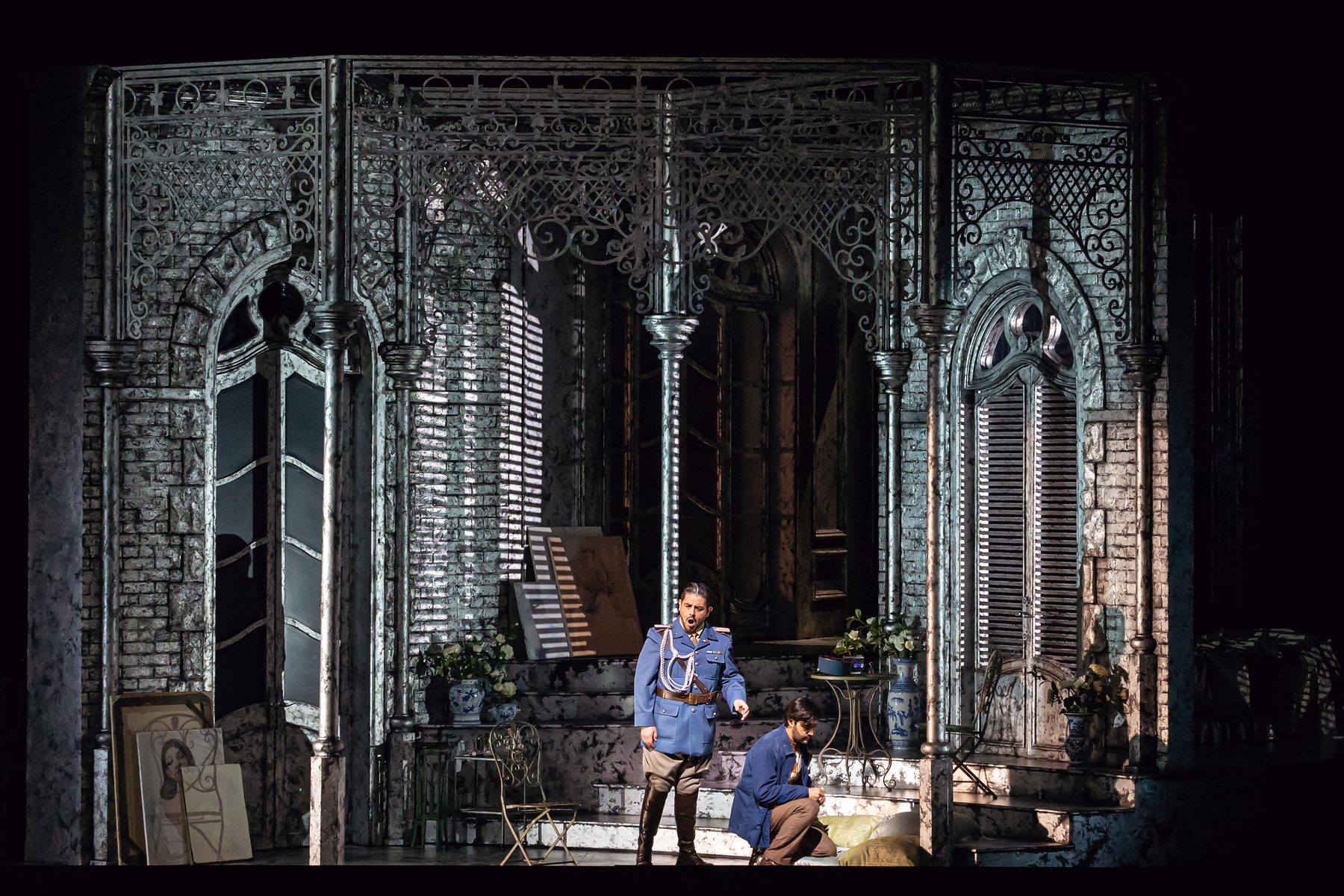
The set by Christopher Oram places evocative spaces on a turntable. The Parisian interiors are elaborately decorated in silver, with discrete lighting adding a touch of color. The rotating set is used strategically: in the first act, Violetta’s public scenes at the party are placed in an ornate salon, while her private moments and scenes with Alfredo move smoothly to an interior bedroom, a contrast that sets up the following scenes with the public alternating with the private. The lovers’ country retreat is appropriately rustic, neither too grand nor too shabby. The sets and costumes adhere carefully to the 1930s aesthetic.
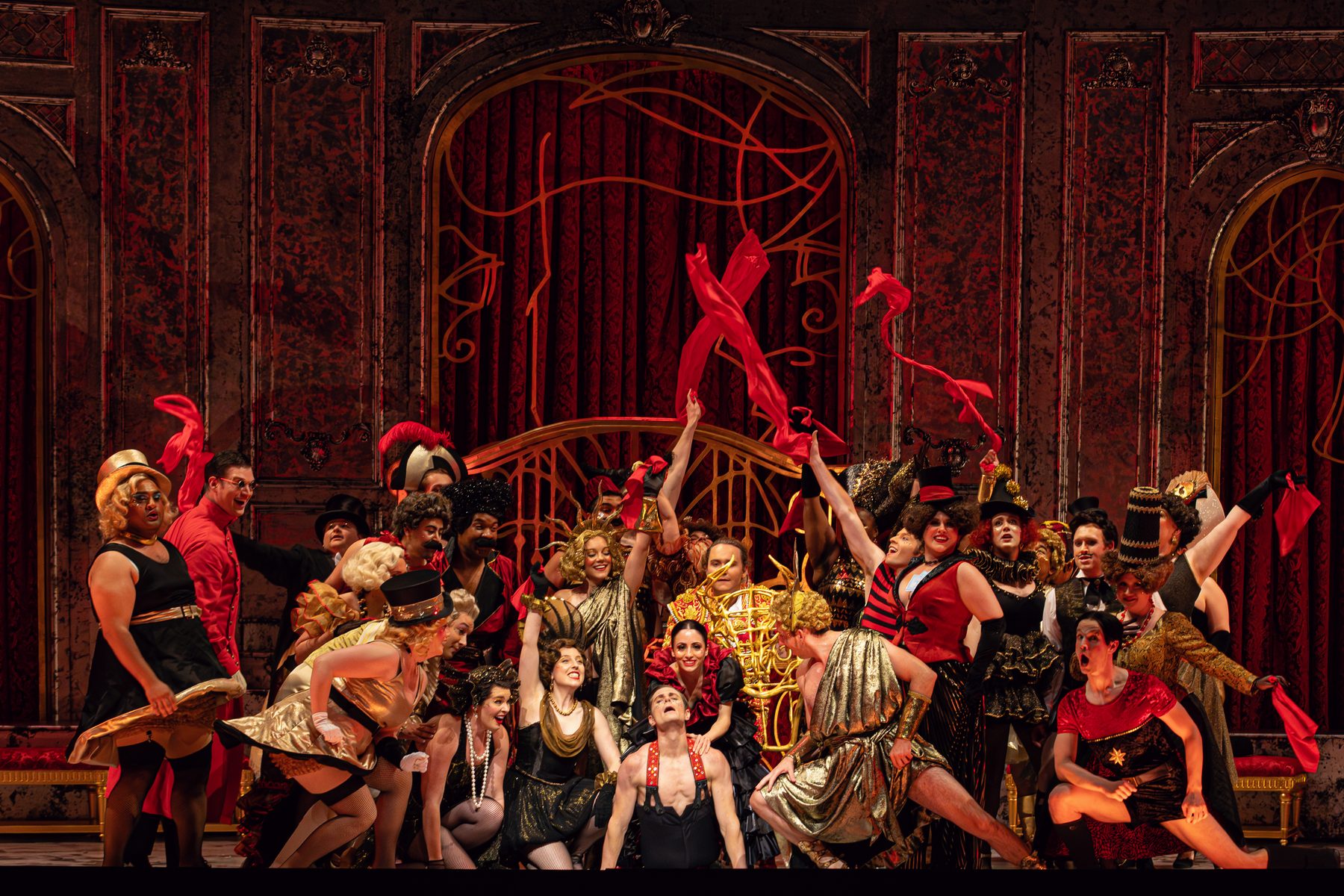
Santa Fe Opera chorus, Act II Scene 2 at Flora Bervoix’s costume party. Photo by Curtis Brown.
A special word for Act II Scene 2, at Flora’s party: Decorated in bright reds, it is a satanic costume party, with characters in various outrageous costumes. Intentionally over the top, the scene evokes every American conception of the Paris of Hemingway, Pound and les années folles (the crazy years) when the arts flourished in spite of a worldwide depression. After the restrained colors of the previous scenes, this hits like a blow to the face, creating exactly the shock that Violetta’s return to her life of decadence implies.
For all the strengths of the production, it is Galoyan’s Violetta that makes the greatest impact. Her bright, focused voice suits the role ideally. Her acting was on a par with her emotive singing, ranging from piercing moments of fury to heartrending fragility. Her delicate pianissimos carried easily and never lost nuance, or flattened out to expressionless undertones. Her most effecting moments were in the second and third acts, when she is overcome by the tragic fate that she can see coming. At the end, her frailty was made tragically real in her singing.
Mané Galoyan (Violetta) and Bakhzod Davronov (Alfredo). Photo by Curtis Brown.
In her director’s notes, Muller describes Traviata as a memory play, with the coming (or remembered) events suggested in tableaux during the Prelude. Violetta, she writes, is “a woman in command of her life choices” who “knows that the end of her life is approaching.” Both the staging and Galoyan’s performance reinforce that conception, making Violetta the emotional center of the opera. The life of a 19th-century courtesan seems remote today, but this is a Violetta current audiences can connect with.
Davronov sang strongly, with a ringing tone that matched well with Galoyan in their duets. If his acting was stiff in the country house scene, that is partly due to the limited space in the set. He sang with great expression and his tragedy was palpable by opera’s end.
Alfredo Daza (Giorgio Germont) and Bakhzod Davronov (Alfredo Germont). Photo by Curtis Brown.
Costumed as a military officer, Daza was an imposing figure, and his large baritone voice commanded the stage from his entrance. He was never a sympathetic figure in his long scene with Violetta, but he is not meant to be. Booked for Dulcamara in l’Elisir d’amore, he has sung Germont before and so was an obvious person to take over the role, which he filled admirably.
Sejin Park was appropriately arrogant as Baron Douphol. Elisa Sunshine sang well and understands her limited role as Violetta’s faithful maid Annina. Kaylee Nichols has a strong voice but didn’t seem dissolute enough for the scandalous Flora Bervoix.
The orchestra played admirably, following Rovaris’s expressive rubatos and supporting the singers well through the softest moments. The party-scene choruses were full voiced and strong, contrasting powerfully with the delicate and reflective moments of the lead singers—another level of contrast between the public and private lives of the characters.
This production, and the performance I saw, would stand out in anyone’s season. In a long history of memorable operas at Santa Fe, it is a production worth seeing and remembering.
* * * * *
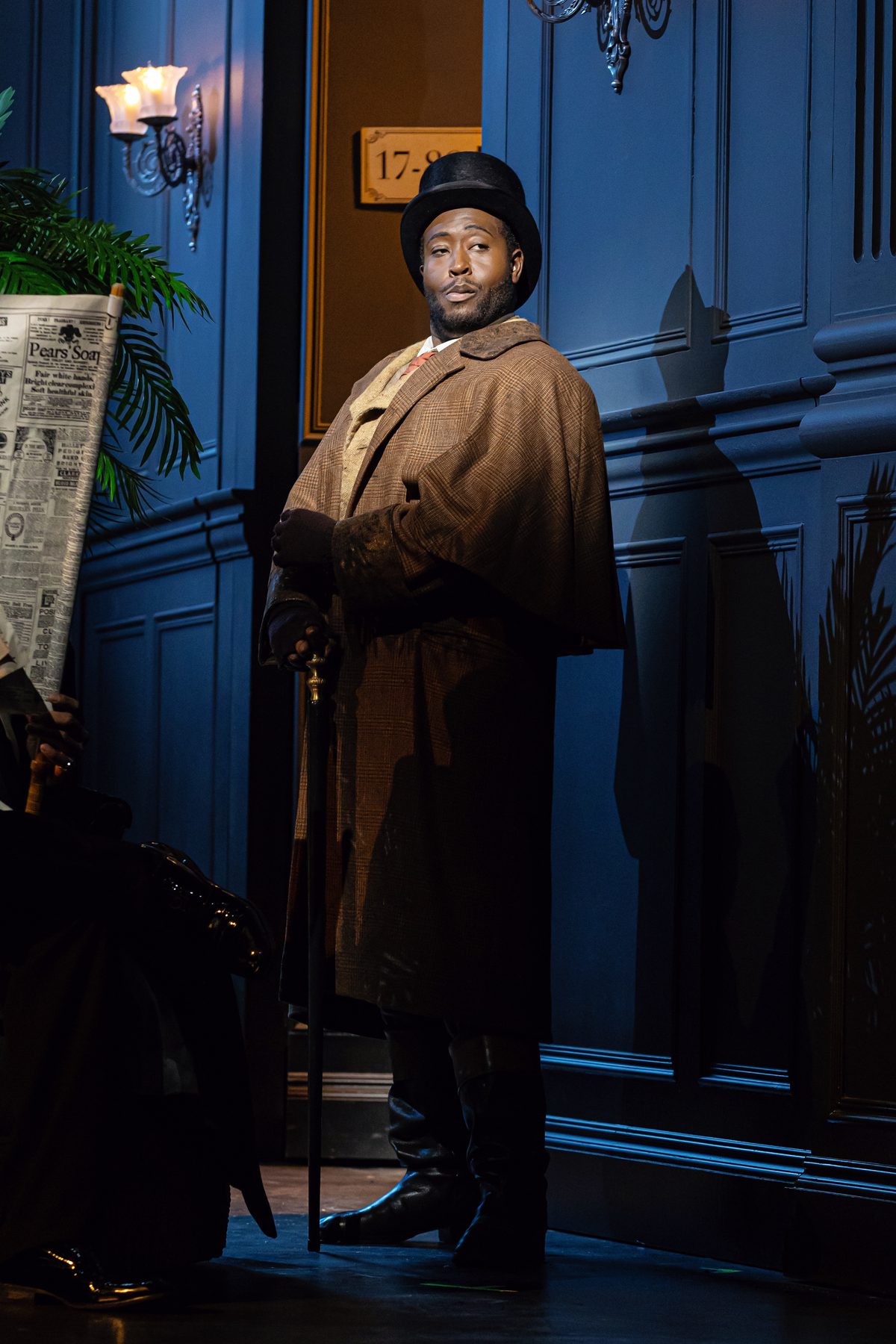
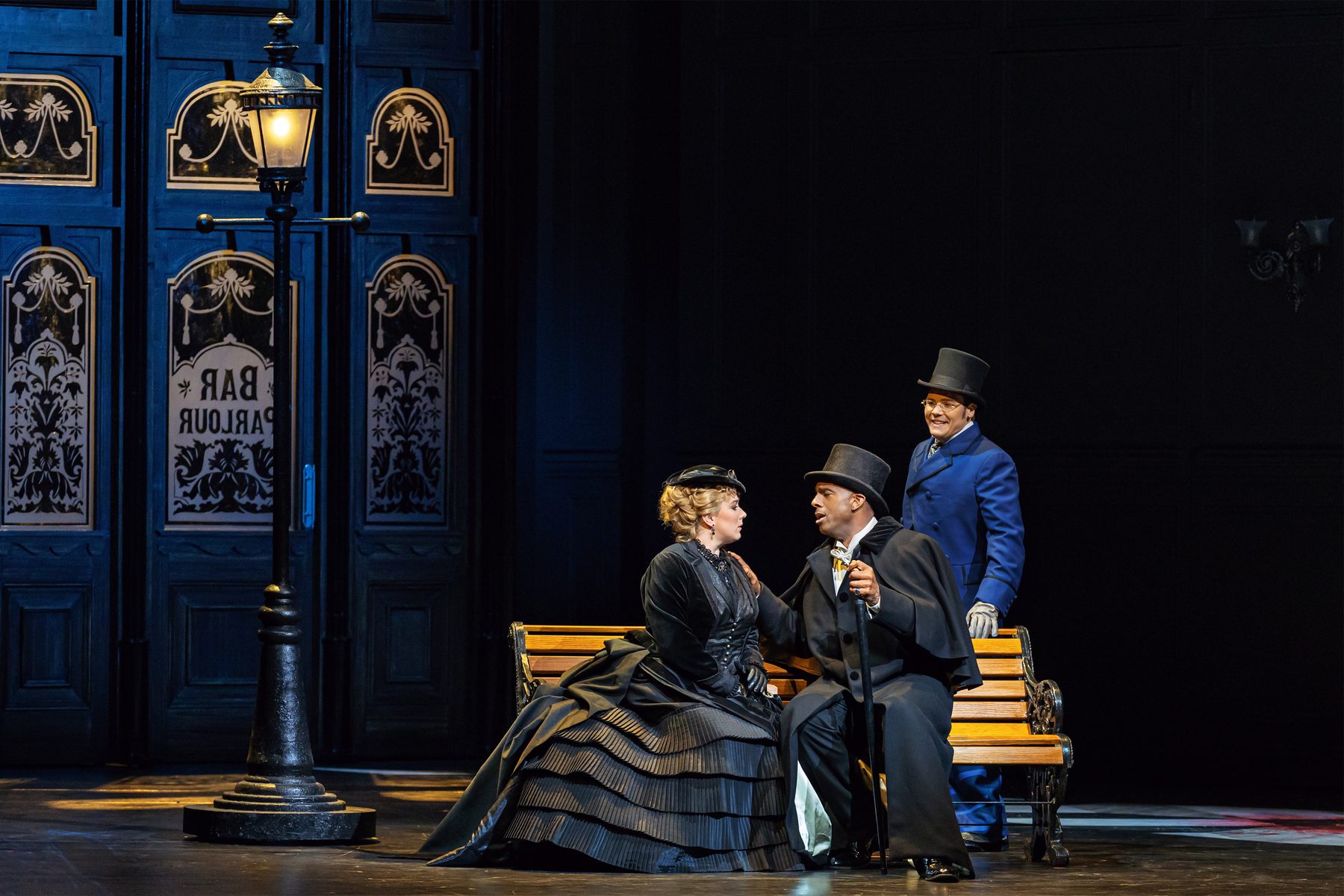
The production of Mozart’s Don Giovanni(seen Aug. 6) has been transported to Victorian-era London. In some ways this works well, but in other ways, not.
The updating was inspired largely by the coincidence that Don Giovanni and Dorian Gray of Oscar’s Wilde’s novel The Picture of Dorian Gray share the initials DG, and that both pursue a life of hedonism. Beyond those superficial similarities, it is certainly true, as director Stephen Barlow points out in his notes, that both the world of Don Giovanni and Victorian England were class-bound societies. In the opera, each member of the cast is defined by their standing as nobility or peasantry, impenetrable social levels identified in the music. These musical distinctions put class, which would have been immediately clear to Mozart’s audience, at the heart of the opera, as it was to lives in Victorian England.
Leporello (Nicholas Newton) in Victorian London. Photo by Curtis Brown.
But in other ways, the updating is less successful. To maintain the transformed setting, Don Giovanni sings “Come to your window, my treasure” sitting in the lobby of a posh hotel. Instead of a graveyard, Giovanni “leap(s) over the wall” into an enclosed funeral parlor. And in a particularly baffling decision, there is no statue, only a casket sitting on a pedestal. Leporello sings of the immobile casket, “He looked at us.” There is no statue at all—a consistent feature of Don Juan mythology for centuries—in the final scene. The Commendatore enters through a picture frame as a ghost, again making nonsense of the sung text.
Some of the seat-back English titles strayed from the literal to contribute to the Victorian ambience. “Listen, guv,” Leporello sings to Giovanni, and the “Champagne Aria”—literally “As long as the wine warms the head”—has no mention of wine.
One other quibble: If Giovanni is an English Lord ravishing the women of London, why is England not mentioned in Leporello’s “Catalogue Aria”? And what’s the big deal with Spain? Or do we not expect the stage action to correspond to the text in concept productions?
But the musical performance was strong throughout. Conductor Harry Bicket led a stylish if unhurried performance, sometimes bordering on sluggish. To its credit, the orchestra followed his expressive direction faithfully. Once under way, the strings played with clean ensemble, and the horns sounded particularly bright.
Rachel Fitzgerald (Opening night Donna Anna), Ryan Speedo Green (Don Giovani) and David Portillo (Octavio). Photo by Curtis Brown.
Ryan Speedo Green, one of the leading baritones worldwide, was an ingratiating, seductive Giovanni. His voice, while used expressively, is almost too strong for the part. At times he struggled to keep it under control, and balance with Zerlina and other light-voiced characters was occasionally askew. He delivered all the hedonistic enthusiasm needed for the “Champagne Aria,” and made Giovanni a totally assured libertine.
Rachel Willis-Sørensen, engaged for the the Marschallin in Der Rosenkavalier and standing in as Donna Anna, was another singer who seemed at times out of her fach. Her strong, steely voice tended to get away from her at phrase climaxes, but she effectively conveyed the opera’s most tragic character. She was equally capable of expressively weighty tones and pure, bright high notes.
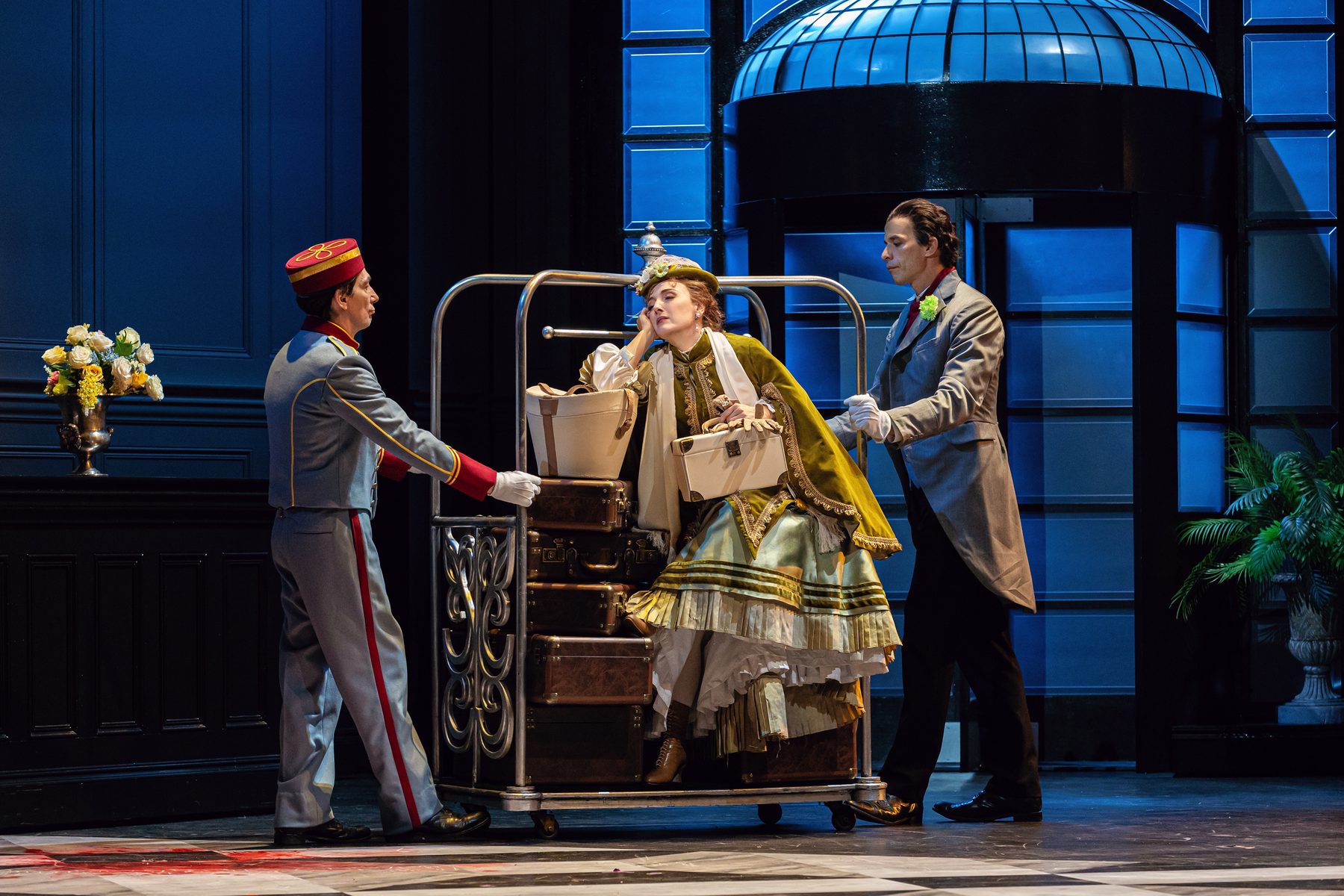
Donna Elvira (Rachael Wilson) and her luggage. Photo by Curtis Brown.
Rachael Wilson’s Donna Elvira was the very essence of the scorned woman. Her dramatic performance and assured singing made Elvira the central character of the unfolding drama, both strong in her confrontations with Giovanni and tragic in her repeated humiliations. She handled the seria aspects of her role with aplomb, with a few stumbles across registers.
Nicholas Newton provided a good comic performance as Leporello. His “Catalogue Aria” was thoroughly entertaining, as he embraced the comic emphasis of the production. David Portillo’s pleasant, light tenor is well suited to the role of Don Ottavio, even though he showed signs of fatigue by the end of a very long opera.
The peasant’s wedding party: William Guanbo Su (Masetto, center), and Liv Redpath (Zerlina, right). Photo by Curtis Brown.
Liv Repdpath was a sweet voiced Zerlina, capturing the character’s innocence well. William Guanbo Su portrayed an angry Masetto whose reconciliation with Zerlina seemed out of reach until the very end. Solomon Howard’s rotund bass suited the Commendatore perfectly.
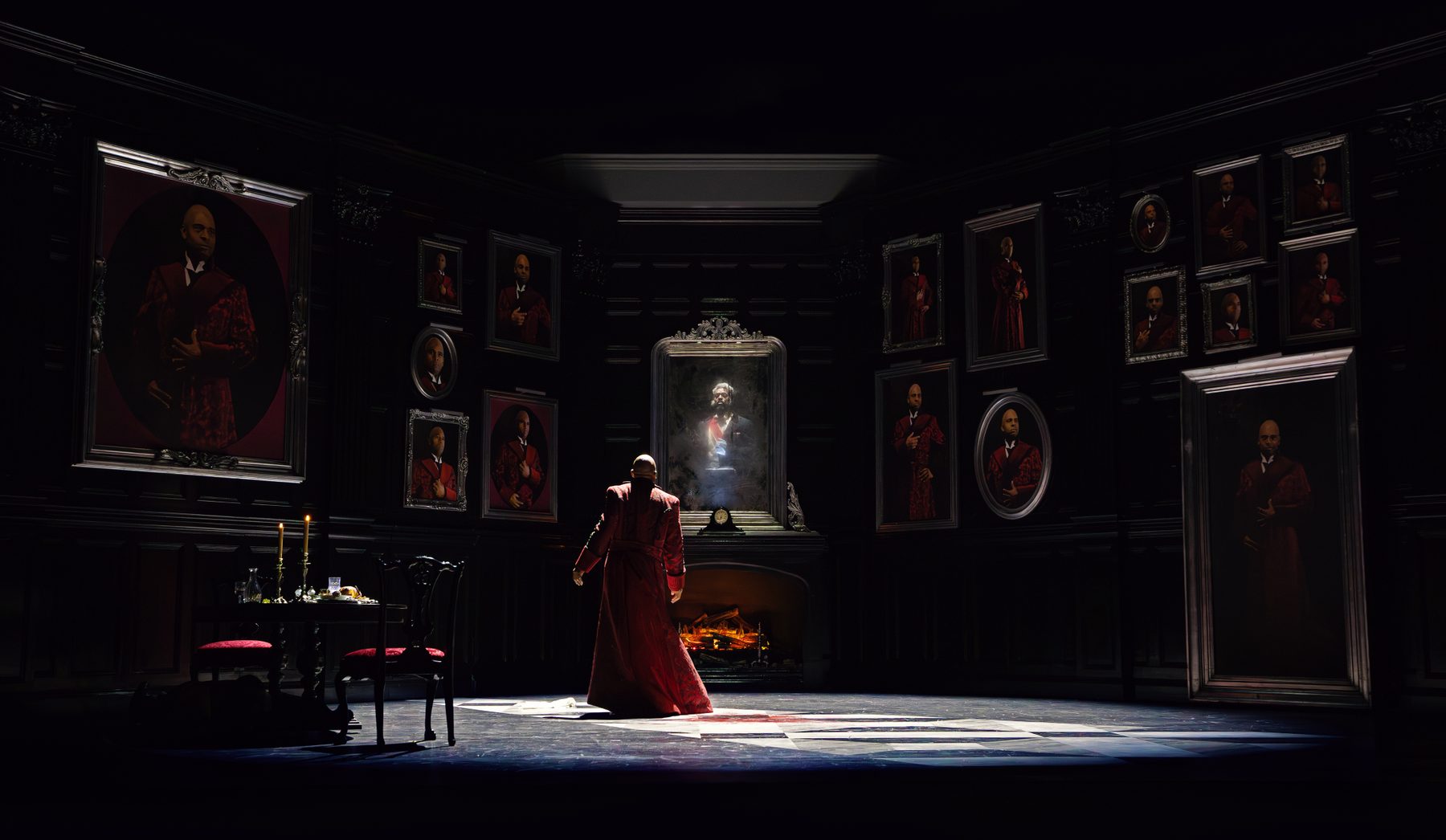
Other notes on the production: a creative set with rotating panels created seamless scene transitions. Don Giovanni’s salon, with walls covered in portraits of the Don recalled the production’s inspiration in The Portrait of Dorian Gray at the same time that it confirmed Giovanni’s narcissism.
A red spot on the floor, marking where the Commendatore dies in the first scene, became a meaningful symbol. From one scene to the next, efforts to scrub it out always failed.
Don Giovanni (Ryan Speedo Green) is confronted by the ghost of the Commendatore (Salomon Howard) in his picture gallery. Photo by Curtis Brown.
Barlow’s production stressed the comic elements of the plot—the opera is labeled a drama giocoso, “comic drama”—but sometimes the resort to burlesque distracted from the singing. The most egregious example was the beginning of Act II, where some clumsy humor with luggage in the background distracted from Elvira’s mournful “Ah taci, ingiusto core.”
I’m not sure what the British Bobby contributes to the last scene, except that it recalls Ottavio’s promise to bring Giovanni to justice. Which raises the question: is the Victorian setting, evoked by Bobbies and street lamps as well as costumes, too familiar to audiences from television? This is not Downton Abbey. I wonder what expectations are raised with such clear signposts in the production.
The Santa Fe Opera Season continues through Aug. 24. A few tickets are still available for some performances. For information and tickets, visit the Santa Fe Opera box office HERE.
Kevin Puts, Tchaikovsky, Dvořák will be featured again tonight
By Peter Alexander Aug. 2 at 12:15 a.m.
The Colorado Music Festival launched into its final weekend of the 2024 season last night (Aug. 1) with a program that had all the hallmarks of the CMF under Music Director Peter Oundjian.
There was a piece by a living American composer—Two Mountain Scenes by Kevin Puts; a sensational soloist playing an audience favorite—violinist Augustin Hadelich and Tchaikovsky’s Violin Concerto; and great piece that is just off the most familiar path—a symphony by Dvořák, but not the “New World” or the Eighth, but the Seventh Symphony in D minor. And the performances were terrific.
The Two Mountain Scenes have a Colorado connection, as they were written for the Bravo! Vail Music Festival and the New York Philharmonic. The first scene evokes an echoing trumpet call sounding against the backdrop of valleys and distant mountain peaks. The CMF trumpet section nailed the treacherous opening, which calls for four trumpets sharing what appears to be a single fanfare with notes dying in the distance.
These calls are answered by sweeping lines in the strings, painting the image of remote mountain ridges. After the tiniest of breaks, the second scene conjures a powerful storm, with a kaleidoscope of orchestral colors cascading down and thrusting forward. Oundjian and the Festival Orchestra gave a stirring performance that asked: why don’t we hear this colorful, evocative score more often?
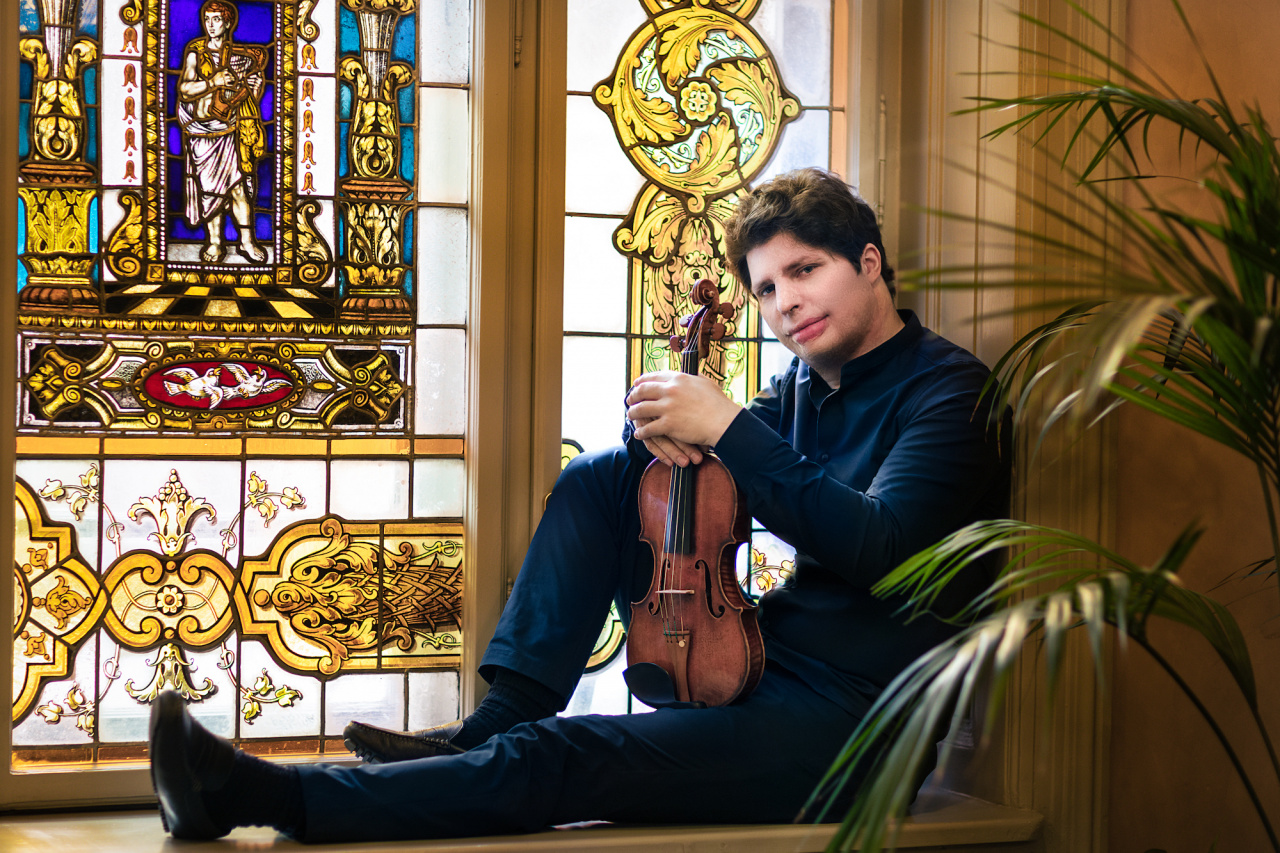
Violinist Augustin Hadelich. Photo by Suxiao Yang.
Hadelich, who shares an obvious musical bond with Oundjian and has been a soloist on previous CMF seasons, gave a stunning performance of the Tchaikovsky Concerto. But don’t be fooled: it’s not as easy as he makes it seem!
The best word to describe Hadelich’s performance might be fluid, but that would not do justice to the brilliant fireworks that he also provided. He has the ability to play tenderly, as at the beginning, and yet penetrate the Chautauqua Auditorium to the back row. In addition to the gentle moments, that were exquisitely played, he has the technique to accelerate cleanly, building speed and volume into the climactic moments.
Handelich’s creamy sound and well crafted restraint in the gentle moments gave more scope for a big buildup, as at the end of the first movement. There, the growing excitement led to spontaneous applause from a normally cultivated audience. Hadelich and Oundjian smiled happily at the crowd before continuing.
One of the pleasures of this performance was seeing knowing glances between Hadelich and Oundjian, who share the experience of having played the concerto. The soaring slow movement and the leap into the brilliant finale were impeccably performed. After a second outburst of enthusiasm from the audience, Hadelich came back to play an encore of “Orange Blossom Special” on steroids that had the audience alternately chuckling and gasping in appreciation. A second standing ovation followed.
The performance of Dvořák’s sometime turbulent, sometimes lyrical Seventh was marked by sleek transitions in and out of the score’s darker moments. Oundjian managed the many tempo shifts and thematic contrasts handsomely, always profiling the drama inherent in the music.
Dvořák can build to an exciting ending as well as any composer I know. He appears to do that in the first movement, but suddenly pulls back in a surprise fading away that was handled eloquently. The finale builds without holding back, leading to the powerful close that was expected before. With its command of a wide dynamic range, the Festival Orchestra created the climax Dvořák asks for.
Horn solos in the first two movements were exceptionally well played, earning a solo bow. Similarly the woodwind solos were as usual outstanding throughout, leading to more solo bows at the end. It was a special pleasure to hear this symphony, both for the quality of the playing and because the Seventh is not heard as often as it deserves.
The same program will be repeated tonight (Aug. 2) at 6:30 p.m. at the Chautauqua Auditorium. The CMF 2024 season wraps up Sunday with Johann Strauss’ Overture to Die Fledermaus, Ravel’s orchestral song cycle Shéhérazade and Mahler’s Fourth Symphony, also at 6:30 p.m. Tickets are available from the Chautauqua Box Office.

 Sharps & Flatirons