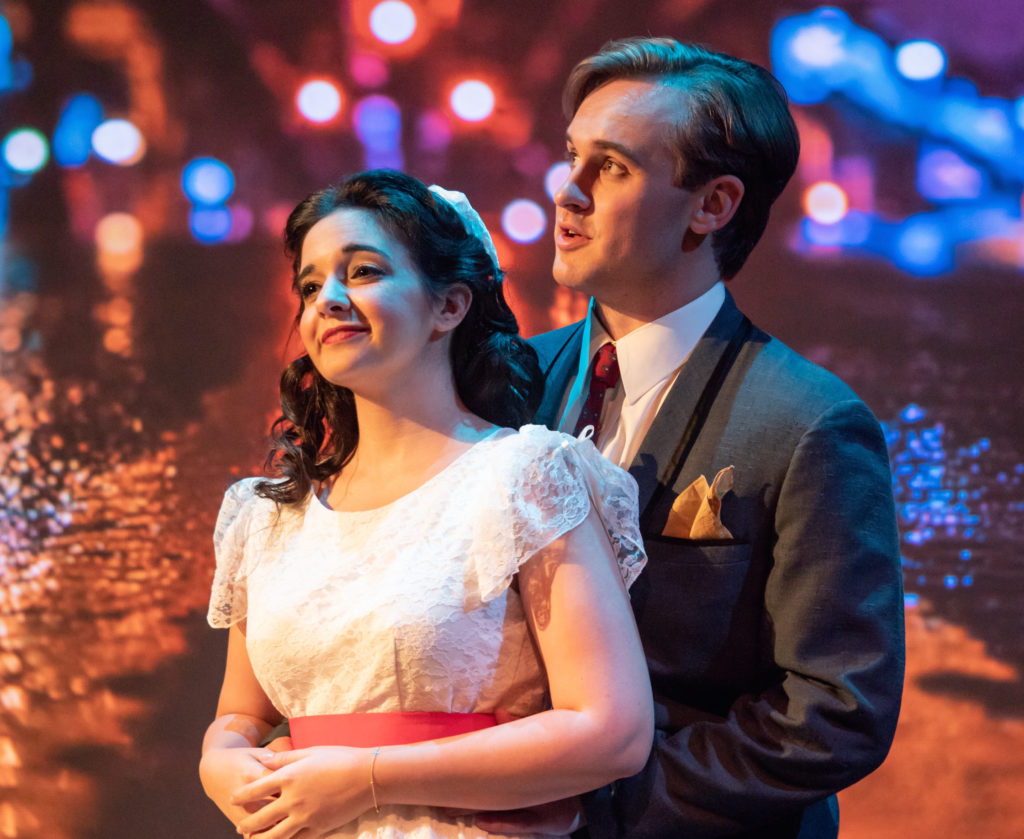
Patrick Bessenbacher (r) as Tony with Christine Honein as Maria in CU production of West Side Story. (Photo by Glenn Asakawa)
Tenor Patrick Bessenbacher, a 2020 graduate of the CU-Boulder College of Music who went on to graduate studies at Juilliard, is featured in the “Sound Bites” column in the October 2022 issue of Opera News.
Bessenbacher, who studied voice with assoc. prof. Matthew Chellis at CU, appeared in several productions of the CU Eklund Opera. He was Lurcanio in Handel’s Ariodante in the spring of 2018, Tony in West Side Story in Macky Auditorium in the fall of 2018, George Bailey in Jake Heggie’s It’s a Wonderful Life in Macky in 2019, and Benedict in a COVID-influenced online production of Berlioz’s Beatrice and Benedict in 2020.
Opera News reports that Bessenbacher performed this past summer with Opera Theatre of St. Louis, and will join Florentine Opera in Milwaukee, Wisc., as a Baumgartner Studio Artist for the current season.
The October 2022 issue of Opera News has only just arrived in mailboxes this week, and is available online to subscribers only.
# # # # #
Cliburn Competition gold medalist will play solo recital Monday at Macky
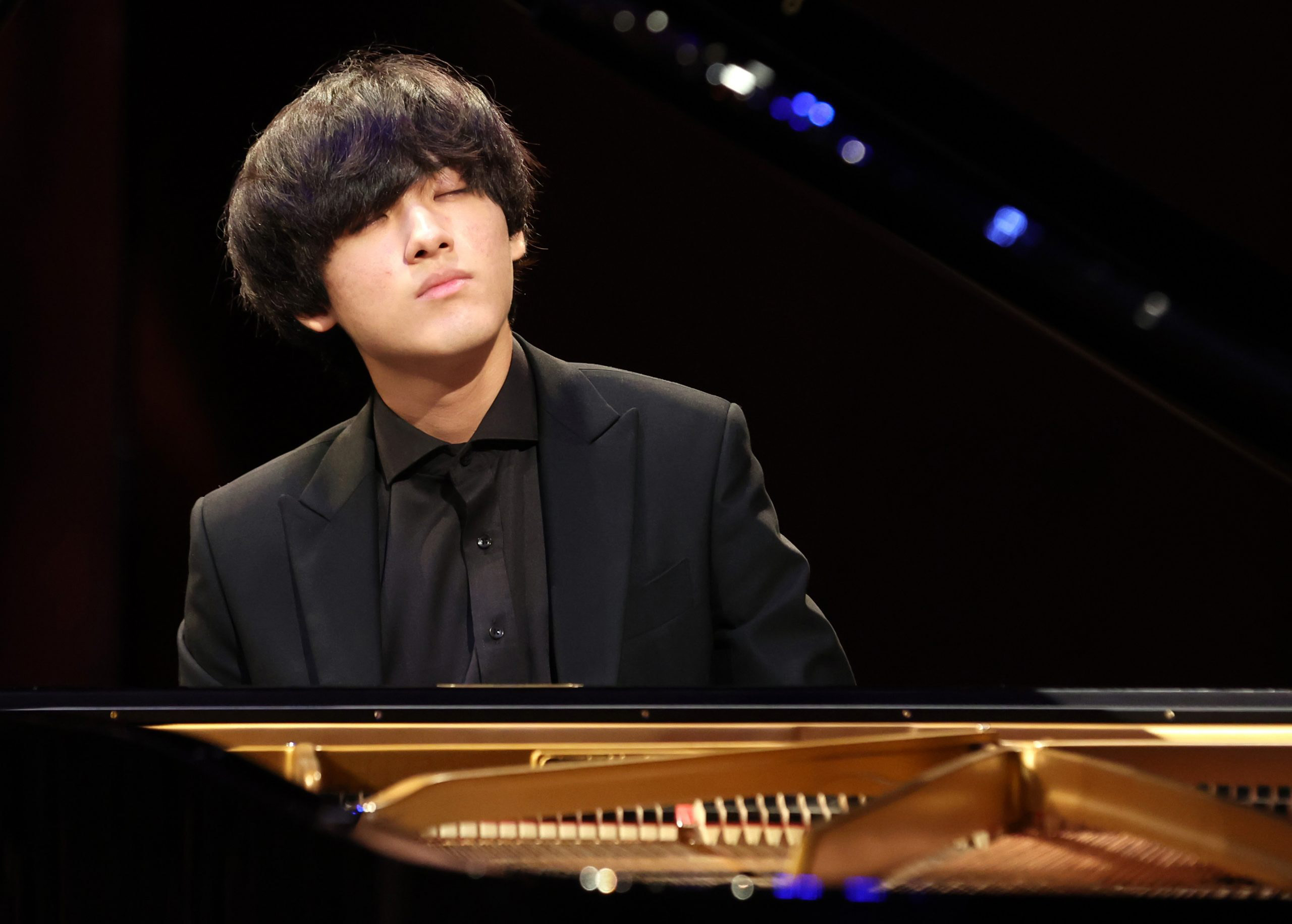
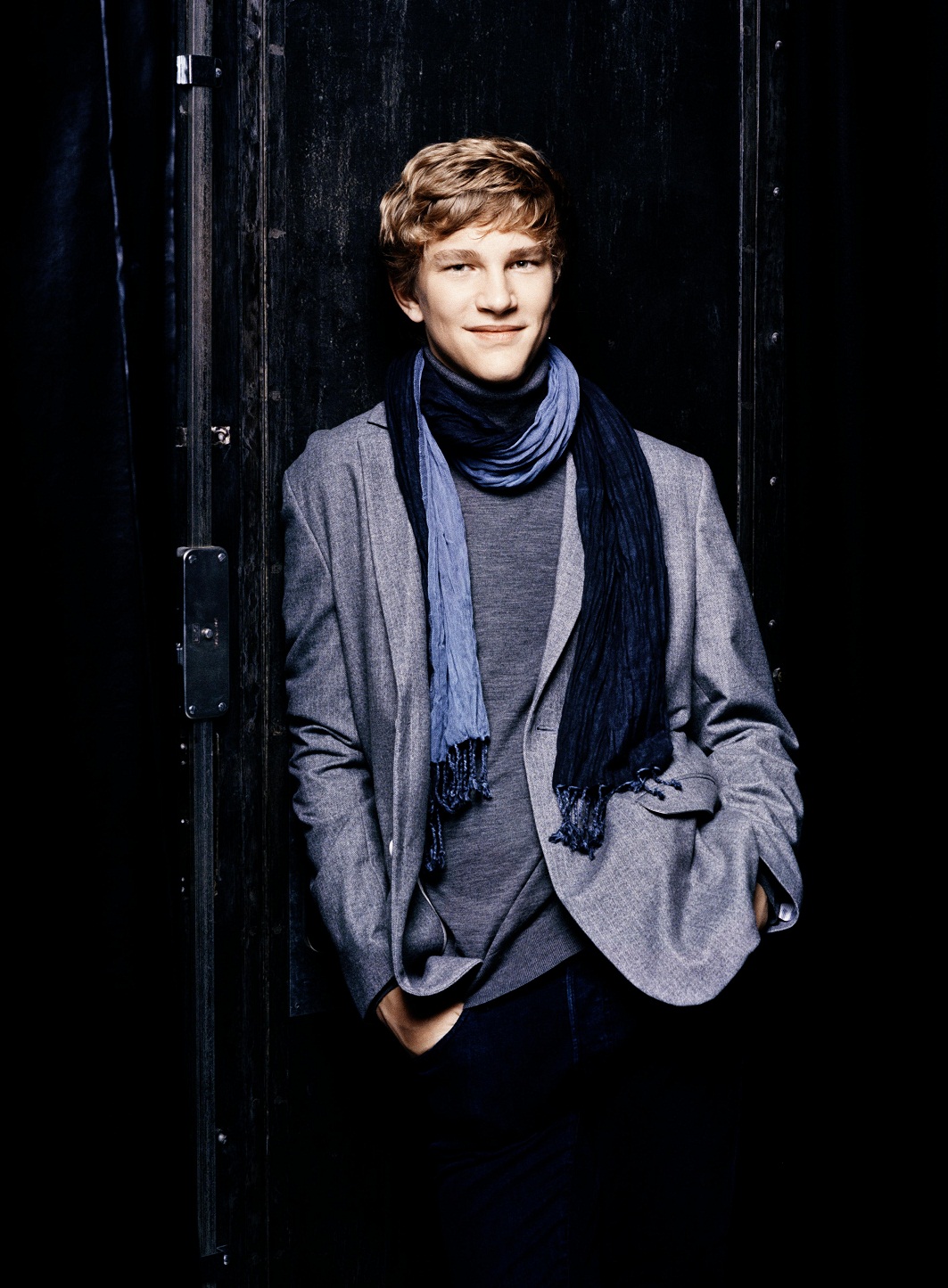
Yunchan Lim
Pianist Yunchan Lim, who at 18 became the youngest gold medalist in the history of the Van Cliburn International Piano Competition in June of this year, will play a solo recital featuring the music of Brahms, Mendelssohn and Liszt at 7:30 p.m. Monday, Sept. 26, in Macky Auditorium.
Lim’s recital is part of the CU Presents Artist Series at Macky.
In addition to the Gold Medal, Lim won the Audience Award and the Best Performance of a New Work at the 2022 Cliburn Competition. A native of Korea, he was accepted at age 13 into the Korea National Instituted for the Gifted in Arts, where he began studies with Minsoo Sohn. He is currently in his second year at the Korea National University of Arts, where he continues to study with Sohn.
Lim’s complete program will be:
Brahms: Four Ballades, op. 10
Mendelssohn: Fantasy in F-sharp Minor, op. 28 (“Scottish Sonata”)
Liszt: Deux légendes —Après une lecture du Dante: Fantasia quasi Sonata
The 2022–23 season features “Christmas in the Late Renaissance” and J.S. Bach
By Peter Alexander Sept. 20 at 11:32 a.m.
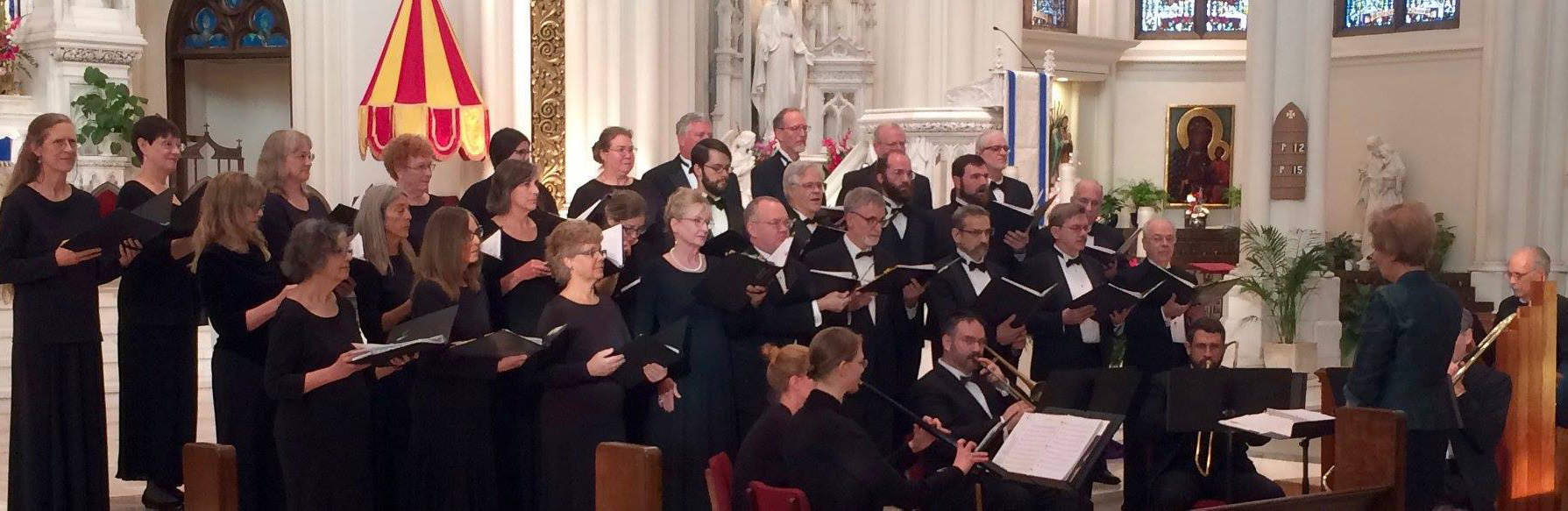
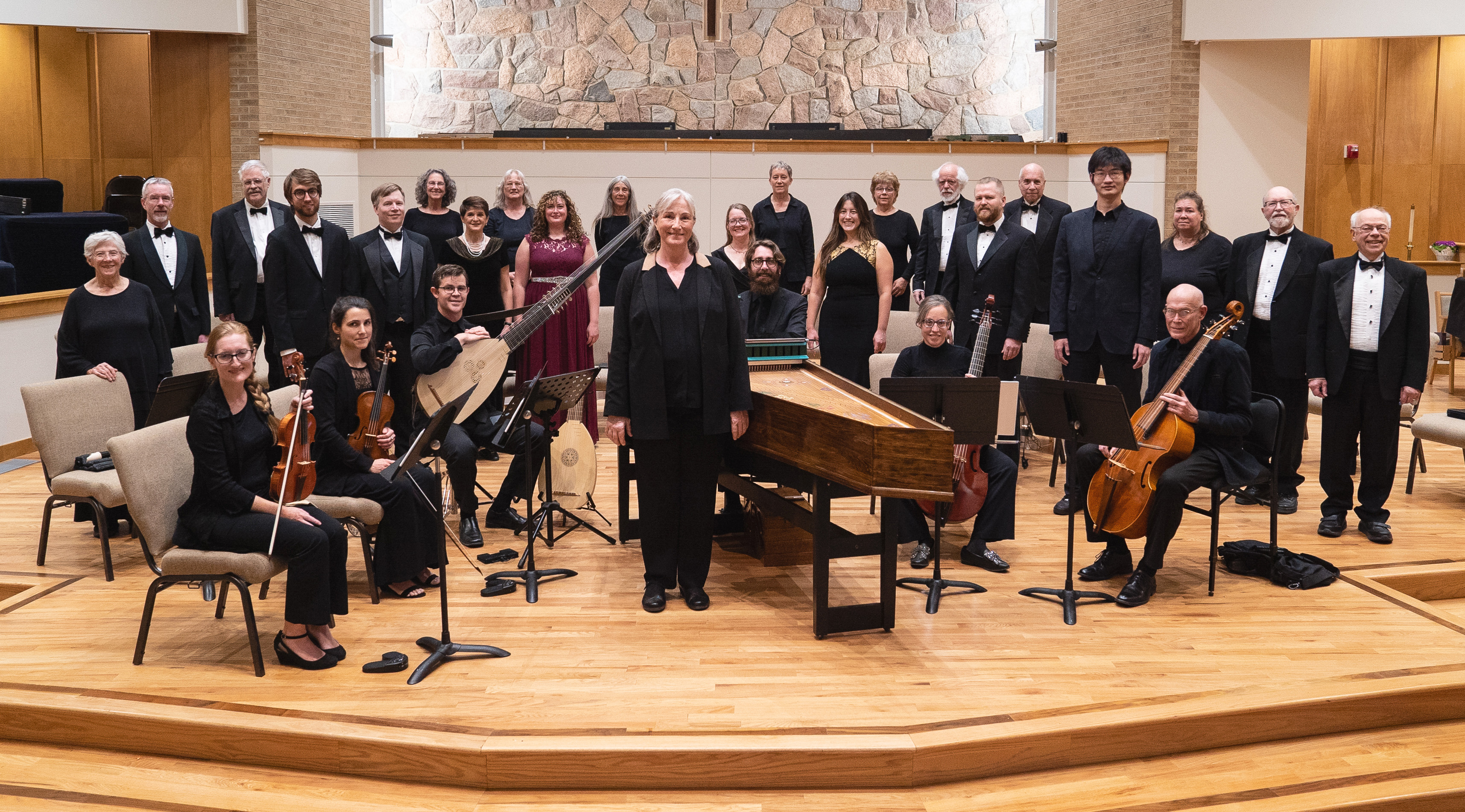
Changes in leadership for performing organizations happen all the time, but Seicento—Boulder’s semi-professional chamber choir and Baroque performance group—has pulled a double switch that is at least unusual.
Founding, and current, director Evanne Browne leads a concert by Seicento. Photo by John Lamb.
They just recently announced a change in the artistic director position, but to fully understand, you have to go back to the founding of the group in 2011.
Seicento was founded by Evanne Browne, an experienced early-music singer who served as artistic director until 2018, when she moved to Arlington, Virginia—“for love,” she says, moving to “explore a relationship that ended up wonderfully.” Amanda Balestrieri, a long-time friend who had performed alongside Browne in early music groups in the D.C. area and later moved to Boulder, took over and directed the group through COVID.
Now Browne and her husband, John Butterfield, have returned to Boulder, and by a total coincidence it’s Balestrieri who is moving to Virginia at the same time. It’s love again, but in this case a daughter and a grandchild.
Newly returned to Colorado, Browne told Seicento’s board, “I’m available!” And so she is returning to the organization she founded.
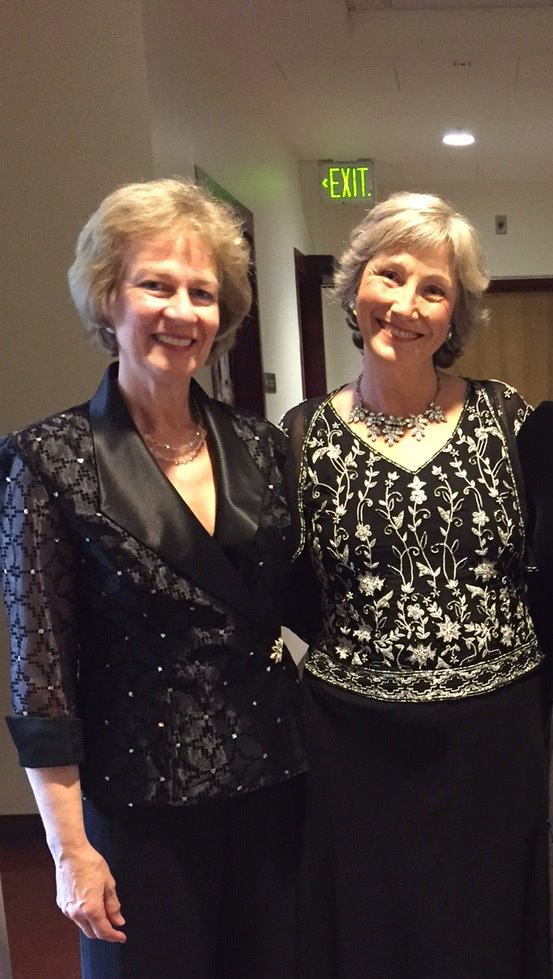
Musical pals and alternating Seicento directors Evanne Browne (l) and Amanda Balestrieri (r)
Have you got that? Today the artistic director is whichever of the two is not living in Virginia. Mostly.
That has worked out quite well, since Browne and Balestrieri have worked together enough that they know each other and trust each other explicitly. “That’s the beautiful thing about the two of us having both led Seicento,” Balestrieri says. “Even though Evanne or I leave Seicento, it’s going to be led the way that we both think it should be.”
The two musical partners arrived at this mutual respect from different backgrounds: Balestrieri from England, where she studied German and French at Oxford, and also studied voice in London and in Milan, Italy; and Browne from a musical education in the U.S., including voice studies at Rice University and post-graduate work in choral conducting.
“We come from different emphases and knowledge bases,” is the way Balestrieri puts it. But “the groundwork is always the note.”
In early music performance, not everyone always agrees even about the note, because the mists of time have left a lot to the interpretation of the performer. That’s where the shared background puts Browne and Balestrieri in agreement about the note, and much more. Their common professional experiences have led them to a mutual understanding of early music styles, and a shared interest in exploring the repertoire.
Balestrieri and Browne ended up in the Washington, D.C., area largely by chance, performing with early music ensembles including the Folger Consort and the Smithsonian Chamber Players. As they sang together in the same groups, they soon found great compatibility as singers. In fact, Browne says, “There were times where we could adjust our voices to be so similar that even I would sometimes go, who’s on which line?”
For a while their careers went in different directions. Balestrieri’s singing career took off, while Browne worked at the Smithsonian in Washington, picking up business skills that she has used with Seicento. Then it was again mostly by chance that they both ended up in Colorado.
Former director Amanda Balestrieri with Seicento
“That’s the beautiful thing, because we were not singing and performing together for quite a while,” Balestrieri says. “I wasn’t even assuming we’d see each other again musically, but it was lovely to reconnect, because we did have that background—even though it was not a continuous one.”
The best part of the saga is Balestrieri’s move to Virginia. She was well settled in Boulder, and had an ongoing relationship with Charley Samson of Colorado Public Radio. They both kept their homes, hers in Boulder and his in Denver, but were often together.
“I have two daughters, one was living in Virginia and one in San Francisco,” Balestrieri says. “The one in San Francisco said ‘Mom, are you going to move here?’ What was I supposed to do, choose? And so she moved to Virginia to call my bluff! She had a baby last December and bought a house. I was visiting her and the house next door came up for sale.”
Thinking that she would like to have a place to stay in both Colorado and Virginia, Balestrieri bought the house next door to her daughter. “I was struggling with leaving (the house in Boulder),” she says. “So I called (Samson) from Virginia and said, ‘Guess what I did! But I have this great idea.’
“So what we’ve done is, Charley sold his house, I bought the house next door to my daughter and I’m selling my house to Charley!”
Just like that, Balestrieri will have a base of operations in both places. She hopes to return to singing in D.C., where she still has many friends and professional contacts, and she has plans to perform in the Boulder area as well, both as a visitor with Seicento in the coming season and with other people she knows in this area.
In the meantime, Browne is going full steam ahead for the coming season of Seicento. The repertoire for two concerts—one in December and the other in May—has been set. The holiday concert, scheduled for December 2–4 with a venue tbd, is titled “Seicento’s Roots: Christmas in the late Renaissance.” The program will illustrate the transition from the choral style of the late Renaissance to the more ornate style of the Baroque period. The program will feature carols that are still familiar today, including “Lo How a Rose E’er Blooming” by Michael Praetorius.
The spring concert, scheduled for May 5–7, will be a 300th anniversary performance of J.S. Bach’s St. John Passion, with Balestrieri as featured soloist. As far as Browne knows, this will be the first performance in Colorado of this passion setting with original instruments. This is by far the greater challenge, since it requires hiring specialist performers on the instruments of Bach’s time, but Browne is unafraid.
“Seicento needs to do this because when we do something that everybody wants to come see, and sing, then you get the response that you want,” she says. “I could have picked something very obscure that didn’t have Baroque oboes or Baroque flute players, but the joy of Seicento and the passion for the music is to find these pieces.”
In the meantime, Balestrieri and Browne both believe that Seicento has put the travails of COVID behind them and can return to the level they had achieved before. “I’m excited to see Seicento get the energy back after COVID,” Balestrieri says.
The group’s most recent concert this past April, which she directed, “had a very good feel,” she says. “The cohesion and spirit was back. The audience reviews were great. I’m just excited to see it and to be there when I’m in town.”
NOTE: The announcement of concert venues and tickets for Seicento’s 2022-23 concerts will be available on the group’s Web page.
CU Quartet in residence will play Grusin Hall Sept. 18–19 and October 30–31
By Peter Alexander Sept. 14 at 11:18 p.m.
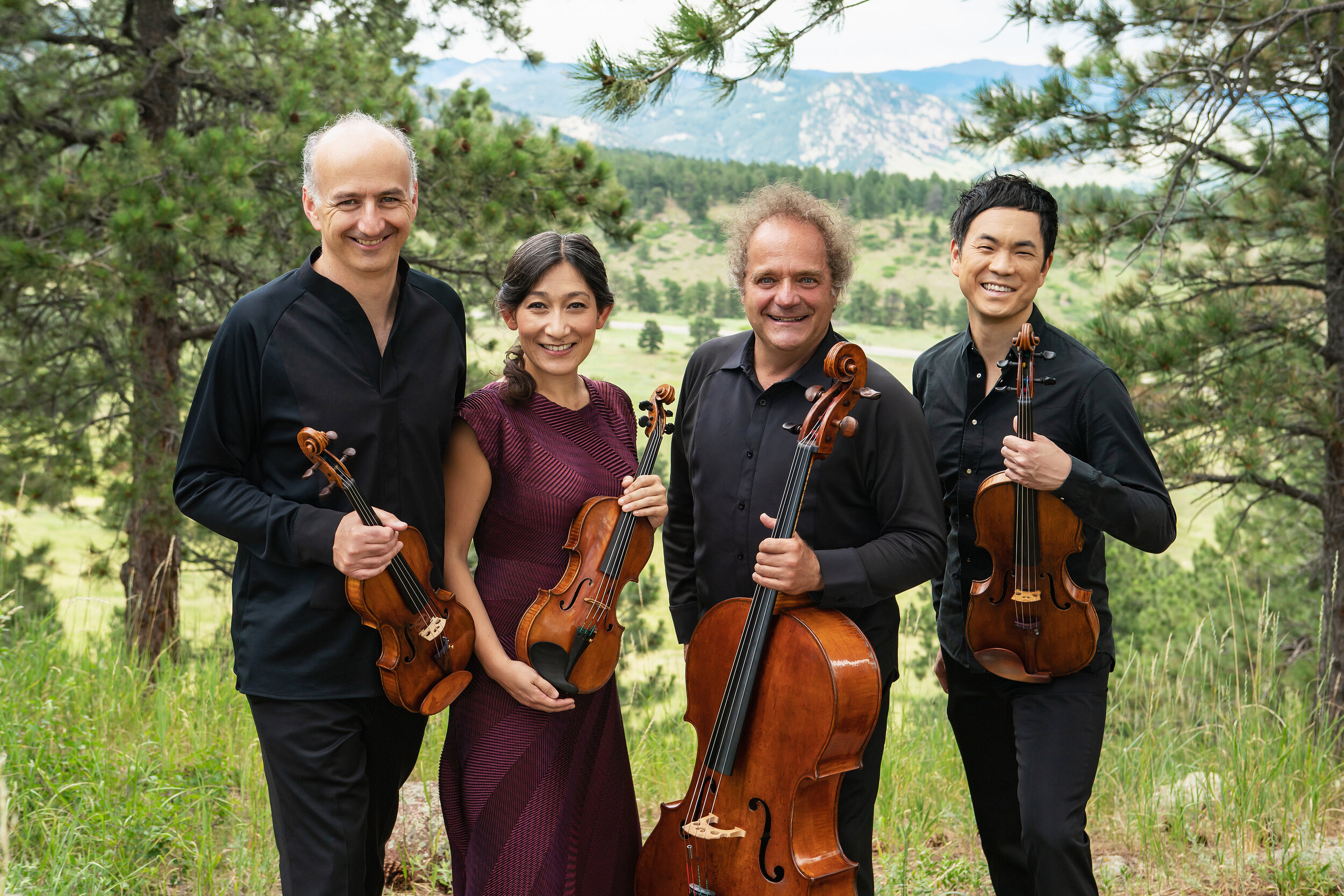
It’s hard to keep up with the Takács Quartet.
Takács Quartet. Image by Amanda Tipton Photography
The CU quartet-in-residence is celebrated worldwide, giving them access to the top classical festivals. Over the past summer, they played the Colorado Music Festival in Boulder, the Tanglewood Festival in Lennox, Mass., the Edinburgh Festival in Scotland, at the Snape Maltings in Aldeburgh, England—a venue made prominent by composer Benjamin Britten and tenor Peter Pears—and the Luberon Festival in France.
But now they are back in Boulder, and their local fans can look forward to their annual series of campus concerts, starting this weekend with an all-Beethoven program (4 p.m. Sunday, Sept. 18 and 7:30 p.m. Monday, Sept. 19 in Grusin Concert Hall). Other events during the fall semester will be concerts Oct. 30 and 31, featuring music by Britten, Bartók and Mozart; and concerts Nov. 6 and 7 by the Ivalas Quartet, who concluded a two-year residency with the Takács in May (program tba; other details and ticket information below).
Between the September and October concerts, the Takács will be touring in Japan and Korea. “We’re looking forward to that,” Takács cellist András Fejér says. “They always bring a special joy because they regard culture and classical music very highly, and they are treating us as such wonderful friends.”
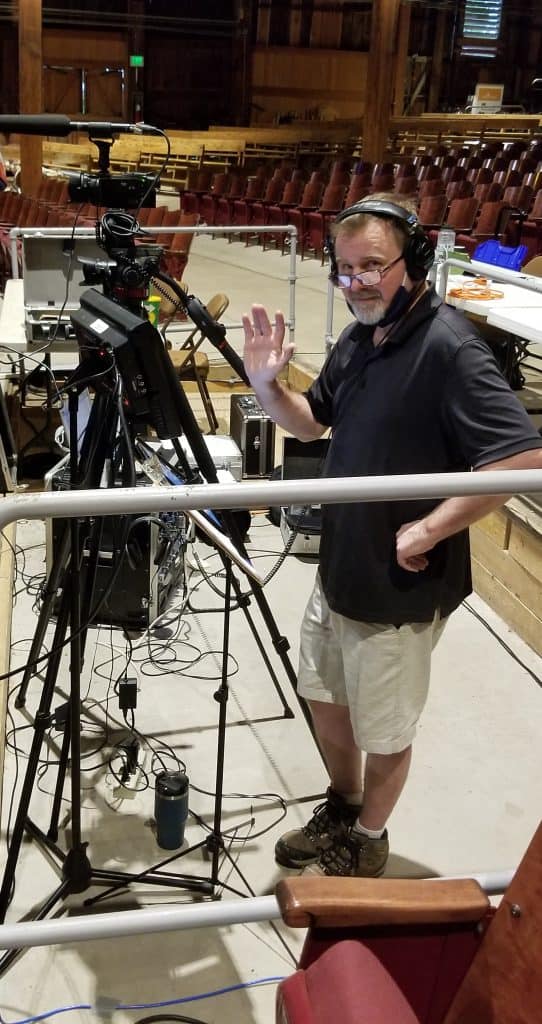
Sound engineer Michael Quam at the Colorado Music Festival
Just this month the quartet released its latest recording, featuring works of Joseph Haydn. The CD, of quartets opp. 42, 77 nos. 1 and 2, and 103, was recorded in the Lone Tree, (Colo.) Arts Center. “We had probably the top American producer, Judy Sherman, and a wonderful, wonderful sound engineer, Mike Quam, whom we got to know at the Colorado Music Festival,” Fejér says.
In addition to working for the Colorado Music Festival, Quam lives and has a recording studio in Boulder. “He’s the most wonderful all-around sound man anywhere,” Fejér says. “We never met anyone like him, so we were very happy.”
In case you are wondering, in addition to the touring and recording and campus concerts, Fejér says “we always make time for (our students)! We have a wonderful new ensemble-in-residence and they are eager and hungry. That’s always a great encouragement for us, because teaching is wonderful!”
The Takács has of course played all of the Beethoven quartets, many times. In the case of the upcoming concert, the choice of an all-Beethoven program is partly from the exploration of familiar repertoire with the ensemble’s newest member, violist Richard O’Neill. “We need to re-learn the Beethoven with our new member,” Fejér says.
“He’s full of great ideas and he’s got an encyclopedic memory. He’s a great, great all-around artist, so we are very happy to be listening to new ideas, new solutions. It’s all a new dynamic, which I am enjoying tremendously.”
The three quartets chosen for the September concerts span the major periods of Beethoven’s life: Op. 18 no. 5 from Beethoven’s very first set of six quartets published in 1801, in the sparkling key of A major; Op. 95 in the gloomier key of F minor, known as the “Serioso” Quartet, from 1810; and Op. 127 in E-flat major, from 1825.
“We love these pieces,” Fejér says. “They are wonderful pieces. Maybe the audience is not jumping on its feet because of the final effect, but it doesn’t take away from the overall greatness.”
The Quartet op. 127 provides unique challenges, Fejér explains. “Some ensembles might not program it because it’s not so spectacular. It’s so deep, and herein lies the difficulty. Its first and last movement are extremely soft, piano, pianissimo, very ethereal, up in the clouds. It takes work and rehearsing and it’s not easy to make it flow and make it light, ethereal and transparent.”
Fejér explains that the Takács usually has three main areas of work when they rehearse. First is “what we play on tour, which might be pieces we already played many times. And then there’s practicing and getting familiar with new or newish pieces, (and finally) the ones we are planning to record.”
What that means is that rehearsing the program for the October concert will mostly come a little later. About that program—Britten’s String Quartet No. 1, Bartók’s String Quartet No. 6 and Mozart’s String Quartet in D major, K499—Fejér declines to comment right now.
“I might refrain trying to be smart about Britten at this point,” he says. “We recorded (his quartets) eight or nine years ago, but we haven’t played them again. So basically now we’re relearning and discussing what’s new and what’s changed, and what we wish to be changed.
“What matters is how we feel about it today or the next week, so we can be even more convincing and find even more joy in bringing it together.”
# # # # #
Takács Quartet
Beethoven: String Quartet in A Major, Op. 18 no. 5 —String Quartet in F Minor, Op. 95 —String Quartet in E-flat Major, Op. 127
4 p.m. Sunday, Sept. 18 7:30 p.m. Monday, Sept. 19 Grusin Hall, Imig Music Building In person and live-stream tickets HERE
Takács Quartet
Benjamin Britten: String Quartet No.1
Bartók: String Quartet No. 6
Mozart: String Quartet in D major, K499
4 p.m. Sunday, Oct. 30 7:30 p.m. Monday, Oct. 31 Grusin Hall, Imig Music Building In person and live-stream tickets HERE
Ivalas Quartet
Program TBA
4 p.m. Sunday, Nov. 6 7:30 p.m. Monday, Nov. 7 Grusin Hall, Imig Music Building In person and live-stream tickets HERE
______________
NOTE: Due to spell checker error “encyclopedic” first appeared as “encyclopedia.” Corrected on 9/15.
David Korevaar, the CU, Boulder, College of Music distinguished professor of piano and an apparently tireless performer, has several performances coming up in the Boulder and northern Colorado region, from a faculty recital on the CU campus to a guest performance with the Ft. Collins Symphony.
Here is a list of his upcoming appearances:
7 p.m. Friday, Aug. 12: Beethoven’ Fourth Piano Concerto with the Ft. Collins Symphony, Wes Kenney, conducting. Other pieces on the all-Beethoven program will be the Coriolan Overture and the Symphony No. 7 I A major. The performance will be in the Timberline Church in Ft. Collins. Tickets are available HERE.
7:30 p.m. Tuesday, Aug. 30: A CU faculty recital, titled “Comedy, tragedy, virtuosity and passion.” The program features sonatas by Florence Price and Beethoven, Chopin’s F-sharp minor Polonaise (“Tragic), and a selections of Chopin études. The performance will be free and open to the public. This performance will also be available by live stream HERE.
7:30 p.m. Tuesday, Sept. 24: A chamber concert, the first of three to be sponsored by the Boulder Chamber Orchestra The program features piano quintets by Edward Elgar and Schumann. The performance will be in the Boulder Adventist Church. Tickets are available HERE.
Rollicking comedy and light-hearted drama lead the summer schedule
By Peter Alexander July 8 at 5:30 p.m.
There will be no babies thrown into the fire (Il Trovatore, 2018), or innocent girls murdered in place of a dissolute count (Rigoletto, 2021) at Central City Opera this summer.
CCO has not been able to perform in their exquisite opera house in Central City since 2019, and between returning to their home and this year’s 90th anniversary, the company wanted a cheerful summer. In the words of Central City Opera chief executive officer Pamela Pantos, the aim was that “after what we’ve all been thorough, people will come and smile, be back in the opera house and enjoy themselves.”
Opening Night at Central City Opera. Featured in Central City Opera’s 75th anniversary book, “Theatre of Dreams, The Glorious Central City Opera—Celebrating 75 Years.”
Both mainstage productions in the Central City Opera House will be light-hearted works: the frothy Viennese confection of Johann Strauss, Jr., Die Fledermaus; and The Light in the Piazza, a Tony-winning Broadway musical by Adam Guettel, which has moments of melancholy but ends happily with boy-marries-girl.
The only darker tones come later in the summer, with a production of Two Remain, a chamber opera by Jake Heggie based on the stories of two Auschwitz survivors. That will be performed at the Martin Foundry in Central City (see dates and time below).
Broadway musicals have often been performed by Central City Opera: Carousel (2021), Man of La Mancha (2015), The Sound of Music (Denver, 2014), Show Boat (Denver, 2013), Oklahoma! (2012) among others. Pantos hopes that there will be ongoing support for musical comedies, for the breadth they bring to the repertoire.
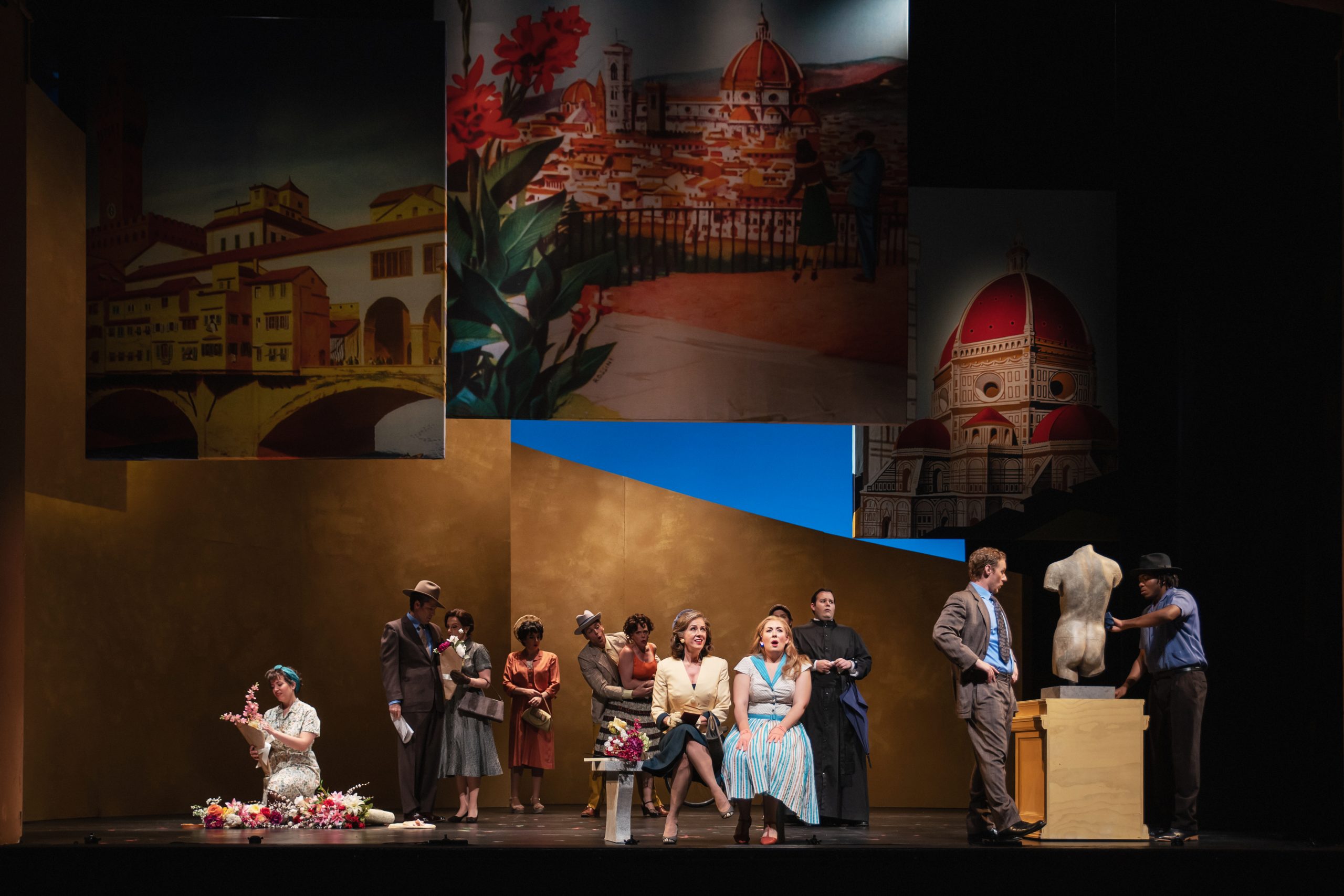
Central City Opera’s production of ‘The Light in the Piazza.’ Photo by Amanda Tipton Photography
A Light in the Piazza tells the story of 1950s American housewife Margaret Johnson and her daughter Clara—who seems to be developmentally disabled from a childhood accident. This being a musical, Clara falls in love with a handsome young Italian man, and Margaret has to decide if the young couple will be allowed to see each other, and ultimately, to marry.
The conflict revolves around Margaret’s desire to protect her daughter, and to let her live her own life. There are also cultural differences between the Americans and the Italians, which create another level of dilemma for everyone. With her husband busy in the United States, Margaret has to find her own path, just as Clara does.
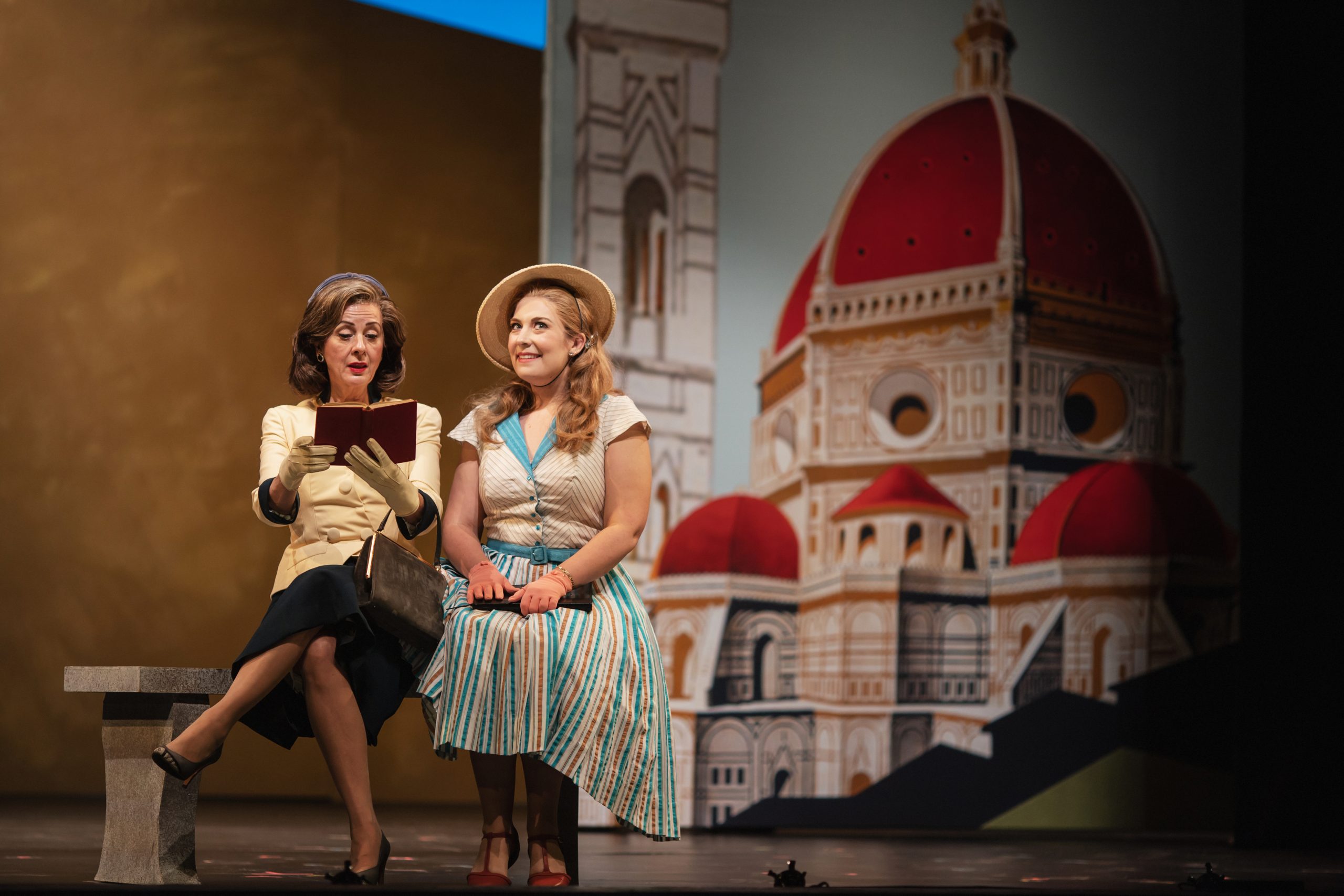
Rebecca Caine (Margaret Johnson) and Diana Newman (Clara Johnson) in the CCO production of ‘The Light in the Piazza.’ Photo by Amanda Tipton Photography.
“While there are moments of seriousness to the piece, it is quite lighthearted,” Pantos says. “It had a long run on the stage in New York, (and) Tony-winning is always Tony winning! There’s a little bit of melancholy, but beautiful music—it is a romance!”
Composed by the grandson of Broadway legend Richard Rodgers, A Light in the Piazza reflects the style and traditions of 20th-century American Music Theater. Die Fledermaus, however, reflects just as deeply the style and manner of a very different world: that of 19th-century Vienna. There are swirling waltzes (of course), a grand party thrown by a bored Russian count, mistaken identities and masks, and hilarious comedy from beginning to end, all capturing the splendor and decadence of Imperial Vienna.
The plot is almost too complicated to explain, except that it is a tale of foolishness, and of revenge between friends, that starts in an elegant home and ends in a dreary prison, with a glamorous dinner party in between. But even in the prison, everyone comes away happy. The musical numbers will be performed in German but the dialog in English so everyone should be able to follow the story.
Conductor John Baril.
The Viennese musical style, combining elegance and sentimentality, is not always easy for non-native performers. There are unwritten rules for modifying rhythms and tempos that are known to the Viennese, but not necessarily outsiders—kind of like the unwritten rules in American jazz.
“The trick in getting Fledermaus right is all of the little things that aren’t on the page,” conductor John Baril says. “There’s a lot of little Viennese things that are done, especially in waltz tempi. You rush the second beat—it’s not written down that way so you have to explain it to an orchestra.
“And then you also have to get them to not play it when you don’t want it. There’s a lot of little things that are traditions, little slow-downs here and little commas there. None of that is written, it all has to be explained. And getting singers to do that and not just do what’s written on the page can be hard.”
One traditional showstopper is a very flashy Hungarian Czardas, sung by one of the characters in the second act. “It’s one of the most difficult things I’ve ever conducted,” Baril says. “It’s super hard to conduct because again everything that the singer needs to do with that piece, to make it interesting, is not on the page.“
In addition to singing one of the lead characters himself, Baril says he has studied recordings and performances by native Austrian and Viennese conductors. “I’m going to do it the way I want to do it,” he says. “And the way I want to do it is all the Viennese things that I’ve heard done.”
Baril mentions one other challenge to any performances at Central City Opera. “We’re at 8500 ft., and some of the phrasings that you could do at sea level you simply cannot do,” he says. “We never know—there’s no way TO know—when a new artist is coming up here, whether they can adapt.”
The production is one that CCO bought from Virginia Opera and modified to fit their small stage. “I saw the set at Northwestern and it’s beautiful,” Baril says. “It is a set that takes place in Vienna, so it will be as Viennese as we can make it.
“I love Fledermaus. I think it’s a masterpiece of the order of anything else.”
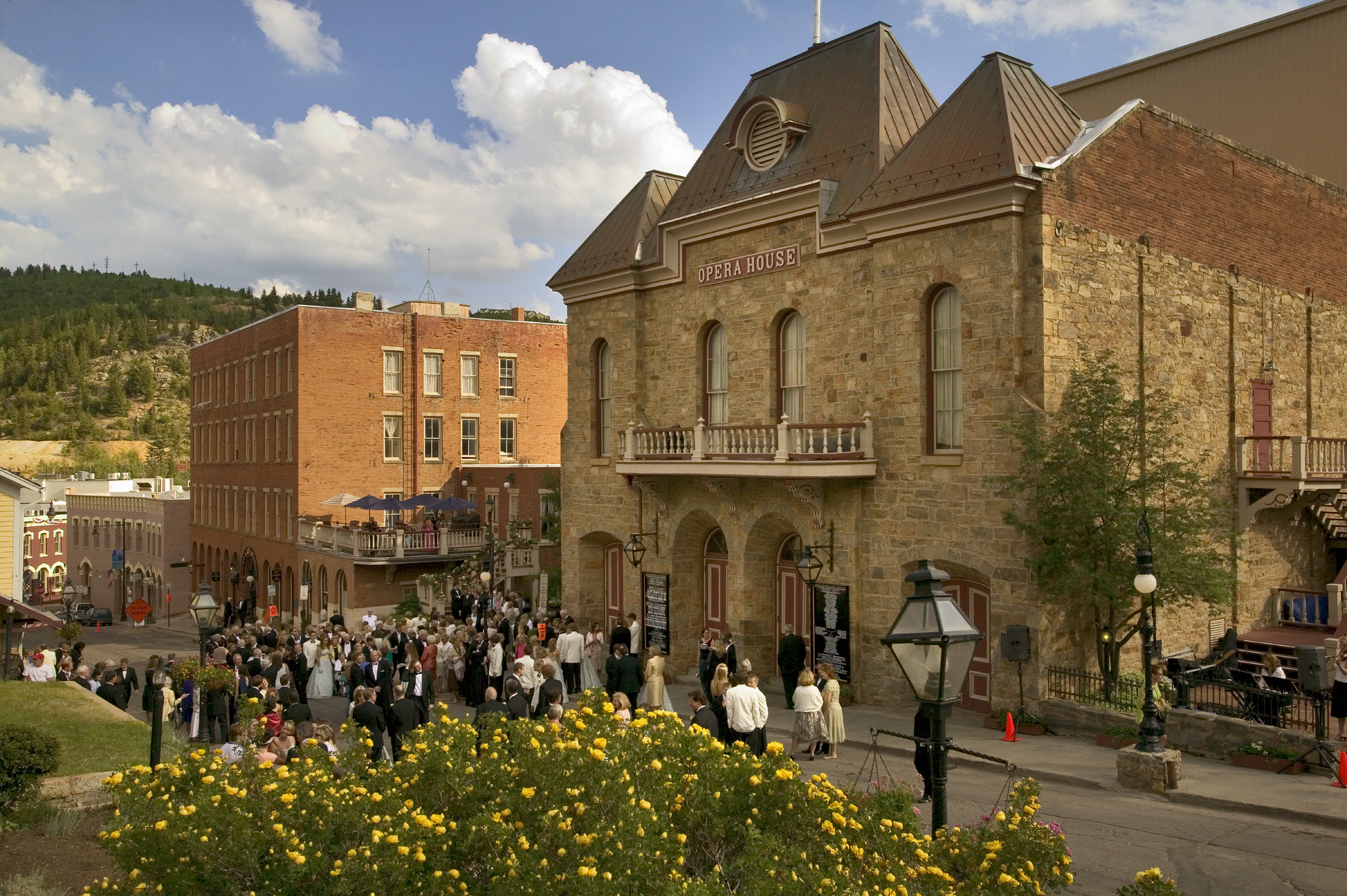
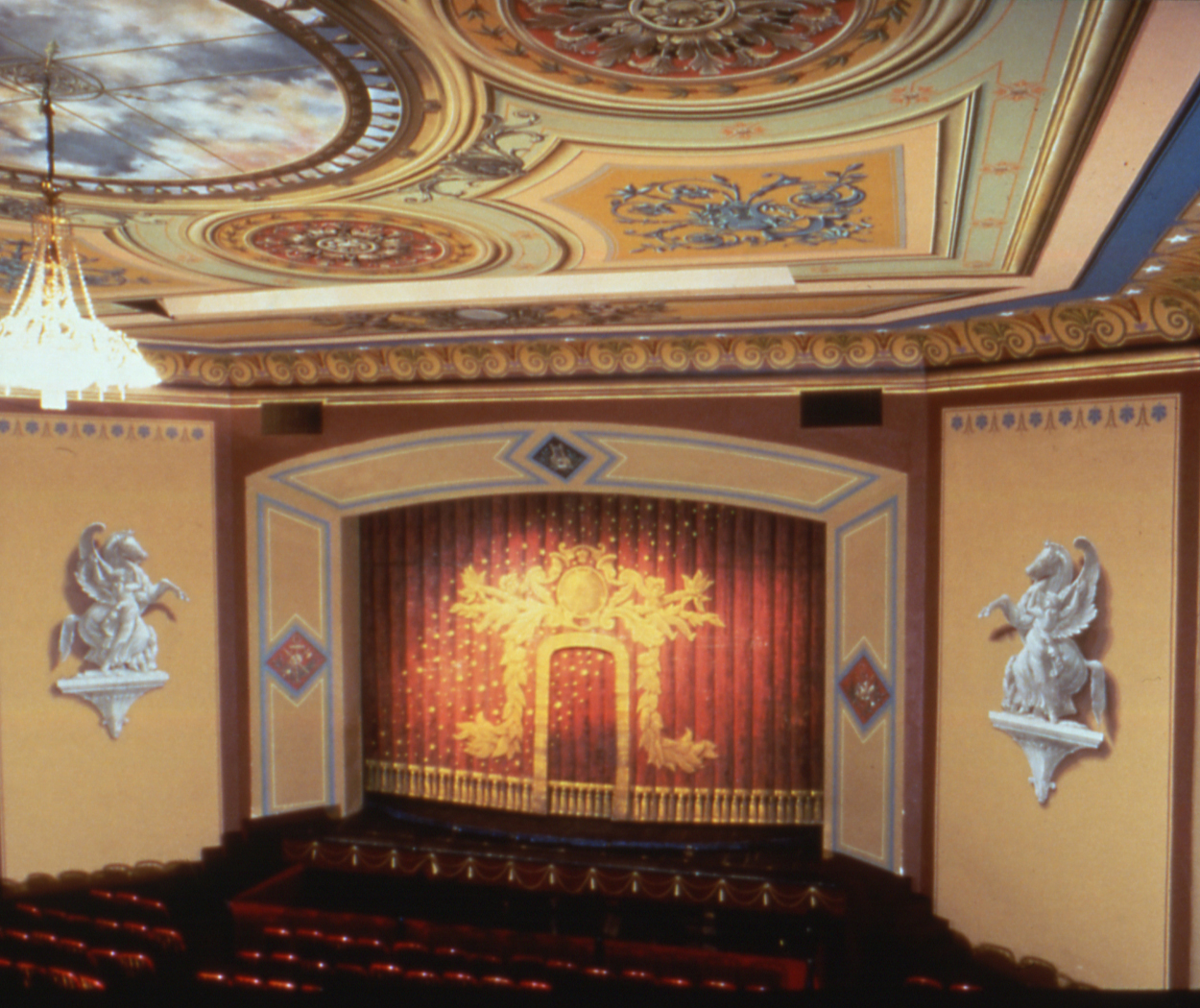
Pantos wants people to make the trip up the mountain to Central City to see the shows, but also just to experience the intimate 550-seat opera house, built in 1878. “Being in such a jewel of a theater and being so close to the stage, you have the unique opportunity of experiencing theater in a way that you’ll never experience it anywhere else,” she says.
The interior of the Central City Opera House
“Because it is such an intimate theater, there is not a bad seat in the entire house. You’re so close to the performers, that it’s exhilarating and the energy literally emanates from the stage and you feel it because its is such a beautiful small theater.”
# # # # #
Central City Opera Summer 2022 season
The Light in the Piazza By Adam Guettel and Craig Lucas Performed in English
Adam Turner, conductor Ken Cazan, stage director
2:30 p.m. Sunday, July 10; Tuesday, July 12; Sat. July 16; Wednesday, July 20; Friday, July 22; Sunday, July 24; Thursday, July 28 8 p.m. Friday, July 8; Thursday, July 14; Tuesday, July 26
Central City Opera House
Die Fledermaus(The bat) By Johann Strauss, Jrs., Karl Haffner and Richard Genée Performed in German with dialog and titles in English
John Baril, conductor Joachim Schamberger, stage director
8:00 p.m. Saturday, July 9; Friday July 15; Thursday, July 21; 2:30 p.m. Wednesday, July 13; Sunday, July 17; Tuesday, July 19; Saturday, July 23; Wednesday, July 27; Friday, July 29; Sunday, July 31
Central City Opera House
Two Remain: Memories of Auschwitz By Jake Heggie and Gene Scheer
Performed in English John Baril and Brandon Eldridge, co-conductors Dan Wallace Miller, stage director
7:30 p.m. Saturday, July 16 (sold out); Wednesday, July 20 2:30 p.m. Thursday, July 21 (sold out) 11 a.m. Thursday, July 28
Composer-in-residence John Adams, “Music of Today” are featured in the 2022 season
By Peter Alexander July 6 at 10:30 p.m.
The 2022 Colorado Music Festival (CMF), underway at Boulder’s Chautauqua Auditorium, offers some terrific programs, but if you want to know which ones are most exciting, don’t ask Peter Oundjian. The festival’s music director and conductor loves them all.
Peter Oundjian at Chautauqua
“Since I designed it, there’s nothing I’m not excited about,” he says of this year’s festival. “You’ve got really interesting guests and wonderful artists, the Takács Quartet and John Adams and Mahler’s Fifth and a fanfare by Wynton Marsalis. It’s full of exciting prospects!” (See the complete, updated program for the festival below.)
In fact, there is enough excitement that it’s hard to mention it all in one sentence. Other intriguing prospects for the summer are performances of all five Beethoven piano concertos on three concerts, by rising Canadian pianist Jan Lisiecki (July 7–10); a week of “Music of Today” (July 12–17); world premieres of music by Timo Andres (July 17) and Wang Jie (Aug. 4); guest performances by pianist Jeremy Denk (July 17), violinist Randall Goosby (July 21–22) and clarinetist Anthony McGill (Aug. 4).
Here are closer looks into some of the headline events during the summer:
Jan Lisiecki. Photo by Mathias Bothor—DG
Lisiecki’s Beethoven Piano Concerto series opens Thursday. “Jan is a young musician and p pianist, really remarkable, and he just recorded the piano concerti of Beethoven for Deutsche Grammophon [record label].” Oundjian says. “He was supposed to play them two years ago, for Beethoven’s 250th. I really didn’t want to lose that idea for the festival, and he promised that he would come back and play them all.”
Another anniversary, one this year, provided the other idea for programming the three concerts. The year 2022 is the 150th anniversary of the birth of the English composer Ralph Vaughan Williams, whose works will open the concerts that conclude with Beethoven’s piano concertos. Fantasia on a Theme by Thomas Tallis open the first of the Beethoven-Vaughan Williams concerts (July 7), followed by the Overture to The Wasps (July 8), and the Fifth Symphony (July 10).
“I’ve always been an enormous admirer of Vaughan Williams’s music,” Oundjian says. “It’s the 150th anniversary and I don’t think anybody in this country has acknowledged it, so that’s what we’re doing. The Fifth Symphony is really extraordinary—it’s so evocative, it’s so beautiful and so sad and reflective, but it ends with a great sense of optimism.”
“Music of Today” (July 12–17) is central to Oundjian’s concept of the festival. “I hope to think it’s important to everyone, but it’s certainly important to me,” he says. Music for the week-long mini-festival was selected by Oundjian together with the Pulitzer Prize-winning composer John Adams, who is the CMF composer-in-residence. In addition to his works being featured throughout the festival, Adams personally selected some of the composers for the festival, and he will conduct part of the programs July 14 and 17.
At 75, Adams is one of the country’s most revered composers. He is perhaps best known for his operas, including Nixon in China (1987) and Dr. Atomic (2005), but he has also written numerous orchestral, chamber, and solo piano works, several of which will be heard at CMF. His On the Transmigration of Souls, written in commemoration of the Sept. 11, 2001, terrorist attack on the World Trade Centra in New York, won the Pulitzer Prize.
John Adams. Photo by Riccardo Musacchio
All four of the “Music of Today” concert include music by Adams, but they also include younger composers who are, so far, less known. The mini-festival opens with the Attacca Quartet (July 12), a young string quartet who describe themselves as “passionate advocates of contemporary repertoire.”
In addition to selections from Adams’s John’s Book of Alleged Dances, Attacca will perform music by Flying Lotus, a DJ, producer and rapper from Los Angeles; Anne Müller, a German cellist/composer; American singer-songwriter Louis Cole; Philip Glass; and Caroline Shaw, who at 30 became the youngest-ever winner of the Pulitzer Prize in composition.
A Festival Orchestra concert (July 14) will feature both Oundjian and Adams conducting. The program comprises Adams’s City Noir, an atmospheric and jazzy symphony inspired by the culture of Los Angeles and noir films of the ‘40s and ‘50s; a Chamber Concerto by his son, Samuel Adams; and the world premiere of Dark Patterns by pianist/composer Timo Andres, a CMF commission. In addition to Dark Patterns, Andres has received commissions from Carnegie Hall for the Takacs Quartet, the Boston Symphony, the St. Paul Chamber Orchestra and the New World Symphony.
Surely a highlight of “Music for Today” will be the “Kaleidoscope” concert (July 15), with performances by guest artists Tessa Lark, violin, and Timothy McAllister, saxophone, with members of the CMF orchestra. Using lighting and video to create a theatrical performance as well as a concert, “Kaleidoscope” features, yes, a kaleidoscopic array of different composers—Adams, Glass, John Corigliano, Osvaldo Golijov, and others.
“It’s so much fun!” Oundjian says. “We put a screen up, and cameras everywhere, so you can watch the artists normally, or you can watch them at various different angles. And all of this cool lighting.! It’s like a theater evening rather than a concert.”
Gabriella Smith
“Music of Today” concludes with another concert shared by Oundjian and Adams as conductors of the CMF orchestra, with pianist Jeremy Denk playing Adams’s Must the Devil Have All the Good Tunes? (July 17).Also on the program is Tumblebird Contrails by Gabriella Smith, a committed environmentalist as well as composer. The score was inspired by an experience Smith had backpacking at the edge of the ocean at Pt. Reyes, Calif. The title, she writes, “is a Kerouac-inspired nonsense phrase.”
The final piece of the “Music of Today” week is also the only piece by a composer who is no longer living, the Symphony No. 6 by Christopher Rouse. “John and Christopher knew each other quite well,” Oundjian says. “(Rouse) basically composes his own final moments—when the gong sounds at the end, that is the final moment of life, and it’s very, very moving. So that’s why I’m ending the whole week with it.”
Later in the summer, former CMF music director Jean-Marie Zeitouni will return to Boulder to lead two programs (July 18–29 and July 31). The first will feature more or less standard repertoire, including Venezuelan pianist Gabriela Montero playing Tchaikovsky’s every-popular First Piano Concerto. Known for her brilliant improvising skills, Montero has appeared in Boulder before, most recently with the CMF orchestra in July 2019.
Zeitouni’s second program is more interesting: Jessie Montgomery’s Starburst for strings, Bizet’s youthful Symphony in C major, and Mendelssohn’s incidental music to A Midsummer Night’s Dream. This very familiar music is rarely heard in its intended context—the play by William Shakespeare. The CMF performance will provide at least a taste of the original idea, with musical passages presented with texts from Shakespeare’s play spoken by actors John de Lancie and Marnie Mosiman. The performance will feature sopranos Jennifer Bird-Arvidsson and Abigail Nims.
The Festival Finale Concert (Aug. 7) ends the festival with a bang: the Colorado premiere of Wynton Marsalis’s fanfare Herald, Holler and Hallelujah! a CMF co-commission, and Mahler’s Fifth Symphony. Ending the summer with a Mahler is symphony is not a convention at CMF, but Oundjian would not mind if it were.
“I wouldn’t want to call it a tradition yet, because we only did it ‘19.” he says. “There’s nothing quite like Mahler for an orchestra, for a conductor, for the experience to listening as a music lover. So I like the idea. We’re going to try again for ‘23.”
The festival’s mix of audience favorites—Beethoven’s “Emperor” Concerto, Tchaikovsky’s Piano Concerto and Mahler’s Fifth, for example—with interesting new works by John Adams, Christopher Rouse, and younger composers including Carolyn Shaw, Flying Lotus, Gabriella Smith and Timo Andres, brings Oundjian’s vision of the festival to life.
“You can’t only program for the box office,“ he says. “You have to program for vision, and for maybe down-the-road box office. If you put interesting juxtapositions together, people develop a trust in you, and they’ll buy stuff they wouldn’t have bought two years earlier.
“It’s like when you go into an art gallery: you don’t have to love everything you see. It’s important that you enjoy an incredibly select [portion] that’s just amazing.”
With such wide ranging repertoire, this year’s CMF gives the audience a lot of opportunities to discover something “just amazing.” And perhaps to discover some new favorite composers in the process.
# # # # #
Colorado Music Festival 2022 (Remaining concerts) All performances at Chautauqua Auditorium
7:30 pm. Thursday, July 7 Peter Oundjian, conductor, with Jan Lisiecki, piano
Ralph Vaughan Williams: Fantasia on a Theme by Thomas Tallis
Beethoven: Piano Concerto No. 1 in C major —Piano Concerto No. 3 in C minor
6:30 p.m. Friday, July 8 Peter Oundjian, conductor, with Jan Lisiecki, piano
Ralph Vaughan Williams: Overture to The Wasps
Beethoven: Piano Concerto No. 2 in B-flat major —Piano Concerto No. 4 in G major
6:30 p.m. Sunday, July 10 Peter Oundjian, conductor, with Jan Lisiecki, piano
Ralph Vaughan Williams: Symphony No. 5 in D major
Beethoven: Piano Concerto No. 5 in E-flat major (“Emperor”)
——-Music of Today——-
7:30 p.m. Tuesday, July 12 Attacca Quartet
John Adams: selections from John’s Book of Alleged Dances
Flying Lotus: Clock Catcher —Remind U —Pilgrim Side Eye
Anne Müller: Drifting Circles
Louis Cole: Real Life
Philip Glass: String Quartet No. 3, “Mishima”
Caroline Shaw: The Evergreen
Gabriella Smith: Carrot Revolution
7:30 p.m. Thursday, July 14 Peter Oundjian and John Adams, conductors With Samuel Adams, composer; Tessa Lark, violin; and Timothy McAllister, saxophone
Timo Andres: Dark Patterns (world premiere commission)
Samuel Adams: Chamber Concerto
John Adams: City Noir
7:30 p.m. Friday, July 15: Kaleidoscope Timo Andres, piano; Tessa Lark, violin; Timothy McAllister, saxophone; and members of the Colorado Music Festival Orchestra
David Skidmore: Ritual Music
Stacy Garrop: Reborn in flames (from Phoenix Rising)
Osvaldo Golijov: Last Round
Valerie Coleman: Red Clay & Mississippi Delta for Wind Quintet
Timo Andres: Honest Labor
Roshanne Etezady: Recurring Dreams
John Corigliano: STOMP
Philip Glass: Etude No. 6
John Adams: Road Movie
6:30 p.m. Sunday, July 17 Peter Oundjian and John Adams, conductors, Jeremy Denk, piano
Gabriella Smith: Tumblebird Contrails
John Adams: Must the Devil Have All the Good Tunes?
Christopher Rouse: Symphony No. 6
—————————
7:30 Tuesday, July 19: Flavors of Russia Members of the Colorado Music Festival Orchestra
Borodin: String Sextet in D minor
Mikhail Glinka: Trio Pathétique in D minor
Tchaikovsky: Souvenir de Florence Sextet in D Minor, op. 70
7:30 p.m. Thursday, July 21 6:30 p.m. Friday, July 22 Ryan Bancroft, conductor, with Randall Goosby violin
Samuel Coleridge-Taylor: Ballade in A minor for orchestra
Florence Price: Violin Concerto No. 2
Saint-Saëns: Introduction and Rondo Capriccioso, op. 28
Sibelius: Symphony No. 2 in D major
6:30 p.m. Sunday, July 24 Ryan Bancroft, conductor, with Albert Cano Smit, piano
Mozart: Serenade in C minor for winds, K388 —Piano Concerto B-flat major, K595 —Symphony No. 39 in E-flat major, K543
7:30 p.m. Tuesday, July 26 Members of the Colorado Music Festival Orchestra
Mozart: Flute Quartet in D Major, K285
Coleridge-Taylor Perkinson: Movement for String Trio
Dvořák: Terzetto in C Major, op. 74
Brahms: Clarinet Quintet in B minor, op. 115
7:30 p.m. Thursday, July 28 6:30 p.m. Friday, July 29 Jean-Marie Zeitouni, conductor, with Gabriela Montero, piano
Mussorgsky, arr. Rimsky-Korsakov: Night on Bald Mountain
Tchaikovsky: Piano Concerto No. 1 in B-flat minor
Prokofiev: Symphony No. 5 in B-flat major
6:30 p.m. Sunday, July 31 Jean-Marie Zeitouni, conductor with Jennifer Bird-Arvidsson and Abigail Nims, sopranos; John de Lancie and Marnie Mosiman, actors
Jessie Montgomery: Starburst
Georges Bizet: Symphony No. 1 in C major
Felix Mendelssohn: Incidental Music to A Midsummer Night’s Dream
7:30 p.m. Tuesday, Aug. 2 Danish String Quartet
Henry Purcell, arr. Benjamin Britten: Chacony in G minor
Folk Music from the British Isles, arr. Danish String Quartet
Schubert: String Quartet No. 14 in D minor (“Death and the Maiden”)
7:30 p.m. Thursday, Aug. 4 Peter Oundjian, conductor, with Anthony McGill, clarinet
Wang Jie: Flying On the Scaly Backs of Our Mountains (world premiere)
Carl Maria von Weber: Clarinet Concerto No. 1 in F minor
Debussy: Première Rhapsodie for clarinet and orchestra
Stravinsky: Suite from TheFirebird (1919)
6:30 p.m. Sunday, Aug. 7: Festival Finale Concert Peter Oundjian, conductor
Wynton Marsalis: Herald, Holler and Hallelujah! (Colorado premiere, co-commission)
Kamala Sankaram’sJoan of the City is inspired by homelessness and Joan of Arc
By Peter Alexander June 17 at 5:23 p.m.
Composer Kamala Sankaram says that many of the pieces she writes start with her own imagination and not the way many operas get written— with a commission for a specific performing organization.
“They start with a crazy idea that I have” Sankaram says. “Then I talk to people and see who also is crazy.” She then works with the “also crazy” people to bring her idea to life.
Kamala Sankaram
For her latest project, an opera titled Joan of the City that combines themes of homelessness with the Joan of Arc story, those conversations led her to Leigh Holman, director of the Eklund Opera Program at the University of Colorado, Boulder, and the New Opera Workshop (CU NOW).
Sankaram has been in Boulder for the past two weeks, composing music and working with students in the opera program to start turning her “crazy idea” into a site-specific opera that will be premiered next year by Opera Omaha. Completed portions of Joan of the City will be performed at 3 p.m. Sunday (June 19) in the Music Theatre of Imig Music Building.
The performance is free and open to the public, and will take place entirely in the Music Theatre space.
The basic idea of the opera is that not one but five Joans will be fighting, not the English invaders in France, but gentrification and other forces creating homelessness in American cities. Starting in five different places within Omaha, the Joans eventually meet up, as audiences move with them through the city.
Sankaram grew up in Southern California, where the car is king, but after she moved to New York she started walking everywhere. “Whenever I go to a new city I’m walking, and I see the homeless community,” she says. “I think it’s important to have people see what does that feel like, to be walking the city, instead of driving by in a car.
“I started thinking about [homelessness] several years ago, and it has become increasingly problematic and prevalent . . . [in] all places across the United States. So the idea was how do you get people to look and see things that they normally look past.”
Another idea was the use of technology, which features in a lot of Sankaram’s work. It is technology that will allow the onsite performances in Omaha to take place in different places across the city, and also will allow audience members to participate in the performance by playing audio from their cell phones.
The final piece of Sankaram’s “crazy idea” was working with homeless agencies—Mary’s Place in Seattle and Micah House in Omaha—to connect the finished work to the homeless community. With her co-creator of Joan of the City, New York-based hybrid-theater director Kristin Marting, Sankaram and the homeless shelters presented writing workshops for the shelter clients.
Leigh Holman (Photo by Glenn Asakawa/University of Colorado)
The work that came from those workshops became the basis of the text for Joan of the City. “The libretto is all these poems that the shelter clients wrote, and then they’re sort of structured on this overall dramatic arc from the Joan of Arc story,” Sankaram explains. “It starts off as arias and then as the Joans meet each other, it turns into duets and trios and finally a quintet.”
Sankaram’s work is an example of the kind of creative and adventurous projects that CU NOW aims to support. Many new works go through a workshop process, but CU NOW is unique in that it offers a longer than average period for composers to work with performers while refining their work.
The program is largely Holman’s brainchild. She started CU NOW in 2010, and it has offered several composers the opportunity to refine works that were in development, including It’s a Wonderful Life by Gene Scheer and Jake Heggie, which was premiered by Houston Grand Opera in 2016 and performed by the CU Eklund Opera in 2019.
The composers and works are chosen for CU NOW largely through Holman’s contacts in the professional world. “So far nobody has ever submitted anything (for consideration),” she says. “It’s only been knowing somebody or meeting somebody through relationships, or going to see their operas. I just invite them, and they do it because they want to develop their piece and we can provide the students and the facilities and the musicians.”
In addition to the work that is done by an established composer preparing a new piece, there is simultaneously an educational component for young composers. Under the rubric Composer Fellows’ Initiative (CFI), a composer and librettist have been brought in to work with students to develop both their musical skills and their understanding of stagecraft.
Tom Cipullo
This year, the students have been working with composer Tom Cipullo, whose comic opera Hobson’s Choice was featured at CU NOW in 2019, and librettist Gene Scheer, whose was in Boulder for CU NOW last year (Intelligence, with composer Jake Heggie) as well as 2016 (It’s a Wonderful Life).
“It’s a marvelously thrilling thing to be a part of,” Cipullo says of CFI. The composers in this year’s program “are extraordinary young musicians,” he says. “CFI gives them a push into writing operas. They have an interest, they’re all talented. How much they’ll pursue it, what works they’ll create, who can say, [but] they jumped in and they’re doing some really good things.”
# # # # #
CU Now Opera Workshop (CUNOW) Leigh Holman, director
Kamala Sankaram: Joan of the City (portions)
3 p.m. Sunday, June 19 Imig Music Building, Music Theatre (N1B95)
Season includes Beethoven cycle, Handel’s Messiah, world premieres
By Peter Alexander June 8 at 1:54 p.m.
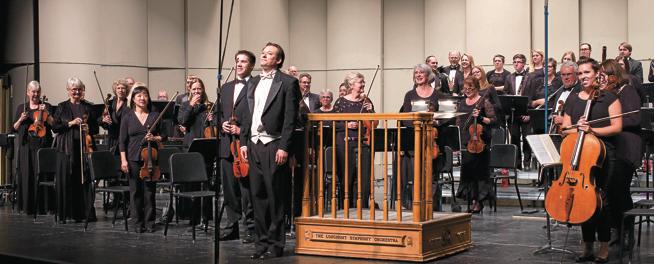
The Longmont Symphony recently announced their 2022–23 season of concerts. The season features six mainstage concerts, three chamber orchestra concerts, and a Messiah singalong during the Holiday season (Dec. 18; see full season listings below).
The Beethoven symphony cycle will continue with Symphony No. 8 (Oct. 22 and 23), and other familiar orchestral repertoire will be represented by works of Dvořák and Sibelius. There will also be works by less familiar composers, including two world premieres, adding up to a season with intriguing discoveries to be made on most programs.
Composer John Heineken
The first of the two world premieres is Symphony for the Great Return by American composer John Hennecken on the opening night of the new season, Oct. 8. With it on the same program are Dvořák’s familiar Cello Concerto, played by Naumburg Competition winner Clancy Newman, Aaron Copland’s Fanfare for the Common Man, and George Walker’s elegiac Lyric for Strings.
The next installment of the LSO’s Beethoven cycle will feature the Eighth Symphony, possibly the least familiar of the canonical nine symphonies (Oct. 22 and 23 in Stewart Auditorium). Sharing the same chamber orchestral program is a symphony by Anton Reicha, a contemporary and friend of Beethoven. An adventurous and experimental composer for his times, Reicha is little known today, but his work serves to fill in the context in which Beethoven worked.
Jerod Impichchaachaaha’ Tate
The major work on the November mainstage concert (Nov. 19) will be Dvořák’s Symphony No. 8 in G major, a cheerful and upbeat piece that was written shortly before the composer’s 1892–93 visit to the United States. It will be preceded by three works that reflect the native American experience: Overture to the choral-orchestral Song of Hiawatha by the black British composer Samuel Coleridge-Taylor; American composer Michael Daugherty’s Trail of Tears for flute, strings and harp, inspired by the forced removal of Cherokees from their homeland; and Chokfi’ (Rabbit) for strings and percussion by Jerod Impichchaachaaha’ Tate, a composer who is a citizen of the Chickasaw Nation in Oklahoma. Flute soloist for Trail of Tears will be Brice Smith.
The LSO will celebrate the Holidays with a complete performance of Handel’s Messiah (Dec. 17), followed by an audience-participation truncated Messiah “singalong.”
Silvestre Revueltas
The new year begins with a family concert (“Painting the Orchestra,” Jan. 21, 2023), followed by an all-Sibelius program (Feb. 18, 2023). Sibelius is generally under-represented in orchestra repertoire now, so it’s good to have a complete concert of his music, even if the program sticks to his more familiar works—Finlandia, the Violin Concerto with soloist Judith Ingolfsson, and the Symphony No. 2 in D major.
March 18 and 19 will see the second concert of the “Made in America” series, opening with Alcancías (Penny banks) for chamber orchestra by the 20th-century Mexican composer Silvestre Revueltas. Jason Shafer, principal clarinet with the Colorado Symphony and a previous soloist with the LSO, returns to play Copland’s Clarinet Concerto. Completing the program are Gershwin’s Lullaby and Ravel’s Le Tombeau de Couperin, written for piano as a tribute to the Baroque composer François Couperin and later transcribed for orchestra.
Tyler Harrison
The season’s second world premiere will be the Symphony No. 3 by pianist/composer and CU, Boulder, alumnus Tyler Harrison. It will be paired with Tchaikovsky’s brooding Symphony No. 6, “Pathétique,” in a program titled “Darkness and Light” (April 15).
The 2022–23 concert season wraps up May 6 with a lighter program, “LSO Goes to the Movies,” featuring music by John Williams, Ennio Morricone and Hans Zimmer. Subscriptions are available through the LSO Web page. Tickets to individual concerts will go on sale Friday, July 29.
# # # # #
2022–23 Concert Season Longmont Symphony Orhestra
Longmont Symphony and conductor Elliot Moore
“The Great Return” Elliot Moore, conductor, with Clancy Newman, cello
Copland: Fanfare for the Common Man
George Walker: Lyric For Strings
John Hennecken: Symphony for the Great Return (World premiere)
Concerts June 3–5 feature new work by Theofanidis and Pizzetti’s 1922 Requiem
By Peter Alexander May 23 at 9:12 p.m.
Nicolò Spera
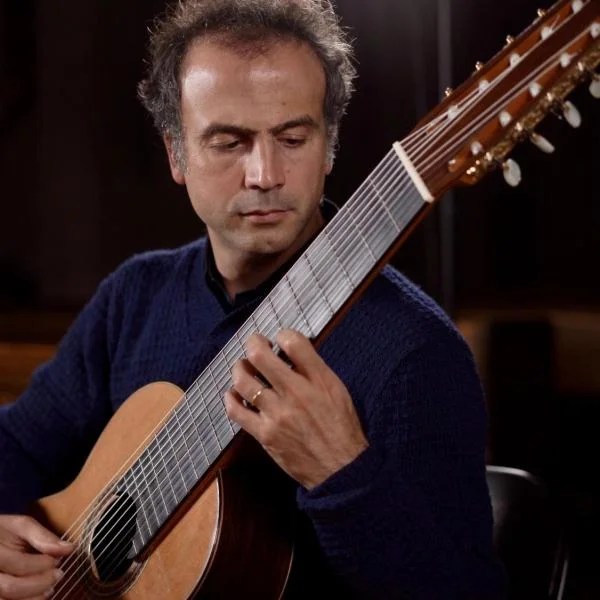
Guitarist and CU music professor Nicolò Spera was shocked by things going on the U.S. after the death of Supreme Court Justice Ruth Bader Ginsburg. He wanted to respond in the best way he knew—with music.
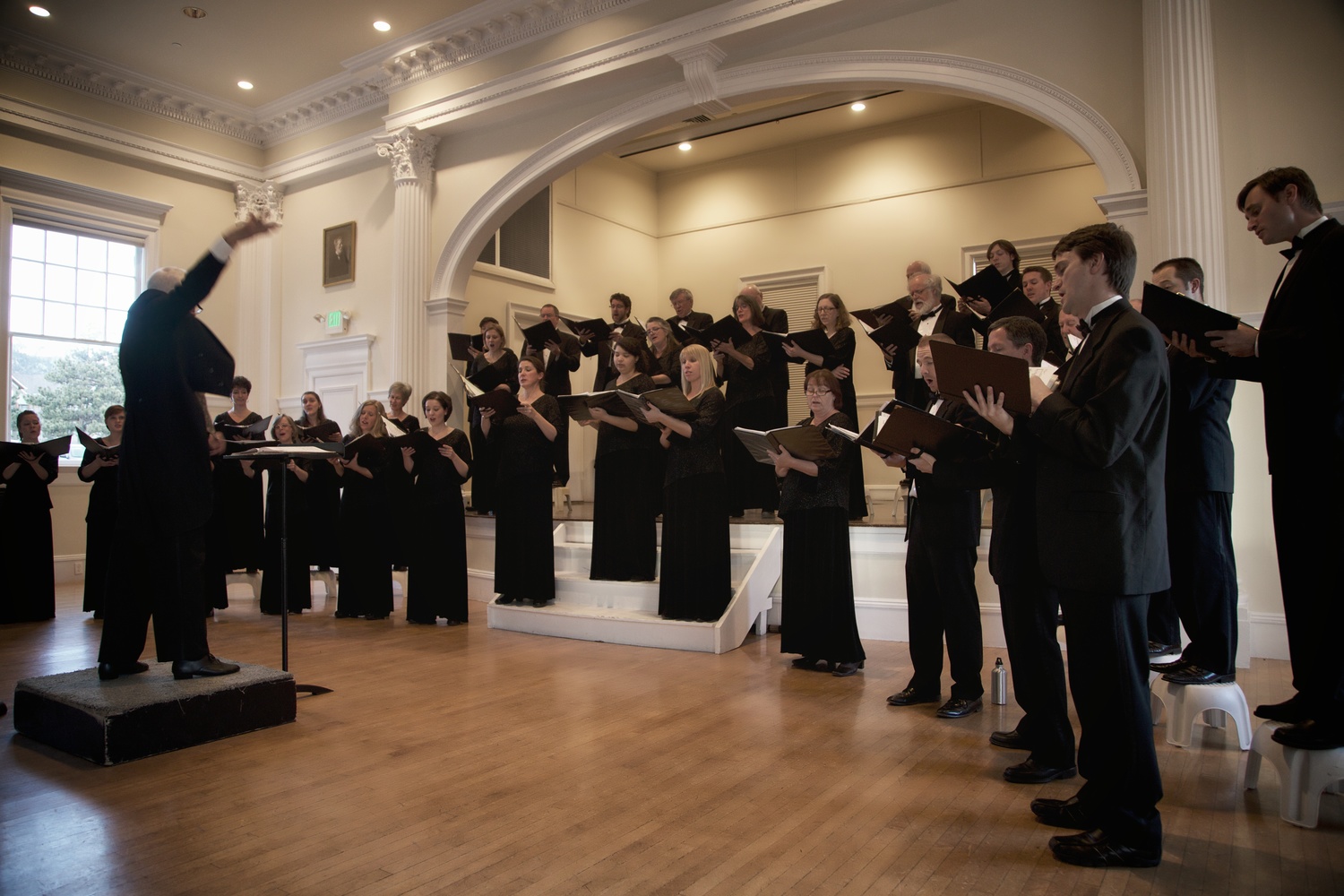
The musical work that came from that desire, Door Out of the Fire by Pulitzer Prize-winning American composer Christopher Theofanidis, will be the centerpiece of a concert by Boulder’s Ars Nova Singers, under the direction of Thomas Edward Morgan. The Ars Nova performance will be the Colorado premiere, following a performance by Spera in Michigan in October, 2021.
Also on the program is the Requiem of Italian composer Ildebrando Pizzetti. Performances will be June 3, 4 and 5, in Denver, Boulder and Longmont, respectively (see details below). In addition to the live performances, the concert will also be available by livestream. Information and tickets for the concerts, which close out Ars Nova’s 2021–22 season, are available here.
Christopher Theofanidis
After Ginsburg’s death, “I wanted a composer to write some ‘postcards to the future,’ in music,” Spera wrote in a recent email. He turned to Theofanidis, who had recently written an orchestral work, On the Bridge of the Eternal, for the 2020 centennial of the CU Boulder College of Music.
Writing for and with Spera, Theofanidis composed four choral “messages in a bottle” based on poems by Melissa Studdard. Each of the four choral settings is preceded by a prelude for guitar.
The texts reflect some of the major issues of our time, including the threat posed by climate change. They are titled “Burning Cathedral,” “The Book of Rahul,” “Ruth’s Aria”—to be sung by CU music faculty member Abigail Nims, mezzo soprano—and “Migration Patterns.” The work is dedicated to “le nostre speranze”—our hopes—Spera’s children, Julia and Giacomo.
Pizzetti’s Requiem will be presented in observance of the 100th anniversary of its composition. The Requiem, Pizzetti’s only liturgical music, is written for a-capella choir. The musical setting includes Gregorian chant as well as movements that recall Renaissance madrigals. The texture varies from single-line chant to eight voices to multiple choirs in the manner of 17th-century Venetian polychoral music.
# # # # #
Thomas Edward Morgan and Ars Nova Singers
Made Real Ars Nova Singers, Thomas Edward Morgan, director With Nicolò Spera, guitar, and Abigail Nims, mezzo-soprano
Christopher Theofanidis: Door Out of the Fire
Ildebrando Pizzetti: Requiem
7:30 p.m. Friday, June 3 St. Paul Community of Faith, Denver
7:30 p.m. Saturday, June 4 First United Methodist Church, Boulder
7 p.m. Sunday, June 5 Stewart Auditorium, Longmont Museum
Thirty-fifth festival returns to near-normal with five days of activities
By Peter Alexander May 16 at 10:20 p.m.
It has only been nine months since the COVID-postponed 34th Colorado MahlerFest, but the festival is returning in its usual May slot and with a full schedule this week.
Performances in the 35th festival include the usual Sunday afternoon Stan Ruttenberg Memorial Concert (May 22) in Macky Auditorium featuring a Mahler Symphony—this year the Third— as well as a symposium Saturday. Other events include music for piano (Tuesday), a film screening (Wednesday), chamber music (Thursday), a free concert of film music at the Boulder Bandshell (Friday) and an opera performance (Saturday; see full schedule below). There are also open rehearsals and social events during the week.
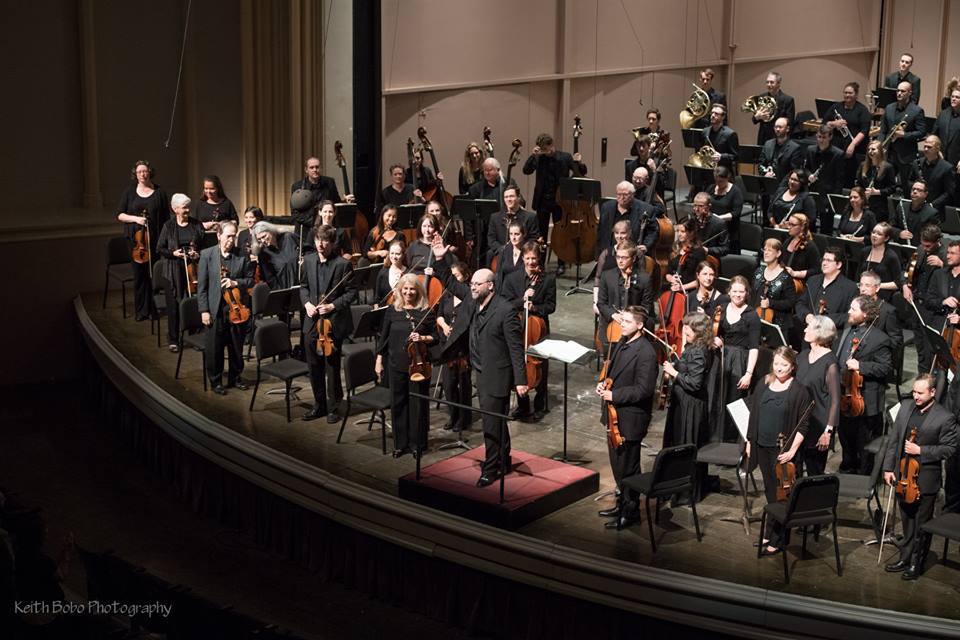
Kenneth Woods with the Colorado MahlerFest Orchestra. Phot by Keith Bobo.
“We’re really excited to do a quote ‘normal’ festival,” MahlerFest’s artistic director Kenneth Woods says. “It will be the biggest festival we’ve done so far.”
The signature event of the festival is the annual performance of a Mahler symphony. That is how the festival was started, and it remains the culmination of the week’s activities. The Third Symphony “is the biggest of the big pieces, the most Mahler-ish of the Mahler symphonies,” Woods says. It will be presented in the first U.S. performance of a new critical edition from the publisher Breitkopf & Härtel.
The Third is indeed a sprawling work in six movements divided into two parts: An opening march, titled “Pan Awakes; Summer Marches In” that lasts 30 minutes or more; and a series of five movements in differing styles and for differing forces, titled respectively “What the flowers in the meadow tell me,” “What the animals in the forest tell me,” “What man tells me,” “What the angels tell me” and “What love tells me.”
In Woods’s words, the opening movement is “a creation myth. It’s incredibly epic.” That exuberant, bold march is followed by a series of more intimate reflections that grew out of Mahler’s reverence for nature. The flowers inspire a graceful minuet, the animals an energetic scherzo that includes a nostalgic offstage posthorn solo.
Kenneth Woods. Photo by Chris Stock.
“What man tells me” is an ominous alto solo using a text from Nietzsche, “O Man! Take heed!” The angels are represented with a folk-like tune accompanied by a children’s chorus imitating bells, and in the final movement the full orchestra without singers brings love’s message in the form of a broad, lyrical slow movement.
“Modern-day fascination with this piece for me is trying to understand what Mahler means when he says, ‘What the flowers tell me’,” Woods says. “It’s quite remarkable that he’s taking these almost naive ideas and writing huge movement after huge movement of intricate, sophisticated music.
“I see the piece almost as a call to action. It ought to inspire us to listen as Mahler listened, (and) to listen to Mahler’s music as he listened to the flowers. It’s so timely—what was once gentle warnings are now urgent cries of alarm. When you think about Mahler’s evocation of the flora and fauna, and what no longer exists, there is an element of a prophetic warning in the Third Symphony, but a whole lot of hope.”
Since taking over as director of the festival in 2015, Woods has expanded the scope of the festival to include music by composers related to Mahler in one way or another. In addition to the Third Symphony of Mahler, the Sunday concert will feature the world premiere of the 10th symphony of British composer Christopher Gunning.
Christopher Gunning
A prominent composer of film scores who has turned more to the writing of symphonies, Gunning is related to Mahler through the world of film music. Woods points out that the earliest film composers—Franz Waxman, Max Steiner and Erich Wolfgang Korngold—were all Austrian- or German-born musicians who brought the style of Mahler and his contemporaries to Hollywood.
And now, he says, Gunning is returning the film-music style to the symphony, “a kind of musical arc of the last 100 years coming full circle. Gunning is taking where film music got to and going back into that large-scale exploration of sonata form (of the symphony) using the language that it evolved through to him.”
The presence of Mahler’s style in film music will be explored in more depth in the free Friday evening concert at the Boulder Bandshell, in a program titled “Mahler and the Movies.”
Another work with a distant relationship to Mahler is the opera Bluebeard’s Castle by Bartók, which will be presented in a chamber version Friday. Half a generation younger than Mahler, Bartók wrote the opera in 1911, the year of Mahler’s death, and saw its first performance in 1918.
“It is the most amazing of operas,” Woods says. “I would not try to convince anyone that Bartók and Mahler are in any way the same, but they’re breathing the same air, and feeding from the same streams. What fascinates me is stylistically how far they diverge, but the role of vernacular music in both composers is provocative for its time, and that’s something that does link them in an interesting way.”
Soprano April Fredrick
The chamber version of Bluebeard’s Castle will be presented in a concert performance, featuring soprano April Fredrick as Judith and bass Gustav Andreassen as Bluebeard. Fredrick will speak about the opera at Saturday’s symposium in a talk titled “Self-will and missed connections in Bluebeard’s Castle.”
The rest of the symposium program, and the programs of the other concerts are listed in full below. There is a great deal of music not by Mahler—pieces by Bruckner, Casella, George Crumb, Beethoven, John Williams and others—but for Woods the focus remains firmly on Mahler’s symphonies, regardless of the program content.
“This will be the first year that you can hear some of every single Mahler symphony in the festival, if you come to every event,” he says. “In fact, I can guarantee listeners that they’ll hear some of every Mahler symphony on Friday night (“Mahler and the Movies”)—just not in the way they are used to hearing it.”
# # # # #
Colorado MahlerFest XXXV “What Mahler Tells Me”
Mahler at the Piano David Korevaar and Jeremy Reger, piano
Bruckner: Symphony No. 3, movements II and IV (arranged by Mahler)
Mahler: Symphony No. 3, “Menuetto aus der III. Symphonie” (arranged by Ignaz Friedman)
Mahler: Symphony No. 4, movement IV ”Das himmlische Leben” (arranged for piano by Mahler; played by Mahler via piano roll)
Mahler: Symphony No. 5, movement I “Trauermarsch” (arranged by Stadl)
Mahler: Symphony No. 6, movements II and III (arranged by Alexander Zemlinsky)
Mahler: Symphony No. 7, movement V (arranged by Alfredo Casella)
7:30 p.m. Tuesday, May 17 Grusin Hall, CU Imig Music Building
Movie: Under Suspicion Film Screening of Under Suspicion, starring Liam Neeson and Laura San Giacomo Film score by MahlerFest guest composer Christopher Gunning
3 p.m. Wednesday, May 18 Boedecker Theater, Dairy Arts Center
Quartets and More Zachary De Pue, Karen Bentley Pollick and Suzanne Casey, violin; Lauren Spaulding, viola; Kenneth Woods and Parry Karp, cello; and Jennifer Hayghe, piano
Christopher Gunning: Piano Trio
Alfredo Casella: Cello Sonata No. 1
George Crumb: Sonata for solo cello
Beethoven: String Quartet No. 16 in F major, op. 13 III. Lento assai, cantabile e tranquilla
Bartók: String Quartet No. 1
4 p.m. Thursday, May 19 Mountain View United Methodist Church
Mahler and the Movies Colorado MahlerFest Chamber Orchestra, Kenneth Woods, conductorMax Steiner: Music from King Kong (arr. Steven Stanke)
Christopher Gunning: The Belgian Detective: Theme from Angela Christie’s Poirot (arr. Kenneth Woods)
Franz Waxman: Suite from Sunset Boulevard (arr. Matthew Lynch)
Mahler: Adagietto from Symphony No. 5 (arr. Kenneth Woods)
Korngold: Suite from Captain Blood (arr. Luciano Williamson)
John Williams: Theme from Schindler’s List
Gunning: Music from Under Suspicion (arr. Kenneth Woods)
George Morton: Mahler, A Final Frontier, Fantasy on themes of Mahler and Courage
NOTE: An alternate venue in case of inclement weather will be the Mountain View United Methodist Church.
Symposium MahlerFest XXXV Symposium
Leah Batstone: “Mahler’s Nietzsche: Philosophical Resonances in the Early Symphonies”
April Fredrick: “’Now all is darkness’: Self-Will and missed connections in Bluebeard’s Castle”
Peter Franklin: “Mirroring the world? What a sentimental trombone, a distant posthorn and The Bird of the Night tell us about a symphony”
Kenneth Woods: “Interpreting Mahler’s Third Symphony”
Nick Pfefferkorn: “Mahler Third Symphony: Insights on the first critical edition from the editor’s desk”
9 a.m.–4 p.m. Saturday, May 21 Mountain View United Methodist Church; Free
Bluebeard’s Castle Colorado MahlerFest Chamber Orchestra, Kenneth Woods, conductor April Fredrick, soprano, and Gustav Andreassen, bass
Bartók: Bluebeard’s Castle Arranged for chamber orchestra by Christopher van Tuinen and Michael Karcher-Young
7:30 p.m. Saturday, May 21 Mountain View Methodist Church
Mahler’s Third Symphony Colorado MahlerFest Orchestra, Kenneth Woods, conductor With Stacey Rishoi, mezzo-soprano, Women of the Boulder Concert Chorale and Boulder Children’s Chorale Festival Choir
Christopher Gunning: Symphony No. 10 (World premiere)
Mahler: Symphony no. 3
3:30 p.m. Sunday, May 22 Macky Auditorium
More information and tickets for all MahlerFest performances are available HERE.
CORRECTIONS (May 17 at 12 noon): April Fredrick’s family name was corrected; it is not Frederick. Violist Mario Rivera has replaced Lauren Spaulding on the “Quartets and More” program May 19. Due to technical constraints in the venue, there will be no lighting effects in the performance of Bluebeard’s Castle as was originally stated.










 Sharps & Flatirons