Boulder Phil boldly goes to Orion Nebula for Saturday’s concert

Program centers on piano-and-orchestra works by Ravel, Rachmaninoff, with pianist Angela Cheng

By Peter Alexander April 20 at 5:10 p.m.

Conductor Michael Butterman, pianist Angela Cheng and the Boulder Philharmonic will visit France and Russia for their concert Saturday (7 p.m. April 22 in Macky Auditorium; details below).
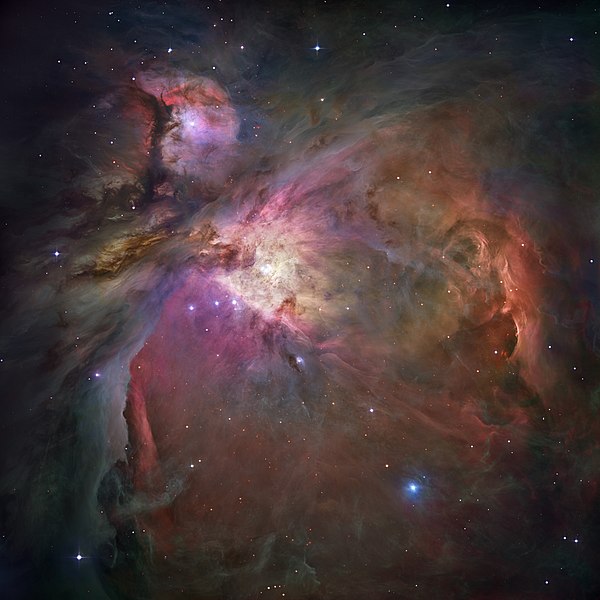
Image taken by the Advanced Camera for Surveys (ACS) aboard NASA/ESA Hubble Space Telescope, the sharpest view ever taken of the Orion Nebula, including more than 3,000 stars of various sizes. Image from 2006.

Those are the native countries of composers Ravel and Rachmaninoff, whose works are featured. But if you add in the subjects of the other programmed works by Tchaikovsky and Boulder native Leigha Amick, the itinerary expands to Shakespeare’s Verona and the Orion Nebula as seen by the Hubble telescope.

The concert will open with the world premiere of Amick’s Gossamer Depths, the 2022 winner of the “Resound Boulder” composition competition. Now a graduate student at the Curtis Institute, Amick grew up in Boulder, where she began her composition studies with CU faculty member Daniel Kellogg. One of her earlier pieces was played at a Boulder Phil Discovery Concert when she was still in high school.

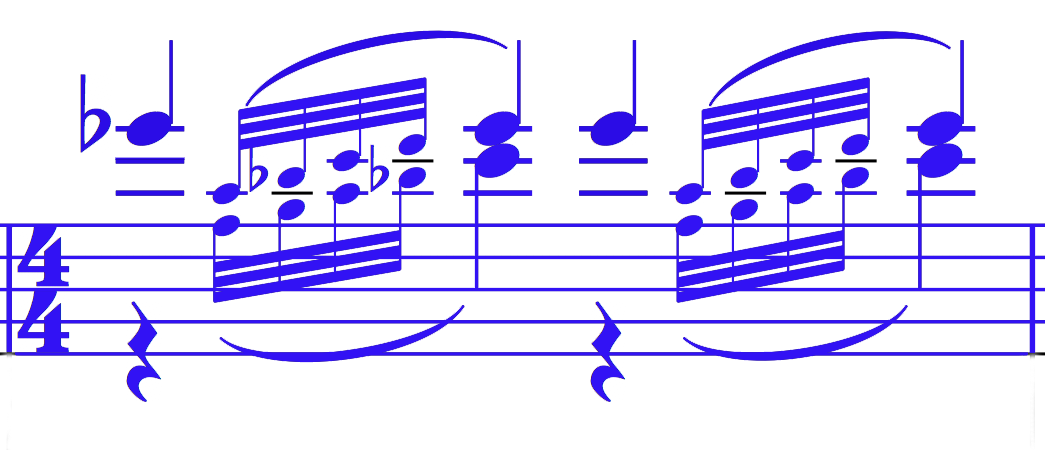
Gossamer Depths was inspired by a photo taken from the Hubble Telescope. “I saw that and thought it needed to be depicted in an orchestra setting,” Amick says. Her music portrays different elements that can easily be seen in the photo: “The different (harmonic) layers of the piece represent the different layers of color within the photograph,” she says.
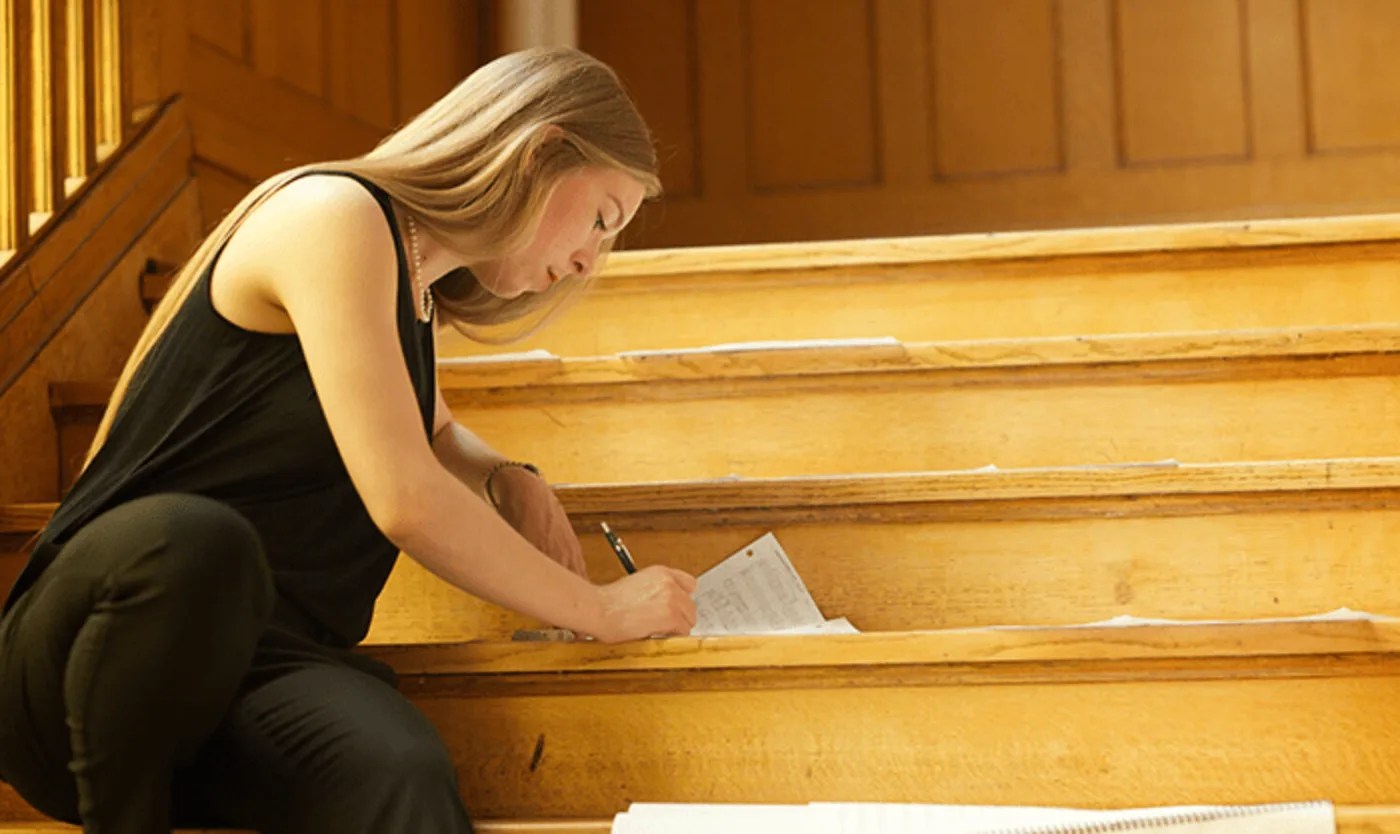
Boulder native and composer Leigha Amick

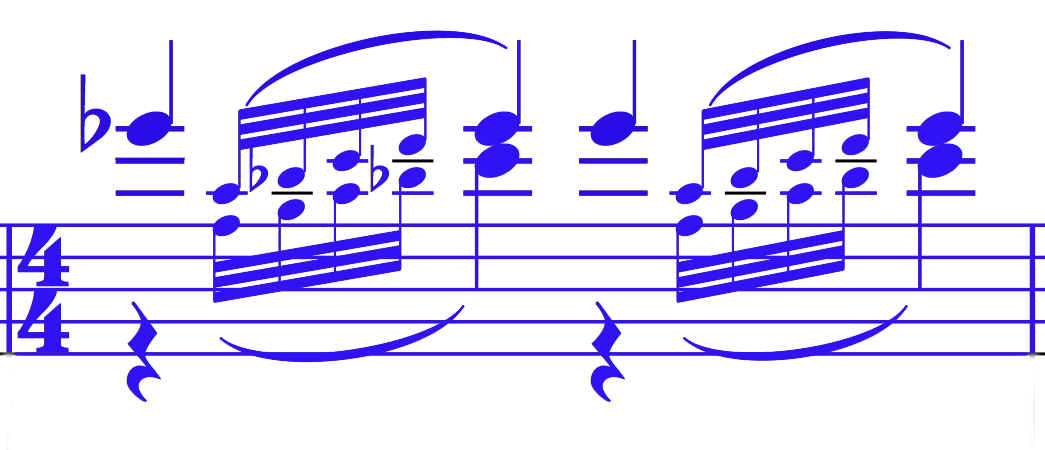
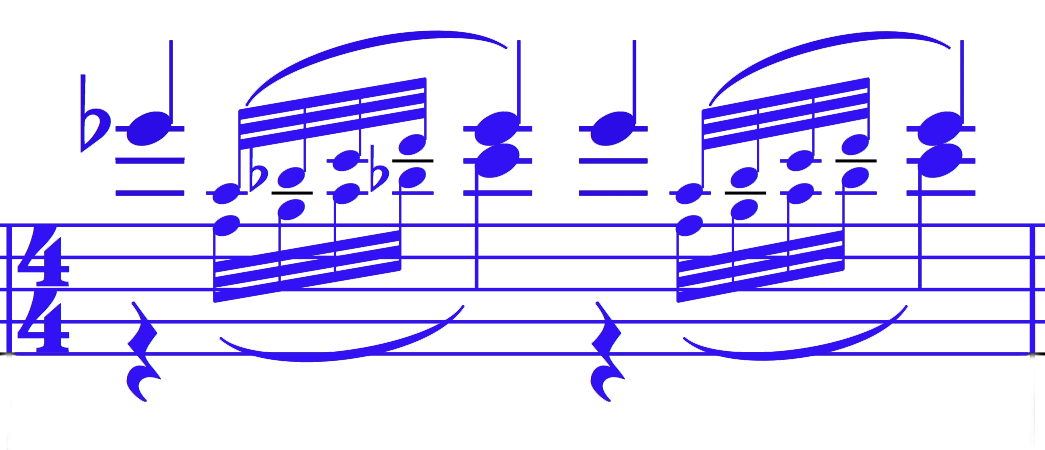
On top of those layers of chords that move independently of one another, Amick explains, “swirls of dust and space gasses are represented by 16th-note runs throughout the orchestra. And then there are stars on top of all this, and those are accented notes, mostly in winds, brass and percussion.”

Amick’s evocative score will be followed by two separate piano solo works with orchestra, played by Angela Cheng: first Ravel’s Concerto in G major before intermission, and then Rachmaninoff’s popular Rhapsody on a Theme of Paganini opening the second half. Although both works were written around 1930, Ravel’s restrained, jazz-influenced concerto contrasts strongly with Rachmaninoff’s deeply romantic Rhapsody.
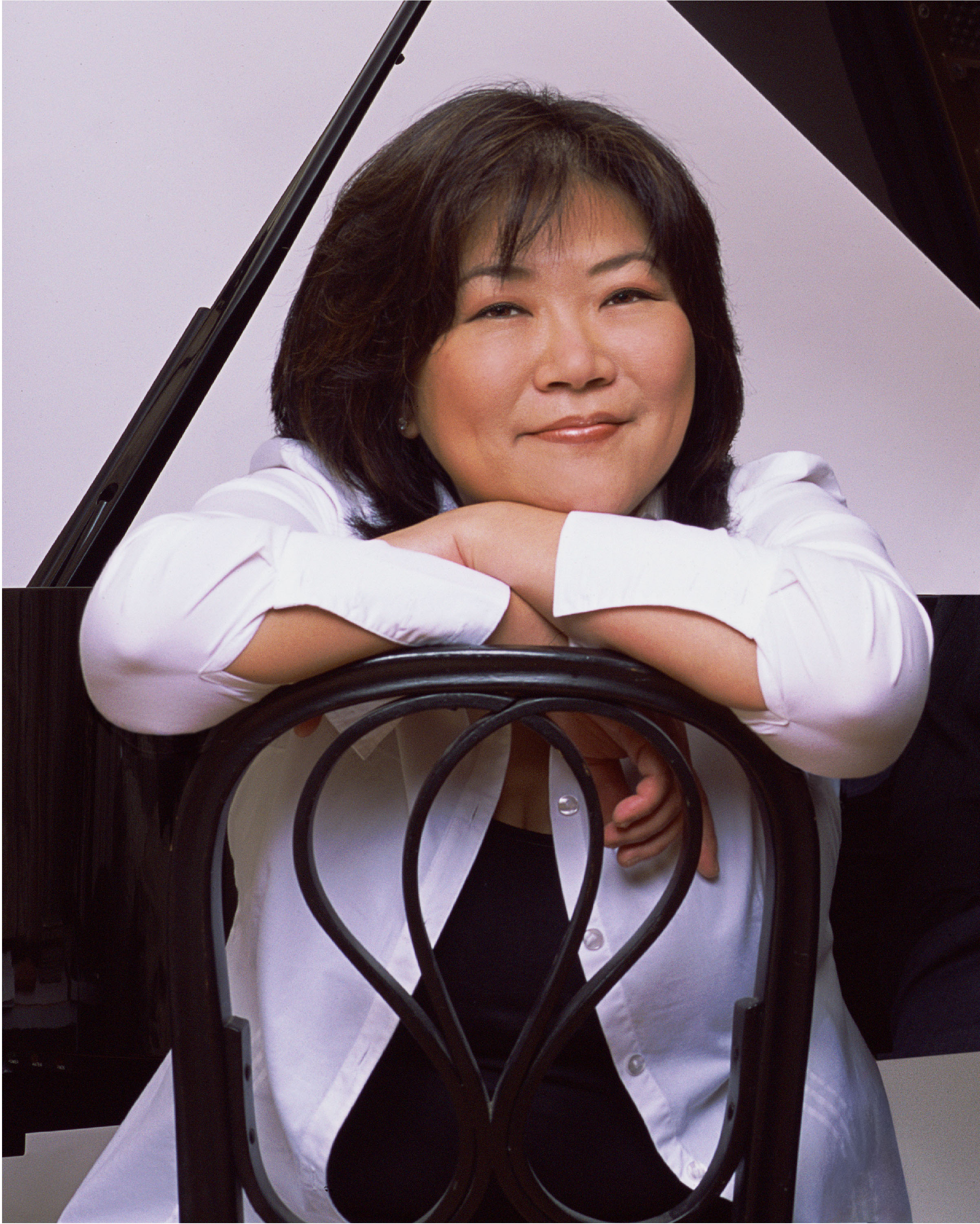
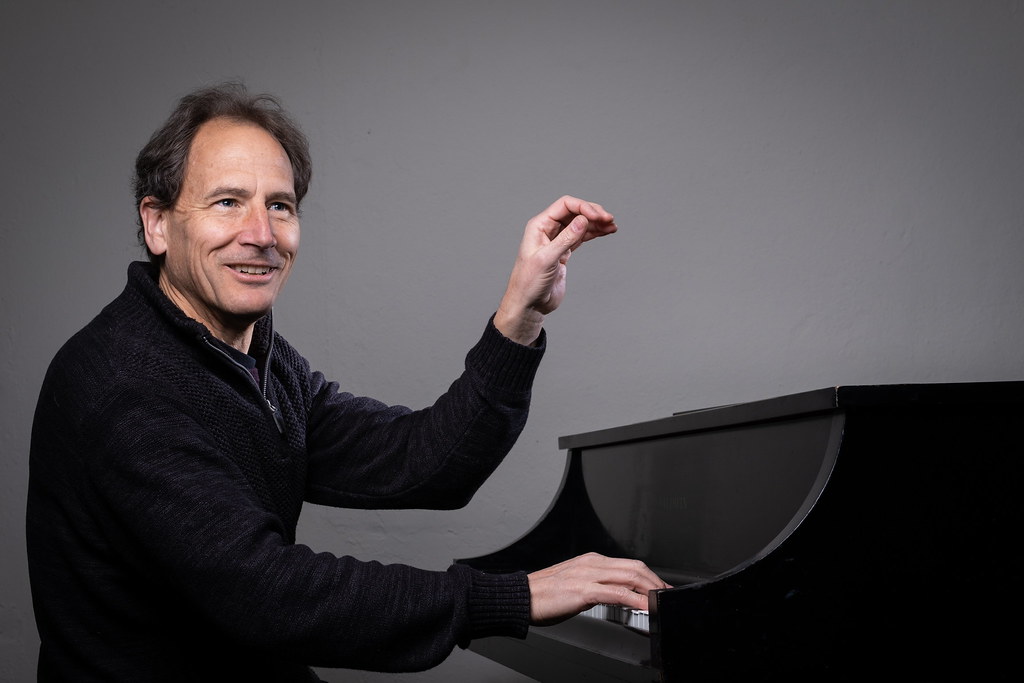
Angela Cheng

“They are such different kinds of music—different sonorities, different kinds of touch required of pianists,” Cheng says. “The one similarity is the orchestra is fully an equal partner. In the Ravel Concerto, the orchestra part is just as difficult for some of the wind instruments—it’s almost like concerto for orchestra and Piano. And the same thing with the Rachmaninoff, you really feel like the orchestra is a full partner.

“Of course the sound that needs to come out of the piano is completely different—the (Ravel Concerto) is much lighter, much more transparent. In the Rachmaninoff, the lushness, the richness of the sonorities in the writing and what is required of the pianist, is great in the piano.”

Beyond the differences in playing technique, Cheng struggles to find just the right metaphor to describe the two pieces. Clearly she loves both, each in its own way. “I don’t know very much about wine, but what I know, how whites can be a little bit lighter, maybe that’s Ravel? And a richer red for the Rachmaninoff.

“Or you could compare it to food, even Chinese cooking: Cantonese, where there’s a lot of steaming, lightness, fresh vegetables, would be the Ravel. Rachmaninoff has heavier sauces, maybe northern cooking where it’s richer. Something like that, but they’re both delicious.”
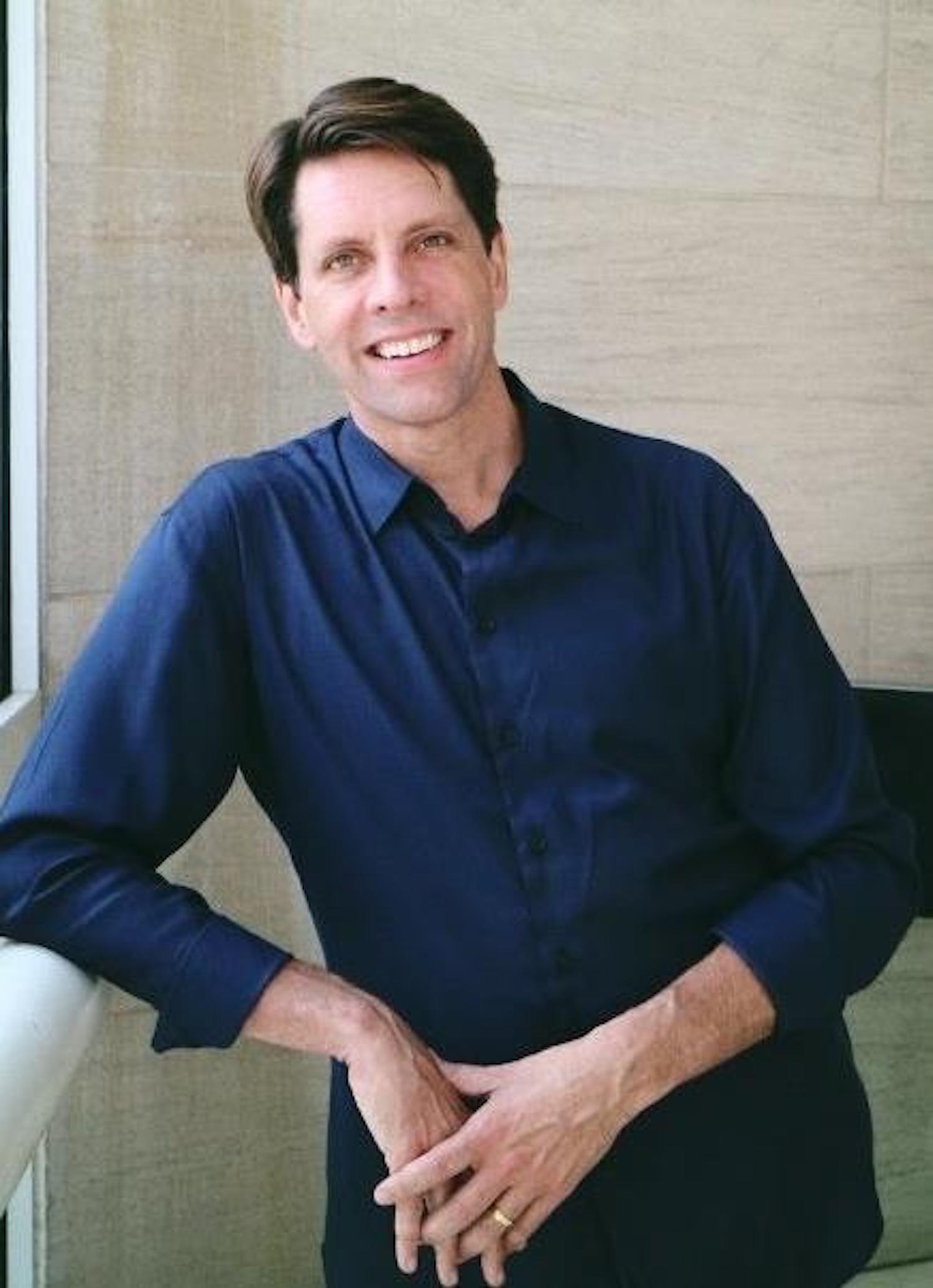
Michael Butterman. Photo by Jiah Kyun

The Rhapsody is a series of variations on a theme used by the violin virtuoso Paganini for his own set of challenging variations in his Caprice No. 24 for solo violin. A simple harmonic outline, it is so well suited for creating variations that dozens of composers have used the same framework for their own variations. 

The most familiar of Rachmaninoff’s variations is No. 18, in which the melodic outline is inverted—turned upside down—and turned into a dreamy, Romantic tune out of character with the dramatic nature of other parts of the score. “It seems to come from a completely different world than the rest,” Butterman says. “It’s marvelous!”

The combination and contrast of Ravel and Rachmaninoff was the starting point of the program, Butterman says. “Originally this was going to be a French and Russian thing,” he says. “I have always thought (there were) color similarities between French and Russian music.”

The concert will conclude with Tchaikovsky’s well known Romeo and Juliet: Fantasy-Overture, which Butterman describes as “an example of music that has made its way into the popular awareness of filmmakers and more. I find it a really effective piece that doesn’t attempt to trace the narrative arc, but gives you the emotional arc of the play, from tragedy, of course, to the overwhelming sense of being head over heels in love. You can go through this whole gamut of emotions in 20 minutes.

“It’s marvelous, and people will love it and I think it pairs well with the Rachmaninoff.”

The concert will be dedicated to the memory of violist Megan Edrington, a member of the Boulder Philharmonic who died March 16 at the age of 43.

# # # # #

Boulder Philharmonic, Michael Butterman, conductor 
With Angela Cheng, piano

Concert dedicated in loving memory of Megan Edrington (1979–2023)

Leigha Amick: Gossamer Depths (World premiere; Resound Boulder Commission)
Ravel: Piano Concerto in G
Rachmaninoff: Rhapsody on a Theme of Paganini
Tchaikovsky: Romeo and Juliet: Fantasy-Overture

7 p.m. Saturday, April 22
Macky Auditorium

TICKETS

CORRECTIONS: The original post was incorrectly dated April 22. April 22 is the date of the concert, not of the blog post. April 20 is the correct date.
The correct title of Leigha Amick’s piece is Gossamer Depths. And earlier version of this story misstated the title as Gossamer Depth.
Longmont Symphony recognizes Mental Health Awareness and Pride months

“Beautiful Minds—Darkness and Light” includes world premiere April 15

By Peter Alexander April 13 at 10:05 p.m.

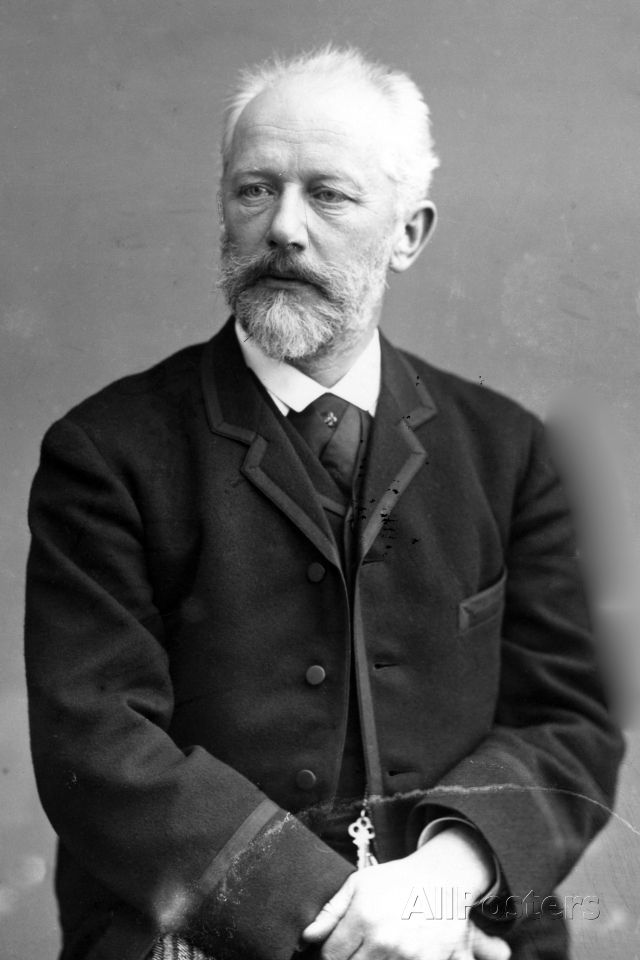
Tchaikovsky

Tchaikovsky’s Sixth Symphony, known as the “Pathétique,” appears frequently on orchestral programs. But conductor Elliot Moore and the Longmont Symphony will turn this standard piece of programming in to a little bit of a statement for their next concert, Saturday (7:30 p.m. April 15; full details below) in Vance Brand Civic Auditorium.

The program features two works: the “Pathétique” and the world premiere of a new work by composer Tyler Harrison commissioned by the LSO. Harrison’s Symphony No. 3, subtitled “The Garden of Tears,” was planned as an answer to Tchaikovsky’s final and most emotionally wrought symphony. The programming has been announced by the orchestra as recognizing “Mental Health Awareness Month” (May 1-30) and “Pride Month” (June 1–30).

It is well known that Tchaikovsky was gay, and in 19th-century Russia he necessarily suffered both legal and emotional trauma as a result. It has even been suggested that his death, soon after the completion of the symphony, was a suicide because of his homosexuality being revealed. While that remains speculative, there is no doubt that the composer suffered personal anguish throughout his life. 

The Longmont Symphony Web page states that the two works “take a look at musical expressions of mental health and identity struggles from two similar voices, separated by a century.” But ultimately, Harrison’s symphony has a more optimistic character than Tchaikovsky’s “Pathétique.” Harrison wrote of his music, “The garden of life thrives on the tears that water it, but it is laughter that ultimately defines its beauty.”

Tyler Harrison

# # # # # 

“Beautiful Minds—Darkness and Light”
Longmont Symphony Orchestra, Elliot Moore, conductor

  • Tchaikovsky: Symphony No. 6, “Pathétique”
  • Tyler Harrison: Symphony No. 3, “The Garden of Tears” (LSO commission; World Premiere)

7:30 p.m. Saturday, April 15
Vance Brand Civic Auditorium

TICKETS

Bandoneon virtuoso will share program with Takács Quartet

Julien Labro will play with the Takács and perform solo, Sunday and Monday in Grusin Hall

By Peter Alexander April 13 at 9:30 p.m.

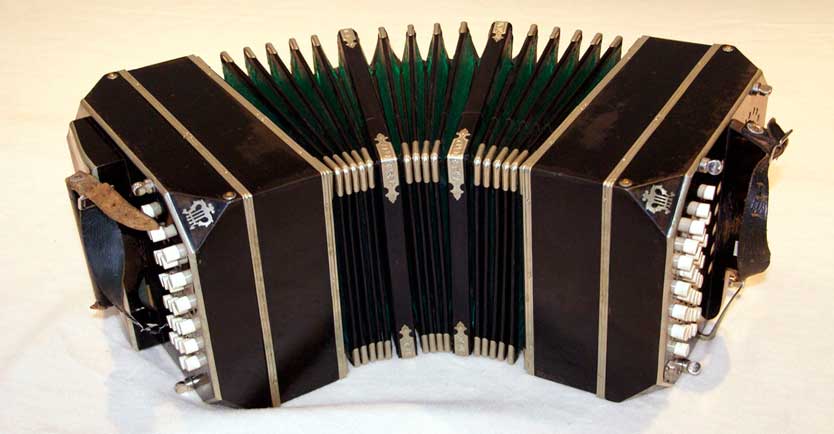
Bandoneon

Their next concert program takes the Takács Quartet outside the standard string quartet repertoire.

The performances Sunday and Monday (4 p.m. April 16, and 7:30 p.m. April 17; details below) will feature bandoneon virtuoso Julien Labro, who will play three works with the quartet and perform a solo set. The quartet will also play Ravel’s String Quartet in F major without Labro.

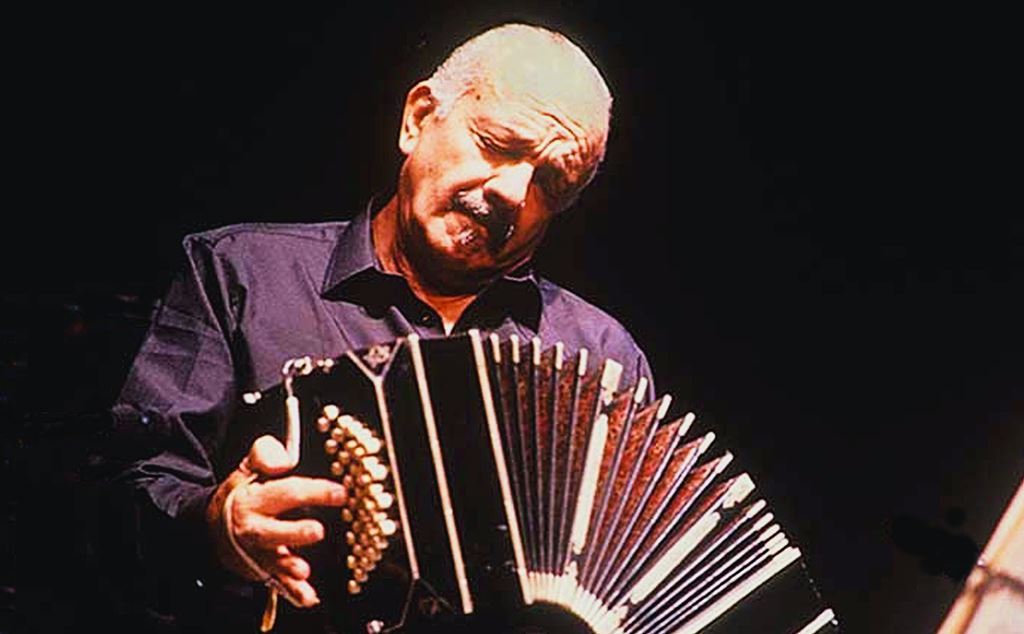
Astor Piazzolla with bandoneon

The bandoneon is a type of concertina, somewhat similar to the accordion. Like those more familiar instruments, sound is creating by opening and closing a bellows to force air across reeds. Pitch is controlled by buttons, similar to those of the button accordion. While it was invented in Germany in the 19th century, bandoneon is primarily associated today with the tango music of Argentina and Uruguay, and particularly the works of Astor Piazzolla.

Labro and the Takács were brought together by the musical consortium Music Accord, an American organization devoted to the commissioning and promotion of new chamber music. They have been playing together on tour for about a year. This is their first joint performance in Boulder.

The current program opens with Circles, a piece written for them by Bryce Dresner. A versatile and prolific composer of film music and a guitarist with the Rock Band the National, Dresner has collaborated with a wide variety of artists, from Kronos Quartet to Philip Glass to Taylor Swift.

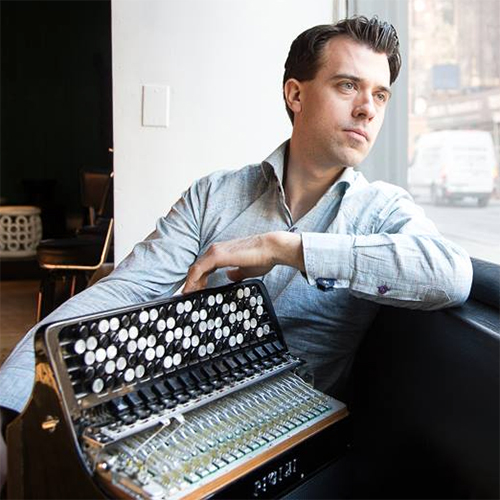
Julien Labro

Circles will be followed by Labro’s own Meditation #1, and then a set of pieces for bandoneon alone: a chorale tune by J.S. Bach, to illustrate the instrument’s background as a substitute for organ in small parishes in Germany; Minguito by Argentinian bandoneon player Dino Saluzzi; and Labro’s Astoración, a tribute to Piazzolla.

Astoración “involves myself playing with a tape that I made, with Piazzolla speaking about the tango and the bandoneon,” Labro explains. ”There is little bit of him playing, so we have this virtual duet between the tape and myself.”

After Labro’s solo set, the Takács returns for Ravel’s quartet, and the program ends with Clash by Brazilian-American composer Clarice Assad. A native of Brazil, Assad has been performing professionally since the age of seven. As a composer, she has been influenced by popular Brazilian culture and jazz, and studied composition with Michael Daugherty at the University of Michigan.

In her program notes, Assad describes Clash as an argument between two antagonists. “On one side we have a person who argues, throws violent insults, interrupts, and yells—and on the other side; another who either retaliates or retreats, appeals to guilt, pleads and indulges in oversentimentalism. These are constant themes in this work.”

The pieces for bandoneon and quartet—by Dresner, Labro and Assad—will be on a CD recording to be released by the Takács in the future. The recording is planned to include other works and piano improvisations by Assad as well as the collaborations with Labro.

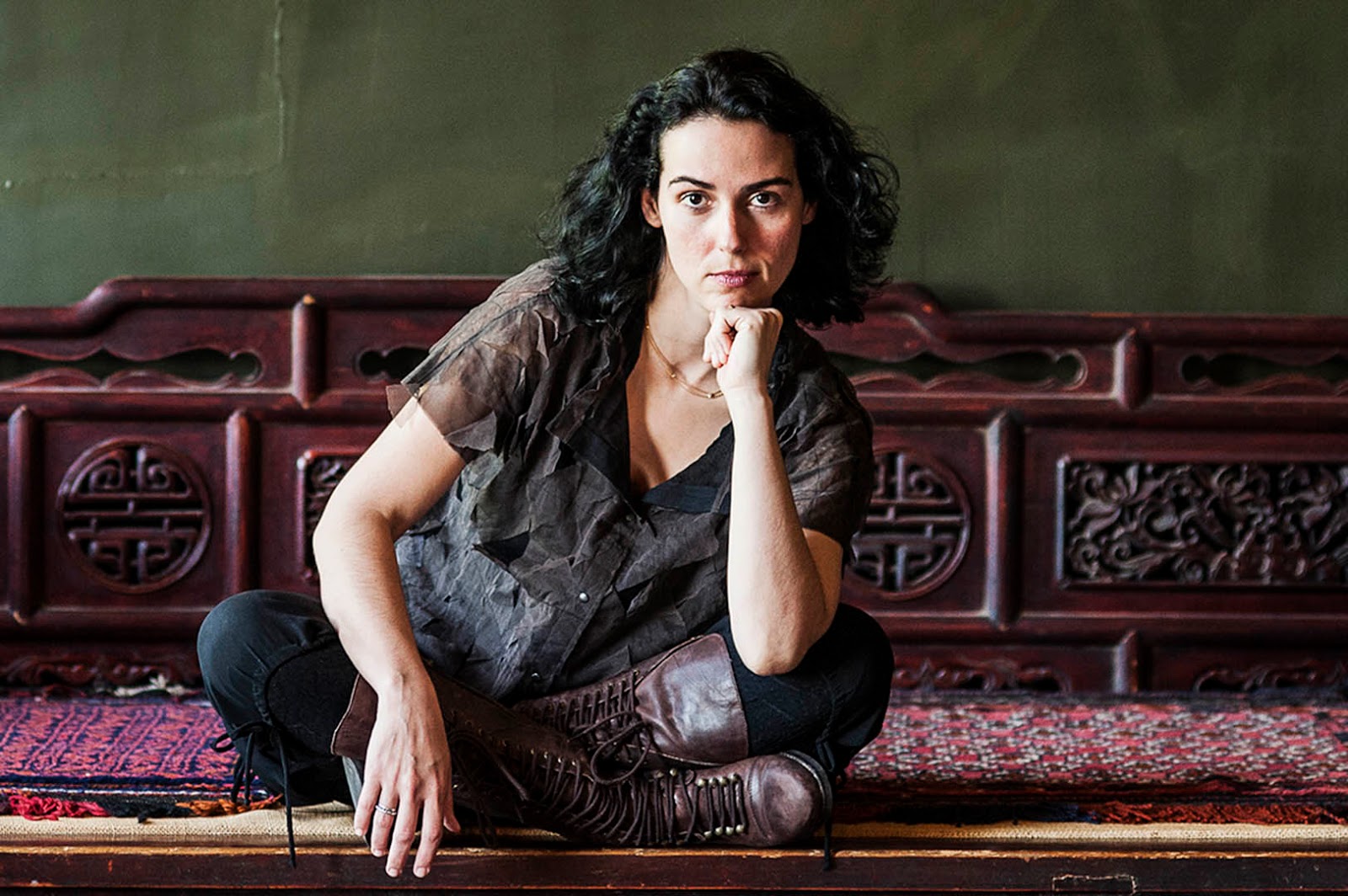
Composer Clarice Assad

“Being paired up with the Takács is a dream,” Labro says. “I pinch myself every time, because of the legacy that they carry. I’m grateful and I’m enjoying every concert. And now the fact that I get to play on their home turf is also cool. I’m really pleased that I get to see them where they hang out and play and teach.”

In fact, he enjoys not only the pieces they play together. Labro has been listening with attention to the Takács’s performances of the Ravel Quartet as well. “The work is incredible, but hearing them play is fantastic,” he says. “Ravel’s writing is outstanding—the colors, the timing—and players of that caliber and the musicianship they bring to it—always when I hear that piece, I wish Ravel had written more than one string quartet!

“Just be ready,” he advises.

Labro grew up in Paris. He first learned to play the accordion when he was nine, after hearing it on the television. When he was around 13, he says, “I discovered the music of Astor Piazzolla, and that experience led me to learn the bandoneon. Today I do play a fair amount of both instruments.”

He will use his solo set to introduce the bandoneon to the audience. “It’s not every day that you get to see an instrument like mine presented in a chamber music setting,” he explains.

Labro ends his conversation where he started, talking about how much he enjoys working with the Takács Quartet. “We’ve been having a lot of fun,” he says. “It’s been a joy, really, being able to make music with them. It’s been a lot of fun getting to know them outside of the music making, just spending time together. They obviously are amazing players, but they’re equally amazing people.

“Every time we step onstage I just cherish the event, because I know we’re going to have fun no matter what happens.”

# # # # #

Takács Quartet by Amanda Tipton Photography

Takács Quartet with Julien Labro

  • Bryce Dessner: Circles
  • Julien Labro: Meditation #1
    (Julien Labro, bandoneon, with Takács Quartet)
  • Johann Sebastian Bach: Wachet auf, ruft uns die Stimme, S64
  • Dino Saluzzi: Minguito
  • Julien Labro: Astoración (with pre-recorded tape)
    (Julien Labro, bandoneon & accordina)
  • Maurice Ravel: String Quartet in F Major
    (Takács Quartet)
  • Clarice Assad: Clash
    (Julien Labro, bandoneon & accordina with Takács Quartet)

4 p.m. Sunday, April 16
7:30 p.m. Monday, April 17

Grusin Music Hall

TICKETS (in-person and digital)

Grace Notes: Sonic Alchemy at Boulder Bach; piano quintets with winds

Mozart, Pärt and Vasks at the Dairy; Mozart and Rimsky-Korsakov chamber music

By Peter Alexander April 5 at 11:45 p.m.

The Boulder Bach Festival continues to explore musical connections across time, as their upcoming concert (4 p.m. Saturday, April 8; details below) brings together works by Mozart with contemporary works by Arvo Pärt and Pēteris Vasks.

A composer from the Baltic nation of Estonia, Pärt is known for his development of a style he calls “tintinnabulation,” in which fragments of sound recur to suggest the ringing of bells. His music is deeply influenced by the mysticism of Byzantine Christianity, and in this concert will be contrasted with the rationality of the European Enlightenment, as reflected in the music of Mozart.

The two are conflated in Pärt’s Mozart-Adagio, a work for violin and piano that balances Mozart’s style and Pärt’s “tintunnabuli” and brings their two centuries—the 18th and the 20th—into close conjunction.

Vasks hails from another Baltic country, Latvia, where he was trained as a violinist and double-bass player. His highly original style has been described as “spiritual,” “powerfully evocative” and “imagematic”—i.e., creating a strong visual impression. Apart from his musical works, he is known primarily for his devotion to environmental causes, which often appear as the subjects of his works.

The performance, which includes two of Mozart’s keyboard fantasies, will be recorded for later release. That will be the second CD release from the Boulder Bach Festival, which has already issued a joint CD and Blu-ray recordings of music from the 2022 Boulder Bach Festival. That recording, “Boulder Bach Festival” on the Sono Lumnus label, can be purchased from the recording studio

# # # # #

“Sonic Alchemy”
Boulder Bach Festival: Mina Gajić, piano; YuEun Ki, violin; Coleman Itzkoff, cello

  • Mozart: Fantasia in C minor, K475
  • Arvo Pärt: Fratres for cello and piano
  • Pēteris Vasks: The White Scenery for piano solo
    Interior Castle for violin and cello
  • Pärt: Spiegel im Spiegel for violin and piano
  • Mozart: Fantasia in D minor, K397Pärt: Mozart-Adagio for piano trio

4 p.m. Saturday, April 8
The Gordon Gamm Theater, Dairy Arts Center

TICKETS   

# # # # #

The Boulder Chamber Orchestra (BCO) will present the last of its 2022-23 Mini-Chamber concerts Saturday (7:30 p.m. April 8; details below), featuring the music of Rimsky-Korsakov and Mozart.

Pianist David Korevaar, who has been the featured artist for the mini-chamber concerts this season, returns to play two quintets for piano and winds with members of the BCO. It is notable that both works feature the wind players as much as the piano.

David Korevaar. Photo by Matthew Dine.

In 1876, Rimsky-Korsakov wrote a String Sextet for a competition sponsored by the Russian Musical Society. After completing the Sextet, he decided to write a separate piece for piano and winds. The composer described the work in his autobiography as follows:

“The First movement, Allegro con brio, (is) in the classic style of Beethoven. The Second Movement, Andante, contained a good fugue for the wind instruments with a very free accompaniment in the piano. In the finale, Allegretto vivace, I wrote in rondo form. Of interest is the middle section where I wrote cadenzas for the flute, the clarinet and the horn to be played in turns. Each was in the character of the instrument and each was interrupted by the bassoon entering by octave leaps.”

Mozart’s Quintet was written for a concert the composer presented in 1784, when he was at the height of his success in Vienna. In came right after thee piano concertos, K449, K450 and K451, and can thus be considered virtually a chamber concerto for piano, although the winds each have their own solo moments as well. After finishing the quintet, Mozart wrote to his father, “I consider it the best work I have ever written.”

The Quintet has the same three-movement structure as a concerto. The first has a slow introduction followed by an allegro where each instrument has its own theme. That is followed by a gentle slow movement and a rondo that, like the central section of Rimsky-Korsakov’s finale, leads to cadenzas for all five players. 

# # # # #

Mini-Chamber Concert 3
David Korevaar, piano, with members of the Boulder Chamber Orchestra

  • Rimsky-Korsakov: Quintet for piano and winds in B-flat major
  • Mozart: Quintet for piano and winds in E-flat major, K452

7:30 p.m. Saturday, April 8
Boulder Adventist Church, 345 Mapleton Ave.

TICKETS

Rarely heard, major work by Beethoven Saturday

Boulder Chamber Orchestra, Boulder Chamber Chorale: Mass in C

By Peter Alexander March 30 at 5:45 p.m.

“What are the chances to go to a Beethoven concert and hear something you never heard before?”

Bahman Saless with the Boulder Chamber Orchestra.

Bahman Saless is talking about the next concert he will conduct with the Boulder Chamber Orchestra, at 7:30 p.m. Saturday (April 1; details below). The orchestra, with the Boulder Chamber Chorale and soloists, will present Beethoven’s Mass in C major, written at the height of the composer’s fame and accomplishment but rarely performed today. The performance will be introduced by Beethoven’s very dramatic Overture to Coriolanus.

“This is your chance to imagine yourself, having lived in Beethoven’s time, and the master has just announced a new piece of music and you’re going to go hear it,” Saless says. “To me that’s really cool!”

Vicki Burrichter, who leads the Boulder Chamber Chorale and prepared the singers for the performance, thinks the Mass in C should be better known and appreciated. “I don’t really understand why its not more popular,” she says. “I think it’s one of the best choral pieces there is. I absolutely love it.”

When Beethoven wrote his Mass in C in 1807, he was an accomplished composer who already had many of his greatest works to his credit. He had completed his first four symphonies, his first four piano concertos, nine string quartets including the “Razumovksy” quartets Op. 59, and his Violin Concerto, among other works. He would soon complete his Fifth and Sixth symphonies.

Nonetheless, he is believed to have been less secure undertaking the Mass in C. It was his first setting of what had been one of the most important musical forms of the 18th century and before. Furthermore, the Mass was commissioned by Prince Nikolaus Esterhazy, which meant that Beethoven was following in the footsteps of his teacher Joseph Haydn, who had written six highly successful mass settings for the Esterhazy court.

The finished Mass is considered a major work, if somewhat unorthodox for the times—like many of the pieces Beethoven wrote. The musicians didn’t particularly like it and the rehearsals were chaotic, with only one of five altos in the chorus present, leaving the others to sightread the premiere. 

Vicki Burrichter with the Boulder Chamber Chorale

The first performance was not a success. The Prince disliked the Mass, and the work was seldom performed afterwards. Beethoven did only portions of the Mass once in December 1808, on a famous concert that included premieres of the Fifth and Sixth symphonies, the Fourth Piano Concerto and the Fantasy for Piano, Chorus and Orchestra.

Performances remain rare, but contemporary judgment of the Mass is more positive. Burrichter summed it up, saying “It’s been overshadowed by (Beethoven’s) Missa Solemnis and the Ninth (Symphony). It’s very dramatic, as only Beethoven can be, it’s immediately emotional from the first bar, and it continues that way the entire time. What Beethoven does with it is the kind of thing that only Beethoven can do.

“It’s not the Ninth in terms of overwhelming power, but I think it comes mighty close.”

The mass lasts less than an hour. To open the concert, Saless selected another work by Beethoven, his Overture to Coriolanus. “To me, that is the most perfect piece of dramatic music,” he says. “There is just nothing like it, because it’s eight minutes long, it carries emotions and content that could be a Mahler Symphony!”

Saless also discovered another reason that Coriolanus makes an ideal opener for the Mass. The overture is written in C minor, and after all of its drama it ends very softly with three unison Cs. This sets up the beginning of the Mass, which begins with the basses singing a unison C. That is followed by a move to C major, which will have immediate impact in performance.

Saless thought, “what kind of effect would that have on the audience?” And he decided it would be “a very Beethoven-esque approach to affecting the audience mentally and emotionally! And the connection from the C minor to just C and then C major makes a lot of sense.”

For audience members hearing the Mass for the first time—which will probably be most—Burrichter has some advice. “The Kyrie that starts (the first movement of the Mass) is just melodically so beautiful. People should listen for the beauty of that melody and then listen for its return at the end. And listen for the way that the soloists intertwine with the orchestra and the chorus.

“I think people will absolutely love it.”

# # # # #

Beethoven: Mass in C
Boulder Chamber Orchestra, Bahman Saless, conductor
With the Boulder Chamber Chorale, Vicki Burrichter, artistic director
Cristin Colvin, soprano; Gabrielle Razafinjatovo, mezzo-soprano; Paul Wolf, tenor; Brandon Tyler Padgett, bass

7:30 p.m. Saturday, April 1
Boulder Seventh-Day Adventist Church
345 Mapleton, Boulder

TICKETS

Stefan Jackiw plays Bruch with the Boulder Phil

Violinist returns for third round in Boulder, second with the Phil

By Peter Alexander March 23 at 6:40 p.m.

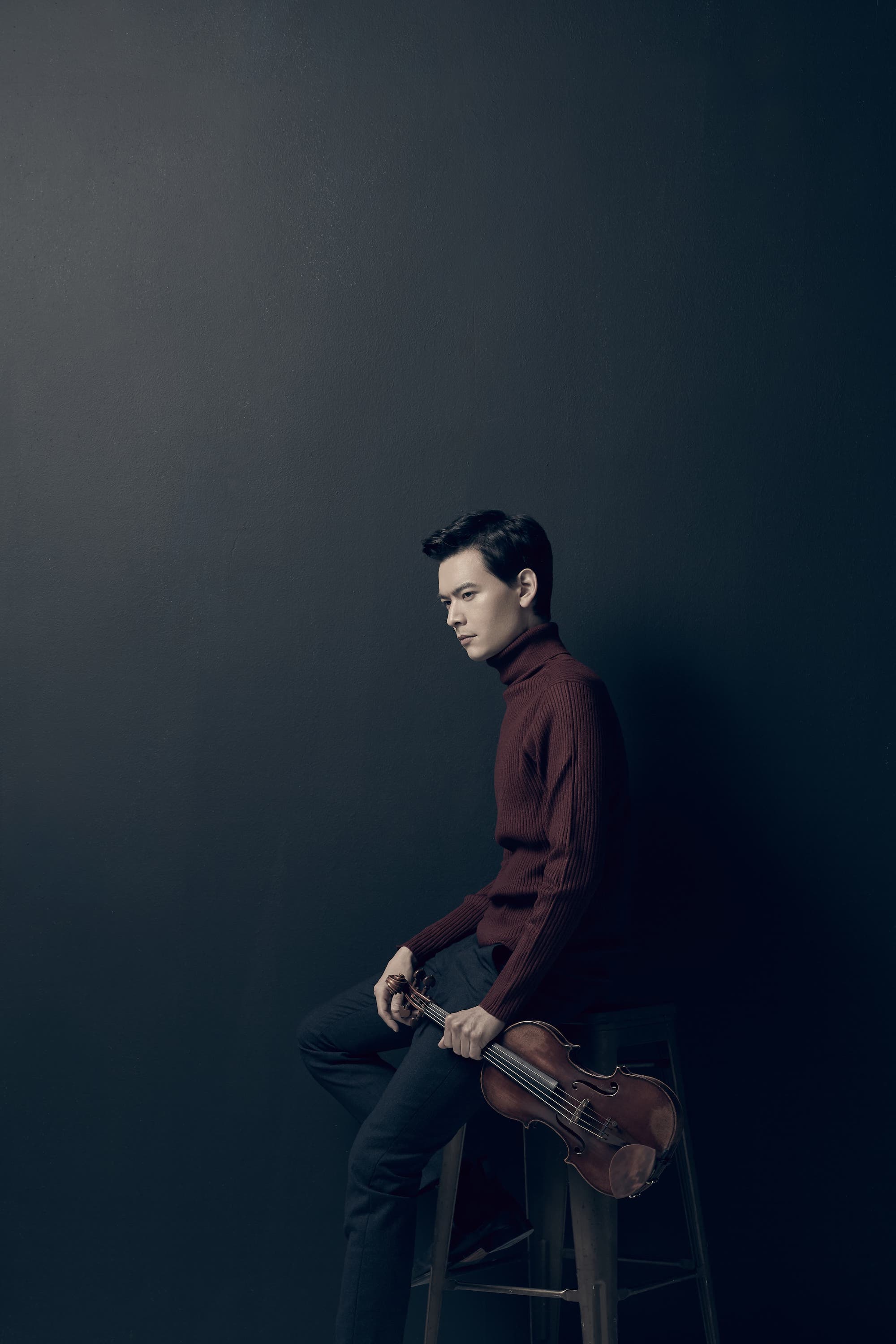
Stefan Jackiw (STE-fahn ja-KEEV) last performed in Boulder pre-Covid, when he was part of a Mozart mini-festival at the Colorado Music Festival in the summer of 2019.

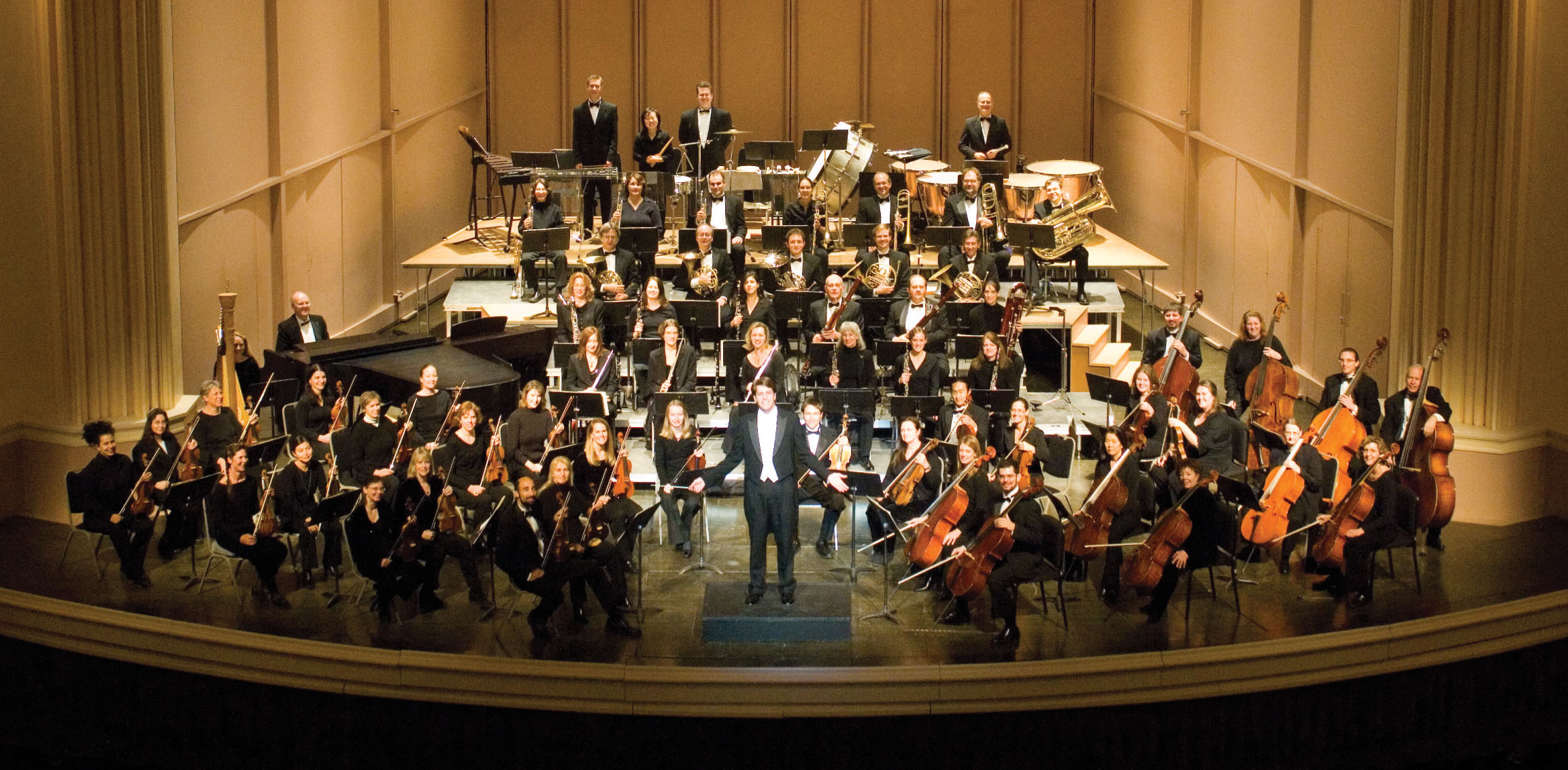
Conductor Michael Butterman with the Boulder Philharmonic Orchestra

Leaping a century and across several borders, he returns to Boulder Saturday to play the Scottish Fantasy composed in 1880 by Max Bruch with the Boulder Philharmonic and conductor Michael Butterman. This will be his second appearance with Butterman and the Phil, after a 2018 performance of Prokofiev’s Second Violin Concerto.

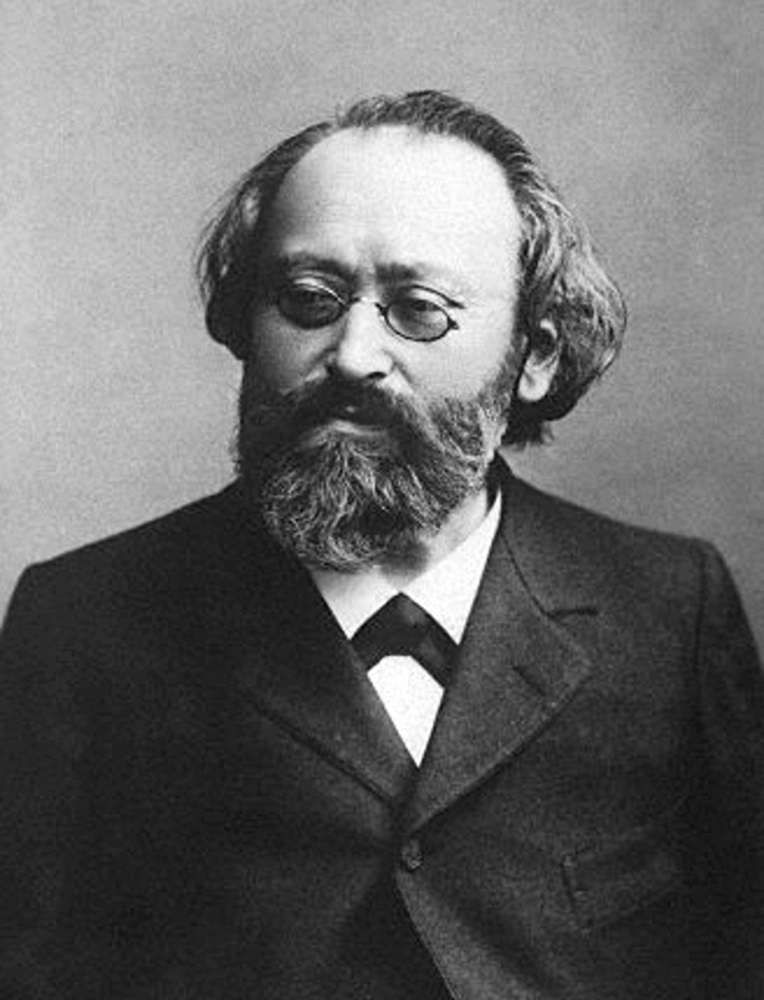
Max Bruch

Maintaining the British flavor, Saturday’s program also includes The Banks of Green Willow by English composer George Butterworth. And in observance of the 150th anniversary of Rachmaninoff’s birth, the program concludes with that composer’s Symphonic Dances, his last completed composition, written around 1940.

In the 19th century, Scotland and the Romantic novels of Sir Walter Scott captured the imagination of composers across Europe. Mendelssohn visited Scotland in 1829 and wrote his Hebrides Overture and his “Scottish” Symphony (Symphony No. 3 in A minor). Operas based on Scott’s novels are legion, including Rossini’s La Donna del Lago (The Lady of the Lake) and Donizetti’s Lucia di Lammermoor, and many others less well known.

Among the composers enchanted by Scott’s stories was the German Max Bruch, who conducted the Liverpool Philharmonic for three years (1880-83). Bruch paid homage to the wild beauty and romance of Scotland by writing his Scottish Fantasy for violin and orchestra. Bruch studied and incorporated Scottish folk melodies into his score, which soon became just about his most popular piece.

Based on two folk songs that he collected in 1907, Butterworth’s Banks of Green Willow has been popular as a musical representation of the English countryside. The songs tell a sad, and even shocking, tale about an English country girl who runs away to sea to cover up an illegitimate pregnancy, but the music nevertheless remains mostly cheerful. Known for only a handful of works, Butterworth was tragically killed in World War I at the age of 31.

Sergei Rachmaninoff was born just about 150 years ago, on April 1, 1873 (Gregorian calendar; March 20 O.S.). In honor of the 150th anniversary of his birth, the Boulder Phil will perform his Symphonic Dances. 

Rachmaninoff had long wanted to write music for a ballet when he composed the Dances. He had shown the score to the great Russian choreographer Michel Fokine, who unfortunately died before he could realize them as a ballet. Rachmaninoff himself died in 1943, not long after the 1941 premiere of the score by Eugene Ormandy and the Philadelphia Orchestra. Today the score is known primarily as concert music, although it has been set by Peter Martins on the New York City Ballet (1994), and by other choreographers.

Stefan Jackiw

Jackiw himself is nearly as multicultural as the program. The grandson of one of Korea’s greatest poets, Pi Chun-Deuk, he is of both Korean and Ukrainian descent. A native of Boston, he attended Harvard and the New England Conservatory. In addition to his international touring as a solo violinist, he has played with Ensemble Ditto, a popular Korean chamber music group that also features CU faculty member Richard O’Neill. 

# # # # #

“Jackiw Plays Bruch”
Boulder Philharmonic Orchestra, Michael Butterman, conductor
With Stefan Jackiw, violin

George Butterworth: The Banks of Green Willow
Max Bruch: Scottish Fantasy
Rachmaninoff: Symphonic Dances

7 p.m. Saturday, March 25
Macky Auditorium

TICKETS

Memorial Concert for late violinist Charles Wetherbee

CU Boulder’s College of Music presents concert March 21 at Grusin Hall

By Peter Alexander March 18 at 5:45 p.m.

Charles Wetherbee

Violinist and CU music faculty member Charles Wetherbee touched people deeply—those he performed with, those he taught, and those who knew him only as audience members.

Wetherbee died  at the age of 56 Jan. 9, 2023, following a battle with cancer. The College of Music will dedicate a faculty recital to his memory Tuesday, March 21 (7:30 p.m. in Grusin Music Hall and by live stream; details below).

In addition to his teaching and performing duties at the College of Music, Wetherbee was first violinist of the Carpe Diem String Quartet and concertmaster of the Boulder Philharmonic Orchestra, who dedicated a performance to his memory Jan. 22.  He was a frequent collaborator with faculty colleagues and other musicians in chamber concerts on and off campus.

His faculty colleague, pianist David Korevaar described Wetherbee as “the best colleague anyone can have.” Korine Fujiwara, violist of the Carpe Diem Quartet, described him as “my best and most trusted friend . . . and a beautiful example of all that is good in the world.” 

In announcing the memorial concert, CU College of Music Dean John Davis wrote, “Chas Wetherbee was a beloved colleague and friend whose influence and inspiration reached far beyond the College of Music. With his passing in January, we lost a deeply valued and cherished member of our community.”

# # # # #

“A Musical Celebration to the Life and Legacy of Charles ‘Chas’ Wetherbee”

CU Boulder College of Music faculty, students, alumni, and guest artists, including members of the Carpe Diem String Quartet, Boulder Piano Quartet and Lírios Quartet 

Program includes works by J.S. Bach, Antonín Dvořák, Brahms, Richard Strauss, Schubert, John Gunther and Korine Fujiwara.

7:30 p.m. Tuesday, March 21
Grusin Music Hall, Imig Music Building
Free

Live Stream 

A stronger Cinderella takes the stage at the Eklund Opera

Massenet’s Cendrillon offers more than a fairy tale, Friday and Sunday at Macky

By Peter Alexander March 16 at 4 p.m.

“She is a sweet girl with a lot of backbone.”

Leigh Holman, director of CU’s Eklund Opera Program, is talking about Cendrillon—real name Lucette—who is the Cinderella character in Jules Massenet’s opera based on the familiar Charles Perrault fairy tale. But if you only know the Disney version of Cinderella, you will meet some deeper characters in Massanet’s opera.

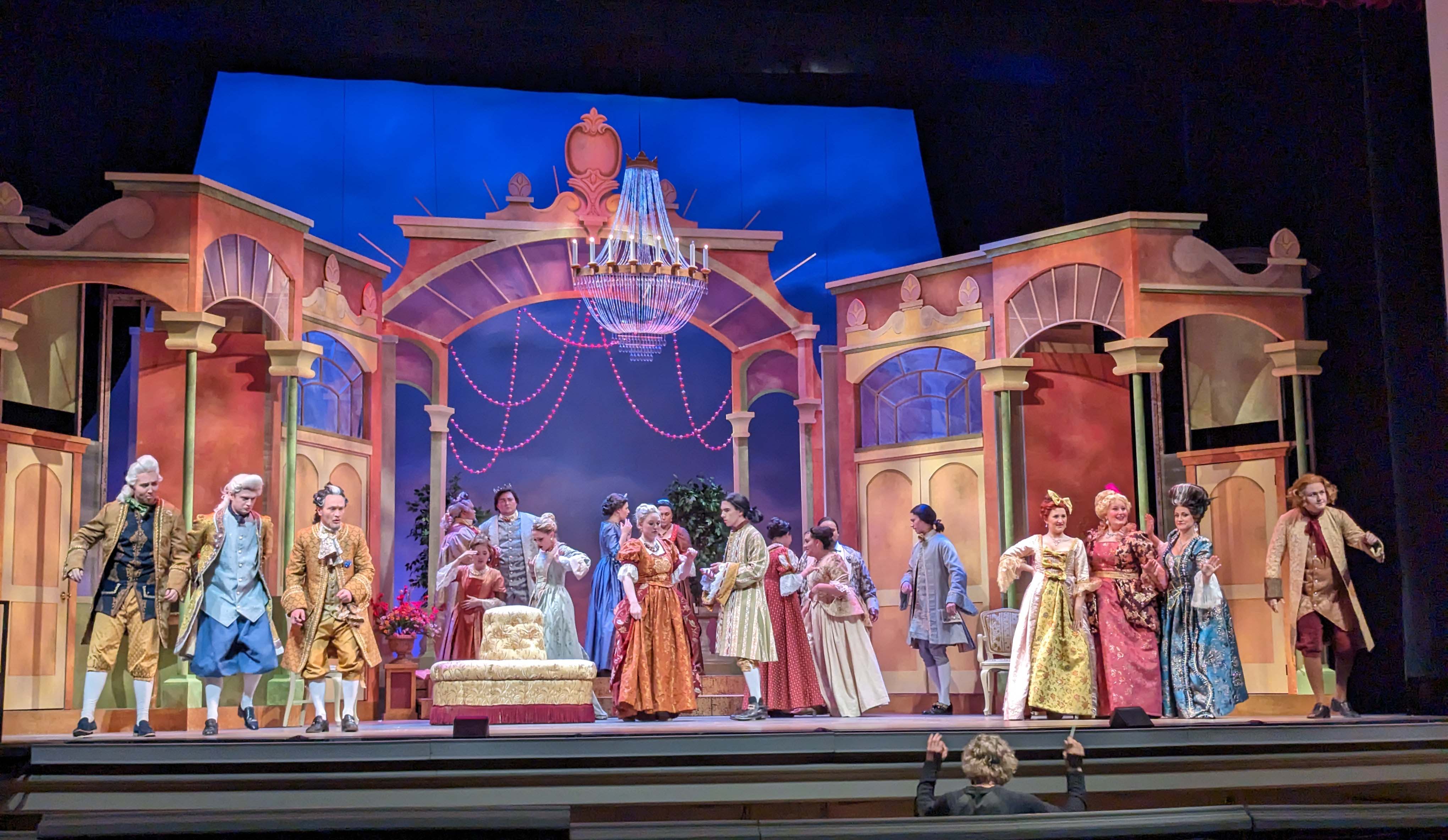
The Eklund Opera’s production of Cendrillon will be performed Friday and Sunday (March 17 and 19; details below) at Macky Auditorium. The cast of CU students will be stage directed by Holman; CU faculty member Nicholas Carthy will conduct the performances. Set deign is by Peter Dean Beck, costumes by Ann Piano.

Eklund Opera production of Massenet’s Cendrillon. Stage design by Peter Dean Beck. Nicholas Carthy conducts. Photo by Glenn Asakawa.

In general outline, the story is the same that everyone is familiar with: after her mother’s death, Cinderella’s father remarried, and her stepmother and two stepsisters mistreat her. There is a fairy godmother, a Prince, and a ball, and Cinderella has to leave at midnight. She and the Prince fall in love and are eventually reunited. That much is familiar.

But there are important differences, too. “This is not our usual fluffy fairy story,” Carthy says. “There is great depth in what happens.” For one thing, Cinderella is a stronger character; when she comes home from the ball and hears her stepsisters gossiping about the mysterious girl at the ball, she resolves to run away and she contemplates suicide. That of course raises the emotional stakes well above the Disney version with its cartoon birds and mice.

The Prince is introduced before the ball. Like Cinderella, he is morose and depressed. Life at court is boring and he’s not interested in his father’s insistence that he select a mate. He also thinks about ending it all to escape his situation. And it does not take a glass slipper for Cinderella to be found; when she and the Prince meet again, they realistically recognize each other right away

Another critical difference is the character of Cinderella’s father. He overhears the stepsisters and realizes how badly they are treating his daughter. “He decides we’re not going to put up with this any more, and I’m going to take you away,” Holman explains. “We’re gong to go back to our farm [where they lived before he remarried], and they have a beautiful duet about that. It’s really gorgeous music.”

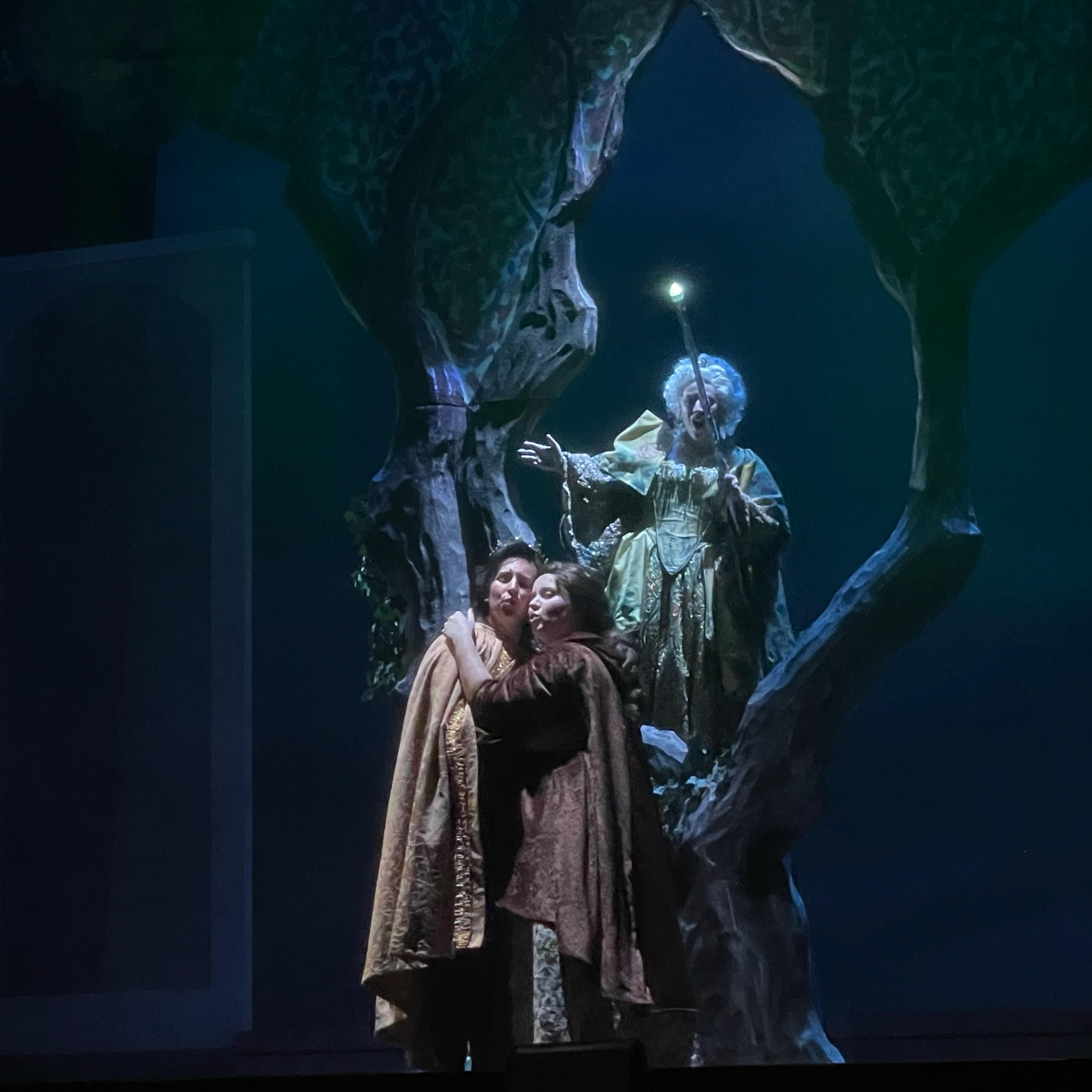
Prince (Jenna Clark), Cendrillon (Anna McMahon) and Fairy Godmother (Alice Del Simone). Photo by Leigh Holman.

For Holman the critical point in the Perrault version of the story, and one that resonates with her personally, is that fact that Cinderella has lost her mother. “Something a lot of productions bring out, and I do, is the fact that Cinderella misses her mom so much. She sings some beautiful music about her mom and how much she misses her.

“And the Prince grew up alone—his mom’s gone, too. So the first time they meet, it’s more than physical attraction; they see themselves in each other. I don’t know if they got married nor not [since that’s not explicitly in the opera], but the great thing that Cinderella gets out of this is that they find each other. So I see Cinderella going from being very lonely, the Prince going from very lonely, to being surrounded by people that love them.”

Holman says that the two students cast in the role of Lucette/Cinderella both embraced the notion of a stronger character than they had known before. “We talked about it from the very beginning,” she says. “We had a long talk about that, and both women have addressed it in different ways, but they carried that into their character.”

Holman sees Cinderella’s dilemma in stark terms. “She’s living in a horrible, violent house, she misses her mother, she misses her former life, and so when she runs away in the woods, it’s not just because she overheard [the stepsisters]. It’s just one thing piled on top of another, and that’s what broke the camel’s back.”

The music is in the lush, romantic style of the late 19th century, with some Wagner influences thrown in. “There are lots of little Wagnerian moments,” Carthy says. “But they are lightened up. They don’t have the same sort of grimness that Wagner tends to have.”

We don’t remember him so much today, but in his time Massenet was massively popular. Carthy sees him as “the Andrew Lloyd Weber of his day,” but in a good way. “Andrew Lloyd Weber steals from everybody, and so did Massenet,” he says. “But the idea of saying that is just the importance that he had. People were all whistling his tunes and there were great Massenet aficionados who went to all of his performances.”

One final important point Holman stresses is that there is more than the usual “happily ever after” in the ending. It’s two people discovering each other in a world that has been hostile. As she explains, “all the women who were trying to get the prince to marry them see the love that they have for each other, and they all become joyful.

“There is a ‘happily every after’ in that, and not just because she found a prince.”

# # # # #

Massenet: Cendrillon
Libretto by Henri Caïn
CU Eklund Opera
Sung in French with English supertitles
Nicholas Carthy, conductor, and Leigh Holman, stage director

7:30 p.m. Friday, March 17
2 p.m. Sunday, March 19

Macky Auditorium

TICKETS

Correction (7 p.m. 3/16): In the original version of the story, the composer Massenet was misspelled as Massanet. Massenet is the correct spelling.

Grace Notes: Nation of Immigrants and Made in America

Boulder Chorale and the Longmont Symphony both strike American theme

By Peter Alexander March 15 at 1:43 p.m.

Taking inspiration from former president Obama’s description of America as “a nation of immigrants,” the Boulder Chorale will present a concert celebrating many of the cultures that have contributed to our national identity.

The concert, to be presented at 4 p.m. Saturday and Sunday at the First Methodist Church in Boulder (March 18 and 19), will be under the direction of Vicki Burrichter, artistic director of the Chorale. Violinist Leena Waite will play “Requiem for Ukraine” by Igor Loboda, and other guest artists will perform music from cultures around the world that have merged on the American continent.

Leena Waite

The program opens with an homage to America’s original inhabitants. “River of Living Waters” by Karen Marrolli, the director of music ministries at a Methodist church in Albuquerque, New Mexico, is based on a Lacquiparlé Dakota melody. That is followed by two songs from Great Britain that describe the journey from the old world to the new: “The Parting Glass” and “The Water is Wide.”

Other cultures celebrated in the program include those of India and China in Asia, and Mexico and Brazil in Latin America. The tour of cultures ends with music of Broadway by Leonard Bernstein, “Take Care of This House,” which is a reminder that Americans should, as Burrichter writes in her program notes, “work together to care for our collective home.” And finally a spiritual that remembers the enslaved people of our continent, Moses Hogan’s “My Soul’s Been Anchored in the Lord.”

“Not all of us have come here by choice,” Burrichter writes. “We hope that ending our concert with a spiritual shows our deep respect for . . . . (African-Americans’) innumerable contributions to American culture and life.”

# # # # #

“A Nation of Immigrants”
Boulder Chorale, Vicki Burrichter, conductor
With Leena Waite, violin
Ensemble of world musicians

Program includes:

  • Karen Marrolli: “Rivers of Living Water” (Lacquiparlé Dakota melody)
  • Traditional Scottish, arr. Desmond Early: “The Parting Glass”
  • Traditional British, arr. Craig Helala Johnson: “The Water is Wide”
  • Igor Loboda: “Requiem for Ukraine”
  • Leonard Bernstein: “Take Care of This House” from 1600 Pennsylvania Avenue
  • Moses Hogan: “My Soul’s Been Anchored in the Lord”
  • Additional repertoire from India, China, England, Mexico, and Brazil

4 p.m. Saturday and Sunday, March 18 and 19
First United Methodist Church, Boulder

TICKETS

 # # # # #

The Longmont Symphony will present the second of two concerts in the current season focusing on American music over the coming weekend, with performances Saturday and Sunday (March 18 and 19; details below) in the Stewart Auditorium of the Longmont Museum.

Titled “The Art of Influence—America: Part II” the program features works that reflect some of the influences that have shaped the sound of American music. Under the direction of conductor Elliot Moore, the orchestra will present the Colorado premiere of Cover the Walls by Ursula Kwong-Brown, Gershwin’s Lullaby, and Aron Copland’s jazzy Clarinet Concerto with soloist Jason Shafer. The program will be filled out by Maurice Ravel’s tribute to the French Baroque tradition, Le Tombeau de Couperin (The tomb of Couperin).

The versatile Kwong-Brown describes herself as “a composer, sound designer and arts technologist” who also is active as research scientist and political activist. A 2010 honors graduate of Columbia University in music and biology, she has had works performed across the United States and overseas. Her catalog includes music for orchestra, chamber ensembles, vocal and choral works, as well as sound design for dance and theater.

Jason Shafer

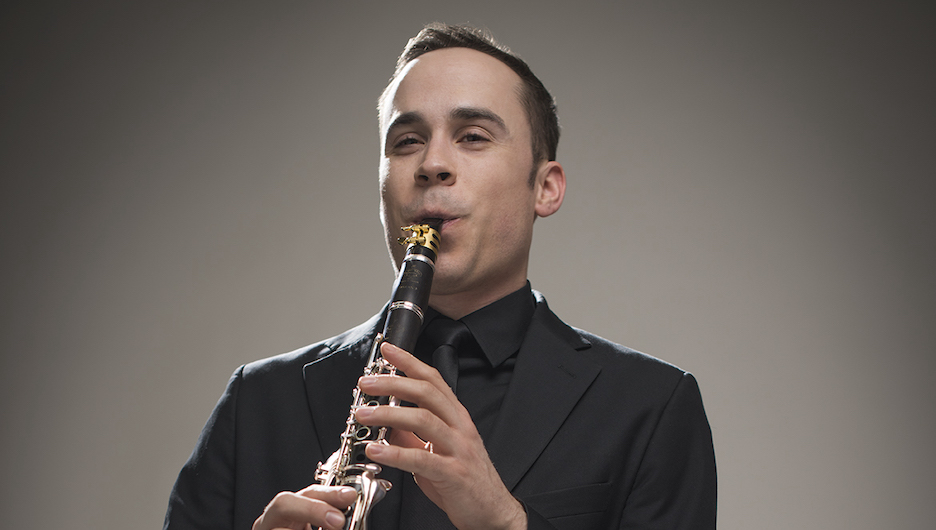
A graduate of the Eastman School of Music, Shafer is principal clarinet of the  Colorado Symphony and a member of the adjunct faculty at the University of Northern Colorado. He previously appeared with the LSO in 2021, when he performed Mozart’s Clarinet Concerto. Aaron Copland’s Concerto was commissioned by Benny Goodman, who played the premiere with the NBC Symphony and conductor Fritz Reiner. If not exactly a reflection of Goodman’s jazz style, the concerto is a tribute to his virtuosity.

Originally composed for piano and later orchestrated by the composer, Ravel’s Tombeau de Couperin was written during the difficult years of World War I. Described by the composer as an homage “less to Couperin himself than to French music of the eighteenth century” generally, the colorful orchestral suite includes movements titled Prélude, Forlane, Menuet and Rigaudon

# # # # #

“Made in American 2: The Art of Influence”
Longmont Symphony Orchestra, Elliot Moore, conductor
With Jason Shafer, clarinet

  • Ursula Kwong-Brown: Cover the Walls (Colorado premiere)
  • Copland: Concerto for Clarinet and String Orchestra with Harp and Piano
  • Gershwin:Lullaby
  • Ravel: Le Tombeau de Couperin (The Grave of Couperin)

7 p.m. Saturday, March 18, and 4 p.m. Sunday, March 19
Stewart Auditorium, Longmont Museum

TICKETS

Grace Notes: “Company” at CU is sold out, Boulder Symphony “Curiosity Concert”

Sondheim’s 1970s musical; “The Good, the Bad, the Music!”

By Peter Alexander March 9 at 2:40 p.m.

The CU Department of Theatre and Dance is presenting the quintessential 1970s musical, Stephen Sondheim’s Company, but over the past 24 hours the show sold out.

The story of a bachelor whose married friends want him to get married and settle down, Company won six Tony awards, including Best Musical, Best Score, Best Lyrics and Best Book. The original ensemble cast starred Dean Jones as Robert (“Bobby”) and Elaine Stritch as Joanne. That 1970 performance featured one of the iconic Broadway performances of the time, Stritch’s rendition of “Ladies who Lunch.”

Although firmly planted in the social mores of the times, Company continues to be popular, and three Broadway revivals—the most recent in 2021 with gender reversals in the cast—and numerous regional performances have kept the show before the public.

The CU production was designed by Annika Radovcich and stage directed by Bud Coleman. Adam Ewing is the music director. 

# # # # #

Company by Stephen Sondheim
Book by George Furth
Orchestration by Jonathan Tunick
University of Colorado Department of Theatre and Dance

SOLD OUT

7:30 p.m. Friday, March 10; Saturday, March 11, Wednesday, March 15; Thursday March 16; Friday, March 17; and Saturday, March 18
2 p.m. Sundays March 12 and March 19

Charlotte York Irey Theatre, University Theatre Building

# # # # #

It’s not Clint Eastwood, but it is the local Sheriff of Musical Harmony.

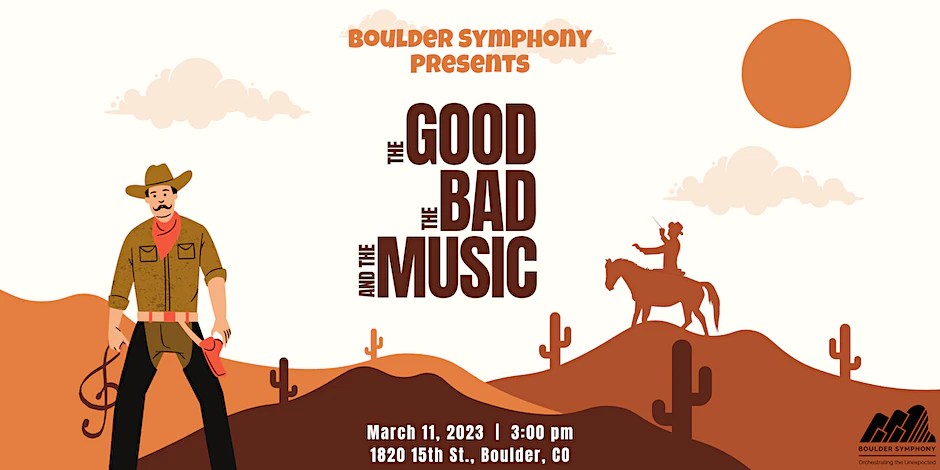
The “Curiosity Concert,” programmed for children and families, will feature classical, pop and movie music associated with the West, including Rossini’s Overture to William Tell,, the “Hoe-Down” from Aaron Copland’s ballet Rodeo, and Johnny  Cash’s “Get Rhythm.” The concert’s plot features the loser of the orchestra’s recent “Best Conductor in the West” contest derailing the concert and taking the orchestra hostage. It will be up to the Sherriff of Musical Harmony to re-establish order in the concert hall.

The sheriff will be present when the Boulder Symphony and conductor Devin Patrick Hughes present “The Good, the Bad and the Music” at  3 p.m. Saturday (March 11) at Grace Commons Church, 1820 15th St. in downtown Boulder.

For 30 minutes before and after the concert, Boulder’s HB Woodsongs will sponsor an “instrument petting zoo” for children to try out instruments. Boulder Symphony’s Curiosity Concerts have sold out in the past, so potential audience members are encouraged to order their tickets soon (see below).

# # # # #

“The Good, the Bad, the Music”
Boulder Symphony, Devin Patrick Hughes, conductor

  • Program includes:
  • Rossini: Overture to William Tell
  • Copland: “Hoe-Down” from Rodeo
  • Scott Joplin: “Maple Leaf Rag”
  • Johnny Cash: “Get Rhythm”
  • Original song by Devin Patrick Hughes, Dana Vachharajani, Andrew Haller, and Liz Comninellis

3 p.m. Saturday, March 11
Grace Commons Concert Hall, 1820 15th St., Boulder

TICKETS