Time to tend the garden and try to make some sense of life
By Peter Alexander July 30 at 12 noon
I am writing this post to let you know that at the end of the summer I will give up my work on Sharpsandflatirons.com. My reviews of the 2025 summer season at the Santa Fe Opera are the last posts I plan to make. That is a suitable place to end, since I first attended the Santa Fe Opera in the original opera house nearly 60 years ago, while I was still an undergraduate music student. Santa Fe has remained a favorite location for experiencing, and learning, great opera for all of those years.
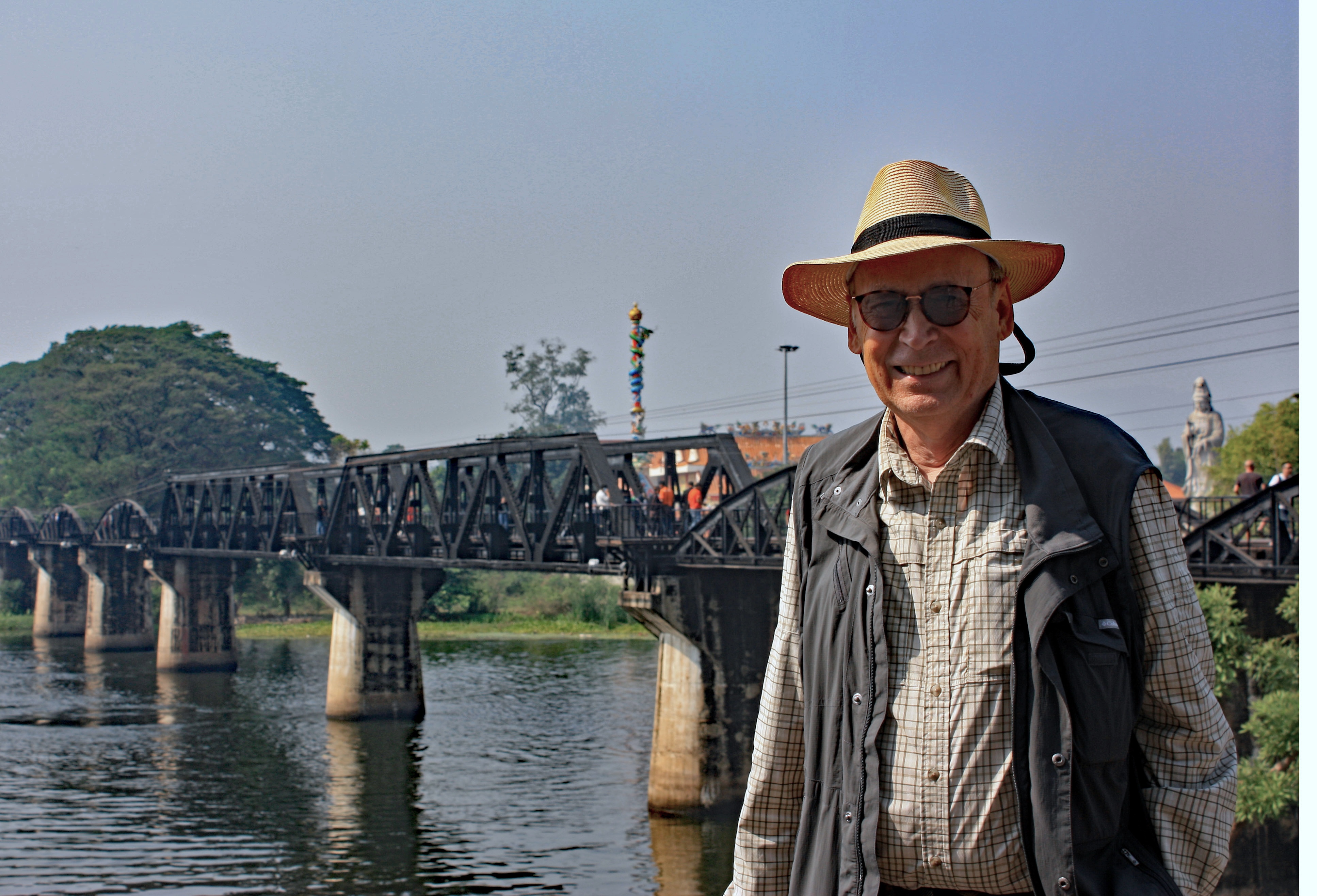
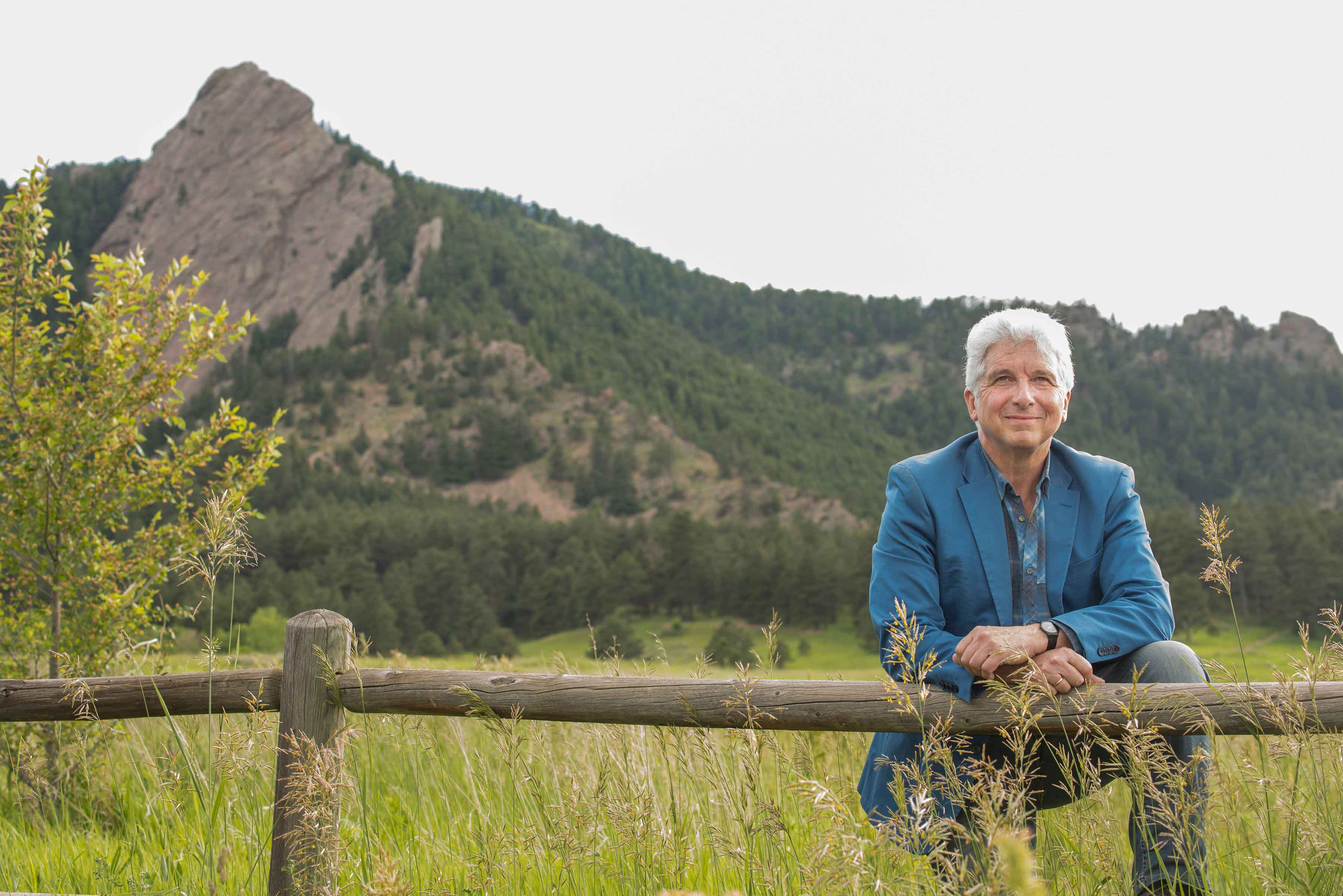
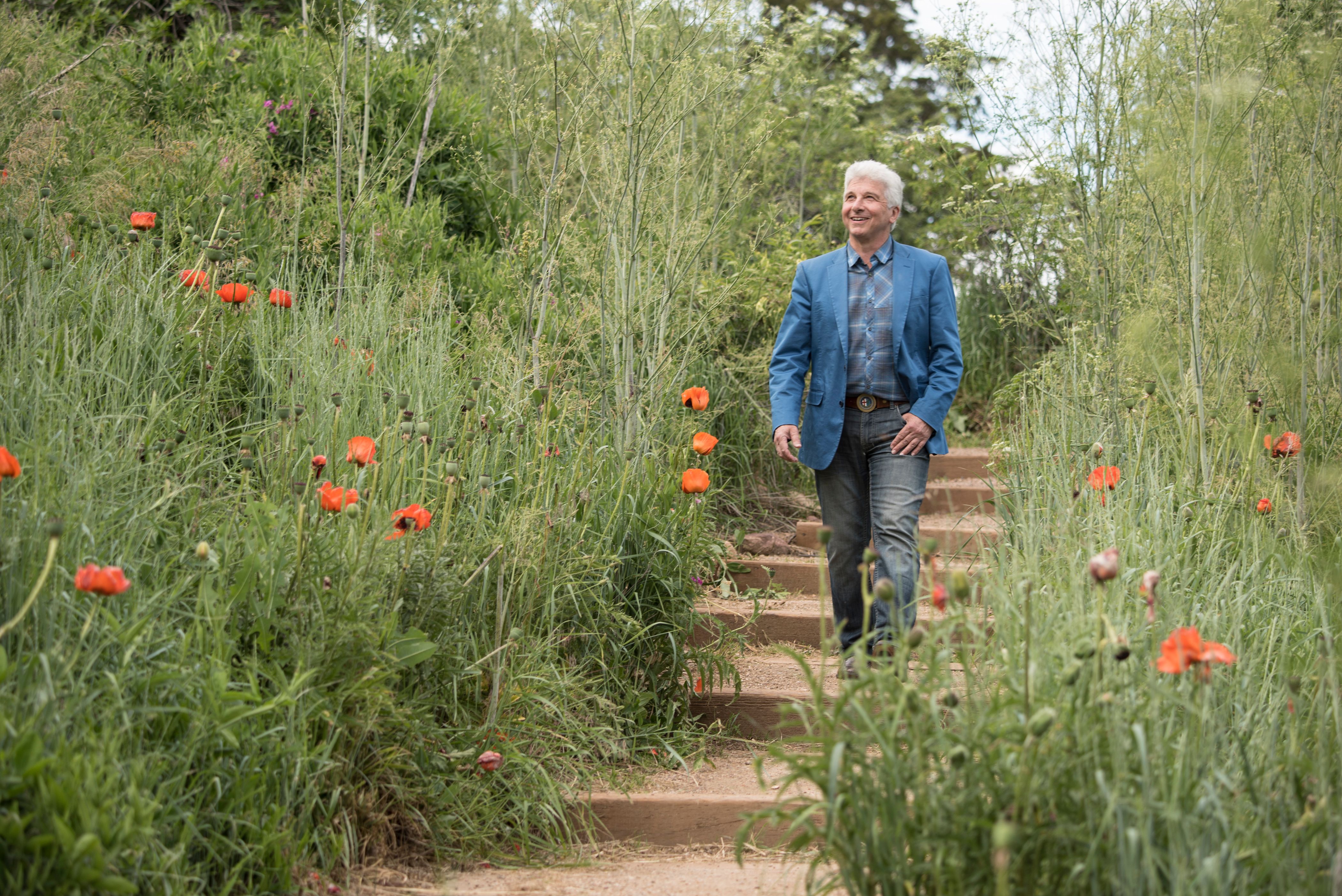
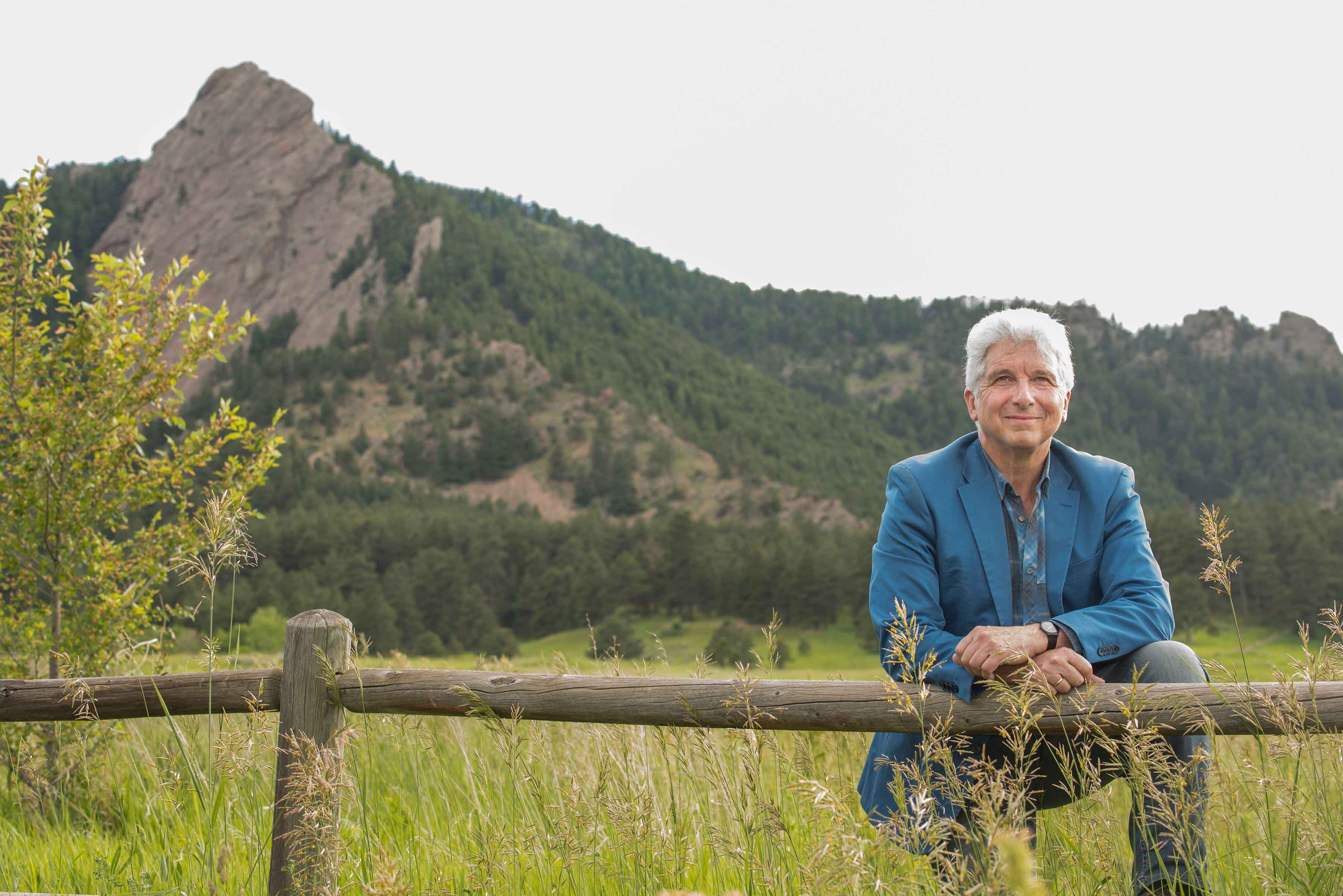
The author while traveling in Asia, before he turned 80
Fourteen years ago I took up work as a music journalist covering classical music in “Boulder & Environs” as a way of making productive use of the extraordinary education I was fortunate enough to receive. It was also a way of giving back to the greater world of music in a small way, on the fringes of our shared musical life.
As the proprietor of the site, I got to define the environs, which certainly include Santa Fe, since it is within a one-day drive of Boulder—and the food in Santa Fe is fabulous. When there were Boulder connections, I have also reviewed operas in Minneapolis and Seattle—just coincidentally, the cities where my two oldest sons live.
I will maintain the site for now, only adding a post if I discover something really important to report: a news event in the local music world, or an issue I feel compelled to comment on. But I don’t think that is very likely, so don’t wait for me, or for Godot.
I have enjoyed getting to know all the musicians in the Boulder area, working with all of them, and bringing their activities to the attention of potential audiences. But I am now 80, and it is better to step back while I am still doing good work, rather than letting it decline. Besides, there are so many great British TV shows still to watch, great Russian novels to read, obscure operas to track down and see, and work to be done tending my back yard and making my garden grow.
If you see me in the lobby, say “Hi.”
And let us try, Before we die, To make some sense of life. We’re neither pure, nor wise, nor good We’ll do the best we know. We’ll build our house and chop our wood And make our garden grow… And make our garden grow.
Peter Oudjian to conduct famous last symphonies by Beethoven and Mahler
By Peter Alexander July 26 at 5:00 p.m.
Music director Peter Oundjian will conclude the 49th Colorado Music Festival (CMF) this week with performances of two very different ninth symphonies.
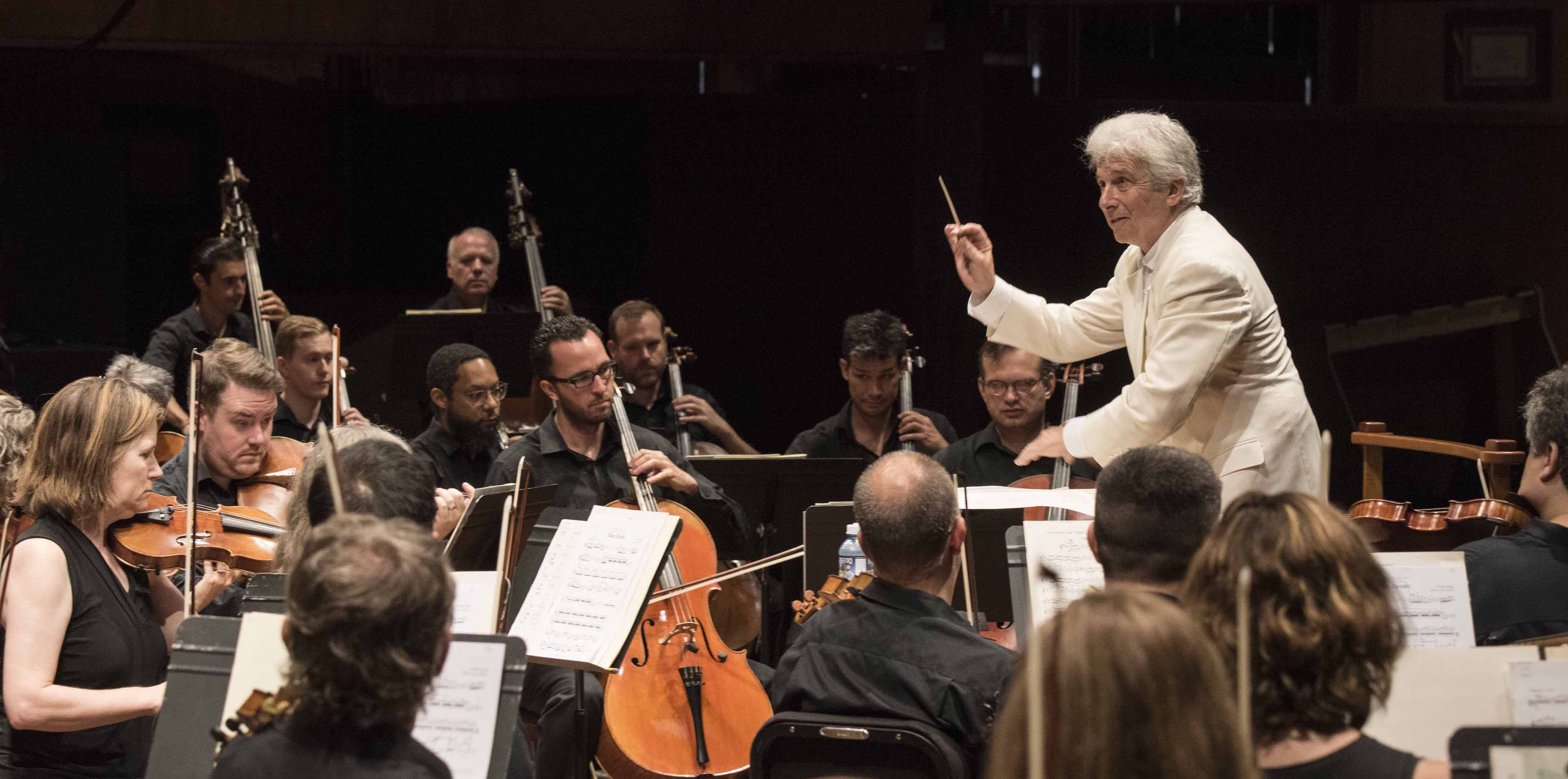
CMF Music director Peter Oundjian conducting the CMF Festival Orchestra
Thursday and Friday will see performances of one of the most famous symphonies ever written, Beethoven’s Symphony No. 9 in D minor for full orchestra, chorus and soloists (7:30 p.m. July 31 and 6:30 p.m. Aug. 1; full programs below). Two shorter works will fill out the program both evenings: Amplify, a short work for orchestra co-commissioned by CMF from composer Michael Abels; and Beethoven’s Elegischer Gesang (Elegiac song), op.118, for string quartet and vocal quartet.
Dover Quartet. Photo by Roy Cox.
The Sunday concert will feature a much less frequently performed Ninth Symphony, that of Gustav Mahler. At 87-plus minutes, the symphony stands alone on the program. “Mahler 9 is just enough of an experience for a listener, or for that matter for an orchestra or even for a conductor,” Oundjian says. “I have done it with other pieces, but I think it’s better just to say, ‘here’s an epic thing.’ It’s more than fulfilling by any measure.”
The week begins with a chamber music concert by the Dover Quartet, playing string quartets from the heart of the 19th-century to late Romantic era: music by Schumann, Tchaikovsky and Leoš Janáček. (See program below.) The Dover Quartet was formed by four students at the Curtis Institute in 2008, and is currently the Penelope P. Watkins ensemble in residence at Curtis.
The culmination of Beethoven’s career, the Ninth Symphony was first performed in May of 1824. It was a revolutionary work at the time, both for its great length and for the inclusion of voices in a symphony. When he wrote it, Beethoven was profoundly deaf, at the end of the performance the composer, who was standing onstage, had to be turned around by one of the singers so that he could see the cheering audience.
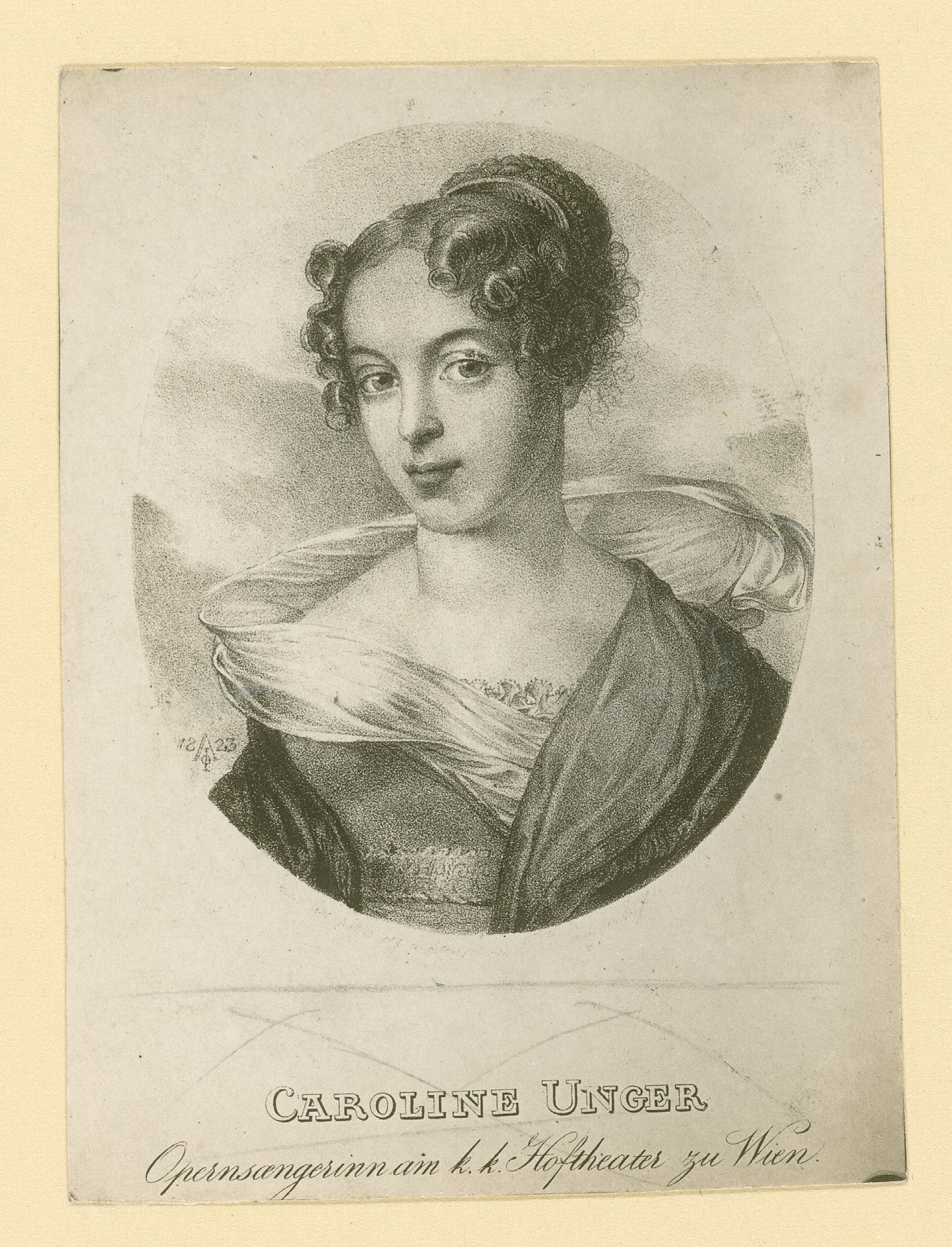
Alto Caroline Unger, who is said to have turned Beethoven to see the cheering audience for the Ninth Symphony.
Today the Ninth Symphony has become the favorite classical piece for celebrations, largely due to its joyful finale based on Friedrich Schiller’s poem “Ode to Joy.” It was famously performed in Berlin in 1989 by Leonard Bernstein and a combined orchestra from East and West Germany to celebrate the fall of the Berlin Wall, with the word “Freude” (Joy) replaced in the text with “”Freiheit” (Freedom).
As much as he loves the entire work, Oudjian says it’s “the profundity, beauty and sense of longing that the slow movement displays” that makes the Ninth a great work. “The depth of this slow movement is for me the peak of the experience,” he says.
“This is among the greatest (musical) variations that was every written. The way he uses the skill of embellishment and transformation among the most important elements (goes) beyond what one could ever imagine.”
Due to the impact of the symphony, and the fact that long after no major composer wrote more than nine symphonies, a legend grew that there was a supernatural limit on the number of symphonies one could write. No one bought into that legend more than Mahler, who avoided as long as possible writing a Ninth symphony. In fact, after his 8th, he called his next major piece Das Lied von der Erde (The song of the earth) rather than a symphony.
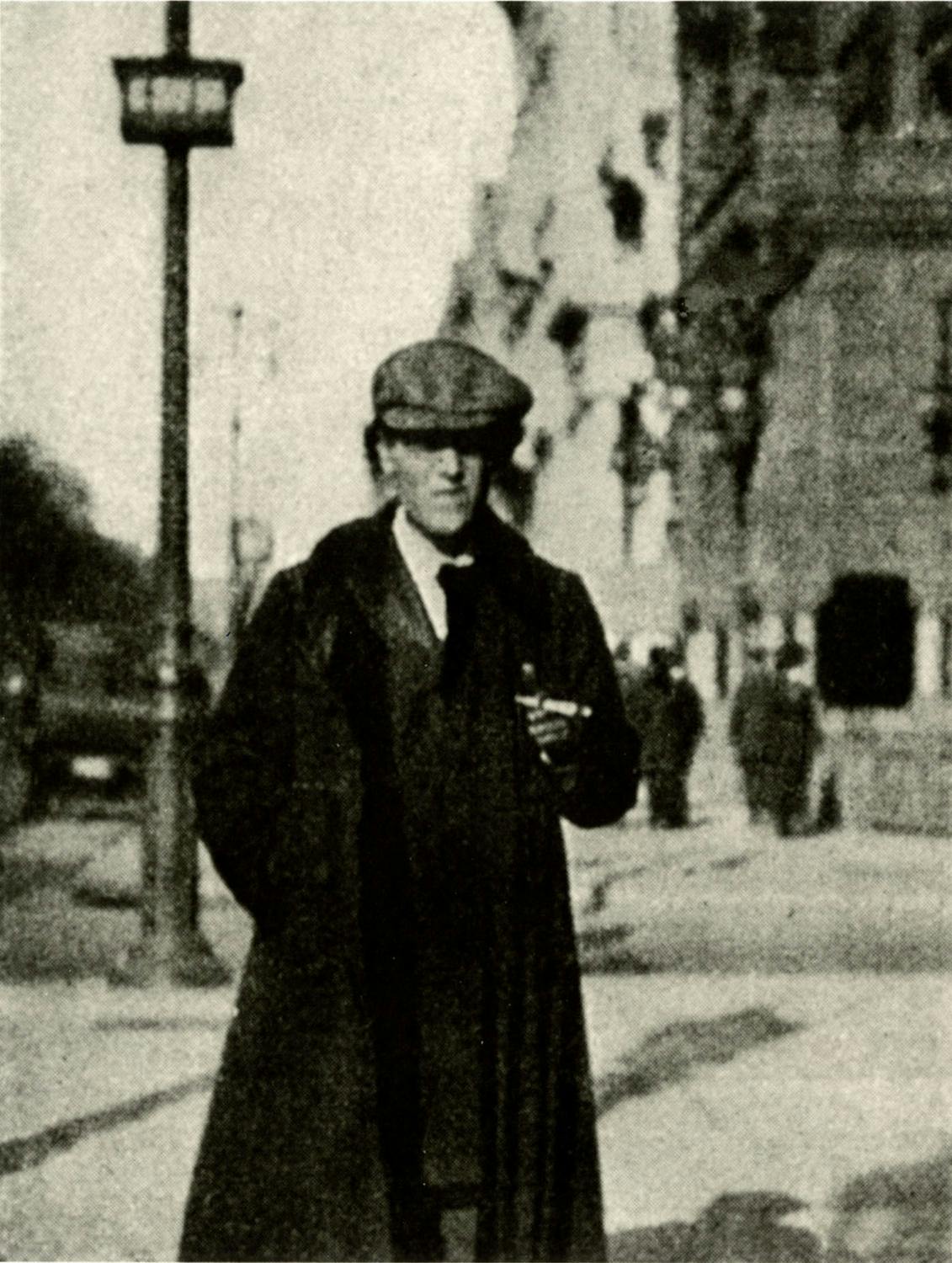
Gustav Mahler in New York shortly after the completion of his Ninth Symphony.
Having safely completed Das Lied, Mahler went on to complete his Ninth Symphony. Ironically, it was still his last completed symphony, although his Tenth has been completed by various editors based on one mostly finished movement and sketches.
As profound as it is, Mahler’s Ninth is not played nearly as often as Beethoven’s. That may be in part because it takes such focus to shape the music over such a long span of time. For Oundjian, the key is to conceive of the performance as a journey.
“[It takes] a tremendous amount of concentration, but you never say ‘Oh my god, I’ve still got to be playing this for 25 more minutes’,” he says. “You’re just thinking about where you are in the journey, and what’s coming and how important this moment is.”
In contrast to Beethoven’s Ninth, Mahler’s Ninth is less a grand celebration and more a final reduction of the symphony into its smallest elements. “Deconstruction is exactly what happens,” Oudjian says. “You have one little gesture that lasts a few notes, then another gesture that removes a couple of notes, and finally just a cadence.”
The key to understanding the Symphony is to hear how the very contrasting movements outline the journey from start to finish. “The first movement is the greatest expression of anguish that you could imagine, but also a strange kind of optimism,” Oundjian says. “The second movement is really bizarre, looking backwards to a simpler time, the Baroque or early classical period.
CMF Music Director Peter Oundjian
“The third movement looks forward to modernism in a way that you could never imagine. It sounds like Shostakovich or Hindemith half the time—later composers (who) were very influenced by Mahler. And the final movement is a statement unlike any other. It’s about eternal beauty and longing and possibility, and perhaps the end is an image of the afterlife, or even the journey between one life and the next. But it’s staggeringly beautiful and it uses silences in a way that no composer had ever dared to do.”
And in the end, Mahler’s silences will help close the 49th Colorado Music Festival.
# # # # #
Colorado Music Festival, Peter Oundjian, music director Tuesday, July 29–Festival Finale, Sunday, Aug. 3 All performances in Chautauqua Auditorium
Tchaikovsky: String Quartet No. 1 in D major, op. 11
7:30 p.m. Tuesday, July 29
Festival Orchestra Concert Colorado Music Festival orchestra and the St. Martin’s Festival Singers Peter Oundjian, conductor With Lauren Snouffer, soprano; Abigail Nims, mezzo-soprano; Issachah Savage, tenor; and Benjamin Taylor, baritone
Michael Abels: Amplify (CMF co-commission)
Beethoven: Elegischer Gesang (Elegiac song), op. 118 —Symphony No. 9 in D minor, op. 125
7:30 p.m. Thursday, July 31 6:30 p.m. Friday, Aug. 1
Festival Finale Colorado Music Festival Orchestra, Peter Oundjian, conductor
Mahler: Symphony No. 9
6:30 p.m. Sunday, Aug. 3
Remaining tickets for these performances available through the CMF Web Page.
Anne Akiko Meyers plays moving new work by Eric Whitacre at CMF
By Peter Alexander July 18 at 1:20 a.m.
The Colorado Music Festival Orchestra presented a program of deeply expressive music last night (July 17), including a new work for violin and string orchestra by the American composer Eric Whitacre.
Chautauqua Auditorium. Photo by Geremy Kornreich.
The program, under the direction of music director Peter Oundjian, featured the violinist Anne Akiko Meyers as soloist. In addition to Whitacre’s The Pacific Has No Memory, Meyers gave a polished and captivating performance of Ravel’s virtuoso showpiece Tzigane.
The concert opened with Aaron Copland’s beloved Appalachian Spring. Written for the Martha Graham Dance Company, the music features kaleidoscopic changes of mood, from moments of quiet contemplation to moments of exuberant energy. These are more than changes of feeling; the music should reflect—or better yet—activate movement.
Oundjian and the Festival Orchestra ably captured that spirit. The quiet moments projected a delicate calmness of spirit. The hushed opening was a little hurried, but elsewhere the shifts of mood were well marked, the animated passages bursting with energy. In their solos, the winds played with great delicacy—especially the fluid clarinet solos of principal Louis DeMartino.
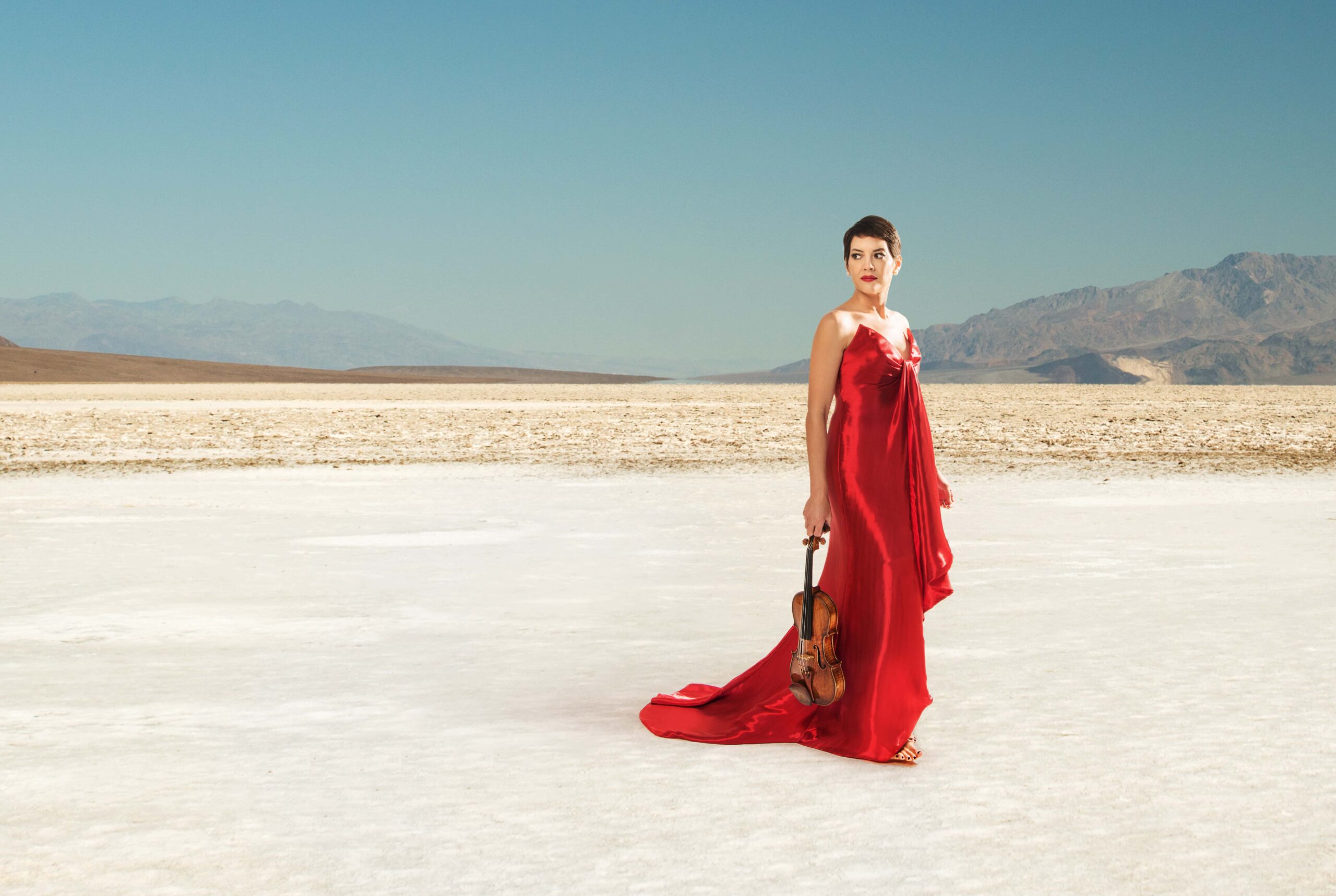
Anne Akiko Meyers
After the Copland, Meyers came on the stage for Tzigane, a colorful exploration of Roma fiddle tunes. From the first note, Meyers opened the floodgates of expression. Her identification with the music’s passionate spirit was reflected in her facial expressions and her dancing movements as she played. The performance was pure entertainment on the highest level.
Meyers introduced Whitacre’s piece by telling of her personal experience during the January fires in Southern California, when she and her family had to evacuate their Pacific Palisades home. Whitacre’s score memorializes the terrible losses in those fires.
In writing the music, he was inspired by the film The Shawshank Redemption, in which a character dreams of a beach on the Pacific Ocean, which he says “has no memory.” Whitacre used that thought as the source of the music’s title, The Pacific Has No Memory, and to symbolize the washing away of harsh memories.
The music is suffused in a feeling of loss, but also consolation. In its gentle beauty, the score formed an oasis of calm at the center of the concert. No doubt reflecting her own sense of loss, Meyers gave a performance of deep expressivity.
After intermission, Oundjian has chosen works from the 19th-century that portray lovers from Shakespeare, but of wildly divergent types. First was the Overture to Béatrice and Bénédict by Berlioz. Based on Much Ado About Nothing, Berlioz’s opera follows the mad adventures of two lovers who engage in happy disputes and cheerful sparring, before finding a happy ending.
The music is flighty, protean in its moods and extreme in its contrasts. Oundjian and the Festival Orchestra embraced all the fickle leaps and bounds of the score, making it come vividly to life. As always, the Festival Orchestra negotiated the most extreme contrasts of volume, including the faintest pianissimos.
This is French music at its most effervescent, something I wish we heard more of in Boulder. And if you want to know the source of Berlioz’s uniquely mercurial style, listen to Rameau—something you are sadly unlikely to hear in the concert hall.
The second Shakespearean subject does not have a happy ending: Tchaikovsky’s Fantasy Overture Romeo and Juliet. Incorporating what Oundjian considers “one of the most beautiful melodies ever,” this one of the most eminent of war horses. But more than the love theme, memorable as it is, Tchaikovsky’s music expresses the conflict between the families, the street brawl, Juliet’s funeral procession, and the fateful blow of tragedy.
From the breathless emotion of adolescent infatuation, the love theme builds into struggle, then into transfiguration, and what one hopes is sorrowful realization and reconciliation. All of that is present in the music, and in the performance by the Festival Orchestra. In all—familiar works well played, a new work beautifully introduced, a brilliant soloist—this was one of the most invigorating concerts I have heard at CMF.
The program will be repeated at 6:30 tonight (July 18) at the Chautauqua Auditorium. Tickets are available HERE.
Two entertaining comedies and a grim story from the home front at Central City
By Peter Alexander July 15 at 1:52 p.m.
Central City Opera (CCO) opened their summer season June 28 with a brisk and bubbly production of Rossini’s 1816 comedy The Barber of Seville. The summer’s other stylistically varied productions have now opened: The Knock, a 21st-century tale of life on the home front during the Iraq war, composed in 2020 by Alessandra Verbalov with libretto by Deborah Brevoort, on July 5; and the 1959 Broadway hit Once Upon a Mattress by Mary Rodgers and Marshall Barer, on July 12.
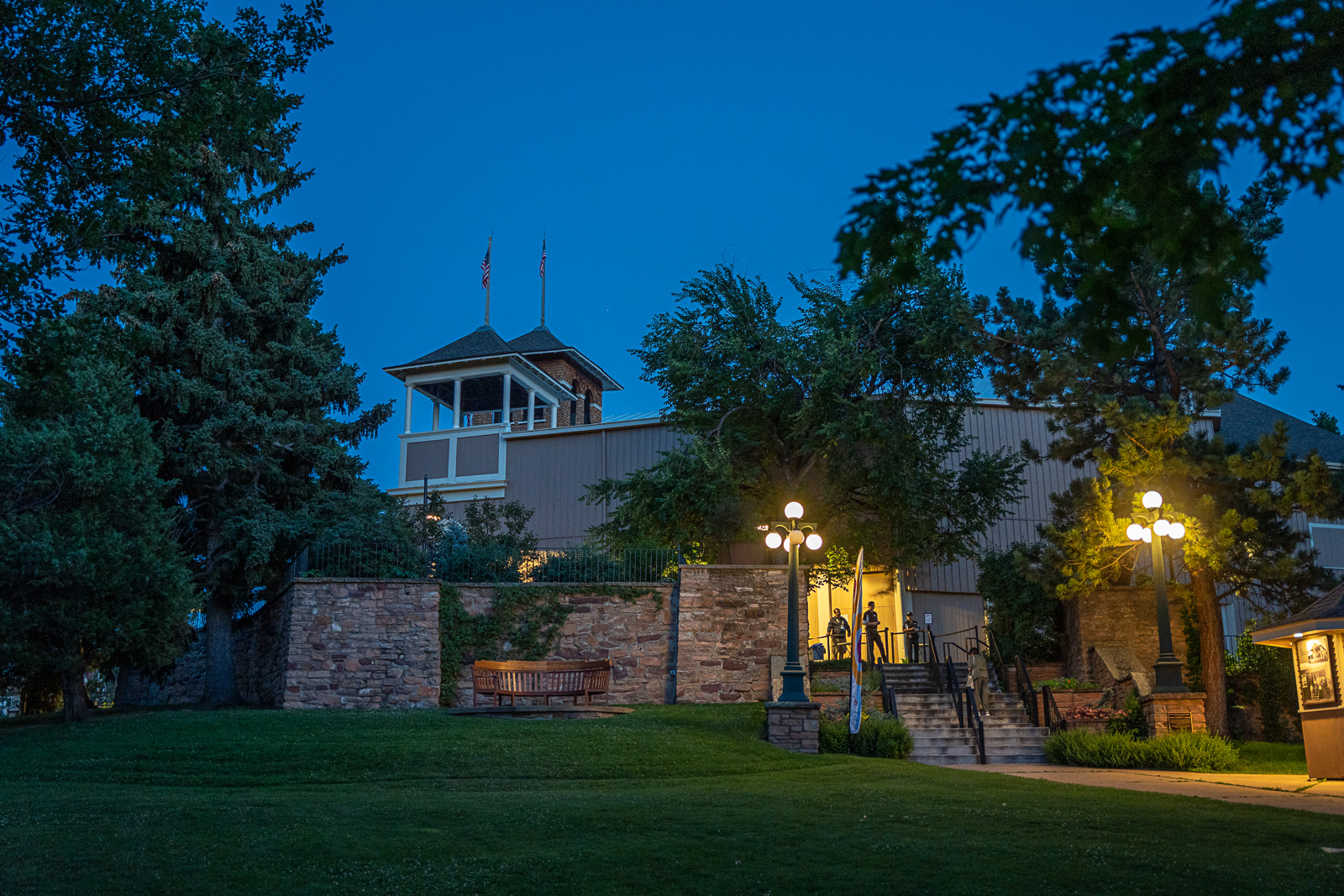
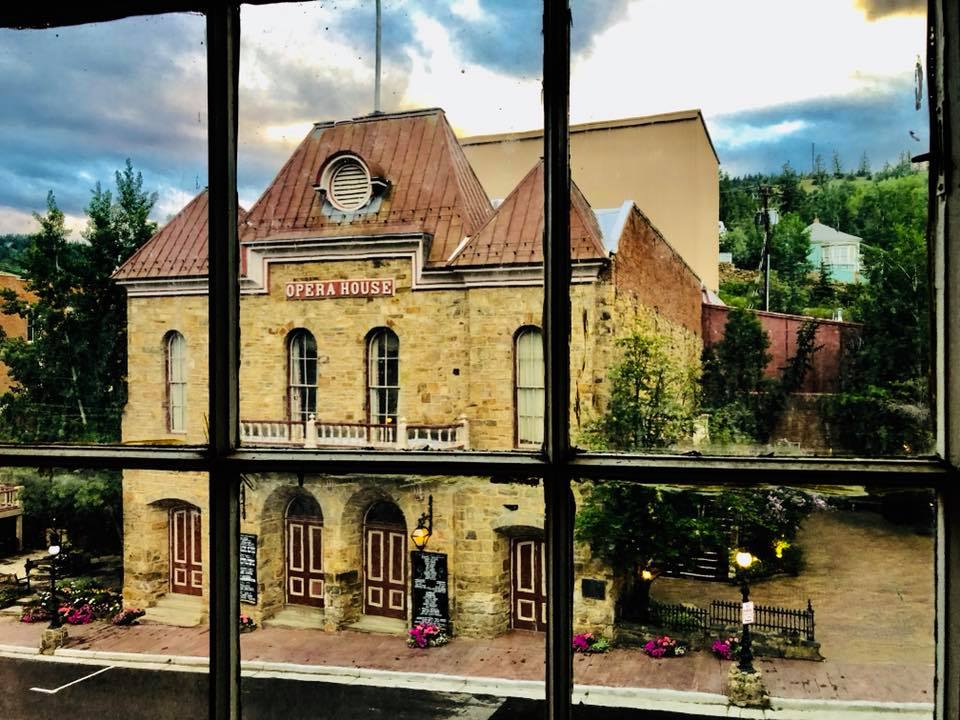
Central City Opera House. Photo by Ashraf Sewailam.
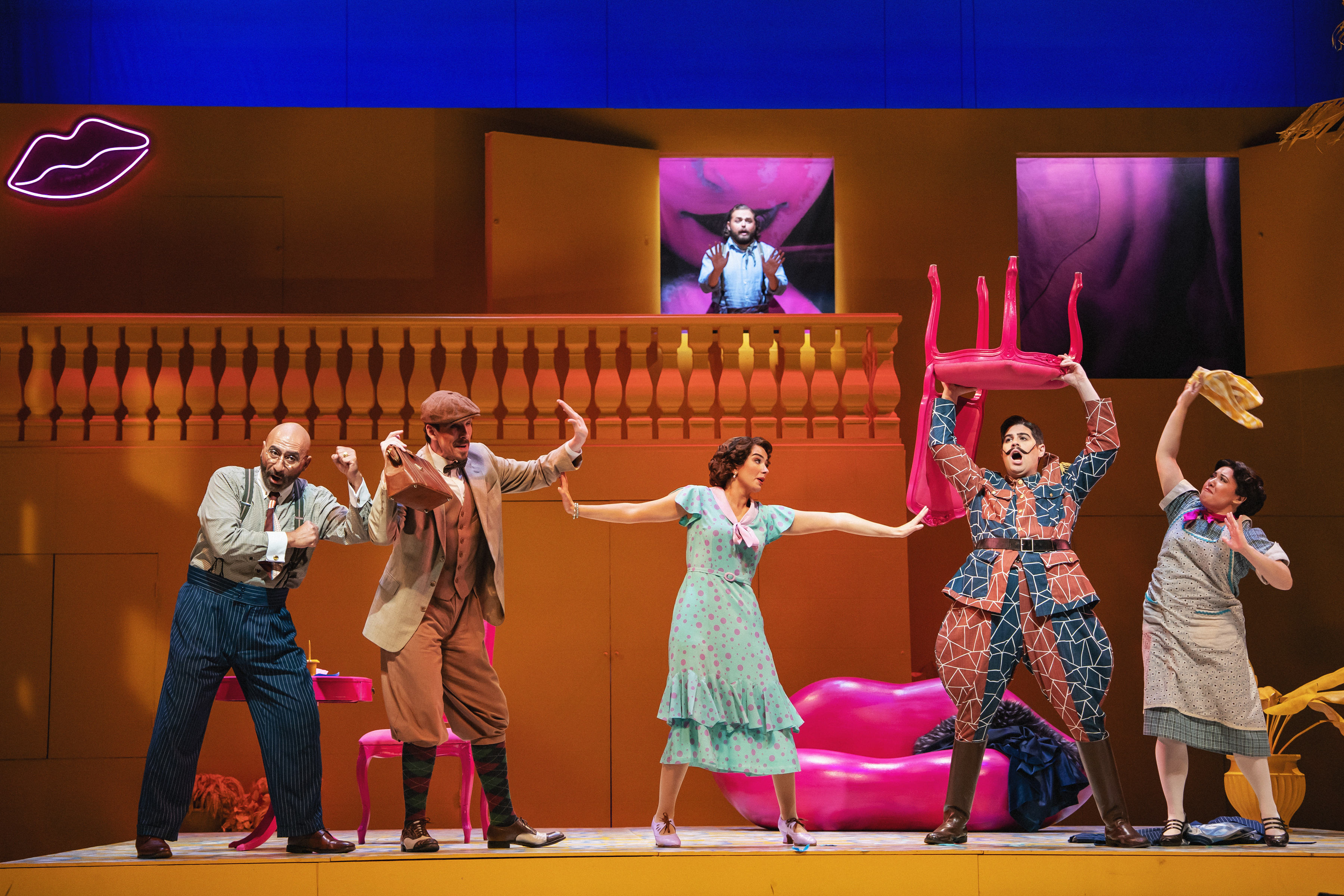
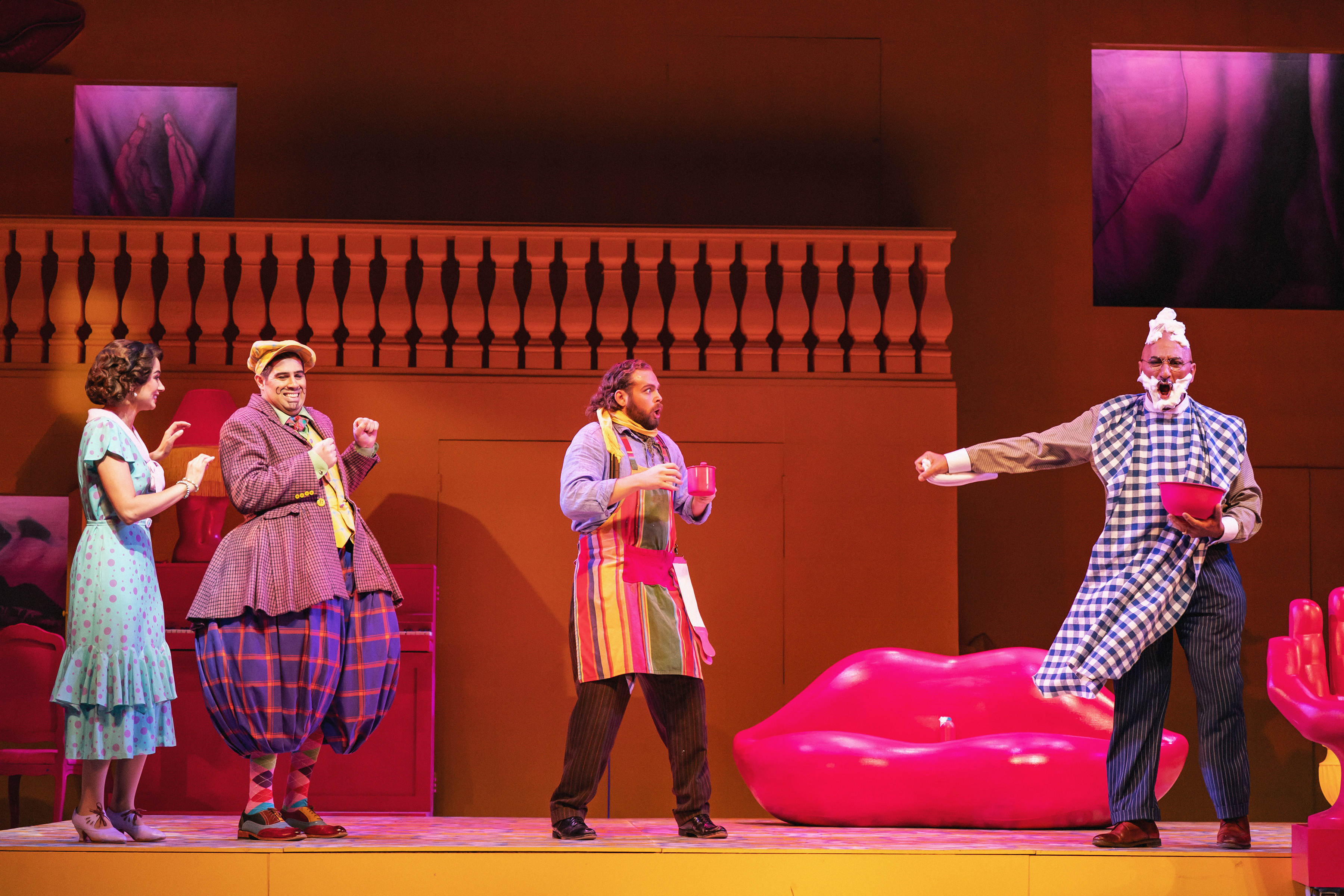
The Barber of Seville is presented with brilliantly colorful sets and costumes that belong to the Opera Theatre of St. Louis. Eric Sean Fogel’s Director’s Notes say that Barber has been placed “in 1930s Spain,” but that concept is almost irrelevant since it hardly touches the story. Stage design by Andrew Boyce reveals Rossini’s raucous comedy dressed up in bright, tropical colors—all yellow and pink on stage, plus a bright red sofa in the form of Rolling-Stones-reminiscent lips.
Costume design is by Lynly Saunders. She describes Barber as an opera “where you can really let loose,” and let loose she does. From police in 1930s-style uniforms—the one period reference that is unmistakable—each with one incongruously colorful sleeve, and giant sunflowers instead of rifles, to ridiculously overpuffed balloon pants and a garishly non-matched coat (or is it “power clashing”?), the costumes reveal a designer gleefully run wild. The crescendo of colors culminates with a joyful competition of surprise costume reveals by Almaviva and Rosina just before opera’s end. I can’t imagine anyone not being delighted by the over-the-top riot of colors.
Barber of Seville cast, L-R: Ashraf Sewailam (Dr. Bartolo), Stefan Egerstrom (Don Basilio), Lisa Marie Rogali (Rosina), Andrew Morstein (Almaviva), and Laura Corina Sanders (Berta); Luke Sutliff (Figaro), above. Image by Amanda Tipton Photography
Stage director Fogel does not shy away from pure farce, but as a cast member reminded me, Barber of Seville is supposed to be farce. There are multiple doors, people popping in and out unexpectedly, pratfalls, a piano wider than the stage, and even a collapsing chair. Whether the manic silliness ever crosses a line will be a matter of individual taste. For me it pushed the line, but the hilarity was irresistible from beginning to end.
The vocally strong cast embraced the production’s style with exuberant energy. As Almaviva, Andrew Morstein had difficulty negotiating registers at the outset and sounded strained at top volume, but was comfortable and sang with expression in his gentler moments. He got stronger across the evening, managing Rossini’s leaps and runs with increasing security, and finished as a winning romantic lead.
Luke Sutliff made a terrific Figaro, filling the theater with his voice and his personality. As Fogel observes in his notes, Figaro is the barber of the title, but the young lovers Almaviva and Rosina want to capture our attention. The direction and Sutliff’s performance make Figaro both the factotum who gets things done in Seville and the mainspring of the opera’s action, as he should be.
Ashraf Sewailum, known locally from previous performances at Central City, the University of Colorado Eklund Opera Company, and numerous concert appearances in Boulder, was brilliantly blustering and periodically baffled as Dr. Bartolo. His full bass voice easily filled Central City’s house. Both his musical phrasing and comic timing made him one of the stars of the show.
L-R: Rosina (Lisa Marie Rogali), Count Almaviva (Andrew Morstein), Figaro (Luke Sutliff) and Dr. Bartolo (Ashraf Sewailam). Image by Amanda Tipton Photography
Mezzo-soprano Lisa Marie Rogali lent her strong, resonant lower register and bright, sweet upper notes to the role of Rosina. Her melting lyricism and confidence in the coloratura passages made her trademark aria “Una voce poco fa” a highlight. Happily she captured the strength and determination of the character, avoiding cliches of the submissive ward and previewing the independent countess of Mozart’s Marriage of Figaro.
Stefan Egerstrom humorously portrayed Don Basilio as a purse-carrying, prancing dandy. His on-target performance was one of the keystones of the interpretation of Barber as farce. Equally fit for her comic role was Laura Corina Sanders as Berta, the unruly servant. She took full advantage of the possibilities the over-the-top production style offered her character.
Louis Lohraseb, who has conducted opera in Rome, Hamburg, Dresden and Berlin, made his Central City Opera debut leading Barber. Under his baton, the orchestra played with stylish restraint, never overpowering the singers. The overture was bright and energetic, despite a few soggy moments.
# # # # #
Nestled between two comedies, Aleksandra Vrebelov’s The Knock tackles the deeply serious question of the hidden pain and tragedies of war. During the 2003–11 Iraq war, American military wives endure a long night of suspense when they are cut off from communication with their husbands in Fallujah. The title refers to the dreaded knock on the door, when a military officer will officially notify one of them of her husband’s death.
Vrebalov’s score was receiving only its second full stage production, since the planned premiere at the 2020 Glimerglass Festival had to be presented on film, due to COVID. The performance at Central City was a fitting regional premiere, as The Knock is set in and around Ft. Carson, Colorado.
Born in Serbia, Vrebalov directly experienced the horrors of war during the 1998–99 Kosovo War and the devastating NATO bombing of her hometown of Novi Sad. This experience stands behind several of her most successful pieces.
In The Knock, her subtle music expresses the rising tension among the military wives at home through steady background chords and ostinato patterns that increase in intensity. A sharp and expressive score, it signals the buildup of despair and fear without resorting to bombast.
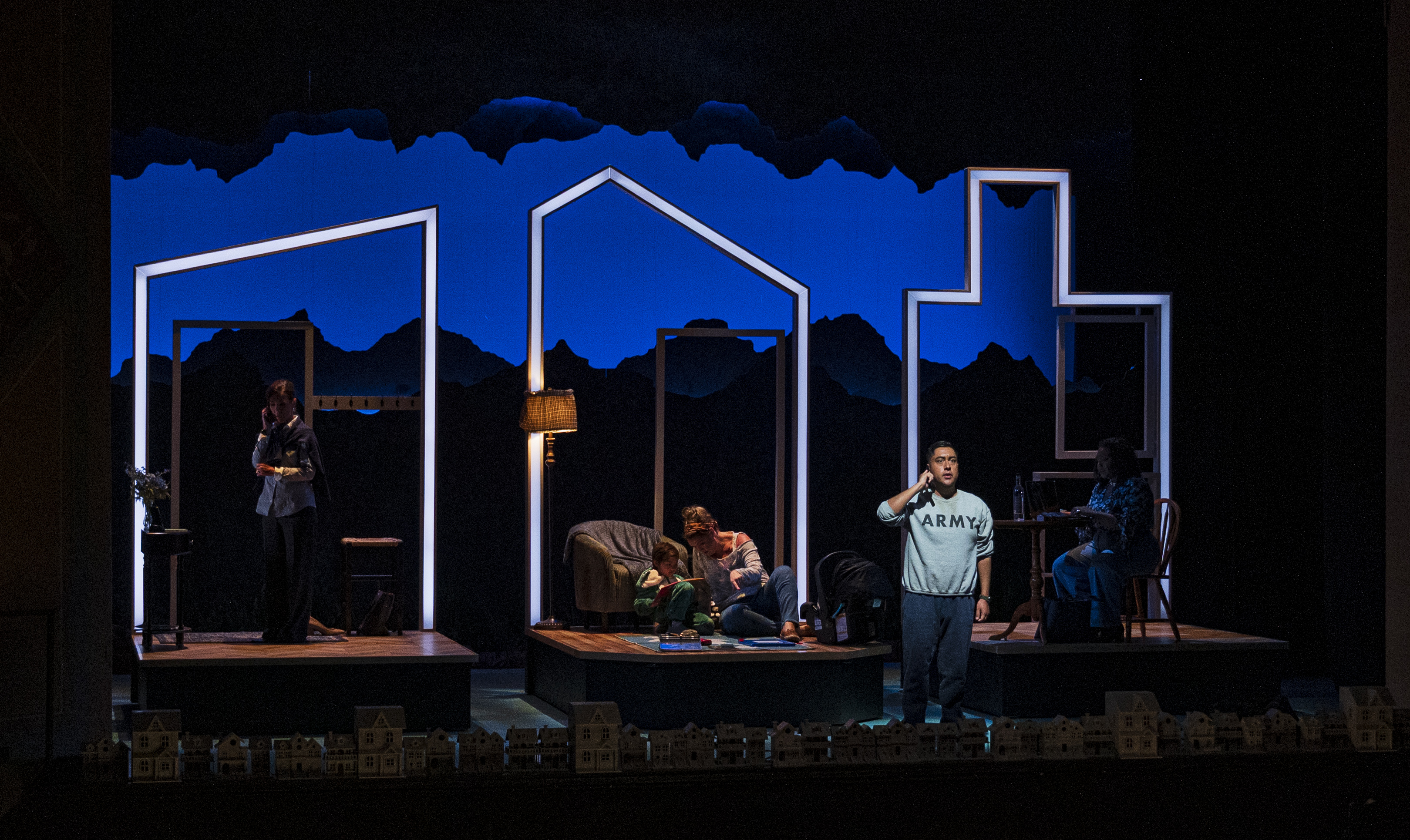
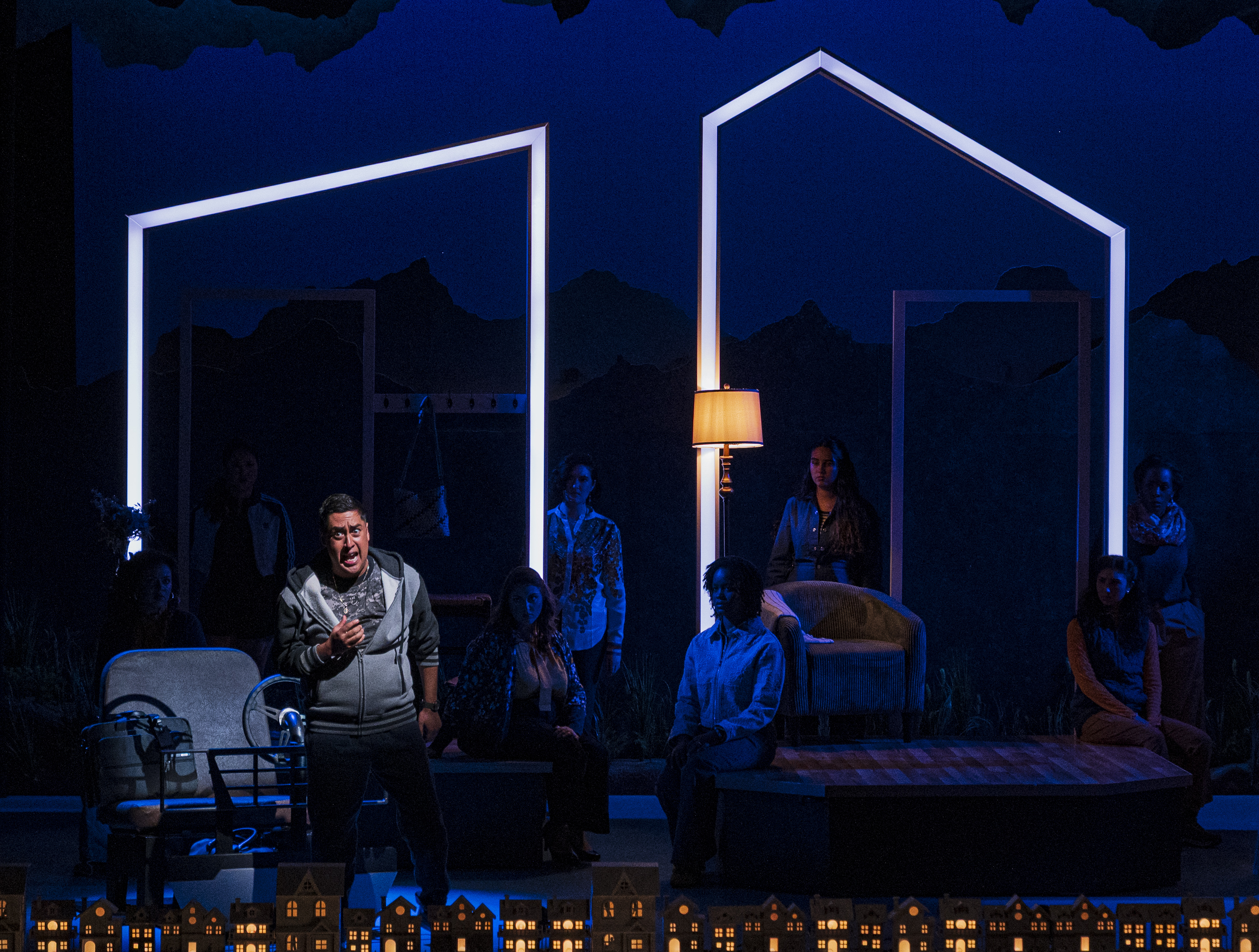
The three houses that form the setting of The Knock. Downstage, Lt. Robert Gonzalez (Armando Contreras) gets the call to deliver “the knock.“ Photo by Lawrence E. Moten III.
The evocative set by Lawrence E. Moten III comprises brightly lit outlines of three houses, those of Jo, Aisha, and an unnamed other military wife. A row of tiny houses across the front of the stage, sometimes lit from inside, represent the larger community of military families. In the back, the outline of Colorado mountains can be seen against a deep blue late-evening sky that is symbolically lit with stars at show’s end.
Three characters dominate the action. Joella “Jo” Jenner is a young wife and mother of two who is undergoing her first nighttime vigil waiting for word from the battlefield. Portraying a nearly one-dimensional character—the mother terrified for herself and her children—Mary-Hollis Hundley ably expresses Jo’s unease and her fragility.
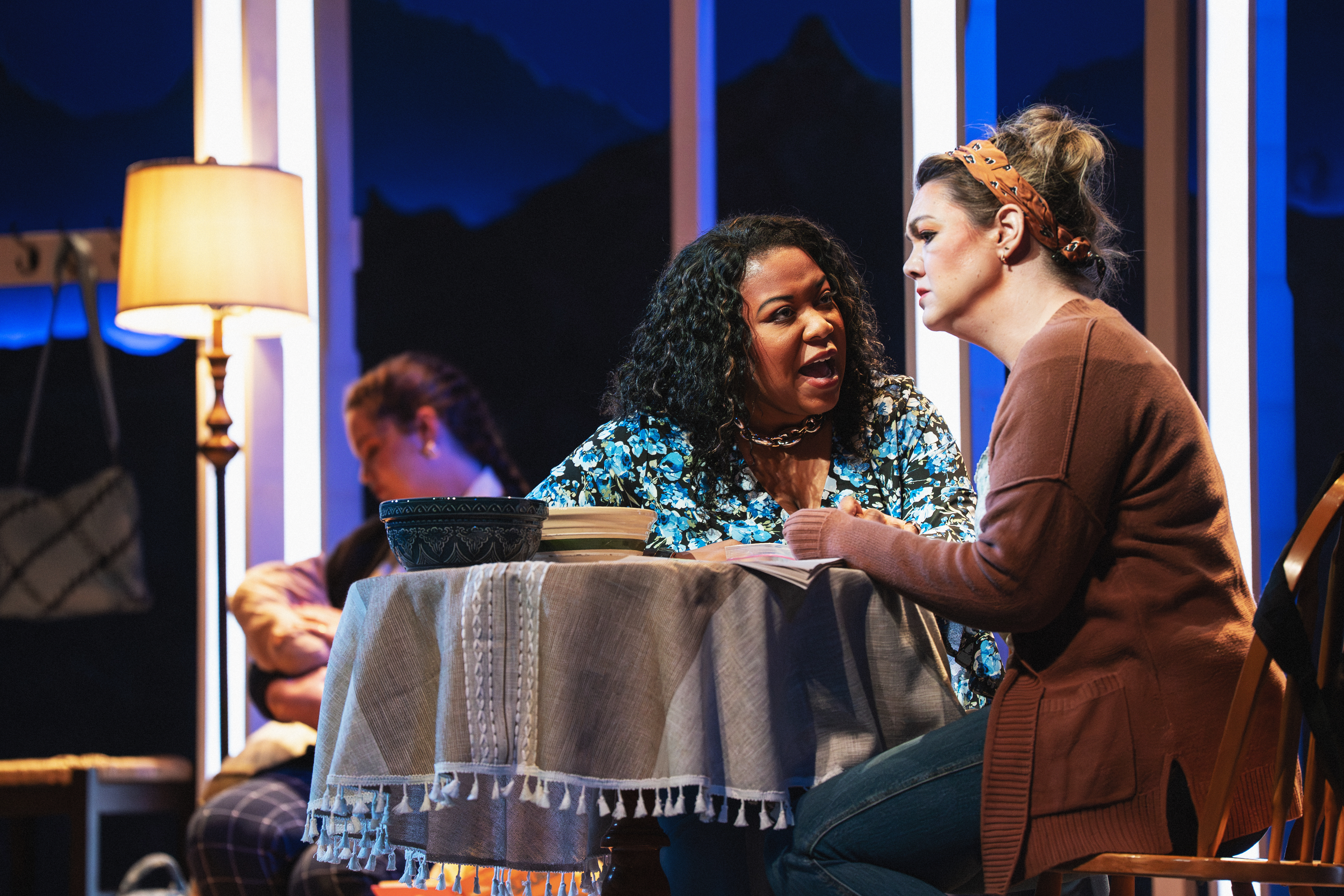
Aishah (Cierra Byrd) tried to console Jo Jenner (Mary-Hollis Hundley). Image by Amanda Tipton Photography
Paired with Jo is Aishah McNair, a more experienced military wife who tries to offer support and perspective to the young mother. Cierra Byrd gave Aishah depth, especially near the end when launching the number “When the person you love is far away,” which blooms into an ensemble number. Her warm, smokey contralto complimented Hundley’s more delicate soprano throughout their scenes together.
Lt. Roberto Gonzalez is a young soldier tormented by being stationed in the U.S. while his comrades face combat. He has been tapped to deliver the mournful news—the knock—for the first time, leaving him nervously trying to fulfill the duties as described in the manual.
Lt. Gonzalez (Armando Contreras) agonizes over his duty to deliver the news of a soldier’s death. Photo by Lawrence E. Moten III.
Baritone Armando Contreras overplayed Gonzalez’s stress, staying at a high volume and almost shouting his way through parts of the role. His repeated invocations of the Virgin de Guadalupe were more than needed, since his sincere faith and apprehension are evident from the start. His lovely singing in the concluding ensembles, when Lt. Gonzalez relaxes into tender feelings for the women he confronts, show that he has a wider range of expression and styles than are heard for most of the opera.
Conductor David Bloom managed the mixed chamber ensemble in the pit comfortably, keeping the music moving through the rather extreme emotional ups and downs of the characters. Moritz’s stage direction effectively kept the action clear, as it moved from separate houses, to one house where the wives gathered, to scenes of Lt. Gonzalez facing his fears while traveling cross country.
The poignant conclusion of the opera—with one wife facing a devastating development and the others embracing relief—provides music that expresses both sentiments, or as the text has it, “Joy and Sorrow.” And the concluding lines describing the folded flag that every war widow receives, “Blue and Stars are All that will Remain,” remind us eloquently of the show’s central point, that the ripples of war’s tragedies spread across society. It is a sobering moment in a powerful piece.
# # # # #
Once Upon a Mattress, which opened Saturday (July 12), was the first full-length Broadway show by Mary Rodgers, daughter of the famed Broadway composer Richard Rodgers who was half of the musical-comedy teams of Rodgers & Hart and Rodgers & Hammerstein. Growing up in so musical an environment, Mary Rodgers naturally took to composing as a teenager, and had a very successful career writing music for children’s records, musicals and reviews, and was the author of several children’s books.
Her one big Broadway hit, Once Upon a Mattress opened in 1959 and perfectly fits the mold of 1940s and ‘50s musicals. It offers ample opportunities for catchy songs, quirky characters, a heavy dose of theatrical silliness, and a thoroughly happy ending. The music is never compelling or deeply memorable, but it is never less than pleasant. The book is full of gags and jokes that elicited hearty laughter from the audience on Saturday.
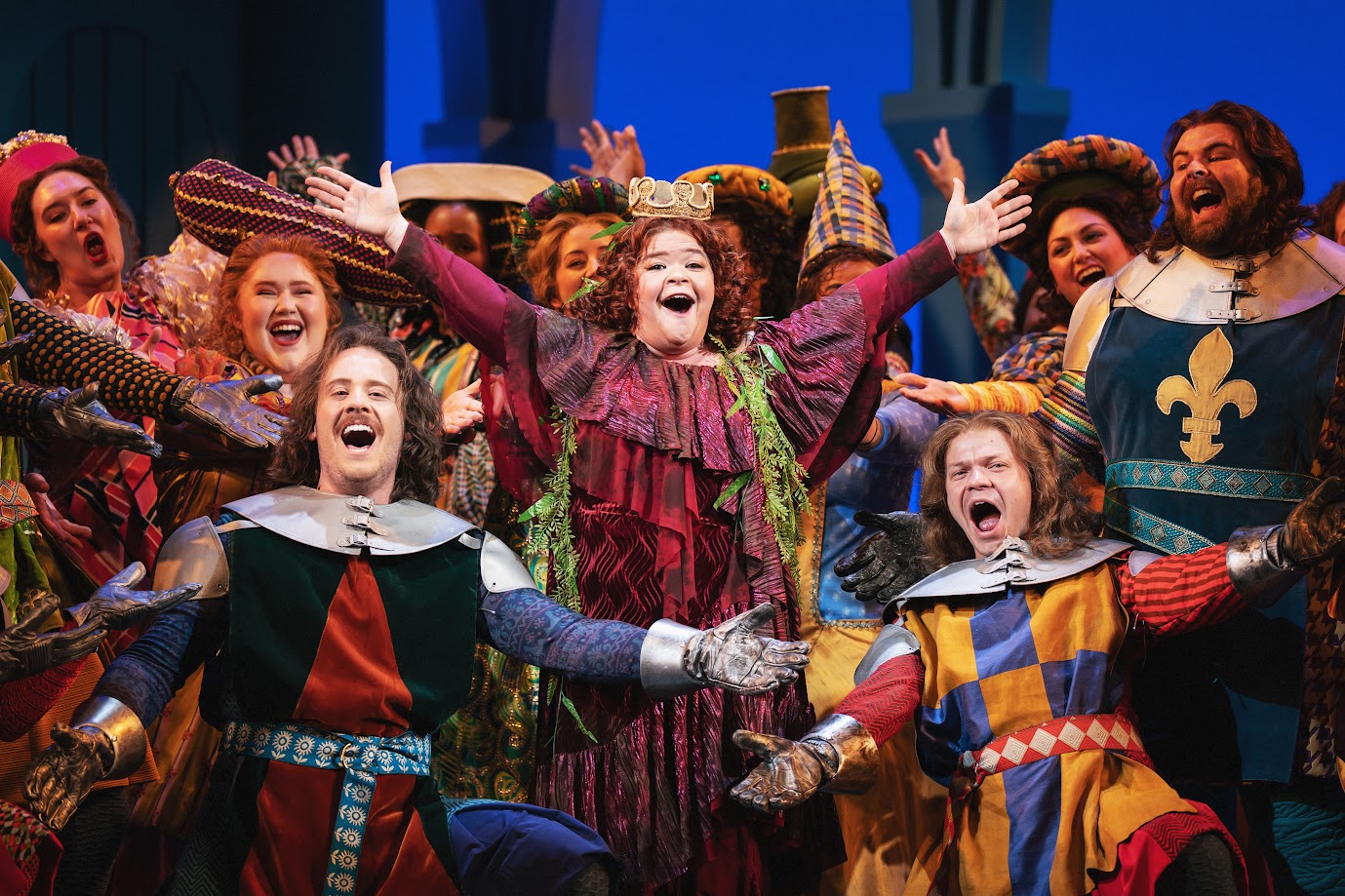
Ensemble cast of Once Upon a Mattress. Princess Winifred (Marissa Rosen) draped with weeds from the moat, center. Image by Amanda Tipton Photography
The plot skates cheerfully on the surface of the Hans Christian Anderson tale of “The Princess and the Pea,” with a goofy young Prince dominated by a despotic mother who will only allow him to marry a proper princess. In the meantime, no one in the kingdom—or is it queendom, since his father is mute?—is allowed to marry until the timid Prince Dauntless the Drab is wed to a suitably, queen-approved mate.
A hopeful candidate shows up in the form of Princess Winifred the Woebegone from a marshy realm—the Broadway debut role of Carol Burnett in 1959. Queen Aggravain has imposed a test on every potential bride, which all have failed. For Winifred she devises the pea under 20 mattresses (actually 14 at Central City), with the expected result.
All of these more or less stereotyped characters were portrayed with the broad humor the show wants. Everyone in the cast had a suitably lyrical musical theater voice, capable of crooning all the ballads and other musical numbers of the score. There are a few solo numbers and many duets and ensemble numbers, all well handled by the consistency solid cast.
Margaret Gawrysiak was everything you could want for Queen Aggravain—imperious, haughty, comically unyielding and too eager by half to rule out potential brides. Michael Kuhn was an ideal Prince, completely under the sway of his controlling mother, with just the right touch of modern nerdiness thrown in. Marissa Rosen made an especially strong impression as Princess Winifred, with just enough of her own nerdiness to captivate Dauntless. She projected the latent athleticism fitting for a princes who, in a moment shocking to the court, “swam the moat” and entered trailing tangles of weeds.
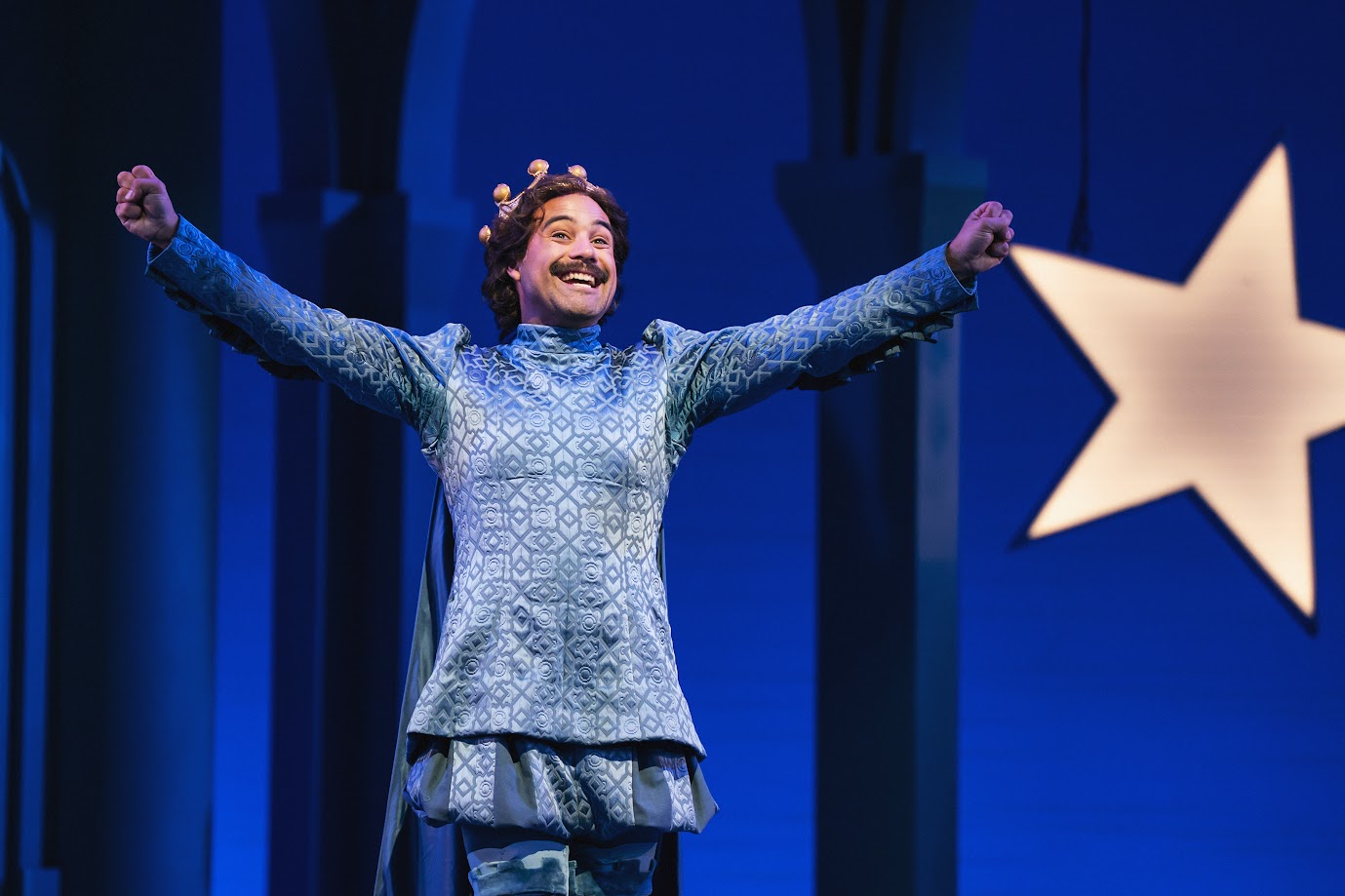
Prince Dauntless the Drab (Michael Kuhn). Image by Amanda Tipton Photography
As the Jester and Minstrel, Alex Mansoori and Bernard Holcomb were well matched stage buddies, either bantering or singing together. Jason Zacher made good use of his short appearances as a wizard who does parlor tricks at random moments. The on-again, off-again couple of Sir Harry and Lady Larken, who have a growing reason for the ban on marriage to be lifted. The couple were well portrayed by Schyler Vargas, who had fun with Sir Harry’s sense of importance, and Véronique Filloux, fittingly flighty as Lady Larken. Together they captured all the traditional nuances of the couple who are happiest while quarreling.
Special mention must be made of Andrew Small, who delighted in his CCO debut as the mute King Sextimus, who has an unfulfilled taste for the ladies in waiting at the court. The son of a musician who played in the CCO orchestra in the 1980s, Small first attended the opera when he was 10, leading to a career on stage. He wrote for the program that performing at CCO is “a deeply meaningful, full-circle moment.”
Seated at the very back of the house I could not always hear the voices over the orchestra. Out from under the balcony and closer to the stage, the sound was probably better. In all other respects conductor Kelly Kuo led a stylish and energetic performance.
The scenic design by Andrew Boyce fits the classic Broadway ambience perfectly, walls and arches suggesting a cartoonish court. The costumes by Elivia Bovenzi Blitz are standard theater-medieval—colors and fabrics no one saw in the middle ages, but pleasantly evocative of make-believe realms.
The stage direction by Alison Fritz, the artistic director of CCO, kept the show moving seamlessly. John Heginbotham’s choreography was handled smoothly by all of the acting/singing/dancing members of the large cast.
Those who love Broadway will relish the opportunity to attend a professional production of Once Upon a Mattress, performed with full orchestra and Broadway-worthy voices. If that’s your dish, go for it! If not, the farcical Barber of Seville and deeply thoughtful The Knock are equally worth a trip into the mountains.
NOTE: Performances of all three shows at Central City continue through the month and into August. The full schedule is listed below.
# # # # #
Central City Opera Remainder of the 2025 Summer Festival Season All performances in the Central City Opera House, Central City, Colo.
Rossini: The Barber of Seville
7:30 p.m. Saturday, July 19 2 p.m. Tuesday, July 15; Friday, July 25; Saturday, July 26; Wednesday, July 30; Sunday, Aug. 3
Aleksandra Verbalov: The Knock
7:30 p.m. Saturday, Aug. 2 2 p.m. Sunday, July 19; Tuesday, July 22
Mary Rodgers and Marshall Barer: Once Upon a Mattress
7:30 p.m. Saturday, July 26 2 p.m. Wednesday, July 16; Friday, July 18; Sunday, July 20; Wednesday, July 23; Sunday, July 27; Tuesday, July 29 Friday, Aug. 1; Saturday, Aug. 2
Tickets for all remaining performances are available on the CCO Web Page.
Eric Whitacre’s Murmur features violinist Anne Akiko Myers
By Peter Alexander July 13 at 9 a.m.
Peter Oundjian often speaks in superlatives.
CMF Music Director Peter Oundjian
The music director of the Colorado Music Festival (CMF) says that the next two weeks of the festival (July 15–July 25) includes one of the composer’s “greatest pieces,” an overture that is “absolutely exquisite,” maybe “the most beautiful melody ever written,” and “an exquisite symphony” that is “as close to perfection as you can imagine!”
You might think he loved the music he will conduct.
Such enthusiasm tends to be contagious, and usually extends to both musicians and audiences. To find out for yourself, go to the festival’s Web page for tickets. (The full program of concerts for those dates is listed below.)
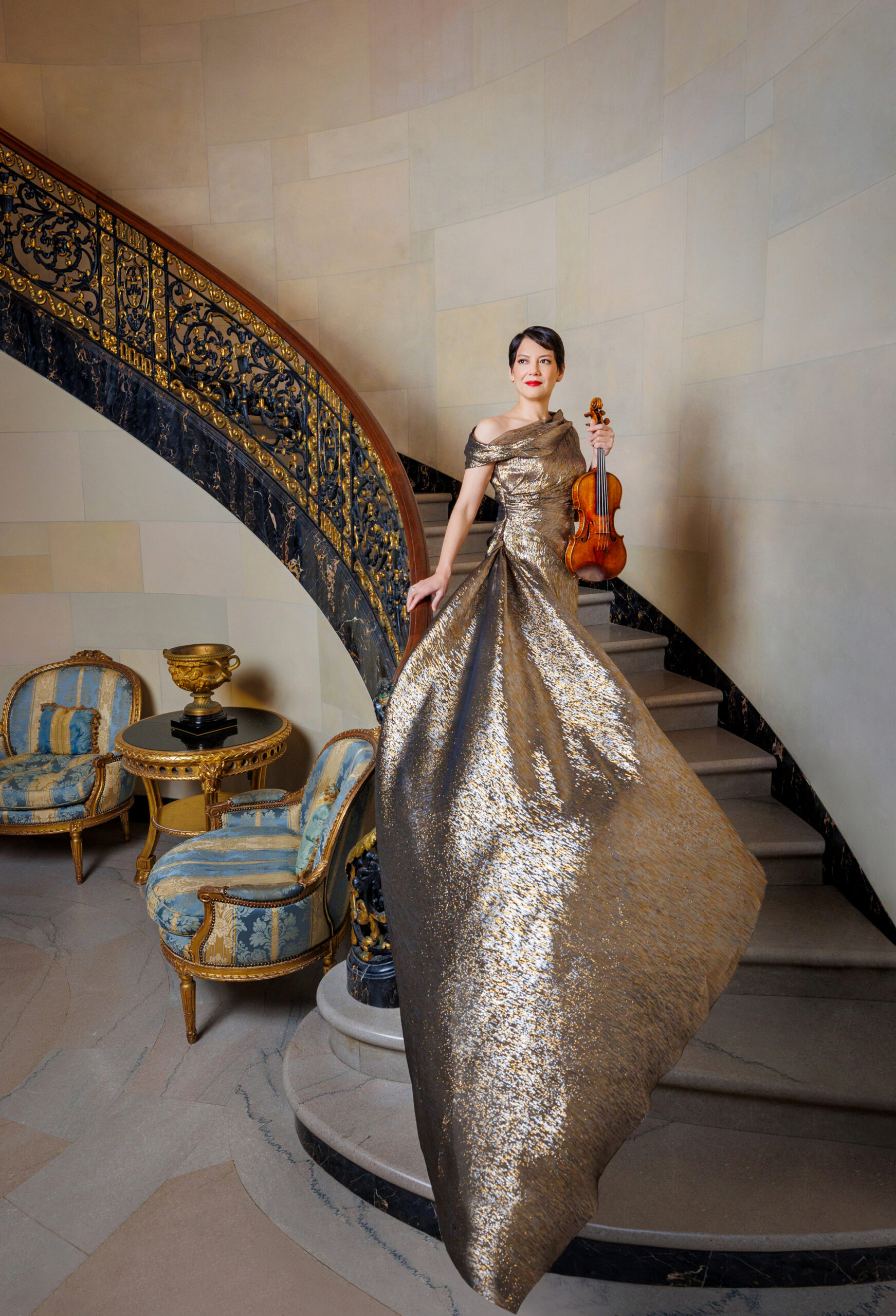
Violinist Anne Akiko Myers. Photo by David Zentz.
The next Festival Orchestra concert on Thursday and Friday evenings (7:30 p.m. July 17 and 6:30 p.m. July 18) features a work co-commissioned by the CMF from composer Eric Whitacre, who is best known for his choral music. Oundjian explained that he met with Whitacre in Los Angeles, “and we had a wonderful chat. I asked him what he was up to, and he already had this plan to write something for (violinist) Anne Akiko Meyers. At that point we said, ‘Let’s do it at the festival!’
Composer Eric Whitacre
“It’s a short, very tender piece, only for strings. It ended up being a memorial to everyone who lost so much in the fires (in Los Angeles the past January). So it’s a very touching piece.”
The program opens with Aaron Copland’s Appalachian Spring, one of the most loved pieces of American concert music. “That’s still one of (Copland’s) great pieces,” Oundjian says. “It epitomizes what we think of as the great middle-20th-century American music.”
After intermission, the program features two works inspired by Shakespeare, and two very different pairs of lovers. First is Berlioz’s Overture to the opera Béatrice et Bénédict, based on the taunting, bickering “merry war” between the two characters in the comedy Much Ado about Nothing. That will be followed by Tchaikovsky’s Fantasy Overture inspired by the tragic teenaged lovers of Romeo and Juliet.
“The second half is one of my favorite little moments (of the summer), because it’s two completely contrasting couples,” Oundjian says. “The Berlioz is absolutely exquisite. And you might think you’ve heard (Tchaikovsky’s Romeo and Juliet) too many times, and then you hear it again, and Oh My God! Is it the most beautiful melody every written?”
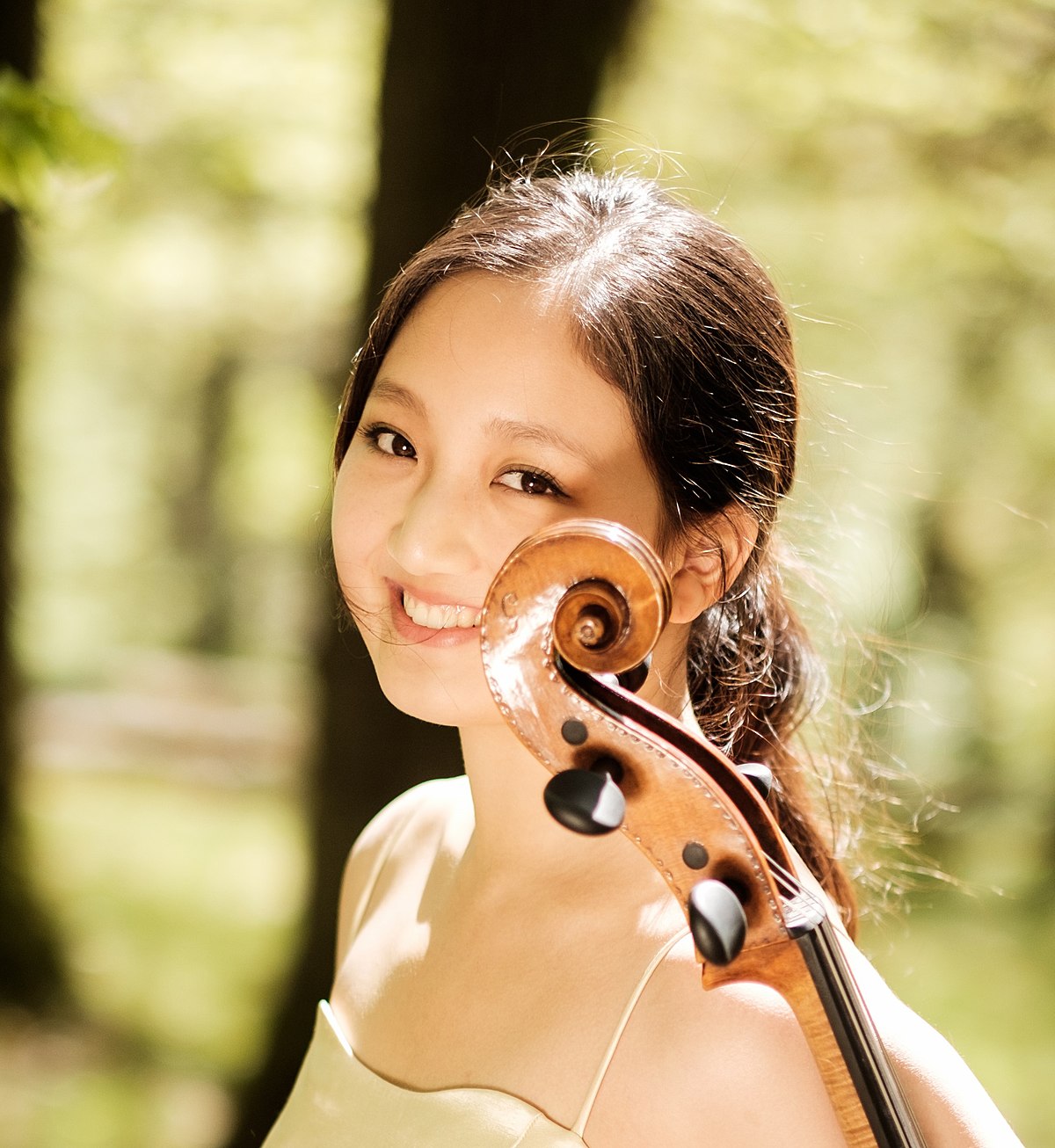
Cellist Hayoung Choi
On the following Sunday, guest conductor Maurice Cohn will lead the orchestra with South Korean/German cellist Hayoung Choi playing Tchaikovsky’s Variations on a Rococo Theme. One of Tchaikovsky’s most popular orchestral works, the Variations were inspired by the style of Mozart. Also on the program is Gli uccelli (The Birds), a suite for small orchestra that, like the Tchaikovsky, was inspired by music of an earlier age—in this case pieces evoking the sounds of birds from the 17th and 18th centuries.
Another guest conductor, Ryan Bancroft of the BBC National Orchestra of Wales and the Royal Stockholm Philharmonic, will lead the CMF orchestra at the end of the following week (7:30 p.m. Thursday, July 24, and 6:30 p.m. Friday, July 25). South Korean pianist Yeol Eum Son will play Beethoven’s Piano Concerto No. 3 in C minor on a program that also includes the Fairy Tale Poem by Russian composer Sofia Gubaidulina, a musical fantasy based on a children’s story.
Ryan Bancroft. Photo by Benjamin Ealovega
Gubaidulina’s score portrays the tale of a piece of chalk that dreams of drawing castles and gardens, in spite of being confined to writing words and numbers in a school classroom. At the end, the dream comes true when a boy carries the last little piece of chalk home in his pants pocket.
The program concludes with a more deeply serious Russian work, Shostakovich’s Symphony No. 10. Like many of the composer’s works, the symphony contains esoteric musical symbols, including a musical anagram on letters of the composer’s name, and another musical anagram spelling ELMIRA, which the composer himself noted is similar to a theme from Mahler’s bleak Lied von der Erde (Song of the earth).
Oundjian returns to conduct the Festival Orchestra on Sunday, July 27. Chinese classical guitarist Xuefei Yang will play Joaquin Rodrigo’s Concerto de Aranjuez. Oundjian and the orchestra will play the Dances of Galánta, based on folk dances by the Hungarian composer Zoltán Kodály, and Schubert’s early Symphony No. 5.
“Schubert 5 is an exquisite symphony,” Oundjian says. “Nobody plays Schubert symphonies except maybe the ‘Unfinished,’ but Schubert 5—ah! It’s as close to perfection as you can imagine. If you think about how often pianists play the piano sonatas, or string quartets play the quartets, or the Trout Quintet, the symphonies kind of get ignored.”
Guitarist Xuefei Yang
Not ignored is the Concerto de Aranjuez, arguably the most popular concerto for classical guitar. “I love Concerto de Aranjuez” is Oundjian’s judgment. “We haven’t done it in years, so it’s time. And an amazing guitarist, Xuefei Yang. Oh my god what a musician!”
Between the Festival Orchestra concerts there will be Tuesday chamber music concerts by the Brentano String Quartet with music by Schubert and Brahms (7:30 p.m. July 15), and CMF musicians with music by Mozart and Dvořák (7:30p.m. July 22). The full programs and ticket information are listed below.
# # # # #
Colorado Music Festival, Peter Oundjian, music director Tuesday, July 15–Sunday, July 25 All performances in Chautauqua Auditorium
Chamber Music Concert Brentano String Quartet
Schubert: Quartet in A minor, D804 (“Rosamunde”)
Anton Webern: Five Movements for String Quartet, op. 5
Brahms: String Quartet No. 3 in B-flat major, op. 67
7:30 p.m. Tuesday, July 15
Festival Orchestra Concert Peter Oundjian, conductor With Anne Akiko Meyers, violin
Copland: Appalachian Spring
Eric Whitacre: Murmur (CMF co-commission)
Ravel: Tzigane
Berlioz: Overture to Béatrice et Bénédict
Tchaikovsky: Romeo and Juliet Fantasy Overture
7:30 p.m. Thursday, July 17 6:30 p.m. Friday, July 18
Festival Orchestra Concert Maurice Cohn, conductor With Hayoung Choi, cello
Respighi: Gli uccelli (The birds)
Tchaikovsky: Variations on a Rococo Theme, op. 33
Beethoven: Symphony No. 1 in C major, op. 21
6:30 p.m. Sunday, July 20
Chamber Music Concert Colorado Music Festival musicians
Nico Muhly: Doublespeak (2012)
Mozart: Quintet for piano and winds in E-flat major, K452
Dvořák: String Quintet No. 3 in E-flat major, op. 97
7:30 p.m. Tuesday, July 22
Festival Orchestra Concert Ryan Bancroft, conductor With Yeol Eum Son, piano
Sofia Gubaidulina: Fairytale Poem (Märchenpoem, 1971)
Beethoven: Piano Concerto No. 3 in C minor, op. 37
Shostakovich: Symphony No. 10
7:30 p.m. Thursday, July 24 6:30 P.M. Friday, July 25
Festival Orchestra Concert Peter Oundjian, conductor With Xuefei Yang, guitar
Zoltán Kodály: Dances of Galánta
Joaquin Rodrigo: Concerto de Aranjuez
Schubert: Symphony No. 5 in B-flat major, D485
6:30 p.m. Sunday, July 27
Tickets to all concerts available through the CMF Web page.
Well shaped performance of “the greatest First Symphony”
By Peter Alexander July 11 at 12:24 a.m.
The world premiere of an engaging concerto for saxophone by American composer Joan Tower topped the bill at the Colorado Music Festival last night (July 10).
The Festival Orchestra was conducted by CMF music director Peter Oundjian, with Steven Banks as saxophone soloist. Tower was present for the premiere performance of her new score, and spoke briefly before the performance.
Titled Love Returns, the score is derived from a piece for solo piano titled Love Letter that Tower wrote in memory of her late husband after his death in 2022. Poignant, well constructed and emotionally coherent, Love Returns should become part of the concert repertoire for saxophone.
The first of the work’s six movements starts tenderly, with beautiful string sounds providing a warm embrace for the soloist. Over the next three movements, the music grows in intensity, reaching an uneasy high point built from nervous swirls in the saxophone. The Fifth movement is a solo cadenza, developing jumpy fragments of scales.
A virtuosic series of edgy passages leads into the final movement, where the nervous swirls loosen and return to the calm of the work’s opening. This creates a perceptible expressive arc, while the gentle ending suggests a moment of acceptance before the music settles into silence.
With a sweet tone and flawless technique, Banks gave an exemplary performance. The fluidity of his rapid passagework was remarkable, and he moved smoothly through all the shifts of mood and style. He has the ability to fade to silence in even the highest register. If recorded, his performance would create the standard for this valuable new work.
The concert opened with Aaron Copland’s Outdoor Overture, a strongly profiled work written for students at the High School of Music and Art in New York. To recognize the work’s origin, Oundjiuan turned over the podium to the CMF’s young assistant conductor Stefano Boccaci, who lead a bracing performance.
Copland’s alternating sections of vigor and delicacy were well marked. As appropriate for a school piece, all sections of the orchestra have opportunities to step forward. The bright trumpet solos of principal Jeffrey Work were acknowledged at the end, but every section earned recognition.
The concert ended with Brahms Symphony No. 1, which Oundjian likes to call “the greatest first symphony ever written.” Before the performance, he also noted that Brahms took 21 years to complete the symphony, during which time he progressed from a callow young musician to an experienced composer of international rank.
Oundjian and the Festival Orchestra gave a well shaped, controlled performance. The tense introduction to the first movement promised the drama to come. Throughout the engrossing first movement, the music surged from the tiniest pianissimos to full Brahmsian fortes. Oundjian convincingly varied the tempo to match the expressive needs of the score.
The slow second movement was carefully played but never came alive. The third movement projected relaxed good cheer, especially in the strolling music played by the woodwinds. Drama came to the fore again in the finale, which Oundjian built carefully to the climax. I heard bravos and cries of “Oh My God” at the end, signaling how well the symphony reached the audience.
The program will be repeated at 6:30 tonight (July 11) at the Chautauqua Auditorium. Tickets are available through the CMF Web Page.
Festival-opening concert ends with a crashing wave of sound
By Peter Alexander July 4 at 12:30 a.m.
It was July 3, and the fireworks started early at Chautauqua.
They were musical fireworks, as the 49th Colorado Music Festival (CMF) got underway last night with music by Russian composer Igor Stravinsky, literally titled “Fireworks” (Feu d’artifice). CMF music director Peter Oundjian conducted the Festival Orchestra in a fleet, bright performance of Stravinsky’s sparkling showpiece for orchestra.
Music director Peter Oundjian with the Festival Orchestra. Photo by Geremy Kornreich
The brief opener was followed by soloist Hélène Grimaud performing Brahms’s First Piano Concerto. Before the performance, Oundjian said that the performance would represent the young Brahms—he was 21 when he started it—rather than the older, bearded Brahms we often see in photographs. I suppose he meant that the more muscular passages were imbued with youthful energy and strongly contrasted with the more tender passages.
The acoustics in the Chautauqua Auditorium flatter the orchestra more than the soloist, whose detailed, expressive playing was not always clearly heard. Here the pianist’s case is not helped by the fact that the piece went through several iterations, including a symphony. Consequently, the solo part does not always stand apart from the orchestra.
No live performance can match the balance of a carefully engineered recording, but it’s too bad Grimaud could not always overcome the orchestral sound. What I heard of her playing was forceful and arresting. The contrasts within the music were well delineated, providing a firm sense of form and movement to the performance.
The first movement was marked by the bright clarity of the woodwinds and the rich warmth of strings. Grimaud provided a well controlled profile of the lines and passages of the expressive slow movement, and took hold of the finale’s boisterous rondo theme from the very first. Even when the balance was less than ideal, you had the sense that she was in control of the music’s momentum. The audience, as CMF audiences do, responded with effusive enthusiasm.
The second half of the concert was devoted to music by Ravel, who this year celebrates the 150th anniversary of his birth. A great orchestrator, Ravel understood the orchestra so well that his music almost plays itself. That is, if you can play it—which Festival Orchestra can.
The two pieces presented last night, Suite No. 2 from Daphnis and Chloé and Bolero, are essentially about sound. The orchestra created magic from the very first gentle, rippling sounds in the woodwinds at the start of the Suite. The music surged to a strong climax in the full orchestra, followed by several evocative scenes of a more placid nature.The solo flute, Viviano Cuplido Wilson played her extensive solos with a warm, controlled sound and received individual recognition by Oundjian during the ovation.
Bolero is a piece that is heard not enough and too much. We don’t hear it often enough as written, but we hear it too often in cheesy arrangements that don’t honor the carefully calculated shape composed by Ravel.
Ravel’s score is about two things: an unchanging tempo as the theme is repeated, and a crescendo that reaches its climax at the very end. The CMF performance started as softly as any I have heard, to the point that I wasn’t actually sure when the first notes were played.
Once the piece starts, it is entirely in the hands of the players to control both the tempo—mainly the responsibility of the snare drummer—and the crescendo. With Oundjian’s careful attention, the Festival Orchestra created a steady, growing wave that crashed over the audience with the very final note.
NOTE: The opening concert will be repeated at 6:30 p.m. Sunday (July 6). The full schedule and tickets are available on the CMF Web page.
Hélène Grimaud plays Brahms, Steven Banks premieres sax concerto by Joan Tower
By Peter Alexander July 1 at 11:34 a.m.
The 2025 Colorado Music Festival (CMF) does NOT open with Scheherazade or the Russian Easter Overture, but fans of composer Rimsky-Korsakov should be pleased anyway.
Music director Peter Oundjian says that the first piece on Thursday’s Opening Night concert (7:30 p.m. July 3), Stravinsky’s Feu d’artifice (Fireworks), “sounds like Rimsky-Korsakov on slight uppers.”
CMF music director Peter Oundjian at Chautauqua
That’s intriguing but not surprising: Stravinsky studied with Rimsky-Korsakov, and wrote Feu d’artifice in 1908 as a wedding present for his teacher’s daughter. Calling it “a short orchestral fantasy,” Stravinsky piled on all the brilliant orchestral colors he could muster.
“It’s a fun, wonderful, four-and-a half-minute opening to a season,” Oundjian says. The “Opening Night” Concert will be repeated Sunday at 6:30 (July 6).
Pianist Hélène Grimaud
After all the musical rockets have been fired, the program continues in a more serious vein with Brahms’s First Piano Concerto in D minor, performed by French virtuoso Hélène Grimaud. The second half of the program is given over to Ravel, honoring the 150th anniversary of his birth, with the Suite No. 2 from Daphnis et Chloé and Bolero.
Like all of the CMF concerts this summer, both performances will be in the Chautauqua Auditorium. The full schedule for the first two weeks is listed below.
Grimaud was originally scheduled to play Gershwin’s Piano Concerto, but Oundjian was happy when she said she would rather play Brahms. “I’ve conducted her with that piece several times, and it’s absolutely extraordinary,” he says. “When she said she’d prefer to play the Brahms, I thought OK, it adds real weight, and it’s not a long program anyway.
“(Grimaud) is a very strong musical personality (who plays) with unbelievable color and the most excellent sense of rubato and expressive freedom. I have always thought her playing deeply moving, so I’m thrilled.”
It’s a stretch from the somber weight of the Brahms to the orchestral brilliance of Ravel, but to Oundjian that is part of the plan. “We always want to create wider contrasts,” he says.
“Ravel’s Second Suite (from Daphnis and Chloe) is lush and beautiful and unique to Ravel. And then to do Bolero—it’s a lesson in orchestration, which is just phenomenal. The use of the saxophone and the trombone—it’s an amazing piece!”
Joan Tower
The second Festival Orchestra concert, Thursday and Friday, July 10 and 11, features the world premiere of Love Returns for saxophone and orchestra by Joan Tower. A long-time personal friend of Oundjian, Tower has been featured at CMF before, including the premiere of A New Day for cello and orchestra in 2021 and a performance of her Concerto for Orchestra last summer.
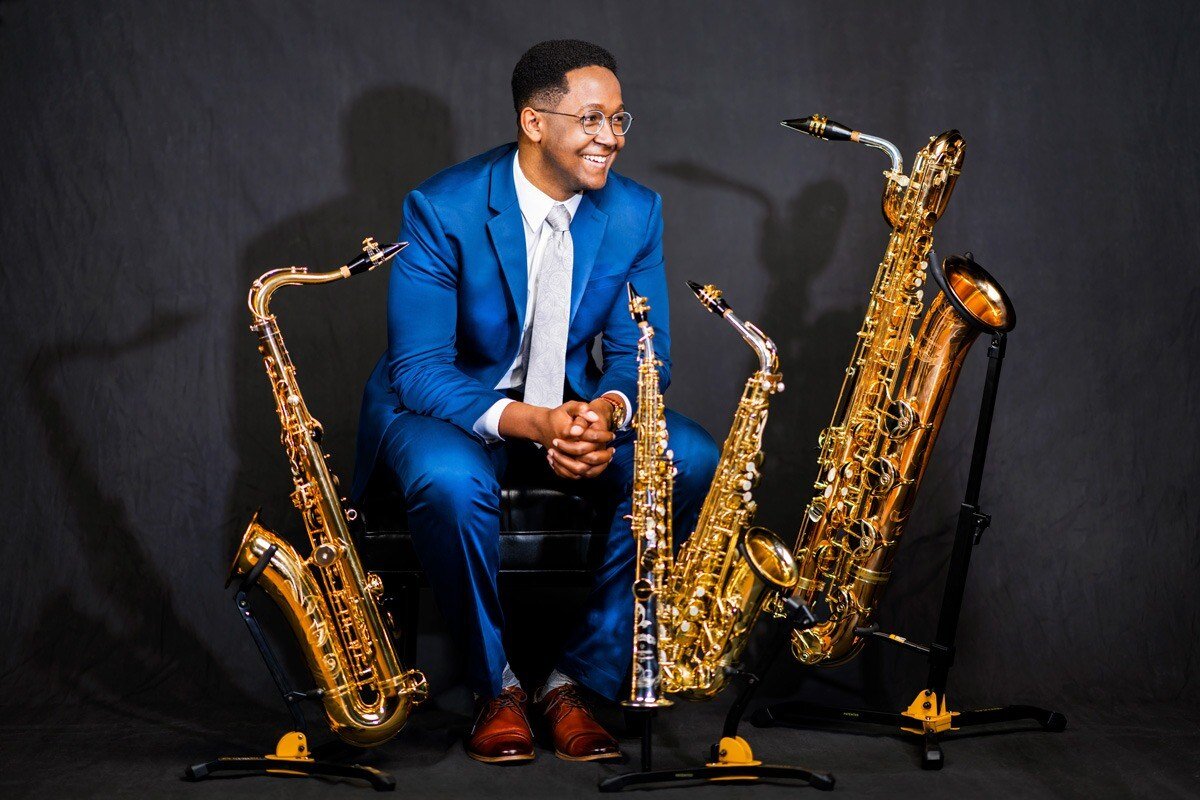
Steven Banks
Love Returns was written for saxophonist Steven Banks, whom Oundjian describes as “one of the most exquisite musicians I’ve ever met. He’s got so many colors—he makes the saxophone sounds like a flute, like a trombone. And he has impeccable musical taste and limitless technique.”
The score was inspired by a piano piece that Tower wrote in memory of her late husband. “It’s a very important piece for her,” Oundjian says. “It’s very exciting, but also very tender. She and (Banks) have become fast friends.”
The program opens with Copland’s Outdoor Overture, written as part of a campaign called “American Music for American Youth,” which aimed to generate new music for use in schools. Copland’s music is included this summer in honor of the 125th anniversary of his birth.
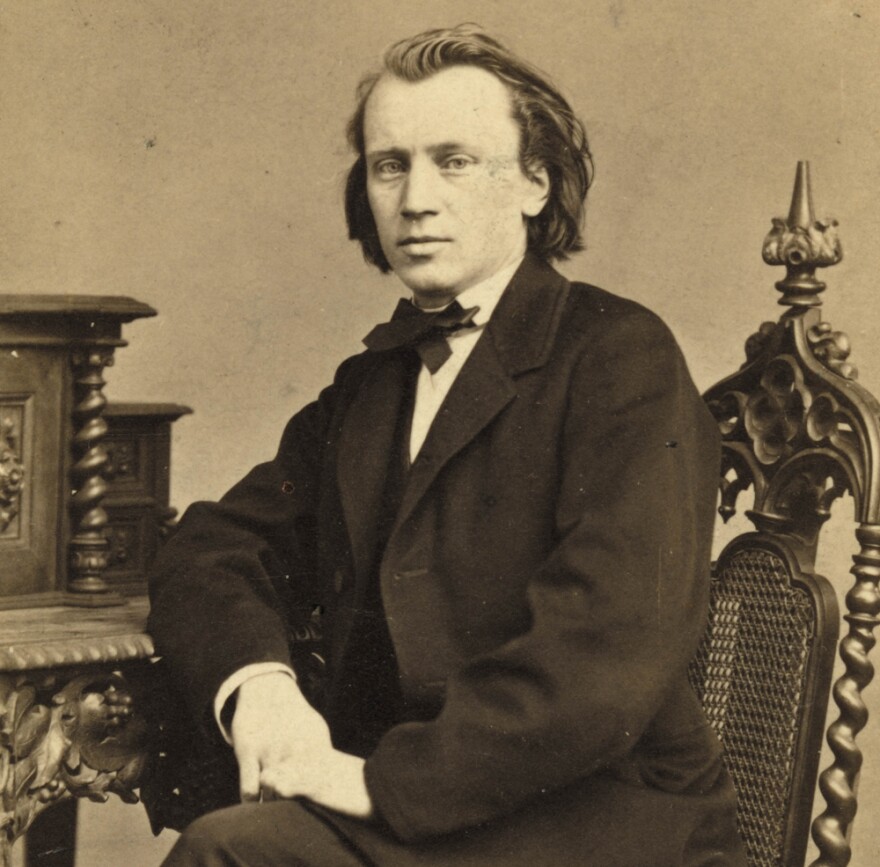
Brahms at the time of his First Symphony
The final piece on the program will be Brahms again, in this case his First Symphony. “The Symphony is exquisite, so powerful—probably the greatest First Symphony ever written,” Oundjian says. He also observes that it was written by a composer who was “young, very handsome, blue-eyed, blond-ish—not the Brahms we imagine as this bearded, sedate individual.”
The symphony has a special place in Oundjian’s life. When he was a student, the imposing German conductor Herbert van Karajan “came to give a masterclass at Juilliard,” he explains. “I was concertmaster of the orchestra and he made me conduct. He was two feet from me!
“I knew that he had asked me to conduct because he wanted to demonstrate that less is more. Conducting students were really trying to show what they had, and he knew that I would not over conduct. He was very complimentary about my conducting. Karajan encouraging me at a very young age was important to me when I was 39 and I couldn’t play the violin any more”—the point in his career when Oundjian turned to conducting
There are tickets available for two other concerts in the first weeks of CMF: a chamber music concert at 7:30 Tuesday, July 8, featuring CMF musicians, and an all-Mozart program under guest conductor Chloé van Soeterstède with violinist Benjamin Beilman at 6:30 the following Sunday, July 13 (full programs below). The annual Family Concert, part of the opening weekend, is sold out.
# # # # #
Colorado Music Festival, Peter Oundjian, music director Thursday, July 3–Sunday, July 13 All performances in Chautauqua Auditorium
Opening Night Festival Orchestra, Peter Oundjian, conductor With Hélène Grimaud, piano
Stravinsky: Feu d’artifice (Fireworks)
Brahms: Piano Concerto No. 1 in D minor
Ravel: Daphnis et Chloé, Suite No. 2 —Bolero
7:30 p.m. Thursday, July 3 6:30 p.m. Sunday, July 6
Family Concert—SOLD OUT Festival Orchestra, Shira Samuels-Shragg, conductor
Sherlock Holmes and the Case of the Missing Maestro
10:30 a.m. Sunday, July 6
Chamber Music Concert Colorado Music Festival musicians
Schubert: String Trio in B-flat major, D471
Prokofiev: Quintet in G minor, op. 39
Brahms: Piano Quartet No. 3 in C minor, op. 60
7:30 p.m. Tuesday, July 8
Festival Orchestra Concert Peter Oundjian, conductor With Steven Banks saxophone
Copland: An Outdoor Overture
Joan Tower: Love Returns for saxophone and orchestra (world premiere)
Brahms: Symphony No. 1 in C minor, op. 68
7:30 p.m. Thursday, July 10 6:30 p.m. Friday, July 11
An Evening of Mozart Festival Orchestra, Chloé van Soeterstède, conductor With Benjamin Beilman, violin
Mozart: Overture to Don Giovanni —Violin Concerto No. 5 in A major, K219 (“Turkish”) —Overture to Le Nozze di Figaro (The Marriage of Figaro) —Symphony no. 34 in C major, K338
6:30 p.m. Sunday, July 13
Tickets to all concerts except the Family Concert available through the CMF Web page.



 Sharps & Flatirons