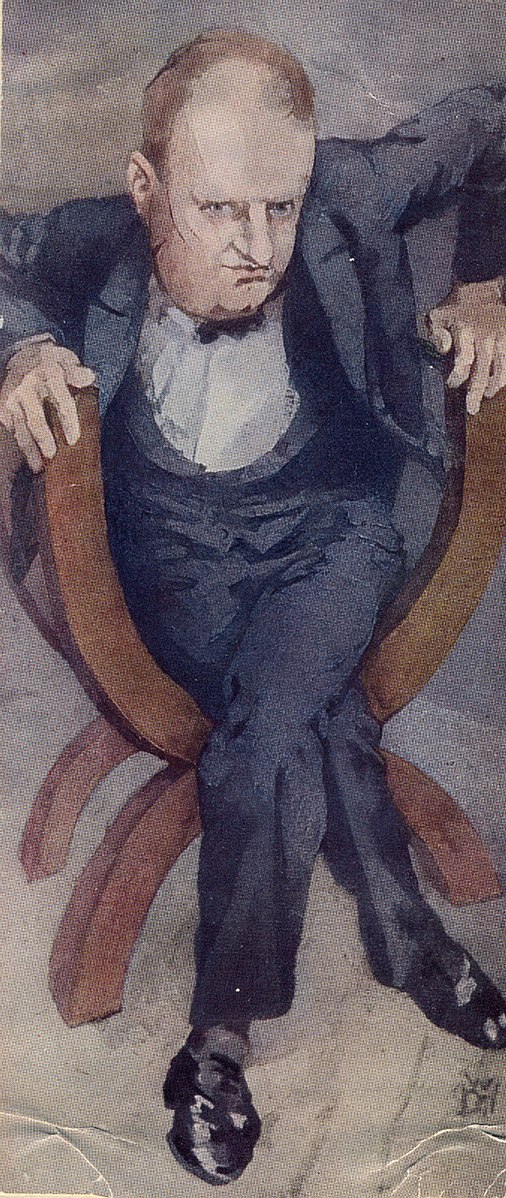
Boulder Phil presents Rachmaninoff and music of two festivals

Guest pianist Alessio Bax and soloists from orchestra in the spotlight

By Peter Alexander March 27 at 5:50 p.m.

Two works inspired by festivals will form bookends for the next Boulder Philharmonic concert, at 4 p.m. Sunday (March 30; details below), with a big, popular Romantic piano concerto in the center.

The Piano Concerto No. 2 by Rachmaninoff fills the central position. Guest artist Alessio Bax is the soloist and Michael Butterman will conduct.

The frame for the concerto will be provided by PIVOT by Anna Clyne, inspired by experiences at the Edinburgh Festival; and Stravinsky’s Petrushka, the brilliant score to a ballet that takes place during the Shrovetide festival in St. Petersburg, Russia.
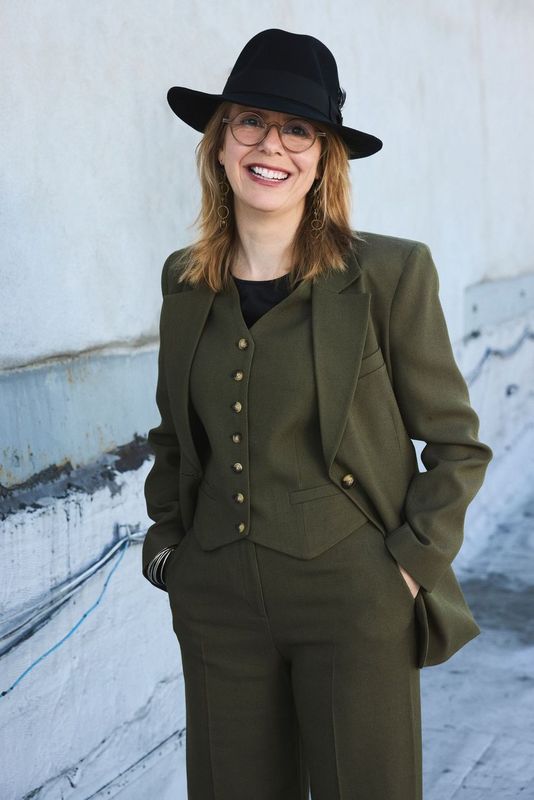
Anna Clyne

The common inspiration of a festival is what suggested to Butterman that Clyne and Stravinsky would make an effective framework for the program. “When we were thinking about programming Petrushka, it struck me that some of the swirling, calliope-like music in the opening section is kind of echoed in Anna Clyne’s PIVOT.

“It’s a piece that I’ve done once before, in Shreveport. You feel that you are walking through a space in which there are different happenings going on. You pass one, (with) a particular tempo and mood, and you turn around and you are facing something else entirely.”

The composer’s description of PIVOT closely matches Butterman’s. “It’s the idea of opening up doors as if you were going down a musical corridor,” she says. “You open one door and there’s a trapeze artist, and another there’s a lady singing an aria. PIVOT really takes you on lots of twists and turns in what’s actually a very short piece.”

It also reflects Clyne’s experience as an undergraduate student in Edinburgh in the 1990s, with a bit of history and folk music thrown in. “I really wanted to evoke a sense of celebration drawing on my experiences living in Edinburgh and being there during the festival,” she says. “Every nook and cranny becomes a venue, be it music, theater, comedy, dance—it’s every art form you can imagine.

“There’s a tune that I borrow called ‘The Flowers of Edinburgh,’ which is a traditional folk tune of Scottish lineage and also a tune that shows up in American folk music. PIVOT was co-commissioned between the Edinburgh International Festival and St. Louis Symphony, so I wanted to find music that brought those two countries together.”

The historical aspect comes from a pub where local musicians meet to share folk music. The pub is called The Royal Oak today, but 200 years ago it was called The Pivot. Thus the title both reflects the nature of the music and recalls the history of a musical venue in Edinburgh.
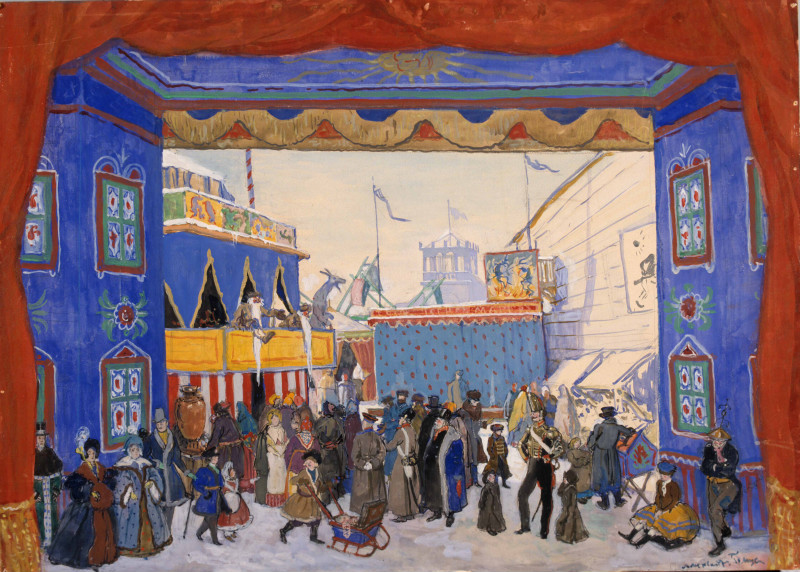
Original design by A. Benois for Stravinsky’s ballet Petrushka

At the opposite end of the program, Stravinsky’s Petrushka is a brilliant, colorful description of the crowds at a Russian Shrovetide (Mardi Gras) festival with various dances—some using Russian folk tunes—as well as drunken revelers, organ grinders, a dancing bear, and most central to the story, a puppet theater with three puppets that dance at the command of a magician.

One of the puppets is Petrushka, who is killed by another puppet as the fair is closing for the night. As the ballet ends, night descends over the empty square. Petrushka’s ghost appears above the theater as the magician runs off in fear.

“This is really a piece in which you need to have a sense of what is happening and what Stravinsky is evoking,” Butterman says. “It works very well as concert music, but it really is a full ballet score. Understanding the dramatic context is critical.”

The score notably includes a major piano part in the orchestra. “It is the most virtuosic orchestral piano part that I can think of, in the whole repertoire,” Butterman says. “It’s absolutely critical to much of the piece.” 

The Phil’s piano and keyboard position is currently vacant, and the solos in this case will be performed by Cody Garrison. A practicing dentist in Denver, Garrison works at Metropolitan State University as accompanist in the brass and woodwind departments. He also serves as pianist for Opera Colorado and staff accompanist for the Boulder Symphony, where he played Liszt’s Todtentanz (Dance of death) with the orchestra last season.

There are important solo parts for other members of the orchestra. Two in particular stand out in scenes for the three puppets: flute, which will be performed by visiting principal Hannah Tassler, and trumpet, which will be performed by principal player Leslie Scarpino.
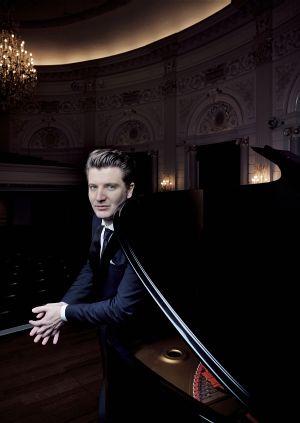
Alessio Bax. Photo by Marco Borggreve.

The Rachmaninoff concerto is the most familiar piece on the program. It had a large impact on the composer’s career, since its success helped him overcome the failure of his First Symphony a few years before. Technically demanding of the pianist, the Concerto is also very tuneful and has become one of the most popular piano concertos in the standard repertoire.

“There’s no question why it’s so winning,” Butterman says. “It has lots and lots of virtuosity, and (Rachmaninoff) had the incredible gift for writing melodies that go straight to the heart, that have both a soaring, noble quality and more than a tinge of melancholy.”

The soloist, Alessio Bax, began his career in Italy, but is distantly related to the English composer Arnold Bax. Butterman relishes working with him. “I did this very same piece with him last season in Shreveport, and I find him an elegant player, yet full of the kind of passion that you want in this piece. I feel like I know where he’s going with a phrase, so from my perspective, it was a dream to lock in with him.

“I thought it was a very effective and memorable performance, so I’m expecting we’ll have a similar experience in Boulder.”

# # # # #

Masterworks Concert
Boulder Philharmonic, Michael Butterman, conductor
With Alessio Bax, piano
Orchestra soloists Cody Garrison, piano; Hannah Tassler, flute; and Leslie Scarpino, trumpet

  • Anna Clyne: PIVOT
  • Rachmaninoff: Piano Concerto No. 2 in C minor
  • Stravinsky: Petrushka (1947)

4 p.m. Sunday, March 30
Macky Auditorium

TICKETS

Correction: Typo corrected the headline, 3/28. The soloist’s name is Alessio Bax, not Max as spell corrector incorrectly changed it.

Boulder Symphony weekend concerts will be recorded

U.S. premiere, arias by Rossini and Puccini, and Beethoven’s countryside

By Peter Alexander March 26 at 5:10 p.m.

The composer Peter Drew came late to a musical career.

After some inconclusive experiences in music as a youngster, he worked a succession of jobs including taxi driver and cruise-ship host and eventually settled in as a teacher. Feeling something was missing, he bought a clarinet and decided to take music more seriously. He played both classical and jazz and studied musical composition.

To make a long story short, his first symphony was recorded in 2022 by the Zagreb Symphony, with positive reviews. And now it will have its U.S. premiere by the Boulder Symphony Saturday and Sunday (March 29 and 30; details below).

Composer Peter Drew

Devin Patrick Hughes will conduct the performances, which will also include arias by Rossini and Puccini sung by soprano guest artist Anastasia Antropova. Beethoven’s “Pastoral Symphony” rounds out the program. Parma Recordings will record the performances.

Drew titled his First Symphony “Reminiscence.” He calls it a pastiche, based on music that had an impact on him and listing the specific sources for each movement. For example, the first movement is titled “Journey” and includes music reflecting Villa-Lobos’ descriptive piece for orchestra Little Train of the Caipira, as well as folk songs that recall Joseph Canteloube’s Songs of the Auvergne.

The second movement, “Pictures in an Album,” refers to Mussorgsky’s Pictures at an Exhibition, along with traces of Copland-esque Americana. The third movement evokes J.S. Bach while the finale, “The Return,” revisits ideas from the first movement.

Soprano Anastasia Andropova

Russian soprano Anastasia Antropova graduated from the St. Petersburg Conservatory in 2017 and since has performed extensively in Italy. She will perform Rossini’s “Una voce poco fa” (A voice spoke to me), the iconic aria of Rosina in The Barber of Seville; and Puccini’s poignant aria from Madama Butterfly, “Un bel di” (One fine day).

Boulder Symphony’s publicity material quotes Antropova commenting on “these iconic arias, each revealing a distinct operatic world. The fusion of music and text bring these characters to life, allowing me to fully immerse in their emotions.”

Beethoven Symphony No. 6 in F major, known as the “Pastoral Symphony,” is one of the composer’s more cheerful even-numbered symphonies, all of which are in major keys. It was made popular when it was used in Walt Disney’s animated musical film Fantasia, with a setting of pastoral scenes from Greek mythology.

Unlike most Beethoven symphonies, the Sixth has specific descriptive titles for the movements, all derived from the composer’s own excursions into the countryside outside Vienna. The five movements are titled “Awakening of cheerful feelings on arrival in the countryside,” “Scene by the brook,” “Merry gathering of country folk,” “Thunder, storm,” and “Happy and thankful feelings after the storm.”

The first performance took place in 1808 as part of a notorious four-hour concert that included premieres of the Fifth and Sixth symphonies, the Fourth Piano Concerto and the Choral Fantasy, along with selections from other works by Beethoven and improvisation at the piano by the composer. 

Held in an unheated hall, the program strained the audience’s attention. One attendee wrote afterwards, “There we sat, in the most bitter cold, from half past six until half past ten, and confirmed for ourselves the maxim that one may easily have too much of a good thing.”

Of course the Boulder Symphony performance will neither take place in a cold hall nor last four hours. And the good things it offers—a U.S. premiere, two beloved arias and a musical tour of the Austrian countryside—are pleasantly varied.

# # # # #

Boulder Symphony, Devin Patrick Hughes, conductor
With Anastasia Antropova, soprano

  • Rossini: “Una voce poco fa” (A voice spoke to me) from Barber of Seville
  • Peter Drew: Symphony No. 1 (“Reminiscence”), American premiere
  • Puccini: “Un bel di” (One fine day) from Madama Butterfly
  • Beethoven: Symphony No. 6 in F major, op. 68 (“Pastoral”)

7:30 p.m. Saturday, March 29
2 p.m. Sunday, March 30
Gordon Gamm Theater, Dairy Arts Center

TICKETS

Coming opera seasons in Colorado

CU Eklund Opera and Opera Colorado announce 2025–’26 seasons

By Peter Alexander March 17 at 5:43 p.m.

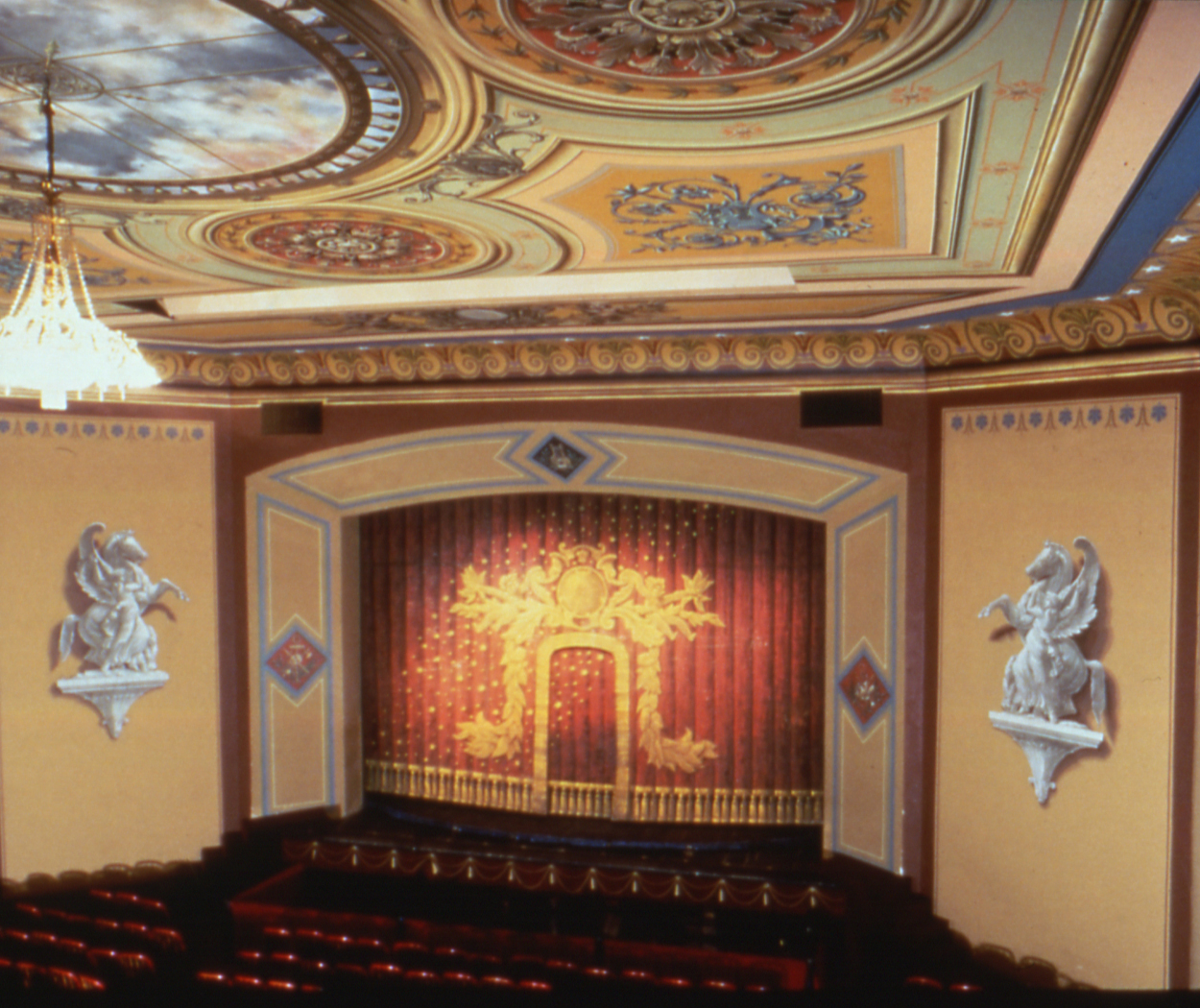
Leigh Holman stepped before the rich, ruby-red curtains at Macky Auditorium yesterday (March 16) afternoon and spoke to the audience.

The occasion was the final performance of CU’s production of Gilbert & Sullivan’s Pirates of Penzance. Holman is the director of the Eklund Opera Program at CU-Boulder, and in addition to welcoming the full house in Macky, she made an announcement of interest to opera lovers in the area. She named the works in Eklund Opera’s 2025–26 season—or most of them.

Leigh Holman

The fall production, she said, will be one of the most successful operas of the past 25 years, Jake Heggie’s Dead Man Walking. Premiered in 2000 by the San Francisco Opera it has since been performed in dozens of productions, at CU in in 2007, Central City Opera in 2014, at the Metropolitan Opera in New York, Houston Grand opera, in university and regional productions around the country, and major houses around the world. 

Based on the memoir of the same name by Sister Helen Prejean, Dead Man Walking features a  libretto by playwright Terrence McNally. The plot revolves around Prejean’s death-row ministry with a convict who was executed for murder in Louisiana in 1984.

Homan then announced that in April, 2026, the Eklund program will present Leoš Janáček’s folk-ish Cunning Little Vixen, a charming and harsh tale of life in the animal world. Finally, she said that the third production, appearing in the March time slot, would be a musical comedy presented in conjunction with the CU program in musical theatre. Contractual obligations, common with the performance of musicals, prevent the release of the show’s title at this time.

Opera Colorado in Denver also has announced the operas that will be their main stage productions in the 2025–’26 season. November will see performances of Verdi’s La Traviata, and in May Opera Colorado will present Puccini’s Madama Butterfly. In the meantime, there will be semi-staged concert performances of Verdi’s Il Trovatore featuring a full cast with the Opera Colorado orchestra and chorus, 7:30 p.m. Saturday, April 26, and 2 p.m. Sunday, May 4, in the Ellie Caulkins  Opera House at the Denver Performing Arts Complex. 

Ellie Caulkins Opera House, Denver

The company’s Calendar of Events lists the dates for all performances and access to the box office for the purchase of individual tickets for the remainder of this season, as well as subscriptions for the ’25–’26 season. 

Central City Opera House

Central City Opera’s summer 2025 season has already been announced, but if you missed it, this year’s summer festival at the Opera House in Central City will feature Rossini’s Barber of Seville, Aleksandra Verbelov’s contemporary The Knock, inspired by events during the 2003–’11 Iraq War, and the 1959 Broadway hit Once Upon a Mattress, recently revived in New York and Los Angeles to great acclaim.

The full summer calendar, and access to the purchase of subscriptions and group bookings can be found HERE. Individual tickets will go on sale April 1.

Not in Colorado but within a reasonable day’s drive for people in the Boulder area, the Santa Fe Opera presents productions in a unique and stunning outdoor theater in the New Mexico mountains. Productions for the summer of 2025 will be Puccini’s La Bohème, Mozart’s Nozze di Figaro (Marriage of Figaro), Verdi’s Rigoletto, Benjamin Britten’s Turn of the Screw and Wagner’s Die Walküre

Santa Fe Opera. (c)Bob Godwin/rgbphotography@mac.com

The full calendar for the Santa Fe Opera is located HERE. Tickets can be purchased through the company’s 2025 Season page. 

NOTE: At the request of the Eklund Opera Program, a quote that that could potentially identify the musical to be presented in March, 2026, was removed from the fifth paragraph of this story as of March 13, 2025.

Eklund Opera presents Gilbert & Sullivan

The perennially popular Pirates of Penzance puts in at Macky for the weekend

By Peter Alexander 10:40 p.m. March 12

CU’s Eklund Opera Program will present Gilbert and Sullivan’s hilarious Pirates of Penzance Friday through Sunday in Macky Auditorium (March 14–16; details below), and conductor Nicholas Carthy wants everyone to know what to expect.

“It’s a comedy,” he says. “This is not (Shakespeare’s) Henry V! It’s supposed to be ridiculous.”

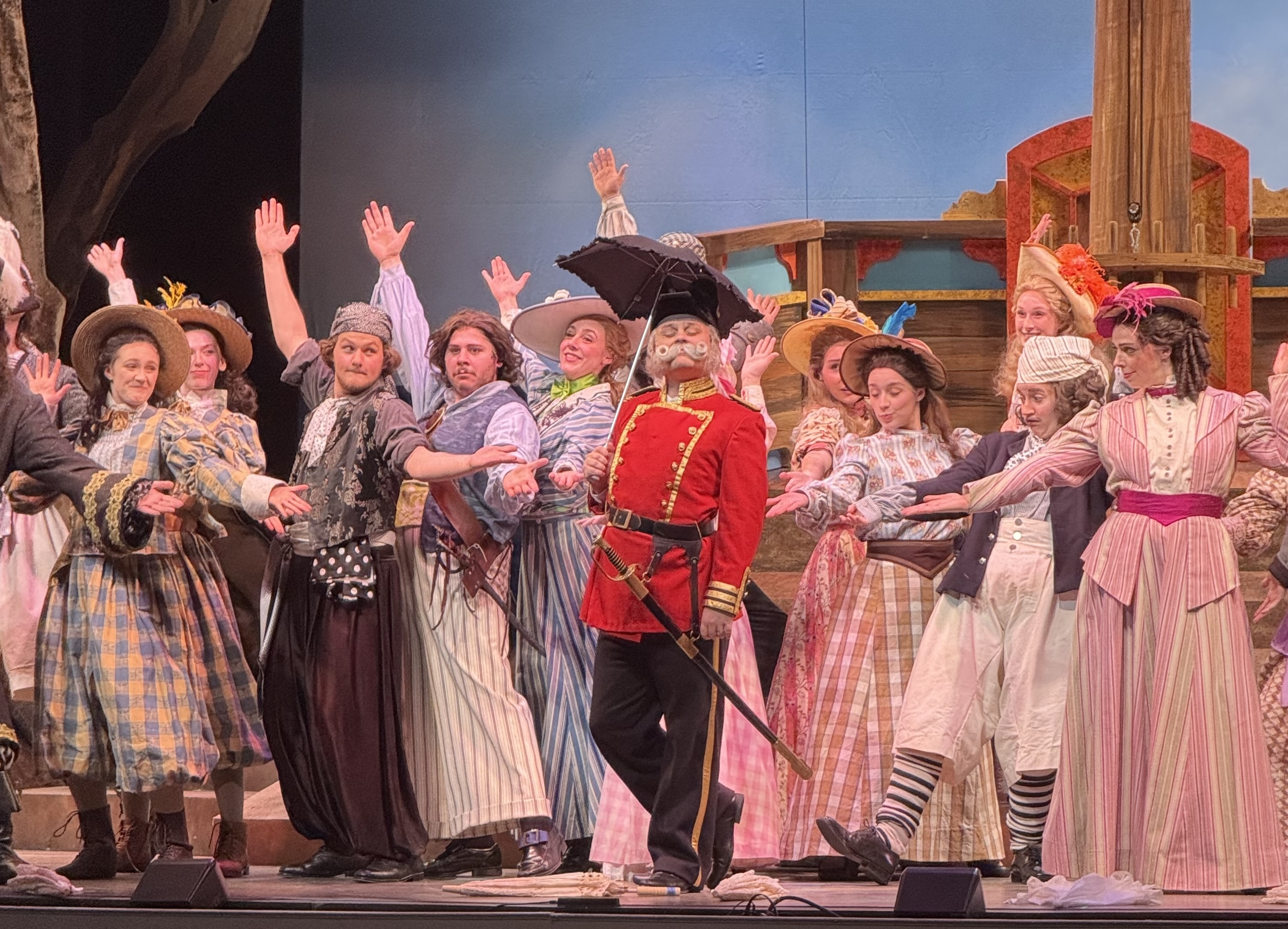
Reese Phillips as Major-General Stanley. Photo by Andrew Konopak.

And ridiculous it is, in some ways. If you don’t know the story, the callow youth Frederic has been apprenticed to a band of soft-hearted pirates through a confusion between a “pirate” and a ship’s “pilot.” He is bound until his 21st birthday, but because he was born on Feb. 29, that won’t happen until he is in his 80s. 

Due to his exaggerated sense of duty, Frederic cheerfully agrees to remain with the pirate band for 60-plus more years, even though he has to postpone marriage to his true love Mabel, one of many wards of the pompous Major-General Stanley. After misadventures with the curiously ineffective pirates and the bumbling police, the day is saved when Frederic’s nursemaid Ruth reveals that the “pirates” are actually noblemen.

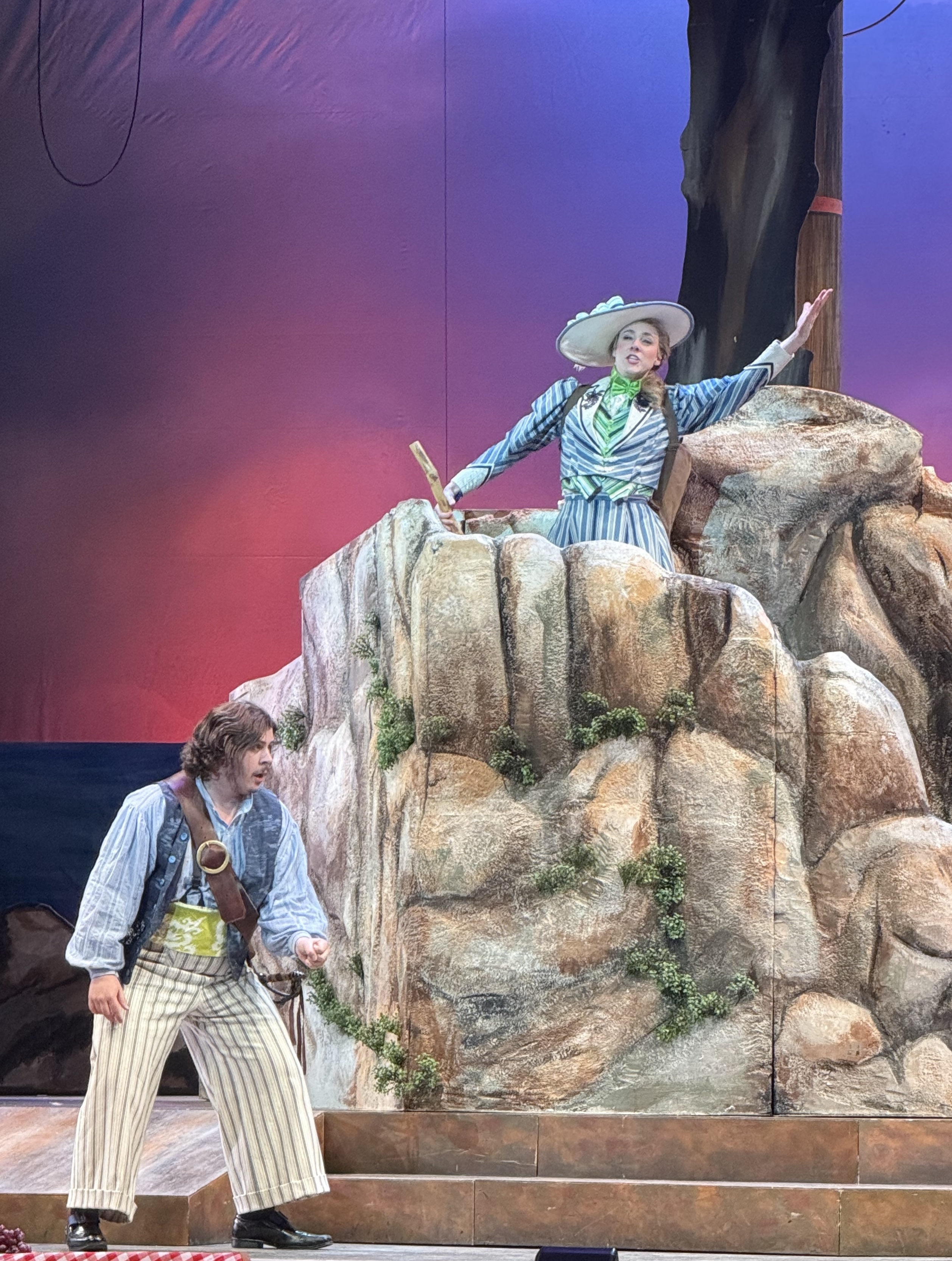
Davian Raggio (Frederic), Madison Falkenstine (Mabel). Photo by Andrew Konopak.

When they declare their loyalty to Queen Victoria, the way is cleared for Frederic and Mabel to marry.

The CU production is stage directed by Leigh Holman, director of the Eklund Opera Program, with choreography by Laura Malpass. The production uses the same sets as previous CU performances in 2014, but with new costumes by Holly Jenkins Evans and new lighting design by Jonathan Dunkle. 

“It will look different,” Holman says, “but in terms of interpretation, we took the same approach as last time. There are many different levels where the show can entertain. There are Gilbert & Sullivan fans that know all the intricacies, and there are people that will learn it as they’re sitting there. Other people will see the slapstick, and they’ll enjoy it too.”

The show must have wide appeal, since it has been selling exceptionally well. According to Holman, “the last show that reached this (many) ticket sales was West Side Story.”

There are several specific aspects of Pirates that Holman and Carthy hopes the audience will recognize. For one, there are clues that the pirates are really from the upper class. For one, “they’re drinking sherry at the beginning,” Carthy says. “If they were real pirates they would be drinking rum.”

At the same time, there is sharp satire of the upper classes. As Carthy puts it, the performers are “having a nod and a wink at the audience, saying, ‘we know what these people are like, and you do too, don’t you?’ Both the audience and the people onstage are in on the joke.”

That pointed satire explains why Gilbert’s text was not popular with the Queen and nobility, even though Sullivan’s music was. “These little barbs against royalty were what Queen Victoria disapproved of,” Carthy says, “which is why Sullivan got knighthood and Gilbert didn’t.”

In one example, the Pirate King, himself a noble, takes a particularly brutal jab at the rigidly “respectable” upper classes. Speaking of piracy, he says, “I don’t think much of our trade, but compared with respectability, it is relatively honest.”

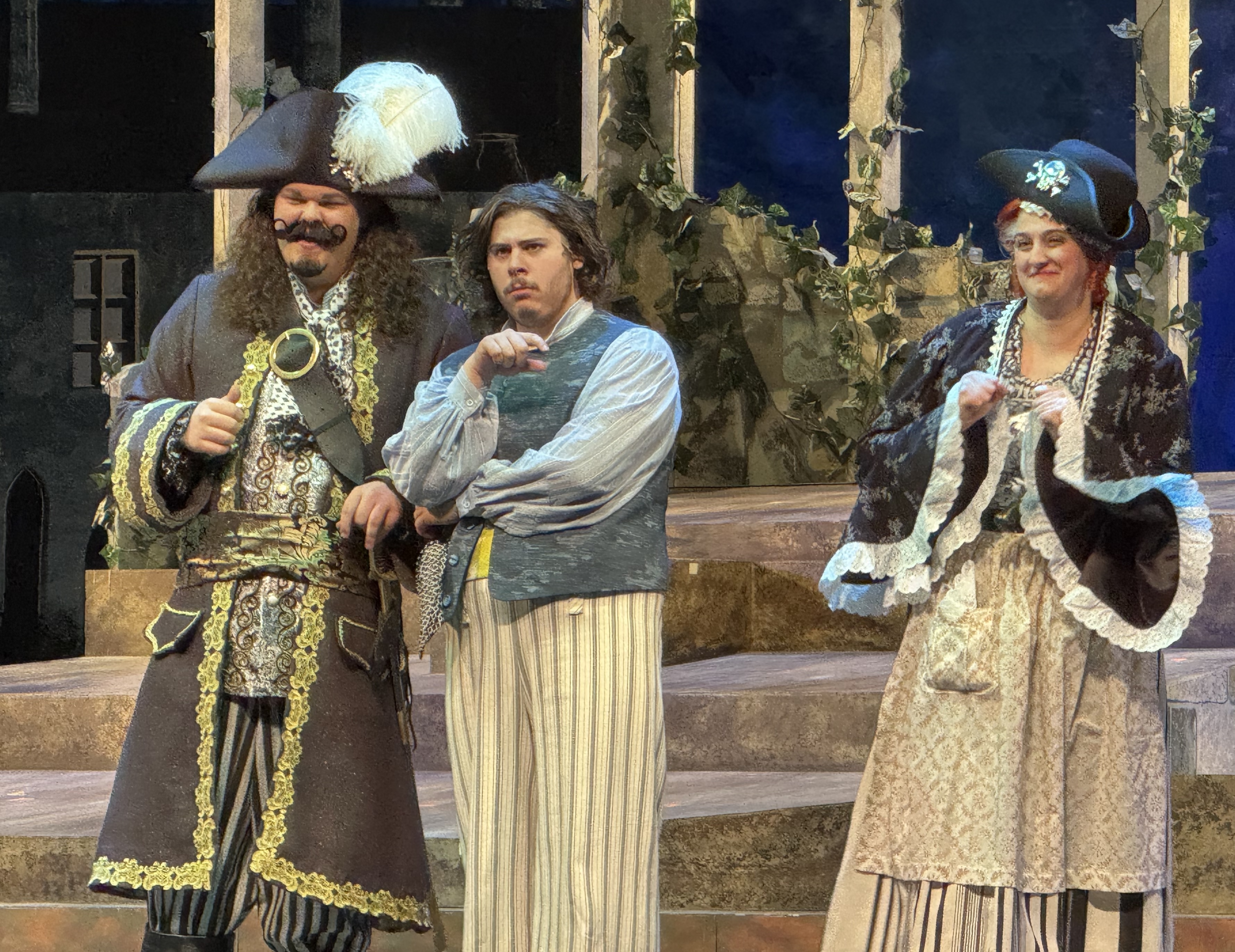
James Robinson (Pirate King), Davian Raggio (Frederic), Carrina Macaluso (Ruth). Photo by Andrew Konopak.

Satire of the upper classes appears in all cultures. It is central to much British literature, but also dates from Roman and Greek theater into the 20th-century. “Gilbert and Sullivan’s policemen are exactly the same as Monty Python’s policemen,” Carthy says. “They are of a particular class and accent—that is a thread through the ages.”  

It is also important to know that Sullivan aimed higher than writing popular potboilers. “Sullivan wanted to be a serious composer and ended up hating Gilbert,” Carthy says. “He wanted to stop (working with Gilbert), but then he lost money in a market crash and had to sign on for another five years.”

Musical evidence of Sullivan’s aspirations is found in throughout the show. “There are little bits of Sullivan as a serious composer, and not just this sort of thing, that we remember him for,” Carthy says, singing an oom-pah accompaniment.

In some places, there are even traces of serious opera, including hints of Donizetti and Rossini. Holman finds these passages especially expressive. “The love duet (between Mabel and Frederic) is beautiful,” she says. “It’s the most sincere thing in the show. That piece is just gorgeous.”

She also hopes you will notice the choreography. “It’s a beast to choreograph, with so much movement,” she says. “Malpass has taken predominantly non-dancers and done amazing jobs with them. (In this show), there’s always something to see, lots of physicality (as well as) great singing!”

Carthy admits that Pirates does not always conform to modern sensibilities. “It’s a piece of its age,” he says.  But he believes its comedy is universal, transcending Victorian sensibilities. “It’s quirky but it works, and it suggests a little depth,” he says.

“Above all, it knows what its audience wants.”

# # # # #

University of Colorado Eklund Opera
Leigh Holman, stage director; Nicholas Carthy, conductor

  • W.S. Gilbert and Arthur Sullivan: The Pirates of Penzance

7:30 p.m. Friday, March 14, and Saturday, March 15
2 p.m. Sunday, March 16
Macky Auditorium

TICKETS

NOTE: The spelling of Eklund Opera was corrected March 13. The original story incorrectly had the spelling as Ecklund.

GRACE NOTES: “The Feminine Divine” and string quartets

Boulder Bach’s CORE and the Takács Quartet fill the weekend

By Peter Alexander March 5 at 5:20 p.m.

COmpass REsonance (CORE), a string ensemble that began as the resident Baroque orchestra of the Boulder Bach Festival, will present a program of music by four women composers of the Baroque era on Saturday (4 p.m. March 8; details below).

Titled “The Feminine Divine,” the program features works by Barbara Strozzi (1619–1677), Elisabeth Jacquet de la Guerre (1665–1729), Francesca Caccini (1587–1641?), and Isabella Leonarda (1620–1704). The performance will be directed by Zachary Carrettin and feature soprano Sarah Moyer and mezzo-soprano Claire McCahan. 

Other guest artists will be Minneapolis-based harpsichordist Tami Morse and cellist Joseph Howe, performing with members of CORE. Carrettin will perform as violinist.

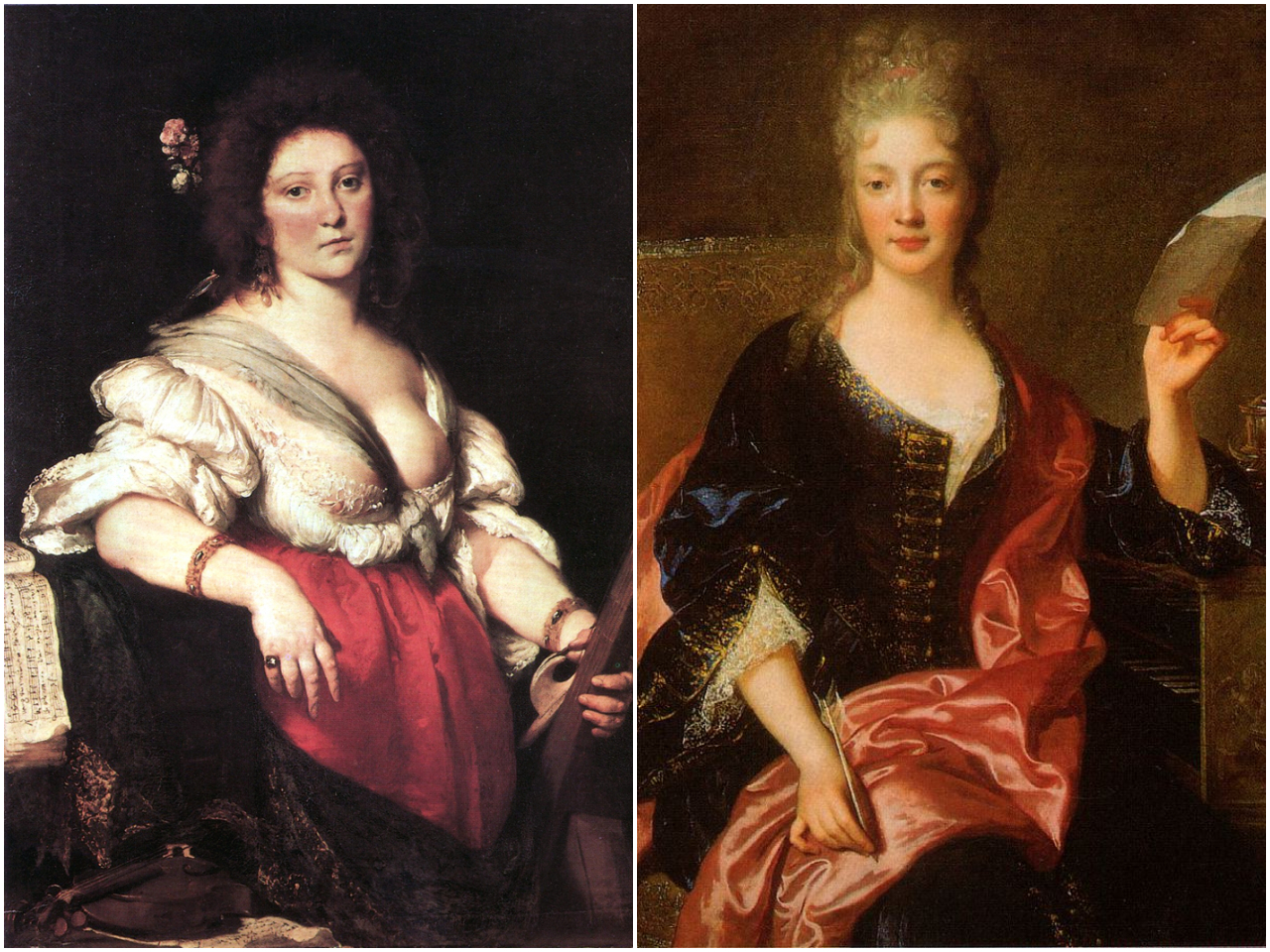
Composers Barbara Strozzi and Elisabeth Jacquet de la Guerre

The most renowned composer on the program, Strozzi published eight volumes of music during her lifetime, and at one point had more secular music in print than anyone else in Europe. She accomplished this as an independent artist, without the usual aristocratic support that most musicians of her era depended upon.

Strozzi first came to prominence as a singer, having been recognized for her virtuosity in her teens. Her first volumes of published music, titled Bizzarrie poetiche (poetic oddities), appeared before she turned 20. Although she dedicated her volumes of published music—all but one using secular texts—to prominent members of the nobility, she never received regular patronage from any of them.

Jacquet de la Guerre came from a family of musicians and instrument makers. An accomplished harpsichordist who performed at the French court of Louis XIV, she composed vocal music, including dramatic cantatas and songs, as well suites for harpsichord and sonatas for violin and harpsichord.  

Francesca Caccini was the daughter of the important composer of early operas, Giulio Caccini. She spent most of her life in service to the Medici Court in Florence. Most of her music has disappeared, including several staged works written for the court. Today she is remembered as the first woman to write an opera, and for a collection of solo songs and duets with basso continuo.

The least known of the four women composers, Leonarda spent most of her life in an Ursuline convent in Novara, Italy. While living in the convent she wrote about 200 compositions, including vocal motets, and instrumental sonatas that are notable for their unusual structure of as many as 13 separate movements. 

# # # # #

“The Feminine Divine”
Compass Resonance Ensemble (“CORE”)
Zachary Carrettinn, director and violin; Tami Morse, harpsichord; and Joseph Howe, cello
With Sarah Moyer, soprano, and Claire McCahan, mezzo-soprano

Music by Barbara Strozzi, Elisabeth Jacquet de la Guerre, Francesca Caccini, and Isabella Leonarda

4 p.m. Saturday, March Dairy Arts Center

TICKETS

# # # # #

The world renowned Takács Quartet, comprising artists in residence and Christoffersen Fellows at CU-Boulder, is currently celebrating its 50th anniversary year.

Between teaching duties and an international touring schedule, they will present one of their campus concerts Sunday and Monday in Grusin Music Hall (March 9 and 10; details below). After 50 years, one of the original members of the Takács still plays with the quartet, cellist András Fejér. Currently performing with him are violinists Edward Dusinberre and Harumi Rhodes, and violist Richard O’Neill.

Paul Hindemith. Portrait by Rudolf Heinisch

Joining them for the March program, soprano and CU music faculty member Jennifer Bird-Arvidsson will perform Hindemith’s Four Songs, Melancholie, with the quartet. Bartók’s String Quartet No. 3 and Beethoven’s String Quartet in F major, op. 135, complete the program.

Hindemith served as a German soldier in the trenches near the end of Word War I. After the war he set four poems from a book by Christian Morgenstern titled Melancholie. The poems and the music reflect Hindemith’s feelings in the years after war, when he wrote to a friend “Everything is dreary and empty. I am deathly sad.” Hindemith dedicated Melancholie, one of his earliest and least known works, to a friend who died in the war.

As the last of his string quartets, Beethoven’s op. 135 comes from the opposite end of the composer’s life from Hindemith’s songs, and stands opposite to them in mood. Surprisingly one of Beethoven’s most cheerful and straightforward works—coming after other late quartets that explore unusual musical forms complex musical styles—Op. 135 shows the standard four movement layout for quartets, symphonies and other works.

Beethoven wrote to his publisher that this would be his last quartet, and headed the last movement “Der schwer gefasste Entschluss” (the difficult decision), suggesting that it was hard to give up a genre that he had explored throughout his life. Below that written title, the movement begins with three three-note motives that form its major themes. Under the musical notes, Beethoven wrote “Muss es seen? Es muss sein! Es muss sein!” (Must it be? It must be! It must be!)

The central piece on the program is Bartók, whose music has also played a central role in the 50-year history of the Takács Quartet, founded by four Hungarian string students. They have recorded the full set of six quartets twice and performed them frequently on tour. The shortest of Bartok’s quartets, the Third has a single movement divided into four parts that do, and don’t, recall the standard four-movement structure. 

# # # # #

Takács Quartet
With Jennifer Bird-Arvidsson, soprano

  • Paul Hindemith: “Melancholie,” Four Songs, op. 13
  • Bartók: String Quartet No. 3
  • Beethoven: String Quartet in F Major, op. 135

4 p.m. Sunday, March 9
7:30 p.m. Monday, March 10

Grusin Music Hall

In-person and streaming tickets available HERE.