
Boulder native Francesco Lecce-Chong subs for Michael Butterman
By Peter Alexander Sept. 5 at 9 p.m.
The Boulder Philharmonic opens its 2024–25 season Sunday afternoon in Macky Auditorium (4 p.m. Sept. 8) with music by Tchaikovsky and Mendlessohn. Sixteen-year-old rising musical star Amaryn Olmeda will be the soloist for Tchaikovsky’s Violin Concerto.
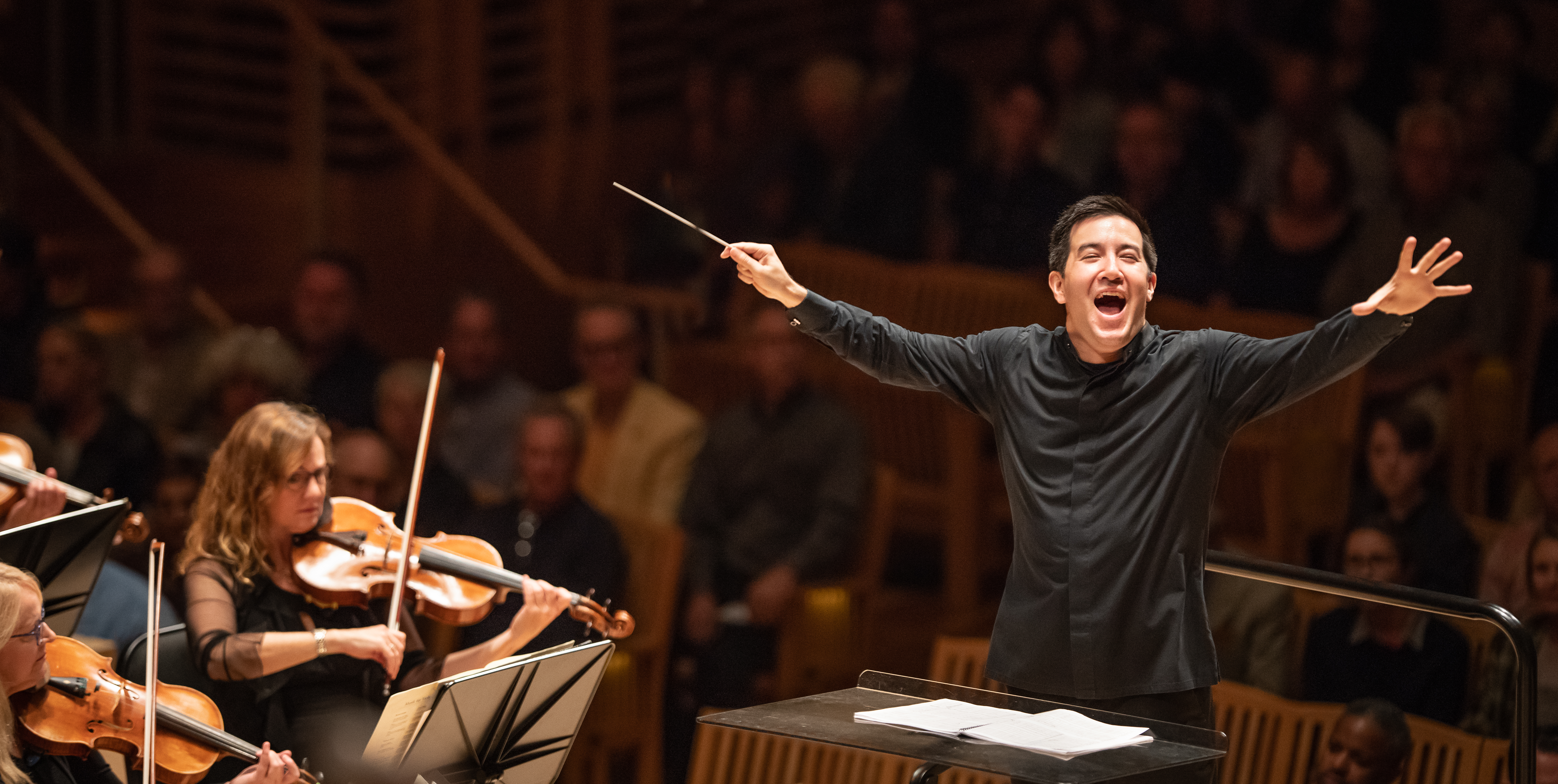
The concert will be led by guest conductor Francesco Lecce-Chong, substituting for an indisposed Michael Butterman. In addition to the concerto, Lecce-Chong will lead the orchestra in Mendelssohn’s “Reformation” Symphony, Vaughan Williams’ Fantasia on a Theme of Thomas Tallis, and English Renaissance composer John Dowland’s Lachrimae antiquae (Ancient tears).
A familiar presence to the Philharmonic’s audience, Butterman was scheduled to conduct the program. However, he was diagnosed with lymphoma, and in a recently posted YouTube video says “I’m going to have to watch my energy (and) stay away from crowds.”
He has had to curtail his activities with all four orchestras he conducts, in Boulder; Shreveport, La., where he lives; Williamsburg, Va.; and Lancaster, Penn. Nevertheless, he says “I feel very good, my doctors are optimistic (and) I hope to be back as soon as it’s practical—hopefully later on this fall.”
Growing up in Boulder County, Lecce-Chong was extremely active in the local youth classical music scene, both as violinist and pianist. He is returning to Colorado for his first opportunity to conduct the Boulder Phil. The program he will lead was selected by Butterman as the season opener, except for one piece that was selected by a vote of the orchestra’s season subscribers, the Fantasia on a Theme of Thomas Tallis by Ralph Vaughan Williams.
Also on the program is Lachrimae antiquae (Antique tears) by the English Renaissance composer John Dowland. Written around 1600 as “Flow my Tears,” a song with lute accompaniment, it was arranged by Dowland for viol consort (an ensemble of string instruments) in a set of seven versions of which the Lachrimae antiquae is the first.
Each of the seven settings represents a different kind of tear, including sighing tears, sad tears, insincere tears and lover’s tears. As an expression of deep melancholy, the collection is considered one of Dowland’s most personal expressions. Another piece he wrote around the same time has the punning title “Semper Dowland, semper dolens” (always Dowland, always mournful). The Phil will play a transcription of the music for viol consort for modern strings.
The centerpiece of the concert will be Tchaikovsky’s Violin Concerto. As popular as it is, the concerto has not been presented by the Boulder Phil in many seasons. The concerto was composed in 1878. Tchaikovsky was in Switzerland, where he went to recover from the emotional damage from his brief marriage.
The concerto was initially dedicated to the Hungarian virtuoso Leopold Auer, who however refused to perform it. The premiere was given instead by Russian violinist Adolph Brodsky, to whom Tchaikovsky later dedicated the work. In spite of mixed initial reviews, it eventually became one of the most popular staples of the violin repertoire.

At only 16, Olmeda has already started building an impressive musical resume. Born in Melbourne, Australia, she won the Sphinx Competition at 13, a national competition for string players. She currently studies at the New England Conservatory of Music. In addition to performances with the Sphinx Virtuosi chamber ensemble, she has appeared as soloist with the Philadelphia Orchestra, Seattle Symphony and Buffalo Philharmonic, among other major groups.
The final work on the program is Mendelssohn’s “Reformation” Symphony in D major/minor. It was comprised in 1830 for the 300th anniversary of the Augsburg Confession, one of the foundational documents of the Lutheran church. The second symphony Mendelssohn wrote, it was not published until 1868, 21 years after the composer’s death, leading to its numbering as his Fifth Symphony.
The symphony includes themes familiar to Lutheran congregations. The slow introduction makes use of the so-called “Dresden Amen,” a seven-note cadence sung by Lutheran choirs in Dresden and the German state of Saxony. Symbolic of the Protestant movement, it has been used by Wagner, Bruckner and other composers.
The final movement of the symphony is based on the chorale “Ein feste Burg ist unser Gott” (A mighty fortress is our God), composed by Martin Luther. In spite of the widespread popularity of Mendelssohn’s orchestral music, the Fifth Symphony is not as well known as either the Third (“Scottish) or Fourth (“Italian”) symphonies.
Growing up in the Boulder area, Lecce-Chong played in the Longmont Youth Symphony and was an assistant to the the conductor of the Boulder Youth Symphonies. In 2002 he won first prize in the PeakArts Young Soloist Competition. After leaving Colorado he attended the Curtis Institute of Music, the Mannes College of Music, and Accademia Musicale Chigiana in Italy.
He served as associate conductor of the Pittsburgh and Milwaukee symphonies, and is currently conductor of the Santa Rosa Symphony in California and artistic partner with the Eugene, Oregon, Symphony. He has appeared with orchestras around the U.S. including the San Francisco Symphony, New York Philharmonic, Seattle Symphony, Baltimore Symphony, Detroit Symphony and Saint Paul Chamber Orchestra.
# # # # #
“Tchaikovsky & Mendelssohn”
Boulder Philharmonic Orchestra, Francesco Lecce-Chong, guest conductor
With Amaryn Olmeda, violin
Ralph Vaughan Williams: Fantasia on a Theme of Thomas Tallis
John Dowland: Lachrimae antiquae (Antique tears)
Tchaikovsky: Violin Concerto
Mendelssohn: Symphony No. 5 in D major/minor (“Reformation”)
4 p.m. Sunday, Sept. 8
Macky Auditorium
 Sharps & Flatirons