
The opera is based on, and different from, the familiar Biblical story
By Peter Alexander May 2 at 4:30 p.m.
The Biblical story of Samson’s betrayal by Delilah, and his violent revenge, is one of the best known dramatic tales from the Old Testament. It has been dramatized many times in film and music.
One of the most successful of those dramatizations will be presented by Opera Colorado over the next two weeks: Camille Saint-Saëns’s Samson et Delilah. The production opens Saturday, May 4, with additional performances May 7, 10 and 12 (details below).
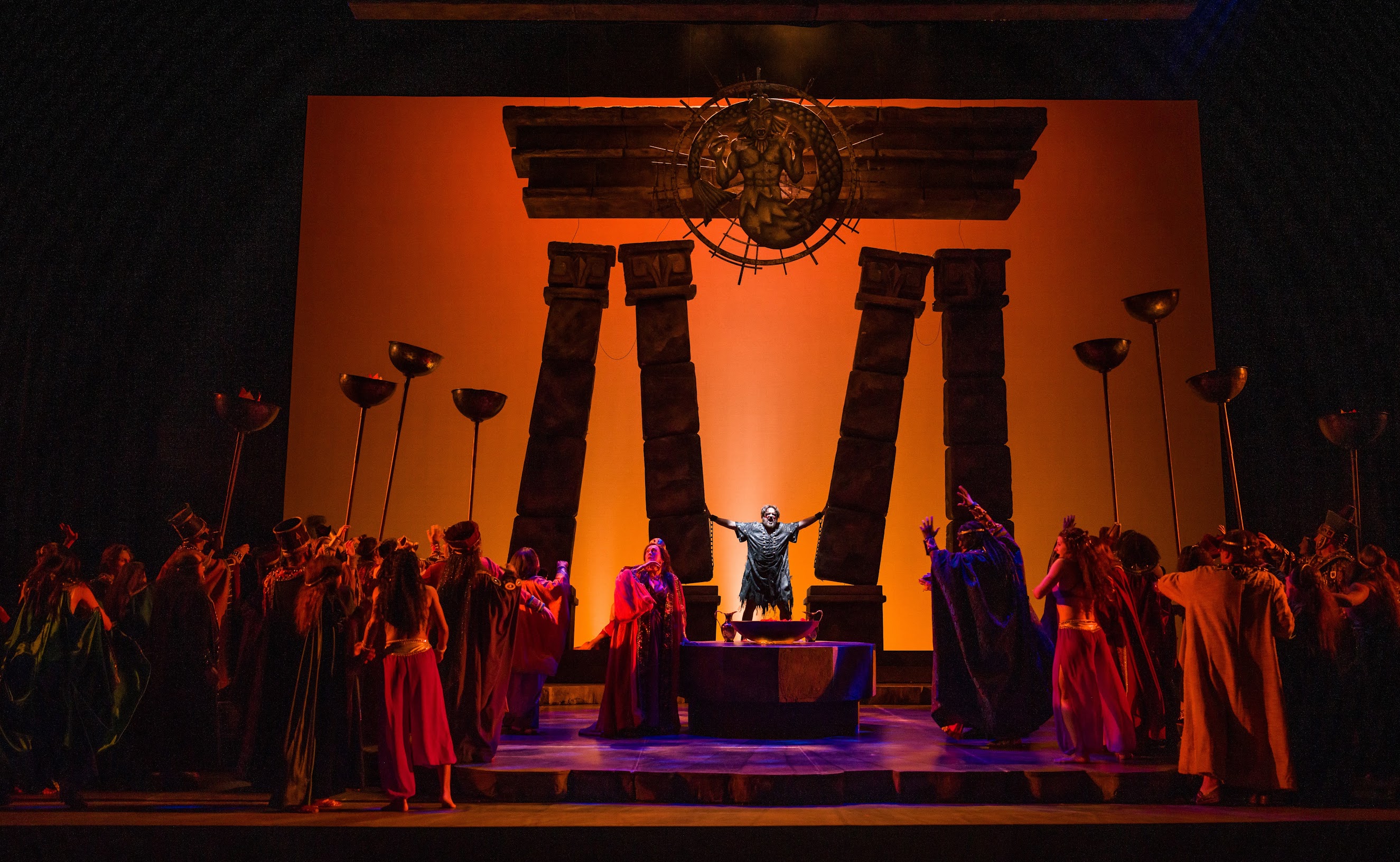
Performances will be conducted by Ari Pelto, Opera Colorado’s music director. Stage direction is by Keturah Stickann, with sets by Peter Dean Beck. The role of Samson will be sung by tenor Rafael Davila, Delilah by mezzo-soprano Katherine Goeldner.
The production will be a traditional one, Stickann said. “We are not updating in any conscious way,” she says. “We are set in Biblical times, as much as you can set something in Biblical times and be accurate.”
Most of the opera’s story will be familiar to anyone who knows the Biblical narrative. Samson has superhuman strength. The Philistines want to know the source of his strength so they can defeat him. Eventually Delilah learns that his strength comes from his hair. His hair is cut, he is captured by the Philistines, then blinded and enslaved. In the final act he destroys the Philistine temple.
That much is familiar, but there are some significant differences, particularly in the character of Delilah. In the Bible (Judges 16), she betrays Samson for money—1100 pieces of silver from each of several Philistine officials. In the opera, however, she acts more out of loyalty to the Philistine people and priests and declines gold offered by the high priest.
“If you look at what is written on the page, in the opera, she is very much an agent of the Philistines,” Stickann says. “That is not the way that she comes across in the Biblical story. Ultimately you have to tell the story that’s on the page.”
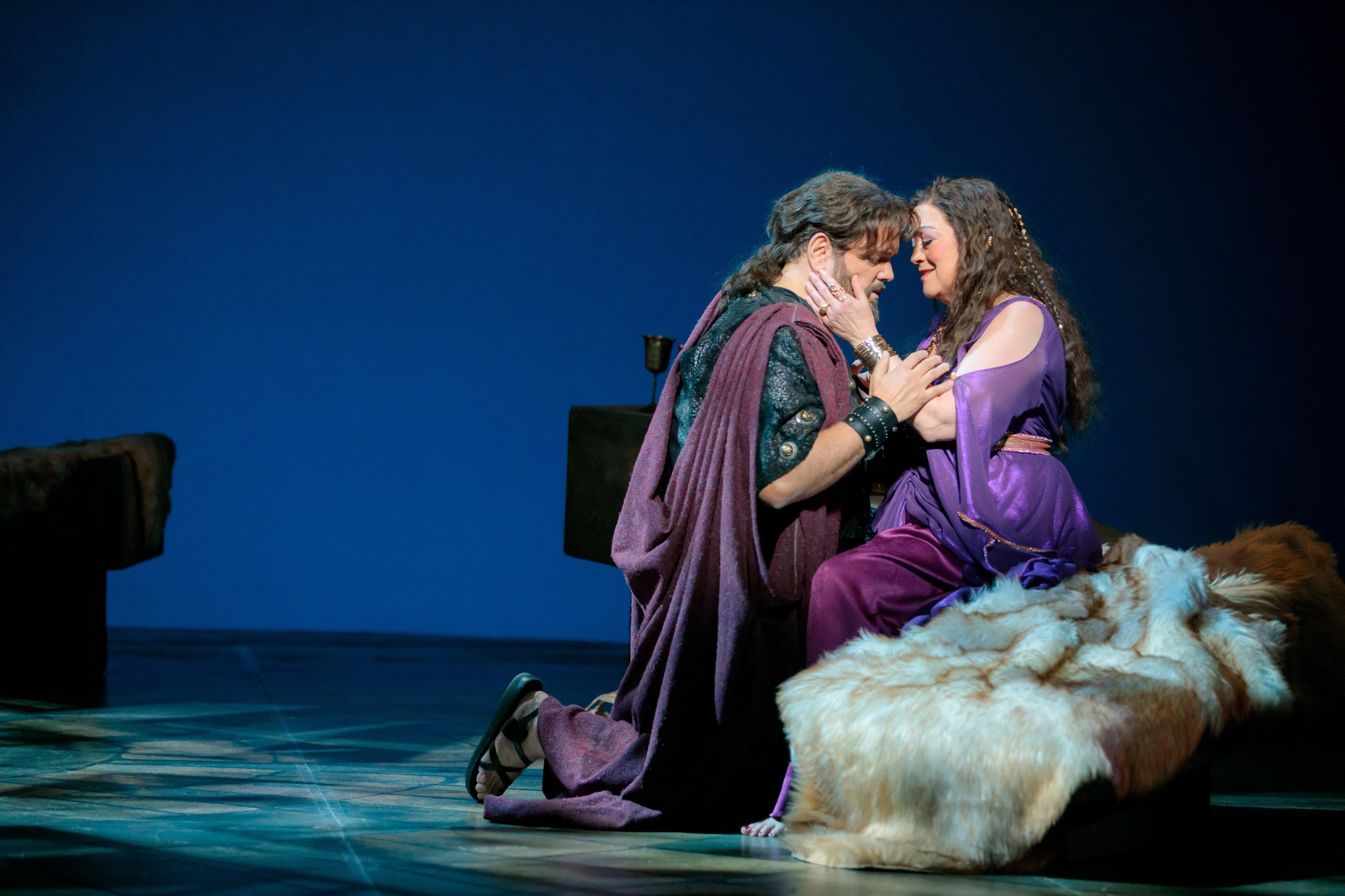
Stickann said that she and Goeldner, who will sing the role of Delilah, talked at length about the character. “She’s a mata-hari creature in this opera,” Stickann says. “She’s a spy for her people (and) is trying desperately to help her people.”
Goeldner agrees, but also sees many layers to Delilah. “She can be seen as just an evil vamp, but that’s too simple and uninteresting,” she says. “She’s not just sultry, she’s complicated. She’s mostly manipulating Samson. This is the fourth time she has tried to get his secret, and he’s lied to her three times. And yet he keeps coming back for more!
“She does love Samson in a way, but I think it’s the way Carmen loves Don Jose (in Bizet’s opera Carmen)—he’s useful and as soon as he stops being useful she’s done with him.”
Along with Carmen and Amneris in Aida, Delilah is one of the major starring roles for mezzo-sopranos. She dominates the second act and her actions drive the plot. As a result, it is one of the most coveted roles for mezzos.
“Getting to do Delilah once in a mezzo’s career is a huge thing,” Goeldner says. “The second act, you’ve got aria, gigantic duet, another gigantic duet, one of the most famous arias in the operatic repertoire—she’s on the entire time. It is one of the most demanding roles in the mezzo repertoire. It’s far more demanding than Carmen for example, which I’ve done a bunch.”
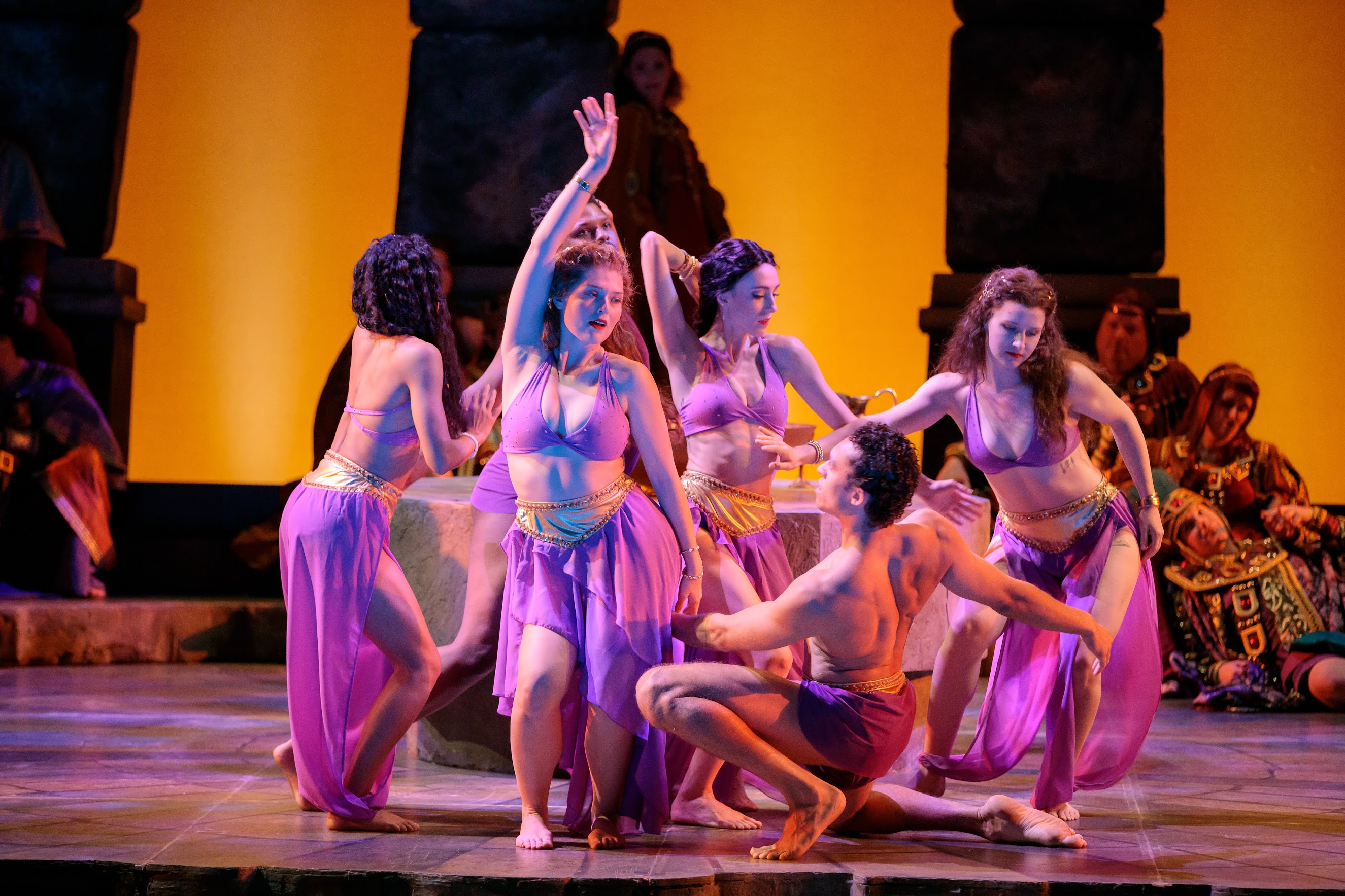
Her second act aria, “Mon cour s’ouvre à to voix” (My heart opens at the sound of your voice) is one of two frequently performed selections from Samson et Delilah. The other is the frenetic Danse Bacchanale in the third act, usually performed as a ballet as was expected in French opera of the 19th century, and a source of many standard musical gestures associated with the Middle East.
One of the challenges of presenting Samson et Delilah, and one that is visible to the audience, is that it was originally conceived as an oratorio rather than an opera. That idea survives in the large choral numbers in the first and third acts, which are great music but dramatically static.
“It is the problem of the piece,” Stickann says. “Sometimes the drama comes directly from the music. We do a little movement at the beginning of the long choral pieces, and then we sink into it a little bit. It gets more active, but this is the way that Saint-Saëns designed it. My challenge as a director is to make it work, that it is a seamless piece of theater.”
Stickann is excited about the Opera Colorado production of the opera. “It’s a terrific cast, the chorus is working at peak, and we have some spectacular dancers in this production. (And) The audience in Denver enjoys grand opera.”
Her perspective comes form having worked in 30 states and several countries overseas, and having lived in Missouri, San Diego, New York, and now Knoxville, Tenn. “It’s not just my upbringing in the Midwest,” she says. “It’s my experience in the South, my experience on the West Coat, my experience on the East Coast. These different places have definitely colored the way that I work.
“Every one of them has given me something, every one has a different way of being, [and] I grow a little bit more every time I move.”
# # # # #
Samson et Delilah by Camille Saint-Saëns
Libretto by Ferdinande Lemaire
Opera Colorado
Ari Pelto, conductor; Keturah Stickann, director
7:30 p.m.Saturday, May 4, Tuesday, May 7 and Friday, May 10
2 p.m. Sunday, May 12
Ellie Caulkins Opera House, Denver Performing Arts Complex
 Sharps & Flatirons