MahlerFest 2024 explores connections 

Mountains, friendship, and wide-ranging influences celebrated

By Peter Alexander May 14 at 1 p.m.

Colorado MahlerFest 2024 comes to Boulder this week, but it might offer a little more than you expect.

Founded in 1988 to bring Mahler’s music to Boulder and the Front Range, in recent years it has expanded its programming way beyond one Austrian composer of big symphonies. And this year, the programming is so diverse—Mahler, Richard Strauss, Schubert, Schoenberg . . . and Jimi Hendrix?—that you might be hard pressed to find the unifying element. (See the festival event schedule below.)

Mahler in the Mountains

The title of this year’s festival—“Mahler and the Mountains”—only offers a hint. But the festival’s music director, Kenneth Woods, has the answer: “We’re trying to explore the idea of connection,” he says. “‘Mahler and the Mountains’ is one very important one. [You also have] Mahler and Richard Strauss, this idea of friendship, and then Mahler and Schubert is the other really good one.”

Bringing in Hendrix might seem like a radical departure (more on that later), but one continuing feature of MahlerFest is the performance of one of Mahler’s symphonies on the final concert. This year it will be the Fourth Symphony on Sunday’s Stan Ruttenberg Memorial Concert (3:30 p.m. May 19, at Macky Auditorium). Sharing the program will be the Prelude to Wagner’s Die Meistersinger and Strauss’s Metamorphosen for 23 strings.

Composed 1899-1900, the Fourth has the smallest orchestra and is in some ways the simplest of Mahler’s symphonies. Expecting a complex and massive work like the Second and Third symphonies, early audiences were disappointed, but more recently the attractive melodies and the joyful finale have made the Fourth a popular entry point for listeners new to Mahler’s music.

“It’s such a gorgeous piece, such a counterbalance to almost everything else he wrote,” Woods says. “It’s so classical, it’s so delicate, it’s so intimate and personal, he reveals something in this piece that he doesn’t show anywhere else. He’s branching out into a much more contrapuntal style (and) using the orchestra one part at a time. It gives it that beautiful transparency that’s not like anything before it.”

Woods says he picked the Meistersinger Prelude for the program because both Mahler and Strauss were heavily influenced by Wagner, and because it features the brass section that the Fourth Symphony barely uses. “We wanted to bring the brass with us to the end of the festival,” he says. “We like our brass section!”

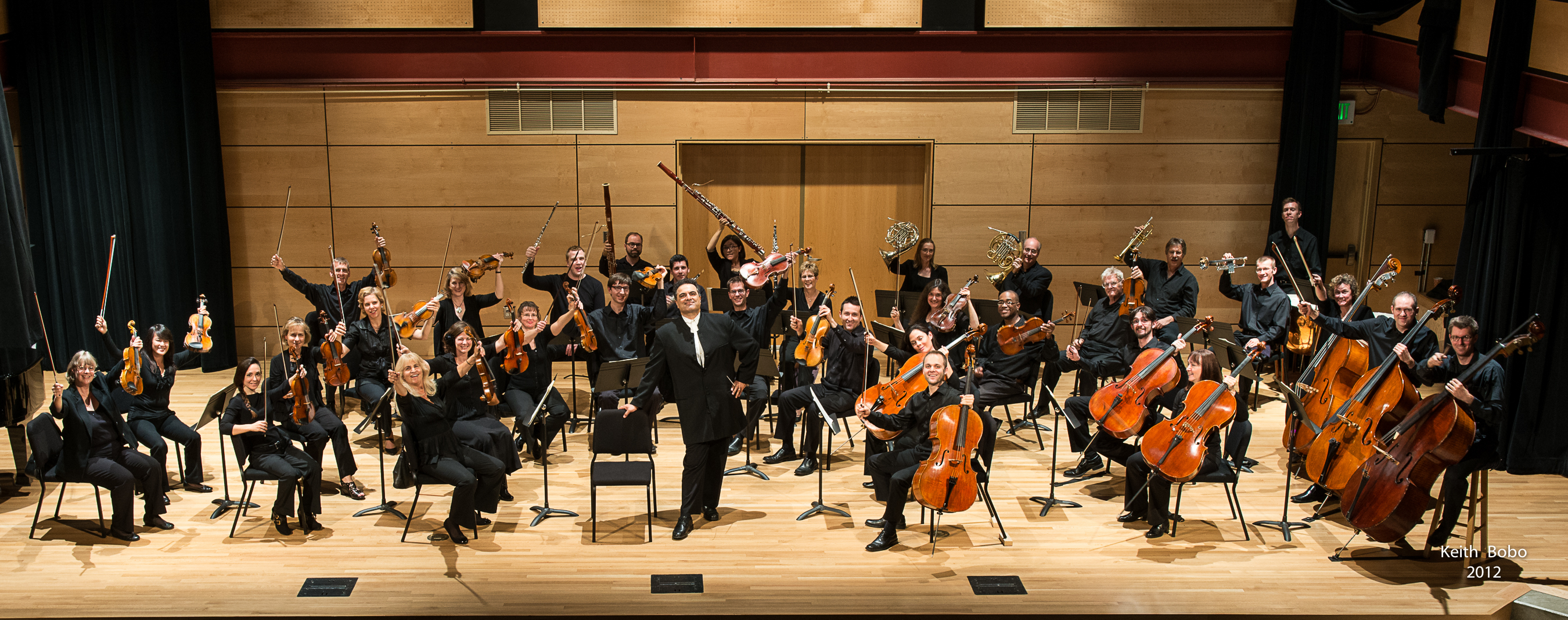
Kenneth Woods with theMahlerFest Orchestra. Photo by Keith Bobo.

Less known than Strauss’s major tone poems and operas, Metamorphosen was one of the composer’s last pieces. And it is one of Woods’s favorites. “I think it might be his greatest work,” he says. “To me, Metamorphosen is the culmination of [Strauss’s] fluidity of musical thought. I don’t  think music could go any further in that direction.”

This year’s MahlerFest also includes an orchestral concert on Saturday (7:30 p.m. May 18, also in Macky). The featured orchestral work connects Mahler, the mountains and Strauss: the Alpensinfonie (Alpine Symphony) that Strauss wrote, in part as a memorial to Mahler. This piece is another of Wood’s favorites, although he has never conducted it before. “I’ve been trying to get a chance to conduct this piece for as long as I can remember,” he says. “I’ve been told ‘No!’ by orchestra managers more times for Alpine Symphony than for any other piece.”

Alphorns. Photo by Christo Vlahos.

The problem is that the Alpine Symphony not only calls for a huge orchestra, running up the costs for organizations that perform it, it also includes alphorns in E-flat that are especially hard to find. These are the long, curved, wooden trumpet-like instruments associated with the Swiss Alps. Because they have no valves, they cannot be transposed. Fortunately, MahlerFest’s provider of alphorns, Salzburger Echo, was able to supply properly pitched alphorns at the last minute so that the festival did not have to improvise a solution. 

“MahlerFest is the perfect place to do (the Alpine Symphony),” Woods says. “To do it here with the Rockies in the background is just magical. It’s an amazing piece, with a strong connection to Mahler. (Strauss) had the idea of something Alpine for over 10 years, but it was only after Mahler died that he started writing as kind of an homage.”

Richard Strauss and Mahler, 1908

Mahler loved the mountains and often hiked in the alps. Strauss’s score describes such an excursion, including a thunderstorm on the summit, but Woods says it stands for much more. “It’s a clear metaphor for the arc of life,” he says, “that striving that it takes to get to a summit, and the fact that none of us get to stay there—we all have to come down eventually.”

Filling out the program is another piece standing for Mahler’s connections to other composers:  his arrangement for full string orchestra of Schubert’s String Quartet in D minor, known as “Death and the Maiden.” Woods points out that arrangements of chamber music, and especially string quartets, for larger ensembles were common in the early 20th century.

“Mahler was in that generation, post Wagner, where everything is getting bigger and bigger,” he explains. “He gets the idea to take some string quartets and arrange them for large string orchestra. It makes it into a different piece in a way and reveals different aspects of the piece. I’m a big fan of (arrangements), and Mahler was, too.”

Other arrangements featured earlier in the festival are not larger, but smaller than the original. During and after World War I, musical resources were strained, and composers were writing pieces for smaller and smaller groups, like Prokofiev’s “Classical” Symphony (1917) and Stravinsky’s Histoire du Soldat (Soldier’s Tale, 1924). Arnold Schoenberg and others started making chamber arrangements of symphonies and other large orchestral pieces by Mahler. 

Richard Strauss

Wednesday’s opening night concert (7:30 p.m. May 15 at Mountain View Methodist Church) will include several of those Mahler arrangements, including movements from the Fourth Symphony, as well as with a chamber version of Wagner’s Siegfried Idyll and Richard Strauss’s revered Four Last Songs. On Thursday, a free concert at the Boulder Public Library Canyon Theater will feature the MahlerFest Brass Quintet playing original works for brass and, yes, a Mahler arrangement.

Friday evening (May 17) brings the most outré part of MahlerFest, including the works furthest removed from Mahler’s orbit. There will be two performances that evening at the Roots Music Project, 4747 Pearl St. in Boulder. The first performance, at 7 p.m., will feature string players from the MahlerFest Orchestra and the Tallā Rouge Duo, a Persian-Cajun fusion viola duo.

The centerpiece of the program will be Schoenberg’s string sextet Verklärte Nacht—a deeply Romantic and descriptive piece still well within Mahler’s orbit. The rest of the program will comprise various ethnic-oriented pieces by Hawaiian/Kanaka Maoli composer Anne Leilehua Lanzilotti, folk/jazz violinist Karl Mitze, and bluesy fiddle pieces by African-American composer Coleridge-Taylor Perkinson.

Starting at 9 p.m., the evening’s second event strays furthest from Mahler and the late 19th century, and brings us back to Jimi Hendrix. Titled “Electric Liederabend: Hendrix Meets Mahler,” the performance will juxtapose one of America’s most creative rock musicians with the composer of big symphonies . 

Woods will showcase his electric guitar and arranging skills, performing his own versions of Mahler—or at least music derived from Mahler—with a small combo. His 9 Reasons: A Meditation on Mahler’s Ninth Symphony will open the program, which also includes his arrangement of music from Elgar’s Cello Concerto and Mahler’s Der Abschied (The farewell).

Jimi Hendrix

Hendrix has his own place on the program, with “Machine Gun” and “Up from the Skies.” There is no mention of “Purple Haze,” but Woods says there could always be an encore. “‘Purple Haze’ is the first song I learned on the guitar,” he says. “When I got my first electric, I bought the ‘How to Play Jimi Hendrix’ book, and ‘Purple Haze’ was the first one I learned.”

While Hendrix once mentioned Mahler as an influence, to most listeners there’s little obvious musical connection between them. However, Woods likes to look deeper into the personalities of the two artists. “I wanted to showcase Jimi’s later development a little bit more, as he got more into the metaphysics and more complicated musical ideas,” he says.

And in the symphonic world, metaphysics and complexity naturally lead to Mahler.

A full schedule of events, including workshops, open rehearsals and pre-concert discussions, with artists’ bios and links for sales for ticketed events, is available on the MahlerFest Web page.

# # # # #

“Mahler & the Mountains”
Mahlerfest 37

Opening Night: “Visions of Childhood”
MahlerFest Chamber Orchestra, Kenneth Woods, conductor
With April Fredrick, soprano, and David Taylor, bass trombone

  • Mahler: Mahlerei, Concertino for bass trombone and chamber orchestra, arr. Schnyder/Horowitz (from Symphony No 4, Scherzo)
  • Richard Strauss: Vier letzte Lieder (Four last songs), arr. Ledger
  • Mahler: Symphony No. 4, First movement, arr. Kenneth Woods
  • Wagner: Siegfried Idyll, arr. Woods
  • Humperdinck: Hänsel und Gretel, “Der kleine Sandmann” (The little sandman) and “Abendsegen” (Evening blessing), arr. Woods
  • Schubert: Die Forelle (The trout), song and variations, arr. Woods
  • Mahler: Des Knaben Wonderhorn, Das irdische Leben (The earthly life), arr. Woods
  • Schubert: Der Tod und das Mädchen (Death and the maiden), song and variations, arr. Woods
  • Mahler: Symphony No. 4, Fourth movement, arr. Stein

7:30 p.m. Wednesday, May 15
Mountain View United Methodist Church, Boulder

Mountains of Brass
MahlerFest Orchestra Brass Quintet
Daniel Kelly and Richard Adams, trumpet; Lydia Van Dreel, horn; Lucas Borges, trombone; and Jesse Orth, tuba

  • Anthony Barfield: Gravity
  • David LeRoy Biller: Little Piece for Brass Quintet (world premiere)
  • Victor Ewald: Quintet No. 3 in D-flat
  • Mahler: Die zwei blauen Augen (The two blue eyes), arr. Michael Drennan
  • Jimi Hendrix: “Angel,” arr. David LeRoy Biller
  • Joan Tower: Copperware
  • Morley Calvert: “Suite from the Monteregian Hills”

3 p.m. Thursday, May 16
Canyon Theater, Boulder Public Library
FREE

Transfigured Night: Schoenberg & More

Members of MahlerFest Orchestra and Tallā Rouge Duo
Alan Snow, Caroline Chin and Sophia Szokolay, violin; Lauren Spalding and Aria Cheregosha, viola; Kenneth Woods and Parry Harp, cello

  • Karl Mitze: Seesaw
  • Anne Leilehua Lanzilotti: Silhouette, Mirror
  • Coleridge-Taylor Perkinson: Blue/s Forms
    Louisiana Blues Strut
  • Schoenberg: Verklärte Nacht (Transfigured Night)

7 p.m. Friday, May 17
Roots Music Project, 4747 Pearl St., V3A, Boulder

Electric Liederabend: Hendrix Meets Mahler
Kenneth Woods, guitar and vocals; David LeRoy Biiler, bass and guitar; Michael Karcher-Young, bass and drums; Michael Baker, drums

  • Mahler: 9 Reasons: A Meditation on Mahler’s Ninth Symphony, arr. Woods
  • Woods: Life/Time
  • Elgar: Malvern Hills Melancholy, arr. Woods from the Cello Concerto in E minor
  • Jimi Hendrix: “Machine Gun”
    —“Up from the Skies/Third stone from the Sun”
  • Mahler: Der Abschied (The farewell), arr. Woods

9 p.m. Friday, May 17
Roots Music Project, 4747 Pearl St., V3A, Boulder

Symposium
Speakers: Jeremy Barham, Joseph Horowitz, Aaron Cohen, Matthew Mugmon, Nick Pfefferkorn and Kenneth Woods

9:30 a.m.–5 p.m., Saturday, May 18
Mountain View United Methodist Church
FREE and live-streamed on YouTube

Strauss and Schubert
MahlerFest Orchestra, Kenneth Woods, conductor

  • Schubert: String Quartet in D minor (“Death and the Maiden”), arr. Mahler
  • Richard Strauss: Eine Alpensinfonie, op. 64

7:30 p.m. Saturday, May 18
Macky Auditorium

Stan Ruttenberg Memorial Concert
MahlerFest Orchestra, Kenneth Woods, conductor
With April Fredrick, soprano

  • Wagner: Prelude to Die Meistersinger von Nürnberg
  • Richard Strauss: Metamorphosen
  • Mahler: Symphony No. 4 in G major

3:30 p.m. Sunday, May 19
Macky Auditorium

Tickets for the full festival or individual ticketed events available HERE

CORRECTIONS: The original version of this story stated that MahlerFest had to use extensions to pitch the alphorns in the proper key. After this story was written, the festival was able to obtain horns pitched in E-flat, as reflected in the later version of the story. And due to an editing error, the Friday night concerts (May 17) were originally listed in the article as taking place on Thursday, May 16. Sharpsandflatirons regrets the error.
Boulder Chamber Orchestra presents student soloists

Teachers Association Concerto competition winners will perform with BCO Saturday

By Peter Alexander May 8 at 3:30 p.m.

The Boulder Chamber Orchestra (BCO) will present winners of the 2024 Colorado Music Teachers Association (CMSTA) Concerto Competition on a concert program Saturday (May 11; details below).

Conductor Bahman Saless with the Boulder Chamber Orchestra

The winners in four categories—Piano Elementary, Piano Junior, Piano Senior, and Percussion and Winds—will each play the concerto movement that was required for the competition, with the orchestra (see the concert program below). The BCO music director, Bahman Saless, will conduct.

An annual event, the CMSTA Concerto Competition has three piano categories that are held every year. There are vocal and instrumental categories in alternating years: strings and voice in odd-numbered years, and winds/percussion (one category) in even-numbered years. The competition is for pre-college students up to age 19.

The 2024 competition was held in March, with videos submitted online. A panel of three judges—Saless; Hye-Jung Hong, piano faculty from Missouri State University; and Jason Shafer, principal clarinet of the Colorado Symphony—selected the winners.

The four categories and winners are:
—Piano, elementary: Aiden Chan
—Piano, junior: Bobby Yuan
—Piano, senior: Mercedes Maeda
—Percussion and winds: Alexander Zhao, bassoon

The BCO has set up an online auction to raise funds for the concert. The “Colorado Young Stars Award Fund” auction will run through Friday (May 10).

This year marks the first time that the BCO worked with the CSMTA to support the competition and present the winners. In a written communication, Saless commented, “We are looking forward to many years of continued collaboration and hopefully building community support and excitement in the Boulder area.”

# # # # #

CSMTA Concerto Competition Winners’ Concert
Boulder Chamber Orchestras, Bahman Saless, conductor

  • Haydn: Keyboard Concerto in D major, Hob.XVIII:11. Mvt. I, Vivace (Piano, Elementary)
    -Aiden Chan, piano
  • Mozart: Piano Concerto No. 12 in A major, K414, Mvt. I, Allegro (Piano, Junior)
    -Bobby Yuan, piano
  • Mendelssohn: Piano Concerto No. 1 in G minor, Mvt. I, Molto allegro con fuoco (arr. by Cord Garben (Piano, Senior)
    -Mercedes Maeda, piano
  • Vivaldi: Bassoon Concerto in D minor, RV481, Mvt. I, Allegro (Percussion and winds)
    -Alexander Zhao, bassoon

8 p.m. Saturday, May 11
Boulder Seventh Day Adventist Church

TICKETS

Effective, powerful Samson et Delilah at Opera Colorado

Production opened Saturday, continues next week May 7, 10, 12

By Peter Alexander May 6 at 12:10 p.m.

Opera Colorado opened an effective and at  times powerful production of Saint-Saens’s Samson et Delilah Saturday (May 4) at the Ellie Caulkins Opera House in Denver.

The final production of 2023–24 season, Samson et Delilah will run for a total of four performances, with additional shows scheduled for 7:30 p.m. May 7 and 10, and 2 pm Sunday, May 12.

The production is a traditional take on the story, meaning there are no attempted updatings or imposed psychological meanings. Sets and costumes represent Biblical times—“as much as you can set something in Biblical times and be accurate,” in the words of stage director Keturah Stickann.

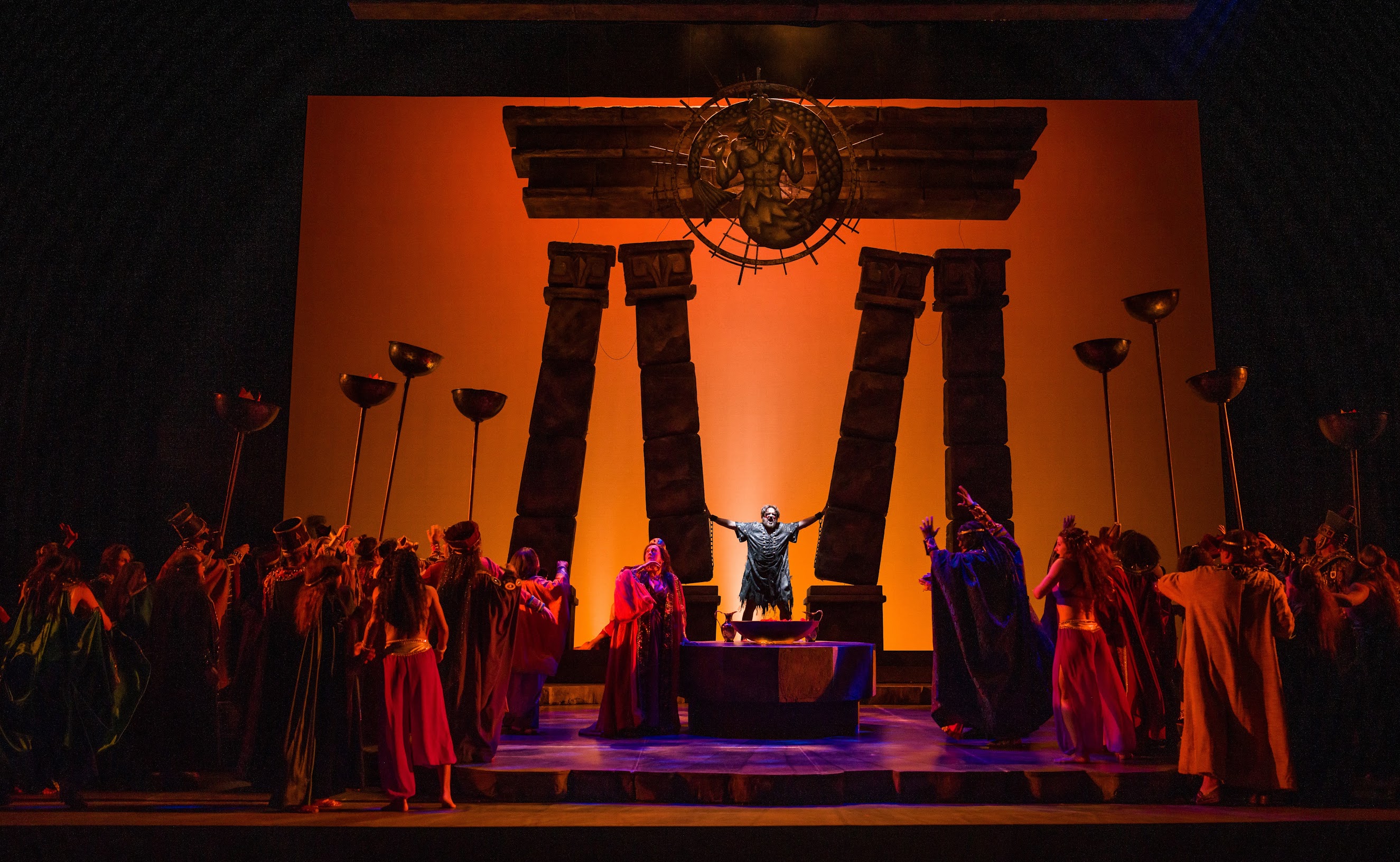
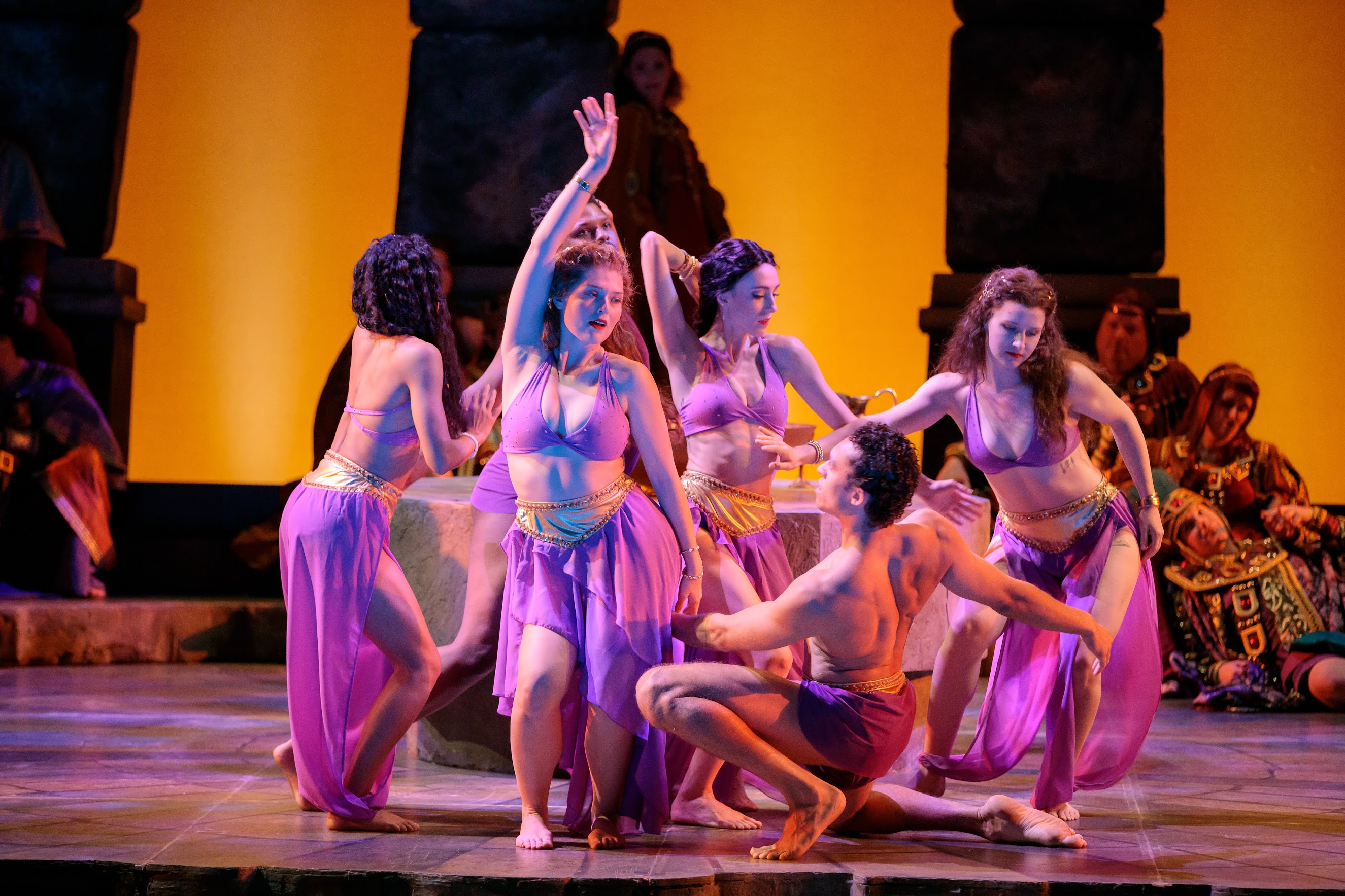
Act III of Opera Colorado’s production of Samson et Delilah. Photo by Matthew Staver for Opera Colorado.

The sets by Peter Dean Beck are evocative of the locations without devolving into middle-eastern kitsch. The first act opens on a nicely lit scene of the suffering Hebrews, in a public square under captivity by the Philistines. Here the set leaves plenty of space for the limited action that takes place, which is useful with so much of that act being otherwise static choral singing. Most impressive is the final scene, with the requisite pillars of the temple looming over the stage. The final collapse of the Philistine’s temple is simply accomplished but effective.

Stickann’s staging is never less than serviceable, which is what is needed for an opera with no hidden motives or deep psychological drama: everything that happens is out in the open. In the first act, the limited movements helped vary the stand-and-sing choral material. Repeated raised-arm gestures by the chorus are overdone but expressive of the repeated pleas of the Hebrews. Otherwise, the action moves smoothly. 

The second act confrontations  of Delilah with the High Priest and with Samson are well dramatized. However, the end of the act does not follow the libretto. In this production, Delilah gives Samson a magic potion, he passes out, and she takes a knife given to her by the High Priest and cuts Samson’s hair. But the libretto is clear: the hair cutting does not take place on stage for the simple reason that she never hears Samson’s secret onstage. 

What Saint-Saëns and the libretto indicate is that Delilah and Samson go into her house, where she seduces him and learns his secret during an orchestral interlude. Delilah calls for the Philistine soldiers who take Samson away. It’s  not clear if she has cut off his hair in her house, or the Philistines do so later, but it does not happen onstage. That is awkward, but a magic potion is too easy a way out. The composer’s version is better.

Rafael Davila as Samson. Photo by Matthew Staver for Opera Colorado

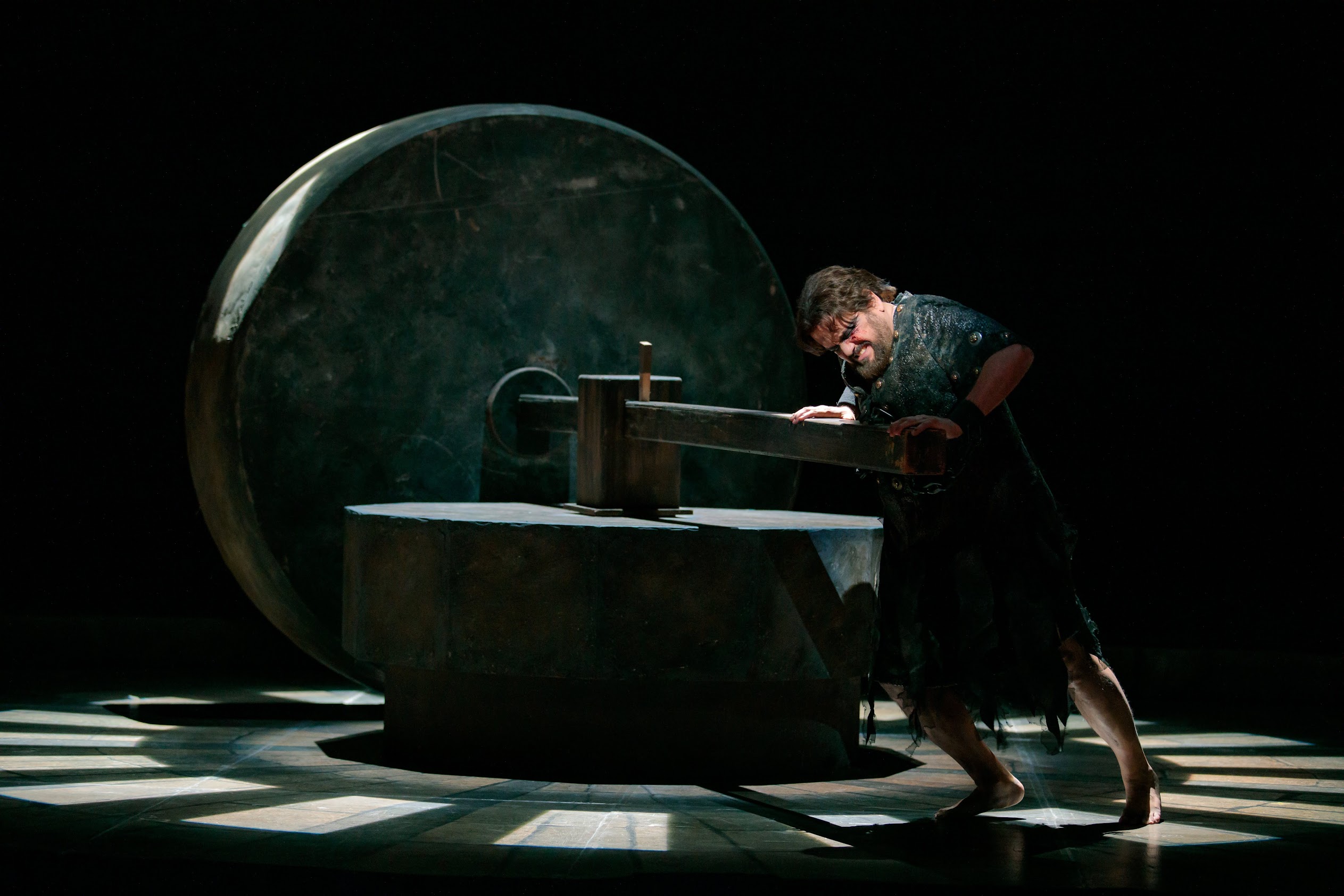
The final act is the best part of the evening. The first sene, of Samson pushing a mill wheel, is uncomplicated but moving. The destruction of the temple in the final scene works well on stage. Again, there’s not anything complicated to direct: there is a dance (the famous Bacchanale), Samson is brought in and mocked by the Philistines, then he moves between the pillars and brings down the temple. I was happy to see that the child who guides the blinded Samson was not forgotten: Samson sends him out of the temple before it collapses.

A fine cast gave top-flight performances. As Samson, tenor Rafael Davila made the strongest impression, singing with a solid, heroic-tenor quality. He consistently sang the words expressively, but did not always convey Samson’s internal struggle between his feelings for Delilah and his religious convictions. He was at his best in the final scene, creating great pathos while pushing the mill wheel and ringing out his denunciations of the Philistines at the end.

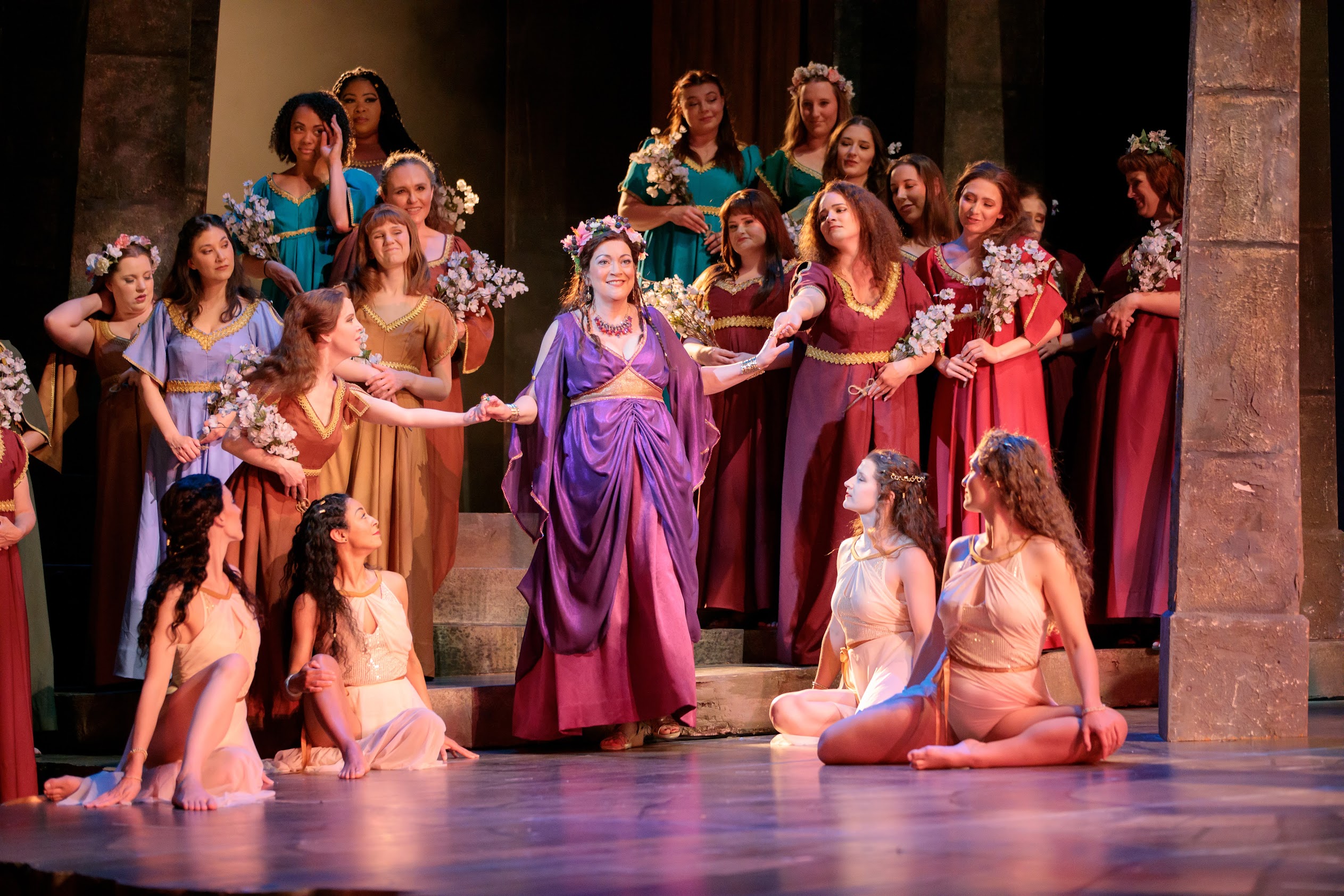
Katherine Goeldner as Delilah (center) with Philistine maidens and dancers in Act I of Samson et Delilah. Photo by Matthew Staver for Opera Colorado.

As Delilah, Katherine Goeldner brought extensive experience to her performance, including a prior appearance as Delilah at Virginia Opera. She no longer has the bright, focused tone of a young singer, but she had all the strength Saturday night to carry off the climactic moments. She sang with firmness of tone and great expression. And her Delilah is multilayered: aristocratic, calculating in her seduction of Samson, and vicious in her mockery in the final scene.

Nmon Ford was a tall, imposing High Priest, capturing both the authority and the evil implicit in the Biblical narrative. He brought a powerful and orotund, if occasionally rough-hewn sound to his portrayal. In the small part of Abimelech, the Philistine ruler who is killed by Samson in the first act, Christian Zaremba provided a dark, sometimes tight bass. Turner Staton was a solid Old Hebrew in his Act I dialog with Samson.

I am not dance critic, but I thought the dancers were smoothly integrated in the first act, more disconnected in the Bacchanale. The singers of the Opera Colorado chorus gave their lengthy, critical numbers a rich sound and secure ensemble.

The orchestra under conductor Ari Pelto propelled the action effectively, especially in Act II where the woodwinds shone in their prominent roulades. The full orchestral sound and expression supported the story throughout. The only reservation would be the Bacchanale, which was too fast. It is a frenzied dance, but taken too fast it looses clarity and precision, and the sudden tempo change near the end, which should be an explosion of sound and fury, looses its impact. Nevertheless, audience granted the expected spontaneous applause.

Tickets to additional performances may be purchased HERE.

Opera Colorado presents Saint-Saëns’ “Samson et Delilah”

The opera is based on, and different from, the familiar Biblical story

By Peter Alexander May 2 at 4:30 p.m.

The Biblical story of Samson’s betrayal by Delilah, and his violent revenge, is one of the best known dramatic tales from the Old Testament. It has been dramatized many times in film and music.

One of the most successful of those dramatizations will be presented by Opera Colorado over the next two weeks: Camille Saint-Saëns’s Samson et Delilah. The production opens Saturday, May 4, with additional performances May 7, 10 and 12 (details below).

Opera Colorado’s production of Samson and Delilah. Photo by Matthew Staver for Opera Colorado.

Performances will be conducted by Ari Pelto, Opera Colorado’s music director. Stage direction is by Keturah Stickann, with sets by Peter Dean Beck. The role of Samson will be sung by tenor Rafael Davila, Delilah by mezzo-soprano Katherine Goeldner.

The production will be a traditional one, Stickann said. “We are not updating in any conscious way,” she says. “We are set in Biblical times, as much as you can set something in Biblical times and be accurate.”

Most of the opera’s story will be familiar to anyone who knows the Biblical narrative. Samson has superhuman strength. The Philistines want to know the source of his strength so they can defeat him. Eventually Delilah learns that his strength comes from his hair. His hair is cut, he is captured by the Philistines, then blinded and enslaved. In the final act he destroys the Philistine temple. 

That much is familiar, but there are some significant differences, particularly in the character of Delilah. In the Bible (Judges 16), she betrays Samson for money—1100 pieces of silver from each of several Philistine officials. In the opera, however, she acts more out of loyalty to the Philistine people and priests and declines gold offered by the high priest.

“If you look at what is written on the page, in the opera, she is very much an agent of the Philistines,” Stickann says. “That is not the way that she comes across in the Biblical story. Ultimately you have to tell the story that’s on the page.”

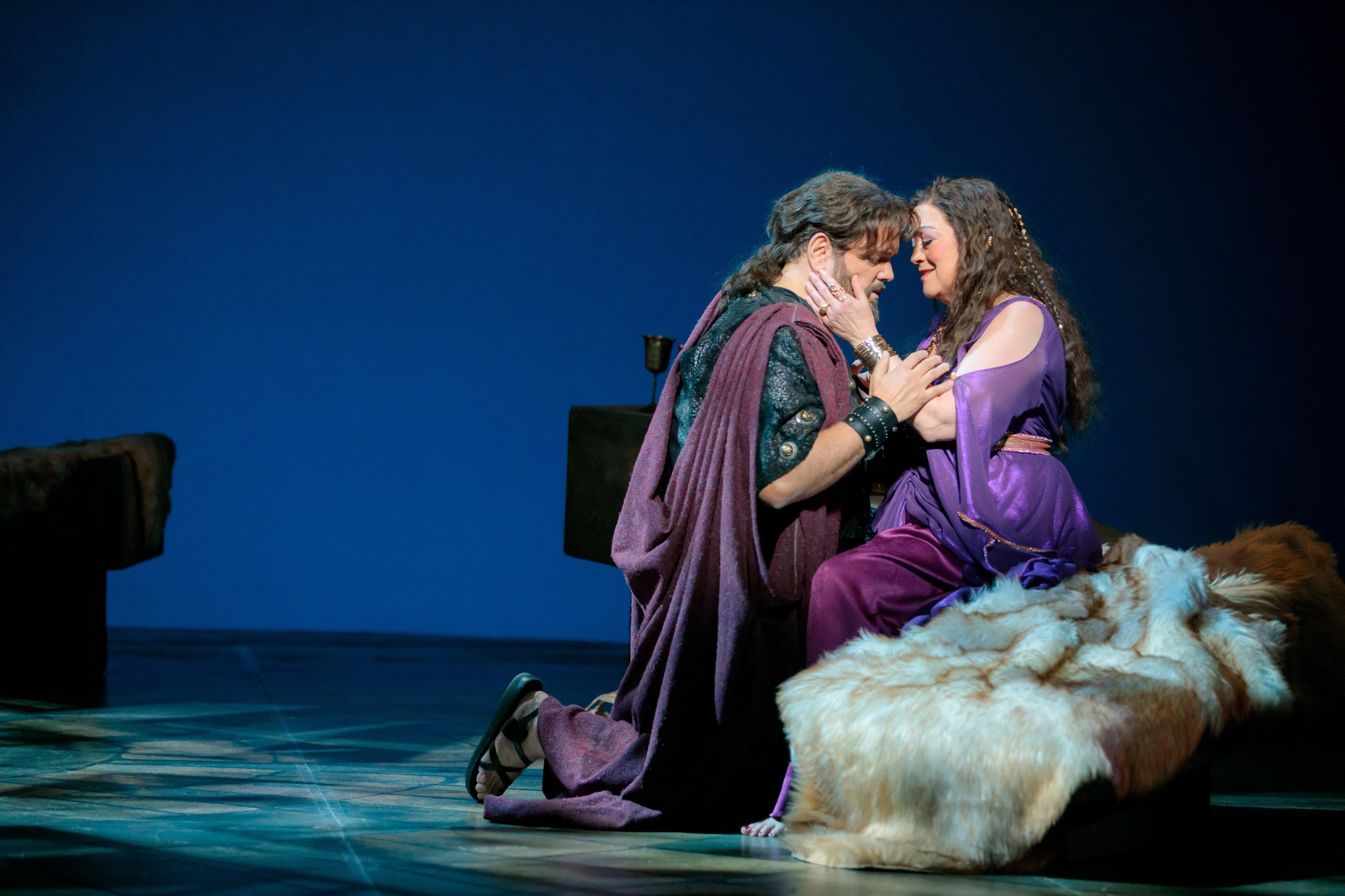
Rafael Davila (l.) and Katherine Goeldner (r.) as Samson and Delilah in Opera Colorado’s production of “Samson and Delilah.” Photo by Matthew Staver for Opera Colorado.

Stickann said that she and Goeldner, who will sing the role of Delilah, talked at length about the character. “She’s a mata-hari creature in this opera,” Stickann says. “She’s a spy for her people (and) is trying desperately to help her people.”

Goeldner agrees, but also sees many layers to Delilah. “She can be seen as just an evil vamp, but that’s too simple and uninteresting,” she says. “She’s not just sultry, she’s complicated. She’s mostly manipulating Samson. This is the fourth time she has tried to get his secret, and he’s lied to her three times. And yet he keeps coming back for more!

“She does love Samson in a way, but I think it’s the way Carmen loves Don Jose (in Bizet’s opera Carmen)—he’s useful and as soon as he stops being useful she’s done with him.”

Along with Carmen and Amneris in Aida, Delilah is one of the major starring roles for mezzo-sopranos. She dominates the second act and her actions drive the plot. As a result, it is one of the most coveted roles for mezzos.

“Getting to do Delilah once in a mezzo’s career is a huge thing,” Goeldner says. “The second act, you’ve got aria, gigantic duet, another gigantic duet, one of the most famous arias in the operatic repertoire—she’s on the entire time. It is one of the most demanding roles in the mezzo repertoire. It’s far more demanding than Carmen for example, which I’ve done a bunch.”

Her second act aria, “Mon cour s’ouvre à to voix” (My heart opens at the sound of your voice) is one of two frequently performed selections from Samson et Delilah. The other is the frenetic Danse Bacchanale in the third act, usually performed as a ballet as was expected in French opera of the 19th century, and a source of many standard musical gestures associated with the Middle East.

Dancers in Opera Colorado’s production of Samson and Delilah. Photo by Matthew Staver for Opera Colorado.

One of the challenges of presenting Samson et Delilah, and one that is visible to the audience, is that it was originally conceived as an oratorio rather than an opera. That idea survives in the large choral numbers in the first and third acts, which are great music but dramatically static.

“It is the problem of the piece,” Stickann says. “Sometimes the drama comes directly from the music. We do a little movement at the beginning of the long choral pieces, and then we sink into it a little bit. It gets more active, but this is the way that Saint-Saëns designed it. My challenge as a director is to make it work, that it is a seamless piece of theater.”

Stickann is excited about the Opera Colorado production of the opera. “It’s a terrific cast, the chorus is working at peak, and we have some spectacular dancers in this production. (And) The audience in Denver enjoys grand opera.”

Her perspective comes form having worked in 30 states and several countries overseas, and having lived in Missouri, San Diego, New York, and now Knoxville, Tenn. “It’s not just my upbringing in the Midwest,” she says. “It’s my experience in the South, my experience on the West Coat, my experience on the East Coast. These different places have definitely colored the way that I work.

“Every one of them has given me something, every one has a different way of being, [and] I grow a little bit more every time I move.”

# # # # #

Samson et Delilah by Camille Saint-Saëns
Libretto by Ferdinande Lemaire
Opera Colorado
Ari Pelto, conductor; Keturah Stickann, director

7:30 p.m.Saturday, May 4, Tuesday, May 7 and Friday, May 10
2 p.m. Sunday, May 12

Ellie Caulkins Opera House, Denver Performing Arts  Complex

TICKETS

Season closing events in Boulder and Longmont

Programs feature piano quartet, acrobatics and film music

By Peter Alexander May 1 at 4:38 p.m.

The Boulder Piano Quartet presents it’s final concert of the 2023-24 season Friday featuring music by Dvořák and the 19th-century French musical prodigy Mélanie Hélène Bonis Domange, known as Mel Bonis (7 p.m. May 3 at the Academy University Hill; further details below).

This will be the fourth and final performance this concert season to feature a guest violinist with the Quartet, appearing in place of their former violinist Chas Wetherbee, who died in 2023. The guest violinist for this performance will be Hilary Castle Green. 

Mel Bonis

This program is the second time that the Boulder Quartet has played music by Bonis, who is virtually unknown in the United States. About a year ago in May 2023, they played her Second Piano Quartet. This year they are playing her First Quartet in B-flat major.

Born in 1858, Bonis taught herself to play piano and entered the Paris Conservatory at 16. She was in the same class with Debussy, and studied composition with Cesar Franck. At the time women were not expected to be composers, and Bonis was urged by her parents to marry an older businessman. Because he didn’t like music, she gave up composing for a number of years. 

Later she met a former classmate who encouraged her and connected her with publishers, which led her to begin writing music again. She wrote the First Piano Quartet soon after, in 1901. When the composer Camille Saint-Saëns heard the Quartet, he is supposed to have said “I never thought a woman could write such music.” After her husband died in 1918, Bonis devoted herself to music.

Dvořák won the Australian State Prize for composition—in effect a grant to allow artists the time for creative work—in 1875. At 34 years of age he was still relatively unknown to the larger musical world, even though he had written four symphonies, seven string quartets, three operas, and other works. During that year he wrote a number of larger pieces, including his Symphony No. 5, his Serenade for Strings and the Piano Quartet No. 1 in D major. 

The Quartet is in the standard classical chamber-music structure of three movements, arranged fast, slow, fast. Unlike other quartets of the time, the piano is not placed separate from, or against the strings, as if it were a chamber concerto. Instead the four parts are more fully integrated. Though only three movements, the Quartet is an expansive work. It was not performed for nearly five years, however, having its premiere in Prague in 1880. 

# # # # #

Boulder Piano Quartet: Matthew Dane, viola, Thomas Heinrich, cello, and David Korevaar, piano, with guest violin Hilary Castle Green

  • Mel Bonis: Piano Quartet No. 1 in B-flat major
  • Dvořák: Piano Quartet No. 1 in D major, op. 23

7 p.m. Friday, May 3, Academy Chapel Hall, Academy University Hill
Admission free with advance reservations

# # # # #

The Boulder Philharmonic will continue its relationship with the performing group Cirque de la Symphonie with two performances Saturday in Macky Auditorium (2 and 7:30 p.m. May 4; details below).

Classical music’s answer to Cirque du Soleil, Cirque de la Symphonie presents aerialists, jugglers, ribbon dancers, acrobats, contortionists and other acts to the accompaniment of classical music performed live on stage. Macky Auditorium will be especially rigged for the aerial acts, and the front of the stage reserved for other performers. The performance of selected short classics will be conducted by Renee Gilliland, associate director of orchestras at CU Boulder.

Renee Gilliland

This will be the fifth time that the Boulder Phil has hosted Cirque de la Symphonie at Macky. Their last previous appearance was in 2018. While limited tickets are still available for both scheduled performances Saturday, previous Cirque performances have sold out.

Gilliland earned a Doctor of Musical Arts in orchestral conducting and literature from CU Boulder, a Master of Music in viola performance with an outside area in conducting from the Indiana University Jacobs School of Music, and a Bachelor of Music in music education and certificate of violin performance from the University of Texas at Austin Butler School of Music. She was also awarded an Artist Diploma in orchestral conducting from the University of Denver where she was assistant conductor of the Lamont School of Music Symphony and Opera Theater orchestras.

She was formerly music director of the CU Anschutz Medical Orchestra and associate conductor of the Denver Philharmonic.

# # # # #

“Cirque Returns”
Boulder Philharmonic Orchestra, Renee Gilliland, conductor
With Cirque de la Symphonie

  • Dvořák: Carnival Overture, op. 92 (orchestra only)
  • Ary Barroso: Aquarela do Brasil
  • Brahms: Symphony No. 3 in F Major, III. Poco Allegretto
  • Bizet: Carmen Suite No. 1, Les Toreadores
    Carmen Suite No. 2, Danse Bohème
  • Mendelssohn: Symphony No. 4 in A major (“Italian”), IV. Saltarello (orchestra only)
  • Rimsky-Korsakov: Capriccio Espagnol, Scena e canto gitano
    —Fandango asturiano
  • Tchaikovsky: Swan Lake Suite, Danse des petits cygnes
  • Mikhail Glinka: Overture to Ruslan and Lyudmila (orchestra only)
  • Rimsky-Korsakov: The Snow Maiden Suite, Danse des Bouffons
  • Leroy Anderson: Bugler’s Holiday
  • Smetana: The Bartered Bride, “Dance of the Comedians” (orchestra only)
  • Johann Strauss, Jr.: Thunder and Lightning” Polka
  • Tchaikovsky: Swan Lake Suite, Valse
  • Bizet: Carmen Suite No. 1, Les Toreadores

2 p.m. and 7:30 p.m. Saturday, May 4
Macky Auditorium

TICKETS

NOTE: Indications of which pieces are played by the orchestra alone without Cirque performance added 5/2.

# # # # #

The Longmont Symphony Orchestra (LSO) concludes its 2023-24 concert season Saturday (May 4) with “A Tribute to John Williams,” featuring the music of one of Hollywood’s greatest film composers.

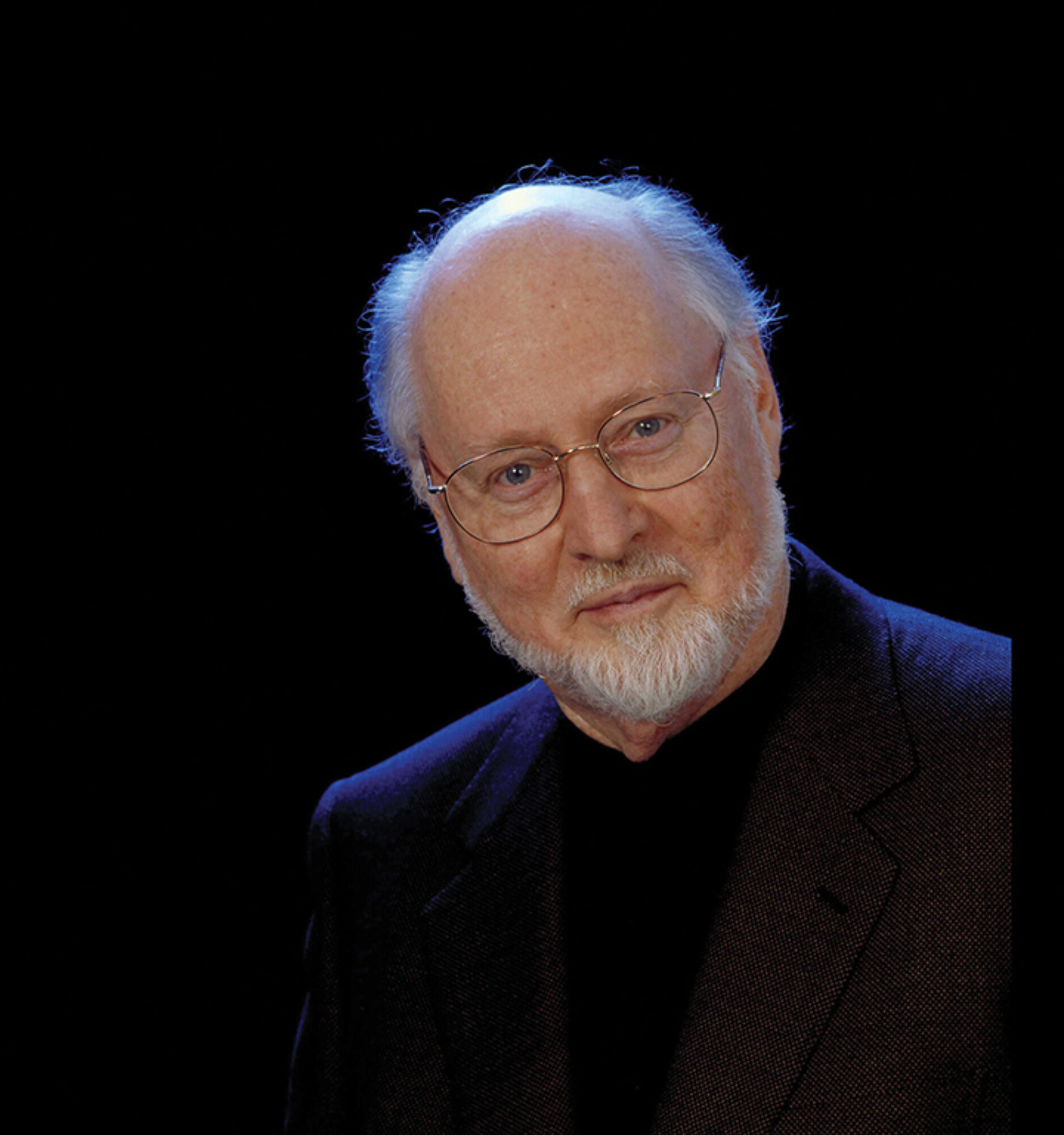
John Williams

The Pops Concert, at 7 p.m. in Longmont’s Vance Brand Civic Auditorium, will be under the direction of the LSO’s music director, Elliot Moore. The program will include music from the soundtracks for Star Wars, Jurassic Park, E.T. and Harry Potter, among other popular films.

With more than 1100 tickets already sold, there are only a few seats left at time of posting. Because of the size of crowd expected, the LSO advises attendees to arrive early. Overflow parking from the Skyline High School lot will be available at the Timberline School lot,  on Mountain View Avenue.

# # # # #

Tribute to John Williams
Longmont Symphony Orchestra, Elliot Moore, conductor

  • Music of John Williams

7 p.m. Saturday, May 4
Vance Brand Civic Auditorium, Longmont

Limited seats available HERE