
‘One of the greatest Italian ensemble operas’ Friday and Sunday
By Peter Alexander Oct. 25 at 5:40 p.m.
“Reverenza!”
That extravagant one-word greeting delivered by Mistress Quickly to the corpulent Sir John Falstaff (“Your reverence!”) sets off all the madcap action of Verdi’s final opera, the comedy Falstaff. A series of hilarious escapades follow, leaving Falstaff dumped in the river at the end of the second act and the butt of a comedic thrashing in the third. In spite of the abuse, it all ends with Falstaff cheerfully proclaiming “All the world’s a jest.” The entire cast joins him for, of all things, a rollicking 10-part fugue.
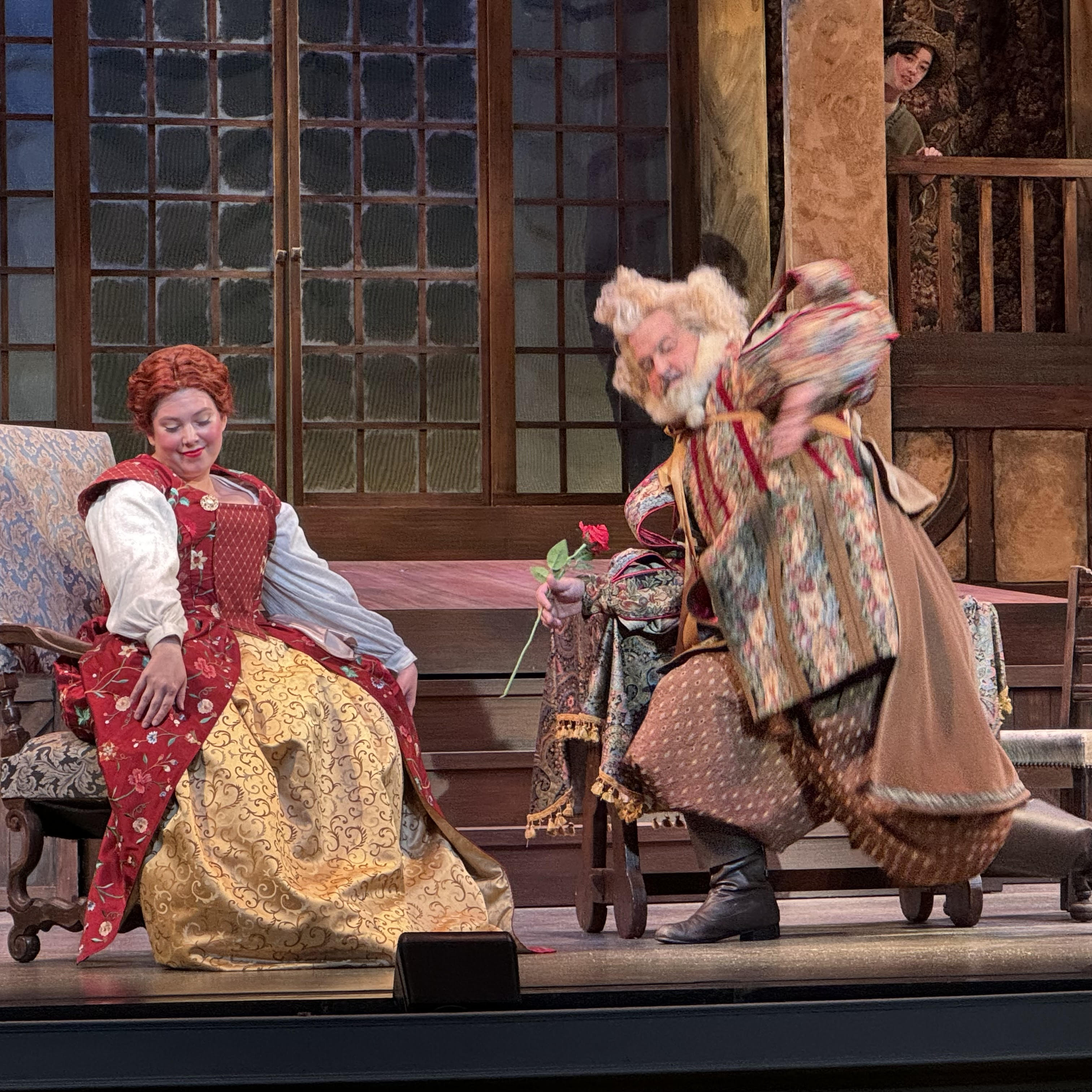
Falstaff will be the fall production of the CU College of Music’s Eklund Opera Company, with performances this coming Friday and Sunday in Macky Auditorium (Oct. 27 at 7:30 p.m., Oct. 29 at 2 p.m.; tickets available HERE). Performances are stage directed by Leigh Holman and conducted by Nicholas Carthy.
The opera is derived from Shakespeare’s Merry Wives of Windsor. Verdi had already retired twice when his publisher passed him the libretto, crafted by the Italian composer Arrigo Boito who also wrote the libretto for Verdi’s Otello. Verdi couldn’t resist, and Falstaff had its premiere in February 1893, when the composer was nearly 80.
The opera has two intertwining plots: Falstaff is trying to woo two wealthy wives in order to get at their fortunes; and one of their husbands, Ford, wants to marry his young daughter Nanetta to his friend Dr. Caius. She, however—in typical comic-opera fashion—is in love with someone her own age, Fenton. And also in comic-opera fashion, the women are far cleverer than the men and hilariously foil both plots.
Falstaff is seldom performed by student opera companies. For one thing, the role of Falstaff requires an experienced singer. As Carthy explains, this is an opera “where, if we get one person in, we can cast around them. So you bring a Falstaff in and it allows you to do one of the greatest Italian ensemble operas there is. Bringing in that one person is a fantastic opportunity to do something (the students) wouldn’t normally do.”
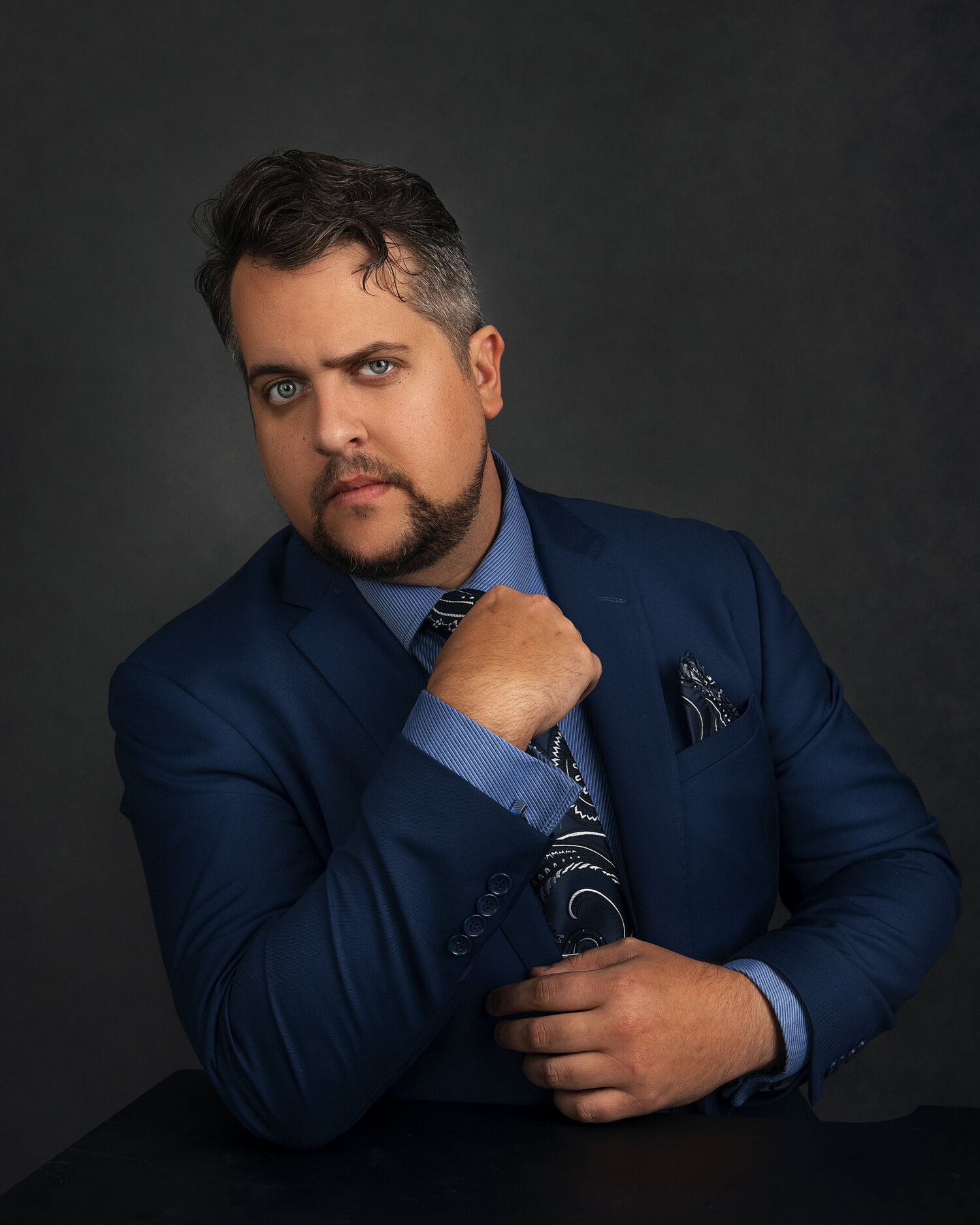
Eklund Opera has engaged Andrew Hiers (pronounced “hires”), who has performed with the San Francisco Opera Merola program, Opera Colorado, and the St. Petersburg (Fla.) Opera, to sing Falstaff. “He’s really good,” Holman says. “It ups everything a level, both in that it allows the students to do an opera that they might not otherwise be able to do. But also in what he brings, the experience that he has.
“He’s a really great actor, and the students are learning a lot working beside him. Every rehearsal, he’s just going, going, going, never complains, he’s just going. And it’s great for (the students) to see that.”
Other than Falstaff, Holman says, “We had all the other forces, including Quickly, who’s an artist diploma student”—Jenna Clark. That could be a difficult role to cast with students, but Holman says, “she’s really got the gravitas and the voice to pull that off.”
Another challenge is the breakneck pace of the music. “It’s a massive challenge for everybody,” Carthy says. “You don’t have time to do anything before something else comes along. It’s very tough, and we rarely have that sort of pacing in an opera. We’ve done Bohème and Traviata, but even Bohème doesn’t have that wickedness of pace that Falstaff does.”
“I would say the same thing,” Holman says. “It’s a difficult piece. As the director there’s just a lot coming at you.”
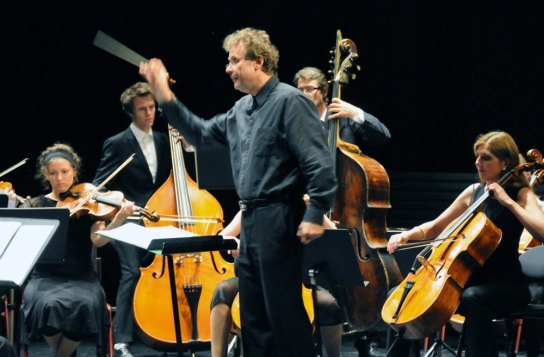
Carthy points out that the same is true for the orchestra and conductor. “Getting a mostly undergraduate orchestra, many (of whom) have never been in a pit before, to play Verdi or anything approaching Falstaff, is always going to be a challenge,” he says. “It’s this massive challenge to coordinate, but that‘s what I love doing that’s what I’ve spent my life doing.”
After all of Verdi’s dramatic, tragic operas, the speed and lightness of Falstaff is surprising. “It’s got more words, more notes, more melodies than anything else he ever wrote. It’s unlike his other operas in that it’s through-composed—it’s not arias and set pieces,” Carthy says. That lack of arias meant that Falstaff was not an immediate success, but the overall richness of Verdi’s invention has won over critics and musicians alike.
A good example is the love music between Nanetta and Fenton. He has one aria, but otherwise their scenes together are brief, made up of highly distilled lyrical expressions of love that are gorgeous but only last a minute or two. “It’s as if Verdi decided that he had trunks full of melodies to get rid of,” Carthy says. “And so he just threw them all at this thing.”
In Holman’s opinion, this is a do-not-miss performance. “We have wonderful singers with an amazing sense of humor and an amazing sense of comic and dramatic timing,“ she says.
“You’ll laugh the whole time!”
# # # # #
CU Eklund Opera Program
Leigh Holman, director
Nicholas Carthy, music director
- Verdi: Falstaff
7:30 p.m. Friday, Oct. 27
2 p.m. Sunday, Oct. 29
Macky Auditorium
 Sharps & Flatirons