
Rusalka and Flying Dutchman come to life in their music
By Peter Alexander Aug. 10 at 11:15 a.m.
Dvořák’s remarkable, beautiful opera Rusalka (Aug. 4) is based on the widespread folk tale of a water spirit, or mermaid, who falls in love with a human, with tragic consequences. As a fairy tale, it is open to many imaginative treatments in performance.
Many, but not all.
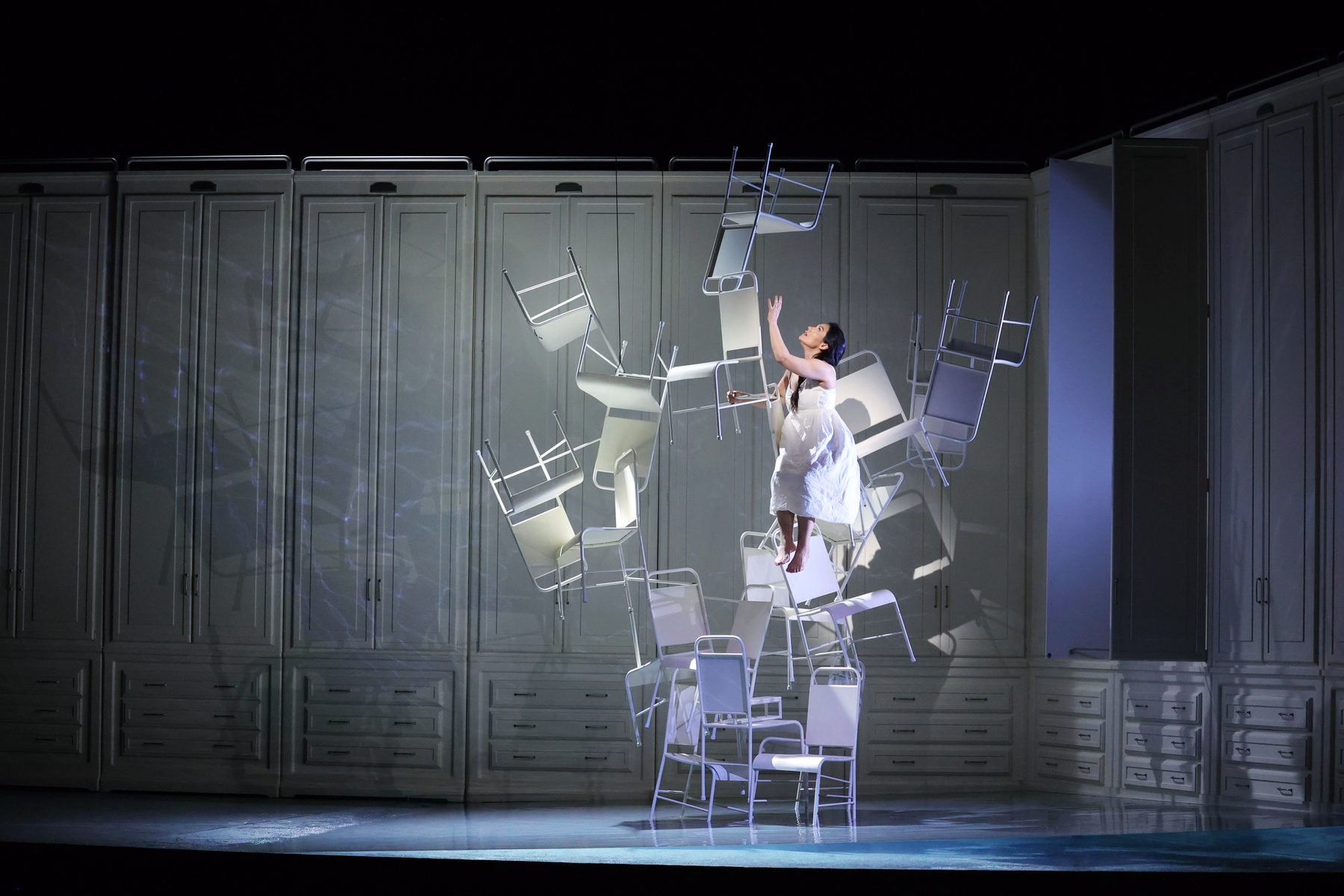
Santa Fe’s production is designed by Leslie Travers, with costumes by Marie-Jeanne Lecca, and directed by Sir David Poultney. There are significant aspects of the original tale that point to the placement of the opera in an asylum, with attendants in white looking over the characters. Rusalka, the spirit who wants to escape the watery realm in order to love a human, is clearly a dreamy misfit, rebelling against her restricted existence—the kind of free spirit who often found themselves confined in Victorian asylums, eager to escape just as Rusalka wants to escape into the human world.
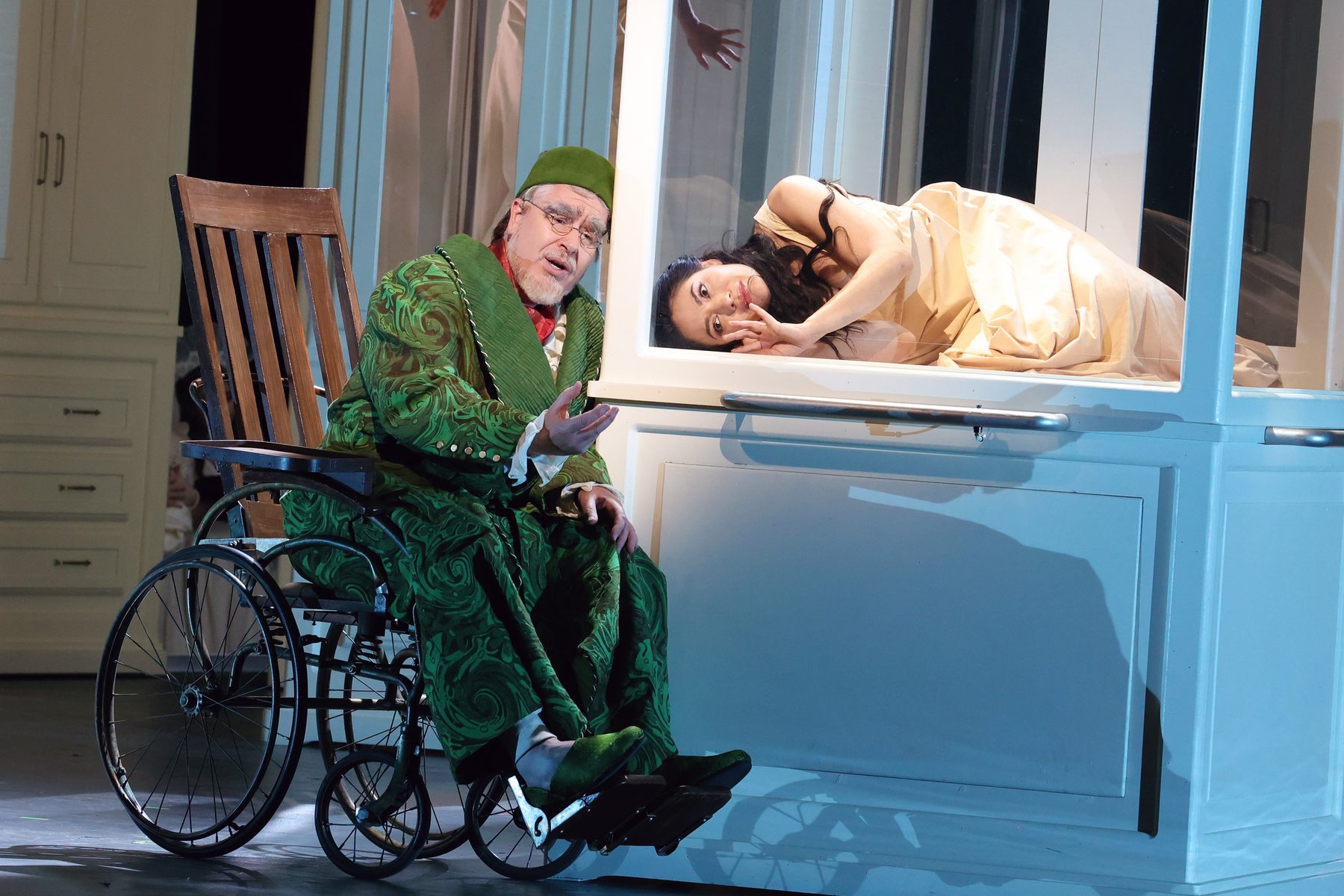
But from that essential truth, Poultney and designers take a series of wrong turns that lead into bewildering dead ends and inappropriate moments of laughter. Having Vodnik, Rualska’s father and a potent spirit of Czech legend known as the Water Goblin confined to a wheelchair, moved around by attendants and drugged by the witch Jezibaba, reduces him to an impotent bystander. This contradicts the legend and the music.
There are no trees in the first act, since it is an asylum rather than a forest. There is a shallow puddle of water and a stack of chairs that Rusalka climbs into and out of during the scene. (The chairs are missing in the final act, which is supposed to be the same place as the first act.) The three sprites who are Rusalka’s sisters enter the scene first as hand puppets (nervous laughter), then as children (ahh!), and then as singers.
At different times characters from the spirit world appear inside glass cases, a demonstration of their imprisonment that needs no repetition. Or are they the Prince’s feminine conquests, inside trophy cases? How would you know? Either way it reflects a truth of the legend, but it is heavy handed. This is especially true in the final scene, when the stage was filled six or eight cases standing at different angles. Not only are these cases obstacles to smooth staging, they clutter the stage to make a point we already know.
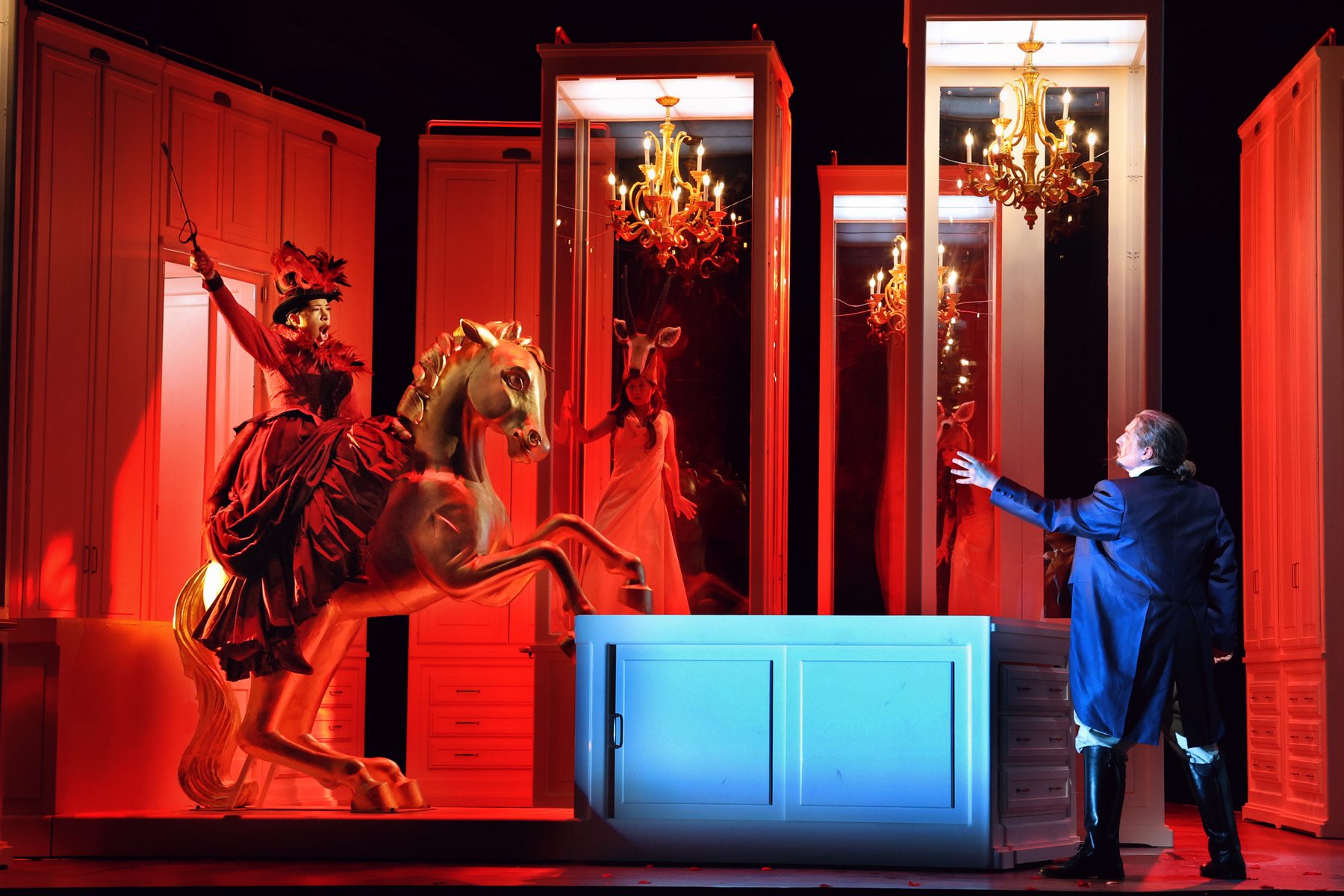
And when the foreign princess, who will seduce and reject the Prince, enters on a golden horse and dressed in scarlet, the laughter serves neither the opera nor the singers. Her riding crop, wielded against first Rusalka and then the Prince, only adds to the hyperbole. It would be better to rely on acting to establish her brutal haughtiness.
There is more; it’s enough to say that this is a production that starts with an interesting concept and takes it so far that action contradicts music and the magic is lost.
As with other operas this summer, the musical performance is first rate. In the title role Ailyn Pérez gave one of the season’s most satisfying performances. In spite of her mute moments in the second act, Rusalka is a large role, with intense, emotionally charged music in all three acts. Pérez consistently delivered her music with a focused voice and intense expression that were a pleasure to hear. The “Song to the Moon” and her anguished aria in the last act were highlights.
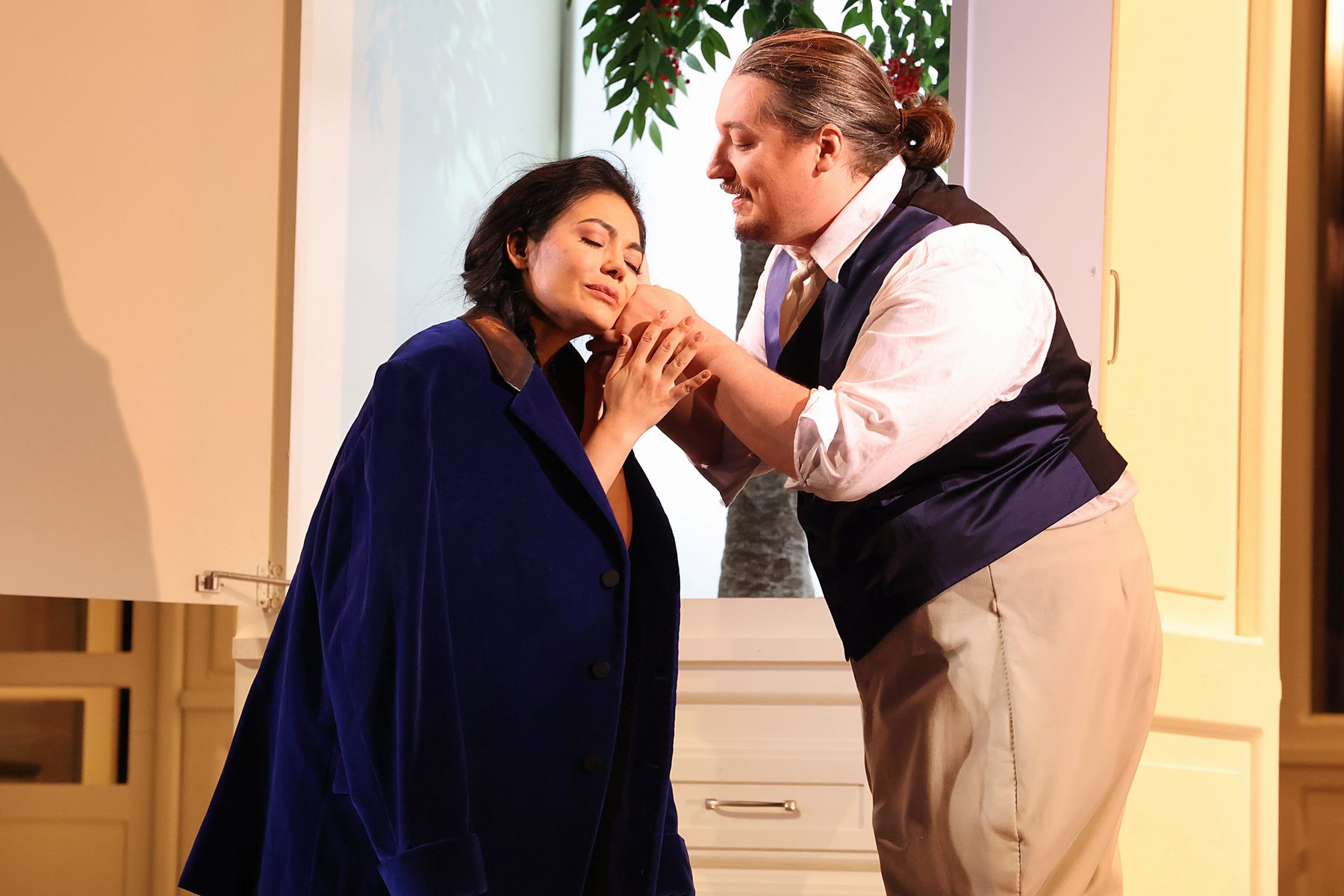
Robert Watson brought a big heldentenor voice to the Prince. In spite of his strong voice, he sounded tight and pressed on the top, where his vibrato was not always controlled. Even in his most ardent moments, he was wooden in his movements and often appeared detached. In spite of the direction that left him dramatically powerless, James Creswell sang richly and expressively as Vodnik. Freed from a wheelchair, he would have made a powerful water goblin. Mary Elizabeth Williams nailed her portrayal of the Foreign Princess. She does not need a riding crop to communicate the character; she does it well with voice and demeanor.
Raehann Bryce-Davis sang well as Jezibaba. Her brewing of the potion for Rusalka—another occasion for self-indulgent comedy, including the simulated killing of a cat—was scenically overdone but musically not quite fierce enough, but elsewhere she fulfilled the expectations for a witch of doubtful trustworthiness. The three wood sprites, Ilanah Lobel-Torres, Lydia Grindatto and Meridian Prall, made a lovely trio, singing some of the most charming music in Rusalka.
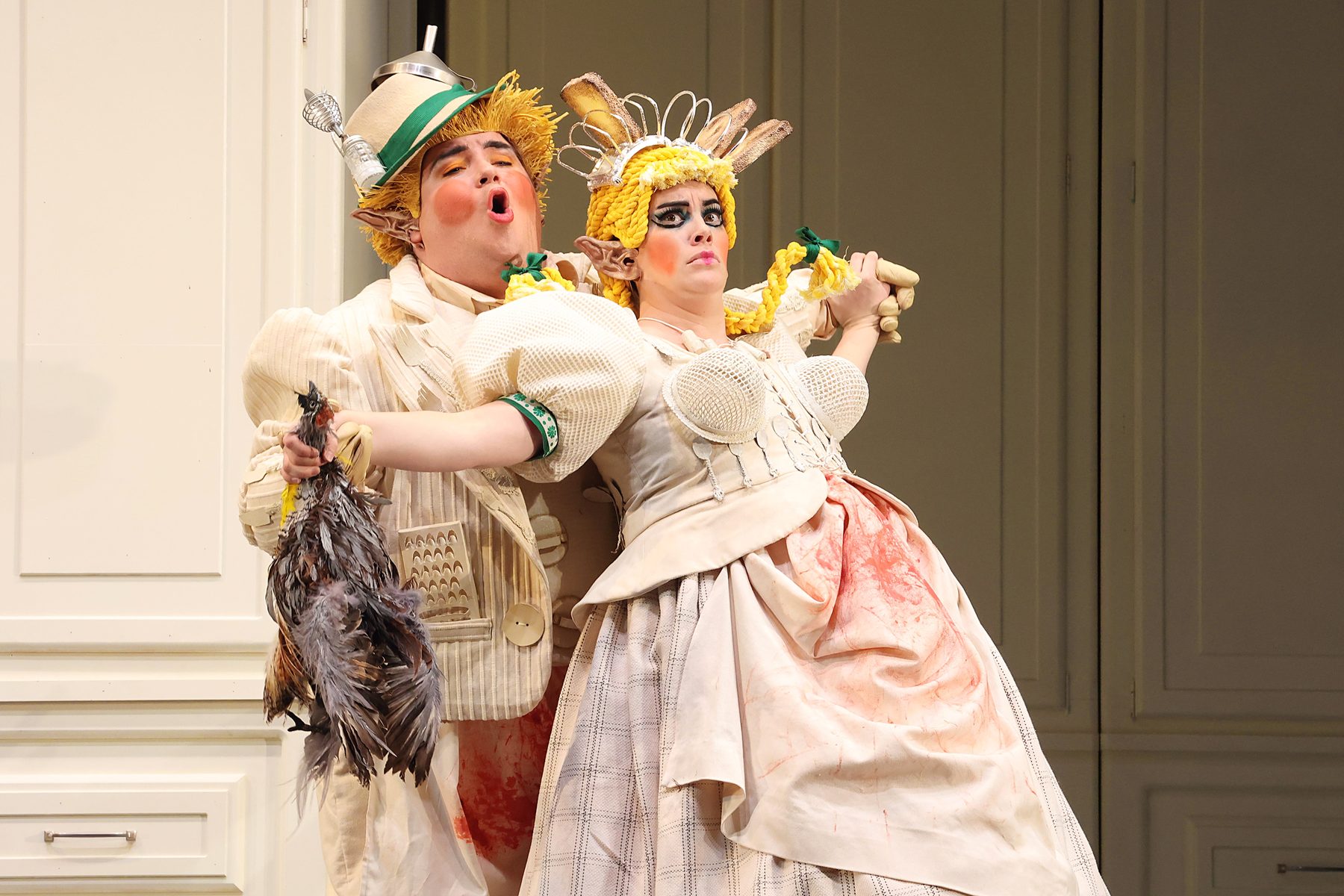
A particular misjudgment were the characters of the Gamekeeper, sung by Jordan Lloyd, and the Kitchen Girl (usually his nephew, the kitchen boy) sung by Kaylee Nichols. As Dvořák wrote the opera, they provide lighter moments of relief from the tragic tale, especially when they wander into the forest seeking Jezibaba. But making them into splapstick characters with silly hats and marionette clumsiness, eliciting more raucous laughs, does not serve Dvořák’s music or the opera. Lloyd and Nichols sang well, but the conception remains misguided.
Russian-American conductor Lidia Yankovskaya, making her Santa Fe Opera debut, captured all the magic of Dvořák’s score. Under her baton the orchestra evoked the forest that was absent from the stage, and captured the stateliness of the Polonaise that was awkwardly choreographed around glass cases. Here is where Dvořák’s opera came to life: in the orchestra and the singers they so ably supported. For that alone the performance was well worth while.
* * * * *
Wagner’s Flying Dutchman (Der fliegende Holländer) (Aug. 5) is, like Rusalka, based on a supernatural legend with a life-long curse at its center. In the Santa Fe Opera production directed by David Alden, however, the Dutchman is an industrial CEO, or a captain of industry rather than a ship’s captain. This suggests that the real curse is greed—one of the deadly sins and so another offense to God—from which Daland, the other major male character, also suffers.

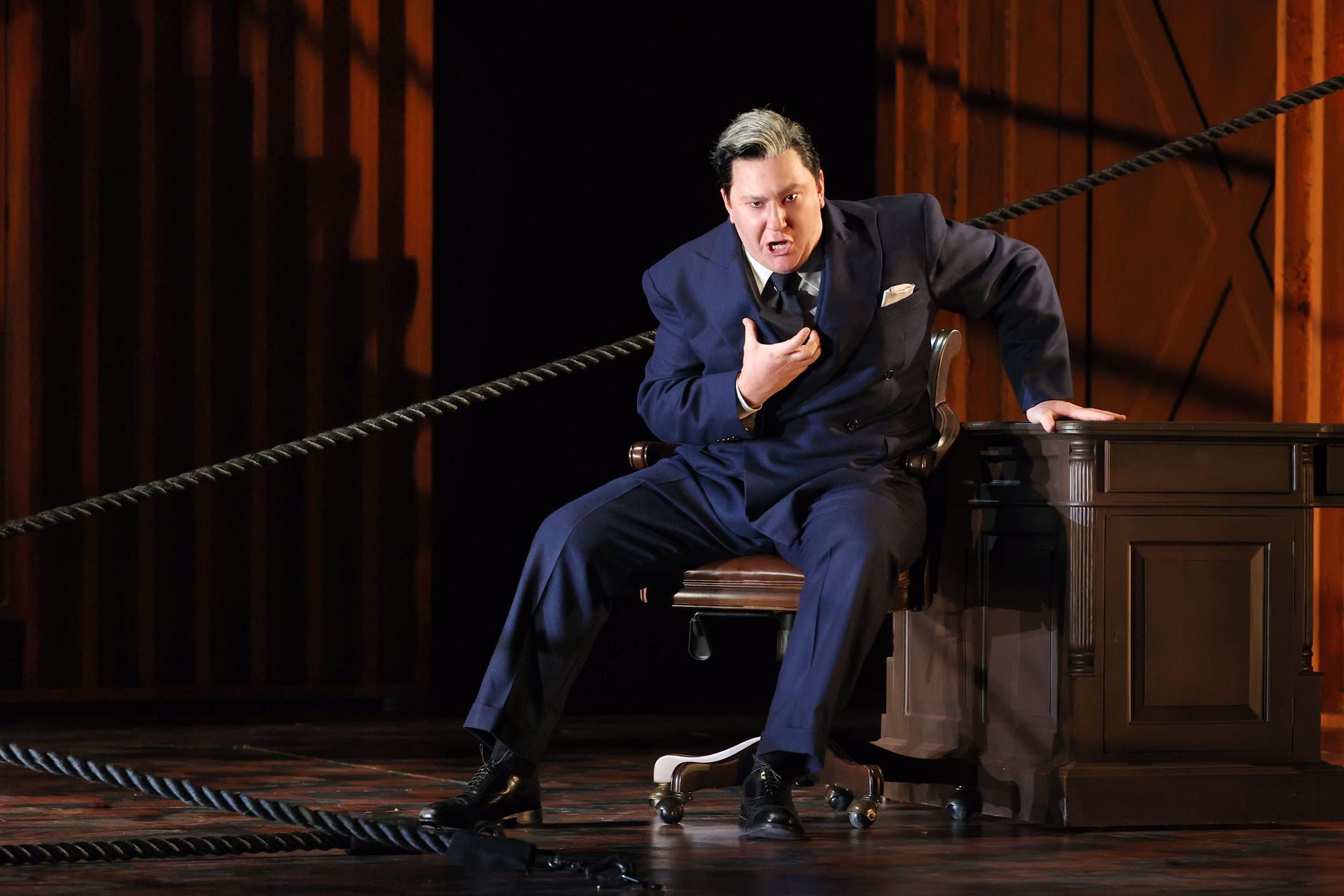
As a directorial statement, this perspective works well enough, but it contradicts many of the lines of the libretto that refer explicitly to a sea-going context—e.g., sailors are commanded to hoist sails and weigh anchors, when there is neither sail nor anchor in sight. And there is the music, which is is some of the most effective invocations of the sea ever written. The Dutchman’s ship is not so much a ship as a pile of shipping containers, symbolizing the world-wide commerce from which the anti-hero gains his riches. And when he arrives, as the containers/ship arise from behind the stage, the Dutchman’s ghostly crew bring on an executive’s desk and chair.
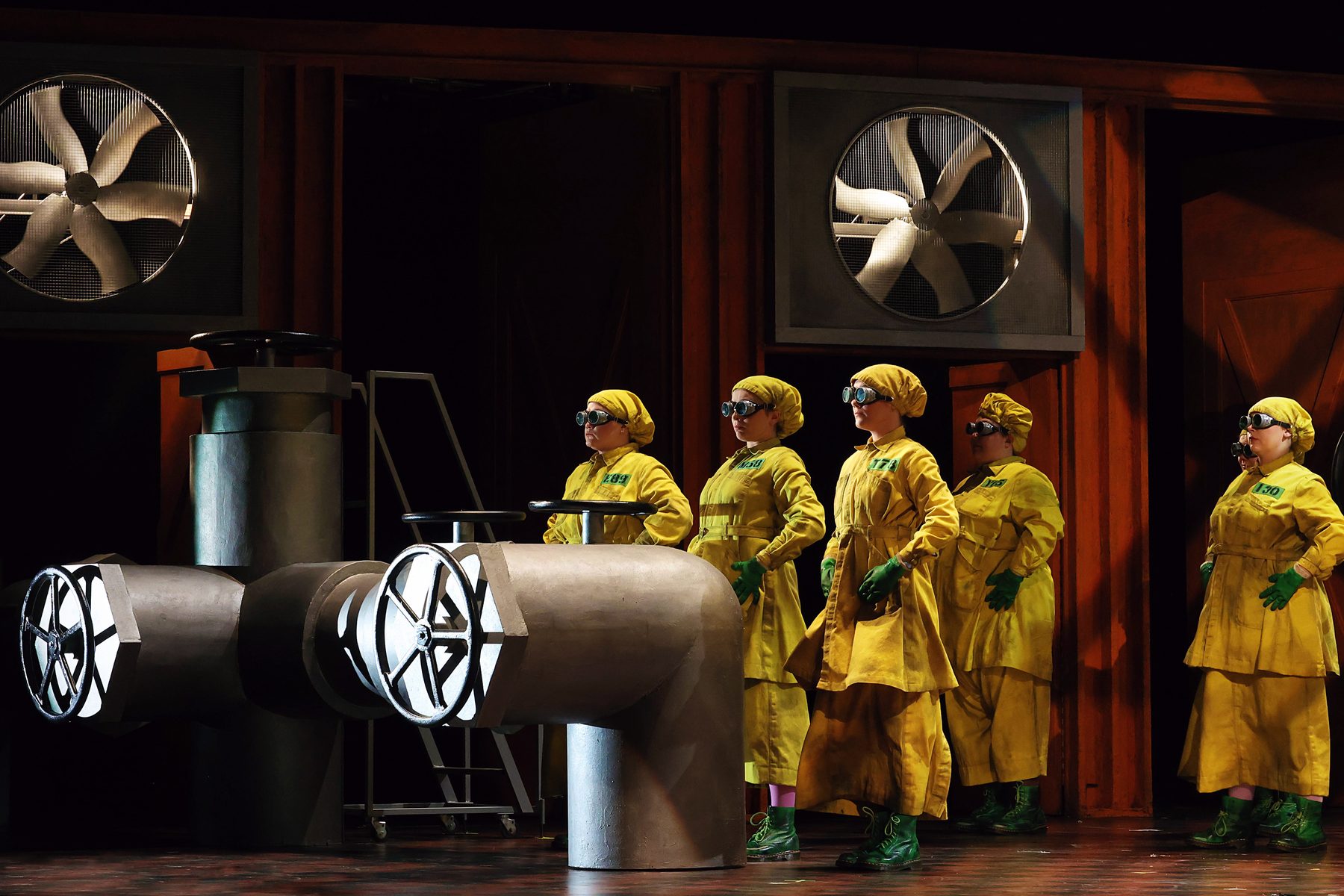
When we get to the second act, where the libretto has the sailors’ home-bound sweethearts singing at their spinning wheels, Alden’s production gives us a chemical plant, indicated by industrial pipes and control valves that are opened and closed. The maidens are clad in yellow protective gear, and Mary, often described as Senta’s nurse, is a plant foreman, watching the workers from above and dressed more like a Soviet commissar than a Norwegian matron. Senta appears to be the plant bookkeeper, seated, like the Dutchman, at the desk.
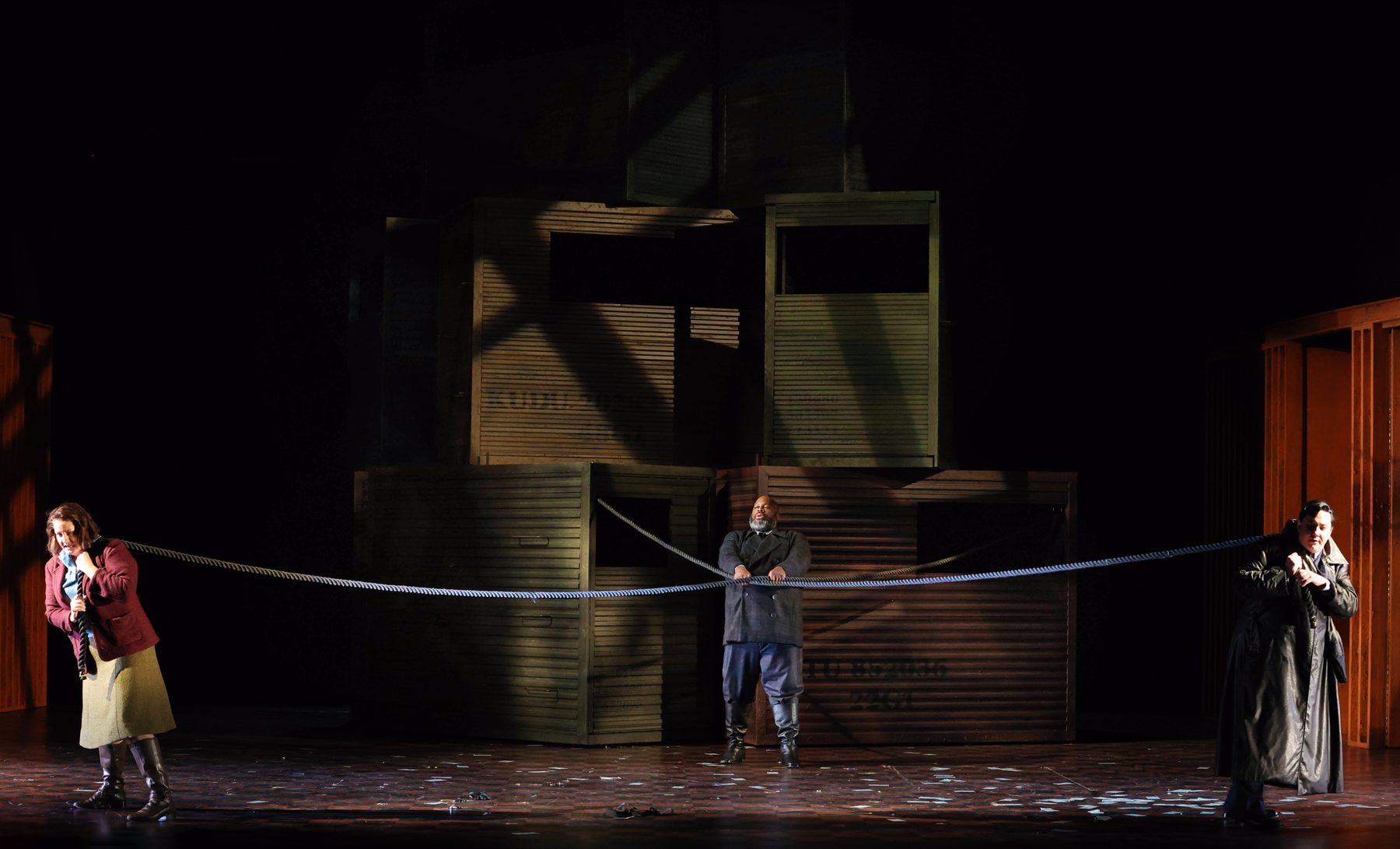
As to why a captain of industry can be redeemed from his greed by a woman’s death, that is not made any more clear than what is in the libretto about the fated Dutchman. At the end, Senta does not make a fatal leap off a cliff but becomes increasingly bound by ropes that are pulled onstage at different moments by sailors, Senta, or the Dutchman. This is a feeble stage image to go with Wagner’s powerful music; whether we believe in feminine sacrifice, Wagner did and he repeatedly wrote powerful music to express that concept. Finally, the ropes: I have seen too many productions of Dutchman where ropes with no apparent purpose are tugged on to suggest a shipboard setting, once even in a Victorian parlor. It has become a cliché.
Still, if you accept the conceit, this is an enjoyable evening of opera, especially with the powerful orchestra and strong voices that Santa Fe again assembled for their production. From the opening of the overture, one of the greatest sea pictures in music, the orchestra under Thomas Guggeis conveyed Wagner’s score powerfully. I don’t usually enjoy overture pantomimes, but the vision of a young Senta reading a book, presumably the legend of the Dutchman, was appropriate.
In the title role, Nicholas Brownlee had unusually clear diction and used his booming bass expressively. He gave a great, raging performance of his critical opening scene, subsiding into a plaintive appeal for a redeeming love, tinged with anger and exhaustion. As Senta, Elsa van den Heever gave an utterly dramatic rendering of her Ballad, accurately hitting the emphatic top notes but melting into the more tender passages. Hers was a powerful and gripping performance throughout.
Morris Robinson was a commanding Daland, equally in charge of his crew in Act I and his daughter in Act II. Even though he asked her to marry the Dutchman, his stentorian voice did not leave much room for her own discretion. Bille Bruley sang the Steuerman with an edgy, penetrating tenor, and offered a slightly choppy performance of “Mit Gewitter und Sturm” that easily disintegrated into sleepiness. Richard Trey Smagur was an impassioned Erik, ardent and expressive throughout. Gretchen Krupp was an officious Mary, resolute in her refusal to sing the Dutchman’s ballad, and fierce in her displeasure when Senta launched into the troubling song.
An early work in Wagner’s career, The Flying Dutchman is more of a traditional opera than the celebrated music dramas that followed. As such, I find it one of the most easily enjoyable of Wagner’s stage works. There are many attractive set numbers—the Steersman’s song, the Dutchman’s arrival scene, the spinning chorus, Senta’s dramatic Ballad, and the large choral scene in the final act with Daland’s crew and the townspeople celebrating around a large table. That is one of the great choral scenes of the operatic repertoire, and it was performed with energy and rhythmic verve by the Santa Fe Opera chorus.
 Sharps & Flatirons