
Kiss Me Kate, Roméo et Juliette, Otello comprise a Shakespearean trifecta
By Peter Alexander July 21 at 7:10 p.m.
Cole Porter’s racy Kiss Me Kate is the apotheosis of the ‘40s musical: spicy, jazzy, witty, full of spiffy dance and raucous fun.
It is also a work filled with the stereotypes of the era that in 2023 push the bounds of taste and acceptability. The current production at Central City Opera, under the direction of veteran Ken Cazan, certainly conveys the style and fun of the ‘40s musical. Whether it avoids all of the pitfalls will be a matter of taste.
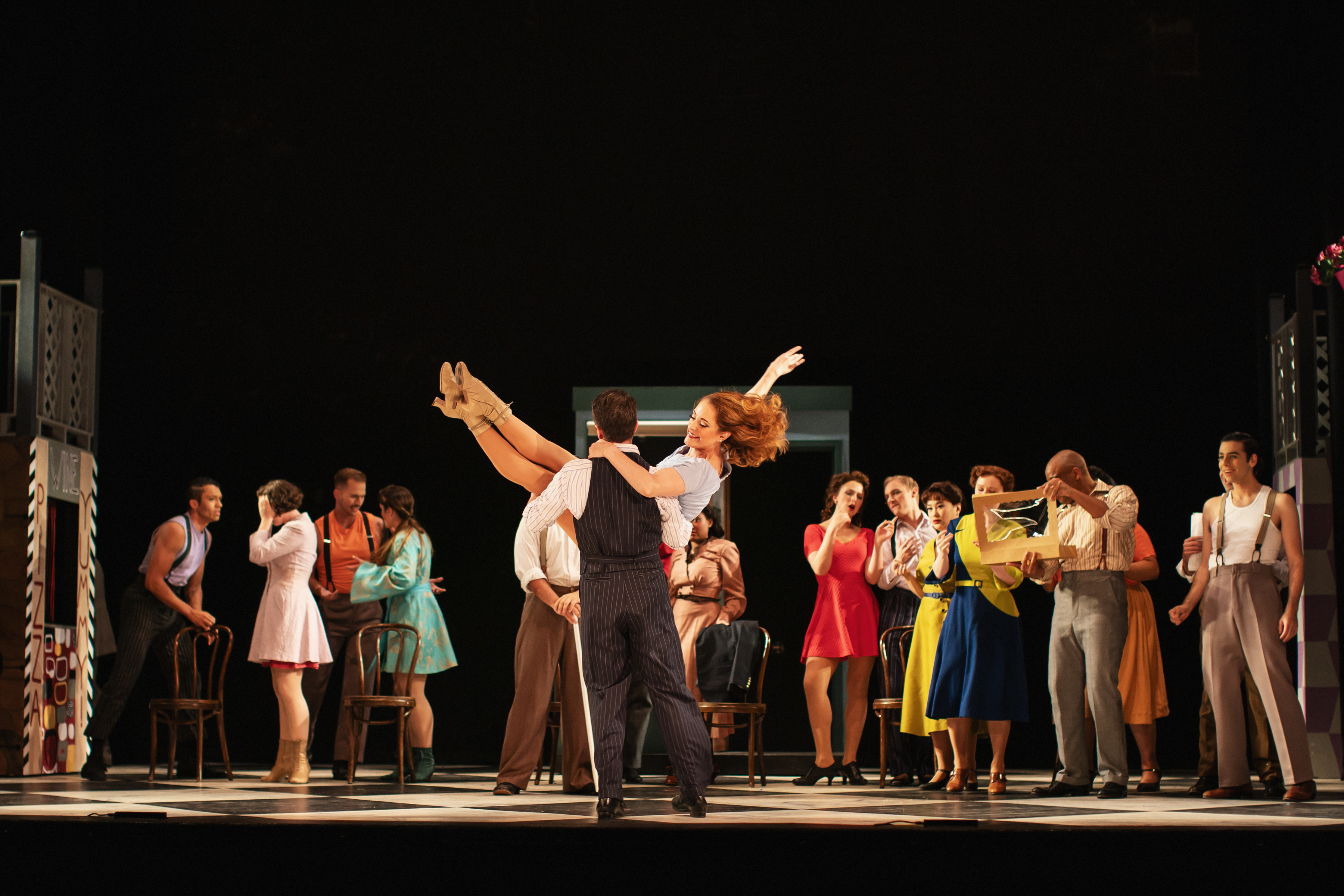
The production is flawlessly cast with Broadway-style performers. Cazan’s direction takes the show as it is and capitalizes on all its strengths. The pit orchestra, under the direction of Adam Turner, plays smoothly and with a natural sense of style. The set, by Matthew S. Crane, serves the script well, moving easily between scenes onstage and backstage.
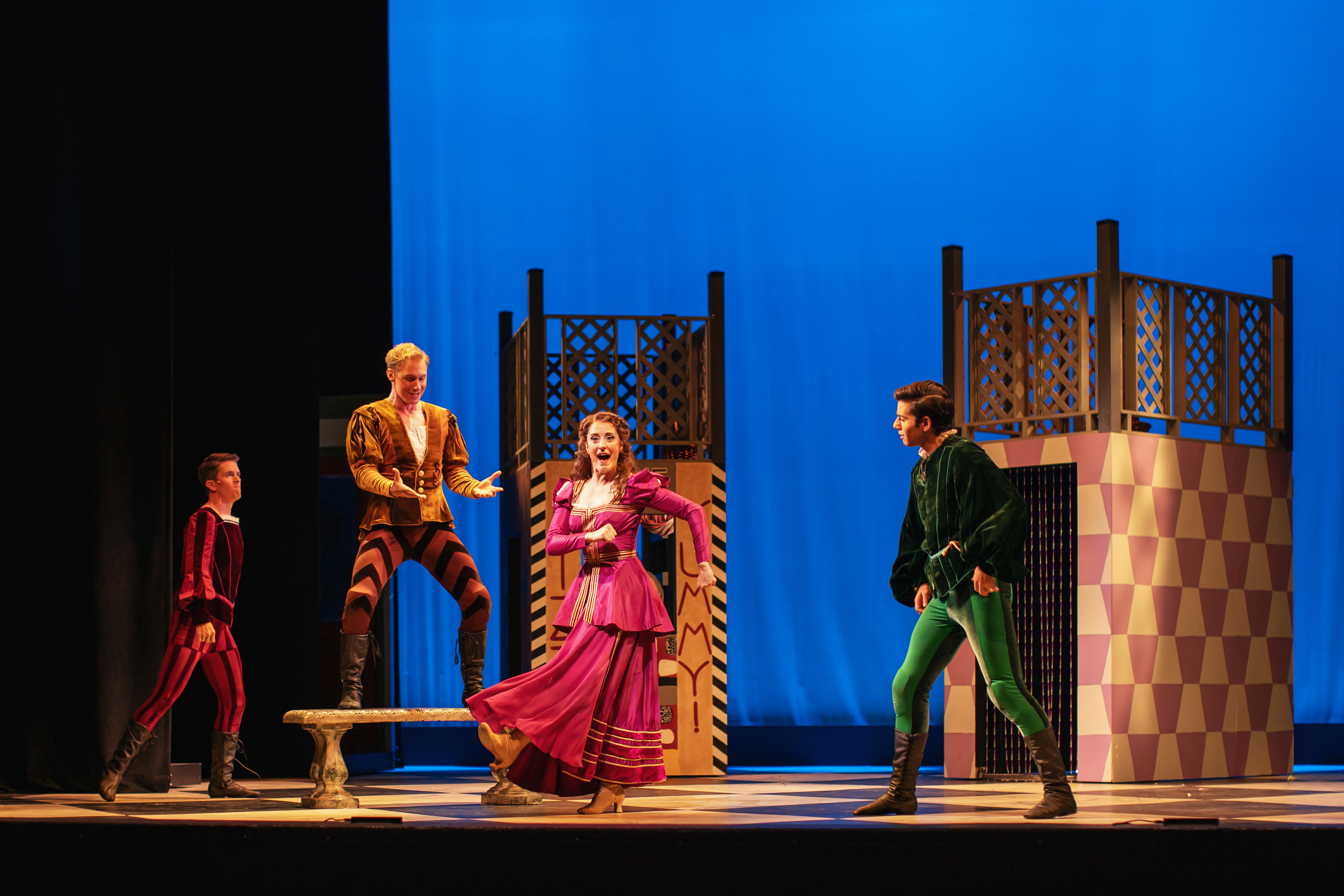
This is no mean accomplishment, as the stage at the Centra City Opera House is really small. A few well chosen items, easily moved in and out, convey the superficial glamour of the stage setting and the contrasting shabbiness of the backstage. Especially noteworthy is choreographer Daniel Pelzig’s staging of the ensemble number “Too Darn Hot” which opens the second act and manages to offer a full production number in spite of the cramped quarters for dancers.
My only real complaint is the use of amplification for the sung numbers. I assume this is done to balance the singers with the orchestra, but the transition from natural speaking voices onstage to disembodied singing voices coming from everywhere and nowhere is jarring. When they happen, naturally sung choral numbers are a relief.
The leading couple of Jonathan Hays as Fred Graham/Petruchio and Emily Brockway as Lilli Vanessi/Kate sparred delightfully. If anything, Hays, all smooth baritone and pleasant crooning, could be more obnoxious. His “Were Thine That Special Face” was a musical highlight, but there were times I wanted more disdain toward Lilli. He is supposed to be a jerk.
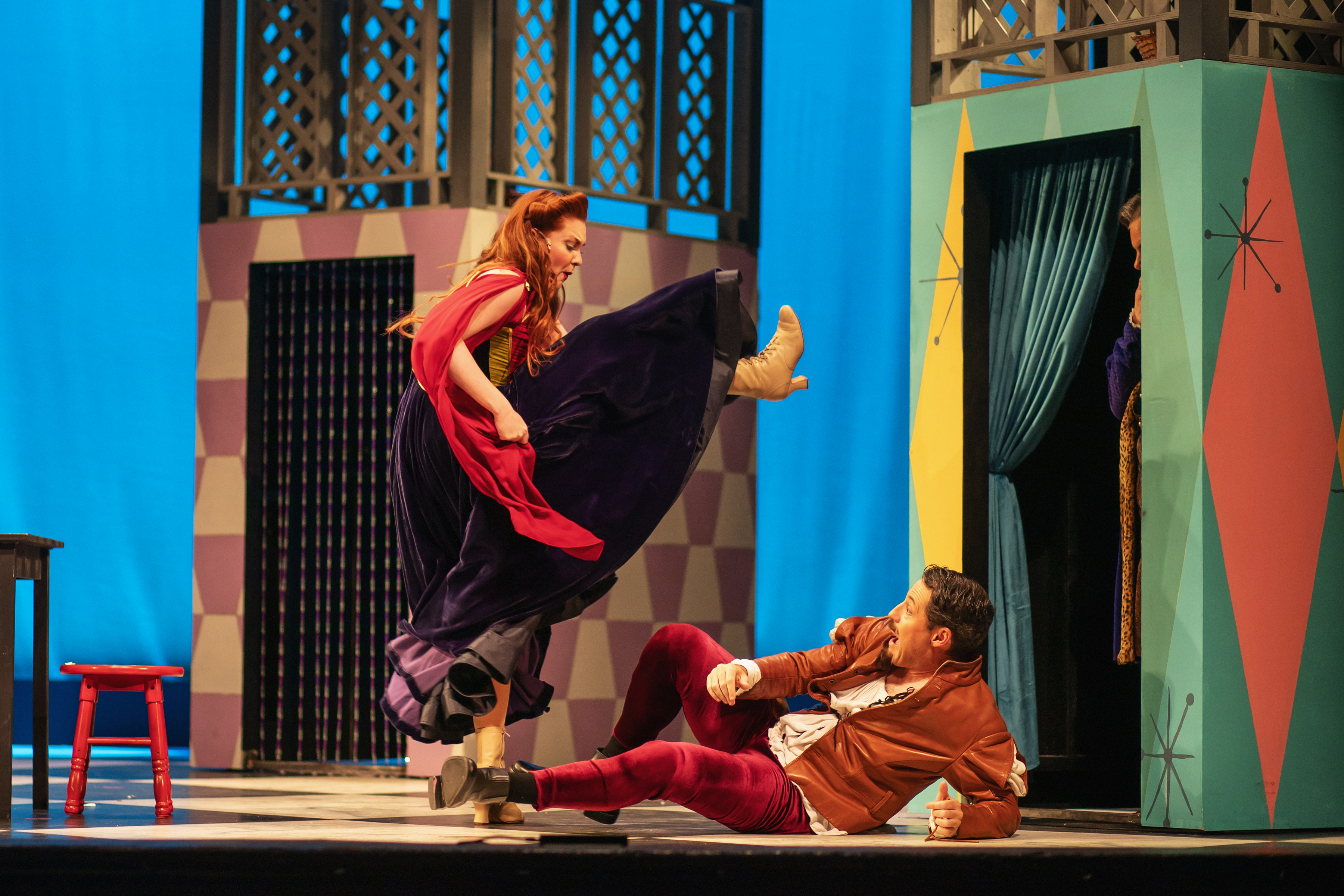
Brockway embellished her light and lovely voice well with a snarling rage, particularly in her showstopper “I Hate Men.” The fight scene between her and Hays is a hilarious highlight, as it should be, with neither holding back. Special credit should go here to fight choreographer Matt Herndon, although I have it on good authority that the sound was deafening in the orchestra pit below the stage.
Lauren Gemelli as Lois/Bianca was just the kind of brassy dame—to adopt the sexist language of the time—that every ‘40s musical needs. Her hit number “Always True to You in my Fashion” was an ideal representation of her loose but lovable character. Jeffrey Scott Parsons was an audience favorite as Bill/Lucentio, for both his smooth tenor and his fluid dance moves, especially the tap dance at the top of Act II.
General Harrison Howell is one of the show’s most obvious stereotypes, brought up to date with a few script additions. Matthew Cossack fulfilled the stereotype of the Southern military martinet and sang his one number, “From This Moment On,” well. Likewise Adelmo Guidarelli and Isaiah Feken as the central-casting gangsters, who found individual ways to personify the dim-witted and swaggering thugs. Their in- and comically out-of-character “Brush up Your Shakespeare” was perfectly enjoyable.
On the subject of stereotypes, it is the sexist tropes that are the most troubling. The relationship between a man-hating harridan and the man who will dominate her, the kernel of so much stale humor, is unavoidable as it is built into the script. In defense of book authors Sam and Bella Spewack, and with a nod to Shakespeare, this show brings a deft touch to the old story. Cazan and Brockway did what they could to make Lilli/Kate more than a doormat, and at the end the traditional obsequious groveling submission to Fred/Petrucchio was reversed, with Fred raising her back up and kneeling at her feet.
Is that enough to redeem a fundamentally misogynist premise? I guess it depends on your own ratio of laughs to cringes. I enjoyed the show, but not without reservations.
# # # # #
Central City’s production of Gounod’s Roméo et Julietteis set in the crypt of the Capulet family, where Juliette’s body will be placed and where she and Romeo will both die.
This unit set designed by Matthew S. Crane serves the entire opera, with two large, raised catafalques that double as serving tables and beds in other scenes. The setting serves a symbolic purpose: with its high walls on the small Central City stage, it portrays physically the claustrophobia of living in a society where hatred seals off half of your neighbors, and it represents how the hatred between Capulet and Montague has turned all of Verona into a boneyard.
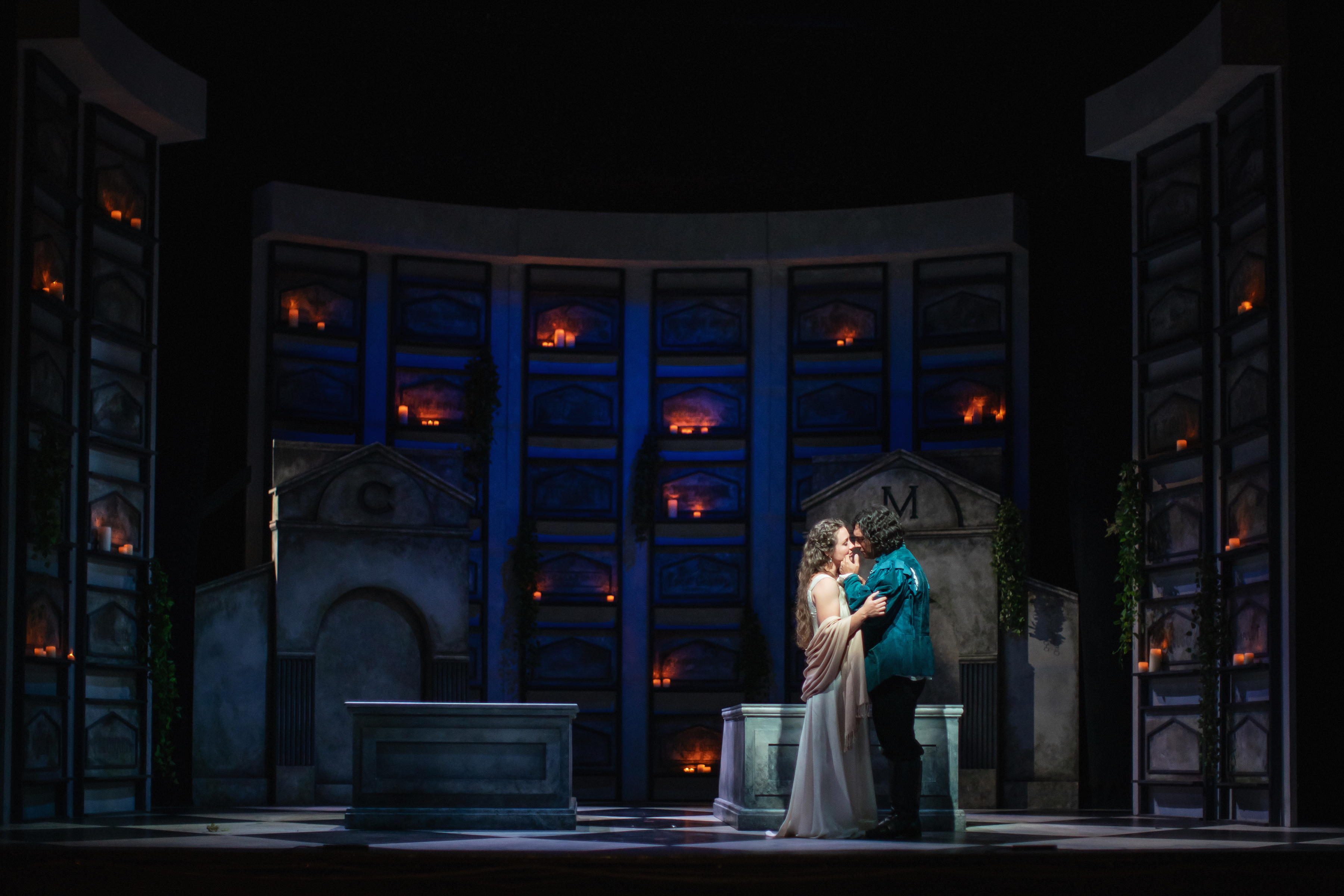
But it barely contains a French Grand opera. The intimate scenes worked best, while larger scenes became so full of singers that they were almost static. The Capulet ball in Act I and the Act III fight were especially challenging. The latter was a directorial tour de force, with the combatants swirling around the stage so fluidly one almost forgot how small the space is. Fight choreographer Matt Herndon has his hands full.
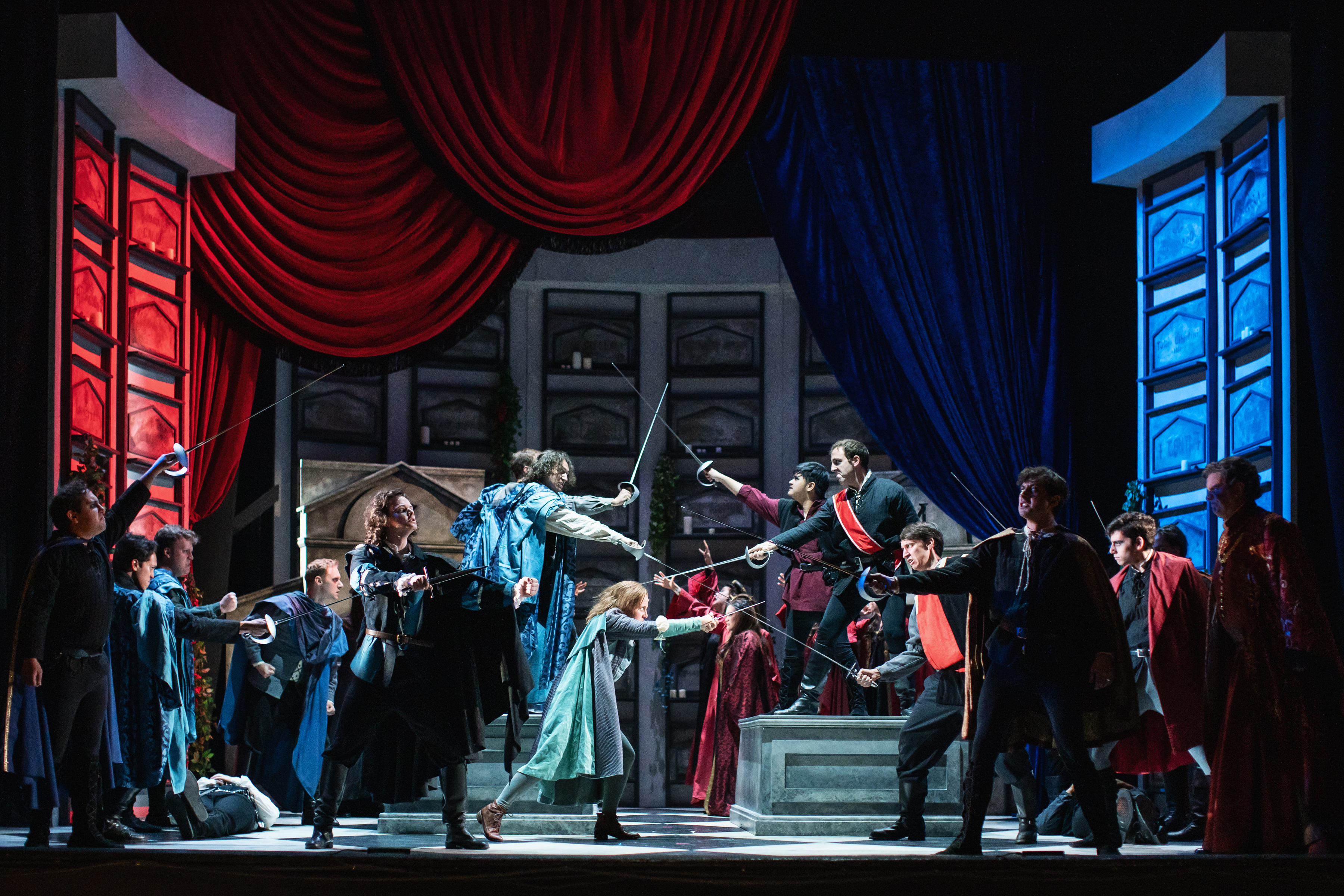
Director Dan Wallace Miller adheres closely to Shakespeare’s characters, notably the fact that Roméo and Juliette are young teens—she explicitly not yet 14, he probably about 17. Miller writes in his Director’s Note about the “teenagers’ hurricane of uncontrollable emotion,” which makes more sense to them than the curdled adult world of hatred and violence they see around them.
This sounds exactly right, and the singers—Madison Leonard as Juliette and Ricardo Garcia as Roméo—do a remarkable job of acting like teens. Particularly revealing were the moments right after their balcony scene when they couldn’t tear themselves apart. Likewise, the wedding scene is an appropriate mixture of joy, impatience and reverent wonder. The point was well made that they were adolescents who had known each other less than a day and were at the mercy of their abruptly aroused lust.
But the fundamental problem with the opera (and many others from the 19th century) is that the music written for young characters requires mature adult artists. No 13-year-old can sing Juliette’s music. So while the singers performed admirably as young lovers, the musical performances revealed their age and experience.
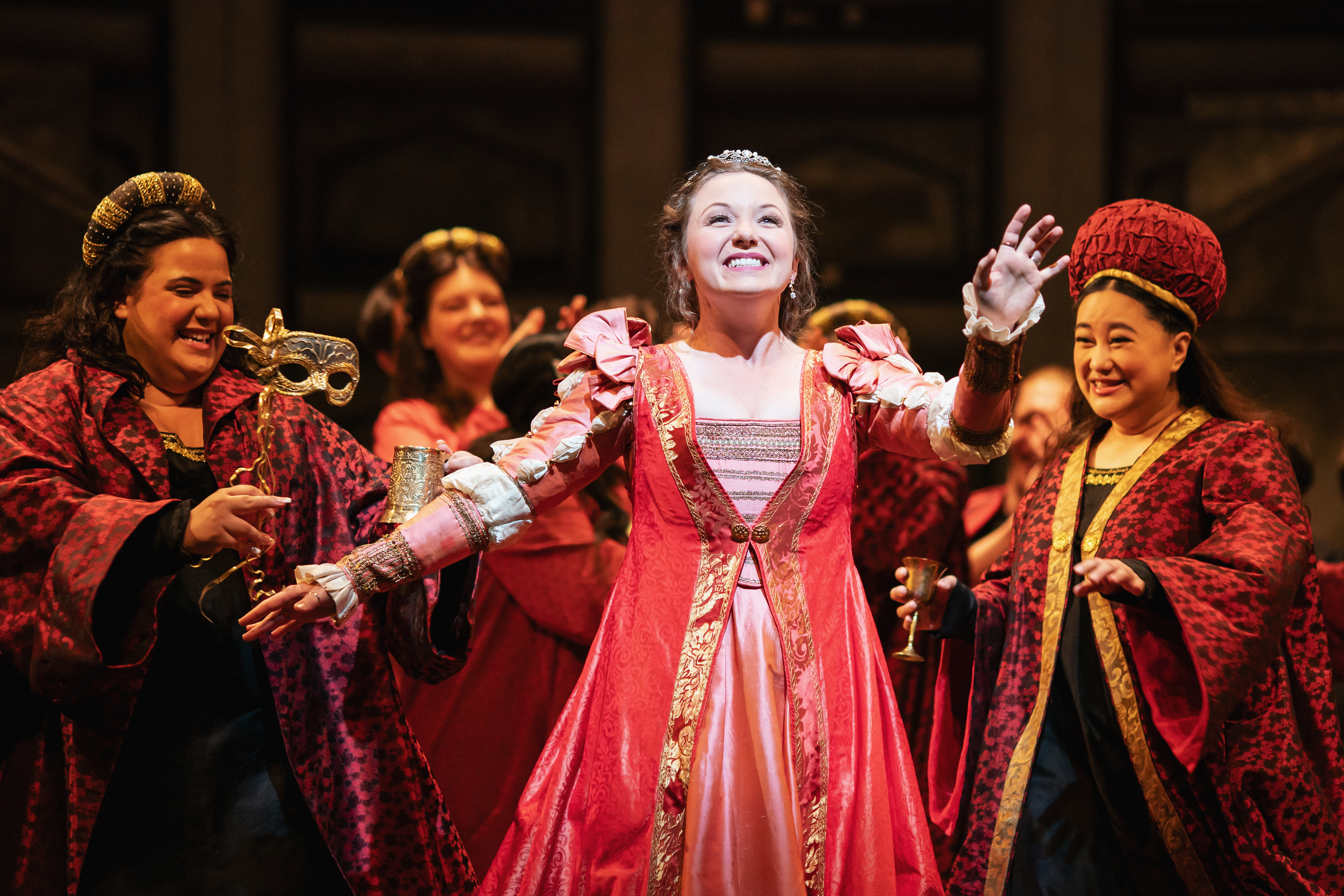
Still, the music is gorgeous. Leonard as Juliette has a full voice that commands the stage and fills the house. The first act Waltz was graceful if not quite girlish. Her singing throughout was bright and focused. Her performance of the poison scene was particularly effective, with mercurial mood changes, terror, and beautifully sung lyric outbursts.
As Roméo, Garcia has an expressive, soaring tenor that was occasionally strained on top. In an opera largely defined by its duets, he was a worthy partner for Leonard. Their duet concluding the balcony scene was especially beautiful.
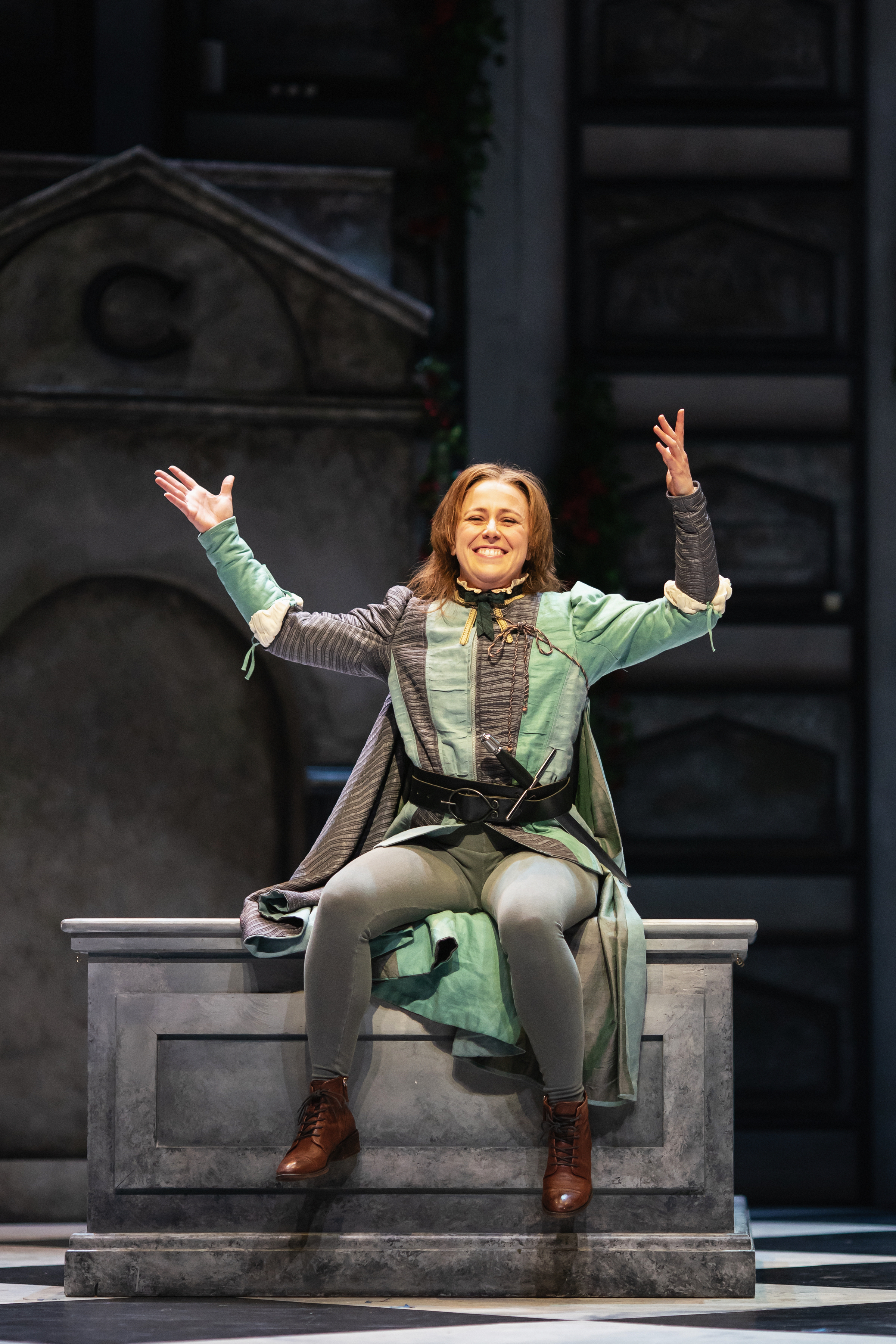
In the smaller roles, Skyler Schlenker brought a big voice to his portrayal of Count Paris. As Tybalt, Kameron Alston sang with a penetrating, edgy tenor, while his opponent from the Montagues, Shea Owens as Roméo’s pal Mercutio, sang with power and a nice ring at the top. Boulder’s Wei Wu lent his fine, rich bass to a slightly tipsy Frère Laurent.
Soprano Sable Stout had fun in the trousers role as Roméo’s page Stéphano, in spite of a moment or two of unsettled pitch. Mezzo-soprano Sarah Neal was sympathetic as Juliette’s nurse, Gertrude. Bass Adam Cioffari made Juliette’s father, Count Capulet, a benevolent host in Act I and a vengeful head of the Capulets after Tybalt’s death.
Brandon Eldredge led the orchestra, which had been conducted by CCO Music Director John Baril in earlier performances, with sensitivity to the emotional sweep of the score. The chorus, which Eldredge prepared, was ragged in the prologue that lays out the hatred between families, but offered a rich and homogenized sound afterward.
# # # # #
Long before “The Three Tenors” became a world-wide phenomenon, there was Rossini’s Otello.
Composed in 1816, Rossini’s opera—based loosely on Shakespeare’s play as translated into French—was premiered in Naples, where the company apparently had a surplus of strong tenors. Rossini obligingly wrote highly decorated tenor parts for three of the characters: Otello, his nemesis Iago, and Rodrigo, his rival for Desdemona’s love.
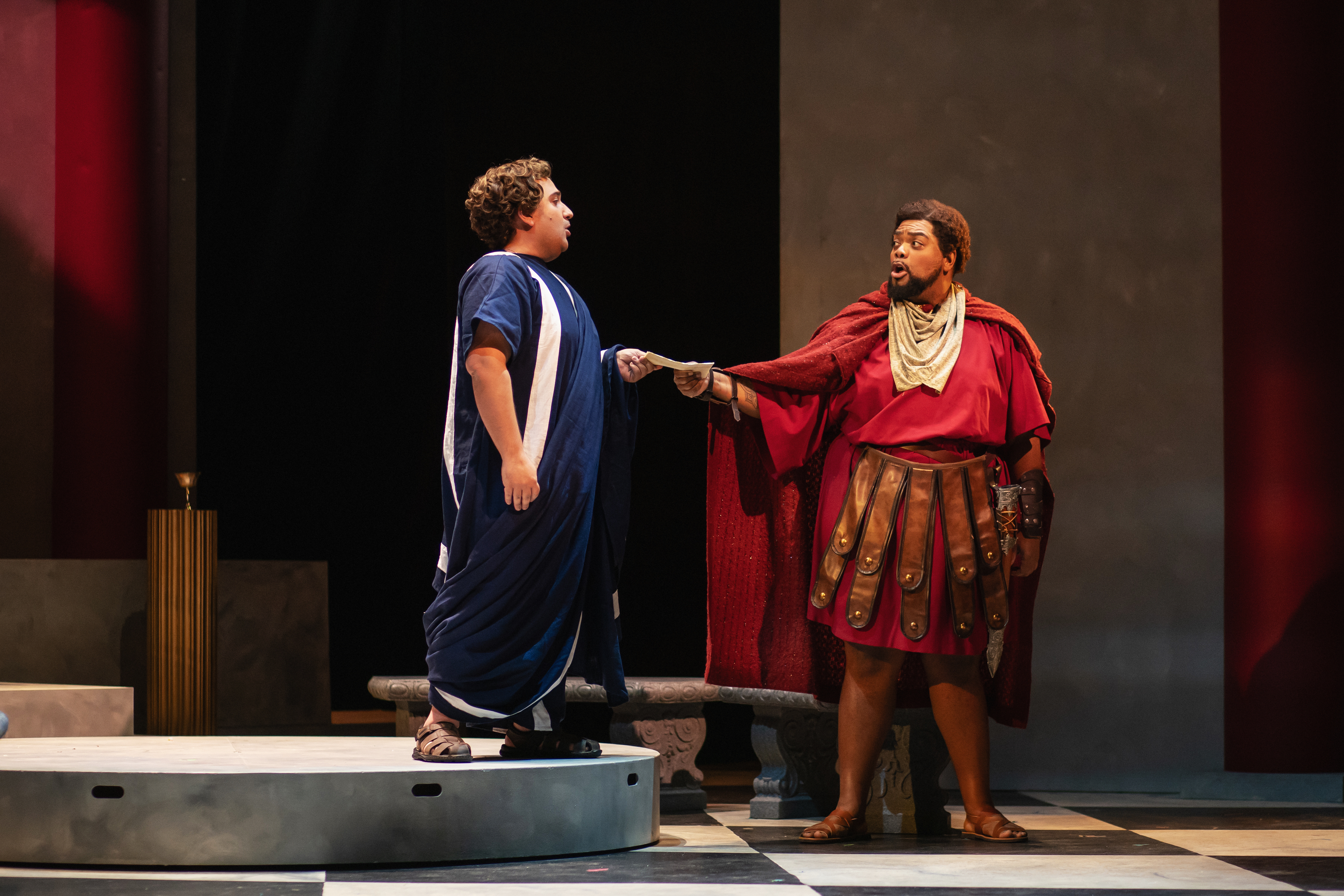
This casting is both the glory and the curse of Rossini’s Otello. The score is filled with stirring arias and duets for tenors in the elaborate style Rossini’s early tenor roles, but finding three tenors up to the challenges in not easy. This is one reason that this opera is not heard often today. The other is that it was surpassed in drama, music and popularity 71 years after its premiere by Verdi’s masterpiece on the same subject.
Nonetheless, Rossini’s three-tenor Otello remains a great opera, full of musical fireworks and potent drama. On that basis, Central City’s production is a welcome opportunity to hear a genuine rarity. It does not quite tell the story that is familiar from Shakespeare’s play and Verdi’s opera. For one thing, it all takes place in Venice; for another the marriage between Otello and Desdemona is secret, opposed by her father who prefers the White Rodrigo to the Black Otello as a match. And Rodrigo is promoted to a major character, one of the three tenors.
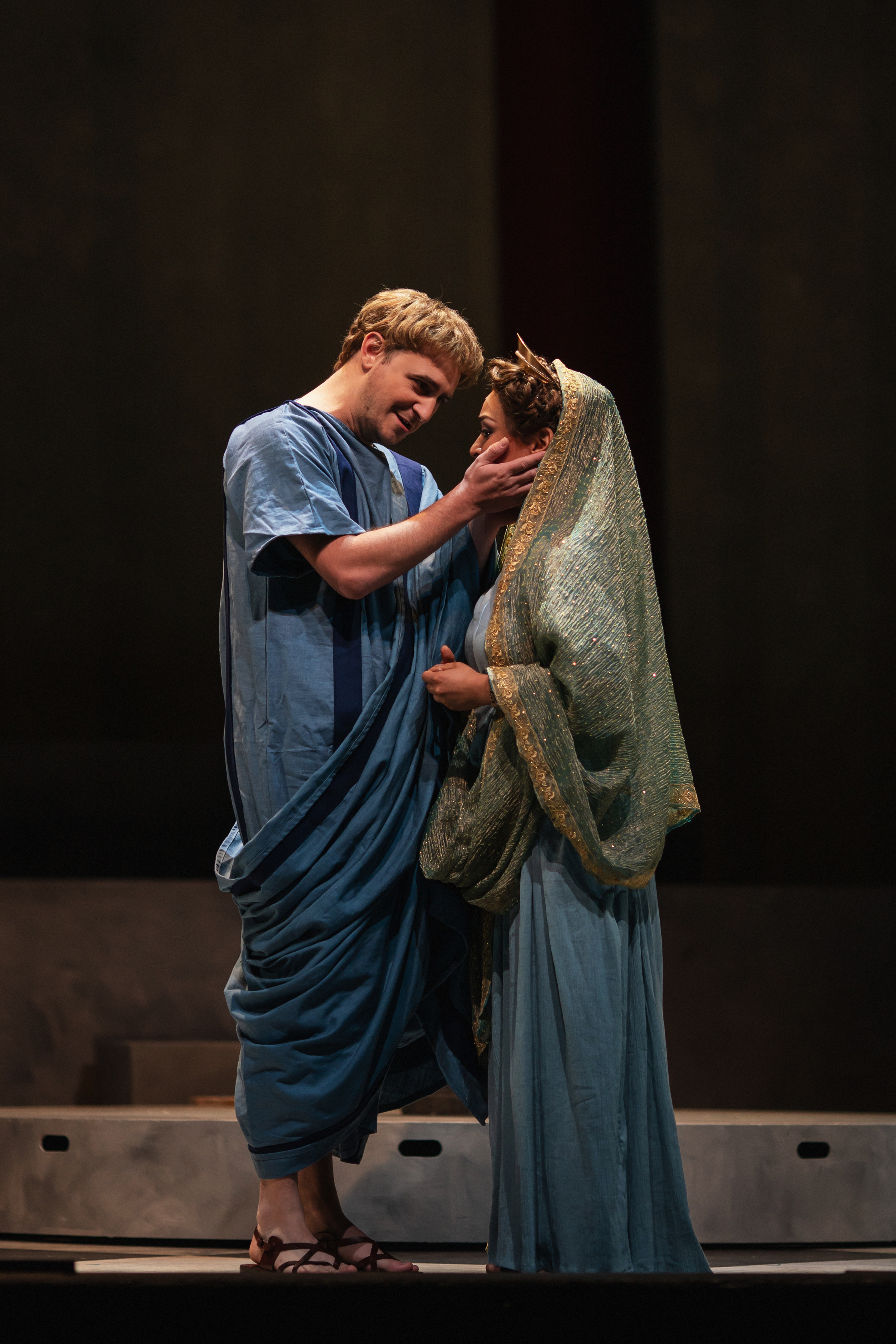
But the biggest difference is that Otello’s downfall comes not from jealousy but racism. Both the text, where Otello is referred to repeatedly as “The African,” and the staging, where characters repeatedly wash their hands after contact with Otello, point to the pervasive racism of the world in which he lives. Stage director Ashraf Sewailam explains that Otello himself came to “believe the narrative” of his own inferiority.
An extra layer is provided by the coincidence that in CCO’s cast, Otello and Iago are performed by Black singers. Sewailam does not fail to make use of this opportunity: action during the Overture make it clear that Iago has been rejected, romantically and otherwise, because of his skin color, which fuels his hatred of Otello. At the same time, his skin color enables him to feign friendship with Otello. He also pretends to help Rodrigo, while laying a trap for Otello to believe that Desdemona has betrayed him.
In the production it is all much clearer than my synoptic outline. Sewailam does an excellent job of keeping actions and motivations clear. He also faces down the opera’s greatest difficulty—the large number of musical numbers where the actors sing but no action takes place. He finds various ways of keeping attention on the stage, some quite successful and others looking more like busywork designed to disguise the static action.
The setting is moved from Venice to Imperial Rome. Done on the basis that the Empire allowed peoples of all nations to succeed on merit, this is a distinction that makes no difference. Matthew S. Crane’s unit set is perfectly serviceable. Plot twists are carefully laid out in performance, both by Sewailam’s thoughtful direction and by the three tenors, who are all capable singing actors.
In the title role Kenneth Tarver is a figure of strength, vocally and dramatically, who is twisted into turning that strength against himself. With his lightning-fast roulades he handles Rossini’s lines comfortably. As a character, he is never less than dignified and controlled.
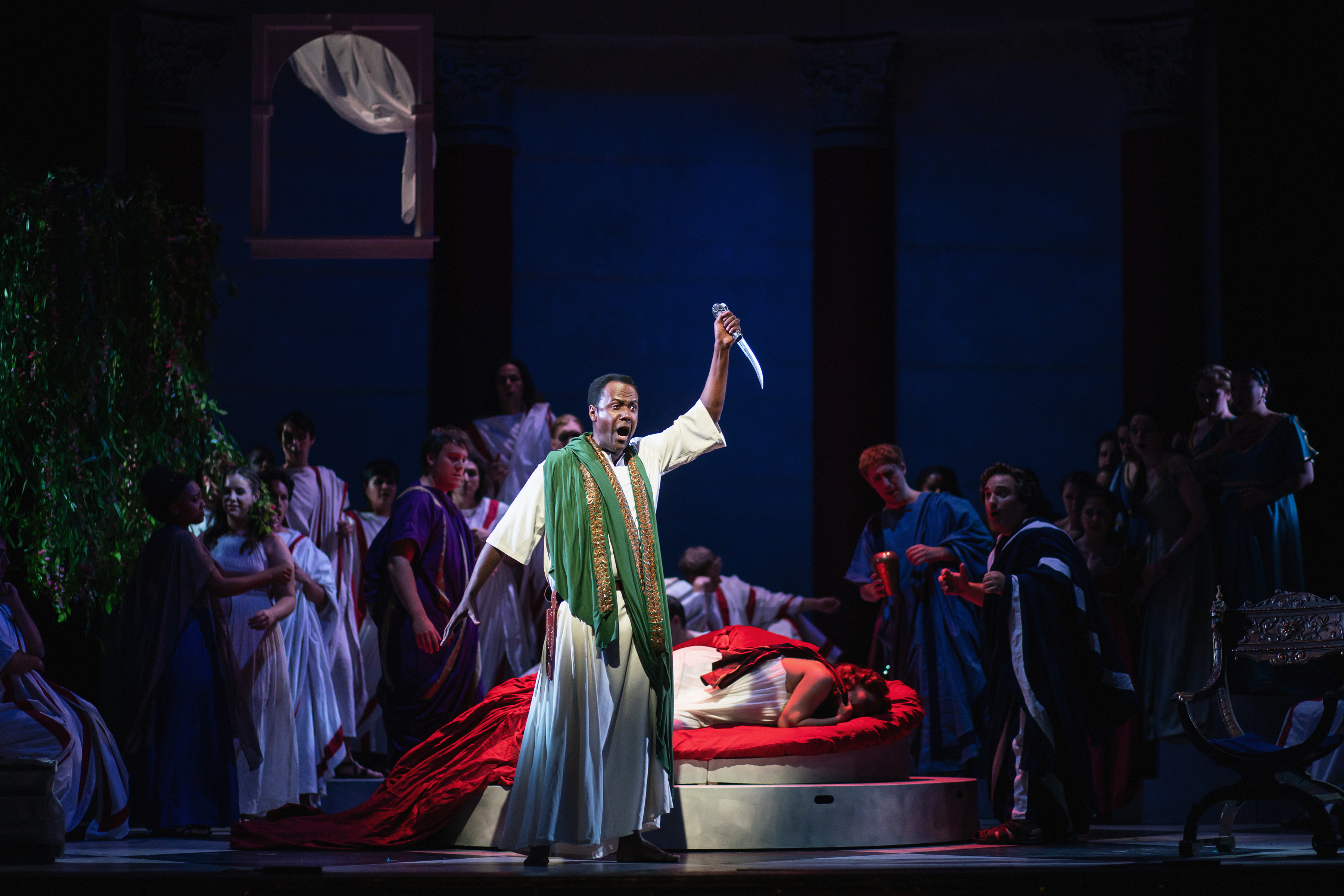
Christopher Bozeka (Rodrigo) sings with ease into his highest registers, not always cleanly but with great feeling. He effectively uses facial expressions to connect with the audience and announce his rarely failing hopes—illicitly encouraged by Iago—to turn Desdemona to his wishes. Bernard Holcomb as the treacherous Iago has at times the cleanest execution, and always projects the cunning ease of the true villain. The various duets featuring two of the tenors—a distinguishing feature of Otello—are rousing highlights.
Desdemona has her own spectacular moments that she carries off comfortably, to the top of her range. She delivers the “Willow Song,” the one aria sung outside of full performances, affectingly. Federico de Michelis’s well rounded bass lends weight to Elmiro, Desdemona’s father, making him so convincing a racist enemy of Otello that his conversion at opera’s end—part of a rapid turn of events that also unmasks Iago’s treachery—is scarcely credible. Hilary Ginther is a warm and sympathetic Emilia.
Under John Baril, the orchestra gives a sprightly and stylish performance of Rossini’s score. Special credit goes to the sparkling woodwinds and horn players for their solo turns.
# # # # #
All three productions on the summer schedule—Kiss Me Kate, Roméo et Juliette, Otello —are presented in attractive productions, their stories cleanly told and well sung. Any one of them makes for a good summer excursion to the mountains, but if you can only make one trip to Central City, see Otello. It is a true rarity that is worth hearing, and its story of the harm done by thoughtless racism still resonates. And where else outside reruns can you hear three tenors?
# # # # #
Central City Opera
Remaining performances of the 2023 Season
All performances in the Central City Opera House
Roméo et Juliette
By Charles Gounod, Jules Barbier and Michel Carré
John Baril, conductor, and Dan Wallace Miller, stage director
Performed in French with English supertitles
2 p.m. Friday July 28; Sunday, July 30; Wednesday, Aug. 2; Saturday, Aug. 5
Kiss Me, Kate
By Cole Porter, Samuel and Bella Spewack
Adam Turner, conductor, and Ken Cazan, stage director
Performed in English with English supertitles
7 p.m. Saturday, July 29; Saturday, Aug. 5
2 p.m. Wednesday, Saturday, July 22; Wednesday, July 26
Otello
By Gioachino Rossini and Francesco Berio di Salsa
John Baril, conductor; Ashraf Sewailam, stage director
Performed in Italian with English supertitles
7 p.m. Saturday, Friday, Aug. 4
2 p.m. Wednesday, July 23; Saturday, July 29; Sunday, Aug. 6
CORRECTION: The original version of this review inadvertently omitted the name of tenor Kameron Alston, who sang the role of Tybalt in Roméo at Juliette. I apologize for the oversight, which has been corrected as of 7.27.23.
 Sharps & Flatirons